Author: Mike Vizard

  • Survey Uncovers Issues Even With Advanced IT Teams

    Survey Uncovers Issues Even With Advanced IT Teams

    Even in the best of times, IT teams struggle with myriad issues related to managing their application environments

    A survey of 1,000 C-level executives at software-as-a-service (SaaS) application providers finds that while the bulk of respondents are “highly confident” or “confident” that their cloud applications were running efficiently (91%), many also are still concerned about staying within budget (65%), maximizing resources (62%) and maintaining uptime.

    Results of the survey conducted by Opsani, a provider of tools for optimizing cloud applications based on machine learning algorithms, suggest that even the most advanced IT organizations are finding it challenging to optimize application performance within the constraints of their IT budgets.

    Amir Sharif, vice president of marketing for Opsani, said most SaaS providers have already optimized complex application environments to the greatest extent possible by a team of humans no matter how mature their DevOps processes. The next level of optimization requires artificial intelligence (AI) capabilities that can discover, correlate and analyze real-time events and dependencies at levels of scale no human can match, he said.

    Within the most advanced IT teams, all the tasks that can be automated easily have already been completed, added Sharif. As IT environments become more complex, optimizing the IT environment requires platforms capable of instantly implementing policies and procedures defined by the IT team. That shift doesn’t eliminate the need for a DevOps team, but rather a shift in their role to define the policies that need to be automated, he said.

    The Opsani survey finds 43% of respondents update software daily and 37% release new software weekly. Only 15% said they conduct hourly sprints. The top concerns among respondents are employees wasting time on mundane tasks (54%), followed by finding talent (47%) and legacy processes that don’t reflect today’s technology landscape (43%).

    When asked how often their organizations optimized their application stack, 82% said they do so regularly, with 81% reporting their organizations already make use of AI tools for faster decision-making.

    When asked about service level objectives and performance goals, respondents cited transactions per second as their top metric (63%), followed by latency (47%), dollar per transaction (43%). IOPS and throughput tied for fourth (34%).

    Sharif said resistance to AI in general is declining in most IT organizations given the level of complexity faced. A 10-tier microservices application and a backend database developed by Google has more than 75 quintillion configuration permutations that must be adjusted. The average IT team might never attempt to deploy something that complex, but even comparatively simple microservices-based applications can have millions of configuration permutations that can adversely impact performance and security.

    Of course, most C-level executives are likely to think highly of their organization’s IT capabilities. The rank and file, however, make assessments that are a little less rosy. The challenge is, not many IT teams have a lot of insight into how well anyone else is doing. It may be cold comfort to see that even advanced IT teams are struggling with issues.

    However, most teams that are driving revenue-generating applications for an organization will have access to more advanced IT tools a lot sooner than the average enterprise.

  • BizOps Coalition Publishes Manifesto

    BizOps Coalition Publishes Manifesto

    The BizOps Coalition, which advocates for fundamental change in the way IT teams and business users collaborate during software development, today published a BizOps Manifesto framework that identifies 12 principles that focus organizations on business outcomes versus merely attaining and maintaining service levels.

    The goal is to close the historic divide between IT and the rest of the business by encouraging IT teams to work more closely with business leaders, who need to make informed technology investment decisions based on real-time data analytics to drive business growth, improve customer experience and increase profitability.

    BizOps Manifesto authors include Dr. Mik Kersten, founder & CEO of Tasktop; Serge Lucio, vice president and general manager of the Enterprise Software Division of Broadcom; Patrick Tickle, chief product officer of Planview; Sally Elatta, CEO of AgilityHealth; Evan Leybourn, CEO of Business Agility Institute; Tom Davenport, distinguished author and professor; Dave West, CEO of Scrum.org; and Kevin Surace, chairman/CTO of Appvance.ai.

    Lucio said even after a decade of advancements in best DevOps practices, far too many IT teams behave as though they have no vested interest in the outcome of an IT project. In fact, there’s far too much focus on requirements at the beginning of a project because too many IT teams believe that as long as an application is available, their task is complete, he noted.

    The BizOps Manifesto encourages IT organizations to assume requirements can and should change frequently as business conditions evolve. IT teams that focus too much on requirements upfront are essentially applying a waterfall mentality to software development no matter how agile their software development processes are, Lucio said.

    In general, he noted, there’s a lot more focus these days on software development. The biggest immediate hurdle is the terminology being employed to address this issue. The IT vendor community is employing catchphrases such as “value stream management” and “software delivery management” to describe essentially the same issue, he said.

    More organizations than ever are finally coming to terms with these issues as they seek to accelerate the rate at which applications can be deployed in the wake of the economic downturn brought on by the COVID-19 pandemic, Lucio said, noting the BizOps Manifesto is intended to facilitate those conversations.

    It’s not clear to what degree a manifesto can change mindsets within IT teams. Too many IT professionals view themselves as being part of the IT industry rather than the industry its employer is in. As a result, there’s often not a deep appreciation for the unique business challenges an organization faces within the IT department. Arguably, that divide is not as wide as it was at the start of the last decade; nevertheless, the issue persists. A manifesto is as good a place as any to start a conversation that in many organizations is long overdue.

  • Red Hat Expands Scope, Reach of Ansible Automation Framework

    Red Hat Expands Scope, Reach of Ansible Automation Framework

    Red Hat, its online AnsibleFest 2020 conference today, announced an on-premises edition of Ansible Automation Platform dubbed Private Automation Hub and previewed technology to connect the Ansible Automation Platform managed as a cloud service by Red Hat and the on-premises edition.

    In addition, Red Hat is making available more pre-integrated workflows to its certified Ansible Content Collections service for Red Hat OpenShift, Kubernetes Core and the VMware vSphere REST application programming interface (API).

    Finally, the company previewed integration between Ansible Automation Platform and Red Hat Advanced Cluster Management, a tool originally developed by parent company IBM for managing Kubernetes clusters at scale. As part of that effort, Red Hat will integrate its implementation of Kubernetes Operators tools for deploying applications on the Red Hat OpenShift platform, which is built on top of Kubernetes, with a Resource Operator for Red Hat Advanced Cluster Management that will enable Ansible Automation Platform to execute tasks outside of the Kubernetes cluster when required.

    Joe Fitzgerald, vice president of management for Red Hat, said there are now more than 60 Ansible Content Collections available that can be deployed on-premises or in a cloud service managed by Red Hat. The connectors will make it easier for IT teams to access workflow content curated by Red Hat and its partners while continuing to create automated playbooks for their own unique IT environments that are stored locally, he said.

    As the number of IT domains to which a declarative IT automation framework can be applied continues to expand, Fitzgerald said the playbooks an IT team can create are becoming more comprehensive. Unlike other IT automation platforms, however, Ansible doesn’t require the IT operations team to learn how to code. In the wake of the COVID-19 pandemic and most employees working from home, the number of workflows that IT teams are trying to automate has increased substantially, he said.

    That framework can now also be applied to both legacy IT environments as well as Kubernetes clusters upon which the cloud-native technologies are being deployed. During AnsibleFest, Red Hat will be showing proofs of concept of support for Knative, open source middleware developed by Google that integrates serverless computing frameworks with Kubernetes clusters.

    While there are still DevOps teams that have adopted programmable frameworks to manage IT as code, many traditional IT administrators are embracing Ansible as a means to automate increasingly complex IT environments. Rather than acquiring and deploying automation tools for each platform in the IT environment, Ansible provides a common framework through which IT teams can automate the provisioning of servers, virtual machines, clusters, switches, routers and storage systems. With vendors such as Cisco Systems supporting Ansible, the number of workflows capable of spanning multiple IT domains continues to expand as internal IT teams share the playbooks either they created or had crafted for them by an IT services firm.

    Regardless of how an internal IT gains access to those playbooks, it’s probable that no matter what the automation requirement is, there is now somewhere a playbook written in Ansible to address it.

  • Akamai Enables Microservices Deployment at the Edge

    Akamai today announced it is adding the ability to deploy microservices on its edge computing platform to enable developers to run latency-sensitive applications faster.

    David Theobald, principal product manager at Akamai, said developers can now code dynamic content assembly at the edge to create microservices on the Akamai Intelligent Edge platform that include external requests and the ability to manipulate response bodies. That approach provides developers with the primitives required to run edge computing applications on the equivalent of a serverless computing framework, he said.

    In addition, Akamai is adding EdgeWorker reporting and debugging tools for JavaScript applications deployed on the edge of its content delivery platform (CDN) and updated its application programming interfaces (APIs) to make it easier and faster to deploy “cloudlet” applications.

    Finally, Akamai also has updated its Akamai Image and Video Manager software-as-a-service (SaaS) offering by adding a video status optimization API through which IT teams can track the status of videos as they are being optimized by the Akamai CDN.

    While CDNs have been widely employed for decades, they are now evolving into platforms for deploying edge computing applications that are developed and deployed using best DevOps practices. Rather than having to replicate the IT infrastructure already put in place by a CDN provider, many organizations are opting to essentially consume IT infrastructure as a service as they deploy edge computing applications alongside existing web applications.

    Competition is already fierce among CDN providers seeking to leverage points of presence around the globe to enable IT teams to deploy applications closer to the point where data is generated and consumed. Many of these edge computing applications are at the core of digital business transformation initiatives that require data to be processed in near real-time. As such, processing that data in a local data center creates too much latency.

    Of course, cloud service providers have also extended the range of services they provide to include CDN services. It’s not clear to what degree IT organizations will prefer to leverage those cloud services versus the CDN capabilities many of them already rely on to deploy web applications.

    Regardless of the approach, the number of IT teams building, deploying and maintaining their own edge computing infrastructure is likely to be reduced sharply in the wake of the COVID-19 pandemic. IT teams are trying to reduce the potential risk to their IT staff by limiting travel as much as possible, which makes putting IT personnel on a plane to install infrastructure an option of last resort.

    Developers, in the meantime, are building more applications faster than ever, thanks mainly to DevOps processes that enable them to work from home. As the deployment backlog for edge computing applications builds, the need to rely more on external services becomes that much more pressing. It may be a while before most DevOps teams routinely view CDNs as just another target platform for deploying applications, but in many cases, that day is already here.

  • Morpheus Data Extends Hybrid Cloud Reach

    Morpheus Data Extends Hybrid Cloud Reach

    Morpheus Data has updated its hybrid cloud computing platform to add support for a bare metal-as-a-service option as well as tighter integrations with VMware vCloud Director (vCD) and NSX-T, Microsoft System Center Virtual Machine Manager (SCVMM), Microsoft Azure and Veeam data protection tools.

    In addition, version 5.0 of the Morpheus IT management platform adds support for additional financial operations tools and a user interface that can be tailored to different classes of end users with varying levels of expertise.

    Finally, Morpheus has added support for the latest release of the ServiceNow platform for managing IT via a software-as-a-service (SaaS) application.

    Interest in employing bare-metal servers is on the rise as IT organizations look to deploy everything from platforms to build and deploy artificial intelligence (AI) to edge computing applications based on cloud-native technologies such as Kubernetes.

    At the same time, many IT organizations are beginning to more aggressively reduce the total cost of IT by centralizing the management of multiple IT platforms.

    Brad Parks, chief marketing officer for Morpheus Data, said the financial operations tools added to the Morpheus platform surface more granular cost analysis for utilization of specific classes of cloud services as well as views into Amazon Web Services (AWS) Reservation Coverage and Savings Plans.

    The revamped user interface, meanwhile, makes the platform available to a wider range of end users by adding support for different types of personas within an IT team. That enhancement makes it easier for IT organizations that have adopted Morpheus to provide self-service capabilities.

    It’s not clear at what rate IT organizations will be transforming IT operations. It typically requires IT teams to spend money before they can begin to save money. However, rationalization of the many tools that IT teams rely on today may also help cost-justify the investment.

    Regardless of the motivation, the need to centralize the management of IT is becoming more acute as IT environments become more distributed. Most organizations cannot afford to hire and retain IT staff for each IT platform it uses. IT organizations also want to be able to move workloads between platforms as they best see fit, which is easier to accomplish via a central control plane. The economic downturn brought on by the COVID-19 pandemic is, in effect, acting like a forcing function driving IT organizations to accelerate the rate of transition to hybrid cloud computing, noted Parks.

    Over time, it will also become easier to apply AI to IT operations when the data on which AIOps platforms depend is more easily accessible.

    In the last several years IT has become much more complex. With the rise of everything from microservices based on cloud-native technologies such as containers to internet of things (IoT) applications, the IT environment has never been more diverse. The challenge now is finding the most efficient way to manage all those devices at a time when IT budgets have never been as constrained.

  • Cisco Expands Effort to Meld DevOps, NetOps

    Cisco Expands Effort to Meld DevOps, NetOps

    Cisco Systems has accelerated its efforts to converge network operations (NetOps) by adding support for Terraform tools for managing infrastructure-as-code as well as expanding its support for the Ansible IT automation framework.

    In addition, Cisco has improved and standardized the application programming interfaces (APIs) it makes available for its Application Centric Infrastructure (ACI) framework for virtualizing network services and is expanding the free code samples, boot camps and certifications its makes available via its DevNet Express training program.

    Yousuf Khan, vice president of technical marketing and solutions engineering, said Cisco is moving toward embracing open source automation tools that are being widely employed to automate the management of IT infrastructure. That transition is being driven by DevOps teams, many of which have assumed control over IT infrastructure budgets as network operations are more integrated within DevOps processes, he said.

    To increase its appeal, Cisco is making available Terraform Providers for Cisco ACI alongside Ansible and Cisco ACI Multi-Site Orchestration (MSO) to enable IT teams to automate network management using declarative tools, Khan added. Ansible can now be applied to invoke Cisco Data Center Network Manager (DCNM) alongside the other network services Cisco has already made accessible via Ansible.

    Terraform is widely employed to programmatically configure cloud infrastructure, which Cisco is now embracing to enable IT teams to apply to network and server infrastructure. Ansible, meanwhile, is being embraced by multiple providers of IT infrastructure as IT teams look to standardize on a single automation framework. That approach eliminates the need to master multiple proprietary IT automation frameworks for each platform employed.

    Cisco has spent the last few years encouraging network administrators to abandon command-line interfaces (CLIs) employed to program individual routers and switches in favor of a software-defined network architecture based on graphical tools that enables NetOps teams to more flexibly manage network infrastructure using virtual overlays enable by its ACI framework. Now ACI is being made accessible to Terraform and Ansible as more IT organizations adopt both tools as de facto open source tools for managing heterogeneous IT infrastructure environments. That effort will make it easier for DevOps teams to employ GitOps processes to deploy applications on Cisco infrastructure from whichever continuous integration/continuous delivery (CI/CD) platform they employ, Khan said.

    Ultimately, he noted, the goal is to make the networks more agile. IT teams in on-premises environments today can provision a virtual machine in minutes but are still required to wait weeks for network services to be provisioned. The goal is to apply a more cloud-like operating model to a hybrid IT environment.

    Each IT organization will need to decide to what degree they will want to meld their network operations and DevOps teams. While the tools to manage network services are becoming available, the cultural divide between most network operations and DevOps teams is still wide. The rate at which that divide is narrowing, however, is finally starting to accelerate as business leaders continue to demand higher levels of agility.

  • DevOps Deeper Dive: IBM to ‘Maniacally Focus’ on Hybrid Cloud, AI

    DevOps Deeper Dive: IBM to ‘Maniacally Focus’ on Hybrid Cloud, AI

    IBM this week announced its intention to spin out a new company next year focused primarily on managed infrastructure as part of a plan to focus more on hybrid cloud computing and artificial intelligence (AI) initiatives.

    IBM is combining the Red Hat assets it gained last year via a $34 billion acquisition with its investment in Watson AI technologies, while an as-yet-unnamed company will assume control over IBM outsourcing services currently provided by the Managed Infrastructure Services unit of IBM’s Global Technology Services division.

    IBM CEO Arvind Krishna, appointed last April, on a conference call with analysts said IBM will primarily focus on high-growth opportunities driven by Red Hat OpenShift, Linux, Kubernetes, containers and DevSecOps software technologies that will drive a trillion-dollar hybrid cloud computing opportunity, while the new company will become the world’s largest IT services provider with more than 90,000 employees serving a base of more than 4,600 clients generating more than $19 billion in revenue. Today IBM generates a little more than half of its revenue from those services and claims to have a services backlog of $60 billion.

    The new approach will enable IBM to “maniacally focus” on hybrid cloud computing and AI opportunities, Krishna said. That shift will also create a separate company capable of generating double-digit growth that should result in a higher stock valuation at a time when investors are pouring billions of dollars into software companies. IBM this week disclosed it has 2,400 hybrid cloud platform clients and that the number of larger deals driven by Red Hat software has increased by a factor of two.

    To achieve its financial engineering goal, IBM will incur multiple charges, including $2.5 billion to spin out the new company and another $2.3 billion to set it up.

    IBM has a long history of spinning out companies. In its new form, the company will grow both organically and inorganically as it makes additional acquisitions, noted Krishna.

    The “new” IBM will look and feel a lot more like Red Hat than it will IBM prior to its acquisition of Red Hat, said Mitch Ashley, CEO and managing analyst of Accelerated Strategies Group (ASG).

    “It’s starting to head toward looking more like Red Hat acquired IBM,” he said.

    The degree to which IBM will be able to dominate hybrid cloud computing is unclear. IBM is making case for unifying the management of IT by standardizing on the Red Hat OpenShift platform based on Kubernetes that can be deployed on any public cloud or on-premises IT environments, including those that also house mainframes and x86 servers. In the wake of the economic downturn brought on by the COVID-19 pandemic, the rate at which IT organizations are expected to reduce costs by centralizing the management of cloud computing platforms is expected to increase.

    Adoption of multiple cloud computing platforms in the enterprise has tended to be reactive and any effort to centralize the management of those platforms is still in the planning stages, said Judith Hurwitz, president and CEO of Hurwitz and Associates, a research and consulting firm.

    “It’s not easy,” she said. “It’s not like you can go out and buy a control plane.”

    Ultimately, however, IT teams will have multiple options to choose from that don’t necessarily require them to adopt the Red Hat OpenShift platform.

    Similarly, IT organizations have access to a wide array of open source AI frameworks via cloud services that provide alternatives to Watson offerings.

    In the meantime, the rate at which organizations are transitioning to hybrid cloud and AI platforms is increasing. The issue IBM will need to contend with is making sure it doesn’t become distracted by its own internal issues over the course of the divestiture, which might take well over a year to ultimately complete.

  • ZeroNorth Extends DevSecOps Orchestration Reach

    ZeroNorth Extends DevSecOps Orchestration Reach

    ZeroNorth has extended its namesake software-as-a-service (SaaS) platform for orchestrating DevSecOps toolchains to include integrations with Scout Suite, Aqua Trivy, Gitlab and BitBucket Server and the configuration management database (CMDB) from ServiceNow.

    The company is also adding application portfolio reports to surface the security policies applied to each application, scan results and progress of remediation work and the ability to customize both alerts and vulnerability data compression parameters, such as rate of compression, name and type of vulnerabilities and libraries.

    Finally, filtering and search tools that can be applied to vulnerability datasets have been added.

    ZeroNorth makes it possible to centrally orchestrate and manage both commercial and open source application security scanning tools via a SaaS application platform.

    Christian J. van den Branden, senior vice president of engineering and product management, said that as DevSecOps processes continue to evolve and mature, most application development teams will employ multiple scanning tools because not every tool discovers every vulnerability. This defense-in-depth approach to vulnerability scanning requires an orchestration tool to integrated multiple scanning tools within a DevOps pipeline, he said.

    That orchestration tool also makes it easier for DevOps teams to prioritize vulnerabilities based on their severity discovered by various static application security testing (SAST) and dynamic application security testing (DAST) tools, noted van den Branden. Tools from vendors such as Qualys, Snyk, Palo Alto Networks, Synopsys and WhiteSource are supported across multiple DevOps platforms.

    In general, van den Branden said a “perfect storm” of security issues is forming in the wake of the COVID-19 pandemic. Organizations are rushing to build and deploy digital business applications that will appeal to end users who increasingly are working from home using largely unsecured networks. Cybercriminals are looking to both compromise applications as they are developed in addition to targeting end users with weak credentials that could be employed to inject malware into applications after they are deployed in a production environment, he said.

    Most IT organizations will clearly need to up their application security game, given the sensitive nature of the digital business processes that need to be protected, he added.

    Ideally, DevOps and cybersecurity teams will meld their workflows to achieve that goal. In many cases, however, DevOps teams will simply extend their existing pipelines to address security issues of their own accord as part of an effort to reduce the number of remediation issues they might need to allocate time to remediate after an application has been deployed in a production environment. That becomes easier to accomplish using a SaaS-based platform to orchestrate DevSecOps processes and pipelines, noted van den Branden.

    Regardless of how IT organizations improve application security time is of the essence. More applications than ever are being deployed across an extended enterprise that now stretches from public clouds to multiple classes of edge computing platforms. Defending that attack surface relying on legacy tools and processes is all but impossible if the code deployed on those platforms is fundamentally insecure.

  • Gitpod Allies with GitLab to Automate Setting Up Dev Environments

    Gitpod Allies with GitLab to Automate Setting Up Dev Environments

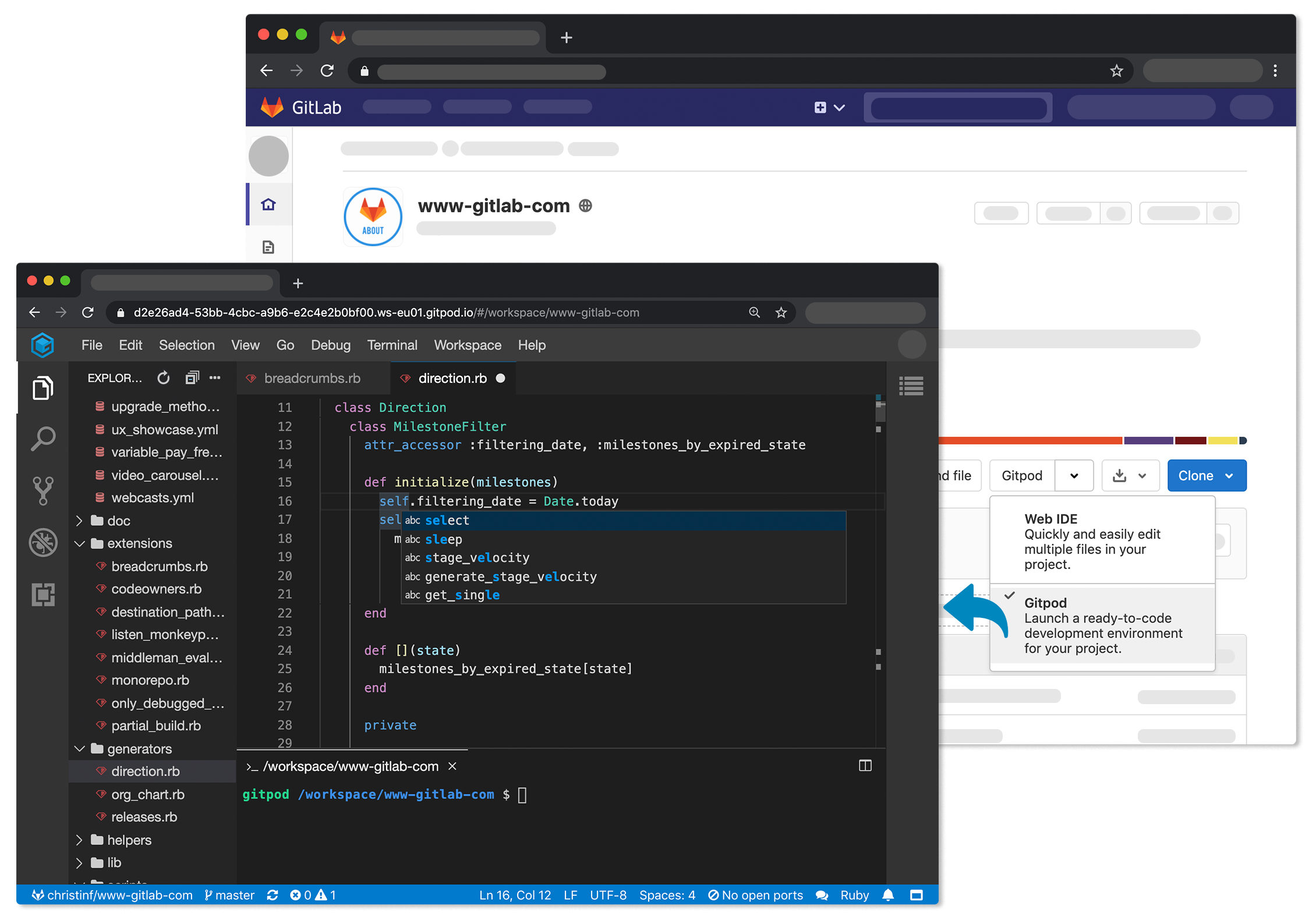
    Gitpod announced today that its open source tool for automating the setup of development environments is now integrated to the GitLab continuous integration/continuous delivery (CI/CD) platform.

    The Gitpod platform treats a version control system as the canonical source of truth from which it then automates everything a developer needs to start coding, including the integrated development environment (IDE), plugins, compilers, build tools, code generators, databases and application servers.

    Fresh off raising an additional $3 million in funding, Gitpod CEO Sven Efftinge said instead of wasting a half an hour or more waiting for a bunch of libraries and tools to get installed, a developer can click a button that allows them to begin coding within a few minutes.

    With the next release of GitLab, developers will also be able to connect their self-managed installation of GitLab to gitpod.io, which is a capability through which multiple git repositories can be registered. In addition, it’s possible to self-host Gitpod on a Kubernetes cluster in a way that integrates with GitLab or install the GitLab VS Code Extension in Gitpod to interact with GitLab.

    Efftinge said Gitpod provides DevOps teams with a tool to automate the setting up of development environments across any Git repository that is equivalent to the Codespaces tool that GitHub recently made available. Rather than having that capability for only one repository, Efftinge noted most developers work on projects spanning multiple types of repositories.

    By automating that process of setting up development environments it also become easier to align them with production environments. One of the reasons why code doesn’t work in a production environment when it is first deployed is because the local development environment has been manually configured in a way that doesn’t accurately reflect the production environment. That issue becomes even more problematic when developers are working on multiple projects involving, for example, separate microservices constructed using different repositories that might not even run in the same production environment. Collaboration also becomes easier when the members of the teams have standardized on the same instance of a local desktop environment.

    Gitpod, formerly TypeFox, collaborated with Google, Ericsson, Arm and Red Hat to develop the open source Eclipse Theia project, which provides a foundation for building IDEs in the cloud using TypeScript, CSS and HTML. Theia, now being advanced under the auspices of the Eclipse Foundation, consists of a front end running in a browser or in the local desktop application and a back end running on any host. Both communicate through JSON RPC over WebSockets. Gitpod leveraged that project to build its own cloud-based service in addition to the core open source project.

    In the wake of the COVID-19 pandemic, there’s naturally a lot more focus on automation and developer productivity. Most developers will be working from home for the foreseeable future to help combat the spread of the virus. Of course, most developers have been writing code outside the office for years. The challenge now is enabling teams of developers to develop applications as efficiently as possible regardless of where they are located. Eliminating inefficient manual tasks such as maintaining development environments is emerging as a significant step in that direction.

  • Observe Unveils Observability Platform Built on Snowflake DBaaS

    Observe Unveils Observability Platform Built on Snowflake DBaaS

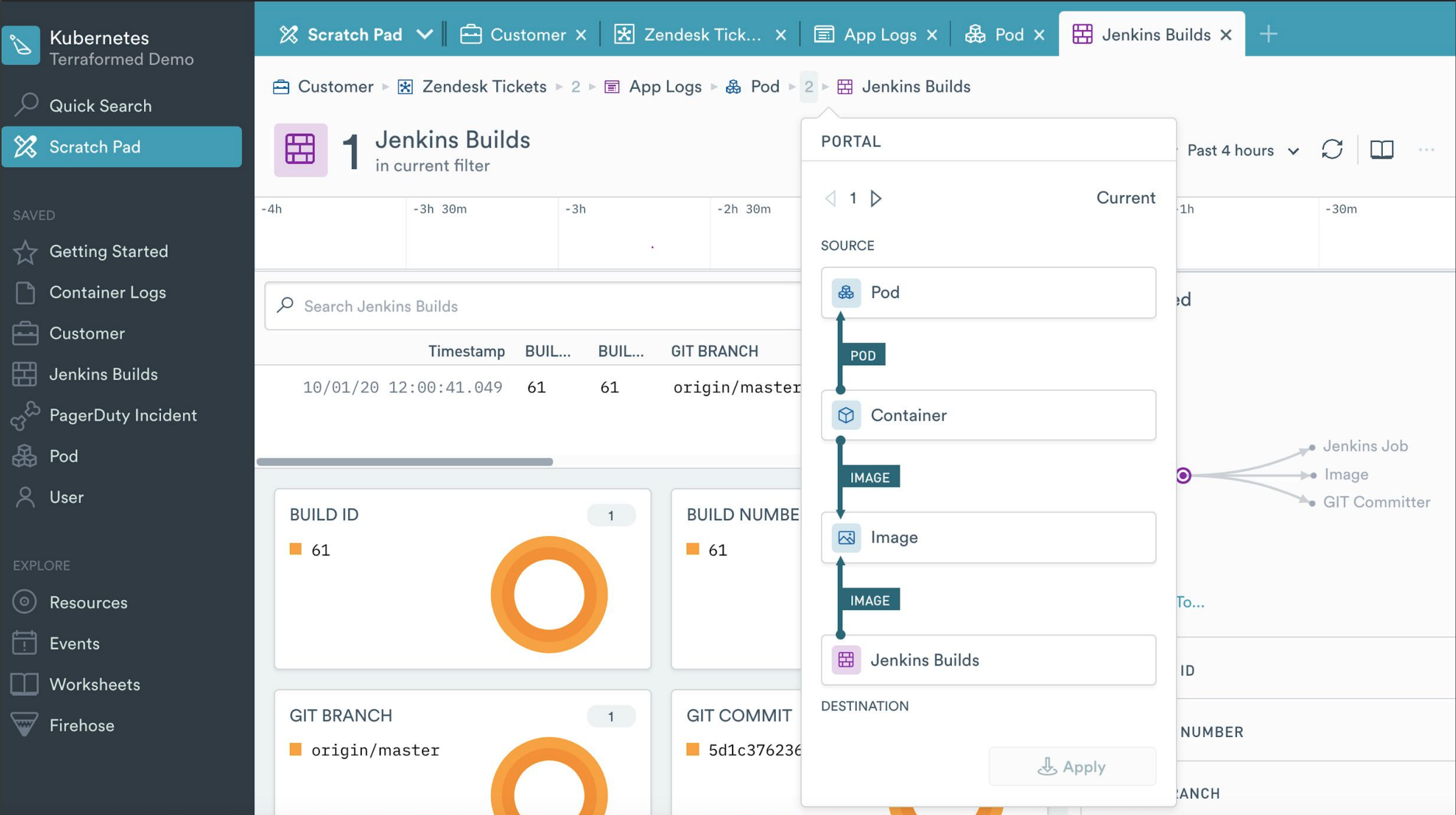
    After raising $35 million in seed funding, Observe Inc. has emerged from stealth with early access to a namesake observability service that leverages the database-as-a-service (DBaaS) platform created by Snowflake Inc.

    Company CEO Jeremy Burton said rather than build another data lake platform, it makes more sense to make an observability platform available using a software-as-a-service (SaaS) application model based on an existing cloud service.

    Burton said Snowflake, which is based on a relational database running on the Amazon Web Services (AWS) cloud, has already proven it can scale to ingest logs, traces and metrics. The Observe platform leverages that platform to correlate that data to monitor application and infrastructure environments in a way that provides more context than legacy tools that monitor software components and infrastructure in isolation.

    The context is achieved by creating a “resource” to represent, for example, a user, a session, a shopping cart, a pod, a container, a help-desk ticket or a build. Observe then enables IT teams to also track relationships between resources in a way that the average IT administrator can query without having to tag each resource, said Burton. IT teams can also track how the attributes of a resource change over time, which Burton noted can be employed to reconstitute the state of an entire IT system at any point in time.

    That approach can be applied just as easily to existing monolithic applications and emerging microservices applications because all the data required is ingested into the Snowflake service without requiring IT teams to first instrument and then update each application, added Burton.

    The pricing model for Observe will be based on the amount of data stored in the AWS S3 bucket and the number of queries launched. IT teams will purchase Observe credits that are billed only when the platform is actually used, noted Burton.

    While observability is a core tenant of best DevOps practices, Burton said there is a need to democratize observability in a way that allows any member of an IT team to troubleshoot any issue. There shouldn’t be a requirement to assemble every member of an IT team to diagnose an issue, said Burton, noting over time, that just aggravates developers who don’t really need to deal with, for example, an infrastructure issue.

    IT teams will be provided access to dashboards that enable novice or intermediate users to quickly ascertain the root cause of an issue, while more seasoned engineers with be provided access to worksheets based on a spreadsheet-like interface through which they can manipulate data, said Burton.

    Competition among providers of observability platforms is already fierce. However, as organizations look to rationalize existing legacy monitoring tools in favor of platforms that add more context, the overall size of the observability market will be measured in billions of dollars. Each IT teams will need to decide what type of platform makes the most sense for them based on costs and their preference for one capability a vendor might have that another doesn’t provide.