Author: Mike Vizard

  • Survey Surfaces Lots of Edge Computing Diversity

    Survey Surfaces Lots of Edge Computing Diversity

    A global survey of 1,652 published today by Eclipse Foundation suggests a flood is lifting all platform boats as IT organizations begin to build and deploy a wide range of edge computing applications.

    The survey finds artificial intelligence (30%) is the workload organizations plan to deploy on edge computing platforms, followed closely by control logic (29%), data exchange between multiple nodes (27%) and data aggregation and filtering (27%), also known as sensor filtering.

    The battle among providers of platforms for building and deploying these workloads is heated on all fronts. In terms of operating systems deployed, Linux (43%), FreeRTOS (35%) and Windows (31%) lead the way.

    The most widely employed developer tools are integrated development environments (IDEs) or text editors for the desktop from the Eclipse Foundation (38%) and Visual Studio Code (35%) from Microsoft. Java (20%) is the No. 1 programming language being employed at the edge and in the cloud (24%), followed by Python (17%), while C (20%) followed closely by Java (19%) is the primary language for constrained devices.

    Container images (36%), native binary (33%) and script files (30%) are the top edge computing artifacts, while MySQL/MariaDB (31%), MongoDB (22%) and PostgreSQL (21%) are the top three databases.

    IoT middleware is a tight race between Amazon Web Services (AWS) Internet of Things (35%), Microsoft Azure IoT (31%), and Google Cloud IoT Platform (30%). The top public IoT and cloud platforms are Amazon AWS (AWS), Microsoft Azure (31%) and Google Cloud Platform (26%).

    When it comes to building and deploying these applications, the top concerns are security (39%), connectivity (27%), data collection and analytics (26%), performance (24%) and privacy (23%). Communication security (43%), data encryption at rest (41%) and JSON web tokens (30%) and distributed ledgers (22%) are the most widely employed security technologies.

    In terms of communications, HTTP/HTTPS (51%), MQTT (41%) and TCP/IP (33%) are most widely employed. The dominant connectivity protocols are Wi-Fi (44%) and Ethernet (39%), with cellular and Bluetooth tied for third (37%).

    Cloud-managed over-the-air updates (48%), locally managed over-the-air updates (42%) and network cable (38%) are ranked as the top means for deploying artifacts.

    Mike Milinkovich, executive director for The Eclipse Foundation, said it appears that best DevOps processes are being extended to create an “EdgeOps” discipline around which edge computing applications are built and deployed. A wide variety of open source technologies will play a critical role in advancing EdgeOps—nearly two-thirds of respondents (65%) of respondents either experiment with, use or contribute to open source projects, with the Apache Software Foundation (51%), Eclipse IoT/Eclipse Foundation (49%), Linux Foundation (49%) and IEEE (41%) cited as being the most relevant open source bodies.

    In terms of vertical industry sectors, agriculture (26%) leads, followed by industrial automation, education, automotive and connected/smart cities all tied at 21%.

    There is, of course, multiple definitions when it comes to edge computing. However, as edge computing continues to evolve, the day when there are more workloads deployed at the edge than in the cloud or local data centers may not be all that far off. Chances are also very high that legacy approaches to managing edge computing platforms will also need to be updated to support what, by definition, are highly distributed application environments.

  • ServiceNow Partners With IBM on AIOps

    ServiceNow Partners With IBM on AIOps

    ServiceNow and IBM this week announced that the Watson artificial intelligence for IT operations (AIOps) platform from IBM will be integrated with the IT service management (ITSM) platform from ServiceNow.

    Pablo Stern, senior vice president for IT workflow products for ServiceNow, said once that capability becomes available later this year on the Now platform, IT teams will become on average 20% more productive. This is good timing, as most teams currently are struggling to adapt to the increased demand for IT support from employees working from home and in the office in the wake of COVID-19 pandemic.

    Mike Gilfix, vice president of cloud and integration and chief product officer for Cloud Paks at IBM, said IT teams will also be able to proactively identify anomalies in IT environments 60% faster.

    IT teams interact with IBM Watson AIOps via a chatbox interface such as Slack. The platform will surface recommendations based on ServiceNow data and enable IT teams to query IBM Watson AIOps to provide a faster mean time to resolution for IT incidents, said Gilfix. That capability is provided via a configuration management database from ServiceNow that tracks the operational state of all business services in real-time.

    IBM Watson AIOps, which can be deployed in the cloud or on-premises, also can surface additional context the next time similar issues arise, in addition to being able to record actions and insights for auditing purposes. IT teams can also feed data from other systems into IBM Watson AIOps to automate a wider range of processes.

    AIOps platforms won’t be replacing IT professionals anytime soon. However, IT teams that are not able to access AIOps platforms will find themselves working harder than their peers. As IT environments become more complex, the number of potential issues that can adversely impact end user experience are moving beyond the capabilities of an IT team’s ability to track manually.

    AIOps platforms, meanwhile, continue to advance in sophistication. Given the structured nature of IT environments, IBM Watson AIOps is now able to have a significant impact on productivity with 24 hours of being deployed, Gilfix said. As part of this launch, IBM is expanding its global ServiceNow services offering to include additional capabilities that provide advisory, implementation and managed services on the Now Platform. IBM also has formed an AIOps Elite Team that will help prepare organizations to transition to AIOps free of charge.

    IT may take a while still for IT teams to adjust culturally to AI, but there are many rote tasks that many IT professionals would like to see eliminated. Over time those tasks conspire to increase the level of drudgery IT professionals experience as they perform the same repetitive tasks. In theory, at least, AI should reduce overall IT staff fatigue in a way that could reduce turnover while at the same time freeing up resources to tackle more complex IT challenges.

    It may take some time for IT teams to trust the recommendations surfaced by an AIOps platform, but the more those platforms learn about the IT environment, the more accurate those suggestions become.

  • Opsera Simplifies Building of DevOps Pipelines

    Opsera Simplifies Building of DevOps Pipelines

    Fresh off raising $4.3 million in funding, Opsera today launched a namesake platform that enables IT teams to orchestrate both the tools employed by developers as well as the pipelines that make up a DevOps process.

    Company co-founder Chandra Ranganathan said the Opsera platform automates setup of DevOps pipelines using a declarative approach that doesn’t require DevOps teams to standardize on a specific set of tools.

    Ranganathan said the Opsera platform also acts as a repository for pipelines that can be reused by DevOps teams. To facilitate that effort, Opsera also includes a set of pipelines that DevOps teams can employ immediately, he said.

    Opsera is designed to be a layer of abstraction that can be deployed across multiple continuous integration/continuous delivery (CI/CD) platforms, he said, noting that capability makes it possible for IT teams to reuse pipelines without having to standardize on a specific CI/CD platform.

    Developers, meanwhile, can still choose among any number of third-party tools that have been integrated into the Opsera platform. The goal is to automate what currently is a manual process for setting up DevOps environments, which often can take months, in a few hours using a declarative process, said Ranganathan.

    Once deployed, the Opsera platform also provides access to analytics tools that enable DevOps teams to optimize those workflows, he added.

    While much progress has been made in terms of accelerating application development thanks to the rise of DevOps, the setting up and maintaining of a DevOps platform often requires a dedicated IT operations team in part because each development team wants to continue to use the tools they prefer. However, platforms that automate the DevOps process have thus far required IT organizations to standardize on specific development tools. The Opsera platform reduces the size of the IT staff needed to support DevOps workflows without forcing developers to employ a specific set of tools, Ranganathan said.

    Each development team is also automatically given its own virtual data center environment to ensure isolation between projects, he noted.

    In the wake of the economic downturn brought on by the COVID-10 pandemic, the need to automate IT processes has increased sharply as organizations look to reduce the total cost of IT. DevOps processes are no exception. In fact, DevOps processes by design should lend themselves more to automation than legacy waterfall-based approaches to application development. As DevOps processes become more automated, it also should free additional resources to develop applications faster.

    Regardless of the motivation, automation of DevOps processes will need to become more automated to keep pace with increasingly complex IT environments. Development teams are increasingly being required to build and then regularly update hundreds—sometimes thousands—of microservices. As the tools for building those microservices become more diverse, the DevOps team needs to find a way to embrace tool innovations without requiring a DevOps platform to be entirely reconstructed. Striking that balance requires a level of abstraction that minimizes the impact any change in tooling preferences can have on the underlying CI/CD platforms.

  • ServiceNow Extends DevOps Integration Reach

    ServiceNow Extends DevOps Integration Reach

    ServiceNow today announced it has added four new integrations with DevOps platforms to its IT service management (ITSM) platform delivered via the cloud.

    The four integrations add native support for Microsoft Azure Pipelines, a Jenkins Plugin, GitHub Actions and GitLab pipelines. A continuous integration/continuous delivery (CI/CD) Spoke capability on the ServiceNow platform makes it possible for developers to build automated pipelines using the Flow Designer tool.

    Marcus Torres, vice president of product platform management at ServiceNow, said these latest integrations build on a DevOps integration initiative that ServiceNow launched last year. Rather than building its own DevOps platform, the company has opted to focus on integrating ticket-based ITSM processes with DevOps processes as the management of IT continues to evolve and mature.

    In some cases, best DevOps practices for rapidly deploying applications is an absolute requirement, he noted. However, there are plenty of IT processes that are still best served by a ticket-based approach based on best practices defined within the widely adopted ITIL framework.

    Since the initiative was launched, the number of organizations that are employing the low-code ServiceNow App Engine platform to build custom workflows that integrate DevOps platforms is also steadily increasing, said Torres. ServiceNow will continue to add other integrations with DevOps platforms based on customer demand with each successive update to its platform.

    Torres said early tensions between ITIL and DevOps proponents are subsiding in favor of a more practical approach, which seeks to leverage the best of both approaches. The goal is to enable developer agility in a way that internal IT teams can support more reliably. The goal is to reduce to mean time to resolution whenever an incident arises from a recent change to the IT environment in real-time, noted Torres.

    Overall, the rate at which IT management platforms have shifted to the cloud has accelerated in the wake of the COVID-19 pandemic. With more IT professionals working from home, remotely accessing management platforms via virtual private networks (VPNs) has shown itself to be cumbersome at best.

    Longer-term, that shift to cloud will also enable IT teams to leverage artificial intelligence (AI) and robotic process automation tools to automate most low-level IT processes. The challenge IT organizations face today is on-premises IT management platforms are not able to aggregate enough data to automate IT processes reliably. However, AI capabilities will not replace IT administrators, but rather free them to address a wide range of more complex challenges, said Torres.

    Arguably, more IT organizations are re-evaluating their existing IT processes now than at any other point in IT history. The shift to supporting employees who will be working from home much more frequently is seminal moment. Each IT organization will need to determine its own best path forward, but the one thing that is for certain now is, like it or not, there is no going back.

  • Datadog Allies with BigPanda on AIOps

    Datadog Allies with BigPanda on AIOps

    BigPanda Inc. and Datadog today announced they will integrate their respective platforms to make it easier to form artificial intelligence for automating IT operations (AIOps) to consume data generated by the Datadog IT monitoring service. The two companies are pledging to invest in a go-to-market partnership to create a comprehensive platform for monitoring, analytics and incident management.

    As part of that effort, Datadog is committing to making available an “integration tile” through which BigPanda will also be able to feed root cause analytics based on machine learning algorithms into the Datadog console. That capability will be enabled by a service-to-service topology map created by Datadog that will be used to drive event enrichment, correlation, impact analysis and prioritization.

    Mohan Kompella, vice president of product marketing for BigPanda, said Datadog affords his company a unique opportunity to better train AI models using a massive amount of IT and security metrics that Datadog aggregates daily. That data can then be combined with data ingested from other IT service management systems, which will enable IT operations to automate processes using better-trained AI models, added Kompella. Thanks to modern application programming interfaces (APIs), Kompella noted it’s become a lot easier for platforms such as BigPanda to consume a wide range of data.

    The more data an AI model is exposed to the faster it learns about the IT environment an organization is seeking to automate. Each IT environment is unique, so it usually takes some time for AI models to be optimally tuned. The more data that’s made available, the faster the AI platform is able to make accurate recommendations. It’s then up to each IT team to decide to what degree they want the AIOps platform to automate a task based on those recommendations versus implementing themselves. The more accurate the recommendations become over time, the more confidence IT teams gain in the AIOps platform.

    Of course, IT environments tend to change rapidly and evolve in the DevOps era. The alliance with Datadog will provide BigPanda with a primary source of data from tools that are already widely employed by DevOps teams.

    Ultimately, the goal is to reduce the mean time to resolution for IT incidents, in addition to eliminating as much as possible the need to invite developers and IT operations teams to a “war room” meeting to discover the root cause of an issue. Many IT teams these days find themselves spending weeks trying to ascertain the root cause of an issue that, once discovered, only takes a few minutes to fix. AIOps platforms afford IT teams the opportunity to eliminate a lot of friction that currently exists in those complex IT environments that have scaled beyond the ability of humans to manage without some AI assistance.

    In the wake of the economic downturn brought on by the COVID-19 pandemic, interest in AIOps is clearly on the rise. IT environments continue to grow in size as the enterprise IT becomes more extended. It won’t be long before most IT teams expect to be able to leverage AI to manage highly distributed computing environments. It may, of course, be a while before IT teams fully trust those platforms; however, it’s also clear IT as a whole is reaching a point where there is no alternative.

  • JFrog Adds Free DevOps Tier in the Cloud

    JFrog Adds Free DevOps Tier in the Cloud

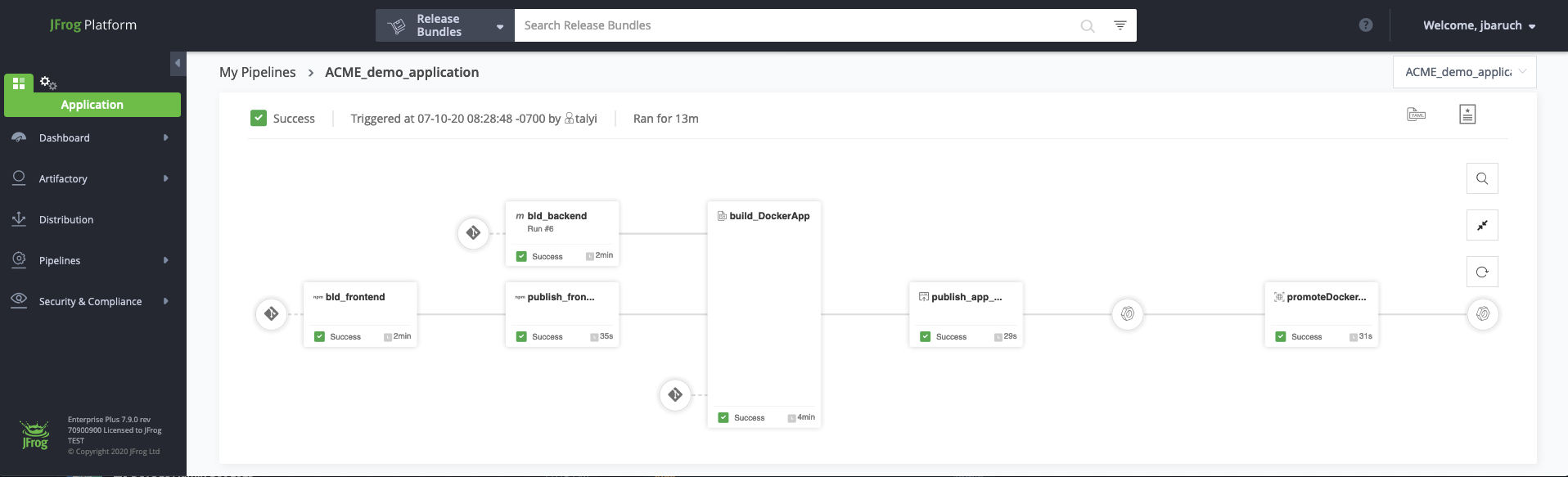
    JFrog announced today it is making a free tier of its namesake DevOps platform available on all three major public cloud service providers.

    Stephen Chin, senior director for developer relations at JFrog, said a free subscription to JFrog Platform running on Amazon Web Services (AWS), Microsoft Azure and Google Cloud Platform (GCP) is now generally available across 18 cloud regions. DevOps teams are provided with up to 2GB of storage, 10GB of monthly data transfer and 2,000 CI/CD pipeline minutes per month free of charge.

    The subscription spans JFrog Artifactory, an integrated software package management tool for binaries and container registry; JFrog Xray, a vulnerability scanning tool; and JFrog Pipelines, a continuous integration/continuous delivery (CI/CD) platform.

    Chin said the best way to further DevOps adoption is always going to be to make it as easy as possible to get started. There is no substitute for hands-on experience, he said.

    Fresh off raising additional capital via an initial public offering (IPO), JFrog is looking to expand its customer base. JFrog has more than 5,800 customers currently. The free tier will make it easier for JFrog to achieve that goal in a way that allows a nascent DevOps team to upgrade to a paid tier as their project scales, he said.

    It’s not clear to what degree organizations that have already embraced DevOps might be willing to replace their CI/CD platform or, in some cases, consolidate the multiple CI/CD platforms they already employ. However, as the number of organizations that are embracing best DevOps practices continues to grow, there appears to be plenty of opportunity for providers of CI/CD platforms to expand as organizations move to accelerate various digital business transformation initiatives in the wake of the economic downturn brought on by the COVID-19 pandemic.

    Less clear as the competition among DevOps platform providers heats up is the degree to which the total cost of DevOps could decline. Most IT organizations are under more pressure than ever to contain costs even as they are being required to accelerate software development. The challenge is striking a balance between open source tools and platforms that IT teams need to deploy and support versus relying on DevOps platforms that are managed on their behalf. In theory, the fewer IT staff dedicated to managing infrastructure, the more money there is to hire developers.

    DevOps adoption historically has been driven from the bottom up within most organizations. However, as more organizations appreciate the importance of software within their organization, senior IT and business leaders are revisiting software development processes. As part of those efforts, more organizations are looking to standardize on a specific set of DevOps platforms across their entire organization regardless of what cloud platform they may be deployed on.

    The challenge, is as often the case with any journey, is making that first step.

  • Survey Uncovers Issues Even With Advanced IT Teams

    Survey Uncovers Issues Even With Advanced IT Teams

    Even in the best of times, IT teams struggle with myriad issues related to managing their application environments

    A survey of 1,000 C-level executives at software-as-a-service (SaaS) application providers finds that while the bulk of respondents are “highly confident” or “confident” that their cloud applications were running efficiently (91%), many also are still concerned about staying within budget (65%), maximizing resources (62%) and maintaining uptime.

    Results of the survey conducted by Opsani, a provider of tools for optimizing cloud applications based on machine learning algorithms, suggest that even the most advanced IT organizations are finding it challenging to optimize application performance within the constraints of their IT budgets.

    Amir Sharif, vice president of marketing for Opsani, said most SaaS providers have already optimized complex application environments to the greatest extent possible by a team of humans no matter how mature their DevOps processes. The next level of optimization requires artificial intelligence (AI) capabilities that can discover, correlate and analyze real-time events and dependencies at levels of scale no human can match, he said.

    Within the most advanced IT teams, all the tasks that can be automated easily have already been completed, added Sharif. As IT environments become more complex, optimizing the IT environment requires platforms capable of instantly implementing policies and procedures defined by the IT team. That shift doesn’t eliminate the need for a DevOps team, but rather a shift in their role to define the policies that need to be automated, he said.

    The Opsani survey finds 43% of respondents update software daily and 37% release new software weekly. Only 15% said they conduct hourly sprints. The top concerns among respondents are employees wasting time on mundane tasks (54%), followed by finding talent (47%) and legacy processes that don’t reflect today’s technology landscape (43%).

    When asked how often their organizations optimized their application stack, 82% said they do so regularly, with 81% reporting their organizations already make use of AI tools for faster decision-making.

    When asked about service level objectives and performance goals, respondents cited transactions per second as their top metric (63%), followed by latency (47%), dollar per transaction (43%). IOPS and throughput tied for fourth (34%).

    Sharif said resistance to AI in general is declining in most IT organizations given the level of complexity faced. A 10-tier microservices application and a backend database developed by Google has more than 75 quintillion configuration permutations that must be adjusted. The average IT team might never attempt to deploy something that complex, but even comparatively simple microservices-based applications can have millions of configuration permutations that can adversely impact performance and security.

    Of course, most C-level executives are likely to think highly of their organization’s IT capabilities. The rank and file, however, make assessments that are a little less rosy. The challenge is, not many IT teams have a lot of insight into how well anyone else is doing. It may be cold comfort to see that even advanced IT teams are struggling with issues.

    However, most teams that are driving revenue-generating applications for an organization will have access to more advanced IT tools a lot sooner than the average enterprise.

  • BizOps Coalition Publishes Manifesto

    BizOps Coalition Publishes Manifesto

    The BizOps Coalition, which advocates for fundamental change in the way IT teams and business users collaborate during software development, today published a BizOps Manifesto framework that identifies 12 principles that focus organizations on business outcomes versus merely attaining and maintaining service levels.

    The goal is to close the historic divide between IT and the rest of the business by encouraging IT teams to work more closely with business leaders, who need to make informed technology investment decisions based on real-time data analytics to drive business growth, improve customer experience and increase profitability.

    BizOps Manifesto authors include Dr. Mik Kersten, founder & CEO of Tasktop; Serge Lucio, vice president and general manager of the Enterprise Software Division of Broadcom; Patrick Tickle, chief product officer of Planview; Sally Elatta, CEO of AgilityHealth; Evan Leybourn, CEO of Business Agility Institute; Tom Davenport, distinguished author and professor; Dave West, CEO of Scrum.org; and Kevin Surace, chairman/CTO of Appvance.ai.

    Lucio said even after a decade of advancements in best DevOps practices, far too many IT teams behave as though they have no vested interest in the outcome of an IT project. In fact, there’s far too much focus on requirements at the beginning of a project because too many IT teams believe that as long as an application is available, their task is complete, he noted.

    The BizOps Manifesto encourages IT organizations to assume requirements can and should change frequently as business conditions evolve. IT teams that focus too much on requirements upfront are essentially applying a waterfall mentality to software development no matter how agile their software development processes are, Lucio said.

    In general, he noted, there’s a lot more focus these days on software development. The biggest immediate hurdle is the terminology being employed to address this issue. The IT vendor community is employing catchphrases such as “value stream management” and “software delivery management” to describe essentially the same issue, he said.

    More organizations than ever are finally coming to terms with these issues as they seek to accelerate the rate at which applications can be deployed in the wake of the economic downturn brought on by the COVID-19 pandemic, Lucio said, noting the BizOps Manifesto is intended to facilitate those conversations.

    It’s not clear to what degree a manifesto can change mindsets within IT teams. Too many IT professionals view themselves as being part of the IT industry rather than the industry its employer is in. As a result, there’s often not a deep appreciation for the unique business challenges an organization faces within the IT department. Arguably, that divide is not as wide as it was at the start of the last decade; nevertheless, the issue persists. A manifesto is as good a place as any to start a conversation that in many organizations is long overdue.

  • Red Hat Expands Scope, Reach of Ansible Automation Framework

    Red Hat Expands Scope, Reach of Ansible Automation Framework

    Red Hat, its online AnsibleFest 2020 conference today, announced an on-premises edition of Ansible Automation Platform dubbed Private Automation Hub and previewed technology to connect the Ansible Automation Platform managed as a cloud service by Red Hat and the on-premises edition.

    In addition, Red Hat is making available more pre-integrated workflows to its certified Ansible Content Collections service for Red Hat OpenShift, Kubernetes Core and the VMware vSphere REST application programming interface (API).

    Finally, the company previewed integration between Ansible Automation Platform and Red Hat Advanced Cluster Management, a tool originally developed by parent company IBM for managing Kubernetes clusters at scale. As part of that effort, Red Hat will integrate its implementation of Kubernetes Operators tools for deploying applications on the Red Hat OpenShift platform, which is built on top of Kubernetes, with a Resource Operator for Red Hat Advanced Cluster Management that will enable Ansible Automation Platform to execute tasks outside of the Kubernetes cluster when required.

    Joe Fitzgerald, vice president of management for Red Hat, said there are now more than 60 Ansible Content Collections available that can be deployed on-premises or in a cloud service managed by Red Hat. The connectors will make it easier for IT teams to access workflow content curated by Red Hat and its partners while continuing to create automated playbooks for their own unique IT environments that are stored locally, he said.

    As the number of IT domains to which a declarative IT automation framework can be applied continues to expand, Fitzgerald said the playbooks an IT team can create are becoming more comprehensive. Unlike other IT automation platforms, however, Ansible doesn’t require the IT operations team to learn how to code. In the wake of the COVID-19 pandemic and most employees working from home, the number of workflows that IT teams are trying to automate has increased substantially, he said.

    That framework can now also be applied to both legacy IT environments as well as Kubernetes clusters upon which the cloud-native technologies are being deployed. During AnsibleFest, Red Hat will be showing proofs of concept of support for Knative, open source middleware developed by Google that integrates serverless computing frameworks with Kubernetes clusters.

    While there are still DevOps teams that have adopted programmable frameworks to manage IT as code, many traditional IT administrators are embracing Ansible as a means to automate increasingly complex IT environments. Rather than acquiring and deploying automation tools for each platform in the IT environment, Ansible provides a common framework through which IT teams can automate the provisioning of servers, virtual machines, clusters, switches, routers and storage systems. With vendors such as Cisco Systems supporting Ansible, the number of workflows capable of spanning multiple IT domains continues to expand as internal IT teams share the playbooks either they created or had crafted for them by an IT services firm.

    Regardless of how an internal IT gains access to those playbooks, it’s probable that no matter what the automation requirement is, there is now somewhere a playbook written in Ansible to address it.

  • Akamai Enables Microservices Deployment at the Edge

    Akamai today announced it is adding the ability to deploy microservices on its edge computing platform to enable developers to run latency-sensitive applications faster.

    David Theobald, principal product manager at Akamai, said developers can now code dynamic content assembly at the edge to create microservices on the Akamai Intelligent Edge platform that include external requests and the ability to manipulate response bodies. That approach provides developers with the primitives required to run edge computing applications on the equivalent of a serverless computing framework, he said.

    In addition, Akamai is adding EdgeWorker reporting and debugging tools for JavaScript applications deployed on the edge of its content delivery platform (CDN) and updated its application programming interfaces (APIs) to make it easier and faster to deploy “cloudlet” applications.

    Finally, Akamai also has updated its Akamai Image and Video Manager software-as-a-service (SaaS) offering by adding a video status optimization API through which IT teams can track the status of videos as they are being optimized by the Akamai CDN.

    While CDNs have been widely employed for decades, they are now evolving into platforms for deploying edge computing applications that are developed and deployed using best DevOps practices. Rather than having to replicate the IT infrastructure already put in place by a CDN provider, many organizations are opting to essentially consume IT infrastructure as a service as they deploy edge computing applications alongside existing web applications.

    Competition is already fierce among CDN providers seeking to leverage points of presence around the globe to enable IT teams to deploy applications closer to the point where data is generated and consumed. Many of these edge computing applications are at the core of digital business transformation initiatives that require data to be processed in near real-time. As such, processing that data in a local data center creates too much latency.

    Of course, cloud service providers have also extended the range of services they provide to include CDN services. It’s not clear to what degree IT organizations will prefer to leverage those cloud services versus the CDN capabilities many of them already rely on to deploy web applications.

    Regardless of the approach, the number of IT teams building, deploying and maintaining their own edge computing infrastructure is likely to be reduced sharply in the wake of the COVID-19 pandemic. IT teams are trying to reduce the potential risk to their IT staff by limiting travel as much as possible, which makes putting IT personnel on a plane to install infrastructure an option of last resort.

    Developers, in the meantime, are building more applications faster than ever, thanks mainly to DevOps processes that enable them to work from home. As the deployment backlog for edge computing applications builds, the need to rely more on external services becomes that much more pressing. It may be a while before most DevOps teams routinely view CDNs as just another target platform for deploying applications, but in many cases, that day is already here.