Author: Mike Vizard

  • Moogsoft Unfurls AI Cloud Service for Observability

    Moogsoft Unfurls AI Cloud Service for Observability

    Moogsoft today launched the Moogsoft Observability Cloud, a software-as-a-service (SaaS) instance of its existing platform for detecting anomalies and prioritizing alerts using AI via machine learning algorithms.

    Company CEO Phill Tee said now every IT organization can employ machine learning algorithms to better manage their IT environment without having to set up and manage an artificial intelligence for IT operations (AIOps) platform. Pricing for the Moogsoft Observability Cloud will be based on data ingestion rates for teams and enterprises, but for now, Moogsoft is making available a free trial edition.

    A collector ingests time-series metric data directly from sources such as Amazon EC2, Docker, MongoDB, Redis and other platforms. Other metrics can also be ingested via a user-definable metrics API. The goal is to make it possible for IT teams to benefit from AI in minutes rather than having to wait days or weeks for machine learning algorithms to learn the entire IT environment, said Tee.

    Designed around a microservices-based architecture and a set of REST application programming interfaces (API), Tee noted the Moogsoft Observability Cloud makes it possible for DevOps teams to self-service their own observability requirements, he added.

    The Moogsoft Observability Cloud applies statistical calculations and anomaly detection algorithms to time-series metrics data. A correlation engine then transparently matches patterns to provide more context to a single notification, which Tee noted reduces the overall alert fatigue.

    The Moogsoft platform can also be integrated with IT collaboration tools such as PagerDuty and can be configured to send data to any endpoint via an open webhook API. Collectively, that capability enables IT teams to build workflows to get to the root cause of an IT issue faster while simultaneously reducing the noise generated by existing monitoring tools, Tee said.

    Moogsoft plans to continue to provide the existing on-premises edition of its platform but expects over time the bulk of IT organizations will prefer to rely on an AIOps platform that is managed on their behalf. Regardless of the delivery model, Tee said IT teams soon will start interacting with these platforms using speech interfaces that will automatically identify pressing issues before they become a major incident.

    In the meantime, Tee said resistance to AI is dropping among IT professionals. Not only are more of them encountering various forms of AI used widely in consumer applications, but many IT professionals also have come to realize it will not be possible for a team of humans to optimize complex IT environments without relying more on machine learning algorithms and other forms of AI. In fact, organizations soon may find it difficult to hold on to IT professionals who increasingly expect to have AI tools available to them, he noted.

    There’s already no shortage of options when it comes to AIOps platforms. Before too long, every IT management platform will have been infused with machine learning algorithms. The issue now is determining how much those algorithms will forever transform existing IT management processes.

  • Cisco CEO: Developers Need More Infrastructure Control

    Cisco CEO: Developers Need More Infrastructure Control

    Cisco Systems CEO Chuck Robbins said this week that the company’s No. 1 priority going forward is to enable IT organizations to better manage application experience via abstraction layers that make to possible for developers to programmatically manage infrastructure.

    Speaking at its annual Cisco Partner Summit, which occurred online, Robbins said Cisco is working toward making it possible for developers to not only programmatically provision IT infrastructure but also impact how services are delivered using application networking services the company is currently developing.

    Over time, the entire Cisco portfolio will either be cloud-delivered or cloud-managed as Cisco increasingly delivers its technology as a service, he said. As part of that effort, Cisco is now exposing application programming interfaces (APIs) across its portfolio.

    At the core of the initiative are investments Cisco is making in AppDynamics, ThousandEyes and its Intersight IT operations management platform. Those tools will be employed to provide insights and observability across a diverse application environment that increasingly includes cloud-native applications running on Kubernetes clusters, Robbins said.

    In effect, Cisco is signaling a more aggressive transition toward managing infrastructure as code inside and out of the cloud. This week Cisco announced it has added an Intersight Workload Optimizer to optimize infrastructure consumption along with adding support for dynamic provisioning of Kubernetes clusters via Cisco Intersight. The company also added a Cisco Nexus dashboard to provide visibility into networks spanning multiple clouds, on-premises IT environments and edge computing platforms, and expanded the Cisco Identity Services Engine to now secure a wider variety of internet of things (IoT) endpoints.

    Cisco, like every other provider of IT infrastructure, is shifting toward a cloud operating model that promises to enable IT teams to manage on-premises IT infrastructure in the same way IT teams consume public cloud resources. As part of that effort, Robbins noted Cisco has been disaggregating all the software functionality it provides from hardware whenever possible, which will provide IT teams with more flexibility and control over highly distributed IT environments.

    The COVID-19 pandemic has only accelerated a transition to managing IT as service, as organizations rely more on applications to engage their end customers, he added.

    Of course, Cisco is not the only provider of IT infrastructure with similar ambitions. Not only is networking software is becoming accessible via APIs, but it’s also now possible to deploy a software-defined network on commodity processors almost anywhere. That transition is also the primary reason that network operations are increasingly being folded into DevOps teams seeking to manage compute, storage and networking as code across an extended enterprise.

    It may be a while yet before network and storage operations are fully assimilated into DevOps processes. However, it’s now no longer a question of if as much as how long before most IT organizations achieve that goal.

  • GitLab Makes Building Secure Mobile Apps Easier

    GitLab Makes Building Secure Mobile Apps Easier

    GitLab has made 60 enhancements to its namesake continuous integration/continuous delivery (CI/CD) platform to address a range of things from DevSecOps processes to collaboration, at a time when most DevOps teams continue to work remotely.

    With help from external contributor support for the Mobile Security Framework (MobSF), version 13.5 of GitLab adds an all-in-one tool for penetration-testing, malware analysis and security assessment that runs both static and dynamic analysis of code running on Android, Apple iOS or Windows platforms. GitLab is also making available a user interface to configure its existing static analysis security tools.

    On the collaboration front, GitLab has added support for Group Wikis to provide a central place to collaborate as well as an enhanced Snippets tool to facilitate code-sharing among group members. Snippets with multiple files are now supported inside a single Snippet.

    GitLab is also making available additional templates for deploying to Amazon Web Services (AWS), as well as a GitLab CI/CD template for Terraform and integration with Gitpod, a tool that makes it easier to spin up development environments.

    Finally, GitLab has made feature flags a core part of its platform and added support for a Timeline view to make it easier to navigate incident discussions. It also included the ability to store other binary types in GitLab that are not yet supported via raw package feeds and attach binary assets to releases.

    Brendan O’Leary, senior developer evangelist for GitLab, the COVID-19 pandemic has accelerated digital business transformation initiatives that often depend heavily on secure mobile computing applications that rely on rapid development. As the DevOps teams tasked with building these applications are working from home to help limit any spread of the pandemic, the need for tools to facilitate collaboration across distributed development teams has become critical, he said.

    It’s not clear to what degree the need to work from home is influencing the selection of CI/CD platforms just yet. The trend toward working remotely was well underway prior to the pandemic. At this juncture, however, it’s clear most development teams will be working remotely well through 2021. Most IT organizations will need to revisit some early assumptions about how to optimize DevOps practices across a distributed workforce now that many of them have had firsthand experience, noted O’Leary.

    The challenge is some developers may thrive while working from home while others struggle. In the absence of collaboration tools, it becomes more challenging for managers to ascertain what specific issues need to be addressed. Of course, even if a vaccine is discovered. there will be no going back—the way applications are built and deployed in a modern enterprise has been forever altered. The issue now is determining how best to move forward as the COVID-19 pandemic continues waxes and wanes.

  • AppDynamics Expands APM Data Consumption

    AppDynamics Expands APM Data Consumption

    AppDynamics, a unit of Cisco Systems, this week extended the observability capabilities of its namesake application performance management (APM) platform to ingest data from open source tools and agentless services alongside metric collected via its agent software.

    At the same time, AppDynamics has added a Cloud Data Collector that automatically captures data from public cloud services generated by tools such as Amazon CloudWatch from Amazon Web Services (AWS).

    Finally, AppDynamics has added a visualization interface optimized for monitoring cloud-native applications and integration with Cisco’s Intersight Workload Optimizer tool, which organizations can employ to better optimize IT infrastructure resources usage to reduce costs across a hybrid cloud computing environment.

    AppDynamics CTO Ty Amell said the need for deeper levels of observability into IT environments has become more pronounced in the wake of the COVID-19 pandemic. Organizations have launched multiple digital business transformation initiatives that depend on the ability to correlate events occurring in IT environments in real-time. To provide that capability AppDynamics has been investing in machine learning algorithms to analyze data that can now be more easily collected, he said.

    Cisco, meanwhile, has been investing in various machine learning technologies to automate the management of compute, networking and storage infrastructure, which Amell said also serves to provide deeper insights into the overall IT environment when combined with the AppDynamics platform.

    The shift toward a more holistic approach to observability justifies Cisco’s acquisition of AppDynamics, which provides a widely used APM platform. However, much of that shift is being made by DevOps teams, where roles tend to be a lot more conflated than in traditional IT environments. Nevertheless, Amell noted the shift will continue to accelerate as IT organizations realize they can also reduce costs by rationalizing legacy monitoring tools.

    As IT environments continue to become more complex, there’s no doubt the tolerance for spending days and sometimes weeks navigating multiple tools to uncover the root cause of an issue is declining. It’s especially frustrating when the root cause of an issue turns out to be something trivial that can be fixed in a few minutes.

    Of course, it will be up to each organization to strike a balance between observability and automatic remediation of an issue uncovered by an observability platform. Many IT teams prefer to review changes before they are applied.

    Regardless of their level of comfort with automation, the amount of metrics, logs and traces that can be collected and analyzed has increased dramatically. As more of that data is collected, the more precise the observability platform becomes. The challenge now is finding the most efficient way to instrument an IT environment as the number of platforms running either monolithic or microservices-based applications continues to expand. In fact, at this point collecting all the relevant data is still often a bigger challenge than analyzing it.

  • Catchpoint Adds Endpoint Device Monitoring Services

    Catchpoint Adds Endpoint Device Monitoring Services

    Catchpoint today extended the reach of its monitoring services to include an offering that monitors the devices of end users.

    Nik Koutsoukos, chief marketing officer for Catchpoint, said the Employee Experience Monitoring service makes it possible to deploy the same agent software the company employs to track application experience on points-of-presence (PoPs) around the globe to an endpoint device.

    With more employees now permanently working across a wider range of geographies in the wake of the COVID-19 pandemic, Koutsoukos said the need to monitor individual application experiences on specific devices has become more pressing.

    Accessed via a software-as-a-service (SaaS) platform, Employee Experience Monitoring also provides access to a desktop application that shows both device and network health along with recommendations for resolving issues. That capability provides the guidance many end users who are working from home (WFH) need to resolve issues before creating a job ticket for the IT service desk, noted Koutsoukos.

    Employee Experience Monitoring service also goes beyond merely collecting data from endpoints. It correlates the data collected from the endpoint against the network data that Catchpoint is already collecting from more than 850 PoPs around the world. In addition, it also combines real-time endpoint analytics, global user sentiment data and synthetic monitoring to provide deeper insights into the actual end user experience.

    Since the beginning of the pandemic, IT teams have been inundated by support calls. However, IT teams traditionally have had very limited visibility into the endpoints they are now being required to remotely support, said Koutsoukos. It’s often impossible to know with certainty whether an application issue is being caused by the device, the network or the local data center or cloud service where the application is deployed, noted Koutsoukos.

    Given the probability that employees will be returning to offices full-time is low, it’s clear another approach to manage remote endpoints is required, added Koutsoukos. In fact, as wireless 5G services, which provide more network bandwidth, become more widely accessible there may not ever be a need for employees to return to an office. Internal IT teams, however, will still be expected to troubleshoot application experiences over any type of network, he said.

    It’s unclear to what degree the COVID-19 pandemic has forever altered IT service management. The one thing that is certain is the days when IT teams could count on the bulk of users being tethered to either a wired or wireless local area network in an office are pretty much over. Even after a vaccine for COVID-19 is discovered, the bulk of employees will still want to work from home more often to limit the spread of the virus. IT teams, therefore, must come to terms with a new normal that requires tools to not only help them manage end users but also enable end users to help themselves whenever possible.

  • Nobl9 Ties Business Goals to Observability Data

    Nobl9 Ties Business Goals to Observability Data

    Nobl9 today announced it has made available via an open public beta program a software-as-a-service (SaaS) platform for correlating business goals against data collected by observability tools.

    Unlike observability platforms that only aggregate metrics, the Nobl9 Service Level Objective (SLO) Platform applies that data to specific reliability targets defined by the business, company CEO Marcin Kurc said.

    Compatible with monitoring platforms such as Datadog, New Relic and Prometheus, Nobl9 SLO Platform calculates uses monitoring data to calculate acceptable rates of error per service threshold and can be configured to trigger alerts and even workflows in anticipation of outages, Kurc said. The critical difference is knowing which metrics are truly impacting customer experiences.

    The platform also enables DevOps teams to create business rules and define “facets” of users based on application experiences required. DevOps teams can identify users who are being serviced poorly in addition to tracking groups of users. They also codify contractual service level agreements (SLAs) down to critical business periods, said Kurc. The Nobl9 SLO Platform is accessible via a CLI/GUI/API for everything, Kubernetes-like YAML SLO-as-code or a sloctl command line.

    This approach also has a significant impact on the cost of monitoring because the Nobl9 SLO Platform makes it easier to identify what data needs to be stored versus deleted, noted Kurc.

    Armed with those insights, Kurc said it then becomes easier for DevOps teams to either determine how to make systems more reliable or lower reliability goals to reduce costs when possible. IT organizations will also spend much less time finger-pointing because the root cause of any issue will be much more readily apparent, he noted, adding the Nobl9 SLO Platform provides access to both real-time and historical reports to enable DevOps teams to achieve both those goals.

    In the wake of the COVID-19 pandemic, there’s a lot more focus on observability than ever. Organizations are relying more on digital business process to survive. The difference between surviving and thriving in this new era will come down to observability of not just the IT environment but also the entire digital business process.

    It may be a while before most organizations fully equate profit and revenue to the performance of their IT environments. However, it’s becoming increasingly clear that it’s not enough to simply make sure IT environments are available. Customers are judging organizations by their ability to drive a quality experience within the context of a digital business process spanning multiple applications. Organizations that are unable to meet those expectations will soon find themselves being cast aside in favor of those that can.

    Naturally, those requirements will put a lot of pressure on IT teams that often don’t have a lot of visibility into a business process. There is no end of alerts being generated by the system that are closely monitored, but the bulk of those alerts lack business context. Undoubtedly, there soon will be plenty of ways to gain that context. The challenge now is explaining to business leaders now why it’s needed before it’s too late.

  • Red Hat Automates More Operating System Tasks

    Red Hat Automates More Operating System Tasks

    Red Hat today announced an update to Red Hat Enterprise Linux (RHEL) that automates a wide range of manual tasks.

    Scott McBrien, a principal product manager for Red Hat, said RHEL 8.3, available in a few weeks, expands the Red Hat System Roles capability that provides a prescriptive and automated means of managing operating system configurations. Red Hat System Role now addresses kernel and log settings, identity management, certificate management and Network-Bound Disk Encryption (NBDE), as well as deployments of SAP HANA databases and SAP NetWeaver middleware. Red Hat has also updated Tuned, a set of pre-configured performance profiles it makes available.

    In addition, RHEL 8.3 provides an update to Application Streams, a set of developer frameworks, databases, container tools and other resources that now adds support for Node.js 14, Ruby 2.7 and other current versions of tools and languages. Red Hat is now committed to streaming support for updates to the frameworks include in Application Streams versus only making updates available each time the entire platform is updated, said McBrien. That approach is intended to make it possible for developers to embrace new capabilities faster while maintaining support for previous versions of frameworks, said McBrien.

    Red Hat is also furthering its effort to encourage organizations that have standardized on RHEL to embrace its tools for building and managing container applications. Updated container images for Buildah, a tool for building container images and Skopeo, a tool for moving container images across storage platform, have been added along with version 2.0 of Podman, a tool for managing containers and images that adds a REST application programming interface (API) that is compatible with Docker Container Engine.

    Red Hat is making the cases for a more modular approach to deploying tools for building and maintaining containers as an alternative to a more monolithic approach pursued by Docker Inc., said McBrien.

    Finally, Red Hat has added Secure Content Automation Protocol (SCAP) profiles for the Center for Internet Security (CIS) Benchmark and the Health Insurance Portability and Accountability Act (HIPAA).

    RHEL and the Red Hat OpenShift application development and deployment platform are at the core of the hybrid cloud computing strategy being advanced by Red Hat and its parent company, IBM. According to a Red Hat Enterprise Open Source Report, 63% of organizations surveyed have a hybrid cloud architecture today, with more than half of those who do not have one in place planning to implement one in the next two years.

    Beyond bundling developer tools with RHEL to reduce the number of IT vendors, an organization needs to engage, McBrien said Red Hat is committed to automating as many low-level IT tasks as possible. IT teams should be able to deploy operating systems in the cloud just as easily as they might in an on-premises IT environment, he noted.

    It may be a little while yet before every manual IT task becomes automated, but with each new update to the operating system the number of those rote tasks that IT administrators need to devote time to continues to diminish.

  • Progress Reorganizes Chef Portfolio

    Progress Reorganizes Chef Portfolio

    Progress today announced updates to the portfolio of DevOps offerings it gained with the acquisition of Chef earlier this month.

    A Chef Infrastructure Management offering now combines Chef Infra and Chef Automate into a single offering, while Chef App Delivery combines Chef Habitat, Chef Infra and Chef Automate into a single offering that creates an artifact that can run anywhere.

    Sundar Subramanian, senior vice president and general manager for core products at Progress, said the goal is to organize the Chef portfolio around a set of distinct offerings for automating the management of infrastructure and continuous delivery (CD). Instead of simply offering a set of tools for power uses, Subramanian said Progress is moving toward creating a set of platforms.

    At the same time, Progress announced a dedicated content delivery service that provides access to a library of curated Chef Premium Content for compliance scanning and remediation that complies with the best practices defined by the Center for Internet Security (CIS).

    Finally, Chef has added a Learn Chef Skills Validation Program based on the online Learn Chef platform and the OpenBadges Standard, a specification designed to promote certifications that teach skills in a way that are both verifiable and portable.

    CD and infrastructure management are typically handled by different members of the same DevOps team. By segmenting its offering around federated responsibilities, the Chef software portfolio will become easier for DevOps teams to consume based on specific tasks, Subramanian said.

    Progress expects its offerings in the months ahead to have greater appeal among midmarket IT organizations that are accelerating multiple digital business transformation initiatives in the wake of the COVID-19 pandemic, he noted. The company has been focused on providing application development tools to these organizations for decades, and as their IT operations mature, many are beginning to embrace best DevOps practices as they seek to reduce the total cost of IT operations.

    The challenge those organizations face today is they depend heavily on ITIL-based frameworks for managing IT. Beyond acquiring DevOps tools and platforms, most of those organizations are at the beginning a what has been shown to be a transformation to DevOps processes that requires major changes to the culture of an IT organization. The cultural transition often involves years of effort as organizations try to balance different approaches to managing IT based on ITIL and DevOps processes.

    It’s too early to say what path to automation of IT those organizations will take. The Chef tools still require a level of programming expertise to employ that is often lacking among traditional IT operations staff. Not to mention the fact that Progress is not the only DevOps platform provider looking to expand its reach into the midmarket.

    Regardless of the path chosen, the number of organizations that embrace DevOps principles is about to expand significantly.

  • Applitools Integrates Testing Platform With GitHub

    Applitools Integrates Testing Platform With GitHub

    Applitools announced today that its test automation tools have been integrated with GitHub and GitHub Actions in addition to being available on the Microsoft Visual Studio App Center.

    Company COO Moshe Milman said these integrations make it possible to add testing tools that incorporate machine learning algorithms, dubbed Visual AI, to a DevOps workflow using the Applitools Eyes testing platform. Those tests are run on a cloud platform dubbed Ultrafast Grid.

    The goal is to make it possible to easily correlate code changes across different versions of updates to web and mobile applications using any testing framework and programming language, said Milman. Visual AI can now be applied to every build and pull request, he noted.

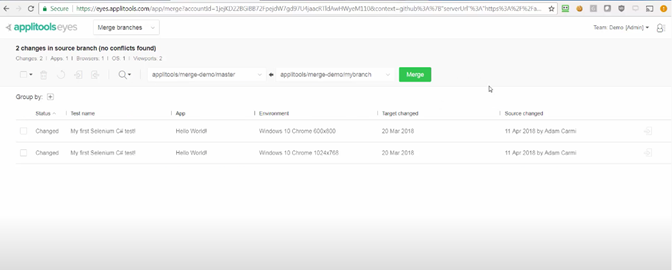
    When feature branches are created, Applitools instantly mirrors those feature branches to create a new set of baseline images. That approach simplifies the automated testing of all feature branches without impacting the trunk and its tests, he said, noting as pull requests are merged back in, the integration automatically updates the target branch with the source branch’s baseline images in a way that ensures no conflicts exist between branches.

    The Applitools approach to AI testing also provides developers with more control based on the application use cases, he added. For example, different settings can be applied to test a medical application that requires perfect alignment of pixels versus an e-commerce application that may not require as much fidelity. Developers can then resolve regression issues by employing root cause analytics.

    In general, Milman said the number of organizations that are applying DevOps processes now to the development of both web and mobile applications is increasing. Mobile applications are core to digital business transformation initiatives that have accelerated in the wake of the COVID-19 pandemic. Many of those applications are being built using components that typically are shared through repositories such as GitHub, which Milman noted creates the imperative to integrate testing tools with code repositories and other DevOps platforms.

    It’s still early days as far as applying AI to application testing is concerned. However, it’s now more a matter of when versus if organizations will be relying more on AI to test applications. As the number of testing platforms that include AI capabilities expands, each IT team will need to evaluate which approaches provide the most accurate testing.

    Nor is it clear to what degree AI might reduce the need for dedicated application testing teams. More responsibility for testing applications has been shifting left toward developers for several years now. Nevertheless, an independent test review of an application before it is deployed is always a good idea. AI capabilities in testing tools should reduce the most common mistakes the developers seem to make regularly.

    As part of an effort to make it tools more widely accessible, Applitools also makes Applitools Eyes along with its GitHub integrations available for free for open source projects hosted on GitHub that sign up to be part of Applitools’ open source plan.

    Regardless of how DevOps teams gain access to those tools, the future of application testing promises to be a lot let less monotonous.

  • Vercel Optimizes Apps Based on React Framework

    Vercel Optimizes Apps Based on React Framework

    Vercel, during its online Next.JS Conf event, announced an update to its open source reactive programming framework that adds support for automatic image optimization along with access to continuous Web Vitals analytics.

    Company CEO Guillermo Rauch said Next.js 10 also adds support for internationalized routing and automatic language detection and quick-start e-commerce capabilities.

    Pioneered by Facebook, reactive programming frameworks are gaining traction as the need to build more interactive applications to drive digital business transformation and other initiatives becomes more critical. Vercel makes it easier to build those applications via a managed serverless cloud environment.

    Image optimization becomes a problem for websites because over time successful waves of application updates conspire to slow performance. Next.js 10 gives developers a replacement for legacy HTML and browser image stacks, which support only one image size and type. Developers can automatically replace legacy HTML image tags with image components based on React that load in a progressive fashion, said Rauch.

    E-commerce applications are especially “ripe for revolution,” he said—as organizations increase their dependency on online interactions in the wake of the COVID-19 pandemic, they are discovering their existing applications are not only slow but also not especially engaging. The more satisfied customers are with an application experience, the more likely they will return to that website, Rauch noted.

    Vercel’s open source Next.js Commerce platform using Node.js 10 adds automation along with a data layer and reusable data primitives developed by BigCommerce to modernize e-commerce applications. Vercel is also in the process of testing a video platform built in Node.js that will be made available as an open source platform.

    Finally, a Next.js Analytics module provides continuous feedback to help developers better understand how their site or application performs. Page rankings on the Google search engine site are now being influenced much more by Google Web Vitals scores, Rauch said, and the analytics module is designed to identify First Input Delay and Cumulative Layout Shift issues that adversely impact the performance of React-based applications.

    Ultimately, the goal is to deliver a new generation of web and mobile applications. Organizations employing Node.js include Apple, Twitch, TikTok, Lululemon, Target, Lyft and Hulu. Companies such as Airbnb, Hashicorp, Washington Post and TripAdvisor also deploy their front-ends on the Vercel cloud platform.

    It may take a while before every company has modernized their web and mobile application portfolios, but at this juncture, it’s now a matter of when rather than if. Organizations that depend on legacy HTML approaches to building and deploying these applications will find that over time, the use of their applications—and, by extension, websites—will decline. At a time when organizations are more dependent than ever on web and mobile applications to remain relevant to customers, interactive applications may soon be nothing less than a matter of survival.