Author: Alan Shimel

  • JFrog, Puppet, Datical & Sendachi – Money Continues to Pour Into DevOps

    JFrog, Puppet, Datical & Sendachi – Money Continues to Pour Into DevOps

    The stock markets may be bearish, the price of oil is down the drain, but money continues to pour into the DevOps tools and solutions market. Just in the last few days 4 companies have announced significant new funding. Whether this is a last gasp before the doors slam shut, the tech industry thumbing their nose at the rest of the business world or proof that the recent market downtrend is a red herring I don’t know. But as someone who has lived through more than a few bubble bursts in the tech world it bears watching.

    For now though, the good times continue to roll! Lets review the new funding news:

    jfrogJFrog raises an astounding $50m! That amount of money is nothing to sneeze at! I spoke with Shlomi Ben Haim, CEO at JFrog. They have over 120 people working there in offices in Israel, HQ in Santa Clara and France. Their JFrog Artifactory and JFrog Bintray are hosting software for organizations the world over, big and small.  Ben Haim and his team, as well as his blue chip investors believe the time is now as DevOps goes mainstream. They want to make sure they have the money to capitalize on the opportunity. Congrats to the JFrog team and we are excited to see what this money translates to for them.


    puppet-labs-logo Puppet Labs raises $22m in debt financing. While Puppet continues its phenomenal growth it took the opportunity to grab $22m in debt financing from Silicon Valley Bank. I spoke to Puppet CEO Luke Kanies about the raise and he told me that he is not even sure the company will use this money, as they still have a sizable portion of their last raise in the bank and are getting close to profitability.  But at today’s low interest rates who can blame him for taking advantage of available cash? There was a time when debt financing was frowned upon. Why take on debt when you could give some equity for cash. But in today’s low interest rate/ high valuations world, why give valuable equity when you can get money for near free?  In addition to the money, Puppet is also expanding their offices by about 37,000 square feet and have appointed financial veteran, Lou Lavigne to their board. This continues their preparation towards and IPO down the road. Of course with the market where it is, they may be better off staying private.

    logo-datical-bDatical raises $8m Series B round. Databases as part of the DevOps movement are going to have their day and Datical wants to be the company to make it happen. To do that they have raised a Series B led by S3 Ventures. They money will be used to continue development of their agile Database automation tools, as well as sales and marketing. I had a chance to speak with Ben Geller and Robert Reeves of Datical. One of the things they want to use the funds for is to expand beyond the North American market. That is a wise move given the economic environment and the reality of a global marketplace. There was a time when Internet companies could concentrate on the US and thrive, but the demographics just don’t support it anymore.

    Sendachi_Logo_gray.232337Finally, today marks the debut of Sendachi. Sendachi is a consulting firm dedicated to helping companies with their DevOps transformation. It was (initially anyway) formed by the merger of Seattle-based Clutch and London based Contino. Along with $30m dollars from Columbia Capital. The money will be used to expand the firms marketing and business teams. Some portion of it though will also probably be used to fund further acquisition. I had a chance to speak with former Clutch and now Sendachi CEO,Steven Anderson and former Contino founder and my friend Ben Wooten. They were both very excited by the potential of this Atlantic spanning venture. Anderson said that the $30m is just the start and if necessary more capital could be available for strategic purposes. My feeling is that we may be seeing the birth of a roll up in DevOps consulting practices in Sendachi.

    In other M&A news on this topic, Docker announced it has acquired Unikernel Systems as well.

    Congratulations to all of the companies raising capital and buying and selling. Anyone who has had to raise money or have bought and sold a company knows that it is not an easy thing to accomplish.  Who will be the next DevOps company raising money? We probably won’t have to wait long to find out.

  • Kicking Off InterConnect 2016

    Kicking Off InterConnect 2016

    Our InterConnect 2016 coverage kicks off with online events

    Once again this year devopsy.kinsta.cloud will be providing extensive coverage of InterConnect. InterConnect 2016, features hundreds of sessions and tracks around DevOps. We think InterConnect offers more DevOps related tracks than any conference in the world.

    We are kicking off our InterConnect 2016 coverage with some great online events leading up to conference which takes place on February 21-25 at Mandalay Bay and MGM Grand in Las Vegas. You don’t have to go to Vegas though to participate and attend these events though.  Mark your calendar for these:

    • Twitter Crowd Chat, DevOps: Outthink Delivery January 22nd, 1 pm EST. Join me and some of the clients, partners and IBM experts for this free-form, lively twitter conversation on how to deliver innovation and start-up performance at enterprise scale.
    • Google Hangout #1: What Will DevOps Look Like in 3 to 5 Years, January 27th, 1 pm EST. This is a preview of a panel I am moderating at InterConnect featuring Gene Kim, Dan Berg and Raghunath Raman.
    • DevOps Chat: DevOps for multi-speed IT and DevOps & Open Technologies IT, January 21th and February 8th. My interview with IBM Distinguished Engineer, Rosalind Radcliffe and Dan Berg. This will be a recorded podcast that unfortunately will not offer audience participation live. However, if you have any questions that you would like me to ask Rosalind or Dan, please leave them in the comments on this article.
    • Google Hangout #2: DevOps for multi-speed IT, February 3rd, 4 pm EST. Join Sanjeev Sharma (IBM ), Carmen DeArdo (Nationwide), Brad Schick (Skytap) and myself as we discuss Bi-Modal IT and DevOps. Link will be available shortly.
    • Google Hangout #3: Innovate Like a Startup, Scale for the Enterprise, February 10th, 1 pm EST. Join Gene Kim, IBM VPs Angel Diaz and David Lindquist and another special guest (still confirming) with me moderating for our last pre-InterConnect event. Link to be provided.

    We will also feature more related content leading up to InterConnect in a dedicated section of the site, DevOps@InterConnect.

    At the conference itself we will be on scene with live coverage, video interviews, blogging and tweeting, so stay tuned.

    In the meantime please join us for these great upcoming events.

  • Merry Christmas, Happy New Year and Happy Holidays from devopsy.kinsta.cloud

    Merry Christmas, Happy New Year and Happy Holidays from devopsy.kinsta.cloud

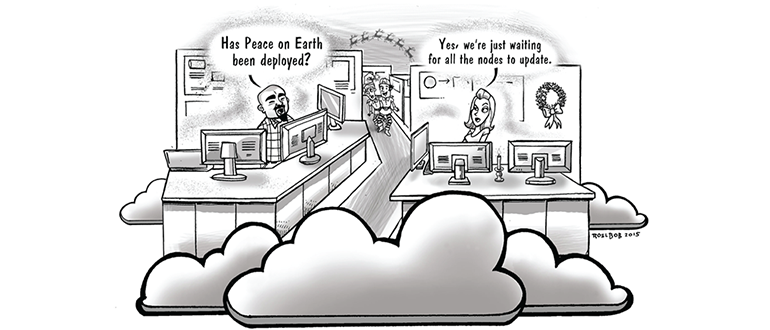
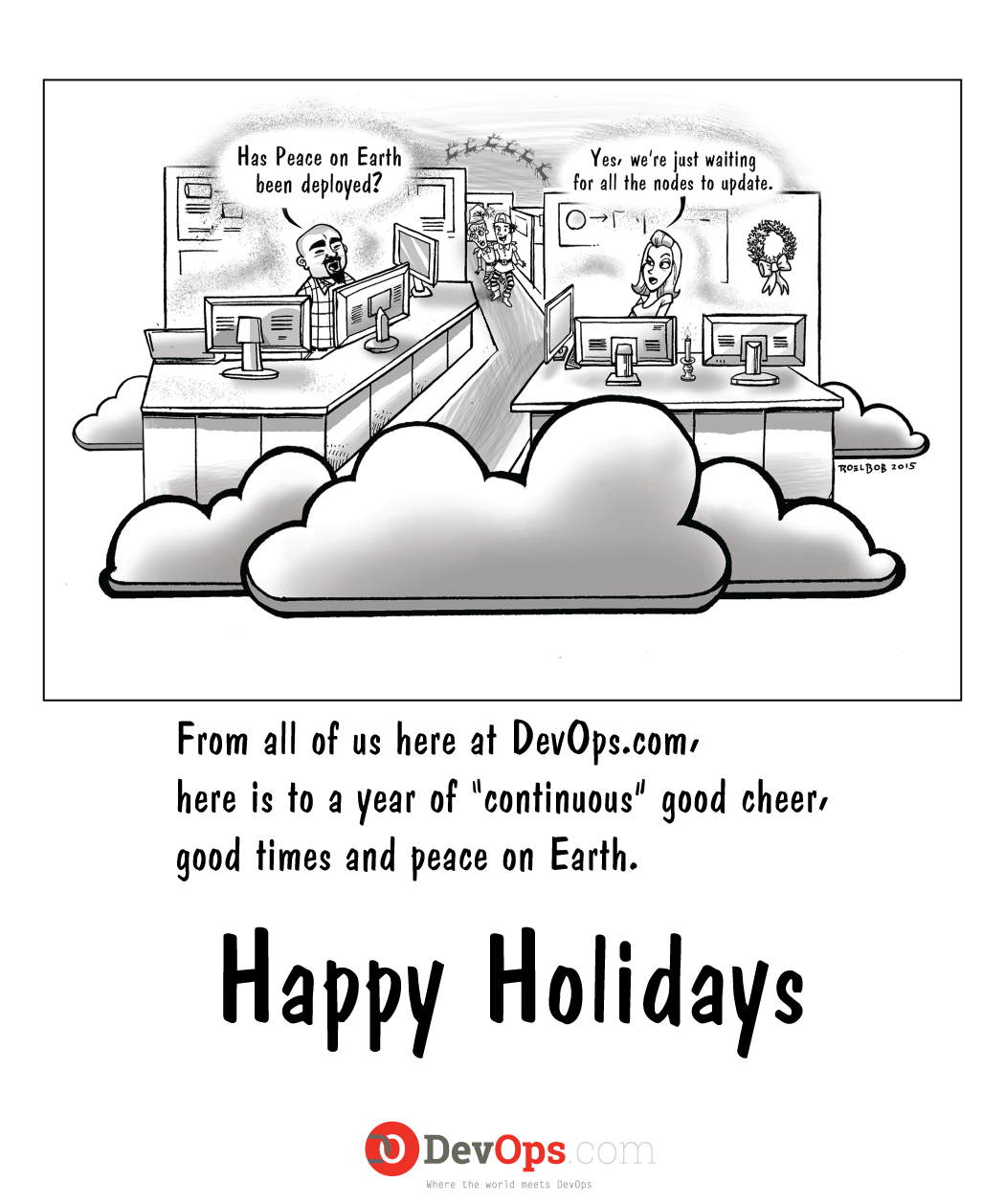
    We will be shutting down for the Christmas holiday tomorrow and will only publish lightly next week as we get ready to update the site for the new year. But we wanted to take a moment to share our holiday greetings card with you and wish you a year of continuous good cheer, good times and peace on earth!DevOpsComHolidayStandAlone02

  • DevOps Chat: Mustafa Kapadia, IBM DevOps Transformation Workshop

    DevOps Chat: Mustafa Kapadia, IBM DevOps Transformation Workshop

    I always enjoy listening and speaking with Mustafa Kapadia of IBM. Mustafa is one of the leaders of the IBM DevOps services team. As such he gets to work with dozens of different organizations in helping them on their DevOps journey. As a result Mustafa has amassed a ton of experience and knowledge on the correct patterns towards successful transformations.  He had developed a workshop around this that I think is a really great exercise for any organization thinking about DevOps to go through.

    I recently sat down with Mustafa for a DevOps Chat. We spoke to him about the workshop and process.  Below is the soundcloud audio of our conversation. Below that is a video of a workshop demo Mustafa recently delivered at our DevOps Connect: cdSummit SoCal event in Los Angeles this month.  I think you will find them both useful.

    Also the transcript of my conversation with Mustafa is below that.  Finally, below that is an interview I did with Mustafa at the recent DOES 15 event as well. Hope you enjoy.

    [soundcloud url=”https://api.soundcloud.com/tracks/237701095″ params=”auto_play=false&hide_related=false&show_comments=true&show_user=true&show_reposts=false&visual=true” width=”100%” height=”150″ iframe=”true” /]

    Transcript

    Alan Shimel:                And we’re here for another DevOps Leadership Chats. Today’s guest is Mustafa Kapadia of IBM. Mustafa, welcome.

    Mustafa Kapadia:       Thank you, Alan. Good to be here.

    Alan Shimel:                Yes. So Mustafa, of course you and I know each other for some time now. But for our audience who may not be familiar, what is your role with IBM right now?

    Mustafa Kapadia:       Sure. I am the service line leader for our DevOps Consulting Practice.

    Alan Shimel:                And a great job you do of it. I’ve seen you in action.

    Mustafa Kapadia:       Thank you.

    Alan Shimel:                Happy to have you here. Mustafa, one of the biggest issues we hear from executives of enterprises especially is well, this DevOps sounds great and we can understand how startups and smaller companies do it because they are doing it on a green field or from the get-go. But how do I turn the ship here? How do I get started in DevOps? How do we lead the transformation if you will?

    Mustafa Kapadia:       Yeah, Alan, that’s a good question. In fact, that is probably the most popular question we get asked from our clients.  DevOps has so many arms and legs and it’s so hairy and it’s such a big topic, getting started is hard and the way to get started to get the biggest bang for the buck is even harder. And that’s where we start bringing in something that we call value stream mapping exercise. And that really helps our executives figure out what is my end-to- end picture looks like? What are my bottlenecks? What are my low hanging fruit? And probably one of the most important outputs of the exercise is what are my metrics? What is it that I can improve through using DevOps?

    Alan Shimel:                Yet. And Mustafa, of course I’ve seen you talk about this and you have developed a whole workshop around this value stream method.

    Mustafa Kapadia:       That’s correct.

    Alan Shimel:                And recently we were out at our DevOps Connect CD Summit event in Southern California and you had an opportunity to actually do this live, right, on a white board. No slides or anything.

    Mustafa Kapadia:       That is correct.

    Alan Shimel:                But why don’t you kind of walk our audience, if you will, and again we don’t have a lot of time but let’s walk them through a little bit about what you do in this kind of workshop.

    Mustafa Kapadia:       Yeah. Well, first of all, Alan, thank you for inviting me to the Summit. It was actually great to catch up with you… It was great to be there and present… But to answer your question, what we start off with in a value stream mapping exercise is just ask the audience or ask our clients How do you do thing folks from point A to point B. Who does it? How many people does it take to do? How do you set up a DevOps environment? What kind of tools do you use? How long does it take? What processes do you use? And depending on how much time we have with our clients, we can go very deep, in the Summit itself, we were very high level since we only had an hour and a half. And what that does is A) Even for the clients, it gives them a complete point of view about how you actually get an idea to market from the time the development team starts coding to the time that it actually reaches the end customer or as we say, moves into production? And it in many ways it is simply a conversation. It’s a facilitated conversation with a goal in mind but it is a conversation about how do you do things and where are your problem areas? And in many cases, for a client, this might be one of the first times that development and operations are actually sitting down in the same room and talking to each other. In many cases, operations is a separate environment and then the development team has to go in and do their own stuff to get the environments ready, to be ready for the developers to start using it. So value stream mapping exercises in many ways is the first time that they are collaborating on the big picture. And that’s what DevOps is all about. It’s about getting the dev and the ops teams together.

    Alan Shimel:                Yep. And Mustafa, typically when you are doing these in the field with real live enterprise customers you’re dealing with, what’s the feedback from the executives that you are working with?

    Mustafa Kapadia:       The two that come to mind is that number one, most executives are amazed at how long it actually takes them to develop code and actually bring it out to the market. It is not uncommon in a large enterprise for the entire lifecycle from the time an idea has been generated and approved to the time that it actually meets the customer or the end-user. It could be as much as 300 days. We were at a bank in which it took them almost 390 days to get some type of a release out to the client. So number one, it’s first just – they are surprised at how long it takes. Number two is, the honest dialogue that they can generate, not just with us but more importantly within their own team, is probably the most valuable key of that exercise.

    Alan Shimel:                Agreed. And Mustafa, I know some people are listening and they’re saying oh great; here’s an IBM services guy who’s going to be pushing us to buy IBM product…But the fact is or maybe it’s not the fact, it’s my understanding the fact is that that’s not the case in this exercise in these kinds of engagements that you work in, correct?

    Mustafa Kapadia:       Yeah, definitely not. In fact, a lot of I would say close to 99% of the time, maybe even 100% of the time, we rarely talk about IBM tools or any system tools for that matter. It doesn’t matter if it’s open source, or if it’s proprietary. That exercise is more about understanding the…process and the…pain points. So it has nothing to do with IBM or it sets of tools but more about clients understanding the end to end workflow.

    Alan Shimel:                Yep. And so Mustafa, let me throw something else at you. I’m going to throw the big C word out there, culture. Because that’s the other thing we hear from execs, correct? How do I change my culture? So everyone talks about this DevOps thing being a cultural sort of leadership thing. How do I do that? What do you do – do you do anything around the culture as part of this exercise?


    Mustafa Kapadia:       We do, we do. So cultural behavioral changes, that’s what we call it here, is a big part of this exercise. Part of it is that I’ve mentioned earlier is people sitting down and talking and sitting down at a table and talking about the entire workflow. But the larger question is a lot of the cultural change happens is actually go through the transformation journey together. So instead of just the operations team doing their fees and development thing in doing their feeds, when we start putting solutions together for our clients, we bring both these teams together and sell the solution together that both of them can support. And that is where the cultural and behavior change starts happening. Not just what they’re doing but how they are doing it, how they are communicating. A lot of the change happens by doing as opposed to just somebody coming in and say well, you need to change or organize your structure this way or you need to put a new metrics and so on and so forth. Our customers that succeed in DevOps do it primarily by actually doing some of the stuff together as opposed to doing organizational realignment.

    Alan Shimel:                Makes sense. So Mustafa, my next question to you is sort of the classic consultant’s dilemma, right, and that you come in, you identify the pain points. You identify new processes, new ways of doing things. You advise the client. You may even stay there on a short engagement timeframe to hopefully see these things starting take root. But what happens after the consultant leaves? What’s the success rate of this stuff really taking hold?

    Mustafa Kapadia:       To be honest with you, a lot of the bread-and-butter at IBM in our service lines is actually what happens after the consult engagement. What we sit down with the client and actually help them execute the roadmap that we had developed together from A) building the platform to integrating disparate capabilities into the platform, supporting that platform and even training. In fact, one of the things that we are rolling out right now with some of our clients is actually training our customers, our clients, on how to start using some of these DevOps platforms tools and so on and so forth. So our longtail…believe it or not, is actually sitting down with the customer and helping them through the entire journey as opposed to just coming down and putting things down on PowerPoint. In fact, the consultant piece is a very small part of that business. Our real business is about hand-holding them through the journey.

    Alan Shimel:                Great. Makes sense. So Mustafa, we are coming close to our time limit but I have another question or two for you. I was on a webinar this afternoon with Gene Kim and lady named Shannon Leitz from Intuit. And it was on security DevOps. But we got a couple questions from the audience in there. It’s a reoccurring theme here at devopsy.kinsta.cloud. One gentleman wanted to know this is all fine and dandy for tech firms. But do you have any examples….chemical or energy-related firms that were doing DevOps? Of course, another person wanted to know did you have any white papers on financial related firms doing DevOps? And you and I were both at the DevOps enterprise. We saw all kinds of companies from presenting there…

    Mustafa Kapadia:       Yep, definitely.

    Alan Shimel:                But your own personal experience, Mustafa, is there a particular vertical that is more suited to adopt this or less suited to adopt these kinds of ways?

    Mustafa Kapadia:       Yeah… So the general rule of thumb is that anytime you have a system of engagement application, that is the best place for us or for you guys to start DevOps. That is where you get the biggest bang for the buck. And that is where this whole idea of being agile … to market makes a difference. Now, with that being said, there’s actually three key industries taking up or adopting DevOps faster than all the other sectors that we have within IBM. First is financial services. Second is retail and third is believe it or not, actually software development companies. So it’s these fast-paced companies that are trying to get some more features and product out to their customers and clients. We see those three sectors taking up DevOps or adopting DevOps much faster than the rest of the industry. But that doesn’t mean that the other parts of the industry are not doing it. In fact, we are right now working with healthcare clients. We’re also actually working with an energy client who is trying to figure out how to bring DevOps into their mix.

    Alan Shimel:                Excellent. The next question is I’m actually working on a report that I want to put out next month on my prediction for 2016 that this is the year of the great divide where we are really going to see the gulf widen between companies who are adopting DevOps patterns and not just DevOps but the Cloud, hybrid Cloud, big data, IOT, the open enterprise if you will versus companies who are sort of digging their heels in the sand… Do you think this is the year we see….real gulf starts opening up or old-style companies skate by still?

    Mustafa Kapadia:       Yeah, I unfortunately think it’s more of the latter than the former. I think some companies, especially in traditional industries, are still going to stick to their guns, so to speak, and think DevOps is just a fad. But then the industries that I’ve just talked about, I think those is where the gulf between the doers and the not doers is going to start widening especially when you get a retailer who can now push out enhancements to their e-commerce website, we’ll definitely see them picking up the benefits of DevOps as opposed to somebody else who just chooses not to do it. I think that’s where it’s going to happen this year or I should say next year. And then if that does happen it, 2017 becomes a really interesting year because that’s when everybody starts to catch up. A lot of our customers are trying to get on the ground in 2016 so they are not in bad shape in 2017.

    Alan Shimel:                I think otherwise it could be fatal to their business. Mustafa, one last question and I usually ask all my guests on the podcast near the end and we’ll let you go. For our leaders out there who are wanting to maybe dive deeper into DevOps or just want to lead the transformation at their organization, if you had to pick one book for them to read, what book would it be?

    Mustafa Kapadia:       Oh, that is a very tough question. There is actually a book called Competing Against Time. It was published in I believe 1975 by a managing partner at Bing. …While it doesn’t talk about software development or application lifecycle, it really talks about how you can start thinking about time as the element of competition. And it’s what other companies are doing or perhaps have done in the past to actually help you actually use time to kind of gain not just an advantage but almost an inhuman advantage over companies, right? So that one comes to mind…Dell comes in mind. This idea about DevOps is not a new idea. It’s new to IT. But the idea of us drinking time has been around for quite some time. And I really like that book because it kind of, a lot of the principles that we talk about now in software development can be found in that book in examples outside of IT and in other industries.

    Alan Shimel:                Fantastic. That’s a new one to our book list and great suggestion. And it just goes to show what’s old is new and some things never go out of style, right? Anyway…

    Mustafa Kapadia:       That is correct.

    Alan Shimel:                Mustafa, we are over our time, I apologize. It’s hard to do these things in 12 minutes. I apologize. But thank you so much for appearing on this episode of DevOps Chats. And thank you so much for helping us whether it be at CD Summit or DevOps Enterprise Summit or at so many locations we run into each other. Not to mention writing press here at devopsy.kinsta.cloud.

    Mustafa Kapadia:       Thank you. And Alan, you’ve always been generous and I appreciate that. I also, if I have a few seconds to make another offer to all of your audience. Three things, actually. So this value stream mapping exercise that we’re talking about in many cases, will actually do it for free for some of our clients so you guys can reach out to me. And Alan, you have my card…

    Alan Shimel:                Yes, we’ll put it in there.

    Mustafa Kapadia:       So that’s number one. Second is, we have this IBM conference call, Interconnect, which is in Las Vegas. It’s on 2/21-2/25. It’s a great way to learn about DevOps.

    Alan Shimel:                I will be there, Mustafa.

    Mustafa Kapadia:       And last year we had 300 or so DevOps sessions. Perfect, perfect.

    Alan Shimel:                Yes.

    Mustafa Kapadia:       And the last thing, if I’m not running out of time, is if you guys can’t wait until Interconnect, I actually publish a monthly newsletter and if you can just email me, I’ll be more than happy to put that on as well.

    Alan Shimel:                What’s the email, Mustafa?

    Mustafa Kapadia:       Email is M.A.Kapadia@US.IBM.com.

    Alan Shimel:                Fantastic. Mustafa Kapadia, IBM. Thank you so much for being today’s guest on DevOps Chats.

    Mustafa Kapadia:       Okay, thank you very much, Alan. I appreciate it.

  • DevOps Chat: 7 habits of successful DevOps

    DevOps Chat: 7 habits of successful DevOps

    I recently had a chance to speak again with Sam Guckenheimer of Microsoft about his experience in leading the transition for Microsoft Visual Studio to Visual Studio online. In doing so, Sam and his team developed the 7 habits of successful DevOps.  You can listen to my interview below or read along below that. Also if you want to download the Microsoft paper on the 7 habits of successful DevOps you can do so here.
    [soundcloud url=”https://api.soundcloud.com/tracks/234949072″ params=”color=ff5500&auto_play=false&hide_related=false&show_comments=true&show_user=true&show_reposts=false” width=”100%” height=”166″ iframe=”true” /]

    Hi, everyone—Alan Shimel, devopsy.kinsta.cloud, here for another DevOps Leadership Chat, and I’m joined today by Sam Guckenheimer of Microsoft. Sam, welcome.

    Interviewee:                 Hey, Alan. How are you doing?

    Interviewer:                 I’m doing well. It’s good to speak to you again. The last time we spoke was at the DevOps Enterprise Summit out in San Francisco.

    Interviewee:                 Yep, that was a lot of fun. That was a great conference.

    Interviewer:                 Yes, and you know what? I think—well, you contributed to making it great, Sam. It was a great presentation you made, talking about, kind of documenting the journey of Visual Studio from a COTS, you know, traditional kind of software model to a SaaS based program, Visual Studio Online. And, you know, I think that’s something that a lot of our listeners may be interested in, and how do they turn their current software offerings into SaaS based. And along the way, of course, you’ve come up with a, I guess you call it the Seven Successful Habits of DevOps?

    Interviewee:                 Yeah, so we think about the seven habits that we’ve applied as we’ve done our transformation. We started around 2010, we were in the, if you will, the pinnacle or the leader’s quadrants on all the analyst assessments as a provider of software for on-prem use in what was then called ALM—application life cycle management. And we said, “Hey, we need to become a great SaaS provider as well.”

    So we think of things in terms of these seven habits that we need to provide. Three of them you can think of as sort of Agile on steroids or second decade Agile. That’s team autonomy and enterprise alignment, is number one. We work in scrum teams or feature crews, think about 8 to 10 engineers and a product owner. They autonomously pull items from a common product backlog, and at the same time, they align to enterprise goals on a six month planning cycle, we call this a semester or a season, where we know, in that time frame, what are the needles we’re trying to move for the business? What are the things we’re trying to do at the epic level that count, and Sprintly we measure, how are we doing against that, and the things that each feature crew is doing are counting against that. They may move forward, they may move backward, they may decide, based on the data they’re collecting to do more or do something else. But you know, that’s in their control based on the things we’ve agreed for the six months.

    The second habit we have is a rigorous management of technical debt. We’ve known about technical debt for a long time, but when you’re running a service, you really can’t afford to let any debt creep in, and you have to stay clean all the time. So we make sure that we’re constantly monitoring both what’s happening in the production service and what’s happening in the development process. So if, for example, there is anything on the live site going wrong, we attend to it immediately. If there’s anything happening in the development process, like a feature crew is letting its bug count start to ride up, they have to stop immediately, fix the bugs, and can’t do any new work until they get them down to zero, so we stay clean on tech debt as we’re going.

    The third habit is a focus on the flow of customer value. We’ve talked about this since early days of Agile. Now, with SaaS, we can measure it. So we have great telemetry in the service, and we look at how people use our software, both quantitatively as we’re going forward; that is, we actually observe what gets used, what doesn’t get used, what the scenarios are, and we reach out to customers qualitatively, where we engage with the high usage accounts and we say, you know, “Let’s talk to them.” And we encourage our engineers to buddy up and reach out and say, you know, what’s gone well, what’s gone not so well, what would you like us to do that you don’t see? Are there things you wish for that we could be doing for you, and so on.

    So we reach out to customers, we listen to them through things like UserVoice and we observe their behavior through telemetry on a continual basis. That’s all kind of Agile on steroids.

    Interviewer:                 Mm-hmm.

    Interviewee:                 You know, those are the first three. Then you get to the stuff that’s really new with devops. The first is, of those, number four is what I’d call hypothesis driven development or a backlog that gets groomed with learning. This is what Eric Ries, in Lean Startup, calls “build, measure, learn.” So, in other words, the idea is that the backlog, instead of being the just, you know, what an omniscient product owner things is right, it’s—we recognize that it’s a set of hypotheses or beliefs. We think that these things will improve our service, but we’re gonna treat them as hypotheses and we’re gonna turn those hypotheses into experiments, and we’re gonna collect data against those experiments so that we can substantiate or diminish the hypothesis, and that data will be evidence gathered in production. That’s the fifth practice—everything is evidence that we need in order to build up or draw down against those hypotheses. We look, we use instrumentation on everything, we use telemetry on everything, and we measure it against what’s important.

    So, for example, if we think something’s gonna be a better sign of experience, we will run the new against the old in parallel, and we may, if we have multiple front doors, like in our case we have a web experience and an experience through the IDE, the integrated development environment, we’ll run those in parallel. So that would be a four cell test, you know? New and old, web and IDE, and we’ll see what the evidence shows us about how much better the new is than the old, and hopefully the new is better; it might not be. Hopefully we’re right, but sometimes we’re wrong. In any event, it’s the data that will tell us, and it’s a “bring your data” world.

    So, evidence gathered in production is our fifth habit, and that is made possible by our sixth, which is what we call a production first mindset, or what Satya, our CEO, calls a live site culture. The idea of a live site culture is that the site status is always first priority, and with site status, you have two goals. If there is a live site incident, you want to, as quickly as possible, remediate so that customers aren’t affected, and you want to drive to a root cause analysis. Practice the 5 Whys like Toyota, get to the root cause, and identify the actions that you need to take in order to prevent a recurrence of such an incident or something similar, and those root cause actions that you take, you need to complete in one or two sprints so that you’re hardening the service as you go learning from the live site incidents so that you’re always getting better.

    That’s number six, and finally, number seven is that we manage infrastructure as a flexible resource. We can do this because we use the public cloud—of course, in our case, that’s Azure. We work as a customer of Azure just like our external customers would. We take things a little earlier, but otherwise, we’re a customer when we need more resources for development or for load testing or to spin up more labs, we just do it.

    And we continue to expand the number of data centers we run, and we now run our Visual Studio Team Services in eight data centers around the world; that’s out of 24 regions that are currently active in Azure, and we fully automate the deployment, but we start each Sprintly deployment with a canary instance, which is where we work. It’s our own one of those stamps, and the one where our closest early adopter customers are so that we know from the canary if there’s anything wrong with the deployment, and if there is, we then restart at the canary before we roll out to the subsequent deployment rings. And that practice of canary-ing, going big with load testing is part of the deployment pipeline, and then using the automation to roll out in subsequent rings is something that we’ve used to harden the service and let us get to a global scale on a regular basis.

    Interviewer:                 Got it. So, Sam, these are obviously lessons learned the hard way, right, [Laughter] by doing and paying the idiot tax and doing that.

    Interviewee:                 Yes.

    Interviewer:                 For our leaders who are listening to you now, where to begin? Where to start? Obviously you can’t do all seven at once. Some of them are dependent on others. Where do they begin?

    Interviewee:                 Well, I think that the first thing is to make sure you have Agility down. I think you cannot do this if you are a command and control organization that doesn’t really let teams learn, and to recognize that you do need to measure your time to learning along with your other measurements, you also need to totally automate your release pipeline.

    So, the notion that you can have manual steps somehow between a development pushing code or checking in and the release of that is a thing of the past. You know, start with continuous integration and then quickly go to continuous deployment and put the telemetry in place so that you can see the evidence from production that gives you the feedback on everything that’s getting deployed.

                                        If you don’t have those things in place, the rest will crumble.

    Interviewer:                 Yeah, agreed.

    Interviewee:                 Sam, we unfortunately are coming up near the end of our time. I want to ask one more question of you, though, and it’s along the same vein. So, you’ve laid out the steps here for us. How did you get your team’s buy-in on this—or did you?

    Interviewer:                 Well, we certainly did. I don’t think it was very hard. I think that we all wanted to move to this world. I think that there was a broad recognition that we needed to become a first class SaaS provider. I think that there were some additional quirks in our case of being a great SaaS provider while we continue to be a great provider on-prem software, and maintaining that engineering discipline.

    The teams were all for it. I think the leadership needed to recognize that we were investing in new practices and that we needed to maintain the investment in engineering systems and engineering practices so we have a rule of thumb that about 20 percent of our investment goes toward non-customer visible engineering, things like live site work, and we don’t quarrel about that. If we need to do live site improvements, we do them.

    So I would say there was a little bit more work on management to accept the change in practices than there was on the ground with the engineering teams who were sort of chomping at the bit to get going.

    Interviewer:                 Well, there often is in devops, right? You have that “from the bottom up” and getting true top down sponsorship and cover is a problem, right? Not a problem that cannot be overcome, but an issue that we’ve explored previously in our leadership suite here.

    Interviewee:                 Yeah. Yeah, it helps that our, right now, our CEO comes from this world, Satya Nadella, so he is pushing everyone in the company to make the change and to learn the new practices. There were some folks in the middle who were not comfortable, necessary, but you know, they’ve come around.

    Interviewer:                 As they often do.


    Interviewer:                 Sam, anyway, we are probably over our time and I apologize, but thank you very much for sharing your Seven Habits for Successful DevOps. Continued success with your Microsoft Visual Online and the rest of your endeavors at Microsoft, and we hope to have you on again some time in the future and we can talk more about leading the transformation at companies around the globe with these new ways of doing things.

    Interviewee:                 Thanks, Alan. I’ll do one commercial, which, which is that there’s a URL, microsoft.com/devops, where you can download an e-book about our journey and a devops self-assessment if you want to read more.

    Interviewer:                 You know what, we’ll include that link in the article, too, in the transcript so people can get that. Sam Guckenheimer, Microsoft—thank you so much for being our guest today.

    Interviewee:                 Thank you very much, Alan.

    Interviewer:                 Okay, this is Alan Shimel for devopsy.kinsta.cloud. Thanks, and have a great day.

  • #DevOpsThanks, what are you thankful for

    #DevOpsThanks, what are you thankful for

    Here in the US this Thursday is our Thanksgiving holiday. Originally celebrated the 4th Thursday in November, it has expanded where most people also take off the following day, Friday, for a long weekend. In fact many schools here in the US close the entire week to celebrate this holiday commemorating the Pilgrims giving thanks for making it through their first year here in the New World with the help of their friends, the native peoples of America. It also marks the official start of the Christmas/New Years holiday season here.

    Beyond that though Thanksgiving always gives me a moment to pause, reflect and think about what I have to be thankful for.  Here at devopsy.kinsta.cloud we wanted to ask our readers, no matter where in the world you are, what you have to be thankful for. It could be something DevOps or IT related, it could be something unrelated. But if you tweet what you are thankful for and use the hashtag #DevOpsThanks our team will monitor and we are picking the top ten tweets to win one of our new DevOps T-shirts. So lets hear what you are thankful for this year.

    I wanted to take a moment and list a few things we are thankful for here at devopsy.kinsta.cloud

    1. Most of all we are thankful to you our millions of readers who have made our site successful and inspire us to keep pushing to bring the most and best DevOps related content.
    2. We are grateful for all of the DevOps practitioners who are the real heroes of this story; that are doing more, faster and better every day.
    3. We are extremely thankful for our 70 + sponsors whose support enables us to keep the lights on here and keep pushing with new ideas.
    4. We are thankful for our feature writers: Tony Bradley, David Geer, George Hulme, Ericka Chickowski and Chris Riley who have contributed so many great articles.
    5. For our 200 + contributors who have given the site its depth and voice with all of your great contributed articles.
    6. We are thankful that we live in such amazing times.  Where the commonplace would be considered miraculous just a few years ago. We couldn’t talk, learn and practice DevOps if not for all of the great technologies and advances that have come before it.
    7. We are thankful that in a time where our world on some days seems ready to blow up in conflict, our audience continues to grow not only here in the US (which is now a minority of our audience) but throughout the entire globe.

    On a personal note, I am grateful for the terrific group of people who have joined with me at devopsy.kinsta.cloud, who bought into a common dream of creating something new & great; who with me push the rope up the hill everyday to make it happen.  I am also grateful to my wife and kids, who don’t see me quite as often as they did before devopsy.kinsta.cloud but who are the reason I get up and do it everyday.  Most of all I am grateful to God or whatever you want to call him for giving me the chance to live a blessed life and the opportunity to meet such great people and do something I love for a living.

    So what about you? What are you grateful for? Tweet it on #DevOpsthanks for chance for a t-shirt.

  • DOES 15 – The 7 habits of successful DevOps

    DOES 15 – The 7 habits of successful DevOps

    Dipping back into the DevOps Enterprise Summit 2015 well, today’s feature is my talk with Sam Guckenheimer of Microsoft.  Sam presented on the transformation he oversaw at Microsoft’s Visual Studio moving to Visual Studio Online. It is the story of COTS to SaaS and all of the pitfalls and idiot taxes Sam and team paid along the way. 

    From this ordeal Sam and his team developed the 7 habits of successful DevOps. Like my earlier interview with Jeff Snover, it is a great peek into how things have changed in Satya Nadella’s Microsoft.

    Here is Sam’s complete presentation at DOES 15. Just a heads up that it is about an hour long, but I think well worth the time.

    If you like what Sam is talking about and want to learn how the 7 habits of successful DevOps can help you lead the transformation in your organization, stay tuned for podcast I just recorded with Sam that will be in our leadership suite next week. In the meantime you can download and find out more about Sam’s 7 successful habits here.

  • CA World 2015 wrap up

    CA World 2015 wrap up

    Just back to my room from the Sheryl Crow/Fall Out Boys concert that ended CA World 2015. It was a full two days of information and news showing how CA Technologies is evolving to remain relevant in the changing world of ITOps and Development. There was certainly lots of new things to report as CA has had a busy year. Among the highlights:

    Rally Software’s agile business is going to transform CA. While you didn’t hear or see the name Rally, you saw Agile everywhere.  From the large “agile transformation zone” to the frequent mentioning of agile ways and training by all of the executives there. The entire top cadre of CA management has undergone agile training according to CEO Mike Gregoire. Agile training is going to be a big part of CA’s business going forward. It represents an expansion from the core software shop business that CA is built on.  How this will effect relations with their channel partners who have traditionally delivered training and pro services around CA software tools, remains to be seen.  But in order to use CA’s portfolio of software, some training and transformation counseling will be necessary.  My prediction is that over the next 18 to 24 months the Rally culture is going to profoundly change CA for the better, making them more nimble, agile and delivering transformation change to their large enterprise customers.

    New leadership faces. While Gregoire himself is now one of the veterans of the exec team having been there about 3 years, much of senior management is new having just taken the reigns in the last few months. I had a chance to question Otto Berkes, CTO and Ayman Sayed, Chief Product Officer. While both have only been on the job for a few months each, they both seemed to have a firm grip on the companies road map and what the market is looking for.

    aymanSayed in particular seemed to have strong feelings about what the market is going to demand in the coming months and years, as well as a willingness to have CA deliver it. Among these is a change in how products are sold and delivered. CA had already started delivering some of their solutions as SaaS based solutions. Sayed went further saying that CA is going to move to a freemium model with some products. Not just a free trial period but actual free versions of their product and dare we say it, even open sourcing some code.

    This will mark a big departure from CA’s traditional enterprise sales force. But I think it is an idea whose time has come. Today’s technical buyers don’t like to be “sold to” or even marketed to. They like to be educated, they like to hear about problem solving, they like to try solutions and if they find they work they will buy these solutions without the hard sell that traditional enterprise sales team used to exert.

    Other new faces were the Xceedium team joining CA’s security team. My old friend Mo Rosen is aboard and Xceedium’s privileged identity management solution is being integrated with CA’s existing identity products to create a full spectrum of choices both host-based and in the cloud.

    The idea of solutions that work both on premises and in the cloud is another big theme at today’s CA. They recognize that for the foreseeable future hybrid environments will rule.

    ottoaymanOf course DevOps was everywhere. It has been and remains one of the foundational aspects of CA’s business model. In listening to several sessions on DevOps at CA it also became clear that CA is using DevOps to expand their business from tools for IT operations to providing developers with tools for the total software development lifecycle.

    Among these developer tools API and API management is big business at CA. Their API and APM business lines are both leaders in their markets. CA seeks to use these best of breed tools to expand their customers use of CA portfolio products.

    I also had a chance to speak one on one with GM of the DevOps business at CA, Mike Madden.  Madden comes from the mainframe division over to DevOps and he recognizes that in todays bi-modal or variable speed IT world DevOps and mainframes actually work together. Madden has a good vision of what DevOps is and what CA needs to do to remain and grow their relevance in the market. He is also a big fan of the agile business from Rally and I think we will continue to see that as a big part of the DevOps business.

    This years CA World was considerably larger than last years event. When you think about it CA World is really different than many other conferences. Just about all of the 5000 attendees are CA customers. The idea is that attendees already use CA product, they are primed to perhaps buy more.

    It will be interesting to see what changes are in store and what next years CA World will look like. A sure bet is that DevOps will continue to play a major part of the CA story.

  • DOES 15 – Jason Josephy and Courtney Kissler, Nordstrom

    DOES 15 – Jason Josephy and Courtney Kissler, Nordstrom

    Few verticals have seemed to embrace DevOps as quickly as the retail sector. Macys, Target, Nordstrom, WalMart and more have all demonstrated success adopting DevOps patterns and culture.  We spoke to many of the folks from these retailers at the recent DevOps Enterprise Summit 2015 (DOES 15).  Here is my interview with Jason Josephy and Courtney Kissler of Nordstrom.

    I spoke to them right after they came off the stage where they showed a 20% improvement in cycle times year over year. This translated into significant savings to the company.  Courtney has presented at DOES 14 so like many other presenters at this years event, this was an update on what happened since they last presented.  It is a great interview, have a listen:

    Here is a link to their actual presentation:
    DOES15 – Courtney Kissler & Jason Josephy – Mindsets and Metrics and Mainframes… Oh My!

    Stay tuned over the coming weeks as we will post more of our devopsy.kinsta.cloud exclusive interviews with many of the speakers and attendees of DOES ’15

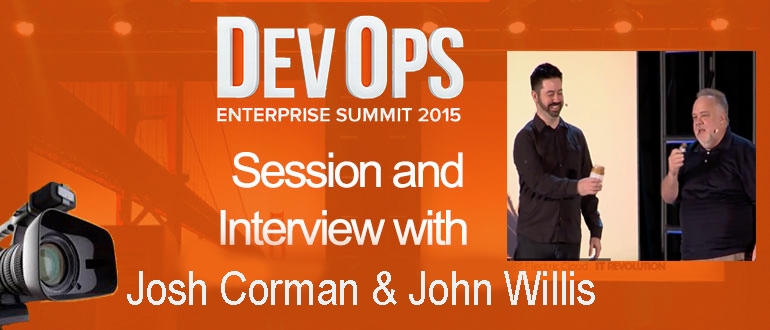
  • DOES 2015 – Josh Corman, John Willis on Immutable Awesomeness

    DOES 2015 – Josh Corman, John Willis on Immutable Awesomeness

    Continuing recapping my favorite sessions of DevOps Enterprise Summit 2015, here is Josh Corman and John Willis talking about Immutable Awesomeness. What is Immutable Awesomeness you ask? Have a listen to my interview with John and Josh and then listen into the actual session where they go over it.

    Just a couple of hints: 1. Software supply chains are a great way to look at your development/deployment process 2.In a world where software controls everything, it really is a case of life and death 3. If you can’t get excited about what this all means, listen to the session again.

    Of course what makes this interview and session great is the unbridled enthusiasm that both John and Josh bring to the subject. In fact there was a palpable buzz in the theater when they walked off the stage and over to my video studio. The same enthusiasm carried over to our interview too. It was a lot of fun to interview these two.

    So have a listen and enjoy. Also if you enjoy John Willis presenting, he will be headlining the DevOps Connect: cdSummit SoCal on December 3rd, joining some other great speakers.

    Here is John and Josh’s actual presentation: