Tag: vmware

  • VMware Looks to Accelerate App Migration to the Cloud

    VMware Looks to Accelerate App Migration to the Cloud

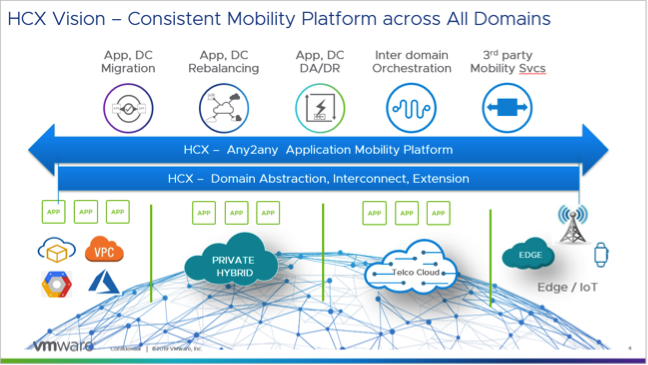
    VMware this week expanded the scope of its cloud migration efforts to include workloads that aren’t running on its virtual machine. VMware HCX leverages replication and virtual machine mobility technology to make it easier to automate the migration of either VMware-based workloads or those running on rival platforms to the latest generation of VMware platforms.

    Previously, VMware only offered this migration capability as part of larger services offerings that were focused on only migrating workloads running on VMware platforms. Allwyn Sequeira, senior vice president and general manager of the Hybrid Services Business Unit at VMware, said VMware HCX not only extends that capability to orphaned platforms such as Open Stack and Kernel-based Virtual Machines (KVM), it also marks the first time VMware has offered this migration tool as a separate, standalone offering.

    Sequeira said VMware HCX provides an opportunity for organizations that have committed to a platform other than VMware to reconsider their options. VMware HCX provides a way to migrate thousands of virtual machines at a level of scale that significantly reduces the amount of time to make that transition, he said.

    In some cases, Sequeira said customers have already employed VMware application migration tools to lift and shift thousands of virtual machines into cloud computing environments such as Amazon Web Services (AWS) in a few weeks. Overall, the rate at which those migrations are occurring has doubled every quarter for the last six quarters, he added.

    VMware HCX is based on virtual machine mobility technology developed by VMware combined with a similar cross-platform workload migration technology the company gained in its acquisition of CloudVelox early last year. VMware HCX now provides organizations with the option of migrating virtual machines programmatically via an application programming interface (API) or via a graphical user interface (GUI).
    VMware HCX

    There exist multiple tools for migrating workloads into any number of cloud computing platforms. Many organizations are also taking advantage of Docker containers to encapsulate entire workloads so they can run on any platform. Deciding which path to pursue most often comes down to the level of integration required with the various services available on the targeted cloud migration platform.

    In the meantime, as workload migration tools become more sophisticated, decisions regarding where workloads need to run are becoming less concrete. Competition for new workloads between platform vendors has always been especially fierce, and it used to be that once an IT organization made its decision, it was unlikely it would change its mind, given the effort needed to swap one platform out for another. Now, however, as application workloads become more portable, competition among platform vendors will only increase as they seek to convince IT organizations to shift existing workloads onto a different platform.

    In general, that increased level of competition bodes well for DevOps teams, who are usually among the strongest advocates for change within any IT environment. The issue now is deciding which platforms within those already-cluttered IT environments make the best candidates for rationalization.

    — Mike Vizard

  • VMware Adds Cloud Automation for DevOps

    VMware Adds Cloud Automation for DevOps

    Those who follow my blog will recall that I covered (and did some work for) CloudCoreo, a cloud security and compliance start-up. What the company was working on was intriguing to me because it pulled many things into the realm of DevOps through automation at a time when cloud security was a big issue.

    It’s still a big issue, and the former CloudCoreo product has been enhanced and integrated into VMware’s growing DevOps infrastructure as VMware Secure State. I hopped on a call with Jason Needham, senior director of product management, multicloud security at VMware, to get an idea of what was new and how the product was integrated with VMware’s other offerings.

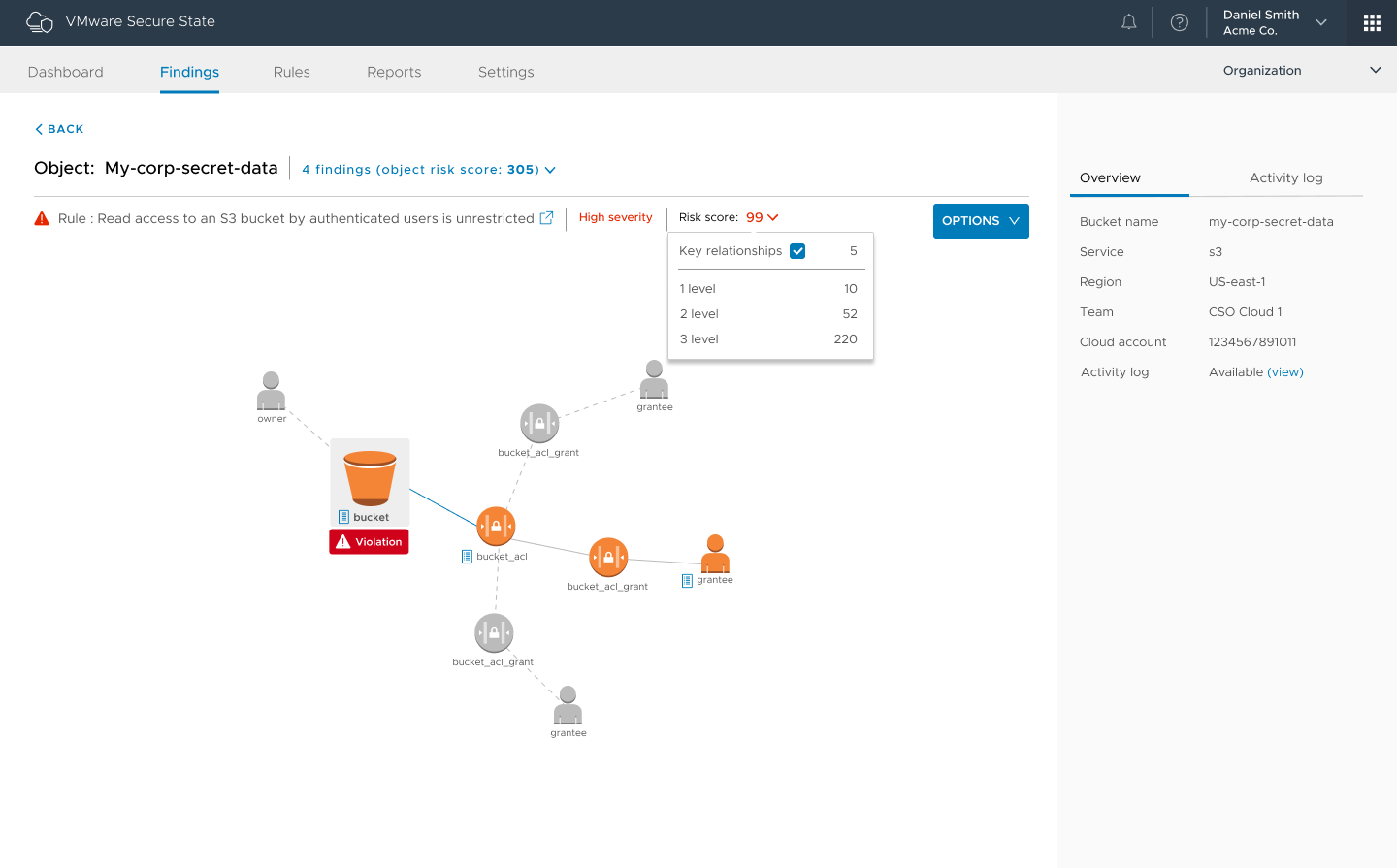
    We’ll get the thing that will interest every risk manager out of the way first. Secure State can tell you about buckets and their current security settings. It can tell you how to fix them. Considering the number of high-profile leaks caused by insecure buckets, I figured I’d mention that even before I talked about how Secure State fits with other VMware offerings. You’re welcome.

    Figure 1: Of the many violation chains available in the product, “authenticated user” buckets are one of the coolest, IMO.

    Secure State is part of VMware’s Cloud offering (grouped with CloudHealth and WaveFront), bringing security and compliance to multicloud. The cool bit is the level of automation, which allows teams to include cloud infrastructure security and compliance with DevOps efforts. That is where the world is headed, and VMware Cloud sees a greater level of DevOps automation than most alternatives just because it was conceived with APIs aimed at automation in the first place. Adding checks for rights and security settings, even compliance, into the DevOps cycle is breaking down one last wall (now we’re basically waiting for someone to do something astounding for cloud storage).

    Part of Secure State is near real-time reporting on status/state. This is big in environments that have real-time reporting for everything else, adding in the one missing piece. It is far better to be told, “There is a problem right now with instance X,” than to be fighting attackers. One of the examples Needham offered was of a project that was used via a small subset of tools: One day a report came in that it was being accessed via JVM instead of the normal methods. In this case, it turned out to be a new developer trying to get work done, but you can imagine such a warning being a heads up that you had an attack going on.

    The other interesting bit is risk scoring, officially known as Smart Risk Scoring. The ability to get a prioritized risk list allows DevOps teams to focus on what is most important. When there is so much for security to get done, this is a huge benefit.

    Disclaimer: I haven’t used this version of the product. That means I can’t say “This rocks!” but if Secure State delivers, it certainly will.

    Anything that adds automation and visibility is a welcome addition to the DevOps stack, making life easier and helping you to rock it.

    — Don Macvittie

  • VMware to Acquire Avi Networks for NetOps Capability

    VMware to Acquire Avi Networks for NetOps Capability

    VMware announced it intends to acquire Avi Networks for an undisclosed price as part of an ongoing effort to close the gap between network operations (NetOps) and DevOps.

    Once this deal closes, sometime between now and August, VMware plans to add a software-based load balancer, along with a web application firewall (WAF) and a service mesh to its network virtualization software portfolio.

    Tom Gillis, senior vice president and general manager for the networking and security business unit at VMware, said the goal is ultimately to make it as simple to deploy applications in an on-premises IT environment as it is on a public cloud by enabling IT organizations to automate the provisioning of network resources exposed via the VMware NSX network virtualization overlay. Avi Networks will extend those capabilities by adding a high-performance programmable load balancer, which eliminates reliance on legacy load balancers based on proprietary hardware platforms that are both expensive and rigid.

    Gillis said VMware will then infuse the WAF technology developed by Avi Networks into its network overlay platform to further secure east-west traffic in the data center.

    Finally, VMware intends to marry the service mesh technology from Avi Networks that supports a high-performance ingress controller with its ongoing efforts to integrate the open source Istio service mesh with NSX.

    Once all that work is completed, Gillis said it should be possible to deploy a workload on any platform with a single click. The challenge organizations face today is that provisioning and securing the network resources required to deploy an application outside of a public cloud computing environment still takes multiple days to sometimes weeks. VMware has already signaled its intention to make NSX network overlays available across multiple clouds and on-premises IT environments.

    Avi Networks CEO Amit Pandey noted that both companies are on a similar trajectory to leverage x86 processors to eliminate reliance on proprietary networking hardware. That shift to software-based networks and security services is driving the biggest transformation in the data center in the last 25 years.

    In terms of leveraging application programming interfaces to automate the provisioning of networks, it’s clear networking technologies have been lagging behind advances made in both compute and storage infrastructure. The challenge and the opportunity vendors such as VMware now see is the ability to more holistically manage IT environments spanning from the network to the application. As part of that strategy, VMware has been making a string of acquisitions to extend its core virtual machine franchise.

    It’s still too early to say whether all those investments will pay off for VMware. Reliance on VMware technologies in public clouds is relatively slight compared to the dominance VMware has today in on-premises IT environments. VMware is banking that its ability to extend the reach of its portfolio to foster the development of hybrid cloud computing, which is strongly anchored around on-premise IT environments that still run the majority of the workloads in the enterprise, will prevail.

    — Mike Vizard

  • Dell Technologies Drives Automation Deeper into Platforms

    Dell Technologies Drives Automation Deeper into Platforms

    Dell Technologies this week launched a series of initiatives intended to provide IT organizations with multiple deployment options for Dell EMC appliances and servers, including forthcoming managed service offering through which Dell will manage private cloud platforms based on VMware software on behalf of customers.

    Announced at the Dell Technologies World 2019 conference, Dell EMC also unveiled a new appliance series and revealed an alliance with Microsoft under which its VMware arm will make available cloud software on the Microsoft Azure cloud, in addition to existing support for Amazon Web Services (AWS), IBM Cloud and servers deployed on-premises.

    Jon Siegal, vice president for product marketing for converged platforms and solutions at Dell EMC, said Dell EMC plans to make it easier for IT organizations to consume IT infrastructure in an on-premises IT environment as a service or continue to use their capital budgets to acquire servers and appliances.

    To advance that latter approach, Dell EMC is launching VxFlex, a set of appliances that include an operating system that enable compute, storage and networking separately. In contrast, the existing VxRail series of appliances are optimized for VMware and assume compute, storage and networking will be scaled in tandem, said Siegal. Dell EMC is also now unifying a set of hyperconverged appliances and converged infrastructure servers under a common VxFlex brand, and Siegal said in the future those offerings will be extended to add support for Kubernetes alongside platforms from vendors other than VMware.

    At the same time, Dell EMC is previewing a VxRail Analytical Consulting Engine (ACE) that will be embedded in VxRail HCI system software that Dell EMC provides in its appliances optimized for VMware. That analytics engine employs machine learning algorithms to maximize application performance, while also providing self-optimization recommendations and capacity forecasts.

    The Dell Technologies Data Center-as-a-Service offering, meanwhile, is scheduled to be generally available in the second half. It marks the first time Dell has launched a managed service under its own brand. VMware, however, has been providing managed services for the past year. The Dell Technologies Data Center-as-a-Service offering extends that concept to include Dell EMC VxRail appliances.

    Automation is clearly at the heart of the evolving Dell Technologies strategy. The challenge organizations that have embraced DevOps will face is aligning their processes with the automation frameworks Dell Technologies is embedding in both VMware and the underlying infrastructure on which VMware gets deployed. To address that issue, Dell Technologies over time will bundle frameworks such as the open source distribution of the Pivotal platform-as-a-service (PaaS) environment from Pivotal Software, an arm of Dell Technologies, on its platforms, Siegal said.

    These moves signal Dell Technologies is trying to fulfill a promise to make it as easy to manage IT infrastructure deployed in an on-premises IT environment as it is to manage on a public cloud. There’s obviously still a gap. But as Dell Technologies starts to make IT infrastructure available as a service, it may one day become challenging for DevOps teams to tell where any one cloud happens to be running at any given moment.

    — Mike Vizard

  • VMware Drops Managed Cloud Onto Dell EMC Appliances

    VMware Drops Managed Cloud Onto Dell EMC Appliances

    At the Dell Technologies World conference, VMware today announced it will make available an instance of its managed cloud platform on appliances from Dell EMC in the second half of this year.

    VMware Cloud for Dell EMC is a turnkey platform that combines VMware compute, storage and networking software in a single offering managed and updated by VMware on behalf of its customers. It is similar to VMware Cloud for AWS, a managed service that VMware provides for Amazon Web Services, said Wei Wang, director of product marketing for VMware.

    VMware Cloud for Dell EMC represents the first commercial instance of Project Dimension, an initiative launched last year that promised to make available a software-defined data center (SDDC) as a managed service for on-premises IT environments in an effort to “ruthlessly automate IT.” In addition to supporting VxRail appliances from Dell EMC, VMware plans to make available instances of Project Dimension on other platforms, Wang said.

    Pricing for the managed service initially will be based on a flat monthly subscription, but Wang said VMware plans to provide a metered option that will enable customers to pay for VMware Cloud for Dell EMC on a pure consumption basis.

    In the meantime, VMware Cloud for Dell EMC, coupled with VMware Cloud for AWS, will provide IT organizations with a consistent control plane across a hybrid cloud computing environment based on vSphere, vSAN and NSX software that virtualizes compute, storage and networking, noted Wang. VMware is already managing infrastructure running more than 25 million workloads on AWS, a number that is expected to increase substantially as it rolls out instances on Project Dimension on additional public clouds including Microsoft Azure and on-premises IT environments.

    By opting to rely on VMware to manage IT infrastructure, organizations should be able to shift more of their own internal IT resources toward developing and deploying more applications. The VMware approach also potentially reduces the scope of the operational challenge many organizations now face when trying to manage virtual compute, storage and networking software in tandem.

    The challenge those organizations will face is implementing a set of best DevOps practices that match the cadence of the updates being made to the IT environment by VMware. It’s not clear to what degree organizations will want to relinquish operational control over IT infrastructure to VMware. Historically, roughly a quarter of all IT is consumed as a managed service usually provided by an IT services firm, but as vendors such as VMware begin to offer those managed services, the number of organizations that might switch to the model may increase.

    Many organizations already rely on cloud service providers such as AWS to manage infrastructure on their behalf. This latest offering essentially extends that same concept to on-premises IT environments.

    The degree to which organizations will save money by relying on a managed service is going to be difficult to quantify. In some cases, relying on a managed service might prove more expensive, while in other cases the savings on IT administrators alone might pay for the service. Whatever the path chosen, the number of workloads that will running on IT infrastructure managed by vendors such as VMware will increase sharply in the months and years ahead.

    — Mike Vizard

  • VMware Doubles Down on IT Automation

    VMware Doubles Down on IT Automation

    VMware this week moved to inject application and operating system monitoring capabilities into the VMware vRealize cloud management platform to make it easier to employ dashboards to map the relationships between applications and the underlying IT infrastructure they run on.

    In addition, VMware enhanced its capacity optimization tools to enable IT teams to run “what if” scenarios based on the amount of IT infrastructure available both on-premises and in the cloud. The company also embedded integrated compliance and automated drift remediation capabilities into VMware vSphere.

    Finally, VMware added support for VMware NSX Data Center network virtualization software to the VMware vRealize Automation platform, and instances of Kubernetes clusters can now be seen by VMware vRealize Network Insight tools.

    Taruna Gandhi, director of product marketing for the VMware Cloud Management business unit, said these efforts are part of a continuing initiative to drive intent-based computing that leverages automation across a software-defined data center (SDDC).

    VMware views application and operating system monitoring capabilities as being critical tools for making informed decisions about those intents, said Gandhi. However, these tools are not intended to replace the need for classes of management technologies such as application performance management (APM) platforms, she said. Instead, VMware envisions using dashboards to more efficiently troubleshoot issues based on metrics gathered by Telegraf agents embedded in VMware vRealize. In effect, IT teams will be able to identify anomalies faster versus wasting time in “war rooms” trying to prove the innocence of any element of an IT stack.

    VMware is pursuing a dual strategy where DevOps and automation are concerned. The VMware vRealize framework can be invoked either through application programming interfaces (APIs) or a graphical user interface (GUI), which tends to appeal more to traditional VMware administrators who don’t have extensive programming skills but still need to respond to rapidly changing IT operation environments.

    Thanks to automation, operational costs are falling considerably, according to VMware. A report from Forrester Consulting commissioned by VMware found organizations that have adopted vRealize have seen a 30% productivity improvement and a 93% reduction in unplanned work. That same report also noted that, thanks to capacity optimization, VMware customers have also seen a 20% reduction in hardware cost savings, a 10% reduction in storage costs, and a 50% reduction in database software licensing costs.

    In most cases, VMware is employing machine learning algorithms to automate IT operations whenever possible within its cloud management suite. But Gandhi said VMware is hesitant to embrace the term “AIOps” until it becomes clearer how employing machine learning algorithms represents a new class of IT management tools rather than an ongoing set of enhancements to existing management frameworks.

    Whatever the outcome, it’s apparent that algorithms are here to stay. How much they will be employed to advance adoption of best DevOps practices across the enterprise, however, remains to be seen.

    — Mike Vizard

  • VMware Advances Hybrid Cloud Ambitions

    VMware Advances Hybrid Cloud Ambitions

    VMware today advanced its hybrid cloud strategy by making a series of updates to existing offerings, including the CloudHealth by VMware software-as-a-service (SaaS) application for managing and optimizing cloud applications, which VMware acquired last summer.

    In addition, VMware Cloud on AWS is now available in data centers operated by Amazon Web Services in Canada, Paris and Singapore, the company noted. VMware also announced that the latest version of VMware Cloud Foundation—which provides and automatically updates all the VMware compute, storage and networking software required to build a cloud—has been optimized to deploy VMware Horizon virtual desktop infrastructure (VDI) software, and will available on Dell EMC VxRail hyperconverged infrastructure in April.

    New capabilities being added to CloudHealth by VMware include enhanced multi-cloud reporting, multidimensional reporting and workspaces reporting.

    The CloudHealth platform also is now integrated with the Wavefront by VMware cloud analytics and monitoring platform, enabling users of CloudHealth to employ Wavefront metrics to rightsize and optimize applications running on multiple cloud applications as part of their DevOps practices.

    A future update to the CloudHealth platform will add enhanced amortization as well as support for convertible Reserved Instance (RI) exchanger automation, container cluster visibility and cross-family rightsizing for Amazon EC2, according to the company.

    Finally, VMware announced it is making available version 9.7 of VMware vCloud Director to cloud service providers. This offering provides a single pane of glass through which multiple VMware environments can be managed regardless of whether they are deployed on-premises or in the cloud. The latest version of VMware vCloud Director adds support for version 3.0 of VMware Cloud Availability, which unifies onboarding, migration and disaster recovery services between multi-tenant clouds. VMware vCloud Director is only available to cloud service providers, but Ajay Patel, senior vice president and general manager for the cloud provider software business unit for VMware, said VMware and its cloud service provider partners plan to make available a software-defined data center (SDDC)-as-a-service offering through which they will manage deployments of VMware from the edge to the cloud on behalf of IT organizations.

    VMware also revealed there are now more than 60 partners building or delivering managed service offerings for VMware Cloud on AWS, and more than 280 partners have achieved the VMware Cloud on AWS Solution Competency. VMware also now has 35 VMware Cloud Provider Program partners that have achieved Cloud Verified status, which is required to be eligible to deliver the forthcoming SDDC-as-a-service offering. Patel also revealed the number of organizations running instances of VMware on public clouds now exceeds 1,000, in the wake of the launch of VMware Cloud on AWS last year.

    Patel said the shift to hybrid clouds is more about transforming IT operational models than it is about deploying workloads at new physical locations. The challenge many IT organizations will need to come to terms with going forward is deciding what portions of that IT operational model they want to run themselves versus opting to rely on VMware and its partners.

    — Mike Vizard

  • VMware Brings NSX Network Virtualization into DevOps Realm

    VMware Brings NSX Network Virtualization into DevOps Realm

    At the Mobile World Congress (MWC) 2019 conference, VMware moved to bring network virtualization into the realm of DevOps by adding support for a declarative programming model and JSON data formats to version 2.4 of NSX-T.

    In addition, VMware is making it possible to use the open source Ansible automation framework to deploy NSX-T.

    Finally, VMware is adding support for IPv6 as well as the ability to now extend microsegmentation all the way to Layer 7 of the application stack.

    Jonathan Morin, product marketing manager for NSX at VMware, said this release of NSX-T not only will become the dominant version of NSX for VMware in the enterprise, it also represents a concerted effort to make network virtualization directly accessible to both developers and IT operations teams alike. JSON support is critical from that perspective because it makes it easier to programmatically replicate the networking requirements and security controls attached to any class of applications.

    Longer-term, JSON support will also make it easier for a wide variety of management tools to consume metrics generated by NSX-T.

    IT organizations must determine to what degree they want to fold network operations into DevOps. Some organizations will simply prefer to provide developers with access to self-service virtual networks, while others will move to expose the declarative application programming interfaces (APIs) in NSX-T 2.4 directly to developers, said Morin.

    VMware expects that, going forward, a hybrid method for deploying and managing NSX will emerge. Developers will want to programmatically invoke network resources as they build and deploy applications. But network administrators will need to be able to access tools to manage those virtual networks over time. To facilitate that process, the latest version of NSX-T has been updated to add support for an HTML5-based user interface. The goal is to not just distribute NSX-T, but also make it accessible to everyone, said Morin.

    Rather than requiring organizations to upgrade switches and routers to enable programmability, VMware has been making a case for employing network virtualization to create a programmable overlay. That approach serves to make the underlying physical network agile enough to be employed with a DevOps framework without requiring organizations to upgrade the entire physical network.

    In many ways, networking represents the last major frontier to which DevOps processes need to expand. It’s possible for developers to spin up a virtual machine in the cloud or in an on-premises environment in seconds. But it can still take weeks to manually provision the networking resources in an on-premises environment that a virtual machine requires. VMware has been advocating for the deployment of instances of NSX in both on-premises IT environments and in public clouds to provide a consistent network overlay that can be programmatically invoked and automated.

    It remains to be seen to what degree network operations will be pulled into DevOps processes going forward. But the one thing that is clear is that IT organizations have the option to decide to what level they might want to achieve that goal.

    — Mike Vizard

  • VMware Wavefront Adds AI, Distributed Tracing

    VMware Wavefront Adds AI, Distributed Tracing

    VMware has updated its Wavefront monitoring service to include support for distributed tracing along with anomaly detection capabilities enabled by machine learning algorithms.

    Stela Udovicic, senior director for product marketing for Wavefront by VMware, said the addition of the distributed tracing support, now available as part of a public beta, means that a single monitoring service now can provide metrics, histograms and the tracing function required to provide a holistic view of the IT environment. Those capabilities eliminate the need to employ multiple services to achieve the same goal, she noted.

    In contrast, Wavefront makes it easier to search for traces containing a specific service or application programming interface (API) to determine which ones have errors or long response time. Additionally, DevOps teams can filter the trace search to show traces containing spans from a given cluster or shard.

    At the same time, VMware is adding an AI Genie capability that promises to make it easier to troubleshoot existing needs and identify future application and IT infrastructure requirements, said Udovicic. That data is collected in real time and presented in a way that allows even the most novice users to visualize using analytics tools built into the Wavefront services, added Udovicic.

    Wavefront is based on an agentless architecture that in part makes it possible for the service to process millions of metrics, histograms and traces per second. That capability is especially critical in IT environments that have embraced microservices based on containers that tend to expand across an enterprise IT environment, said Udovicic. Wavefront already supports Kubernetes clusters.

    In general, Udovicic noted that developers tend to embrace a variety of open source approaches to monitoring applications as they build their applications. But a SaaS application such as Wavefront makes it easier for enterprise IT organizations to apply monitoring across a broad range of applications. To facilitate that transition, Wavefront provides an OpenTracing/OpenCensus compliant solution that includes a drop-in replacement for the Zipkin and Jaeger distributed tracing software, which is at the core of many open source monitoring tools.

    VMware is clearly betting that increased reliance on AI will push organizations toward relying more on cloud services. Machine learning algorithms require access to massive amounts of data before they can construct AI models capable of accurately predicting events. The cost of collecting and storing all that data, plus the expertise required to train the AI models, are beyond the capabilities of most DevOps teams.

    Most enterprise IT organizations have applied monitoring tools to only their most critical applications, mainly because of cost concerns. But as applications based on microservices proliferate across the enterprise, it’s becoming apparent that all the dependencies that will exist between various application services will need to be continuously monitored. The only issue now is determining how best to achieve that goal as part of an integrated set of DevOps processes.

    — Mike Vizard

  • VMware Extends Scope of Alliance with IBM

    VMware Extends Scope of Alliance with IBM

    On the heels of IBM announcing its intent to acquire Red Hat, VMware announced at the VMworld Europe 2018 conference this week an extension of its longstanding cloud alliance with IBM.

    Red Hat competes directly with VMware; yet, there are also more than 1,600 customers running VMware on the IBM cloud. Ajay Patel, senior vice president of product development for cloud services, said VMware remains committed to the IBM cloud alliance even while its relationship with Amazon Web Services (AWS) continues to expand.

    VMware and IBM jointly announced this week they have opened Joint Innovation Lab and that IBM Cloud Private Hosted can now be installed on VMware vCenter Server on IBM Cloud. In addition, IBM Cloud for VMware Solutions are now integrated with the IBM Cloud Kubernetes Service. IBM is also adding support for VMware NSX-T Data Center to provide VMware customers with access to a network virtualization (NV) overlay on IBM Cloud.

    In addition, VMware vRealize Operations automation software is now available on IBM Power Systems, and VMware will use the IBM Watson cognitive computing platform within VMware customer support portals.

    Despite the obvious tension between VMware and Red Hat and IBM and AWS, Patel noted that VMware has more customers running on the IBM cloud service than any other cloud environment. In addition, IBM, VMware and Red Hat all are committed to advancing Kubernetes. Point of fact: VMware, separately at the conference, announced its plans to acquire Heptio, a provider of management tools for Kubernetes and added support for Kubernetes running on top of VMware virtual machines in version 3.5 of VMware Cloud Foundation.

    VMware, via its alliance with IBM, is making a case for enabling customers to run stateless components of an application on Kubernetes, while maintaining stateful components such as databases on virtual machines, which provide better support for persistent storage.

    IBM said it intends to treat Red Hat as an independent subsidiary capable of making independent alliances, in much the same way VMware operates as an independent unit of Dell Technologies. It may take a while for IT organizations to get used to navigating strange-bedfellow relationships in the era of the cloud; for example, Red Hat has an extensive relationship with Microsoft that spans both Microsoft Azure and on-premises IT environments.

    What remains to be seen is the degree to which DevOps teams will navigate conflicting vendor alliances in isolation from one another instead of trying to unify the management of all those clouds under a common framework. A recent IDC report finds that while most customers (64 percent) are employing multiple clouds, the degree to which those clouds are interoperate varies widely. IDC finds that only 24 percent of IT organizations have a high degree of interoperability between their cloud environments. Another 40 percent say they have achieved low interoperability between their clouds. Only 7 percent say they have a true hybrid cloud in place.

    As the number of organizations with hybrid cloud capabilities starts to increase, the next battle in the cloud won’t be focused on what platforms are employed as much as what management plane might be employed to unify them all.

    — Mike Vizard