Tag: software development

  • How to Build a Team That Embraces Metrics

    How to Build a Team That Embraces Metrics

    When we talk about metrics in software delivery, a lot of developers think of execution metrics — things like throughput, delivery and number of deploys. But in reality, those metrics don’t motivate anyone — at least not without connecting them to a bigger picture.

    I’ve worked in software for 23 years. I’m a three-time founder and four-time CTO, responsible for leading a 200+ member distributed engineering organization. I’m passionate about metrics because they can tell me a lot about where things are working and where they are not. On the other hand, there’s a risk that operating metrics become the focus, taking attention away from measures of business value.

    Getting your developers to embrace metrics isn’t about hand-selecting specific metrics to track. It’s about disseminating the bigger picture and sharing measures of business impact that allow your team to see progress against those larger, shared goals.

    When developers understand how their day-to-day work directly impacts the company’s goals and vision, they’re able to understand their impact, too, and will want to do better. When they want to do better, they want execution metrics to get them there.

    Clarify Your Goals

    If you want your developers to not only track their metrics but be excited to use them, there are a few things you need to do first:

    • Get clarity on the goals you’re trying to accomplish as a team and as an organization
    • Figure out how you’re executing against those goals
    • Find out what’s getting in the way

    Developers shouldn’t be obsessing over execution metrics. Rather, you need them to understand what the company is trying to achieve. What is the outcome you’re aiming to deliver to customers and for the business overall?

    If your developers have clarity on the company’s mission and vision, they understand how their work directly impacts the customer and the success of the organization, which is highly motivating.

    Individual contributors will start asking for access to more information so they can diagnose their own problems and improve their work.

    Are we spending too much time on technical investment? Does it feel like we have too many incidents, issues and escalations from customers? Are we far off on our estimates? By answering these questions, your team can determine which metrics to track.

    Don’t Make These Mistakes

    Using one metric to rule them all. A lot of engineering organizations try to rally entire departments around the same execution metrics. Velocity, or throughput, for example, is a great tool to expose other issues, but consistent velocity is not a guarantee of delivering business value. In fact, targeting consistent velocity is likely to result in tradeoffs you didn’t anticipate, like taking shortcuts to get things out the door.

    Treating the metric as the goal. Meeting a metric shouldn’t be the goal; rather, metrics should be viewed as a way to ensure your team is meeting their goals. Organizing around business value is what really helps your team understand the purpose of their work. If you’re just rallying around how many times you can deploy per day, then sure, you can be an amazing software-deploying machine — but you might be deploying changes all day that have nothing to do with the actual goals of the business.

    Being a blocker. Developers need autonomy and flexibility to do their jobs well. Give teams a high-level objective and let them determine which metrics they need to push, instead of giving everybody the same metrics and telling them to get better.

    If engineers don’t have the autonomy to make their own decisions, then they’re going to feel like they’re just part of the machine. As engineers, and as humans, problem solving is what motivates us, along with the knowledge that our skills are contributing to a larger, shared goal.

    A Team That Embraces Metrics: Putting it Into Practice

    There are three channels that are essential to communicating business-value metrics to teams. At the company level, executives will introduce their high-level goals at all-hands meetings — where the company is trying to go this year, how you differentiate in the market — the things that really matter to a business.

    One level down, during organizational or department meetings, is where to communicate how teams should think about the goals from a product and engineering perspective, while still thinking about them within that overall business context.

    It’s also important that this is understood down through the management chain. An engineering manager should be able to explain to their team the overall business goals with local-level reinforcement and how it all ties together.

    When you have that knowledge as a team, you know what you’re capable of executing because you understand what you’re trying to achieve for the company and the customer. That’s when developers start asking for more metrics because they want to understand how to get there faster.

    If You’re Not Hitting Your Goals, You Should be Asking for the Data

    The only real failure is not learning from failure. It should be okay to not hit your numbers. Set a bold target and push yourself, then learn something from your misses. Figure out what you didn’t understand, what got in your way and why.

    Estimation is hard. Trying to plan work is hard. But if you know how much you were able to deliver last quarter, you can focus on getting something similar done this quarter instead of assuming this will be the one quarter where there are no interruptions, your initiatives will all be perfectly defined and nobody will get sick.

    If you’re not hitting your business goals and you’re not looking at your historical data, then you’re missing your opportunity to improve.

    Your Team Embraces Metrics. Now, How Do You Get Them Excited?

    The first time I started using continuous deployment (CD), I was truly amazed at how quickly it allowed my team to put new functionality into the hands of our customers. We could instantly find out if they liked it, and if they didn’t, we would build another version tomorrow.

    As an engineer, CD is a great way to feel more connected to your customers because you get to put something you built in front of them the same day you complete it. You also become interested in a different form of metrics: usage and adoption.

    The connection between your work and the ultimate value to the user is much clearer when the feedback cycle is shorter. CD allows you to get that feedback from customers directly and really see the impact you have on them. That gets people excited.

    There’s no Shortcut

    You can try to drive an entire organization by execution metrics, but it simply won’t be fulfilling for anyone. If your team is aligned around what they’re trying to achieve, they will recognize the value of execution metrics and they will come looking for them.

    There’s no shortcut.

    If you start with the reason and you end with the numbers, you know you’re on the right track. You’ll know you’re getting there because you’ll see the numbers moving, your team will be excited by that, and they’ll be motivated to do even better.

  • Unqork Extends Automated No-Code SDLC Platform

    Unqork Extends Automated No-Code SDLC Platform

    Unqork today announced it has extended a no-code platform for managing the software development life cycle (SDLC) to include the ability to automatically document changes to application programming interfaces (APIs) and data models in addition to adding a point-in-time rollback capability.

    Ken Gavranovic, head of strategy and engineering for Unqork, said Unqork 2021.5 also adds a range of dashboards for monitoring application dependencies, service logs, revisions, logs and metrics.

    Finally, Unqork is adding tools to analyze, test and debug configurations along with enabling workflows to subscribe to events and adding a search capability for release candidates.

    Unqork is designed to present IT teams with a set of visual tools through which they can manage SDLC processes without having to build and maintain a platform made up of disparate offerings that they need to then integrate, said Gavranovic. The goal is to reduce the overall size of the team required to maintain an application development environment to enable organizations to allocate more time and resources to building applications, he added.

    The auto documentation for APIs is being added at a time when IT organizations are starting to employ a larger number of APIs as they transition toward building and deploying microservices-based applications. In addition to making it easier to reuse APIs, Unqork also now makes sure documentation for those APIs is always current, said Gavranovic.

    At the same time, Unqork is now providing a means to automatically document changes to data models based on a data store that is integrated in the platform, noted Gavranovic. That capability enables organizations to implicitly add governance capabilities to workflows with a minimal amount of friction.

    As organizations look to accelerate the rate at which applications are being developed to enable multiple digital business transformation initiatives, Gavranovic said more of them are starting to realize their existing processes are too complex and cumbersome to achieve that goal. Unqork is based on a data store that is shared by all the modules that make up the platform, which, in addition to enabling reusability, makes Unqork easier to deploy and manage, added Gavranovic.

    In addition, Gavranovic also noted that, over time, complex processes only increase the overall burnout rate of the development team. It’s hard enough to hire and retain developers today without requiring them to navigate a complex application development environment, he added. Eventually, the best talent will migrate to organizations that make it as easy for them to write code as possible, said Gavranovic.

    It’s not clear to what degree IT organizations will be revisiting the way they build software in the months ahead but as more of them realize how dependent the business now is on the timely delivery of software it’s only a matter of time before pressure to automate as much of the software development process as possible starts to mount. The cost of replacing an application development environment is, of course, not insubstantial. However, continuing to do the same thing with the expectation of producing a different result is, by definition, insanity.

  • ZenHub Brings More Science to Sprint Planning

    ZenHub Brings More Science to Sprint Planning

    ZenHub today revealed it has added a Planning Poker capability to its platform for managing software development projects that is designed to make it possible to prioritize sprints based on feedback collected from members of the application development team.

    That capability extends a sprint planning capability the company added this year to a project management application designed specifically for software development teams that employ the GitHub software repository. That sprint planning tool also automates routine tasks, such as automatically carrying over unfinished work to the next sprint.

    Aaron Upright, head of strategic accounts for ZenHub, said collectively, those capabilities will make it possible for development teams to prioritize their efforts in a way that is less biased using points that weight the opinions of team members based on how accurately they have made previous forecasts. For example, Planning Poker will assign a different weight to a developer that is consistently either overly optimistic or pessimistic about the length of time required to complete previous projects.

    Planning Poker is built right into GitHub, which Upright noted allows developers to make estimates without having to exit an environment where they already spend a good portion of their day.

    Thanks mainly to both an increase in and acceleration of the digital business transformation initiatives organizations have launched, DevOps teams are under increased time constraints.

    Many organizations’ entire business strategies now revolve around the rate at which software development projects can be completed. Many elements of those projects can’t go forward until a specific component upon which it depends is completed. Investors are holding business leaders more accountable for software delivery timetables that have direct implications on revenue generation.

    Not surprisingly, the type of end users that are now accessing project management applications to keep tabs on development progress has increased. Everyone from the sales team to the board of directors now wants more visibility into the rate at which software development projects are being completed. The challenge DevOps teams face is software development is an inexact science. Developers, based on individual personalities, exacting standards and willingness to work extra hours, are going to have widely divergent opinions on how long it may take to complete any given sprint.

    Nevertheless, Planning Poker presents organizations with an opportunity to rely on a more scientific approach than traditional guesswork, said Upright. The simple fact of the matter is that all estimates are wrong. The goal is to narrow the margin of error, he added.

    Regardless of how application development projects are managed, the relationship between DevOps teams and the rest of the organization has fundamentally changed. The entirety of some organizations is wholly dependent on the speed at which high-quality software is developed. In many cases, expectations are not realistically aligned with available development resources. A project management application that is widely employed across an organization should make that apparent to all interested stakeholders, which, in theory, at least, should result in either the hiring of additional developers or reassessment of the business strategy before the existing development team simply decides to abandon ship altogether.

  • Best Practices for Building Next-Gen Software Teams

    Best Practices for Building Next-Gen Software Teams

    Technology is moving faster than ever before. The pandemic has accelerated digital transformation across every organization in every industry. Creating new remote working environments or developing new digital revenue channels has taken place at lightning speed over the past year.

    At this time of rapid change, software development teams are continuing to help organizations adapt to our new environment and stay ahead of changing consumer habits. They also have to deal with their own personal situations and shifting organizational priorities – from new COVID-19 protocols to virtual offices.

    As 2021 progresses, what are the elements that can help business leaders stay ahead of the latest innovations and build resilient, forward-looking teams? Here are three tips I believe will help build next-generation software development teams.

    Put Your People First

    Finding the right people is never an easy task. Hiring for the skills you need to fill a role is important, but it’s also necessary to look beyond those requirements. Having the right technology skills is not always the be-all-end-all when it comes to hiring. Is this candidate a good fit from a cultural standpoint? Will they be engaged and motivated? Are they interested in learning and growing their own skill sets? Do they have different experiences and perspectives than your existing team members? Each team member brings something special to the table, and treating each person as an individual and as an essential part of your larger operation is crucial. Everyone should feel valued and connected to the company. This is especially true during the pandemic. Managing with a sense of empathy, understanding, and caring helps team members feel a sense of belonging and as though their job matters – because it does. When employees feel that their role is undervalued or unnecessary, they can easily become detached and uninterested. Hiring for the person and caring for your people during and after work hours builds better teams and keeps them connected to the business and mission.

    Allow Software Teams to Experiment

    Staying ahead of the latest trends and technologies is critical for delivering advanced software. Experimenting and allowing your teams to try new things can go a long way to drive innovation. It gives them opportunities to learn new applications and ways to deploy new technologies. Continuous training is a key part of the experimentation process. Our teams, for example, actively participate in more than 20 events per month. We also invite clients to join and participate, adding another layer of value for our clients. These events come in different forms and settings. They are virtual, gamified and often employee-led. The idea is to create space for open-minded discussions, team-building exercises and knowledge sharing. For example, our head of digital security leads regular sessions to educate our people on evolving security threats and effective security strategies to defend against them. Adapting to new ideas and building expertise in new technologies require a “no fear” mindset. Having the freedom to experiment and learn from each other provides the framework to keep teams ahead of the latest digital trends.

    Empower Your People

    Giving team members a certain degree of autonomy and responsibility for decision-making in their daily work improves innovation and productivity. When you empower employees to make their own decisions and decide their own path to success, you create a better workplace culture. At Cinq, for example, all one thousand of our developers know what projects we are engaged with across the company. Not only are they aware of what’s happening, they know the project goals, objectives and KPIs of every client engagement. Team members can request to be added to certain projects and teams at any given time. They may be interested in the client’s business, want experience with a new application or have an idea or suggestion to help us achieve our goals. We also give them the tools and resources needed to successfully manage or lead their own projects, which can lead to massive innovations inside our own business. Empowered employees are loyal, committed and more productive. When employees are given opportunities to work toward their goals and drive their own careers, the benefits are enormous.

    Staying ahead of new technologies and applications can be a challenge for even the most tech-savvy organizations. Recruiting motivated learners, empowering your employees to move across teams, and creating opportunities for experimentation are critical elements to building next-generation software development teams.

  • China’s Open Source Activity Surged in 2020

    China’s Open Source Activity Surged in 2020

    Activity among China-based open source project contributors and creators surged in 2020, as Alibaba, Huawei, Tencent and other leading Chinese tech companies are playing an increasingly important role in the open source development community worldwide. 

    According to the recently released Open Source Contributor Index (OSCI) ranking, as of March 2021, Alibaba, Huawei, and Tencent collectively ranked in the top 20 worldwide for the first time. Rankings are based on the total number of contributors and contributions on GitHub. Microsoft, Google and Red Hat ranked first, second and third, respectively.

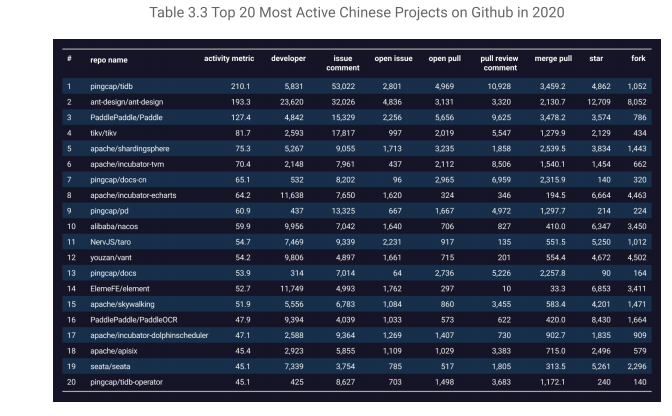
    Alibaba, as well as China-based Pingcap, came within striking distance of reaching the top 20 worldwide open source ranking for 2020 measured in activity; the total number of forks, commits, stars, pull requests, issue comments and other metrics, according to the GitHub 2020 Digital Insight Report released in April. 

    Authored by X-lab in conjunction with East China Normal University, Kaiyuanshe, Shanghai Open Source Information Technology Association and other unnamed “scientific research institutions and open source community institutes,” the X-lab report revealed Pingcap’s eponymous Pingcap (a distributed relational database) and Alibaba’s AntDesign (a Microsoft React framework) activity metrics of 210 and 193, respectively, in 2020. Meanwhile, jwasham (an open source study plan detailing how to become a software engineer) ranked 20th worldwide with an activity metric of 234. 

    Open Elastic’s Kibana, recently forked by Amazon Web Services (AWS) and Kubernetes ranked first and second worldwide with activity metrics of 698 and 602, respectively.


    open source China

    Torsten Volk, an analyst for Enterprise Management Associates (EMA), says the increased popularity of and activity in China-based open source projects are proof that the concept behind open source software actually works. 

    “This is the classic ‘one plus one adds up to more than only two’ theory, and that applies to most companies anywhere in the world. And if it was possibly to gain advantages by only using open source code but not contributing, companies anywhere else in the world would have done so right from the start,” says Volk. “Remember that the core idea behind open source software is not to give out your secret sauce for other companies to enjoy for free, but to spend the least possible amount of funding on building commodity code.”

    What, if anything, China-backed open source projects means for the community worldwide — as well as China’s influence in the industry in general – remain to be seen. Tencent, which entered the top 20 in March ranked by contributors in the OSCI study, for example, has become a leading supplier of components for machine learning (ML) databases in, for example, Kubernetes and cloud-native environments.  

    “This is great for everyone, and there is no benefit for anyone to purposefully not contribute to a project they benefit from. The benefit comes from your own contributions, in terms of reputation and credibility gain, across your industry. This motivates others to also contribute, as there is little to no benefit in keeping your own code secret while self-serving from the GitHub buffet,” says Volk. “As in the case of Kubernetes, your own company’s differentiation needs to come from the manner your proprietary apps [integrate] on top of this platform, or from the way you are able to integrate Kubernetes clusters with machine learning databases and other elements higher up the stack. And that’s why open source works.”

  • Are Developers Responsible for Open Source Governance?

    Are Developers Responsible for Open Source Governance?

    There are lots of factors in the open source software world converging to make it a big year for “shift left” in software development. Heightened security concerns, an increasing need for software supply chain visibility and the growth and complexity of open source ecosystems will continue to push the responsibility for ensuring code is secure earlier in the engineering process as far left as the request and design phases.

    This means 2021 will be yet another year in which developers are challenged to take on more responsibility, and pushed further onto the front lines of open source governance. Developers will need access to the right training, resources and tools to do this job. But they also can’t be successful if they’re expected to do it alone. Shift left can’t mean shifting all responsibility to the developer as the sole protector of secure code and the only go-to open source expert. The reality is that the depth, breadth and complexity of open source governance in 2021 demands a cross-functional team and layered approach.

    Equipping Developers With Governance Knowledge

    Let’s start with how to better equip developers and other stakeholders in the governance process, including legal, security, IP compliance and product people. These teams need enough knowledge to be aware of the top compliance issues, and their corresponding remediation options, to be active contributors in this rapidly evolving space. Research from Forrester shows that of the top 40 computer science programs in the United States and the top five programs internationally, none include open source licensing and security coding practices in the curriculum.

    Instead, it has fallen to the industry itself to impart this expertise on the job. Leading companies are packaging open source training programs into something that resembles standard HR-led and managed training, including check-ins and quizzes to test and solidify knowledge, and regularly updating content and scheduling trainings to make sure people stay abreast of changes and challenges. In the spirit of open source, many industries work collaboratively to share best practices on governance in this regard, with industry experts speaking on the topic at other companies. Others are leveraging existing management training courses, such as the ones offered by the Linux Foundation.

    The growing importance of the Software Bill of Materials (SBoM) also points to the need for cross-functional collaboration. Software supply chain visibility will become even more crucial in 2021 so that companies can build and sell secure and safe products, as well as ensure compliance. More people across the organization will need to access and view the SBoM in ways relevant to their functional needs. As a result, its assembly is transforming from being assembly-line-esque (passed along and viewed in the context of siloed business functions) to becoming much more collaborative. The SBoM is becoming akin to a business intelligence tool, providing the ability for different functions and stakeholders to filter for relevant information.

    Depending on your function, you may be interested in a top-down view of the open source and third-party components across your portfolio of products in order to understand risks in the organization. For instance, as an engineering leader, you may want to understand if you are impacted by a new security vulnerability, where in your portfolio of products you may be exposed and the current status of remediation work for that vulnerability. If you are in legal, you may be interested in a significant licensing change for a component in use at your organization. This allows you to be prepared with changes to legal policies for automated reviews and obligation fulfillment guidance for engineering when the next build occurs and a more recent version of a dependency is pulled in. If you are in the export control function, and are required to provide your application’s encryption capabilities as part of the certification process, understanding which open source components are part of the application, and which provide cryptographic capabilities is essential. Finally, don’t overlook your customers, who today are requiring open source disclosures as part of commercial software contracts to protect themselves from insecure software.

    Collaboration has also been made simpler by the fact that new industry standards now enable an asset portfolio view of open source security. Open Chain obtained ISO certification in late 2020, ISO/IEC 5230:2020, providing a clear and effective process management standard for open source license compliance. It allows companies of all sizes and in all sectors to adopt the key requirements of a quality open source compliance program. Coupled with ISO/IEC 27001–the de facto standard for managing security in information security management systems (ISMS) – organizations can now take a more holistic view of all of their software assets in an effort to make the information they hold more secure.

    Open Source Program Office

    The best way to ensure developers aren’t left footing the bill for open source governance is to create a centralized team dedicated to it. Savvy organizations could form an Open Source Program Office (OSPO), which brings together key stakeholders in legal, engineering, product and security to develop, communicate and operationalize open source strategy for their entire organization. This team works to define a framework and process for consuming open source software as part of their development work (inbound use case) and/or contributing code to the community via open source projects (outbound use case). The mission and main charter of these teams is to help their organization create and manage an open source strategy in terms of the adoption, use, support, participation and development of open source software. However, they’ve also found their role has evolved to become the experts on open source internally and evangelists of the technology and its use.

    The bottom line is that the developer’s job is to develop software – and every piece put in place for stronger open source governance means less time spent focusing on the problems that could be in the open source code and more time on the promise of using it to rapidly innovate for the benefit of their customers.

  • AI Reimagines Computation and Improves Software Development

    AI Reimagines Computation and Improves Software Development

    While modern business software solutions unlock organizational efficiencies, agility and the ability to deliver new value to customers, such tools were not available when applications deployed on mainframe systems were being developed.

    Today, many of the Fortune 500 companies, the world’s largest banks and insurance companies and several of the largest retailers in the U.S. continue to rely on legacy programming languages, such as COBOL or Java, to power their applications. However, with new languages coming on the scene and experienced programmers in legacy languages exiting the workforce, organizations find themselves in an increasingly difficult spot.

    Is it a Coding Skills Shortage or a Knowledge Gap?

    As proficient programmers retire or move on, organizations across industries are recognizing they no longer have the specialized domain knowledge of the industry and institution to effectively maintain and support their complex critical systems. To combat what is perceived as a skills shortage, organizations are sinking a significant amount of effort into hiring new developers, teaching them to write in the legacy languages and tasking them with changing enterprise systems.

    Modernizing applications, databases and systems that run well in their current state can be risky and expensive, so building on top of and around existing code can be the better choice. But such workarounds are not always completed in the most appropriate manner. For example, when a developer is cutting and pasting large chunks of code just to change one behavior, the end result is often awkward and unmanageable applications that even the most accomplished developers struggle to deconstruct and understand.

    Understanding the code is not enough. Developers have to know what an application actually does, but if they don’t recognize how altering code in one part of a system impacts another part, the consequences can be devastating. As such, the challenge is not a skills problem — most programming languages are straightforward enough to learn — it’s a knowledge problem that exists across programming languages.

    Goodbye, Years of Language-Specific Experience. Hello, AI.

    The programmers who wrote all those billions of lines of code are still running mission-critical applications, but they are increasingly aging out of the workforce or opting for a new or different career path. This results in legacy systems being less well-understood by the companies that rely on them every day. While many programming languages are meant to be easy to read and understand, unknotting the program logic frequently devolves into a tedious reverse-engineering project in which developers are attempting to unearth the intent of previous developers encoded in the software.

    Rather than relying on aging subject-matter experts to pass along that specialized knowledge to programmers fresh out of college (who are in short supply anyway), organizations might consider leveraging advanced artificial intelligence (AI) tools to automate the process of identifying the specific code that requires attention — no matter how entangled that code is throughout the system.

    While AI can be used to help with the syntactical issues of writing code (much like the Smart Compose feature leverages machine learning to “look ahead” and offer suggestions as you type), the impact of such tools is minimal. AI’s greatest time-saving opportunity lies in automating developers’ steps when conceptualizing and writing code. Whatever the reason — be it poor documentation or spaghetti code — developers spend about 75% of their time in search of the source code that needs to be changed. That source code is likely to be interspersed throughout the code repository, requiring a developer to “think through” what the code does, at nearly every step, to trace out the code detailing the behavior that they seek to modify.

    How AI Overcomes the Inadequacies of Automated Testing

    The goal of many organizations is making changes to systems running older programming languages as safely and efficiently as possible. Some organizations are turning to DevOps to improve agility and accuracy without sacrificing their existing mainframe system’s stability and performance. When it comes to COBOL code, where the problem is more acute than in other languages, automated testing in the CI/CD pipeline is inherently inadequate.

    Once a developer has identified the code representing a behavior that needs to be changed, they’re in a position, in that automated pipeline, to ensure that the corrected behavior never changes. However, because the code describing the behavior in question can be spread throughout the system, a developer will make a change believing they haven’t altered any other behavior, but they may have actually ‘broken the world.’ System-breaking changes can be made to the code -and stay hidden – because testing may not cover scenarios that the developer didn’t consider. Well-constructed automated test suites are data-dependent, but assembling all of the data necessary to get 100% code coverage is, unfortunately, next to impossible.

    If, for example, the application required a security or regulatory change, a developer might think that their correction will be covered by the automated test suite when it’s not. Without copious data in the suite, developers cannot guarantee that a behavior will never be altered. With AI “reimagining” computation as conceptual, developers are able to validate that they haven’t broken the system before they compile or check-in the code — or even run it in debug mode to check it — before running the automated test suite. Once developers are confident their change is isolated, the “conceptual check” of the behavior may be leveraged in the CI/CD pipeline, thereby ensuring the behavior remains intact from that point forward.

    In short, advanced AI makes developers’ lives easier because AI can automatically analyze source code and understand the human intent behind it. Now, developers can collaborate with AI to locate source code in an effortless manner, quickly perform comprehensive impact analysis and make the necessary change(s) without ‘breaking the world.’ The improved productivity and efficiency AI unlocks is critical in maintaining and improving the important legacy and mainframe systems that handle tens of billions of business transactions every single day.

  • Survey Finds Digital Transformation Outcomes in Doubt

    Survey Finds Digital Transformation Outcomes in Doubt

    The COVID-19 pandemic forced organizations, both large and small, to either launch or accelerate digital business transformation initiatives that, to varying degrees, depend on their level of DevOps acumen to succeed. Value stream management platform provider Digital.ai today published the results of a survey of 200 IT decision makers, 200 security decision makers and 200 business executives in organizations with at least 500 employees which suggests that, while there’s a lot of confidence in those initiatives, the business outcomes those efforts are intended to enable are still very much in doubt.

    The survey finds 95% of respondents believe their digital transformation initiatives are going well, with 22% reporting they have been completed. Just under a third (32%), however, said they still have a lot to accomplish. Just under half (49%) said they have yet to see the results they expected. In fact, more than half of respondents (56%) also noted they are concerned about the return on investment (ROI) of those initiatives.

    Overall, the survey suggest optimism continues to prevail. A full 92% of respondents said they are creating new value for the business, with 93% claiming the business as a whole remains competitive. However, more than half (57%) are concerned that business, IT and security goals might be misaligned. More than half (54%) are concerned about meeting customer needs. Nearly two-thirds are concerned about software vulnerabilities.

    More challenging still, 94% of respondents need software development and delivery to be better aligned to business objectives. Only 54% claim to be strategically aligned. Almost every respondent (99%) needs more visibility into business planning processes, with just over a third (34%) noting they are not especially good at attaining that visibility.

    Not surprisingly, a full 91% said they still need more time to work on their digital business transformation initiatives.

    Derek Langone, head of strategic transformation for Digital.ai., said the survey makes it apparent there is a much greater need for a set of key performance indicators (KPIs) for IT teams that are tied to specific business objectives. As organization of all sizes realize how dependent they have become on software, any delay can have a major impact on revenue and profitability projections, noted Langone.

    Of course, not every digital business transformation project is going to succeed, no matter how optimistic business and IT leaders may be. Many initiatives were hastily conceived during the early days of the pandemic. Others were simply accelerated without enough due diligence. Digital.ai is making a case for a value stream management (VSM) platform that enables organizations to first understand the true status of these projects by synthesizing all the data residing in various DevOps platforms, and then assessing the impact any delays might have on the business.

    It’s not quite clear how many organizations have managed to get as far as they have without at least some VSM platform equivalent. However, as software development continues to become more complex, it’s also apparent that without a VSM capability, the odds various digital business transformation initiatives currently underway will eventually be derailed are substantially higher than many IT and business professionals would like to admit.

  • Python Remains Popular in Programming Language Study 

    Python Remains Popular in Programming Language Study 

    A ranking by analyst firm RedMonk reflects on Python’s continued popularity as a leading enterprise programming language for a number of reasons. According to a recent study by RedMonk, JavaScript also remains widely popular as the web development programming language of choice for a significant number organizations. 

    In many ways, Python’s strong showing in the ranking — drawn from GitHub pull requests and Stack Overflow data — indicates its long-term viability among DevOps developers. 

    “One lack of change that is worth surfacing is Python’s number-two spot,” Stephen O’Grady, a RedMonk co-founder and analyst writes in The RedMonk Programming Language Rankings: January 2021. “Java was extremely hot on Python’s heels – and was, in fact, closer to the number-one ranking than to PHP behind it – but Python’s ability to defend its new high ranking is notable.” 

    RedMonk

    Python’s prolonged high ranking is notable because of its versatility, Rachel Stephens, a RedMonk analyst who is responsible for the RedMonk Language Rankings’ design, told devopsy.kinsta.cloud. “The breadth of use cases — and associated libraries that support those use cases — means there are a number of possible entry points for developers. The number of toeholds for the language within the enterprise helps its ubiquity,” said Stephens.

    There also remains much discussion about what accounts for Python’s continued popularity beyond the scope of the study. A popular subject in forums, including Reddit, Python is typically described as highly versatile, relatively easy-to-learn and a simple, yet elegant language. While not cited in the RedMonk study, some software engineers and coders — such as this writer — appreciate how Python can make more intuitive sense, and is also less rigid compared to, say, a classic language such as C++. While JavaScript is largely used for web apps and scripts, of course, Python could arguably be the most popular language outside of the sphere of web development, thus accounting for its second-highest ranking in the study.

    As such, “due to the accretive nature of our methodology, movement within the top-ranked languages is an infrequent occurrence,” Stephens said.  

    “[However], Python overtaking and sustaining its ranking over Java was a big deal. That said, we remain strong believers in the future of Java and the Java ecosystem, and we know there is a vast amount of enterprise Java that isn’t captured in the metrics we use,” Stephens said. “We don’t view Python’s ascendence as a zero-sum gain over the use of Java.”

    For JavaScript, “in spite of all of the competition from up-and-coming languages, all the discussion of fragmentation – and even criticisms of JavaScript the language itself – it remains remarkably popular,” O’Grady said.  

    “Simply put, JavaScript remains – its detractors notwithstanding – a force of nature like no other within the industry, and there are no indications in the data that this is likely to change any time soon,” O’Grady added.

    Meanwhile, in the book Hardcore Programming for Mechanical Engineers, published by No Starch Press, JavaScript trails Python in other rankings, while Python is also more popular than JavaScript for other reasons than those described in the RedMonk study. Python, for example, is cited as the ‘The Most Wanted Language,’ based on a Stack Overflow survey. 

    While Python is not the fastest language, as measured  in benchmarks listed in Hardcore Programming for Mechanical Engineers  — Go consistently outperforms it, for example, in execution times — Python’s popularity remains very high overall, according to the book’s author.

    “These results are not surprising; Python is an extremely versatile and productive language,” author Ángel Sola Orbaiceta wrote. “Writing code in Python is a delight, and its standard library is well-equipped: for just about anything you want to do, Python has something ready to help.” 


  • Cooperative Gaming: Software Teams’ Secret to Success?

    Cooperative Gaming: Software Teams’ Secret to Success?

    Trust falls and team backpacking trips are out — cooperative gaming is in. Don’t think embarking on group Minecraft missions could help deliver great software products? Think again. A 2019 BYU study found a 20% increase in office productivity after just 45 minutes of gaming.

    Software engineering is a mentally taxing endeavor, and many developers are under mounting pressure to deliver. To destress, many software teams use gaming to unwind during work hours. Gaming, it turns out, has added benefits of improved morale, increased productivity and lowered ego around unofficial hierarchies within the office. Setting aside time to recharge with collaborative gaming could increase a workplace’s health and help software teams work together to deliver products more efficiently.

    I recently spoke with Max de Lavenne, founder and CEO of Buildable, ally to the workplace gamer, to see why he embraces gaming as a regular part of his software developer team’s weekly regimen. Buildable adopted gaming and saw a notable impact; de Lavenne shared how other teams could similarly introduce gaming to improve performance.

    Gaming in the Workplace

    Traditional business environments don’t typically embrace fun activities on the clock — there is a clear separation between work and life. But at Buildable, gaming is integrated into the weekly routine. The Buildable engineers set aside about 45 minutes mid-week for collaborative gaming, typically on Wednesday or Thursday. The Buildable team, made up of about 20 software engineers, favors Rocket League and a modded version of Minecraft.

    According to de Lavenne, gaming is a great way to foster collaboration and intuitive group thinking. “Getting recharged is really important,” he said. He encourages the team to adopt cooperative multiplayer games; no solo play. He also discourages violent and aggressive RPGs, like first-person shooters.

    Workplace gaming isn’t unique, in and of itself — many teams at other companies will often play Haxball during coffee breaks or get into a Call of Duty: Warzone match from time to time. Yet, few leaders have the stomach to sanction gaming as integral to the developer’s workflow and overall team dynamic.

    “Engineers collaborate best when they respect each other and have confidence in each other’s skillsets,” said de Lavenne. “They are individuals, but there’s a lot of groupthink in teams.”

    Benefits of Gaming

    Gaming has proven benefits. In fact, researchers at Kansas State University found that employees who spent one or two minutes during breaks in their day playing games such as Candy Crush on their phones reported being happier than their peers. Similarly, de Lavenne noticed improved mood and other positive outcomes from collaborative gaming at Buildable, including:

    • Better team morale: Having scheduled gaming breaks to look forward to each week keeps attitudes positive. Software engineering can cause fatigue, which managers need to monitor carefully. “People get tired, and there’s only so much the brain can do,” de Lavenne said .
    • More fluid communication: Collaborative gaming focuses a team’s effort on a collective activity free from monetary incentives, bonuses or other hidden agendas. Afterward, de Lavenne said he’s noticed more fluid communication emerge among the team.
    • Increased collaboration: There’s satisfaction in doing something together, and de Lavenne reports that gaming has redefined collaboration for his team in unique ways. Employees take the cooperative, creative attitude fostered from gaming experiences and apply it to more structured, scrum-type environments.
    • Increased productivity: Dedicating one hour for gaming per week equates to about a 2% loss of labor time. However, de Lavenne reported that the productivity gains afterward surpass that lost time and more.
    • Reduction of ego: In work environments, unspoken hierarchies inevitably exist. Interestingly, collaborative gaming can completely reverse those social dynamics. Seeing senior engineers at the bottom of a gaming leaderboard can be humorous and boost confidence for younger engineers.
    • Combating isolation: Throughout the pandemic, remote work has left many of us feeling lonely. For young engineers without families, a big chunk of social interaction may occur in the workplace. Games can help maintain good spirits by bringing teams together virtually.

    Tips for Encouraging a Healthy Gaming Culture

    The overall goal is to promote enjoyable, freeform shared experiences. To enable this, de Lavenne shared a few tips on integrating games into developer team workflows.

    First off, gaming should not be mandatory, as making it a required activity would somewhat defeat the purpose. Instead, gaming should be fun and completely voluntary. If people would rather get in some physical exercise or check Instagram, they should feel just as free to do so.

    Also, as much fun as gaming with the team could be, it’s helpful having the CEO removed from this activity, de Lavenne advised. This is important so that players don’t feel they’re constantly monitored. Yet, leaders may want to have a say in the type of game, as well as when it’s played.

    Furthermore, the game doesn’t need to be an immersive RPG — it could be as simple and accessible as Jackbox. Cooperative board games like Dungeons & Dragons or Gloomhaven could have just the same effect as digital games.

    Outside of encouraging collaborative gaming, leaders can take other actions to boost morale and productivity. One such action is leaving chat channels unmonitored, so that team members can engage with each other on whatever subject they want without oversight. Another way to affect morale is location, noted de Lavenne. As I’ve written previously, hiring interest is expanding outside of traditional tech hubs. Buildable, for instance, chose to headquarter in suburban McMinnville, Oregon, for its walkability, greenery and better work-life balance than in larger cities.

    Gaming Is Where It All Began

    Multiplayer video games, LARPing, and AR/VR environments not only offer an escapist retreat — they represent nostalgia. For many programmers, video games were a doorway to the computer science field in general.

    “I’ve rarely met a software engineer that never gamed,” de Lavenne added. Gamers often seek out the highest-performing machines. And chances are, those kids with limited resources built their rigs from scratch. “This inspires you to learn about hardware, and you start to care about speed, compile and software activities,” said de Lavenne.

    From Atari to Minecraft, gaming has been a shared passion among generations of programmers. Recognizing this affinity can unite a team. Because at the end of the day, “building good software is all about people,” said de Lavenne.

    Of course, software development takes extreme diligence, planning, and structure to deliver bug-free, user-centric products. But under intense pressure to perform and meet new digital innovation demands, software developers could get burned out without a bit of distraction. With gaming, “the team really comes alive,” de Lavenne said.

    So, when things get slow, check out what’s hot on Steam. You may, ironically, just find your next productivity breakthrough.