
Tag: software development
-

Postman Acquires Akita Software to Gain API Observability
Postman today announced it has acquired Akita Software to gain access to a platform for monitoring and observing application programming interfaces (APIs).
The first integration of the respective products offered by both companies will arrive in beta this fall.
Postman CEO Abhinav Asthana said the acquisition of Akita Software will make it much simpler for organizations to discover what APIs are being employed across an enterprise. A recent Postman survey found that 28% of developers are now deploying APIs at least once per week.
The Akita Software platform will make it simpler for organizations to discover both rogue APIs that have been created by a shadow IT project and zombie APIs that have been inadvertently left exposed long after they are needed.
Akita Software’s CEO Jean Yang said the integration with Postman’s API management platform will provide a rich source of data that can be used to add artificial intelligence (AI) capabilities to Akita’s API observability platform. For example, generative AI capabilities should make it simpler to create summaries in natural language that explain the calls an API is making to specific data sources.
In addition, the combined company will be in a better position to enable organizations to better secure their APIs after deployment by surfacing anomalous behavior indicative of an API that is being used to exfiltrate data, she added.
The merger with Postman will, in effect, enable the combined entity to provide a complete ecosystem for managing APIs, noted Yang.

Most APIs are used primarily to interconnect internal-facing applications and systems, with a subset used to integrate partners. Only a relatively small percentage of APIs are externally facing in the sense that they expose data to the internet. Many organizations, however, fail to appreciate how quickly an internally facing API can become externally facing over the course of its life cycle. As such, IT teams need tools and platforms that can manage and secure APIs as they evolve.
As APIs continue to play a crucial role in advancing business goals, there is a clear need for increased visibility as the types of APIs employed also continue to expand. Most APIs in use today are based on the REST format, but there are also APIs based on GraphQL, event-driven architecture and various messaging platforms. None of these newer APIs will supplant REST APIs any time soon. Rather, they are being applied to drive additional processes alongside REST APIs.
In the longer term, it’s not clear how many APIs will be managed by the developers that created them versus a centralized DevOps team. However, the more APIs that are deployed in a production environment, the less feasible it becomes for developers to manage their life cycle. The challenge is making sure there is some type of structured workflow in place that, at the very least, makes everyone involved in the process aware that a new API has been created and deployed.
-

State of API Report Highlights Productization and Generative AI
In today’s software landscape, an API-first strategy is increasingly popular. It’s the bedrock of how applications are built and connected. APIs help promote internal tech reusability, helping developers do more with less. Due to this increasing API reliance, maintaining quality control is increasingly important for internal and partner integrations and ensuring the reliability and security of these connections remains a top priority.
Due to the rising API ubiquity, nearly half of the total development energy is spent working with APIs. And to continually improve these interfaces, taking a product mindset is proving helpful. In fact, 60% of API developers now view their APIs as products. Generative AI has also shown incredible promise and is now being used in tandem with traditional tools to increase API code quality.
Postman recently released its fifth annual State of the API Report. The 2023 edition, which surveyed thousands of developers and API professionals, found subtle changes in tooling preferences and styles. It also sheds light on the ongoing API productization movement and API developers’ use of generative AI. Below, I’ll focus on these two key areas and review the report for its other key takeaways.
API Productization is Hot
The majority of API developers now view their API as a product, and this figure rises to 68% in large companies. A full 65% of respondents said their API generates revenue, too. This news is significant, as it demonstrates the industry is maturing its view of APIs. They are no longer offshoot developer toys but fully functional services contributing to overall business growth.
But how much growth? Well, of those monetizing APIs, 43% now say APIs generate a quarter of company revenue. For some companies, APIs generated more than 75% of total revenue! There also appears to be a parallel between API revenue generation and large companies.

Do you view your APIs as products? Most developers say yes. Other industry reports unearthed similar API productization potential. Rapid’s 2022 State of APIs report found that 42.6% of organizations are now monetizing APIs. And investment into API-first products remains strong even amidst a broader contracted tech investment climate. These findings come as social media giants like Reddit and Twitter attempt to monetize their APIs.
That said, for 28% of companies, API revenue still equates to less than 10% of total revenue. APIs still don’t get the lion’s share, perhaps because they’re packaged with an existing platform or because of the many other indirect ways APIs might benefit the business. Furthermore, consumers are becoming more cost-conscious, as 60% cite pricing as a factor before integrating with an API. Still, the numbers are significant firsts for the burgeoning economy.
Most API Developers are Using Generative AI
Generative AI interfaces like ChatGPT and Bard have certainly taken the tech industry by storm due to their ability to generate code snippets, debug code and more. And for the first time, the State of the API Report spotlighted generative AI and its use within the API economy.
Today, 60% of API professionals are using generative AI on the job. API engineers commonly use generative AI to find mistakes in code, generate machine-readable code and increase learnability around their programs. Some even use generative AI to suggest potential security flaws in their APIs.
Compared with other app development endeavors, developers are by far most excited about building generative AI-powered applications in the year ahead. Yet, the efficiency gains are modest—many engineers forecast productivity improvements of 10% to 25%.
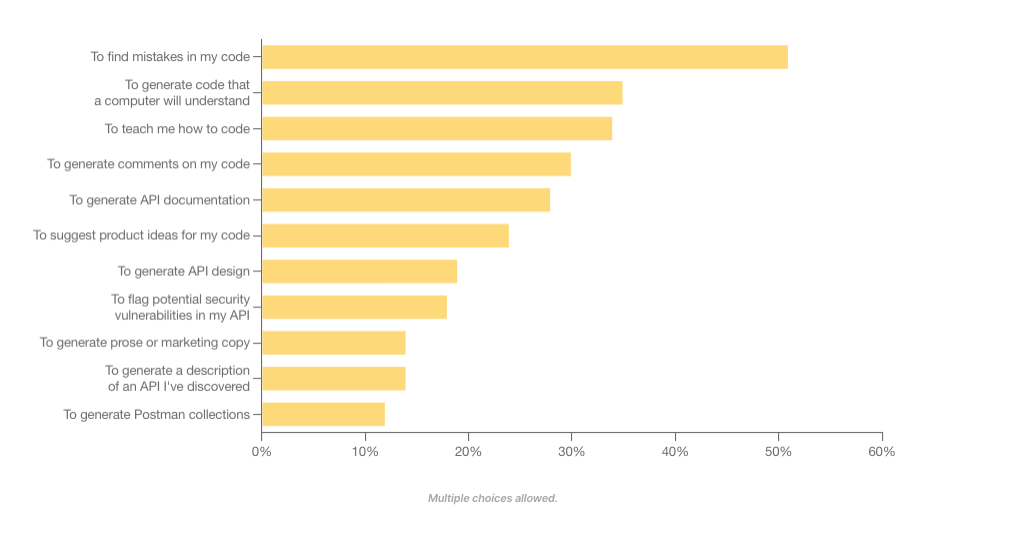
How are API developers using generative AI in their work? Generative AI is set to accelerate many areas, including DevOps and API operations. Yet, contrary to some headlines, generative AI can’t automate all aspects of the software development life cycle. Rather, the technology is more likely to augment the API developer’s workflow than replace the need for seasoned professionals altogether.
Other Key Takeaways
Similar to last year’s report, integrating between internal applications, programs or systems remains a top concern for integrating an API or producing an API. The good news is that these integrations continue to increase in quality.
The report found that deployment failures and times-to-recovery are improving on average. More than half (56%) of respondents said API security incidents occur less than once a year within their organization. This shouldn’t overshadow the significant impact API security breaches can have but signals that DevSecOps is beginning to respond to persistent API vulnerabilities.
There are more API-first leaders than ever before. And API owners continue to evolve how their services are built and deployed. For example, REST is still by far the most common API style, used by 86% of developers. Webhooks made second place at 36%. However, GraphQL rose in usage, bumping SOAP into fourth position.

REST is still the dominant style, but GraphQL makes gains as SOAP slips. Other Quick API Factoids
- More non-developers are becoming interested in APIs, as evidenced by 53% of survey takers being non-developers.
- Most APIs are private—61% percent of businesses’ APIs are for internal use only.
- After the technology group, business/IT services, financial services and health care are the most common sectors to adopt APIs.
- Microservices is still the dominant architectural style of APIs, at 42%.
- Performance, security and reliability are the top factors evaluated when integrating with a new API.
- Improper authentication, authorization or access control is the most commonly cited API risk.
- Common API tools include Postman, SwaggerHub, Datadog, SoapUI and Insomnia. Top gateway and API management platforms include AWS API Gateway, Azure API Management, Apigee and Kong.
- JSON Schema is by far the most popular API specification.
- The financial industry is a leader in API-first strategies—32% of respondents spend more than 20 hours a week working with APIs.
- Most developers deploy APIs to production once a week to once a month.
- When developers leave a company, their departure can cause outdated documentation, zombie APIs and a loss of institutional memory.
API Obstacles Remain
Looking to the future, investment in APIs is projected to climb. In fact, 92% of developers said their organization plans to invest the same or more time and resources into APIs in the coming year. Yet, some obstacles remain—a lack of documentation and poor service discoverability are still prominent roadblocks to API consumption. Furthermore, a lack of time and talent are major concerns that might stunt API development.
The Postman State of API Report surveyed over 40,000 developers and API professionals, making it the largest study conducted on APIs to date. It should be noted that, given Postman’s specific focus in the market and its surveyed pool, figures may be skewed to represent increased API enthusiasm. For deeper insights, you can read the entire report here.
-

Key Insights From the Stack Overflow 2023 Developer Survey
Stack Overflow has released its seminal yearly developer survey. The 2023 report, which surveyed over 90,000 developers, provides a comprehensive view of the current software developer experience.
Below, I’ll highlight a few important findings, namely the significant programming language and tooling preferences, the use of AI in the development workflow and what these trends could mean for the DevOps field. I also gathered insights from Joy Liuzzo, vice president of product marketing at Stack Overflow, to dive deeper into some of the findings.
Developer Technology Preferences in 2023
Of note is that more and more developers are learning to code online. Learning to code using online resources increased from 70% in 2022 to 80% in 2023. Although many developers (47%) still have a Bachelor’s degree in computer science or the equivalent, these trends underscore the movement toward alternative knowledge solutions, especially for younger programmers. The topmost online resources include technical documentation, blogs, forums and how-to videos.
JavaScript is still king—it’s now in its eleventh year as the most common programming language. But it’s worth highlighting that Python has overtaken SQL as the third top language. “SQL was solidly in the top three (JavaScript, HTML/CSS, SQL) since 2015, so it’s a big deal for it to have fallen below Python,” said Liuzzo. “We’ve seen Python’s popularity increase based on the number of questions asked on our public site, so we’ve been expecting some shifts.”
TypeScript and Bash/Shell have also consistently grown in usage over the last few years. “These two languages are involved with the functions of other popular programming languages, explaining their prevalence among programmers,” Liuzzo said.
PostgreSQL also overtook MySQL as the most common database type. In terms of web frameworks, Node.js and React.js are the most dominant. Other frameworks, like jQuery and ASP.NET, are showing signs of going out of style, likely because they are older web frameworks.
Spotlight on AI
The explosion of new AI innovations, such as large language models (LLMs) and chat-driven generative AI tools, had a major impact on this year’s technology findings. In fact, 83% of respondents have used ChatGPT over the past year. This is followed by Bing AI (20.6%), WolframAlpha (13.36%) and Google Bard AI (9.86%). GitHub Copilot was ranked as the top most-used AI developer tool.
There was a significant spike in using AI tools amongst those learning to code—these folks often see benefits like speeding up learning, increasing productivity and greater efficiency. “Pair this with how they are currently using AI tools to debug and get help (68%) and learn about a codebase (50%), and we see that the commonality is that AI tools enable learning,” explained Liuzzo.
That being said, there’s skepticism around AI’s accuracy, and only 13% see improved accuracy in coding as a benefit of using such tools. These pain points may resolve as LLMs evolve, but for now, there still needs to be human judgment to catch bugs and avoid hallucinations.
“AI has a complexity cliff. Much like Helmsman’s complexity cliff found in project management, after a certain point, the ability for AI to handle all the nuances and interdependencies of a solution drops off,” said Liuzzo. “That’s when humans, their ability to apply judgment and have original thoughts, saves the day.”
How These Trends May Affect DevOps
So what are some takeaways for those working in the DevOps field, namely DevOps tooling providers and platform engineers? Well, new tooling preferences and habits will continue to evolve in the DevOps field in new ways. Here are some potential examples:
- More Markdown-based collaboration. Markdown is the most admired asynchronous tool and has increased in popularity this year. New programmers are adopting a blend of Markdown, GitHub Discussions and Notion for their asynchronous tooling. Flavors of Markdown are already being used for comments, merge requests, issues and more.
- Continued Docker reliance. Docker remains the top-used tool, followed by npm and Pip. Despite the rise of managed container services, Docker is still a popular way to package and distribute software.
- Challengers to the big three loom in the distance. Amazon Web Services (AWS) is still the most-used cloud platform at 48.62%. It’s followed by Microsoft Azure (26.03%) and Google Cloud (23.86%). Yet, newer developers want to work more with Hetzner and Vercel.
- Online learning is paramount to knowledge sharing. Given the steady increase in new programmers and their reliance on online resources rather than traditional schooling, DevOps and open source communities should seek to enhance their online footprint by making knowledge like tooling documentation and tutorials easily consumable.
Last but not least, generative AI is set to enhance programming in many areas and is already becoming embedded into many environments. Just as AI can be used for code generation and debugging, LLMs will likely assist the DevOps side of the equation, helping automate the CI/CD pipeline, optimize infrastructure, detect anomalies and provide more chat interfaces to initiate these capabilities.
“AI tools are empowering and enabling learning,” said Liuzzo. “Generative AI will democratize coding and grow the developer community by several folds—and that growing number of developers will be the ones using the tools and also verifying and validating the outputs as they learn—bringing the power of the developer community and the technological power of AI together.”
-

Choosing the Right Software Deployment Tools
Imagine this scenario: After investing countless hours in developing your software, it is finally ready for deployment. Now, you must select the appropriate software deployment tools to guarantee a seamless release.
This article will guide you through the concept of software deployment and discuss various tools that cater to different needs—from dedicated deployment tools to comprehensive CI/CD pipeline solutions and GitOps approaches. By understanding these categories and their benefits, you’ll be well-prepared to make an informed decision on which tool is the best fit for your organization’s needs.
What is Software Deployment?
Software deployment plays a crucial role in the software development life cycle. It involves packaging, distributing and installing an application on target systems or environments, aiming to make your software accessible and usable for end-users seamlessly.
In today’s fast-paced world, companies must be able to deliver applications rapidly and reliably. A well-planned software deployment strategy ensures that new features reach users promptly while minimizing downtime and errors during updates.
What to Look For in a Software Deployment Tool
When selecting the ideal software deployment tool, consider the following factors:
- Automation: The tool should automate complex software deployments, making the deployment process faster and more efficient.
- Continuous deployment: Continuous deployment tools allow you to deploy software repeatedly, ensuring consistent deployments. Choose a tool that automates release management and integrates automated builds throughout the development process.
- Scalability: The tool should be capable of handling large-scale deployments and distributing software across multiple servers. Opt for a tool that enables applications to deploy to multiple servers simultaneously.
- Integration: The tool should integrate with version control and other third-party tools, making the deployment process seamless. Look for a tool that integrates with modern DevOps processes and connects automated builds to configuration management.
Full CI/CD Tools
Bamboo

Bamboo by Atlassian is a robust tool that integrates seamlessly with other Atlassian products, such as Jira and Bitbucket.
It offers first-class support for multiple languages and platforms while providing built-in deployment projects for smooth releases.
GitLab CI/CD

GitLab CI/CD, an integral part of GitLab, simplifies pipeline management using YAML configuration files stored within your project repository.
This approach enables easy collaboration among team members while ensuring consistent build environments across all stages of development.
Codefresh
Codefresh is a cloud-native solution designed specifically for Kubernetes deployments, It provides a modern interface to manage pipelines visually, along with advanced real-time debugging capabilities.
Dedicated Deployment Tools
Jenkins

Jenkins was originally conceived as a continuous integration (CI) tool, but many organizations use it mainly for deployment. It is an open source automation server that provides support for building and deploying software projects, as well as to schedule and run tasks at regular intervals. Learn more about Jenkins in this in-depth blog post.
Harness

Harness is an intelligent software delivery platform that simplifies deployments through automation and machine learning. Their continuous delivery-as-a-service (CDaaS) approach helps you deploy faster while minimizing risks and errors.
AWS CodeDeploy

If you’re using Amazon Web Services (AWS), AWS CodeDeploy might be a perfect fit for your needs. This completely managed service automates code deployments to any instance or serverless Lambda function in AWS, guaranteeing consistent results every time.
Spinnaker

An open source project backed by Netflix and Google, Spinnaker offers powerful multi-cloud continuous delivery capabilities for deploying applications at scale across various cloud providers like AWS, GCP, Azure, Kubernetes clusters, etc.
GitOps Tools
Argo CD

Argo CD is a declarative, Kubernetes-native continuous delivery tool that uses Git repositories as the source of truth for application definitions. It simplifies rollbacks, provides audit trails and enforces consistency across environments.
Flux CD

Flux CD, another Kubernetes-focused option, automates deployments by monitoring your code repository for changes and applying them to your cluster accordingly. Bonus: It supports multi-tenancy and integrates with Helm charts.
Weave GitOps Core

Lastly, Weave GitOps Core offers an open source foundation for managing Kubernetes applications using the power of GitOps workflows. This versatile tool can be extended to fit various use cases while maintaining simplicity in its core functionality.
Conclusion
There are many software deployment tools available that can help automate the software delivery process, reduce errors and improve collaboration between development and operations teams. From open source tools like Jenkins to cloud-native solutions like AWS CodeDeploy, each tool has its own strengths and features that make it suitable for different use cases.
When selecting a software deployment tool, it is important to consider factors such as compatibility, automation, scalability, security, monitoring, deployment environment compatibility, integration with existing tools and support and documentation. By carefully evaluating these factors and choosing the right tool for your specific needs, you can ensure that your software deployment process is efficient, reliable and successful.
-

Friend or Foe? ChatGPT’s Impact on Open Source Software
OpenAI’s ChatGPT took the world by storm, amassing 100 million users in the first two months after its public launch. The continued interest in the tool has created a buzz among developers, especially those in the open source community. But this begs the question: How will ChatGPT impact open source software?
Amid the excitement and promise that ChatGPT holds, many wonder whether the open source community, just like any other organization, should fear or embrace the technology. Certain concerns for open source contributors and developers are sparking debate as questions surrounding the origin of generated source code surface, and the possible ethical and legal implications are discussed. While valid, developers should not fear or stray away from using ChatGPT but rather shift their focus to understanding how to embrace it for positive outcomes.
The Top Three Open Source ChatGPT Concerns
Collaboration between contributors is the cornerstone of open source projects, which some fear will be disrupted with the increased use of AI-based tools. However, the level of synergy within the community cannot be easily taken away or replaced by tools. Instead, ChatGPT or other AI-based tools, including GitHub Copilot, allow developers to produce code more quickly and more efficiently.
As developers increasingly use AI tooling to assist with new or enhanced code, project collaboration and oversight will help improve the AI-generated code.
Debunking and navigating the top concerns will be imperative to take full advantage of the technology’s promise and potential.
Validity. While the creation of code by ChatGPT has generated excitement among developers, critics argue that—without context—the validity of code can be questioned. Some open source developers worry that teams will begin to rely entirely on ChatGPT to generate code, but this concern fails to consider the humans involved in the process—today and far into the future.
Developers don’t take ChatGPT’s output as the final word; rather, they use it as a baseline and jumping-off point to streamline their code. In fact, code is rarely created from scratch anymore. Developers rely on others’ source code. For example, code from Stack Overflow, GitHub and thousands of open source libraries that are available on public registries like npm, Maven, Nuget and PyPI. Bringing ChatGPT into the fold will not significantly change how developers source their code, but will improve development velocity, saving valuable time and associated cost.
Training Data. Machine learning (ML) and deep learning (DL) model training must be fair, robust and explainable to avoid biases. If the data is wrong, the results will be as well. Garbage in, garbage out. Coming from ML/DL models, the code ChatGPT returns in response to prompts could raise concerns surrounding its accuracy. Like any other source (Stack Overflow, GitHub, etc.), ChatGPT’s code outputs are not guaranteed to be perfect, and developers must be mindful of this.
However, there are more benefits of ChatGPT-trained models concerning code outputs. ChatGPT can also explain new or existing code, it can also effectively provide unit tests for code, which will help with writing better software faster.
Ownership. Questions of ownership have surfaced regarding the use and distribution of the code that the AI tool generates. While the code that ChatGPT generates is the result of ML/DL inference from many sources, it’s the developer’s responsibility to use that code ethically and safely. It should be treated as any other public data or open source software, as not a final product and must be used in the context of your requirements. It’s also important to carefully review any code generated by ChatGPT and ensure that it doesn’t introduce vulnerabilities.
Similar to GitHub Copilot, ChatGPT is trained by millions of lines of open source software. Code posted in prompts is likely to make it to models, too. Unlike copyrighted pieces of art and writing, the code that ChatGPT outputs should not be considered in a final state and should not be used in a way that is subject to licensing restrictions or legal implications that have dominated the conversations around its use.
Ownership closely relates to the ethical dilemma of using AI-generated text, code and more. To address that, there are new tools that help detect whether AI generated the content and how much, which will be useful for educators concerned with students overusing the tool. This emerging area of checks and balances exemplifies the constantly evolving and improving technologies that allow humans, and in the case of open source, contributing developers to improve their craft and produce better open source software.
ChatGPT’s Impact on Open Source Talent
Discussions about whether ChatGPT will require new skills for existing positions or new jobs with specialized experts are ongoing. While new and exciting, ChatGPT won’t immediately create new or different jobs. Like any new tool introduced to developers, it takes time for developers to become familiar with the technology and understand how to use it best. ChatGPT is no different. For example, consider the previous push to use low-code/no-code technology. While this great technology is used to speed up the creation of apps and improve the usability for non-developers, it has taken time for organizations to properly use low-code/no-code technology. A similar perspective and trajectory will extend to the use of ChatGPT for all software development, including open source projects.
In the coming weeks and months, it will be essential to encourage the open source community to embrace ChatGPT and explore its possibilities. Technology has already proven to be an effective educational tool. Consider asking ChatGPT for book recommendations about programming languages and coding; it delivers short descriptions for each book. Or, prompt it for the top takeaways from one specific book. By doing this, individuals can make learning so much easier. By learning from other developers and sharing resources, including results from ChatGPT, the community roots of open source will keep thriving.
Human Involvement is Always Needed
The public’s reaction to ChatGPT may be novel, but the idea behind the tool’s relationship to open source is not. Analyzing how ChatGPT works within the open source community reveals that it will be useful because it enhances the capabilities of developers, it doesn’t replace them.
Whether it’s reviewing code, pair programming or learning from fellow developers, humans will not be replaced by generative AI, only enhanced. Leveraging the tool will decrease the time and effort needed to complete tasks, increasing developer quality and efficiency. The use of ChatGPT does not create new positions or overhaul current skill sets; it makes them better and empowers developers to expand their opportunities and enhance their abilities.
Soon, ChatGPT and other AI tools will be standard practice within the open source community—or until a new technology is created and shakes up software development once again.
-

No, Dev Jobs Aren’t Dead: AI Means ‘Everyone’s a Programmer’? ¦ Interesting Intel VPUs
Welcome to
The Long View—where we peruse the news of the week and strip it to the essentials. Let’s work out what really matters.
This week: Nvidia’s CEO grabs headlines by saying your career is toast, and Intel is still fighting. (more…)
-

Five Great DevOps Job Opportunities
devopsy.kinsta.cloud is now providing a weekly DevOps jobs report through which opportunities for DevOps professionals will be highlighted to better serve our audience.
Our goal in these challenging economic times is to make it easier for DevOps professionals to advance their careers.
Of course, the pool of available DevOps talent is still relatively constrained, so when one DevOps professional takes on a new role it tends to create an opportunity for others.
The five job postings shared this week are selected based on the company looking to hire, the vertical industry segment and, naturally, the pay scale being offered.
We’re also committed to providing additional insights into the state of the DevOps job market. In the meantime, for your consideration:
Indeed.com
AT&T
Dallas, Texas
Software Engineer
$158,766 to $210,100LinkedIn
Northwestern Mutual
Syracuse, New York
Senior Systems Software Engineer – DevOps
$97,300 to $139,900CareerBuilder.com
United Healthcare
Remote
Senior DevOps Engineer
$85,000 to $167,300SimplyHired
GEICO
Remote
Azure DevOps Engineer
$82,000 to $185,000Dice.com
Integrated Practice Solutions
San Diego, California
DevOps Engineer
$80,000 to $140,000 -

The Role of SBOMs in Software Supply Chain Security
The software supply chain has become increasingly complex and dynamic with the rise of cloud computing, open source software and third-party software components and APIs. Widespread damage can occur if third-party APIs, cloud services, SDKs and open source software have security flaws. As a result, software supply chain security has emerged as a critical concern for organizations across industries. Supply chain attacks have become more frequent, sophisticated and devastating, as evidenced by high-profile incidents such as SUNBURST, Kaseya and Apache Log4j.
To address the growing challenge of software supply chain security, organizations have turned to leveraging software bills of materials (SBOMs). SBOMs are a standardized inventory of software components used in a particular product or system, including their versions, dependencies and sources. SBOMs provide transparency and visibility into the software supply chain. They can be an effective approach for identifying and mitigating security risks, compliance issues and operational challenges – assuming organizations have the right tools to fully benefit from SBOMs, including runtime discovery, in place.
SBOMs are not a new concept, but their adoption has accelerated in recent years due to a number of important factors, including the following.
First, regulatory agencies, such as the U.S. National Institute of Standards and Technology (NIST) and the Cybersecurity and Infrastructure Security Agency (CISA), have been advocating for SBOMs as a best practice for software supply chain security. NIST has released a draft guidance document on SBOMs, and CISA has mandated SBOMs for federal contractors and subcontractors.
Second, industry initiatives, such as the Open Source Security Foundation (OpenSSF) and the Software Assurance Forum for Excellence in Code (SAFECode), have promoted SBOMs as a key element of software security. OpenSSF has launched a working group on SBOMs and published the Open Source Software Security Mobilization Plan to improve the resiliency and security of open source software (OSS), including guidelines for SBOM management; SAFECode published a whitepaper on SBOMs.
Third, supply chain attacks have highlighted the need for SBOMs as a proactive and preventive measure. SBOMs can help organizations detect and respond to vulnerabilities, malicious code and unauthorized changes in the software supply chain. SBOMs can also support incident response and recovery efforts by providing accurate and comprehensive information about the affected software components.
Fourth, customer demands and market pressures have influenced the adoption of SBOMs. Customers are increasingly aware of software supply chain risks and are asking for SBOMs as part of their procurement and evaluation processes. Some industries, such as health care and automotive, have mandated SBOMs for safety and liability reasons. SBOMs can also enhance brand reputation, customer trust and competitive advantage for software vendors.
Fifth, technological advancements have facilitated the creation and consumption of SBOMs. The emergence of open standards, such as CycloneDX and SPDX, has enabled interoperability and integration of SBOMs across different tools and platforms. The development of automated tools, such as software composition analysis (SCA) and vulnerability scanners, has enabled the generation and validation of SBOMs in a timely and accurate manner. The integration of SBOMs with other security measures, such as identity and access management (IAM) and security information and event management (SIEM), has enabled an effective view of software supply chain security.
However, SBOMs are not a silver bullet for software supply chain security. They are only as good as the data they contain, and the quality of data can vary depending on the source and the method of collection, particularly around the application software stack of APIs, cloud services and SDKs. SBOM inventory is constantly changing, and being able to leverage their up-to-date data requires more than a snapshot from traditional source code static analysis approaches, but rather continuous runtime analysis and dynamic inventory.
For example, common vendor management and software composition analysis (SCA) approaches often lack source code access for mobile, web, cloud and commercial-off-the-shelf (COTS) software, as well as third-party API services.
For a more effective approach, organizations can benefit from a full-stack attack surface management (ASM) software supply chain solution that delivers continuous third-party application asset discovery and dynamic tracking of third-party vendors. These newer approaches automatically categorize assets under known vendors, allow customers to add additional new vendors, curate individual assets under any vendor, and alert on increases in policy violations and high embed rates of third-party vendors within key applications. These automated capabilities allow vendor management teams to remedy supply chain security problems more quickly and easily and much more accurately than older approaches.
It is important to note that SBOMs also require collaboration and communication among multiple stakeholders, including software vendors, suppliers, customers and regulators. They may also pose some privacy and intellectual property concerns since they can reveal information about the software components and their relationships.
Overall, organizations need to adopt a comprehensive and risk-based approach to software supply chain security, of which SBOMs and tools to best leverage their information are an important component. Organizations should establish policies and procedures for SBOM creation, management and sharing, as well as for validation and verification. Organizations should also integrate SBOMs with other security measures and practices, such as threat modeling, penetration testing and code review to best ensure the security of their software supply chains.
-

8 Hot Takes: Will We See a Monolithic Renaissance?
Is the DevOps world slowly backing away from microservices and to a monolithic renaissance? After years of proselytization about the benefits (Flexibility! Resilience! Support faster release speeds!) of microservices and serverless architecture, there are signs of a potential backlash against the singularly fragmented microservices architectural approach.
The argument in favor of rolling back to monolithic architectures feels similar to the cloud repatriation debate. Just as with a lot of cloud-first transformations—often in lockstep with them, actually—many organizations moved headlong toward microservices without a case-by-case business or technical rationalization for the change. As the shiny newness of microservices has dulled under that approach’s daily exposure to real-world deployment and business challenges, the monolith isn’t looking so bad in a lot of situations.
The monolithic versus microservices debate boiled over the last few weeks in the wake of the publication of a case study earlier this month from the Amazon Prime Video team. The analysis from Marcin Kolny, senior software development engineer for Prime Video, reported that his team was experiencing scaling bottlenecks in its audio/video quality inspection tooling, which was architected as a distributed system using serverless components. By rearchitecting the tool as a monolith, they were not only able to increase scaling capabilities but drastically reduced the infrastructure costs around that tool.
“Moving our service to a monolith reduced our infrastructure cost by over 90%,” Kolny wrote.
The announcement elicited a fair degree of hyperbole on the topic, but it also spurred a very organic airing of the pros and cons of monolithic, microservices and serverless architectures.
The following are 10 different perspectives spurred on by this online debate from a range of CTO and engineering experts. Some of them are diametrically opposed to one another, many are overlapping in their opinions. But as a body, they point to the general (and very pragmatic) consensus that there simply will never be a one-size-fits-all approach to software architectures.
Microservices a Siren Song for Complication
“It’s clear that in practice, microservices pose perhaps the biggest siren song for needlessly complicating your system. And serverless only makes it worse. Replacing method calls and module separations with network invocations and service partitioning within a single, coherent team and application is madness in almost all cases.”
—David Heinemeier Hansson, creator of Ruby on Rails and CTO at 37signals (maker of Basecamp and HEY)
Architectures Aren’t Good or Bad
“Application architectures are neither good nor bad, nor are they appropriate for every use case. Organizations need to step back and consider carefully what it is they’re trying to achieve and which architecture might best serve that need instead of choosing the most “modern” architecture because, well, it’s in vogue.”
—Lori MacVittie, distinguished engineer in office of CTO at F5Networks
Distributed Architectures Will Suit AI-Driven Future
“In the ongoing debate between monolithic and serverless architectures, it is important to acknowledge that both approaches have their merits and considerations. Monolithic architectures have been prevalent in large human-centric organizations due to their management advantages and historical use cases. However, as the world continues its rapid progression towards a more AI-driven future, the landscape is shifting towards architectures that embrace fluidity, autonomy, and distribution.”
— Reuven Cohen, veteran CTO and entrepreneur, mentor for TechStars
Monolithic and Serverless Each Have Pros And Cons
“Over the last 15 years, everyone has wanted to move to serverless microservices-based horizontally-scaled architecture – but it is not ideal for every application’s specific needs. As with any choice in life and in business, there are always tradeoffs; you must evaluate and choose the appropriate architecture based on your business and technology needs. Another important dimension to this is workforce skills for application architecture.
—Hemang Davé, client technical leader and CTO at Kyndryl
The Amazon Rearchitect Wasn’t Even Truly a Monolith
“The problem is that they called this refactoring a microservice to monolith transition when it’s clearly a microservice refactoring step, and it is exactly what I recommend people do in my talks about serverless first. I don’t advocate “serverless only”, and I recommended that if you need sustained high traffic, low latency and higher efficiency, then you should re-implement your rapid prototype as a continuously running autoscaled container as part of a larger serverless event-driven architecture, which is what they did. If you built it as a microservice to start with, it would probably take longer (especially as you have to make lots of decisions about how to build and run it) and be less able to iterate as you figure out exactly what you are trying to build.”
—Adrian Cockcroft, longtime DevOps advocate and veteran architect with stints at eBay, Netflix, Amazon, and Battery Ventures, among others
One Tool as a Monolith, Maybe, But Not All of Amazon
“Microservices, while duplicative and inefficient from a compute standpoint, allow you to release stuff really quickly, which is a tradeoff that most organizations at scale are willing to make.
Microservices exist to reduce communication pathways—not to solve technical scaling challenges. At a certain point, teams stop functioning due to the communication overhead. A seven-person team has 21 communication pathways, whereas a 100-person team has 4,950. I work with large retailers selling billions of dollars a year online, and putting everything into a single monolith just doesn’t work. Could the entirety of Amazon.com be deployed as a single monolith? No way.”
—Kelly Goetsch, chief strategy officer at commercetools
Architectural Tension Always Exists Between Speed and Maintainability
“Speed to market and speed to develop does not always equate to long-term scalability and maintainability. You must actively balance your investments across these two critical pillars to build a viable product. Active rebalancing and reconsideration of the stack and technology mix for your FinOps and BizOps context is both art and science.
Cloud-native distributed systems paradigms are here to stay. The Prime Video folks have mistakenly labeled a properly factored, highly coupled data-intensive processing step a monolith—it’s at best a rocky outcropping in their distributed microservices forest. “
—Ajish George, managing director of cyber data & analytics for State Street
The Shiny Thing is Not Always the Best Thing
“The news that AWS discovered that serverless and microservices aren’t for everything is surprising. Not because it didn’t work out for that use case; but because the wrong use cases have been so well-known for the serverless/microservices pattern and should have been obvious to Prime Video. It’s worth remembering: That shiny new thing isn’t necessarily a better way of trapping mice. Right tool for the right job.”
—Doug Vanderweide, director of cloud architecture for Avanade