Tag: secure coding

  • Game On: Secure Coding Virtual Summit 2021

    Game On: Secure Coding Virtual Summit 2021

    Agile organizations are looking for ways to win at security without slowing down their release cycles. That’s where DevSecOps comes in. The days of a hands-off security approach for developers are over. Organizations implementing DevSecOps to integrate security into their DevOps framework are able to release secure software faster. Developers test code for potential security vulnerabilities earlier in the pipeline to fix security issues in real time to avoid costly delays.

    At Secure Coding Virtual Summit 2021, industry-leading AppSec and DevSecOps practitioners, analysts and visionaries will come together to share their best pro tips and power ups to level up your code security. The agenda for the virtual event, taking place March 24 from 10 a.m. to 6 p.m. ET, features a mix of topics including AppSec, threat modeling, API security, container security, case studies and more.

    The most brilliant security luminaries from OWASP, Okta, Microsoft, Secure Code Warrior, WhiteSource and many other well-known IT companies, will discuss:

    • How to level up your secure coding strategies
    • How to run an AppSec program with open source projects
    • The best practices for securing your APIs, the attack surface of an API and common authorization problems
    • The concept of threat modeling, its objectives and its role in the SDLC
    • How to transform developers into security people
    • How easy (or not) it is to get a container or Kubernetes cluster hacked on purpose
    • How to create an AppSec pipeline with containers in a short period of time (demo)

    This year’s Secure Coding features outstanding industry leaders, such as:

    • Vandana Verma Sehgal, global board of directors at OWASP
    • Simone Curzi, cybersecurity principal consultant at Microsoft
    • Keith Casey, API problem solver at Okta
    • Matias Madou, CTO and co-founder at Secure Code Warrior
    • Matthew Coles, senior principal product security engineer at Dell
    • Sarah Young, security architect at Microsoft
    • Chris Romeo, CEO and co-founder at Security Journey
    • Dr. Phillipe de Ryck, web security expert and founder at Pragmatic Web Security
    • Richard Greenberg, founder and CEO at Security Advisors LLC
    • Izar Tarandach, principal security engineer at Squarespace
    • Jeroen Willemsen, principal security architect at Xebia
    • Shiri Ivtsan, director of product at WhiteSource
    • Justin Hutchings, director of product management at GitHub
    • Matt Tesauro, senior partner at 10 Security
    • Matthew Butler, principle engineer at Laurel Lye

    Attendees will have access to useful resources and will be able to interact with sponsors to power up their secure coding strategies. There will be live Q&A chats with keynote speakers to get your burning questions answered. Attendees will also have the opportunity to hunt for Easter eggs to boost their player score for a chance to win a PlayStation 5.

    To see the full agenda and to register, please visit the Secure Coding website.

  • Best of 2019: Breaking Down the OWASP API Security Top 10, Part 1

    Best of 2019: Breaking Down the OWASP API Security Top 10, Part 1

    As we close out 2019, we at devopsy.kinsta.cloud wanted to highlight the five most popular articles of the year. Following is the fifth in our weeklong series of the Best of 2019.

    As a result of a broadening threat landscape and the ever-increasing usage of APIs, the OWASP API Security Top 10 Project was launched. From the start, the project was designed to help organizations, developers and application security teams become more aware of the risks associated with APIs. This past September, the OWASP API Security Top 10 release candidate (RC) was finalized and published on OWASP.

    In my previous article, I provided a high-level view of the interaction between API endpoints, modern apps and backend servers, in addition to how they’re different from their traditional browser-based counterparts. I also discussed why this project was so important to the contributors and the industry overall.

    In this article, I aim to clarify the first five risks by highlighting some of the possible attack scenarios to help organizations and end-users understand the dangers associated with deficient API implementations. The following discussion follows the same order as found in the OWASP API Security Top 10.

    API1:2019 – Broken Object Level Authorization

    Attackers can exploit API endpoints vulnerable to broken object level authorization by manipulating the ID of an object sent within the client request. What this means is the client can request information from an API endpoint that they are not supposed to have access to. This attack normally leads to unauthorized information disclosure, modification or destruction of data.

    Example attack scenario:

    Say for instance there is an e-commerce platform that provides financial and hosted services to a group of different online stores (shops). The platform provides an API used to gain access to revenue charts for each of their hosted stores, and each store should only have access to their own revenue charts. However, while inspecting the client request from a single store who wants to gain access to their own revenue charts, an attacker can identify (find) the API endpoint for those revenue charts and identify the URL in use, for example /shops/{shop name}/revenue_data.json. Using the names of other stores being hosted on the e-commerce platform, an attacker can create a simple script to modify the {shop name} ID object in subsequent requests, and gain access to the revenue charts of every other store.

    API2:2019 – Broken Authentication

    Being different than authorization discussed above, authentication on the other hand is a complex and confusing mechanism concerning APIs. Since authentication endpoints are exposed to anyone by design, the endpoints responsible for user-authentication must be treated differently from regular API endpoints and implement extra layers of protection for credential stuffing attempts, in addition to brute force password and token guessing attacks.

    Example attack scenario:

    Suppose an attacker obtained a list of leaked username/password combinations as the result of a data breach from another organizations. If the API endpoint handling authentication does not implement brute force or credential stuffing protections such as CAPTCHA, rate-limiting, account lockout, etc., an attacker can repeatedly attempt to gain access using the list of username/password combinations to determine what combination(s) work.

    API3:2019 – Excessive Data Exposure

    By design, API endpoints often expose sensitive data since they frequently rely on the client app to perform data filtering. Attackers exploit this issue by sniffing the traffic to analyze the responses, looking for sensitive data that should not be exposed. This data is supposed to be filtered on the client app, before being presented to the user.

    Example attack scenario:

    Image an IoT-based camera surveillance system allows administrators to add a newly-hired security guard as a system user, and the administrator wants to ensure the new user should only have access to certain cameras. These cameras are accessible via a mobile app the security guard uses while at work. The newly hired security guard’s mobile app makes an API request to an endpoint in order to receive data about the cameras and relies on the mobile app to filter which cameras the guard has access to. Although the mobile app only shows the cameras the guard can access, the actual API response contains a full list of all the cameras. Using the sniffed traffic, an attacker can manipulate the API request to show all cameras, bypassing the filtering on the mobile app.

    API4:2019 – Lack of Resources and Rate Limiting

    It is common to find API endpoints that do not implement any sort of rate limiting on the number of API requests, or they do not limit the type of requests that can consume considerable network, CPU, memory and storage resources. The amount of resources required to satisfy a request greatly depends on the user input and endpoint business logic. Attackers exploit these issues causing denial-of-service attacks and associated endpoint outages.

    Example attack scenario:

    Let’s say an attacker wants to cause a denial-of-service outage to a certain API that contains a very large list of users. The users’ list can be queried, but the application limits the number of users that can be displayed to 100 users. A normal request to the application would look like this: /api/users?page=1&size=100. In this case, the request would return with the first page and the first 100 users. If the attacker changed the size parameter from 100 to 200,000, it could cause a performance issue on the backend database, since the size parameter in use is so large. As a result, the API becomes unresponsive and is unable to handle further requests from this or any other client.

    API5:2019 – Broken Function Level Authorization

    Although different than API1 above, exploitation of this issue requires the attacker to send API requests to endpoints that they should not have access to, yet are exposed to anonymous users or regular, non-privileged users. These types of flaws are often easy to find and can allow attackers to access unauthorized functionality. For example, administrative functions are prime targets for this type of attack.

    Example attack scenario:

    To illustrate this further, imagine during the registration process to a certain application that only allows invited users to join, the mobile app triggers an API request to GET /api/invites/{invite_guid}. GET is a standard HTTP method used to request information from a particular resource. In this case, the response to the GET contains details about the invite, including the user’s role and email address.

    Now, say an attacker duplicated the request and manipulated the HTTP method by changing GET to POST. POST is an HTTP method used to send information to create or update a resource. The URL would look like this: POST /api/invites/new/{“email”:”hugo@malicious.com”,”role”:”admin”}. In this case, the attacker easily exploits this issue and sends himself an email invite to create an admin account.

    In the context of the five risks above, one could easily image many similar attack scenarios. Those provided were just examples of the nearly unlimited possibilities when attacking vulnerable API implementations. As you can see, the risks above are primarily caused by errors or oversights. I believe these risks could easily be managed or nearly eliminated when organizations improve their secure coding practices, especially when it comes to the way they’re utilizing APIs.

    — Erez Yalon

  • State of the Software Supply Chain: Secure Coding Takes Spotlight

    State of the Software Supply Chain: Secure Coding Takes Spotlight

    After almost a year of research that involved studying 36,000 open source software projects, 12,000 enterprise development teams and 3.7 million open source releases, we at Sonatype are excited to share the “2019 State of the Software Supply Chain” report.

    This year, we worked with research partners Gene Kim, founder of IT Revolution, and Dr. Stephen Magill, principal scientist at Galois and CEO of Muse, to examine and empirically document objectively for the first time the attributes of exemplary development practices, especially in relation to secure coding practices. But, as in years past, we’ve also analyzed the rapidly expanding supply and continued exponential growth in demand for open source components.

    Not All Open Source Projects Are Created Equal

    For the past four years, we’ve studied the ins and outs of the software supply chain—what it’s comprised of; how vulnerabilities are getting in and how often; the growing regulations; and, most recently, a new trend in which adversaries are purposely attacking the supply chain with malicious components.

    For our fifth anniversary of the report, we wanted to look deeper. We wanted to understand exactly how enterprise development teams—and potentially even more importantly, how OSS projects—were thinking about and addressing the software supply chain security issues. We wanted to understand and identify the very best practices so we could share them with others.

    As a result of our research, we identified five common behavior patterns across 36,000 open source development teams. This includes identifying attributes of Large Exemplars and Small Exemplars who rest within the top 3%, or 1,229, OSS project development behaviors.

    To arrive at this list, we examined a large number of variables, including:

    • Do differences exist in how effectively OSS projects update their dependencies and fix vulnerabilities?
    • Are there exemplary teams that do this better than others?
    • Are components from exemplary teams more widely used than “non-exemplary” components?
    • What factors correlate with exemplary components?
    • What advice can be offered to producers of OSS components and the developers that consume them?

    The answers were quite striking—and the resulting data even more illuminating. While the report identifies Small Exemplars and Large Exemplars, we’ve also identified three additional groups of OSS projects: Laggards, Features First and Cautious.

    Secure coding: 2019 State of the Software Supply Chain

    Exemplary Commercial DevSecOps Practices Create Superior Software

    There are clear, competitive advantages for teams with exemplary DevSecOps practices.

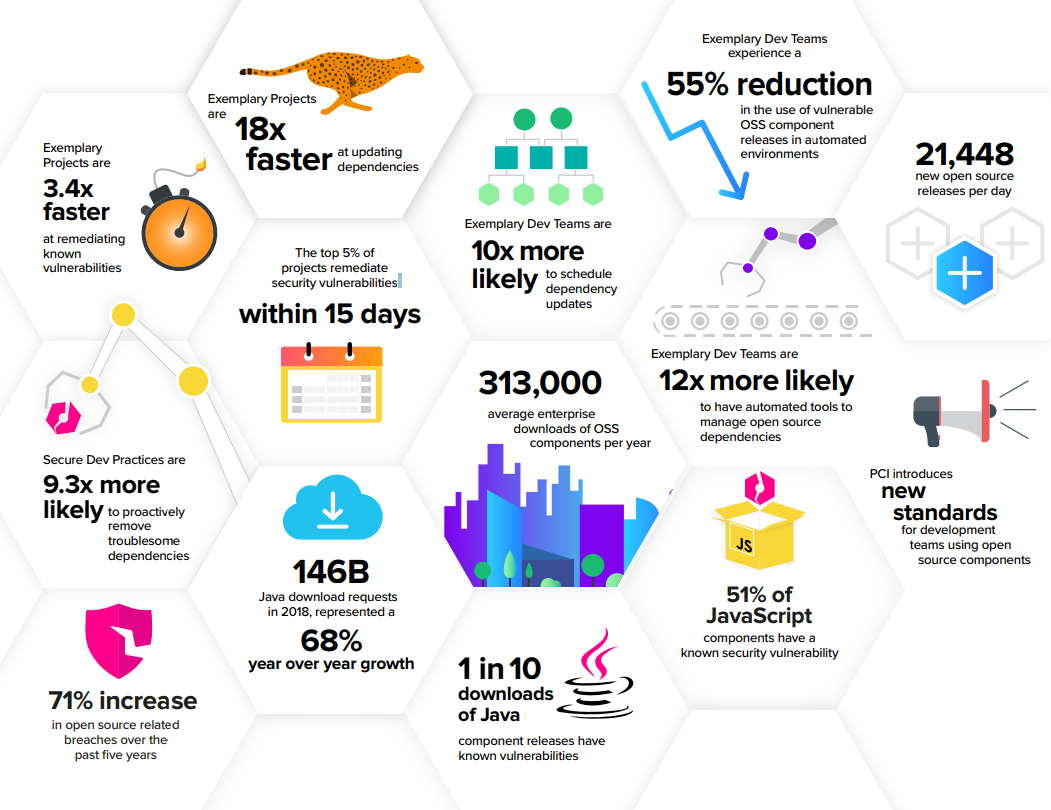
    We’ve known for years that innovation is critical, speed is king and open source is at center stage. This research further underscores these accelerating trends throughout the software supply chain. It also shows that taming the supply chain is possible. By making better supplier choices, component selection and using automation, dev teams are seeing impressive rewards. In fact, for those development teams actively managing their software supply chains, the use of known vulnerable component releases was reduced by 55%.

    The report details 11 other behaviors and attributes of leading enterprise development teams, including their frequency of software releases, their use of repository managers and their reliance on a software bill of materials.

    Gene and Stephen helped shed new light on exemplary development and DevOps practices that I believe will help developers around the world better understand what secure coding means and how to start addressing it.

    — Derek E. Weeks

  • Are Developers Your First Line of Security Risk or Defense?

    Are Developers Your First Line of Security Risk or Defense?

    Every organization on the planet, whether public or commercial, is facing an ongoing challenge: to exist in an increasingly digital space. Past products must transform to meet the digital expectations of their customers, and new products must be built with “digital-first” frameworks in mind. After all, if they fail to meet these expectations, there’s almost certainly a competitor ready to swoop on the opportunity.

    So, what does that mean for all these businesses, old and new? It means they are employing teams of developers to create line after line of the code that forms their digital product or service.

    In this fast-moving, high-pressure environment, CIOs have become the new innovators, and are in positions of immense influence. However, they face a strong demand to meet rapid speed-to-market goals, enhance product quality with each update and increase flexibility. This has led to complex, often fragmented development teams whose primary focus is on rapid development of features and functions, without consideration of the vulnerabilities they could be creating in the code they are so quickly churning out.

    If our data is to remain safe, we must implement a new way of working. Just look at the catastrophic damage Equifax faced following its recent breach: a disaster that occurred as a direct result of insecure coding practices.

    CIOs and CISOs need to consider carefully whether their development teams are in fact the first line of data breach risk in the organization or the security champions, their company’s true “first line of defense” against cyberattacks. If they’re not the latter, they certainly could be.

    Secure Coding Checklist

    Where does your own dev team fit? I have created this Secure Coding Checklist to help CIOs and CISOs identify whether their development teams are truly equipped to be secure coding champions, helping to innovate with faster, better and safer code (or, indeed, whether you’re in need of a more robust security program):

    1. Is there acknowledgment at your executive C-level that traditional network security is no longer enough?

    These days, securing the network layer using traditional security measures is simply not good enough (and, let’s face it, is rarely successful anyway) even against semi-professional hackers. Among many consistent reports, Verizon’s “2017 Data Breach Investigations Report” cites that 35 percent of data breaches today are caused by web application vulnerabilities.

    Web application security is equally as important as network security; ignoring fundamental, protective AppSec measures could leave you well and truly open to a breach.

    2. Are you considering security from the start?

    The current approach to application security utilizes tools that focus on moving from right to left in the software development life cycle (SDLC). This, by design, supports a detection and reaction outcome. This means that security teams search for and detect vulnerabilities code that is already written, then react to fix them. According to the National Institute of Standards and Technology (NIST), it is 30 times more expensive to detect and fix vulnerabilities in committed code than it is to prevent them as they are written in the IDE. This doesn’t even take into consideration the production delays, double-handling and time spent in remedying any issues. Secure code champions start at the extreme left of the SDLC, with a focus on continually training their developers in secure coding, so they can be the first line of defense in their organization, preventing common vulnerabilities from occurring in the first place.

    3. Do you actually make the effort to build security skills, or are you just feeding knowledge?

    The vast majority of security training solutions (online and in-classroom) focus on building knowledge instead of building practical skills. For developers to thrive and engage in writing secure code, they need regular access to hands-on learning that actively encourages them to learn and build their skills in a real environment. They need to learn about recently identified vulnerabilities, in real code, and be able to work in their own languages/frameworks. This learning experience should help them understand how to locate, identify and fix known vulnerabilities in the code they are actively working on in the course of their jobs.

    4. Are you measuring your secure coding skills with real-time metrics?

    A vital step in ensuring a security-first mindset is being built within a development team is to collect and review evidence. Metrics seek to prove to the developer and their organization that their hard work is paying off, and secure coding skills are improving. You can’t improve what you cannot measure. There should be relevant assessments, and these should help identify the progress of your development teams in real-time as well as benchmarking their secure coding strengths and weaknesses for continuous improvement.

    5. How sure are you that any outsourced vendors are actively using secure coding techniques?

    Many organizations decide to contract out development work to other development houses. Whether they exist on- or offshore, their general secure coding abilities and practices are a relative mystery. In the best case, the only form of assurance an organization will receive relating to security is a statement in the contract requiring the deliverable to be “secure.” Few companies actually take the step to verify the skills of these development houses upfront, thus winding up with software that has been built without following sound secure coding practices. Worse yet, if the company is not aware of them, it risks going live with a vulnerable application.

    The most common scenario is that any vulnerabilities get picked up by dedicated security specialists (that come at a high cost) and you are faced with a delay of your go-live date, and possible contractual discussions on who needs to pay for fixing these security weaknesses. However, if you’re smart upfront and assess the application security skills of the developers who are going to build your next application, you save a lot of potential delay, frustration and cash.

    6. Are your developers aware of the most common security weaknesses?

    More than 85 percent of exploited web application vulnerabilities are attributed to just 10 known vulnerabilities—the OWASP Top 10. At a bare minimum, your application security training must cover these, in addition to many more vulnerability types. The training challenges your developers contend with must be actively revised and updated on a regular basis, with new challenges for either new coding frameworks or new vulnerability types.

    7. Do you have in-house security champions?

    Every developer-heavy organization should invest in a security champion—someone who is going to take responsibility for a security standard within the dev team. Their purpose is to be a support point of contact for anyone with questions around security, as well as become the chief advocate for following security best practice.

    8. Have you invested in tools for your developers to make secure coding easier?

    If your organization is one in which agile development is practiced, or indeed you are faced with frequent updates to company-built applications, automating parts of your security is one of the only ways to keep up with the frantic pace and volume of work.

    There are tools available at each stage of the SDLC that will serve as advisers, quality gatekeepers or detection tools. Ideally, you should have IDE plugins that focus on certain types of security bugs and act almost like a “spell-checker” while developers are writing their code. There are others that integrate with the build process, detecting certain types of weaknesses as the code is being submitted to a code repository.

    In addition, some tools run automated tests over the code, simulating attempted hacking once the software is in production. All have their own set of benefits and challenges, and none can provide a catchall, 100 percent guarantee that no security threats exist within the application. The No. 1 preventative measure you can employ is that the earlier you can capture the weakness, the faster and cheaper it is to remediate it with the least impact on your business.

    CISOs and CIOs are essentially forced to quickly and aggressively build their enterprise agile capabilities. As such, secure coding skills will be a weapon—not a hindrance to—innovation, and foregoing them could spell the absolute destruction of company reputation and data. Think twice before you skip this critical capability.

    So, how did your organization fare against this checklist?

    — Pieter Danhieux