Tag: Puppet

  • DevOps Chat: State of DevOps Report 2017, Nigel Kersten, Puppet

    DevOps Chat: State of DevOps Report 2017, Nigel Kersten, Puppet

    The results and analysis of the State of DevOps Report 2017 report are due out in early June. just in time for the DevOps Enterprise Summit London June 5-6. In this DevOps Chat we speak with Puppet exec and one of our favorite interviews, Nigel Kersten.

    Of course, Nigel and the folks over at Puppet have been co-producing the State of DevOps report and survey for six years now. For this year, Nigel along with Dr. Nicole Forsgren and Jez Humble of DORA, will be co-presenting at the DOES London, where they will announce the results of this year’s survey. It should be quite interesting.

    Nigel gave us some sneak peeks and early trends for this years report, as well as discussed the DevOps Enterprise Summit and, as usual, some good info on what is happening at Puppet and the DevOps world in general.

    You know the drill by now: The streaming audio of our conversation is immediately below and the transcript of our conversation is below that. Enjoy!

    Streaming Audio

    Chat Transcript

    Alan Shimel: Hey, this Alan Shimel, devopsy.kinsta.cloud, and we’re here for another DevOps Chat. And we’re happy to be joined again by a repeat guest on DevOps Chat, none other than Nigel Kersten of Puppet. Nigel, welcome.

    Nigel Kersten: Hey, Alan. Nice to talk to you again.

    Shimel: Good to speak with you. So, Nigel, we’re not talking about the latest and greatest from Puppet today. Well, maybe if you wanna just mention it quickly, feel free, but I wanted to really talk a little bit about the upcoming DOES London event, Gene Kim’s DevOps Enterprise Summit, which is June 5th and 6th in London at the QEII Center, and you will be presenting there. Correct?

    Kersten: I will be. Yep, with Dr. Nicole Forsgren, who’s one of the other authors of the DevOps report, and DevOps Enterprise Summit London last year, I think, was honestly one of the best events I’ve been to in this space for a long time and I adore London for lots of reasons, and so it’s always great to be back there.

    Shimel: Yeah. And, Nigel, correct me if I’m wrong – is Jez Humble also presenting with you and Dr. Nicole?

    Kersten: I think Jez probably will be, but I’m not sure if it’s quite confirmed yet. We’re sort of trying to work out how we’re covering all of the different events, for the various roadshows and webinars we’re doing around the DevOps Enterprise Summits and the DevOps enterprise report.

    Shimel: Yep. Okay, so I guess we’ll stand by for final confirmation on that, but, certainly, you and Dr. Nicole will be on, and, of course, Nicole has appeared on our show before and we’ve talked a little bit about not only this year’s DevOps survey but past years’ as well. But, Nigel, for some of our listeners who maybe weren’t lucky enough to hear previous talks about it, this is what? The sixth or seventh year of the State of DevOps survey?

    Kersten: This is the sixth year, which is kind of amazing ’cause, you know, I think, when we first started with the fantastic Alanna Brown, who also works here at Puppet, everyone was a bit skeptical about it. I think this was even before you’d started devopsy.kinsta.cloud and people were like, “Is this really a thing? Do we really need a survey about all of this?” but I think it’s just gone from strength to strength over the years. So, yes, I guess, for the people who are sort of new and may not have come across the report before, what we essentially do is we survey a whole bunch of practitioners—we’ve done tens of thousands of ’em around the world over the last six years—and what we do is we ask about the practices and the tools that they use, but also some metrics about “What’s your mean time before failures? How quickly can you deploy your software? What sort of practices do you use?” as well as what sort of outcomes you have. And then we do a statistical analysis on all of that so that we can—and we actually end up showing that there’s a huge gap between what we call “high-performing” IT organizations and everyone else.

    And, in fact, interestingly enough, over the last few years, we’ve shown that the gap is increasing over time, so the people who’ve adopted DevOps practices—because, essentially, what we’re showing is we’ve been able to show statistically that what we tend to call “DevOps practices,” around using CI, using CD, using infrastructure-as-code software, doing continuous deployment, using testing, storing things in version control, all of these practices, when you cluster them, are the people—the people who employ these practices are the people who have high-performing organizations. And they’re really huge statistics—they tend to be thousands of times better, being able to deploy just ridiculously faster—and, essentially, what this ends up showing is you really don’t have to sacrifice quality for speed or vice versa, so we’re seeing that these people are both producing high-quality infrastructure and applications and they’re doing it far more quickly than everyone else.

    I think one of the things I’m really proud of with the DevOps report is that it’s useful to sell DevOps practices within your organization, so I talk to an awful lot of customers and practitioners out there who are really thankful for the report because it tends to be focused on business outcomes. So, even though we’re surveying practitioners, it’s something that’s really applicable to C-levels and VPs and directors. They can look at this with them and go, “Ah, this is where the industry’s moving and these are the sort of benefits we’ll actually get.”

    Shimel: Excellent. And, Nigel, in typical humble Nigel self, you’re—I mean, let’s give a little bit more flavor, if we can. Over the five previous years, I think there’s over 25,000 responses to these surveys.

    Kersten: Yeah, no, that’s right. 25,000 over five, six years. It’s pretty crazy.

    Shimel: So that does represent a—in a field like DevOps, which is fairly new, right, it represents a sizable amount of people and organizations who have taken the time and contributed to the data that you guys have analyzed over the years. And another important thing, I think, to note for our audience is not only the analysis of the data but even the questions themselves are, from a statistics point of view, a statistician’s point of view, rigorous—rigorously designed and rigorously analyzed. And, look, having a Ph.D. statistician helping you with it doesn’t hurt, but so these are not just some –

    Kersten: No, it’s not your average –

    Shimel: – go up and doing surveys.

    Kersten: – sort of marketing survey at all, and I think this is why it’s always really important for us that—you know, we’re a software vendor and we’re in this space and there’s a lot of people in our space who do pretty fluffy kind of surveys that only take two or three minutes and then some sort of ridiculous claim gets made, so this is why we’ve always been really keen on working with the external parties of Gene Kim, Jez Humble, Dr. Nicole Forsgren. Particularly Nicole. She’s a trained statistician who’s literally got a Ph.D. and has spent her career working on studying organizational performance, which overlaps with DevOps in really interesting ways, but I think having that external rigor, and I think it helps keep us honest as a software vendor. So this is something we really loved, having a partnership with them, ’cause this is their specialty.

    They actually—to give them a little bit of a plug, they have their own organization, DORA, DevOps Research and Assessment, where they’ll come in and do benchmarking of your organization and actually measure how you’re actually doing, so I think it’s just really great. We’re clearly really plugged in as Puppet into this whole community, but they plugged in at a different level, and working together, I think, means that we both get to expand reach and bring a bunch of statistical rigor to something that could easily devolve into a self-serving survey, which ultimately doesn’t –

    Shimel: Hey, Nigel?

    Kersten: Yep?

    Shimel: I thought I lost you there for a second. I apologize. Agreed, I mean, on all of the above. And that’s really—I want people to understand that, that this isn’t a marketing survey they up and have done now for six years running. I wanted to make another point, Nigel, and that is, certainly, over the last two years at least, and I would imagine for this year as well, one of the real nuggets of wisdom that have come out of this analysis is really just how high-performing or what high-performing IT organizations mean to the bottom line of these companies that are doing it. I think, at some level, we all at a gut level say, “Well, if you’re performing better, you’re releasing faster, it should translate into a better company,” but, certainly, the State of DevOps report—survey and report is one of the few that are out there that really connects the dotted lines here.

    Kersten: Absolutely. So you look into the sort of things that people are actually sort of seeing. What we’re seeing, so to sort of hit some of the boon stats from last year, is that we’re seeing the high-performing IT orgs, three times lower change-failure rate, 200 times more frequent deployments, and 24 times faster recovery from failures. And those are really amazing stats because I think they really resonate, both with practitioners who’re the people who are getting woke up in the middle of the night or having to deal with the pain of a deployment that didn’t work properly, but they’re also the sort of stats that your average, been-away-from-the-technology-keyboard for a few years, high-level executive, can look at it and they go, “No, that’s actually what we want. We want to be able to deploy more frequently,” because, I think, one of the lessons that SAS has taught us is the reason a lot of SAS companies outstrip on-premise competitors is because, every time they deploy, it’s a chance for learning, it’s a change for feedback.

    And Agile has taught us, from traditional software development, the more frequently you can deploy, the smaller the deltas are in those deployments and you can do more frequent cost correction, so you can actually produce a much better outcome over time by deploying more frequently and being able to correct course more frequently.

    And, to, I think, bring it back to enterprise folks, not everyone always thinks about deployments in this way, but, every time you get a patch from your vendor, that’s another deployment. Every time you respond to a security incident internally, every time you have to follow through a recommendation of your audit and compliance committee—all of those things are deployments and the more pain-free and friction-free you can make the ability to deploy within an organization, the more responsive you’re gonna be to all the different stakeholders.

    Shimel: Yeah. Let me give you my favorite stat that you omitted or you just didn’t get a chance to, and that is these high-performing IT organizations have 50 percent less vulnerabilities post-deployment.

    Kersten: Yep.

    Shimel: That’s huge.

    Kersten: It’s a major. And you’re spending less time on that. And I think the other related one that’s really amazing is that the high-performers spend 22 percent less time on unplanned work and rework. And, for anyone’s who’s been neck-deep in infrastructure, it’s the unplanned work that kills you. It’s the context switching. You’re not making progress on your defined road map every time you’re having to spend time on unplanned work.

    Shimel: Yeah. So, Nigel, these are all fantastic insights and metrics, so now, of course, though, we’ll turn the table on you and say, “Hey, what have you got for us this year?” I know it’s early; I know you haven’t released the report yet. You’ll probably be announcing a lot of the results, I think, come out just at the time of DOES London, which, again, is June 5th and 6th, but is there anything you can share with our audience as maybe a preview?

    Kersten: So I think one of the things that I could share is we’re still going through doing the analysis, but we’re seeing that, again, the high-performing orgs are achieving just as well compared to everyone else, as they have in previous years. It doesn’t look like there’s only sort of peak, as far as implementing these practices. I think the whole industry, even people who have been doing this for a while, have still a fair way to improve.

    I think one of the really interesting things—well, there’s two big ones I wanna call out. One is that, this year, we spend a bit of time working on non-profit performance ’cause, in previous years, we’ve shown that commercial companies who are high-performing IT orgs tend to outperform their financial metrics, outperform in the stock market, their internal company goals, but, this year, we decided to focus on non-profit performance, and so we’re looking at things like, “What’s their operating efficiency like? Customer satisfaction? Quality of the products that have been shipped?” So we’re actually, I think, showing that DevOps practices in high-performing IT orgs impact in a positive way all sorts of industries, so I think that’s gonna be one of the really interesting sections.

    The other section, I think, that’s gonna be really fascinating is that we’re actually looking at what’s the—there’s a myth out there, to sort of back up a little bit, that DevOps practices tend to work if you’re building all of the software yourself, if you’ve got a web app, if you’re building a whole bunch of stuff in Node.js or something like that, and deploying it to the cloud, sure, you can do DevOps—you can do continuous integration; you can do continuous delivery—but, for those of us who are sitting there running commercial, off-the-shelf software, we can’t actually do that and we can’t actually obtain the benefits that are available by employing DevOps practices. So I think what we’re gonna be showing is that this isn’t true, that there’s a couple of things you can do as an organization, in the way you consume commercial, off-the-shelf software, to actually let you employ continuous integration, continuous delivery.

    Now the reality is you’re not gonna be able to test all the same kinds of things because, unfortunately, you know, lots of vendors that release software don’t necessarily have an API-first policy, so you’re not always gonna be able to test everything inside the application, like you can’t run unit tests, necessarily, ’cause it’s not your code, but there are a whole bunch of things you can do. And one of the big bits of guidance that we’re gonna be pushing is that, when it comes to commercial, off-the-shelf software, really try to make the installation as vanilla as possible. Don’t spend forever customizing it. And, if you’re having to customize it because that’s what your business processes say, in many ways, the lower-cost and better-outcome approach is to not customize the software and adjust your business processes because there’s something within your control, generally. And if you adjust those, then it becomes simpler to deploy that software into a CI system, to have Jenkins or Bamboo or whatever do deployments of it, do external black-box testing, make sure that it actually works, and then roll it out to production.

    So we’ve got a pretty strong belief that, when it comes to utility computing, to sort of use Martin Fowler’s distinction between utility and strategic computing.

    Shimel: Yep.

    Kersten: There are huge efficiency gains to be made there, but there’s a few things you can do to avoid those problems. The analogy I kind of come back to is that there was a period, I think, in the late ’90s and early 2000s, when lots of people would customize their Apache installs. They would sit there and come up with this fine-grained list of modules, configured in specific ways, and, every time they deployed a new version of Apache, they’d eke out another one or two percent performance by having this really customized installation. It turns out the actual cost to the business is really great because those tend to be manual processes—you’re turning yourself into a snowflake when you didn’t actually need to be—and I think the more you can commoditize the software you’re buying and that you’re building and that you’re deploying, the faster and more friction-free a lot of these processes are gonna be.

    Shimel: Got it. You know, Nigel, that—so I’m old. That’s firing up some old synapses in my brain back from the dot-com days, when I helped start a company called “Interliant.” We were an early ASP. And, mind you, this is before we have a modern cloud and virtualization and ubiquitous connectivity, but we were offering hosted Lotus Notes, PeopleSoft, Oracle applications, Lawson ERP—I don’t know if you remember Onyx was an early CRM tool back then.

    Kersten: Oh, yeah. Yep.

    Shimel: That’s a blast from the past, huh?

    Kersten: Totally.

    Shimel: Anyway, so our thought was to offer hosted versions of these applications. This is early, right? We called them “application service providers.” And what we quickly learned in—you know, when you go to market, and we did the whole IPO thing, all of that, but what we learned from our enterprise customers was that, as much as we wanted them to run a vanilla PeopleSoft or a vanilla Lawson or Onyx or even Lotus Notes, for that matter, the best we could hope for was about 80 to 85 percent of out-of-the-box, just plug-and-go. They always needed—and so what happened was we had to change our whole business model and we wound up acquiring a bunch of service bodyshops, for lack of a better word, who would come in and do that last-mile customization, if you will, that last 15 percent. And, as a result of that, I will tell you, the business model failed, ultimately bankrupt. And, if you look at all those early ASPs, none of them really succeeded—USinternetworking and Corio, some others—because we weren’t able to get people to use the vanilla configs that would have been easy for us to host, spin up, and put down.

    I think you see the same thing a lot today, with kind of bare-metal hosting. Right?

    Kersten: Yep.

    Shimel: Versus a traditional cloud virtual, you know, kind of hypervisor thing. How many people are using just vanilla bare-metal kind of config versus how many have—and you guys are Puppet, right? You’re dealing with this more than most, right? How many people are highly, highly customizing their bare-metals?

    Kersten: I think we’re seeing people shift away from customization. I think there’s probably a few things. One is I think people are realizing that a lot of this industry is sort of commoditizing, and so you may as well use off-the-shelf stuff. And so, if you’re just consuming stuff the way it was sort of shipped from the vendor, whether it be hardware or software, there’s sort of a general expectation that, I think, both software quality has improved—as much as we like to bitch and complain about software, I generally think software has gotten better than it used to be. There was no sort of Golden Age of incredibly rigorous enterprise software, as far as I’m concerned. I think stuff’s getting better. So I think there’s a couple of different pressures there, is that software’s gotten better, people have gotten more used to the idea that various things are being commoditized, and so they’re more willing to entertain the notion that the next layer up is getting commoditized.

    Shimel: Yep.

    Kersten: I think we’re also seeing things like—so here’s a good example, I think. If you consume Atlassian’s JIRA, the hosted version, versus the on-premise version, you can’t customize it as much. And, if you’re consuming GitHub the public service, versus GitHub enterprise, you can’t customize it as much. And so there’s a general understanding from people that, you know, an uncustomized version, or as much as is sort of possible, is actually pretty good and we don’t need to make everything completely different for everyone else because it means that documentation just works out of the box and people who’ve used the software somewhere else can join the company and have much faster on-ramp.

    And I think we’re seeing that—and this is a somewhat optimistic approach—that there’s a general desire for people to adopt software engineering principles and sort of DevOps cultural changes to get to that higher-performing IT organization state. And I genuinely think, if we keep pushing this sort of attitude out to people that, “If you don’t customize your software, adjust business processes to fit instead, that’s cheaper and you’ll get a better outcome,” I think all of those things combined sort of give me hope that we’re actually heading towards a world where people are giving up unnecessary customization.

    Shimel: I hope so. But, Nigel, we’re so far off our course here. You know, we were supposed to be talking about DOES London, and let me try to bring you back. So, I mean, obviously, all of this is background and the—this is why this survey is so important, so that we see these trends and we see it manifest itself in how companies are doing things and so forth. Let me ask a little bit—so, Nigel, you’ve presented at DOES before and I did an earlier interview today—I was talking to one of the program committee’s members for London, Jonathan from Hiscox—and –

    Kersten: Ah, yes.

    Shimel: Yep. And, forgive me, his last name—Jonathan Fletcher from Hiscox.

    Kersten: Yeah.

    Shimel: You know, and I’ve known Jonathan for some time—great guy. What we—you know, we forget—all rolled into one place in the space of two days, we’re gonna be jam-packed with all of this great information around DevOps and what we’re seeing and not only what we’re seeing but people are gonna talk about what they’re doing right now and what they did last year versus this year versus next year, what the findings are in our surveys, and I think that’s what really makes for a great event. Right? I think –

    Kersten: Yeah, I think there’s a couple of things that are really unique about it. I think one is that it’s not a vendor event, and I’m in the business of working the software company and we make and sell software, but it’s also really refreshing to go to an event where everyone who’s on stage is really there just telling case studies, their real-world stories. They’re not product-pitching to you. We’re not getting up and pitching Puppet Enterprise to you at all. We’re getting up and talking about the DevOps report, and everyone who’s there is—I think this is Gene’s big focus, is that everyone’s telling a real-world case study about what they’re actually doing, where the challenges were. It’s war. It’s honest. So I think that’s one section of it, that it’s real stories from out in the field.

    But, perhaps more importantly, it’s not just practitioners. And I think those of us who sort of have had a technical background can sometimes get too in the weeds about going and watching someone’s talk about this incredibly interesting deployment they’ve done and what they achieved, but we’re seeing business leaders talking about the actual impact on the business, how they ran large departments, large transformation projects. You know, the term “digital transformation”’s been kicking around for quite a long time, but we tend to see very sanitized case studies, driven either by a software vendor or a large consulting firm or the PR department of some multinational corporation talking about what they’re doing, and these tend to be really warts-and-all stories, going, “This is what we did and this is how it worked or this is how this didn’t work.”

    And I think some of those are some of the more fascinating stories, where people are getting up and talking about “Here were our lofty ambitions and we only got 60 percent of the way there and these were the problems we ran into.” And that, I think, is just really, really powerful, so I think the fact that you’ve got senior business leaders and executives there, as well as the fact that they’re all real-world case studies, is just a really, really powerful combination.

    Shimel: Yep. I agree with you. As a matter of fact, one of the things I’d love to see is more people get up and talk about failures, right, where maybe DevOps, they didn’t do it right, or what they could have done differently or what have you, where it didn’t work out right and this is what we did as a result, ’cause I think too many people come out of these events, out of Gene’s things, sometimes, and it’s like it’s all rainbows and unicorns and horses and such, and that’s great, but we—you know, as a dad, I try to teach this to my kids—you don’t always win. And that’s why you gotta learn to deal with failure and how to recover from that as well. And I think those are some of the best lessons for people to learn, is we learn more from our failures than from our successes sometimes, so.

    Kersten: Absolutely. And I think it’s hard because we haven’t always had a culture in the IT industry of actually performing postmortems and retrospectives on large projects that we’ve done, so it’s people don’t always have great answers for how they would have done things differently, but I think that’s something that’s actually also starting to shift quite considerably. We’re seeing DevOps has been a big part of that, of “Let’s do blameless postmortems,” and, hopefully, that continues so that we see more people being open about their failures.

    ‘Cause I think one of the things I find really frustrating—this has happened to me more than once and I don’t think this is gonna identify me, one customer or user, because they do so many of them—seeing your executives at Amazon summits get up and talk about how fantastic their whole cloud migration journey has been and that they’re all in the cloud and everything’s done and it’s absolutely wonderful. And then you go talk to the VPs or directors who are actually running those deployments and they’d be like, “Oh, God, no. We’ve only moved five percent of things and it’s been a miserable failure and we’ve now added three years to the project because we’ve fallen over organizational boundaries.” So I think that gap between the sort of PR-style business leader talk and the reality—that’s not a gap that actually exists at the DevOps Enterprise Summits, which I think’s been really fantastic.

    Shimel: Yep. Agreed. Agreed. Well, Nigel, our little 15-minute chat has turned into a solid half-hour, and I think we’re gonna need to call a break here. We are looking forward to the release of this year’s analysis of the survey, looking forward to your presentation along with Dr. Nicole at Gene Kim’s DevOps Enterprise Summit in London, June 5th and 6th, and just always looking forward to what you’re up to and what the folks in Puppet are up to. Many people, you know, when they think DevOps, they think of companies like Puppet, right? A leader in—I don’t know if they’re ever gonna do a DevOps Magic Quadrant, but—or some sort of stuff like that, right? But, I mean, seriously, Puppet’s one of the cornerstones here and you’re one of the cornerstones in Puppet, so it’s always great to hear what’s happening from you and getting caught up. It’s a pleasure.

    Kersten: Aw, thanks, Alan. So I will get one little pitch in, which is, because of DevOps Enterprise Summit being in London that week, we’re going to be announcing pretty soon that we’ve got a Puppet Camp happening pretty soon afterwards, so there’ll be a Puppet Camp in London, and this will be a slightly different tweak on the Puppet Camp format. We’ve run hundreds and hundreds of these events over the last few years, but we’re doing a slightly different thing, where we’re having a sort of more executive-manager-focused morning and a more practitioner-focused afternoon. So, if you’re someone who’s an IT architect, you might find mornings and afternoons both applicable, but we’re really looking to try and join together the conversation for sort of senior executive leaders as well as practitioners on the ground. So we’re already collecting a whole bunch of really great talks, both for the morning and for the afternoon, but, for those of you who are into Puppet, look out for a Puppet Camp London coming soon after DevOps Enterprise Summit.

    Shimel: All right. We’ll try to get info on that up on devopsy.kinsta.cloud for anyone interested. Nigel, fantastic, man. Thank you so much for the time today. We appreciate it. Nigel Kersten of Puppet here on DevOps Chat. This is Alan Shimel for DevOps Chat. Hopefully, we’ll see you soon at the next—on the next DevOps Chat. Until then, have a great day.

    — Alan Shimel

  • When DevOps Disrupts DevOps

    When DevOps Disrupts DevOps

    As longtime readers of my blogs will know, one of my hobbies—when not writing about or playing with technology—is modeling. There is a similarity between quality tech work and quality modeling, but the brain power involved in modeling is much less, leaving me time to think about tech issues or listen to audiobooks (when I’m not listening to music, anyway).

    In modeling, as in tech, there is a process. The process varies based upon what you’re working on, but is largely the same, with some steps slightly different or skipped altogether and others taking longer. At the moment, I’m building the first day of Gettysburg from the American Civil War, but I simply enjoy modeling—and wargaming with the models, but that’s a separate story for a hobby-focused blog.

    The thing is, that process is nailed down, and to the extent it can be, is automated. One step leads reasonably to the next, and while one step is completing on a given model (glue or paint drying, etc.), there is an opportunity to advance a separate project.

    Sounds a lot like DevOps, doesn’t it?

    The thing is, every once in a while, you will get something that is so different, it totally interferes with the carefully planned flow. My current primary project is a little over 300 figures. While one unit is getting the final two coats of finish (that are basically the same or every model), the next unit is getting primed. Assembly of all the figures came first, so there is only the priming step before painting can commence.

    Picture, but you missed it.
    Piper Millin and Lord Lovat cross Pegasus Bridge.

    But here is a work-in-progress picture of Pegasus Bridge. This came as a complete set, and took a large chunk of time to get together, find the correct water for, get placed on foundation boards, etc. This is outside the normal process of assemble/paint/base figures and vehicles. The set is beautiful, and even this picture, which was taken well before completion and only to study color and weathering effects versus reality, shows how truly nice the model was. But it totally disrupted the process flow.

    DevOps and Multisystem Installations

    That’s what complex system installations such as Hadoop or OpenStack do. You’re installing across multiple systems, configuring them for load-sharing and communication, and doing it by hand is a long process that interrupts the normal DevOps flow. Crafting scripts to install them is possible but highly complex and frustrating, simply because of the complexity and interrelationship of the nodes in the system.

    Having installed both by hand, and installed both with tools designed to make it easier, I will happily tell you that yes, you will understand more if you do it by hand, and no, that immediate understanding is not necessarily worth the cost of weeks or months figuring it out and getting it installed.

    You see, to operate these systems, you will need much of the knowledge you would gain hand-installing, so you’re going to learn it either way. Your choice is a simple one: Get a working system and learn by tweaking settings or swapping nodes in and out, or have no working system and learn by the frustrating process of trying to figure out what you’re supposed to do next, and why that step is failing for your specific hardware.

    DevOps and Multisystem Maintenance

    The only real problem is that it is painful to maintain these systems. It’s not as simple as

    yum update [[packagename]]

    because that would only upgrade one package on one system. But these tools span multiple systems, and even just dependencies generates a massive list for each system in the cluster. Seeing the need, most of the traditional application provisioning tools (Puppet, Ansible, et al) have built or cobbled together solutions that will get the job done. But custom solutions exist for these products, too. The problem is that, like Pegasus Bridge, as beautiful as they are they disrupt the DevOps flow. No system goes without exceptions, and I’ll go out on a limb and say that custom solutions to install and maintain solutions such as Hadoop and OpenStack are worth having yet another tool in the DevOps tool chain. The trend is multipurpose tools to be used on many projects, but the importance of a cloud or big data cluster in your IT operations makes them worth the extra tool. As long as the extra tool reduces the amount of work and the chances for human error (which, in my opinion they do—it is kind of their selling point).

    That Leaves Time

    These tools (a good example, though in general I won’t be talking about the competing vendors here, is the Mitaka-based release of Mirantis) allow not just installation but also ongoing management of the OpenStack cloud or big data cluster. That means there is less nitty-gritty for DevOps (or operations for that matter) teams to worry about, freeing time for working on what actually gets built on top of these powerful platforms. Cloud and big data both are just enablers for more functionality when looked at in the right light, which means more work (and often more meaningful work) for DevOps teams.

    When you consider either of these technologies, check out what’s available for installation and maintenance, even if it is outside your normal DevOps tool chain. Like Pegasus Bridge, the change is likely to disrupt you for a bit, but once you have a tool and process in place, it will just be something that happened—and was going to happen with or without the tools. They just make it less painful.

    — Don Macvittie

  • Puppet Appoints Chief Product Officer and VP of Customer Success

    PORTLAND, OR – February 7, 2017 – Puppet, the standard for automating the delivery and operation of the software that powers everything around us, today announced the appointment of Omri Gazitt as chief product officer and Sandra Hamilton as vice president of customer success. Omri comes to Puppet from Hewlett Packard Enterprise (HPE), where he was vice president and general manager of its cloud native platform business unit. As chief product officer at Puppet, Omri will oversee engineering, product management, next-generation technology and evangelism. Sandra joins from EMC, where she served as vice president of global services. She was instrumental in establishing the company’s consulting business and in helping it grow to more than $250 million in worldwide revenue. As vice president of customer success, Sandra will expand the global services practice, advance the customer vision and elevate customer relationships.

    “To sustain incredible innovations and outstanding customer experiences, we hire truly exceptional people to fill every position,” said Sanjay Mirchandani, CEO of Puppet. “Software is the heart of every business and Puppet’s vision is to provide cutting-edge products and services that enable global organizations to automate software delivery, support DevOps and drive digital transformation. Omri and Sandra will help accelerate this vision and our products and services roadmap.”

    Omri Gazitt

    Omri has more than 25 years of experience in roles spanning engineering, product and business management. Most recently, he was the vice president and general manager for the HPE Cloud Native Platform business unit, where he was responsible for all aspects of the business. Omri joined HPE as the vice president of engineering for the Helion Development Platform product, which he defined and launched. He was then promoted to vice president of products, where he led cloud strategy, product management, UX and security functions for the entire Helion portfolio, including HPE’s private, managed and public cloud solutions. Additionally, he oversaw HPE’s involvement in the OpenStack and Cloud Foundry open source projects and served as board director of the Cloud Foundry Foundation in 2016.

    “We’re in the midst of a sea change as enterprises deploy new workloads into public clouds such as AWS, Azure and the Google Cloud Platform,” said Gazitt. “It’s a great honor to be joining Puppet, an iconic company in our industry which has played an essential role in helping customers manage through the complexity of running ever-larger and more heterogeneous IT footprints. As our customers adopt DevOps practices and increase their agility, Puppet has an excellent opportunity to be their trusted partner on that journey.”

    Sandra Hamilton

    Sandra brings more than 25 years of experience to Puppet. She has a record of leading global organizations through successful business transformations in a range of industries, including finance, deal management, consulting and technology. In her previous role as vice president of global services at EMC, Sandra developed and supported EMC Global Services’ go-to-market strategy for its broad portfolio of professional services.

    “I’m very passionate about the total customer experience,” explains Hamilton. “My entire career has been about the customer, in one way or another. Even in the age of technology, I recognize the value of personally engaging with them. At Puppet, I’m looking forward to elevating the customer connection even further.”

    Promotions

    Puppet also today announced that Katie Abbott has been promoted to vice president of legal affairs and Terry Wrightson to vice president of Americas.

    Katie Abbott

    Katie has been with the company since 2014. In her new role, she will assume greater responsibility for legal matters, including guidance in the dynamic landscape of licensing, data privacy and open source software as Puppet continues its global expansion.

    Terry Wrightson

    Terry joined Puppet in 2015 after a lengthy career in high-technology sales, including roles with Quest Software, EMC, VMware and HP. In his time with Puppet, Terry has led the Western Field & Enterprise team and successfully executed business objectives. In Terry’s new role as vice president of Americas, he will be responsible for managing all aspects of the Puppet Enterprise business.

    New hires and promotions are taking place during a period of continued growth:

    • More than 35,000 companies around the world, including 75 percent of the Fortune 100, now use Puppet.

    • Strong growth in the U.S. accounted for 78 percent of bookings in Q4.

    • Strong growth in EMEA accounted for 18 percent of bookings in Q4.

    • More than 500 people work for Puppet today.

    Additional resources

    — Jules Louis

  • Infographic: DevOps Lessons from Lean Auto Manufacturing

    Infographic: DevOps Lessons from Lean Auto Manufacturing

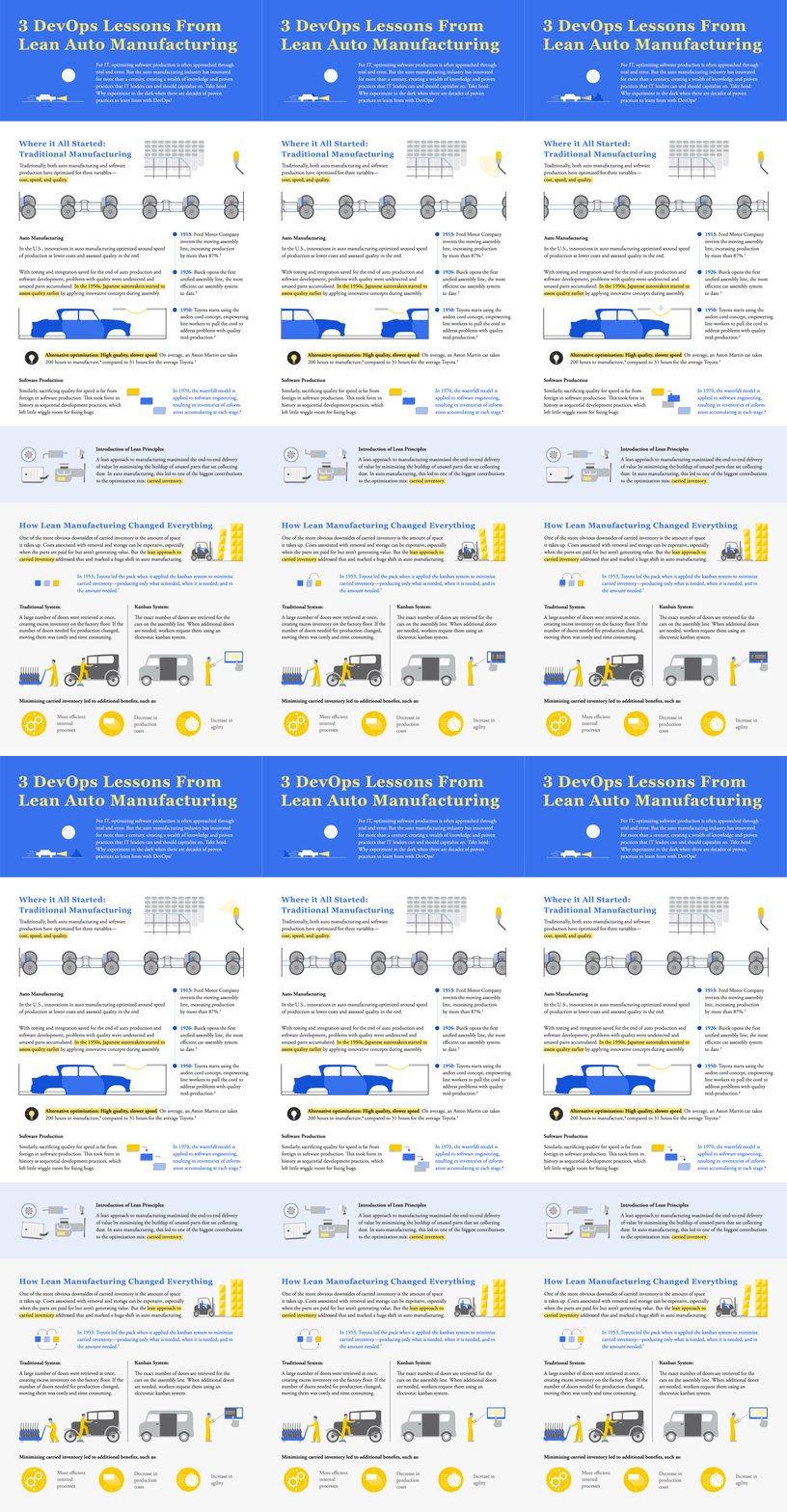
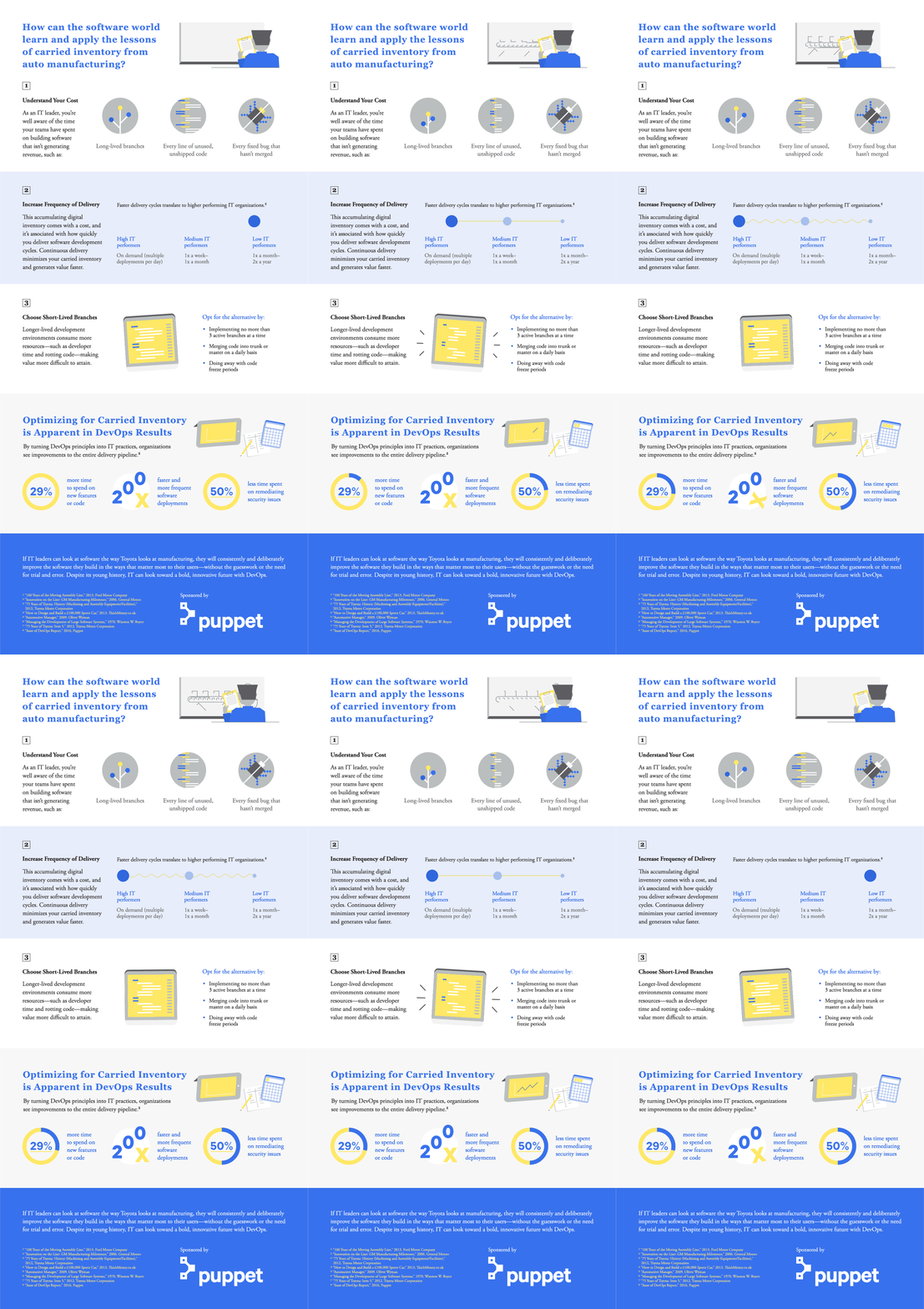
    Lean principles are as relevant to software delivery today as they were to auto manufacturing in the 20th century. And when you apply lean practices to software delivery, you get the same great results — lower costs, faster cycle times and higher quality.
    See the below infographic from Puppet to explore what software can learn from lean auto manufacturing, including the role DevOps practices and continuous delivery play in improving organizational performance, productivity and profitability.


  • DevOps Chat: Nigel Kersten, Puppet, 2017 DevOps Survey

    DevOps Chat: Nigel Kersten, Puppet, 2017 DevOps Survey

    I had a chance to sit down recently with Nigel Kersten, chief technical strategist at Puppet. Besides the fancy title, Nigel is one of the smartest, nicest people you will meet. Always a pleasure catching up with him. We spent most of our time speaking about the Puppet 2017 DevOps survey, which is now open right here.

    We also spoke about some of the findings of the past five annual DevOps surveys and the DevOps space in general. Great, informative conversation. As usual, the streaming audio of the our chat is below, followed by a written transcript. But please remember to take the 2017 DevOps Survey. Enjoy!

    Alan Shimel: Hi, everyone, Alan Shimel, editor in chief, devopsy.kinsta.cloud here, for another DevOps Chat, and today’s DevOps Chat guest is none other than Nigel Kersten, chief technical strategist at Puppet. Nigel, welcome back.

    Kersten: Hey, Alan—thank you. It’s great to be back, and always good to talk to you.

    Shimel: Absolutely. Nigel, you know—well, first of all, it’s always great to have you on the show, and we’d love to have you on as often as we possibly can, but specifically today, I wanted to talk a little bit about—it’s that time of year again where Puppet will be launching their, the annual DevOps survey, and I wanted to spend a little time talking about it and cluing our audience in, into what’s in store for this year.

    Kersten: Absolutely. Always happy to talk about the survey. So I think, you know, this has been—we’ve been running this for quite a while now, this is now the sixth year. And I think one of the things that’s really fascinating about the survey is, we survey generally technical practitioners, but also managers as well. But, in the course of surveying all of these practices and technical behaviors and how teams communicate with each other, we end up coming to a bunch of really great conclusions around the actual business outcomes.

    And this is why I think it’s so important for people to be going out and filling out this survey, because I see customer visit after customer visit, every time I’m out there on the road, so many people come up to me and say, “We’ve been trying to change the way we work inside our company, and your surveys turned out to be a really useful tool for handing to our senior management, and saying, ‘This is the sort of outcomes we can expect if you let us work the way we actually want to work.’”

    Shimel: Yes. And you know what, Nigel, just a little bit of a frame of reference, I got the number while I was at Gene’s last DevOps Enterprise Summit in San Francisco, but I was speaking to Nicole, Dr. Nicole Forsgren. What was the total—you may not know—but the total amount of people who have taken this survey at this point over the past five years?

    Kersten: There are actually over 25,000 people, which I think is fantastic, and particularly even in the first few years, we’re definitely really focused on the sort of North American market. We’ve been seeing this growing more and more in Europe, in Asia, and we’re starting to see that, really, DevOps has become a global movement and is being recognized as such within the enterprise, not just sort of the, you know, webscale hacker groups.

    Shimel: Yeah. Well, that’s certainly for sure. And Nigel, this year, is Dr. Nicole—well, they’ve actually started a company now around DevOps statistics and research.

    Kersten: Yeah, so we’ve been working with Dr. Nicole Forsgren and Gene Kim, who many people know from the author of, “The Phoenix Project,” and ex-CTO of Tripwire, and the inimitable Jez Humble, who many people know from his Lean Enterprise and Continuous Delivery books. We’ve been working with them for about the last four or five years and, yeah, this year they’ve formed a new company called DORA—DevOps Research and Assessment—where they go in and help companies do benchmarking around their actual sort of DevOps practices.

    Shimel: Yep.

    Kersten: And so I think that combination of industry experience, great sets of contacts, and really, the statistical rigor that people like Nicole actually bring to this—

    Shimel: Exactly.

    Kersten: —make this to be much, much more than just a vendor survey. Because it’d be easy for us at Puppet to just survey the Puppet user base and come to a bunch of conclusions. But I think the really interesting fact is when we get to talk to people—more people than are just using Puppet, people across the whole industry, some people who are just coming to DevOps for the first time.

    Shimel: Sure.

    Kersten: So I’d really highly encourage anyone who’s listening, you know, go out and fill out the survey when we launch next week, and don’t just feel like, “I don’t really know very much about DevOps, I shouldn’t fill out the survey.” We’re really looking for input from people all across the spectrum.

    Shimel: Absolutely. And of course, Nigel, by the time people hear this, it will be next week, and we will include the URL in the show notes so that people can click right out of this article to the survey.

    Kersten: Excellent.

    Shimel: Nigel, I don’t know if you would know this, even, but is there sort of a shortened URL that people can look for, to go to?

    Kersten: Yeah, we’ll give you a shorter URL by the time we actually launch this podcast out.

    Shimel: Okay. Not a problem. We’ll put that in there. So Nigel, six years in, though, if you’re not moving forward, you’re dying, right? [Laughter] As they say. What’s different about the survey this year?

    Kersten: Yeah, so I think we’ve really shown, over the last few years, that there’s a couple of practices that have really been formalized when it comes to DevOps enterprise adoption. We’ve seen that things like version control being heavily used in operations teams and that infrastructure being shared with your development groups, we’ve seen the role of continuous delivery and lean product management practices. So we really feel that, over the last four or five years, we’ve really shown a bunch of this stuff, that it really isn’t changing very much.

    So we’ve switched focus a little bit this year. So one of the interesting things we’re really looking at are the role of infrastructure architecture patterns in DevOps environments. And I don’t just mean, you know, “Are you adopting containers, are you doing macroservices, service-oriented architecture?” But we’re really looking for information on, architecture-wise, in terms of the way your application is set up, is your team self-sufficient and autonomous? Can you make changes quickly on your own, without lots of dependencies across the organization, and can you experiment really quickly?

    Because I think we’ve seen from Agile and from all of the DevOps enterprise movements over the last few years that the ability to do small tests and iterate quickly on the results of those tests to set your larger direction is really critical to both advancing your service, but doing so quickly and more reliably. Because I think that’s been one of the really huge sort of new things for senior management who haven’t been so familiar with these practices to realize is, adopting DevOps practices doesn’t actually mean sacrificing quality for speed or vice versa. It actually means you’re producing better, high-quality software more quickly.

    Shimel: Absolutely. So, Nigel, as I think you mentioned, this week, or the time people are listening to this, the survey will be open. Just in terms of time frames, how long will it be open and when do you think people might start getting a look at some of the data in the report?

    Kersten: Yeah, so we should be launching later on in the year as far as the results go. We tend to leave it open for at least a few weeks. Some of that sort of depends upon, you know, making sure we get a sufficiently large statistical base to get the conclusions that we’re actually looking for. So, the faster people want to see the results, the faster we want to see them fill out the survey. So, basically, head off and go and do it now.

    Shimel: Right. [Laughter]

    Kersten: As soon as we get that critical mass of data, we’ll be launching the results. So you’ll see us talking about this at Velocity, at the DevOps Enterprise Summits and a bunch of the different events happening.

    Shimel: Oh, I’m sure, I’m sure—looking forward to it. And being written about on devopsy.kinsta.cloud, I might add. [Laughter]

    Kersten: Absolutely.

    Shimel: For sure. So, Nigel, if you were king for the day, you know—

    Kersten: Okay.

    Shimel: —what would you, you know, and you looked into your crystal ball, what would the headlines be from this year’s survey?

    Kersten: If I looked into the crystal ball, what I would really like to see is that we’ve drawn some really strong conclusions around the benefits of DevOps practices in the public sector and in nonprofit organizations, because that’s been a constant source of feedback for the last few years, that we’ve managed to draw really great conclusions for profit-oriented companies.

    But I think we’ve also seen, with the rise of the U.S. Digital Service in the U.S. and .gov.uk that’s been running for quite a long time in the UK and the Digital Transformation Office in Australia—we’re really starting to see some of these practices start to be applied to the public sector. And, honestly, that’s in all of our interests, for government infrastructure to work more efficiently and deliver better services that progress more rapidly to all of us.

    So that’s something I would really, really love to see, that we can draw those conclusions, which I’m feeling pretty optimistic about. But I think the big headline I would like to see, continuing that thread of, “How do we make sure that the survey and the results in the report that we’ve come out with are useful for practitioners selling upwards in their organization, as well as senior leaders trying to implement change?” is—give your teams more autonomy. Make sure that you’re designing your infrastructure in such a way that they can test on their own, that they can rapidly experiment on their own, and that you can actually progress things much, much faster than we’re you’re needing lots and lots of meetings just to create major changes.

    So the more we can actually absorb the lessons of service-oriented architecture, and not just create a mass of complicated services, but create clusters of services that teams can work on with a high degree of autonomy and flexibility. That’s really the headline I would love to see—teams that are able to experiment and are autonomous will produce better results for the business.

    Shimel: Absolutely. Nigel, let me ask—go off on a little bit of another tangent, here. You know, one of the things that I kinda, I find fascinating and I tend to come back to and I get as much of as I can is the Project Blueshift stuff that you guys do at Puppet. Gareth Rushgrove is deeply involved in it. And while, today, you know, there’s certainly a strong container focus on it, it really is about sort of future-proofing Puppet, right, and making sure that the folks at Puppet are aware of, you know, what’s the next big thing coming down.

    What can we look for in the survey that may give us a clue in terms of what is the next big thing and hence, you know, something for Blueshift to be aware of?

    Kersten: Yeah, so I think we’ve generally tried to stay a little bit away from stuff that’s too vendor-specific research for us. But I agree—so you’ve totally captured what Blueshift is about for Puppet. It’s very much about us making sure that, you know, Puppet’s a highly successful project, you know, and used by tens and tens of thousands of companies across the world.

    But we’re in a very fast-changing technology landscape right now and I think it’s really critical for us as a company to make sure that we’re not just resting on our laurels there. We’re seeing lots and lots of things change. It’s entirely possible that, in 10 years’ time, everyone will be on completely serverless infrastructure, so to speak. And, you know, you might have been able to hear my air quotes somewhat around serverless, because there’s always someone’s servers running that code somewhere.

    Shimel: Right. [Laughter]

    Kersten: That old saying that the cloud is just someone else’s server.

    Shimel: Uh huh.

    Kersten: And I think, really critical for us, we’ve seen that Puppet, the language, has been an incredibly portable model. We started off in the UNIX and Linux space, and it’s proven to be hugely successful in the Windows space for a lot of our enterprise customers, and people really like having that common language describing all of your infrastructure. And we see no reason why, just as you’ve seen the Puppet container build stuff that we’ve done, that we can use the Puppet language to describe and compose containers and maintain that audibility.

    We can also describe all sorts of infrastructure, no matter where things come from. So, for us, Blueshift is very much about keeping that eye on the sort of next level horizon over the next six to 24 months, and just seeing what’s emerging and making sure that Puppet stays agile and that we start baking in the features to Puppet the language and the platform that will enable us to all take advantage of those things.

    Shimel: Sure. And I—

    Kersten: I think it’s really exciting. I don’t think we’ve seen infrastructure technology change as fast as this, ever.

    Shimel: It’s crazy. And, you know, I don’t know if it’s the gadget boy in me or, you know, I’ve lived in tech for so long, but it’s that—it’s not even a Puppet thing to me, Nigel, it’s a thing. What is the next thing? I think it’s a little bit of how I got into DevOps, it’s a little bit of how I got into computers and technology to begin with. So I’m always interested and curious.

    Kersten: Totally.

    Shimel: And sometimes, you know, the nice thing about this survey is, it does cast such a wide net of responses that you—

    Kersten: Yeah. And I wanna make sure that people don’t feel too left out as well. Because, you know, I often talk to people who are in big enterprise environments, managing important legacy applications, and some of them are still struggling with getting relatively basic principles adopted—of just using version control, using infrastructure as code.

    Shimel: Mm-hmm.

    Kersten: And sometimes you talk to them and they get a little demoralized, going, “You know, everyone’s talking about all this cool technology out there, and we’re not actually getting to use it.” But I think the reality is, most enterprise environments, the software they’re running is delivering actual business value, and it’s important to keep making sure that’s as efficient as possible.

    We saw from the “DevOps Handbook” that Gene and Jez and all of those people are involved in that you can apply these principles to mainframes, you know? You can see people taking incredibly legacy technology, applying these modern ways of working to them, and getting really, really huge benefits.

    Shimel: Got it, got it. Nigel, we’re almost out of time, unfortunately. You know, we can talk all day, but people only listen, it’s the curse of the modern, you know, the 10-minute or the 10-second sound bite and the 12-minute podcast—but first of all, good luck with this here survey. You know, I encourage anyone listening to go, please click on the link and fill out the survey. Can’t wait to see what some of the results are this year.

    Continued good luck with Puppet, too, as you guys are really, you know, coming out of Puppet Conference and meeting with Sanjay and some of the exec team, I was very excited about the possibilities, and I’m sure you are more than me—

    Kersten: Absolutely.

    Shimel: —about, you know, what’s on the horizon here for Puppet, so good luck with that as well. And thanks for being our guest on DevOps Chat.

    Kersten: No problem, Alan. It’s always great to catch up with you.

    Shimel: Okay, my friend. Nigel Kersten, chief technical strategist at Puppet, thanks for appearing on this DevOps Chat, and thanks for telling us more about the upcoming devops survey, or sixth annual devops survey from Puppet.

    This is Alan Shimel for devopsy.kinsta.cloud. Have a great day.

    — Alan Shimel

  • Puppet Launches 2017 State of DevOps Survey

    Puppet Launches 2017 State of DevOps Survey

    It’s that time of year again!

    We at Puppet have kicked off the 2017 annual State of DevOps. survey. Now in its sixth year, we have once again teamed up with DevOps Research and Assessment (DORA), founded by our dear friends Gene Kim, Jez Humble and Nicole Forsgren, to survey technology professionals worldwide in an effort to better understand the health and habits of organizations adopting DevOps. We’re pleased to see that the report now serves as the de facto gauge for the DevOps community to find out how IT organizations are doing and how they can improve.

    One of the most critical aspects of the survey is that it manages to translate the processes between technical practices and choices into actual business outcomes and helps organizations understand the real benefits of DevOps adoption. Through analysis of each year’s survey responses, we’ve been able to quantify IT performance. From last year’s report, we know that high-performing IT teams are pulling away from the pack in terms of throughput. They deploy 200 times more frequently, have 2,555 times faster lead times, have a three times lower change failure rate and recover from failures 24 times faster.

    Survey Says …

    This year, we’re interested in learning more about infrastructure architecture patterns within organizations. We’re not just asking how the services are designed, but we also are curious to see if teams are free to move at their own pace and if they are largely self-sufficient. Can they easily make large-scale changes to their architectural design?

    We’re asking questions about team experimentation and whether teams are able to evolve the design of their architecture as they work and if they are required to interact with a lot of people across the organization. One of the things to emerge from the agile and DevOps movements is that the more we can enable teams to work quickly and self-sufficiently, and increase speed without reducing quality, the better it is for everyone.

    This year, we expect to see proof that high-performing IT teams are those who have been enabled to operate with a much higher degree of autonomy, and that their quality metrics remain stable or even exceed those of high-performing IT organizations. We also expect the findings to confirm that early DevOps adopters are still seeing exponential benefits compared to their colleagues who haven’t yet embraced DevOps. The longer your organization has been adopting DevOps practices, the more it becomes muscle memory and reinforces positive behavior within them, which has unparalleled benefits. As any IT professional working in a large company knows, there’s an awful lot of waste and inefficiency and we’re not anywhere near peak DevOps penetration. With each passing year, survey results show DevOps adoption is a key contributor to enhanced productivity and efficiency. We expect this year’s results to be no different.

    We’ll be publishing the results and our analysis in June, and have no doubt it’ll be worth the wait. Stay tuned!

    About the Author / Nigel Kersten

    Nigel Kersten is CIO of Puppet. He came to Puppet from Google, where he was responsible for the design and implementation of one of the largest Puppet deployments in the world. At Puppet, Nigel was responsible for development of the initial versions of Puppet Enterprise, and has since served in a variety of roles, including head of product, CTO and CIO. He has been deeply involved in Puppet’s DevOps initiatives, and regularly speaks around the world about adoption of DevOps in the enterprise and IT organizational transformation.

  • Puppet Appoints Former Cisco Executive, Marianne Calder as Managing Director, Vice President, of Europe, Middle East, and Africa

    New London Office Will Allow Doubling of Company’s EMEA Workforce to Support Growing International Demand for DevOps

    Puppet Promotes Nick Smyth to VP of Engineering

    Portland, OR – November 21, 2016 – Puppet, the standard for automating the delivery and operation of the software that powers everything around us, today announced the appointment of Marianne Calder as managing director and vice president of Europe, Middle East and Africa (EMEA) to continue scaling Puppet’s international expansion. In this new role, Marianne will lead Puppet’s customer operations, including sales, marketing, and customer success throughout EMEA to help fuel Puppet’s aggressive expansion in the region. Puppet also announced that Nick Smyth has been promoted to vice president of engineering.

    “Our vision is to enable every organization around the world to leverage software automation as a means of driving new innovation in the marketplace, quickly and confidently,” said Sanjay Mirchandani, CEO of Puppet. “We already have a large customer presence in the region — including three of the five largest banks in Europe, the largest telecoms, and some of the most recognizable brands — but we’re just getting started. By adding Marianne to our talented executive team, we’re able to aggressively devote more resources towards scaling our international presence so we can realize our vision globally.”

    Marianne Calder

    Marianne most recently served as managing director of collaboration sales at Cisco, where she led the sales and architecture team to growth, and set the strategic direction for the $1 billion collaboration business in EMEAR. During her 21-year career at Cisco, Marianne also drove the transformation of Cisco’s EMEAR inside sales organization and was integral to the creation and development of the global accounts program, which at the time represented more than 30 percent of Cisco’s business.

    “I joined Puppet for the huge opportunity in front of us. For companies to thrive in the next decade, they need to be able to transform their business to meet the demands of today’s software-driven world,” said Marianne. “Puppet is the cornerstone for making this transformation happen. I’m excited for the opportunity to lead Puppet’s global expansion and bring the transformative power of Puppet to even more organizations by building a highly collaborative team and a robust partner ecosystem.”

    Nick Smyth

    Nick is a 20+ year technology veteran, having led engineering and technical teams at Nortel, IBM and Puppet. In his tenure at Puppet, Nick has proven his leadership and delivered at the highest levels. He brings strong engineering disciplines alongside a strong customer focus and has been instrumental increasing product velocity at Puppet. Nick will continue to work from Puppet’s Belfast office.

    New London Office

    Today, Puppet has approximately 75 employees in three offices in EMEA (Belfast, Czech Republic, and London) to support sales, engineering, customer success and marketing. Located at the Aldgate Tower (2 Leman Street in London), the new 7,500 square foot office space will enable Puppet to double its EMEA headcount. The office was awarded the best possible Public Transport Access Level by Transport for London and features an open floor plan with natural light and sweeping views of central London.

    About Puppet

    Puppet is driving the movement to a world of unconstrained software change. Its revolutionary platform is the industry standard for automating the delivery and operation of the software that powers everything around us. More than 33,000 companies — including more 75 percent of the Fortune 100 — use Puppet’s open source and commercial solutions to adopt DevOps practices, achieve situational awareness and drive software change with confidence. Based in Portland, Oregon, Puppet is a privately held company with more than 470 employees around the world. Learn more at puppet.com.

    — Jules Louis

  • Puppet Appoints Mark Iserloth as Chief Financial Officer

    Mark Iserloth Brings 16 Years of CFO Experience to Help Drive Rapid Growth and International Expansion

    Portland, OR – November 21, 2016 – Puppet, the standard for automating the delivery and operation of the software that powers everything around us, today announced that it has appointed Mark Iserloth as chief financial officer (CFO). In this role, Mark will oversee finance and business operations, and will be part of the executive management team that will lead Puppet as it continues its rapid growth and international expansion.

    “Mark is a proven leader and his background aligns perfectly to Puppet’s culture and business at this pivotal part of our growth journey,” said Sanjay Mirchandani, Puppet CEO. “With extensive experience in software, services, and international operations he has the drive and capabilities we need as Puppet embarks on our next phase of growth.”

    With 16 years of experience as a CFO, Mark has led finance and human resources teams through the acquisitions of several companies, led an IPO process, and overseen all regulatory filings for a publicly traded company. Prior to joining Puppet, Mark was CFO at STATS, LLC., where he was responsible for finance, accounting, human resources and additional administrative functions. Prior to joining STATS he held CFO positions at Mattersight, Trustwave and Initiate Systems. Mark has extensive experience at a range of organizations, including hyper-growth private companies and large global, publicly traded companies.

    “I’m incredibly excited to join Puppet,” said Mark Iserloth, Puppet CFO. “As the market leader in a large untapped market with innovative technology and a great culture, Puppet has all the characteristics I look for in a great company. I’m looking forward to contributing and being a part of its success.”

    Mark holds an MBA from the J.L. Kellogg Graduate School of Management at Northwestern University and a B.S. in Electrical Engineering from Northwestern University.


    About Puppet

    Puppet is driving the movement to a world of unconstrained software change. Its revolutionary platform is the industry standard for automating the delivery and operation of the software that powers everything around us. More than 33,000 companies — including more 75 percent of the Fortune 100 — use Puppet’s open source and commercial solutions to adopt DevOps practices, achieve situational awareness and drive software change with confidence. Based in Portland, Oregon, Puppet is a privately held company with more than 470 employees around the world. Learn more at puppet.com.

    — Jules Louis

  • Puppet Brings Puppet Enterprise to AWS Marketplace

    New AWS Marketplace Offering Adds to the Simplicity of Adopting, Managing and Securing the AWS Cloud

    Portland, OR – November 17, 2016 – Puppet, the standard for automating the delivery and operation of the software that powers everything around us, today announced that Puppet Enterprise is now available on AWS Marketplace. The new listing builds on AWS and Puppet’s existing collaboration, and makes it simple for anyone to launch core Puppet Enterprise services directly from AWS Marketplace.

    “Today, organizations are rapidly embracing cloud computing and DevOps practices so they can deliver new value to customers faster than ever,” said Nigel Kersten, CIO at Puppet. “By listing Puppet Enterprise on AWS Marketplace, we’re making it even easier for organizations around the world to adopt DevOps practices in automated cloud environments so they spend less time managing infrastructure and more time driving innovation and delivering great software.”

    “Many businesses rely on Puppet Enterprise to provision, operate and provide enhanced protection for their cloud environments,” said Barry Russell, General Manager, AWS Marketplace and Catalog Services, Amazon Web Services, Inc. “Puppet Enterprise helps customers quickly and easily deliver their software, and now they also have an incredibly simple way to purchase and deploy it through AWS Marketplace.”

    Puppet Enterprise on AWS Marketplace

    Beginning today, AWS customers can find, launch and run Puppet Enterprise directly from AWS Marketplace. Now AWS customers can adopt Puppet Enterprise for a standard, centralized way to manage infrastructure services and applications in AWS environments, taking full advantage of the agility, efficiency, flexibility and scale of the AWS Cloud. And through Puppet’s declarative approach to infrastructure as code, customers can rapidly move from physical infrastructure to deploying production workloads in the cloud with reduced risk and more reliability.

    Additional resources

    About Puppet

    Puppet is driving the movement to a world of unconstrained software change. Its revolutionary platform is the industry standard for automating the delivery and operation of the software that powers everything around us. More than 33,000 companies — including more than 75 percent of the Fortune 100 — use Puppet’s open source and commercial solutions to adopt DevOps practices, achieve situational awareness and drive software change with confidence. Based in Portland, Oregon, Puppet is a privately held company with more than 470 employees around the world. Learn more at puppet.com.

    — Jules Louis

  • Sanjay Mirchandani Builds Out Puppet While Keeping Culture Intact

    Sanjay Mirchandani Builds Out Puppet While Keeping Culture Intact

    sanjay-square-smI attended my first PupetConf last week in San Diego. While there I had a chance to sit down one on one with Sanjay Mirchandani who recently took over as CEO/President of Puppet from long time CEO and founder, Luke Kanies, who is now a member of the BOD. As this was my first meeting with Mirchandani, it was good to understand what he sees his mission is at Puppet and how he views the market and Puppet’s place in it.

    I would say first of all that Sanjay understands what has made Puppet successful to this point. Luke and the team have built a tremendous culture around Puppet. With over 34,000 users, 75% of the Fortune 100 and a world-wide base, Puppet has the community and market perception of a winner. Sanjay sees his job to build a truly world-class organization on top of this great foundation. The difficult part is to not mess with this great foundation while building that world-class organization.

    Sanjay has already started this building process. Over the last few months he has brought on board several senior level people flesh out the executive team. Some of these new Puppet executives are:

    mike-smMike Guerchon, Chief People Officer. Mike joins Puppet from Riverbed and while he is adamant about not being HR, he will lead Puppets HR department. Part and parcel of that is to preside over what will probably be a huge uptick in new Puppet employees all over the world.


    gary-green-square-smGary Green, SVP Sales. Gary was a long time VMware executive who was instrumental in building out the successful sales team over there.  Sanjay is very excited about what Steve brings to the Puppet team. With Sanjay’s plans to expand Puppets offerings (more about that below) Gary will be key to taking Puppet to the next level.


    simonSimon Hayes, Business & Corporate Development. To be fair Simon joined this past February, so not really a Sanjay appointment, but still a fairly new exec team member. Simon comes from Citrix and Sanjay says brings some big company biz and corp dev experience to the team. Could it portend some M&A activity going forward? Perhaps, we will have to see.


    scottScott Campbell, SVP of Go-To-Market Initiatives. Scott is another new add to the exec team. He was most recently at Jive Software and at Tripwire before that. His background is in sales. I asked Sanjay if he was a “farmer” to Gary’s “hunter”, but Sanjay says no. Scott’s role is to make sure Puppet customers are getting the most out of their products, as well as understanding what their needs and future needs are.


    Besides the four highlighted above, the Puppet exec team is well filled out now. Sanjay should have the lieutenants needed to carry out his plans.

    So what exactly are his plans? Well as I said before first and foremost is to not rattle the apple cart and mess with Puppets enviable culture and the fanatical support of its customers and users. At the same time converting more of those 34,000 users into paying customers is certainly a major priority. They currently have about 1200 paying customers. Quick back of the napkin math says about 3% of users are paying customers. In my experience that is about right for an open source tool. Somewhere between 2-4% convert to paying customers. The trick that successful open source vendors figure out is how to get that number higher. That is what Sanjay and team are working on.

    One idea that Sanjay and I discussed was adding services to the mix. It is a common practice in commercial open source companies. At this time Puppet isn’t ready to announce something. But I would not be surprised to see either Puppet itself offer services or an aggressive move to grow a channel of service providers who work closely with Puppet.

    Of course growing the user base beyond the 34, 000 current users is in mix. One strategy on that is Project Blueshift. I think of it as future proofing Puppet. But as you will find in an upcoming article from my conversation with Gareth Rushgrove, Blueshift is about making sure that Puppet’s core functionality of configuration management extends horizontally across all of the different platforms that the market is using. Right now Docker and containers are a major focus of this.

    Beyond my meeting with Sanjay, PuppetConf was a great trip for me. I enjoyed meeting many new faces, catching up with many folks I knew already and most of all, seeing the Puppet culture up close. Sanjay Mirchandani has an exciting opportunity in front of him, but he seems to have a very capable team to work with and a great foundation to build on. Looking forward to next years PuppetConf (back in San Francisco) to see how it plays out.

    — Alan Shimel