Tag: mainframe

  • Open Mainframe Virtual Summit: Adding Value to the Mainframe

    Open Mainframe Virtual Summit: Adding Value to the Mainframe

    While many predicted mainframes would eventually become obsolete, they continue to be prevalent in the corporate world. Mainframes are still in high demand, and the mainframe market is likely to grow over the next few years as business and IT leaders validate its enduring role in their hybrid strategies. Mainframes are rapidly evolving to meet the demands of today’s changing technology and business environments. How can we leverage the mainframe for reliability, availability and security? How does open source fit in with the mission-critical workloads that only a mainframe can drive?

    At the Open Mainframe Virtual Summit, taking place on Feb. 11, top industry leaders will come together to discuss all open source projects and technologies impacting the mainframe.

    Open Mainframe is a free virtual event featuring a conference lobby, presentation theater, expo hall and more. Attendees will be able to interact with sponsors and like-minded individuals who are passionate about the mainframe industry, watch videos and download information.

    Open Mainframe Virtual Summit features an exceptional lineup of industry leaders, including:

    • Abubakar Siddiq Ango, Developer Evangelism Program Manager at GitLab
    • Anna Murray, Senior Product Manager at ASG Technologies
    • Bob Miller, Solution Architect and Legacy Transformation Lead, IBM Alliance at Deloitte Consulting LLP
    • Gatien Dupre, IBM Z DevOps Offering Manager at IBM
    • Girish Wani, Agile Product Owner at Swedbank
    • Kristaps Duburs, Software Engineer at Swedbank
    • Maneesh Goyal, Offering Management Leader at IBM
    • Mark Howell, DevOps Centre of Excellence Lead at Lloyd’s Banking Group
    • Mathieu Dalbin, DevOps Transformation Specialist at IBM
    • Matthew Cousens, IBM Z and LinuxONE Developer Advocate at IBM
    • Michael Bauer, Zowe CLI Squad Leader at Broadcom
    • Mürsel Taşgın, Mainframe Systems Manager at Credit Bureau of Turkey
    • Nathan Cassata, IBM Z DevOps Testing Lead at IBM
    • Patrick Wawrzoszek, Programmer Analyst Advisory at Scotiabank
    • Peter Haumer, Senior Software Engineer, IBM Z DevOps Intelligence at IBM
    • Rajesh Murugan, Software Engineer at Swedbank
    • Rosalind Radcliffe, Distinguished Engineer at IBM
    • Rose Sakach, Zowe Onboarding Leader at Broadcom
    • Seamus Hayes, Software Engineer at Broadcom
    • Terri Cobb, Vice President, Alliances Relationships at Deloitte Consulting LLP
    • Umut Arslan, Unit Manager at Garanti BBVA Technology
    • Vaughn Marshall, Senior Principal Product Manager at Broadcom
    • William Alexander, Senior Software Engineer at IBM

    The breakout sessions will cover a wide range of topics relevant to the open source and mainframe communities—the latest in IBM Z, DevOps, LinuxONE, cloud, analytics, open source and more. Speakers will discuss:

    • The growing usage of mainframe computing
    • How to build and debug mainframe application code
    • The biggest business challenges of mainframe modernization
    • The benefits of using open source tools such as Zowe, Git, Eclipse and VSCode with IBM Wazi Developer and IBM Z Open Editor to deliver continuous integration on IBM Z
    • How IBM Z DevOps testing solutions can improve your testing capabilities and enable your CI/CD pipeline
    • And more

    To check out the full agenda and to register, please visit the Open Mainframe website.

  • Open Source and the Mainframe with Rocket Software

    Open Source and the Mainframe with Rocket Software

    Open source enables developers to quickly create and deploy containers and business services across public and private infrastructures. Open source tools allow DevOps teams to harness the power of the mainframe.

    In this TechStrong TV interview, Tim Willging, chief architect and strategist, and Peter Fandel, mainframe open source evangelist at Rocket Software, join Mitch Ashley to discuss advancements in the use of open source software with mainframe apps and tools. Tim and Peter challenge some long-held beliefs around mainframes, open source software and the increasing role open source is playing today.

    Rocket Software is a global software development firm that offers enterprise products and services.

    The video interview is immediately below, followed by the transcript of the conversation. Enjoy!

    Transcript

    Mitch Ashley: Hi everyone, I’m very pleased to be joined by a couple of great gentlemen here to talk about some interesting open source, security, mainframe, DevOps, all kinds of good things. So I’m pleased to be joined by Tim Willging who is chief architect and strategist for the mainframe business unit with Rocket Software and Peter Fandel, senior director of product manager mainframe open source. Welcome, guys.

    Tim Willging: Hello, thank you.

    Peter Fandel: Hello.

    Ashley: I think I might have said your name incorrectly, Tim. Is it Willging? I don’t know if I said that right. 

    Willging: That’s correct. That’s fine. 

    Ashley: Okay, good. Would you start? I’ll have you both introduce yourselves. Maybe you can also introduce the company, Tim, and then we’ll have Peter do the same?

    Willging: Sure. Yeah, I’m Tim Willging. As Mitch mentioned, I’m the chief architect and strategist for the mainframe business unit at Rocket. I’ve been with Rocket about 15 years and spent the majority of my career developing commercial solutions for the mainframe and mostly around database tools, DB2 tools. Rocket Software has been in existence for 25-plus years and is a privately held company and specifically we do software that’s not just on the mainframe but let me talk mostly about the mainframe software.

    Rocket has a development partnership with IBM and many of the solutions we develop are IBM branded; but we also have many things we’re doing Rocket direct; and open source, particularly the subject of this call, is one of those things that we also sell direct or partnership with companies direct to provide that open source. So Rocket has a long history with the mainframe and we believe in its future and in its sort of importance in the computing divisions across many of the largest companies of the world. 

    Ashley: Excellent. Great. Peter, if you would introduce yourself.

    Fandel: Sure. Peter Fandel, again. I’ve been at Rocket for 19 years. The great majority of those years in engineering management, and I took over management of the open source porting team about, four or five years ago and transitioned to product management about a year ago. And I manage both the open source porting portfolio as well as the Zowe portfolio, and both of those portfolios are critical components to the modernization story for the mainframe in large part because of the huge amounts of open source that are out there that you can _____ can get them running well on the OS as well as attracting talent, the next generation of developers. So that’s really our focus area for open source.

    Ashley: Excellent. You know, maybe you ought to start – and I started my career in the mainframe, too, and so I understand, kind of get where you’re all coming from in the market. There’s a lot of built up beliefs about mainframes and applications and whether you should think about porting or not or, you know, replatform them, leave them alone. Probably like you, I’ve learned it’s very costly and also fraught with danger to just go rebuilding applications, you know, because you think you want them on a different platform. You have to have a really good reason. But open source is actually a really important part of the mainframe ecosystem. I think maybe folks don’t really realize how important it is. How would you guys kind of set that up to give people an idea for the role that open source is playing in the mainframe environment today?

    Willging: Well, I’d start off by saying open source is incredibly important part of IT computing. I mean it’s something early career professionals are learning. It’s a huge way companies are running their business today and rather than writing things from scratch, many are starting with open source and then augmenting or augmenting existing systems with open source to modernize that open source because of its collaborative nature, how different companies and individuals contribute to that open source based on the needs of the industry. You really can’t separate the needs of our organizations that are running mainframes from that open source. Open source is a critical component of running your compute division. So without it, I think the mainframe would be, you know, would have a big missing part in what companies need to run their business today. 

    Fandel: I think also there’s a huge cost savings associated with that because you take any recent graduate and even not-so-recent graduate of any comp sci program and you ask them to start developing applications, they’re going to expect to build those applications on open source building blocks. And if they’re not there, your cost goes way, way up. As well, another area where open source is a must have is DevOps where if you want to – do you want to have a different DevOps tool chain for the mainframe than the rest of your organization or do you want to unify that? And if you’re going to unify it, it’s got to be open source based.

    Ashley: It’s a massive source of innovation and I don’t know if we’re here yet, but if we aren’t, we’re quickly reaching a point where you can’t operate a company, a software team without open source software. And if you aren’t using it, I can promise you your competitors are. So take advantage of it, right? Well, let’s talk a little bit about I know Zowe is of course a big important part of your strategy. Break it down for us. Go into a little bit more detail about where the places, roles that open source does play a role in the software development process and operational systems of mainframes, kind of paint that picture for our folks, our listeners.

    Willging: I think there are a lot of different ways it plugs in, but the one that I hear most of the companies I talk to is precisely what Peter just said. You know, the mainframe through many years of existence has been very waterfall-ish I’ve heard some companies because of the reliability. It’s the security, the maintainability of the mainframe that there’s a process which changes are rolled out in large batches. As companies modernize the mainframe and they start to add components to those mainframe applications that are off the mainframe, like in the hybrid cloud or have a web frontend or a mobile app frontend to a backend service or application that’s running on the mainframe, they want to be able to build, test, deploy the components of that application that go across the mainframe and those different computing platforms in the same manner.

    And to have tools, pipeline building tools, pipeline organization tools that have tools that build these environments, run the tests, destroy these environments, they need those open source tools to run on the mainframe to be able to drive those processes in a unified manner across all the different components of that application. So many companies today are just starting – you know, mainframe companies are starting on this journey. Many of them are hand rolling over the years have hand rolled sort of tools to try to have them plugged in, but that can get expensive as we’re talking about. So to get that open source running on the mainframe it’s important for them to be able to deploy those DevOps principles and practices in that application management lifecycle process. 

    Fandel: I would –

    Ashley: Very much so. Of course there’s also more with that too. Go ahead. I’m sorry, go ahead, Peter. 

    Fandel: I was going to build on what Tim said by introducing a really important distinction and that is that there is three very different ways you can get open source onto the mainframe. Most of the open source we’re talking about is units based. And you can do it by a Linux on Z, you can do it by a zCX Docker container or you can do it by UNIX System Services. And it used to be that the low cost way of doing that was Linux on Z and now more recently zCX because the porting is not much work to do because it’s all automated just port to the hardware which is done by compiles on those systems.

    But doing it on UNIX System Services is a lot more time consuming if you do it manually. But the advantage if you do port well on UNIX System Services is you’re close to the data. I mean if you’re running open source on Linux on Z or on zCX, it’s akin to running it on another machine on the network. You don’t have direct access to the data. Everything has to pass through TCP/IP. But UNIX System Services is part of z/OS and so you have direct access to all of the important data in your organization that MVS data. And that’s a key distinction. Where Rocket plays is open source on UNIX System Services on z/OS. So we are close to where the data is and we have solved the problem of high cost of porting through this GCC/GLIBC technology where we essentially automate the port of open source by simply compiling and linking in GCC and it injects the z/OS specific changes directly into the binary output of the build.

    Ashley: Talk about that process. Is that something that you’ve been doing a while? Of course going and changing binaries, most folks probably don’t do that as a natural first thought. But it does sound like a pretty straightforward way of minimizing the steps that you have to go through to get to begin using this. You can actually do it ____.

    Fandel: Yeah, it’s just we’ve been working on this GCC/GLIBC port in this manner for over two years, and it’s just coming to fruition now where in first quarter we will be releasing new versions of several of our ports that are not ported by hand. They are ported simply by building them with GCC, and we hope to have transitioned our entire portfolio by the end of 2021 to be built in this manner. And that means we no longer have to modify the source code because upstreaming is no longer a question, an issue. It means that we can turn around security vulnerability fixes much, much faster than we could otherwise.

    Ashley: I don’t mean this in a hyperbolic way or kind of playing up to you in any way, but that kind of an approach can be a pretty big game changer because you’re really asking people, it’s a low lift instead of a heavy lift to port if you will. 

    Fandel: Yeah.

    Willging: I’ve talked to many through the z/OS community who believe that due to the effort of going through these ports in the past, they felt that a better strategy was to run your open source close the mainframe – I say close with parentheses – or on a partition on the mainframe that’s running zLinux because the porting effort to get open source running on zLinux is minimal. And so they felt that the version currency, the security fix as Peter said, and the breadth of the packages available, open source source packages available on z/OS proper would always be behind. So they felt that was a better strategy to run it on zLinux.

    We don’t believe that at Rocket. We believe, as Peter said, that there are technical advantages to running that open source both from a DevOps standpoint but even more so from somebody who is looking to augment a legacy application say via some Python library that they’re looking to deploy where they’ve found some open source with a particular function. Running that Python on z/OS and accessing the data directly in concert with the legacy application that’s running or via some subfunction in that modernization effort is vastly different than running that Python in zLinux or on a machine off-platform and reaching into the data. The latency of what you can do, trying to embed that open source sort of in transaction, in the code in transaction becomes much more difficult to do. So we feel that Z customers as they’re looking to modernize will benefit greatly from opensource running on Z proper.

    Ashley: And as I understand, I think as you were describing it Peter, really you are talking about that compile process, right? That’s where you’re introducing GCC/GLIBC libraries. So that’s where this process is happening, changing things in a binary to adapt it to be able to use open source. Is that pretty much it or what else do you have to do to verify or test it or what are folks going to want to go through as they start to introduce this into the process?

    Fandel: Once we build it, we obviously have to run it through the test suites and we have two forms of testing. We have the built-in test suites that most open source products come with. I mean if you go to Git or Python and you download the source code from the community, it will be the product plus a huge volume of test code, self-test code. And so we execute that test code to make sure that it performs with the same results as on a test UNIX System. I think we used Ubuntu as the comparison and we compare the results. And if there’s any divergence on z/OS, then we inspect those divergences.

    And then in addition to that, we have a series of tests that test the z/OS specific capabilities that you want in open source. That’s mostly relating to the ASCII/EBCDIC conversion because z/OS and including UNIX System Service assumes EBCDIC is the default. Most of the data that you’re dealing with is in EBCDIC. And so our philosophy in porting on UNIX System Services, ASCII is the default internally. We compile with ASCII. Communication between open source packages and programs is in ASCII. But when you reach to the operating system, that’s where the conversion has to take place. So we have extra test suites for all of our ports that make sure the ASCII/EBCDIC conversion is taking place correctly both in file IO and pipes. So that adds to our testing process. So it’s not just build it and ship it. We do thoroughly test as well. 

    Ashley: That’s great. I’m glad you explained that too because there certainly are some fundamental differences in the operating system and environments down to the characters that –

    Fandel: Sure. 

    Ashley: – that we’re using. How about are there any kinds of applications that are more easier to port this way? That’s not the right way to say it. It’s not porting it but, you know, understand starting to use open source this way or others that maybe are a little more challenging, you might want to wait to take on that kind of an app? How would you recommend people get started?

    Fandel: Well, I mean we found that the porting a language is the most challenging because it just dips into every aspect of the operating system. So our conversion of the Python and Perl ports will be the last ones we release at the end of 2021. Our Python and Perl today are still, the ones we’re releasing are based on manual porting efforts. 

    Ashley: Okay, good. Any thoughts on that, too, Tim?

    Willging: I thought your question originally was like talking about a customer application they were looking to augment and add open source to what might be easier.

    Ashley: I would like to go there, too. That actually was my – but I’m glad you answered it the way you did, Peter. I’m curious from a customer perspective data intensive, things that are ultra-high security, high volume, lots of parameters can go into deciding what kind of an application you might use first to go down this path. Any thoughts on what you’d recommend to look at, to pick what app you might try this with?

    Willging: I mean there are a lot of mainframe applications that leverage CICS for online transaction processing and CICS is a great environment to deploy opensource. It’s been very forward thinking in its development to take and say a CICS application that’s written in COBOL and say you wanted to augment that via some modules that are written in open source language. That’s very possible and to make that communication really between the first thing you think about is there a runtime environment that’s involved, how do I want to lower that runtime environment so it doesn’t load every time that transaction is moving or it’s moving from the legacy code to the modern language?

    If there’s not, if it’s just a binary without a runtime environment, then you don’t have those types of concerns. So thinking about that and thinking through how you’re laying that out from an architectural standpoint and making sure you think through that. The speed of transition between legacy and open source language environments, that’s probably the biggest concern depending on what you’d like to do. But many companies have successfully done this and gone off and said, okay, we don’t want to necessarily go and rewrite my 30 million lines of COBOL. 

    Ashley: In a billing system probably not where I would start. 

    Willging: But there’s a new function we would like to add that potentially goes and augments via reaching to another system where customer data is available that you certainly can do that and many companies have done that successfully. Again, leveraging more modern languages and having that available for that augmentation is much cheaper, much less risk than is involved in a total rewrite and a re-platform which is again even then much of your language that you’ve written or much of what you’ve written won’t even necessarily run on a new system in the cloud. So replatforming is also very expensive or very risky depending on, again, the number of lines of code.

    Anyway, I probably went too far there but that’s sort of how I think about it from an online transaction standpoint. But a batch, different again, that you might just have some data that you want to reprocess and write a new output from that batch and augmenting there with open source is much easier because, again depending on the language can it run in batch, does it require to be hosted within a web server? But even then you can still have a batch process that alerts a web server to now go read this files so you can embed your open source within a say WebSphere Liberty or some web server that can go and even augment batch processes that way. It’s really getting the right architecture down first to say how you want to do that. 

    Fandel: Another area is data science and machine learning. You have for the past 20 years or so you’ve had academics and scientists and corporate engineers developing machine learning extensions, data science extensions, and they haven’t been writing those extensions in COBOL. They’ve been writing it in Python. And so that’s the go-to language for data science. 

    Ashley: It does give you access to a lot of new innovation just because of the language as well as the platform –

    Fandel: Exactly.

    Ashley: – and software stack differences. Two other areas I’d like to explore in our kind of time remaining, you mentioned DevOps and the role that open source plays in this. How does it help facilitate moving a mainframe application or developing a mainframe application now into more of a DevOps fashion? Are there some things inherent about because it is, you know, libraries that have a compile time process and there’s other tools? There’s Zowe and things like that can help you with interfaces and tool chains, workflows, things like that. What are your thoughts on that topic?

    Willging: Go ahead, Peter, you start. 

    Fandel: Well, I was just going to say that Git, since we release Git I think it’s three years now for z/OS, I think it was our number one download within 30 days of release. Everybody in the world is using Git now –

    Ashley: It starts with Git, doesn’t it?

    Fandel: – or Source Code Control. And so it, like I said before, just enables you to have a unified DevOps pipeline and that’s just huge. 

    Willging: Yeah. I mean to add to that, to have all of your source code in Git and then kick off a build process but then thinking of the mainframe and some of its legacy components like the parts of an application that help that make up the database. You know DB2 is very big on the mainframe. DB2 for Z. So to say that you can take those parts of the application touch the tables or smooth the tables in DB2 and extract those and then store those in a source code management repository because in DevOps you really want to store everything as code and represent everything in code so changes can be tracked over time. So taking open sourced, taking some even commercial tooling, taking some open source scripting languages, opensource to allow you to interact with a DevOps pipeline that’s running off the mainframe that’s driving the build and reaching in. You know, DevOps is really, again, not a product. It’s a culture and it’s a –

    Ashley: It’s a process. It’s a way of creating software, right?

    Willging: And so to build that DevOps pipeline using those tools but then have the tools – the DevOps tooling and scripting and running on the mainframe to be able to interact with the mainframe sometimes is a combination of open source, purchased tooling, and then hand rolling the pieces in between to fit your company’s needs. That’s really not possible. Again having a Git client for the mainframe and a lot of the other tools there are really important for that process. 

    Ashley: I’m curious about the security side of this. You know, a lot of application of air gap requirements things like that or the frequency or timeliness of security fixes. I don’t know if there’s a lot of difference between mainframe environments versus open source. That tends to happen of course more transparently. Maybe what are some of the advantages, pros and cons from a security standpoint of taking this approach?

    Fandel: Yeah, I’m glad you mentioned that because that’s one of the major changes that we have put in place this year with the introduction of the Rocket Open AppDev for Z Solution Bundle. We have switched from sort of old style, one at a time download of tarball and FTP it and then run through ten steps to set environment bevels and get it installed for each source tool or language. And as an example, GIT, which has four dependencies meant four or five downloads. Then you FTPed them over, and then you do the 10 steps four or five times. It’s like _____ way. We’ve switched to conda as the system for downloading, installing, and deploying open source on z/OS. That has made a huge difference in terms of the user experience and the ownership experience.

    So it’s now once you have conda installed on your mainframe, that takes about 30 minutes including the download and the setup, then it’s a single command to install Git and all of its dependency from the command line; and further, conda has this concept of a channel which is their word for a software repository or repository of software you download from. Conda supports something called a file channel as well as internet channels.

    So in addition to this, we have set up two internet channels at Rocket, one public one at anaconda.org that anybody in the world can use to download from and a secure channel server on our network that is authenticated for our customers on support. And then additionally you can set up a file channel which is on your premise which is ideal for air gap systems. So if you have an air gap mainframe, you don’t want it to have a connection to the internet, you can set up a file channel, populate it with the full contents of our bundle and then all of the developers within your organization can download at will from your on premise channels. That’s a big advantage in the area of security. 

    Ashley: Those some really big ones, big changes. 

    Willging: It is a big change. I mean there are a lot of companies that have said that the only delivery mechanism for software to my mainframe is through IBM Shopz. So you know, I have some feelings on that. I think that’s old school thinking as far as I’m concerned, but there’s still a culture amongst many mainframe customers that that’s it. I think that is changing and to make it simple, to guarantee that it’s secure and to provide options is what Peter just went through I think is important to help increase adoption of open source on the mainframe. And so Rocket is really leading in that area to help make that possible. 

    Ashley: It is culture. It is sort of tried and true. You know, if it’s not broken don’t fix it. But on the other hand, when you start to demonstrate new capabilities, new benefits, speed improvements, more security, whatever it might be, access to innovation, suddenly that becomes maybe a compelling reason to start to break down some of those traditions or barriers or kind of think about adding this as a capability. You’re not talking about changing everything, right? We’re talking about adding capability to how you create software in a mainframe and expanded environment, correct?

    Willging: Yep, exactly. 

    Fandel: Sure. 

    Ashley: Good, good. Well, where can folks learn more about this? I don’t know if you have any trials or free downloads or you’ve been in beta on some things that are GA or coming out in GA. What’s the best way for folks that want to engage with you and find out more and kind of give this some –

    Fandel: I think you can Google z/OS Miniconda. You can Google Rocket Open AppDev for Z which is the product release from September and that will lead you to our product pages, our download page, documentation on how to install z/OS Miniconda which is the bootstrap to get you started. There is a couple of published videos. If you look at the Open Mainframe Projects Summit from September and look for, under the video there, “Demonstrating a Secure System for Downloading and Installing Software on z/OS,” you’ll find a video there that shows how it’s used. 

    Willging: The only thing I’d add to that is go check out zowe.org.

    Fandel: Thank you, Tim, yes, absolutely, zowe.org.

    Ashley: Don’t want to look past that, of course. 

    Willging: It completes everything else Peter said. 

    Ashley: Very important. 

    Willging: Important stuff. We haven’t really talked much about Zowe, but yeah. 

    Ashley: We’ll have a chance to do that. Would love to have you back and we can delve into that. I really would like to explore some more about this delivery of software into production and how do we start to evolve and expand helping more organizations consider how they might do that so there will be some great areas to explore further. So look forward to doing that with you. It’s been a lot of fun talking. Any parting thoughts before we wrap things up here?

    Willging: Just real quick, I’d encourage those mainframe z/OS shops, if you don’t have a policy for downloading, consuming open source, I encourage you to get your thought leaders together, you know think about the advantages that open source will provide in your modernization efforts. Check out zowe.org but create a policy to not only to consume but contribute. Get involved in the projects. It’s a way to expand your employees’ interest in the mainframe to make that open source there available. So if you haven’t done it, you really should do that. 

    Ashley: Access to more talent I think as Peter was mentioning earlier. It really is opening up new pathways as opposed to replatforming and a lot of not very attractive options sometimes that you now have because of open source. So folks definitely should consider this, look at it, get into it, get involved. Great. Well, gentlemen, it’s been great talking with you, both Tim Willging and Peter Fandel from Rocket Software. Take care, gentlemen, we will see you next time. 

    Willging: Thank you.

    Fandel: All right, thank you. Take care. Bye-bye.

    Willging: Bye.

  • The Use of Open Source in Mainframe Environments

    The Use of Open Source in Mainframe Environments

    Open source is a critical element of IT computing. As companies modernize the mainframe and start to add components to mainframe applications that are off the mainframe, they should to be able to build, test and deploy the components of that application that go across the mainframe and different computing platforms in the same manner. Organizations need open source tools to run on the mainframe to be able to drive those processes in a unified manner across all the different components of that application.

    Tim Willging, chief architect and strategist, and Peter Fandel, mainframe open source evangelist of Rocket Software, join Mitch Ashley to discuss advancements in the use of open source software with mainframe apps and tools. Tim and Peter challenge some long-held beliefs around mainframes, open source software and the increasing role open source is playing today.

    The video is immediately below, followed by the transcript of the conversation. Enjoy!

    Transcript

    Mitch Ashley: Hi everyone, I’m very pleased to be joined by a couple of great gentlemen here to talk about some interesting open source, security, mainframe, DevOps, all kinds of good things. So I’m pleased to be joined by Tim Willging who is chief architect and strategist for the mainframe business unit with Rocket Software and Peter Fandel, senior director of product manager mainframe open source. Welcome, guys.

    Tim Willging: Hello, thank you.

    Peter Fandel: Hello.

    Ashley: I think I might have said your name correctly, Tim. Is it Willging? I don’t know if I said that right. 

    Willging: That’s correct. That’s fine. 

    Ashley: Okay, good. Would you start? I’ll have you both introduce yourselves. Maybe you can also introduce the company, Tim, and then we’ll have Peter do the same?

    Willging: Sure. Yeah, I’m Tim Willging. As Mitch mentioned, I’m the chief architect and strategist for the mainframe business unit at Rocket. I’ve been with Rocket about 15 years and spent the majority of my career developing commercial solutions for the mainframe and mostly around database tools, DB2 tools. Rocket Software has been in existence for 25-plus years and is a privately held company and specifically we do software that’s not just on the mainframe but let me talk mostly about the mainframe software.

    Rocket has a development partnership with IBM and many of the solutions we develop are IBM branded; but we also have many things we’re doing Rocket direct; and open source, particularly the subject of this call, is one of those things that we also sell direct or partnership with companies direct to provide that open source. So Rocket has a long history with the mainframe and we believe in its future and in its sort of importance in the computing divisions across many of the largest companies of the world. 

    Ashley: Excellent. Great. Peter, if you would introduce yourself.

    Fandel: Sure. Peter Fandel, again. I’ve been at Rocket for 19 years. The great majority of those years in engineering management, and I took over management of the open source porting team about, oh, four or five years ago and transitioned to product management about a year ago. And I manage both the open source porting portfolio as well as the Zowe portfolio, and both of those portfolios are critical components to the modernization story for the mainframe in large part because of the huge amounts of open source that are out there that you can _____ can get them running well on the OS as well as attracting talent, the next generation of developers. So that’s really our focus area for open source.

    Ashley: Excellent. You know, maybe you ought to start – and I started my career in the mainframe, too, and so I understand/kind of get where you’re all coming from in the market. There’s a lot of built up beliefs about mainframes and applications and whether you should think about porting or not or, you know, replatform them, leave them alone. Probably like you, I’ve learned it’s very costly and also fraught with danger to just go rebuilding applications, you know, because you think you want them on a different platform. You have to have a really good reason. But open source is actually a really important part of the mainframe ecosystem. I think maybe folks don’t really realize how important it is. How would you guys kind of set that up to give people an idea for the role that open source is playing in the mainframe environment today?

    Willging: Well, I’d start off by saying open source is incredibly important part of IT computing. I mean it’s something early career professionals are learning. It’s a huge way companies are running their business today and rather than writing things from scratch, many are starting with open source and then augmenting or augmenting existing systems with open source to modernize that open source because of its collaborative nature, how different companies and individuals contribute to that open source based on the needs of the industry. You really can’t separate the needs of our organizations that are running mainframes from that open source. Open source is a critical component of running your compute division. So without it, I think the mainframe would be, you know, would have a big missing part in what companies need to run their business today. 

    Fandel: I think also there’s a huge cost savings associated with that because you take any recent graduate and even not-so-recent graduate of any comp sci program and you ask them to start developing applications, they’re going to expect to build those applications on open source building blocks. And if they’re not there, your cost goes way, way up. As well, another area where open source is a must have is DevOps where if you want to – do you want to have a different DevOps tool chain for the mainframe than the rest of your organization or do you want to unify that? And if you’re going to unify it, it’s got to be open source based.

    Ashley: It’s a massive source of innovation and I don’t know if we’re here yet, but if we aren’t, we’re quickly reaching a point where you can’t operate a company, a software team without open source software. And if you aren’t using it, I can promise you your competitors are. So take advantage of it, right? Well, let’s talk a little bit about I know Zowe is of course a big important part of your strategy. Break it down for us. Go into a little bit more detail about where the places, roles that open source does play a role in the software development process and operational systems of mainframes, kind of paint that picture for our folks, our listeners. 

    Willging: I think there are a lot of different ways it plugs in, but the one that I hear most of the companies I talk to is precisely what Peter just said. You know, the mainframe through many years of existence has been very waterfall-ish I’ve heard some companies because of the reliability. It’s the security, the maintainability of the mainframe that there’s a process which changes are rolled out in large batches. As companies modernize the mainframe and they start to add components to those mainframe applications that are off the mainframe, like in the hybrid cloud or have a web frontend or a mobile app frontend to a backend service or application that’s running on the mainframe, they want to be able to build, test, deploy the components of that application that go across the mainframe and those different computing platforms in the same manner.

    And to have tools, pipeline building tools, pipeline organization tools that have tools that build these environments, run the tests, destroy these environments, they need those open source tools to run on the mainframe to be able to drive those processes in a unified manner across all the different components of that application. So many companies today are just starting – you know, mainframe companies are starting on this journey. Many of them are hand rolling over the years have hand rolled sort of tools to try to have them plugged in, but that can get expensive as we’re talking about. So to get that open source running on the mainframe it’s important for them to be able to deploy those DevOps principles and practices in that application management lifecycle process. 

    Fandel: I would –

    Ashley: Very much so. Of course there’s also more with that too. Go ahead. I’m sorry, go ahead, Peter.

    Fandel: I was going to build on what Tim said by introducing a really important distinction and that is that there is three very different ways you can get open source onto the mainframe. Most of the open source we’re talking about is units based. And you can do it by a Linux on Z, you can do it by a zCX Docker container or you can do it by UNIX System Services. And it used to be that the low cost way of doing that was Linux on Z and now more recently zCX because the porting is not much work to do because it’s all automated just port to the hardware which is done by compiles on those systems.

    But doing it on UNIX System Services is a lot more time consuming if you do it manually. But the advantage if you do port well on UNIX System Services is you’re close to the data. I mean if you’re running open source on Linux on Z or on zCX, it’s akin to running it on another machine on the network. You don’t have direct access to the data. Everything has to pass through TCP/IP. But UNIX System Services is part of z/OS and so you have direct access to all of the important data in your organization that MVS data. And that’s a key distinction. Where Rocket plays is open source on UNIX System Services on z/OS. So we are close to where the data is and we have solved the problem of high cost of porting through this GCC glibc technology where we essentially automate the port of open source by simply compiling and linking in GCC and it injects the z/OS specific changes directly into the binary output of the build. 

    Ashley: Talk about that process. Is that something that you’ve been doing a while? Of course going and changing binaries, most folks probably don’t do that as a natural first thought. But it does sound like a pretty straightforward way of minimizing the steps that you have to go through to get to begin using this. You can actually do it _____.

    Fandel: Yeah, it’s just we’ve been working on this GCC glibc port in this manner for over two years, and it’s just coming to fruition now where in first quarter we will be releasing new versions of several of our ports that are not ported by hand. They are ported simply by building them with GCC, and we hope to have transitioned our entire portfolio by the end of 2021 to be built in this manner. And that means we no longer have to modify the source code because upstreaming is no longer a question, an issue. It means that we can turn around security vulnerability fixes much, much faster than we could otherwise.

    Ashley: I don’t mean this in a hyperbolic way or kind of playing up to you in any way, but that kind of an approach can be a pretty big game changer because you’re really asking people, it’s a low lift instead of a heavy lift to port if you will.

    Willging: I’ve talked to many through the z/OS community who believe that due to the effort of going through these ports in the past, they felt that a better strategy was to run your open source close the mainframe – I say close with parentheses – or on a partition on the mainframe that’s running zLinux because the porting effort to get open source running on zLinux is minimal. And so they felt that the version currency, the security fix as Peter said, and the breadth of the packages available, open source source packages available on z/OS proper would always be behind. So they felt that was a better strategy to run it on zLinux.

    We don’t believe that at Rocket. We believe, as Peter said, that there are technical advantages to running that open source both from a DevOps standpoint but even more so from somebody who is looking to augment a legacy application say via some Python library that they’re looking to deploy where they’ve found some open source with a particular function. Running that Python on z/OS and accessing the data directly in concert with the legacy application that’s running or via some subfunction in that modernization effort is vastly different than running that Python in zLinux or on a machine off-platform and reaching into the data. The latency of what you can do, trying to embed that open source sort of in transaction, in the code in transaction becomes much more difficult to do. So we feel that Z customers as they’re looking to modernize will benefit greatly from open source running on Z proper. 

    Ashley: And as I understand, I think as you were describing it Peter, really you are talking about that compile process, right? That’s where you’re introducing GCC glibc libraries. So that’s where this process is happening, changing things in a binary to adapt it to be able to use open source. Is that pretty much it or what else do you have to do to verify or test it or what are folks going to want to go through as they start to introduce this into the process?

    Fandel: Once we build it, we obviously have to run it through the test suites and we have two forms of testing. We have the built-in test suites that most open source products come with. I mean if you go to Git or Python and you download the source code from the community, it will be the product plus a huge volume of test code, self-test code. And so we execute that test code to make sure that it performs with the same results as on a test UNIX System. I think we used Ubuntu as the comparison and we compare the results. And if there’s any divergence on z/OS, then we inspect those divergences.

    And then in addition to that, we have a series of tests that test the z/OS specific capabilities that you want in open source. That’s mostly relating to the ASCII/EBCDIC conversion because z/OS and including UNIX System Service assumes EBCDIC is the default. Most of the data that you’re dealing with is in EBCDIC. And so our philosophy in porting on UNIX System Services, ASCII is the default internally. We compile with ASCII. Communication between open source packages and programs is in ASCII. But when you reach to the operating system, that’s where the conversion has to take place. So we have extra test suites for all of our ports that make sure the ASCII/EBCDIC conversion is taking place correctly both in file IO and pipes. So that adds to our testing process. So it’s not just build it and ship it. We do thoroughly test as well. 

    Ashley: That’s great. I’m glad you explained that too because there certainly are some fundamental differences in the operating system and environments down to the characters that –

    Fandel: Sure.

    Ashley: – that we’re using. How about are there any kinds of applications that are more easier to port this way? That’s not the right way to say it. It’s not porting it but, you know, understand starting to use open source this way or others that maybe are a little more challenging, you might want to wait to take on that kind of an app? How would you recommend people get started?

    Fandel: Well, I mean we found that the porting a language is the most challenging because it just dips into every aspect of the operating system. So our conversion of the Python and Perl ports will be the last ones we release at the end of 2021. Our Python and Perl today are still, the ones we’re releasing are based on manual porting efforts.

    Ashley: Okay, good. Any thoughts on that, too, Tim?

    Willging: I thought your question originally was like talking about a customer application they were looking to augment and add open source to what might be easier.

    Ashley: I would like to go there, too. That actually was my – but I’m glad you answered it the way you did, Peter. I’m curious from a customer perspective data intensive, things that are ultra-high security, high volume, lots of parameters can go into deciding what kind of an application you might use first to go down this path. Any thoughts on what you’d recommend to look at, to pick what app you might try this with?

    Willging: I mean there are a lot of mainframe applications that leverage CICS for online transaction processing and CICS is a great environment to deploy open source. It’s been very forward thinking in its development to take and say a CICS application that’s written in COBOL and say you wanted to augment that via some modules that are written in open source language. That’s very possible and to make that communication really between the first thing you think about is there a runtime environment that’s involved, how do I want to lower that runtime environment so it doesn’t load every time that transaction is moving or it’s moving from the legacy code to the modern language?

    If there’s not, if it’s just a binary without a runtime environment, then you don’t have those types of concerns. So thinking about that and thinking through how you’re laying that out from an architectural standpoint and making sure you think through that. The speed of transition between legacy and open source language environments, that’s probably the biggest concern depending on what you’d like to do. But many companies have successfully done this and gone off and said, okay, we don’t want to necessarily go and rewrite my 30 million lines of COBOL. 

    Ashley: In a billing system probably not where I would start.

    Willging: But there’s a new function we would like to add that potentially goes and augments via reaching to another system where customer data is available that you certainly can do that and many companies have done that successfully. Again, leveraging more modern languages and having that available for that augmentation is much cheaper, much less risk than is involved in a total rewrite and a re-platform which is again even then much of your language that you’ve written or much of what you’ve written won’t even necessarily run on a new system in the cloud. So replatforming is also very expensive or very risky depending on, again, the number of lines of code.

    Anyway, I probably went too far there but that’s sort of how I think about it from an online transaction standpoint. But a batch, different again, that you might just have some data that you want to reprocess and write a new output from that batch and augmenting there with open source is much easier because, again depending on the language can it run in batch, does it require to be hosted within a web server? But even then you can still have a batch process that alerts a web server to now go read this files so you can embed your open source within a say WebSphere Liberty or some web server that can go and even augment batch processes that way. It’s really getting the right architecture down first to say how you want to do that. 

    Fandel: Another area is data science and machine learning. You have for the past 20 years or so you’ve had academics and scientists and corporate engineers developing machine learning extensions, data science extensions, and they haven’t been writing those extensions in COBOL. They’ve been writing it in Python. And so that’s the go-to language for data science.

    Ashley: It does give you access to a lot of new innovation just because of the language as well as the platform –

    Fandel: Exactly.

    Ashley: – and software stack differences. Two other areas I’d like to explore in our kind of time remaining, you mentioned DevOps and the role that open source plays in this. How does it help facilitate moving a mainframe application or developing a mainframe application now into more of a DevOps fashion? Are there some things inherent about because it is, you know, libraries that have a compile time process and there’s other tools? There’s Zowe and things like that can help you with interfaces and tool chains, workflows, things like that. What are your thoughts on that topic?

    Willging: Go ahead, Peter, you start.

    Fandel: Well, I was just going to say that Git, since we release Git I think it’s three years now for z/OS, I think it was our number one download within 30 days of release. Everybody in the world is using Git now –

    Ashley: It starts with Git, doesn’t it?

    Fandel: – or Source Code Control. And so it, like I said before, just enables you to have a unified DevOps pipeline and that’s just huge.

    Willging: Yeah. I mean to add to that, to have all of your source code in Git and then kick off a build process but then thinking of the mainframe and some of its legacy components like the parts of an application that help that make up the database. You know DB2 is very big on the mainframe. DB2 for Z. So to say that you can take those parts of the application touch the tables or smooth the tables in DB2 and extract those and then store those in a source code management repository because in DevOps you really want to store everything as code and represent everything in code so changes can be tracked over time. So taking open sourced, taking some even commercial tooling, taking some open source scripting languages, open source to allow you to interact with a DevOps pipeline that’s running off the mainframe that’s driving the build and reaching in. You know, DevOps is really, again, not a product. It’s a culture and it’s a –

    Ashley: It’s a process. It’s a way of creating software, right?

    Willging: And so to build that DevOps pipeline using those tools but then have the tools – the DevOps tooling and scripting and running on the mainframe to be able to interact with the mainframe sometimes is a combination of open source, purchased tooling, and then hand rolling the pieces in between to fit your company’s needs. That’s really not possible. Again having a Git client for the mainframe and a lot of the other tools there are really important for that process.

    Ashley: I’m curious about the security side of this. You know, a lot of application of air gap requirements things like that or the frequency or timeliness of security fixes. I don’t know if there’s a lot of difference between mainframe environments versus open source. That tends to happen of course more transparently. Maybe what are some of the advantages, pros and cons from a security standpoint of taking this approach?

    Fandel: Yeah, I’m glad you mentioned that because that’s one of the major changes that we have put in place this year with the introduction of the Rocket Open AppDev for Z Solution Bundle. We have switched from sort of old style, one at a time download of tarball and FTP it and then run through ten steps to set environment bevels and get it installed for each source tool or language. And as an example, GIT, which has four dependencies meant four or five downloads. Then you FTPed them over, and then you do the ten steps four or five times. It’s like _____ way. We’ve switched to conda as the system for downloading, installing, and deploying open source on z/OS. That has made a huge difference in terms of the user experience and the ownership experience.

    So it’s now once you have conda installed on your mainframe, that takes about 30 minutes including the download and the setup, then it’s a single command to install Git and all of its dependency from the command line; and further, conda has this concept of a channel which is their word for a software repository or repository of software you download from. Conda supports something called a file channel as well as internet channels.

    So in addition to this, we have set up two internet channels at Rocket, one public one at anaconda.org that anybody in the world can use to download from and a secure channel server on our network that is authenticated for our customers on support. And then additionally you can set up a file channel which is on your premise which is ideal for air gap systems. So if you have an air gap mainframe, you don’t want it to have a connection to the internet, you can set up a file channel, populate it with the full contents of our bundle and then all of the developers within your organization can download at will from your on premise channels. That’s a big advantage in the area of security. 

    Ashley: Those some really big ones, big changes. 

    Willging: It is a big change. I mean there are a lot of companies that have said that the only delivery mechanism for software to my mainframe is through IBM Shopz. So you know, I have some feelings on that. I think that’s old school thinking as far as I’m concerned, but there’s still a culture amongst many mainframe customers that that’s it. I think that is changing and to make it simple, to guarantee that it’s secure and to provide options is what Peter just went through I think is important to help increase adoption of open source on the mainframe. And so Rocket is really leading in that area to help make that possible. 

    Ashley: It is culture. It is sort of tried and true. You know, if it’s not broken don’t fix it. But on the other hand, when you start to demonstrate new capabilities, new benefits, speed improvements, more security, whatever it might be, access to innovation, suddenly that becomes maybe a compelling reason to start to break down some of those traditions or barriers or kind of think about adding this as a capability. You’re not talking about changing everything, right? We’re talking about adding capability to how you create software in a mainframe and expanded environment, correct?

    Willging: Yep, exactly. 

    Fandel: Sure. 

    Ashley: Good, good. Well, where can folks learn more about this? I don’t know if you have any trials or free downloads or you’ve been in beta on some things that are GA or coming out in GA. What’s the best way for folks that want to engage with you and find out more and kind of give this some –

    Fandel: I think you can Google z/OS Miniconda. You can Google Rocket Open AppDev for Z which is the product release from September and that will lead you to our product pages, our download page, documentation on how to install z/OS Miniconda which is the bootstrap to get you started. There is a couple of published videos. If you look at the Open Mainframe Projects Summit from September and look for, under the video there, “Demonstrating a Secure System for Downloading and Installing Software on z/OS,” you’ll find a video there that shows how it’s used. 

    Willging: The only thing I’d add to that is go check out zowe.org.

    Fandel: Thank you, Tim, yes, absolutely, zowe.org.

    Ashley: Don’t want to look past that, of course. 

    Willging: It completes everything else Peter said. 

    Ashley: Very important. 

    Willging: Important stuff. We haven’t really talked much about Zowe, but yeah. 

    Ashley: We’ll have a chance to do that. Would love to have you back and we can delve into that. I really would like to explore some more about this delivery of software into production and how do we start to evolve and expand helping more organizations consider how they might do that so there will be some great areas to explore further. So look forward to doing that with you. It’s been a lot of fun talking. Any parting thoughts before we wrap things up here?

    Willging: Just real quick, I’d encourage those mainframe z/OS shops, if you don’t have a policy for downloading, consuming open source, I encourage you to get your thought leaders together, you know think about the advantages that open source will provide in your modernization efforts. Check out zowe.org but create a policy to not only to consume but contribute. Get involved in the projects. It’s a way to expand your employees’ interest in the mainframe to make that open source there available. So if you haven’t done it, you really should do that. 

    Ashley: Access to more talent I think as Peter was mentioning earlier. It really is opening up new pathways as opposed to replatforming and a lot of not very attractive options sometimes that you now have because of open source. So folks definitely should consider this, look at it, get into it, get involved. Great. Well, gentlemen, it’s been great talking with you, both Tim Willging and Peter Fandel from Rocket Software. Take care, gentlemen, we will see you next time. 

    Willging: Thank you.

    Fandel: All right, thank you. Take care. Bye-bye. 

    Willging: Bye.

  • Improving Mainframe Agility With DevOps

    Improving Mainframe Agility With DevOps

    Mainframe workloads were on the rise even before the coronavirus pandemic, and transaction-processing mainframes became vital as lockdowns went into effect and every aspect of business and personal life occurred online. Mainframes are reliable, secure, highly available and affordable, and it is essential for organizations to ensure their mainframe can achieve peak agility to enhance profitability and improve customer experience.

    There are four areas of focus for DevOps teams who want to improve mainframe agility: teamwork, cloud services, KPIs and automation. Let’s look more closely at each one.

    Encourage Teamwork Between DevOps and Mainframe Ops Teams to Improve Agility

    It’s vital that mainframe ops teams work seamlessly with DevOps teams to ensure adoption of best practices in both areas, where practical, and that those best practices are adhered to. No matter how skilled your DevOps team, they must always be open to learning from mainframe professionals, operational and cybersecurity experts.

    To truly empower everyone on your team to achieve maximum mainframe agility, mainframe code must translate within the larger, multi-platform DevOps toolchain. If DevOps and mainframe code are not in sync, mainframe code could slow down software development lifecycles. Important processes, such as diagnostics, test execution and source code need to be integrated to enable DevOps teams to achieve better productivity.

    Enterprise DevOps is shifting focus away from software development exclusively to encompass surrounding processes within organizations. Successful DevOps teams must be able to work with cybersecurity experts and mainframe ops teams throughout the coding life cycle to ensure that everyone is on the same page and applications are functioning optimally.

    Decide Whether to Move Entirely to the Mainframe or Integrate Cloud Services with On-Premises Mainframes

    Scaling your organization for growth by migrating entirely to the cloud is not necessarily the right choice for everyone. In some cases, moving away from the mainframe’s core systems can be costly and unnecessary.

    Cloud-based services don’t have to be eliminated entirely, either. The cloud can and should be used for business processes that could benefit from real-time data updates, easy team collaboration and seamless integration with other software and tools. Mainframes excel at functions that require reliable, secure transactions.

    Whatever decision your organization makes, it must be communicated and agreed to at all levels. A customer-centric approach is ideal here, where the needs of the business are considered, but a seamless customer experience is prioritized.

    Establish Measurable KPIs

    Achievable and measurable key performance indicators (KPIs) are essential to monitoring your progress as an organization. KPIs for mainframe functionality usually include an availability rate of 99.999%, which roughly translates to downtime of less than 5.6 seconds per year. KPIs also generally measure time windows for batch completions. Software delivery velocity, efficiency and quality should be evaluated, but make sure you’re not prioritizing one of these metrics at the expense of another.

    There are more nuanced goals that need to be prioritized, too. Continuous improvements in software delivery are harder to quantify, but no less important. By fostering a collaborative environment where communication is key and teamwork is valued, your organization can create a better product or deliver better services for developers and customers.

    Use Automation Whenever Possible for Mainframe Agility

    Automated testing and AI-enabled processes can solve problems in real-time and free your DevOps teams to focus on larger issues. Mainframe ops teams can save their organizations money by relying on automated processes, which can also reduce personnel costs.

    Despite the benefits of automation, mainframe code is often removed from automated processes commonly applied to DevOps toolchains. Javascript, for instance, is one of the most commonly used programming languages due to its platform independence. It’s an essential tool for DevOps developers to enable the smooth configuration and installation of applications.

    But as infrastructures grow more complicated and surface areas expand to accommodate more users, operations teams can feel overwhelmed. With the continuous pressure to create new and better software on accelerated timelines, DevOps teams can unwittingly introduce vulnerabilities in Javascript coding as they speed through the software development and delivery pipeline.

    Automated mainframe diagnostics and optimization tools are vital to improving both the customer and developer experience.  Comprehensive and accurate data presented to mainframe ops teams in real-time can detect vulnerabilities and to find and fix potential issues.

    Ultimately, the mainframe is here to stay, with 93% of software experts citing the strength, reliability and scalability of the platform. Mainframes form the backbone of most monetized applications and websites, so it’s no surprise that mainframe agility has become a top focus for many IT departments. No matter how sleek and flashy your application is, if customers have a bad experience at the transactional level of the process, it could mean lost sales.

  • BMC Expands Scope of Mainframe Management Portfolio

    BMC Expands Scope of Mainframe Management Portfolio

    BMC this week updated its portfolio of mainframe tools as part of an effort to make mainframe platforms more accessible to IT operations teams and developers.

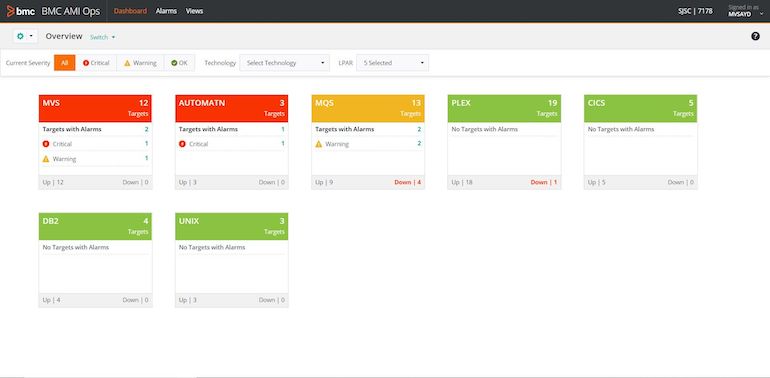
    At the core of these offerings is BMC Automated Mainframe Intelligence (AMI), which embeds machine learning algorithms in mainframe platforms to automate a wide range of processes. BMC AMI supplants the company’s existing MainView tools with a framework that promises to make artificial intelligence (AI) more accessible via a revamped user interface.

    BMC AI Ops

    John McKenny, senior vice president and general manager for ZSolutions at BMC, said an AI model based on the data collected by BMC AI can now be spun up in a matter of minutes, and can identify a potential issue days before it might otherwise occur.

    BMC AMI also exposes a REST application programming interface (API) through which more mainframe tasks will be automated.

    McKenny said as organizations accelerated digital business transformation initiatives in the last year, the need to modernize mainframe platforms became more acute. Mainframes are now the backend for multitier application environments that need to be managed in concert with other platforms, McKenny said.

    BMC is also adding Compuware zAdviser dashboards to the DevOps platform it gained with the acquisition of Compuware last year. BMC also updated Compuware Topaz for Total Test to streamline test creation for mainframe applications. There’s a growing need for better tools to test digital business processes created for the mainframe, noted McKenny.

    Other updates include Control-M job scheduler and Compuware ThruPut Manager integration, to ensure jobs run at or before their expected times on a mainframe, and an update to BMC AMI Data for IMS that simplifies database management in mainframe environments.

    Finally, BMC updated the BMC AMI Security offering with the Compuware Application Audit tool; this update allows for better capture of relevant user access and behavior data.

    McKenny said while mainframes remain one of the most secure platforms available, administrators must ensure security policies are properly implemented. IT organizations should avoid complacency and ensure zero-trust security in mainframe environments, McKenny said.

    McKenny added that, despite their long tenure and the rise of cloud computing, mainframes remain relevant. Many organizations determined that the fastest way to achieve their digital business transformation goals is by extending their mainframe platforms – platforms many of them already rely on to process and analyze transactions.

    What’s changing is the IT professionals that manage mainframes alongside other platforms, such as the cloud. Many of those IT professionals naturally expect integrated AI capabilities that enable the average IT administrator to manage a platform that was once the sole realm of dedicated IT specialists.

  • Bringing Agility to Mainframes in COVID-19 and Beyond

    Bringing Agility to Mainframes in COVID-19 and Beyond

    Of the many ways this pandemic has shifted resources online, financial transactions are among the most critical. With the use of cash and checks grinding to a halt, transactions generated with our devices are increasing, and most of them are being completed on a mainframe. It’s not hyperbole to state that mainframes—the systems of record for major banks, investment houses and insurers—are helping to keep the world economy resilient, all without a single glitch.

    Will the increases in online transactions be temporary while sheltering and social distancing are in place or does this mark a critical inflection point in the market? There are already signs that the online uptick is here to stay. J.D. Power research says approximately one-third of retail banking customers plan to increase their use of online and mobile banking services post COVID-19, with this percentage expected to increase with the duration of the crisis. It’s likely similar increases in online transactions will take permanent hold with commerce beyond finances and retailing.

    Bringing the Mainframe and Digital Transformation Together

    The main beneficiaries of this trend will be those organizations that have committed to better serving their customers through digital means and include their mainframe assets in their necessary digital transformation. While the mainframe is the most securable, reliable, performant and scalable platform, mainframe software development and delivery have traditionally followed slow waterfall processes, further hampered by archaic tooling. New and growing workload demands will require organizations to apply Agile and DevOps methodologies to their mainframe code and data to increase their overall agility. What are the keys to doing this?

    Articulate Your Vision and Identify Impediments: Articulating your vision starts with outlining your goals. Maybe you want to improve velocity (compressing the time between business need identification and code in production), agility (the ability to make more frequent changes to application code), efficiency (automating time wasted on manual execution of common repetitive tasks) and integration (better coordination of code changes across platforms). Or perhaps an important strategic focus for your organization is empowering technical staff with mainstream skill sets to assume responsibility for mainframe DevOps.

    The key to achieving these goals is to identify your organization’s unique constraints – these could be tools that lock you into slow, waterfall processes; entrenched habits that fail to place sufficient emphasis on speed and collaboration; or lack of funding. Once an organization knows where it wants to go and what it needs to do to get there, it can start crafting a rational, credible transformation road map without compromising the reliability and stability of core applications.

    Modernize Your Mainframe Development Environment: The “green screen” ISPF environments of most mainframe shops require highly specialized knowledge and problematically limit new staff productivity. Modernizing the mainframe begins with modernizing the developer experience, which should feature a user-friendly interface that allows staff to toggle easily as they work on both mainframe and non-mainframe applications. The modernized mainframe user interface should also support integration with best-of-breed DevOps solutions to help improve the quality, velocity and efficiency of mainframe software development.

    Automate Testing: According to a Vanson Bourne survey, 90% of application development managers say that automating more test cases could be the single most important factor in their success as the pressure to accelerate innovation increases. Yet currently only 7% of organizations automate the execution of test cases on mainframe code.

    Technical obstacles have historically prevented the kind of “shift-left” automated testing that is commonplace in Java from being applied to mainframe development. Luckily, these obstacles have been removed and reliable automated unit testing can become a mainframe reality. Once unit testing is automated, organizations can extend automation to functional testing (to validate the implementation works as specified) as well as integration testing (evaluating if the collaboration between two or more programs works as expected) and ultimately improve an organization’s ability to accelerate innovation.

    Empower Developers: As mainframe applications have been expanded and enhanced over many years, they have typically become large and complex. They may also not be very well-documented. This combination of complexity and poor documentation is a major block to core transformation goals—including agility, confidence and efficiency. The undocumented idiosyncrasies of some mainframe applications and data structures tend to make enterprise IT highly dependent on the personal/tribal knowledge of senior mainframe staff. Worse yet, if a seasoned mainframe developer is no longer available, IT may be fearful of making any changes at all.

    Empowering developers means more than modernizing the mainframe development environment, as discussed above; it means making it much easier for any new participant/contributor to quickly “read” existing application logic, program interdependencies, data structures and data relationships. This enables them to work on even the most unfamiliar and complex systems with clarity and confidence—in essence, to be less reliant and more independent. It also means empowering developers to take on jobs that may have traditionally been done by a testing team, e.g. unit testing, or a DBA, e.g. test data setup to remove bottlenecks and speed delivery.

    Training: Once an organization has the right development environment in place, it can start shifting its process from a traditional waterfall model with large sets of requirements and long project timelines to a more incremental model. The move from large-scale waterfall projects to Agile represents a significant change in work culture for most mainframe teams. Training in Agile processes and work culture is really a must.

    Technical leadership roles and product owners, in particular, need in-depth training and coaching. All team members should have at least some formal introduction to basic Agile concepts. To ensure that mainframe development is not left behind, organizations should consider pairing mainframe developers with agile-experienced developers from other platforms.

    Include Mainframe Code in All Aspects of the DevOps Toolchain: If an organization fails to include mainframe code in all aspects of the DevOps toolchain, there will always be one code component (mainframe) that slows down the rest of the DevOps process. To truly enable DevOps and Agile on the mainframe, mainframe code must integrate easily and seamlessly with other tools in the end-to-end toolchain, including Jenkins, Digital.ai, Slack, CloudBees and others.

    Among the processes that must be integrated and automated include source code management (SCM). The shift from waterfall-based SCM to Agile-enabling SCM is a pivotal moment in mainframe transformation—an absolutely essential shift if an organization’s goal is to increase the speed and frequency of new mainframe code drops, optimize developer productivity and simplify end-to-end management of the software development life cycle.

    Organizations also need to be able to pinpoint mainframe code deployment issues as soon as they occur, so immediate corrective action can be taken. If such corrective action does not produce its expected effect, there must be the ability to quickly and automatically fall back to the previous working version of the application. This automated fallback is, in fact, a key enabler of rapid deployment and particularly important for mainframe code, since it is the primary means of mitigating the business risk associated with the promotion of mission-critical code.

    Enable Coordinated Cross-Platform Continuous Delivery: Mainframe applications and data increasingly serve as a back-end resource for multi-platform customer- and employee-facing applications that include mobile, web and/or cloud components. DevOps teams therefore must be able to fully synchronize the delivery of new, approved code across all platforms.

     This is the desired state of enterprise DevOps: a de-siloed environment where the mainframe is “just another platform” that can be quickly and appropriately modified to meet the needs of the business.

    Conclusion

    From the changes in the daily commute to the way we buy food, the COVID-19 pandemic is likely to exert long-lasting, sweeping changes in the ways we live and our preferences. As more people become accustomed to conducting more of their day-to-day activities online—including banking but so much more—mainframe development will be required to exhibit higher levels of agility than ever before. The tips described here can help organizations transform their venerable mainframes into platforms for innovation and become an autonomous digital enterprise that can thrive during seismic changes. After all, those who do this the best are likely not to be hampered by COVID-19’s enduring imprint on society.

  • Mainframe and DevOps in Traditional Enterprise, With ASG Technologies

    Mainframe and DevOps in Traditional Enterprise, With ASG Technologies

    The assumption that large, established enterprises—from insurance companies to government agencies—can’t adopt Agile processes or DevOps is based on the falsehood that legacy technology stacks won’t allow for it; that existing traditional mainframe applications or legacy applications that large enterprises are built on are incapable of adapting to these approaches.

    Accelerated Strategies Group recently released the new research report, “5 Crucial DevOps Strategies For Cloud and Mainframe 2020,” sponsored by ASG Technologies. In this episode of DevOps Chats, Jeff Cherrington and Anna Murray with ASG Technologies joins Mitch Ashley, CEO of Accelerated Strategies Group, to explore how mainframe app teams embrace DevOps, its processes and tools to equip software teams so mainframe apps continue to provide businesses with vital systems and capabilities far into the future.

    The audio file of the conversation is below, followed by a transcript. Enjoy!

    Transcript

    Mitch Ashley: Hi. I’m joined by some special people, some folks that I really enjoy working with from ASG Technologies—different from the ASG that I work with. [Laughter] So, I’m joined today by Jeff Cherrington and Anna Murray. Thank you, both, for being here.

    Jeff Cherrington: Well, thank you very much, Mitch. I’m Jeff Cherrington, I’m Vice President of Product Management for Systems with ASG Technologies. Many of you may know ASG. We’ve been in enterprise infrastructure management software for over 40 years, and certainly hold a prominent position as well in enterprise content management. We’re very keen to have the conversation today around how traditional infrastructure—meaning the mainframe—aligns with new DevOps initiatives in the enterprise.

    Anna, if you would introduce yourself.

    Anna Murray: Sure. Hi, my name is Anna Murray, and I’m a Senior Product Manager with ASG Technologies, and I work with Jeff Cherrington. And I have extensive experience with automation across platforms and data centers, as well as agile transformation for teams.

    Ashley: Excellent. Jeff was saying before we started that he used to work in radio—you can tell. [Laughter]

    Murray: [Laughter]

    Cherrington: [Laughter]

    Ashley: You’re very comfortable behind a microphone—no doubt, no doubt. We were talking about everybody’s on video these days, so that’s awesome.

    Murray: Right. [Laughter]

    Ashley: Well, great. You know, we’ve been doing some work together and we do have a report coming out to kind of pre-announce that. We’ll be talking about that a little bit later. But there’s a lot of myth about DevOps and mainframes. I know even some analysts—I won’t name any names—have said they’re two different paths, you shouldn’t try to do both. I think the jury has started to change their mind on that.

    Why do you think some of those myths have existed of, “No, we can’t do DevOps on mainframe environments?” Do you wanna start, Jeff?

    Cherrington: I think I will, and then I’m sure Anna’s got some thoughts that she’ll want to contribute. You know, it’s certainly a reality within the industry that we’re going through a generational shift around our leadership or IT, whether it’s infrastructure or application development. There are those who are still working daily, like myself, who represent the traditions of IT from the very beginnings back in the 1960s, and then there are others who are certainly much younger and certainly have much different experiences, which may not include any exposure to the mainframe. And, as a consequence, there might be some resistance, there might be a little bit of anxiety about the technology, and it can be formidable to approach if you don’t have the appropriate background.

    The things that we’d love to talk to, though, is that the mainframe as traditional technology still performs incredibly important roles within the enterprise. And at the end of the day, DevOps is much more about technique than technology, and it can apply as easily to mainframe and should as it does to any other part of the IT infrastructure.

    Anna, do you have some thoughts to build on that?

    Murray: Sure. You know, as I think about the generation gap that you’re talking about, I kind of come on the other end, but I’m Gen X. And so, we were the generation that said, “Oh, the mainframe’s dying,” right? [Laughter] So, that—obviously, I’ve learned that’s totally wrong, and the generation coming after us is coming in to learn the mainframe and realize how powerful it is, right?

    And so, I think a lot of the leaders that are coming in are coming from this generation that didn’t even think about mainframe for a while, right? And so, they did all their planning and their agile transformation and their DevOps transformations thinking about the cloud and all of their Windows and Linux and Unix servers and didn’t even think about the mainframe.

    And so, I think that’s the other side of the gap that happens. As the younger leaders are coming up, you know, especially, I would say blame my generation the most, right? [Laughter] Because there’s this gap, and—learn more and make sure you’re talking to both ends of the spectrum and learn about crossing the gap.

    Cherrington: And actually, the way I like to phrase it now is far less to use jargon like “generational gap,” but instead talk about generational bridge, because that’s what I’m seeing.

    Murray: That’s so much better, yeah.

    Cherrington: We’re seeing that the younger IT professionals are identifying that there’s great opportunity to work with mainframe in the coming years. And so, we see Millennials, or is it Gen Y—the generation after yours, Anna—who are stepping forward and saying, “This is really interesting. The mainframe does all of the technologies, it supports all of the technologies that I learned in uni, university. I can do Java, I can do TCP/IP connections, I’ve got great sources for strong cryptography, it supports Unix, I can put Linux onto a mainframe LPAR—this is a good space to be in.”

    And so, more and more, we’re seeing that the people we engage with are a mix of people that are my age with the white beard or the gray beard and a mix of young, fresh faces that are really eager and really excited to get involved, and who come predisposed to new techniques such as DevOps.

    Murray: Mm-hmm.

    Ashley: You know, there’s so much important things that both of you said. One is that in DevOps, there is no technology definition of what it applies to, and it’s very easy to associate it with Cloud Native and maybe newer applications, because that’s where it sort of grew up initially.

    But DevOps is really about how we create software, not what technology we use to create software. And it’s about how teams collaborate, it’s about how you share information, it’s about how you get different functions from the business together in a collaborative team to kinda do things earlier in the process, do automation. All of that applies to the mainframe, of course, and there’s tools to do much of what we’ve talked about. Maybe you can say a little bit about how people approach DevOps in the mainframe environment.

    You wanna go, Anna?

    Murray: Right? Well, you know, when you approach DevOps in the mainframe environment, it’s not so much just about the mainframe environment, but the company. The whole organization has to be behind DevOps, and there has to be leadership saying, “Hey, this is something we need across silos,” right? And then you have to look at the tools available to you. DevOps is a lot about the toolchain itself. There’s hundreds of tools in that toolchain, and so, you have to start looking for solutions that are gonna meet your needs and help you cross those silos.

    Cherrington: You know, it’s certainly true that everybody resists change. I think that’s an innate part of human nature, but both Anna and I have seen that things of this nature can come forward, can be used with teams that are mainframe-centric, perhaps have been doing things the way they’ve been doing them for 10 years or 20 years or 30 years.

    And there’s natural resistance. “Gosh, you know, I’ve done things the way I’ve done them successfully for so long, why should I change?” Certainly, I’ve seen agile adopted by mainframe development teams, sometimes kicking and screaming, but once the resistance curve is overcome, it becomes very productive and becomes very natural.

    And I think we’re at that stage now in terms of adoption of DevOps for the entire enterprise infrastructure, from Windows all the way to the mainframe and onto the cloud and even onto mobile, even as there are initial reactions of going, you know, “How can this apply? This is not something I learned when I went to my classes to learn more about the mainframe at SHARE in 1995 or 1985.” But we have proof points.

    We have large international enterprises, we have small regional enterprises that are coming forward and saying, “I must have mainframe. It plays a critical role for things that I need to do, particularly around payments processing, anything that needs highly available, real-time online absolute reliable performance. And it is only part of my infrastructure, and I need to treat how I develop there the same way I treat developing anywhere else.”

    Ashley: You were talking about, also—so many apps are not just a mobile app, right? There’s a whole back end to it, oftentimes sharing data, even talking transactions between multiple systems, one of those or multiple may be mainframe applications. You know, and if I step back for a minute and think about our current environment and how much things have accelerated in doing sort of these digital transformation, digital experiences for customers, organizations are looking to both strategically move quicker, but also be able to react opportunistically and sometimes based on conditions. And it seems like some of the flexibility with DevOps makes it easier to coordinate some of those activities across multiple applications. So, if you do have to do three different release to make up one new capability, that comes together much easier.

    Cherrington: It does. You know, the thing that I always look to as I engage with anything around business is, to use an old phrase, “why is the juice worth the squeeze?” And while we talk about DevOps a lot because of its elegance, because of its collaboration, because of the ways in which it makes development easier, the real juice of the squeeze is time to market. The whole reason to consider DevOps is how can we get something we need to get in terms of new technology enablement to market quickly, more quickly than we did before, but not sacrifice quality.

    And that’s what we see time and time again is, we have something we need to get to market. I want to present new capabilities to my customers through an app on the phone because that’s where people live their digital lives. But at the back end, it’s dependent upon the mainframe for things such as account balances, customer statuses—an unending list of capabilities that still remain on the platform as the best place for that type of activity to occur.

    Ashley: Mm-hmm. You know, I’m thinking about just the recent experiences with the reactions to COVID and contactless delivery, inventory, product inventories are often something that’s still on the mainframe, has been for a long time, and now, you know, retail stores, as well as a lot of others, have to be able to maintain a really accurate enough inventory and also present that to the customers so they know, what store can I go at to pick up whatever I’m looking at buying.

    I’m curious, too—I know that ASG Technologies has some of your own products, your own technology around this idea of orchestration across platforms because you work both mainframe and non-mainframe environments. Talk to us a little bit about how you approached coming up with that product and maybe a little bit about how it works and what it does.

    Murray: Sure, I’ll jump in for a little bit here. You know, you talk about orchestration—that’s combining your toolchain, right? You’ve got all the little pieces of your DevOps toolchain, and you need to figure out how to connect all the dots and bring it together and, you know, ASG has been doing automation and orchestration for a long time, but we’ve changed our focus into bringing in the development part of that toolchain, right?

    Operations has been kind of a focus of automation for a long time, and now we have to pull in all of the development pieces that happen and the configuration management that happens, and all of those—there’s lots of little tools there, right?

    So, we haven’t tried to come at the market as trying to provide all the tools, but we’re trying to provide some of them, right, and we definitely want to orchestrate as many as possible, right, and cover the entire environment for the customer. On the mainframe, the most popular thing we’ve been working with recently is JCL Management. Every mainframe’s running JCL, right? Nothing happens on the mainframe without it, and so making sure that there’s a DevOps interface to your JCL Management solution is really important. And so, we’ve made an investment in making sure that ours has both an Eclipse plug-in that makes it easier for the developers to interface with that JCL as well as a RESTful web service API so that it can be integrated with building of the products and crossing across the silos to other products.

    Ashley: Mm-hmm.

    Cherrington: And certainly, in the approach that we’ve taken, we look to be a good citizen of the DevOps enterprise community, and the work that Anna and her team have done, we ensure that we support the most popular integrated development environments for doing this sort of work. So, the JCL quality assurance and management offerings that we have for the mainframe are also certified for the Compuware Topaz integrated development environment and for the IBM—what’s the name of it again, Anna? It’s—

    Murray: IDZ.

    Cherrington: IDZ. What was the rational development environment that’s now rebranded?

    Murray: Yes. [Laughter]

    Cherrington: As well as any other Eclipse compatible IDE that a customer may want to use.

    Ashley: You know, it’s interesting, just thinking about all the, a number of the terms that you both used in just those last two comments, you know, mainframe 10 years ago, you wouldn’t have been talking about, I don’t think, RESTful IDE—all the tools that we kinda think of as sort of in cloud applications, much of it is the same toolset, a lot of the same ideas, just working with integrating some other different tools that are specific to the mainframe environment.

    Cherrington: It is, and you know, I certainly want to encourage those who are listening and watching—and particularly, those who may be ASG customers now or are considering becoming ASG customers—to join us at our worldwide customer conference, a virtual conference this year, EVOLVE, that will be occurring on October 6th and 7th, because we will be making some significant announcements about extending support in this area, including opportunities for creating interfaces to mainframe applications that can extend all the way to mobile, if that’s of use to a customer.

    We’ve had a lot of excitement coming into this, we have a lot of partners and customers who are going to be presenting, and there’s a great deal of energy that we’ll be putting forth around our DevOps support and DevOps enablement.

    Murray: And can folks sign up? How do they register to attend the virtual conference? Is that on your website?

    Cherrington: It’s on our website if you come to www.asg.com, I’m sure you’ll find something right on the home page that says EVOLVE 2020 and it’ll give you the opportunities to get, well, involved.

    Ashley: [Laughter] EVOLVE and involved at the same time.

    Cherrington: Exactly. [Laughter]

    Murray: [Laughter]

    Ashley: You know, the fact that you get to work with so many organizations that are adopting DevOps, I’m kinda curious about two things. How does the mainframe teams approach wanting to learn about DevOps and coming up to speed and trying it, and then how do the existing practitioners maybe outside of the mainframe group that are also using DevOps—how do they see what’s happening in the organization and how do they…do they want to participate, do they support it, are they kinda not sure? What do you see happening, there?

    Murray: So, yeah, you know, there’s a mixed feeling. You know, there’s definitely differences between, you know, if it’s led from the top down and people are being told they have to change, right, it depends on how you’ve adjusted the expectations in your team, right? Helping them learn what’s coming and why instead of just telling people what to do makes a huge difference, right?

    Ashley: Mm-hmm.

    Murray: We’re all much more interested in solving problems and learning new things together. So, it’s really important conversation is held properly, right?

    So, we have some that are really excited that they want to learn and they want to jump in from the mainframe side and grow, and then there’s others that are really just struggling and pulling their mainframe teams along, right? So, one customer I think of, you know, is standardized on Compuware Topaz Workbench, but the developers are less interested in switching over. They have some of the older generation who’s very comfortable with the green screen and they think, “Why bother switching to Topaz?” You know? They just don’t even get it.

    Ashley: Mm-hmm.

    Murray: And so, you know, the truth is, we really need to have solutions that meet the needs of all of the people that are part of the DevOps environment, right? So, it isn’t—you know, a very experienced mainframe programmer doesn’t have to use Eclipse, right? They can be quite happy on the green screen and we should let them stay there, right? [Laughter] And we do, our JCL Management solutions have a very robust green screen interface, and then we bridged the gap, as Jeff was talking about earlier, with having those APIs, right?

    And so—yes, so the DevOps toolchain is still brought together with something like our ASG Enterprise Orchestrator pulling in the code and grabbing with the API the JCL and making sure that the standards are applied and then bringing them across for compiles and distribution into another environment, right? Not that you compile JCL, but there’s other parts that are related.

    Ashley: Mm-hmm.

    Murray: So, you know, you asked—it’s kind of a mixed bag. And we see that, too, right? And as the conversation becomes more common, right, I think we’ll have more people who are more comfortable having that conversation and learning together.

    Ashley: Excellent. Well, Jeff has been bitten by the Zoom bug, so he had to call in from his call dropping, so glad you’re still with us, Jeff.

    Cherrington: Mm-hmm.

    Ashley: You know, we were just talking about the adoption process, and Anna, you were talking about how mainframe teams kind of approach this. I’d like the other side of it. DevOps teams that maybe aren’t in the mainframe group that have been practicing this for a while, maybe a few months, a few years—how do they see this happening, and is there collaboration? Do they pitch in, do they tend to work together or not? How does it go?

    Cherrington: Well, some of the things I’ve seen actually goes to either end of the spectrum. For the teams working with the more modern technologies and have to adopt DevOps very frequently, we find evangelists, those who have gotten to the point where they believe in the techniques and the approaches so passionately that they’re out there actually promoting them everywhere they can. It’s much like what we saw with the adoption of agile in the last decade. We’re seeing that same sort of passion surround this approach to development in this decade.

    You know, it’s one of those things, we have to keep in mind—DevOps was not even a term within the industry until 2009. I mean, it’s barely a decade old, and it’s in these last five years that we have seen the acceleration for adoption.

    Now, having said that, you know there certainly are always going to be pockets within any enterprise where, again, there’s resistance. There are those who are not looking for change and those that, perhaps, while they have embraced the DevOps approaches for their distributed systems or cloud development, look at the ideas of what they have to change or adapt to on the mainframe side and really don’t want to go there. The idea that there might be a long compile that has to be done on the mainframe before the next step in the DevOps process can occur will cause some—a little bit of agita.

    And that’s why it’s so important we need to take a look at the strategies that are necessary for DevOps success. I think that’s something that you speak to very eloquently, Mitch. And out of those steps, the one that I think is so critically important is culture shift. Just like with agile adoption, DevOps adoption needs support from the top, and it needs to be constantly vocal support to help people pull through these resistance curves. Resistance curves are natural and the quicker an enterprise gets through them, the quicker they get to a point that they’re delivering new capabilities to market much more quickly.

    Murray: Right.

    Ashley: Thanks for your kind words about the culture, too, and I want to get your thoughts on this, Anna. Culture is a lot of things, but I think we’re all human at the end of the day and none of us want to look dumb, right? We don’t want to tackle something we don’t know if we can learn or maybe not kinda look so good in front of our peers if we’re the ones behind the curve.

    And I think something that can help combat that is, one of the principles of DevOps is sharing, is really—it’s collaborating, but it’s also sharing. Sharing scripts, process, tools, content, methods—all of those kinds of things which, if you truly adopt DevOps, as you said, Jeff, you can become an advocate and then also help with that transition and very quickly, you know, they kinda get over that curve of, “Okay, alright, I’m not—I’m familiar with this,” as you mentioned, Anna, I can still use my green screen or many of the tools that I’m already using and I’m just adding to kinda what I’ve been doing.

    So, your thoughts, Anna?

    Murray: Right, well, I’ve recently been having other conversations with partners about this culture shift and it’s become really clear with other companies that are supporting DevOps and those initiatives that you really have to have not just buy-in from your senior management, you’ve got to have active support. You know, they have to sponsor the change.

    Because we’ve also seen companies who don’t go through the change, they fail. If it’s from the bottom up only and the senior leadership says, “Okay, yeah, sure, that’s a great idea,” but they’re not actually investing in it themselves, the team, when they hit road bumps—because they will. It’s not, you know, switching to DevOps doesn’t happen overnight. I think we all know that. And over time, you’re gonna hit roadblocks and you’re gonna get discouraged. And who is it that’s gonna lift you up?

    Now, hopefully, there’s evangelists that’ll help keep pulling you through and encouraging you, but at the end of the day, if your senior management isn’t coming back in to say, “Hey, guys, we believe in this process, it’s worth fixing, we’re gonna invest in whatever it takes to solve this problem,” then they’re encouraged to keep moving forward, right?

    But, you know, there is the difference happening out there where the leadership isn’t always invested in it. And so, that’s what we’re really encouraging when it comes to that culture shift that has to happen, make sure that you get not just buy-in but investment from your senior leadership.

    Ashley: Mm-hmm. Hugely important and it goes back to the, “Why are we doing this question?” that you talked about also, Jeff. You talked about really responding quickly and getting software out to market or quickly in today’s situation with COVID and uncertain as well as very quickly changing conditions, you know, something could very easily come down from Product Management or whoever to the development teams and say, “Okay, we need to add this capability or change how we’re doing something.” And the team’s ability to react quickly—I mean, they already do today, but even more quickly under these circumstances, I think, demonstrates the value not only of DevOps, but also those teams.

    Cherrington: Absolutely. Absolutely. I mean, it’s always a virtue to be able to get to market quickly. And in the current period of the pandemic, it’s a virtue that actually can impact lives on a broad scale.

    As the different national governments are taking the steps that they need to take to provide stimulus and secure the safety of their populations during all of this disruption, one of the things we’ve seen is that there have to be changes to critical traditional mainframe systems for all of this to happen. Certainly, the unemployment compensation that was distributed here in the U.S. touched legacy traditional systems at the state level that perhaps have not been actively developed for some period of years.

    And certainly, those government enterprises or commercial enterprises that were pre-prepared to apply their DevOps techniques to making those changes to their traditional offerings, traditional applications were better prepared to deal with this and to deal with the ongoing change as our government’s tried to figure out how to stabilize economies and get us through this challenging time.

    Murray: Mm-hmm.

    Ashley: You’re absolutely right, and that’s one example of many. I mean, there’s insurance claims processing to get your request fulfilled quickly, you know, new medicines—all of that kind of thing. There’s so many areas where mainframe technology is involved today.

    Well, I wish we could keep going. Maybe I have to come to the conference to continue the conversation. [Laughter]

    Cherrington: [Laughter]

    Murray: Yeah, we would love that.

    Cherrington: You would always be welcome.

    Ashley: Well, I appreciate that very much. And so, just a reminder for our audience, the EVOLVE conference is on October 6th and 7th. Go to the ASG.com website to find out how to register; I absolutely recommend doing that. And as I mentioned earlier, we have a research report coming out and the working title of that report, I think, was “Five Critical Strategies for DevOps and Mainframe.” So, we’ll see, maybe that title will stick or something close to that. I’m excited to get that out because that’s been a great effort working with you.

    Well, Anna Murray, thank you very much; Jeff Cherrington, also—thank you for joining us today.

    Cherrington: Thank you so much.

    Murray: Thank you, Mitch.

    Cherrington: And folks—stay safe.

    Murray: Yeah.

    Ashley: Alright.

    Murray: Alright, thank you.

    Ashley: You bet.
  • Why It’s Time to Migrate Away From COBOL

    Why It’s Time to Migrate Away From COBOL

    Every few years an alarm goes up about the shortage of COBOL programmers, and then it dies down. While it’s hard to tell whether this cycle occurs because programmers are found or because other solutions are identified, the latest resurgence of interest is at least in part due to the pandemic and state governments’ use of software for social services that couldn’t stand the increased caseload of tens of millions of unemployment claims.

    As we continue to sit in the midst of the pandemic, organizations are thinking about the many ways businesses will have to change. For instance, will cash still be used in five years or will the business need to support some kind of cryptocurrency? It’s time to ask those big questions now—and determine whether it’s possible to make changes without touching COBOL code.

    For most organizations, I believe that in answering these questions they’ll find that it’s time to start migrating away from COBOL.

    The Rise (and Fall) of COBOL

    COBOL is one of the earliest programming languages. It was invented in 1960 and rose to prominence as a language that required minimal programming skills. Part of COBOL’s initial attraction was that it was a domain-specific language designed for business—not only was it easy for programmers to learn, it also could be understood by executives; hence, the acronym for “Common Business-Oriented Language.”

    COBOL was also one of the few programming languages that understood the requirements of business computing—most simply, the fact that an amount like 10 cents can’t be represented accurately in binary was a huge challenge. If you’re a bank, small rounding errors on each transaction add up. Libraries for business arithmetic could be written in other languages, but they’re scarce and hard to find.

    While COBOL never disappeared, its influence faded in the 1980s but many large institutions failed to transition away from it. Today, there are billions of lines of code in governments, banks, enterprises and elsewhere performing essential business functions with few programmers able to maintain them.

    Part of the reason why COBOL fell out of fashion was its inability to adopt things such as modularity or breaking down problems into smaller, functional pieces. When COBOL was invented, old business software was monolithic—and monolithic in a very deep sense. Internally, the software wasn’t partitioned into separate components that could be updated without affecting each other. It also tended to model forms that humans would fill out and couldn’t be submitted until the form was complete. Putting a web interface in front of those monoliths leads to a predictable result: long, complex forms that can take hours to fill out and are close to unusable on the modern web.

    While the COBOL language itself has evolved over the years (with revisions released in 1961, 1974 and 1985 and object-oriented COBOL released in 2002), you still have to ask: what will it take to bring a COBOL program written in the 1970s or 1980s up to date? Is redesigning a program to take advantage of COBOL 2014 any easier than porting it to Java or Python or Go or Rust? Furthermore, COBOL looks unfamiliar and forbidding to most modern programmers, which likely caused it to lose popularity in the first place.

    Finding an Alternative

    So, where are we now, with our billions of lines of COBOL running the world’s governments and finances? We certainly need more people who know and understand COBOL programs. There’s a lot of old code that needs to be maintained, pure and simple.

    But it goes deeper than that. COBOL is just another programming language; if we’re going to maintain (or replace) that software, we need programmers who understand the engineering decisions that made the software what it is. Programmers used a lot of tricks to work around the limitations of 1960s computers. Those tricks just don’t make sense to modern programmers; they solve problems we no longer have. We also need engineers and managers who are willing to look at our current situation—for example, the huge surge in unemployment applications—and think beyond the short-term solution. What does it take to reinvent current systems rather than replacing them? How can these systems become more human-centric? Can they be redesigned to match the way we live and work now? Putting a web front-end on a monolithic business process from the 1950s is the road to failure.

    The new generation of programmers must understand financial programming and how to design business systems. There’s little value in migrating from COBOL if you don’t get something better in return. What you should get in return is the flexibility to add new features and new user interfaces, the ability to adapt to changes in competitive conditions and implement changes in the regulatory environment, and so on. We don’t yet know what those new features will be (perhaps cryptocurrency or virtual reality user interfaces), but we do know that businesses will need the flexibility to add them.

    Simply put: Scrambling for COBOL programmers whenever there’s a crisis is not a viable business decision. Transitioning from COBOL is a change businesses will have to make eventually. This transition should be made when businesses have time to think it through, time to hire the right people and time to do a good job—rather than waiting for the next crisis.

    In the meantime, while businesses are baking in the time to think through their transition strategically, it’s important to note that this isn’t an all or nothing decision—i.e. let’s scrap our legacy software and replace it by Jan. 1, 2021. This is not Y2K. Using a microservices approach offers numerous advantage. For one, businesses can split their existing infrastructure into different independent services. They can start with pieces such as authentication, then move on to things such as billing and other services. Whatever businesses decide, they need an approach that’s modular so that it’s easy to add new features as needed. That requires careful thinking about design—and that thinking is more important than the programming language itself.

  • Z is for Zowe – the Open Path to Mainframe DevOps

    Z is for Zowe – the Open Path to Mainframe DevOps

    The energy and excitement in the IBM Z mainframe community during the two years since the announcement of Zowe have not been seen in a generation.  By enabling mainframers to work like technologists who work on the cloud, mobile and distributed platforms, Zowe unlocks the power of DevOps for mainframers, ensuring the vitality of the platform for the long-term.

    It accomplishes this by opening up the world of enterprise DevOps tools, both familiar and special-purpose ones, for mainframe applications, allowing users to easily create toolchains that include the mainframe. This freedom to leverage any enterprise DevOps tools across the entire deployment pipeline is achieved simply and elegantly.

    The Zowe Backstory

    The Zowe journey began when Broadcom, at the time CA Technologies, along with IBM and Rocket Software realized the challenges they were hearing from customers—IT isolation, need for increased delivery velocity and recruitment and retention problems—were bigger than any single vendor could solve on its own. The challenges of this scale required an ecosystem-wide response.

    So the vendors came together with the Linux Foundation’s Open Mainframe Project to create the open source framework known as Zowe (as in David Bowie, for the uninitiated). The Zowe community operates transparently and welcomes contributions from all in the form of code, enhancement requests, educational content and shared experiences. A virtual meetup held earlier in the year attracted participants from 47 companies from across the mainframe ecosystem.

    Traditionally, mainframe application development and operations have been separate from the rest of the IT organization due to specialized processes, roles and tools designed around the platform. While they have served the mainframe community extraordinarily well over the decades, the world outside has changed with demand for ever-shorter software delivery cycles resulting in the DevOps model.

    In short, the tipping point has arrived and the time to normalize is now.

    What Is Zowe?

    Zowe is a modern interface to the mainframe that extends z/OS-based services and tooling to the greater IT landscape, including DevOps. As a framework, it consists of four main components:

    • Zowe API Mediation Layer (APIML)
    • Zowe Command Line Interface (CLI)
    • Zowe Explorer (Visual Studio Code extension)
    • Zowe App Framework (UI)

    Broadcom is proud to have initially contributed the first three of these components. The first two were created as part of our CA Brightside offering, which won an award for the Most Innovative DevOps solution—yes, a mainframe offering won a DevOps innovation award!

    These components provide a modern way of working that supports core DevOps practices such as empowering developers with shift-left testing responsibilities and DevOps engineers with robust automation options.

    This article describes the framework’s ability to onboard the mainframe to enterprise DevOps, so developers, systems programmers and others who work with the mainframe can now do so the same way their peers do with other IT platforms (i.e., cloud, mobile, distributed). These shared experiences close the gap between mainframers and others while preserving the core advantages of the platform. Common tools fuel a common language that benefits all, especially when deploying hybrid applications (e.g., web front-end with mainframe back-end).

    Through automation and script libraries, Zowe helps reduce the range of mainframe-specific knowledge necessary to be productive, enabling organizations to more easily recruit, onboard and retain the next generation of talent. By using modern DevOps tools and techniques combined with access to “big iron” applications, the next-generation now sees mainframe as an exciting career choice.

    Recent milestones achieved by the Zowe community include the launch of the long-term support (LTS) release ensuring the stability and longevity of the framework and a Zowe Conformance program ensuring the interoperability of a growing ecosystem of conformant tools.

    The framework drives mainframe DevOps in several ways:

    Zowe API Mediation Layer – Discover and Securely Consume

    As RESTful APIs become table stakes, the greater the challenge becomes, making those services easily discoverable and consumable in a secure way. The Zowe API Mediation Layer (APIML) addresses this need by exposing mainframe services, ranging from z/OS system level to database/transaction services to tool-based services, through a centralized gateway and catalog.

    Conformance of these APIs with the Zowe LTS standard eliminates breaking changes while bringing additional value, including the usability and productivity benefits of single sign-on (SSO).

    At Broadcom, we’ve leveraged Zowe to achieve conformance across our product portfolio and have a healthy pipeline of Zowe-conformant products soon to be announced. By spanning the traditional Dev and Ops domains, we’re facilitating true mainframe DevOps adoption—teams can combine their preferred mainframe-native tools with off-platform ones, including ones used by their peers working on other platforms, to optimize speed, quality and productivity.

    Zowe CLI – Orchestrate and Automate

    For DevOps Engineers and DevOps-savvy self-service developers, CLIs are a “go-to” tool. They use CLIs for a wide range of platforms including AWS and Azure, Git, Kubernetes and so on … why not mainframe? The use of CLIs paves the way for robust, script-based automation, which is a cornerstone of DevOps. The Zowe community already offers some basic scripts, free for anyone to use.

    Using a CLI may be new for some, so community members often share tips and tricks to help these users navigate the productivity curve quickly.

    Broadcom currently offers a dozen or so CLI extensions to mainframe-native tools, once again spanning the traditional Dev and Ops domains to improve productivity across roles and processes.

    Zowe Explorer for VS Code – Visualize and Navigate

    Visual Studio Code is exciting for any mainframers editing code, especially developers and sysprogs. While ISPF and Eclipse will remain viable options for the foreseeable future, the extraordinary success of the lightweight VS Code, which is backed by Microsoft, and the rapid emergence of browser-based editors/IDEs expand the range of options. With 11 million users around the globe, VS Code provides an experience users love and a marketplace of 20,000 extensions enabling users to personalize their UX and optimize their workflows.

    Zowe Explorer, which streamlines interaction with mainframe data sets, USS files and jobs, is only one of the many VS Code extensions available in the VS Code marketplace for mainframe users (and a successful one with more than 12,000 downloads). Unlike Eclipse extensions, all of the mainframe extensions from Broadcom are free, and many are open-sourced.

    In the Queue: SSO/MFA, SDK, Mobile App

    The Zowe community has been working diligently on the implementation of SSO and multi-factor authentication (MFA), which eliminates the drudgery of constantly logging on to multiple systems.

    Also, software development kits (SDKs) are in the works, the goal of which is to make Zowe services (and by extension, the mainframe) easier to use by providing reusable code for common mainframe operations in popular languages and runtime libraries. The beginnings of a Zowe Node.js SDK and Zowe Python SDK already exist.

    Finally, a Zowe mobile app to help systems and operations support staff improve system availability is, like the SDK, being incubated by the community.

    Decision Time – Zowe Open Path or Closed, Proprietary

    Mainframe teams face a choice: Continue with a vendor-controlled model, in which vendors determine which tools you use and how you work or adopt the open path. While the prescriptive (aka opinionated) approach of the former may have been acceptable for a siloed mainframe, the open approach is the foundation of enterprise DevOps.

    As an indication of the early success of the open path, we’ve been delighted to learn about many mainframe shops adopting Zowe on their own, with CI/CD integration and code analysis a common entry point.

    For those with reservations about open source, consider the prevalence of Git, Visual Studio Code, Jenkins, SonarQube and so on in the DevOps landscape. Microsoft CEO Nadella recently stated, “We’re all-in on open source” and Zowe co-founder IBM recently acquired Red Hat—more shining examples that open source tools are a trusted part of the technology stack.

    Change is never easy, which is why no-fee Design Thinking workshops are available to help adopters prioritize the DevOps use cases enabled by Zowe. Because so many see “open” as the least costly, least risky and fastest path to mainframe modernization, familiarity with Zowe is quickly becoming an industry standard. Ask your vendors if they’re joining the Zowe community and ecosystem.

    With ongoing commitment from IBM, Rocket and Broadcom and the guidance and support of the Open Mainframe Project, the excitement around will Zowe continue so join the open mainframe movement!

    To learn more about Zowe, visit Zowe.org and the community blog site.