Tag: mainframe

  • IDC Tech Spotlight: Making Open Source Work for You

    IDC Tech Spotlight: Making Open Source Work for You

    Starting from remarkably humble beginnings over three decades ago, open source software is the story of a better mousetrap that wins over the world. Originally, the intent of open source projects was to create software that system administrators and developers could use without having to pay licensing fees – but it has become much, much more. This IDC Technology Spotlight takes a deeper look at the value proposition associated with using commercially supported open source software in mission-critical environments, like IBM Z.

    To read more, please visit: IDC Tech Spotlight: Making Open Source Work for You: Achieving Optimum Value, Security, and Productivity

  • Discover Rocket Open AppDev for Z

    Discover Rocket Open AppDev for Z

    Give your developers the open software they want through a system that combines an easy user experience with the security and support IBM® Z® customers demand.

    Rocket® Open AppDev for Z helps you bring applications to market faster, at lower cost and with less risk. We make it easier to implement modern application development practices by automating processes while ensuring compliance to organizational standards and business rules.

    Rocket Open AppDev for Z provides:

    • 20 ported open source tools and languages for IBM Z, bundled for the AppDev experience (with more to be added over time)
    • Secure, controlled and easy deployment, with a package management system that also serves as an environment manager
    • World-class 24x7x365 global support

    Rocket Open AppDev for Z is much more than a collection of software ports. Our most recent innovation is a software deployment and management system based on conda and our own Anaconda Team Edition channel server. This system combines the high security that mainframe customers demand with an easy user experience for sysprogs and end users.

    Compliance and security

    Many of the world’s largest banks, insurance companies and government agencies rely on Rocket Open Source Languages and Tools for z/OS. That’s why it’s essential that we check our deliverables for vulnerabilities and follow proper licensing requirements.

    All of our products are:

    • Continuously kept up to date against the NIST National Vulnerability Database
    • Scanned for both security vulnerabilities and conformance to proper open source licensing prior to release

    Secure and simple delivery, deployment and maintenance

    Rocket Open AppDev for Z is based on the conda package and environment management system. Conda is uniquely suited to the mainframe world, thanks to its two levels of available security, including the most secure file channel option for air-gapped mainframes.

    Dependency-safe
    Conda is aware of dependency and version compatibility, protecting you against dependency and version mismatches and allowing you to run multiple package versions.

    Environment support
    Simple conda environment commands enable you to create, delete, activate and deactivate environments at will.


    Language-agnostic
    Conda features (including conda environments) are all language-agnostic, making Conda the choice for users regardless of whether they’re programming in Python or R, or simply want to download some tools completely independent of any programming language (e.g. Git).

    Secure repositories with guaranteed provenance
    Whether you’re using our secure channel server or your own file channels, our compliance and security system will give your team confidence that you know where your open-source technology is coming from, that it’s authentic and tamper-free and that it’s been scanned, vetted and tested. All of the open source products and packages we provide with Anaconda Team Edition are ported, built and audited by the team here at Rocket Software.

    Support
    Our Open Source Support packages are based on the same world-class, customer-centric principles as our other support offerings. When it comes to open source support, we’re offering support and fixes for open source development tools, as opposed to consultancy or solution engineering services.


    Get more information on Rocket Open AppDev for Z.

  • Open Source Languages and Tools for z/OS

    Open Source Languages and Tools for z/OS

    Open Source Languages and Tools for z/OS

    Empower your developers to use their preferred open source languages. We offer many open source languages and tools—including Git, R and Python—that allow any developer to harness the power of the mainframe without having to spend months learning new skills.


    Git

    Git is a version control system (VCS) for tracking changes in computer files and coordinating work on those files among multiple people. It is primarily used for software development, but it can be used to keep track of changes in any files. The z/OS port of git supports automatic tagging and conversion of text files between ISO8859-1 (ASCII) and IBM-1047 (EBCDIC) character encodings.


    Bash

    Bash is an sh-compatible shell providing users a command-line interpreter that provides a traditional interface via text window and a script execution capability. It is the default shell on Linux and Mac OS X.


    Bison

    Bison is a programming utility for creating parsers. It’s commonly used in both build automation and build automation generation, and converts annotated context-free grammar into a C, C++, or Java parser. Bison is used by PHP, Bash, Ruby, and many other tools.


    bzip2

    bzip2 is a data compressor that compresses single files (it is not a file archiver). It typically compresses files to within 10% to 15% of the best available techniques of statistical compressors, while being around twice as fast at compression and six times faster at decompression. This version of bzip2 was not written to exploit z Systems architecture; gzip may work best for these needs.


    cURL

    cURL is an open source tool that can transfer data to and from servers by using one of the supported protocols (HTTP, HTTPS, FTP, FTPS, TFTP, DICT, TELNET, LDAP, or FILE). This tool can work without user interaction. cURL functionality includes proxy support, user authentication, FTP upload, HTTP post, SSL connections, cookies, file transfer, resume, and more.


    Diffutils

    Diffutils is a package of several programs intended to find differences between files. The diff command, for example, shows exact line differences between two files.


    Gzip

    Gzip is a popular data compression/decompression program (our ported tools have been compressed using this utility). This version of Gzip has also been modified to exploit z/OS EDC compression hardware, if present on your system.


    libssh2

    libssh2 is a software library that allows developers to use the SSH-2 network protocol in an easy-to-use self-contained package. This package only contains LIBSSH2 libraries intended for use by other programs or utilities.


    m4

    M4 is a general-purpose macro processor. Most users require M4 simply as a dependency of Autoconf or Bison, although the language is used in other contexts such as text template re-use, text editing and text-processing applications.


    Make

    Make controls the generation of program executables and other non-source files from the program’s source files. Make allows users to build, install and update packages without knowing the process details.


    Mktemp

    The mktemp utility takes a given filename template and overwrites a portion of it to create a unique filename. Mktemp also manages the creation of temporary files and directories that allow the user to avoid the cleaning up files that are not needed permanently.


    OpenSSL

    OpenSSL is a software library to be used in applications that need to secure communications against eavesdropping or need to ascertain the identity of the party at the other end.


    Pkg-Config

    pkg-Config is a programming tool that assists with compiling applications and libraries. It helps you insert the correct compiler options on the command line without the need of hard coding values on where to find glib (or other libraries).


    Sed

    sed (stream editor) is a utility for parsing and transforming text. It is typically used for extracting part of a file using pattern matching, or substituting multiple occurrences of a string within a file.


    sudo

    sudo is a command-line utility that allows admins to delegate authority, giving certain users the ability to run commands as a super-user or another user, while providing an audit trail of the commands and their arguments.


    Unzip

    UnZip is an extraction utility for archives compressed in .zip format. Unzip is also compatible with PKZIP and PKUNZIP utilities for MS-DOS as well as Info-ZIP’s and supports bzip2 compression methods as well.


    Vim

    Vim is a highly configurable text editor built to make creating and changing any kind of text very efficient.


    Zip

    Zip is a compression and file packaging/archive utility. Zip puts one or more compressed files into a single ZIP archive, along with information about the files.


    zlib

    zlib is a general-purpose, lossless data compression library providing in-memory compression and decompression functions, including integrity checks of the uncompressed data.


    Download Now   Please link to https://www.rocketsoftware.com/zos-open-source/tools

    Read more about Rocket Support for Open Source Tools   Please link to: https://www.rocketsoftware.com/contact-open-source-tools-zos

    Join the FREE Rocket Open Source Tools Forum Please link to: https://community.rocketsoftware.com/forums/forum-home?CommunityKey=1e694975-142d-4f2d-9b52-0e37e225db41?utag_campaign=ADM&utag_channel=3P&utag_platform=CS&utag_content=OpenAppDevdevopsy.kinsta.cloudmicrosite&utag_location=WW&utag_name=ADM_3P_CS_OpenAppDevdevopsy.kinsta.cloudmicrosite_2020-01_WW

  • Languages and DevOps: Mainframe

    Languages and DevOps: Mainframe

    In true DevOps fashion, I nearly forgot to cover the mainframe after saying it warranted its own blog!

    There is a lot going on right now in the mainframe space, so the question of mainframe language choices has several different answers. We’ve got Linux running on the mainframe, we’ve got cross-compiled open source capable of running on the mainframe natively, we’ve got mainframe-based containers and we even have traditional mainframe tools being ported to other platforms (hello, COBOL on Linux!) so that development can happen on smaller platforms but target the mainframe.

    Taken in the order they came available, we have traditional mainframe development, in languages like COBOL and RPG, right on the mainframe in standard LPARs. This has gotten easier over the years, but is still basically the same development environment that was used in the 1980s, with prettier UIs.

    Then we have Linux LPARs available that allow for development right on the mainframe. There are issues and differences from other Linux development environments, but not as many as you’d think. This approach gives a broad selection of development tools on a Linux platform, making it an appealing choice.

    Next came containers, which can then run Linux in a container with the container offering the interfaces that Linux expects to find. This approach has the benefit of being more like development on other Linux platforms, but interaction with core services can still be platform-specific at times. This approach offers the breadth of open-source languages that came naturally with containers plus the few that have been ported over to z/OS.

    Then came speed porting. The biggest weakness of the above options was that it took too long for vulnerabilities to be addressed and new functionality to be moved over to the mainframe. The fact is that porting a language took time, and wasn’t as rapid as the response for the core Linux kernel. There has been a movement to improve the dev tools that create the ports, and now response time to CVEs or improvements in the kernel is much better. A side effect of this movement has been increased availability of languages and tools that are used by DevOps to get things done.

    Finally, we have recently received support for traditional languages on other Linux platforms. Most notably, given the number of lines of code out there, COBOL is now officially supported on Linux, meaning you can develop on the desktop without a ton of overhead, and then deploy to the mainframe. This has the effect of enabling DevOps processes and mentality for more traditional languages. This is still new, and the differences between developing on one platform and deploying on another will have to be worked out, but it is a step in the right direction.

    So what should you use?

    Mainframes are generally a more controlled environment than most DevOps teams are used to. The work required to support and update a given language, keeping it and its libraries up-to-date is more complex than just a generic Linux system, and that gives rise to very focused shops in the mainframe space. Generally speaking, you will be told what to use, or more to the point, which languages are supported. If you get input into the process, recommend Python, as it has the biggest pool of developers and libraries out there at the moment. But chances are, the mainframe team already has a language in place that they want DevOps teams to focus on, and in that case, use what’s available.

    No matter which language you end up using, API-wrapping mainframe functionality is a time honored tradition at this point, make the mainframe do the heavy lifting and return just what your application needs. Think of it as a big, smart database that can pre-process results for you at high speed, in high volumes.

    And keep rolling.

    Mainframes have been around forever. They’ve been pronounced dead dozens of times, and yet the security, stability and locality of a mainframe keeps them in the mix. Data gravity helps too – the data is there, the routines to do processing on the data are there, handing that data off to another platform for presentation isn’t that big a deal, and the mainframe just keeps ticking along. Because (at this point) generations of developers have made it tick. Keep that tradition alive if you’re in a mainframe shop; they are literally the core of systems in the places they are in heavy use.

  • BMC Tightens Integration Across DevOps Tools for Mainframes

    BMC Tightens Integration Across DevOps Tools for Mainframes

    BMC has extended its BMC Automated Mainframe Intelligence (AMI) and BMC Compuware portfolios as part of an ongoing effort to make mainframes just another platform for DevOps teams to build and deploy applications on.

    John McKenny, senior vice president and general manager for Intelligent Z optimization and transformation at BMC, said the DevOps technologies that the company gained last year with the acquisition of Compuware have now been fully integrated with the rest of the BMC mainframe portfolio.

    The BMC Compuware continuous integration/continuous delivery (CI/CD) platform has been integrated with Visual Studio Code, a free tool from Microsoft that is employed widely by developers, he added.

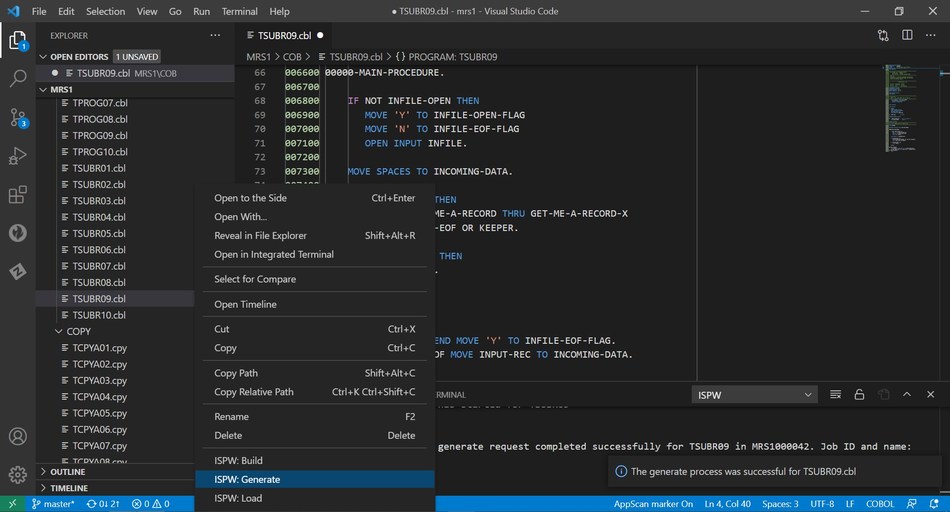
    The BMC Compuware ISPW solution integrates with Visual Studio Code to enable developers to compile changed code on the mainframe with a right-click.

    In addition, the BMC Compuware Topaz platform for applying DevOps practices to the development of mainframe applications has a new command-line interface (CLI) along with support for multiple application programming interfaces.

    A BMC Compuware File-AID 21 tool now makes it possible to reduce the time required to search billions of transactions and log files on a mainframe, while the BMC AMI Security tool has been integrated with the BMC Helix IT service management (ITSM) platform.

    Finally, the BMC AMI Ops Insight tool has been updated to provide diagnostic capabilities to more easily identify the probable cause of an issue, while the BMC AMI SQL Performance for DB2 tool now includes a plug-in for the open source Jenkins continuous integration/continuous delivery (CI/CD) platform.

    McKenny said the goal is to integrate mainframes with any DevOps workflow as part of an effort to either deploy new applications or modernize legacy applications already running on the platform. Modernization of mainframe applications is being driven by the need to add application programming interfaces (APIs) to mainframe applications that need to be integrated with a much broader array of distributed applications, he noted.

    Much of the demand for those APIs is being driven by digital business transformation initiatives that require applications to be able to access backend transaction processing and analytics applications running on mainframes, added McKenny.

    It’s not clear at what rate IT teams that build and deploy applications on mainframes are moving away from waterfall-based processes to embrace best DevOps practices. However, McKenny noted, the rate of changes being made to mainframe applications has accelerated significantly over the last few years.

    While large numbers of applications have been migrated off mainframes over the last decade, the number of enterprise IT organizations that continue to rely on the venerable platform to process transactions remains considerable. Many organizations aren’t convinced that it’s worth rewriting the applications they have relied on for decades when it’s easier to make them more accessible to other applications by adding an API. In effect, McKenny noted, mainframe applications are becoming just another microservice that can be invoked by a developer.

    Regardless of the motivation, it’s clear mainframe applications will continue to run well into the next decade. The challenge IT teams now face is finding a way to make those mainframes just another platform on which to deploy applications at the end of a DevOps toolchain.

  • IBM Deepens DevOps Insights on Mainframes

    IBM Deepens DevOps Insights on Mainframes

    IBM today extended its effort to enable IT organizations that have mainframes to embrace DevOps best practices by updating the analytics tools it provides.

    Tom McPherson, vice president for IBM Z Software, said a version 6.0 update to the suite of IBM application discovery and delivery intelligence (ADDI) for IBM Z tools surfaces more granular insights by leveraging a new version of Wazi Analyze that now analyzes code immediately after a change is made. That capability is critical, because most of the workloads running on a mainframe are highly tuned. Any issue that is likely to occur can usually be traced directly back to the latest software update made to the environment, McPherson said.


    Wazi Analyze also can now be deployed as a set of containers, which McPherson said means IT teams can opt to run the analytics application on a platform other than the mainframe.

    ADDI also has been updated to improve Assembler support by making it easier to analyze multi-level dynamic assembler macro calls. A set of application programming interfaces (APIs) for feeding that data back to a continuous integration/continuous delivery (CI/CD) pipeline has also been added.

    Finally, IBM revealed it signed a licensing agreement with ITP Software Systeme GmbH, Munich (ITP) to enhance application analytics capabilities. That capability will be added to a future release of DevOps for IBM Z Hybrid Cloud, which includes ADDI and IBM Wazi Developer, to enable organizations to determine how best to modernize legacy monolithic applications as they transition to a microservices-based, cloud-native computing environment.

    Naturally, not every monolithic application is going to be converted into a series of microservices. However, McPherson said, it’s clear there is a need for analytics tools that will enable IT teams to more easily determine which elements of an application are better suited to being reconfigured as microservices that could be deployed on, for example, a Red Hat OpenShift cluster.

    For the last several years, IBM has been encouraging IT organizations that have mainframes to embrace DevOps best practices as part of a larger effort to position mainframes as another type of distributed computing platform. The overall goal is to lower the total cost of mainframe ownership by reducing the need to rely on specialists to manage mainframe application environments. Each year, more of those specialists retire. IBM wants to make it more feasible for organizations to replace those specialists with IT generalists, like those that typically manage distributed computing environments. At the same time, management of distributed computing environments is becoming more automated, thanks to the rise of DevOps.

    Of course, mainframe processes have been highly automated for decades. IT teams managing mainframes may still rely primarily on waterfall-based processes to deploy applications, but the underling infrastructure is designed to scale up and down on demand as application workloads require. Convincing IT teams that, for decades, have employed the same processes to manage mainframes often requires a significant amount of cultural change.

    Regardless of motivation, however, the winds of DevOps change are now blowing through mainframe environments just as fiercely as they have through the rest of IT.

  • Join the Open Source Languages for z/OS User Forum

    Join the Open Source Languages for z/OS User Forum

    Why join the Rocket Open Source Languages and Tools for z/OS forum? It’s a place where you can ask questions about our open source languages and tools and get answers from other mainframe professionals like yourself, as well as members of the Rocket team.

    As a Forum member, you can engage with your peers, learn how they’re using Rocket Open Source Languages and share your own experiences. You can crowdsource solutions and get access to exclusive information and experiences, including invitations to work directly with product teams on future releases and enhancements.

    Access general installation and use postings
    Leverage experience of other users
    Post your own questions

    Join the Forum NOW!

  • Download Rocket Open Source Languages for z/OS Today!

    Download Rocket Open Source Languages for z/OS Today!

    Empower your developers to use their preferred open source languages. We offer many open source languages and tools—including Git, R and Python—that allow any developer to harness the power of the mainframe without spending months learning new skills.

    Git
    Git is a version control system (VCS) for tracking changes in computer files and coordinating work on those files among multiple people. It is primarily used for software development, but it can be used to keep track of changes in any files. The z/OS port of git supports automatic tagging and conversion of text files between ISO8859-1 (ASCII) and IBM-1047 (EBCDIC) character encodings.

    Bash
    Bash is an sh-compatible shell that gives users a command-line interpreter through a traditional interface via text window and a script execution capability. It is the default shell on Linux and Mac OS X.

    Bison
    Bison is a programming utility for creating parsers. It’s commonly used in both build automation and build automation generation, and converts annotated context-free grammar into a C, C++ or Java parser. Bison is used by PHP, Bash, Ruby and many other languages and tools.

    bzip2
    bzip2 is a data compressor for single files (it is not a file archiver). It typically compresses files to within 10% to 15% of the best-available techniques of statistical compressors at rates approximately twice as fast at compression and six times faster at decompression. This version of bzip2 was not written to exploit z Systems architecture; Gzip may work best for these needs.

    cURL
    cURL is an open source tool that can transfer data to and from servers using one of the supported protocols (HTTP, HTTPS, FTP, FTPS, TFTP, DICT, TELNET, LDAP or FILE). This tool can work without user interaction. cURL functionality includes proxy support, user authentication, FTP upload, HTTP post, SSL connections, cookies, file transfer, resume and more.

    Diffutils
    Diffutils is a package of several programs intended to find differences between files. The diff command, for example, shows exact line differences between two files.

    Gzip
    Gzip is a popular data compression/decompression program (our ported tools have been compressed using this utility). This version of Gzip has also been modified to exploit z/OS EDC compression hardware, if present on your system.

    libssh2
    libssh2 is a software library that allows developers to use the SSH-2 network protocol in an easy-to-use, self-contained package. This package only contains LIBSSH2 libraries intended for use by other programs or utilities.

    m4
    M4 is a general-purpose macro processor. Most users require M4 simply as a dependency of Autoconf or Bison, although the language is used in other contexts such as text template re-use, text editing and text-processing applications.

    Make
    Make controls the generation of program executables and other non-source files from the program’s source files. Make allows users to build, install and update packages without knowing the process details.

    Mktemp
    The mktemp utility takes a given filename template and overwrites a portion of it to create a unique filename. Mktemp also manages the creation of temporary files and directories that allow the user to avoid cleaning up files that are not needed permanently.

    OpenSSL
    OpenSSL is a software library used in applications that need to secure communications against eavesdropping or need to ascertain the identity of the party at the other end.

    Pkg-Config
    pkg-Config is a programming tool that assists with compiling applications and libraries. It helps you insert the correct compiler options on the command line without the need for hard-coding values on where to find glib (or other libraries).

    Sed
    sed (stream editor) is a utility for parsing and transforming text. It is typically used for extracting part of a file using pattern matching, or substituting multiple occurrences of a string within a file.

    sudo
    sudo is a command-line utility that allows admins to delegate authority, giving certain users the ability to run commands as a super-user or as another user, while providing an audit trail of the commands and their arguments.

    Unzip
    UnZip is an extraction utility for archives compressed in .zip format. Unzip is also compatible with PKZIP and PKUNZIP utilities for MS-DOS as well as Info-ZIP’s and supports bzip2 compression methods, as well.

    Vim
    Vim is a highly configurable text editor built to make creating and changing any kind of text very efficient.

    Zip
    Zip is a compression and file packaging/archive utility. Zip puts one or more compressed files into a single ZIP archive, along with information about the files.

    zlib
    zlib is a general-purpose, lossless data compression library providing in-memory compression and decompression functions, including integrity checks of the uncompressed data.

    Download Now
    Read more about Rocket Support for Open Source Tools
    Join the FREE Rocket Open Source Tools Forum

  • Modernize Without Disruption

    Modernize Without Disruption

    How to modernize without disruption.

    Through recessions, geopolitical shifts, pandemics and threats to global security, IBM® Z® has proven to be the most reliable, high-performing and secure platform in the industry. It’s time to expose the flexibility, agility and efficiency to provide an open and inclusive infrastructure that supports shifting business models and delivers strategic value.

    With Rocket modernization solutions, you can create an innovation layer that securely extends IBM Z capabilities with familiar software that today’s most innovative programmers use to deliver the modern and intuitive experiences customers demand. Get more from your legacy systems so you can create legendary, real-world outcomes for your customers.

    Reinvigorate your traditional infrastructure.

    Enabled with the right tools and technologies, organizations can modernize without disruption. Rocket Software can help you meet changing market demands with software solutions to drive value from your existing investments.

    Expand your talent pool to attract today’s most innovative programmers.

    • Rocket® LegaSuite® and Rocket® API – No-code modernization tools to deliver modern, intuitive user experiences that increase productivity and customer satisfaction.
    • Rocket® Open AppDev for z/OS® – With 1-click porting, give your developers their preferred open software through a system that combines the high security and support IBM Z customers demand with an easy user experience.

    Bring modern DevOps to your traditional systems securely with the familiar tools and intuitive experiences users demand.

    • Rocket® Aldon® – IBM® i ALM and DevOps platform allows your developers to work with the tools and environments they expect to develop innovative applications, while providing the process management and compliance reporting needed for today’s businesses.

    Support remote working by quickly and seamlessly adapting call center and service operations.

    • Rocket® Terminal Emulator® – Anytime, anywhere remote terminal emulation for your critical applications that delivers a lower total cost of ownership while improving the user experience.

    To read more, please visit: Modernize Without Disruption

  • Using IBM ADDI and VTP to Enhance Observability in Mainframe Development

    Using IBM ADDI and VTP to Enhance Observability in Mainframe Development

    Observability has always been a key factor in software development – not so much on the mainframe. However, the rise of the internet as the go-to platform for modern commerce has caused an explosion of transactional activities. There’s much more complexity behind the scenes than the request/response activity that used to be the usual interaction between a client and a single server. That necessitates ubiquitous observability as a mission-critical necessity for any modern application. As computational activities increase, so, too, does the risk of failure. One way to avoid disaster is to rely upon observation technologies that monitor not only runtime behavior, but design-time behavior, as well.

    Analytical Insights are Key to Application Modernization
    IBM observabilityModern computing activity goes well beyond simple request/response interactions. Today, one request can traverse any number of computing resources before resolving to a completed response. These resources range from application logic that’s encapsulated and then exposed to the network at a number of endpoints, to a diverse mixture of data storage mechanisms. And, if the application is part of an event-driven architecture in which messages are passed around to a large number of recipients, ancillary logic can be executed in ways that are unknown to the originating request. This can cause significant side-effects, nonetheless.

    Given the complexities inherent in modern applications running at web-scale, without ubiquitous observability, developers are flying blind. This is true not only for what we have come to know as commodity computing, in which applications are hosted on racks of X86 servers housed in private and public data centers but also for mainframe computing.

    The Emergence of Observation Technologies

    Over the last decade, a growing number of observation and monitoring technologies have emerged for network applications and database environments. Open source projects such as OpenTracing, OpenTelemetry, and Prometheus give developers insights into the runtime behavior of applications. Also, there are a plethora of commercial observability products that companies can buy to meet their specific monitoring and observability needs.

    At the development level, there are open source tools such as JSHint for JavaScript developers, PyLint for Python developers and FindBugs for Java developers, just to name a few. These tools can inspect static code and point out shortcomings. Some tools, such as .NET analyzers, will go as far as to correct code as the developer is writing it. The easiest bugs to fix are those that are never created. Correcting code as it’s being written brings a whole new dimension to design-time observability.

    However, while the X86 development community has benefited from observability tools for a while, their mainframe counterparts haven’t had it so easy. Commodity developers require nothing more than a click on a web page link to access any number of powerful observability tools, but mainframe developers have been starved for these types of tools.

    Until now.

    Applying the Principles of Observability to Modern Mainframe Development

    One of the big challenges of mainframe programming is getting a clear picture of application dependencies. Unlike programming under Java, C# or Node.JS, where external dependencies are defined in a central configuration file, or internal dependencies can be discovered with a code analyst tool, mainframe programming makes knowledge of dependencies a difficult undertaking. This type of design-time observation hadn’t really existed until technologies like IBM’s Application Delivery and Discovery Intelligence (ADDI) came along.

    An important thing to understand about dependencies in most mainframe computing is that they exist at both the function and executable levels. A developer can create a function, which, in mainframe parlance, is called a routine. That one routine might be used by dozens, if not hundreds, of other routines. Sharing code from a common resource is not unusual in X86 development, where binary libraries get shared all the time. However, in mainframe computing, these shared routines, along with file layouts and resource definitions, are physically copied in with the developer’s code using a technology called a copybook. Then, the code is compiled and linked to create an executable file. Once turned into an executable, the code becomes opaque. As a result, observing what’s going at runtime and design-time within the executable can be a herculean task. For many years, it was.

    Fortunately, you can use a tool like ADDI to overcome this obstacle. IBM’s ADDI provides important insights and analysis into the code that makes up a mainframe application. Both developers and system analysts can use ADDI to determine not only application dependencies but also to gather information about the execution environment; for example, scheduler settings and database configuration.

    As with X86 development where ancillary application intelligence, well beyond information about the source code, can be displayed in the developer’s integrated development environment, ADDI also makes it possible to report information in the developer’s IDE. Also, systems analysts can use the additional information provided by ADDI, such as the structure and segmentation of an application, to make decisions about how to refactor code when it comes time to make improvements.
    Providing a broader scope of observability into design-time activity is but one aspect of enhanced observability in the modern mainframe environment. ADDI also reports test coverage metrics. Knowing what and how much code has been tested is an important part of observability, even more so when used with tools that are focused on mainframe testing. One such tool is Virtual Test Platform (VTP).

    Leveraging Observability in the Mainframe Testing Process

    Until VTP came along, mainframe developers were flying blind – they had limited visibility into the transactions that their code used and the dependencies that their code relied upon. They had an enormous amount of work to do to figure out transactional behavior throughout the application. They spent a lot of time doing archeological digging in legacy codebases to get a clear idea of what was happening. And, it didn’t get any easier as testing demands on all types of applications, both X86 and mainframe, increased due to the rise in commercial activities on the internet at a global scale.

    According to Chris Trobridge, senior offering manager at IBM, “The testing load for developers has been increasing tremendously, and with the introduction of agile development processes, developers just can’t keep up with the testing load that they have.”

    VTP addresses many of these testing issues, both in terms of observability and quality assurance. “VTP really is observing what goes on at runtime, but without knowing anything about the application,” Trobridge said.

    VTP can monitor an application and capture and record all its interactions. This type of observability enables developers to make modifications and then run those changes against observed behavior. It’s a novel approach to mainframe development in which the benefits of both design-time and runtime observability are leveraged in a synergistic manner. In order to understand how groundbreaking this capability is, you need to remember that only five years ago, while X86 developers were enjoying a maturing set of monitoring and tracing tools; for mainframe developers, this type of observability wasn’t possible. Now it is. It’s a dramatic step forward.

    “VTP is a tool that enables developers to automate a lot of the testing, and, in turn, enables the recording of a transaction environment without having to know a lot about the environment,” Trobridge explained. “The recordings themselves can be played back rapidly without compromising security. This is an important aspect of VTP. This level of observability and interactivity really is something that mainframe developers have not had access to before. It’s a transformational technology in the mainframe world.”

    Technologies such as ADDI and VTP are a transformational approach to enhancing observability in mainframe environments. In many ways, the focus on exposing the granularity of computing at the routine level is a harbinger of things to come for all developers, in both the X86 and mainframe worlds.

    Taking a Function-Centric Approach to Observability

    Historically, for commodity developers, observing request/response behavior between services at runtime, along with identifying code quality and complexity issues at design time, allows for identification and remediation of most issues in software development.

    For the mainframe developer, request and response behavior is only the tip of the iceberg when analyzing application behavior. In a mainframe environment, one sub-routine might be used by thousands of other functions and subroutines at any given time. Commodity developers have been spared the burden of accommodating the function as the fundamental deployment unit because, until recently, functions were grouped into well-encapsulated deployment units, such as Java’s .jar file, .NET DLLs or, more recently, containers. If something went wrong, the error would generally appear in one of the deployment units.

    However, with the current rise of serverless computing, where the function becomes the primary deployment unit, X86 developers are in the same boat as their mainframe counterparts. In the past, for the X86 developer, one application might use a limited number of components that could have dozens, maybe hundreds of functions. Now in the serverless world, all these functions are exposed as standalone units, in which each function is the responsibility of a distinct team. We’ve gone from an ecosystem that has a limited number of deployment units to an ecosystem that can contain thousands. Fixing bugs can require hours of poring over logs and examining minute details just to determine the root cause of an issue.

    As mentioned above, this depth of dependency at the function level is something that mainframe developers have been dealing with for years. Fortunately, tools such as ADDI and VTP provide a high degree of observability for very complex mainframe applications at both runtime and design-time.

    It’s strange to say, but the large, function-based ecosystem issues that mainframe developers are solving today will become a growing concern for X86 developers in the very near future. In many ways, tools such as ADDI and VTP are setting an example for X86 tool development moving forward. The mantra, “You can’t fix what you can’t see” is as true today as it has ever been. That the mainframe community is at the vanguard of creating new ways to work in massive computing environments is a testament to the power of rejuvenation in the most unexpected ways.