Tag: machine learning

  • 4 Challenges OEMs Face When Implementing New Technology

    4 Challenges OEMs Face When Implementing New Technology

    Like many others, the manufacturing industry is moving to a subscription-based business model. This new way of doing business is being referred to as servitization and it is forcing manufacturers to no longer strictly sell new products, but instead sell access to and the outcome those products deliver. This is fundamentally changing the way manufacturers have traditionally done business and is not only encouraging a shift to subscription-based pricing models, but also Products-as-a-Service.

    As manufacturers implement the processes and resources necessary to make servitization a reality, implementing new technology will be key to success–laying the foundation for success today and in the future. More specifically, machine learning and predictive analytics will become especially important for predictive maintenance, process optimization and supply chain management. While there are opportunities to capture a significant competitive edge using these technologies, there are also significant challenges specific to the manufacturing industry. Some of these noteworthy challenges include:

    Efficient and Secure Data Connectivity

    Complex, capital equipment (think construction equipment, agricultural equipment or industrial machinery) is built and designed to last, on average, 30 to 40 years. As a result, these machines must be very reliable. Today, however, the majority of equipment in service has upwards of 20 to 30 years remaining in its lifespan. However, almost none of these products were built or designed for IoT connectivity–creating the challenge of retroactively fitting existing equipment with IoT-enabled parts.

    In addition, a majority of this equipment operates in some of the harshest and most rugged environments in the world. Whether it’s an electro-submersible pump 3,000 feet below the surface of the ocean or a mining truck in a remote mine with little to no cellular connectivity, efficiently connecting this type of equipment to collect relevant data is a difficult challenge and oftentimes cost prohibitive.

    Even if manufacturers manage to connect this equipment, there is an added challenge of doing it in a way that ensures cybersecurity. Rogue elements that could gain malicious access to this equipment could have serious safety and economic consequences–and could even implicate national security in some instances.

    Sparse Data

    Newer machine learning algorithms, such as Deep Learning and Recurrent Neural Nets, have been groundbreaking for capabilities like image and voice recognition. However, these algorithms are also very data hungry, requiring millions–if not billions–of similar data points from millions of users.

    Because complex industrial equipment is intended to last for decades, failures are generally rare. Think about it: There have been just a handful of actual engine failures during flights for the entire global commercial fleet, which amounts to nearly 30,000 aircraft. Assuming an average of 2.5 engines per plane, the global commercial aircraft engine fleet is less than 100,000. While certainly a large number by itself, it is relatively small when considering these engines vary greatly in design and thus any single engine type that could be modeled together would be even smaller.

    Manufacturers of industrial equipment or durable goods also tend to be reluctant to share data, especially if their competition could potentially benefit from it. The challenges of efficient connectivity, rare failures and relatively small numbers of similar equipment in a fleet leads to the sparse data problems in the Industrial IoT (IIoT) realm.

    Domain Expertise

    While domain expertise to successfully apply machine learning and predictive analytics is required in the consumer world, in the manufacturing space, it is much more critical. Machines and processes are designed using physics and engineering principles. And, the context in which machines operate and behave is very important for accurate training models and analyzing results. Without appropriate context, there becomes a “garbage in, garbage out” problem as sensor data and machines alone do not capture or provide any context. This is where domain experts who can make sense of historical data for accurate model training as well as interpreting results are critical.

    The impact of making an incorrect decision can have expensive–and sometimes catastrophic–results that aren’t seen in the consumer-facing domain. For example, re-routing an aircraft mid-flight could cost millions of dollars for an airline. If that decision is made because of bad data and an incorrect prediction, it would be a very costly mistake. For us as consumers, we have some aspect of domain expertise for problems in the consumer world, whereas a trained pool of engineers with the relevant design, operational and maintenance expertise is a very small pool. And this, combined with the problem of baby-boomer retirement where expertise is lost at a significant rate, there is a real challenge to capture the knowledge and best practices required to deliver value.

    Data Ownership

    Currently in the manufacturing sector, there aren’t industry standards for data security, ownership or accessibility. Currently, many manufacturers are wrestling with who owns and has access to the data. Is it the manufacturer who designs and builds the equipment? Or, is it the third-party entity that rents and operates it? Or, is it the financial entity that may be the legal owner? What about the supplier that provides a component that is part of a larger piece of equipment (e.g. an aircraft engine that works in conjunction with the aircraft, with each component manufactured by a different entity)?

    Manufacturers being risk-averse in nature, are being very conservative in interpreting and applying the myriad patchwork of regulations being brought in other industries, including data security standards. This is limiting them in adopting more connected processes and strategies. The industry must accelerate efforts to establish industry-wide standards as well as regulatory frameworks for data ownership, data-sharing, interoperability and testing of systems and end-to-end security to overcome the roadblocks for faster adoption of these technologies and realize the promised benefits.

    The shift to servitization will require manufacturers to completely re-think how they operate–new organization structures and skilled resources, new incentive models, new KPIs to measure success and new processes. They will have to become data-driven organizations investing in technologies to connect and track products, collect data and efficiently analyze massive amounts of operational and service data, using technologies like IoT, machine learning and predictive analytics. This will strain manufacturers’ existing organizations and IT infrastructures, necessitating investment in highly scalable, cloud-based solutions to lay the foundation for a successful future. Manufacturers that embrace these changes will be the winners, while others will struggle to stay relevant. In fact, the ones that can successfully adapt to these paradigm shifts will be able to gain significant competitive advantage and market share.

    — Vivek Shah

  • OverOps Integrates AI Code Analyzer With CI/CD Platforms

    OverOps Integrates AI Code Analyzer With CI/CD Platforms

    At the DevOps World | Jenkins World 2019 conference, OverOps announced it has integrated its namesake tools for analyzing Java and Microsoft .NET code at runtime with a variety of continuous integration/continuous deployment (CI/CD) platforms, including Jenkins, JetBrains TeamCity, Atlassian Bamboo and Pivotal Concourse.

    Eric Mizell, vice president of solution engineering for OverOps, noted that the more errors that are discovered by DevOps teams early in the development cycle, the less technical debt organizations must address after an application is deployed in a production environment. By pushing testing to further to the left of the application development process, the less troubleshooting will be required later on, he said.

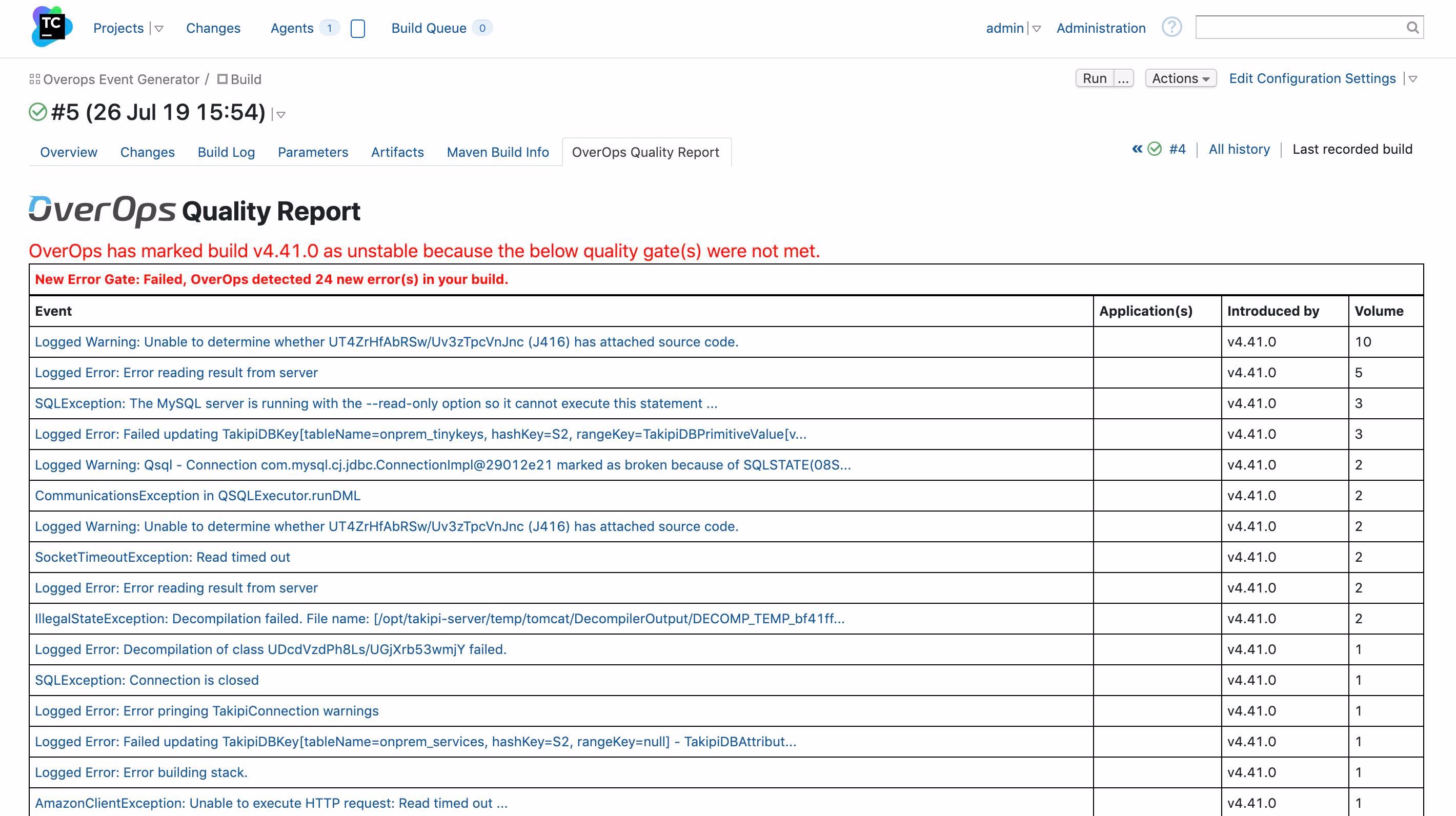
    OverOps employs predictive analytics and machine learning algorithms to identify new, increasing, resurfaced and critical errors in a release. It then generates a code quality report that ranks all severe issues likely to impact end users and application functions. By integrating OverOps within the CI/CD pipeline, DevOps teams can use those reports to determine whether code is safe to promote or automatically block unstable releases from moving forward.

    In addition, because the machine learning algorithms surface the true root cause of an issue, DevOps teams can more efficiently remediate issues by routing code back to the development team responsible for all the issues that are being created downstream.

    Making testing an integral part of the CI/CD process not only tightens the relationship between developers and testers, but also in many cases enables developers to test their own code before submitting it for review.

    Mizell said the need to shift testing to the left has become more critical as customer tolerance for application errors is low, especially in use cases involving mobile applications—consumers are especially unlikely to give a mobile application a second chance after they’ve encountered an issue.

    In an ideal world, of course, testing tools that make use of machine learning algorithms would be employed to coach developers in a way that enables them to develop reliable code more consistently and faster. However, some organizations will use tools that leverage machine learning algorithms to identify developers who are not meeting expectations. That weeding out process is likely to begin much earlier in the application development life cycle as more advanced testing tools are embedded within CI/CD environments. Those tools won’t eliminate the need for developers and testers, but they do promise to increase dramatically the rate at which quality applications can be built and deployed at an industrial scale. Technical debt may never be completely eliminated, but at the very least the rate at which that technical debt is being accumulated should substantially decline.

    It may be a while longer before machine learning algorithms and other forms of artificial intelligence (AI) are employed pervasively across DevOps processes. In most cases, those algorithms will help developers write better code faster. However, it’s also apparent there will be other algorithms at work that one way or another ensure developers will have fewer opportunities to make mistakes in the first place.

    — Mike Vizard

  • Low-Code Providers Continue Enhancing Their Development Platforms

    Low-Code Providers Continue Enhancing Their Development Platforms

    Enterprise low-code development continues to grow in popularity as software vendors continue to unveil tool enhancements designed to help business users and non-developers build functional applications and business processes.

    The help from low-code platforms (and other platforms that are integrating low-code capabilities) couldn’t come at a better time, as enterprises continue to struggle to digitize operations and dig through their application backlogs.

    Consider open source digital process automation platform Bonitasoft and its recent increased support for low-code development and what the company promises to be accelerated user interface development for more customized user experiences. The platform (including a new Bonita Cloud edition) helps to enhance collaboration between professional developers and so-called citizen developers, according to the company.

    Recently, low-code development platform provider OutSystems announced it is adding new artificial intelligence (AI) and machine learning capabilities into its platform. The company said the enhancements provide customers the ability to help automate the creation of self-service portals, respond to text and voice queries and improve customer service.

    OutSystems said citizen developers now can more easily build communication channels into their apps and better utilize virtual assistants such as Alexa, Google and Siri, as well as common chatbot platforms. The company claimed developers don’t need any specialized development skills or knowledge in data science to use these features. “These new, high-level components package everything organizations need to implement rich use cases from end to end. As a result, many more companies can easily adopt AI and machine learning to positively impact their business,” said António Alegria, OutSystems’ head of artificial intelligence.

    According to the research firm Gartner, by next year, consumers will manage 85% of their relationship with enterprises without having to interact with a human. However, despite the use of AI having tripled over the past four years, two-thirds of organizations have yet to deploy AI in some form, it noted.

    According to Research and Markets, the global low-code development platform market size will reach just over $27 billion by 2022, up from $4 billion in 2017 and a 44% annual growth rate.

    According to the research firm, it is the increased demand in software automation and innovative applications and the ease of development of web and mobile apps that are driving enterprise demand for low-code development. “Moreover, the cloud-based deployment mode is gaining high traction in the market, as it requires less capital investment, helps decrease the operational and maintenance costs, and reduces the management’s efforts,” the research firm said.

    While many analyst market predictions do fall short, as long as low-code platforms reduce costs and help organizations move forward rapidly with their digitization efforts, low-code development is here to stay and will continue to grow.

    — George V. Hulme

  • Getting the Enterprise Digital Core in Shape

    Getting the Enterprise Digital Core in Shape

    While enterprises rush to transform their business digitally, most are taking tactical steps rather than building a comprehensive digital core that can be improved over time. Very few are taking a thorough view of their entire technology portfolio and looking for ways to create a cohesive core—their digital core—to provide them the strength and stability to move forward swiftly in their digitization efforts. The enterprise digital core essentially is the vital set of technologies and employee skill sets that enable the organization to deliver its digital services. These services are both consumed by customers and internally by staff and others.

    How do enterprises get their digital core into shape?

    Emphasize Talent Over Technology

    While a strong digital core includes the technological platform, it is also a people-platform. “The heart of digital transformation isn’t technology but the mindset and skill sets of your staff,” said Andy Lin, senior vice-president of strategy and consulting at Nexient. Digitization, he said, means enabling customers to transact and interact with you anytime they want, from anywhere, using any device. The only way to get there is if leadership makes it clear to staff why digitization is crucial; otherwise, they will struggle to adapt, he said.

    If the staff does understand the reasons behind the transformation, they will—instead of just following rules for the sake of rule-following—be much more likely to adopt a digital mindset. They’ll also be more likely to embrace the training and skill set development they’ll need to make the transformation a success, Lin added.

    Scrum.org CEO and product owner Dave West agreed that the digital core starts with the customer. “There needs to be a clear line from the mission and strategy of the business with the outcomes the customer wants,” he said. Teams need to understand clearly how their work helps deliver the organizational mission digitally to the customer, no matter what that mission may be. That means everyone needs to be clear on the nature of the business, or organizational business, as well as what success looks like

    West also advised organizations that seek to improve their digital core to look both inward and outward for support. From within the organization, of course, support should come from leadership, who must set the course and ensure efforts are going in the right direction. “Externally you need to build a network of support from people and organizations that have done it before,” he said.

    Put Cloud at the Core

    Of course, a strong digital core must have a strong technological foundation. In today’s typical enterprise, that may very likely mean more about subtraction than addition. While emerging technologies, such as internet of things (IoT), artificial intelligence (AI)/machine learning (ML) and others are recommended to be integrated within enterprise software, “Many of them are not generally suited to run on legacy IT infrastructure,” said Maxim Ivanov, CEO at enterprise software development firm Aimprosoft. “The digital core relies on intelligent automation scalable platforms that are integrated in the cloud and prepares data for next-generation technologies.”

    Gabriel Salazar, digital solutions manager at systems integrator Enstoa, agreed that building a cloud-based infrastructure goes a long way to improving the digital core. “It’s important, however, not to simply carbon-copy the business processes used prior,” said Salazar. “Look to take advantage of all automation, machine learning and analytics offered by converting and folding them into your updated business process.”

    Finally, if organizations want to have a strong digital core, they are going to have to work to maintain it. “Due to the speed of technology change, getting your digital core in shape is a continuous process. Start by understanding what is preventing you from supporting business goals, what is causing ongoing stability or performance issues and what reduces your time to market,” said Nick Polachek, senior principal of strategy and transformation at Maven Wave Partners.

    To do so, Polanchek recommended building the digital core iteratively while maintaining the focus on delivering business value or resolving current issues. It’s also important, he said, to have a thoughtful future vision for your digital core and ensure that each delivery is at least aligned, if not an improvement, over core technology already in place.

    After all, keeping that digital core in shape is an ongoing process that will require ongoing work and practice.

    — George V. Hulme

  • Are Self-Service Machine Learning Models the Future of AI Integration?

    Are Self-Service Machine Learning Models the Future of AI Integration?

    DevOps teams seeking to step up their mojo in developing cutting-edge artificial intelligence (AI) features are facing a big skills bottleneck when it comes to data analytics and machine learning modeling. As a result, the market is seeing an influx of self-service machine learning models and machine learning-as-a-service offerings designed to help development teams more easily integrate AI capabilities into their software.

    This is coming in direct response to an explosion in demand for AI capabilities in the enterprise. According to Gartner analysts, AI adoption in the enterprise tripled in the past year. A report last fall from MIT Sloan Management Review and Boston Consulting Group found that 91% of enterprises believe that AI will deliver new business growth to them by 2023.

    The trouble is that folding AI functions and predictive analytics into software requires a whole new level of expertise in data science and machine learning from cross-functional DevOps teams. They need added skills to choose the right algorithmic approaches, acquire and manage data, train the models and integrate them into the code base and underlying infrastructure so that everything works properly under the hood.

    “We have heard from customers everywhere that they want to adopt machine learning but struggle to actually get models into production,” said Eric Boyd, vice president of cognitive and AI for Microsoft.

    Ali Farhadi Xnor
    Ali Farhadi, Xnor.ai CEO

    DevOps leaders today already face an uphill battle to keep their developer ranks staffed with well-trained software engineers. Piling on additional requirements for very specialized machine learning and data science expertise further strains those recruitment efforts. According to the most recent Harvey Nash/KPMG CIO Survey, the top one and two technical realms that suffer the biggest skills shortages today are in data science and AI, with 46% and 38% of CIOs respectively reporting recruiting pain in those areas.

    “There’s a huge imbalance between the demand in the market and the supply of the very best AI experience to actually train these models,” said Ali Farhadi, CEO of Xnor.ai, a Seattle firm that just last week released a self-service platform for developers. Called AI2Go, the platform provides pre-trained deep learning models to quickly integrate AI features such as facial recognition and object classification directly into their software.

    “We want to enable anyone who can code to benefit from AI,” Farhadi said.

    The Xnor release comes just a few weeks on the heels of a big launch from Microsoft of several self-service machine learning model tools aimed firmly at MLOps teams—those DevOps teams implementing machine learning capabilities. The new services from Microsoft roll out capabilities to manage the code, data and environments used by MLOps teams throughout the machine learning deployment life cycle.

    “Azure Machine Learning service’s MLOps capabilities provide customers with asset management and orchestration services, enabling effective ML lifecycle management,” explained Jordan Edwards, senior program manager for Azure MLOps, in a blog post on the topic. “With this announcement, Azure is reaffirming its commitment to help customers safely bring their machine learning models to production and solve their business’s key problems faster and more accurately than ever before.”

    Tools such as these are not always going to obviate the need for data scientists and machine learning/AI specialists on DevOps teams. As Farhadi noted, even a simple service like AI2Go requires development teams to choose the right models for the right situations. Nevertheless, this burgeoning market could take the pressure off teams by minimizing the scale of specialized recruiting, while reducing bottlenecks and dreaded re-work.

    “Machine learning projects usually involve several people—data engineers, data scientists, DevOps and others. Conventionally, at each stage of the machine learning life cycle, most, if not all, of these people end up doing an excess of custom coding, redundant work and manual trial and error,” said Craig Stewart, senior vice president of product management and product marketing for SnapLogic, which last fall introduced a self-service machine learning add-on for its integration platform. He noted that one of the primary goals is speed, to help cross-functional teams “build, train, validate and deploy high-performing models faster.”

    — Ericka Chickowski

  • DevOps Chat: We Are Devo, With Walter Scott

    DevOps Chat: We Are Devo, With Walter Scott

    If you have massive amounts of data, Devo wants to help. The Madrid-based company specializes in the handling and processing of massive amounts of data.

    In this DevOps Chat we spoke with Devo CEO Walter Scott about the use cases for Devo in a data-crazy world. Walter is a seasoned CEO in the tech sector. He knows a problem when he sees it and he thinks Devo is the answer. Have a listen to why and check out Devo at devo.com.

    As usual, the streaming audio is immediately below, followed by the transcript of our conversation. Enjoy!

    Transcript

    Alan Shimel: Hey everyone, this is Alan Shimel, devopsy.kinsta.cloud. You’re listening to another DevOps Chat. Really happy to have a new company, a new friend, joining us on DevOps Chat today. I have Walter Scott, CEO of Devo. Walter, welcome to DevOps Chat.

    Walter Scott: Thanks, Alan.

    Shimel: So, Walter, you and I met recently in Iceland, of all places, at a Insight IGNITE event that really kinda focused on DevOps, cloud, cybersecurity, if you will, the topics, but it was my first exposure to Devo. I don’t know if our audience is familiar with Devo. Why don’t you–give us the foundation, man. “We are Devo.” What are you guys? What do you do?

    Scott: Well, Devo is a data analytics platform that’s the next gen of technology, that provides a data fabric to allow our customers to take all of the noise that exists in the machines and petabytes, and petabytes of data coming in, for them to really start getting signals so that they can start their automation or their AI or their machine learning process, to make their companies more efficient; to be able to have them act more quickly; as well as to be able to get the people who use our platform, to get them the time back that they spend in managing the underlying data platform and allowing them to add the value to drive IT, to drive that value back to the business.

    Shimel: Excellent. And, you know, Walter, one of the things that impressed me with Devo was this wasn’t your sorta typical Silicon Valley story—a couple of wiz kids come up with a PowerPoint business plan and get funded via VCs, pre-revenue, pre-product even. Devo—the underlying technology here, the company’s been around a while and it’s not a Silicon Valley company, right?

    Scott: That is correct.

    Shimel: Give us a little background on that.

    Scott: Well, you know, over my six stints of being a CEO, I’ve never really run an American-based company. There’s great IT being built all over the world. I’ve done them from Malta to Scotland, Germany to Armenia to now with us here in Madrid, is where the company started. And we had a not Silicon Valley startup, but it was five guys—or four guys and a girl or woman—and started off the product in a research key, to really build something special and change the market because the bank that they worked for had to completely change the way they do business.

    And over the course of three years in research and we finally launched a product in 2014 and have been three-figure type growth every single year, since the date of the company being founded, ’cause it’s such a large market. And it’s really accelerating because of what we’re seeing happening with businesses and trying to get ahead of everything from getting arbitrage out of supply chain to solving their security problems, just to start with basic log management and monitoring to consolidate tools and increase agility.

    Shimel: Sure. So, Walter, you were—as you alluded to, this is your sixth or seventh startup where you’ve come in as CEO and had some tremendous success. And, look, not everyone is a success, right? That’s the mantra in business, but you keep plugging. When we look at Devo—and you and I spoke a little bit about this in Iceland, but so much of what we see as, quote unquote, “AI” today is really machine learning. And so much of machine learning is based, really, on data, right? You’re only as good as your data. In order to find patterns, you have to have enough data to analyze it and make actionable kinda calls out of it.

    But this is not a new problem and there’ve been other solutions. What makes Devo’s solution—I don’t know if you use the term “next-gen” or “new-gen” or something like that, but what makes Devo’s solution different?

    Scott: Well, you know, this has been going around a long, long time and you’ve heard me say, in the absence of data, the machine can’t learn. And I go back, all the way back, to the Walmart days in the ’80s, when they built—I would argue … them as the first person to really take the competitive advantage, coming from their data warehouse, right? And —

    Shimel: I agree.

    Scott: —They actually had the line, they could tell your daughter’s pregnant before you could by looking at the data. Well, today, that’s become necessary, but, over the last 10 years, it’s really—what’s happened with the cloud is being able to get that data manageable. I don’t like the term “AI.” I like more “augmented intelligence” because we’re not at the place—or even narrow AI ’cause I think it can solve very specific business problems that people might have. We have one customer that needed to actually build some ML and machine learning to detect what a bot was, were hitting their site, because, when they launched a new product, the bots would come in and sell it all in the secondary market. They wanted that brand loyalty to go to the end users.

    Or we have another customer that has a bunch of IoT devices integrated into their sporting equipment, where they’re trying to figure out if somebody’s gonna get hurt and using machine learning to be able to define what is that case, in terms of repetitive hits, but they need that data over long scales. And just the data science is actually making that possible. It could be done in the past; the problem was it just wasn’t cost-efficient enough to do it.

    We have customers that are taking literally over a trillion events a day to try to—and building machine learning models to understand which customers may leave their environment, based upon dropped calls or poor support integration. And it’s not just having that one set of data; it’s about having hundreds of different sets of data to help prove those hypotheses, to get those more and more efficient. And the data scientists are spending 70% to 80% of their time getting their arms around the data. We take that problem away from them and allow them to have—to solve that other 80% now, they can put in training their models and getting data to make them more and more efficient.

    Shimel: Excellent. Great answer. Hey, you know, Walter, you and I, this is neither one of our first rodeos. And, when I look at your job, your mission over there, at Devo, one of the things that I guess it’s a double-edged sword ’cause it presents so many opportunities, but, at the same time, there’s an axiom in business—“Put all your wood behind one arrow,” right? There are so many use cases for what you can do here, right? There’s the cybersecurity case, right? Where, “Look, man, we need this data. We need to be logging everything. We need to find if we’re under attack, where the attack’s coming from, what’s happening?,” right? So there’s that. And one can spin up an entire company around just using this kind of technology in cyber.

    You alluded to a few other use cases, right? That had nothing to do with cybersecurity. Better business intelligence. Understanding your customers better. Understanding your product better. There’s only so many targets, though, that you can go after, right? Without a tremendous—you know, you wanna build an IBM kind of force or something or a Dell force, that’s a whole different story. So how do you—Walter, as the CEO, how do you prioritize? What are the best use cases for this technology? What are the right markets for us to pursue?

    Scott: Well, what you say no to is just as important as what you say yes to, in a business.

    Shimel: Yep.

    Scott: And, right now, we are very, very focused in the Americas, as well as in western Europe, right? So we’ve been able to say no to Asia for another year or two. Our value proposition is really about the biggest of the big—the telcos, the banks, the large retailers, people who’re looking at real scale that they’re trying to solve problems with. But the fact is, is where I see the market going over the next three years is more about consolidating the DevOps, the ITOps, the Network Ops, the SecOps. All of those are coming into one. And I’ve heard a couple of people start using the term “fusion center,” which is really helping them drive the business and stop pointing fingers and reducing that mean time to response.

    Well, every security product starts with the logs, right? And every IT monitoring product starts with the logs and the data. And the advantage of us being able to load in all of that relational data, which is about 20% of our data that’s in our systems, across our customer base, is things that is coming out of Xdata or data warehouses or relational or customer application type or weather data or threat hunting data that comes in, and being able to combine all of that. So, for us, it’s the larger customers or companies that have data at scales that we’d see in the global 1,000 and really looking at the people who understand that what Google, and Apple, and Facebook, and Netflix have done is taken a data-first approach to their business.

    And, when we look at customers that are forward seeing—that see forward into the market, they realize there are a whole new set of competitors and being able to ask what their real competitive advantage is in their business and the data that it takes for them to be able to do that, whether that’s a telco to figure out how to launch a 5G network because they have all the 4G, 3G and 2G data, whether it’s in their customer retention rates or net retention of “Can they get more dollars out of their customers each year?” to whether it be their manufacturing process and figuring out that arbitrage in the supply chain.

    So I think we are—because of the ease of use of our product, because it’s so easy to get data in, because we keep data in raw format. So you can have one set of data that’s very easy to get in and use it 100 times, not having to index it or reduce that data because it just makes it more efficient.

    But I see us, in the next couple of years, really focused on the security side of the equation. Looking at people who’re doing the transformation and the weight that it’s gonna take on their DevOps and CloudOps teams and being able to work closely with the network and the DevOps teams to be able to grow their business because the cost of becoming so great on having so many different tools, at different layers of your network, I say that the best and the brightest companies will take control of their own data, consolidate those tools so they have a better competitive advantage.

    Shimel: Good. Good. Good. Walter, I’m gonna throw a term at you and I want your opinion on it, “AIOps.” What do you—this is a term that we, here at devopsy.kinsta.cloud anyway, we see it rising with a bullet. And, like you—to me, there’s AIOps with a capital “A” and a capital “I” and it’s like Robby the Robot stuff that’s gonna make us live like The Jetsons, finally. And then there’s AI with a small “a” and a small “i,” like the real, functional, kinda down in the dirt–maybe it’s not as sexy, but it provides real change for us. AIOps is—man, everyone—what’s your story on AIOps? It reminds me of when cloud came out in 2005. What do you think?

    Scott: So let’s be very clear. AIOps is a term that’s been coined by Gartner. Out of the last 100 conversations I’ve had with CIOs, I’ve only heard it referenced once or twice. I think it’s more the vendors that are getting on it. And, when you look at it, log management is a big part of AIOps. You know, user behavior analytics is part of AIOps. The anomaly detection is part of AIOps, right? There’s seven or eight different components to that. I don’t think any vendor right now, in the world, really has defined themselves as an AIOps vendor. I think we’ve probably got three years, through help of M&A and deciding what that is, ’cause incident response or the service management is also there, so I think it’s gotta evolve.

    But, of the seven or eight different components, the monitoring, the dealing with events, the user behavior, the anomaly detection and the log management is there, which is where we focus. And I think the enterprise log management, I thought, five, six years ago, was solved, when we solved who all those vendors are, but now, with the complexity of the cloud, it isn’t solved at the scale customers need to do with it. We had solved router management; now, with SD-WAN, it’s a whole new market.

    Shimel: Yeah. You’re right. I mean, and it’s funny that things that–it’s kinda like the measles, right? We thought we cured measles and here we are back with measles. Walter, we’re both CEOs of companies and I don’t know how many people listening out there are CEOs—many of our listeners are kinda getting their fingernails dirty, practitioners as well as managers at large enterprise—what keeps you up at night about Devo? What do you worry most about, Walter?

    Scott: Well, I think part is we have to manage tens or hundreds of petabytes of data for our customers, right? And I think we have a very large team internally for security, to make sure that the data that we have is protected and we work very closely with Amazon and Google and Azure to make sure that we address that. And that’s something that you’re never gonna sleep well ’cause you have to be passionate about making sure that you protect your customers.

    We were on the phone literally an hour ago with a manufacturer that makes toys for children, and that was the question that’s keeping him up–he says, “I have 10-year-old boys and girls logging into my website. I have to protect that data, making sure in the things that we do with being able to obfuscate data at the row, in the column level, without having to duplicate it and our algorithms that are in there.”

    But my job, as a CEO, is to help people build careers. I’ve been very fortunate in my career and have had some very large exits in part of the business, but it’s making sure that the team around us continues to make sure that we handle all of the things, in dealing with our business and our main offices in Madrid. We also have a big office in Cambridge, Massachusetts, because I love the guys and women coming out of MIT, where we do a lot of hiring. But it’s mostly about the team and then making sure that we continue to have what I call a industry-abnormal or an anomaly in terms of net retention. And our goal is to help our customers continue to grow because it benefits us and wanting to make sure that we make it easier for them to be able to get more value because our mission is about making IT so that they can provide data to the business that is actionable.

    And my belief is is the CISO or the CIO that has control of that data, if they push it out to the business and say, “Hey, did you know that, on this particular case or when this happens, we’re losing customers or we’re gaining customers?” That data is 80% more likely to be leveraged than it is if the customer asks the business. So—

    Shimel: Nice.

    Scott:–I think it’s empowering the IT to accelerate value to the business and most of my nights are, well, we see this new customer is bringing in this type of a data, bringing in our data science teams to help think about use cases that we can drive more value from.

    Shimel: Excellent. So, Walter, as I mentioned to you before we started recording today, the good news and bad news about this audio format is it goes so darn quickly. And we blew past our time. So what we’ll do, though, is we’ll—secret’s out: you live down in Florida, too. We’re gonna need to get you down here and into our studio and let’s do a whole video on this. We’ll continue our conversation in a video format. But, for now, we’re gonna call a—have to pull the plug on this one. Walter Scott, CEO of Devo, thanks for being our guest today on DevOps Chat.

    Scott: Great, Alan. Thanks.

    Shimel: All right. Hey, this is Alan Shimel, devopsy.kinsta.cloud, and you’ve just listened to another DevOps Chat.

    — Alan Shimel
  • Technology: Isolation in the Age of Automation

    Technology: Isolation in the Age of Automation

    Dependence on technology makes us more independent overall, but it also makes us more isolated. So, what happens if things come to the point where we depend on machines more than we depend on other human beings?

    Earlier this month I attended a presentation about machine learning on mobile phones at Google IO 2019. Right now Google is spending a lot of time and money developing machine learning models and capabilities that operate solely within the mobile device. No connection to the internet is required. It’s a big deal.

    During the presentation, the company showed a video that featured an illiterate woman in India who uses her phone’s text recognition features to read to her. All she needs to do is point the phone’s camera at a recipe or newspaper and the phone converts the text to speech.

    I found the story inspiring as a technologist and as a human being. But it’s not all peaches and cream. At the end of the video, the woman said something that gave me pause. When talking about using the technology to book a train ticket, she said, “I can book it myself. I don’t need anyone’s help.”

    There’s no doubt the phone liberated her, very much in the same way that the light bulb liberated millions of other people in times past, bringing human activity forward beyond the setting sun. Dependence on a particular technology can create greater independence overall. However, I do wonder what happens when things evolve to the point where we depend on machines more than we depend on others, when we no longer need “anyone’s help.”

    To my thinking, human interdependence is the thread that binds the fabric of a society together. The thousands of little interdependencies that make up the human experience have beneficial side effects. To get along, we learn the basic rules of civility. We learn to say “please” and “thank you.” We learn how to wait in line at the DMV. We pick up after our dog. We open the door for others. It’s all part of the implicit contract that makes living with other people possible.

    But, these days it seems we depend more on machines than the kindness of strangers. The fact is, you don’t have to be nice to a machine, even for a self-serving purpose. You can yell at your cell phone. You stick your tongue out at the ATM as it accepts your deposit. Whether you’re nice to it or not doesn’t matter. Your deposit is not going to be processed any faster or slower. Your cell phone isn’t going to disconnect you because you were rude to it.

    Take away these simple rules of civility and strange things happen. It’s interesting that road rage is common, yet sidewalk rage is rare. Maybe wrapping ourselves up in a piece of silicon-powered transportation hardware predisposes us to a hostile attitude when interacting with others in the same situation.

    As I stated earlier, depending on technology makes us more independent in the big picture. But, it also makes us more isolated. Whereas in the past, talking about the weather with a stranger might be a prelude to another conversation that’s more meaningful, today the stranger next to me usually has his ears plugged up listening to his own interests. And, if I really want to know about the weather, I can ask Alexa.

    Modern technology gives me help on demand. I no longer ask a stranger for directions to the train station, I use my phone. It seems as if I need the help of others less during those small, random moments of vulnerability. A machine is but a voice prompt away. And, thus, the thread that binds me to the world at large gets a little bit looser.

    Now don’t get me wrong—isolation is nothing new. Five hundred years ago most people never traveled far from where they were born except on very special occasions. Village life is a case study in group isolation. But, while villages were isolated from the outside world, inside the village it was a different story. The social fabric was dense; the threads were tight. Being shunned by the group was a matter of life and death.

    Today we’re all over the place, literally. But we move in our own domains in which we end up wishing happy birthdays to people we’ve never met but who somehow have meaning to us by way of LinkedIn, Facebook and the plethora of other social platforms brought to life and sustained by something other than human labor.

    Is this such a bad thing? Dunno. I like it that my phone is now my personal stenographer. It helps me think better. But, I’m not sure that Google Assistant will ever be a good best friend. What’s even stranger is that a time might come when I don’t even need one. It will be just me and my mobile device. Then I won’t need anyone’s help, ever.

    — Bob Reselman

  • 3 Steps to Building Data Science Models

    3 Steps to Building Data Science Models

    Have you ever considered supplementing your development skills with some data science? Expand your range and follow this quick tutorial on how to build your own predictive models using open datasets, Jupyter notebooks and Sequential models.

    Pick Your Data Game

    Your first step in learning data science is to find a dataset that fits your interests. A robust platform where you can find inspiration is Kaggle, a web-based data science environment for machine learning enthusiasts. It offers, not only open datasets, but also competitions and even free micro-courses.

    Maybe you want to change the world and help with scientific research. Maybe you’d like to jump in to win $65,000 in a sponsored challenge. Or maybe you’d like to start with some machine learning techniques. There is plenty of data to search through and there always are a couple of open contests to enter.

    For this tutorial we are going to use a dataset from a competition called “Histopathologic Cancer Detection.” It is very important to understand not only the data we are going to work with, but also the main purpose of this challenge. Looking at our example, we read the following: Identify metastatic tissue in histopathologic scans of lymph node sections.

    In layman’s terms, the goal is to determine/recognize/discover if there is a sign of tumor tissue in a given image based on a dataset of lymph node scans. This is enough information to know that our model will have to answer this question in a binary manner: if there is a metastatic tissue in a given image, the answer is yes; if there is not, the answer is no.

    Choose a Game Plan

    There are two main types of machine learning, supervised and unsupervised.

    In our case, we have a training set and a ground truth–train labels. In other words, we have prior knowledge of what the output values for our training images should be. Therefore, if we have a ground truth, then we know we are dealing with supervised machine learning.

    The goal here is to learn a function based on example input-output pairs. Having this function, the task is to map a new given input to a predicted output. Sound reasonable? Let’s jump into the competition sources and see if we have what we need.

    Train set: This set contains the data you will train your model on. It’s the set of plain images for which we already know the correct answer.

    Train labels: As you may have already guessed, this file contains the correct answers to each image in a train set.

    Test set: Set of images for which we do not know the answer.

    Our goal is to create a new file (similar to train labels) containing predicted answers for images from the test set.

    Game On!

    For this opportunity, I decided to explore Google Colaboratory. It is a free Jupyter notebook environment with Python 3 that requires no setup and runs entirely in the cloud. If you haven’t used Jupyter before, now is a great chance to get started. With Jupyter notebooks, you can write and execute code, save and share it, and even access powerful computing resources, all from your browser.

    We start our game by importing the files we need to Google Colaboratory. Here’s how: Remember to copy the imports as we will need them later.

    We will use the Kaggle official API (you can read more about the setup and obtaining needed keys here) to easily retrieve large datasets directly to a server environment.

    Now when you execute ls /content/, you should see:

    We are going to read dataset into the pandas data frame.

    The output should be as shown below:

    Having all data in place we are ready to construct our first model.

    The Sequential model is a linear stack of layers. The model needs to know what input shape it should expect. For this reason, the first layer (and only first) needs to receive information about its input shape. You can read more about the construction of Keras Sequential model here.

    We need to declare some helper functions to transform the data to fit our needs (map train set with train labels).

    Execute the code below and put on your favorite TV show … this will take some time to compile! Remember to change hardware accelerator to GPU. It’s free and can speed up model building time up to five times. Go to Runtime, then change runtime type and change None to GPU.

    Data Science Endgame

    Before we generate predictions, we should probably preserve our model (better be safe than sorry).

    The last step is to get the answers for the images in our test set. When all is computed we can see predictions for the first couple of images.

    To save final results and download them run this:

    It’s time to upload the files to Kaggle and wait to see our final percentage score.

    Stepping Up Your Data Science Game

    There’s nothing better than a little healthy competition. Since we are taking part in a real contest, we have to consider that there will be some winners and some losers. There’s no doubt that we want to be in the first group, but the model that we have trained so far does not guarantee this. We should improve the predictive power as much as possible (although watch out for overfitting).

    There are many techniques to do that, including adding more data, algorithm tuning or ensemble methods. It’s easy to list them, but not so easy to pick the ones that actually will improve our score.

    There are endless possibilities to increase the predictive power of this or any model. Pick a new dataset and try for yourself to expand your data science skills.

    — Magdalena Baracz

  • Harness Invests in Automating Continuous Delivery

    Harness Invests in Automating Continuous Delivery

    Fresh off raising an additional $60 million in funding, Harness plans to make more investments in machine learning algorithms to advance continuous delivery through automation.

    Harness CEO Jyoti Bansal said the startup, which he co-founded with Rishi Singh, a former DevOps platform architect at Apple, is now in a position to invest more aggressively in additional engineering and sales resources needed to expand adoption of the cloud-based service, which provides a level of abstraction through which much of the continuous delivery process can be automated using drag-and-drop graphical tools. Bansal and Singh co-founded Harness after AppDynamics, provider of an application performance management (APM) platform Bansal also co-founded and served as chairman of the board, was sold to Cisco Systems.

    Bansal said Harness takes advantage of YAML files and machine leaning algorithms to present DevOps teams a set of visual tools accessed via a cloud service that enables them to build sophisticated pipelines as quickly as 10 minutes. That approach promises to significantly advance DevOps adoption by making it easier for IT operations teams to set up those pipelines as part of continuous delivery process without needing deep programming expertise.

    While there’s been a lot of progress made in terms of driving adoption of best continuous integration practices among developers, the continuous delivery side of the DevOps equation has proved much more difficult to achieve. Most IT organizations rely on multiple platforms that have their own unique attributes. As such, IT operations teams typically have created their own scripts or rolled out automation frameworks such as Ansible to allow them to automate some aspects of the application deployment process.

    However, Bansal noted, custom scripts typically don’t scale very well and usually have not been well-documented. What’s more, frameworks such as Ansible are still too low-level to enable DevOps teams to build pipelines in minutes. The approach Harness has designed enables DevOps teams to describe their intent using a set of visual tools, which then employs machine learning algorithms to automate the deployment process regardless of the underlying platform, he said.

    That approach is further augmented by a set of rules that can be added to make sure security and compliance requirements are met, he noted, adding Harness also provides views into how processes are being automated to provide DevOps teams with the confidence required to trust a highly automated platform.

    Bansal said the goal is to not just make it simpler to build and deploy pipelines, but also maintain them in what have become highly dynamic IT environments where there is simply too much data that needs to be tracked for human administrators to effective manage relying on low-level tools and frameworks. Rather than having to build and deploy the framework needed to achieve that goal, he said, Harness is making it possible to automate the continuous delivery process using a cloud service on demand.

    It may take a while for IT organizations get comfortable with the level of automation being enabled by machine learning algorithms. But like it or not, it’s already becoming apparent the ability to dynamically manage IT at scale is clearly on the cusp of making another significant leap forward.

    — Mike Vizard

  • What Can Automation Learn From DevOps?

    What Can Automation Learn From DevOps?

    A recent Capgemini survey revealed that while enterprise-scale automation is still in its infancy, IT automation projects are moving along. IT is starting to view automation less tactically and more strategically.

    IT leads automation implementation (respondents were asked to select all that apply: “In which of the following functions has your organization implemented automation initiatives?”). Capgemini Research Institute, Automation Use Case Survey; July 2018, N=705 organizations that are experimenting with or implementing automation initiatives.

    The Capgemini survey also showed that IT automation can be responsible for several quick wins, including self-healing, event correlation, diagnostics, application releases, cybersecurity monitoring and storage and server management tasks. These projects not only lead to massive IT cost savings but, more importantly, to an increase in reliability and responsiveness to customer demands and business services. That would indicate that while automation is a great solution for manual work, it’s also a part of a high-level, strategic IT plan to innovate the business.

    As DevOps practices such as agile methodology, continuous deployment and optimization start to take hold within the modern enterprise, it stands to question: Can automation be agile as well? This is the promise of artificial intelligence (AI) for IT operations, or AIOps, but if that’s not a possibility for your IT organization today, it’s important to make sure that your automation practices are continuously optimized to fit the task. Setting and forgetting was a practice of the server era, and in a world of on-demand infrastructure, automation ought to be continuously optimized and evaluated for maximum benefit.

    The New Expectations of Automation

    IT automation projects can have serious ramifications if anything goes wrong because when the machines execute a policy, they do it in a big way. This is perhaps the chief argument as to why it’s critical that progressive steps are used to define and evaluate both the process being automated and the automation itself—they mitigate the seriousness of any issue that can arise. This is why it’s important to consider the following:

    1. Is this a good process, and is it worth automating?
    2. How often does this process happen?
    3. When it happens, how much time does it take?
    4. Is there a human element that can’t be replaced by automation?

    Let’s break down these steps and see how it can provide the basis for an iterative approach to automation:

    Is this a Good Process?

    This may seem like a rudimentary question, but in fact, processes and policies are often set and forgotten—even as things change dramatically. Proper continuous optimization or agile automation development will force an IT team to revisit existing policies and identify if it’s still right for the business service goals.

    Some processes are delicate and automation may threaten their integrity, whereas others are high-level and automation neglects the routine tasks that underlie the eventual results. A good automation engineer understands what tasks are best for automation and sets policies accordingly.

    How Often Does this Process Happen?

    Patching, updating, load balancing or orchestration can follow an on-demand or time-series schedule. As workloads become more ephemeral moving to serverless cloud-native infrastructure, this process’s schedules will change as well. An automation schedule ought to be continuously adapted to the workload need, customer demand and infrastructure form. As the business continues the march toward digital transformation, the nature and schedule of particular work may become more dynamic.

    When It Happens, How Much Time It Takes?

    This also depends on the underlying infrastructure. Some legacy systems require updates that may take hours and some orchestration of workloads will be continuous. Automation must be tested to be efficient and effective on the schedule and frequency of the manual task.

    Is There a Human Element that’s Irreplaceable?

    As much as you may want to, it’s difficult for automation to shift left (to more experienced tasks and teams) without the help of AI or machine learning. Many times, there is a human element involved in deriving insights, creating new workflows, program management or architecture that take place. When building an iterative automation practice, make sure you identify where human interaction must occur to evaluate and optimize. In our lifetime, technology has advanced at lightning speed, with robots now completing jobs that were once held by people. However, there are times when a machine just cannot deliver the same quality a human can.

    Automation for All

    Automation is perhaps one of the most defining signatures of the future of IT operations management. It relieves teams of routine work and helps improve overall efficiency, all while driving quick wins that turn an IT team into heroes. But don’t let automation be the end goal. Instead, consider it a tool that can drive action from data. And until AI is an everyday option, it’s inherent on the IT professional to continuously optimize the data that drive that action.

    — Bhanu Singh