Tag: IT management

  • Moogsoft Expands Reach of AIOps Platform

    Moogsoft Expands Reach of AIOps Platform

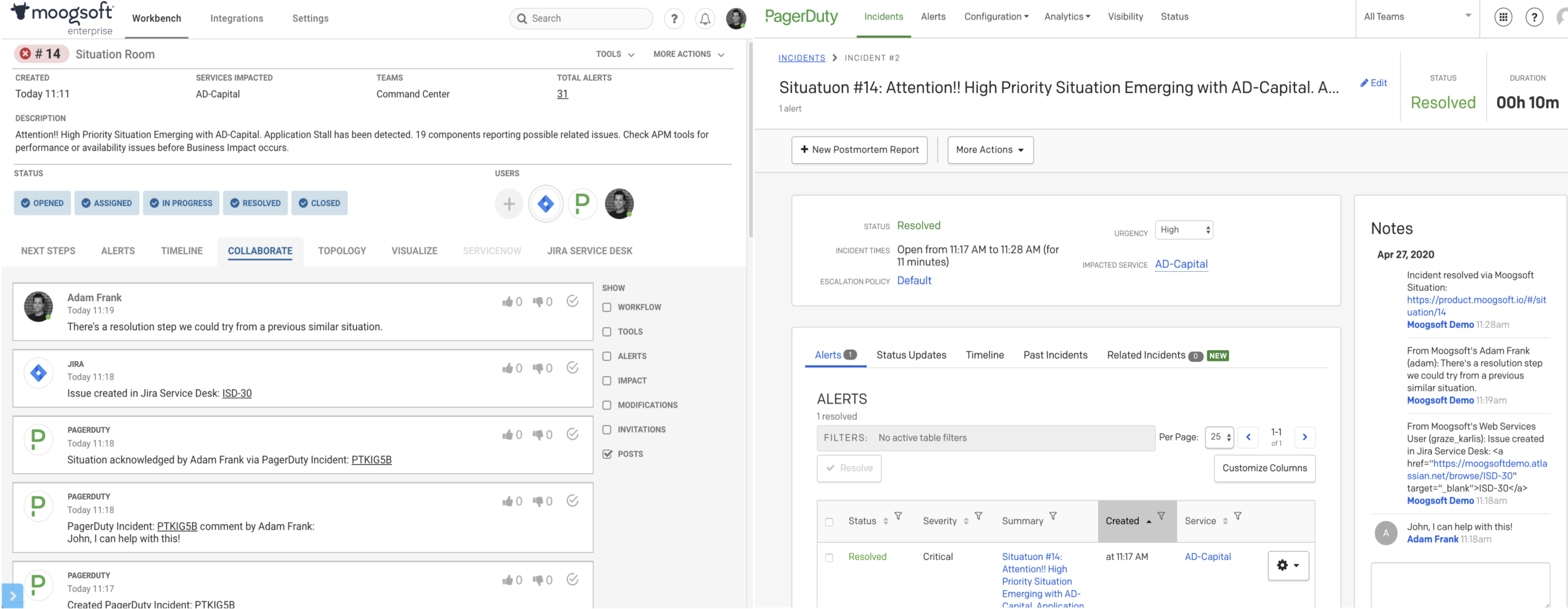
    Moogsoft this week updated its AIOps platform to enable IT organizations to construct a virtual network operations center (NOC) that pulls in data from incident management and DevOps platforms for remote IT management.

    Adam Frank, vice president of product and design at Moogsoft, said version 8.0 of Moogsoft Enterprise enables IT teams to aggregate alerts from multiple platforms in a way that enables machine learning algorithms to identify high-priority issues that require immediate attention.

    Moogsoft accomplishes that goal using noise reduction analytics to better prioritize alerts, which are then surfaced via an automated topology visualization tool that makes it easier to identify the root cause of any issue, he said.

    Version 8.0 of Moogsoft Enterprise adds integration with the Amazon Web Services (AWS) Firelens services to ingest EC2 log files, the PagerDuty incident management platform and the Opsgenie incident management platform from Atlassian.

    Moogsoft has also revamped its user interface and enhanced its Workflow Engine (WE) to ease the process of aggregating data from a variety of IT management platforms.
    Even before the start of the COVID-19 pandemic, IT organizations had been moving to embrace machine learning algorithms and other forms of AIOps to help manage increasingly complex IT environments. In the wake of the pandemic, Frank said it’s clear IT teams will be relying more on AIOps platforms. Many organizations simply will not be able to afford to maintain the current size of their IT teams, noted Frank. At the same time, resistance to adopting AI to manage IT is likely to decline because IT staff simply will not have the time to manually perform as many rote tasks as they do today.

    In the meantime, the debate over AIOps continues to heat up. Incumbent providers of IT management platforms contend they already have collected the relevant data, so it makes sense to apply algorithms to data where it already resides. Providers of AIOps platforms such as Moogsoft contend that for AI to be effective at scale machine learning algorithms need to be applied to data that currently resides in multiple IT platforms. As such it makes more sense to apply machine learning algorithms to data that has been aggregated in a single repository.

    Of course, machine learning algorithms will soon be pervasively applied throughout the IT landscape. The decision IT teams will need to make is which platform will ultimately serve as its primary control point for managing enterprise IT.

    While some IT organizations may be tempted to postpone that decision in the wake of the COVID-19 pandemic, Frank notes the pandemic has also highlighted the need to modernize IT management platforms that increasingly need to be accessed remotely. Legacy IT management platforms generally assumed the IT staff would be working on-premises. Moogsoft is designed to enable organizations to employ a virtual NOC that can be accessed more easily from anywhere.

    It remains to be seen just how the management of IT will evolve in the weeks and months ahead. The one thing that is certain is the way IT is managed is never going to be the same again.

  • VMware Makes vRealize Automation Framework Available via the Cloud

    VMware Makes vRealize Automation Framework Available via the Cloud

    VMware this week announced it has made a software-as-a-service (SaaS) edition of its vRealize automation platform generally available.

    Taruna Gandhi, senior director for product and technical marketing at VMware, said VMware vRealize Operation Cloud will make IT automation more accessible to a broader swath of organizations that might not be able to implement IT automation on their own.

    The vRealize Operations Cloud service provides all the same capabilities as the on-premises edition of vRealize with the added benefit of being integrated with other VMware Cloud services, including VMware Cloud on AWS.

    In general, Gandhi said VMware is seeing increased adoption of IT automation frameworks occurring in three phases. In the first phase, IT teams are automating internal processes primarily for their own benefit. In the second phase, IT operations teams set up self-service portals for developers. In the third phase, organizations embrace DevOps processes to provide developers with the equivalent of a cloud computing experience spanning both on-premises and public cloud computing resources.

    Most existing VMware customers are still in the first or second phases, but over time Gandhi said VMware expects organizations to adopt DevOps practices as part of a more aggressive effort to reduce costs during the current economic downturn brought on by the COVID-19 pandemic while accelerating the rate at which applications are deployed and updated.

    The VMware vRealize Operations Cloud will play a significant role in accelerating that transition because it makes IT automation available as a service rather than a platform that needs to be deployed and maintained by an internal IT department. The beta test for vRealize Operations Cloud spanned dozens of customers that put more than 130,000 virtual machines under management across 120-plus vCenters and more than 10 VMware Cloud on AWS deployments, Gandhi said, noting the next phase will to see IT organizations begin to centralize the management of multiple cloud silos that have sprung up over the last several years within most organizations.

    There are, of course, no shortage of options these days when it comes to IT automation frameworks. VMware is making a case for vRealize as a natural extension of the VMware management tools that many organizations employ to manage VMware virtual machines that are widely used across most enterprise IT environments. VMware is now extending the reach of those tools to enable IT teams to also manage containers and even rival virtual machine platforms, noted Gandhi.

    Most of those IT organizations are now struggling to manage IT environments that have become more complex at a time when the pressure to employ higher levels of automation to rein in costs is rising sharply. It remains to be seen how IT organizations will respond to that imperative as pressure to either cap or reduce IT headcount continues to mount. Of course, not every sector of the economy is experiencing the same pressure. There are high-growth segments involving, for example, educational or entertainment services. Regardless of industry, however, it’s clear IT teams are being asked to do a lot more sooner with either the same or fewer resources.

    — Mike Vizard

  • Splunk Adds Remote Workforce Metrics Dashboard

    Splunk Adds Remote Workforce Metrics Dashboard

    Splunk has made available a Remote Work Insights dashboard designed to help IT administrators track and identify the most relevant IT metrics for a workforce that is working from home to help combat the spread of the COVID-19 pandemic.

    Company CTO Tim Tully said the dashboard is initially configured to track virtual private network (VPN) traffic as well as access to cloud applications being made via an instance of an identity management platform from Okta.

    In addition, the dashboard tracks the level of usage of Zoom video conferencing services to help determine to what degree employees are continuing to collaborate during the pandemic.

    The level of productivity being achieved in most corporate environments is tied directly to the amount of network bandwidth being made available via a VPN, which can be deployed inconsistently on various client devices. Cloud application experiences, meanwhile, can vary widely based on the geographic region an end user is located.

    The dashboard helps IT teams to determine where there are issues they can address and where there are issues that may need to be addressed by a third-party service provider.

    Built on top of the Splunk Mobile applications, the dashboard provides a way for IT administrators to employ a tablet or smartphone to continuously monitor key remote connectivity metrics, Tully said, noting that capability means IT administrators don’t have to stay tethered to PC all day to monitor their environments.

    Over time, Splunk plans to add support for additional metrics to make it simpler for IT teams to monitor remote workforces, he added.

    Beyond simply monitoring metrics, the Remote Insights Dashboard also makes it possible to send rich notifications based on thresholds defined by the IT team. That approach allows Splunk Mobile to reduce the number of alerts being generated by the various IT platforms being monitored, said Tully. Those notifications then provide the relevant actionable intelligence IT administrators need to share with other IT professionals to remediate an issue.

    It’s not clear to what degree IT teams will work from home after the COVID-19 pandemic subsides. Many organizations may decide it’s less expensive to have IT teams work remotely at a time when many of them will be looking to, for example, reduce the amount of office space they require to reduce costs. Many organizations are about to discover that IT staffs, much like customer support personnel, don’t necessarily need to be in an office to be effective.

    Regardless of where they are located, many IT professionals are about to discover how productive they can be working remotely. That may create some boundary issues between the home and office. However, it should also go a long way toward eliminating the occasional need to go to the office at odd hours of the night, only to determine the source of a problem can only be fixed by a third-party service provider the IT professional could have contacted from home in the first place.

    — Mike Vizard

  • BigPanda Provides Free 90-Day Access to IT Ops Platform

    BigPanda Provides Free 90-Day Access to IT Ops Platform

    BigPanda, a provider of an IT ops platform infused with machine learning algorithms, this week announced it will make available for free for 90 days an instance of its software available to IT professionals working from home to help combat the COVID-19 pandemic.

    Mohan Kompella, vice president of product marketing for BigPanda, said the IT Ops From Home program is intended to make it easier for IT teams to manage IT operations using a platform that was designed from the ground up to remotely manage highly distributed computing environments.

    BigPanda is also providing free 90-day support along with free training via a virtual classroom. Organizations that opt to participate in the program are under no obligation to renew.

    Kompella said the BigPanda platform is designed to correlate events in a way that automates IT incident management. It provides built-in integrations with software and services from Amazon Web Services (AWS), AppDynamics, Cloudwatch, Splunk, Azure, Jira and Slack.

    It may take a little effort for IT organizations to implement a new platform for managing IT in the midst of a pandemic, he conceded, but also noted there are organizations that are finding their existing IT platforms are not designed to enable IT teams to support an entire workforce that is now accessing distributed applications from home. The BigPanda platform makes it possible to unify the management of all the silos that now make up an enterprise IT environment—in fact, Kompella said managing IT environments remotely may soon become the “new normal.” In much the same way many organizations now employ remote workers to provide customer service, Kompella noted it’s possible many IT support staff will now simply work from home. That approach would, among other things, reduce the cost of office space for IT personnel.

    As organizations struggle to implement business continuity plans there’s no doubt many legacy IT operations platforms are being stretched to their limit. Many of the plans organizations had to slowly transition to a modern IT management platform now need to be accelerated, said Kompella.

    There’s no doubt the COVID-10 pandemic will have a profound impact on the way IT is managed. Many processes will be forever altered, especially as organizations embrace DevOps processes to manage application workloads that are increasingly likely to be deployed in the cloud, as part of a concerted effort to make business processes more resilient in the face of global disruptions such as the COVID-19 pandemic. After all, no one is quite sure when the current crisis might subside or return. There may even additional pandemics to contend with in the future.

    Whatever the motivation, an evolutionary approach to modernizing IT ops will be moving forward at a faster pace among organizations that have the wherewithal to stave off the current economic downturn caused by the pandemic. In fact, there may even be a high correlation between organizations that fail to modernize those processes and those organizations that don’t re-emerge stronger in 2021.

    — Mike Vizard

  • COVID-19 Reaction: Massive Spike in IT Incidents

    COVID-19 Reaction: Massive Spike in IT Incidents

    A report published this week by PagerDuty, a provider of an incident management platform, finds organizations that rely on the platform to manage IT issues are managing on average double the number of incidents since the start of the COVID-19 pandemic.

    In some industry segments, such as online learning services, travel and entertainment services, the number of incidents has increased 11-fold, the report noted.

    Rachel Obstler, vice president of product for PagerDuty, said with more people at home, online services that are seeing a spike in use while at the same time deploying new code to drive additional services are clearly stressed. Enterprise IT organizations, meanwhile, are now dealing with large numbers of employees trying to remotely access a wide range of applications simultaneously. Incidents now range from relatively simple authentication issues to accelerating the rollout of a digital business initiative to help maintain business continuity, she noted.

    Many of those organizations were already short of staff before the COVID-19 pandemic so longstanding challenges in many cases are now being further exacerbated, added Obstler. In addition, organizations that are rushing to deploy applications to enable their organizations to maintain business continuity are likely to not have tested those applications as thoroughly as they once might have. Inevitably, that decision will result in more IT incidents as issues are discovered after those applications are deployed in a production environment.

    Naturally, there may be a temptation to suspend rollouts of new applications. However, with millions of individuals now required to work from home for an indefinite amount of time, digital business applications may be the only way to engage those individuals. In fact, Obstler noted that as working remotely becomes the new normal, many people are about to become a lot more proficient at both working and shopping from home. As such, digital business applications may soon become the primary medium through which organizations engage their end customers.

    On the plus side, Obstler said it’s now relatively simple to deliver IT services from anywhere in the world, so there is an opportunity to bulk up existing IT support staff. Of course, the pool of IT professionals who are available to hire should also increase as vertical industries such as the travel and hospitality sectors essentially shut down.

    It’s too early to say precisely how the COVID-19 pandemic will impact the IT sector. While there will certainly be layoffs, many organizations will be loath to let go of IT staff who will be difficult to replace once the immediate economic recession ends. Countries around the world are also making funds available to companies on the condition they keep layoffs to a minimum.

    Regardless of how many IT people are retained, however, the remaining IT staff will continue to be stressed. Many organizations are going to have to re-engineer IT processes by, for example, embracing best DevOps practices on the fly to adjust to a new reality. Many of the IT issues about to be encountered might not always be within the control of IT teams to address. However, business leaders will expect that one way or another those IT staff will come up with the innovative workarounds needed to enable the business to continue to survive and thrive.

    — Mike Vizard

  • HPE Leverages AI for Remote Server Management

    HPE Leverages AI for Remote Server Management

    The latest ProLiant MicroServer is designed to use AI to provide the next generation remote server management

    Hewlett-Packard Enterprise (HPE) announced an HPE ProLiant MicroServer Gen10 Plus platform designed to be managed remotely using advanced algorithms the company makes available via the cloud.

    Tim Peters, vice president and general manager for global small-to-medium businesses and the midmarket at HPE, said the goal is to make it possible for organizations of all sizes to take advantage of artificial intelligence and advanced analytics to automate the management of servers in remote offices.

    Based on Intel Pentium and Intel Xeon processors and weighing less than 10 pounds, the HPE ProLiant MicroServer Gen10 Plus comes with HPE Integrated Lights Out 5 (iLO5) server management tool that enables IT teams to configure, monitor and update servers remotely. Those servers can then also be connected back HPE InfoSight for Servers, a cloud-based AI tool that HPE is making available for the first time on this class of servers, said Peters.

    HPE is making this class of servers available as part of a subscription service option that makes the HPE ProLiant MicroServer Gen10 Plus available starting at just less than $20 per month for organizations that prefer to treat IT as an operational expense. This latest generation of HPE servers also only generates 36dB of sound so most employees in a remote office may not even be aware of its existence.

    In addition, Peters noted the HPE ProLiant MicroServer Gen10 Plus server also supports HPE’s silicon-based root of trust technology, which prevents servers in remote offices from being tampered with when there is no IT staff available at that location.

    The days when most organizations could afford to have IT staff at each remote office are all but over. IT organizations increasingly need to rely on frameworks that allow them to centrally manage IT infrastructure wherever it’s deployed. IT teams can either build and deploy those IT automation frameworks themselves or they can rely on the frameworks that IT vendors are embedding in their latest generation of systems. Naturally, that latter approach requires IT to replace their existing IT infrastructure. However, given the rate at which applications are being deployed and upgraded, many organizations are now finding they are replacing server infrastructure more frequently.

    Regardless of the approach, overworked IT staffs don’t want to have to send someone to a remote office location unless it’s absolutely required. Beyond the cost of the travel, there’s the time that could be better spent on more pressing IT management tasks to consider.

    Of course, anything involving AI is likely to make IT administrators nervous. However, as IT becomes more complex, it’s not likely IT teams will be replaced. Rather, the focus of IT teams will shift toward other areas that add more value to the business as more rote tasks increasingly are automated.

    Naturally, it may be a while before all the legacy infrastructure installed is replaced, so IT teams may still need to travel to remote offices for some additional period of time. However, the days when IT teams racked up frequent flyer miles because of the need to visit remote office locations will soon be a distant memory.

    — Mike Vizard

  • ServiceNow Embraces AI to Manage IT

    ServiceNow Embraces AI to Manage IT

    ServiceNow has taken the wraps off the Orlando update to its cloud platform for managing IT that adds advanced analytics and artificial intelligence (AI) capabilities.

    In addition, an existing integration framework that enables the Now Platform from ServiceNow to manage DevOps pipelines created by third-party platforms is now part of the core platform. Previously, that capability was only available as an add-on that could be downloaded from the ServiceNow online store.

    Pablo Stern, senior vice president of IT workflows for ServiceNow, said that as ITIL-based frameworks and DevOps continue to converge it is apparent IT teams will also need to rely more on AI to manage IT environments that are becoming increasingly more complex.

    The Now Intelligence capabilities being embedded into the Now Platform will address that issue by surfacing insights and making recommendations to predict and resolve issues before they become a major problem, he said.

    IT teams can also take advantage of “always-on virtual agents” to track and automatically initiate specific workflows.
    Analytics capabilities provided by Now Intelligence also include recommendations on how to optimize usage of cloud assets based on the billing options available and the ability to asses risks to the business. That latter capability includes vulnerability assessments of software and hardware that can be used to automatically trigger a remediation process.

    ServiceNow has also enhanced its support for mobile computing platforms and added Agent Affinity for Work Assignment, which allows IT teams to assign work to agents that have the most expertise dealing with a specific issue or familiarity with certain end users.

    In general. Stern said IT organizations would be well-advised to starting walking back many of the biases that now exist among advocates of DevOps and legacy ITIL-based approaches to managing IT. Both approaches are equally relevant depending on the task at hand. The challenge now is providing access to a common pool of data that informs those processes, he said.

    There’s no doubt that ITIL and DevOps frameworks will continue to evolve side-by-side for many years to come. In fact, the latest iteration of the ITIL framework borrows many of the concepts for adroitly managing IT infrastructure from best practices that were pioneered by DevOps practitioners. The balance that needs to be struck is finding a way to respond faster to rapidly changing application and business conditions without sacrificing a structured approach to managing IT that makes it possible to consistently scale systems that are highly resilient.

    Naturally, it may be a while before that balance is struck. However, AI will play a critical role in enabling organizations to achieve that goal. Given the complexity of modern IT environments, it’s simply not possible to effectively manage IT by relying on manual processes or custom scripts that don’t scale. AI is not likely to replace the need for human IT expertise anytime soon, but it will go a long way to maximizing what is already an overtaxed resource often subject to more fallibility than anyone cares to admit.

    — Mike Vizard

  • Nerdio Unfurls Management Tools for WVD on Azure

    Nerdio Unfurls Management Tools for WVD on Azure

    Nerdio has launched a management tool that makes it easier to provision large numbers of virtual desktops on the Microsoft Azure public cloud.

    Company CEO Vadim Vladimirskiy said that now that Microsoft is finally encouraging organizations to embrace desktop virtualization in the form of its Windows Virtual Desktop (WVD) service, there is a need for tools to manage all those desktops.

    Nerdio Manager for WVD fills that gap by providing support for, among other things, dynamic host pools that automatically grow and shrink depending on workload and desktop images that can be employed across thousands of users.

    Vladimirskiy said Nerdio Manager for WVD runs natively on Azure, which among other things allows all the data it collects to remain within the geo-boundaries of the selected Azure region. No additions to an Azure subscription are required to store that data, he noted.

    Fresh off raising an additional $8 million in funding, Nerdio is riding the coattails of a relatively newfound enthusiasm at Microsoft for virtual desktops. While the concept of a virtual desktop has been around for the better part of two decades, Microsoft has only been encouraging IT organizations to embrace virtual desktops since the WVD Service became available on Azure in the last several months. Previously, Windows licensing restrictions tended to make virtual desktops less economically attractive.

    Rather than organizations relying on Citrix or VMware for virtual desktops, Microsoft is now making a case for employing its Azure cloud service to subscribe to virtual desktops as a less complicated alternative that also supports both Windows 10 and Windows 7. That means IT teams that embrace Windows 7 on Azure will be supported by Microsoft.

    It’s not clear to what degree Windows desktops will move into the cloud now that Microsoft has embraced the concept. In addition, it’s also worth noting that rivals such as Amazon Web Services (AWS) now provide similar desktop virtualization services. What is clear is many fewer instances of Windows will be running locally as more organizations determine it might be easier for them to manage Windows desktops via the cloud than on each individual machine. At the same time, many organizations are also looking at ways to more easily enable remote computing to help limit potential employee exposure to the COVID-19 virus.

    Whatever the path forward, it’s not likely large enterprise IT organizations will make the jump to WVD or any other cloud service all at once. IT administrators may find themselves managing a hybrid desktop computing environment for many years to come. There are also, of course, organizations operating in highly regulated industries where virtual desktops running on a public cloud are simply not an option.

    Nevertheless, it’s apparent the time when IT administrators had to spend time visiting individual desktop machines is coming to an end. The management of both virtual desktops and physical endpoints is becoming more automated with each passing day. The only real question is what degree of automation can be achieved based on where the desktop actually resides.

    — Mike Vizard

  • Survey Finds IT More Challenging to Manage Than Ever

    Survey Finds IT More Challenging to Manage Than Ever

    A survey of 415 IT executives published today shows IT teams are struggling to keep up as the number of platforms that need to be managed continues to expand rapidly.

    Conducted by Propeller Insights on behalf of Volterra, a provider of a distributed computing platform, the survey finds 97% are planning to distribute workloads across two or more clouds. The top three reasons cited for adopting multiple clouds were the need to maximize availability and reliability (63%), meeting regulatory and compliance requirements (47%), and leveraging best-of-breed services from each provider (42%).

    At the same time, the survey finds 70% of survey respondents said it’s “very important” to have a consistent operational experience between the edge and public and private clouds.

    The survey, however, also makes it clear IT leaders understand that achieving the goal will be a significant challenge. The top issues identified when employing multiple clouds are establishing secure and reliable connectivity between providers (60%), employing different support and consulting processes (54%) and navigating different platform services (53%).

    The rise of edge computing is going to further exacerbate those challenges. The survey finds the difficulty in managing apps across multiple edge locations (44%) and an inability to accommodate the IT infrastructure needed to host and operate at the edge (38%) as the two major edge computing issues identified by survey respondents. In terms of specific technical challenges identified, integrating cloud-native workflows such as automation, continuous integration/continuous delivery (CI/CD) and performance management (69%) and trouble installing a full set of application infrastructure spanning compute, storage and network and security (67%) top the list of issues.

    As far as lifecycle management at the edge is concerned, the two biggest long-term issues identified are the lack of resources or time to keep applications and infrastructure up to date (37%) and managing silos of distributed clusters (26%).

    Mark Weiner, chief marketing officer for Volterra, said the survey makes it clear there soon will come a day when IT organizations will need to centralize the management of an increasingly extended enterprise. IT organizations may have adopted public clouds aggressively, yet 70% to 80% of all workloads still run in an on-premises IT environment. At the same time, the number of workloads that will be distributed to edge computing platforms is set to explode. The survey identifies the primary reasons more workloads will be deployed on the edge as the need to control and analyze data locally (54%) and the amount of latency experienced when sending edge data to public cloud-based apps (47%).

    Ultimately, the goal is to have a hybrid cloud computing environment through which the management of IT is as centralized as possible. While the cost of deploying workloads in a public cloud is comparatively inexpensive, it turns out the total cost of IT continues to increase as IT teams find themselves managing more distributed platforms than ever. It may be a while before IT teams have the tools and processes in place to rein in those costs. However, at this point, it’s more a question of how and when that goal will be accomplished, not if.

    — Mike Vizard

  • Quest Software Expands MDM Cloud Reach

    Quest Software Expands MDM Cloud Reach

    Quest Software today extended the reach of its mobile device management (MDM) service to provide more granular control over mobile devices and applications in addition to being able to track their location.

    Capabilities being added to the KACE Cloud MDM service include support for a “Kiosk Mode” for Android devices that allows administrators to lock down a device and limit activity to a specific application or task, as well as a Disallowed Apps feature that brings the same level of blacklisting capability to Android devices that currently exists for Apple iOS devices.

    Quest Software has also added file encryption tools for MacOS devices and extended the multi-tenant capabilities of cloud service to enable profiles to be applied within Apple Business Manager or Apple School Manager.

    Jody Evans, product manager for KACE Cloud MDM at Quest Software, said the latest updates to the service are intended to make it easier for IT teams to manage a broad range of mobile computing devices using a cloud service they don’t have to deploy and manage.

    Longer-term, the goal for most IT teams will be to unify endpoint management as much as possible relying on cloud services. In the meantime, most organizations will continue to rely on a mix of cloud services and local appliances to manage endpoints, said Evans.

    It’s not clear to what degree or at what rate IT organizations are unifying the management of endpoints. Internal IT teams tend to manage desktops and laptops. Mobile computing devices such as tablets and smartphones, however, are often managed via portals provided by telecommunications carriers or managed service providers (MSPs).

    Competition across the IT systems management category is naturally fierce. The KACE product line has been around since 2003, when the company developed appliances to automate the management of Windows desktops. In 2010, Dell acquired KACE Networks and in 2012 it acquired Quest Software, which, along with KACE Networks and SonicWall, became part of Dell Software. At roughly the same time, VMware, also part of Dell, had also been expanding its reach into the realm of MDM via acquisitions.

    To help raise the cash needed to take Dell private, Quest Software and SonicWall were formally separated into two separate companies that were sold to venture capital firms. The KACE product line remained with Quest Software. Since then, Quest Software has been gradually rolling out instances of its portfolio that are delivered as a cloud service.

    At the same time, however, ITSM is being transformed by the rise of DevOps. While most endpoints are still managed using service desks based on ITIL frameworks that typically rely on job tickets to manage tasks, many of the mobile applications that reside on those platforms are being managed using DevOps processes to deliver a richer end user experience faster. It’s not at all clear to what degree the management of endpoints using ITIL processes and mobile applications using DevOps processes will converge.

    In the meantime, reliance on mobile applications and devices continues to increase. Many end users now spend more time on tablets and smartphones than they do in front of traditional desktop systems. The challenge IT teams now face is determining the best way to manage an IT endpoint landscape that has never been more diverse or complex.

    — Mike Vizard