Tag: gitlab

  • GitLab Allies With Google to Bring AI to DevOps

    GitLab Allies With Google to Bring AI to DevOps

    GitLab extended its alliance with Google as part of an effort to bring more generative artificial intelligence (AI) capabilities to DevOps workflows.

    The GitLab suite of software-as-a-service (SaaS) applications already reside on the Google cloud platform to provide GitLab with the foundation of data required to train those AI models. Over the course of the last two months, GitLab has already added numerous capabilities that rely on multiple types of AI technologies.

    For example, there is now an experimental Explain This Vulnerability capability that provides a natural language summary of an issue in a way developers and cybersecurity teams can easily comprehend.

    Taylor McCaslin, a product group manager for data science and AI/machine learning for GitLab, said going forward, most of the AI focus is going to be on leveraging generative AI capabilities. Those capability will be enabled by Google using a large language model (LLM) that GitLab developed for DevOps workflows. That approach enables GitLab to surface more accurate recommendations based on validated data compared to the general purpose LLM that was used to create the ChatGPT service.

    In addition, GitLab can continuously update the AI models it is running on the Google Vertex AI cloud service using the data from its SaaS application environment which is continuously monitored and updated, McCaslin noted.

    It’s not clear what impact AI may have DevOps workflows, but GitLab is forecasting a 10x improvement. That will be accomplished by, for example, surfacing code that can be used to remediate a vulnerability. Today, many vulnerabilities are not addressed simply because developers don’t have enough time to write a patch.

    A recent GitLab survey, however, suggested developers are already embracing AI to improve productivity, with 62% of developers using AI and machine learning algorithms to check code. More than a third (36%) also rely on AI and machine learning algorithms to review code.

    At this juncture, the one thing that is certain is AI and other associated technologies are going to make developers more productive. It’s not nearly as apparent what impact increased amounts of code moving simultaneously through DevOps pipelines is going to have on the software engineers that manage those processes. The expectation is that similar types of AI advances will also enable more code to flow through those pipelines without, hopefully, further exacerbating any existing bottlenecks that might exist.

    In the meantime, it’s clear the AI genie is out of the bottle. There will soon be more LLMs for all kinds of tasks. DevOps teams should start planning today based on the assumption that many manual tasks that conspire to make software engineering tedious are going to fade away. As such, the roles with a DevOps team are going to change and evolve. The assumption those DevOps teams should make is that these changes will be for the better. After all, the reason organizations embraced DevOps in the first place was to ruthlessly automate IT processes—AI is simply the latest iteration of that commitment.

  • GitLab Survey Reveals DevSecOps Gains

    GitLab Survey Reveals DevSecOps Gains

    A global survey of 5,010 IT leaders, CISOs and developers published by GitLab this week found well over half (56%) of respondents are working for organizations that are using DevOps or DevSecOps practices. However, 72% of respondents said they are using a DevSecOps platform (36%) or are considering adopting one in the next year (36%).

    Overall, less than a third of survey respondents (30%) said they were “completely” responsible for application security, with 53% reporting they are part of a larger application security team. Well over a third (38%) of the 1,453 security professionals surveyed said they are part of a cross-functional team focused on security.

    License compliance checks and security capabilities for cloud-native or serverless tied for the top of the list of current priorities (19%), but shifting security left (29%) was the top focus for the coming year. Nearly three-quarters (74%) of security professionals said their organizations either shifted left or plan to in the next three years. Nearly as many (71%) said a quarter or more of all security vulnerabilities were discovered by developers.

    Top frustrations identified specifically by security professionals included testing happening too late in the development cycle (43%) and difficulty prioritizing vulnerability remediation (41%).

    Those frustrations might increase in the coming year, with 85% of security professionals reporting they either have the same or lower budget in 2023.

    On the plus side, nearly two-thirds of the 1,954 developers surveyed said they are either using artificial intelligence (AI) and machine learning (ML) algorithms in testing today or will be in the next three years. A full 62% said they used AI/ML to check code, while 53% use bots for testing and 36% use AI/ML for code review.

    Nevertheless, more than two-thirds of security professionals (67%) said they are concerned about the impact of AI/ML capabilities on their job, with 28% of them admitting they are “very” or “extremely” concerned. Of those respondents who expressed concern, 25% said they are worried about the potential for AI/ML to introduce errors that will make their job more difficult.

    David DeSanto, chief product officer at GitLab, said GitLab is also working to address those concerns by embedding a range of AI/ML capabilities into its platform to optimize DevSecOps workflows and, most recently, enhanced its GitLab Remote Development module to make it easier to centralize the maintenance and security of development environments.

    GitLab this week also announced it is partnering with Oracle to make it easier to use the GitLab continuous integration/continuous delivery (CI/CD) platform to run AI and ML workloads on the Oracle cloud platforms. AI/ML is going to play a critical role in enabling organizations to build and deploy secure code without slowing down the pace of application development, said DeSanto. In fact, many organizations will soon be consolidating toolchains to enable them to achieve that goal, he added.

    The GitLab survey found 57% of security respondents said they use six or more tools, but many of those tools are legacy software composition analysis (SCA) tools that will be replaced as more responsibility for application security shifts left toward developers, noted DeSanto. Two-thirds of survey respondents (66%) reported they want to consolidate their toolchains this year.

    Collectively, the GitLab survey makes it clear that DevOps and DevSecOps practices and platforms continue to evolve rapidly. The challenge, as always, is keeping up with the pace of that change.

  • GitLab Strengthens Remote DevOps Management

    GitLab Strengthens Remote DevOps Management

    GitLab this week moved to provide remote developers with access to a more secure continuous integration/continuous delivery (CI/CD) platform while at the same time adding a dashboard that makes it simpler to track the overall status of application development projects.

    David DeSanto, chief product officer for GitLab, said GitLab Remote Development takes advantage of an instance of the GitLab CI/CD platform running on a Kubernetes cluster. That cluster is accessed via a Web-based integrated development environment (IDE) to eliminate the need for developers to create development environments on their local desktops.

    That capability reduces developers’ time and effort on tasks other than code and gives organizations more centralized control over the intellectual property being created, noted DeSanto. Organizations will no longer have to worry, for example, about theft of a developer’s laptop that has sensitive data on it, he added. In addition, organizations will be able to more easily create “golden” images that can be consistently accessed by developers residing in multiple locations.

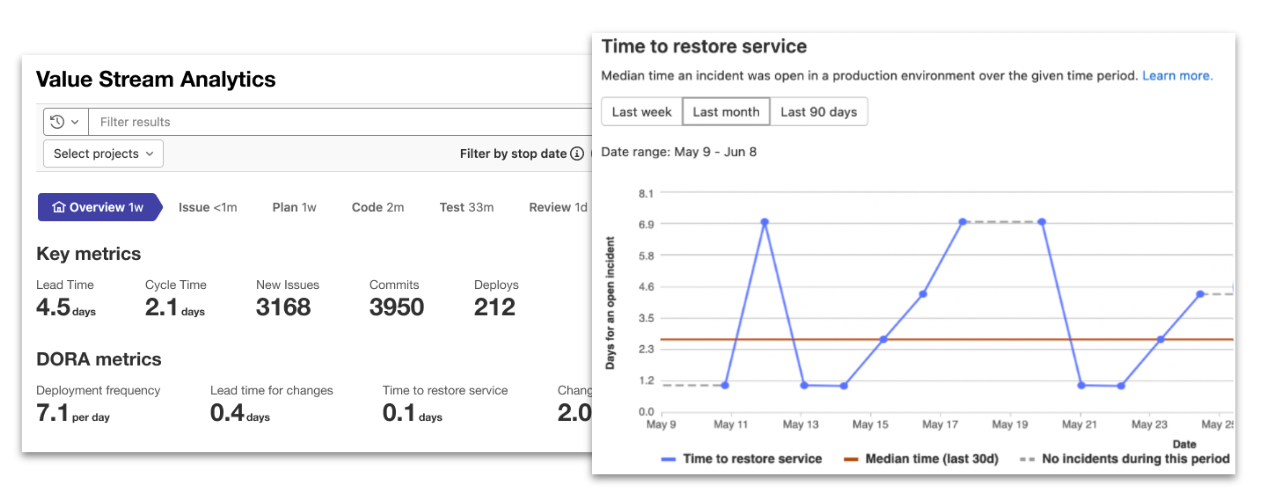
    In addition to making it easier to centrally manage a distributed team of developers, GitLab is also adding a GitLab Value Streams Dashboard that provides senior executives with access to metrics that assess the overall health of an application development project. While GitLab has always provided metrics to DevOps teams, DeSanto said this dashboard, available as a private beta, makes it possible to identify, for example, bottlenecks that might result in delayed delivery of an application.

    Value stream management (VSM) is, of course, not a new idea. The issue that DevOps teams are trying to come to terms with is whether they need to adopt a dedicated VSM platform. The other option is to simply provide a set of dashboards that enable senior IT and business executives to track projects’ progress without deciphering a set of much lower key performance indicators (KPIs). Previously, the GitLab platform surfaced a lot of nitty-gritty details that don’t provide the context senior executives required, noted DeSanto. The Value Streams Dashboard metric surfaces KPIs based on DevOps Readiness Assessments (DORA) metrics from Google alongside other flow metrics.

    These latest offerings are part of a larger case being made for an integrated DevOps platform that reduces the total cost of application development by eliminating the need for organizations to integrate various tools themselves. Each DevOps team can employ as many of the modules GitLab makes available as they need. Once invoked, they take advantage of the same data store as every other element of the GitLab platform. That capability is becoming more critical as organizations embrace platform engineering to reduce the cost of application development using DevOps best practices, said DeSanto.

    It’s not clear how much interest there is in replacing legacy CI/CD platforms that, in some instances, have been in place for nearly a decade. However, as the pace at which applications are being built and deployed continues to accelerate, there is no doubt that organizations of all sizes will need to modernize application development processes.

  • GitLab Unfurls Dedicated SaaS Edition in the Cloud

    GitLab Unfurls Dedicated SaaS Edition in the Cloud

    GitLab today made available to a limited number of customers a single-tenant version of the software-as-a-service (SaaS) edition of its continuous integration/continuous delivery (CI/CD) platform.

    David DeSanto, vice president of product at GitLab, said the GitLab Dedicated option provides all the benefits of a cloud platform without running afoul of any potential compliance issues.

    Designed to be deployed on a cloud platform selected by the customer, DeSanto said the single-tenant edition of the platform makes sure that all the data stored in the cloud is isolated. In addition, the access to GitLab Dedicated is provided via a private network connection, he added.

    Initially, GitLab Dedicated is being made available on the Amazon Web Services (AWS) cloud with support for other cloud platforms planned for 2023 once it becomes generally available.

    GitLab is, in effect, trying to strike a balance between a lower-cost multitenant edition of the platform or, alternatively, requiring organizations to deploy an on-premises edition of the platform themselves, DeSanto said.

    In general, GitLab expects this latest version of the platform to appeal most to organizations that operate in highly regulated industries. However, the number of organizations looking to isolate their data in a private cloud to better protect their software supply chains is expanding, he noted.

    In the wake of a series of high-profile breaches and vulnerability disclosures, the number of organizations that are reviewing their software supply chains has increased. Less clear is the degree to which organizations will look to lock down their existing CI/CD platform versus replacing it with a more secure modern alternative that can be more easily accessed via the cloud.

    The challenge, of course, is replacing a CI/CD environment is not trivial, so organizations will need to consider the time and effort made over the years to customize their CI/CD environment. In some instances, that customization provides a meaningful competitive advantage. In other cases, however, the weight of maintaining all those customizations has become more troublesome than it’s worth.

    Each individual organization will need to decide to what degree they will want to manage the DevOps platforms used to construct applications. More organizations are deciding they prefer to devote as much of their resources as possible to writing code instead of managing the underlying CI/CD platform used to create their applications, said DeSanto.

    Regardless of approach, the number of organizations adopting DevOps best practices to build and deploy applications faster continues to increase. A CI/CD platform accessed via the cloud lowers the barrier to entry for smaller organizations that typically don’t have the skills and resources required to manage DevOps platforms.

    In the meantime, SaaS-based approaches should significantly increase the number of applications being constructed using DevOps workflows. The level of DevOps adoption will naturally vary by organization. However, the total number of custom applications being used to drive, for example, digital business transformation initiatives should considerably expand in the months and years ahead as more applications are built and deployed at incredible speed.

  • GitLab Allies With Google to Improve Developer Productivity

    GitLab Allies With Google to Improve Developer Productivity

    GitLab Inc., in collaboration with Google, today launched an open source Cloud Seed tool that makes it simpler for DevOps teams to consume Google Cloud Platform (GCP) resources.

    The Cloud Seed tool, announced at the virtual Google Cloud Next ’22 conference, is integrated within the GitLab web UI to make it simpler for developers to consume Google cloud resources—such as Cloud Run for building and deploying containerized applications—and the managed Cloud SQL database service.

    Nima Badiey, global vice president of alliances for GitLab, said the goal is to reduce friction that would otherwise be created by requiring developers to write code to consume these services using a set of lower-level application programming interfaces (APIs).

    That self-service approach not only improves productivity but provides the added benefit of reducing the odds those services might be misconfigured in a way that creates a cybersecurity vulnerability, he added.

    As it seeks to gain ground on Amazon Web Services (AWS) and Microsoft, Google has a vested interest in working with providers of DevOps platforms to make it simpler for developers to consume cloud resources. The challenge is that developers often make mistakes when they programmatically invoke cloud services. Those resulting misconfigurations are all too often not discovered and remediated until after there has been some type of cybersecurity incident.

    In the wake of a series of high-profile breaches of software supply chains, there is a lot more focus on security. The challenge, of course, is finding a way to ensure application development platforms are as secure as possible without slowing down the rate at which software is developed and deployed. Achieving that goal requires the right mix of policies, training and systems, said Badiey.

    Most organizations are trying to strike a balance between the need for greater security and their need to attract and retain developer talent. In theory, the rise of DevSecOps best practices is pushing more responsibility for security further left toward developers. However, most developers have little to no cybersecurity expertise, so it’s clear more guardrails need to be built into DevOps tools and platforms to prevent cybersecurity mistakes from being made.

    It’s not clear how much improved developer productivity and greater security will drive organizations toward one cloud platform versus another, but in an age where many more organizations now routinely employ two or more cloud platforms, it could make a significant difference. Developers don’t especially enjoy remediating applications after they are deployed in a production environment because they have generally already moved on to other projects. IT operations and cybersecurity professionals are also likely to nudge developers toward platforms that create the least amount of operational overhead for them.

    Regardless, one thing that is certain is compliance requirements are about to become stricter for all concerned as scrutiny of software supply chains intensifies in the months ahead. The issue now is how to proactively address those requirements before they become a much larger issue.

  • GitLab Research Shows Security Concerns in DevOps Teams

    GitLab Research Shows Security Concerns in DevOps Teams

    The threat of breaches is top-of-mind for many DevOps teams, and while security continues to shift left it appears to be a driving force for many decision-makers when it comes to choosing a DevOps platform or other technologies.

    These were among the results of a GitLabs survey that also found getting security right is the number one challenge for DevOps teams. 

    Getting it Right

    Among the top reasons respondents said they chose DevOps were better code quality, developer productivity and operational efficiency—cited by 37% of survey takers, followed very closely by better security/more secure applications.

    The survey also revealed that 53% of developers said they are fully responsible for security in their organizations, a 14% jump from 2021. 

    Michelle McLean, vice president at Salt Security, said it is risky for organizations to depend on development teams alone for security.

    “Security and developer teams need to collaborate and work together–at every point in the application life cycle–not just development,” she explained.

    For example, security teams must bring runtime insights back to development so they can be applied for education and training.

    “It’s fundamentally important to choose a DevOps platform that either has security capabilities built-in or that can easily integrate with security platforms to facilitate collaboration by security and DevOps teams,” she said. “Otherwise, organizations run the risk of pushing out unsecured software or introducing other risks into the software supply chain.”

    Tim Mackey, principal security strategist at the Synopsys Cybersecurity Research Center, added that an obsolete mantra in the cloud-native community held that security wasn’t a high priority as proper DevOps workflows meant that incremental changes were small and easily deployed.

    He said the Log4j and Log4Shell experiences called that philosophy into question with a recognition that security issues can, and do, occur out-of-band from a release or feature and that continuous monitoring for external threats is part of a properly functioning security process.

    “By implementing monitoring for new threats, regardless of source or nature, the ability for cloud-native development to quickly issue tested patches becomes itself a security feature,” he explained. 

    Understanding the Pipeline

    McLean pointed out that while there is a growing understanding of security in the pipeline with DevSecOps, it’s not enough.

    “This is particularly true, for example, in the case of APIs. Because APIs aren’t just straight code, you must see them being exercised to spot logic flaws,” she said. “You need the ability to monitor them in runtime in order to spot anomalies and find areas where APIs might be exposing critical data. Although developers write APIs, their testing often falls short for security.”

    To accurately see what’s going on with APIs, developers need to exercise the API–even in pre-production.

    McLean said this is an area where security and development collaboration and integration is essential–APIs underpin a significant portion of the modern economy and the disconnect between security and development teams can have a direct economic impact.

    John Bambenek, principal threat hunter at Netenrich, a security and operations analytics SaaS company, added there has always been a delay between the release of new platforms and the awareness that security capabilities for those platforms need to be implemented.

    “With cloud-native and serverless technologies, that delay is as short as I remember in my career,” he said. “I greatly prefer the world where everyone at least understands the need for security instead of having to spend time getting buy-in that it matters in the first place.”

    He said if you can manage and implement security in a seamless and efficient way early in the development process, it is far easier and cheaper to address issues than addressing them after code has already shipped—and that’s without adding in breach or liability costs.

    “You can either fix it in dev or in prod, but you’re going to have to fix it sooner or later,” he said. 

    McLean noted many organizations are still maturing in their DevOps practices, not to mention their DevSecOps initiatives.

    From her perspective, educating developers as to what is expected of them from a security perspective before a line of code is written is key.

    “To help increase compliance, we’ve begun to see organizations taking steps to introduce security tooling into their pipeline process and add testing into the build process,” she said.

    Then they’ll add a step that triggers an alert for non-compliant builds but won’t prevent the build. Then they’ll add a step that mandates sign-off by the developer that they’ve seen the security alert for a non-compliant build but still won’t interrupt the build.

    “In rare organizations with highly mature DevSecOps processes, they’ll fail the build for non-compliance,” she added.

    McLean said organizations need to understand what’s realistic given their maturity and risk tolerance and implement controls that match.

    They also need to reevaluate those controls to look for opportunities to increase adherence to security policies and other compliance regulations.

    Overall, continuing to educate through compliance automation in the software development life cycle (in development, testing and deployment phases) further helps reinforce best practices while ensuring issues are uncovered before they become a risk or technical debt.

    Mackey said because DevOps platforms touch the software powering your business, when choosing any DevOps platform, the security of the platform itself and the competencies it enables should always be must-haves.

    “In effect, any decision about new software should be based on how it improves the current security capabilities of the business,” he said. 

  • GitLab To Embed Observability in CI/CD Platform

    GitLab To Embed Observability in CI/CD Platform

    The latest version of the GitLab continuous integration/continuous delivery (CI/CD) platform added a range of monitoring and visualization capabilities as part of an effort to embed a full set of observability capabilities in the core platform within the coming year.

    As part of that effort, the latest version of GitLab, 15.1, has now added support for all the metrics defined by the DevOps Research and Assessment (DORA) team that is also part of Google.

    In total, the 15.1 version of the GitLab platform has more than 30 updates. These include additional security capabilities in the form of support for the security assertion markup language (SAML) Group Sync and the Supply chain Levels for Software Artifacts (SLSA) framework defined by Google.

    Finally, GitLab added links to all configuration files and templates included in the CI/CD platform to the pipeline editor to make it easier to manage large and complex pipelines.

    Cindy Blake, director of product marketing for GitLab, said the monitoring, observability and security capabilities added to the platform are part of an ongoing effort to eliminate the ‘digital duct tape’ that many DevOps teams currently rely on to extend a CI/CD platform. In fact, as many DevOps teams look to better secure their software supply chains, many are now taking advantage of the moment to replace do-it-yourself (DIY) approaches with an integrated CI/CD platform based on a common codebase, noted Blake.

    As part of that effort, Blake said GitLab is building its own dynamic application security testing (DAST) tools that are more tightly integrated with its CI/CD platform.

    In general, there is now an expectation that the tools required to secure software supply chains should be made available within a CI/CD platform, but organizations are still working through the processes that will need to be implemented to achieve that goal, added Blake.

    It’s not clear to what degree organizations are looking to replace legacy CI/CD platforms as they modernize application development and deployment. In many cases, however, the technical debt associated with maintaining custom integrations across their DevOps environment has become considerable. Many organizations are revisiting their DevOps workflows as part of an effort to increase overall developer productivity. The challenge, of course, is that migrating from one CI/CD platform to another requires considerable time and effort.

    In the meantime, the number of organizations embracing DevOps best practices continues to grow. GitLab is betting that as the total size of the CI/CD market continues to expand, most of those organizations will prefer an integrated platform rather than writing and maintaining custom integrations themselves.

    Regardless of approach, the ability to monitor and observe workflows is an essential element of any DevOps workflow. There is, of course, no shortage of observability platforms available. It’s not clear whether IT organizations will adopt one of those offerings versus taking advantage of observability and monitoring embedded within a CI/CD platform. One way or another, however, it’s getting easier to discover the root cause of any IT issue.

  • GitLab Gets an Overhaul

    GitLab Gets an Overhaul

    GitLab launched its next major iteration, GitLab 15, starting with its first release version, 15.0, which the company said pulls together new DevOps and data science capabilities into the platform. With GitLab 15, GitLab says it provides (or soon will provide) continuous security and compliance, enterprise Agile planning, visibility and observability, workflow automation and increased support for data science workloads.

    In an interview with devopsy.kinsta.cloud, Hillary Benson, director of product management, detailed how GitLab 15 provides several security benefits, including the ability to automatically create an exportable software bill of materials (SBOM) and signed attestation for build artifacts, centralized security policy management including a two-step exception approval process, as well as providing compliance managers the ability to see project history changes and better enforce policy. “Supply chain security, especially, has become a major area of focus for us, both because it’s become a high priority in the industry and because GitLab is uniquely positioned to support customers well in this area,” Benson said.

    GitLab 15 also provides improved static application security testing (SAST) with stronger and more flexible rules and finding management, Benson said. Finally, users can pool together GitLab project data to create custom automations.

    According to Benson, GitLab 15 will also introduce more capabilities that interlink data across every stage of the DevOps life cycle from initial planning, implementation, deployment and monitoring. “Some of the things that will happen in this area are additional options for the types of work items that can be managed,” said Benson. That includes supporting a more diverse range of workflows and frameworks—including enterprise Agile frameworks. The platform will continue to support issues, epics and requirements and soon enable tasks, features and objectives.

    GitLab 15 provides new capabilities the company hopes will increase visibility and enable an end-to-end view of value delivery and application health, the company said. The unified collaborative context will help remove DevOps silos within organizations and decrease incident rates as well as provide comprehensive insights into issues that hinder performance in addition to real-time triaging of incidents. These new capabilities can help shorten lead times from code to production, reduce error frequency and severity, help development teams deploy more frequently and reduce mean-time-to-recover (MTTR) after an incident.

    Upcoming features include improved product analytics and experimentation, such as increasing the practicality of surfaced data by enabling testing and validating new ideas and measuring the adoption of DevOps best practices across teams and projects, Benson said. Expanded support for all DevOps research and assessment (DORA) metrics including improvements to value stream analytics for projects and groups is also addressed. “This is about making it easier to understand what value your product is bringing,” said Benson. “We’re introducing product analytics and experimentation to increase the practicality of the data that you’re using and the data you’re collecting to actually move your product forward,” says Benson.

    Finally, GitLab 15 will increase support for data science teams and their workloads. “This is about streamlining the development and deployment of machine learning models to train and test those and then get them into production. We’ll also be working on providing monitoring for those workloads so that it can be understood if those models are being used, how they’re being used and where there may be performance issues,” said Benson.

  • Pull-Based Kubernetes Deployments Moving to GitLab Free Tier

    GitLab will include support for pull-based deployment in the platform’s Free tier in an upcoming release, which will provide users increased flexibility, security, scalability, and automation in cloud-native environments. With pull-based deployment, DevOps teams can use the GitLab agent for Kubernetes to automatically identify and enact application changes.

    “DevOps teams at all levels benefit from utilizing GitOps strategies such as pull-based deployment in their cloud-native environments. By offering this feature in GitLab’s Free tier, we can introduce more organizations to the power and utility of this secure and scalable functionality,” says Viktor Nagy, product manager of GitLab’s Configure Group.

    As an open-core company, GitLab is happy to contribute to the GitOps community and enable the adoption of best practices in the industry.

    What is pull-based deployment?

    Pull-based and push-based deployment are two main approaches to GitOps, an operational framework that takes DevOps best practices used for application development such as version control, collaboration, compliance, and CI/CD tooling, and applies them to infrastructure automation.

    GitOps enables operations teams to move as quickly as their application development counterparts by making use of automation and scalability, without sacrificing security.

    While push-based, or agentless, deployment relies on a CI/CD tool to push changes to the infrastructure environment, pull-based deployment uses an agent installed in a cluster to pull changes whenever there is a deviation from the desired configuration. In the pull-based approach, deployment targets are limited to Kubernetes and an agent must be installed in each Kubernetes cluster.

    “As long as the GitLab agent for Kubernetes on your infrastructure has the necessary access rights in your cluster, you can configure everything automatically, reducing the DevOps workload and the opportunity to introduce errors,” Nagy says.

    Pull-based deployment vs. push-based deployment

    Push-based deployment and pull-based deployment each have their pros and cons. Here is a list of the advantages and disadvantages of each GitOps practice:

    Push-based deployment pros:

    • Ease of use
    • Well-known as part of CI/CD
    • More flexible, as deployment targets can be on physical servers or virtual containers, not restricted to Kubernetes clusters

    Push-based deployment cons:

    • Requires organizations to open their firewall to a cluster and grant admin access to external CI/CD
    • Requires organizations to adjust their CI/CD pipelines when they introduce new environments

    Pull-based deployment pros:

    • Secure infrastructure – no need to open your firewall or grant admin access externally
    • Changes can be automatically detected and applied without human intervention easier scaling of identical clusters

    Pull-based deployment cons:

    • Agent needs to be installed in every cluster limited to Kubernetes only

    How pull-based deployment impacts the Free-tier experience

    Including support for pull-based deployments in GitLab’s Free tier provides a tremendous competitive advantage for smaller organizations, as they can now apply automation in a safe and scalable manner to their cloud-native infrastructure, including virtual containers and clusters. And, for organizations that are trying to get started quickly by minimizing the number of tools in their infrastructure ecosystem, this functionality is included in One DevOps Platform, not as a point solution.

    “DevOps teams don’t have to continuously write code for new infrastructure elements – they can write the code once, within a single DevOps platform, and have the agent automatically find it, pull it, and apply it, as well as configuration changes,” Nagy says.

    “Also, with the availability of pull-based deployment in this introductory tier, newcomers to GitLab will immediately be able to modernize application development and reduce the security risk associated with configuring such infrastructure.”

    This blog post contains information related to upcoming products, features, and functionality. It is important to note that the information presented is for informational purposes only. Please do not rely on this information for purchasing or planning purposes. As with all projects, the items mentioned in this blog post and linked pages are subject to change or delay. The development, release, and timing of any products, features, or functionality remain at the sole discretion of GitLab Inc.

  • D2iQ Partners with GitLab Inc. to Accelerate the Deployment of Smart Cloud Native Applications

    D2iQ and GitLab combine the power of Kubernetes and DevOps to deliver more efficient operations and faster time-to-market for new applications

    San Francisco, CA May 16, 2022 — D2iQ, the leading enterprise Kubernetes provider for smart cloud-native applications, today announced a partnership with GitLab Inc., The One DevOps Platform for software innovation, to automate and simplify the deployment of containerized workloads, accelerating software delivery cycle times. 

    Through this partnership, users can now run the GitLab Kubernetes Operator on the D2iQ Kubernetes Platform (DKP), providing  consistent upgrades, deployment and security policies for infrastructures and applications. Enterprise organizations can also safely deploy a project to DKP from a continuous integration/continuous delivery (CI/CD) pipeline with a cluster attached to GitLab, providing enhanced flexibility and agility.

    “The partnership between GitLab and D2iQ allows joint customers to build, test, deploy, and run modern apps at scale,” said Jaimie Kander, Sr. Manager of Alliance Partner Programs and Go To Market at GitLab. “GitLab’s single application for the DevOps lifecycle encourages continuous testing and allows increased visibility, which makes it easier to securely adopt the next generation of cloud-native technologies.”

    According to the findings in the “Kubernetes in the Enterprise Annual Report,” a lack of IT resources was the most prevalent challenge in growing Kubernetes adoption across the enterprise. Full integration of GitOps workflows along with declarative APIs enables easier management of Kubernetes clusters in production environments. DKP reduces the operational loads on DevOps teams so they can focus on innovation, not just supporting infrastructure. In addition, DKP’s user-friendly control plane provides a variety of development approaches using GitLab, including ongoing delivery and deployment with FluxCD, which is designed for Kubernetes and supports multi-cluster and multi-tenant use cases. 

    “Organizations of all sizes are under more pressure than ever to drive innovation, performance, and speed,” said Tobi Knaup, CEO of D2iQ. “Combining the leading Kubernetes and DevOps platforms enables organizations to achieve a new level of business performance. D2iQ and GitLab are delivering a best-in-class solution and an unmatched user experience to enable our customers to achieve success in Day 2 operations.” 

    D2iQ Kubernetes Platform can be experienced live at D2iQ’s booth at KubeCon + CloudNativeCon EU on May 16-20, 2022. For more information, visit: www.D2IQ.com 

    About D2iQ

    D2iQ accelerates Day 2 success for smart cloud-native applications on enterprise Kubernetes. The D2iQ Kubernetes Platform (DKP) includes everything needed to adopt Kubernetes easily and expand Kubernetes use to multiple clusters across any infrastructure, whether on-premise, in the cloud, in air-gapped environments, or at the edge, and to enable smart cloud-native applications. 

    D2iQ eliminates roadblocks to success, such as lack of skills, with our Kubernetes and cloud-native expertise, alleviates operational complexity with a simpler and easy-to-use platform, and addresses security concerns with military-grade security. 

    D2iQ is headquartered in San Francisco with additional offices in London and Hamburg. D2iQ investors include Andreessen Horowitz, Hewlett Packard Enterprise, Khosla Ventures, Koch Disruptive Technologies, Microsoft, and T.Rowe Price Associates, Inc. Find us at http://www.d2iq.com.