Tag: gene kim

  • Damon Edwards and John Willis @ DOES London 2016

    Damon Edwards and John Willis @ DOES London 2016

    It was a very busy DevOps Summer 2016. Now that it is almost over, we wanted to bring you some of the highlights. One highlight certainly was the DevOps Enterprise Summit (DOES) in London, where Gene Kim assembled a great lineup of speakers. Two of my favorites were Damon Edwards and John Willis, and I had a chance to sit down with both right after they finished presenting on the main stage of the event.

    This interview runs a little long (18 minutes or so) but features a really great discussion with John and Damon. They had just presented on better, faster & cheaper—the “iron triangle,” as Damon calls it. The presentation has grown out of John and Damon’s conversations over the years, many of them on the DevOps Café Podcast.

    To me, this iron triangle is the “cold fusion” of DevOps. It is really counterintuitive that by utilizing DevOps principles, you can achieve all three of these business goals. At the end of the day I agree with John and Damon that it is possible with DevOps.

    A special thanks to John, who literally had just stepped off an overnight flight to London and appeared that morning on little to no sleep.

    I am including first their actual presentation at DOES, courtesy of IT Revolution, and then my interview with them, where we dug a little deeper. I hope you enjoy listening and watching as much as I did speaking with these fellows.

    Here is the interview:

  • From Pockets of DevOps to Dev-Biz-Sec-HR-QA-Sales-Everything-Ops, DOES London 2016

    From Pockets of DevOps to Dev-Biz-Sec-HR-QA-Sales-Everything-Ops, DOES London 2016

    I am just recently back from London (again) where I attended Gene Kim’s DevOps Enterprise Summit London 2016. To me the theme from this years show is that at so many large enterprises (or horses as Gene calls them), we are moving from the initial “pockets of DevOps” trials to full blown DevOps adoption across the enterprise. This DevOps adoption is even moving beyond just the pure Dev and Ops team to include many different parts of the enterprise. Marketing, sales, business units and even HR are jumping the DevOps bandwagon to perform at higher levels.

    Time and time again we saw speakers get up and describe how their organization started with pockets of DevOps adoption 2 to 3 years ago or more and now those successful efforts had been replicated in other parts of the enterprise.The results have convinced other parts of the organization to give DevOps theories a chance.

    Of course not everyone agrees that DevOps has a place in the enterprise beyond Dev and Ops. I spoke briefly to John Willis about it and his initial reaction was that he is more of a purist who believes DevOps is still about Dev and Ops, not HR or other departments. I didn’t get a chance to speak to John more about this as it was a busy few days, but hope to follow up with him soon on it.

    In the meantime the idea that DevOps starts with a beachhead or pocket of DevOps is one we have heard before. Carmen DeArdo of Nationwide has talked about how he has helped lead Nationwide’s DevOps transformation by  picking a few smaller but important projects that generated visibility for the rest of the organization to see that DevOps does indeed work.

    Of course Carmen is not alone in the concept of pockets of DevOps. We have heard similar from folks like Gary Gruver in his “Leading the Transformation” book, Damon Edwards and others espouse this approach. What is interesting to me though is the follow through we saw at DOES.

    I think we can all imagine that if DevOps works in a few projects, we would see it rolled out to more Dev and Ops teams.  What I think was really surprising was that it doesn’t stop there. The fundamentals and principles of DevOps are proving to be useful beyond the borders of developers and sys admins.

    One could say that it would be easy to see how adjacent players like QA and security admins would also see the benefits of DevOps. But as we saw at DOES London even HR and other business units are joining in the DevOps fun.

    This goes to something I have been saying for some time. While DevOps certainly originally referred to Dev and Ops, it seems to have outgrown the original intent. Maybe this is due to the fact that we never had a real definition or manifesto. In failing (not sure failing is the right word even) to do so, DevOps has been given a little more freedom to expand into areas that perhaps no one really thought it would. To me DevOps has become an umbrella term to refer to “the new way things get done”.

    Now granted this may not sit well with John Willis and some others. I respect that they have a more narrow view of what DevOps is and what it is supposed to be based upon their years in the trenches evangelizing and helping to drive DevOps adoption.  However, as I said I think it has grown beyond that and at least some of that is due to the hard work that people like John Willis, Patrick Dubois, Damon Edwards, Jez Humble and others have put in over the years.

    There were many sessions and speakers at DOES London on a wide range of topic as well. We did almost 40 video interviews that will be available on our YouTube channel, DevOpsTV. There will be a separate playlist for DOES London 2016. More videos will be added to that as soon as we receive the approvals from the participants.  In the meantime I wanted to show you one with my friend Helen Beal of Ranger 4 and Soren Pederson of Lego.

  • Iterative Indicators: Measuring DevOps ROI

    Iterative Indicators: Measuring DevOps ROI

    It’s well-established that application of ROI measurements to IT investment remains an imperfect science, and the same goes for ongoing adoption of DevOps methodologies.

    The fuzzy math of vendor-driven ROI calculators aside, even the most respected industry watchers have long struggled to create concrete parameters for assessment of technology spending. This, in large part, has been related to the fact that the requirement for continued investment has outweighed the value of short-term metrics.

    At the same time, it’s hard to put a price on the influence that paradigms including mobility, virtualization and the cloud are having on today’s business world. The scope of the so-called Applications Economy is only truly beginning to be realized.

    For in-depth discussion of DevOps ROI, register today for the upcoming webcast “Maturity Metrics – Analyzing the 2016 State of DevOps Report” with noted industry expert Gene Kim.

    With DevOps, the challenge of ROI measurement evokes similar characteristics as with these other bellwether movements. The affect that leveraging DevOps to become more agile and respond adeptly to changing customer expectations will have, long-term, ultimately will be realized as much in organizational viability as in any immediate cost-savings or other factors.

    That said, the recently published 2016 State of DevOps Report, assembled by the researchers at DevOps Research and Assessment (DORA), goes further down the path toward creating meaningful ROI metrics than any other such previous effort.

    For starters, the 2016 report builds on previous year’s conclusions that so-called “high-performing organizations”—those already deeply engaged in DevOps practices—are “decisively outperforming their lower-performing peers in terms of throughput,” and this gap continues to widen.

    Moreover, DORA contends that high performers deploy applications code 200 times more frequently than slow performers and achieve 2,555 times faster lead times. Perhaps even more importantly, in particular as it relates to the ability to improve applications performance, the report estimates that leading DevOps practitioners lay claim to 24 times faster recovery times and three times lower change failure rates.

    The State of DevOps Survey, completed by roughly 4,600 technology practitioners, also found that high-performing teams spend far less time on so-called “unplanned work and rework”—most often required to address existing problems—allowing them to spend nearly 50 percent more of their time on new work. The latter brand of effort is typically aimed at adding or improving feature functionality—or, in simple terms, innovation.

    As increased software velocity and reduction of MTTR represent the most critical differentiators in today’s environment, where an end user may wait only seconds for an app to load before abandoning your brand altogether, these conclusions obviously carry impressive weight.

    Finally, based on a framework established by research analysts at IDC which suggests that hourly application downtime costs can range from $1.25 to $2.5 billion for a Fortune 1000 firm, and that the average cost of a critical application failure is $500,000 to $1 million per hour, the State of DevOps Report allows for the conclusion that high-performing organizations save an average of more than $91 million per year.

    Much of this advantage is found, the researchers note, in the form of lower applications change failure rates, or those updates to software code that result in subsequent performance issues or outages. While high-performing DevOps practitioners experience an average change failure rate of 7.5 percent, medium-performing organizations see that figure rise dramatically, to a whopping 38 percent.

    If the undeniable adage that “time is money” applies in today’s Applications Economy as much—if not more than ever—than these ROI calculations would appear to infer substantial meaning.

    Later this month, Gene Kim, one of DORA’s founders and a key contributor to the State of DevOps Report, will host a webcast with CA Technologies expert Aruna Ravichandran to discuss DevOps ROI and many other related topics. Register for that event today.

  • DevOps Chat: Sanjeev Sharma, DevOps Enterprise Summit London 2016

    DevOps Chat: Sanjeev Sharma, DevOps Enterprise Summit London 2016

    I had a chance to speak with CTO of technical sales of DevOps for IBM right before the recent DevOps Enterprise Summit in London. I also interviewed Sanjeev at the DOES London event and that video will be available shortly, but I wanted to give you a preview of what he was speaking about in case you didn’t get a chance to attend DOES London 2016.

    Below is the audio file of our chat and below that is a transcript of our conversation.

    Of course Sanjeev is a frequent contributor  to devopsy.kinsta.cloud and you can read more of his articles here.

    Alan Shimel:                Hi, everyone, Alan Shimel, Editor in Chief of devopsy.kinsta.cloud and we’re here with another DevOps Chat. Today’s guest is Sanjeev Sharma, CTO of Technical Sales of DevOps IBM. Sanjeev, I mangled that probably. Why don’t you correct me?

    Sanjeev Sharma:         Sure. No, Alan, you got it right. My title is CTO for DevOps Technical Sales. I’m a Distinguished Engineer here at IBM and happy to chat with you, my favorite topic, DevOps.

    Alan Shimel:                Yeah and always happy to have you on, Sanjeev. Sanjeev, today, specifically, I wanted to talk a little bit about the upcoming Gene Kim’s DevOps Enterprise Summit event taking this Thursday and Friday, June 30 and July 1, over at the Hilton Metropole in London, England. You, of course, I think are handling or moderating a panel at the event. Correct?

    Sanjeev Sharma:         Yes, sir. Yes, Alan. I’m really excited about it, and as you know, Gene has been hosting these events. This is his third year, if I remember correctly, but this is the first time he’s having it in Europe, so very excited about it. IBM, of course, is a sponsor for the event, but I also have the privilege of hosting a panel.

    On the panel, we’ll be focusing on how to assess a large enterprise’s readiness to adopt DevOps. People ask about – ask the question, “How long does it take to get from here to London? I live in Washington, D.C.” Well, I have to ask them the question, right? First of all, where in London do you want to go? Secondly, where in Washington, D.C. do you live? It can take you about an hour just to get to the airport. Knowing your Point B, where you want to go, and knowing where you are, your current state, your Point A, is very important. We will be focused on that.

    I’m pleased to have a very exciting panel. I have the leader of DevOps adoption at Lloyds Bank with me on the panel, Mark Howell. I have a VP of Application Development from Monetize on the panel with me, and then I have my peer, Rosalind Radcliffe, who is the CTO for DevOps Architecture for our Enterprise Organization aligned here at IBM. She comes from the mainframe side of the world, also as a third panelist, talking about this topic.

    Alan Shimel:                Got it. Sanjeev, before we jump exactly or primarily into the panel, as you said, this is the third year for Gene’s DevOps Enterprise Summit, first year in London. It’s happening at an auspicious time after all of this Brexit, right on the heels of it. For those who may not be familiar though, they’ve never had the chance to attend a summit, you have, obviously. Can you give our audience an idea of what the summit or what these DevOps Enterprise Summits are about? What are they trying to do? Then, we’ll dive into it specifically.

    Sanjeev Sharma:         Sure, Alan, sure, sure. I think DevOps, as folks listening to this and people who follow your phenomenal devopsy.kinsta.cloud probably realize, it came from – had its origin primarily in what we like to call the “unicorns” of the world, the cutting-edge companies, the startup companies, who are normally leaps and bounds ahead of your traditional enterprise.

    Gene Kim started this event. I think he had this as the tagline for his first one, I don’t know if he still uses it, saying, “DevOps is also for the horses, not just for the unicorns.” Right? The focus of this event is how are large enterprises, with all the complexities, the legacy, the sheer inertia of it, which comes from the size of them, how are they adopting DevOps?

    We, obviously, at IBM found that very exciting because that’s our sweet spot. Every DevOps Summit I’ve attended, the speakers Gene has been able to go find, and of course, being from IBM, I have to look at everything a little bit through my own lens, but this is not a vendor-specific event. It is totally agnostic. It is people sharing their real-life’s journeys of adopting DevOps, what stumbling blocks they encountered, what challenges they had to overcome, and these challenges, while they vary from company to company, the ones, if you’re a large enterprise with a large legacy install base, with a large distributed set of practitioners, vendors, and business partners, outsourcers, geographic time issues, these are common problems.

    You hear a lot at this summit about how large organizations are addressing these challenges, which companies face. For anybody who does not work in the proverbial startup with the proverbial “two-pizza” team, but works in such an organization, I think this is a must-attend event. This will be actually my first time speaking. I’ve attended the previous events, but I’ve not had an option to present or speak, so I’m really looking forward to it, to be a part of the action.

    Alan Shimel:                Got it. Sanjeev, thank you. That was actually dead on, and I hope that gives people a good sense of what the DOES shows are about and why they may want to attend. Let’s now jump in though. As you mentioned, you’ve got a great cast. I’ve met the gentleman from Lloyds Bank, and for those maybe on this side of the pond who aren’t familiar with Lloyds Bank, would you call them a mid-size or a large bank, as banks go, Sanjeev?

    Sanjeev Sharma:         I would qualify them as a large bank.

    Alan Shimel:                Yup. What’s interesting, and I always find this interesting when you talk to DevOps people, Sanjeev, is we think of financial and the whole financial industry as being rather conservative. But yet, when it comes to new technology, such as DevOps, or I don’t want to say new, but a little more out there technologies and things such as DevOps, we see large banks and financial institutions, whether they be insurance, banks, but finance, really kind of leading the way here. Lloyds Bank is, I think, a great example of that.

    Sanjeev Sharma:         Yes and I think, in fact, both the companies I have on, Monetize is the second panelist. In fact, Garret Evans, who was a VP of AppDev at Monetize, is the other panelist other than Mark Howell from Lloyds. They’re both in the financial services industry, and they both come at it from kind of a different angle in the sense that Monetize is a service provider, and you would call them as a company. They’re not a bank themselves. They provide services to financial organizations, and they’re on the cutting-edge of technology. They’re way ahead of their – on the innovation forefront, and Lloyds too. But Lloyds still has that whole legacy, like more large banks, still has the legacy, “keep the lights on” applications that they to run.

    But it is interesting what you mentioned about how financial services, which we, until a few years ago, one would think of them as the slow plodding conservative people in their suits and ties and risk-averse, being at the forefront of DevOps adoption, and that is very true. They are a prime example of how adopting things like Agile and DevOps actually reduced your risk, actually makes you agile in a disciplined and organized manner, as an organization, rather than some people’s view of it being the Wild West.

    I think they’re a prime example. Why are they doing this? They’re doing it because of all the industries out there, they are one who are going through probably the most transformative change in their existence they’ve ever had. Financial services, banking, peer-to-peer lending, peer-to-peer money transfer, these are all undergoing a massive transformational change. They’re getting challenged by these FinTechs, or financial startups.

    I think this has become a very interesting place for them, and I worked with financial services, it’s kind of my core industry, all over the world. Right? When you go to the developing nations, you see these financial services companies facing the challenge of, “How do I go and reach the un-banked populations who need banking services without – but cannot access a traditional bank?”

    Then, in the developed world, you have this challenge of, “HOw do I go access the Millennials, who, again, do not want to go into a traditional bank, but need banking services, but do not consume and access those banking services the way you and I, and the folks with much more grey hair than them, are used to doing so?”

    It is ripe for transformation, ripe for disruption, and DevOps provides that enablement for the IT organizations in these financial institutions to be ready for the disruption and enable it, and not be the inhibiter, but be the enabler.

    Alan Shimel:                Excellent, absolutely. Sanjeev, we’ve left an important person out of your panel though. Haven’t we? Besides yourself and the two financial institutions, we also have Rosalind Radcliffe on here.

    Sanjeev Sharma:         Absolutely. I didn’t want to – I’m not intending to ignore her [chuckles].

    Alan Shimel:                Why don’t you give our listeners a little background? Rosalind has been a frequent guest on our podcast, but for those who may not be aware, why don’t you give them a little background?

    Sanjeev Sharma:         Absolutely. Rosalind is my peer. She’s also a Distinguished Engineer here at IBM. She’s in the Development Labs in our Enterprise Modernization side of IBM. She focuses on the very – to simplify it and make it very generic – on the mainframe end of the world, although, her influence extends across to all aspects of DevOps, and she’s been a great person we’ve worked with, a great partner, in expanding IBM’s DevOps capabilities.

    She actually has her own session also, I think, a couple of sessions before my panel, where she’ll be talking about DevOps and how it’s adopted in the mainframe world, especially talking about testing, which is a major area where we’ve seen a lot of traction when it comes to DevOps adoption on the mainframe.

    She is going to be bringing to our panel the mainframe point of view, and I’m generalizing here when I say “mainframe.” Right? It could be Systems Z, or Series I, or large traditional legacy systems, but bringing that because if you look at large organizations, especially large organizations who have been around for a while, be it they’re banks, or retail, or government institutions, and those which are transaction heavy, they still rely on the mainframe to run their core businesses.

    How they are adopting DevOps has been a surprise, a refreshing surprise, so to speak, in the sense that a lot of these large organizations have come forward and their mainframe teams have the lead of saying, “We want to adopt DevOps first.” It is unique, and when we tell people that, they’re usually surprised going, “Mainframe?” One usually thinks of them as being at the laggard end of adopting new technologies and new processes.

    But we have found that to be exactly the opposite. I’m sure there are organizations out there where their mainframe teams are going, “Hey, it’s not broken. Why should I try to fix it?” but most mainframe organization’s mainframe teams are in the process of modernizing their application-delivery capabilities. I think DevOps has given them the opportunity, the platform, and the capability to move into the modern world. There’s a significant C-change going on in how customers are consuming the mainframe.

    Linux’s own mainframe is a great example. OpenStack’s own mainframe is great example. And, of course, the z/OS, which IBM’s operating system for the mainframe has also evolved and become extremely modern. She has a very – is going to be able to bring a very unique perspective, which I think will apply to a lot of the attendees, so I’m very fortunate to have her on the panel.

    Alan Shimel:                Absolutely. Sanjeev, believe it or not, we’re almost out of time already, but real quickly, specifically now to your panel, give me, if you can, three reasons why it’s a must-attend panel for those who may be in attendance in London.

    Sanjeev Sharma:         Sure. Number one, people don’t want to hear theory, and I’m sure all our attendees, or our listeners who have the opportunity to attend, don’t want to come and listen to theory. I mean you can Google DevOps, you to YouTube, watch 100 videos on the theory of DevOps, read some books. People want to hear how a company actually undertook that journey and succeeded with it. Right?

    That’s what we have on this panel. We have three examples of people, and I’m not even counting my own experiences working with the dozens of companies I’ve worked with in my role. My goal is not to talk there, but be the facilitator, but the three people we have on the panel are bringing tons of experience, real-world experience, and they will be, hopefully, sharing very openly. I know these folks. I know they’ll be sharing very openly and are willing to talk about all the pitfalls and the speed bumps they hit along the way, so real-world experience.

    Number two, it’s an interactive panel. We are going to have no slides, maybe one slide in the beginning just so people know who we are. The idea is – in fact, we are going to do it very uniquely. I’m going to have my iPad up there with me, with these organizations, both Monetize, Lloyds Bank, and Rosalind. They’re going to give me some drawings before and which I’m going to draw out during the panel, so people can, in real life, see real-life versions of what their application delivery pipelines and their architectures look like, and what changes they needed to make.

    Thirdly, we are going to focus or talk a lot about culture because the biggest bottleneck, the biggest inhibitor to adopting DevOps, is cultural inertia, especially in a large organization. Right? Things have been going on for a while. This is how we always do things, always start things. The responsibility is not mine. It’s not broken. Why should I try to fix it? These are all the specific examples of cultural inertia. We intend to spend a lot of time talking about how, in a large organization, which has set ways of doing things, which have highly distributed teams, how does one overcome that cultural inertia?

    I would say those are three very good reasons to come to our panel. We are on Thursday, I believe, at 2:45 PM, but please check the agenda, they’ve been moving things around on the agenda, for the final time and location, but come there. Our plan is to open it up for questions from the audience, so you’ll be able to ask your own questions, and, of course, all of us panelists will be around for the entire event to meet with you and answer any questions one-on-one also. I hope to see you all there.

    Alan Shimel:                Absolutely. Sanjeev, thanks for giving a quick preview of both DevOps Enterprise Summit and the great all-star panel you’re hosting there. I will be there. We’ll be filming. I think we’re actually going to video interview, so we’ll follow-up then. But for anyone who is attending DevOps Enterprise Summit in London, please be sure to take in Sanjeev’s panel. As most things Sanjeev does, I’m sure it will be a great event.

    For those who are considering going to DevOps Enterprise Summit in London, I highly encourage you to do it. If you can’t make London though, the San Francisco version of the event will be in the fall, and I encourage you to go there. Sanjeev Sharma, IBM, thanks for being today’s guest on DevOps Chats.

    Sanjeev Sharma:         Thanks, Alan. Thanks for the opportunity and I look forward to working more with you.

  • State of DevOps Report: Reaping Results

    State of DevOps Report: Reaping Results

    The newly released 2016 State of DevOps Report concludes that DevOps is “no longer a mere fad or buzzword,” but rather an established set of practices and cultural patterns. Yet, a closer look at this year’s findings reveals progress is far more substantial than any matters of perception.

    The report was conducted and analyzed by the experts of DevOps Research and Assessment (DORA) and sponsored by CA Technologies. Among its findings is proof that high-performing organizations that have embraced agile and DevOps methodologies deeply are outperforming massively those that have not. And the gap is widening.

    The State of DevOps Report also shows leading DevOps practitioners are appreciating benefits that span nearly every area of their business. If I know my colleague Gene Kim, he will assert this point exuberantly on our upcoming State of DevOps Report Webcast.

    It’s noteworthy that high performers are surpassing incredible milestones related to core elements of the applications life cycle. Examples include deploying code 200 times more frequently than low performers, driving 2,555 times faster lead times, 24 times faster recovery times and producing three times lower change failure rates. This is evidence that DevOps is having the desired outcome on applications delivery, software quality and organizational velocity. It also shows organizations truly committed to wholesale transformation of culture and process are actively succeeding.

    At the same time, the State of DevOps Report shows employees working at organizations enjoying this success are more satisfied with their jobs and more closely engaged with their companies. Chalk this up to the halo effect of operating in a fundamentally more sensible, innovative fashion. Cultural change is undoubtedly the greatest hurdle to DevOps advancement. Here’s proof that if you can navigate the process, your workers will be happier and more productive.

    Using Employee Net Promoter Score (eNPS) as a barometer, the report finds that employees in high-performing organizations were 2.2 times more likely to recommend their organization as a great place to work. They also were 1.8 times more likely to recommend their team as a great working environment. Previous studies have found that such an air of positivity can be directly correlated with improved business outcomes, researchers noted.

    Shifting the manner in which you build applications to better adapt to changing customer expectations is a necessity. That’s what began driving this movement years ago. That said, proof it also makes it easier to keep valued software engineering and IT operations employees should not be overlooked.

    In addition to positive conclusions on the impact of continuous delivery and improvement of test data management, the report offers some important metrics related to return on investment. This is nothing short of landmark, as for decades we have struggled to make a hard case for IT investment beyond implied competitive advantage. It actually was impressive that last year’s report highlighted such a “predictive relationship between IT performance and organizational performance.”

    One such new measurement of note is that high-performing teams occupy the least amount of time responding to unplanned work and rework—efforts widely recognized to be results of flawed processes. On a related note, DevOps leaders spend 49 percent of their time on new work‚ surely, in many cases, the next “must-have” feature which impacts competitive standing and, ultimately, the bottom line.

    This report is fantastic. It reaffirms powerfully that so many of the promises made about DevOps over the last few years are neither hype, nor overstated. The gap between the leaders and laggards is growing. Industry landscapes and business models are being redefined.

    This is critical transformational work that every organization must adopt to survive.

    Are you on board? Download the full State of DevOps Report here.

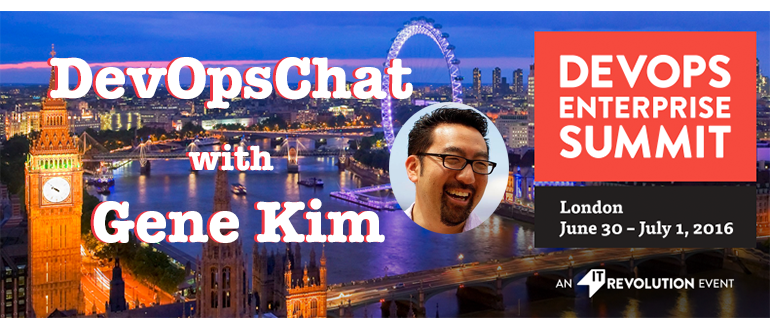
  • DevOps Chat: Gene Kim, DevOps Enterprise Summit London 2016

    DevOps Chat: Gene Kim, DevOps Enterprise Summit London 2016

    I recently had a chance to sit down with author and researcher Gene Kim about the upcoming DevOps Enterprise Summit in London (DOES). This is the first DOES out of the US and Gene and team are planning to make it a great success. Below is the audio of our conversation and below that is a the transcript of the conversation.

    Of course if you are thinking about attending DOES London, you can also attend next week’s DevOps Connect: CD Summit/Jenkins Days and receive a full credit towards a DOES London ticket. A great 2 for 1 sale. BTW, Gene mentions the DevOps Enterprise YouTube channel in our discussion. Here is the link for it: https://www.youtube.com/channel/UCkyYEVVmT9vQ4yPBR4ciFUA

    Enjoy!

    Alan Shimel:                Hi, this is Alan Shimel, devopsy.kinsta.cloud here for a special DevOps chat with Gene Kim, bestselling author, researcher and DevOps personality. Hi, Gene. How are you?

    Gene Kim:                   Doing great, Alan. Oh, my goodness. How about a researcher who loves studying high performing technology organizations.

    Alan Shimel:                Okay. Hi, I’m here with Gene Kim, a researcher who loves studying high performing technology associations and writes a good book.

    Gene Kim:                   Ah, love it. So much better.

    Alan Shimel:                All kidding aside, Gene, it’s a pleasure to have you on our show again. And we’re here to talk about the upcoming DevOps Enterprise Summit, London for 2016.

    Gene Kim:                   I love it. In fact, this has been so fun. It’s our first year in London and so it’s been amazing. Sort of tapping you know the network to find great DevOps transformation stories in large complex organizations. But you know after just a lot of hard work on behalf of the entire programming committee, you know I think it’s shaping up to be just a fantastic conference.

    Alan Shimel:                Yeah. I mean I had a look earlier today at the speakers announced and you know part of me was really happy that I knew a lot of the names of who are these speakers and part of me was really happy that I didn’t know a lot of the names, right. Because you always want to hear new stories and from new people. So I think there’s something for everyone there. But Gene, you know what I’ve had the pleasure and honor of being on a program committee with you for the RSA Rugged DevOps event we do every year and so forth. But a lot of our listeners may not really understand what goes on behind the scenes and how do you get great speakers. Would you give our listeners just a little bit of like pull back the curtain a bit and talk to us about how you always come up with great speakers?

    Gene Kim:                   Yeah. You know in fact, so let me first acknowledge the amazing programming committee that we have. One of them is Owen Gartner who is part of the DevOps initiative at Barclays Capital. Ben Grinnell, he’s at North Highlands Consulting Firm. There’s Marco Swindell from Accenture. There’s Benjamin Wootton from Sendachi Consulting. And then two committee members from the U.S. DevOps Enterprise Summit, which is Damon Edwards and John Willis, who are both a part of the DevOps movement from the very beginning. So the job of the programming committee is really to shape and to kind of form the vision of the conference and shape the talks to help achieve those objectives. And I think what’s been different about the DevOps Enterprise Summit is that you know we really aim to create a vendor neutral conference that really focuses on the technology leaders who are driving DevOps transformations in large complex organizations.

    And so it means that with some rare exceptions, you don’t have a lot of the speakers from the DevOps community speaking because they’re not you know in large complex organizations. And so you know the challenge really was to find these amazing stories out there of people driving these audacious transformations in you know very conservative organizations. And you know for that you need people who aren’t just well networked in the industry and in the local market. And so you know we spent, my goodness, five, six weeks just you know scouring our rolodexes, brainstorming about all these – this is where we’ve heard about DevOps transformations going on and then actively reached out and you know vetted them just to gain some assurance that you know they weren’t just talking a good game, but they actually had _____ to show for it.

    So you know as a first year conference, you know there was just a tremendous amount of work that went into that.

    Alan Shimel:                Sure. And Gene, you know to me it’s obvious why London, right. You know when we look at our own Google Analytics here at devopsy.kinsta.cloud, London is the second biggest city from an audience perspective for us. But I’m curious, why did you pick London?

    Gene Kim:                   You know it was because that was actually one of the feedbacks that we got from our speakers and attendees, that you know because we’ve had the DevOps Enterprise Summit now going into the third year in San Francisco on the West Coast of the United States, that is a very long way to travel from people in the UK or from the European continents. So you know the ask was, hey, can you hold it somewhere in the European Union, whether it’s in the UK or in the EU. And so we were actually considering London, the Netherlands and there might have been a couple other options, but ultimately we decided to do it in London just because that’s where our network was. And when I say the network, that’s where the program committee was and that’s where I think our network was strongest. Which was very important because I think it gave us the best chance for succeeding and generating you know the right programming, the right speakers and so forth, the right transformation stories.

    Alan Shimel:                And you know what, I’ll reiterate it. London is a fantastic town. The DevOps scene there is just happening. Not to date myself and sound all groovy, but it’s a happening scene and it’s a vibrant dynamic DevOps community as well. So I think you couldn’t have picked a better place to do it in, Gene.

    Gene Kim:                   You know it’s just a huge center of economic activity. You have a huge financial services industry. You have basically every type of you know industry vertical that are operating, you know in and around London. So, yeah, I agree, it was a great – and also where so much of the progressive DevOps activity is going on within government agencies. Like the UK.gov, the UK Digital Services, all that pioneered inside the UK government.

    Alan Shimel:                Absolutely. You’re a hundred percent right there, Gene. So, Gene, listeners who are listening to this, maybe they haven’t quite decided if they want to go to does London or not. Give me right now, have all the speakers been released or announced at this point or no?

    Gene Kim:                   No. And we’re about 60 percent announced.

    Alan Shimel:                Right.

    Gene Kim:                   But I can certainly share with you the talks that I’m super excited about.

    Alan Shimel:                Go ahead.

    Gene Kim:                   You know one of them is Ron van Kemenade. You know so he is famous for his work at ING as the Global CIO. And so many of us in the DevOps community were aware of the ING DevOps Days that was held in 2011. In fact, that was probably the event that kicked off the first Target DevOps Days and the first DevOps Days at Capital One. You know it was such a novel concept. And so Ron van Kemenade as the CIO, will be talking about you know their journey when ING back in 2011 was very much like Parts Unlimited and the Phoenix Project. You know it was certainly very different from the organization they’ve become where they’ve created a world class technology organization that is widely admired. And so I’m excited that he’ll be talking about his role as the technology leader and to tell the whole inside story of how that transformation happened. And I’m particularly excited that I’ve asked him to share you know in his mind, what does it mean to be a technology leader. You know it’s not about picking Cassandra over Redis, versus Zookeeper, versus NoSQL, versus you know MySQL, right.

    So what does it mean? I think that’s not well understood and certainly not well understood by me. You know there’s a talk from Robin Hughes from LV. So that’s the Liverpool Victoria Insurance Company. So multibillion pound turnover company. So again, an organization that’s been around for over a century and you know this is just a phenomenal DevOps transformation that was really driven by the operations team. And Robin Hughes will be telling the story about how they transformed one of the largest business applications inside their portfolio and enabled developer productivity. So I think that’s great. Anthony Collard, he’s the Deputy Director at HMRC. So that’s the Majesty’s Revenue Collection. So in the US we would call it the IRS, Internal Revenue Services. And you know they have over 60 scrum teams now working to help make life better for tax payers. Whether it’s the people at home or within businesses. And it’s just an incredible story about genuine innovation and creation of phenomenal efficiencies that you know haven’t been typically associated with the way government operates.

    In fact, I was so inspired by it, I actually wanted to voluntarily pay UK taxes just to reward these amazing efforts.

    Alan Shimel:                Don’t count me in on that one, Gene. Thanks. But it’s good for you. Let me also just throw a couple of other names that I recognize and got me all excited. One is actually a friend of mine that I’ve worked with, Jonathan Fletcher over at Hiscox.

    Gene Kim:                   Right.

    Alan Shimel:                I don’t know how much you know about Jonathan, but he’s brilliant. He’s not the – I don’t want to say the suit, but he’s not the title who leads the entire DevOps transformation there. But that person relies on Jonathan to make it happen. ‘Cause I’ve looked at that organization. This guy, I love listening to him talk about what they’ve done there.

    Gene Kim:                   And it’s another phenomenal story. Another insurance company.

    Alan Shimel:                Yep.

    Gene Kim:                   And I think what makes them so remarkable, so obviously they’re a multibillion British pound turnover company. But again, over 100 years old. And yet they’re growing at 30 percent in certain market segments.

    Alan Shimel:                Yes.

    Gene Kim:                   When that’s happening its putting tremendous pressure on the technology organization, you know for them to deliver what the organization needs. And so here’s an incredible effort initiative, where they – and this one is driven by kind of an operations platform and architecture that is enabling development teams to respond quickly to the market and scale with demand. Yeah.

    Alan Shimel:                Yeah.

    Gene Kim:                   I love that Hiscox story.

    Alan Shimel:                Yeah. No. The thing about Hiscox is you know though they’re UK based most of their business is on the continent. You know they have a large presence for instance in the Caribbean as well as the Western U.S. So this is a global organization dealing with regulations and I mean its insurance. I don’t want to tell well, too much on them and Fletcher, Jonathan is a tremendous, tremendous talent. I’m sure it’s gonna translate into a great presentation. Another one Gene, that I wanted to highlight if you don’t mind me stealing a little bit from you, is Gareth Rushgrove, you know who’s at Puppet now. But you know Gareth, besides curating the DevOps weekly newsletter, you know he has a great security background like we do, Gene. And I can listen to him all day.

    Gene Kim:                   Yeah. And what’s great is that maybe not so well known is that he was part of the early UK.gov effort.

    Alan Shimel:                Yes.

    Gene Kim:                   Where he had to deal with all of the regulatory and compliance bodies inside you know a very powerful central government, as well as the intelligence agencies. And so the fact that he was able to span those boundaries and earn the trust of those agencies and essentially help define kind of the next generation of security standards and strategies, is just a really inspiring one. It’s just a really neat guy.

    Alan Shimel:                Yeah. He’s a rock star. I just wanted to mention two others Gene and they’re from DevOps San Francisco who are I guess coming over to London. And that’s Jason Cox from Disney and Rosalind Radcliffe from IBM. Just two brilliant people and I just appreciate brilliance. So you know looking forward —

    Gene Kim:                   I love them both.

    Alan Shimel:                I’m sorry what, Gene?

    Gene Kim:                   What I love about the conferences if you take a look, this is like a great cross section across you know almost every industry vertical. So you’ve got Unilever from you know the consumer goods on the financial services. You have   Barclays from _____ –

    Gene Kim:                   – insurance companies. You’ve got Pearson Publishers. News UK is another publisher. Thomas Cook Group does retailing and travel services.

    Alan Shimel:                Yes.

    Gene Kim:                   Zurich Insurance. You know actually I never realized we have so many insurance companies. So we have 26 speakers announced. You know I’ll tell you another part of the programming committee is that a lot of these we handpicked from people from our own investigation. But then we also had I think it was about 80 submissions through our call for presenters. And so you can imagine how challenging it is when you have only 25 speaking slots, of which over half had already been taken.

    Alan Shimel:                Yeah.

    Gene Kim:                   You can imagine the vigorous debate about you know which talks really need to be a part of the programming. And I just very much appreciate you know the candor and the fact that everyone had the best interest I think for the attendees in mind as we were trying to figure out how do we create the best program for the technology leadership community around DevOps.

    Alan Shimel:                Yeah. And debate is a kind word. Gene, let me –

    Gene Kim:                   Yeah.

    Alan Shimel:                – pivot a little bit ’cause we’re running low on time. So we’ve got this great lineup of speakers. We’ve hit a bunch of them and there’s more yet. But okay, if they attend DevOps Enterprise London, what are they taking out of it. Give me three bullet points. What are the three lessons? What are the three most important things they’re taking out of their attendance at this event?

    Gene Kim:                   Yeah. I think the most important thing is that they are going to hear transformation stories of organizations that look like them. So I think in the DevOps community we’re very used to hearing stories from you know Google, Amazon, Facebook, Etsy, Netflix and so forth. But if you’re in a large insurance company that’s been around for over a hundred years or a government agency that’s been around for five hundred years, you know they don’t relate very well to those unicorns. So to hear how those same type of technology transformations have occurred in large complex organizations, that is the mission of the conference is to share 30 minute experience reports where each speaker shares what business problem were they trying to solve, where did they start and why. What did they do and what were their outcomes and what do they still not know how to do and what are they looking for help with. So, yeah, I think what I’ve heard over and over again is that you know these stories, when you go to this conference you’re surrounded with people just like us, right. Or rather just like me.

    I think the second thing that they’ll hear is that they’re achieving the same sort of outcomes you know in these large complex organizations that we’ve only typically seen in the unicorn organizations. But there’s an element to me that has a tremendous amount of significance and meaning is that each one of these leaders, even though they were given some degree of air cover, I mean it’s as much true for the London conference as for the two previous conferences in the U.S. Each one of these leaders I think wildly exceeded the air cover they were given. Essentially putting themselves into some degree of personal jeopardy. And so when you ask why would they do that? What you see that each one of these speakers have in common is that if they have a sense of utter clarity and conviction that the capabilities that they’re creating for their organization are needed in order to win in the marketplace, let alone survive in the marketplace. So there’s kind of this other dimension of just the hero nature of these stories that I just find so inspiring. And it’s been an honor to help chronicle.

    Alan Shimel:                Excellent.

    Gene Kim:                   Oh, and I guess the third dimension is like to see the value they’re creating. And I would suspect that in the London conference it’s going to very much match the U.S. conferences, where we’ve observed that one out of four of the speakers at the DevOps Enterprise has gotten promoted in the last three years. Many of them more than twice.

    Alan Shimel:                What a great metric.

    Gene Kim:                   Yeah. This is a reflection of you know I think the value that they’re creating is being recognized by their organizations and they’re being asked increasingly to try to replicate that across a broader portion of the organization and help elevate the state of the practice.

    Alan Shimel:                Fantastic. Well, if that’s not enough to get them to attend to DevOps Enterprise, London, Gene, I don’t know what is. But we’re almost at the end of our time here and we’re gonna have to wrap up. I just want to quickly mention for our devopsy.kinsta.cloud audience, that we will be out there and working with Robin and Todd and the team on setting up an interview area where we’ll be doing interviews with many of these speakers when they come off stage. And much like we did in San Francisco last year and also just hearing some great insights and stories from these folks.

    Gene Kim:                   Yeah. By the way, I’m hoping you’ll post in the show notes, I actually love the devopsy.kinsta.cloud interviews that you did. And so we have them all on the YouTube channel, where you can actually see all of your interviews Alan.

    Alan Shimel:                Yep.

    Gene Kim:                   As well as all the DevOps Enterprise talks from the years past.

    Alan Shimel:                Absolutely.

    Gene Kim:                   So I think it’s just a phenomenal resource for anyone who’s interested in this topic.

    Alan Shimel:                And that’s the DevOps Enterprise Summit YouTube channel.

    Gene Kim:                   Correct. Yes. And the link will be in the show notes.

    Alan Shimel:                Fantastic. I’ll put it in there. And I’ve actually featured many of them over the months on devopsy.kinsta.cloud. You can find articles and embeds and links to it as well. But Gene, let me let you go because I probably took up more time than I was supposed to. I apologize. We’re really looking forward to a smashing DevOps Enterprise Summit in London.

  • A Panel Discussion On What DevOps Looks Like In 3 to 5 Years?

    A Panel Discussion On What DevOps Looks Like In 3 to 5 Years?

    With all of the hype around DevOps, I wanted to return to a topic that I was lucky enough to moderate a terrific panel on at IBM InterConnect this past February. The panel was an all star one anchored by Gene Kim, moderated by myself and we were joined by Dan Berg of IBM, Michael Azoff, principal analyst at Ovum and Raghunath Raman of Kaiser Permanente.

    It was a lively discussion as we all had our own opinions on where DevOps may be headed and how this will impact how we do business. Unfortunately this panel was not video taped, so I cannot share it with you here. But I did get a chance to sit down and discuss this topic with three of the four panel members (I was not able to catch up with Gene as he was running right after our panel).

    So I wanted to share my discussions with each of the panelists with you. First is Raghunath Raman of Kaiser Permanente:

    Next up is Michael Azoff from Ovum. Also you may want to check  in a subsequent DevOps Chat I did with Michael a few weeks ago.

    Finally, last but certainly not least is IBM’s Dan Berg who I have had the pleasure of interviewing several times.  Dan’s interview was done a little later at the show, so is less focused on our panel subject. Our discussion on the panel comes in at about 2:58. Here is Dan’s interview:

    So what about the panel? Some of the highlights were that containers and microservices are going to become a major factor in development going forward. They won’t replace hypervisors totally, but they will become the defacto standard for building and deploying apps.

    Several of the panelists said they didn’t know if DevOps would be called out as DevOps anymore, it would just become the way things are done (something I very much agree with). Of course Gene was full of antidotal stories and studies of companies he has spoken with who are adopting DevOps. All in all the 45 minutes was way too short to dig in as much as one would like with four great panelists, but the standing room only crowd certainly got a lot to chew on.

  • State of DevOps Survey – The Ultimate Feedback Loop

    State of DevOps Survey – The Ultimate Feedback Loop

    If there’s any consistent criticism of the larger DevOps movement, it’s that the talking heads and industry gadflies are driving the conversation, not the people in the trenches.

    All the thought leadership panels and “how-to” content (including the written and AV materials on this very site) make for great watercooler discussion, but lack the input of those dev, ops and IT management pros who are actually living the DevOps experience, some critics have said.

    Well, fair enough. Talking heads are paid to talk. Thought leaders are chosen to lead the debate at conferences and on webcasts. Bloggers blog. Reporters report. This is simply the way of the world. Certain voices are heard via the channels they frequent. It is, as so many people are fond of saying these days, what it is.

    So what about everyone else? What of the people reading this stunning prose and listening to these talks while rolling their eyes based on the connectivity of it all to their real-world experience? How can their voices be heard?

    Independent of jumping into the blogsphere or applying to speak at said industry events – which you should, btw – there’s one significant opportunity available to anyone who cares to take the time – participating in industry research.

    Over the next few business days, citizens of the DevOps world will have their last chance to contribute to the industry’s most widely read and respected research project, the State of DevOps Report.

    If you haven’t done so already, take the time to fill out this year’s survey, and make sure that your voice is heard when the subsequent report is published in June. Sure, it takes a little time, about 15-20 minutes; but that’s because it goes to the trouble of exploring the real-world issues that weigh most heavily on today’s practitioners.

    Why is this particular project so important, or even credible? Consider that the minds behind the survey and analysis resulting in the 2016 State of DevOps Report are those authors and talking heads that actually get the most respect.

    Backed by DevOps Research and Assessments (DORA), the independent think tank operated by a partnership of Jez Humble, Gene Kim, and Nicole Forsgren – perhaps the most respected voices on the landscape, along with Nigel Kersten, the project is categorically aimed at surfacing the truth about DevOps adoption today – not merely promoting the interests of vendor sponsors.

    Like previous iterations of the report, the 2016 edition will focus on topics including IT performance, technical practices, culture, lean management, and organizational performance. This year’s survey also examines several new areas, including the ROI of IT performance, security and compliance, and containers.

    To further entice participation, project leaders are also offering free tickets to the DevOps Enterprise Summit, along with forthcoming books from some of the industry’s leading advocates to a lucky few who take the time to get involved.

    DevOps success is fundamentally based on the notion of increased collaboration and continuous feedback among the people scattered across the SDLC. Likewise, the legitimacy of this research project is utterly dependent on the input of as many real-world practitioners as possible.

    If you’re one of those individuals, and you really care whether or not everyone else involved in the advancement of DevOps understands what this all means to you, do yourself a favor and participate.

    Much like an application being built using DevOps practices, this quality of this project will be directly determined by the degree to which anyone with insight is willing to get involved and build toward optimal results.

    Take the 2016 State of DevOps Survey… today!

  • IT Revolution AnnoUNCES EARLY BIRD TICKETS FOR DevOps Enterprise Summit LONDON 2016

    Gene Kim to keynote, encourages IT leaders and software delivery practitioners from large enterprises in Europe to join the premier DevOps Enterprise event

    PORTLAND, Ore., April 11, 2016 – IT Revolution (http://itrevolution.com), the industry leader for advancing DevOps, today announced Early Bird ticket sales for DevOps Enterprise Summit London (DOES16), the premier industry conference for the leaders of large, complex organizations implementing DevOps in the UK and Continental Europe (http://events.itrevolution.com/eu/). Tickets for the conference, which is scheduled for June 30-July 1 at the Hilton London Metropole, can be found at (http://bit.ly/doesldnreg). Early Bird registration ends on May 2 and is highly encouraged, as the popular DevOps Enterprise Summit San Francisco event has sold out the past two years, while doubling in attendance.

    To start the event, Gene Kim will present the “Top Lessons Learned from DevOps Enterprise Summit” where he will deliver key highlights and takeaways from the stories of large-scale DevOps transformations and amazing results from companies all over the world. Want to join Gene in the speaker lineup? The call for presentations for DOES16 London closes on April 18 (http://bit.ly/LDNCFP) and abstract submissions should address the conference theme of “Leading Change,” and its sub-topics of organizational design in the enterprise, the functions of people, modern processes and technology adoption, and addressing security and compliance.

    “Our goal is to help accelerate the rate of DevOps adoption in large, complex organizations and to increase the probability of those transformations succeeding. One of the ways we do this is to understand the top obstacles in these transformations,” said Gene Kim, founder of IT Revolution and co-author of “The Phoenix Project: A Novel About IT, DevOps, and Helping Your Business Win.” “A great community is one that helps one another — by having leaders share how they’re overcoming the top obstacles identified last year, my hope is that we can quickly elevate the state of the practice.”

    IT Revolution and Premier Sponsor HPE Software are excited to present the inaugural DOES16 London event. DOES16 London programming will emphasize the evolving technical and architectural practices, and the methods needed to lead widespread change efforts in large organizations. The goal is to provide leaders in the UK and Continental Europe the tools and practices needed to deliver software innovation faster. DevOps Enterprise London provides keynotes, panels, breakouts, an “unconference” community space for spontaneous gatherings and an expo hall. Sessions will be led by leaders who are pioneering these practices in large and complex organizations across a wide range of industries.

    “As premier sponsor of the DevOps Enterprise Summit London, we are thrilled to be an integral part of the event,” said Tony Caine, vice president and general manager, EMEA, at HPE Software. “Now more than ever, DevOps is playing a crucial role in enabling businesses to become better at ensuring quality, maximizing speed and reacting to market changes, and for those looking to understand how to implement a successful strategy this event is a perfect opportunity for them to learn more and hear from experts within the industry.”

    For more information about DOES16 London, please visit: (http://events.itrevolution.com/eu/).

    Share This: Now Available: #DevOps Enterprise Summit London Early Bird Tickets! Register now: http://bit.ly/doesldnreg @DOESsummitEU #DOES16 

    About IT Revolution

    IT Revolution assembles technology leaders and practitioners through publishing, events, and research. Our goal is to elevate the state of technology work, quantify the economic and human costs associated with suboptimal IT performance, and to improve the lives of one million IT professionals by 2017.

    #

    Contact:

    Jeremy Douglas

    Catapult PR-IR

    303-581-7760, ext. 16

    jdouglas@catapultpr-ir.com

  • Gene Kim and Industry Experts to Discuss DevOps for High Performance IT at Perforce Conference

    MERGE 2016 Brings Speakers from EA, Dolby, McKesson, Scania, NetApp, Intel and Others to Address Software Development and Delivery Trends

    ALAMEDA, Calif., April 5, 2016 /PRNewswire/ — Perforce Software today announced that MERGE 2016, its user conference that brings together customers, partners and thought leaders to discuss software development trends, will take place at the Parc 55 Hotel in San Francisco April 13-15. During the conference, the 300+ attendees will discuss best practices for embracing trends such as DevOps and other shifts in enterprise collaboration.

    MERGE 2016 will feature talks on the merging of development and operations teams (DevOps), and the adoption of DevOps by many of the world’s most high-performing IT teams. Other topics addressed include the merging of DevOps with security, artists merging with coders, and distributed workflows merging with centralized workflows. Highlights from the conference include talks by Gene Kim, the leading authority on DevOps and IT operations, release engineering expert J. Paul Reed, and Perforce customers Samsung, Dolby Labs, EA, McKesson, Scania, Tableau, Intel and Citrix, among others.

    “We’re seeing customers across industries become technology companies and adopt software development practices like DevOps in order to remain competitive,” said Janet Dryer, CEO of Perforce Software. “MERGE 2016 will give attendees the inspiration, knowledge and tools they need to deliver real value to their customers in a software-driven world.”

    About Perforce Software

    Perforce Software helps companies build complex products more collaboratively and securely. Its highly scalable source code management (SCM) and collaboration platform, Perforce Helix, enables global teams to collaborate on any type or size of file. It supports both centralized and distributed (DVCS) workflows while safeguarding intellectual property with advanced behavioral analytics. Perforce is trusted by the world’s most innovative brands including adidas, Samsung, NVIDIA, Intuit, Pixar, Salesforce, EA, Ubisoft, and VMware. The company is headquartered in Eden Prairie, Minnesota, with offices in California, the United Kingdom, Canada and Australia, and sales partners around the globe. For more information, please visit www.perforce.com

    Media Contacts

    Global
    Ivana Gaspic
    Perforce Software
    Ph: +1 510-473-3186
    Mob: +1 415-955-7483
    igaspic@perforce.com

    US
    Michael Thomas
    Edelman
    Ph: +1 312-233-1361
    Mob: +1 773-822-6182
    michael.thomas@edelman.com

    UK/EMEA
    Maxine Ambrose/Nicola Males
    Ambrose Communications
    Ph: +44 1491 412944
    perforce@ambrosecomms.co.uk

    Logo – http://photos.prnewswire.com/prnh/20141021/153498LOGO