Tag: gene kim

  • New DevOps Book: Leading the Transformation

    New DevOps Book: Leading the Transformation

    When I first started researching DevOps and was looking for early enterprises that were successful but not “Unicorns” I was introduced to Gary Gruver. At the time Gary had led the transformation at Macy’s and he was talking about it at several DevOps events.  For me it was strong proof that DevOps could work beyond the native-cloud companies and start ups. Gary had made it work at Macy’s and at HP before that. In fact Gary had co-authored a book on his experience at HP, “A Practical Approach to Large-Scale Agile Development: How HP Transformed LaserJet FutureSmart Firmware (Agile Software Development Series)”

    I was lucky enough to meet Gary around then and have stayed in touch since then. He left Macy’s and was consulting helping companies transform from waterfall to agile and DevOps.  I knew that he was working on another book.  Well finally I am happy to report that Gary’s new book is now available:

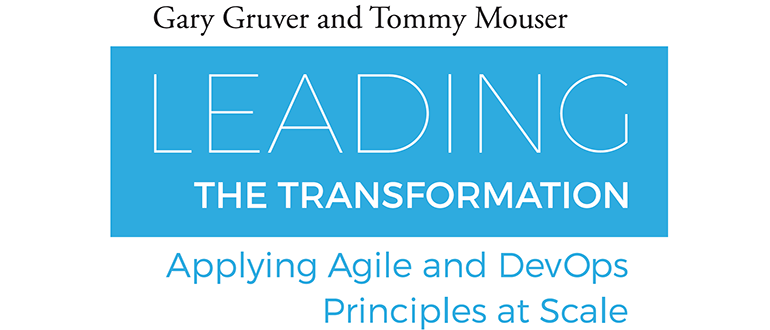
    leading the transformationLeading the Transformation: Applying Agile and DevOps Principles at Scale. Gary is actually co-author of this along with Tommy Mouser. The forward is by Gene Kim and the book is published by Gene’s IT Revolution.  I have just started reading it, but knowing Gary and from what I have read all ready, it should be a must read on your DevOps book list.

    As a special treat for readers of devopsy.kinsta.cloud, we are very happy and proud to offer our readers a sneak peek at this exciting new book. At the bottom of this article is a link to a PDF with the first two chapters of the book free for you to read! Of course we are sure that once you read the first two chapters you will head over to IT Revolution and buy the full copy.

    BTW, don’t take our word about how good Gary’s book is.  Here is what Jez Humble, VP Chef, author and DevOps leader said:

    “If you want to understand how to lead a Continuous Delivery or DevOps transformation in your company, there’s no better book than this. Concise, practical, and based on hard-won executive experience, this book is essential reading for every IT executive.”

    So click the link and enjoy!

    Leading the Transformation

  • Inside Look at State of DevOps Report: Q&A With Puppet Labs

    Inside Look at State of DevOps Report: Q&A With Puppet Labs

    Last week Puppet Labs released the analysis behind its annual study of DevOps and continuous delivery practices in the 2015 State of DevOps Report. Now in its fourth year, the report offers an in-depth look at the findings of the team on what it means to be a high-performance IT organization—the cultural characteristics these organizations share, the lean engineering practices they engage in and the technical architectures they depend upon.  Like last year,  however, the report tends to be a bit of a black box when it comes to actual statistical findings. While some figures do make it through, for example the oft-flogged statistic of high-performance organizations deploying 30 times as fast with 200 times the lead time of low performers stands pat, the report itself is somewhat oblique about the statistical basis upon which the designators of low-, medium-, and high-performance were determined.

    devopsy.kinsta.cloud spoke to Nigel Kersten, CIO for Puppet, and Alanna Brown, senior product marketing manager for Puppet,  about the report to get a little more detail, to have them explain the process behind the analysis, and to offer up some of the most important facets of their findings over the last few years.

    devopsy.kinsta.cloud: Can you tell our readers a little bit about the high points from the report?

    Kersten: Big finding from 2013 was the orgs that used Devops’ practices deployed code 30 times more often and had 50 percent fewer failures.  In 2014 what was quite fascinating was that we actually found a link between these practices and overall organizational performance, not just IT performance. Higher-performing IT organizations are twice as likely to exceed their own profitability, market share and productivity goals.

    If we fast-forward to today, the high-performing organizations using Devops practices are more stable and reliable than they’ve ever been.  They’re recovering 168 times faster from their failures and have 60 times fewer failures due to their changes.  So we’re not actually seeing throughput increase from the year before, but what we are seeing is the quality and speed has definitely increased.  So people are producing changes that are of higher quality and that require fewer rollbacks.

    And so what we’re concluding from the data that we’ve seen this year in the report is that there’s been a really huge focus to the left of the assembly line from production. So if we envisage the developer work flow application delivery, essentially we start with the developer laptop like on the far left, and on the far right is the application actually existing in production.  So from the point between the developer’s laptop and the actual release, we’re seeing organizations focus much more on that stage, putting more testing in the hands of the developers, and all of these practices not just being focused around the release but the pre-production stage of the application life cycle having a really huge impact upon quality.

    devopsy.kinsta.cloud: Why doesn’t Puppet publish the actual data from the survey? You have great analysis here, but there’s very little statistical proof behind it—why don’t you provide that?

    Brown: Well so we have a ton of data, and part of the reason we don’t issue the data is because you wouldn’t be able to actually get to the same results without doing a ton of data cleansing and statistical analysis.  So our analysis is actually fairly rigorous, and some of that analysis doesn’t really lend itself very well to graphs and charts and visuals and things like that because it’s all based on correlations and predictive regressions.  So that’s part of the reason.

    Kersten: I think in many ways it’s analogous to releasing software to the world. We have all of these tools inhouse.  We have all of these Excel spreadsheets we’ve put together.  We have all of these you know pivot tables and different bits of cluster analysis, but they only – they’re not particularly usable for anyone else right now.

    As much as we would love to work out how to polish all of that up and share it so it’s one big data set along with all of the tools, our biggest worry is honestly being that people would actually draw sort of misleading and incorrect conclusions from the data because of the level of analysis that was required.

    devopsy.kinsta.cloud: Can you tell us, then how you came to the determination of what’s a high-, medium- or low-performance organization? Because if you look at some of these numbers, you say they’ve got thirty times more deployment frequency. But of course they do because they’re high performers. So how does that work out statistically?

    Brown: No, no, you’re absolutely right, and I will agree that IT performance metric is a bit circular.  However, those are the actual metrics that are important to an IT organization, so they care about deploy frequency, deployment lead time, their mean time to recover and change failure rate.  So we feel like that’s a pretty good approximation or a proxy for IT performance, and it’s better you add at doing those things that is correlated to higher performance overall.

    Kersten: One thing, too, is that even though there’s a whole spectrum in terms of how fast people are able to actually deliver and ship code, what actually came out really strongly out of the survey this year and in previous years is that the high performance (orgs) definitely cluster in terms of data points. It’s not just a smooth spectrum, but there’s this really obvious clusters of high performance that leap out that all have a very high correlation of the kinds of practices they use.  So it is a little bit circular but it’s also it’s not that we’re seeing this smooth spectrum from zero to 100.  We’re seeing the masses and then the high performers, and they divide into quite clear clusters.

    Brown: Yeah, and they’re not arbitrary clusters; they’re actually statistical.  So the low IT performers share all the same characteristics and the high IT performers share all the same characteristics, so they’re very clear.

    devopsy.kinsta.cloud: OK, so let’s talk about some of those common characteristics between these groups if you’ve got statistical bases for these.  Tell me a little bit about the low performers and we’ll kind of go on up the spectrum and we can talk about the characteristics they share.

    Brown: So for IT performance, deployment pain was actually the number one most highest-correlated construct. And deployment pain consists of a couple of questions.

    Like how painful are your deployments?  Are they very disruptive events, etc?  So there’s three questions that we ask around deployment pain.

    The next thing that’s highly correlated with IT performance is version control. We use the version control for all production artifacts.  Following that is culture, and the model we use for culture comes from a guy named Ron Westrom who is a sociologist.  And he created a typology of cultures, and you can see the table in the report itself.  So he has a pathological culture, bureaucratic, and then generative.  So the more generative your culture is, the more likely you are to have higher IT performance.

    Kersten: And I think this is what was so fascinating for us when we first started adopting Westrum last year We actually adopted Westrum as part of the model in that this pathological versus generative cultures, this is the language our practitioners in this space use to talk about you know what’s so great about working there: “My ideas are valued. I get to create ideas.  I can create impact.” Similarly around what’s horrible about working at this other place.  It maps to the pathological and generative descriptions of organizations perfectly really.

    devopsy.kinsta.cloud: So what would you say is the key characteristic in that first leap from low performance to medium performance, based on your data?

    Brown: So the lower performers in terms of IT performance will be doing less automation, less testing.  They haven’t automated their deployments, for example.

    Kersten: I think one way I at least think about is that there are these characteristics that are necessary but none of them are sufficient on their own, and so you see people who say just adopted version control.  They’re definitely heading ahead of the pack of the people who haven’t adopted any of these tools.

    But there’s this transformative leap once you actually adopt version control and continuous delivery and the highly-automated conflict management system, that those things together are greater than the sum of their parts.  That is at least how the data seems to us, ’cause we don’t actually have this smooth little spectrum between low performers and high performers who just adopted one of those technologies.

    We definitely see improvement from those people, but it’s when they adopt all of them in total that they suddenly take this sort of order-of-magnitude leap.

  • Gene Kim shares his thoughts on upcoming Jenkins User Conference

    Gene Kim shares his thoughts on upcoming Jenkins User Conference

    DevOps is coming to Virginia June 18 and 19. The Jenkins User Conference is being held in Alexandria and one of the keynote speakers is none other than Gene Kim—one of the original leaders of the DevOps movement. I had a chance to speak with Kim about what he plans to present and about his thoughts on the current state and future direction of DevOps in general.

    Kim told me he’s looking forward to speaking in front of the Jenkins User Conference audience. One of the core elements of his presentation will be a closer look at the principles and patterns of successful DevOps organizations and the lessons we’ve learned so far as a DevOps community. He told me he’s not interested in “unicorns”—the big name companies like Netflix or Facebook that were early adopters and DevOps innovators. He is more interested in the “horses”—ordinary companies effectively employing DevOps to do extraordinary things.

    Over the last year or two I have written a number of articles around the theme of DevOps being undefinable. I’ve asserted that there’s no default DevOps solution and that if you asked 10 different organizations to define what DevOps means you’d get 15 different answers. Gene Kim does not agree.

    Kim told me that he takes the completely opposite position—that there are unmistakable characteristics of DevOps. An organization can choose to call something DevOps, but according to Kim if it’s lacking in these core elements it will not succeed.

    He said that there are certain core principles that comprise DevOps and enable organizations to develop and operate faster. The principles Kim listed were peer review, less management approval required, rigorous automated testing, the ability to create entire environments on demand, and one-click deployment. Many of the core elements are a reflection of the culture shift required to successfully implement DevOps.

    Kim didn’t just pull this stuff out of thin air, either. He and some partners recently shared the results of a comprehensive study of 9,200 organizations scattered across 110 countries. The research revealed that the high-performers—those who have successfully embraced these core principles—do better than the non-high-performers by two orders of magnitude or better.

    Put another way, those organizations that are employing DevOps effectively are poised to blow their rivals completely out of the water. DevOps isn’t just a different approach to infrastructure or development—it has a direct impact on the bottom line. One part of the study found that high-performers have 8,000 times faster lead times than their peers. How can an organization that isn’t using DevOps compete with a rival that can produce 8,000 times faster than they can?

    That brings me to the other aspect of the Jenkins User Conference that Kim is excited about: the diversity of the organizations represented there. Both in terms of the companies represented by the presenters and the companies represented by the attendees, it’s apparent that DevOps has reached a critical mass of mainstream adoption. Organizations from Agilant and AirBus to IBM, Perfecto Mobile and Pivotal have respected professionals sharing knowledge about DevOps.

    If you happen to be in the Alexandria area or plan to be in a couple weeks you should try to go to the Jenkins User Conference. If you’re company isn’t using DevOps you’re already behind the learning curve. If you don’t catch up soon a competitor will out-perform you by two orders of magnitude and you won’t have a company anymore.

  • DevOps Connect: SecDevOps @RSA the videos

    DevOps Connect: SecDevOps @RSA the videos

    Back in April we were proud to partner with RSA Conference, IT Revolution, Sonatype, TheNexus and RuggedSoftware.org to bring DevOps Connect: SecDevOps to the Moscone Center. It was a full day of great DevOps and Security presentations. For me personally it succeeded beyond my wildest dreams of highlighting the intersection of DevOps and Security.

    The line up of speakers and topics that day was extraordinary.  In no particular order:

    • Gene Kim/Josh Corman – Rugged DevOps: Going Even Faster With Software Supply Chains
    • Jez Humble – Continuous Delivery
    • David Mortman – DevOps Myths Versus Real World Realities
    • Julie Tsai – Windfall Wins: DevOps Empowers Agile Security and Compliance
    • Constantine Aaron Cois – DevOpsSecFail: DevOps Security Anti Patterns
    • Terri Potts – Leading a Horse to Water and Enticing Him to Drink
    • Nick Galbreath – BYOD: Bring Your Own Dependencies
    • Jessica Devita – No White Boards Allowed
    • Rich Mogull – Building Your SecDevOps Toolkit
    • Dan Cornell and Kris Curylo – Blending the Automated and the Manual
    • Damon Edwards and Alex Honor – Coaches and Toolsmiths
    • Dan Cundiff – Why DevOps != the Wild West and How Embracing it Can Improve Security
    • Chris Corriere – Automating Enterprise Security
    • Chris Walsh – I’m the New Security lead, and I’m Here to Help

    The good news is we had hired professional video crew to tape all of the presentations. Then through the efforts of Mark Miller and Derek Weeks of Sonatype the actual presentations were edited into the videos, creating a fantastic video recreation of the sessions.  Here is a short preview of sessions:

    In all there are over 10 hours of fantastic DevOps content here spread over the 14 presentations.  Through TheNexus and devopsy.kinsta.cloud we are making them available to you free. The only obligation is your fill out a registration form.

    Fill out the form here.

    Please note that the form submission will generate an email to verify your identity. You can access the entire video library via that email.  We ask that you please not share the URL of the videos and instead direct viewers to this page or TheNexus to download for themselves.

    Also, if you are attending InfoSecurity Europe this week, be sure to check out DevOps Connect: Rugged DevOps, Thursday, June 4 all day at the Olympia. Here is the lineup:

    Agenda

    8.30- 9.00             Meet and Greet

    9.00-9.10              Introductions: Alan Shimel and Wai Man Yau

    9.10-9.50              Keynote Presentation: Dr. StrangeOps: How I Came to Embrace Rugged DevOps & SW Supply Chains, Joshua Corman, CTO, Sonatype and Rugged  

    9.50-10.30           Maintaining Control While Letting Go, Gareth Rushgrove, Puppet Labs

    10.30-11.00         Security at Speed; Best Practices for a Secure DevOps Implementation, Florin Coada, IBM 

    11.00-11.30         The DevOps Toolkit, Helen Beal, Head of DevOps, Ranger4 Limited

     11.30-12.00         A Manifesto for High Velocity Compliance, Justin Arbuckle, Vice President, EMEA & Chief Enterprise Architect, Chef

     12.00-13.00         Opportunity to visit the Infosecurity Europe Exhibition

     13.00-13.30         Secrets Within Your Java-Based Software Supply Chain, Derek Weeks, VP, Sonatype & DevOps Advocate

     13.30-14.00         Automating Security Tests for Continuous Integration, Stephen de Vries, CTO, Continuum Security

    14.00-14.30         SecDevOps 2.0- Managing your Robot Army, Elizabeth Lawler, CEO and CoFounder, Co-Founder Conjur Inc

    14.30-15.00         Case study: DevOps Cost-Effectively Secured Quality and Time-to-Market for a Complex Hardware/Software Network Product, Marc Hornbeek, Senior Solutions Architect, Spirent Communications

    15.00-15.15         Afternoon break

    15.15-15.45         DevOps:  How the Industrial Revolution Got Us Here, Jonathan Fletcher, Enterprise Architect – Technology & Platform (DevOps) Lead

    15.45-16.15         Transforming to Devops in the Enterprise, Benjamin Wootten, Co-Founder, Contino

    16.15-16.45         SecDevOps: From Zero to $2.5B Revenue in 18 Months, Justin Lundy, CIO/CTO, Evident.io

    16.45-16.50         Thank you and close, Alan Shimel and Wai Man Yau


  • IT doing more faster is the DevOps way

    IT doing more faster is the DevOps way

    Pillar_DoMoreFaster-coverMy friends at JumpCloud asked me to contribute to an Ebook they wrote on “Doing More Faster now with IT control”. The idea was to take the concept made famous by David Cohen and Brad Feld in a book and as the mantra for Techstars and apply it specifically to IT.  I was part of an all star team, each assigned to write a section.  Gene Kim, Ben Kepes, Tony Bradley and Raj Bhargava each contributed. My section is on BYOD.  Gene Kim writes about DevOps (no surprise there), Ben writes about hybrid organizations.

    But I don’t write this article to blow my own horn about writing a chapter in a book (maybe just a little). Rather I read Brad Feld’s blog post on it today and as much of what Brad writes, it made me think. As Brad said doing more faster generally is a good thing. But as the saying goes, “speed kills”. Going faster can spawn a cascade of other issues. Dealing with them is often the key to success. On that note Brad calls out three things about organizations who successfully do more faster:

    • They decentralized decision making
    • They push the pace of their product development by more closely aligning with customers
    • They create a culture of action

    In terms of DevOps, isn’t in many ways the idea of doing more faster core to it? So to me doing more faster is as much a mantra in DevOps as it is at Techstars. I don’t know the idea that IT wants to do more faster is just natural to me.  But again on Brad’s blog I was reminded that is not the belief of everyone.  There was one comment on the blog when I read it today:

    Does IT matter? 🙂
    IT has been outsourcing and offshoring itself for the past 15 years, and that trend is on-going.
    “Fast” and IT are oxymorons. But if there is hope, that’s great.

    I read this comment and it occurred to me. This fellow is pretty sour on IT.  While I think we are living in a golden age of IT and technology, there are some who believe that IT is slow non-responsive and “outsourcing and offshoring itself for the past 15 years.”   My first reaction is do you still think we are off-shoring and outsourcing so much? To me that pendulum has already swung back.  Then I thought even if didn’t what difference does it make?  If you are having development done off shore or outsourced does that slow you down? Does it prevent you from doing more faster?

    One of the benefits of trends like DevOps is that we are doing less outsourcing I think. But really is fast and IT an oxymoron?  What IT team abused this poor fellow?  I just don’t get it.  Am I missing something or just living in a bubble?  What do you think?

    In the meantime, you can download and read the ebook yourself from: http://go.jumpcloud.com/it-decentralization-doing-more-faster.html

  • A True Story: DevOps(Sec) Manages Out Elective Risks

    A True Story: DevOps(Sec) Manages Out Elective Risks

    A True Story

    There are over 2000 developers in Bill’s organization.  He is a C-level executive for one of the largest insurance companies in North America. Bill boosted developer productivity by 15% last year after taking a closer look at the company’s software supply chain. And this approach isn’t unique to Bill’s organization.  Many high performance IT and DevOps teams are adopting proven supply chain principles to accelerate software delivery.

    Origins, Quality and Integrity

    The concept was rather simple and straightforward.  Bill’s team recognized that they were consuming hundreds of thousands of open source and third-party software components to build their applications.  But at the same time, they did not apply much scrutiny to the origin, quality, age, or integrity of those components.  Developers simply selected components at-will that met their functional requirements and helped them meet the next delivery deadline.

    Secrets of the Free-For-All

    Deeper analysis of their practice revealed that the free-for-all component sourcing methods were leading to quality, efficiency, and productivity issues.  Here is what Bill found:

    • The company had downloaded an average of 27 versions of over 100 different binary artifacts over a one year period.  Bill knew this meant the quality of their applications was being impacted through the use of outdated software components.
    • The company had also downloaded 13,203 software components with known security vulnerabilities — and 65% of those included alerts earlier than 2014.  Without quality controls in place, Bill recognized they were sourcing in elective and avoidable risks that would impact the integrity of their application, grow their technical debt, and lead to more rework down the road to replace the flawed components.

    Removing Complexity

    Bill decided to take action.  He knew that to accelerate innovation, he needed to remove complexity from the company’s software supply chain.  He enacted three moves to eliminate waste and complexity within the open source and third-party components being used:

    1. Automate the scrutiny of software suppliers to minimize risk and bloat.
    2. Enable real-time traceability and visibility to components used across the development lifecycle, in order to improve response times when defects were discovered – cutting back from days/weeks to minutes!
    3. Reducing complexity, rework and risk by standardizing on specific components types (e.g., web frameworks, logging frameworks, encryption modules), using fewer and more current artifact versions, and managing out elective security risks.

    Want to hear the rest of the story?

    The same principles that Bill applied to his business that boosted developer productivity by 15% are being discussed by Gene Kim (@RealGeneKim), author of The Phoenix Project, and Joshua Corman (@JoshCorman), CTO of Sonatype, on April 30th.  Both Gene and Josh are huge fans of marrying DevOps practices with leading supply chain management principles that enable developers to maximize throughput of features from “code complete” to ‘in production,” without causing chaos.

    If you’re looking to achieve similar goals, be sure to join Josh and Gene for this April 30th, 1pm ET, discussion.


    josh corman, gene kim

  • Welcome to the ADC (After DevOps Connect) era of DevOps and Security

    Welcome to the ADC (After DevOps Connect) era of DevOps and Security

    I was speaking with Britta Glade of RSA Conference after our DevOps Connect conference at RSA Conference Monday.  She congratulated us on putting together a great day of tracks and sessions (kudos to Gene Kim and Josh Corman).  But then she said something else that really struck me to my core.  She said after today there is no longer any question about security working with DevOps.

    Think about it.  Three years after Josh and Gene first presented Rugged DevOps at RSA Conference. After so many papers, articles, presentations and tracks, it has finally sunk in.  Security will embrace DevOps, Security will be better because of DevOps and as importantly, DevOps will be better because of Security.

    It is very fulfilling to know that this event we produced (along with Mark Miller and theNexus Community) was what finally pushed this over the finish line. For me personally it really represents one of the fundamental reasons I was so attracted to DevOps.

    It was 4 or so years ago that I first met Gene Kim and over a bottle or two of wine he explained to me what DevOps was about and what he was working on with the Phoenix Project.  While DevOps may seem primarily about Dev and Ops to some, for me it was about making security work better. It seemed like such a no brainer that of course security should embrace DevOps.

    But it was not that easy.  The besieged security industry faced with a never ending barrage of breaches and a continually escalating threat environment could not accept that automation, acceleration, velocity would also allow us to shift security left, leaving us more secure and more compliant. Many security people dug in their heels and said no, this wouldn’t work and they didn’t take the time to really explore it.

    Monday all of that changed.  Security folk came out in droves to see people like Jez Humble (many people in the audience weren’t really familiar with Jez when he first took the stage, but they were enthralled with him by the time he stepped off. Jez finished to a standing room only crowd of close to 700. They heard Damon Edwards and Alex Honor talk. Though they were also unfamiliar to the crowd, their message resonated to the core.

    When Julie Tsai of Walmart took the stage the audience heard how a “unicorn” like Wal-Mart used Agile and DevOps to be more secure. Terri Pots of Raytheon and Jessica Davita of Microsoft re-enforced the message that security needs to embrace this approach. I loved Jessica’s security org chart.  Chris Corriere who writes here on devopsy.kinsta.cloud, Dr. Aaron Cois of Carnegie-Mellon also had great sessions.

    Then names familiar to the crowd, Gene Kim and Josh Corman kicked it off with a great talk on Software Supply Chains.  Nick Galbreath had a great session. David Mortman delivered a terrific talk, Dan Cornell on web app security and more.  For me the perfect ending was when my friend Rich Mogull took the stage and demonstrated his Squirrel Monkey toolset. Rich’s scripts that he wrote himself showed how we could use automation to make our security better and easier.  People were stunned.

    Throughout the day, the buzz that was coming down the big hallway was that there were some great things happening over at the DevOps tracks. People from the Cloud Security Alliance meeting next door were hopping over to check it out. Other people joined in.  By the end of the day we had given out all of the materials we had prepared.

    By now I know you are wishing you were there.  The good news is the entire event was videotaped. We will have videos and slides of all of the presentations shortly so stay tuned.

    We are already starting to plan next year’s event. Also, the call for speakers is now open for DevOps Connect: Rugged DevOps event @InfoSecurity Europe June 4th.  But after Monday DevOps and security will never be the same again.  No longer can security deny that they must be part of DevOps. We are and should be. We are now in the ADC (After DevOps Connect) era.

  • Live Blogging DevOps Connect @RSAC

    Live Blogging DevOps Connect @RSAC

    We will be live blogging the DevOps Connect: SecDevOps event from RSA Conference on Monday, April 20th. Stay tuned for updates

  • First wave of sessions and speakers announced for DevOps Connect: SecDevOps @ RSA Conference

    First wave of sessions and speakers announced for DevOps Connect: SecDevOps @ RSA Conference

    As we previously announced there will be a DevOps Connect: SecDevOps @ RSA Conference this year at the Moscone Center.  The event takes place Monday of RSA Conference week at the Moscone Center.  The program committee for the event is headed up by Gene Kim and Josh Corman.  Gene and Josh will be delivering the keynote for the event as well. More on that will be announced soon.

    Today we are happy to announce the first wave of speakers and sessions selected by the program committee to present at DevOps Connect: SecDevOps.  The first wave of selections are:

    Automating Enterprise Security by Chris Corriere of Autotrader.com (and devopsy.kinsta.cloud) – How to automate security scans and make the remediation process as easy as possible for everyone involved.

    I’m the new Security Lead, and I’m Here to Help by Chris Walsh of Signal – How a new security hire learned from and Agile+Devops team, added security to the mix, and made people happier.

    DevOpsSecFail: DevOps Security Anti Patterns by Constantine Cois of Carnegie Mellon University – Common security anti-patterns I’ve observed in DevOps implementation and process.

    Blending the Automated and the Manual: Making Application Vulnerability Management Your Ally by Kris Curylo of Ally Financial and Dan Cornell of Denim Group – Security in DevOps is often laser-focused on automation. This talk looks at methods to incorporate manual tasks in a non-disruptive manner.

    All four of these sound like excellent presentations. There will be many more sessions to announce soon. With a little over a month until RSA, stay tuned for more information soon including some surprise guest speakers.

    Many thanks to everyone who submitted responses to the CFP for the event. Just because you were not selected in this first wave does not mean you are not selected.  Stay tuned for more speaker announcements shortly.

  • Five Great Books on DevOps

    Five Great Books on DevOps

    While the DevOps movement began in earnest in 2009, there are still a lot of questions about what DevOps means, how it’s done, and what the purported benefits of DevOps are. Big questions, for sure. And there are no quick answers. In fact, to thoroughly answer each would require numerous books.

    Which brings us to the question, what are the best books that define DevOps, describe how to operationalize it in the real world, and show what beneficial outcomes one could expect?

    Here are my choices of five great books on DevOps, in no particular order:

    Book: The Phoenix Project

    Authors: Gene Kim, Kevin Behr, George Spafford

    This one is a fictional story, written in engaging novel style, that tells the story of how to apply DevOps to unleash IT’s potential. The story is about Bill, the IT manager at the fictional company Parts Unlimited. Not an exciting business name, but the adventure starts in earnest when on a drive to work, Bill gets the call from the CEO that sets the story in motion.

    The book’s cover description tells it best:

    The company’s new IT initiative, code named Phoenix Project, is critical to the future of Parts Unlimited, but the project is massively over budget and very late. The CEO wants Bill to report directly to him and fix the mess in ninety days or else Bill’s entire department will be outsourced.

    With the help of a prospective board member and his mysterious philosophy of The Three Ways, Bill starts to see that IT work has more in common with manufacturing plant work than he ever imagined. With the clock ticking, Bill must organize work flow streamline interdepartmental communications, and effectively serve the other business functions at Parts Unlimited.

    In a fast-paced and entertaining style, three luminaries of the DevOps movement deliver a story that anyone who works in IT will recognize. Readers will not only learn how to improve their own IT organizations, they’ll never view IT the same way again. 

    As one Amazon reviewer put it: “This “parable” of how applying DevOps to pull out of an IT death spiral of delays and defects is an enjoyable read backed with great references and support materials for understanding the principles underlying DevOps. It’s not enough to get you all the way there, but it will get you inspired to start down the path.”

    Book: Continuous Delivery: Reliable Software Releases through Build, Test, and Deployment Automation

    Authors: Jez Humble and David Farley

    This seminal read is all about putting into practice rapidly and consistently delivering new highly-functional software to your users. From the back cover: “Through automation of the build, deployment, and testing process, and improved collaboration between developers, testers, and operations, delivery teams can get changes released in a matter of hours—sometimes even minutes-no matter what the size of a project or the complexity of its code base.”

    The book covers automated infrastructure management and data migration and the use of virtualization, and automating creating, integrating, testing, and deploying software, as well as improvement collaboration within the teams.

    As one Amazon reviewer put it, “This is an absolute must read for anyone in software or application development. It is amazing how well the authors capture the real pain points and provide all the information you need to getting to a more effective IT practice.”

    Book: The Visible Ops Handbook

    Authors: Kevin Behr, Gene Kim and George Spafford, IT Process Institute

    This is the first book I ever read on IT process improvement, and it was an eye-opener for me. This book came out about 4 years before the term DevOps was coined, but it nailed the essence of what high-performance IT is all about. And it’s an essential read today:

    Visible Ops codifies how these [High performance enterprise] organizations achieved their transformation from good to great, showing how interested organizations can replicate the key processes of these high-performing organizations in just four steps:

    1. Stabilize Patient, Modify First Response – Almost 80% of outages are self-inflicted. The first step is to control risky changes and reduce MTTR by addressing how changes are managed and how problems are resolved.
    1. Catch and Release, Find Fragile Artifacts – Often, infrastructure exists that cannot be repeatedly replicated. In this step, we inventory assets, configurations and services, to identify those with the lowest change success rates, highest MTTR and highest business downtime costs.
    1. Establish Repeatable Build Library – The highest return on investment is implementing effective release management processes. This step creates repeatable builds for the most critical assets and services, to make it “cheaper to rebuild than to repair.”
    1. Enable Continuous Improvement – The previous steps have progressively built a closed-loop between the Release, Control and Resolution processes. This step implements metrics to allow continuous improvement of all of these process areas, to best ensure that business objectives are met.

    As this Amazon reviewer this had to say, this fall, on the book: “This is the first and foremost required reading on my team! If you are an IT professional, you must read this. It is a concise, powerful expression of how to reinvigorate your operation and become a top performing IT organization.”

    Book: DevOps for Developers

    Author: Michael Hüttermann

    This book is for software developers and engineers that aim to help improve the delivery of software by using lean practices to get apps and software into production.

    From its description:

    DevOps for Developers is for motivated software engineers, particularly programmers, testers, QA, system admins, database admins, both beginners and experts, who want to improve their software delivery process. It’s the perfect choice for engineers who want to go the next step by integrating their approaches for development and delivery of software. This book is for engineers who want to shape their processes and decide on and integrate open source tools and seek for guidance how to integrate standard tools in advanced real world use cases.

    And as an Amazon reviewer put it: “Developers tend to produce updates in short cycles whilst admins prefer a stable system. And if something bad happens, they often start finger-pointing to blame the other side. One solution is to tear down the silos of development and operation. In other words, set up integrated teams.

    This is the core message which Michael Hüttermann would like to stress out. Agile methods and tools might be used for development as well as for deployment and operation. In his book, Michael explains how to do and which (free) tools to use.”

    To be fair, the book has taken dings about not being a programming book, and repeating some of its concepts. But the value in this book is its real-life examples, and explanations as to how different roles on teams in Dev and Ops can work together more collaboratively. It also dives into common pitfalls organizations hit in their journeys of operationalizing DevOps.

    Book: The Goal: A Process of Ongoing Improvement

    Authors: Eliyahu M. Goldratt, Jeff Cox Author, David Whitford (Other Contributor)

    The Goal is the second fictional book in this list. Written more than 30 years ago, it could have been written yesterday. When discussing concepts and systems, many times story is the way to go because the motivations and thought processes of different roles can be discussed in depth and elegantly so. The Goal succeeds in this, and is a must read for anyone who seeks to help be a catalyst of improvement in their organization.

    From the book description:

    One of Eli Goldratt’s convictions was that the goal of an individual or an organization should not be defined in absolute terms. A good definition of a goal is one that sets us on a path of ongoing improvement.

    Pursuing such a goal necessitates more than one breakthrough. In fact it requires many. To be in a position to identify these breakthroughs we should have a deep understanding of the underlying rules of our environment. Twenty-five years after writing The Goal, Dr. Goldratt wrote Standing on the Shoulders of Giants. In this article he provided the underlying rules of operations.

    This article appears at the end of this book.

    Here’s what an Amazon reviewer had to say: “I have often heard myself complaining that companies over complicate the simplest of activities. Measurements do not truly measure the end result and are often held in a high regard by executives. These measurements cause further loss and mask the true issues. This book was fascinating, very “simple” in a sense which lends to making it even more fascinating. I learned a lot about the production aspect of my “department” which would often not be looked as a production department in the literal sense of the word. Thought provoking and inspirational, every leader can benefit from the story told. A must read.”

    I would love to hear from you, what are the most important books on DevOps that you’ve read?