Tag: digital transformation

  • How ESM Enables Digital Transformation

    How ESM Enables Digital Transformation

    The pandemic has forced organizations of all sizes to overcome colossal challenges and embrace flux. We’ve all heard stories about businesses having to adopt a new communication tool and train staff overnight, but that’s just the tip of the iceberg.

    Many companies are in the middle of fundamental transformation, enabling enterprises to create more business value quickly. Still, digital shifts can also highlight stumbling blocks—such as inefficient management of people, tools and processes.

    As modern business needs grow increasingly complex and require teams to do more with less, C-suite executives have learned that real value lies in customizable systems built for scalability, automation and collaboration. In the same way, companies have embraced DevOps to break down silos between development and operations teams, modern businesses are adopting enterprise service management (ESM) principles to create shared responsibility and opportunity across departments.

    This approach has helped businesses view their digital transformation plans in a new light. Forward-thinking leaders are using ESM to enable a DevOps mindset, to centralize knowledge and ensure efficient digital service delivery within their organizations over the last twelve months.

    The Business Benefits of ESM

    ESM includes the tools and processes that enable an organization to manage the entire life cycle of IT (or other business units’) services. At an organizational level, it can be considered analogous to service-oriented architecture rather than an application architecture level.

    Within larger organizations, multiple teams are often doing similar things to support different parts of the business. Keeping track of requests, prioritizing them and ensuring the right resources are available can be challenging. With ESM, companies can consolidate their resources and provide a consistent way for the organization to consume them. Akin to microservices, employees can easily access shared company services through a uniform interface, streamlining resources management.

    The approach encourages enterprise leaders to see everything the company does as an integral service to the entire business. So, rather than an accounting team merely existing to process purchase orders and take care of payroll, it becomes a service provider. For example, they might create a portal that provides templated service requests for everyday tasks, such as raising a purchase order or understanding if a payment has been received, and a mechanism for capturing ad-hoc work that isn’t otherwise defined.

    The real benefit of this approach is work management. A ticket is raised, and the department dealing with it can have a rotation of people, with whoever is least busy picking up the service request, assessing and resolving it or assigning it to someone else. That’s one reason it’s hardly a surprise that 87% of companies surveyed in 2019 said that they had already incorporated ESM in some way.

    Practices, Not Processes, to Optimize Digitization

    However, with businesses forced to undergo historic digital transformations over the last year, ESM has become even more valuable for organizations. The pandemic has shifted work management to a 100% digital initiative as teams were distributed remotely. A well-executed ESM strategy has enabled enterprises to take their digital-first workflows to a higher level, driving more value from employees and enabling organizations to scale service delivery and create unrivaled customer experiences.

    ESM requires businesses to understand that there is no one-size-fits-all approach to service delivery and encourages them to replace their process-orientated mindset with an approach that focuses on value delivered through practices. These practices, which are built on user interaction and feedback, support agile organizations by helping them accelerate change and make services more available and reliable for customers.

    Furthermore, these practices put users’ pain points and needs front and center to ensure continuous improvement. Through frequent evaluation, enterprises can address the things that matter the most to staff and customers. While this might seem like a basic practice for any company’s digital transformation plans, the truth is in many cases, we’ve found the practice to be widely neglected. A recent report from Eagle Hill Consulting found that one-third of U.S. employees say their company’s technology either doesn’t help or makes it more challenging to serve internal and external customers.

    Digitization driven by these ESM principles can enable businesses to improve operational efficiency, reduce cost and risk, and plan strategically to support their evolving needs. All of these are, of course, what every organization had in mind as goals when the COVID-19 pandemic forced them to rethink how they do business.

    ESM Automation and Cross-Departmental Visibility

    At a high level, ESM sets out to bring all internal services into one place where every employee can easily find what they’re looking for in an instant. Accessing everything in one place also opens the door to leveraging automation. The option for automation means that some previously manual tasks – like providing access to systems – can be automated, speeding up wait times for staff or external customers and ensuring scarce resources, like your best people, are used more efficiently.

    Moreover, common, consistent and shared platforms for all with a single access method gives individual departments enhanced visibility and control throughout the entire organization. Historical silos hampered individual business units’ visibility and understanding of the functions their business provides or how they’re processed. A unified portal where all departments can access resources and receive requests, in the same way, solves that.

    Of course, this isn’t to take away from the inevitable learning curve that comes with digital transformations, especially at the size, scope and scale currently being undertaken. But the turnaround time from disconnected, slow, siloed teams to visible, open, speedy services far outweighs the effort required. In fact, recent research from Digital.ai uncovered just how badly visibility problems and poor internal alignment plagued businesses, with 56% admitting they’re worried that they’ll fail to achieve any return on investment from their stagnant digital transformation initiatives.

    On the other hand, industries like finance, which have upscaled self-service and automation significantly in recent years, have built entirely new business models with collaborative technologies, accelerated innovation cycles, and have learned to make better, faster decisions.

    These companies all embraced technology to empower their employees to help customers get the most from their service. In doing so, they are better able to deliver the best business value, which is core to a DevOps mindset and is achievable with successful ESM strategies.

  • 3 Reasons Your Digital Transformation Stalled

    3 Reasons Your Digital Transformation Stalled

    The more a company modernizes, the more value it gets from the cloud, but not all digital transformation efforts are created—and executed—equally. According to Gartner, “87% of senior business leaders say digitalization is a company priority, yet only 40% of organizations have brought digital initiatives to scale … [and] without a shared vision across the organization, digital transformation efforts will continue to stall.”

    CIOs and other senior technology leaders are constantly looking for the best way to lead and scale modernization efforts that positively impact the business and generate the most value from the cloud. Here are three factors to consider to make sure digital transformation efforts don’t start to slow or stall out entirely.

    The Price of Ignoring Technical Debt

    Any CIO should be able to say how much of their development efforts are invested in innovation and how much is going into maintenance. A harder number to take into account is how much their innovation development effort is slowed down by technical debt.

    A good way to gauge this for CIOs—if you can say that your development organization dedicates more than 50% of its effort to innovation and that your development velocity is exactly where it was a couple of years back, then technical debt is not dragging you down. However, chances are that’s not the case.

    Why is that? A major reason is that the vast majority of business applications and business logic still reside on-premises in legacy applications and infrastructure with a once-solid software architecture that is now showing signs of wear.

    The technical debt these applications accumulated takes a toll. It is a ‘tax’ that many CIOs know they need to pay; know what is required, but choose to ignore until it’s too late.

    Many organizations delay modernization because they believe that it reduces the capacity for effort that can be spent on innovation, assuming that legacy maintenance can just carry on as usual. With the potential for a lengthy and risky modernization project, delaying innovation for that length of time is not even an option. The only way to stop ignoring technical debt is to find a way to reduce the risk of modernization and accelerate the modernization project so you can go back to doing what you love about tech: innovating.

    Managing App Modernization as a Tactical Project

    It’s amazing that application modernization is so often viewed as a tactical project—time- and materials-based, cost-focused—versus a strategic imperative driven by business goals. This approach also explains why many projects fail to meet expectations, are half-finished or abandoned or never even get started in the first place.

    The business logic and processes embedded in your legacy application estate are your core intellectual property and competitive advantage, and they need to be treated as such. These applications, and the business processes they encapsulate, require a strategy that continually modernizes them, starting now and continuing into the future. A one-and-done approach is a recipe for disaster and disappointment.

    So be strategic, make sure your modernization plan is aimed at reducing technical debt, restoring velocity and focusing on innovation. Once you get there, make sure you continuously manage your technical debt and keep your velocity high.

    Reliance on Lift and Shift for Cloud Migrations

    Cloud migration projects are most often critical parts of digital transformation initiatives, and yet, many outside advisors or quick-win focused insiders will push for the “easiest” approach.

    A rational plan to transform and modernize your applications for the cloud requires a critical assessment of your application estate to determine which applications should be refactored, lifted and shifted (rehosted or platformed), rewritten or just retired. Skipping this critical step and categorizing the majority of your apps into the “lift and shift” category is a common mistake that too many enterprises later regret. A lift and shift strategy may be fine for a subset of your applications, but for the most important ones it will result in a transfer of your technical debt to the cloud, increase your maintenance costs and take another bite out of your organization’s ability to innovate.

    Digital transformations are getting bogged down by technical debt, tactical decisions and modernization shortcuts. Organizations need to directly address these issues and reduce the significant drag they are incurring on modern transformation initiatives. By attacking them head-on, enterprises can accelerate their cloud migrations, application modernizations and business agility goals.

  • Decentralized Autonomous Organizations (DAOs): Org-as-Code

    Decentralized Autonomous Organizations (DAOs): Org-as-Code

    We are all familiar with ‘everything-as-code’—a pattern that started with infrastructure-as-code and has now extended to other areas such as architecture-as-code,  security-as-code and more. However, all the incarnations we have seen so far have been less than ambitious! The dawn of cryptocurrencies and the underlying blockchain technology is moving us firmly toward organization-as-code. Org-as-code is the most disruptive evolution we have seen so far. The crypto world uses a different term for it: decentralized autonomous organization (DAO).

    Before you freak out because, “OMG crypto!” let me assure you that I am not trying to sell you any of the 9,000 (at last count) cryptocurrencies. Undoubtedly, crypto has polarized public opinion. There are crypto maximalists who believe that crypto is the solution to everything. You often hear, “Bitcoin solves it!” Then, there are the crypto skeptics who dismiss the movement as simply digital tulips—a Ponzi scheme at scale for the internet age. Only time will tell if they are right.

    Now, my opinion falls in the gray area in between, where some groundbreaking new ways of working are evolving. People across the globe are collaborating in decentralized, efficient, democratic and non-hierarchical ways in the world of crypto. Radical new constructs for the internet age are being piloted—DAOs, smart contracts, pseudonymous identities, tokenomics, etc. just to name a few.

    This post is firmly focused on DAOs.

    So, What is a DAO?

    A DAO is a way to work with like-minded folks around the globe where the business (the org) is owned and managed by its members in a democratic way.

    “In traditional organisations, people are at the core and automation is at the edge; whereas in DAOs, automation is the core and people are at the edge.” – Vitalik Buterin

    As opposed to traditional organizations that are structured in a top-down hierarchy, with many layers of management and bureaucratic coordination, DAOs provide an operating model for people and institutions that do not know nor trust each other, who might live in different geographical areas, speak different languages and, therefore, are subject to different jurisdictions. Instead of legal contracts managing the relationships between people, computer code enforces the rules.

    Some of the key features of a DAO are:

    1. An organizational setup based on rules and policies that are encoded as computer code.
    2. The rules are transparent and controlled by members, not a central authority; usually, on a public blockchain.
    3. Rules are executed by a set of smart contracts independent of human (not even the creators!) involvement.
    4. Built-in treasury that no one has the authority to access without the approval of the group/community.
    5. Decisions and ideas are governed and funded by proposals that are voted on and managed through voting by token holders.

    Colony.io is one startup that helps set up DAOs. A screenshot below from their site gives you an idea of the elements of organizational design that can be (re)defined in the radical new DAO world.

    DAOs features

    Do We Really Need DAOs ?

    Here are a few challenges that DAO attempts to resolve that you often see in conventional centralized organizations:

    • Good ideas struggle to reach the top.
    • The system incentivizes authoritarian leadership.
    • Failure to tap into the wisdom of the crowd.
    • There is a higher probability of spectacular failures driven by the greed of a few, as evident from examples such as Enron or the 2008 financial crisis.
    • There is usually a lack of transparency in decision-making.
    • Good policies exist—usually on paper or hidden away in by-laws—but are not executable.
    • Single points of failure are natural due to the asymmetry in organizational structure.

    Examples of DAOs

    Before you dismiss this as utopian and unrealistic, here are a few real-world of examples of DAOs in play

    1. Nexus Mutual—A decentralized ‘people-powered’ alternative to insurance which operates as a DAO. It is run entirely by its members. Only members can decide which claims are valid. All member decisions are recorded and enforced by smart contracts on the Ethereum public blockchain.
    2. DAI and MKR—A stable decentralized currency (DAI) and platform for decentralized finance apps (with a market cap of about $5 billion).
    3. The DAO ( Đ)—A form of venture capital that started as a crowd-funded token sale. There was no conventional management structure or board of directors. But it got hacked in 2016, and a third of funds were siphoned off. (This is a key example to remind ourselves that if the org is code, then security issues can be near-fatal.)
    4. DASH —A digital cryptocurrency. A DAO run by a subset of users called masternodes, which perform standard node functions like hosting a copy of the blockchain, relaying messages and validating transactions on the network, and which, in addition, act as shareholders, voting on proposals for improving DASH’s ecosystem.
    5. Flamingo DAO—A DAO that deals in digital art via NFTs. NFTs are non-fungible tokens, not non-functional testing!
    6. Gitcoin —Uses DAO to fund digital public good projects ( $24 million funded so far using a quadratic funding model)

    These are just a few examples. Adoption is exploding, and stretching into areas like charities, freelancer networks, venture funds, investment clubs and more.

    DAOs are still emerging, and there are many aspects that are yet to be fully explored, especially around legal status, regulatory frameworks and compliance. It is, however, only a matter of time before the DAO way of working becomes mainstream.

    In my view, it is not a binary question between DAOs and conventional organizations. Adopting many of the practices of DAOs will strengthen traditional organizations and reduce some of the weaknesses we touched on earlier.


  • Big Gains Are Made In The ‘Last Mile’ of DevOps

    Big Gains Are Made In The ‘Last Mile’ of DevOps

    A new study by mabl found a correlation between complete, fully automated test coverage and a significant increase in customer happiness and DevOps maturity. In contrast, those with moderate DevOps maturity and nearly automated testing coverage tend to experience a sharp decline in end-user satisfaction.

    Mabl recently released its 2021 State of Testing in DevOps Report, a study that highlights the state of DevOps adoption and quality testing throughout the software industry. According to Dan Belcher, co-founder, mabl, the study results clearly show that true business returns are made in the last mile of DevOps adoption.

    I recently met with Belcher to hear his viewpoint on the major takeaways. Below, we’ll explore these and other insights from the 2021 State of Testing in DevOps Report.

    State of DevOps Maturity

    Nearly one in four teams have a mostly mature DevOps methodology and automated process. Still, a significant portion, 52%, are still aspiring or striving to fully embrace a mature DevOps model. A small percentage, 11%, have a fully automated DevOps software development pipeline in place. The bulk of teams are still using manual deployment processes and disparate frameworks, limiting the potential for full automation.

    Interestingly, non-technical barriers remain the most common inhibitor to realizing a completely automated development pipeline, found the report. Out of these obstacles, reluctance to change was the most common barrier, cited by 29% of respondents. Other challenges to DevOps adoption include budgetary constraints, DevOps not being a company priority and internal politics.

    When added up, non-technical roadblocks account for 82% of the problems that hinder complete DevOps adoption. On the one hand, this depicts the cultural challenges associated with introducing DevOps in an organization. On the other, it could signify the wealth of DevOps packages and open source tooling available to manage areas like automated deployment and version control. The report found GitHub, Jenkins, Gitlab, Azure Pipelines and BitBucket among the five most commonly used DevOps Tools.

    Although it’s growing rapidly, continuous delivery is still an emerging trend; almost half of developers still deploy code less than once a month. Only 15% of teams are deploying code daily or multiple times per day. This echoes findings from CDF’s State of Continuous Delivery Report, which pegged this figure at 11%.

    Fully Automated Testing

    Testing is a critical component of the software life cycle. With the need to ensure functional applications and high-grade security, automated testing is helping teams discover more errors earlier in the development process. According to the report, the most popular test types include UI or functional tests, unit tests, regression tests, integration tests and end-to-end tests. Non-performance tests and visual testing ranked lower. Naturally, the teams that have implemented fully automated pipelines are automating more types of these tests.

    In general, it appears test automation aligns with DevOps maturity. The report found that those with fully automated testing experienced significant net customer experience gains. For example, 72% of teams that were automating regression testing indicated their customer happiness is pretty good or amazing, whereas this figure sank to 6% at companies not automating regression testing. And 80% of teams with high test coverage report high customer happiness, whereas only 30% of teams with low test coverage report high customer happiness. Nonetheless, much has yet to be fully automated—similar to the state of continuous deployment, the bulk of teams rely on a combination of automatic and manual testing approaches.

    In terms of tooling preferences, Selenium ranked as the most popular option for functional testing, with 41% of developers using it. The report also found migration toward Cypress, Smartbear and other functional testing tools. Interestingly, the report also uncovered a noticeable lack of adoption when it came to automated API testing—only about one out of three are automating their API tests. Postman, SoapUI, internal tools and ReadyAPI are among the most popular tools for running manual API tests.

    As I’ve covered before, APIs are surging in use across digital transformation initiatives. Web APIs are an increasingly common mechanism for delivering data to partners and consuming third-party software-as-a-service (SaaS). Full API testing coverage will be essential to audit the entire end-to-end digital experience. Low-code API testing is one way to reduce barriers to auditing the highly technical area of integration.

    Key Takeaways

    DevOps success is a ‘last mile’ problem. There is much variance in DevOps maturity and testing coverage. It’s pretty flat until you reach that last point, when breakthrough results occur. “Success in DevOps is a ‘last mile’ problem,” said Belcher. “The difference between 90% and 100% of the way there is dramatic.”

    Quality really matters. Though much tech discussion focuses on increasing delivery speed, code quality is just as important. “This isn’t about speed at all costs, it’s about innovation with velocity and quality,” said Belcher. “Quality engineers are just about as key to success as developers writing code.”

    DevOps success is less about technology and more about people. As the report found, the majority of the roadblocks to DevOps maturity are non-technical. “The things holding us back, as an industry, are more about leadership and figuring out our processing than introducing more technology,” said Belcher.

    Breaking down role silos is still fundamental to DevOps. Some see DevOps as instrumental to opening collaboration between roles. Simultaneously, there is the idea that new tooling dashboards will arm individual developers with complete ownership to develop, test and deploy software (known as full cycle development).

    Belcher believes that the full cycle momentum has been misinterpreted to mean developers alone have full accountability. Instead, he frames developers as a pitcher on a baseball team; leading the game, but utterly incapable without the rest of the team. Similarly, disparate roles should be working together, said Belcher. Reaching that ‘last mile’ of DevOps is not only about CI/CD or full cycle development; it’s about working together as a group.

    I’ve only scratched the surface of many findings from The State of Testing in DevOps. The report queried 600 quality engineers and software development professionals and offers loads of additional insights on the state of DevOps, testing, CI/CD and more. You can view the full results here.

  • Digital Customer Experiences: The Future is Modular

    Digital Customer Experiences: The Future is Modular

    With the proliferation of microservices and APIs, will UIs go modular too? Some technologists note a rising trend around smaller, intent-based customer experiences that more directly mirror API endpoints.

    I recently met with Adam Evans, co-founder and CTO of Airkit, to better understand what’s broken with today’s digital customer journeys and how they need to evolve. He predicted that single-purpose experiences will become more pervasive in the future. In the process, we’ll likely encounter fewer native apps and fewer downloads. To enable all this, he’s putting faith in low-code to bring easier integration and automation patterns to more developers.

    The State of Digital Experiences

    Digital customer experiences are becoming increasingly connected and web-based, and at times, disconnected from the core service. In headless environments, end users are engaging with companies through more and more abstraction layers, such as chat, SMS, voice or email notifications. These interactions are increasingly modular and event-driven, noted Evans.

    Increasingly, user encounters are the result of trigger-based patterns activated when user action is required. Not only is the communication style changing, but new devices and platforms have emerged, further making a case for a decoupled development approach. B2C apps become more modular in this transition, presenting experiences built around specific tasks and closely reflecting the specialized microservices or APIs that drive them. Consider the rise of the single page application (SPA) style or AWS Lambda as evidence.

    As more automation and subscription models enable a “set and forget” attitude to commercial software, Evans predicted we’ll likely see more intent- and event-driven workflows emerge. He said these reimagined UIs would shroud platform complexity and, instead, focus on single, specialized actions, like submitting an insurance claim, checking the status of a package or updating your coffee subscription.

    A Broken Customer Journey

    So why would end user digital experiences evolve into more intent-driven applications? Well, complex digital platforms can get feature-bloated very quickly. Bulky applications with many menus are difficult to navigate, thus impacting user experience.

    As Evans describes, generic interfaces often display tons of information irrelevant to the task at hand. “Don’t make me go through generic interfaces to help me do something specific,” he said.

    Clunky interfaces are at odds with small digital tasks that involve an attention span of 20 seconds or less. Evans describes these as “micro touchpoints in our daily lives where you don’t need traditional, large applications.” These actions could be, for instance, looking up COVID-19 infection rates, checking your credit card balance or updating a streaming subscription, he said.

    Organizations have other imperatives to improve user experience, too. For example, if a platform isn’t self-service, it can increase support calls, which can cost a company significant resources. Plus, if the service isn’t event-driven, users must routinely check in of their own accord, which could waste time and encourage tech anxiety.

    Single Page Applications

    In the age of modular microservices, the days of bulky apps and “manual polling” may be limited. To Evans, the solution lies in expressing the “minimum way to represent the transaction of that interface.”

    “How do we keep moving smaller divisions from the back end to the way interfaces are built?” Evans asked. Similar to the way microservices architecture separates domains, Evans noticed UIs segmenting attention along API endpoints. He envisioned more single-purpose experiences being constructed that extend APIs and microservices with a user interface.

    Technically, this may result in more single page applications being developed. Niche UI layers that map APIs would likely carry a data model, Evans described, so that micro apps are delivered with data for entering fields into API calls. As they are web-based, asynchronous single-purpose experiences could also transcend the barriers of app stores and third-party marketplaces.

    Potential Benefits of Modularity

    More intent-based workflows mean less overhead for the user, bringing quicker, more convenient access to the problems they want solved. Sure, users still register with a core service, such as their bank, coffee subscription service or insurance agency for centralized account management. But, users frequent account centers less often, as the periphery of interactions around them continues to grow.

    “The future of apps will look more like individual, intent-based micro apps,” Evans reiterated. These would reflect a metronome of touchpoints Evans called “little moments of delight.”

    Pinging users only when action is required could reduce check-ins, thus reducing digital anxiety. Aside from the user benefits, deployment and maintenance for small applications may be easier to support, said Evans. Lastly, more isolated intentional customer experiences increase engagement, response rates and sales, he added.

    Using Low-Code For Customer Experiences

    Connected digital experiences are relying more and more on APIs. Yet, API integration can be difficult, even for experienced programmers. So, how do we make it easier for people to build interfaces to hit these APIs? Building user-facing layers on top of APIs will require great developer experience, says Evans.

    Lately, low-code has been dominating these discussions. With greater emphasis on visual-driven development, low-code is empowering non-technical employees. To Evans, low-code capabilities will be essential to influence how future customer journeys are constructed.

    Evans noted how low-code “changes the whole game around how apps are built.” For example, branded experiences often require reusable code and common libraries, all of which low-code platforms excel at. In addition, when working with APIs, a “layer over REST design is essential to maintain state and enable long-term processing,” he said.

    Will The New Digital Journey Go Micro?

    Complex interfaces seem to work for conglomerate giants like Amazon. But other scenarios may benefit from more single-purpose workflows. As platforms become more extensive, the user interactions need to become leaner to avoid added stress. As a result, Evans predicts that micro, trigger-based B2C touchpoints will become more common in the coming years. In this paradigm, better UI extensions of common APIs could help bring people into the equation.

    “We’ll see a lot of cool stuff in the next decade,” he said. “Future apps won’t look like what past ones looked like.” As IT moves to support new, multiple channels, such as chat, voice, web and VR/AR, our perception of what an application is also will inevitably alter.

    In tomorrow’s “great unbundling of apps,” as Evans called it, “if you don’t use it every day, there’s a pretty good chance it doesn’t need to be there.”

    There are many schools of thought on the best methods to retain quality user experiences. Do you think modularity is the answer? What do you think tomorrow’s digital experiences will look like? Feel free to let us know in the comments below.

  • How Low-Code/No-Code Can Transform Your Organization

    How Low-Code/No-Code Can Transform Your Organization

    For many companies, IT transformation is no small feat. Between the technology, process and organizational changes needed, it can take time to see a return on your IT transformation efforts and investments. So it’s no surprise that low-code/no-code is starting to be seen as a compelling solution for some.

    With low-code/no-code, you can empower teams of ‘citizen developers’ and enable experienced developers to accelerate deployment and reduce IT backlogs. To gain insights on the ways that low-code/no-code can transform your organization, I asked several DevOps Institute Ambassadors for their thoughts. Here’s what they said:

    Brendan O’Reilly, DevOps Specialist, Daysha DevOps

    Low-code/no-code introduces urgency into an organization. By removing the bottleneck that is scarce development resources, you can reduce the lead time to value.

    Mark Peters, Technical Lead, Novetta

    Low-code situations are likely best for highly tailored situations, with clearly defined purposes and minimal changes. Low-code can work when your business depends on scaling rather than creating new code. If the business is good enough, and one is adding microservices or more instances of the same expanded for a larger market, low-code can be perfect. Implementing low-code then allows the next opportunity to move from some code to no-code, providing a graphical interface to change architecture, implement policy or change recurring controls through mouse clicks rather than code. This also provides an excellent chance for improved ops control; if one is scaling the number of users, controls can be implemented to ensure the graphical delivery does not hard-code a password into the system, instead of relying on approval checks within an alternative interface.

    Vishnu Vasudevan, Head of Product Engineering and Development, Opsera

    When an organization practices DevOps, they continuously expand by team, product, platform and application because of different solutions coming into the market. Incorporating a low-code/no-code approach gives enterprises the ability to speed time-to-market and expand engineering capabilities beyond IT.

    If you have a low-code platform that can help manage and provide visibility into technology and security compliance, that’s a gold mine for any developers or any organization. For example, anytime a new application comes in, teams can use a template from the previous application and put it over the new application. The same security quality of the audit governance is quickly established as a baseline, and all the developers have to do is focus on coding.

    Shriniwas Sathe, DevOps Chief Architect and CoE Leader at Capgemini

    Low-code/no-code tools can help change the way that regular employees interact with technology. With no-code tools, every employee, regardless of their background, can create custom applications, websites, forms, etc. With low-code tools, this can be taken a step further by building upon the offerings of a no-code tool by coding in the unique features needed by the organization. This is much less time-consuming compared to traditional development processes, even though it requires a general know-how of coding.

    With every employee able to contribute to new applications and tools, there’s a better chance of obtaining unique insights and unforeseen capabilities. You can also simplify processes to an extent where regular employees can benefit from the freedom from tedious and repetitive tasks. There are low-code/no-code tools for most industries, which gives you a choice of either a ready-made solution or one that can be customized to your particular requirements.

    Peter Maddison, Founder, Xodiac, Inc.

    Low-code development platforms are great at automating important procedures using drag-and-drop editors that allow citizen developers to create virtual models of an app’s business logic and user interface.

    A major advantage of having an enterprise no-code platform is the presence of built-in governance capabilities. No matter what an IT team’s size, a central console offers visibility for all applications and environments so that they can keep track of any issues or vulnerabilities.

    Business developers can use the solution to create applications that fit their unique business needs. And more than one developer, or a team of developers, can work on the same module at the same time.

    Of course, we need to ensure we are providing appropriate guard rails so our citizen developers are not able to accidentally expose data or create additional risks through the solutions they create.

    If you’d like to learn more about the latest in low-code/no-code and similar topics, check out the upcoming SKILup Day schedule. Or, learn more about the benefits of becoming a DevOps Institute Member.

  • Digital.ai Deepens Value Stream Management Integration

    Digital.ai Deepens Value Stream Management Integration

    Digital.ai announced today it has expanded usage of machine learning algorithms within its namesake value stream management (VSM) platform to include modules to optimize flow and improve application quality in addition to enhancing its risk prediction and process optimization modules.

    In addition, Digital.ai has expanded the number of pre-built integrations it now provides for hundreds of DevOps tools and platforms.

    Derek Holt, general manager of agile and DevOps for Digital.ai, said the goal is to expand the bi-directional flow of data between the core Digital.ai platform and modules and tools provided by the company and its third-party DevOps partners.

    Digital.ai was formed from the merger of XebiaLabs and CollabNet VersionOne. The combined company has rolled up Numerify, a provider of analytics tools infused with artificial intelligence (AI), Experitest, a set of testing tools and Arxan, a provider of an application security platform. With the latest release, these capabilities have been integrated into the core Digital.ai platform in a way that goes well beyond merely providing access via a common user interface, said Holt.

    The goal is to provide organizations with a VSM platform through which better decisions can be made to optimize software development and delivery by first collecting data from all the DevOps tools employed and then using machine learning algorithms to surface optimization recommendations, noted Holt. As application development environments become more complex to manage, it’s already apparent that most IT teams will require AI capabilities embedded in a VSM platform to manage interdependent projects, noted Holt.

    Armed with those recommendations, it becomes simpler to reallocate resources in the event a critical project is going to be completed later than planned or shift resources to make sure that project is completed on time. A VSM platform also enables IT organizations to assess the impact those decisions will have on the rest of the business at a time when organizations have never been more financially dependent on the timely delivery of software. The late delivery of a single application module can wind up having a profound impact on revenue projections for organizations that increasingly rely on digital processes to engage customers.

    A recent survey conducted by Digital.ai found that many digital transformation initiatives are struggling, to some degree. Nearly half of respondents (49%) said they are not seeing the results they expected from their digital transformation efforts, and 54% admitted they were worried about their ability to compete. Over 90% need to see a better return on their digital transformation investments.

    Digital.ai claims it currently has more than 1,200 customers, including Allianz, Commerzbank, eBay, Janus Henderson and Levi’s that are using elements of the Digital.ai platform to better manage software development projects. Many of the users of those tools now include business executives and other application stakeholders that are employing a VSM platform to track the progress of application development projects. Digital.ai Analytics Lenses that are domain-specific make it simpler for different classes of end users to access pre-built dashboards and metrics, noted Holt.

    The market research firm Gartner has predicted that 70% of organizations will employ a value stream management platform by 2023 to improve flows across their DevOps pipelines. However, as DevOps platforms and project management applications continue to evolve, many are also adding many of the analytics capabilities found in a VSM platform. Each IT organization will need to decide which approach makes the most sense for them, but Digital.ai is clearly betting that as application development becomes more challenging, the need for an integrated VSM platform will become much more apparent.

  • Despite Cloud Adoption, Enterprises Demand On-Premises Software

    Despite Cloud Adoption, Enterprises Demand On-Premises Software

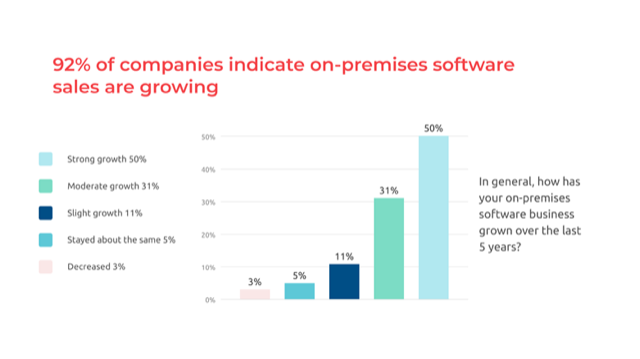
    A recent report from Dimensional Research reveals that the demand for on-premises software is equal to that of public cloud. The report, which was commissioned by Replicated, a company specializing in on-premises software modernization, queried 405 participants in software development, executive, product management, sales and services roles to determine the needs, usage and challenges of on-premises software.

    The report revealed that some 90% of companies surveyed said their on-premises sales of software solutions continue to rise, while 70% that do not currently offer on-premises solutions intend to in the near future. 

    “In the past few years we’ve experienced a steady increase in interest from leading global companies who see that modern on-prem software delivery through containers and Kubernetes can make data protection and security much easier,” said Grant Miller, co-founder and CEO of Replicated. “Coupled with growing customer demand, it’s a win-win scenario for any industry.”

    While Miller’s view may be optimistic, the survey also revealed that the majority (65%) of companies cited privacy compliance as the top reason for using on-premises software delivery; an indication that the market is being influenced by cybersecurity issues more than any other factor. However, 54% also stated uptime and reliability were a primary driver for on-premises solutions, while 45% noted the importance of integration.

    The report indicates that enterprises, which have cited digital transformation and a movement towards the cloud as critical factors over the last two years, may also be thinking more about on-premises solutions in light of cybersecurity and compliance concerns. This, in turn, means that DevOps has the potential to gain even more traction in the enterprise. 

    While the report mentions the merits of an on-premises software strategy, it does raise the question of why more enterprises have not moved in that direction already. That hesitation to re-embrace on-premises software can mostly be attributed to perceived complexity, time commitments and the cost of engineering resources to make it happen. 

    Complexity is further highlighted by 74% of survey respondents reporting that it would take more than a week to install and configure on-premises software, and 29% stated an install could take over two months. For the 16% that claim they can rapidly install and configure on-premises software in less than a week, the potential for growth in the market is notable. 

    While the future remains somewhat uncertain, the report from Dimensional Research runs counter to other reports, such as a Synergy Research Group report that revealed in 2019, spending on cloud platforms edged past the resources spent on acquiring servers and software for on-premises data centers. “60% of the servers now being sold are going into cloud providers’ data centers and not those of enterprises,” said John Dinsdale, a chief analyst at Synergy Research Group, confirming the trend. “Clearly, companies have been voting with their wallets on what makes the most sense for them.”  Dinsdale said the growth of cloud infrastructure will continue to accelerate aggressively over the next five years. 

    Although conflicting observations tend to add to the market confusion, one thing is certain – DevOps shops have market opportunities to service customers deploying both to the cloud and on-premises software.

    on-premises

  • DAOPS Meetup 2021: Software Engineering, DevOps and DevSecOps

    DAOPS Meetup 2021: Software Engineering, DevOps and DevSecOps

    DAOPS Foundation—a non-profit organization committed to accelerating global digital transformation through technical standardization—is hosting the first ever DAOPS Meetup on May 18. The virtual meetup will bring together DevOps leaders from Sonatype, DevOps Institute, TARS Foundation and DAOPS Foundation to discuss the latest in software engineering and the latest DAOPS developments.

    Here are the four sessions scheduled for the DAOPS Meetup.

    ASEM, Next Generation Software Engineering Infrastructure

    Software is the core of digital transformation. In the digital era, the way we produce software also needs to be digitized. Forest Jing, chief evangelist at DAOPS Foundation, explains how they plan to help global enterprises build a high-performance, technical organization based on Lean, Agile, CI/CD, SRE, DevSecOps, Cloud Native, etc., by developing the next generation software engineering infrastructure named ASEM.

    Best DevOps Practice with TARS

    TARS is a high-performance RPC framework based on name service and Tars protocol, also integrated administration platform, and implemented hosting-service via flexible schedule. During this session, Mark Shan, chair at Tencent Open Source and TARS Foundation, will share the best DevOps practice using TARS.

    DevOps Hybrid Skills — Upskilling towards EverythingOps

    Upskilling is a human endeavor and a key contributor to personal and career growth. This past year was like no other. As we progress through the “next normal” of this decade, one thing is certain—digital transformation relies on human skills transformation. DevOps has continued to shift left in recent years, becoming more integral to operational processes as manifests in domains such as secure-development-focused DevSecOps, secure-operations-focused SecOPs, artificial intelligence-based AIOps, machine learning-focused ModelOps, and data management-related DataOps. As each of these evolves, its specific required skill set is being fleshed out and internal IT staff have the opportunity to upskill to meet requirements. Join Dheeraj Nayal, global community ambassador at DevOps Institute, to learn all about DevOps upskilling.

    The Rise of Next Generation Software Supply Chain Attacks

    Cameron Townshend, Solution Architect from Sonatype

    The adoption of open source in software development has grown exponentially over the past decade. Yet, the time required for hackers to exploit a newly disclosed open source vulnerability has shrunk by 93.5%. As development teams deliver new innovations, adversaries are also upping their game; something we’ve seen in recent high profile and devastating cyberattacks, such as Dependency Confusion.

    Adversaries have the intent and ability to exploit security vulnerabilities in the software supply chain—and in some cases plant vulnerabilities themselves. They have increased scale through automation and improved breach success through precision targeting. Cameron Townshend, solution architect at Sonatype, urges developers to fight back by doing the same: automating security directly in the DevOps pipeline.

    For more information and to register visit the DAOPS Meetup website.

  • The Role of APIs In Digital Transformation

    The Role of APIs In Digital Transformation

    Digital transformation is increasingly propelled by rapidly changing user expectations. Release frequency is increasing, as is the need to connect a growing number of applications and digital experiences. As a result, 83% of IT specialists consider API integration critical to their business, found the State of API Integration Report.

    Application programming interfaces (APIs) hold powerful sway in tech discussions of late. Building API-first could increase internal reusability. APIs have become a standardized machine-readable mechanism for connecting partners. There is also a hot market for API startups, meaning APIs are becoming products in their own right.

    APIs are also enabling change for large enterprises. I recently connected with Bernd Gross, CTO at Software AG, to get his perspective on the role APIs and integrations are playing within the new wave of enterprise digital transformation. Below, we’ll see how connected customer experiences, digital business excellence and a new ecosystem-driven economy are driving the emergence of more API-based strategies.

    Three Drivers of the Connected Enterprise

    Businesses continue to transform into more connected enterprises. Once relegated solely to improving back-office efficiency, digitalization efforts are being applied across the board — to employee management, assets, machines, partners and the supply chain at large, said Gross.

    Amid rising digitalization, connectivity is the glue that unites disparate elements and tools. A fully connected world is “the new flavor of digitalization,” said Gross. To his point, ‘connected experiences’ is a crucial driver for 68% of platform providers, The State of API Integration Report found.

    So, how are APIs fueling the new connected enterprise? Gross identified three key reasons why integration is now fundamental to enterprise digitalization initiatives.

    Software AG Marketecture, used with permission.

    1. Connected Customer Experience

    Many organizations “want to transform into a technology and software company,” said Gross. To participate in the connected digital economy, organizations are striving to create advanced 360-degree customer experiences. Today’s technology needs to “look beyond a PC application,” Gross said. These experiences must cater not only to desktops and smartphones but also to IoT devices and physical assets.

    For example, he explains how one large elevator company architected an embedded connected experience, incorporating digital touchpoints within elevators to showcase signage, entertainment and ads, opening new monetization possibilities. This change was so radical that the mechanical engineering company pivoted its mission statement, reimagining itself as a “vertical transportation company.” Soon, their AI-enabled elevators will predict behaviors and optimize travel times, so they are always on the right floor, waiting for human riders.

    Intelligent building technology is similarly being applied by digital-savvy hotels, Gross explained, which is especially important for contactless visits during the pandemic. A fully digitalized customer experience could involve automated check-in, a room access code sent to a smartphone, an online billing system, physical sensors and more. Enabling a seamless digital hotel experience sounds easy, but it’s technically quite challenging — there are endless integration requirements to connect. In some cases, it would take 24 integration points, noted Gross.

    2. Digital Business Excellence

    Gross recognized the high expectations for modern digital experiences. He described a “new trend of business excellence in delivering more of an end-to-end digital experience.” This means data can no longer be locked up; even traditional companies must transition to platforms to offer software and data to their end users. In the process, interesting things may occur — your customers could become partners, Gross adds.

    He described how one medical company, a leading centrifuge producer, sought to build more digital experiences to complement their hardware. Though the machine functioned seamlessly, there was no easy way to port data results to other applications. This inhibited initiating the fully digitalized workflow required for a smart lab experience.

    In this case, APIs were imperative to opening up back end cloud services to enable smooth user interfaces and end-to-end workflow automation. “Intuitive user interfaces must integrate all services, including cloud and on-premises services, to create and automate workflows,” Gross explained. “To do this, you need integration.”

    3. Ecosystem-Driven Economy

    The network effect of platforms is that they enable an ecosystem to form. And, according to Gross, involving partners in this new digital experience matrix is imperative for success. For example, the API gateway is one area where partnerships help an integration strategy; “You need an API gateway for security and governance reasons,” he stated.

    Throughout his experience overseeing APIs on many projects, Gross often noticed a naïveté associated with defining the ecosystem. “When [clients] engage in the first phase of these projects, they think they know how to do it, but they typically don’t,” he said. Potential API providers often don’t fully realize their monetization strategy, the security implications or the complementary software providers necessary to support a working model. “Partnerships often facilitate a value-add to customers — they enrich the total offering through APIs and ecosystems,” said Gross.

    Similar to how a machinery company may embed a bill of materials into the product they sell, digital partnership ecosystems can open up data so partners can access and innovate with it, Gross said. Frequently, ecosystem partnerships make a lot of sense, as they can better meet consumer expectations. For example, Gross suggested that integrating a ticketing system into a conditional monitoring system would bring compelling value.

    The Next Stage: Self-Service Integration With APIs

    According to the report, 40% of companies said that digital transformation is driving their need for app integration. Truly connected enterprises must embrace digitalization and integration across all aspects of the business. As a result, this is forcing a business shift toward more open ecosystems.

    But building these systems will require newfound knowledge dissemination around developer experience and self-service capabilities. “Self-service has become fundamentally important,” said Gross. It’s not enough to simply open interfaces — you have to also add self-service capabilities to integration tools, he added. This could mean offering low-code options alongside APIs — such drag-and-drop UIs would help facilitate integrations for more citizen developers. A self-service approach to digital platformification is an emerging trend, yet one that’s “not fully at mass market,” described Gross; it’s still in its early stages.

    Open ecosystems are guided by consumers, who often desire connections between your tool and external partners. But, opening up data isn’t just helpful for partner integration; it could also benefit internal use. As Gross described, time-series industrial analytics could empower operators on the shop floor or production facility to make sense of local data. “You need self-service analytics tools to give them that ability,” Gross said.

    Building new customer experiences to cater to various devices and platforms is a big driver for API adoption. As a result, headless styles are emerging to address multi-platform requirements. For these reasons and many more, APIs are fueling new digital transformations across enterprises, powering innovative customer experiences and hiding complexity in the back end. With APIs, smart processes, smart machines and smart partners can all come together.