Tag: devops

  • Time-Sharing to Unicorns: The DevOps Problem Facing Enterprise IT

    Time-Sharing to Unicorns: The DevOps Problem Facing Enterprise IT

    How did we in Enterprise IT get to this point? There’s a lot of talking and writing about the value of adopting DevOps but very little analyzing the problem domain we’re trying to correct. There are some schools that will say we can move forward without looking back, but I believe a key element of the dysfunction that faces many enterprise IT organizations can directly be attributed to their history and how they were formed.

    One of the clear lessons we can learn from businesses that we call “unicorns”–termed this because of their mythical capabilities as an IT organization that can deliver high quality software very quickly–is that they have very little friction in the process from ideation to operation. Startups and greenfield initiatives are practically operating in a vacuum relative to the amount of friction they encounter compared to operations around entrenched decade-old legacy mission-critical applications. In retrospect, this should not be surprising given frictionless delivery is a mandate for many of these efforts and has been from the start.

    You create what you focus on!

    Some will say we don’t require the capability to deliver to production ten times a day (or even a year) for our SAP Enterprise Resource Planning (ERP) system. So they will conclude that perhaps DevOps isn’t right for our needs. This shows the skewed thinking that current literature on DevOps is fostering. It is not the need to deploy changes quickly into production that is at issue, but the ability to deliver business capabilities when they are required as quickly and with little impact as possible. Current processes around changes to the ERP are usually so fraught with friction that when the time comes to fulfill a need for the business so that the business can continue to compete effectively, it takes weeks or months instead of days or hours.

    I researched how the division between development and operations was formed and interestingly, there’s very little history about this division of work. We can trace this division back to the early days of time-sharing systems in which the division of work actually represented the exact advice DevOps prescribes today. Deliver and operate a platform on which developers can build and deliver their applications. In the days of time-sharing systems, operations was not responsible for what developers put into the box, just ensuring that the box was available, secure, and backed up. If developers applications had bugs or crashed, it was the developers that were responsible for repair.

    Then came the era of client/server. Application pieces ended up distributed across application infrastructure like a kid that dumped their Legos all over the floor. Managing these applications became as painful as stepping barefoot on a Lego as well. Developers didn’t work on the complete application, but instead worked on modules and these modules were split across various services each requiring their own levels of expertise to keep running in an optimal manner. The DBA was responsible for ensuring the database could meet transactional requirements and support data design and management, the network professionals dealt with protocols and traffic issues caused by these modules communicating with one another. Each layer of the application had it’s own capacity management and operational concerns. The only chance we had to keep the ship from sinking was to put it all in the hands of the one team that had access to all the components — IT Operations.

    Things have not progressed much since this divergence away from time-sharing to client/server either. Today’s applications are more complex and more distributed than ever before. We have clusters of the same server working in unison to handle scalability exponentially increasing the complexity and difficulty for operations. A single application may now require anywhere from 5 to 25 servers to deliver the required capacity.

    On top of all this we’ve never modified the division of work from the days of time-sharing and continue to push the burden for monitoring and uptime to the operations staff. We have turned IT operations into the Jigsawyer’s–someone who does jigsaw puzzles–and developers into the puzzle makers. Moreover, the puzzle is never the same; the puzzle makers change the picture all the time as they add new piece forcing the Jigsawyers to figure out how to retrofit the new piece into the whole.

    While researching the history of IT operations and trying to figure out the path from computing’s earliest organization until now, I came across a great piece that really helps identify the problem we have created. So What Is A Deployment Really? by Robert van Loghem illustrates what it takes to move from ideation to operation with today’s application platforms. What I really like about this piece is the illustration that even if we want to go back to earliest division of work, it may not be possible. IT operations cannot simply provide a black box for developers to deliver their applications on and expect them to work as planned. Firewalls need updating, web servers need configuration changes to support the new domain requests and the security architecture must now allow these new requests to be routed appropriately based on rights and source.

    Deployment is a team activity!

    So, what have most of us in enterprise IT done? We broke down the tasks of deployment further into divisions of work so that we can apply the necessary level of specialization to ensure the application can be delivered to the end user at the cost of adding a ton of friction into the process slowing things down by a logarithmic factor when compared to our unicorn friends.

    What is surprising is the number of pundits that put forth that the answer to this problem domain is empathy and culture change. Clearly, we have organizationally written ourselves into a corner because this is how large enterprises solve problems. Here’s a simplification of how this decision was most likely made:

    Question: There’s a lot of issues attempting to monitor and operate these distributed applications and the developers don’t have the means or transparency into all the components.

    Retort: Then who does have access and insight into all these components?

    Answer: IT operations can see what’s running and has the tools to monitor the health, let’s give them the task.

    At a time when IT was viewed as an expense versus a strategic advantage, there was no offsite planning to assess what the impact to this answer means to the business ten or twenty years hence. It’s solve the problem and keep moving because that’s what enterprises need to do in non-strategic areas. At the time this answer was formulated most businesses equated this decision with “which office supply vendor should we use?” Moreover, the leaders in client/server barely had any experience with IT operations, they were primarily comprised of application developers. Hence, there was no experience to guide businesses away from this decision. IBM, Unisys, Honeywell, etc. the vendors that were a prime source of guidance at the time were still leading with a time-sharing mentality.

    This entire trip down memory lane was with one purpose in mind, figure out what we created and how it was created so we can consider the means to unwind it and provide a path for enterprise IT to move forward in an agile manner. The history provides the answer. We need to move away from the traditional time-sharing division of work that was formulated before the age of the Internet and realign along frictionless surfaces. What does that mean? Well, that, my friend, is an entire book that happens to be in the works! 😉


  • Waterfall to Agile to DevOps: The State of Stagnant Evolution

    Waterfall to Agile to DevOps: The State of Stagnant Evolution

    DevOps is all the rage. The hot IT buzzword intended to heal the expanding divide between development and IT operations is being used to sell a range of services and solutions to struggling development shops and enterprises, even though DevOps can’t be sold – it’s a cultural shift that nurtures under a strong leadership.

    Prior to DevOps, Agile methodology generated a similar hype that forced businesses to spend millions of dollars in revamping organizational hierarchy, deploying new solutions and hiring self-proclaimed expert consultants. The original values and principles of Agile development to deliver working solutions in small and iterative chunks were quickly forgotten. The methodology was only implemented during development phase and created backlogs for operation teams that failed to push product releases fast enough.

    (more…)

  • The DevOps Scorecard

    The DevOps Scorecard

    Mid-last year our team switched from doing Agile to doing DevOps. As we forayed into the journey trying to learn about DevOps and practice it at the same time,  a lot of questions arose in the team.  How was this different from agile and most importantly How were we going to be successful?

    That’s when we wrote down what would be the success criteria for our team: “Ship code frequently without causing a customer outage“.

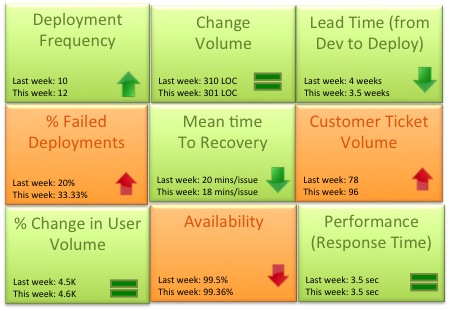
    As the team matured we started evaluating a more granular way to track success.  Could the team mantra be broken down into quantifiable success metrics that could be represented in a scorecard? Based on our experience the DevOps scorecard should contain these 9 metrics to track DevOps team success:

    DevOps Scorecrd

    1. Deployment frequency: How often were we deploying code and getting new code in the hands of our customers? This metric should trend up or remain stable from week to week. Example: Twice a week, 50 times a day
    2. Change volume: For each deployment how many user stories and new lines of code were we shipping?  Example: 3 new features per day, Average 500 lines of new code per week. Another parameter to consider in addition to volume is complexity of change.
    3. Lead Time (from Dev to Deploy): How long does it take on an average to get the code from development complete through a cycle of A/B testing to 100% deploy and upgrade on production? Lead time should reduce as the team gets a better hold of the lifecycle.
    4. Percentage of failed deployments: What percentage of deployments failed causing an outage or a negative user reaction? This metric should decrease over time. Example: 9% deployments failed this month as opposed to 15% last month. This metric should be reviewed in combination with the change volume. If the change volume is low or remained the same but the percent of failed deployments increased, then there maybe a disfunction somewhere.
    5. Mean time to recovery: When we did fail, how long did it take us to recover? This is a true indicator of how good we are getting with handling change and this should ideally reduce over time.  You can expect some spikes in this number due to complex issues not encountered before. Example: On an average it took the team 15 minutes to resolve each last week, 14 minutes this week.
    6. Customer Ticket Volume: Number of alerts generated by customers to indicate issues in the service. This is a basic indicator of customer satisfaction. Example: 54 tickets were generated this week as opposed to 38 while the user volume remained steady is not a good thing
    7. % Change in User Volume: Number of new users signing up, interacting with my service and generating traffic. As new users sign up is my infrastructure able to handle the demand? Example: This week the number of customers spiked by 30% due to an external event causing volume of requests to go up
    8. Availability: What is the overall uptime for my service and did I violate any SLAs? Example: 99.9% uptime consistently for the last 3 months even with change in user volume
    9. Performance (Response Time): Is my service performing within my predetermined thresholds? This metric should remain stable irrespective of % change in user volume or any new deployment. Example: Sub 5 second response time from all geographies and devices

    Would love to hear thoughts on what other critical metrics DevOps teams are using

  • SDN has a lot to offer to DevOps

    SDN has a lot to offer to DevOps

    When discussing DevOps it’s natural to focus the attention on the one operations  team that focuses on application infrastructure. But when you start digging in to DevOps and its applicability to all four operations groups you’ll find that technological shifts in the network – like software-defined networks (SDN) – are just as important to the overall success of DevOps-related initiatives as the spread of software-defined operations going on across the application infrastructure.

    One of the intersections of network and app infrastructure operations is around speed. Not just speed of deployment of services supporting applications, which is critical, but also the resulting speed of the application itself. Application performance management (APM) is a less often mentioned concern of those looking at DevOps but it is one with which developers and app infrastructure operations alike are very interested in not just monitoring and measuring but improving.

    But here’s the thing: the relationship between the app infrastructure and the network are intertwined when it comes to application performance. Measuring and monitoring in the app infrastructure is all well and good, but it is impacted by network performance. And vice versa. Technically speaking, the app infrastructure folks are going to end up tweaking things like TCP; changing window sizes and timeouts in order to improve poorly performing apps. And they should, as TCP is highly tunable and one of the primary means of changing the performance behavior of an application.

    But tweaking TCP has an impact on network performance. TCP is a reliable transport protocol, meaning its particular about thinks like packet order and its very responsible about making sure each and every packet is received. When one isn’t, it resends it. And resends it. And resends it. Retransmit storms contribute to the congestion of the network, which in turn contributes to the need to retransmit, which in turn… well, I think you see the Catch-22 here. While the app infrastructure team is pointing fingers at network operations, the network operations team is pointing fingers at the app infrastructure team.

    Both are equally responsible for the problem.

    SDN promises, in part, to address the problems associated with speed. Both speed of service deployment (through operationalization) as well as speed of delivery, i.e. application performance. SDN will, ostensibly, provide the means to both recognize application specific performance requirements and adjust, as necessary, the delivery of application data through the network in order to meet those requirements. But what it also implies is the ability to provide visibility into the reason why new routes were necessary. There are plenty of reasons an application might initiate a retransmission storm and some of them are related to the application platform (TCP problems), others to the client or the Internet itself, and still others to the network. Being able to quickly identify what is causing a degradation in application performance gives everyone the ability to react and resolve the problem faster.

    That goes to MTTR (mean-time to resolution), a key DevOps-related metric.

    But for all that to happen, there has to be some collaboration (sharing) going on between network and app infrastructure operations. There has to be less finger pointing and more question asking going on between the two, and the sharing of collected performance data across the entire application delivery chain – from network to platform to the app itself. SDN provides a means through which such measurements can be obtained and shared with other systems – and teams. This ability is important. Puppet Labs 2014 State of DevOps Report named it a “top practice” correlated with MTTR, and CA’s latest report indicated 19% of organizations adopting DevOps have experienced “Improved quality and performance of our deployed applications.”

    Monitoring and measuring application performance is a key component of DevOps, and yet a significant portion of that performance is dependent on and related to the network. Which means app infrastructure operations can’t measure or address poor performance without understanding the network’s contribution to the whole.

    SDN “apps” can be one way in which app infrastructure and network operations can gain insight into how apps are performing and how the network is impacting that performance – for good or bad. Whether it’s simply having the data to share or providing an interface into the network to gather the data, SDN has the potential to enable greater collaboration across network and app infrastructure teams.

    That makes it an excellent player in the wider ecosystem of tools and frameworks that support the need for monitoring and measurement associated with DevOps initiatives.


  • Survey: DevOps gaining mainstream traction in IT today

    Survey: DevOps gaining mainstream traction in IT today

    New survey results released last week shows just how thoroughly DevOps has captured the mindshare of enterprises. Commissioned by Rackspace, the global Vanson Bourne survey showed that more than three-quarters of IT decision-makers are now familiar with the term DevOps and well over half of them have already implemented DevOps practices to some degree or another. And by 2017, that figure could go up by another 31 percent according to survey respondents’ plans.

    “This survey shows a real appetite for the kind of development and operational processes today’s digitally-focused businesses need,” said Chris Jackson, CTO of DevOps Services at Rackspace.

    Among those who have chosen the DevOps route, nearly half have already fully integrated their development team with their operations team and 38 percent say that integration is in effect for all of their applications. For the most part, the ops team has been the primary champions for these projects. Approximately 43 percent of respondents with DevOps programs in place report that IT operations have driven them and 32 percent say either the CIO or the CTO have driven the program. Just 16 percent say developers have been behind their DevOps transformation.

    As expected, among respondents who have deployed DevOps, 57 percent have already experienced faster delivery of new features and 46 percent have a more stable operating environment. Additionally, 43 percent reported increased innovation and 32 percent have even reduced their IT costs.

    However, it is the business upsides of respondents’ DevOps adoption that are really eye-opening. The speed and innovation seems to have directly translated to improvements in the business as a whole. Over half of companies that have implemented DevOps report an increase in customer conversion and satisfaction and 43 percent say they’ve seen an improvement in customer engagement. As a result, DevOps is stimulating topline revenue growth, with 38 percent of respondents reporting an increase in sales as a result of their revised IT approach.

    “DevOps is empowering IT functions to make a real impact on the business,” Jackson said. “It is also finally an opportunity for IT to be recognized for having a central part to play in delivering great customer experiences and ultimately increasing sales.”

    However, deploying DevOps has not always been easy for these organizations. Approximately 37 percent of respondents who’d embraced DevOps reported internal resistance from ops teams and 32 percent said developer resistance posed problems. Fortunately, less than a quarter of wider business stakeholders  stood in the way of DevOps adoption. Nevertheless, among all IT decision-makers, 41 percent still said they had other more urgent IT priorities that kept them from the DevOps journey.

    “DevOps is all about encouraging innovation and streamlining processes to help ensure development and operations are working hand in hand to deliver business objectives,” Jackson said. “While, the findings suggest that the DevOps journey is already becoming well established in many organizations, there is still a job to do in articulating the benefits to all groups involved for them to accept and drive through this change.”

  • Microsoft determined not to get left behind by DevOps

    Microsoft determined not to get left behind by DevOps

    Microsoft is a massive company—a behemoth with a lot of inertia, and a lot of bureaucracy in place that make it difficult to adapt quickly. Under Satya Nadella, however, Microsoft is striving to re-invent itself, and—to the extent that it is possible—become more agile. For evidence of Microsoft’s new philosophy, look at how Microsoft is aggressively embracing concepts like open source and DevOps that used to be viewed as pariahs.

    I wrote recently about the partnership between Microsoft and Docker. Microsoft added support for Docker containers in the Azure cloud platform within Linux virtual machines earlier this year, but then it upped the ante by announcing that it will support Docker natively in the next version of Windows Server, and that it is working closely with Docker on an open source project to drive development of the Windows engine for Docker.

    “An important aspect of this announcement is the noticeable speed we are observing Microsoft move to implement open source technologies,” explained Al Gillen, an analyst with IDC, in a report about the relationship between Microsoft and Docker. “The company appears to be determined not to be left behind as the velocity of open source developer technologies accelerates. The company appears to be willing to integrate competing technologies, or technologies from competing ecosystems at a faster pace and with less hesitation.”

    Docker isn’t the only piece of the puzzle, either. Earlier this year Microsoft joined forces with Chef and Puppet Labs, and integrated both of those popular DevOps platforms into Azure as well. Incorporating Chef and Puppet Labs gives IT admins more flexibility to deploy, configure, automate, and manage VMs in Azure.

    What the new philosophy really represents is a realization. Nadella’s Microsoft sees the writing on the wall, and understands that it’s a new world. Technologies have changed, and the way companies and individuals use technology has changed, and the days of dominating the tech universe as a virtual monopoly are gone. The two choices facing Microsoft were to either stubbornly cling to its former glory and die a slow, painful death, or adapt and embrace change in order to remain relevant, and continue to play a vital role. Thankfully, it seems Microsoft has chosen the latter path.

    What does embracing change look like? Microsoft appears to be taking a two-pronged approach. On the one hand, Microsoft is changing internally to shed some of its entrenched bureaucracy and enable it to function with more agility. It is also striving to keep up with new technologies itself—buying Nokia to bring smartphone manufacturing in house, developing the Surface tablets, rolling out the Microsoft Band wearable health tech, and other initiatives demonstrate that Microsoft is working hard to break free from the shackles of its own past, and find ways to keep up with the changing tech landscape.

    The second—and arguably more important—prong is how Microsoft is addressing the new multi-vendor, cross-platform world we live in. Microsoft recognizes that it is not the only game in town, but it has a vested interest in ensuring that customers continue to rely on Microsoft tools no matter what platform they choose. To that end, Microsoft is doing a much better job of offering its own products and services across a wider range of devices and platforms.

    The new Microsoft represents a win-win-win scenario. It’s a win for Microsoft because it enables the company to shift and evolve to stay relevant with a rapidly-changing tech landscape. It’s a win for open source and DevOps because companies of all sizes are built around Microsoft operating systems and applications, so incorporating support for open source and DevOps tools exponentially increases the potential customer base. Finally, it’s a win for the customers themselves because they get to maintain their existing investments in a Microsoft infrastructure, while also gaining access to new tools that enable greater automation and efficiency.

  • Acorns Turns Sluggish FiServ on its Head with DevOps

    Acorns Turns Sluggish FiServ on its Head with DevOps

    Modern investment tools are popping up all over the place. Not only are they shifting the power from large institutions to the consumer, they are applying modern technology to a red-tape laden world.

    (more…)

  • Cloud-Based Documentation at the Speed of DevOps

    Cloud-Based Documentation at the Speed of DevOps

    Welcome back to this (semi-)regular column where I attempt to answer questions about DevOps, especially in larger enterprises. This time I address a vexing issue facing many large enterprises – how to make sure downstream processes move as fast as development and operations:

    Q. In my enterprise we are getting faster at releasing code, but we are still slow to update and translate downstream product documentation. How can documentation and technical writing be optimized as part of a DevOps approach?

    As I have said before, you can ask me any question you want (in the comments below, via e-mail, or on Twitter), but that doesn’t mean I know all the answers. If (when) I don’t know, I have promised to try to find someone who does – and this is one of those times.

    This question stumped me, so I asked around to find some insight into this issue. As it turns out, my company (a large enterprise, building out our DevOps capabilities, developing and operating new software every day, in many different languages, across about 40 countries worldwide) is working with what we think is an answer to this question. So I asked my colleague Jim Turcotte to explain what we are doing to address this problem. Here is what he said:

    The problem – serial downstream processing

    I know exactly the problem that this writer is facing! We have been wrestling with this ourselves. The problem is that with current industry practice, a team of technical writers shadow developers to document the latest product functionality. By the time product is delivered, it’s a mad dash to publish the PDF/HTML. Then, to make matters worse for international customers [our software users], it may be days or weeks before localized [translated] versions of content follow. It’s a slow, tedious, serial process that ends up being a rush to the content finish line every time.

    To make matters worse, both documentation and code are typically “thrown over the wall” for Support to discover and address bugs. Documentation bugs are often handled by Support engineers writing dozens of knowledge docs.  The end result is that skilled Support engineers are often diverted from addressing customer issues, to updating documentation.  We then expect users of our software – our customers – to search through the product documentation and sometimes hundreds of Support knowledge documents to find answers to their questions—not exactly an optimal self-service experience!

    Introducing a cloud-based collaborative approach

    Something we have started doing to address this concern is by applying what we call ‘DocOps.’ It is a continuous content supply chain that connects all the stakeholders, and which is agile and collaborative. In this way, our approach mirrors many of the characteristics and culture of DevOps.

    Instead of waiting until code is complete before starting on documentation, multiple writers “curate” content throughout the product lifecycle. Instead of producing static, standalone knowledge documents in PDF (or even HTML), we use cloud-based documentation, wikis, forums and chat groups. Instead of a single one-time effort, original content topics are matured continuously in a collaborative effort.  Instead of channeling documentation through a single technical writer, we allow developers, operations, support, and even technical field staff [pre-sales] to curate documentation.

    On-demand translation is performed as needed using local cloud-based translation services. Highly automated workflows determine which vendors will be used for each product and language. The platform senses the customer’s language preference and automatically pulls up the content in the language they prefer.

    Then there’s online help. With the approach, we provide contextual help by linking content directly to product UIs. This allows customers to access additional sources of information like education courses and discussion threads all from the same source. Customers no longer have to log into multiple systems or sites to find the information they need to be successful.

    Benefits of the new approach for end-users – and for us

    For end-users, collaborative curation ensures documentation is always crisp and relevant, reducing the age-old problem of large quantities of duplicated knowledge/content. Customers who need help using a product are always able to find and use the latest curated content – in their language, relevant to their experience. Customers can also now access not only the developer’s original instructions, but also knowledge from other product experts, colleagues and peers.

    For us, we can use its analytics to provide real-time operational feedback, so technical writers can make updates on the fly to further improve the customer experience. The new approach also enables us to close the feedback loop, connecting end user questions with engagement and lead generation tools such as Marketo, marking the first time product documentation can also be leveraged as a serious sales tool.

    The old school Content Supply Chain cannot support the business agility that DevOps requires to be successful. The new documentation approach solves that. It was conceived and built around the need for an improved customer experience with product information. Do you really want to maximize your DevOps platform? Support the content with the new approach for the ultimate agile experience.

    Jim Turcotte is a Senior Vice President with CA Technologies and the Business Unit Executive for its Information Services team. For more information about DocOps, follow him on LinkedIn Pulse.


  • Mobility Means Enterprises Need to Get Lean with DevOps

    Mobility Means Enterprises Need to Get Lean with DevOps

    When people say “mobile” most folks think “devices.” Phones. Tablets. Phablets. Smart things. Wearables.

    But what we really ought to be talking about in most cases is apps.

    A McKinsey & Company survey noted, “When we recently surveyed 250 CIOs on their mobility strategies, 56 percent reported strong demand from employees to support a wide range of mobile devices.” With no direct mention of applications you might think CIOs are reporting just that employees be allowed to use mobile devices, but dig deeper into this and similar surveys and you’ll find what CIOs and employees mean by “support a wide range of mobile devices” is really this: make applications available across all the myriad devices we might want to use.

    When we say “mobility” is a driving factor for the adoption of a technology or an emerging methodology like DevOps, we don’t mean just the insatiable demand consumers have for engaging with you through mobile apps. We also mean your employees, who have an increasing appetite for engaging with business applications and tools through mobile apps.

    For enterprises, mobile means apps as much as devices – and lots of them. If there is one area of enterprise concern that aligns well with the startup mentality of measuring the success of a DevOps approach by the number of deploys per , it is around mobile applications.

    the state of applications

    That’s because mobile apps change a lot. According to an Oracle-sponsored survey, “35 percent of midsize and large enterprise organizations update their application portfolio monthly, while an additional 34 percent update their applications quarterly. More than four-fifths (82 percent) of respondents expect those rates to increase over the next two years.”

    That rate may seem trivial to organizations seeking to achieve “X deploys per day” but traditionally enterprises plan for a single change window a month, and if you can’t fit in that window, you’ll just have to wait. There’s only so much time – and so many cans of Mountain Dew one can drink – in a single Saturday night change window and these numbers don’t take into account existing applications – both new and updates to existing – that are being pushed out on a monthly basis.

    A 2012 survey from VersionOne found 37% of organizations push 6-25 net new applications per year. Nearly half (46%) push 11-50 upgrades during the same time period. That’s atop an existing base of apps that must be managed, scaled and secured.

    One of the ways DevOps is able to assist is through the optimization of deployment processes that take that app or app update to production. Whether it’s through value-stream mapping or Six Sigma or automation – or all of the above- the precepts of “lean” that underpin many DevOps concepts are invaluable to enterprises looking to up their number of deploys – even if it is just per window.

    If you can automate and optimize deployment processes to fit 2 or 3 more applications into each window, you gain ground. And gain ground you must, because mobile isn’t going away and neither is cloud and neither is the application economy we’re running headlong into.

    There is certainly room for operational improvement – and DevOps – in the enterprise to accommodate the increasing number of applications (mobile and otherwise) that need to get to market faster and with greater assurance of availability and competitive performance.

  • The DevOps Culture Cocktail

    The DevOps Culture Cocktail

    As I have written in previous posts, I believe that IT has accumulated decades of cultural debt that is now due.  We are a young  industry that grew up in silo neighborhoods, each with it’s proprietary practices, language and population of like-skilled specialists.  Left unchecked, the resulting “framework culture” contributed to IT’s cultural debt and is partially the motivation behind DevOps.

    The goal of DevOps is not to undervalue or replace the frameworks that are in place.  On it’s own, DevOps is not a framework – in fact,  successful DevOps relies on combined effect of best practices such as Agile, Lean and ITSM.   By recognizing and adapting the best of each, IT can formulate a potent recipe for enhancing performance and increasing customer satisfaction.

    So let’s belly up to the bar and mix ourselves a DevOps Culture Cocktail by taking the best guidance from the top shelf of each of the frameworks and practices.

    Ingredient 1:  ‘Git R Done’ Scrum

    Scrum is the most prominent of the Agile frameworks and with good reason:  it focuses on getting work “done” in manageable increments while reducing work in progress.

    Pair it with a Kanban Board

    While deceptively simple, Kanban is a powerful method for visualizing workflow, identifying constraints and keeping a team focused.

    Ingredient 2: Automation

    There is a lot of debate around the balance of automation use in DevOps, but there is no dispute that automation and metrics play a key role in successful DevOps.

    Ingredient 3: IT Service Management

    ITSM is the deployment’s “ever after”.  Agile and repeatable service management processes lead the way to stable continuous delivery and increased flow.

     Ingredient 4: Lean

    Let’s make it a skinny by creating more value for customers with fewer resources and less waste.

    Ingredient 5: People

    The most important ingredient.   DevOps relies on the way people think, behave, interact and trust their colleagues.   According to Lloyd Taylor,  “You can’t directly change culture. But you can change behavior, and behavior becomes culture.”

    Finally, add a splash of common vocabulary and a shot of the alcohol of your choice and you now have a DevOps Culture Cocktail!  Serve it daily, share it with your neighbors or sip it while reading a good book like The Phoenix Project.   It does get more potent with age.

    DevOps Culture Cocktail 2I recently had the opportunity to present the DevOps Culture Cocktail Party at Fruition Partner’s FruDevCon Conference.  One of the attendees, a hobby mixologist,  formulated her vision for a signature DevOps Culture Cocktail during my presentation.  We asked the hotel bartender to mix it up, passed it around and a new cocktail was born. Here goes:

    The DevOps Culture Cocktail
    1 part pear vodka
    1 part St. Germain
    1 part Chardonnay
    2 parts simple syrup or 7 up

    Top with a spear of pineapple and a cherry.

    Improvement recommendations are of course welcome.  Could this become a staple at all future DevOps events?