Tag: devops

  • Jelastic Cooper 4.6 Unlocks Reselling of PaaS and CaaS for Hosting Service Providers

    Jelastic Cloud launched its new reselling program for hosting providers and MSPs to offer DevOps platform with support of Docker containers without upfront investments

    Palo Alto, Calif (PRWEB) March 15, 2016

    Jelastic, Inc., the cloud software company for automation of DevOps processes with the help of containers, today has announced the launch of their latest release – Jelastic Cooper 4.6. The main focus of this version is a new reselling option that makes PaaS and CaaS business accessible for a wide range of hosting companies and MSPs.

    The inspiration for this release name lies in the words of Joseph Cooper, the main character from Interstellar: “We’ve always defined ourselves by the ability to overcome the impossible. And we count these moments. These moments when we dare to aim higher, to break barriers, to reach for the stars, to make the unknown known.” In these words it is explained the main aim of Jelastic 4.6 release – to make such fast growing trends like DevOps and microservices available for hosting business, to provide hosting companies of different sizes with ability to reach new market, to let them try something unknown (but perspective) without upfront investments, and in this way to break the barriers.

    ”Cooperation is a key point to unlock new opportunities and reach new horizons. Working together hosting providers are able to conquer DevOps space faster and easily adapt to quickly transforming cloud market. The new Jelastic release allows service providers to cooperate across countries and continents, regardless of their size and without risky investments,” told Ruslan Synytsky, Jelastic CEO and co-founder.

    Many hosting companies face a set of problems while fighting for their place at the current cloud hosting market: lack of expertise and knowledge to handle new business opportunities, new markets exploration risks, not enough sales and marketing force, low hardware utilization, budget limitations to speed up growth and many more.

    To overcome these difficulties Jelastic offers a smart franchising system between existing Jelastic hosting partners and resellers. A reseller can use the infrastructure and billing system of a parent hoster. As a result, the parent hosting provider will obtain a wider area of influence, a better local presence and higher selling, while the reselling partners can easily start their new hosting business out-of-the-box with zero investments:

    • no installation fee or investments in hardware
    • no minimal commitment
    • production ready PaaS and CaaS with Docker containers support
    • built-in billing system
    • support and marketing tools
    • marketplace with pre-packaged applications

    “Adding a partner portal to the main panel is truly innovative and logical step. This capability now gives small and medium sized hosting companies an opportunity to expand their service portfolio literally with a single click and open up a cloud playing field which was historically available only for big players. All this is achieved without any investments or commitments! I talk to hosting companies quite often and I am constantly hearing about new investment risks and diminishing margins. MIRhosting pioneered this initiative and now we want to open new business opportunities for all and we are happy that Jelastic supported us and unlocked new functionality within their platform. Now our partners can enjoy true cloud features and will add highest flexibility to their business to become more successful!” told Andrey Nesterenko, CEO, Innovation IT Solutions Corporation.

    Starting from this release, our hosting partners can easily create a special reseller account with a dedicated dashboard for users and a cluster admin panel for management and customization. User dashboard and all the settings can be fully customized and white labeled, so the reselling partner can sell the product under own brand, with own prices, quotas and permissions.

    Besides reselling opportunity, Jelastic 4.6 release included a set of improvements like advanced containers hibernation control, automatic horizontal scaling of Docker containers and wider range of load alerts for their monitoring, pricing tutorial within the dashboard and many other enhancements. A full list of new features and improvements can be seen in the Release Notes 4.6.

    About Jelastic

    Jelastic is an enterprise DevOps PaaS for containers deployed on bare metal hardware or any IaaS. Jelastic customers and partners, such as ISVs, hosting service providers, systems integrators, outsourcing companies, DevOps teams and enterprises, can choose between Public, Private, Hybrid and Multi-Cloud options. The platform provides certified containers for Java, PHP, Ruby, Node.js, Python and .NET and the ability to use custom Docker containers. Jelastic offers agile deployment models without coding to proprietary APIs, flexible automatic scaling for stateless and stateful applications, collaboration, access control, monitoring, backup and disaster recovery, built-in billing and business analytics tools, while driving down TCO with high density and hardware utilization. Jelastic multi-cloud functionality enables customers to achieve high-availability through geo-distribution across different data centers or clouds, easily relocate the projects to the superior hardware with the help of live environment migration, choose between higher quality or more cost affordable hardware and host applications with the trusted cloud vendors. For more information, visit us at http://www.jelastic.com

     

  • DBmaestro Mitigates DevOps Security Risk with CyberArk

    DBmaestro Customers Gain Solution to Better Secure and Manage Privileged Credentials in Oracle Database Environments

    Houston, Texas, March 15, 2016 – DBmaestro (http://www.dbmaestro.com), the pioneer and leading provider of DevOps for database solutions, today announced a technology integration with the market leading CyberArk Privileged Account Security Solution. This integration helps improve security and compliance in DevOps environments by allowing DBmaestro to secure the powerful privileged access needed across the range of DevOps actions.

    Successful application development is dependent on the efficient management of multiple Oracle database environments including development, integration, internal testing, user acceptance testing, production and disaster recovery. To mitigate security risk, powerful access associated with the privileged credentials used by in-house/custom applications in DevOps environments needs to be effectively managed and secured.

    Privileged credentials are frequently targeted in cyber attacks due to their broad, often unfettered access to an organization’s most sensitive assets and information – including databases and applications. Without this security in place, privileged credentials can be hijacked by attackers, leaving the organization susceptible to significant theft or destruction of data, or even complete network takeover.

    DBmaestro integrates with CyberArk Application Identity Manager, part of the CyberArk Privileged Account Security Solution. This enables DBmaestro TeamWork to automatically retrieve and securely use the target database credentials that are stored in and managed by CyberArk Enterprise Password Vault. Enforcing multi-factor authentication to the CyberArk Vault to retrieve a credential indicates that it is a valid, trusted application requesting and gaining access to their key applications and targets.

    As part of a proactive cyber security program and to address evolving compliance requirements, passwords can be automatically rotated based on the organization’s security policy for both in-house/custom applications running on Oracle, and the DBmaestro TeamWork Oracle solution. CyberArk Application Identity Manager enables automated synchronization of credentials in the background without requiring any code or file changes while reducing downtime and maintenance windows caused by manual credential rotation.

    DBmaestro TeamWork is a secured DevOps for database solution that brings continuous delivery best practices to the database. Offering features and functionality far beyond what’s achievable using manual work or simple compare-and-sync tools, DBmaestro TeamWork will transform development operations, while dramatically increasing productivity and reducing development costs.

    “This integration helps companies successfully manage and secure multiple database environments in order to create applications and drive business results,” said Yariv Tabac, co-founder and CEO of DBmaestro. “By combining security and database change management capabilities, customers can better address critical database security vulnerabilities and their ability to meet audit and compliance requirements.”

    To achieve secure DevOps for Oracle databases, CyberArk Application Identity Manager enables organizations to protect critical business systems by eliminating embedded credentials from application scripts, configuration files and database tables. In addition, implementing both these solutions leads to combining individual accountability with detailed, centralized tracking and reporting on all application privileged account activity, thus enabling organizations to meet diverse sets of compliance requirements.

    “Privileged accounts and credentials, including those that allow applications to access sensitive databases and systems, are targeted by attackers in virtually every cyber attack,” said Adam Bosnian, executive vice president, global business development, CyberArk. “CyberArk reduces the risk of unsecured privileged accounts and credentials use across the enterprise. For developers utilizing solutions like DBmaestro, CyberArk complements existing agile workflows to empower developers to balance security and productivity, while enabling organizations to automate compliance based on their security policies.”


    About DBmaestro

    DBmaestro is a pioneer and leading DevOps for database solution provider. Its flagship product, DBmaestro TeamWork, enables Agile development, Continuous Integration and Delivery for the Database.

    TeamWork supports streamlining of development process management and enforcing change policy practices. The solution empowers Agile team collaboration while fostering regulatory compliance and governance. With DBmaestro, organizations can facilitate DevOps for database by executing deployment automation, enhancing and reinforcing security as well as mitigating risk.

    DBmaestro’s solutions are deployed at many major international companies, including Visa, MasterCard, Frost Bank, Bank of the West, Knight Capital, Thomson Holidays, Bank Leumi, Barclays, and others.

  • CLOUDBEES ANNOUNCES INDUSTRY’S FIRST CERTIFICATION PROGRAM FOR JENKINS ENGINEERS

    New Technical Certification for Jenkins and the CloudBees Jenkins Platform adds value for engineers, teams and employers

    SAN JOSE, Calif. – March 15, 2016 – CloudBees, Inc., the enterprise Jenkins company and continuous delivery (CD) leader, today announced the rollout of a professional certification program for both Jenkins and CloudBees Jenkins Platform engineers. Though Jenkins and the CloudBees Jenkins Platform are utilized in over 128,000 projects globally by countless engineers, no formal certification existed until now. CloudBees developed the certification program in collaboration with a Certification Advisory Board comprised of Jenkins subject-matter experts, as well as CloudBees customers and partners. Registration opens on March 15 and engineers can take the exam in Prometric test centers around the world as of May 12.

    The program offers two options for certifications:

    • Certified Jenkins Engineer, for demonstrated knowledge and hands-on experience in the use of the open-source Jenkins server and plugin ecosystem
    • Certified CloudBees Jenkins Platform Engineer, for certification of additional, specific knowledge and hands-on experience in the use of the CloudBees Jenkins Platform, which adds enterprise functionality on top of the open source Jenkins server

    Achieving certification can benefit engineers in several important ways. Along with recognizing them for their Jenkins skills, certification helps engineers build credibility with colleagues, differentiate themselves from their peers and gain additional knowledge through the certification preparation process.

    The certification program offers benefits to employers and organizations, as well. Hiring managers can more easily identify qualified candidates and have confidence that they are acquiring an employee with a documented level of expertise. Alternatively, if an IT manager contracts a services organization employing certified staff, the IT manager will feel more confident that they will receive competent, skilled Jenkins experts for their project. Finally, services organizations who employ certified staff will be confident that their teams have the right skills, showcasing the organization’s qualifications and differentiating their services from competitors.

    “I volunteered to be part of the Certification Advisory Board created by CloudBees,” said Senior Director of DevOps at Ellucian, Jason Shawn. “I see the certification program as very strategic – for both the community of practitioners who are using Jenkins or the CloudBees Jenkins Platform and for hiring managers, such as myself, who want to be sure they are getting someone with a documented level of skills.”

    Attaining Certified Jenkins Engineer status will mean the engineer possesses the technical skills and knowledge necessary to effectively implement and use Jenkins with a proven level of proficiency. The exam questions are designed to test an engineer’s knowledge and hands-on experience with Jenkins throughout all stages of the software delivery process – from development to build, test, stage and deployment. Achieving Certified CloudBees Jenkins Platform Engineer status means the candidate has answered additional exam questions related to functionality specific to the CloudBees Jenkins Platform.

    “As the popularity of Jenkins for continuous delivery grows, the market demand for advanced skill levels in Jenkins as a discipline is tracking right alongside that growth,” said VP of Customer Success at CloudBees, Francois Dechery. “We’re proud to offer Jenkins and CloudBees Jenkins Platform certification opportunities. We’re looking forward not only to helping engineers build knowledge and improve their career prospects as domain experts, but also to making a contribution to the overall improvement of DevOps and CD practitioner skills available in the marketplace.”


    The customary certification exam fee is $200. However, for the first year of the Jenkins Certification Program, the exam fee is based on registration date, as follows:

    • Early bird: $50 for registrations between March 15 – March 31, 2016
    • Extended early bird: $150 for registrations between April 1, 2016 – March 31, 2017
    • Ongoing: $200 for registrations as of April 1, 2017

    Additional Resources

    About CloudBees

    CloudBees (www.cloudbees.com), the Enterprise Jenkins Company, is the continuous delivery (CD) leader. CloudBees provides solutions that enable DevOps teams to respond rapidly to the software delivery needs of the business. Building on the strength of Jenkins, the world’s most popular open source continuous delivery hub and ecosystem, the CloudBees Jenkins Platform provides a wide range of CD solutions that meet the unique security, scalability and manageability needs of enterprises. The CloudBees Jenkins Platform supports many of the world’s largest and most business-critical deployments.

    Backed by Matrix Partners, Lightspeed Venture Partners and Verizon Ventures, CloudBees was founded in 2010 by former JBoss CTO Sacha Labourey and an elite team of continuous integration, continuous delivery and DevOps professionals. Follow CloudBees on Twitter, Facebook, LinkedIn and Google+.

    Media Contacts:

    Katelyn Campbell / Gaby Berkman

    PAN Communications

    +1.617.502.4300

    cloudbees@pancomm.com


  • InterConnect 2016: Culture Matters

    InterConnect 2016: Culture Matters

    The recent IBM InterConnect 2016 focused on plenty of tools and technologies, from cloud/SaaS solutions to containers and automation, but there was another popular topic of conversation heard in the halls—the culture of organizations. The basic premise of these conversations was that unless you get the culture right, all the technology in the world won’t get an organization to where it needs to be to compete in the ongoing digital transformation.

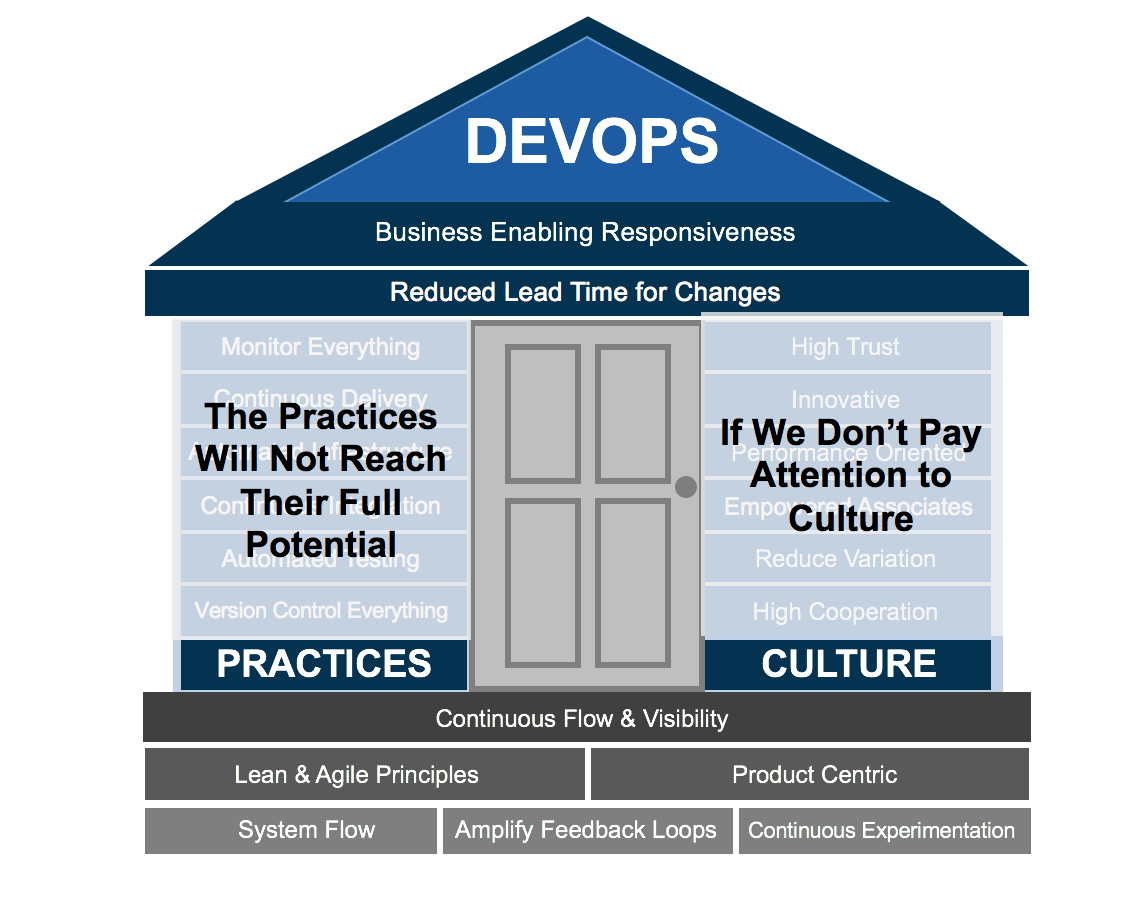
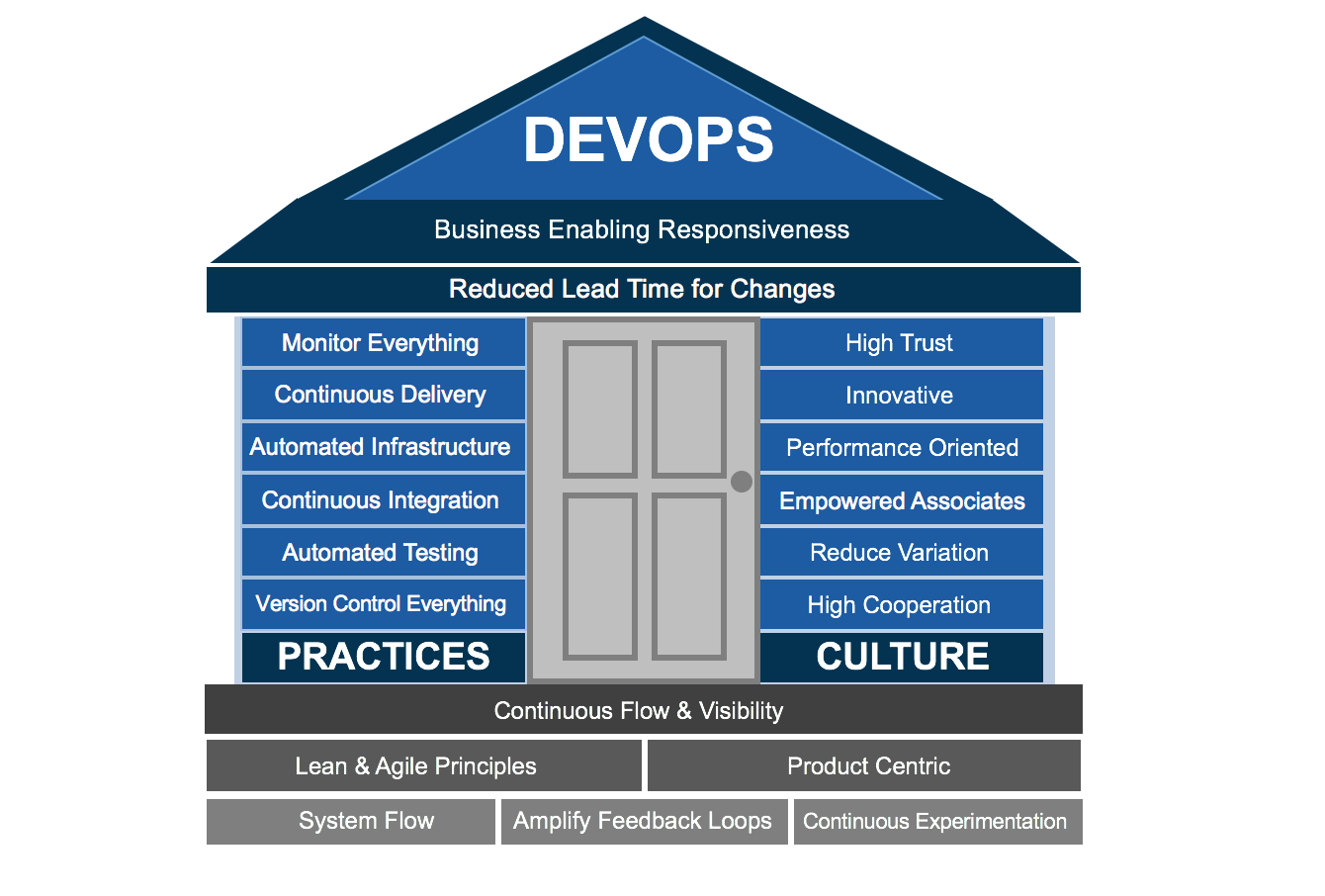
    At Nationwide, we have developed a foundational DevOps model that has two main pillars built on top of Gene Kim’s “The Three Ways” and lean and agile principles.

    While there are initiatives to implement the DevOps-related practices such as continuous integration using Jenkins, continuous delivery using TaskTop and UrbanCode and version control everything using GIT, how does one influence culture? Because clearly if the culture is not correct, technology solutions will not be enough to reach the goals of DevOps in terms of reducing lead time and enabling the business areas to be more responsive to market needs.

    Dev Cul 22

    Trust: The Foundation of Culture

    A key component of what underpins culture is trust. This was emphasized in a blog written by Lee Reid last year titled, “The Simple Math of DevOps.”

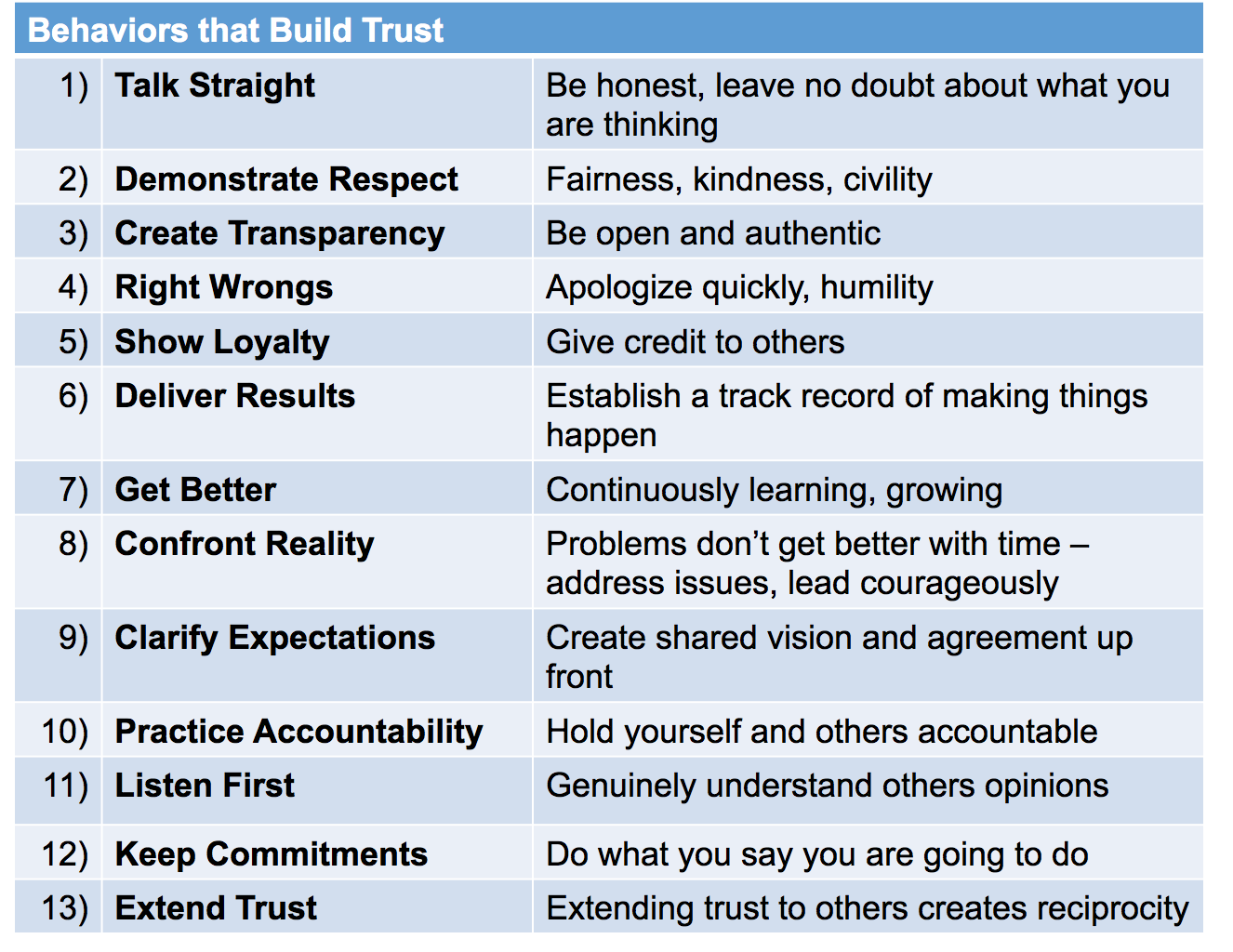
    So how does one build trust? Here are 13 behaviors that build trust from Steven Covey:

    Dev Cul 33

    Colin Powell, in a video on the Essence of Leadership, talks in a powerful way about this, saying that one way to build trust is to “Do what you say and say what you do.” He also stresses that successful leaders are those who provide selfless service to their teams.

    I don’t claim to have any magical formula to build trust, but clearly an organization’s transformational success must include a focus on culture and trust. Without this, the true promise of DevOps won’t be realized.

    You can read more about my session, “Achieving continuous visibility across the DevOps Lifecycle” at InterConnect 2016.

    About the Author| Carmen DeArdo

    Carmen-DeArdo-sq
    Carmen DeArdo is technology director at Nationwide Insurance. An ardent advocate of DevOps and a leading speaker in the DevOps and technology related events, Carmen is responsible for driving continuous delivery utilizing DevOps, lean and agile techniques across mobile, distributed and mainframe and other technologies.

  • Black Duck Announces Open Source “Rookies of the Year”

    BURLINGTON, Mass.–(Business Wire)–Black Duck, a global leader in automated solutions for securing and managing open source software, today announced the eighth annual Open Source Rookies of the Year, recognizing the top new open source projects initiated in 2015.

    The selected projects show how diverse and ambitious open source software development has become. From communications to healthcare and beyond, they offer innovative solutions to a range of consumer- and enterprise-grade problems.

    The 2015 Rookies class reflects three industry trends shaping the future of open source software:

    • Docker Containers: Docker, a 2013 Rookies of the Year selection, established containers and DevOps as the heirs apparent to server virtualization. In 2014, a number of Docker ecosystem players emerged, and the trend continues this year with several, including projects sponsored by Red Hat and Capital One.
    • Open Collaboration: Email isn’t dead, but it’s not as important as it used to be. The success of Facebook messaging and Skype for personal use fuels demand for similar solutions in the office, with real-time tools like Slack and GoToMeeting becoming standards. However, proprietary solutions face competition from open source alternatives which promise all the same features of the originals, but without the lock-in downside of proprietary solutions.
    • Artificial Intelligence: We may be a long way yet from truly “sentient” machines, but development teams are helping computers get smarter at getting smarter. Deep learning techniques aim to teach computers to teach themselves by using a system of multiple processing layers to model the neural network of a human brain. This year we recognize two new projects in the field of deep learning.

    The 2015 Black Duck Open Source Rookies of the Year are:

    • Rocket.Chat – an open source web chat platform built for communities and companies wanting to privately host their own chat service.
    • Mattermost – an open source, on-premise Slack alternative, written in Golang and React.
    • Hubl.in – a free and open source video conferencing solution.
    • MXNet – a lightweight deep learning library created by DMLC, the people behind CXXNet, Minerva and Purine2.
    • Bazel – a subset of Google’s internal software development tools, building software quickly and reliably through a shared code repository in which all software is built from source.
    • React Native – a Facebook-sponsored framework for building native mobile applications using the React JavaScript library.
    • Kontena – an open source container management solution “built to maximize developer happiness.”
    • Nulecule – a specification for packaging complex multi-container applications while ensuring smooth deployment across all instances.
    • InSpec – an open source compliance testing framework for specifying compliance, security and policy requirements.
    • Hygieia – Capital One’s enterprise DevOps dashboard, released last year as an open source project on GitHub.
    • Glucosio – the world’s first open source diabetes monitoring application.
    • Honorable Mention: Vault – a tool for securely accessing API keys, passwords, certificates, employee credentials and other sensitive resources.
    • Honorable Mention: RancherOS – a miniscule Linux distribution specially designed to be the easiest way to manage Docker containers.
    • Honorable Mention: OWASP Security Knowledge Framework (SKF) – a free, open source web app security system based on OWASP security standards.

    “This year’s Rookies are impressive examples of how far open source has come, with start-ups like Mattermost and Glucosio as well as big players like Google, Facebook and Red Hat leveraging the open source community to help drive innovation in everything from DevOps and Docker container solutions to diabetes monitoring and real-time communication,” said Patrick Carey, Director of Product Management, who headed the Rookies selection process.

    “These are sophisticated initiatives where the open source approach is a core part of the business strategy for speeding development, promoting adoption and providing the most value to their customers,” Carey said.

    For more information about the Black Duck Open Source Rookies of the Year, please visit www.blackducksoftware.com/open-source-rookies.

    About Black Duck Software

    Organizations worldwide use Black Duck Software’s industry-leading products to secure and manage open source software, eliminating the pain related to security vulnerabilities, open source license compliance and operational risk. Black Duck is headquartered in Burlington, MA, and has offices in San Jose, CA, London, Frankfurt, Hong Kong, Tokyo, Seoul and Beijing. For more information, visit www.blackducksoftware.com.

    Black Duck
    Brian Carter, 508-277-7570
    Director of Strategic Communications
    bcarter@blackducksoftware.com
    or
    PAN Communications
    Michael O’Connell, 617-502-4300
    blackduck@pancomm.com

  • In DevOps, Standardize to Minimize Architectural Debt

    In DevOps, Standardize to Minimize Architectural Debt

    I recently reading a great Q&A with the Etsy CTO John Allspaw over on The New Stack, which contained some nuggets of good advice that increasingly are important as we continue the journey toward DevOps adoption. Of particular note were statements on the introduction of “new” things to solve problems. In a nutshell, Allspaw reinforced the importance of standardization as a means to reduce architectural debt.

    If you aren’t familiar with the concept of architectural debt, it’s similar to technical debt, in which choices made today incur longer term investments of time and money when future changes are introduced. If you settle on a caching solution such as Redis, for example, there are technical and architectural implications. You can’t simply switch out Redis for memcached later without significant changes to both code and the infrastructure.

    Even your choice of load balancer today implies architectural debt because of the growing inclusion of scalability as part of the application infrastructure itself. The result is integration with automation and orchestration systems that are not easily changed later on if you decide you want a different solution. The style of service registry you choose is an architectural decision that impacts clients, servers and systems across the microservices architecture. Switching from client-side to server-side will later be costly.

    That’s architectural debt.

    Allspaw noted the need to not reinvent the wheel when possible, and instead encourage the collaborative aspects of DevOps as a means to avoid reinventing the wheel and potentially increasing the architectural debt load on the organization.

    This is not a new concept. There’s a reason enterprises in particular proudly proclaim themselves “Java shops” or “Microsoft shops” and primarily require development in one or perhaps two languages, but no more. Maintainability is a component of technical debt, just as middleware decisions are a component of architectural debt.frameworks in use soad2016

    So as we continue to see wider DevOps adoption, it’s important that we carefully consider the impact of our choices in terms of the automation, orchestration and integration required to implement continuous delivery and deployment. Once you’ve invested time and energy (and probably budget, too) in Puppet or Chef, VMware or Cisco, OpenStack or SaltStack, you’re going to find an unavoidable amount of technical and architectural debt in development as well as production across infrastructure and networking teams.

    Each of these systems, solutions and frameworks comes with its own components. It isn’t just a language, it’s a comprehensive system with management and repositories and agents and reporting components. All of these impose certain architectural requirements on organizations, from needing certain software running to prescriptive details on networking that must be enforced, lest the system break down.

    We’re already starting to see that fragmentation in enterprises that are engaged in automation and orchestration efforts. When asked the number of automation frameworks (Cisco, VMware, Python, OpenStack, Chef, Puppet, etc…) in use, one-third today reported using three or more.

    That’s not necessarily “bad,” as it could be indicative of standardization across silos (networking wants to use Cisco, infrastructure is already on VMware, and Python is being used to cobble it together by ops), but it also could be an early sign of the kind of fragmentation that causes exponential growth in technical and architectural debt.

    Certainly there is room for experimentation in these early days, but it behooves us to maintain a watchful eye on the use of frameworks and systems and languages we employ for automation and orchestration to ensure we don’t end up buried in technical and architectural debt.

    Standardization, even loosely enforced, can help minimize the impact of that debt before it spirals out of control.

  • Vapor IO Introduces OpenDCRE 1.2, the First True DevOps Platform for Physical Infrastructure

    OCP, AppliedMicro and BASELAYER team with Vapor IO to further efforts to modernize today’s data centers through open source projects, bringing out-of-the-box management capabilities that eliminate complexities and significantly lower CapEx and OpEx

    AUSTIN, Texas–(BUSINESS WIRE)–Vapor IO, provider of the world’s first intelligent, hyper modular data center solution, today announced a new release of the Vapor Open Data Center Runtime Environment (OpenDCRE). With broad community support including technology partners Open Compute Project (OCP), AppliedMicro Circuits Corporation (Nasdaq:AMCC), and BASELAYER, OpenDCRE is the first true infrastructure automation and DevOps platform connecting IT and physical infrastructure. These partnerships highlight Vapor IO’s goal of furthering development of hyper converged data center architectures within the open source community.

    OpenDCRE is an open source solution created by Vapor IO to simplify data center infrastructure communication. The new release now supports AppliedMicro X-Gene server family and BASELAYER Anywhere modular data center (MDC) products. OpenDCRE is a superior alternative to competing proprietary rackscale architectures/infrastructure, eliminating vendor lock-in.

    “As a founding member of the Open Compute Project, we are proponents and early adopters of open source solutions,” said Grant Richard, Managing Director, Technology, at Goldman Sachs. “OpenDCRE presents an opportunity to simplify data center infrastructure communication and advances OCP’s mission to build the most efficient server architecture possible. We are pleased to be working with Vapor and our partners in the open-source community toward this mission.”

    “The Open Compute Project is dedicated to ensuring community led standards are brought to market through open interfaces,” said Corey Bell, CEO, Open Compute Project. With Vapor IO’s OpenDCRE hardware, which was submitted for contribution, end users now have the ability to remotely manage OCP compatible infrastructure via a completely free and completely open API.”

    Creating an Intelligent, Hyper-Modular Data Center

    OpenDCRE provides a secure, RESTful API for monitoring and completely controlling your entire data center and IT equipment. It can be used as an open platform for monitoring and managing data center hardware, software and environmental characteristics. The OpenDCRE API enables easy integration with third-party monitoring, management and orchestration providers. An alternative to proprietary interfaces and custom silicon, it provides a simple, curl-able interface for common and custom DevOps tasks. There are a wide variety of possible applications, deployments, physical mounting strategies, and network connectivity options for which Vapor IO is working to foster community support.

    OpenDCRE 1.2 provides the following capabilities to enterprises:

    • Out-of-the-box management to the Open Compute Project (OCP) community while removing the complexities, CapEx, and OpEx of top-of-rack, out of band management switches and complex network architecture.
    • Ability to speak directly with data center critical environment systems removing additional CapEx from the M&E cost of the building
    • Linux-like compatibility with its licensing under GNU General Public License version 2 (GPLv2)

    The Applied Micro ARMv8-A 64-bit quad-node X-Gene based OCP platform is the first of its kind and marks the entry of ARM servers into OCP,” said Kumar Sankaran, associate vice president, software and platform engineering, AppliedMicro. “This platform is particularly suited for the high density compute market segment. With the integration of OpenDCRE into this platform, it paves the way for a very highly efficient management infrastructure within the data center.”

    BASELAYER founder and CEO William D. Slessman stated, “We are pleased to be working with Vapor IO. The combination of Vapor IO’s OpenDCRE with BASELAYER’s modules and RunSmart data center operating software extends the range of our platform, and enables our customers to achieve improved operating performance.”

    “Data center environments are becoming increasingly complex and filled with a myriad of hardware and software solutions and tools from various vendors. In order for IT organizations to succeed they need to run efficient and agile environments. The collection of resources that make up today’s data centers must work together seamlessly, but at the same time exist as independent components so they can be replaced, repaired or upgraded as necessary,” said Cole Crawford, founder and CEO, Vapor IO. “Our mission is to take the disaggregated data center, and turn it into a highly efficient, well-connected but intentionally decoupled IT system.”

    Vapor IO was founded by Cole Crawford, an industry veteran with deep expertise in open source hardware and software technologies. With over 20 years of experience in the data center industry, Crawford has co-founded companies and nonprofits alike dedicated to transforming IT including OpenStack, where he served on the foundation formation committee and the Open Compute Project, where he served as its founding executive director.

    Supporting Resources

    About Vapor IO

    Vapor IO provides the industry’s first intelligent, hyper modular data center solution. Significantly lowering capex and opex costs when building and running data driven data centers, Vapor IO provides an integrated solution to integration problems. Eliminating complex structures and parking lot data centers, Vapor IO offers a true intelligence platform for any data center workload. For additional information, please visit www.vapor.io.

    Contacts

    Mindshare PR
    Heather Fitzsimmons, 650-279-4360
    Heather@mindsharepr.com

  • DevOps and Agility for Multi-Speed IT

    DevOps and Agility for Multi-Speed IT

    Let’s step back for a moment and look at the IT world a bit differently from the traditional technology-centric lens through which most of us IT peeps tend to look at things. Line of business (LOBs) need us, the IT organizations, to deliver capabilities to their customers and users that deliver business value. They also rely on these systems to provide feedback on how customers and users are consuming the business capabilities and deriving value; how they are interacting the business systems; and what capabilities and features they need to get better value. The LOBs are asking the IT organizations to deliver these capabilities with:

    • Velocity
    • Agility
    • Innovation
    • Cost Management

    IT organizations, in most cases, are not designed for velocity, agility or innovation. They are large organizations hindered in their ability to deliver these by legacy systems, myriad practices and tools, overbearing governance and compliance regimes, archaic and siloed organizational structures and cultural inertia. This lack of ability of the IT organizations to deliver agility, velocity and innovation in some cases even results in LOBs creating their own “Shadow IT” organizations to deliver their IT needs.

    Finding Velocity, Agility and Innovation

    The solution of late has been to undergo a DevOps transformation that enables IT organizations to adopt the necessary practices, automation tools and organizational and cultural change to deliver with velocity and agility, and become innovative by being able to deliver rapid experimentation. The origins of DevOps lie in Lean IT, and adopting DevOps is really applying Lean principles to help achieve agility, velocity and innovation.

    DevOps does so by making organizations that are delivering IT systems and software more efficient and lean. Organizations that have adopted DevOps are able to:

    • Get ideas out to production faster
    • Have users/user surrogates use them
    • Get rapid feedback

    Using this feedback the organizations can improve three things:

    1. Applications delivered
    2. The infrastructure delivered
    3. The process by which IT systems and software are delivered

    However, large organizations have been struggling to achieve the results promised by DevOps and achieved by the poster children of DevOps, with whom the movement started. For every Netflix and Etsy out there, there is a large, complex, organization that has been struggling with simply where to start. They may be able to achieve success in some parts of their IT organization—with small, innovative ‘two pizza’ teams working on isolated projects—but not at enterprise scale. They struggle with how to achieve even the results of DevOps adoption they see in their own successful teams, at scale. The organizational and cultural inertia appears to be too difficult to overcome.

    The major reason of this inability to achieve at scale is the persistent struggle in all large organizations between the desire to innovate, and the need for stability. This push-and-pull exists in all organizations—even an innovative startup feels it. The Dev teams are focused on creating innovation thru rapid change and experimentation, and the Ops teams are focused on creating stability and continuity. DevOps addresses this existential struggle by adopting a series of practices that drive cultural change, automation and process adoption that allow these Dev and Ops teams to work toward common goals and balance their needs. Even in large organizations, this can be achieved on small teams that are able to circumvent the legacy organizational structures and practices and figure out how to get all the stakeholders working toward common goals. That is why this works great on small, strategic projects that have well-defined goals and timelines and can “fly below the radar” of corporate governance enforcers. As we move to larger projects with large, potentially distributed teams, spread across different groups and corporate “fiefdoms,” adoption struggles and often fails.

    The Rise of Multi-Speed IT

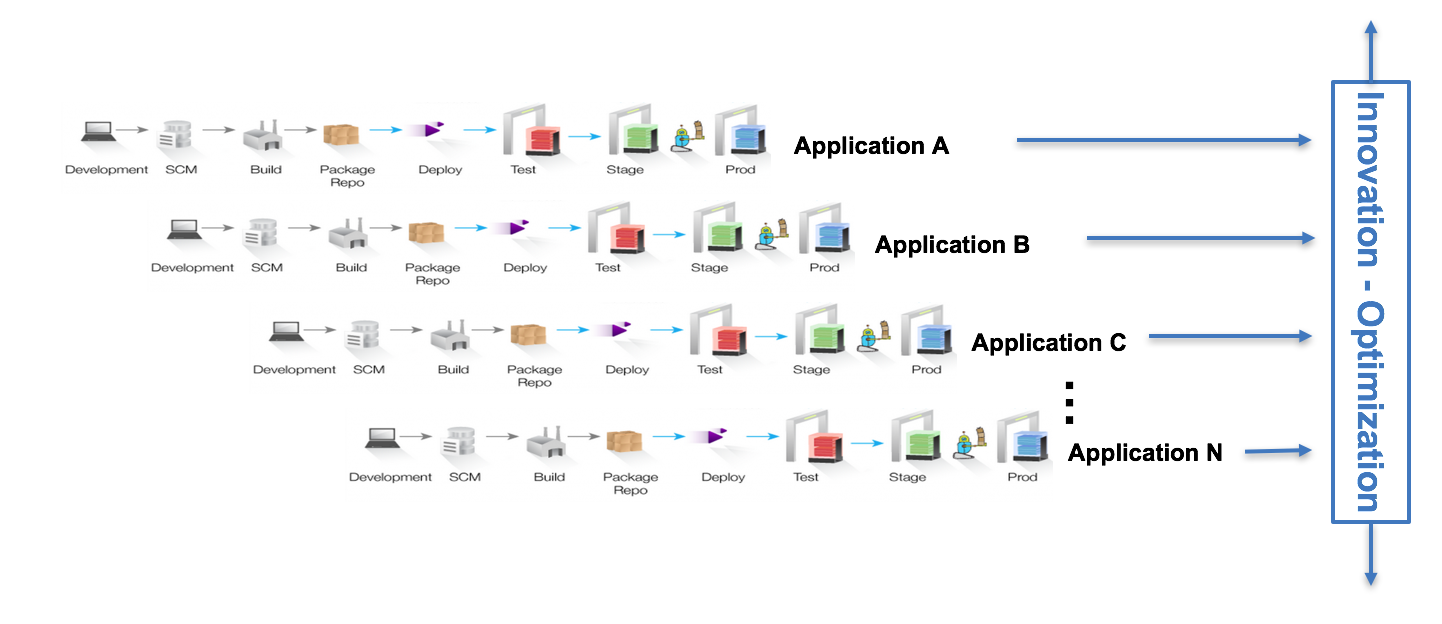
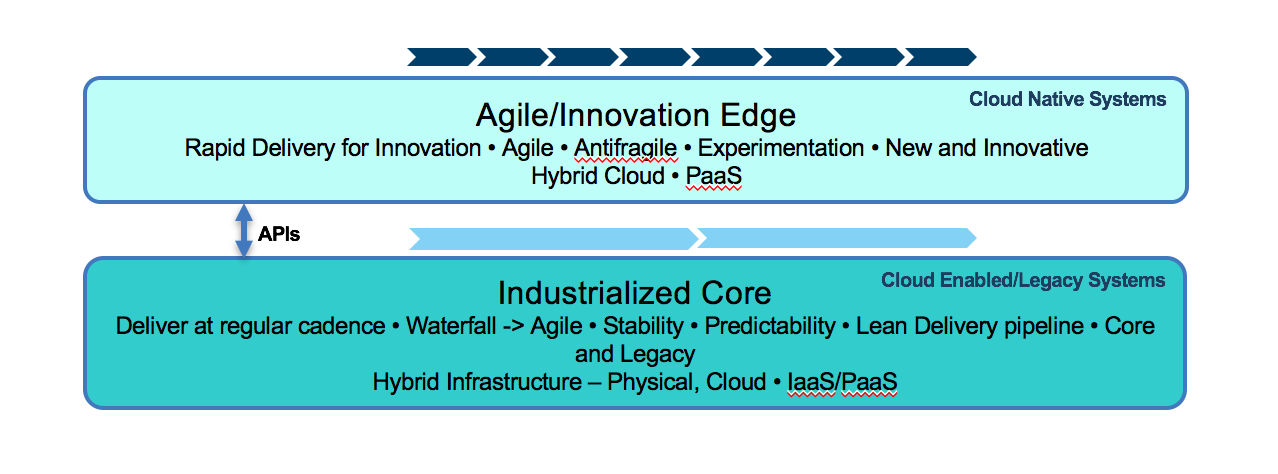
    One fact these large organizations need to recognize is that they really must have two modes of delivering IT: one focused on innovation (and velocity and agility) and the other focused on optimization (stability and continuity, with agility and velocity). This view is being referred to in the industry as “bi-modal IT” and is actually more of a continuum than a clear-cut two modes model. Hence, the term is evolving now to “multi-speed IT.” However, classifying the continuum into two broad categories based on the business intents of innovation or optimization serves the purpose of determining how to adopt DevOps very well.
    Multi-Speed ITMulti-Speed IT

    One interesting way to look at these two modes is to classify them as:

    1. The ‘Industrialized Core’ that delivers core business capabilities—things that keep the business going, and the primary business intent is optimization
    2. The ‘Innovation Edge’ where experimentation happens and new systems get identified and developed; in other words, the primary business intent is innovation

    Innovation vs OptimizationInnovation vs. Optimization

    The goal of the Innovation Edge is to allow for rapid experimentation, development of minimum viable products (MVP), rapid delivery and fast failure. The goal of the Industrialized Core, on the other hand, is to be lean and efficient and deliver business capabilities in an optimized, predictable, stable and secure manner, with the ability to scale as needed. Note: Eventually systems from the Innovation Edge will need to be “industrialized” once they start serving a core business function. This is a continuum from innovation to optimization.

    The Industrialized Core itself needs to be continuously incrementally industrialized to provide the stability and reliability needed, while getting leaner and more efficient, at scale. The core needs to get to optimization, with agility and velocity, as it delivers the core systems, again at scale. The core, too, needs to adopt DevOps and agile development practices, even for legacy systems, including those on the mainframe. This Industrialized Core is, after all, what keeps the business going and delivers the ongoing business value as the Innovation Edge seeks out new and disruptive business capabilities and avenues to deliver them.

    However, they both need different DevOps approaches and platforms delivering Agility, Velocity and Innovation at different levels.

    These two systems to deliver business capabilities are, in reality, joined at the hip. The systems delivered on the Innovation Edge are dependent on the services provided by the Industrialized Core to deliver the innovations they are developing. The Industrialized Core, on the other hand, consumes most of the budget in typical large organizations, and needs to be optimized to free resources for innovation.

    Consider a typical mobile application (say, mobile banking). To deliver that application, there is a team charged with developing the mobile front end. These kind of applications are developed and delivered in the Innovation Edge. Does all of the data and business logic sit on your mobile phone when you use that application? Of course not. Most likely, the business logic and certainly the data are components of the application that are delivered by pre-existing systems or services in the Industrialized Core. So, the mobile application is hybrid, comprised of components running in both places. To deliver even some experimental features of this mobile app, the company needs to release a hybrid or composite application, delivering components delivered by both the Innovation Edge and the Industrialized Core.

    During the Dev/Test cycle, these two modes of application delivery must be as decoupled as possible, so the development schedules and cycles of one does not drag the other, to prevent the Core from becoming a drag on the Innovation. Creating an API ecosystem is thus essential to decouple the Industrialized Core from the Innovation Edge. The Core provides the business services consumed by the innovative applications being delivered by the Innovation Edge as APIs. A key benefit of developing this API-based architecture is that these APIs potentially can be monetized to third-party partners, generating a revenue source at the same time.

    It is important to note that the architectural and process needs for adopting DevOps in both of these modes are different in many ways. Their needs and how they deliver applications and services differ as they are serving different business goals. In my next post, I will start delving into these architectural and process needs for adopting DevOps for both the Innovation Edge and for the Industrialized Core, which allow the Innovative Edge to allow for experimentation and innovation, and for the Industrialized Core become more optimized.

    Watch this discussion between industry practitioners as to how they have adopted DevOps in a multi-speed IT model: the challenges faced, successes achieved and lessons learned.

    About the Author/ Sanjeev Sharma

    Sanjeev

    Sanjeev Sharma, CTO and Distinguished Engineer – DevOps Technical Sales and Adoption, IBM Cloud Unit, is a 20-year veteran of the software industry with expertise in DevOps, Mobile Development and UX, Lean and Agile Transformation, Application Lifecycle Management and Software Supply Chains. He is a DevOps Thought Leader at IBM and speaks regularly at conferences. He has written several papers and is the author of the DevOps for Dummies book.

  • Building a Business Case for DevOps

    Building a Business Case for DevOps

    You can get your DevOps vehicle as fast and fine-tuned as you like, but until you provide an effective business case to the board it will remain in the garage. To get the thumbs up, you have to prove your model is efficient and makes financial sense for the company as a whole.

    Do You Need to Make a Business Case for DevOps?

    Coherent business cases are needed for companies at various different stages of their DevOps journey, not just those at the very beginning. Ask yourself which one of these scenarios best suits your current situation:

    1. You/your CIO know(s) the company needs to become more agile, but you don’t know how to quantify the benefits.
    2. Your teams have started to implement DevOps practices locally and can see the benefits, but you don’t know how to quantify the success to sell it to management.
    3. Your organization sees the success of DevOps pilots, but need to justify the investment to bring DevOps to an enterprise scale.

    DevOps can represent a huge shakeup of the IT department that must be justified clearly and logically. The risk must be outweighed by the projected financial gain. Crucially, this needs to be quantified in language that finance department can relate to. It is referred to as the hurdle rate: the necessary annual or total return of a project to compensate for the risk.

    What Should the Business Case Contain?

    1. Executive briefing
    2. Recommendations
    3. Required decisions
    4. Business drivers
    5. Scope
    6. Assumptions
    7. Analysis
    8. NPV (Net Present Value)
    9. Strategic options

    Hallmarks of a Successful DevOps Business Case

    Agility

    This is the main benefit of DevOps: the ability to deliver applications faster and allow for frequent changes and adoptions all the way into production. But how do we measure and quantify the benefits of agility?

    Time Value of Money

    The time value of money expresses the fact that money today is worth more than money tomorrow. The more you have to invest early (instead of over time) and the longer it takes to receive the return, the lower the present value of your investment.

    The number you receive when calculating the present value of an investment (benefits minus costs) is called NPV (Net Present Value). It tells you what your future investment is worth today.

    With agile and DevOps you are able to develop an application and deliver it to your end user in small chunks rather than in big ones; thus, you will improve the NPV (Net Present Value) of your project even if the total amount of investment and output are the same.

    Delivering software continuously rather than yearly creates benefits in the same way as receiving interest on your savings account every day rather than just once a year.

    The precise time value of money depends on the average cost of capital a company has to bear. For example, a large, publicly traded company has a lower cost of capital than a small, privately owned one. Your finance department will know it.

    Cost of Waste

    A second aspect, which speaks for agility in a quantifiable manner, is the reduction of waste.

    Functionality delivered using non-agile software engineering practices may be irrelevant or outdated once it reaches the end user because of the time gap and mismatches in requirements and expectations. The cost of such waste can be reduced drastically by using DevOps.

    Calculate the benefit of waste reduction using available statistics on the average percentage of functionality used without changes in your applications. It may pay off to assess this number for the last two or three releases delivered.

    Take into consideration:

    1. Total cost of development and delivery of these releases.
    2. Relative efforts of different functionalities delivered by release.
    3. Cost of change requests that arrived during and after the release date.
    4. End-user survey on the need and usability of these functionalities.

    Combine the benefit of waste reduction and of frequent delivery and add them as positive future cash flows to your calculation.

    You also need to calculate the forecasted costs of your DevOps initiative. Consider:

    1. Investment in build, test, deploy and provisioning and related operating expenses.
    2. Investment in IT infrastructure.
    3. Investment to complement skills in development and operations teams.
    4. Investment in organizational changes.
    5. Operating expenses for all above.
    6. Extra cost of non-automated activities in test, release and deploy due to increased release velocity.

    As part of your strategic options in the business case, balance your investments in automation with investments in more resources for build, test and deploy for given agility scenarios. The higher the release velocity, the more build, test and deploy activities are required. The more automation, the less of these activities must be done manually. Visualize in diagrams how the investment in more automation starts to pay off with increasing release velocity.

    Finally, sum up positive and negative cash flows and use your company’s hurdle rate to calculate your NPV.

    About the Author/Michael Schmidt

    Courtney-Glymph_avatar_1435225162-96x96Michael Schmidt heads DevOps Practice at Automic, a management and technology advisory service established to help Automic customers to prepare for and transform their organizations toward DevOps. Michael spent his carrier as consultant, entrepreneur and in several product-related leadership positions. He has a passion for building lean IT organizations. Michael holds a joint MBA from New York University, London School of Economics and HEC Paris and a Master of Computing Science.

  • Chef Makes DevOps Workflow Faster and Safer for Enterprises Amid Rapid Business Growth

    New Chef Delivery Product Enhancements Come as Company’s Annual Recurring Revenue Grows 94 Percent Year-Over-Year in 2015 and Chef Nears 1,000 Customers

    SEATTLE, WA–(Marketwired – Mar 10, 2016) – Chef, the leader in automation for DevOps, today introduced Dependency Management, a new feature of its Chef Delivery product, that enables faster and safer developer collaboration by allowing Chef Delivery to know which services and applications in the pipeline depend on one another. With Dependency Management, not only must changes pass local tests, but related, downstream components or services must pass those tests, as well. Only service changes that pass are promoted, so deployments to production are safe. Dependency Management enables a reliable, repeatable and scalable process for cross-team collaboration in large enterprises. It doesn’t matter if there are two developers or thousands of staff — teams can create and safely deploy interconnected services on diverse runtime environments, including containers.

    Chef also today announced enhanced capabilities for Chef Compliance to enable automated management of compliance policies that are based on the broadly used Center for Internet Security (CIS) benchmarks. Users can now implement CIS and other compliance policies as code, called “compliance profiles.” In addition, Chef Compliance offers an enhanced Windows experience by allowing users to import Windows policies from the Microsoft Security Compliance Manager.

    By using compliance profiles in conjunction with Dependency Management, users can enforce these policies with Chef Delivery to ensure that changes to infrastructure and applications meet all requirements across the pipeline. Together these two new features enable users to easily input, track, and test service runtime dependencies. Simultaneously, users can incorporate CIS benchmarks profile into Delivery’s automated testing pipeline to create a foundation for meeting Payment Card Industry (PCI) standards.

    Software is now the competitive currency of the enterprise. However, software is also becoming increasingly complex and composed of interdependent services that reside in the cloud. Businesses must be able to develop and maintain these intricate applications, along with the infrastructure that supports them, while moving at high velocity. It is critical that any changes to applications and infrastructure be versioned and tested before they are deployed to production. Because multiple teams often work on a single application, cross-team collaboration and transparency are critical to the success of a project. The DevOps workflow, which uses both culture and technology to foster these values, is becoming the most effective approach to developing software quickly and safely. Chef has distilled its customers’ successful workflow patterns into Chef Delivery, where service dependencies can be predefined and compliance requirements become part of the development pipeline. Chef Delivery eliminates silos and project segregation, enabling developers and operations personnel to begin committing code to the primary development pipeline in their first week on the team, instead of waiting weeks or even months in traditional environments.

    “Enterprises need comprehensive solutions to safely implement DevOps in the push toward ever-greater development velocity. Unlike other frameworks and tools, Chef Delivery doesn’t just help you build a change management pipeline, it is the pipeline,” said Alex Ethier, vice president of product, Chef. “We’re committed to advancing our product in a way that enables developers, operations and IT to collectively manage the speed and scale of enterprise business.”

    Company, Customer and Community Growth
    The new product enhancements reflect Chef’s rapidly growing footprint in the enterprise. Today, more than 80 percent of the company’s revenue comes from enterprise organizations, and more than half of the Fortune 50 use Chef. Chef has tens of millions of machines under management on any given day. To date, the Chef client has been downloaded more than 27 million times, with more than 13 million client downloads in 2015 alone. Among the increased demand from the enterprise, Chef’s annual recurring revenue (ARR) grew 94 percent year-over-year in 2015.

    Regionally, Chef’s EMEA business continues to rapidly expand. Q4 2015 was a record quarter for Chef EMEA, accounting for nearly 20 percent of the company’s total ARR for the quarter. Chef’s EMEA business now serves more than 150 customers and ARR for 2015 grew 91 percent year-over-year.

    Chef is closing in on 1,000 customers worldwide, with Chef’s commercial offerings used by organizations including Nordstrom, Facebook, Disney, Target, Standard Bank, and Etsy.

    Critical to Chef’s success is its open source community, which has more than doubled in size – at a clip of more than 100 percent year-over-year for three consecutive years – to nearly 70,000 registered members and thousands of active constituents contributing code daily. As adoption of open source technologies rise and more developers adopt Chef skills, the value of those abilities is reflected in enterprise careers. Dice recently noted that developers who cultivate Chef skills see return in a more than $130,000 annual salary.

    Recently, Chef announced a new Partner Cookbook Program to allow even greater collaboration and integration for its open source community. Some of our partners include 3Scale, Alert Logic, CloudPassage, Dynatrace, Infoblox, and NetApp.

    Availability
    Chef Delivery’s new Dependency Management capability is now available to all current Delivery customers. Read more on accessing and utilizing this new feature. Register for a webinar demonstrating Chef Delivery with Dependency Management on April 7, at 10 am PT.

    The CIS and Microsoft Security Compliance Manager profiles for Chef Compliance will be available on March 31 and demonstrated via a webinar that day at 10 am PT. Register here for this webinar and for more information on the profiles’ availability.

    Additional Resources

    About Chef
    Founded in 2008, Chef Software is changing the way companies build and deliver software to delight customers. Chef is the leader in automation for DevOps, empowering customers to build and operate high velocity organizations. Built on a strong open source foundation, we have distilled the proven patterns and practices for fast and scalable software development into our leading IT automation platform. Chef automates the continuous and unified delivery of applications and infrastructure, enabling enterprises worldwide to deliver software much faster with minimal risk. With hundreds of commercial customers and tens of thousands of open source community members, we are leading one of the strongest technology movements today. Our company is based in Seattle, WA, and financed by DFJ Growth, DFJ Ventures, Battery Ventures, Citi Ventures, Ignition, and ScaleVP. Learn more about Chef at www.chef.io.

    CONTACT INFORMATION