Tag: devops

  • JFrog Announces swampUP 2016 Agenda and Keynote Speakers

    SANTA CLARA, CA — (Marketwired) — 03/29/16 — JFrog today announced the agenda for its second annual swampUP user conference, featuring keynote speakers Sully Sullenberger, former airline captain and aviation safety expert, and Adrian Cockcroft, DevOps visionary at Battery Ventures. Taking place May 23-24 in Napa, Calif., the two-day event will also include sessions led by several DevOps industry experts and Fortune 500 customers of JFrog.

    swampUP 2016 will gather leading developers and DevOps engineers from around the world to exchange knowledge, new ideas and best practices around continuous integration and continuous delivery (CI/CD), and provide a unique opportunity for attendees to meet and build relationships with fellow users and community leaders, with a glass of Napa Valley wine in hand.

    Captain Sullenberger will share his experience managing a real disaster, when he successfully executed an emergency water landing of a commercial flight in the Hudson River, at the swampUP community gala on the evening of May 23. With the data center as their cockpit, developers and DevOps pros will learn how to avoid and recover from their own disasters. Watch the trailer: “Will You be Ready When Your Server Crashes?”

    swampUP 2016 sessions include:

    • “Will You Be Ready When Your Server Crashes?” – Capt. Sully Sullenberger
    • “The Future of DevOps” – Adrian Cockcroft, Battery Ventures
    • “Managing Huge Files on the Right Storage with Git LFS” – Tim Pettersen, Atlassian
    • “Best Practices in Docker Continuous Delivery” – Carl Quinn, Riot Games
    • “Astrid: Artifactory-Sourced Dependency Insight at Netflix” – Jon Schneider and Nadav Cohen, Netflix
    • “Automated Distribution of Open Source and Private Components with JFrog Bintray” – Allen Reese and Jack Weaver, Yahoo!
    • “Docker at Scale” – Viraj Purang, Oracle and Jagan Subramanian, JFrog
    • “Immutable Infrastructure with Docker and Artifactory at Cars.com” – Keith Kreissl, Mac Heller-Ogden, Zlatko Sisic and Deep Mistry, Cars.com
    • “DevOps Journey at IBM Research” – Christian Vecchiola, IBM
    • “GitHub + Artifactory – A Match Made in Heaven (Or at Least in the Cloud)” – Cynthia Rich, GitHub and Baruch Sadogursky, JFrog
    • “How Bintray Saved My Marriage: Scaling WebJars with Bintray” – James Ward, Salesforce.com
    • “Bringing Android Content to the Big Screen with Google Cast” – Kevin Nilson, Google
    • “Bot-driven Development with Artifactory” – Jim Clark, Atomist
    • “Are Open Source Vulnerabilities Hiding Out in Your Repository?” – Bill Ledingham, Black Duck
    • “JFrog Artifactory as the Automated Backbone for a Global CD Tool Chain” – Craig Vosburgh, CA Technologies
    • “Building the System of Systems – Creating a Universal CI/CD Pipeline for Legacy Applications” – Mark Maxey, Raytheon
    • “Make Artifactory Dance: Automate Data Center Management Using Artifactory’s REST API and Groovy Plugins” – Bryan Belanger, Autostructure
    • “Continuous Delivery for the Cloud Native Java Developer” – Josh Long, Pivotal and Baruch Sadogursky, JFrog
    • “Leveraging JFrog Artifactory to Empower Developing Ideas in a Restricted Environment” – Alex Coto, University of Havana
    • “Does Size Matter? CI/CD in a Large Scale Infrastructure” – Loreli Cadapan and Rohit Kumar, Oracle
    • “Continuous Deployment into the Unknown with Artifactory, Bintray, Docker and Mesosphere” – Gilad Garon and Kiril Nesenko, VMware
    • “Writing Performance User Plugins for an HA Environment” – Daryl Spartz, Yahoo!
    • “Pragmatic Scalability: Under the Hood of Artifactory HA” – Viktor Gamov, Hazelcast

    To learn more about what swampUP 2016 will offer and what’s new to this year’s event, watch this video: https://youtu.be/57Zy7tu58sA.

    For additional information and to register for the event, visit:https://swampup.jfrog.com.

    Resources

    About JFrog
    More than 1,500 paying customers, 50,000 installations and millions of developers globally rely on JFrog’s world-class infrastructure for software management and distribution. Customers include some of the world’s top brands, such as Amazon, Google, LinkedIn, MasterCard, Netflix, Tesla, Barclays, Cisco, Oracle, Adobe and VMware. JFrog tools, comprising open-source, on-premise and SaaS cloud solutions, are revolutionizing the way companies and individuals develop, release and distribute software. JFrog Artifactory, the Universal Artifact Repository, and JFrog Bintray, the Universal Distribution Hub, are used by millions of developers and DevOps engineers around the world. The company is privately held and operated from California, France and Israel. More information can be found atwww.jfrog.com.

    Embedded Video Available

    Embedded Video Available: http://www2.marketwire.com/mw/frame_mw?attachid=2984534

    Media Contact
    Danielle Salvato-Earl
    Kulesa Faul for JFrog
    (650) 922-7287
    Email Contact

  • Electric Cloud Announces Four Events To Advance DevOps Release Automation In The Enterprise

    SAN JOSE, Calif., March 29, 2016 /PRNewswire/ — Electric Cloud (http://electric-cloud.com), the leader in DevOps Release Automation, today announced four upcoming industry events taking place in April and early May. These events focus on advancing DevOps and Continuous Delivery in the enterprise by discussing tips and learnings for implementing modern IT practices across a wide range of industries and organizations.

    Electric Cloud logo (PRNewsFoto/Electric Cloud)


    Event #1:

    Live Video Podcasts: Continuous Discussions (#c9d9) Episode 38: CI Acceleration

    Continuous Discussions is a live video podcast for discussing Agile, DevOps and Continuous Delivery. Each episode focuses on a different topic relating to modern software delivery, and features different speakers from the DevOps community.

    Join us on Tuesday, April 5, to discuss tips for accelerating your CI efforts.

    • 

    Tuesday, April 5, 2016 at 10 a.m. PT

    https://plus.google.com/events/cp4f4ch4f7iijfo5nskm1bgr2n4

    Event #2:

    Avantika Mathur to speak about strategies for managing Microservices at scale at MERGE 2016

    At MERGE 2016, the Perforce Conference, over 400 developers, executives and thought leaders will come together in San Francisco to discuss the future of DevOps. During three days of breakout sessions, speakers and lively discussions, attendees will learn about the current state of the industry and discuss where DevOps is headed.

    Join Electric Cloud’s Avantika Mathur as she discusses strategies and best practices for managing Microservices at scale. Using a real use case example and a live demonstration of Perforce Helix, Docker and Selenium, Avantika will share patterns and tips for enabling a robust, scalable and extensible pipeline to support today’s modern app delivery with microservices.

    •

    Thursday, April 14, 2016 at 3:40 p.m. PT

    •

    Ballroom III – Level 4

    Parc 55 – A Hilton Hotel

    San Francisco, Calif.

    Event #3:

    Live Video Podcast: Continuous Discussions (#c9d9) Episode 39: CD Automation

    On Tuesday, April 19, join DevOps experts to discuss tips for automating your CD pipelines.

    •

    Tuesday, April 19, 2016 at 10 a.m. PT

    https://plus.google.com/events/cuj348ss8l75d4u572e7h9l9qec

    Event #4:

    Anders Wallgren to speak about patterns and processes for Continuous Delivery of Microservices at Continuous Lifecycle London

    Continuous Lifecycle London brings together experts and decision-makers in Continuous Delivery and DevOps to help reveal the potential and scope out the obstacles ahead of time. The conference’s holistic approach addresses concepts, processes and tools that are essential to Continuous Delivery and DevOps, as real world experts share their practical experience with attendees.

    Join Electric Cloud CTO Anders Wallgren as he outlines modern requirements for creating, deploying and managing multiple microservices both independently and as a collection in order to satisfy end user requirements and allow for Continuous Delivery.

    •

    Continuous Delivery of Microservices: Patterns and Processes:http://continuouslifecycle.london/sessions/continuous-delivery-of-microservices-patterns-and-processes/

    •

    Tuesday, May 3, 2016 at 11:40 a.m. BST

    •

    30 Euston Square

    London, U.K.

    Share:

    Tune in for new #c9d9 episodes at 10 am PT on 4/5 & 4/19 @electriccloud http://electric-cloud.com/c9d9 #DevOps #CD #automation

    OR

    Attending #MERGE2016? Be sure to catch @avantika_ec‘s talk on managing#microservices at scale on 4/14: http://bit.ly/1VL08kt @perforce

    OR

    Join @anders_wallgren at @ConLifecycleLon as he discusses#ContinuousDelivery of #microservices on 5/3: http://bit.ly/1RnsJJ6

    More Info:

    For more information, contact Hilary Livingston at 303-581-7760 ext. 19 or via email at hlivingston@catapultpr-ir.com


    About Electric Cloud
    Electric Cloud is the leader in DevOps Release Automation. We help organizations developing enterprise web/IT, mobile and embedded systems applications deliver better software faster by automating and accelerating build, deployment and release processes at scale. Leading organizations like Cisco, E*TRADE, Gap, GE, HP, Intel, Lockheed Martin, Sony and Qualcomm use Electric Cloud solutions and services to boost DevOps productivity and Agile throughput, while providing a scalable, auditable, predictable and high-performance pathway to production.

    Media Contact:
    Hilary Livingston
    Catapult PR-IR
    303.581.7760 x19
    hlivingston@catapultpr-ir.com

  • Cloud on the customers’ terms: iland offers maximum flexibility with new ReST API and software development kits

     iland cloud API empowers developers to tap the advanced security, disaster recovery, compliance, management and big data functionality of iland’s enterprise-class cloud 

    HOUSTON – March 29, 2016 – iland, an award-winning enterprise cloud hosting provider, today announced its new iland cloud API, enabling customers to easily access cloud data, deploy workloads, and integrate the iland cloud into their own management tools. By releasing the API along with Python, Java and Golang software development kits (SDKs), iland gives DevOps, IT Operations and managed service providers yet another vector of customizability and flexibility to interface with cloud on their own terms.

    “From day one, we designed the iland cloud to give companies the fastest possible path to the scalability, cost efficiency and agility benefits of cloud while also ensuring customers never sacrifice transparency or security,” said Justin Giardina, CTO at iland. “By leveraging ReSTful endpoints, we’ve been able to rapidly integrate advanced security, disaster recovery and other features that set us apart from the competition. With the new API, we’re now giving customers the ability to directly access and build on top of that integration so they can focus on designing and delivering new capabilities for their business.”

    Unlike most cloud infrastructure offerings, iland Enterprise Cloud Services-Advanced Security (ECS-AS) platform integrates advanced security, compliance, disaster recovery, backup, monitoring and resource management functionality to ease cloud adoption and ensure rapid success. Further, iland ECS is built on the open source Apache Cassandra global data warehouse, giving iland and its customers a powerful Big Data back-end that fuels intelligent control, automation and reporting capabilities. iland’s cloud console allows companies to manage all of this functionality from a single web-based interface, which is ideal for many cloud infrastructure customers.

    Now with the new iland cloud API, customers also have the option of programmatically interfacing with the iland cloud and all of its advanced features – from security information to disaster recovery to the vast resources in the Big Data back-end. This straightforward gateway to comprehensive data and services enables customers to further benefit from the unmatched transparency, granular resource control of vApps, clear pricing and nuanced alerting of the iland cloud. The API and SDKs provide seamless access to the complete functionality integrated into the iland cloud, assembled into a single stack of accessible services. The iland API is built using the ReST architecture, which, due to its usability, is the industry-leading approach to exposing functionality.

    iland’s global customers will deploy this API towards a host of innovative uses, but some initial approaches include:

    • DevOps and Operations automation:Developers and systems engineers can rapidly spin up virtual machines or configure systems using their existing deployment tools. There is no need for extended training or a deep understanding of the data structure and workflow to add a connector. The straightforward SDKs mean creating the lightweight cloud interfaces can be simple.
    • Operations integration: Operations teams can access and visually integrate cloud data alongside their other monitoring tools in a single display or network operations center.
    • Reporting Flexibility: Whether delivering billing reports or assembling executive updates, the API can ensure IT can easily and accurately demonstrate cloud success.
    • Data to fuel innovation: With access to the iland Big Data back-end, customers can leverage performance, capacity, usage, security and compliance information about their systems to drive decision-making, prioritization, and IT innovation.

    For more information on iland Enterprise Cloud Hosting or to access the iland cloud API and SDKs, go to:

    About iland

    With data centers in the U.S., U.K. and Singapore, iland delivers the only enterprise cloud solutions in the market today with true innovation, transparency, intelligent management and advanced security built in. iland’s technology and consultative approach mean anyone– regardless of expertise, location or business objective–can benefit from a hassle-free cloud. From scaling production workloads, to supporting testing and development, to disaster recovery, iland’s secure cloud and decades of experience translate into unmatched service. iland has been recognized as Veeam’s Service Provider of the Year as well as VMware’s Service Provider Partner of the Year, Global and Americas. iland is also part of the Cisco Cloud Managed Service Provider Program for IaaS and DRaaS and partners with other industry leaders including Zerto, Trend Micro, Hytrust and Nimble Storage. Visit www.iland.com.

    Trademarks

    All registered trademarks and other trademarks belong to their respective owners.

  • Our Sprint to Agile Success

    Our Sprint to Agile Success

    Adoption of the agile methodology is essential to the success of a DevOps culture. This is not revolutionary, but is an important foundation.

    We view agile as the tool for developers to achieve DevOps. Our team, which is developer-centric, is focusing on the agile piece of the equation moving forward.

    But what happens when you think you have a grasp on the agile methodology but it turns out you were completely wrong?

    A change is needed.

    Getting back to the Agile Manifesto is a great starting point. This is our story of DevOps failure to success by implementing the correct agile methodology.

    Our Perception Was Wrong

    When thinking about the agile methodology, and, to a greater extent, DevOps, open communication is at the core. However, it is not the only thing agile and DevOps is.

    At the beginning, we thought as long as there was open communication we were agile. Seeing as we sat in the same room, this was pretty simple. But we quickly learned that this was not agile, and the revelation was painful.

    As we experienced development bottlenecks and difficulty in defining responsibilities, we knew there needed to be an adjustment in how we viewed the agile process. Also, we had begun adopting projects in areas where we did not have a high level of expertise.

    This is what brought us back to the drawing board.

    Getting back to the basics meant looking at the reason for implementing agile in the first place. For us, it was releasing better software, more often, with fewer updates. In detail, it was looking at how long it took the team to identify and define the need. Then, it was looking at how long it took from problem definition to software release. We consider this one software cycle.

    The reason for implementing agile is to decrease the time it takes to move through one of these cycles, as well as to decrease the number of cycles on any one project. Defining this process to the team is how we brought our software development back to the basics.

    Renewed Focus

    Once there was a renewed focus, it was time to implement a set of tools and processes. The concepts we focused on incorporating are the following:

    • Adoption of sprints
    • Open communication
    • Version tracking
    • Environment of continuous testing
    • Responsibility definition

    None of these are particularly revolutionary, but when implemented effectively, it made a world of difference. Once we defined these five areas of focus, we adopted the daily sprint meeting. This implementation was the core of our transformation into a truly agile environment.

    The Daily Sprint Meeting

    In the developer environment, meetings can be against the team culture, especially in a startup. This is why a meeting needs to be strategic. The daily sprint meeting should have both a question constraint and a time constraint. The result is no dragging meetings.

    The two metrics for the daily sprint meeting are: 1) each team member gets two minutes to speak, and 2) four questions need to be answered. Those are:

    1. What did I accomplish yesterday?
    2. What will I achieve today?
    3. What obstacles do I face to accomplish my projects?
    4. How am I feeling today?

    With a team of five people, this meeting should take 10 minutes at the beginning of each day. The adoption of the daily sprint has helped us achieve a level of focus not possible without it. This focus has produced increased productivity, as well as adopting an effective agile environment.

    The daily sprint meeting is how we successfully implemented a DevOps culture. This has made all the difference within our team.

    About the Author/Logan Rivenes

    LRivenes PictureLogan Rivenes is a Marketing Manager with Datapath.io, specializing in decreasing latency through network traffic optimization for DevOps.
    Twitter: @loganrivenes

    LinkedIn: https://www.linkedin.com/in/logan-rivenes-01a8964a

  • Evolving to Continuous Testing

    Evolving to Continuous Testing

    As agile development practices mature and DevOps principles infiltrate our corporate cultures, organizations are realizing the distinct opportunity to accelerate software delivery. However, when you speed up any process, immature practice areas such as testing and roadblocks become much more pronounced. It’s the difference between driving over a speed bump at 5 mph vs. 50 mph … at 50 mph, that speed bump is going to be quite jarring.

    Accelerating any business process will expose systemic constraints that shackle the entire organization to its slowest moving component. In the case of the accelerated software development life cycle (SDLC), testing has become the most significant barrier to taking full advantage of more iterative approaches to software development. For organizations to leverage these transformative development strategies, they must shift from test automation to continuous testing.

    Drawing a distinction between test automation and continuous testing may seem like an exercise in semantics, but the gap between automating functional tests and executing a continuous testing process is substantial. This gap will be bridged over time as the process of delivering software matures. Both internal and external influences will drive the evolution of continuous testing. Internally, agile, DevOps and lean process initiatives will be the main drivers that generate the demand for change. Externally, the expense and overhead of auditing government and industry-based compliance programs will be the primary impetus for change.

    A Roadmap for Testing

    Any true change initiative requires the alignment of people, process and technology—with technology being an enabler and not the silver bullet. Yet there are some basic technology themes we must explore as we migrate to a true quality assurance process. In general, we must shift from a sole focus on test automation to automating the process of measuring risk. To begin this journey, we must consider the following:

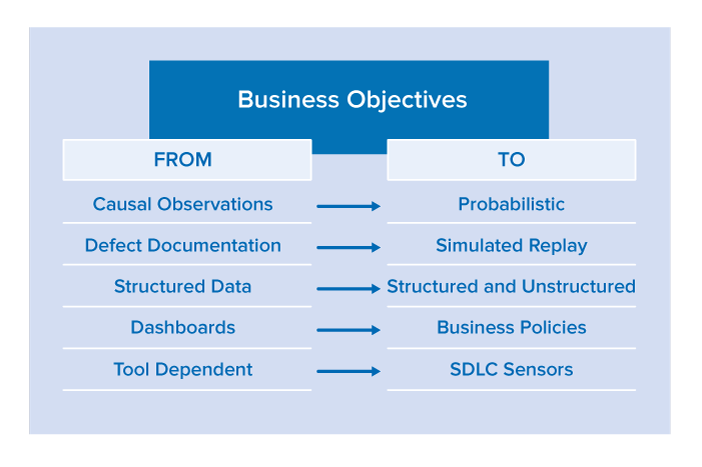
    Driven by business objectives, organizations must shift to more automated methods of quality assurance and away from the tactical task of testing software from the bottom up.
    graphic

    From Causal Observations to Probabilistic Risk Assessment

    With quality assurance (QA) traditionally executing manual or automated tests, the feedback from the testing effort is focused on the event of a test passing or failing—this is not enough. Tests are causal, meaning that tests are constructed to validate a very specific scope of functionality and are evaluated as isolated data points. Although these standalone data points are critical, we must also use them as inputs to an expanded equation for statistically identifying application hot spots.

    The SDLC produces a significant amount of data that is rather simple to correlate. Monitoring process patterns can produce very actionable results. For example, a code review should be triggered if an application component experiences all of the following issues in a given continuous integration build:

    • Regression failures greater than the average
    • Static analysis defect density greater than the average
    • Cyclomatic complexity greater than a prescribed threshold

    From Defect Documentation to Simulated Replay

    The ping-pong between testers and developers over the reproducibility of a reported defect has become legendary. It’s harder to return a defect to development than it is to send back an entrée from a world-renowned chef. Given the aggressive goal to accelerate software release cycles, most organizations will save a significant amount of time by just eliminating this back and forth.

    By leveraging Service Virtualization for simulating a test environment and/or virtual machine record and playback technologies for observing how a program executed, testers should be able to ship development a very specific test and environment instance in a simple containerized package. This package should isolate a defect by encapsulating it with a test, as well as give developers the framework required to verify the fix.

    From Structured Data to Structured and Unstructured

    The current tools and infrastructure systems used to manage the SDLC have made significant improvements in the generation and integration of structured data (e.g., how CI engines import and present test results). This data is valuable and must be leveraged much more effectively (as we stated above in the “From Causal Observations to Probabilistic” section.

    The wealth of unstructured quality data scattered across both internal and publicly-accessible applications often holds the secrets that make the difference between happy end users and unhappy prospects using a competitor’s product. For example, developers of a mobile application would want constant feedback on trends from end user comments on:

    • iTunes app store
    • Android app store
    • Stackoverflow
    • Twitter
    • Facebook
    • The company’s release announcements
    • Competitors’ release announcements

    This data is considered unstructured since the critical findings are not presented in a canonical format: parsing and secondary analysis are required to extract the valuable information. Although these inputs might be monitored by product marketers or managers, providing these data points directly to development and testing teams—in terms that practitioners can take action on—is imperative.

    From Dashboards to Business Policies

    In a Continuous Everything world, quality gates will enable a release candidate to be promoted through the delivery pipeline. Anything that requires human validation clogs the pipeline. Dashboards require human interpretation—delaying the process.

    Dashboards are very convenient for aggregating data, providing historical perspectives on repetitive data, and visualizing information. However, they are too cumbersome for real-time decision making because they do not offer actionable intelligence.

    Business policies help organizations evolve from dashboards to automated decision making. By defining and automatically monitoring policies that determine whether the release candidate is satisfying business expectations, quality gates will stop high-risk candidates from reaching the end user. This is key for mitigating the risks inherent in rapid and fully-automated delivery processes such as Continuous Delivery.

    From Tool Dependent to SDLC Sensors

    Let’s face it—it’s cheap to run tools. And with the availability of process intelligence engines, the more data observations we can collect across the SDLC, the more opportunities will emerge to discover defect prevention patterns.

    Given the benefit of a large and diverse tool set, we need to shift focus from depending on a single “suite” of tools from a specific vendor (with a specific set of strengths and weaknesses) to having a broad array of SDLC sensors scattered across the software development life cycle. And to optimize both the accuracy and value of these sensors, it’s critical to stop allowing tools to be applied in the ad hoc manner that is still extremely common today. Rather, we need to ensure they are applied consistently and that their observations are funneled into a process intelligence engine, where they can be correlated with other observations across tools, across test runs and over time. This will not only increase the likelihood of identifying application hot spots, but will also decrease the risk of false negatives.

    About the Author/Wayne Ariola

    Wayne Ariola (1)Wayne Ariola, Chief Strategy Officer, leads the development and execution of Parasoft’s long-term strategy. He leverages customer input and fosters partnerships with industry leaders to ensure that Parasoft solutions continuously evolve to support the ever-changing complexities of real-world business processes and systems. Ariola has contributed to the design of core Parasoft technologies and has been awarded several patents for his inventions. A recognized leader on topics such as service virtualization, SOA and API quality, quality policy governance, and application security, Ariola is a frequent contributor to publications including software test & performance, SOA World, and ebizQ—as well as a sought-after speaker at key industry events. Ariola brings more than 20 years strategic consulting experience within the technology and software development industries.

  • Serena Software Releases Latest OEM Versions of Tasktop Sync and Tasktop Dev Integrations for DevOps Tools

    Enable Organizations to Standardize on SBM in the Enterprise, Gain Automated Visibility, Reporting, Traceability Across Development Tools

    SAN MATEO, CA and VANCOUVER, BC (PRWEB) March 28, 2016

    Serena Software, the leading independent provider of application development and delivery solutions throughout the SDLC for the most highly regulated large enterprises (HRLEs), and Tasktop, the leader in Software Lifecycle Integration (SLI) and creator of the Eclipse Mylyn open source tool, today announced a new OEM version of Tasktop Dev and the Tasktop Sync DevOps integration platform for Serena Business Manager (SBM).

    SBM is the leading process management platform for IT development and operations to orchestrate processes across an organization, including software development, delivery and operations.

    Tasktop Sync Pro for SBM

    Tasktop Sync Pro for SBM is based upon Tasktop Sync Version 4.5, and provides fully automated enterprise-grade synchronization between SBM and third-party tools used by practitioners in various specialized roles. This integration enables organizations to standardize on SBM in the enterprise while gaining the automated visibility, reporting and traceability across multiple development tools that is essential for HRLEs. Key third-party integrations for SBM include Atlassian JIRA, HPE ALM & Quality Center, Microsoft Team Foundation Server and Zendesk.

    This release includes Tasktop’s market-leading Artifact Relationship Management (ARM) capability that mirrors not only artifacts in other systems but also manages the complex relationships between them for sophisticated traceability across systems. Other enhancements include new support for complex status workflow configuration, the ability to support massive scale deployments with one instance, and numerous usability and performance improvements.

    “Many of our customers assemble a best-of-breed development tool stack with SBM as the central system of record where one or more third-party tools are also required by specialized practitioners,” said David Easter, director, Product Management at Serena Software. “Tasktop enables Serena customers with these mixed environments to create an integrated tool chain and automate the necessary information flow for collaboration, reporting and visibility throughout the lifecycle. By deploying premium DevOps integration technology from Tasktop, these customers can still move fast without breaking things.”

    Tasktop Dev for SBM

    The latest version of Tasktop Dev for SBM is based upon Tasktop Dev Version 4.5, and provides integrated access to SBM from within the Microsoft Visual Studio, Eclipse and Eclipse-based Integrated Development Environments (IDEs) for software developers. This integration makes it easy for developers to view, update and create SBM artifacts without leaving their development environments so that project status information in SBM is timely and accurate for better decision making.

    “Serena has long been a leader in highly regulated industries, and is also well positioned to help customers excel as the new wave of IOT takes hold,” said Wesley Coelho, senior director, Business Development at Tasktop. “Software traceability across development tools is essential in these areas, and we’re excited to work with Serena to provide the powerful combination of SBM and Tasktop.”

    The latest OEM versions of Tasktop Sync for SBM and Tasktop Dev for SBM are available from Serena Software immediately. Interested parties should contact their Serena Software representative for more information.

    About Tasktop

    Over one million users employ Tasktop’s DevOps integration technology to transform software development and delivery. Tasktop not only unifies the software development and delivery team, but also provides unprecedented visibility into the business critical processes of software delivery. Tasktop customers are the global leaders in financial services, insurance, government and manufacturing, and include 34 of the Fortune 100, 11 of the top banks in the world and five of the top ten US insurance companies. Partners, including Serena, CA, HP and IBM, rely on our independent, vendor-neutral role to connect their customers’ software delivery disciplines via OEM distributions of our products. For more information about Tasktop, please visit: http://tasktop.com

    Twitter: @tasktop

    Blog: http://blog.tasktop.com/

    About Serena Software

    Serena Software provides orchestrated application development and release management solutions to the Global 2000. The company is the largest independent ALM vendor and the only one that orchestrates DevOps, the processes that bring together application development and operations. Headquartered in Silicon Valley, Serena serves enterprise customers across the globe. Learn more at serena.com.

    Twitter: @SerenaSoftware

    Blog: http://www.serena.com/blog/

    Serena Media Contact:

    Kevin Parker

    +1 650-481-3494

    kparker(at)serena(dot)com

    Tasktop Media Contact:

    Joyce Bartlett

    +1 781-771-3112

    Joyce(dot)bartlett(at)tasktop(dot)com

    For the original version on PRWeb visit:http://www.prweb.com/releases/2016/03/prweb13289201.htm

  • Twistlock Announces Accelerated Business Momentum, Expands Executive Team Amidst Multiple Industry Accolades

    Company Appoints Dr. Gene Kim to Advisory Board and Taps Jacinta Tobin for Chief Revenue Officer Role

    SAN FRANCISCO, CA–(Marketwired – Mar 28, 2016) – Twistlock, the leading provider of virtual container security solutions, today announced that its business momentum heading into 2016 has surpassed the company’s revenue goal for the first half of the year, delivering sales far above planned expectations. The company also announced the appointment of Gene Kim as a strategic advisor and Jacinta Tobin as Chief Revenue Officer.

    Twistlock’s Container Security Suite has experienced strong adoption since the company announced its general availability in November 2015. The product is now deployed at leading financial services, insurance, healthcare centers, as well as in highly secured military and defense environments.

    This momentum has resulted in numerous prestigious industry acknowledgements; Twistlock has been named a “CyberSecurity company to watch in 2016” by both Dark Reading and Momentum Partners. SC Magazine selected Twistlock as a finalist for the prestigious “Best Emergent Technology” Award. The company received Virtualization Review’s Editor’s Choice Award, and was named as one of CRN’s Top 10 Coolest Security Startups of 2015.

    Today, the company announced the appointment of Gene Kim, an award-winning CTO, researcher, and author, and a prominent authority in DevOps and security, as a strategic advisor. Kim was the co-founder and CTO of Tripwire, and co-authored “The Phoenix Project: A Novel About IT, DevOps, and Helping Your Business Win” and the upcoming “DevOps Handbook.” Kim will advise the company on its product direction, as well as serve as a sounding board for the company’s overall strategies.

    “Driven by the need for increased agility, containers and DevOps are increasingly being used by large, complex organizations, across all industry verticals. There is the potential to not only increase productivity, but to also increase security and reliability,” said Kim. “Container security is a powerful enabler to build quality and security into how we develop and deploy software.”

    In addition, Twistlock announced the appointment of Jacinta Tobin as Chief Revenue Officer. Tobin comes to Twistlock with many years of experiences driving hyper-growth businesses. She is known for her customer-focused execution strategies, which have consistently delivered results to help Fortune 500 customers and large operators achieve technology visions and goals. Tobin will oversee sales, market expansion, and channel practices for the company.

    “Gene brings a unique blend of experiences in entrepreneurship, security innovations and DevOps thought leadership,” said Ben Bernstein, CEO of Twistlock, “Jacinta is one of the most successful high tech sales executives in the field. The addition of Gene and Jacinta comes at an important moment as we expand our market presence and the breadth of our offerings to customers. We look forward to working with them both and leverage their vast expertise to enable innovations and business success for our customers.”

    Bolstering the general availability of its Container Security Suite, Twistlock also announced strategic integrations with two of the largest cloud platforms — Google Cloud Platform’s Container Engine and the Amazon EC2 Container Registry Service. As part of these integrations, Twistlock’s technologies are now easily available to help identify vulnerabilities, detect anomalies and enforce run-time policies for containers in and across both AWS and Google Cloud Platform.

    Twistlock’s Container Security Suite is the only dev-to-production security product on the market today. It has been adopted by more than 30 organizations, spanning financial services, health care, media, hospitality, consumer technology services and government agencies. Many of these customers have deployed Twistlock in both development and mission-critical production environments, protecting live services and valuable customer data in containers.

    Accolades and Awards:

    Additional Resources:

    About Twistlock
    Twistlock is the industry’s first enterprise security suite for container security. Twistlock’s technologies addresses risks on the host and within containers, enabling enterprises to consistently enforce security policies, monitor and audit activity, and identify and isolate threats in the container environment. Twistlock’s mission is to provide an enterprise-grade security stack for containers, enabling organizations to maximize the benefits of adopting containers. For more information, please visit www.twistlock.com

    CONTACT INFORMATION

    • Media Contact:
      10Fold
      Travis Anderson
      Email Contact
      925.271.8227
  • Resurrecting the CMDB Through a Singular Path to Production

    Resurrecting the CMDB Through a Singular Path to Production

    Change consistency (or the predictability of how change is deployed) followed by change transparency (or the visibility into the state of change at any stage in the software development life cycle [SDLC]) are two key benefits of embracing a highly functioning enterprise-class DevOps set of services. Most organizations are attempting to transform themselves from a widely varied manual delivery system to an automated, template-based delivery model that DevOps relies upon.

    Along this journey a key fact soon emerges: We cannot allow “manual” tweaks to our environments and maintain the predictability, visibility or the stability we want. To be truly consistent, process must be fully automated. A process that relies upon human interaction (whether planned or unplanned), is subject to human variability that can impact its success. In short, we do not want a deployment process that has humans coming along after it, to “clean it up.”

    Thus a key principle of DevOps, is that it becomes “the singular path to production.” We want all changes going in to production to have gone through our DevOps systems and processes. Our goal becomes to reduce and eliminate human reliance in every interaction. As an example, we automate test execution, then test evaluation, then test gated change progression. We use “smart” deployment technologies to overwrite what is different in the destination environment, forcing it into compliance with our stated version of changes that “should” be there.

    In effect, we “step on” variations, overwriting them every time we initiate a deployment. This quickly teaches our freestyle engineers who make changes on the fly that their work will get “stepped on” with each new deployment (perhaps daily or hourly). Most engineers quickly get the hint that to preserve their work, they need to include it in the deployment process itself (updating the proper configuration file, or adding the right series of steps in the deployment execution automation itself). Otherwise, they will face a daily onslaught of repetitive tasks that inevitably will overwhelm them.

    In this sense, a properly implemented DevOps system is “self-cleaning.” Paired with an executive mandate to have all change go into production through DevOps, another benefit emerges that may bring the CIO glee. Just a few years ago, IT organizations were bent on the idea of documenting change (therefore understanding it better) through the means of a configuration management database (CMDB). Those projects tended to be large, costly, and doomed to minimal success. Typically, the CMDB effort was great for 90 days after its first instantiation, then over six months its data became “suspect,” then after a year or two its data became prehistoric and close to useless.

    The simple truth is, engineers (of nearly every variety) are toxically allergic to documentation. Asking engineers to have the human discipline of keeping up with documentation is like asking the sun not to shine. No matter what set of inducements is offered, or punishments threatened, the engineer simply remains toxically allergic to documentation and its maintenance (probably a DNA thing).

    Industry tried to solve this problem by producing “discovery tools,” or tools that could determine automatically what our state of change was environment by environment. The idea being that if we ran discovery tools on regular intervals we could at least renew our CMDB baseline from time to time. It was an improvement, but discovery still lacks context for change and often is not thorough enough to generate real value beyond asset location and basic configuration.

    Enter DevOps, which inherently has an artifact database capability to track versions of builds, deployments and releases over time. DevOps understands the need for artifact identification, articulation, compilation and history. Most early DevOps tooling has some form of it built into the products. But this is where a perfect storm becomes possible.

    If our DevOps systems have achieved transparency; that is, if we are able to connect the context of change outlined from ideation (in the business requirements) through production release (including the history of testing, etc.) by version, we now have a great deal of wealth we could plug into a resurrected CMDB. And we could maintain the CMDB automatically (requiring no engineers to have to do manual things to keep it up to date). Our CMDB becomes a repository, or master repository of the artifacts of change we implement through DevOps.

    This is more than just baseline or the ability to establish a “golden copy” of what change should look like. It is the ability to establish “relative” golden copies by development version while it progresses through environments of even highly complex SDLC systems. We have thus increased the value of a CMDB exponentially beyond its use in just production, but can integrate it, into the SDLC process and watch change become documented in real time no matter how fast or how often we move change.

    This should be groundbreaking. Even if the CIO has burned all his funding and political capital on a former CMDB project that has had less-than-desirable results, he or she can salvage what is left of it and quietly use DevOps to resurrect the CMDB, making it an integrated step of moving change. Once the CIO has demonstrated success doing this, he or she can offer this reclamation project to the business and begin exploring ways of creating CMDB valuation to the business (beyond asset location and valuation).

    What emerges is a DevOps-centric CMDB. DevOps, having become the singular path to production, has both insight and context into all change progression and simply updates the CMDB (master artifact repository) as needed automatically. In this way, an integrated CMDB becomes part of the DevOps continuum. And perhaps the greatest benefit or win is the simultaneous recognition of engineer’s allergy to documentation already baked into this sustainable solution. I would call that win-win—or, at least, a recognition of reality.

    To continue the conversation, feel free to contact me.


  • Trusting Continuous Delivery

    Trusting Continuous Delivery

    DevOps, continuous delivery and the pipeline for faster software development are fundamentally different from traditional software development. It’s such a different approach and a different culture that it can take some time before Dev and Ops teams embrace and trust it—a necessary step for DevOps to make progress in any organization. By mixing containers and their value proposition into DevOps, this new software creation and deployment paradigm can readily foster that trust.

    What Continuous Delivery Brings

    DevOps and continuous delivery offer application development using containers, providing the required level of trust to get over that hump and move things forward. According to David N. Blank-Edelman, a DevOps veteran and currently technical evangelist at Apcera, the following container features lead to trust because they answer Dev and Ops concerns:

    • Containers are resource-friendly replacements for virtual machines, built to encase the coder’s development environment
    • Containers are the complete package format replacement, possessing everything you need to run an app
    • Containers create an abstraction that enables development and its results to sit in a host in any of a number of infrastructures including on-premise and inside any of several public cloud providers
    • Containers are the fastest means to launch short-lived, purpose-built testing sandboxes as part of a continuous integration process
    • Containers are the end result of a build pipeline (artifact-to-workload)
    • Containers form the boundary for loosely coupled components as part of a larger app or service. Such is the case, for example, when each part of a microservice-based app lives in its own container

    According to Blank-Edelman, the aforementioned features imbue trust because they satisfy the following Dev and Ops queries:

    • Is the container allocated to use only the resources it should?
    • What resides in that container / workload?
    • Where did that container come from? Is it OK from a security, coding and business requirements perspective?
    • Where is the container permitted to live and run such as in what cloud, environment, country, and in proximity to other containers technically?
    • Can the container communicate with only the things it should such as other containers and any hypervisor or other management resource? “If I move the container to another location, do the answers to these same questions still apply?” asks Blank-Edelman.

    Though these questions express concerns in direct and simple language, experienced DevOps engineers who have felt the frustration of building development processes and attendant infrastructure understands these are difficult questions to satisfy. Without modern containerization efforts to sustain DevOps, development and production goals grow further out of reach.

    The Importance of Policies

    As containers undergird DevOps and continuous delivery, policies support containers. Developers input changes and innovations in code to the continuous delivery pipeline. Developers then respond to the needs of the growing code in a nurturing fashion, fixing errors and enabling new features. This pipeline works when automation, together with each progressive step in the development process, lays a foundation for the next step in a predictable and reliable manner.

    “Here’s where it gets tricky: First, not only do you have to be able to answer the trust-related questions for each step, but it is entirely possible (and entirely likely in an enterprise environment) that different people/teams will share control of and input to each step on that path,” says Blank-Edelman. With so much collaborative effort in play juggling all these pieces, policies are necessary to configure these steps, address networking and other elements, and control the component parts of the process ahead of time and everywhere along the way.

    Policies that make particularly good container watchdogs include those that set steps in the DevOps/continuous delivery pipeline apart, hemming them in on all sides. “Just like having your papers in order makes for an easier border crossing when you travel abroad, so, too, does having your policies reflect the trust required to move from one step to another,” says Blank-Edelman.

  • NetEnrich Teams with Microsoft to Drive Azure Adoption

    IT infrastructure & operations management services provider will offer and deliver Azure deployment services to Microsoft partners in exclusive pilot project. San Jose, CA—March 22, 2016—NetEnrich announces it has been selected as a Microsoft® Technology Partner to deliver services for setup, migration and management of Azure Backup, Azure Site Recovery and applications to Microsoft partners and Cloud Solution Providers around the globe. NetEnrich has created a set of white-label services that a partner can incorporate as part of its Azure cloud offerings. The two companies expect to accelerate deployment and management of Azure services while also saving partners significant time and cost.

    NetEnrich Teams with Microsoft to Drive Azure Adoption Microsoft Azure revenue and compute usage more than doubled year-over-year, with Microsoft Office 365™ revenue growing nearly 70%, according to the company’s latest quarterly earnings release. As businesses migrate rapidly to Office 365, many also need help moving to Azure, giving Microsoft partners a huge opportunity for new revenue streams. Yet many partners are still not up to speed on the Azure platform and don’t have enough in-house staff, expertise or automation technology to respond to customer demand. NetEnrich, however, has nearly 500 engineers, high competency in Microsoft technologies, deep expertise in automation and all components of Azure, and several years of experience in private and public cloud deployments.

    Microsoft partners globally will benefit from a proven, high-caliber service offering, including the ability to begin migration for a customer within 24 hours, round-the-clock support, and management services. Additionally, partners will benefit from NetEnrich’s highly scalable automation platform that enables services for backup, migration and management, speeds time-to-market for partners, and minimizes costly errors during deployment.

    “Microsoft is focused on empowering customers to capitalize on the benefits of cloud, and our partners are key to providing the expertise and support they need to plan their strategy and maximize their Azure investments,” says Hyder Ali, CTO for Worldwide SMB, Microsoft. “NetEnrich will provide a valuable service in a predictable and scalable way to those partners seeking best practices and standard approaches to an Azure migration and deployment, which will mean faster time to value for our customers.”

    “Most service providers want to ramp up quickly on Azure as it offers many advantages on price, flexibility and features,” says Raju Chekuri, CEO of NetEnrich. “Our 11-plus years of experience delivering highly scalable, infrastructure & operations management services to hundreds of partners – both onpremise and cloud, along with our super-efficient automation tools for migrations, monitoring & management, makes this a reality for partners. We’re excited to help grow industry awareness and adoption of Azure.”

    About NetEnrich

    NetEnrich combines industrialized services and a proprietary automation platform to deliver next-gen IT infrastructure & operations management services from on-premise to cloud. This new world approach to IT operations reduces costs while mitigating risk, providing control, and driving innovation. NetEnrich has over 150 channel partners and over 1,400 clients spanning SMBs, mid-markets, and enterprises. NetEnrich is headquartered in Silicon Valley, California. To learn more about NetEnrich, visit www.netenrich.com.

    ###

    Media contact:

    Kevin Wolf TGPR

    (650) 327-1641

    kevin@tgprllc.com