Tag: devops

  • First We Fixed Dev, But Let’s Not Forget About Ops

    First We Fixed Dev, But Let’s Not Forget About Ops

    Since its beginning in 2008, DevOps has gone from an underground rebellion by developers to a mainstream movement with representatives in every industry and at every scale. You can see the change just by looking at how people attending DevOps events dress: the black T-shirts are still there, but these days there are lots of suits and ties as well. Another hallmark of this success is companies trying to fit DevOps into their existing conceptual frameworks—hence, the plethora of “ITIL and DevOps” papers out there.

    Despite all this success, though, the DevOps movement is still young. Of course, things move fast in IT, but we aren’t talking about a technology or a technique that can be adopted rapidly and spread very widely. Committing to DevOps is a major cultural shift for organizations, and that takes time. Some organizations have been doing DevOps for five years and have fully re-engineered their processes around this new approach, but most are still only at the beginning of their DevOps journey. As William Gibson said, “The future is here; it’s just not evenly distributed.”

    First Things First: Speed Up Releases

    The early phase of DevOps adoption focuses on activities around releasing code to production, because that was the bottleneck that the DevOps movement was originally created to break. While it still may be too soon to declare victory, it’s safe to say the improvement in the release process is enormous. Today, any new project that does not propose to implement DevOps principles would have to have a very good reason and explanation.

    Notice that qualification about new projects. It’s easy to adopt DevOps methodologies and expectations in a greenfield situation; however, it is much harder in a brownfield project, where previous cultural norms have been expressed in tooling and processes that are hard to change in-flight. The good thing is that over time, the old way of doing things will die off naturally, as code bases get re-engineered, ported and replaced. Eventually, every project will be a DevOps project.
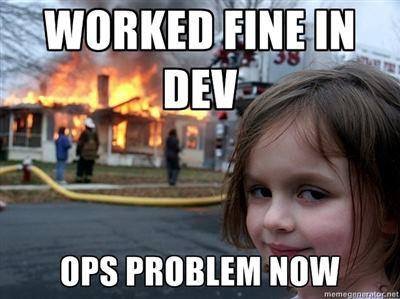
    DevOps image

    Are We Running So Fast That Others Can’t Keep Up?

    DevOps, however, is not just about release and deployment. It also covers operation of what has been deployed. It’s right there in the name, after all! Coming from an operations background, though, there can be a feeling that DevOps is not for “people like me.” Some simplistic interpretations of DevOps focus on the sometimes adversarial relationship between Dev and Ops, forgetting that good Ops people are just as incentivized as Devs to get Devs more involved in Ops.

    One of the difficulties that arise when engineers try to “do the DevOps” without involving Ops is that Ops are not ready to join in. When Dev are doing non-agile releases on an 18-month cycle, Ops have a certain set of assumptions about what a release represents for them. Doing these sorts of monolithic releases is a major pain for Ops for a while, but there will be plenty of time to get ready for it, and other required activities can be scheduled around that release.

    One of those important dependencies is preparing the monitoring and management of the code that is being deployed. What needs to be instrumented, where do those feeds need to go, what needs to be in place to make sense of those feeds when they arrive, who needs to jump when one of the feeds goes red, and so on. There is a lot going on in the NOC that Devs are not always aware of.

    If Devs suddenly show up with a more Agile cadence of a release every couple of weeks, Ops are simply not going to be able to adapt their existing tools and process on the fly to that new cadence. When you have months of lead time, it’s feasible to write and modify extensive sets of rules and filters to make sense of monitoring data, filter out the cruft, and route the remainder correctly. When your lead time on a release is measured in days or hours—not so much.

    Devs should remember that “infrastructure as code” also includes debugging that code. Adopting release automation, containerization or whatever will be the next cool tool will not solve the problem on its own. Bridget Kromhout has a wonderful articulation of this mechanism:

    Containers will not fix your broken culture. Microservices won’t prevent your two-pizza teams from needing to have conversations with one another over that pizza. No amount of industrial-strength job scheduling makes your organization immune to Conway’s Law, which states that “organizations which design systems … are constrained to produce designs which are copies of the communication structures of these organizations.

    Leaving aside the communications barriers that all too often still exist between Dev and Ops, one of the constraints that Ops teams have to deal with is that Ops is segmented into many different teams, each of which deals only with one area or one technology. These days, though, problems tend to have symptoms that cross these domain boundaries, and so operations teams have to communicate with each other.

    The historical ways of doing this are not very efficient, relying on ticket ping-pong, escalations, war-rooms and good old blame-storming. What do you think happens if you suddenly accelerate a system like that? The answer is that it just torques itself into scrap.

    Completing the DevOps Culture Shift

    The good news is that others have been where you are now, and there are both tools and techniques that can help you operate what you have developed. In common with the rest of the DevOps movement, it’s as much a cultural shift as a technological one. Ops teams need to start thinking of operations in a new way.

    One aspect of that change is the ongoing shift to immutable architecture, also known as puppies vs. cattle. Another is to enable efficient communication across support domains. Today, like in the parable of the blind men and the elephant, support teams often get hold of different bits of the problem, misidentifying them because they only have partial information, and therefore cannot truly resolve the problem. Nobody really has a complete view of the whole elephant, except perhaps for some savant who can be reached only after many escalations—and really has better things he or she should be doing.

    If Ops teams can work side by side with Dev, on the other hand, there is a virtuous cycle that becomes possible, with efficient operations removing even more friction from the development process. Communications are the key, whether that means machine-to-machine feeds, human-to-human conversation or machine-to-human interaction. Organizations that get this right reap enormous rewards in both Dev and Ops.


    Dominic Wellington serves as Moogsoft’s Chief Evangelist

  • Puppet Labs Launches Fifth Annual State of DevOps Survey

    PORTLAND, OR–(Marketwired – Mar 22, 2016) –  Puppet Labs, the leading provider of IT automation software, today announced that it has opened the survey for the fifth annual State of DevOps Survey and Report (http://bit.ly/2016DevOpsSurvey). This one-of-kind, comprehensive industry study provides enterprises with insights into how DevOps, automation, IT and organizational performance impact the world’s leading organizations. The 2015 report revealed the critical role that IT leaders play in a company’s DevOps transformation, affirmed that through the power of DevOps and automation, high-performing organizations have 60 percent fewer failures and recover 168 times faster, and demonstrated that DevOps provides a powerful competitive advantage.

    This year’s report is being conducted in partnership with DevOps Research and Assessment (DORA), founded by IT and development experts Gene Kim, Jez Humble, and Nicole Forsgren. The survey will examine a number of new research areas, including:

    • ROI of IT performance. Exploring the ROI of IT performance and technical practices to better understand how throughput, stability and quality measures affect the bottom line.
    • Security and compliance. Security and compliance are top of mind in the DevOps space. This year’s survey investigates the role security plays in a DevOps environment.
    • Quality. Past reports have revealed the impact of DevOps practices on key IT performance metrics for throughput and stability. This year’s survey will help to better understand how quality is affected by DevOps practices.
    • Containers. Containers are no doubt changing the IT landscape. The survey will make clear how much containers are truly affecting IT performance.
    • Lean. Last year’s report found that lean management practices such as limiting work in process and creating and maintaining visual displays showing key quality and productivity metrics predict IT performance. This year’s survey will continue diving into lean practices to boost productivity and performance.

    “As DevOps practices have been increasingly adopted in all industries, we hope to have even more people in IT share their experiences through this year’s DevOps survey,” said Nigel Kersten, CIO of Puppet Labs. “We’re looking to get more information on how well DevOps practices actually pay off for organizations that make this investment, and which practices lead to more effective IT and more successful organizations.”

    “DORA is honored to participate in this year’s survey,” said Gene Kim, one of the co-founders of DORA and co-author of The Phoenix Project. “Organizations in all industries increasingly adopt DevOps because the business value is so high. More than ever, this research helps us understand what organizational and technical practices are required to make DevOps work, as well as how to measure its value.”

    In addition, for the first time in the survey’s history, Puppet Labs and DORA have opened sponsorship to a consortium of companies that are both leaders and innovators within the DevOps space. Current sponsors of the report include Atlassian, Automic, CA Technologies, Hewlett-Packard Enterprise, IT Revolution, Splunk, and ThoughtWorks.

    To participate in the 2016 DevOps Survey and Report, visit (http://bit.ly/2016DevOpsSurvey)

    Additional Resources

    About Puppet Labs
    Puppet Labs, Inc. is the leader in IT automation. Puppet Labs software provides system administrators the operational agility, efficiency and insight they need to proactively manage dynamic infrastructure, scaling from tens of servers to thousands, both on premise and in the cloud. Thousands of the world’s leading organizations use Puppet Labs software to configure and manage their IT infrastructure, including Bank of America, Cisco, NYSE, Salesforce.com and WebEx. Based in Portland, Oregon, Puppet Labs employs more than 360 people. The company is backed by investors Kleiner Perkins Caufield & Byers, Google Ventures, VMware, Cisco, True Ventures, Radar Partners, and Emerson Street Partners. To learn more, please visit PuppetLabs.com.

    About DevOps Research and Assessment, LLC
    DevOps Research and Assessments (DORA) brings together the leading DevOps experts and researchers to help technology and business leaders create world-class technology organizations, leveraging insights from Gene Kim and Jez Humble, renowned experts in the space of IT operations and development, and Nicole Forsgren, PhD, an expert in metrics and psychometrics in software delivery and IT impact.

    In the last three years, DORA has compiled tens of thousands of respondents from technology organizations around the world. By doing this, DORA can benchmark organizations against their industry peers, and provide guidance to leaders on how they can address any gaps to achieve their technology and organizational goals.

    Media Contact
    Justin Dorff
    PR Manager
    (510) 875-9608
    justin.dorff@puppetlabs.com

  • Micro Focus Announces Intent to Acquire Serena Software, Inc.

    Leading Infrastructure Software Vendor Further Strengthens Solution Set to Help Customers Build and Deploy Business Applications and Services Faster, with Greater Reliability and Less Risk

    ROCKVILLE, Md., March 22, 2016 /PRNewswire/ — Micro Focus announced today its intent to acquire Serena Software, Inc., a leading provider of Application Lifecycle Management (ALM) software, in a transaction valued at $540 million. The acquisition is expected to close in early May 2016, subject to receipt of competition clearances in the US and Germany.

    “Today’s announcement marks another significant milestone for Micro Focus, bringing together two highly complementary solution sets that enable customers to build better applications, adapt to changing business conditions more rapidly and maximize the value of existing investments to drive further innovation within their business,” said Stephen Murdoch, CEO, Micro Focus. “With Serena, we are further positioned to deliver richer solutions for the complex business demands customers are solving today – with greater reliability, predictability and less risk of failure.”

    Enterprises globally have increasing demands to build and deploy high-quality business applications to support employees, customers, partners and other third-parties. They require solutions that help them increase the quality of their applications and speed the delivery of change. The combination of Micro Focus and Serena allows companies to better:

    • Design and build business applications and services with greater accuracy, reliability and predictability;
    • Continuously deploy existing core business applications on a wider variety of platforms to meet changing business needs; and
    • Improve the speed and efficiency of new business services through automated release and deployment solutions.

    Serena has extensive expertise in software application development; software configuration and change management; and business process management. Additionally, Serena is a pioneer in processes and solutions that bridge application development and operations to create true DevOps, an increasingly critical area of focus for enterprise customers looking to develop applications and services faster, with greater accuracy and agility that fully meet business demands.

    “This is an exciting announcement that promises to offer substantial value to Serena customers and partners,” said Greg Hughes, president and CEO of Serena. “Our complementary strengths in software development and IT Operations will only serve to provide a stronger foundation for the next-generation of applications and services they require to meet ongoing business demands.”

    About Serena

    Serena is the largest independent Application Lifecycle Management vendor with more than 2,500 enterprise customers. Serena helps the highly regulated large enterprise move fast without breaking things – increasing velocity of the software development lifecycle while enhancing security, compliance, and performance. More information is available at www.serena.com.

    About Micro Focus

    Micro Focus (LSE: MCRO.L) is a global enterprise software company helping customers innovate faster with lower risk. Our software helps customers build, operate and secure IT systems that bring together existing business logic and applications with emerging technologies to meet increasingly complex business demands. For more information, visit: www.microfocus.com.

  • VictorOps Announces DevOps Roadtrip to Impart Industry Best Practices Across the Country

    New event series provides practical tips for implementing and enhancing DevOps strategies

    BOULDER, Colo.–(BUSINESS WIRE)–VictorOps, the real-time, agile incident management company for DevOps teams, today announced its DevOps Roadtrip, a series of events designed to help software development and IT professionals across the country to better implement DevOps practices. The half-day events will focus on tactics and strategies to streamline processes specific to incident management and resolution.

    The first stop in Denver on March 29 will be held at Sports Authority Field at Mile High Stadium and will feature guest speakers from Forrester,Craftsy, and SendGrid. The half day event includes fast-paced TED style talks, topical breakout sessions, and a keynote presentation all aimed at helping others progress in their DevOps journeys.

    “DevOps can be an intimidating topic to many in IT. VictorOps wanted to create a welcoming forum where technology professionals can engage with DevOps experts in the industry,” said Jason Hand, DevOps Roadtrip MC and DevOps Evangelist, VictorOps. “Throughout the country, we’ll spotlight notable speakers in an effort to share DevOps wisdom amongst those tasked with the hard job of maintaining uptime. Our hope is that attendees can head back to their teams with actionable tactics to not only improve their organizations, but also simplify their own lives.”

    In addition to benefiting from a wide range of DevOps expertise and know-how, attendees will:

    • Hear real-life DevOps implementation stories from local companies
    • Learn about industry trends from renowned analysts
    • Network with others searching to implement real-time, agile incident management best practices
    • Have the opportunity to ask questions during an interactive Q&A session
    • And receive practical suggestions to take back to their teams

    By putting these teachings into practice, attendees can help their own companies become more efficient and ultimately more effective.

    “Organizations face an existential threat: deliver more value to customers faster than their competitors, or die. In the past, faster delivery usually meant lower quality and higher risk,” wrote Diego Lo Giudice and Kurt Bittner, Forrester Principal Analyst and DevOps Roadtrip Denver speaker in the December 2015 Forrester report entitled Agile and DevOps Adoption Drives Digital Business Success. “Leading organizations have shown how applying Agile and DevOps practices enables faster delivery with higher quality and lower risk.”

    Other stops on the 2016 DevOps Roadtrip include Seattle, San Francisco, Minneapolis, and New York.

    For more information about the DevOps Roadtrip, visit VictorOps.com/DevOps-Roadtrip, and to sign up for the Denver event, visitVictorOps.com/DevOps-Roadtrip-Denver.

    About VictorOps
    VictorOps is the real-time, agile incident management platform focusing on incident lifecycle management and collaboration for IT and DevOps teams. The solution combines the power of people and data to solve IT problems in real-time. The VictorOps platform seamlessly orchestrates team situational awareness, incident creation, escalation, notification, and remediation with team members regardless of physical location or time of day. Privately held, VictorOps is backed by Costanoa Venture Capital and Foundry Group. For more information, visit www.victorops.com and follow the company on Twitter @VictorOps.

    Contacts

    For VictorOps
    Mackenzie Kreitler, 978-518-4536
    victorops@matternow.com

  • goPaddle goes Google Cloud and Kubernetes v1.2 friendly

    SEATTLE, March 18, 2016 /PRNewswire/ — Bluemeric Inc, a Cloud & DevOps company, today announced the release of the next version of goPaddle v2.0, a DevOps platform for micro-services.

    goPaddle optimised for Google Cloud and Kubernetes v1.2

    2016 being the year of DevOps, IT organizations are already looking at scale-out and economies of scale, while e-commerce companies have understood the impact of agile delivery and zero downtime of their applications. As Gartner predicted, it is becoming a mainstream strategy employed by 25 per cent of Global 2000 organisations. While the need for DevOps is building up, micro-services based architecture is becoming the key enabler for rapid application delivery. Micro-services are sizable units of execution that are independent, polyglot and reusable. Independent teams / developers can make versions of these micro-services, package them as container such as Docker and deploy them on an infrastructure of their choice. Container Clusters like Kubernetes provide a distributed and portable platform that can manage the lifecycle of these containers and provide consistent environments so that applications can be moved painlessly across datacenter and clouds.

    While a spectrum of DevOps ready solutions are emerging in the market, a platform that is focused on continuous build, integration and deployment for micro-services will be a huge cost & time saving solution for businesses.

    Customers have been using goPaddle, for continuous build and deployments since last year. With the new release, goPaddle is optimized for Google Cloud, thus making authentication, on-boarding micro-services and cluster provisioning simple and seamless for Google Cloud Developers. goPaddle provides a powerful yet simple designer interface, that developers can use to drag drop components to create micro-service designs and generate container/cluster specifications on the fly. These designs can then be deployed on to Google Container Engine (GKE) or to a cluster of their choice. Developers can leverage Google Container Registry (GCR) or use Docker Hub for storing/retrieving the container images. As these features signify, goPaddle has moved the infrastructure management hassles away from the developers, while the developers can focus on building their applications.

    While adding simplicity, goPaddle also gives the traceability and control to audit and monitor the applications. In general, log aggregation platforms like fluentd have greatly been in use by the developers and system administrators to monitor the system, application and access logs. goPaddle v2.0 brings in the support for fluentd leveraging the newest features in Kubernetes v1.2. With goPaddle, fluentd can be deployed on selective cluster infrastructure to aggregate logs from micro-services running within those infrastructure.

    goPaddle is available as a hosted version at https://gopaddle.io and as enterprise ready on-premise version with extended support. For more information, get in touch with the Bluemeric team at info@bluemeric.com.

    Photo – http://photos.prnewswire.com/prnh/20160317/345548

  • BlazeMeter Uses the Force of Performance Testing to Prepare MovieTickets.com for the Release of “Star Wars: The Force Awakens”

    SAN FRANCISCO–(BUSINESS WIRE)–Movie releases are major traffic events for online ticket providers. So when the most storied movie franchise in history comes out with a new chapter, it creates a unique performance challenge. That’s whyMovieTickets.com, a worldwide leader in advance movie ticketing, turned to BlazeMeter to ensure that its new Amazon Web Services infrastructure could manage the volume of online ticket orders around opening weekend for “Star Wars: The Force Awakens.”

    The majority of online advance ticket buying occurs 1-2 weeks prior to a release date, but the release of “Star Wars: The Force Awakens” marked a historically unique buying trend, as MovieTickets.com was inundated with pre-orders months prior to the film’s December 2015 release date.

    “The demand for advance ticketing during the first buying opportunity was unprecedented,” said Craig Lefkowitz, Director of Infrastructure Systems at MovieTickets.com. “We had not seen that type of volume two months before a movie release, so we needed to make sure we were well prepared for opening weekend.”

    To prepare its site to meet demand, MovieTickets.com wanted to upgrade its infrastructure to manage spikes in volume, migrating to an Amazon Web Services (AWS) cloud environment that could scale alongside demand. However, in order to make sure the new cloud-based infrastructure could perform optimally, the company enlisted the help of BlazeMeter’s continuous performance testing technology.

    “We chose BlazeMeter because it’s the leader in performance testing,” said Lefkowitz. “BlazeMeter is a standout and very well-respected in the industry. We needed to utilize a proven solution to get us ready for such an important event.”

    MovieTickets.com used BlazeMeter’s performance testing solution to examine various load volumes and times across the AWS infrastructure. A member of the AWS CodePipeline partner network, inaugural DevOps Competency Program member and trusted partner, BlazeMeter’s testing solution can integrate directly into an AWS DevOps or continuous delivery framework, identifying trouble spots in real-time and readying the site for major traffic events.

    With BlazeMeter’s help, MovieTickets.com tested their infrastructure to manage more than 30,000 simultaneous users per second. As they continued to extend their infrastructure, that number expanded to more than 300,000 concurrent visitors.

    “The higher the performance expectation from an event, the greater the need to ensure an infrastructure can support the required service level,” said Alon Girmonsky, CEO and Founder of BlazeMeter. “The trust that large companies have in our technology around critical events speaks to the importance of performance overall. The inability to manage the volume directly equates to lost sales, making performance testing a critical investment for any company that needs to maintain peak performance at all times.”

    “Performance is our top priority,” said Lefkowitz. “Our customers have high expectations and we need to meet those expectations.”

    For more information on how MovieTickets.com works with BlazeMeter, visit https://www.blazemeter.com/case-study/movietickets?utm_source=BM&utm_medium=newswire&utm_campaign=MovieTickets. And for more information on how to improve site performance through continuous performance testing, visit https://blazemeter.com/.

    About BlazeMeter
    BlazeMeter ensures delivery of high-performance software by enabling DevOps teams to quickly and easily run open-source based performance tests against any mobile app, website or API at massive scale to validate performance at every stage of software delivery. The rapidly growing BlazeMeter community has over 100,000 developers and includes prominent global brands such as Adobe, Atlassian, Gap, NBC Universal, Pfizer and Walmart as customers. Founded in 2011, the company is headquartered in Mountain View, California with Research & Development in Tel Aviv, Israel.

    For more information, sign up for a free 14-day trial at www.blazemeter.com, visit our blog or find us on Twitter @BlazeMeter and on LinkedIn.

    About MovieTickets.com
    MovieTickets.com is the leader in advance movie ticketing with nearly 250 theater chains, representing over 28,000 screens in its group, offering moviegoers a quick and convenient way to purchase tickets online, via mobile devices and at 877-789-MOVIE. The company currently enables remote ticketing for consumers across 21 countries/territories including the United States, Canada, United Kingdom, Ireland, Argentina, Puerto Rico, the Dominican Republic and the Caribbean. Fans can stay connected with MovieTickets.com through Facebook (facebook.com/MovieTicketscom), Twitter (twitter.com/movietickets) and YouTube (youtube.com/c/movietickets).

    Contacts

    Press Contact:
    PAN Communications
    Adam Novak, +1-617-502-4300
    blazemeter@pancomm.com

  • DevOps Debates: Monoliths or Microservices

    DevOps Debates: Monoliths or Microservices

    From the time software came into existence, application software has been booming to leverage the benefit of the computing paradigm. During this cycle, it has transformed decades of design and architectural thinking, and has crossed all aspects of application development and management needs, be it configurability, reusability, maintainability, scalability or security (a good list is of these “ilities” is here).

    While many have been addressed, one “ility” that has turned a lot of eyes and attention in the last few years is deployability. More than that, it is the ability to do so continuously. This requirement has changed the thinking of building software for two main reasons: (a) Businesses have started asking to release software faster than ever, even in verticals unheard of before; and (b) Cloud and infrastructure as code has made faster deployment a easier possibility. When you look at application design with deployability in mind, given the need to be agile, what you end up getting is a microservice.

    Most applications of old style addressed most “ilities” in an architecture but did not consider “continuous deployability” as a core need as well. I call these monolith from a deployment perspective. They are tightly coupled, and for any small change a complete build of the application was necessary.

    Now the question is, Should you really look at microservice as a silver bullet to deploy all software? Should you consider that as the de facto standard to deliver any application functionality? Will applications cease to exist the way we know? Here are my thoughts. As usual, feel free to add yours or write to me personally, as some of you do as well.

    Applications as monoliths will stay as they are

    1. Monoliths have evolved over generations of design and architecture tests and stood the test of time. The focus on modular development is, in fact, a way of creating modules, which are built with separation of concerns in mind.
    2. Monoliths were built to run for a long time. It had addressed some of the “ilities” well before they became considerations.
    3. Applications will remain easier to debug, as most of the debuggable areas are in developer’s hand, instead of having to work with a team.
    4. Applications will perform better, as they can share data in memory; they don’t have to do out-of-process calls to get one task executed.
    5. Applications will be more secure, as they will be a black box from an end user perspective or even a hacker perspective, with little coming out from the system.

    Microservices will be a monolith-killer all the way

    1. Deploy, deploy and deploy to correct your problems away. Fail fast and fix faster is the mantra that you can practice.
    2. It helps bundle two-pizza teams owning microservices and hence embrace better ownership and faster response.
    3. The overall architecture to deliver an end-to-end use-case may become complex, but each piece of the jigsaw puzzle can be handled faster.
    4. In the faster-moving world, business wants to try a concept rather thinking through all the “ilities” ahead of time, and progressively make everything better. Microservices helps abstract all complexities much better.
    5. Microservices will help developers think out of box from day one, while helping business deliver smaller chunks, without having to make the system a “big ball of mud.”

    At the end of the day, irrespective of the approaches, the key is to ensure the applications are managed well, changes are refactored well, the code that is written is readable and maintainable, and significant test assets are created to regress the entire system quickly. So whether it is a large system or microservices, you are able to make any necessary changes quickly and can deploy fast.

    While microservices surely will help this new faster-deployment thinking, I—and I am sure you all—have also seen large monolithic systems that are making delivery at an astounding pace.

    Thoughts?

  • 5 Things DevOps is Not

    5 Things DevOps is Not

    For those who have been embracing and championing DevOps for years, the growing popularity of DevOps is as exciting as landing your first job out of college! Okay, maybe not that exciting, but still really cool. More and more companies of all sizes are embracing DevOps by including the adoption of DevOps practices directly into their fundamental strategies.

    On one side, this is giving teams the leverage they have needed all along to either begin their DevOps journey or to increase the maturity of existing DevOps adoptions. On the other side, when DevOps becomes a mandate, some of that grassroots passion can become watered down, as the use of the word becomes increasingly overused or incorrectly used.

    DevOps incorporates a new collaborative culture that embraces numerous practices combined together for a continuous software development methodology that places significant emphasis on feedback loops, collaboration and continuous improvement. DevOps requires fundamental cultural changes and includes so many practices that can be overwhelming to those just starting their journey.

    Instead of highlighting everything that DevOps is, I thought it would be good to take a step back and highlight what DevOps is not instead.

    1. DevOps is not simply combining Development & Operations teams

    We’ve all seen this one when the term DevOps comes up. “Let’s combine the Development & Operations team and, voilà!, we now have DevOps.” DevOps combines a set of processes and practices to be adopted throughout the entire delivery pipeline and spans multiple stakeholders. A couple of the key practices within DevOps adoptions include continuous integration (CI) and continuous delivery (CD). Simply combining two teams and calling it DevOps cannot accomplish those practices.

    2. DevOps is not a separate team

    Setting up a separate DevOps team is another trap many organizations fall into when beginning their DevOps journey. In general, I’m not a fan of the DevOps team as I believe it leads to more silos in the end. I’ve also found the creation of these teams can lead to further confusion when the mission is not clearly defined.

    There are some cases where a temporary DevOps team may make sense to help enable the processes and potential tooling that may be needed for adoption, but the key is making it temporary—which is often better in theory than in practice. There are several great blogs out there discussing DevOps teams such as Matthew Skelton’s blog, “What Team Structure is Right for DevOps to Flourish?”

    3. DevOps is not a tool

    Let me be the first to say I actually love the growing number of tools that enable us to continue maturing our DevOps adoptions, but I’ve noticed the use of one or two tools starts to lead to the perception that DevOps is a tool. How many times have you heard?

    “We’re already doing DevOps. We have Chef.”

    “We do DevOps. We automatically deploy through Jenkins.”

    Keep in mind, I’m a big fan of both Chef and Jenkins, but I think the power of DevOps is drastically underutilized if you’re equating the utilization of a single automation tool to DevOps success. Adopting automation and tooling is, of course, a part of DevOps, but only when combined with end-to-end practices of increased collaboration with continuous integration/continuous delivery, amplified feedback loops and continuous improvement (to name a few)! DevOps is a journey and that journey may start with a tool, but the goal should be to first identify your DevOps strategy and then find a tool or tool chain that meets those goals.

    4. DevOps is not a one-size-fits-all strategy

    Because there are so many different business drivers and technologies to consider when setting up an overall DevOps adoption strategy as well as identifying your DevOps tool chain, it’s important to apply the same tenets of DevOps to your DevOps strategy. Embrace change, gather metrics, understand feedback, fail fast and correct your course quickly. As an example, if you initially identify a tool that no longer works for your technology or environment, abandon it and move on. Just because you used it on the last project doesn’t make it a silver-bullet fix for the next one. We need to first understand our current strategy and environment, then react accordingly.

    5. DevOps is not automation

    That one may have caught the eye of a few people, so I’ll clarify: DevOps is not solely automation. Automation is absolutely a huge part of DevOps; however, it is not the only part, and deploying some degree of automation is often used interchangeably with DevOps. I think understanding the key DevOps practices is a great precursor to ensuring DevOps is viewed as more than just automation. Understanding the core DevOps principles is key to understanding the true benefits of DevOps adoption.

    There are a lot of things that DevOps is and I think I share a widely spread passion for DevOps. There are also a few things that DevOps isn’t—or isn’t solely. If you’re just starting your DevOps journey or still maturing your existing model, making sure everyone on your team has some basic DevOps education and is aware of the DevOps strategy for your project is key. It will go a long way in helping everyone understand that DevOps is about a lot of things. It’s also not about a lot of things.

    The list above isn’t exhaustive and I’m sure you all have a few you’d like to see on the list. I’d love to hear you thoughts and suggestions at @Shelbee_SE.

    You also can download and browse through the DevOps for dummies e-book.

    About the author/Shelbee Smith-Eigenbrode

    Shelbee

    Shelbee Smith-Eigenbrode is a Senior Software Engineer/IT Architect at IBM Cloud Infrastructure Center of Competency. She has worked across varying roles spanning the software development life cycle. Her experience across functional roles as well as performing that work deeply inside traditional silos has contributed to her passion for embracing the DevOps culture and transforming the way teams are delivering technologies by adopting DevOps practices. She is a member of the IBM Academy of Technology committed to driving innovation and technical advancement.

  • PagerDuty Selects Threat Stack to Enable High-Velocity Security and Compliance in the Cloud

    Threat Stack’s Continuous Security Monitoring Helps Assure Security and Scalability

    BOSTON– March 16, 2016 – Threat Stack, a leader in cloud security management and compliance, today announced that PagerDuty, the pioneer in agile incident management, selected Threat Stack Cloud Security PlatformTM to protect and secure its rapidly growing infrastructure within its Amazon Web Services (AWS) environment. PagerDuty’s decision to adopt Threat Stack was driven by its need for continuous security monitoring and complete visibility into its users, data, and expanding AWS and Microsoft Azure infrastructure.


    “As a rapidly growing organization committed to delivering reliability and uptime, it’s critical that we leverage the scalability and flexibility of the cloud, while keeping our resources safe and secure,” said Arup Chakrabarti, Director of Infrastructure Engineering at PagerDuty. “Not only is Threat Stack easy to deploy, it’s also easy to integrate with both new and existing tools. We now have complete visibility into our processes and activities for continuous monitoring and security management across our environment.”


    The PagerDuty platform allows IT Ops and DevOps teams to manage and respond to incidents quickly and efficiently, reducing the chance of outages or setbacks of any kind. Threat Stack’s continuous, real-time security monitoring helps the PagerDuty team to quickly identify top-level threats, streamline processes within the operation’s workflow and increase security across the organization.


    “We are longtime fans of PagerDuty, and are excited to partner with them to deliver granular, integrated visibility into user activity, processes, files and network connections,” said Venkat Pothamsetty, Vice President, Products and Customer Advocacy at Threat Stack. “We are proud to deepen this relationship by helping PagerDuty scale their cloud-based business while keeping them secure and compliant.”


    PagerDuty is using Threat Stack Cloud Security Platform’s full suite of features and special integrations across its AWS environment to provide host-level visibility and other key capabilities including:

    • Autoscaling: Threat Stack’s cloud-native architecture automatically scales up or down with the capacity of PagerDuty’s AWS and Microsoft Azure infrastructure to ensure continuous visibility across its dynamic environment.


    • Insider Threat Identification: Continuous monitoring for unauthorized actions, such as escalation of user privileges, unauthorized installs, new users added/deleted, suspicious commands, anomalous behavior, changes to security groups, user session information and process stops.


    • External Attacks Early Warning: Automatic detection of abnormal login attempts/failures, wide open security groups, launches of new processes or kernel modules, user session information, process stops, external connections for command and control.


    • Data Security Verification: Automated access, editing or copying of customer or personal data intellectual property, as well as internal configuration, passwords, certificates and keys.


    • Compliance Reporting: Real-time visibility, detailed audit trails and built-in compliance reporting provide the historical record needed to meet compliance regulations and ensure data and infrastructure are protected.


    To learn more about how PagerDuty uses Threat Stack, please visit the Threat Stack blog.

    About Threat Stack

    Threat Stack enables growth-driven companies to scale with confidence by identifying and verifying insider threats, external attacks and data loss in real-time. The only fully integrated, cloud-native continuous monitoring solution that gives customers instant visibility and automatically responds to changes in their environment, Threat Stack provides the coverage needed to run secure and compliant, in all environments, without sacrificing speed and efficiency. For more information, or to start a free trial, visit threatstack.com.

    About PagerDuty

    PagerDuty is an agile incident management solution that integrates with IT Ops and DevOps monitoring stacks to improve operational reliability and agility. From enriching and aggregating events to correlating them into actionable alerts, PagerDuty streamlines the incident management lifecycle by reducing noise and resolution times. With hundreds of native integrations with operations tools, automated scheduling, advance reporting and guaranteed availability, PagerDuty is trusted by over 7,000 organizations globally to increase business and employee efficiency. The company is headquartered in San Francisco and backed by leading venture capital firms Andreessen Horowitz, Bessemer Venture Partners, Baseline Ventures, Ignition Partners and others. To try PagerDuty for free, or to get more information, visit www.pagerduty.com

    Media Contact

    Ashley Crutchfield

    fama PR for Threat Stack

    (617) 986-5025

    threatstack@famapr.com

  • Git: One Giant Leap Toward DevOps

    Git: One Giant Leap Toward DevOps

    If you work in an organization that has not yet embraced DevOps, then you might be wondering where to begin. Fortunately, there are many good answers. But I want to introduce one simple starting point that you probably haven’t heard: introducing Git to operations. By itself, Git might not seem like a meaningful way to overcome the barriers between dev and ops. Yet, Git provides some capabilities that mark the difference between the lowest performing IT organizations and the highest. And the difference in IT performance can translate into substantial business benefits. The highest performing IT organizations have noticed the following benefits:

    • They are about twice as likely to exceed profitability, market share and productivity goals.
    • Their employees reported far higher levels of job satisfaction.
    • They realize 50 percent higher market capitalization growth over a three-year period.

    To be clear, no amount of data will ever prove that use of Git leads directly to growth, profit, productivity and job satisfaction. What the Puppet Labs’ “State of DevOps Survey” does show is the incredible range between low and high performance in IT organizations. The rate of deployment has hovered at 30 times faster for high-performing organizations over the lowest. The 2014 survey showed 50 percent fewer deployment failures, while 2015 showed 60 percent fewer deployment failures, when comparing highest to lowest. The survey also indicates which practices separate the highest performers from the lowest. According to the State of DevOps Survey, the top two indicators of high performance are:

    • Version control of all production artifacts (surprisingly, a far greater predictor of performance than version control of source code); and
    • Peer review of production changes (in contrast to external change approval).

    It’s not that these two practices magically yield business benefits. Indeed, ITIL has long recognized management of production artifacts and review of production changes as best practices. But too many organizations still believe faster deployment and higher reliability are trade-offs. What is “magical” in high-performing organizations is they realize they can have both faster deployment and higher reliability by collaborating across organizational boundaries and automating intelligently. That means dev and ops sharing goals, measurements and tools. So one way in which these practices differ from typical ITIL practices is how dev and ops perform them collaboratively. More specifically, when dev and ops use the same tool for version control, they can better share techniques and workflows. For example, the peer review of changes can include both dev and ops. Thus, Git is a gateway to DevOps.

    Git has long provided those two capabilities for software developers: Developers use Git to version source code and developers use pull requests to perform peer review of source code. With a few tips about how to apply Git to configuration files, operations can use pull requests to perform peer review of configuration changes. Now with git-lfs, operations can also version production artifacts, which often are large, binary files that historically have not worked well with Git. More advanced concepts such as infrastructure as code and dedicated binary repositories, for example, build on version control, so even if the role of Git changes over time, the skills and collaborations remain valuable.

    In summary, the business case of Git for Ops is simple. The Puppet Labs survey shows meaningful upside for low performing IT organizations to become high performing. The survey shows high performing organizations are characterized by both rapid deployment and high reliability, not picking one over the other. Two practices that characterize high performing IT organizations are version control of production artifacts and peer review of changes. Git is now well-positioned to provide both capabilities. If you’re ready to start introducing operations to Git, don’t forget that Bitbucket has no limits to the number of private repositories.


    About the Author/Ian Buchanan

    ianWhile Ian Buchanan has broad and deep experience with both Java and .NET, he is best known as a champion of agile methods in large enterprises. He is currently the Developer Partisan for Developer Tools at Atlassian, where he focuses on the emerging DevOps culture and the application of Bitbucket and Bamboo for better continuous integration and continuous delivery. During his career, he has successfully managed enterprise software development tools in all phases of their life cycle, from cradle to grave. He has driven organization-wide process improvement with results of greater productivity, higher quality and improved customer satisfaction. He has built multinational agile teams that value self-direction and self-organization. When not speaking or coding, you are likely to find Ian indulging his passions in parsers, meta-programming and domain-specific languages.