Tag: devops

  • VersionOne® Spring 2016 Release Helps Organizations Successfully Scale Agility with SAFe® and DevOps

    VersionOne Enables Program Boards, PI Planning, and WSJF Ranking to Align with the Scaled Agile Framework®

    Atlanta, GA (PRWEB) April 22, 2016

    VersionOne, the independent leader in agile lifecycle management, today announced its Spring 2016 Release to help organizations successfully scale agility with SAFe and DevOps. New features in VersionOne Lifecycle that directly support SAFe include: a new Program Board for coordinating across teams and visualizing cross-team dependencies; interactive, multi-team Program Increment (PI) Planning capabilities; and Weighted Shortest Job First (WSJF) Ranking. In addition, VersionOne Continuum™ for DevOps now includes the ability to view a graphical timeline of work item history and a visual depiction of the development, test, and stage phases of a DevOps product workflow.

    VersionOne’s Spring 2016 Release includes the following:

    • Program Board – Coordinate efforts and visualize cross-team dependencies at the portfolio item level across each iteration in a release. These visualizations help teams avoid risks and costly delays that often result from unforeseen dependencies with other teams.
    • PI Planning – Plan complex, multi-team releases on a single screen with flexible, interactive team assignment and context sensitive filtering of backlog items during large-scale planning sessions.
    • WSJF Ranking – Rank portfolio items, epics, features, and capabilities based on the cost of delay. The cost of delay algorithm is based on estimated business value, risk reduction, time criticality, and effort.
    • DeliveryStream – Give teams the ability to trigger pre-configured Continuum actions within Lifecycle work items.
    • Continuum Product Workflow – Define the workflow for any product that is defined in Continuum and visualize the development phases.
    • Continuum Work Item History Visualization – See a visual representation of all the steps and automation a particular work item has participated in, all in a single place.
    • ALM Connect™ – Connect VersionOne to the world’s most popular application lifecycle management (ALM) systems and manage the integrations from one intuitive, web-based interface. ALM Connect ensures visibility and coordination across today’s complex development processes and heterogeneous environments.

    “While agile adoption continues to grow, ensuring successful large-scale agile implementations can be challenging without the right framework, solutions, and services,” said VersionOne CEO and Co-founder Robert Holler. “The Spring Release is further proof of our ongoing commitment to helping our customers successfully scale across the entire software delivery value stream.”

    Learn more about the VersionOne Spring 2016 Release.

    About VersionOne

    VersionOne is a recognized leader and visionary in agile lifecycle management software and services. Our mission is to help companies envision and deliver great software. Our promise is to promote and serve the best interests of the agile software development community with respect and humility. Every day, we work hard to make a difference in our community and with our customers.

    Today, more than 50,000 teams at 1,000 companies, including 33 of the Fortune 100, use our solutions to help scale their agile initiatives faster, easier, and smarter. Whether a small team just starting out with agile or a global enterprise scaling agile, VersionOne customers get the best solutions in the industry backed by the pioneers in agile lifecycle management. VersionOne has offices in Atlanta and in Amsterdam.

    VersionOne is a registered trademark and ALM Connect and Continuum are trademarks of VersionOne Inc. Scaled Agile Framework and SAFe are registered trademarks of Scaled Agile, Inc.

  • DBmaestro To Expand Globally With Appointment of Former Microsoft Executive

    DBmaestro expands to Europe, the Middle East, Africa, APAC and Japan

    Houston Texas, April 21, 2016 – DBmaestro (http://www.dbmaestro.com/), the pioneer and leading provider of DevOps for Database solutions, announced today that it’s expanding its focus globally with the appointment of Danny Neuberger as Senior VP of Sales in Europe, the Middle East, Africa, Asia Pacific and Japan to further expand their client base and global network of strategic partners. DBmaestro currently partners with IBM, Microsoft, Oracle, CA Technologies, Perforce, Xebialabs, Serena, Clarive and many other top technology vendors.

    Neuberger has spent the past five years serving as Managing Director and Country Manager at EMC and has held a number of senior positions at Microsoft including SMS&P Senior Director for the Middle East & Africa. This hiring comes on the heels of a $3 million Series A round of funding by DBmaestro.

    DBmaestro’s DevOps for Database solution offers a comprehensive approach to the database development life cycle, addressing enterprises need to deliver changes faster. DBmaestro has been at the forefront of Continuous Delivery for the database, delivering innovative methods for safe database automation and allowing companies to reduce costs in development and deployment.

    Yariv Tabac, co-founder and CEO of DBmaestro said, “With our solution currently deployed in some of the largest enterprises in North America, the time was right to focus outwards to the European and Asian markets. Danny’s wealth of experience and industry knowledge has already made him a key addition to the DBmaestro executive team. His appointment is a sign of our commitment to bringing DevOps solutions to the databases. It’s very fortunate that we were able to find someone of Danny’s caliber to fulfill this role and I’m confident that Danny will take DBmaestro to new heights on a global scale.”

    Danny Neuberger commented: “I am truly excited to join the DBmaestro team and look forward to working with them to further develop their global client base and network of partners. Having spent the last 20 years involved in the sales and marketing of software solutions, I have seen first-hand how the database is often left behind when it comes to DevOps and Continuous Delivery. DBmaestro brings those latest methodologies to the database, ensuring it is not the weakest link in the chain”

    About DBmaestro

    DBmaestro is a pioneer and leading DevOps for database solution provider. Its flagship product, DBmaestro TeamWork, enables agile development, Continuous Integration and Delivery for the Database.

    TeamWork supports streamlining of development process management and enforcing change policy practices. The solution empowers Agile team collaboration while fostering regulatory compliance and governance. With DBmaestro, organizations can facilitate DevOps for database by executing deployment automation, enhancing and reinforcing security as well as mitigating risk.

    DBmaestro’s solutions are deployed at many major international companies, including Barclays, Visa, Isracard (MasterCard), Frost Bank, Thomson Holidays, Bank Leumi, and others.


  • Murphy’s DevOps: The Internet Apocalypse

    Murphy’s DevOps: The Internet Apocalypse

    I’ve been immersed in cybersecurity for a good stretch, since it was known as just “infosec” and “security.” Over time, I’ve had opportunities to work with some brilliant minds and young-gun “hackers” (I’m not a name dropper, so I’ll refrain from using them as SEO-bait). I’ve watched attackers transition from being basement-dwelling teenagers to organized intruders to APTs. At one point or another, I’ve met all of Five Horsemen of the Internet Apocalypse: Scam, Extortion, Embarrassment, Theft and Death.

    The biggest cybersecurity news story of all time is still Edward Snowden. Fancying himself a “whistleblower,” champion of the Constitution and privacy rights expert, this fugitive data thief accused of espionage by the United States government has done more to force businesses and individuals to think about digital security and privacy than anyone or incident before him.

    Snowden aside, there are thousands of other stories about just how fragile our online lives and businesses are. If you were at the devopsy.kinsta.cloud Rugged DevOps event at RSA 2015 and caught the presentation by Wired cybersecurity and privacy writer Kim Zetter, “2015 — The Year in Hacks,” then you had a chance to get a great overview of some of 2015’s biggest digital crimes. You might have even noticed the Internet Apocalypse Horsemen riding through.

    With an ear to the ground on everything the NSA and APT-using hackers are guilty of, @KimZetter never fails to intrigue readers and live audiences. Whenever you read her stories or listen to her speak, you always walk away reassured that when all the smoke and headlines have cleared, the great deep-down reality is that everything we digitize is subject to the whim of Scam, Extortion, Embarrassment, Theft and Death. If you didn’t have a chance to attend, please enjoy some of the highlights listed below.

    China vs. U.S., Spy vs. Spy

    Internet Apocalypse

    She kicked off with the biggest hack of 2015: the one that penetrated the U.S. Office of Personnel Management (OPM). The full extent of the damage done and who the actual attackers were may never be fully realized. Were they Chinese spies, rogue hackers or a combination of both? What we do know is that it exposed millions of identities tied to covert U.S. operatives and their family members listed on security clearance forms. It may have even exposed personal information on everyone who has ever applied for a job with the federal government. One for-sure lesson is that even after several decades of security product development (with more than 800 available for review at RSA), the world is still in need of innovation in the space.

    Men Behaving Badly …

    Internet Apocalypse

    Some might argue that Embarrassment made a special appearance at Ashley Madison, but the fact that suicide was part of that hack leaves me to think that Death was the lead actor there. @KimZetter pegged the data theft as the most brazen hack of 2015. With 30+GB of account information stolen and dumped, login credentials for 32 million accounts purloined, credit card transaction information accessed and even several suicides tied to the incident, the hack again reminded the world that the great deep-down reality is that everything we digitize can be used by attackers to scam, extort, embarrass, steal and even kill us.

    From the Keyboards of Babes …

    Anyone at the presentation must agree that Embarrassment really stole the show in the hack of CIA Director John Brennan’s AOL email account. Allegedly perpetrated by a teenager, Zetter describes the incident more deeply in her October story: Teen Who Hacked CIA Director’s Email Tells How He Did It

    Internet Apocalypse

    Keep Calm and Internet On

    Anyone reading this may be walking away with a rather pessimistic view of our chances of remaining secure online. The truth, however, is that the existence of determined hackers should do no more to stop individuals or businesses from going online than road rage should to prevent anyone from getting behind the wheel of a car.

    If any lesson can be learned from news articles pumped out by @KimZetter and her peers, it’s that the world should continue to take full advantage of the Internet but to also take the time needed to apply effective security. Quite simply, we all should keep calm and Internet on …

  • Infrastructure as Code is SDN for Ops

    Infrastructure as Code is SDN for Ops

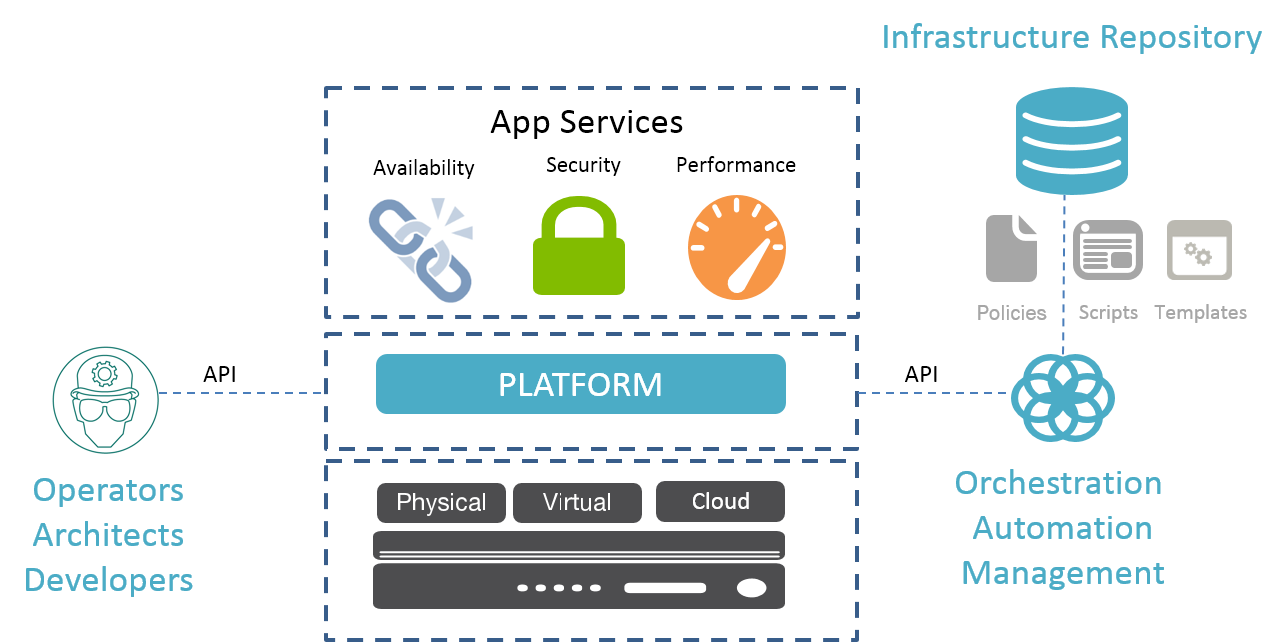
    As we continue to recognize the importance of DevOps—particularly its automation and orchestration aspects—to achieve the agility necessary for continuous deployment of apps, the question of how the term “Infrastructure as Code” (IaC) applies to traditionally network-bound systems and services is bound to crop up more frequently. After all, in addition to core IP-based networking characteristics required for an app to communicate and serve up content, an entire ecosystem of app services that support, secure and scale it must be considered.

    IaC is driven by the application of development principles to network infrastructure. Configuration, scripts, templates, profiles and the like are treated as code, in that they should be reviewed, versioned and provisioned from a centralized repository (one hopes on-premises) rather than managed as discrete network elements.

    In a recent article in TechBeacon, Boyd Hemphill, director of evangelism at StackEngine, noted, “The basic principle is that operators (admins, system engineers, etc.) should not log in to a new machine and configure it from documentation.”

    Christopher Null, CEO of Null Media and author of the article, then wrote, ” … But IaC is a concept that extends beyond simple infrastructure automation. IaC requires applying DevOps practices to automation scripts to ensure they’re free of errors, are able to be redeployed on multiple servers, can be rolled back in case of problems, and can be engaged by both operations and development teams.”

    The idea is that you can describe any given service as a set of artifacts and deploy (and redeploy) them at will. So rather than set up a system and configure it directly, its configuration any associated artifacts (such as profiles or templates) are treated as code and stored in a common repository. A controller—the orchestrator—is responsible for distributing those artifacts when necessary. The controller uses an API (or protocol such as OpenFlow) to manage the configuration of services across a distributed infrastructure. It’s decoupling the service definition from the service and its platform.infra as code

    Read that again. It decouples the service definition from the service and its platform and assigns responsibility for provisioning and configuration to a controller. Kind of like decoupling the control plane from the actual forwarding and switching actions (the data plane) and assigning operational responsibility to an external controller.

    At its simplest, treating infrastructure as code is separating configuration from the platform and enabling a software-driven or software-defined approach to provisioning, configuring and managing infrastructure. It’s applying the principles of software-defined networking (SDN) to operations, rather than to devices and systems.

    But as Null makes clear in his article, IaC goes beyond just automation and orchestration, adopting the best practices of development with respect to code reviews, versioning and management of that “code” to ensure consistent, predictable and repeatable deployments.

    It’s all driven by software, ultimately, and deployed by software, and defined by software but always under the auspices of the operational experts: the engineers and architects.

    Treating infrastructure as code is basically applying the architectural principles of SDN to operations itself. It’s SDN for ops.

  • Bonitasoft Fuses BPM and DevOps with Continuous Integration

    SAN FRANCISCO–(Business Wire)–Bonitasoft recently publicly affirmed its commitment to supporting digital transformation of business with its award-winning application platform.

    Bonitasoft founder Charles Souillard headed Bonitasoft’s 2015 initiative to deliver Bonita BPM 7, to support high demand, short development cycles and associated constraints through a decoupled architecture. In April 2016, he revealed to the innovators atbpmNEXT a fresh look at a set of tools to help DevOps automate and scale their applications via Continuous Integration.

    bpmNEXT is the definitive showcase for the next generation of Business Process Management software. In his address to the innovators, Souillard fused BPM and software industry standards, emphasizing that there is no need for BPM to “reinvent the wheel.” “A business process can be viewed as a complex algorithm with different execution paths,” he pointed out. “This makes it perfectly adapted to automated testing as already practiced by DevOps.”

    One of the “power tools” of DevOps is Continuous Integration, which Souillard demonstrated with an example of an of e-commerce order management application.

    “With the help of cutting edge technologies such as Docker, we can greatly reduce the pain and cost of setting up continuous integration and test platforms,” said Charles Souillard. “We empower DevOps by letting them focus on mission-critical tasks while building and testing confidently over time.”

    Jim Sinur, a former Gartner analyst and now an independent thought leader in applying business process management to innovative and intelligent business operations, has commented on Bonita BPM’s strengths as a digital business platform. “Bonitasoft’s Bonita BPM, as a digital business platform (DBP), brings capabilities that allow for experimentation and incremental development of digital capabilities quickly while leveraging instant feedback on the resulting living digital system,” he said. “The power here is that Bonita BPM empowers incremental approaches because it can be modified quickly even in production and leverages power testing that allows for speedy iterations. This is ideal for digital experimentation and rapid development. As business needs and requirements arise the resulting applications, user interfaces and processes can change with great agility and speed.”

    Vance McCarthy, Editor of Integration Developer News, has noted the role of front-end enablement in escalating digital transformation efforts. “I see Bonitasoft as a pebble in a pond, with this whole innovative cycle happening. Other vendors are making the pivot to BPM-as-app. We’re seeing a whole new wave of developers, and front-end developers, who are now engaged with our BPM-CON conference.”

    About Bonitasoft

    Bonitasoft builds a BPM-based application platform — so it’s easier to create business applications without the cost and rigidity of long, unpredictable custom development cycles. With Bonita BPM 7, developers can build “living” business applications that adapt in real time to changes. As the world’s fastest-growing BPM provider, Bonitasoft has thousands of customers and a community of more than 120,000 members.

    Bonitasoft
    Press Contacts
    Carol Winqwist, +33 623 465 205
    carole.winqwist@bonitasoft.com

  • What to Expect: DevOps Enterprise Summit London

    What to Expect: DevOps Enterprise Summit London

    After the success of the first two years of the U.S. DevOps Enterprise Summit, people have been asking us to host a similar conference in other locations, specifically in Europe. This summer, we’re hosting our first DevOps Enterprise Summit in London!

    This conference is for technology leaders who are driving transformations in large, complex organizations. These are successful enterprises that have been around for decades (and, in some cases, for centuries!), with thousands (or tens of thousands) of employees, and billions of dollars in annual revenue. These are organizations with massive and complex daily operations, and all the resulting processes and bureaucracies that come with it. In many ways, these complex operations and bureaucracies are the very things that create the worst-case conditions for DevOps transformations!

    We’ve heard amazing case studies from Barclays Capital, GE Capital, Disney, Marks & Spencer, Bank of America, Capital One, Telstra and many more, where leaders have created amazing DevOps outcomes that are more typically associated with organizations such as Google, Amazon, Facebook and so forth.

    For this inaugural year of DevOps Enterprise Summit London, we’ll be bringing some of our “greatest hits” from the United States, but the rest of the programming will feature DevOps transformations in organizations residing in the U.K. and continental Europe. (And we’re still holding the DevOps Enterprise Summit in San Francisco, so feel free to join us there as well!)

    New World and Old World DevOps

    The speakers at DevOps Enterprise are pioneering the practices of how large, complex organizations transform and deliver software. It’s my belief that these principles are universal, regardless of what continent or country the organization resides in.

    One of the biggest surprises from co-authoring “The Phoenix Project” has been how many people have told me that the book describes their organization, seemingly independent of company size, industry vertical, for-profit or nonprofit or the continent they’re writing from. This validates that the problems that result when Dev and Ops can’t get along are universal.

    The good news is that the DevOps solutions we deploy to fix the problems also have lots of commonalities!

    It’s always inspiring to hear how these leaders have overcome the challenges they faced. I see our speakers as genuine heroes who have put themselves in personal jeopardy, often risking their careers and livelihoods, to achieve something they believe is genuinely important. They  possessed the clarity and conviction that the capabilities they were creating for their organizations were needed to win in the marketplace—or maybe even just to survive.

    I think one of the interesting statistics is that more than 25 percent of DevOps Enterprise speakers have been promoted in the last two years—some more than once! It’s a fantastic testament that the organization values the contributions they have made, and their risk-taking and heroism paid off.

    The DevOps Movement Matures

    Every year at the DevOps Enterprise Summit, I have asked all speakers to share what problems they didn’t know how to fix or the problems that they were looking for help on. What I’ve found is that the answers have evolved. From year to year, we are seeing trends on the obstacles facing the DevOps Enterprise community.

    In 2014, attendees’ stated problems were about needing better strategies and tactics for creating automated tests for legacy applications, as well as the culture and leadership aspects during transformation, information security and compliance practices and identifying metrics to best improve performance with DevOps initiatives.

    In 2015, the problems were focused on people and organizational design. Examples included the need for effective strategies and methods for leading change in large organizations. Speakers and attendees also wanted to know what the organization charts looked like for organizations successfully adopting DevOps. What were the respective roles and responsibilities, and how had they changed from more traditional IT organizations?

    Now, as we approach DevOps Enterprise Summit 2016, we are seeking to address the next phase of challenges facing the community: What are the modern architectural and technical practices that every technology leader needs to know about? What are the technology practices for managing infrastructure, environments and automated testing? And what are the transition patterns to get there?

    From the HR perspective, how do you go about reskilling the workforce and employing these new design patterns? Lastly, we are seeing compliance and security discussed more often, including: What are concrete ways for DevOps to bridge the information security and compliance gap to show auditors and regulators that effective controls exist to prevent, detect and correct problems?

    The programming committee always invites a handful of speakers to return from year to year. While to some this might appear redundant, it’s actually quite fascinating to witness their journeys unfold. It’s like an episode of, “Where Are They Now,” and the speakers never cease to amaze!

    Solving Problems Together

    As a vendor-neutral conference, DevOps Enterprise Summit curates stories that are from the enterprise point-of-view. Most of the presentations follow a very specific “experience report” structure—speakers describe their organization and their industry, the business problem they faced, where they started their transformation, what they did and the business outcomes. It’s a simple format but very powerful because it helps other people facing the same problems learn how other people solved the problem, and it often reveals practices that can be used in other contexts.

    I’m so excited to share some of the initial speakers we have slated for DOES London:

    • Chris Jackson, Director of Cloud Product Engineering at Pearson
    • Robin Hughes, Head of Development Services at LV=
    • Justin Dean, SVP, Platform and Technical Operations at Ticketmaster
    • Jeremy Waite, Chief Digital Strategist at Salesforce
    • Gareth Rushgrove, Senior Software Engineer at Puppet Labs, Inc; ex-UK GDS
    • Antony Collard, Deputy Director at HMRC
    • Finbarr Joy, Group CTO at Lebara
    • Amy Philipps, Head of Test at Songkick
    • Jason Cox, Director, Systems Engineering at The Walt Disney Company
    • Rosalind Radcliffe, Distinguished Engineer, Chief Architect for DevOps for Enterprise System at IBM

    What also amazes me about DevOps Enterprise is the concentration of talent in the technology leaders who attend—they’re all people who are passionate about technology and helping teams win, and willing to do disruptive things to get there.

    Ross Clanton from Target (a large U.S. retailer) told me he valued being surrounded by people who were not only trying to solve the same problems that he was facing, but were the best in the game—and there’s a huge intrinsic value of being surrounded by those kind of people. I can definitely relate; I learn something in every one of my interactions at the conference, and I have no doubt that the practices this group is pioneering will be commonplace within a generation.

    Like in any aspect of life, peers are important. As Buzz Aldrin said, “Show me your friends, and I will show you your future.”

    DOES is a unique opportunity to meet some very talented and inspirational new friends who can help shape your career path. We hope you’ll join us in London.

    DevOps Enterprise Summit London

    June 30 & July 1, 2016

    Hilton London Metropole

    225 Edgware Road, London, UK

    @DOESsummitEU

    Early Bird £600 +VAT (ends May 2)


    DevOps Enterprise Summit San Francisco

    November 7–9, 2016

    Hilton San Francisco Union Square

    333 O’Farrell Street, San Francisco, CA

    @DOESsummit

    Early Bird $1,450 (ends May 16)
    Check out videos from previous DevOps Enterprise Summits on YouTube.

  • IT Revolution Announces First Speakers For DevOps Enterprise Summit London 2016

    Technology leaders from Disney, IBM, Ticketmaster, Pearson and Salesforce among the first to join the premier DevOps Enterprise event speaker lineup

    PORTLAND, Oregon, April 20, 2016 /PRNewswire/ — IT Revolution (http://itrevolution.com), the industry leader for advancing DevOps, today announced its first round of speakers for DevOps Enterprise Summit London (DOES16), the premier industry conference for the leaders of large, complex organizations implementing DevOps in the UK and Continental Europe (http://events.itrevolution.com/eu/). Tickets for the conference, which is scheduled for June 30-July 1at the Hilton London Metropole, can be found at: (http://bit.ly/doesldnreg). Early Bird registration ends May 2 and is highly encouraged, as the popular DevOps Enterprise Summit San Francisco event has sold out the past two years, while doubling in attendance.

    Logo – http://photos.prnewswire.com/prnh/20160322/346968LOGO

    The first speakers to be included in the DOES16 London program include:

    • Antony Collard, Deputy Director at HMRC
    • Jason Cox, Director, Systems Engineering at The Walt Disney Company
    • Justin Dean, SVP, Platform and Technical Operations at Ticketmaster
    • Robin Hughes, Head of Development Services at LV=
    • Chris Jackson, Director of Cloud Product Engineering at Pearson
    • Finbarr Joy, Group CTO at Lebara
    • Amy Philipps, Head of Test at Songkick
    • Rosalind Radcliffe, Distinguished Engineer, Chief Architect for DevOps for Enterprise System at IBM
    • Gareth Rushgrove, Senior Software Engineer at Puppet Labs, Inc; ex-UK GDS
    • Jeremy Waite, Chief Digital Strategist at Salesforce

    “The speakers assembled at the DevOps Enterprise Summit are technology leaders who are pioneering the practices of how large, complex organizations transform and deliver software,” said Gene Kim, founder of IT Revolution and co-author of “The Phoenix Project: A Novel About IT, DevOps, and Helping Your Business Win.” “They have all overcome immense challenges to help their organizations win in the marketplace, and we can all learn from their experiences.”

    IT Revolution and Premier Sponsor HPE Software are excited to present the inaugural DOES16 London event this summer. As a vendor-neutral conference, DevOps Enterprise Summit curates stories from the enterprise point-of-view. Most of the presentations follow a very specific “experience report” structure—each speaker describes their organization and their industry, the business problem they faced, where they started their transformation, what they did, and the business outcomes. It’s a simple yet powerful format that reveals solutions to shared problems and new practices that can be used in other business contexts.

    For more information about DOES16 London, please visit: (http://events.itrevolution.com/eu/).

    Share This: DevOps Enterprise Summit Announces Invited Speakers http://bit.ly/doesldnreg @DOESsummitEU #DOES16#DevOps

    About IT Revolution
    IT Revolution assembles technology leaders and practitioners through publishing, events, and research. Our goal is to elevate the state of technology work, quantify the economic and human costs associated with suboptimal IT performance, and to improve the lives of one million IT professionals by 2017.

    Contact:
    Jeremy Douglas
    Catapult PR-IR
    303-581-7760, ext. 16
    jdouglas@catapultpr-ir.com

  • Cohesion Critical in a Successful DevOps Team

    Cohesion Critical in a Successful DevOps Team

    In the push to adopt DevOps among enterprise IT organizations, cohesion has been one of the biggest challenges in collaborating effectively. Historically, departments within a business existed in disparate locations, or silos. Marketing, IT and operations all had their own teams and their own communication channels, which made it difficult for members of separate teams to work successfully with one another despite the fact that they were working toward a common goal.

    However, with the continuing adoption of DevOps, IT admins are finding that projects are easier and more well-executed when all the parts of the development cycle—creation, coding, testing and deployment—are working in tandem. Therefore, it’s becoming ever more critical that agile product teams are on the same page when it comes to their DevOps projects.

    Cohesion Matters

    Why is it so important to have a development team that coheres as one entity and communicates effectively among all its members? Let’s take a look:

    Quicker feedback cycles

    When team members are working as one unit instead of disparate entities, testing and development cycles don’t have to be long, drawn-out affairs. One of the biggest benefits of DevOps itself is the ability to shorten time to market and deploy code more quickly, with fewer errors—so enabling teams to communicate can only enhance that benefit.

    According to devopsy.kinsta.cloud contributor John Balena, facilitated collaboration allows teams to achieve continuous testing goals and streamline processes. This can lead to a continuous delivery cycle, which is the goal of DevOps in the first place.

    “DevOps can best be realized when IT operates in a social, collaborative environment that ensures all groups are working with a visual model in their context with the necessary information from downstream and upstream teams, as well as in collaborating with relevant experts at the moment when clarifications are needed or issues arise,” Balena wrote.

    Shared responsibility

    With a collaborative DevOps culture, no one person or group of people is responsible for the entire project. It is a team effort that doesn’t rest on anyone’s shoulders unnecessarily. This makes the project more of a shared endeavor, which everyone is invested in and cares about. With silos, when something goes wrong, members of different teams may try to lay blame on one another, which lowers morale and may defeat the entire purpose of DevOps. But when teams are communicating effectively, they can share blame—but they also share success.

    This mindset enhances the teamwork aspect of software development and can help get rid of the culture of fear, according to devopsy.kinsta.cloud contributor Claire Agutter. When teams work together within a blameless culture, they can more quickly see and learn from their mistakes.

    Common goal

    Throughout all of the steps of the software development life cycle, another important advantage of teams working together is that they share a common vision of how the company should progress. Business needs and customer satisfaction are both critical factors in the DevOps cycle, and team members should all be on the same page when it comes to these goals.

    In all, it’s critical for IT managers to support a culture of collaboration and communication if their DevOps endeavors are going to succeed. You need the right tools for the job, but you also need to have the right attitude.

    “Culture is like quality,” DZone contributor Jim Bird wrote. “You don’t build culture, or quality by talking about it. You build it by doing things, by acting, by making things happen and making things change, and reinforcing these actions patiently and continually over time.”

    A collaborative DevOps culture can improve project success.

    About the Author/Sanjay Zalavadia

    SanjayHeadShot (1)As the VP of Client Service for Zephyr, Sanjay brings more than 15 years of leadership experience in IT and Technical Support Services. Throughout his career, Sanjay has successfully established and grown premier IT and Support Services teams across multiple geographies for both large and small companies. Most recently, he was Associate Vice President at Patni Computers (NYSE: PTI) responsible for the Telecoms IT Managed Services Practice where he established IT Operations teams supporting Virgin Mobile, ESPN Mobile, Disney Mobile and Carphone Warehouse. Prior to this Sanjay was responsible for Global Technical Support at Bay Networks, a leading routing and switching vendor, which was acquired by Nortel. Sanjay has also held management positions in Support Service organizations at start-up Silicon Valley Networks, a vendor of Test Management software, and SynOptics.

    Connect with Sanjay:

    Facebook: https://www.facebook.com/getzephyr?_rdr=p

    LinkedIn: https://www.linkedin.com/in/sanjayzalavadia

    Twitter: https://twitter.com/yourzephyr

    Google+: https://plus.google.com/+Getzephyr/about

  • Threat Stack Secures $15.3 Million in Series B Funding to Drive More Efficiency for Cloud Security Teams


    Scale Venture Partners Leads Round; Market Demand and Rapid Customer Growth Key to Series B Funding Round

    BOSTON – April 19, 2016 – Threat Stack, a leader in cloud security and compliance management, today announced it secured $15.3 million in Series B funding, led by Scale Venture Partners (Scale), with participation from all existing investors, including Accomplice and .406 Ventures. Threat Stack today also announced that Ariel Tseitlin, a partner at Scale, will join the company’s board of directors. The latest round of funding brings total investment in Threat Stack to more than $26 million.

    Threat Stack Series B funding comes on the heels of the company’s record year of customer growth in 2015 and the launch of the Threat Stack Cloud Security Platform™ (CSP) in early 2016. The new capital will be used to double headcount in the next year, bolstering sales, marketing and engineering to further enhance product capabilities and user experience. Threat Stack will also use funding to support expansion into a new Boston headquarters in the coming months.

    “We are thrilled to bring Threat Stack into our strong portfolio of cloud businesses. Threat Stack’s rapid quarter-over-quarter growth and industry-leading approach to cloud security made this a compelling investment for us. There is a big gap in the security needs of cloud-native application and the capabilities of security tools in the market, and Threat Stack fills that gap with a unique product that’s easy to use and scale,” said Tseitlin. “I look forward to Threat Stack’s further expansion in the market as enterprises of all sizes continue to build rapidly and securely in the cloud.”

    “Threat Stack’s Cloud Security Platform has enabled us to grow faster by replacing point tools and using security resources dedicated to our cloud environment more efficiently,” said Jarrod Sexton, senior security engineer for Interactive Intelligence. “By enabling us to more quickly and cost-effectively identify and resolve security issues, Threat Stack has proven to be an invaluable partner.”

    The cloud-native, fully-integrated Threat Stack Cloud Security Platform supports security insight across all environments, cloud security providers and containers, eliminating the need for fragmented solutions and reducing the complexity of security concerns facing IT leaders and CISOs. With integrated security data from all aspects of the cloud environment, customers achieve a faster time to resolution and an overall lower total cost of ownership. Threat Stack’s CSP is used by companies in the healthcare, fintech and SaaS sectors, among others.

    “Since I joined Threat Stack a year ago, we’ve experienced incredible business momentum. Our growth is not only across our customer base but also as a team working passionately to build a security and compliance solution that meets the growing needs of modern cloud infrastructure,” said Brian M. Ahern, chairman and CEO, Threat Stack. “This latest round of funding validates our approach to the market, and will fuel further enhancement of Threat Stack’s Cloud Security Platform to improve operational efficiency, while resolving security and compliance challenges for customers across all industries.”

    Today’s fastest growing companies are relying on modern cloud infrastructure to fuel speed to market, innovation and scale. Resources are at a premium while security risk is greater than ever. According to a recent Enterprise Strategy Group (ESG) survey of cyber security and IT professionals,“34 percent said their organization finds it challenging to monitor workloads across clouds. This could be related to workloads within hybrid clouds, or it could indicate monitoring challenges with workloads across heterogeneous private or public cloud infrastructure.”

    For more information on Threat Stack, please visit https://threatstack.com.

    About Threat Stack

    Threat Stack enables growth-driven companies to scale with confidence by identifying and verifying insider threats, external attacks and data loss in real-time. The only fully integrated, cloud-native continuous monitoring solution that gives customers instant visibility and automatically responds to changes in their environment, Threat Stack provides the coverage needed to run secure and compliant, in all environments, without sacrificing speed and efficiency. For more information, or to start a free trial, visit threatstack.com.


  • Mesosphere Democratizes the Container-Based Datacenter with DC/OS Open Source Project; Backed by Accenture, Cisco, Equinix, Hewlett Packard Enterprise, Microsoft and Many Others

    More than 60 leading technology companies collaborate to deliver first 100% open source datacenter-scale operating system for running containers and distributed apps in production.

    SAN FRANCISCO — (Marketwired, April 19, 2016) — A broad alliance of leading companies today joined forces with Mesosphere to unveil the beta release of DC/OS, the first open and comprehensive platform for building, running and scaling modern enterprise applications. Derived from Mesosphere’s revolutionary Datacenter Operating System, the 100 percent open source DC/OS offers powerful capabilities for container operations at scale and single-click, app-store-like installation of 20+ complex distributed systems (called DC/OS “services”), including HDFS, Apache Spark, Apache Kafka, Apache Cassandra and more. DC/OS lets every company deploy the automated infrastructure powering applications at some of the world’s largest technology companies.

    “The world needed a better architecture for all modern apps, not just containers,” said Florian Leibert, CEO & Co-Founder of Mesosphere. “DC/OS represents a major industry transformation, delivering today’s enterprises an open source datacenter-scale operating system that pools compute resources into what looks like one big computer, running containers, microservices, big data systems and other components of modern applications with ease. The open source community has come together around DC/OS to deliver an amazing ecosystem of products and datacenter services.”

    More than 60 partners— including Accenture, Cisco, Hewlett-Packard Enterprise and Microsoft — have had early access to DC/OS leading up to its launch and have pledged to help grow and shape the project through technology integrations and open source software contributions. DC/OS brings the industry’s most proven approach for container operations, and its Universe “app store” brings single-click deployment and simplified operations for the latest generation of services designed to run in distributed environments.

    View a list of supporting quotes from DC/OS launch partners.

    “DC/OS is the inevitable next step for Apache Mesos,” said Benjamin Hindman, Co-Creator of Mesos and Mesosphere Chief Architect and Co-Founder. “Organizations that run Mesos quickly discover they need all of the components we’ve built into DC/OS. DC/OS will democratize large-scale distributed systems and the applications they power, building on the work of the Apache Mesos kernel. By open sourcing DC/OS we’re enabling organizations of all sizes to harness the same computing infrastructure as the Twitters and Apples of the world.”

    Organizations and individuals are invited to join the DC/OS community at dcos.io. The DC/OS name and trademarks are attached to the open source community, and Mesosphere is committed to working with the community to determine the right long-term home for the project.

    Read more about DC/OS on the Mesosphere blog.

    Partners Driving Deployments

    One of the earliest DC/OS collaborators—Microsoft—announced today the general availability of Azure Container Service, including support for DC/OS. First announced in September, Azure Container Service is a completely open-source-based, production-ready container service. Azure Container Service is the easiest way to get started with DC/OS and is uniquely designed to give customers flexibility and easy deployment while taking advantage of proven technology and vibrant community support. DC/OS is also available for cloud deployment via the Azure Marketplace.

    “DC/OS takes an open source approach ideally suited for applications that will define the next decade of business,” said Mark Russinovich, Microsoft Azure Chief Technology Officer. “Microsoft selected DC/OS for the Azure Container Service so our customers can easily build, deploy and manage modern applications on our enterprise-ready Azure cloud platform, as well as in private and hybrid cloud environments.”

    Read Microsoft’s blog post about why it supports DC/OS.

    Other DC/OS partners from across the IT spectrum are already delivering strong integrations between DC/OS and their products and services. These include industry leaders such as Accenture, Equinix and HPE, as well as many innovative enterprise IT startups.

    “DC/OS is specifically designed for organizations seeking highly scalable, agile application development with continuous improvement and robust, reliable deployment,” said Edy Liongosari, managing director, Accenture Labs. “Accenture is mature in its ability to implement container-based solutions and DC/OS is a powerful underlying technology that will provide us with the implementation agility needed for custom development projects. We look forward to continuing our participation in the DC/OS open source project and supporting the evolution of the ecosystem.”

    “Hybrid and multi-cloud deployments are the new reality,” said Ihab Tarazi, CTO of Equinix. “We see DC/OS as a critical part of the true hybrid cloud. Equinix is home to 1,100 network providers across 145 datacenters in 21 countries and we will be using DC/OS to form the foundation for an open source ecosystem that innovates around multi-cloud and IoT. We believe that DC/OS, combined with other initiatives like Open Compute, will drive rapid innovation in the manageability, performance, security, and reliability of modern applications in hybrid environments.”

    “Businesses want to accelerate the development and delivery of secure and scalable cloud native services,” said Manoj Nair, Vice President, CDI Converged Product Management, Hewlett Packard Enterprise. “HPE is excited to partner with Mesosphere to simplify this process for customers by bringing together container orchestration, big data, and composable technologies for modern data centers.”

    Read HPE’s blog post about why it supports DC/OS.

    A Universe of Services

    DC/OS Universe, an app-store-like experience for exploring and installing services, is a built-in component of DC/OS. The Universe provides an open catalog of services built to run on DC/OS. making it easy for developers and operators to install and run complex distributed systems like Spark, Cassandra, Kafka and NGINX—the building blocks of modern applications—with ease. The DC/OS Universe simplifies packaging and delivery of its services for use in datacenter and cloud environments and provides a low-friction distribution path for ISVs that is analogous to app stores on desktop and mobile devices. With a single command or click within the DC/OS CLI or GUI, users can install services on the DC/OS. Any software developer can build services that run on DC/OS and publish them to Universe—thus inheriting the scalability and high availability of DC/OS.

    “We’re excited to join the DC/OS community in this launch, as developers and operators can now easily access and deploy NGINX as part of their DC/OS environment through Universe,” said Gus Robertson, CEO of NGINX, Inc. “NGINX is one of the most widely deployed application tools in containerized environments, enabling organizations to confidently build and deliver their next-generation applications at scale. We see a huge opportunity for the DC/OS Universe to bring plug-and-play services and apps such as NGINX and NGINX Plus to the distributed enterprise.”

    The Open Source Community Behind DC/OS

    DC/OS is an evolution of the Apache Mesos technology originally developed at the University of California, Berkeley, in 2009. Mesos was inspired by the types of systems that manage datacenter resources for companies such as Microsoft and Google, and simplifies the work of managing datacenters and the process deploying modern datacenter-scale applications. It works essentially by aggregating datacenter resources—tens of thousands of servers in its largest deployments—into a single logical computer on which many workloads (Docker containers, Hadoop, Spark and Kafka, to name a few) can run simultaneously.

    “Using new architectural principles such as containers at carrier-scale, Verizon is taking new applications from idea to production with greater speed than traditional deployments,” said Larry Rau, Director of Architecture & Infrastructure, Verizon Labs.  “Combining resources from the greater open source community and DC/OS technology, Verizon will be able to better standardize operations and maximize efficiencies across multiple datacenters. The launch of the DC/OS open source community is another step toward accelerating innovation in the datacenter.”

    “At Cisco we are interested in using DC/OS to deliver Mantl (mantl.io), our batteries included end to end solution for your microservices infrastructure,” said Ken Owens, Chief Technical Officer, Cloud Infrastructure Services at Cisco Systems. “The design point for Mantl is to focus a community around an end to end solution, not around an individual component; designed to solve business and team challenges, one glue, improved by the community, tested everywhere. We are very excited to be working with Mesosphere on DC/OS as this project that will greatly improve the stability and reliability of the microservices platform deployment and runtime.”

    The DC/OS platform, originally developed by Mesosphere, includes Apache Mesos as core technology (or kernel) but adds significant functionality above and around Mesos. Marathon is the native container-orchestration engine for DC/OS, and already runs large-scale Docker environments and other long-running applications at many large companies. DC/OS packages for Spark, Kafka, Cassandra, HDFS, Jenkins and other distributed systems increase operational simplicity and flexibility beyond what’s possible running them on non-Mesos platforms. Other DC/OS components—there are more than 30 overall, ranging from the build kit to the user interface—make it simpler than ever to install, run and manage modern applications on a wide range of platforms.

    “Yelp is a heavy user of DC/OS technologies for managing a large Docker environment that spans our private datacenters and the public cloud,” said Michael Stoppelman, Senior Vice President of Engineering at Yelp. “We even built our in house PaaS—PaaSTA—on top of DC/OS’s Marathon. Adopting these technologies has given Yelp’s developers and operators remarkable agility, and we believe DC/OS can bring the same results to all companies as they embrace technologies such as containers and cloud computing.”

    DC/OS is currently v1.7 and in beta. Based on the community’s confidence in the code, Mesosphere expects it to transition to general availability (GA) by Q3 of this year.

    DC/OS Founding Partners

    10th Magnitude (www.10thmagnitude.com), Accenture (www.accenture.com), Alluxio (www.alluxio.com), ArangoDB (www.arangodb.com), Autodesk (www.autodesk.com), Avi Networks (www.avinetworks.com), Big Industries (www.bigindustries.be), Big Switch (www.bigswitch.com), Buoyant (www.buoyant.io), Cake Solutions (www.cakesolutions.net), Canonical (www.canonical.com), Capgemini (www.capgemini.com), Cervoo (www.cervoo.com), Chef (www.chef.io), Cisco (www.cisco.com), Citrix (www.citrix.com), Cockroach Labs (www.cockroachlabs.com), Confluent (www.confluent.io), Container Solutions (www.container-solutions.com), Data Art (www.dataart.com), Data Dog (www.datadog.com), Data Fellas (www.data-fellas.guru), Datera (www.datera.io), Dynatrace (www.dynatrace.com), Element Analytics (www.elementanalytics.com), Elodina (www.elodina.net), EMC (www.emc.com), Equinix (www.equinix.com), HPE (www.hpe.com), Iguaz.io (www.iguaz.io), InfoSiftr (www.infosiftr.com), Ishi Systems (www.ishisystems.com), Joyent (www.joyent.com), Kovarus (www.kovarus.com), Lightbend (www.lightbend.com), Linker Networks (www.linkernetworks.com), Magnetic.io (www.magnetic.io), MapR (www.mapr.com), MemSQL (www.memsql.com), Mesosphere (www.mesosphere.com), Metaswitch (www.metaswitch.com), Microsoft (www.microsoft.com), Miracl (www.miracl.com), NetApp (www.netapp.com), NGINX (www.nginx.com), Offscale (www.offscale.io), OpenCredo (www.opencredo.com), Packet (www.packet.net), Puppet (www.puppet.com), QCT (www.qct.io), Quobyte (www.quobyte.com), Redapt (www.redapt.com), Samsung SAMIIO (www.samsungsami.io), SolidFire (www.solidfire.com), Sumologic (www.sumologic.com), Sysdig (www.sysdig.com), Vapor.io (www.vapor.io), Verizon (www.verizon.com), Weaveworks (www.weave.works), Xentaurs (www.xentaurs.com), Yelp (www.yelp.com)

    Additional Materials

    About Mesosphere

    Mesosphere (Twitter: @Mesosphere) is leading the enterprise transformation toward distributed computing and modern applications with its Datacenter Operating System, and is the principal founding member of the DC/OS open source project. DC/OS is a production-proven datacenter-scale platform for container operations and simple installation of complex distributed systems—including HDFS, Apache Spark, Apache Kafka, Apache Cassandra and more. Mesosphere was founded in 2013 by the architects of hyperscale infrastructures at Airbnb and Twitter, along with the co-creator of Apache Mesos.  Backed by A Capital, Andreessen Horowitz, Data Collective, Fuel Capital, Hewlett Packard Enterprise, Khosla Ventures, Kleiner Perkins Caufield & Byers, Triangle Peak Partners and Microsoft, Mesosphere is headquartered in San Francisco with additional offices in New York and Hamburg, Germany.

    In March, Mesosphere announced that it closed $73.5 million in a Series C funding round led by Hewlett Packard Enterprise, with Microsoft joining as a new strategic investor. The round brought Mesosphere’s total funding to date to nearly $126 million and supports the company’s accelerating growth as DC/OS becomes the de facto standard for enterprises operating containers and distributed systems in production.