Tag: devops

  • DevOps: Metrics Do Matter

    DevOps: Metrics Do Matter

    One of my favorite quotes about metrics or KPIs is from Jim Fowler, CIO of GE Capital: “Don’t measure me on cost or traditional IT metrics, but on the metrics of the business.”

    It’s a perfect tee-up for me to talk about metrics in the context of DevOps.

    DevOps is the movement of enabling a business via technology or the ability to look at business processes and issues to mitigate them or achieve a goal.

    The Importance of Metrics

    DevOps has as one if its five major principles the concept of measuring (CLAMS: culture, lean, automation, measurement and sharing). DevOps helps the business understand how it uses and benefits from its second major resource after people: technology. This is where key performance indicators (KPIs) come in, though hopefully not KPIs such as this:

    a

    This specific KPI was created to show the productivity of developers, using lines of code written as the measure. Could you use or explain this? It’s a great example of metrics or KPIs that are based on bygone times of being complicated, disconnected from business goals, or driving the wrong behaviors by placing quantity ahead of quality.

    Catch the Ball

    DevOps enables everyone to work together toward a common goal. The DevOps lifecycle approach of creating a strategy, figuring out how to do it, introducing those steps, checking the results and, via feedback (people or tools), improving that strategy or product aids in improving the use and proving the benefit of IT.

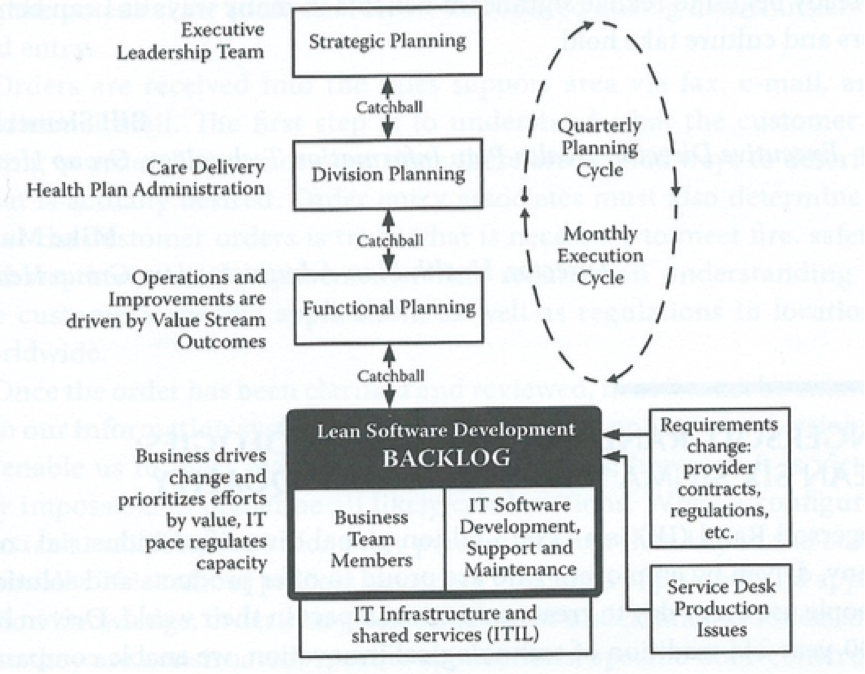
    DevOps can use a trick from lean (Hoshin Kanri), where the strategy from senior management is passed down to each level (“catchball”) such that each team can create its own way of supporting that strategy. Hoshin Kanri allows every person to set their own way of working to meet the goal. How DevOps is that?
    b

    By permission Steve Bell: LeanIT @All rights reserved worldwide

    KPIs should be designed to help answer these questions:

    • Did we improve or decline?
    • Are we on course?
    • Does the impact effect our organization?
    • Do we need help?

    KPIs provoke a Yes/No response and force an immediate action/decision. If not, they are simply metrics that probably support a KPI but do not key to help fulfill a strategy or request.

    How Do You Create a KPI?

    First, look at a business target. Can you see what’s required to help achieve the goal or remove the obstacle to achieving the goal? Then could you determine how you would know this was happening and whether you could you prove it? All answers have to be Yes/No.

    I like making a tree, which also acts as a dashboard to quickly show at the various levels the indicators of performance and their status.

    c

    This helps make KPIs such as Cost of Delay, Mean Time between Repair, Defects2Incidents and others relevant to the right people at the right time. You could even be brave and flash the status using red and green: Red = we have a problem and need help to overcome or improve and green = all ok. Don’t hide behind amber—see how using just two colors helps guide easier, faster, better and safer.

    KPIs should be collaboration and communication tools. Create and use them wisely to keep your organization in business and on course.

    About the Author/Daniel Breston

    dDaniel Breston is the Chief of DevOps Transformation for Ranger4. Daniel has 30+years leading IT Service, Operations, Applications, Data Center and service partners in management of technology enabling business processes and functions. He has also spent 15 years of consulting and coaching leadership teams across the EU and UK in developing their people, processes and use of technology to deliver technology services better, faster, safer. Daniel has qualifications in IT Service Management (ITIL, COBIT,etc.), Lean and DevOPS.

  • Does the Future of DevOps Lie in NoOps?

    Does the Future of DevOps Lie in NoOps?

    Why DevOps is more a bi-directional rather than a simple top-down approach

    DevOps is one of those buzzwords that nearly everyone wants to discuss these days. However, it often is interpreted as an extension of Development’s influence to the detriment of Operations teams.

    So much has changed in the past few years that it is conceivable we will see another major shakeup: Could Operations teams disappear altogether? Or to put it another way, is “NoOps” the future of IT? While DevOps promotes faster delivery of new digital services and a blurring of the lines between Dev and Ops, in reality, is Dev consuming Ops entirely?

    Before DevOps was called DevOps, the two disciplines were growing further apart. Agility has been driven by Developers since the turn of the century, with the famous Manifesto for Agile Development. Meanwhile, Operations formalized repositories of good practices into frameworks such as ITIL or COBIT, which were implemented by most large companies in the mid-90s. Those two approaches seem to oppose, as DevOps advocates the acceleration and multiplication of changes and ITIL tends to monitor and control them.

    NoOps, or the End of Operations?

    If you believe everything you read, then Operations is a dying art. But in practice, Development does not want to be involved with infrastructure, while few organizations would trust developers to manage their data centers, whether physical, virtual or cloud. So breathe easy: DevOps does not mean the end of Operations teams.

    On the contrary, Operations remains essential throughout the DevOps approach. Production infrastructure is a complex and delicate stack of technologies, often with a discreet mix of modern architecture and historical applications. It often is impossible for Development to replicate these types of environments. And that is why an application successfully tested in a qualification environment often does not work properly in production. However, it is crucial to validate new developments in a representative replica of the production environment.

    So is DevOps doomed to constant failure because of lack of continuity between qualification platforms and production systems? Well, this is probably the case if we merely consider DevOps as a simple top-down approach from Development to Operations. Focusing on producing changes at a higher frequency only shifts and grows a bottleneck that sits in production, without producing the added value expected by the company. As a consequence, DevOps must also be seen as a bottom-up process. In other words, if we consider DevOps, we must also take very serious look at “OpsDev” (OK, it doesn’t flow off the tongue, but you see my point!).

    DevOps or OpsDev?

    For a successful DevOps approach in practice, Development must position itself as a consumer of turnkey infrastructure environments. Operations then adopts an OpsDev approach and provides infrastructure on demand for all steps of continuous integration, from compilation to qualification, through unit testing.

    If DevOps is a radical change in how Development works, OpsDev would also revolutionizing common Operations practices. It comes with more agile “declarative” infrastructures (described and built from source code), an even more sophisticated level of automation and the ability to provide self-service infrastructure for developers.

    The adoption of DevOps does not mean that Operations will disappear or will be replaced by Development, but rather the emergence of bi-directional agility that needs to be supported by more sophisticated automation. In fact, DevOps implies OpsDev rather than NoOps. Finally, whatever you consider your release process under the ITIL or DevOps angle, isn’t the end goal exactly the same: delivering zero-default service to customers?

  • Red Hat Launches Red Hat Open Innovation Labs, Introducing Collaborative Open Source Cloud and DevOps Residency Program

    Red Hat Open Innovation Labs is designed to enable customers to jumpstart innovation and software development initiatives the open source way

    AUSTIN, Texas–(BUSINESS WIRE)–Red Hat, Inc. (NYSE: RHT), the world’s leading provider of open source solutions, today announced the creation of Red Hat Open Innovation Labs, a consulting service that helps companies integrate people, methodology, and technology to solve business challenges in an accelerated fashion. As part of an Open Innovation Labs consulting engagement, customers will work collaboratively in a residency-oriented lab environment with Red Hat experts to jumpstart innovation and software development initiatives using open source technology and DevOps methods.

    Digitalization is increasingly connecting people, process, data and devices and enabling new business innovation platforms. Software is powering this shift and enabling companies to build innovation-driven advantages. The Red Hat Open Innovation Labs service helps customers rapidly develop and integrate applications using microservices, deploy them in containers, and deliver them using DevOps methodologies across physical, cloud and mobile environments that can quickly scale up or down on-demand. With Red Hat, customers can innovate with speed, agility, scalability and increased security.

    Red Hat Open Innovation Labs aims to help customers achieve this transformation, enabling them to:

    • Work on real business problems from day one, using Red Hat’s push-button infrastructure and automated development environments, teams can more quickly start development once the residency begins, enabling quicker time to value.
    • Learn how to take advantage of modern application development technologies and methodologies, including migrations, microservice architectures, container application platforms, DevOps, application and data integration, mobile and hybrid cloud strategies.
    • Re-platform existing applications for scale-out with OpenStack and public cloud infrastructures.
    • Bridge legacy and new application development efforts on one platform, helping teams design and develop solutions to modernize applications, or take on entirely new challenges.
    • Learn to innovate the Red Hat way by engaging with the Open Source community and collaborating in upstream projects.
    • Innovate onsite and virtually, meeting new requirements as a result of digital transformations, offering distributed teams access to environments in different locations. Red Hat provides a more secure cloud environment so authorized team members can work together, and development can happen on your site, in a Red Hat lab environment, or virtually.

    Availability

    Red Hat Open Innovation Labs is available immediately in North America, with full global availability planned within the year.

    Supporting Quote

    John Allessio, vice president, Global Services, Red Hat

    “We’ve heard from customers around the globe who want to get new initiatives off the ground quickly – whether they are talking about application modernization, or cloud, mobile and microservices – to help them meet their goals and stay ahead of competitors. To these customers, Red Hat Open Innovation Labs offers the ability to innovate faster and to solve business problems alongside Red Hat experts, and the open source way – through collaboration, and using DevOps methodologies and open source technologies.”

    Additional Resources

    Connect with Red Hat

    About Red Hat, Inc.

    Red Hat is the world’s leading provider of open source software solutions, using a community-powered approach to reliable and high-performing cloud, Linux, middleware, storage and virtualization technologies. Red Hat also offers award-winning support, training, and consulting services. As a connective hub in a global network of enterprises, partners, and open source communities, Red Hat helps create relevant, innovative technologies that liberate resources for growth and prepare customers for the future of IT. Learn more at http://www.redhat.com.

    Forward-Looking Statements

    Certain statements contained in this press release may constitute “forward-looking statements” within the meaning of the Private Securities Litigation Reform Act of 1995. Forward-looking statements provide current expectations of future events based on certain assumptions and include any statement that does not directly relate to any historical or current fact. Actual results may differ materially from those indicated by such forward-looking statements as a result of various important factors, including: risks related to the ability of the Company to compete effectively; the ability to deliver and stimulate demand for new products and technological innovations on a timely basis; delays or reductions in information technology spending; the effects of industry consolidation; the integration of acquisitions and the ability to market successfully acquired technologies and products; uncertainty and adverse results in litigation and related settlements; the inability to adequately protect Company intellectual property and the potential for infringement or breach of license claims of or relating to third party intellectual property; risks related to data and information security vulnerabilities; ineffective management of, and control over, the Company’s growth and international operations; fluctuations in exchange rates; and changes in and a dependence on key personnel, as well as other factors contained in our most recent filings with the Securities and Exchange Commission (copies of which may be accessed through the Securities and Exchange Commission’s website at http://www.sec.gov), including those found therein under the captions “Risk Factors” and “Management’s Discussion and Analysis of Financial Condition and Results of Operations.” In addition to these factors, actual future performance, outcomes, and results may differ materially because of more general factors including (without limitation) general industry and market conditions and growth rates, economic and political conditions, governmental and public policy changes and the impact of natural disasters such as earthquakes and floods. The forward-looking statements included in this press release represent the Company’s views as of the date of this press release and these views could change. However, while the Company may elect to update these forward-looking statements at some point in the future, the Company specifically disclaims any obligation to do so. These forward-looking statements should not be relied upon as representing the Company’s views as of any date subsequent to the date of this press release.

    Red Hat is a trademark of Red Hat, Inc., registered in the U.S. and other countries. Linux® is the registered trademark of Linus Torvalds in the U.S. and other countries. The OpenStack Word Mark is either a registered trademark/service mark or trademark/service mark of the OpenStack Foundation, in the United States and other countries and is used with the OpenStack Foundation’s permission. We are not affiliated with, endorsed or sponsored by the OpenStack Foundation, or the OpenStack community.

    Contacts

    Red Hat, Inc.
    Stephanie Wonderlick, +1 571-421-8169
    swonderl@redhat.com

  • Resin.io Teams Up With Samsung to Deliver Benefits of DevOps Management to the SAMSUNG ARTIK™ Platform

    CEO & Co-Founder Alexandros Marinos to Demo the Resin.io Platform During the Opening Keynote Session at Samsung Developer Conference 2016

    SAN FRANCISCO, CA–(Marketwired – Apr 27, 2016) – (Samsung Developer Conference) — Resin.io, provider of a modern DevOps management platform for connected devices, today announced that it has teamed up with Samsung to make it easier for developers to build, deploy and manage software for the IoT using open emerging standards such as Docker and Git . This collaboration is designed to help provide developers and device fleet owners with everything they need to build and scale their IoT projects. With Resin.io and the SAMSUNG ARTIK™ platform, developers benefit from the ability to develop with fast feedback, deploy software iteratively to production-class modules and collect and analyze data from within an IoT environment.

    As part of the collaboration, Resin.io will integrate its management platform with the SAMSUNG ARTIK™ Cloud, an open data exchange platform that collects and standardizes machine and sensor data from remote environments. Resin.io CEO and co-founder Alexandros Marinos, will be giving a live demonstration of Resin.io’s management platform capabilities during the opening keynote session at the Samsung Developer Conference at 9:15 a.m. PT on April 27 at Moscone Center in San Francisco.

    “Resin.io has built a highly robust and elegant management platform that solves a real problem for companies struggling to deploy and manage IoT software with both speed and security,” said Curtis Sasaki, vice president of Ecosystems, Samsung Electronics. “Through this collaboration, software developers will have an easier experience building, deploying and managing a wide range of IoT applications, whether it’s an early hackathon project or a complex deployment to a fleet of thousands of IoT devices.”

    “Samsung is a driving force behind making the promise of the IoT a reality for consumers and businesses alike. As more devices become connected devices, the ability to seamlessly push live updates over-the-air becomes a critical business requirement,” said Alexandros Marinos, Founder & CEO of Resin.io. “We are confident that developers will love both the agility and the control that Resin.io brings to their businesses.”

    Resin.io’s support for SAMSUNG ARTIK modules and its integration with the SAMSUNG ARTIK Cloud are available today as open source code. Developers also have access to Resin.io’s device fleet management capabilities, including simple provisioning, device-specific configurations, build logs, phased deployments and device status dashboards.

    A collection of resources including tutorials, a getting started guide, and videos of the integration can be found at: http://www.resin.io/artik

    More information about SAMSUNG ARTIK, partners and development tools can be found at artik.io.

    About Resin.io

    Resin.io brings modern DevOps tools and practices to the Internet of Things. Resin.io’s software deployment and management platform makes it simple to deploy, update, and maintain code running on Linux-based connected devices regardless of their location. With Resin.io, businesses and developers can jumpstart their IoT projects and applications quickly, slashing development time, cost and management overhead. Resin.io has offices in Seattle, Washington, London, England and Athens, Greece. For more information go to https://resin.io

    CONTACT INFORMATION

    • Press Contact for Resin.io
      Robert Nachbar
      Kismet Communications
      206-427-0389
      Email Contact
  • Reasons Why Developers Should Test More

    Reasons Why Developers Should Test More

    When I got started as a professional software developer, I thought awesomeness in development was measured by the lines of code (LOC) per day and how quickly code got to QA for testing. Coding a few thousand lines overnight gave one instant bragging rights, regardless of how well the code worked (or didn’t) in the morning. The more senior guys always acted like they knew better, suggesting that it’s not about the quantity but the quality. But I was too young and arrogant to listen. And, of course, I had to learn it the hard way. My seemingly amazing overnight code would show cracks once under the microscope of the QA team.

    True today as it was then, most mistakes are tiny and easy to fix, but even small problems require a tedious set of steps from when a QA engineer finds the mistakes to when the developer fixes them and sends them back to QA for verification. Some bugs are the size of the Mariana trench and require weeks of work and thousands of additional LOC. And, even new code, once resubjected to QA, can generate bugs, therefore repeating the cycle without an end in sight. Of course, by this time projects are late and developers are tired, frustrated and burnt out.

    After this happened to me too many times, I realized that maybe I was wrong. Maybe the experienced guys were on to something with this quality thing. They never seemed too tired, and their projects were in much better shape. I decided that for my next feature, delivering quality instead of LOC would be my priority.

    I’m sure you think you know what’s coming next. I’m going tell you that I tested my stuff from that day on and it worked perfectly—no more boring bug-fixing. You think I’m going to tell you, you should do it too, right? Well, no. I actually spent a lot of time in my second attempt instrumenting my code better so that I could debug it faster as the need arose. I also spent a lot of time writing my own test tools because I didn’t have one. But I kept moving forward and learned the hard way. Here is what I took away from those moments:

    Develop More, Bug-Fix Less

    There are two common reasons for developers’ involvement in a project. Developing a new feature or enhancement is about creativity, as it gives one the opportunity to design and implement new things. And then there’s the challenge of bug-fixing, which is all about maintaining existing functionality within older, already-made things. As a developer needs to do both, often at the same time, minimizing bug-fixing time is important to have more time in which to actually be creative and develop new functionality. And the best way to minimize bug-fixing is to test code more, as it’s developed, to avoid the death spiral I describe above. Good initial quality will mean QA will find fewer bugs and it is very likely that the criticality of the bugs found will be greatly reduced. As such, fixes no longer would be a struggle on short notice; shortcuts that generate more bugs don’t have to be used; and developers can focus on new features as opposed to fixing bugs. In all, the reasons are to develop more, and bug-fix less to be more productive.

    Be More Reliable

    Bugs also are nasty in that they tend to appear really, really late in the game. The Murphy’s Law on bugs should be something like, “The hardest bug is found one hour before the release is pushed to production.” This typically happens because everyone is busy peeling the onion, finding and fixing bug after bug until they get the “system” stable enough for QA to crush it with those large-scale system test cases that expose that one nasty bug. It is an artifact of waterfall development but also happens in agile development, as no agile team can afford running long duration tests in a sprint. So what happens then? Who ends up in crunch mode? The developer. To avoid this, developers need to find and fix the easier bugs sooner, as they write the code. That way, the onion is half peeled once it reaches the QA team. The nasty bug will be found much sooner—if the developer did not find it and fix it already. In short, developers can be more reliable by avoiding last minute bug-fixing. And we all know, reliability in execution is fundamental for fostering trust with management. A trusted developer is the one that gets to work on important, meaningful projects.

    Be More Flexible

    While in an ideal world the design of a feature is not changed frequently, in real life the exact opposite is true. At some point, even regularly, developers will have to modify the code as the scope of the features keeps changing. Massive code changes such as refactoring, if not done right, can send developers right back to a long, teeth-grinding, bug-fixing period. Avoiding it by testing early, as they change the code, offers a significant advantage—flexibility. Developers would be able to accommodate required changes more quickly.

    Agile Development is Critical

    Let’s do a quick recap: By simply testing code as it is written, developers can spend less time fixing bugs and more time developing new features, to become more productive, more reliable and trustworthy and even more flexible in implementing changes. This takes us to our final reason for early testing: Agile development is no longer nice to have, but business-critical. All of the attributes described above are quintessential for succeeding in an agile team. Developers are expected to be flexible, reliable and build a lot in short time periods. The days of trial and error, of learning the hard way, are gone. Today, we need to go from design to development to testing to going live in days, not months. Quality is what differentiates products. Developers need to do all of this to be successful.

    About the Author/Gabriel Chiriacescu

    UntitledGabriel Chiriacescu is the director of Software Development at Ixia, with more than 13 years of experience in embedded software development. He is currently leading the product management effort for the new Ixia Developer solution, an agile test tool designed specifically for developers.

    At Ixia, Gabriel has led multiple engineering teams responsible for developing market-leading test solutions in a variety of technological areas, including wireless, broadband access, data center, triple play, authentication and security.

    A native of Bucharest, Romania, Gabriel holds a BS in computer science from the Polytechnic University of Bucharest. After living several years in Los Angeles, Gabriel is now based in North Carolina and enjoys discussing CICD, SOA design patterns and the evolution of software development.

  • Site24x7 Supports Nagios, Custom Plugins to Monitor Entire App Stack

    Site24x7 Supports Nagios, Custom Plugins to Monitor Entire App Stack

    Site24x7 Plugins Drive Customized, Detailed Monitoring of IT Resources

    • Supported plugins: Nagios, MySQL, Redis, MongoDB, NGINX, HAProxy, ZooKeeper, WordPress, Apache, Memcached
    • Users can create their own plugins using Python or shell scripts
    • Access Site24x7 Plugins at http://ow.ly/109LDi

    PLEASANTON, Calif — April [26], 2016 — Site24x7, the cloud infrastructure monitoring service for DevOps and IT operations, today announced Site24x7 Plugins. Available now, the new feature lets IT pros use third-party and custom-built plugins for detailed monitoring of their IT resources — all within the Site24x7 control panel. Site24x7 Plugins let users customize the set of monitored attributes for the hosts, devices, services, protocols, applications and all other resources in their environments, providing deep performance visibility into the entire application stack.

    Network and server administrators often require specific monitoring data that goes beyond the scope of vendors’ standard monitoring solutions. Acquiring such data typically requires users to extend the functionality of their existing tools with third-party and custom plugins designed to provide detailed monitoring metrics of individual resources. With Site24x7 Plugins, IT admins can now access that data using thousands of supported, pre-built plugins or create their own.

    “The new Site24x7 Plugins for server monitoring will help DevOps teams to monitor the full application stack,” said Gibu Mathew, director of product management, Site24x7. “With support for custom scripting and out-of-the-box integrations to provide additional, system-level metrics, Site24x7 Plugins extend the end-user monitoring and application troubleshooting capabilities that Site24x7 customers around the world rely on daily.”

    Out-of-the-Box Plugins Support – Site24x7 Plugins supplement Site24x7 monitoring with precise, resource-specific metrics that an IT team deems critical to the monitoring of its particular environment. For example, installing the Site24x7 MySQL plugin will let users analyze key details such as total number of used connections, number of slow queries, total aborted connections and other metrics needed to tune and troubleshoot apps that rely on MySQL.

    Nagios Plugins Without Nagios Servers – With support for Nagios, users can execute thousands of Nagios plugins in Site24x7 without the need to run a Nagios server. This means that there is no need to maintain a dedicated server for Nagios and Nagios server software, yet users can still take advantage of Nagios community scripts. Nagios plugins can be executed with a simple configuration file while the other pre-built plugins work out of the box.

    Create Your Own Plugins – Users can also create custom plugins using Python or shell scripts and analyze the performance of databases, Web servers and more with a simple script.

    In addition to MySQL, Nagios and custom plugins, Site24x7 Plugins support a wide range of out-of-the-box integrations, including Redis, MongoDB, NGINX, HAProxy, ZooKeeper, WordPress, Apache and Memcached. Site24x7 Plugins will support additional modules going forward.

    All plugin data is passed through to the Site24x7 alerting and reporting engines, so users can set threshold values for individual attributes and configure alerts if values exceed the set limit. Performance charts for custom attributes can be viewed on the Site24x7 dashboard.

    “We have been using Site24x7 for more than a year, and I should say that we are more than just satisfied,” said Aleksander Andrijenko, IT infrastructure at Marcura Group in Dubai. “Site24x7’s broad feature offerings and price point made it an obvious choice over other vendors. The product is easy to set up, and you can start monitoring your environments in just minutes. The instant alerts using [the Site24x7] Plugins feature ensures we’re on top of issues all the time.”

    Pricing and Availability

    Site24x7 Plugins is available as a standard feature along with Server Monitoring, priced at $9/month for 10 servers in the Standard pack.

    For more information about Site24x7, please visit http://www.site24x7.com/; follow the blog at http://blogs.site24x7.com/, on forums at http://forums.site24x7.com/, on Facebook at http://www.facebook.com/Site24x7, and on Twitter @Site24x7. For information on upcoming Site24x7 webinars, visit https://www.site24x7.com/webinars.html.

    About Site24x7

    Site24x7 offers unified cloud monitoring for DevOps and IT operations. Monitor the experience of real users accessing websites and applications from desktop and mobile devices. In-depth monitoring capabilities enable DevOps teams to monitor and troubleshoot applications, servers and network infrastructures, including private and public clouds. End-user experience monitoring is done from 50+ locations across the world and various wireless carriers. For more information about Site24x7, please visithttp://www.site24x7.com/.

  • Should Your Apps be Cloud-Native?

    Should Your Apps be Cloud-Native?

    There’s plenty of life left in a great number of the applications companies have been relying on and profiting from for years. The future may belong to cloud-native apps that deliver the performance and efficiency benefits of microservices and containers, but in the here and now, organizations are looking for ways to combine the best of the old with the promise of the new.

    With continuous development, you could argue that the software industry has eliminated the concept of product life cycle altogether. Yet, IT managers know that some of the applications currently used by their organization likely will be running long after they have hung up their compilers.

    These legacy applications have proven their worth many times over. Some are one-offs that easily accommodate and are accommodated by new systems as they are implemented. Some are so good at what they do they epitomize, “If it ain’t broke, don’t fix it.” In the mass migration of apps and data to the cloud, it’s natural that such grand old apps would come under scrutiny as candidates for replacement by their cloud-native counterparts.

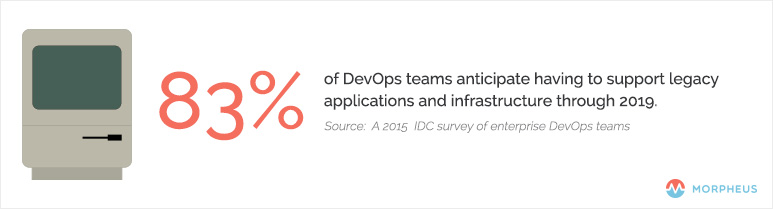
    In a Dec. 8, 2015, article on The Stack, Red Hat’s Gordon Haff examined the results of a recent IDC survey of enterprise DevOps teams, which found that 83 percent anticipate having to support legacy applications and infrastructure through 2019.

    DevOps_Cloud_Native

    It may seem counterintuitive, but the organizations that have gone furthest in adopting distributed, scale-out, microservices-based applications are twice as likely to delay converting existing apps to cloud architectures, he noted.


    What Characteristics Make an Application Cloud-Native?

    The simplest definition of a cloud-native application is one that is “decoupled from the physical infrastructure,” as TechTarget’s Sean M. Kerner wrote in a December 2015 article. In addition to being designed from the ground up to run in the cloud—whether private or public—the app also must scale on demand, both up and down, and across nodes.

    Cloud-native apps are fault-tolerant, built to scale and designed to process requests asynchronously, using queues to decouple functionality, according to Munish Kumar Gupta via Slideshare.

    Another feature that quickly is becoming standard on cloud-native apps is the use of Docker containers, which facilitates deployment on public Amazon Web Services (AWS) clouds and private OpenStack clouds, among other options. A more formal definition of “cloud native” likely will arrive soon from the Cloud Native Computing Foundation (CNCF), an effort sponsored by the Linux Foundation and others.

    Containers are a key component of the CNCF’s proposed standard for applications and services that run natively on public and private clouds, and that move seamlessly between the two environments. Rather than writing specs on paper first and then implementing the code based on the specs, CNCF will create the code for its reference implementations. Google, a CNCF member, has donated its Kubernetes container-orchestration system and stands to benefit via the foundation’s support for private and hybrid clouds, a technology the company currently lacks.

    The Continuing Evolution of Cloud-Native

    It’s tempting to limit the definition of a cloud-native app to those two primary characteristics: decoupled from the infrastructure and scalable up, down and across nodes. If this approach strikes you as too simplistic, you’re not alone. InformationWeek’s Charles Babcock explained in a July 30, 2015, article that the key to cloud-native is microservices—which he referred to as “discrete application services”—running in their own containers and connected via a network to create custom applications. The result is an environment for “user-driven systems” comprised of standardized parts and governed by “standardized deployment and operational procedures.”

    The combination of microservices and containers pushes down the app stack and simplifies deployment in computing environments of all types, according to Richard Harvey of Ngineered via SlideShare.

    The payoff for companies is still far off, according to Babcock, but ultimately cloud-native apps will keep firms focused on their customers as the software landscape shifts around them. This translates into a competitive advantage via continuous deployment and delivery of “fresh” software.

  • Supermicro Total Solutions for Private, Public Cloud Accelerate Open Infrastructure Growth

    April 25, 17:00 UTC+3

    Complete End-to-End Integration, Validation, Deployment and Services Maximize ROI through Agile, Scalable Cloud Infrastructure Total Solutions

    AUSTIN, Texas, April 25, 2016 /PRNewswire/ – Super Micro Computer, Inc. (NASDAQ: SMCI), a global leader in high-performance, high-efficiency server, storage technology and green computing showcases its total solutions for public, private and hybrid cloud at OpenStack® Summit this week in Austin, Texas. Business success today requires adaptability, flexibility, and security. The Cloud promises to address these challenges by providing an open standards-based infrastructure that enables rapid workload deployment. Supermicro Total Solutions for OpenStack® enable cloud and hyperscale growth with the most comprehensive OpenStack certified compute, storage, networking and management node components. Supermicro’s Total Solutions for OpenStack takes into account design considerations across performance, density, redundancy, and serviceability down to the component level to build exactly the best reference architecture addressing use cases such as DevOps, Big Data and Service Providers.

    “Supermicro offers the industry’s strongest server, storage and networking solutions for high scalability OpenStack deployments,” said Charles Liang, President and CEO of Supermicro. “Supermicro’s OpenStack Reference Architecture leverages our SuperServer, SuperBlade, SuperStorage and high-throughput network switches to deliver ready to deploy complete rack solutions. With our Total Solution advantage, Supermicro offers full integration, validation, deployment, service, and support worldwide”.

    Supermicro Showcase

    • Supermicro Reference Architecture for OpenStack® – Balanced configuration for enterprise grade DevOps system with high-availability on data path. Leverages a pre-validated design that integrates compute, storage, networking and software into an efficient, application-centric cloud solution that is simple to deploy and easy to scale. Standard and Advanced Reference Architecture configurations are also available. For more information email Total_Solutions@supermicro.com.
    • Supermicro (Mirantis) Unlocked Appliance – Supermicro and Mirantis are bringing the best of cloud and converged infrastructure together to simplify OpenStack deployments and reduce the time-to-value of your private cloud, allowing you to focus on your business and your applications. Together our goal is to ensure the success of your OpenStack cloud, enabling you to achieve Agile IT. www.supermicro.com/SUA

    Visit Supermicro at OpenStack Summit in Austin, Texas, April 25 through the 29 at the Austin Convention Center, Booth #B25.

    For more information on Supermicro’s complete range of high performance, high-efficiency Server, Storage and Networking solutions, visitwww.supermicro.com.

    Follow Supermicro on Facebook and Twitter to receive their latest news and announcements.

    About Super Micro Computer, Inc. 
    Supermicro® (NASDAQ: SMCI), the leading innovator in high-performance, high-efficiency server technology is a premier provider of advanced server Building Block Solutions® for Data Center, Cloud Computing, Enterprise IT, Hadoop/Big Data, HPC and Embedded Systems worldwide. Supermicro is committed to protecting the environment through its “We Keep IT Green®” initiative and provides customers with the most energy-efficient, environmentally-friendly solutions available on the market.

    Supermicro, Building Block Solutions and We Keep IT Green are trademarks and/or registered trademarks of Super Micro Computer, Inc.

    All other brands, names and trademarks are the property of their respective owners.

    SMCI-F

    CONTACT:

    Media Contact, David Okada, Super Micro Computer, Inc., davido@supermicro.com

    More:
    http://tass.ru/en/press-releases/872266

  • Global DevOps Platform Market to Grow 19.42% – Shift Toward PaaS – Research and Markets

    April 25, 2016 10:08 AM Eastern Daylight Time

    DUBLIN–(BUSINESS WIRE)–Research and Markets has announced the addition of the “Global DevOps Platform Market 2016-2020” report to their offering.

    The global DevOps platform market is projected to grow at a CAGR of 19.42% during the period 2016-2020.

    PaaS is built where the entire IT environment is designed to support test and development processes. Instances of PaaS on public cloud include IBM Bluemix, CloudFoundry from Pivotal, and the Google App Engine whereas for PaaS on private cloud include hosted CloudFoundry. Cloud platform vendors usually offer automation and management tools to consolidate and integrate applications directly into their cloud platforms. As a result, IT organizations get better automation features in the same turnkey cloud platform. This has made PaaS essential for those organizations who approached DevOps and want to automate, test, and develop services.

    According to the report, software development processes require standardized platforms to bridge the gap between software developers and operational teams. Earlier, software development processes were not subject to intermediary technologies (that help to synchronize the work of developers and IT administrators). DevOps is a solution that helps software developers to connect with the operational process, thus helping to speed up the software development process.

    Further, the report states that Technical glitches during DevOps application deployment hinders the market growth.

    Companies Mentioned:

    • CA Technologies
    • IBM Corp.
    • Puppet Inc.
    • Rackspace Inc.
    • Red Hat Inc
    • CFEngine
    • Chef
    • Cisco
    • Clarive
    • CollabNet
    • DBmaestro
    • Dell
    • Docker
    • HP
    • Inedo
    • Infosys
    • Microsoft
    • SaltStack
    • VersionOne
    • VMware

    Key Topics Covered:

    PART 01: Executive summary

    PART 02: Scope of the report

    PART 03: Market research methodology

    PART 04: Introduction

    PART 05: Market landscape

    PART 06: Market segmentation by end-user

    PART 07: Geographical segmentation

    PART 08: Market drivers

    PART 09: Impact of drivers

    PART 10: Market challenges

    PART 11: Impact of drivers and challenges

    PART 12: Market trends

    PART 13: Vendor landscape

    PART 14: Key vendor analysis

    For more information visit http://www.researchandmarkets.com/research/mtsz8v/global_devops

    Contacts

    Research and Markets
    Laura Wood, Senior Manager
    press@researchandmarkets.com
    For E.S.T Office Hours Call 1-917-300-0470
    For U.S./CAN Toll Free Call 1-800-526-8630
    For GMT Office Hours Call +353-1-416-8900
    U.S. Fax: 646-607-1907
    Fax (outside U.S.): +353-1-481-1716

  • SaaS-Powered FlightPartner Fueled by DevOps

    SaaS-Powered FlightPartner Fueled by DevOps

    Private jet charter company FlightPartner is reaping the benefits of DevOps to build a powerful software-as-a-service (SaaS) offering to keep its customers flying high with no delays.

    “FlightPartner does not own any aircraft but rather facilitates the travel needs of clients by offering air charter brokers (agents to the client) access to a global network of private jet charter availability,” says Douglas Schmohl, CEO and founder of FlightPartner. By acting as a global distribution network (GDN), FlightPartner enables access to real-time availability of private jets.

    What TravelPort is to airline seat availability, FlightPartner is to private jet availability, Schmohl says.

    FlightPartner’s cloud-based SaaS manages data exchanges and transactions through a web browser as a web-based service, requiring no client software installs for the brokers or operators. The service uses Angular.js, a “structural framework for dynamic Web apps” to pass data from the browser to a PHP back end. A database and integrated systems back end builds real-time pricing quotes for available private jets, while the payment mechanism supports search, booking and payment, completing the transaction, Schmohl says.

    FlightPartner uses a Laravel open-source PHP framework, which was created by Taylor Otwell and was originally targeted to developing Web applications following the model-view-controller (MVC) architectural pattern. “This framework allows for rapid development, testing and deployment of our SaaS solution,” Schmohl notes.

    SaaS Technical Challenges

    Schmohl and company endured some technical issues as they built FlightPartner software and worked to raise it to the skies where it would eventually soar. Schmohl was committed to following the lean startup practices of Eric Reis, author of “The Lean Startup,” which redefined the roadmap for a startup tech company, Schmohl says. According to the book, one of the first steps in approaching a new business as a lean startup is to try to float a “minimum viable product,” or just enough product or service to test the market demand for it. “This was nearly impossible for us due to the complexity of the air charter marketplace,” he says, so Schmohl had to invest in a more technically developed product rather than a simple solution.

    In the private jet charter industry, with so much change, so many variables, so many players needing access and so many systems that FlightPartner would need to access, a minimum viable product still necessitated numerous external integrations and APIs. “Developmental collaboration to achieve this was difficult at best and developers often pushed code to production only to create more issues with each deployment,” Schmohl says.

    A second technical misstep—and in the absence of formal development structure—Schmohl’s team wrote code to solve specific functional problems one by one. However, the team found that a method for developing one function would conflict with a different method that was used to create another function, and so on. “The constant patching of the front and back end consisted of whatever worked. This code became challenging to manage and scale,” he says.

    Because of these two technical challenges, FlightPartner’s attempts at a minimum viable product and at following a lean startup approach soon were tangled in a mess of spaghetti code and unmanageable methods, Schmohl says.

    FlightPartner Development Pipeline

    Today, development at FlightPartner is much improved. The SaaS and its components start with a local build that the system pushes to a development server in AWS. FlightPartner developers use SourceTree, a Git client and the Git versioning system to manage software versions. FlightPartner uses quality assurance to manage development and to test code, and developers fix errant code and deploy it to AWS using Elasticbeanstalk. “This enables rapid builds and continuous deployment,” Schmohl says.

    Using a DevOps approach to development brings structure to an otherwise-highly dynamic marketplace. “Offering a SaaS solution as a marketplace presents challenges unlike a typical marketplace. Our inventory (aircraft) is fluid in that it moves often and the price changes depending upon location. This operational challenge translates to numerous and constant development with changes in software functionality,” Schmohl notes.

    These are the operational needs that drive software requirements; the developers’ goals increasingly are to meet those requirements so the software seamlessly supports operations. Development uses a priority status to identify and escalate the builds that are most critical to continued, smooth operational activity.

    Results

    FlightPartner’s development process has created a workflow process that minimizes the resources necessary to achieve operational results. Thanks in large part to DevOps and the cloud-based SaaS system, FlightPartner’s GDN has aircraft available for charter in six of the seven continents, including 35 percent of available aircraft located outside the United States, says Schmohl.