Tag: devops

  • VMs, Containers, Cloud, Cluster: Scheduling Differences

    VMs, Containers, Cloud, Cluster: Scheduling Differences

    Scheduling is a large part of making the data center go, and more to the point of making the virtualized (be it VMs, cloud, containers, or clustering) portion of the data center work.

    While there are a lot of variables to virtualization performance, scheduling impacts performance all of the time. And yet we only really talk a lot about it in clustering (where a robust scheduler on par with an OS scheduler is required).

    There’s a reason for that, and it is worth exploring.

    (Side note: I was talking about this blog with Lori while I was writing it, and she reminded me of when we took our Masters’ courses, the Operating Systems class used Homer Simpsons greedily wanting donuts as our scheduling project. So whenever we think scheduling, we mentally hear one of the many Homer processes being denied a donut and going “D’oh!”)

    For virtual machines, scheduling is largely forgone in favor of other resource utilization. Virtualization only cares about CPUs and memory requirements when the virtual machine is created. You tell it then, and the only time you worry about it again is if you demand more CPU cores than the physical hardware can provide—and in some cases, CPU virtualization will allow you to keep spinning up VMs even after that. Only the real scheduling mechanisms actually can be at odds with each other in a heavy load situation. The host OS scheduler, for example, could swap out your VM’s active thread at the same time the guest OS has raised the level of importance for an app to “insanely high, do it now.” Although this only begins to show if basic rules about servers and loads are ignored, it does happen.

    You get the same issues with private clouds. Why? Because even though everyone in the marketing world pretends it isn’t true, private cloud and VMware ESXi essentially are the same underlying toolset. And usage patterns in the enterprise show not only does everyone know that, but also the differences are less substantial than any of the organizations involved want to admit. Not that they are the same code, but in practice, they do the same things.

    The one place where these two (and public cloud for that matter) really make use of scheduling is when automatically responding to spikes in usage that threaten to bury a system. However, solutions to usage spikes are not part and parcel of these systems; they are crafted by DevOps (or Dev, or Ops) folks who work at places where dropped connections are lost money and, thus, a quick response of growing the pool of available servers and then later shrinking it is important. But because they are using their own metrics to determine the need, more of these systems are implemented in application provisioning tools than in cloud or virtualization software. We could argue about where this functionality actually belongs, but not really where it is implemented today.

    I kind of bled into public cloud there, so will address it. When people talk about it being more “agile” or “adaptive,” they mean “with this quasi-scheduling code we wrote to spin up instances at need.” It doesn’t matter if the “code” is a python script or an Ansible playbook—they did the scheduling, not the system.

    That leaves clustering software (such as Mesos). Because clustering software treats many machines as one big thing, it requires a scheduler to manage the resources. In the case of Mesos, the central scheduler really isn’t that smart, and I think that is a genius implementation. It knows what resources (CPU, memory) each machine has available, it knows what resources have been assigned from that machine, and for each of the “frameworks” (think of them as job executors; though that’s a bit simplistic, it’s perfect for this discussion) what it needs to get its work done. Then it does a best match, offers resources to frameworks and waits for more resources to come available from finished executions.

    So in the world of VMs, if you have 50 unique applications that need resources, you create 50 VMs to service them. In either cloud environment, you do the same. It is a joke we like to make that because of microservices, containers are treated like VMs, except if you have 50 unique applications, you create 500 containers, but the reality is that they are exactly like VMs in many use cases, and make 50 containers when containerizing existing apps. Taking a look at MesoSphere’s 2016 survey of clustering users, you can see that a fair number of clustering users are using containers with Mesos and DC/OS, while many of them are not doing it exclusively with microservices.
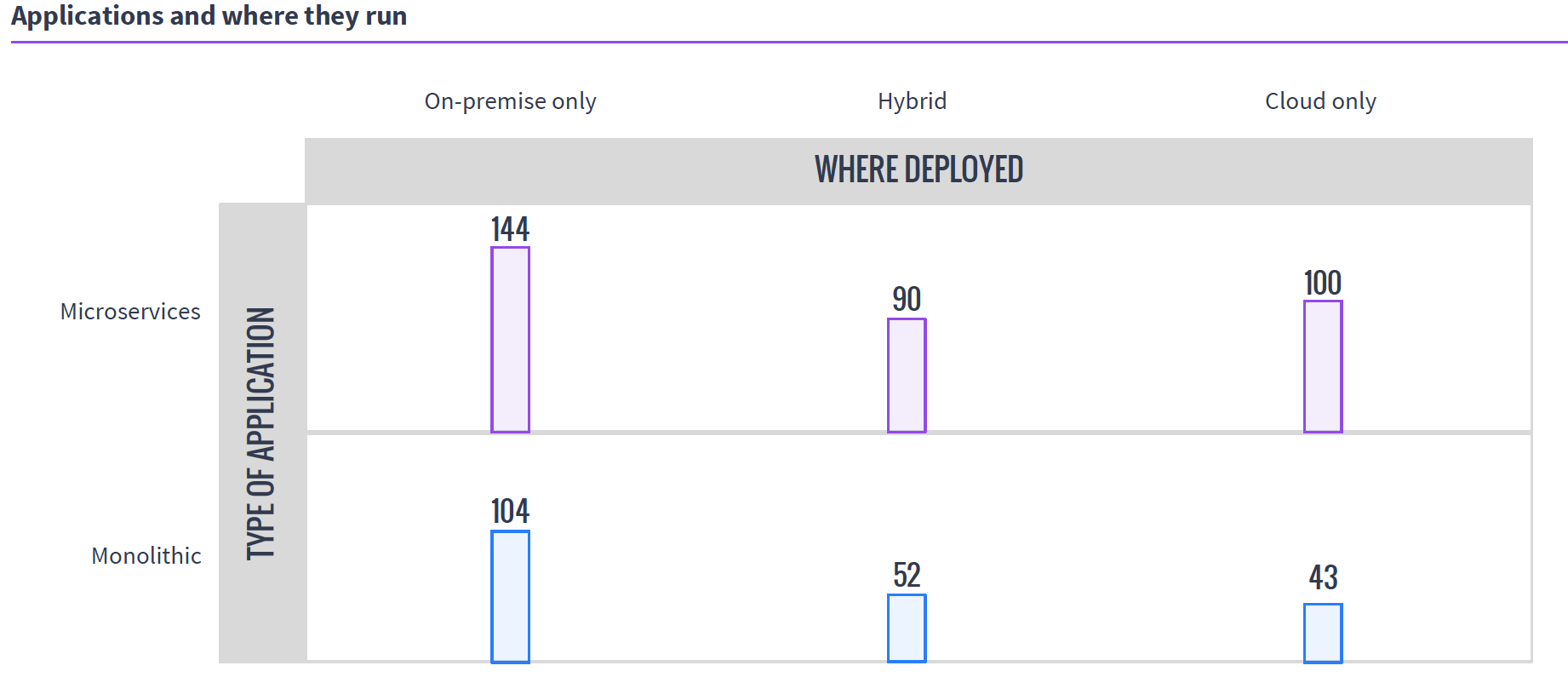
    Source: MesoSphere user survey, August 2016

    In the clustering world, you have what presents as one big monster machine that is going to run these applications as resources come available, so if your 50 applications require fewer resources than the cluster offers, they simply execute in parallel; if you don’t have enough hardware to run them, unlike with VMs, you can just queue them up and, assuming the cluster isn’t over-burdened, eventually they all will run.

    This gets more interesting when containers are added to clustering (a common environment), because then you do have discrete containers, but the scheduler still manages how many resources are available/in use, and the container architecture allows the app to carry its requirements with it across the cluster.

    Why do we care? Because you know what your workloads are and which scheduling methodology is more important to your organization. If there are 50 applications that all have steady resource needs and run all of the time, then virtualization might be right for you, but if the organization’s workloads are shifting constantly and resources need to be cycled at a high rate, clustering might be right for you. Either way, knowing what’s out there is never a hindrance.


    — Don Macvittie

  • Everything Ops: Are DevOps Principles Being Applied Too Broadly?

    Everything Ops: Are DevOps Principles Being Applied Too Broadly?

    From big data to storage to security, the DevOps concept is being applied to every field of IT operations under the sun today. This “Everything Ops” movement reflects the popularity of DevOps—but is it also diluting DevOps’s significance?

    DevOps itself focuses on software delivery. It’s about designing, building, testing, deploying and managing software applications.

    If you follow the DevOps conversation, however, you know that DevOps principles are now being extended to lots of niches that don’t have much or anything to do with software delivery chains. Consider these examples:

    • DataOps: DevOps principles for data analysts.
    • ChatOps: The idea that chat tools should be integrated into workflows.
    • SecOps (or rugged DevOps, or DevSecOps, or whatever else you want to call it): DevOps practices for security teams.
    • Storage Ops: The insertion of DevOps practices into storage.

    The list could go on. Taken together, these many flavors of DevOps reflect what I like to a call an “Everything Ops” tendency. Fans of DevOps want DevOps to take over the entire world of IT.

    Benefits and Drawbacks of ‘Everything Ops’

    If you believe that DevOps represents a better way to deliver software, then the Everything Ops movement is a positive thing. It’s a way to help people who work in areas of IT other than software delivery to innovate as well by taking cues from their DevOps colleagues.

    But there is also a danger that Everything Ops can be applied too broadly. You can’t fit every single thing in the IT universe into the DevOps mold. For example, CloudOps (the DevOps-related way of managing cloud infrastructure, not the company of the same name) just doesn’t make a lot of sense. It’s basically just a reiteration of the ideas that are already at the core of cloud computing: Scalability, agility and location-agnosticism.

    Concepts like ChatOps can also be problematic because they refer to a specific way of using a particular type of technology, whereas DevOps is about cultural practices. ChatOps is a fundamentally different sort of thing from DevOps.

    Conclusion

    In short, by overextending the DevOps conceptual framework, you run the risk of diluting the importance of DevOps itself—and of losing your focus on software delivery, which is the area that DevOps benefits most.

    This is not to say that we shouldn’t extend DevOps to other fields. We certainly should. But we should be careful when doing so. Don’t try to make DevOps eat the entire IT world, because that just doesn’t make sense.

    — Chris Tozzi

  • Predictable Progress: Tracking DevOps Maturity Metrics

    Predictable Progress: Tracking DevOps Maturity Metrics

    As DevOps methodologies continue to evolve, we’re naturally seeing an increased emphasis on the cultivation of related maturity metrics.

    For instance, in the 2016 State of DevOps Report, researchers with DORA took an initial stab at creating relevant ROI measurements.

    Similarly, a new report issued by researchers Coleman Parkes, sponsored by CA Technologies, offers additional evidence that as agile and DevOps processes continue to expand, today’s practitioners are increasingly employing metrics to optimize their efforts.

    The report, titled, “Accelerating Velocity and Customer Value with Agile and DevOps,” finds some form of adoption among nearly every enterprise, with 87 percent having adopted agile to some degree and 73 percent leveraging DevOps.

    Related to the overall maturity of these practices, those organizations that are moving to embrace the techniques most broadly are predictably seeing greater returns. Yet, despite the widespread adoption, only a third have deployed either practice widely, according to the research.

    Percentage of Advanced Adopters Reporting Improvements in Customer Experience


    Based on a survey of 1,770 senior business and IT executives, the study also closely investigates the specific KPIs that organizations are using to gauge how agile and DevOps initiatives are translating into customer interactions.

    Most notably, “advanced” agile and DevOps adopters have observed more than an 87 percent improvement in overall customer experience, compared to “basic” adopters.

    In terms of how those efforts are affecting business drivers, Coleman Parkes finds:

    • Advanced agile practitioners are experiencing a 40 percent improvement in time-to-decision, compared to 33 percent for basic users.
    • Advanced DevOps adopters have noted a 42 percent improvement in speed-to-market, compared to only 24 percent for basic practitioners.

    Key Performance-Invoking Indicators

    To that end, the research highlights specific KPIs that organizations are using to measure the impact the agile and DevOps practices are having on customers. In fact, the study finds that between two thirds and three quarters of all the organizations surveyed have established such measurements.

    At least half of these focus on business or customer-related metrics, reflecting how “critical software has become to businesses’ ability to achieve their core mission,” Coleman Parkes researchers note.

    Among the mostly widely invoked metrics, include:

    • Business growth (specifically revenue): over 73 percent
    • Operational or process efficiency: over 73 percent
    • Employee productivity: over 73 percent
    • Customer experience: over 71 percent
    • IT-related costs: over 71 percent
    • Speed-to-market: over 71 percent
    • Customer satisfaction (via NPS): over 70 percent
    • Time-to-decision: over 70 percent
    • Quality of development: over 70 percent
    • Employee retention: over 64 percent

    If increasing applications delivery speed and overall organizational velocity are, in fact, the primary goals of engaging agile and DevOps, the research bears out that the techniques are having the desired effect. After all, the survey finds that time-to-decision and speed-to-market are being accelerated among approximately a third of the organizations studied.

    Related to other notable KPIs, Coleman Parkes highlights that a full three-quarters of adopters have moved the needle on overall customer experience, along with employee recruitment and retention, a significant benefit that was also highlighted in the State of DevOps Report.

    Along with positively impacting customers, the reality is clearly that agile and DevOps are also making a big difference in allowing companies to improve the atmosphere for their workers—a huge benefit when you consider the shortage of talent in IT today, and how much it typically costs to attract new employees, just as DORA’s researchers noted.

    Other key findings by Coleman Parkes include “before and after” metrics that many organizations are observing related to their continued adoption and advancement of the involved methodologies themselves.

    I encourage you to download the entire report, and leverage it to measure how far you’ve come with Agile and DevOps transformation—and where you may need to re-examine your efforts.

    — Aruna Ravichandran

  • 35+ Tools Every DevOps Expert Must Know

    35+ Tools Every DevOps Expert Must Know

    List of DevOps tools and resources:

    Here is the set of tools and resources that help every DevOps enthusiast must know.

    Learn coding:

    Code academy: Learn to code interactively, for free.

    Code school: Interactive programming courses and guided projects.

    Treehouse: Learn Web Design, Coding & Much More.

    Lynda: Technology and Creative Skills taught by industry experts.

    Tuts+: Thousands of free tutorials and online courses to help you learn software development from mobile devices to web applications and everything in between.

    Source control:

    GitHub: GitHub is a web-based Git repository hosting service. It offers all of the distributed version control and source code management (SCM) functionality of Git as well as adding its own features.

    Bitbucket: Bitbucket is a web-based hosting service for projects that use either the Mercurial (since launch) or Git (since October 2011) revision control systems. Bitbucket offers both commercial plans and free accounts.

    Versions: Versions offers the best way to work with Subversion on the Mac. Thanks to its clear-cut approach, you’ll hit the ground running.

    Tower: Version control with Git, made easy. In a beautiful, efficient and powerful app.

    SourceTree: Harness the power of Git and Hg in a beautifully simple application.

    Continuous integration and deployment:

    Circle CI: The modern continuous integration and delivery platform that software teams love to use.

    Travis CI: Easily sync your GitHub projects with Travis CI and you’ll be testing your code in minutes!

    Shippable: A declarative CI/CD and release automation platform that streamlines software delivery.

    GO CD: Open-source continuous delivery server to model and visualize complex workflows with ease.

    Xebia Labs: Continuous delivery at enterprise scale.

    Electric Cloud: Powering continuous delivery and release automation.

    CloudBees: CloudBees is the hub of enterprise Jenkins and DevOps, providing companies with smarter solutions for automating software development and delivery.

    Development platforms:

    Heroku: Deploy and run apps on today’s most innovative platform as a service.

    Cloud 66: Simplify DevOps—build, deploy and maintain any application on any server, on Rackspace

    Docker Cloud: Build, ship, and run any app, anywhere.

    Appfog: A platform for creating, scaling and managing cloud-native apps.

    Engine Yard: Reliability and support you can count on. Built and proven on over 1 billion AWS hours.

    Bug tracking and monitoring:

    Bugzilla: Bugzilla is server software designed to help you manage software development.

    Bugify: Bugify is being used in many different industries. If there’s anything you need to keep track of, keep track of it with Bugify.

    Usersnap: Collect feedback and track bugs. Your central place to organize your web projects.

    BugHerd: Bug tracking so simple—it’s like sticky notes on a website. Capture client feedback, resolve issues and manage projects visually.

    New Relic: New Relic is the first, best place to examine and understand your digital business.

    Browser add-ons:

    Measureit: Draw out a ruler to get the pixel width and height of any elements on a webpage.

    Ghostery: Protect your privacy. See who’s tracking your web browsing with Ghostery.

    View source chart: Inspect the DOM at lightning speed.

    Colorzilla: Advanced eyedropper, color picker, gradient generator and other colorful goodies.

    Empty cache button: Cache clearing made easy. One click.

    CSS and HTML5 frameworks:

    Foundation: The most advanced responsive front-end framework in the world.

    Bootstrap: Sleek, intuitive and powerful front-end framework for faster and easier web development.

    Framework 7: Full-featured HTML framework for building iOS and Android apps.

    Some cool tools:

    Metricfire: Metricfire operate Hosted Graphite, a powerful way for teams to measure technology.

    Snippets: Snippets is a powerful application for Mac and Windows that stores the most valuable pieces of code you can reuse in different projects many times.

    Lingohub: Master your translation workflow and connect with world leading translators.

    Flowdock: Chat and inbox for teams. One place to talk and stay up to date.

    These tools can definitely help you do DevOps and software development efficiently.

    — TeamShippable

  • Forecasting Culture: Sunny with Accumulating Collaboration

    Forecasting Culture: Sunny with Accumulating Collaboration

    Bryson Koehler believes the most important enabling factor for DevOps success is culture.

    Koehler is CTO of IBM’s newly formed Watson and Cloud Platform group. Prior to this role, he served as executive vice president, distinguished engineer and CIO/CTO of The Weather Company (TWC), an IBM business since 2016. He has a record of successfully leading significant business transformations and underlying cultural transformations, which he maintains in tech companies must be incited first at the developer level. As such, while at TWC Koehler built a DevOps culture and practice that encourages transparency, accountability and collaboration, and it is his mission to replicate the successful model in the transformation of IBM’s culture.

    Since I experienced some of the TWC culture firsthand, I asked if he would be willing to share his thoughts on enabling a high-performing culture as well as maintaining that culture during periods of rapid growth or change.

    He started the interview with a theme clearly central to his core ideology as a transformational leader, and one of TWC’s key factors for success:

    Culturally, the goal is to find people who really love what they do. I want people to wake up in the morning and love what they do—not tolerate it, not like it, but love it. We work very hard to find people who love what we do and love the mission we are on. If you work very hard to assemble a team that loves what they do, the culture will take care of itself as long as you enable it … it’s about enabling them, with as much freedom and flexibility as possible, while still maintaining some level of consistency and control. It’s a balancing act and at TWC we worked very hard to give the right tools that enable people to work on any device, anywhere, at any time. The tools were an enabler; it was the culture that really invented itself based on the fact that we hired people who love what they do.

    Koehler’s commitment to finding the right people with the skills and passion consistent with his company’s mission put the base focus of enabling DevOps practices where it needs to be—with the people.

    For those that have read some of my other blogs, one of the things I’ve written about before is the mistake of choosing tools without first addressing the critical underlying aspects of DevOps including, a solid agile foundation and the cultural changes required to facilitate DevOps practices. Needless to say, Koehler’s comments about tools being an enabler really resonated with me because it was clear he still views the tooling as very important but puts the real emphasis on having the right people. The other key message that really resonated with me during the interview was his commitment to accountability and transparency:

    … from a leadership perspective, it’s around making sure there is clear accountability. There is single-person accountability for work. If you walk into a meeting and you don’t know who the single decision maker is in the meeting, my recommendation to the team is to leave. Don’t have the meeting, because it’s a waste of time. There should be one person that everyone knows is the decision maker, whatever the topic. If we don’t know that, then it’s my job to make sure I make that crystal clear. You can’t walk into a meeting with five people all thinking they own the decision when also working to create a culture with high velocity, high throughput and high passion towards meeting objectives and getting stuff done. You hire people who love what they do, you enable them with great tools, you have crystal-clear accountability and decision-making so that things can get decided quickly and that we know who is accountable for making sure that decision was successful, and then constantly work against the goals of the business. You also have to be very willing to adjust your tools, very willing to adjust your people, and very willing to adjust your decision-making. We must be constantly willing to look at ourselves and figure out how we improve.

    Koehler’s willingness to continuously look inward and adjust what is not working demonstrates another key success factor for high-performing DevOps teams. Having an executive driving that culture of continuous improvement is critical for DevOps success.

    He also is dedicated to core agile principles that allow for flexibility and responsiveness while maintaining some degree of focus and clear prioritization. With the rapid TWC growth, we also discussed how he maintained and adapted the existing culture in response to that growth:

    It’s really critical for me as a leader to stay very in tune with how these teams work and function, calling out any bad behavior and correcting it quickly. I’m just as willing to roll up my sleeves and get dirty as the next guy, and I expect everyone else to do the same. Kingdom building is not something that will get you very far in how we work. If you do that [roll up your sleeves], then as part of your culture, everyone puts down their guard and realizes that nobody is any more or less important than anyone else. We are all here to accomplish the same thing.

    Common goals and people that love what they do! It’s a great mix and Koehler has some fascinating perspectives on driving cultural transformation in support of DevOps practices, not only for the efforts he successfully led at TWC but for the efforts he will continue to lead within IBM. His commitment to culture can best be wrapped up by one of his final comments:

    None of our great technical ideas has any chance of seeing the light of day if we don’t get the culture right.

    Thank you again to @brysonkoehler for the interview and insight into TWC’s amazing culture and your vision for IBM!

    About the Author / Bryson Koehler and Shelbee Smith-Eigenbrode

    Bryson Koehler is CTO, IBM Watson & IBM Cloud – GM & Distinguished Engineer at IBM Connect with Bryson on LinkedIn and Twitter


    Shelbee Smith-Eigenbrode is a Senior Software Engineer/IT Architect at IBM and has been in IT for 19 years.  She has worked across varying roles spanning the software development lifecycle.  Her experience across functional roles as well as performing that work deeply inside traditional silos has contributed to her passion for embracing the DevOps culture and transforming the way teams are delivering technologies by adopting DevOps practices.  She is a member of the IBM Academy of Technology as well as an IBM Master Inventor committed to driving innovation and technical advancement. Connect with me on Twitter @Shelbee_SE.


  • DevOps is More Than Just Automation

    DevOps is More Than Just Automation

    DevOps is a lot of things. What DevOps is, what DevOps does and how an organization adopts and implements DevOps tools and practices are largely subjective, but there are some foundational elements that are fairly ubiquitous. One of which is automation. As pervasive as it is, though, DevOps is not automation and automation is not DevOps.

    The Preface of “The DevOps Handbook” lists a number of prevailing myths about DevOps, including the idea that DevOps is just “infrastructure as code” or automation. The book goes on to explain:

    While many of the DevOps patterns shown in this book require automation, DevOps also requires cultural norms and an architecture that allows for the shared goals to be achieved throughout the IT value stream. This goes far beyond just automation.

    The book also shares an anecdotal quote from technology executive Christopher Little: “DevOps isn’t about automation, just as astronomy isn’t about telescopes.”

    I prefer a golf analogy. If DevOps is the game of golf, then automation is like the putter. The game itself may be played for different reasons by different individuals—exercise, competition, just to get out and enjoy nature—but the fundamentals are the same no matter what the ultimate goal is. There is a wide variety of clubs available and strategies that can be employed to get the ball from tee to green, at which point the putter is somewhat indispensable. It is technically possible to tap the ball in using some other club, but everyone will agree that the putter is the best tool for the job. As necessary as a putter may be, though, the putter is not golf and golf is not the putter.

    The important thing to remember is that automation is simply a tool or method for achieving the goal. It, like any other facet of DevOps, has to be part of a broader cultural shift and mindset.

    It was about a year ago that I theorized that microservices could make the “Ops” in DevOps obsolete. If everything—infrastructure included—can be implemented in code and automated, will we still need people to be involved? The answer then—and now—is yes, because DevOps is about more than just automation. Its evolution is to one of enabler rather than job-killer. As more functions are automated, people can focus on bigger and deeper issues and create new innovations instead of focusing on mundane, repeatable tasks.

    You can’t do astronomy effectively without a telescope, and you can’t play golf effectively without a putter. Similarly, you can’t effectively do DevOps without automation—but it is theoretically possible, because it is just one element of DevOps.

    I can’t imagine why anyone would want to do DevOps without automation, though. It wouldn’t make any sense—like trying to look at the stars without a telescope, or sink a golf ball from 18 feet with an 8-iron. Although DevOps is more than just automation, the most effective and efficient way to succeed at DevOps is to automate everything that can be automated so you can stay focused on the big picture.

    — Tony Bradley

  • DevOps by the Book in 2017: Where we Really Stand

    DevOps by the Book in 2017: Where we Really Stand

    Now that the year-end prediction season is over, it’s time to focus squarely on the actual here and now—where the DevOps movement actually stands at the start of 2017.

    As we’ll need to wait another six months or so for the annual State of DevOps Report to emerge from the good folks over at DORA and IT Revolution, which forces us to take stock of the situation using other resources. In this case, I’ll point to the recently released book, “DevOps for Digital Leaders,” authored by my colleague Aruna Ravichandran along with co-authors Kieran Taylor and Peter Waterhouse.

    Register today for the upcoming webcast, “Chart a Winning Course: DevOps for Digital Leaders,” and enter the chance to win a free signed copy of the book [U.S. only].

    Why should you value this book over any of the other DevOps-related titles inundating the technology literature scene, in particular those issued by (gasp!) technology vendors? I’d cite two very specific reasons: real-world metrics and use cases.

    I often preview any comments I make in cross-functional meetings with the phrase “shameless marketing.” That is because I work in marketing. For 12-plus years prior and sometimes in between marketing gigs I’ve served as a journalist, wherein my job was to attempt to be as objective as possible. Today, I work for a vendor that would really like to sell you stuff.

    That said, this current career path does not preclude me from being able to see beyond my own not-so-secret agenda. While many onlookers understandably groan and roll their eyes at the manner in which DevOps has been co-opted by marketers as a means to advance products, this doesn’t mean we’re all full of it.

    Like myself, working at CA—in particular, leading marketing efforts that span a huge array of strategic technologies actively being leveraged by global enterprises to attack various elements of DevOps—has given Aruna and her partners tremendous insight into where many people stand in terms of maturity.

    To that end, this book is written around some fantastic stories about how some of these organizations are refining best practices and measuring real success in domains including continuous testing, release automation and shift-left monitoring. IMHO, these are some of the hottest areas of DevOps being advanced as we speak.

    In addition to these use cases and related practices, the book takes an up-close look at critical aspects of the DevOps build, test, deploy and manage stages, along with key processes related to tuning and continuous improvement. And it even goes so far as to talk about essential DevOps tooling. I hope people are ready to acknowledge that beyond culture and leadership, automation absolutely plays a significant role in all of this.

    Specific to metrics, one of the areas where the State of DevOps peeps attempted to break new ground in the 2016 report, there’s a lot to appreciate. The book takes a close look at how these same organizations are attempting to tie DevOps-driven change directly to ROI, including the all-important customer experience.

    Worth noting, in the coming days we’ll also see the release of a new report from Coleman Parkes that charts numerous KPIs being used to this same end, so stay tuned.

    So there you have it, the marketer has officially hijacked this blog space to do little more than market a book about DevOps written by marketers. But, the truth is that’s not all.

    If you really want to hear the best parts of this story, sign up for the upcoming devopsy.kinsta.cloud webcast, “Chart a Winning Course: DevOps for Digital Leaders,” in which Aruna and Alan Shimel will discuss the high points, with an emphasis on fielding questions from the audience live Q&A style.

    If you don’t have time to read the book—or, better yet, you want a preview to ensure that what I’ve written here is true—post up and ask your own questions. We’ll also be conducting live polls about DevOps maturity, audience use cases and the leading types of DevOps metrics.

    It’s worth noting that all proceeds from the print edition will go to Foundation for Excellence, which provides STEM scholarships to children in India. Order your own copy today (or download it for free).

    — Matt Hines

  • Automation: Achieving Faster Rollouts with Better Accuracy

    Automation: Achieving Faster Rollouts with Better Accuracy

    A changing landscape requires new processes

    At the recent Symposium/ITxpo, Gartner shared a list of technologies and trends that will be important for organizations to embrace and prepare for in 2017. These trends, which are listed in the report, “Top Strategic Predictions for 2017 and Beyond: Surviving the Storm Winds of Digital Disruption,” reinforce the breadth of technology that IT must support, roll out and engage with. This includes everything from the 100 million consumers who will shop using augmented reality to dealing with the roughly 21 billion endpoints expected to be in use in 2020.

    The report also demonstrates how fast technology changes directions. For example, Gartner predicts that in 2019, 20 percent of brands are expected to abandon their mobile apps. “Many brands are finding that the level of adoption, customer engagement and return on investment (ROI) delivered by their mobile applications are significantly less than the expectations that underpinned their app investment,” the report notes. However, this doesn’t mean less work. IT departments continuously have shift gears to support new processes, news apps and new technologies, such as the Internet of Things (IoT) and the massive amount of data that it produces.

    The dynamic needs of today’s businesses are driving organizations to increasingly adopt new technologies and applications that oftentimes don’t play nice with the existing set of infrastructure and legacy systems in place. So, while it’s clear that the technology landscape is changing, what isn’t so obvious is how IT and business decision makers should be adapting to an industry that is in constant motion.

    In-Steps DevOps

    To keep up, IT must implement agile methodologies that can adapt quickly to market changes. The DevOps mentality is making its way into many organizations and involves the development team creating, building and evolving products to ensure the organization is up to date, while the operations team confirms everything is running smoothly prior to a launch going live. This level of checks and balances isn’t just a nice to have, it’s a necessity—one mistake and the entire system can be brought down. Fostering a greater level of collaboration between development and operations makes it possible to efficiently and effectively build, test and correct new features and new products.

    While the shift to a more collaborative environment between the Dev and Ops teams can take time, using modern IT automation solutions can make this transition easier. Such solutions automate many of the routine—and even not so routine—elements of the application release process within DevOps. Many of the actions necessary to move from code to production—not to mention maintenance, testing and cleanup tasks—can be taken off the backs of developers and operations, saving them time so they can focus on higher-level projects and reduce manual errors.

    Finding the Balance Between Speed and Accuracy

    In 2012, Facebook announced it was increasing the speed at which it released code to twice a day, every day. As Chuck Rossi, director of Release Engineering at Facebook said, his team follows the advice “ship early and ship often.” Facebook continues to follow this model, and while the company certainly didn’t invent it, the model has caught on and is spreading among companies developing virtually every type of technology. The catch? It’s an incredibly time-intensive process and not every company has the resources necessary for a dedicated release team. Plus, a true shift to DevOps doesn’t happen overnight, especially since there is a ramp-up time for folks to get on board. For example, Phil Dibowitz, systems engineer at Facebook, told TechTarget that it “led its Chef team through a three-year process to rethink configuration management to scale on par with the web-scale company’s data centers.”  This took three years, he said, “not because of the technological change, but because of the structural change.”

    A slow transition to a new technology or new way of operating is a common occurrence because historically the production systems are cordoned off from development groups. While the Ops team has to ensure the rollout will meet certain standards, the Dev team wants to speed the process to begin the final rollout process as soon as possible. A happy medium exists, but if it isn’t found, things can go very wrong. Unfortunately, 2015 gave us two major examples of what can go wrong if products can’t speak to each other and rollouts are completed too early: Remember the New York Stock Exchange and United debacles?

    Breaking Constraints Through Automation

    This is where modern workload automation comes into play. Automation and solid change management allows IT to flexibly add on new technologies with automated processes for building, testing, upgrading and configuring IT—all while reducing the slack time between various steps. For instance, a workload automation solution should be able to trigger a build, deploy the build to the test environment, run the test suite and, assuming testing meets acceptable criteria, promote the build to production. If something does go wrong, necessary remediation can occur, and through monitoring and alerting capabilities, the required parties can be notified proactively.

    Additionally, automation solutions with pre-built integrations make it easier for disparate applications to communicate, creating an end-to-end approach to workflow creation and maintenance. As a result, IT organizations can minimize the risk of business disruptions and achieve a more fluid technology delivery to the business.

    Although it’s not a silver bullet that will solve all DevOps transition issues, automation does reduce manual intervention, which leads to fewer delays and errors and improves speed at which tasks are completed. However, beyond the technological aspects, there must be a clear understanding by both sides (the Dev and Ops group) on what their counterparts need—and this requires a high level of trust and coordination.

    While the specifics around the DevOps methodology certainly will change, automation will remain a critical piece of the process. With IT automaton, DevOps teams are able to refocus on critical IT business and operational processes, thereby reducing delays, decreasing errors and improving the speed at which tasks are completed. Ultimately, automation makes it possible to increase the speed of product releases and enable companies to stay ahead in the age of unpredictable customer preferences and ever-changing technological developments.

    About the Author / Mehul Amin

    Mehul Amin, a 21-year veteran of Advanced Systems Concepts Inc. (ASCI), previously held roles as product engineer and technical support manager and played an integral part in building the company’s workload automation solution, ActiveBatch. In his current role as director of Engineering, Mehul drives high-profile initiatives and leads both the Product Engineering and Release Engineering teams. Mehul received a master’s in computer science from the Stevens Institute of Technology.

  • Time, Training: How to Implement DevOps Effectively

    Time, Training: How to Implement DevOps Effectively

    Successful implementation of DevOps solutions requires two very important investments: time and training.

    New technologies have always transformed how the commercial world operates. The steam engine for example, fueled the industrial revolution of the 18th century and changed the face of business forever. This dramatic shift didn’t happen overnight, though; people had to learn new skills to manage steam power and operate trains, ships and equipment that previously did not exist.

    Adopting a new system within a modern day organization is no less challenging. It takes in-house expertise and top-down leadership to crest the learning curve as quickly as possible.

    Training Your People

    To realize the benefits of DevOps, businesses need people—particularly, system administrators and their managers, who know how to operate the systems. It really is that simple, yet most companies just don’t have the skills. Training, training and more training, coupled with lots of hard work and practice, is paramount.

    Middle managers in charge of integrating the new systems are first in line for training. They deal directly with upper management as well as with the new software’s end users. To communicate the importance of DevOps to both audiences successfully, they need to understand exactly what DevOps can achieve—and how to get it up and running in line with the company’s wider business goals. They need to know what skills are needed to implement DevOps companywide and identify the right people to learn the ropes quickly and efficiently.

    Push from the Top

    A successful switch to DevOps also is dependent on support and buy-in from upper management. They don’t necessarily need to have an in-depth knowledge of the systems, but they do need to push for fast and effective implementation—and allocate the resources to make it happen. With all key stakeholders working together to reach the same realistic timelines and deadlines, the new systems will be introduced far more seamlessly. If the process is at all disruptive, people will be reluctant to change their way of working and do things the same way they always have.

    Senior management must support the system change and encourage its use across the organization by openly embracing its potential.

    Test the System

    Traditionally, implementing a new production system was a long, onerous process with lots of restrictions and administrative hurdles to jump. In many instances, a committee of key stakeholders was needed to verify and approve each step. Forms had to be filled out, a thorough backup plan would be prepared and a bureaucratic chain of command would be followed. The further removed from the actual implementation project each signatory was, the less committed they were—which often led to repetitive meetings and costly delays.

    This labor-intensive change management approval process was in place to help prevent any failing in the production plan, which could have disastrous effects. Should for example, an online retailer’s check-out or internet banking infrastructure go down, business profits and reputation would suffer significantly.

    Implementing DevOps is different. It uses a test environment to speed up the onboarding process and minimize errors. IT engineers can do dry-runs before going live to check how the new systems are integrating and if anything is wrong before it actually does go wrong. Bugs and glitches are fixed without impacting the current systems and the approval process is far faster and much more confident. All of which can speed the entire implementation process and its success.

    The potential of DevOps is inextricably linked to the people who implement and operate the new systems as well as the old. To achieve the best possible outcome, your team needs to have the experience and skills to ensure a seamless integration that enhances core business functions without losing or disrupting the organization as a whole.

    About the Author / Francis Miers

    Francis Miers is a Director at Automation Consultants – Automation Consultants (AC) is an IT services and software company with a mission to improve the speed and reduce the cost of IT project deployment by implementing automation across the software life cycle. AC develops and deploys advanced software automation solutions. Customers include BskyB, HSBC, Invensys, Orange, EverythingEverwhere and Vodafone.


  • DevOps Leaders Share 2017 Reflections, Predictions

    DevOps Leaders Share 2017 Reflections, Predictions

    As the New Year kicks off, it is a time for reflection and a chance to look ahead and plan for what is to come. While many are making personal resolutions pertaining to their physique, job performance or travel plans, there is a lot of chatter in the software delivery space around what DevOps will look like these next 12 months.

    Looking back on 2016, suffice to say it was a big year for DevOps. There was no lack of resources for those in any phase of a transformation, with global conferences touting its name to weekly (if not daily) podcasts and webinars designed to share the latest expertise with the community. However, as DevOps moves from buzzword to phenomenon, it will be held to even higher standards and scrutiny, becoming ever-more polished and perfected as challenges are faced and overcome. But don’t just take my word for it.

    Electric Cloud recently hosted a live, online video podcast featuring notable DevOps luminaries discussing their own reflections and conjectures. The panel included Nicole Forsgren, CEO and chief scientist at DORA; Robert Stroud, principal analyst at Forrester; Chris Riley, analyst at fixate.io; Manuel Pais, author at InfoQ and SkeltonThatcher; Alan Shimel, editor in chief at devopsy.kinsta.cloud; Sam Fell, VP of Marketing at Electric Cloud; and yours truly. This article highlights 16 different insights from our discussion with these great minds in DevOps. Here’s to what has been, and what is to come!

    • Expect to see a trend toward strategic DevOps transformations in 2017, according to Forsgren: “I think there’s going to be a huge trend moving forward to do really careful and strategic assessments about where you are, intentional prioritization and strategy about understanding what your constraints are, so that you can do strategic capabilities development moving forward.”
    • Riley hopes 2017 will be the year we stop talking about DevOps and start doing it: “In 2017, we’re going to stop defining DevOps, and we’re going to hopefully use the word a lot less. We’re going to be real about what it is and getting it done. It’s going to be a lot less talk and more doing.”
    • I emphasized that having good architecture in place is crucial to successful DevOps: “What’s starting to happen is that you’re going to have a really hard time doing DevOps well with a crappy architecture, whether that be a crappy architecture for your pipeline or crappy architecture for your application. Application architecture matters in your ability to do DevOps well.”
    • Stroud emphasizes the importance of experimentation in DevOps: “Organizations [will] look to drive mainframe R&D in a DevOps methodology—not just mainframe development, but also supporting velocity in rolling it out to production, with organizations moving from one or two major releases a year, to now experimenting with both quarterly and monthly releases using DevOps practices and experimentation and techniques.”
    • While tools and processes play a major role in a DevOps transformation, we must not forget to maintain a culture of empathy, emphasizes Shimel: “Have empathy for your fellow workers, empathy for your fellow humans. Don’t think because you’re the dev, that what you’re doing is more important than what the ops guy is doing.”
    • DevOps certifications are the future, according to Pais: “I think we’re seeing more and more DevOps education and certifications. I know, for example, there’s an IEEE standard for DevOps being worked on.”
    • Sweat the small stuff, advises Fell: “It’s never been truer than in this accelerated cycle that we’re seeing with productivity and all this awesome value being created from relatively minor, incremental improvements in process, in tooling, and all the stuff that we do, and the feedback that we’re getting.”
    • I believe 2017 will bring major disruption in the FinServ community: “We will see some, hopefully, interesting disruption in the financial technology area, because the financial institutions have always treated technology as a key differentiator. Now, the problem they have is that their culture, by and large, sucks.”
    • Some wise words from Stroud: “Strategy without execution is wasted time. We have to execute. We have to be prepared to fail. We have to be prepared to come and share our experiences.”
    • Measure, measure, measure is Forsgren’s DevOps focus in 2017: “What’s going to be my goal is having all of us think about measuring in smart ways, so that we can actually do these experiments that are small, that allow us to fail, because big massive failures are scary, but those are the ones that are easy to measure with crap measurements. Because when you fail big, you know you failed big.”
    • In 2017, we will see a breakdown of DevOps tools’ silos, per Shimel: “It’s really ironic that in something like DevOps, where the idea was to break down silos between dev and ops, dev and QA, and QA and security, but what we’ve done is we’ve built new silos of DevOps tools.”
    • Pais on the trends he sees in early adopters of DevOps: “For the majority of organizations that have already been doing DevOps for a while, they’re now focusing on what’s the best way to organize teams. Moving, often, from having just specific people who know about continuous delivery, DevOps and so on, to actually getting platform teams that embed all the services that they want the development teams to use.”
    • Oddly enough, development teams are still more likely to adopt DevOps than operations teams, explains Stroud: “One of the data stats we pulled has to do with DevOps adoption in development versus operations. Isn’t that ironic? Because the name DevOps is dev and ops. We still see significantly more DevOps adoption in development than operations, but the good news is the gap is closing, based on the Forrester data.”
    • Containers will continue to be a major player in 2017, says Riley: “Where I believe there will continue to be growth is container-native tooling, container-native security and container-native release automation.”
    • The reality is, there are still a lot of organizations not doing DevOps, remarks Fell: “We are living in this bubble, happy bubble, of everybody gets DevOps and we’re all Agile. But we talk with folks that we talk to who are just like, ‘Yeah, we do nightly builds, and we’re really looking forward to doing continuous integration.’ Your jaw drops, like, ‘Wow. Yeah, that’s a good idea. You should do that.’”
    • And, finally, I share some sage wisdom to keep in the back of our minds: “If what you’re doing on any given day isn’t moving that ball forward, what is the point? I think we need to focus a little more on that.”

    Bonus 17th quote for 2017, from Shimel: “I think the story of 2016 is DevOps has gone mainstream. We’re seeing pockets of DevOps come together as bubbles, but we still have the majorities in front of us, going forward.”

    For more reflections and predictions, watch the full episode:


    About the Author/Anders Wallgren

    leadership-anders-wallgrenAnders Wallgren is Chief Technology Officer of Electric Cloud. Anders brings with him more than 15 years of in-depth experience designing and building commercial software. Prior to joining Electric Cloud, Anders held executive positions at Aceva, Archistra, and Impresse. Anders also held management positions at Macromedia (MACR), Common Ground Software and Verity (VRTY), where he played critical technical leadership roles in delivering award winning technologies such as Macromedia’s Director 7 and various Shockwave products.  Anders holds a B.SC from MIT.  Connect with Anders on LinkedIn or Twitter.