Author: Pavan Belagatti

  • The Basics of DevSecOps Adoption

    The Basics of DevSecOps Adoption

    Embracing DevOps is essential, but keeping the software delivery and deployment pipeline safe has become more critical than ever. While attackers are keen on getting into your Docker containers or Kubernetes clusters, securing your images, pods and clusters can deter attackers. Securing your artifacts, deployment workloads and production environments remains critical today. While we have many tools to get these jobs done, it is vital to understand DevSecOps and its related factors.

    DevSecOps has become a mass movement today. But what makes it so important?

    What is DevSecOps?

    DevSecOps addresses software development security via the mindset that everyone is responsible for security at every stage in the development process.

    DevSecOps is a culture and an evolution where security is given the utmost priority in the software development life cycle (SDLC). Security is everyone’s responsibility, and inspection is done at each stage of the development cycle. Basically, implementing a process for inspecting, scanning and reviewing code by developers at predetermined checkpoints to immediately tackle any identified bugs or vulnerabilities. One of the most challenging parts of the transition from DevOps to DevSecOps lies in building more open and communicative teams.

    Why DevSecOps?

    Using DevSecOps, security becomes an integral part of the planning, coding, building, testing, deployment and production stages. DevSecOps makes continuous testing the default for developers and security professionals to deliver more secure features to the market more quickly.

    In many organizations, most development, operations or DevOps teams see security or security teams as a roadblock to getting things done faster; delaying features. In traditional DevOps implementations, the security aspect was missing, DevSecOps was introduced to stress the priority of security in DevOps.

    The Importance of DevSecOps

    Let’s take Uber’s security breach in 2017 as an example. Personal details and information of 57 million customers and over 600,000 drivers was exposed. Uber paid a $100,000 ransom to hackers in an attempt to get them to delete the breached data. This breach happened because engineers failed to secure and update the credentials they were using on GitHub.

    Similarly, in 2018, Tesla’s Cloud was hijacked and used to mine cryptocurrency by abusing a vulnerability in the company’s Kubernetes cluster. A significant amount of FedEx data was also exposed in the same way, affecting 119,000 individuals.

    Logz.io’s annual DevOps Pulse 2020 survey revealed that, out of 1,000 respondents, only 3% indicated their development methodology as DevSecOps, hinting at the slow pace of DevSecOps adoption in the industry.
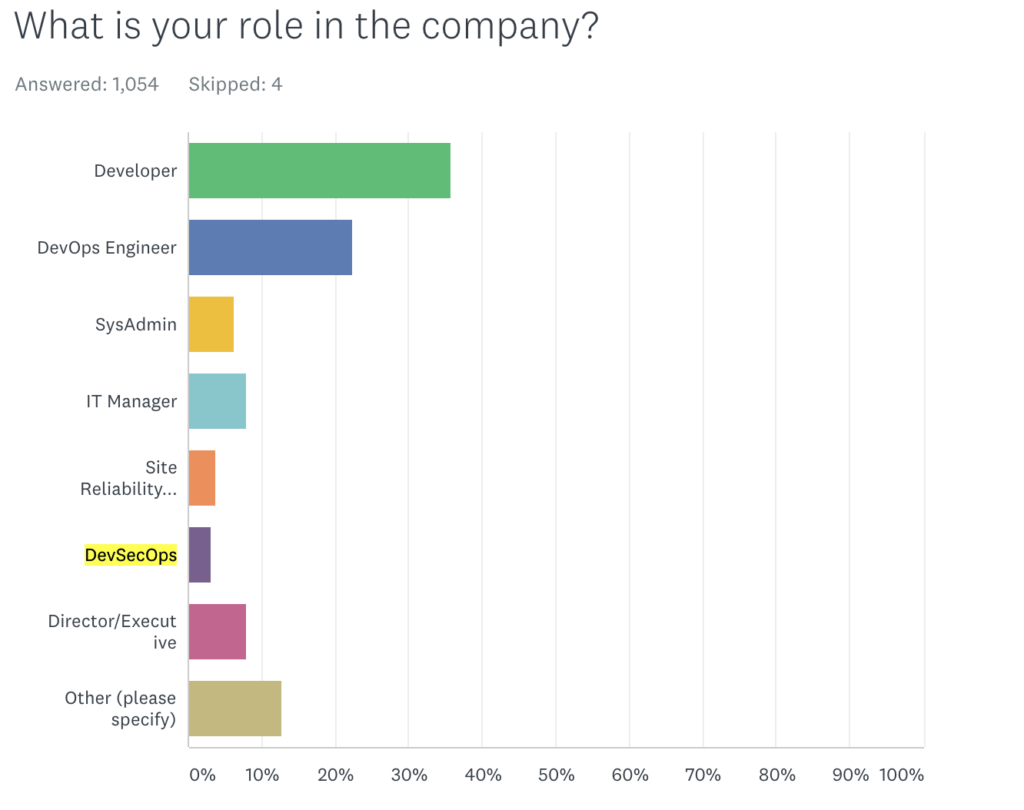
     

    Image source: Logz.io

    DevSecOps Best Practices

    Adopt a Shift Left Approach

    Shifting security left helps organizations secure each stage of the development life cycle. This refers to starting testing earlier in the SDLC. The goal here is to enhance quality, cut down long test cycles and reduce the likelihood of unpleasant security surprises at the end of the development cycle or in production.

    Include a Threat Modeling Mechanism

    It is essential to implement a threat modeling mechanism in DevOps workflows since it helps developers and security professionals to view software from an attacker’s perspective. It makes developers more careful while writing code and encourages them to more closely follow code writing and review best practices. Threat assessment or threat modeling will also help identify potential vulnerabilities in system design and architecture, and acts as a crucial part of successful security integration in the SDLC.

    Mandate Developer Training

    Training developers on the importance of security is a critical best practice. Making sure each developer who writes, tests and deploys code understands that security is part of their job description is a priority. Training developers on security best practices, how to embed security, check for vulnerabilities and use appropriate security tools will improve overall security knowledge and increase its application within the organization. 

    Use Available Security Vulnerability Tools

    A vulnerability is considered a flaw in the code, application dependencies, external libraries, licenses used or operating system (OS) packages. There are a number of static and dynamic application security tools that can help the development team to find and address bugs and vulnerabilities as early as possible in the development pipeline. Many are automated to reduce the time it takes for developers to find these flaws.

    Sponsor Bug Bounties

    Bug bounty programs and rewards motivate external and internal security experts to experiment with the platform, analyze, think outside the box and report any major bugs and security flaws found. 

    Security-as-Code

    Security-as-code is the next evolution in DevOps, where security is fully embedded in the development processes. This practice implements security and secure coding practices in the earliest stage of development. With security-as-code, developers will be able to identify vulnerable code ahead of time and add security checkpoints/measures to tackle such irregularities. 

    DevSecOps Tools

    When we talk about DevSecOps, the software development cycle involves multiple checkpoints to identify bugs and any other vulnerabilities and resolve them so that the application works as designed. The aim is to deploy software with quality and confidence, and this is achieved by using various tools at different stages.
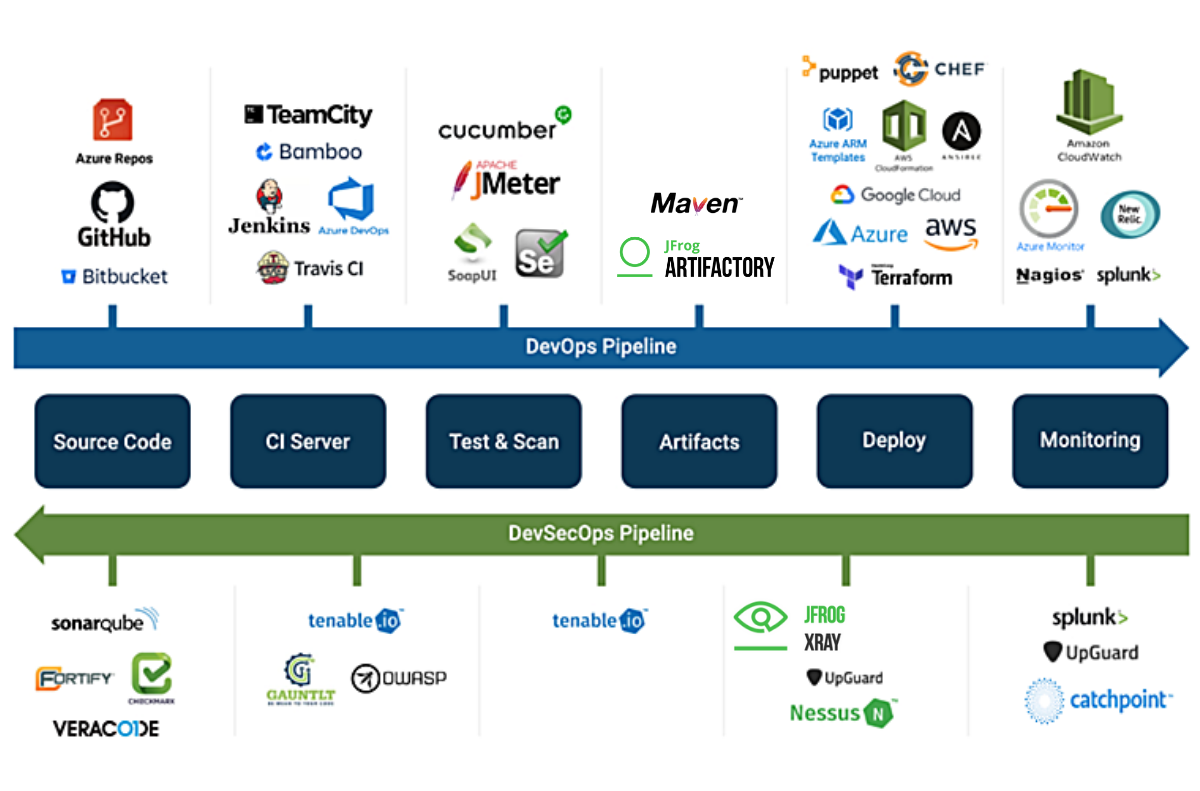
     

    Image credits: CatchPoint

    Organizations can choose to use the type of security tools that best work for their needs from their preferred vendor. While the security tools themselves are critical for detecting vulnerabilities in the application through the DevSecOps pipeline, monitoring is also considered an integral part of this process. It not only lets developers analyze and evaluate security vulnerabilities from the end user’s viewpoint, but it can help identify breaches and anomalies after an application is in production.

    DevSecOps Pipeline

    While DevOps focuses on speed and agility, DevSecOps adds a layer of security throughout the software development life cycle. A DevSecOps pipeline adds security activities to every stage of the development process, not simply tacking it on to the end as an afterthought. This is achieved by integrating security checkpoints, controls, policies, tools and techniques from the beginning of the DevOps pipeline until the end. These additions facilitate automated security controls at each stage of the software delivery pipeline.
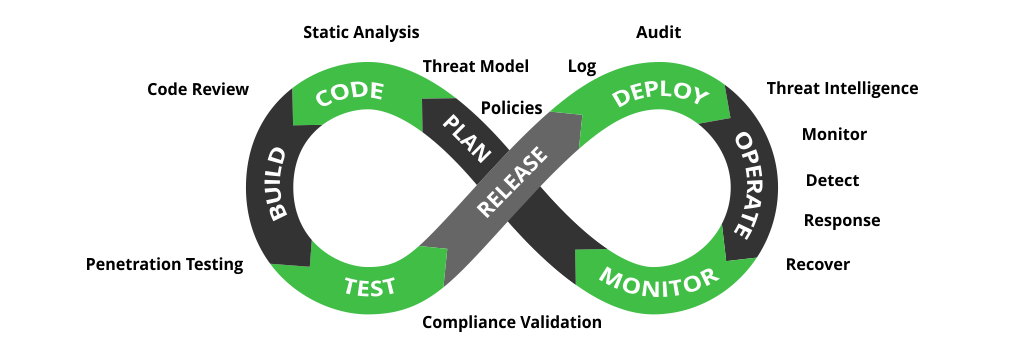
    Image credits: JFrog

    In his swampUP conference keynote The Divine and Felonious Nature of Cyber Security, John Willis shared some valuable DevSecOps best practices, including:

    • Treat security issues as you would software issues.
    • Adopt a “security-as-code” approach to enable the automation of security.
    • Build security controls and vulnerability detection into CI/CD pipelines.
    • Automate security testing as part of the build process.
    • Proactively monitor the security of production deployments.

    Embedding security earlier in your software development life cycle will yield bug-free features and satisfied customers. Have security checkpoints at each stage and make sure developers understand that security is everyone’s responsibility, including theirs. Manage your software and build artifacts, scanning and securing them at every stage of the pipeline using appropriate tools and techniques. Happy DevSecOpsing!

  • Best Free Virtual DevOps Conferences to Attend in 2021

    Best Free Virtual DevOps Conferences to Attend in 2021

    New year, new beginnings and new conferences. It’s that time of the year again, to review and research upcoming events for 2021. Of course, given the ongoing COVID-19 pandemic, we’ll cover only virtual conferences. Here are the top five best DevOps virtual conferences you can attend for free. Just sign up, reserve your seat and attend, it’s as simple as that. 

    Why attend virtual conferences?

    Conferences provide wide visibility into market trends. As an individual, it’s impossible to know everything that is happening around the industry, especially the software industry. Conferences give us a chance to see things from different perspectives. Knowing how others are solving their engineering problems, what best practices they are using, how they deploy to production, etc., gives us the confidence to tackle our own problems. Demos, practical approaches and learning from top experts and speakers is yet another advantage for conference attendees. As the world has gone virtual, it has become easier to attend conferences via our laptops/desktops, right from the comfort of our home office. 

    So, let’s consider some of the industry’s best DevOps conferences this year.

    swampUP

    Date: May 25 – 27 (AMERICAS) | June 1-3 (EMEA)

    devops epicenter conference

    swampUP is one of the most recognized global DevOps conferences meant for DevOps practitioners around the globe. This conference puts you at the center of DevOps.

    It’s about all the stuff you ever wanted to know and understand from an engineering perspective. It empowers the attendees with actionable tips, patterns and use cases to drive DevOps initiatives with modern CI/CD, package management and security best practices. swampUP enables attendees to talk to the leading DevOps gurus live and benefit from their insight. 

    What is unique about this conference?

    The conference also includes three full days of hands-on DevOps training, keynotes, breakout sessions, real-world use cases with renowned speakers and brands and comprehensive, deep-dive tutorials. 

    DevSecOps Days

    Date: March 5, 2021

    devsecops days conference

    DevSecOps Days is a renowned conference that takes place in various cities and is organized around the latest security best practices in DevOps. Topics and talks center on adding security to DevOps. This conference aims to educate, share knowledge, evolve and explore DevOps and DevSecOps technologies and concepts, keeping security the focal point in software development. That’s what we call developing security as code. Volunteers from the local community organize the event. 

    What is unique about this conference?

    Attendees of DevSecOps Days will get a chance to talk to the industry’s leading security practitioners, and come away with insights about implementing security, automating security, overcoming challenges in DevSecOps and scaling security best practices. 

    DockerCon

    Date: May 27, 2021

    dockercon conference

    Docker is the tech that popularized container technology. If you are a DevOps enthusiast and want to know more about working with container tech, DockerCon is the conference for you. So much is happening around Docker these days, and it is worth your time to attend the event. DockerCon is an industry-recognized conference that offers:

    • Technical demos of container technology products and innovations from Docker and their partners. 
    • In-depth, real-world Docker use cases and examples of how others are using it to streamline software development. 
    • Technical sessions from Docker experts and captains and notable leaders from across the industry.
    • A chance for the community to come together and connect with collaborators around the world.

    What is unique about this conference?

    The conference is for everyone from beginners to experts. This is a great opportunity to hang out and chat with Docker experts and Docker captains. 

    DevOps World

    Date: September 22-24

    DevOps World 2021 conference

    DevOps World  is one of the premier DevOps events, bringing together DevOps thought leaders, software practitioners, developers, contributors and the entire DevOps ecosystem in one place. What else can attendees expect? 

    Aside from interacting with industry experts, it provides attendees the opportunity to learn, share, explore and help mold the future of software development and delivery best practices.

    What is unique about this conference?

    Attendees get hands-on experience with various new DevOps technologies and can make new connections in the industry.

    cdCon

    Date: June 23 – 24, 2021

    cdCon conference

    cdCon is a two-day virtual conference on delivering software with security and speed. It is a global conference featuring continuous delivery thought leaders, industry experts, practitioners, open source experts and developers delivering world-class talks. Attendees get to be part of the conversations driving the future of software delivery, enterprise leadership and open source technology.

    What is unique about this conference?

    cdCon is the best place for networking with industry thought leaders. Attendees will learn the latest trends in software delivery from experts. Meet and explore open-source technologies with other practitioners and enthusiasts. 

    DevOps India Summit

    Date: August 27-28, 2021

    DevOps India Summit conference

    One of the APAC region’s top conferences is DevOps India Summit.

    The conference theme this year is “Adapting to Industry 4.0 with DevSecOps, SRE, AI/ML/IoT and Data Science.” This conference focuses on broad topics related to SRE, data science and DevSecOps. It emphasizes Industry 4.0, which refers to the fourth industrial revolution focused on the rising trends in automation, IoT, big data, AI and cloud computing technologies.

    What is unique about this conference?

    The conference features industry leading speakers and panel discussions, and it enables attendees to interact with sponsors, attend yoga sessions, a party with a DJ, fireside chats and much more. 

    Let’s make 2021 an amazing year for DevOps by attending some great conferences, learning new technologies and adopting them into your organizations to solve engineering problems. Happy DevOpsing!

  • Winning DevOps in the Finance Industry

    Winning DevOps in the Finance Industry

    DevOps is making its impact on almost every software-powered company these days. Companies in the finance domain, however, have been perhaps the slowest to embrace DevOps because of concerns regarding governance, security, compliance and regulatory regulations. But it is safe to say that they are currently leading the digital innovation in this era of cloud-native technology.

    Why DevOps for the Finance Industry?

    Higher customer engagement and continuous transactions make the finance industry one of the busiest and naturally requires uninterrupted infrastructure. DevOps implementation helps companies develop fast, fail fast and learn fast so they can fulfill customer expectations and deliver features faster to market than their competitors. Technology in the finance sector has not evolved much, as many companies have assumed it is too risky to embrace DevOps because of the amount of legacy code and old methodologies still in practice. As a result, digital innovation has lagged.

    Challenges of Implementing DevOps in Finance

    Unlike other industries, regulated industries imply several challenges:

    • Strong restrictions on secured networks.
    • Fine-grained audit trails.
    • Strong ACLs models.
    • Full lifecycle governance.
    • Integration with third parties.

    Security and compliance are top concerns in financial companies, and DevOps practices are, in fact, viewed as risk factors to security. Plus, the increased frequency of software releases in DevOps is seen as a threat to governance and regulatory controls.

    Is the Needle Moving Toward DevOps?

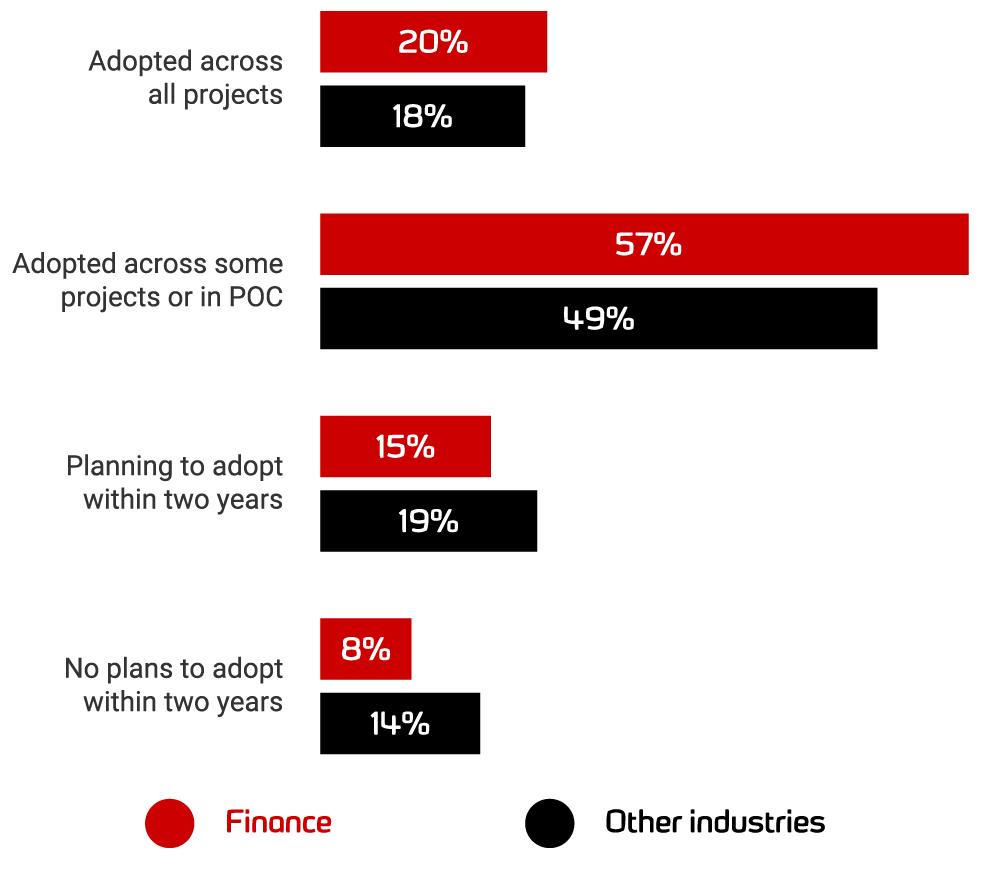
    According to the “2020 State of Database DevOps report“ by Redgate, financial services organizations report the highest levels of database DevOps adoption this year, with proportionally higher rates than any other sector. That shows financial sector maturity in terms of digital innovation. 

    Image source credit: Redgate

    Case Studies of Financial Companies and Their DevOps Journey

    Barclays DevOps Adoption

    In 2015, Barclays announced it was adopting DevOps for its digital transformation journey. Barclays processes payments that equate to around 30% of the UK’s gross domestic product. The developers’ morale and quality of code increased because of DevOps and the leadership team at Barclays credited DevOps with significantly reducing the complexity of its codes, which has allowed the company to reduce delivery risk and ultimately, improve the quality of services.

    DevOps the Lunar Way

    Lunar Way’s journey shows you don’t have to be big to use Kubernetes. The company started its cloud-native DevOps journey by splitting its massive monolith application into smaller microservices. To spin up these microservices, Lunar Way used Ansible, Terraform and Jenkins and to deploy these microservices as a whole unit. 

    Then Lunar Way started to experience scaling issues with microservices and didn’t experience any of the microservices benefits. 

    The company started looking for ways to move past this complexity by shifting its focus from machine-oriented to application-oriented architecture. It chose Kubernetes as the abstraction layer along with AWS, not worrying about where the containers are running, and this is how it was able to manage and unlock the velocity of microservices. Lunar Way also chose Kubernetes from a security perspective and to specify how the applications should run. Now the company runs around 80+ microservices in production with the help of Kubernetes. Watch and learn how Lunar Way did it: “Two years in production with Kubernetes.”

    Italy’s Biggest Bank Embraces DevOps

    A conventional bank running its real business on such a young technology? No way, are you kidding me? Nope, I am not kidding. 

    Italy’s banking group, Intesa Sanpaolo, has made this transition. Banks still run their ATM networks on 30-year-old mainframe technology, so embracing the hottest trend and tech is nearly unbelievable. 

    Even though ING, the banking and financial corporation, changed the way the banks were seen by upgrading itself with Kubernetes and DevOps practices very early in the game, there was still a stigma attached to adopting Kubernetes in highly regulated and controlled environments including health care and financial services. The bank’s engineering team came up with an initiative strategy in 2018 to throw away the old way of thinking and started embracing microservices, container architecture and migration from monolithic to multi-tier applications. Today, the bank runs more than 3,000 applications. Of those, more than 120 are now running in production using the new microservices architecture, including two of the 10 most business-critical for the bank. 

    HSBC Going the DevOps Way

    HSBC is changing the way typical banking works with cloud-native technology and DevOps, as an early user of Google’s Cloud Services Platform to provide core banking services to its business customers. 

    HSBC plans to build its all-new business banking service to run on a Kubernetes-managed container infrastructure using Google’s toolset. HSBC also has excellent partnerships with AWS and Microsoft, favoring the multi-cloud strategy. The company’s engineering team believes that moving to a container model under the umbrella of Kubernetes is significant because it means the environment is similar across different clouds. HSBC also hired people from outside of the banking sector because it wanted to change its culture from within. HSBC is said to have invested $10 million so far in its DevOps initiative.

    Capital One’s Agile to DevOps Journey

    Capital One’s Agile journey started in late 2011, with just two teams, which expanded slowly as more teams were trained in Agile development. The developers at Capital One were following the Scaled Agile Framework (SAFe). Initially, since the teams were new to the automation methodologies, integration testing, security testing, unit and performance testing were all done outside of development sprints by separate test teams. Later, once they understood how important it is to have a collaborative culture, they integrated testing into the dedicated DevOps teams and automated it well. Then slowly, they moved all testing into development sprints, adopting a culture of DevOps and uniformity and wiring integration, security and performance testing into a continuous delivery pipeline. As of 2016, the company had more than 700 Agile teams following continuous delivery.

    DevOps at Bank of America

    Bank of America is one of the world’s biggest financial institutions following DevOps practices, and its digital enterprise operations support nearly 4,300 retail financial centers and approximately 16,600 ATMs worldwide. The award-winning digital bank has nearly 38 million active users and approximately 29 million mobile users.

    Automating Security and Compliance

    As DevOps continues to evolve and become mainstream, it will continue to be of interest for many senior managers across financial services. The above case studies show they are already making DevOps a priority. But security and compliance remain barriers slowing the innovation in the financial companies. 

    Organizations should start small and keep security high priority, first using continuous integration and then adding continuous delivery and deployment using the available tools in the market. Over time, the more a company automates, the higher return on investment it can achieve.

    Automating security permissions and controls will help financial companies remove some of their most common software barriers and get their releases out quicker than before, while still maintaining the necessary governance and compliance. 

    Take a Step Forward

    Financial services companies need complex and rigorous software development processes to meet intense corporate and regulatory requirements. Yet, they are expected to release software faster than ever to meet expectations and beat the competition. By starting small and keeping security and compliance in mind, DevOps in finance can be achieved with great success.

  • Cloud and DevOps: CI/CD and Market Analysis

    Cloud and DevOps: CI/CD and Market Analysis

    Companies today are under heavy pressure to deliver software faster and with more quality than their competitors. A set of good features and their reach to customers can increase only when the company releases software updates frequently. As a result, organizations are embracing DevOps and CI/CD approaches to improve their ability to plan, build, test and release applications and features to market quickly with quality and at scale. IDC predicts the worldwide DevOps software market will reach $8 billion by 2022, up from $3.9 billion in 2017. 

    The buzz around continuous integration, continuous deployment and continuous delivery is more than ever today, but in practice, the actual usage of CI/CD seems to be less. It can be because of the shortage of skill set required in DevOps or companies still practicing traditional software development methodologies. Enterprises are not understanding the amount of money they are leaving on the table by missing CI/CD and DevOps automation practices. 

    For many companies, DevOps is something they have to try because their competition is doing so or because it is a trend. This is a desperate attempt without understanding the consequences and basic understanding of DevOps principles. 

    For the most part, it is a disparate set of tools that customers have to connect together for their software delivery that creates chaos around. On the other hand, it is difficult to choose the right tools and understand what are the best practices. That’s why we are starting to see a trend of DevOps companies delivering a unified toolset so that customers have a complete solution out of the box ⁠—without having to worry about finding many different solutions from different vendors.  

    What Is CI/CD?

    Whenever a developer commits and pushes changes to the repository, the CI system will rebuild the branch and run all related test cases to verify that new changes won’t break the existing application and functionalities. 

    Continuous delivery is an extension of continuous integration that helps you deploy your application with a click of a button. It means deploying changes every time they pass CI tests. With this, you can easily automate your build and testing phase and most of your release process as well.

    With continuous deployment, developers will be able to release or deploy software automatically into the production environment. In this stage, no manual code check-ins happen into the app. Code is automatically tested through the CI process for issues, and if none are found, then the code is deployed.

    Why CI/CD?

    CI/CD serves as the best practice for testing and deployment of applications. For the purpose of quality assurance, making CI/CD the single channel to deploy code is the best practice. DevOps teams should ensure that everything is going through the CI/CD pipeline so that the code in testing and production are the same. This will also reduce human error and avoid deploying other versions not being tested by mistake.

    One of the biggest reasons for companies to practice CI/CD today is faster software delivery, which leads to more frequent updates to customers. It makes them feel happy and a constant improvement with frequent releases will ensure enhanced customer satisfaction. This is a competitive advantage because it allows companies to deliver new features more often. It can help companies stay ahead of competitors.

    Passing code through the CI/CD pipeline ensures that any changes made adhere to the established standards before moving to the next stage in the delivery pipeline. Any failure or discrepancy prevents the advancement of such changes to the next step until it is rectified. This simply means this approach of CI/CD ensures that bad code does not get into the production. CI/CD promotes the fail fast, learn fast and deliver fast approach. When you have automated CI/CD in place, the code is run through the CI/CD process constantly with each commit by developers which allows bugs to be caught quickly ⁠— it is easier to isolate the bug since each small change is tested separately. 

    What Is the CI/CD Pipeline?

    A CI/CD pipeline is a deployment pipeline workflow that is integrated with automation. When conducted well, it will minimize manual handoffs and errors to enhance the feedback loops throughout the software delivery life cycle, allowing development teams to deliver smaller chunks of releases within a shorter time.

    The CI/CD pipeline is now mainstream among software companies, and it has become the backbone of the modern DevOps environment. While DevOps lays principles and standards related to the culture aspect, CI/CD focuses on the automation, flow, process and tools. CI/CD scenario has changed with the introduction of containerization and microservices. Now, every cloud vendor has support and integration with tools such as Docker and Kubernetes that help the CI/CD pipeline to scale. 

    Stages of the Continuous Delivery Pipeline

    • Test Automation and CI: This is the important stage where the new features and prototypes are prepared, coding is done and then the code is integrated with the base. With the use of a CI server, the unit tests and packaging is done.
    • Build Automation: This is the stage where the artifacts are pushed by developers (i.e., Dependencies, Docker image) to the registry (i.e., Amazon ECR or Docker hub or any container registry).
    • Alpha Deployments: In this stage, developer checks-in changes. It is the place for developers to carefully see the changes they’ve made and how they interact with each other and affect other systems. Also, here developers can be able to see if they broke anything in the master branch.
    • Beta Deployments: This is the stage where testers carry out manual testing. Manual testing is still required to see the perfection of CI tools. This gives the DevOps team the guarantee that the condition of the application is good and will work definitely as desired when deployed.
    • Production Deployments: Here comes the final stage, where the app goes live.

    What Is the Market Saying About CI/CD? 

    • The search volume has gradually increased in the world for the keyword “CI CD Pipeline” on Google.
    • When Mabl, a test automation company surveyed 500 software testers, 53% of the people said their team uses continuous integration, while 38% embrace continuous delivery and only 29% have adopted continuous deployment. 
    • A DevOps related survey from Codefresh showed that a third of companies had automated more than half of their workloads, but only 1% were all the way there. Almost no one has automated the entire CI/CD process. A plurality of engineering teams have automated less than 10% of the process.
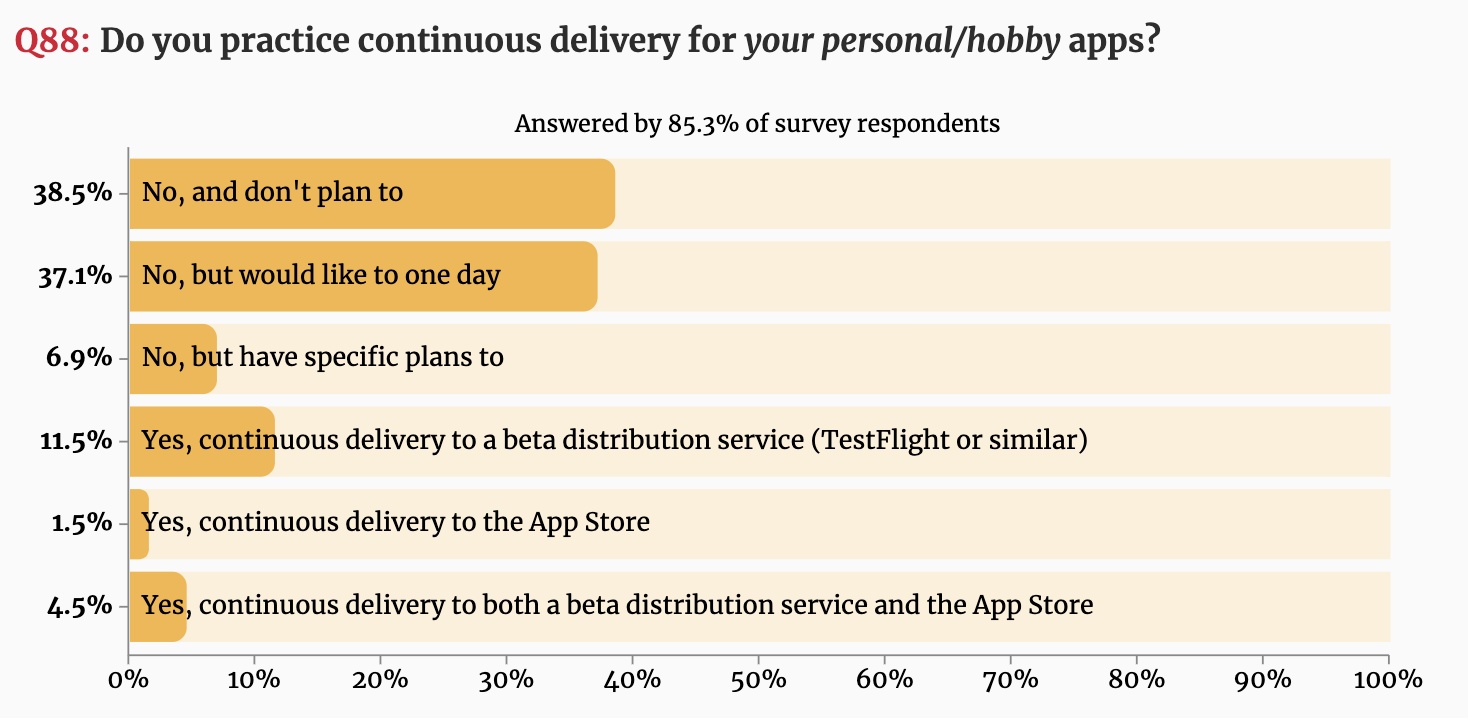
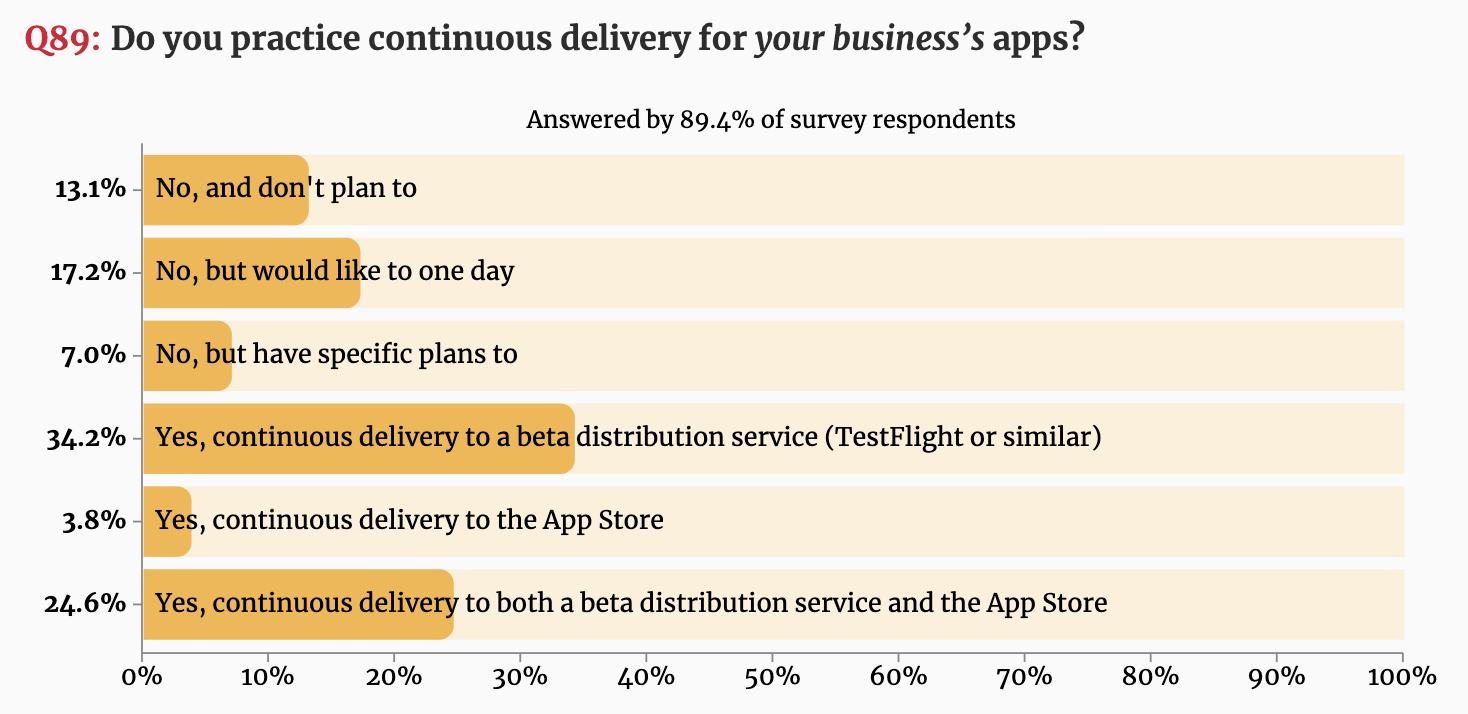
    • The iOS Developer Community Survey is the largest survey of Apple platform developers ever undertaken, where 2,290 people filled in the questionnaire in which CI/CD questions were also a part of the survey. 

    Below are the results that showed a majority of developers are practicing CI/CD when it comes to business apps. 

    Figure 1: Do you practice continuous delivery for your personal/hobby apps?
    Figure 2: Do you practice continuous delivery for your business’s apps?
    • The way forward: Companies will not be able to fully take advantage of containers and DevOps unless they embrace the use of a proper deployment pipeline. Companies will start offering pre-built pipelines to customers, something like JFrog pipelines. There is a need for a unified platform that has all the tools needed to support a CI/CD system ⁠— automation (Pipelines), binary repository management (Artifactory), security (Xray), release/deployment (Distribution), etc. JFrog provides a unified platform.
    • Codefresh conducted a survey and published the results of the survey of 130 developers at the KubeCon + CloudNativeCon Europe 2019 conference ⁠— and the results were a bit shocking. It showed that nearly a third (32%) don’t use any continuous integration or continuous delivery (CI/CD) platform at all. Sixty percent of the survey respondents said their organization has yet to take full advantage of automation to accelerate software development and deployment.
    • The Market Radar Report by GigaOm is a recent research on the enterprise CI/CD solutions where the author compares the leading CI/CD solutions in the industry and rates them depending on different valuation criteria. According to the results, JFrog, Codefresh and GitLab are outperformers as shown below.
    Figure 3: GigaOm Radar for CI/CD. Source: GigaOm.

    The CI/CD solutions considered were AWS, CircleCI, CloudBees, CodeFresh, GitLab, IBM, JFrog, Micro Focus, Microsoft, Red Hat and Xebia Labs. You can download the free analyst comparison report here: GigaOm Radar For Enterprise CI/CD.

    CI/CD is one of the DevOps best practices because it ensures proper alignment between developers and operations. While it enhances automation, developers can push code changes more reliably and frequently. At the same time, the operations team can see greater stability because environments have standard configurations, and rollback procedures are automated. To win the CI/CD game, both dev and ops teams need to develop consensus on the right tools and approaches that are beneficial for the business growth in the long run. 

    Cloud and DevOps Go Hand in Hand

    You can’t do DevOps without the cloud. DevOps won’t have much value without it, and the cloud won’t do much without DevOps. 

    Cloud computing has many definitions, the fundamental explanation of the cloud can be defined as a system that enables and supports the provisioning of infrastructure. Thus, it allows it to be described as code or templates, facilitating the creation of repeatable processes. That is also the basic principle of DevOps, automating the processes/tasks in the software development life cycle to the fullest extent.

    One of the biggest benefits of cloud for CI/CD is the dynamic nature of cloud infrastructure. This is perfect for the ephemeral and bursty nature of CI/CD workloads. Cloud resources can automatically scale up and down based on CI/CD workloads. This allows huge management and cost benefits for enterprises. Enterprise companies don’t need to have their own servers to maintain, they need to increase these servers as CI/CD workloads increase or waste server resources when they are idle.

    Regardless of how your organization defines the cloud technologies and, despite which DevOps routes you travel to achieve digital transformation with the cloud integration, the aesthetics of cloud technologies and services can be easily amalgamated in the DevOps dictionary because they radically complement DevOps principles and processes. 

    For DevOps implementation, Agile principles serve as a driver, as there are shorter release cycles and automation to deliver fast and achieve the deadlines. To implement continuous practices, cloud computing is a great facilitator, since resources are available quickly for all the activities involved in development and application lifecycle management. Agile principles, along with cloud computing and DevOps practices, enable high developer productivity and faster growth in organizations.

    With secured cloud gateways, users get the ability to access enterprise resources easily from anywhere and with any device, without compromising on the security of the network. Letting users access your network from their devices might sometimes seem scary, but the modern cloud platforms have much more to offer, they come with built-in security stacks to help provide administrators with the tools they need to manage and support security.

    DevOps coupled with cloud tech has enormous benefits for businesses employing them:

    1. Increased developer productivity and collaboration.
    2. Faster time to market through quick and easy access to development environments.
    3. Help to automate different repetitive tasks so that developers can focus on the tasks that matter.
    4. Cloud complexity and system maintenance can be incredibly reduced by automation and infrastructure as code approaches.
    5. Increase security with modern cloud platforms and principles that serve to eliminate the manual error.
    6. Help to eliminate downtime through cloud-based continuous business operations. Developers can build stateless applications with automation, which will increase the availability and failover ability, along with increasing business reliability and improved customer satisfaction.
    7. Scale to new heights — one of the main reasons businesses employ cloud and DevOps is to scale their infrastructure and applications as and when needed. 

    Cloud Deployment Models

    When the cloud provider entirely hosts organization’s applications and data, it is a public cloud. With just having an internet connection, the employees of the company employing public cloud can access the applications. 

    A private cloud is when the resources of an organization such as storage, compute and networking resources exist in a provider’s data center. Companies prefer private cloud mainly because of security and for storing highly sensitive data when it comes to running applications. 

    One more modern approach is the hybrid cloud; it is a combination of private and public cloud services. According to the traffic and demand considerations, organizations can make the change. Some customers may have on-prem CI/CD systems. Some of these CI/CD systems can expand their workloads to the cloud in a hybrid setup. This can allow them to realize the benefits of cloud now and not have to do a complete migration.

    Mainly, when there is high demand, workloads can be run in the public cloud, and then when things get back to normal, return to the private cloud. This approach reduces the overhead cost spent on cloud resources. Additionally, the key point is, sensitive information, data and critical applications can be kept in the private cloud. In contrast, less-sensitive data and applications can be stored and run in the public cloud.

    Choosing DevOps Cloud Solutions

    If cloud is like an instrument, then DevOps is the musician who plays it.

    Cloud computing and DevOps play a vital role and are interlocking parts of the IT strategy. Together, cloud and DevOps help IT shift its emphasis from “How far and long can we go without an outage?” to “How often we can deliver new and stable functionality/feature?” or “How fast/quickly can we deploy a new service?”

    Businesses today are looking for ways to digital transformation with the help of the cloud, DevOps and automation practices. Considering the competition in the cloud space, it is overwhelming to see so many vendors and get confused on what to choose. 

    Here, in the State of DevOps Cloud Solutions 2020, you can see a high-level overview of the cloud DevOps platform solutions available today, and what you should expect from vendors in your cloud DevOps journey.

  • 6 Virtual DevOps Conferences You Can’t Afford to Miss in June 2020

    6 Virtual DevOps Conferences You Can’t Afford to Miss in June 2020

    Conferences and events make up to a trillion-dollar industry and have been playing a major role in connecting people from different parts of the world and exchange ideas. Because of the COVID-19 outbreak, the first major tech conference that got canceled due to health and safety concerns was the Mobile World Congress (MWC), the annual gathering of electronics makers.

    Along the way, similarly, Facebook also canceled all physical conferences and events through June 2021, including the major F8 Developer Conference and the most awaited Oculus Connect 7 virtual reality event that was supposed to be held in San Jose, CA.

    Even Microsoft, the giant, has announced all of its events are going digital-only until July 2021, including its flagship Microsoft Build and the prestigious Microsoft Ignite 2020.

    At the beginning of April, more than 30,000 people were expected to attend the prestigious Google Cloud Next ’20 conference, all set to happen in San Francisco. But, as the coronavirus crisis intensified all over the world, keeping the attendees’ and employees’ safety in mind, Google decided to move the entire event online.

    Today, we will see six virtual DevOps conferences you can’t afford to miss in June.

    TechStrong Con

    Date: June 4

    Cost: Free

    TechStrong Con is a virtual summit dedicated to and celebrating all things tech. The event, hosted by MediaOps, brings together some of the most prestigious industry leaders for 12 hours of immersive learning and networking. The sessions are divided into three tracks: Emerging Technologies, Security/DevSecOps and Digital Transformation. Attendees will have access to downloadable resources and will have the chance to interact with tech leaders and fellow DevOps practitioners.

    You can also be a part of the #TechStrongCon Challenge, which consists in sharing a photo of your work-from-home space during COVID-19 on LinkedIn for a chance to win either an iPad Pro or a DJI Maxic Drone.

    A portion of the proceeds raised from the event will be donated to charities dedicated to fighting COVID-19. For more information on the event and the challenge visit the TechStrong Con website.

    Agile + DevOps

    Date: June 8–11

    Free Pass: $0

    Conference Pass: $499

    All-Access Pass: $999

    The theme of the event is “accelerating software delivery with the power of Agile and DevOps.” This is an event by TechWell, and this time it is happening fully virtual. From the comfort of your own digital device, sitting at your home, or wherever you are, you will have access to all of the great content and experts the Agile + DevOps conference is known for. This time, the event will be streaming over 90+ talks—including five keynotes, 25 tutorials, more than 50 sessions and 14+ Industry Technical Presentations. All this is happening over an engaging and interactive premium virtual atmosphere. You can select the conference package that fits your needs and your budget.

    DevSecCon 24 

    Date: June 15 -16

    Cost: Free

    This virtual conference focuses mainly on the security aspect in development and operations and tackles the impact of development operations and security “run by practitioners, for practitioners.” 

    The aim here is to show attendees how DevOps and security can work together seamlessly to make continuously secure development a reality.

    This virtual expo allows for interaction with different vendors and companies. Check their website for updated details.

    swampUP

    Date: June 23-24

    Cost: $20 (all goes to charity)

    swampUP is JFrog’s annual DevOps conference, and this time it is happening in a virtual format with two full days of action-packed DevOps talks and training. The conference has a remarkable set of visionary keynotes and thought‑provoking DevOps sessions delivered by industry experts. 

    Leap into DevOps, DevSecOps and cloud-native best practices with practical training by experts delivered virtually. Sessions are experimented and thoroughly designed for developers, administrators and managers. This is regarded as one of the industry-recognized conferences of all time.

    DevOps Enterprise Summit London

    Date: June 23-25

    Cost: $240 – $480

    Gene Kim’s IT Revolution hosts this event. DevOps Enterprise Summit has great speakers and exciting courses provided by experts. It is a place for exchanging DevOps success stories and best practices. 

    Some of the big brands such as Adidas, Walmart, John Deere, Capital One and many others are participating. Attendees will get three days of immersive learning and interaction with fellow technology leaders.

    Cloud Foundry Summit

    June 24-25

    Attendee Registration: $50

    Academic Registration: $35

    Cloud Foundry Summit is where developers, architects, operators, CIOs and other IT professionals meet to share the best software and IT practices and innovate together. Simplifying developer experience is the theme of the conference where both days are filled with interesting sessions and hands-on labs. 

    This is where you will learn how to automate, scale, and manage cloud apps throughout their lifecycle. 

    It looks like virtual is the new normal for the events industry and for the companies looking to host future events. The upsides of the virtual format of the conferences are many: It is easy to attend, saves a lot of money we used to spend on travel, stay, food, etc. and eliminates the effort and fatigue that used to happen while attending a physical conference happening in some other city or country. Well, thinking positively about any situation makes you feel good, and I hope we will get out of this COVID pandemic as soon as possible.

  • Five Attributes of a Great DevOps Platform

    Five Attributes of a Great DevOps Platform

    As we move toward 2020, the expectations are high, the software industry is moving faster and the demand for rapid and continually improving digital experiences have raised the standard. To match the needs and demands of the market, firms around the world are embracing the DevOps culture to ensure and streamline the development, packaging, testing, deployment and maintenance of software at scale. 

    Every DevOps organization is defined by its own leadership, culture, practices, policies, leadership style, structure, talents, skills, technical capabilities, processes and tools. However, there are certain common characteristics that are important to consider before deciding a better DevOps platform to use in your organization. Today, we will discuss such important features that can help you while selecting your DevOps platform. 

    What is DevOps?

    DevOps is a mindset in an organization that enforces a set of collective practices to ensure easy collaboration between dev and ops so the business can run smoothly without any hassle. DevOps aims to fasten the time to market through frequent and incremental improvements to deliver quality software updates to customers. 

    The meaning and definitions of DevOps can vary from company to company. Automation being the focal point, firms want to focus on achieving zero-touch automation, with utmost security and governance as a priority in the delivery pipeline.

    Even though the meaning of DevOps varies, several inherent DevOps principles cannot be replaced, and they repeatedly insist on collaborative relationships, developing early, failing early, shared learning and continuous feedback. These DevOps principles enhance quality with improved deployment rates while simultaneously improving predictability, scalability and security of the production environment. Tech leaders in the company need to view DevOps as a holistic approach rather than a small set of guidelines for the teams, and DevOps guidelines should be aligned with the company’s long term technology vision and objectives. 

    Here are some facts to consider while deciding a better DevOps platform for your organization.

    A Mindset of a Unified Culture

    Culture plays a significant role in establishing the guidelines while embracing DevOps in any organization. Through DevOps culture, companies seek to bring dev and ops teams into harmony to promote collaboration, automation, process improvements, continuous iterative development and deployment methodologies. But above everything else, a sound DevOps culture fundamentally solves one of IT’s biggest people problems: bridging the gap between dev and ops teams to get them to stop working in silos and have common goals. 

    According to Gartner estimation, DevOps efforts fail 90% of the time when infrastructure and operations teams try to drive a DevOps initiative without nurturing a cultural shift in the first place. It is not just about the efficient tools or experts working; it is about the behavioral modifications and mentality necessary to effect cultural change.

    Hence, it is important for the firms to consider the culture of the company before selecting its tool as a potential DevOps tool for their development. 

    Automation Inside and Outside

    Automation is one of the key principles of a strong DevOps team because it has such a high return on investment. 

    Automation makes up as a large part of DevOps culture to standardize production platforms, and even firms believe it as true because standardization and automation help make deployments more predictable, easy and less prone to human errors. 

    Automate everything as part of the workflow process, including infrastructures, compliance and continuous delivery pipeline. For example, tools such as Artifactory can manage and control all your binary repositories to help your developers and ops collaborate and automate build and deploy tasks easily. Similarly, Docker allows development teams to containerize applications and automate application deployments with speed.

    By reducing manual, non-important and repetitive tasks, you will increase your development and testing speed while cutting down on human and unnecessary errors. Additionally, by automating tedious and repetitive tasks, firms free up team members to work on higher-level and more important tasks.

    Important to note here, JFrog Pipelines is an innovative DevOps automation solution that well integrates and connects all critical processes in the software delivery lifecycle in the company, from development to testing to production. Using minimum code, it allows you to create smart and event-driven workflows across tools and teams easily, to speed up the release of software applications. This helps you achieve continuous integration, continuous delivery, continuous deployment and continuous monitoring in DevOps.

    Support Both Hybrid and Multi-Cloud

    What is Multi-cloud?

    Multi-cloud is the use of cloud computing from two or more public cloud providers in single network architecture to meet their business objectives. A multi-cloud strategy has many advantages. It avoids vendor lock-in, decreases latency, enhances business continuity, overhead cost reduction and maximizes flexibility for development teams. However, multi-cloud management comes with some challenges that require careful orchestration, and needs to pay close attention to security and governance issues.

    What is Hybrid-cloud?

    A hybrid cloud is a mixture of on-premises and off-premises IT resources. Based on business and compliance requirements, the hybrid cloud allows firms to move data and applications between private and public environments. 

    Hybrid cloud computing allows instant transfer of information between public and private environments, allowing enterprises to experience the benefits of both environments efficiently. 

    Flexibility, scalability and cost savings are some of the top benefits of hybrid-cloud. 

    Considering a platform that supports both multi-cloud and hybrid-cloud is the best solution for the enterprises moving toward the digital transformation ladder.

    Continuous Updates 

    Frequently rolling out updates, in a continuous sequence, to bring service improvements to consumer devices more rapidly and efficiently is what every firm is trying to do these days. The customer wants new features as early as possible and continuously. That is one reason why companies embrace automation and follow practices like continuous integration, continuous deployment and continuous delivery through tools such as GitHub, Artifactory, Circle CI, Docker, Kubernetes, etc. 

    The DevOps platform should be able to manage your DevOps pipeline from a single pane of glass. A platform that can provide a universal end-to-end solution that integrates with your ecosystem to orchestrate and optimize all critical processes in your CI/CD pipeline. Boosting fearless updates continuously from code to the edge in self-managed, on-prem, hybrid and multi-cloud environments.

    A Robust Community 

    All successful companies have built their own communities through their products and services. DevOps is all about the culture shift. Changing existing culture and moving forward is one of the hardest things to do—despite the benefits that DevOps offers, such as speed and agility. No matter what changes a team implements, embracing DevOps often comes to a halt once the companies realize it requires a change in culture and mentality of all the teams involved. This is where the value of community comes in, by fostering the development of a more open communication, easy and supportive feedback, and collaborative culture within teams, companies can be able to drive this DevOps culture. This mindset should come from within and outside of the organization by tapping into this sense of community-based collaboration. Communities are required because they ensure the well being of many of the technologies we use daily.

    Your favorite DevOps platforms—Jenkins, Docker, Kubernetes, Artifactory—and their popularity is because of the communities they have created around the tools. 

    A well-focused DevOps platform gives power to people who listen carefully to what the market is saying, gets the feedback and utilizes it effectively. Hence, community is a very important feature of a DevOps organization. 

    Conclusion

    Companies around the world are embracing DevOps, and the demand for DevOps skills soars as organizations spend their time and money on digital transformation. DevOps has become a modern approach to IT that helps companies to think and execute broader business strategies. DevOps can drive significant brand value by accelerating speed to market, better collaboration, ensuring better testing and automation. A DevOps platform should have all the qualities mentioned above to succeed in this highly competitive market.

  • DevOps at Scale: Winning Strategy for Modern Enterprises

    DevOps at Scale: Winning Strategy for Modern Enterprises

    DevOps is a word that has generated massive interest over the last few years among the software-powered organizations and developers, yet many people don’t fully understand what it actually means. One thing is for sure, as cool as it sounds, DevOps is not some kind of top-secret developer army group, job profile or even a tool. It is a wonderful ideology that any firm can help itself to unite their tech crew and take the company to newer heights.

    As different departments grow, communication becomes difficult between the teams, mainly development and operations. Since communication is the key to avoid unproductive siloing, the DevOps movement started as a cultural phenomenon in order to bridge this gap between dev and ops. So firms started embracing DevOps principles to get everyone on the same page and create a sense of shared responsibility, and moving forward, firms believe that was the recipe for success.

    Where Does DevOps Come into Play?

    Automation is one of the things DevOps is most known for. Automation reduces the amount of work, and smaller batches of work are easier to understand, commit to, test, review and know when they are done. These smaller batch sizes also contain less variance and risk, making them easier to deploy and, if something goes wrong, to troubleshoot and recover from.

    With DevOps best practices like CI/CD, it is easy to understand which code has created bugs and make possible corrections wherever necessary. 

    Just like lean development, through automation and agile practice, firms can get feature development very close to single-piece flow, and this provides value to customers quickly and continuously by delivering features as quickly as possible. 

    More traditionally, DevOps is referred to as a means to break down the walls of confusion and chaos between the dev and ops teams and smoothen the flow of communication. In the DevOps model, development teams develop new features, and operations teams keep the system more reliable for customers, stable and running smoothly.

    Today, we will see some important elements that help firms to embrace DevOps with ease.

    Start a Cultural Shift, a DevOps Initiative

    This should flow from top to bottom, company management leaders should start the discipline of embracing DevOps. Usually, it is the CIO who should move the needle and make things start from scratch. A DevOps mindset is very crucial at this point to make sure the teams are all prepared for a change in the culture.

    Gartner predicted that through 2022, 75% of DevOps initiatives will fail to meet expectations due to issues around organizational learning and change. One of the main reasons why DevOps efforts fail is that most of the organizational leaders don’t understand Agile and DevOps. Leadership makes a huge impact on the organizational culture and its way of doing business, hence engineering leaders need to understand why this change is necessary and start a culture of collaboration, culture of experimentation and learning, and eliminate the blame game. 

    Train Your People

    Training is one essential aspect for team leads and the people involved under them so they understand what DevOps is, the fundamentals, and why it is important for the organization to embrace it. Training enriches knowledge, collaboration and communication processes between the people working in development and operations teams. 

    It helps them to get together and get their hands on, test the new technology practices and tools introduced. There are many group courses, boot camps and DevOps experts that can help people get trained in DevOps. It is the firm’s responsibility to set proper expectations and choose the right candidates to train their people. 

    Build a DevOps Plan with a Strategy

    All those engineering best practices that enhance automation, team collaboration, seamless integration and testing that facilitate new ways of software development with ease are key to a DevOps strategy. Firms have to set a common goal, track changes and align teams in a shared environment making them aware of each other’s responsibilities and duties. Implementing Infrastructure as Code (IaC), test automation, integration, deployment and release processes should be a part of it.

    Set Policies and Processes

    The policy is an integral part of any software powered organization. With security being the priority, this has become a supreme topic in the DevOps world. For every company that has adopted DevOps, the policy is critical. As we all know, policy-driven development is a fundamental concept that fits really well into the DevOps model. This model ensures that information security, ops, development practices, language standards, SRE, sysops administration and development, are all aligned with common goals.

    Containerize Applications

    Containers are well equipped with the IaC approach and are used in DevOps to instantly deploy applications across various environments. Docker provides the most popular container technology toolset. Docker image management technologies, such as Amazon ECR, have made it easy for developers to perform IT operations, collaborate with each other, share software and enhance overall software delivery productivity.

    Containerizing legacy applications will reduce the burden of handling the ever-growing overhead costs and it also increases developer productivity. Container deployment can be an effective solution as containers typically start in seconds. The container image holds all the dependencies, meaning there is no need to add environment-specific configurations. The same image is now portable across multiple systems and environments. The main idea is to make applications able to run anywhere, on any machine and at any given time. 

    Make Use of Microservices Architecture

    Decouple the legacy and monolithic application that involves thousands of lines of code into numerous small elements called microservices. With the idea of microservices, a company continues to innovate and stay agile as the products or the platform gets larger. With this approach, engineering teams focus on developing business capabilities and important features autonomously.

    Instead of having to orchestrate a large release after writing hundreds of lines of code, waiting for the perfect time to offer new features, a new business functionality can be added by just adding a new service. Eventually, firms end up creating microservices that can be easily and independently deployed, scaled and managed without having to worry about other parts of the application.

    Determine the Toolchain

    When companies initially start embracing DevOps they feel proud, but they find it hard once they really start working toward it practically. The simple logic for this is: DevOps is fragmented. 

    For many years, firms have tried to embrace DevOps and have found themselves making various mistakes by their custom scripts and logic. From source control to CI, to artifacts management to CD, as soon as one task is completed, the next step should proceed without any lag, and that is how the firms achieve their DevOps automation. But in practice, this doesn’t happen.

    There are many handovers that take place manually—that is not called DevOps. Custom scripts and practices might work temporarily for a startup but when the company grows, taking different tools and writing code to make them talk to each other becomes a complex task. For this reason, recently, JFrog has launched a unified DevOps platform for companies struggling with doing DevOps at scale. 

    Companies around the globe are in a race to innovate and release software and valuable features to their customers as early as possible to stay ahead of the competition. You need a platform to deliver software updates fearlessly from code to the edge. It would help if you had an end to end universal DevOps solution, like JFrog platform, to manage your entire DevOps pipeline. A highly scalable enterprise platform unifies the management of all services in a single pane of glass. The JFrog platform is Kubernetes ready to manage your Docker images and Helm repositories for your Kubernetes deployments. It has everything you need to do DevOps, from artifactory repository management to distribution.

    Continuously Monitor and Share Feedback

    Once we deploy the application in production and make it available for the end-users, the next step is continuous monitoring. This alerts the team if there are any misconfigurations or worse situations of an outage or of any application issues. You can monitor infrastructure health, or if would like to see and analyze logs over weeks and months, you should be able to do so.

    This step provides critical feedback, essential for the team to understand and work on the aspects of the application that require additional work and resources. Continuous monitoring enables you to find issues (if any) before any customer finds them. Having no visibility is just like getting your arms tied behind your back, you can’t really see what is going on. 

    Conclusion

    Other than easy collaboration, improved communication, an increase in productivity and effective feedback loops, the one benefit DevOps will bring is delivering software at speed without compromising on quality. DevOps is an ongoing effort and helps people in the organization fail early and learn early from their mistakes, and it builds confidence. DevOps implementation can look too overwhelming at times, but a prepared approach with a well-thought strategy can take your firm from zero to hero. Given that the teams have patience, persistence and ever-learning attitude, it is possible to scale DevOps to new heights. 

    — Pavan Belagatti

  • The State of DevOps Adoption and Trends in 2017

    The State of DevOps Adoption and Trends in 2017

    DevOps has come a long way, and we see a tremendous increase in adoption in the recent years. To outrank your competition and be ahead in the growth curve, it has become an essential element for software-powered organizations. DevOps has taken a center stage in the software development field with no signs of leaving.

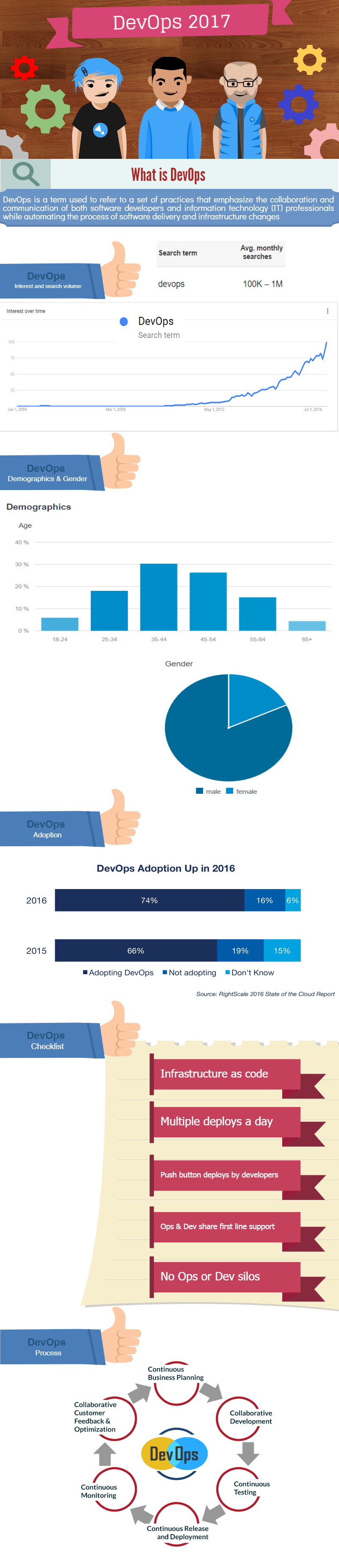
    Below is an infographic of DevOps and some of the trends we see happening this year in DevOps:

    DevOps trends in 2017

    Sources:

    http://www.rightscale.com/blog/cloud-industry-insights/new-devops-trends-2016-state-cloud-survey

    https://www.storybase.com

    slideshare.net

    https://en.wikipedia.org/wiki/DevOps

    Google.com

    7 DevOps Trends

    1. DevOps will be the mainstream and garner a lot of attention; hence, 2017 is going to be the “Year of DevOps.”
    2. Along with DevOps, the three C’s—Continuous Integration, Continuous Deployment, and Continuous Delivery—are going to gain a huge momentum.
    3. A number of new DevOps automation tools will be released that change the way we do software development.
    4. “Containerization” also will be in the limelight.
    5. Many software firms will move to a microservices architecture.
    6. Automation and continuous testing will become more popular—and more important.
    7. Must-have tools and platforms including Docker, AWS, GitHub and JIRA will become even more popular within developer zones.

    The Names to Know

    Below are the names of the top DevOps experts you need to follow:

    Name Twitter Profile Who is He/She Klout Score Website
    patrickdebois https://twitter.com/patrickdebois bridging the gap between creativity and technology with a #devops mindset; eternal researcher and pragmatic implementor; cto @townheroes; started @devopsdays 50 http://www.jedi.be/blog/
    Avi Cavale https://twitter.com/avinci ceo @beshippable, wildlife photographer, scotch lover 50 https://app.shippable.com/
    Kris Buytaert https://twitter.com/krisbuytaert Everything is a Freaky #Devops Needs Sushi Problem, Open Source, Infrastructure as Code, Consultant, Speaker, Author, Organiser of #devopsdays, #cfgmgmtcamp 53 https://about.me/krisbuytaert
    Gene Kim https://twitter.com/realgenekim DevOps enthusiast, The Phoenix Project co-author, Tripwire founder, Visible Ops co-author, IT Ops/Security Researcher, Theory of Constraints Jonah, rabid UX fan 64 http://www.realgenekim.me/
    Jez Humble https://twitter.com/jezhumble Co-author of Continuous Delivery, Lean Enterprise, DevOps Handbook; CTO devops-research.com, lecturer @BerkeleyISchool. PGP: https://keybase.io/jezhumble 63 https://continuousdelivery.com/
    Gareth Rushgrove https://twitter.com/garethr Software developer, occasional sysadmin, general web, programming and technology geek and curator of Devops Weekly. Engineer at @puppetize. @gdsteam alumnus 56 https://www.morethanseven.net/
    Denise Dubie https://twitter.com/ddubie Strategic Content Creator @CAInc, editor/writer/techie focused on App Economy, DevOps, Mobility, ITSec.& Mgmt., Cloud; former Network World/IDG tech journo. 50 https://www.ca.com/us/rewrite.html
    Sanjeev Sharma https://twitter.com/sd_architect #DevOps #Agile #Cloud #TechSales #CTO #Architect #Author – #DevOpsForDummies #Blogger #Inventor #Disruptor #IBM #DistinguishedEngineer. 52 https://sdarchitect.blog/
    Donnie Berkholz https://twitter.com/dberkholz Research director for development, DevOps & IT ops @451Research. PhD biophysicist. Open-source OG. Emerging tech, craft beer, and zeroth-world problems 59 https://451research.com/analyst-team/analyst/Donnie+Berkholz
    Nathen Harvey https://twitter.com/nathenharvey VP, Community Development at Chef 57 http://nathenharvey.com/
    Damon Edwards https://twitter.com/damonedwards DevOps, IT operations, and improving how businesses operate is my thing. Rundeck is where I work. 49 https://www.rundeck.com/

    We hope DevOps will be a rock star in 2017 and continue to rule the software industry.

    — TeamShippable

  • 35+ Tools Every DevOps Expert Must Know

    35+ Tools Every DevOps Expert Must Know

    List of DevOps tools and resources:

    Here is the set of tools and resources that help every DevOps enthusiast must know.

    Learn coding:

    Code academy: Learn to code interactively, for free.

    Code school: Interactive programming courses and guided projects.

    Treehouse: Learn Web Design, Coding & Much More.

    Lynda: Technology and Creative Skills taught by industry experts.

    Tuts+: Thousands of free tutorials and online courses to help you learn software development from mobile devices to web applications and everything in between.

    Source control:

    GitHub: GitHub is a web-based Git repository hosting service. It offers all of the distributed version control and source code management (SCM) functionality of Git as well as adding its own features.

    Bitbucket: Bitbucket is a web-based hosting service for projects that use either the Mercurial (since launch) or Git (since October 2011) revision control systems. Bitbucket offers both commercial plans and free accounts.

    Versions: Versions offers the best way to work with Subversion on the Mac. Thanks to its clear-cut approach, you’ll hit the ground running.

    Tower: Version control with Git, made easy. In a beautiful, efficient and powerful app.

    SourceTree: Harness the power of Git and Hg in a beautifully simple application.

    Continuous integration and deployment:

    Circle CI: The modern continuous integration and delivery platform that software teams love to use.

    Travis CI: Easily sync your GitHub projects with Travis CI and you’ll be testing your code in minutes!

    Shippable: A declarative CI/CD and release automation platform that streamlines software delivery.

    GO CD: Open-source continuous delivery server to model and visualize complex workflows with ease.

    Xebia Labs: Continuous delivery at enterprise scale.

    Electric Cloud: Powering continuous delivery and release automation.

    CloudBees: CloudBees is the hub of enterprise Jenkins and DevOps, providing companies with smarter solutions for automating software development and delivery.

    Development platforms:

    Heroku: Deploy and run apps on today’s most innovative platform as a service.

    Cloud 66: Simplify DevOps—build, deploy and maintain any application on any server, on Rackspace

    Docker Cloud: Build, ship, and run any app, anywhere.

    Appfog: A platform for creating, scaling and managing cloud-native apps.

    Engine Yard: Reliability and support you can count on. Built and proven on over 1 billion AWS hours.

    Bug tracking and monitoring:

    Bugzilla: Bugzilla is server software designed to help you manage software development.

    Bugify: Bugify is being used in many different industries. If there’s anything you need to keep track of, keep track of it with Bugify.

    Usersnap: Collect feedback and track bugs. Your central place to organize your web projects.

    BugHerd: Bug tracking so simple—it’s like sticky notes on a website. Capture client feedback, resolve issues and manage projects visually.

    New Relic: New Relic is the first, best place to examine and understand your digital business.

    Browser add-ons:

    Measureit: Draw out a ruler to get the pixel width and height of any elements on a webpage.

    Ghostery: Protect your privacy. See who’s tracking your web browsing with Ghostery.

    View source chart: Inspect the DOM at lightning speed.

    Colorzilla: Advanced eyedropper, color picker, gradient generator and other colorful goodies.

    Empty cache button: Cache clearing made easy. One click.

    CSS and HTML5 frameworks:

    Foundation: The most advanced responsive front-end framework in the world.

    Bootstrap: Sleek, intuitive and powerful front-end framework for faster and easier web development.

    Framework 7: Full-featured HTML framework for building iOS and Android apps.

    Some cool tools:

    Metricfire: Metricfire operate Hosted Graphite, a powerful way for teams to measure technology.

    Snippets: Snippets is a powerful application for Mac and Windows that stores the most valuable pieces of code you can reuse in different projects many times.

    Lingohub: Master your translation workflow and connect with world leading translators.

    Flowdock: Chat and inbox for teams. One place to talk and stay up to date.

    These tools can definitely help you do DevOps and software development efficiently.

    — TeamShippable

  • 15 DevOps Expert Opinions on Continuous Integration and Delivery

    15 DevOps Expert Opinions on Continuous Integration and Delivery

    We at Shippable recently approached some DevOps experts and asked them what they really think about continuous integration (CI) and continuous delivery (CD). The responses were just amazing, proving that CI/CD’s future is just bright and long in the software development process.

    Perhaps this insight might be of help to organizations, regardless of whether they already practicing CI/CD or have yet to adopt it in their organization.

    Sit back, relax and read these opinions from DevOps Experts:

    1. Chris Nwamba

    Chris Nwamba is a self-described code beast who works with scotch.io. “Continuous integration is simply ‘building big and shipping small,’” he said. “The developer or engineer is not expected to produce a complete result; the project is divided into milestones and he or she can produce the expected output for each milestone which is reviewed and pushed. Continuous delivery, on the other hand, involves delivering and deploying a tested and usable feature to the end user as soon as it is available from the engineer. No constraints such as milestones or daily reports are placed on the engineer; rather, the product is delivered when it is ready and tested within a reasonable amount of time.”

    2. David Bernstein

    David Bernstein is the author of “Beyond Legacy Code: Nine Practices to Extend the Life (and Value) of Your Software.” He says, “I’ve written a lot about CI and CD. It’s one of the nine core practices in my new book. The first principle of the Agile Manifesto is, ‘Our highest priority is to satisfy the customer through the early and continuous delivery of valuable software.’ The practice of continuous delivery is the only way I know to achieve this principle and is at the very core of Agile software development.”

    3. Tomohiro Iizuka

    Tomohiro Iizuka is a full-stack web application developer. He says, “Continuous integration and delivery are still at the frontier of IT technology, like NoSQL. It will change the business style of freelance engineers. Businesses using cloud servers will especially change. However, there are some issues to solve in order to execute it. An IT system consists of some subsystems that affect how teams work together on development and management after the first release. If an engineer can provide a subsystem that’s comprehensive to end users, freelance engineers can have their own product and they can concentrate on maintaining their own product continuously. That will make use of cloud platforms more popular, and they can have opportunities to gain profit continuously in addition to development fees. Open-source products like Eclipse, Firefox, WordPress are some examples. However, in general, that is not done. I think that the platform for making independent software components is necessary for freelance engineers to make new businesses with continuous integration and delivery.”

    4. Anubhava Srivastava

    DevOps expert Anubhava Srivastava is a lead engineer-architect at AOL Inc. According to him, some of the advantages of CI and CD are: “DevOps and CI/CD give more power to developers. Developers have greater control over the application stack and require access to production servers. The exact same repeatable deployment process is used across different environments like dev, QA, staging and production. Everything is automated right after code is checked in. There’s fast and quick resolution time for emergencies. Due to code coverage reports being monitored and shared widely, developers are forced to write test cases for every line and every condition in the code. Due to stress on TDD, developers are producing higher-quality applications with significantly fewer bugs. It has definitely helped the organization, as they don’t need the same headcount for QA and Ops teams anymore.”

    5. Erik Dietrich

    Erik Dietrich is the founder and principal of DaedTech, LLC. He says, “In short, both of those [CI and CD] are practices that I endorse and help people move towards. On the whole, I’m a huge fan of automating the automatable to avoid mistakes and save time.”

    6. Tom Zorde

    Tom Zorde is an enterprise architect at Monadelphous. He says, “There is an inevitable need for CI, no doubt. But developers need to have autonomy to self-elect to skip a check-in if they don’t feel their code contribution is ready. This will reduce the wasted effort of dealing with failed integrations and keep developers focus in the zone.”

    7. Ian Robertson

    Ian Robertson is a product owner at River Island. He says, “I work in retail (fast fashion). While we do build core ranges to meet the seasons, it is our quick response to rapidly changing trends that generates the excitement that drives our brand values. An emerging style cue seen on the catwalks one Friday can be in our stores and online by the following weekend. Those same customers expecting the latest fashion will be interacting on our app and website, so we need to be as Agile in development and deployment as we are in apparel design and production to keep up with customer expectations. It’s not just the front end; our supply chain, logistics and merchandising systems need to be able to respond rapidly to real-world changes. Adopting CI and CD allows us to reduce the time to market, reduce risk, deliver better customer experiences and drive value for the business.”

    8. The Folks at Browser Up

    Browser Up is a performance and load testing tool. Folks there say, “Using CI and CD is a force multiplier that amplifies the speed at which software can be developed and delivered. To be effective, a CI and CD pipeline must include a robust test suite that include continual performance and functional testing.”

    9. Georg von Sperling

    Georg von Sperling is a practitioner, evangelist and general geek on software development methodologies, technology, patterns, systems, delivery practices and DevOps. He says, “CI and continuous deployment are very technical in nature and benefit the technical teams. They are crucial to address. They do not, however, define continuous delivery. CI could be defined as an early detection system at the code and build level. Early detection at those levels have been proven beneficial as these are types of bugs that are exponentially more costly to remediate at later stages. Continuous deployment is an ability to promote code technically down the pipe into production at velocity, allowing consumption faster. There are facets of continuous deployment that must be considered: rollback, A/B testing and metrics gathering. Many fail here very quickly. Continuous delivery (of which I am an avid advocate for) is a business subject; although, in software powered organizations and/or digital business models, it has a fairly large technical component. It is very difficult, if not impossible, to translate CI and continuous deployment into direct business benefits. Continuous delivery, however, is business metrics-driven and defensible at the CxO level to stakeholders and shareholders.”

    10. Endi Sukaj

    Endi Sukaj is a full-stack developer who specializes in back-end development. He’s currently a community team member at Slant.co. He says, “CI is a crucial part in the development and deployment process of projects of a certain size especially if two or more people are working on it. The most valuable resource is time, and a good CI service and implementation helps developers in saving as much time as possible by avoiding ‘integration hell’ and by running all unit tests in the same environment as in production.”

    11. Jordi Mozcode

    Jordi Mozcode is a software developer focused on .NET Core, MVC, TDD, SOLID, clean, software quality, best practices, secure coding and pentesting. He says, “In my professional experience, the adoption of continuous integration and continuous delivery improves three basic facts: quality, flexibility, and speed. Quality, because CI guarantees a much lower rate of development bugs and CD provides a robust and secure system throughout the development cycle. Flexibility, because at every step of the development cycle you have the control of continue to next step or going backward easily. Speed, because in an idyllic case with no development bugs the release can be deployed in production almost instantly.”

    12. Dave Kerr

    Dave Kerr is a software developer for everything from device drivers to full enterprise applications. He says, “If the org is building tech services or products, CI and CD are critical. Deployment doesn’t need to be continuous but the team needs to be confident that what they are building is shippable.”

    13. Matt Kurleto

    Matt Kurelto is a serial entrepreneur and CEO at Neoteric. He says, “I think it’s a necessity if you are thinking seriously about cloud services. I think that microservices architecture can only be well-leveraged with automated CI, CD and QA flow, and for me, this setup is a must if you want to take advantage of lean business and agile project management.”

    14. Sean Handley

    Sean Handley is the lead cloud applications engineer at DataCentred. He says, “CI and CD are things we practice on our tech team. They allow us to ship production changes many times per day in confidence. My view is that any software team not using CI and CD needs to seriously reconsider their methods!”

    15. Manisha Sahasrabudhe

    DevOps Expert Manisha Sahasrabudhe is the co-founder at CMO at Shippable. She says, “All companies are software companies today, and faster innovation is the key to winning against your competitors. Continuous integration and delivery are crucial in helping you accelerate your release cycles and innovate faster than anyone else. This will become especially important as microservices become ubiquitous and your application is composed of hundreds of services that need to be deployed, scaled and monitored independently. CI and CD automation is the only way to bring some method to the madness.”

    We hope these DevOps Experts opinions are enough for you to figure out how important it is to adopt to CI/CD practices.

    — TeamShippable