Tag: devops process

  • Improving the DevOps Process for Mobile App Developers

    Improving the DevOps Process for Mobile App Developers

    Development teams—perhaps especially mobile development teams—have heavily invested in systems to automate their processes and accelerate the delivery of mobile apps. From build, test and release to tracking and monitoring, the mobile DevOps team depends on systems like Fastlane, Bitrise, Jenkins, Azure Pipelines and GitLab—and really, that list just scratches the surface.

    The mobile app market moves so fast that automation is the only way mobile DevOps teams can keep up with their competitors and rapidly changing customer expectations. They have to iterate and release rapidly—the more frequently a publisher puts out new features, the more highly customers rate their app. In the GitLab 2022 Global DevSecOps Survey, 70% of respondents said their teams release code every day or every few days.

    Unfortunately, there’s one major component of mobile app development that sits outside of these automated processes in most mobile DevOps teams: Security. For the most part, developers still implement security manually, and the process for ensuring apps are secure mostly comes down to code scanning and penetration tests. Again, from the GitLab survey, 53% of developers are running static application security testing (SAST), but unfortunately, the data from those scans is often not feeding back into developer workflows. Less than three out of 10 teams (29%) pull scan results into a report for developers.

    Additionally, there’s still a large disconnect between the security and development teams. Nearly half (47%) of security pros said that developers miss more than three-quarters of the bugs in the code, leaving them for the security teams to find, and more than half (56%) said it was hard to get developers to prioritize fixing code vulnerabilities. In fact, prioritizing vulnerability remediation was security professionals’ biggest challenge. Additionally, it’s interesting that when it comes to shift left security, the emphasis appears to be on early code scanning, not actually building security into apps earlier in the process.

    Data-Driven Decisions and Security Automation

    First, DevOps teams need to integrate data about the security of their mobile apps early in the process so they can make informed decisions about what protections to incorporate into the next build. Scanning information and results from penetration tests clearly need to feed back to the development team as quickly as possible—there’s no point in doing these tests if the information remains unavailable and not acted on.

    But mobile devices have the capability to collect and send much richer data about the security threats apps are actually facing in the field. By collecting this data, DevOps teams can make data-driven decisions about which threats are the highest priority to combat.

    However, as noted earlier, it does little good to collect data if it’s never used. And the slow pace of manual security implementation does not allow DevOps teams to implement protections quickly or nimbly enough to keep pace with the rapidly changing threat environment. DevOps teams need to automate the build, testing, release, tracking and monitoring of security to the same degree as every other aspect of an app’s development. Specifically, they need:

    • A system that can store, provide version control and audit security in every release
    • An automated system that can build the desired protections into the app within the organization’s existing CI/CD processes
    • Automated verification that the protections slated for implementation are actually included in the release
    • A feedback system from data collected in the field, including data about the effectiveness of protections already implemented. This proves security measures are working and reinforces the value of the DevSecOps process.

    With this combination of data and automation, mobile app developers can transition from DevOps attempting to shift left security towards a DevSecOps process that is completely data-driven. Instead of reacting to the latest threat that’s making headlines in the news or working off gut feelings about the direction the threat environment is moving, DevOps teams can look at trending threat data from their very own apps, slicing it according to growth, geography, device, OS version and a multitude of other filters. As a result, the organization can pinpoint exactly which threats are emerging as the next big thing so they can defend against them early.

    And with the assistance of automation, the DevOps team can keep up with the trending data, building security protections into the app within days or even hours of making a decision on what to include.

    To improve the DevOps process, security has to shift left, but moving code scanning and penetration testing earlier in the process won’t do much good to harden protection without real-time data from the field and automation for security implementation. What DevOps needs is a transition to data-driven DevSecOps.

  • Assessment of DevOps Capabilities: 5 Dimensions Explained

    Assessment of DevOps Capabilities: 5 Dimensions Explained

    In order for organizations and teams to move toward DevOps maturity, they need to understand their DevOps capabilities. An Assessment of DevOps Capabilities determines a baseline DevOps state, measures and accelerates continuous improvement.

    When we designed our Assessment of DevOps Capabilities (ADOC), the ambassador cohort brought a ton of ideas to the table around the high-level topics based on their experience performing this work for years. We talked about how important it was to cover the three aspects we have classically referred to in our industry; people over process over tools and many referred to the CALMS (culture, automation, lean, measurement and sharing) model widely known in the DevOps world and originally coined by Willis, Edwards and Humble.

    Our chief of research, Eveline Oehrlich, who led the 40-strong ambassador cohort who crowdsourced the model along with myself, had been conducting research for our Upskilling Report for several years. We looked at the models she’d been using there to drive comprehensive coverage of the different dimensions of DevOps. They aligned with the other models we were considering, resonated with the team and we all agreed that they gave us the best chance of ensuring the organizations that would use the assessment considered all the elements of these complex and sophisticated ways of working we call DevOps.

    The 5 Dimensions of the Assessment of DevOps Capabilities (ADOC)

    1. Human aspects
    2. Process and frameworks
    3. Functional composition
    4. Intelligent automation
    5. Technology ecosystem

    Our next job was to define the topics in each dimension and then to define Likert statements for each of the topics. These statements allow for data to be collected that provides teams with insights into where their capabilities are strong and should be shared, and where we recommend they experiment with improvements. Let’s look at each dimension in more detail:

    1. Human Aspects Dimension

    At DevOps Institute, we’re all about the human aspects. We know that culture is the biggest challenge for most organizations on a DevOps journey. Helping individuals and teams to understand and change behavior is a core purpose of ours.

    In this dimension, we address psychological safety and a culture of trust. We explore how leadership behaves, using transformational leadership as a model. We ask questions that explore how the team feels the organization is performing in terms of alignment, accountability, autonomy, empowerment and if and how they feel supported. We look at dynamic learning and constructive collaboration.

    Some topics focus on The Three Ways; we consider flow through the lens of customer focus and value stream thinking. We ask about how feedback is generated, received and reviewed in retrospectives. We explore how innovation and experimentation happens. There are some statements that help the teams learn about organizational design and team topologies. And we also include happiness and joy at work, and diversity and inclusion topics.

    2. Process and Frameworks Dimension

    Many years ago, I borrowed our esteemed leader Jayne’s phrase, “DevOps is the happy, polygamous marriage of ITSM, lean and agile.” Naturally, these frameworks are in this dimension – specifically, how they connect with DevOps activities.

    We also look at how the teams are experiencing scaling their activities and whether it’s working for them. We want teams to understand how to achieve high performance in continuous compliance, so we help them explore how they incorporate governance, risk and compliance (GRC) in all that they do.

    We take another look at value stream ways of working from a process perspective, and how well teams are transitioning from project to product. We look at a couple of frameworks very closely related to DevOps; site reliability engineering (SRE) and DevSecOps.

    We explore how the teams are leveraging systems and design thinking. We gather data on which elements of immersive learning, Holacracy and Humanocracy are helping them achieve their DevOps goals.

    3. Functional Composition Dimension

    In this dimension, we are looking at all the steps from ideation to value realization.

    We start with looking at how the teams collaborate and then where and how ideas are conceived, nurtured and refined through portfolio, backlog and product management and ownership.

    We look at change, whether the teams are using lower-level change advisory/approval board (CAB) patterns, and how far they have progressed towards peer-review. We explore with them how loosely coupled their architecture has transitioned, and how they build, develop and integrate. We ask them to rate their capabilities around test and validation, and deploy and release.

    Other capabilities we explore include operations and support, security, infosec and cybersecurity – helping them understand the patterns that create the safest environments to reduce business risk. We look at data lakes and how they manage data generally; its statefulness has always caused problems with DevOps at speed; for remediation and test data in particular. And we help them understand how to build in reliability and recovery patterns to counteract the risks associated with high-velocity working.

    4. Intelligent Automation Dimension

    This dimension is all about the DevOps toolchain; from artifact management and source control through CI/CD and into live.

    We also look at how tools are used to create a unified backlog, and how service and support happens post-release. We explore environment management and how well the teams are achieving continuous compliance and what this means for customer delight.

    We consider some of the key tool categories that help obtain feedback for improving customer experience; observability and monitoring and tie it all together by exploring how the team is using value stream management to gain visibility, traceability and insights into the end-to-end flow through the DevOps toolchain.

    5. Technology Ecosystem

    Our final dimension is designed to help teams understand how the infrastructure that surrounds their product, service or value stream influences their ability to work better, faster, safer and happier. This means understanding their capabilities for cloud, elasticity, serverless, containers, microservices and APIs.

    They rate their attitude toward open source, and how inner source does or doesn’t help them work better. It requires investigation into how they construct their route-to-live and how they architect the toolchain within these contexts.

    We look at security elements, such as secrets management, and some of the technology concepts that are currently emerging and that promise to drive us further forward; robotic process automation (RPA), blockchain and virtual and augmented reality.

    What to Expect From the Assessment of DevOps Capabilities

    This five-dimensional model allows teams and organizations to assess their current state on their DevOps journey. The data collected allows teams to self-discover improvements and accelerate progress, with the guidance of a qualified ADOC consulting partner. Organizations can compare team capabilities across their enterprise, pinpoint high levels of capability and turn local discoveries into global improvements. ADOC is a tool to measure and accelerate a DevOps journey.

    ADOC is now available as an exclusive benefit to Premium and Enterprise Members. Learn more about the assessments at: https://devopsinstitute.com/devops-assessment/

  • Antipatterns That Hurt DevOps Implementations

    Antipatterns That Hurt DevOps Implementations

    Avoiding these DevOps antipatterns can help organizations reap the benefits of implementations faster

    It’s a given that all organizations at some point will suffer from poor development practices when trying to find the perfect balance between software development and IT operations. The good news, however, is that implementing DevOps can help you improve these processes and get them synchronized and working together in harmony.

    However, understanding and mapping out the core issues and the common DevOps “antipatterns” that are holding you back from successful DevOps implementation is essential. This article will focus on the most common DevOps antipatterns that organizations tend to fall into and how to avoid or overcome them.

    What Are DevOps Antipatterns?

    At first glance, DevOps may sound like a pretty straightforward concept. At its core, DevOps is about bringing together separate but functional areas and bridges the gap between software development (Dev) and IT operations (Ops) with the ultimate goal of delivering software faster and with better stability.

    That said, DevOps antipatterns can best be defined as ideas that are counterproductive to the DevOps culture. They include:

    • Blame culture: In this kind of culture, blaming and punishing people is the norm when mistakes are done. It can happen at an individual or organizational level.
    • Root cause analysis (RCA): RCA is a process that involves identifying the “root” cause of a problem or an event, as well as the appropriate actions to take to avoid a recurrence. It’s an iterative and continuous process that must be performed until data is exhausted or all organizational factors have been identified.
    • Human error: Human error is often cited as a root cause in RCA. This is also common in “blame culture” and someone has to be held accountable for mishaps and mistakes.
    • Silos: An organizational or departmental silo defines the mentality of teams that don’t share their knowledge with other teams within the same company.

    4 DevOps Antipatterns and How to Break Them

    Wrong Perception of Your DevOps Team

    The perception you have of your DevOps team matters. It’s essential to consider the team as part of the entire process. Neglecting to provide them with structure, resources, and a positive working environment can increase your chances of DevOps failing. Furthermore, making DevOps teams more productive requires proper implementation of processes and tools.

    How to Break It

    A successful DevOps implementation requires more than just bringing people together. Structuring the team correctly and adding processes is vital if they are to succeed. Providing the necessary resources, technology and information security they need will get the best results.

    Practices such as continuous integration (CI) and continuous delivery (CD) are both concerted processes that can be used to bring development teams together in alignment so software products are delivered quickly, operations are more simple to manage and no downtime is present during deployments that are detectable to the end user.

    Poor Choice of Technology

    Technology plays a significant role in IT; however, the rapid development of new technologies has made it challenging to separate essential and overhyped tech trends. For instance, DevOps itself is a powerful digital transformation tool as it plays a critical role in new software development and problem-solving. Nevertheless, many of the latest IT trends should not be worth your attention unless you and your team are willing to implement it correctly.

    How to Break It

    This antipattern can be broken by top-level and project managers who make the decisions regarding technology choices. Asking questions such as, “What does the organization need?” or, “How well will this technology work for us?” will help when choosing what tech is right for your organization. With thousands of tools and technologies available, you need such a mindset to make the right decisions.

    Unclear Responsibilities in Teams

    You may have come across this problem in many other non-IT projects. However, in both IT and DevOps teams, the consequences can be severe if solutions aren’t implemented quickly. If team members aren’t clear on their roles and responsibilities, this can lead to poor decision-making and unnecessary interference in other people’s positions.

    How to Break It

    First of all, you need to clearly define roles and responsibilities for everyone in the team. A clear definition of roles boosts productivity. For example, having a data scientist in your DevOps team can play a huge role in business success due to their very specific data analytics skills, techniques and tools. In fact, 89% of business managers agree that hiring a data professional will help to improve success at their respective organizations. There just needs to be active and consistent communication between team members for everyone to conduct their own roles and responsibilities efficiently.

    Every team member should follow the strategies and plans in place so timelines can be monitored and effective top management decisions can be made. When implementing complex DevOps architectures that require teams and software to work together, poor decision-making will be an issue if roles are left unassigned.

    Wrong or No Code Deployment

    To put it bluntly, there’s no DevOps without code deployment. With this being the ultimate result, DevOps makes no sense if it fails. This is quite a challenge for several organizations, as having Dev and Ops teams working in harmony can seem impossible.

    How to Break It

    As mentioned above, code deployment is often a challenging task for DevOps teams. However, organizations can break the resultant antipattern by integrating the units correctly to enable a collaborative environment, a great strategy for successful DevOps implementation.

    Such an environment will also make code deployment easier by reducing the need for a series of meetings and reviews, which ultimately delay teams from getting code to deployment.

    NoSQL’s Key Role in Database DevOps

    DevOps processes need to work in a synchronized manner to be successful. Issues with the database can cause it to slow down and affect the delivery of database changes. However, NoSQL’s unique approach is designed to simplify the process of DevOps implementation in the following ways:

    Faster scalability

    Many small companies fail to maintain peak performance with greater workloads. A more significant workload calls for better tools that can help maintain peak performance, subsequently making it easier for organizations to scale out.

    More efficient technical support

    Having technical support that doesn’t hold you back is key to DevOps success. The right NoSQL solution enables you to solve problems before they become full-fledged, expensive and time-consuming.

    Faster adaptability

    The changes that new codes bring for databases can be challenging. NoSQL makes it easier to deliver solutions to client requests, as it organizes them using dynamic indexing. Therefore, it verifies all queries before answering them with the appropriate index.

    Platform testing

    Testing is one of the critical steps you need to go through before actual implementation. Databases should be flexible enough to allow you to test queries without interfering with the real data. Testing helps to determine how new changes will impact the development process.

    Conclusion

    As you can see, there are many ways to implement DevOps systems in your business to deliver products faster, offer more technical support and automate essential tasks.

    All of the requirements we have covered are necessary if a business is to scale and grow. Businesses need to ensure the correct strategies are in place, roles in the company have been clearly defined and common antipatterns have been identified and eliminated.

  • Automation: We Have Not Yet Achieved Balance

    Automation: We Have Not Yet Achieved Balance

    I’m going to start this week’s blog out with a very clear statement that regular readers will already be aware of: I fall on the automation side of the DevOps equation. I see DevOps as automation first, process second. The problem is getting to that “second” part. The act of automating the entire pipeline should, by example, show the benefits of integrating these disparate tools and disparate teams. But it seems it often does not.

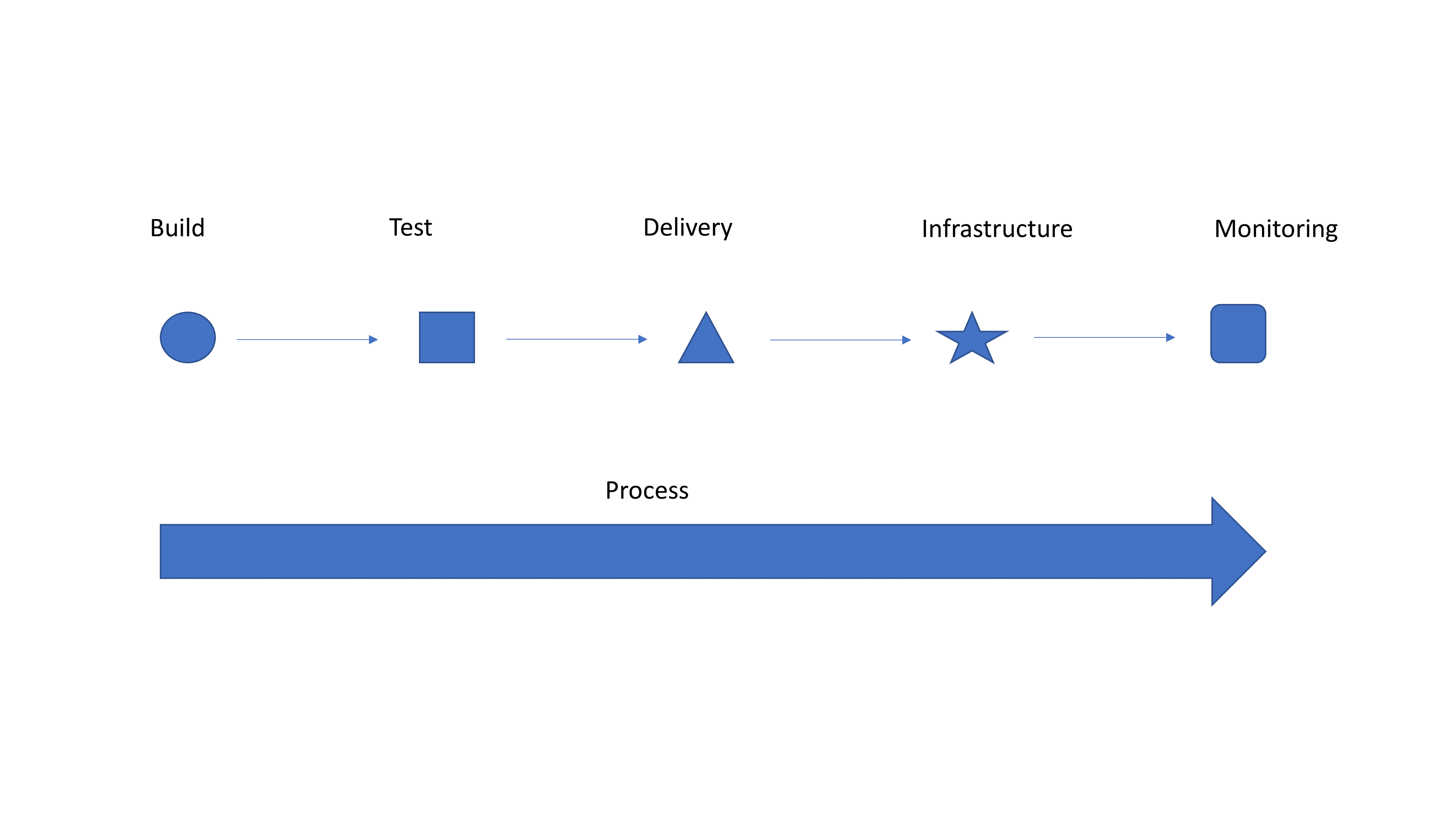
    Simple Graphic for Discussion

    So I’m going to take a second to tell you why it should. If you have integrated tools and teams, kudos! Hopefully you get absolutely nothing out of this blog, and you are enjoying a drink on a beach somewhere while your entire operation is taking care of itself. Everyone else, please read on.

    Look at the generic graphic. Notice how each step on the top is a different shape? That’s because they are individually implemented with limited integration of both people and processes. So you have a tool to submit for testing … Does testing (or monitoring at the end) feed back into your bug tracking system? Does it create tickets to get stuff done? When a container fails, is it simply dropped and a new one spun up to replace it because “they’re just cattle”? If so, does the system take steps to keep the failed container—or at least information about it—alive so troubleshooting can occur? Ignoring failed instances that were replaced and their impact on users was low is exactly how CloudBleed happened a couple years ago.

    Automate first, get the benefits of automation and drive faster delivery. Then take advantage of all that automation and make it into a streamlined process. It’s a massively complex system, even if you deliver everything on a single “platform,” so it will never be perfect. But issues that occur with regularity can be automated also to provide integration between systems. Isolating an instance and sending a notice to the defect tracking system that it is alive but not communicating (because it has been replaced) is something that is relatively easy to script/integrate and offers the ability to find what actually went wrong. Contrasted with just dropping the instance and starting a new one, this process is an order of magnitude better, and with integrated teams, Dev and Ops can work together to resolve whatever caused the instance to go down.

    Strong integration and a smooth pipeline is what technologies such as application release automation are designed to deal with, but most shops see these tools as “unnecessary” overhead. I disagree. Find one you like—there are a million of them—and use it to connect things. It’s just one step, but it is a step to transforming your operational delivery systems from unique snowflakes to part of a collection that works together.

    That’s it. Automate first because the gains are phenomenal, but don’t stop there. Really—don’t. You are doing yourself a disservice if you do. The whole “We’re going to change your world!” crowd is annoying, because changing your world is your decision, but listen to them anyway, and see which of their ideas fit your organization. You’ll be surprised once automation is solidly in place how much of what the process side of DevOps offers makes sense.

    — Don Macvittie

  • DevOps Disillusionment? 4 Behaviors to Get Your Team to the Other Side

    DevOps Disillusionment? 4 Behaviors to Get Your Team to the Other Side

    For most teams, the adoption of DevOps and an agile mindset involves many twists and turns on the path to maturity. It’s not uncommon for teams to experience a “trough of disillusionment” period as:

    • Initial euphoria and “us-against-the-world” team mentality ushered in by adoption of new work patterns wanes with time.
    • Client demands and pressures to produce intensify.
    • Sustained leadership engagement and support fails to materialize.
    • Key evangelists move on to new roles.
    • Apologists for organizational status quo never tire.

    And before you know it, what once felt like a cultural movement seems mired in the realities of metrics, tools and keeping the operational wheels on.

    Pushing through these challenges and self-doubt is a critical step in DevOps maturity that can refine and strengthen a team’s character. Getting to the other side of “the trough” requires a team and its leaders to reconnect with why they embarked on the DevOps journey in the first place, and remind themselves that a lasting shift in behaviors is the ultimate goal. Where behaviors change, results follow.

    What are these behaviors? With so much written by thought leaders in the DevOps community, teams have the luxury of expressing the behaviors they intend to model in a way that resonates with their situation. Ultimately four actions, practiced faithfully, will build the team muscle memory necessary to get to the other side.

    Choose Wisely

    Overcoming the urge to please others and having the courage to say “no” to work that is unlikely to add customer value is perhaps the most important behavior of all. Doing it in a way that preserves credibility and trust is a skill that can only be learned through deeply understanding who your customers are and what problems they are trying to solve. Choose wisely and prioritize ruthlessly. Flawless IT delivery of unnecessary features is a shared failure for both customer and DevOps team alike.

    Commit Boldly

    Go “all in” on the work you choose to take on. Ensure that the desired outcomes and acceptance criteria of your work are clear before committing, and rely on those closest to delivery to determine how to get it done. Once established, game on! Commit boldly to small deliveries that add customer value and invite accountability for what you take on—knowing that customer satisfaction is the ultimate measure of your success.

    Adapt Quickly

    Sometimes, we fail. In big and small ways teams employing DevOps don’t always meet their own expectations or those of their customers. Our failures don’t define us; how we respond to them does. Learn. Adapt. Move on. Welcome the changes to requirements you know will come and adapt quickly by leaning in to the power of small and frequent deliveries to place you back on track quickly.

    Share Freely

    Teams employing DevOps are part of a larger community of like-minded individuals committed to delivering customer value quickly and making their organizations better. Take your obligations to continuous improvement seriously, share best practices freely and solicit expertise to help improve the pace and quality of your delivery and those around you. Helping others succeed has the remarkable effect of making yourself better in the process!

    — Chad Sands

  • Revolutionize Software Delivery with DevOps and AWS

    Revolutionize Software Delivery with DevOps and AWS

    Technology is constantly evolving—every time we think we’ve got a complete hand-holding experience on some technological aspect, there emerges a better innovation.

    When the DevOps solution emerged, organizations were more than happy to incorporate its principles. But somewhere down the line, there came DevSecOps. Innovation is an upward curve that doesn’t see a decline but rather starts another journey of its own.

    And that is what most DevOps consulting service providers are striving to produce—innovation. Ever thought about getting a cloud service to operate and innovate a DevOps process? Well, that’s exactly what AWS does to innovate the DevOps process and services. Plus there’s more. That’s Innovation + Benefits!

    Benefits the Team ‘DevOps AWS’ Can Offer

    Automate – Automation is vital to the DevOps process and more so with the DevOps processes for cloud instances. It can drastically reduce developers and operators work hours dedicated to creating bug reports, generating scripts for specific functions, performing calculations and testing code. AWS helps automate DevOps approach including software testing, adding innovation, besides accuracy, consistency and repeatability. It’s human to err but it is technology that removes any scope for error.

    Scale – AWS was designed for scaling operations. AWS brings scalability to operations allowing you to do as many things as your businesses require. It facilitates easily availability of resources to fulfill the requirement at hand. The best example of this is handling traffic spikes and downtimes without the need for manual monitoring.

    Collaborate Better – Collaboration is at the very heart of the DevOps process. The unification was essential to make the development process a systematic and organized one. AWS can quickly accelerate this process and make it the way it’s intended to be. It unifies automation and enhanced operations to deliver the promises of DevOps. Gone are the days when different departments would wait on each other for communication; this paves way for improved software delivery.

    Deliver Quality with Performance – DevOps as a working principle and AWS suite of services are individual names of efficiency. So when they come together, it’s a powerful combination of quality, performance and remarkable output. Even before the output is out, developers and operators are rewarded with automated testing, continuous delivery and better infrastructure to work with. The entire process is knitted to facilitate a smooth DevOps process.

    Secure – Just as we discussed earlier, security has definitely become a part of DevOps. With AWS automation and managed cloud computing, it becomes easier to introduce updates and deploy them frequently. In turn, it makes easy to track changes in the code and ensure that security measures are enough and running correctly.

    Some DevOps-AWS combination services that enhance the DevOps process for cloud computing:

    AWS CloudFormation: DevOps-for-cloud professionals need to create and release cloud instances/services faster than general DevOps professionals. AWS CloudFormation increases the pace of creating cloud instances by creating templates of AWS resources such as EC2 instances and ECS containers to let you construct the entire setup without much manual intervention.

    AWS EC2: AWS EC2 brings security and management features to your DevOps process, making it a more the DevOps AWS duo a more desirable combination to work with. It can run containers in EC2 instances.

    AWS CloudWatch: This is an AWS monitoring tool that helps you track every AWS resource. Additionally, it enables DevOps experts to use third-party monitoring tools.

    AWS CodePipeline: This service is a popular AWS feature that eases the management of continuous integration and continuous delivery tools. It allows you to integrate tools such as CodeDeploy, GitHub and Jenkins so that you can visually control the flow of apps from scratch to the end.

    Not a service or tool but the next on the list is more like a functionality feature:

    AWS Instances
    AWS creates and adds new instances to its list. The flexibility to customize along with these instances makes it easy to use AWS DevOps together.

    Conclusion

    If DevOps is a solution, then AWS further enhances that solution to make businesses deliver their best. No wonder our world is being dictated by speed and quality!

    — Veritis

  • Avoid Crashes: 5 Best Practices for Load Testing

    Avoid Crashes: 5 Best Practices for Load Testing

    Demanding customer expectations and the rapid distribution of information across social media have made website and applications crashes an off-limits path for today’s companies and organizations.

    Crashes resulting from traffic spikes cause immediate and long-term loss of sales, as well as tarnishing the brand name. When servers or websites go down during highly anticipated events such as Black Friday, the Big Game or before a major concert, the repercussions can be permanent.

    Yet, avoiding the “website temporarily unavailable” screen is also easier than ever before. By performance testing your website continuously and proactively you can easily detect errors, bottlenecks and bugs, and then fix them to ensure your website handles any amount of traffic.

    Here are five best practices for load testing your website or app:

    Define Your Load Goals

    Before starting your tests, you need to figure out what it is that you need to test.

    This includes the number of concurrent users, traffic patterns and areas that users can visit on your site. For example, if your site has 10,000 users concurrent at its peak, but  3,000 arrive in the morning and that total slowly climbs up to 10,000 in the afternoon—and these visitors mostly just browse your homepage—you’ll need to run a different test than if you have 10,000 concurrent users on your website all day long, constantly browsing multiple pages.

    To determine your load goals, you need to engage directly with your business colleagues. For instance, get your product manager to set the system’s expected abilities, ask the marketing team to inform you about any special campaigns that might increase website traffic, and then look at server logs and tools such as Google Analytics to determine previous customer patterns.

    Choose Your Load Testing Tools

    There are multiple open-source load-testing tools that you can use to run your tests.

    JMeter is the most popular tool, but you can also use Gatling, Locust, Tsung, The Grinder or Selenium. See here to learn more about the differences between these toolsets.

    Does this seem complicated? Taurus is an open-source automation test framework that simplifies running these tools, by using a simple YAML script. If you need to run your tests from the cloud, utilizing rich analytics or requiring user collaboration, you might consider using BlazeMeter.

    Take Your System to the Limit

    To make sure you stand up to your load goals, you need a buffer; specifically, you need to make sure that your system can handle heavier loads.

    This ensures that the CPU stays low and you don’t experience memory leaks. However, we also recommend you take your system to the limit and see when and how it fails. This ensures that you know exactly what your system’s weaknesses are, giving you a better ability to fix any errors that might occur.

    This is especially important if you come across an unexpected traffic spike—say, if your competitor’s website crashes and all their customers come running to you. Wouldn’t you rather be prepared for that?

    Monitor Test Results

    Set aside resources for looking at test results.

    Examine KPIs including Response Time and Hits/s, as well as the correlations between them, to learn what your system’s abilities and bottlenecks are. This information will help you see what needs fixing.

    As you continue testing over time, you will be able to identify KPI trends, which will help you monitor system health. We also recommend you monitor backend KPIs like DB Queries, with APM tools.

    Test Again

    So, you’ve tested, you’ve analyzed, and you’ve fixed.

    Now you have one last thing to do: Run your tests again to make sure everything is working smoothly after the committed changes. That ensures nothing gets overlooked. It would be a shame if all your hard work went down the drain due to a minor oversight.

    Now, let’s get testing!

    To get more load testing tips, check out this free whitepaper, “How to Ensure Your Website or App Won’t Fail at Peak Times.” To learn more about BlazeMeter, request a demo.

    — Noga Cohen

  • DevOps is a Lifeline to Connected Mainframe ROI

    DevOps is a Lifeline to Connected Mainframe ROI

    A new IDC white paper sponsored by IBM and CA Technologies reveals the adoption of DevOps is a hallmark of those organizations that are actively modernizing and integrating legacy systems such as a mainframe to support digital transformation.

    Early adopters are blazing a path for faster innovation and greater ROI.

    DevOps Delivers Mainframe Modernization and Integration

    I’m encouraged to see DevOps recognized as an important element in realizing a “connected mainframe” vision. Respondents demonstrated a continued commitment to modernizing their mainframe environment.

    The IDC study confirmed that leveraging Java on the mainframe was one of the most popular approaches. In fact, I’m constantly surprised at how few managers realize that these days, Java and Git can be used by developers in such a way that allows them to completely separate themselves from the mainframe “green screen” environment when coding or maintaining applications.

    DevOps automation has also helped organizations overcome many of the cultural and operational challenges to a fully end-to-end enterprise by aligning application development tools and orchestration chains across multiple platforms and teams.

    Adopt a Business-First Approach

    Customers I’ve spoken with are experimenting with DevOps for mainframe tools and practices, with many piloting new approaches across the life cycle. They’re immediately becoming more agile, realizing shortened development cycles, improved collaboration between distributed and mainframe teams and faster MTTR that maximizes availability. In all, these early adopters have benefited from increased speed to market, improved business agility and better platform economics.

    The IDC study concurs, identifying more effective delivery of applications and services as a powerful cost-saver, with savings of $58,900 per application achieved through increased developer productivity and day-to-day support efficiencies. By helping mainframe organizations to realize improvements at every stage of the application life cycle—from build through test, deploy and operate—DevOps delivers compelling benefits; for example, from our recent study Accelerating Velocity and Customer Value with Agile and DevOps:

    • Advanced DevOps users reduce the time taken to develop, test and release new applications by 42 percent.
    • Advanced agile users reduce their time to decide and act on new opportunities by 40 percent.
    • Advanced agile users accelerate the time to develop, test and release new apps by 36 percent.1

    Excited? I encourage you to catch up on the full IDC White Paper here.

    — Aline Gerew

  • CD 101 Podcast: The What, How and Future of Continuous Delivery

    CD 101 Podcast: The What, How and Future of Continuous Delivery

    Now that we’ve arrived at Episode 4 of our CD 101 Podcast, let’s address some basic concepts—like the what and how of it all and the future.

    Wait … perhaps we could—or should—have touched on these key topics earlier. Or not. At least not the future part? Anyway …

    While this (mostly) backwards-looking orientation may seem a bit odd, I’d argue that we’re actually navigating the conversation on precisely the correct path. Let’s rewind for a moment to look at where we’ve come from.

    Episode 1: We highlighted many of the fundamentals of this thing called CD, yet we did so from more of a conceptual and best-practices standpoint. While the ideas and processes involved do resonate in the real world, the topics we cover in this episode are bit closer to the water-cooler conversations we’re hearing about CD as it grows in practical adoption.

    In Episode 2: We covered the whole how do you “realize agility” piece of the conversation. This is important and a precursor to some of these other basic questions. The entire process of digital transformation begins with getting agile and you can’t truly adopt continuous delivery without doing so; therefore, this was another good place to feed today’s discussion.

    In Episode 3: We looked at the prospect of re-inventing the “Modern Software Factory” with agile development and continuous delivery. OK, so, perhaps we were getting a bit ahead of the basics here, but I’d maintain that this is an important piece to consider upfront that builds on these other building blocks. As with the topics covered in Episode 2, it is critical to understand the big picture challenges and benefits before you begin to get your hands dirty.

    And now for some nitty gritty.

    In Episode 4, we hear from Shamim Ahmed, CTO of Continuous Delivery Solutions at CA Technologies, as he answers the nine burning questions he most often hears in speaking to enterprise practitioners as they look to employ DevOps and Continuous Delivery practices in the real world.

    So, while these previous conversations were material, this is a crucial set of topics to consider as you invoke your own strategy, including:

    1. What is the difference between DevOps and continuous delivery?
    2. What are the key impediments/obstacles to achieving speed/quality in CD?
    3. How do we overcome these obstacles?
    4. How do we get started on the CD journey?
    5. What are the key top-level metrics you want to track in a CD program?
    6. What org changes do we need to make to implement CD?
    7. What the key capabilities we need to implement?
    8. How do we integrate all the different tools we have in our environment?
    9. How will the future of continuous delivery evolve?

    OK, that last part is a bit more postulation on our part—though we like to think on the practical side, based on the answers to all these other important real-world adoption dynamics.

    Tune in and hopefully learn a good deal about where your approach stacks up, and needs to evolve.

    As always, you can find said Episode 4 of the Continuous Delivery 101 Podcast by:

    • Listening to it on your computer on YouTube
    • Downloading it from iTunes store
    • Downloading it via the Podcast App by searching for “Continuous Delivery 101 podcast”

    Enjoy!

    — Scott Edwards

  • DevOps Security: Stop Discussing, Start Implementing

    DevOps Security: Stop Discussing, Start Implementing

    Is it Strong DevOps? DevOps Security? Secure DevOps? DevSecOps? DevSecQAMktSalesOMGBBQOps?

    Who cares?

    Like a ton of people with an interest in information security, I was appalled when I read “The Phoenix Project.” Here was a book that portrayed DevOps, why it was required, how it could help and the benefits very well. But it served security terribly. Worse than terribly. While it did accurately portray the predominant feelings of developers and Operations toward security, it utterly failed to adequately consider the correct usage of DevOps to attain InfoSec goals. Indeed, while it is a light treatment, it certainly comes across as, “Give up on InfoSec and you’ll be happier, healthier and more popular!”

    Clearly it was not a book written by information security staff.

    The Point Is …

    Don’t get me wrong, those who follow me know that I’m a developer that learned operations and has always found himself doing security bits, because no one else was, or because I was teamed with them (as an enterprise architect, our team was EA + Infosec, so we did a lot together). But that abiding interest in InfoSec has made it easy for me to see that the bulk of the problem between Security, Dev and Operations really is communication. An example might be in order.

    When SQL injection first hit the scene in a big way, it came with simple examples and was easy (for a developer) to understand the danger. Nearly immediately, developers had worked up solutions, were sharing them and tools were being developed to scan for injection weaknesses. Things moved very quickly, because developers understood the danger and agreed that it was a big deal.

    Meanwhile, using page data—hidden fields, hard-coded values (like from a list), etc.—pose the same level of risk. Copying the page, modifying those values and submitting the page—or using any of a dozen easy to use tools to mock up the data—makes them equivalent to user input, particularly in cases where they are used directly in queries. Yet even today, many many developers still use them without user-input error checking.

    Why? Because they don’t believe the risk is equivalent. For SQL injection, all a bad actor has to do is hit a vulnerable webpage and enter the right (and, I might add, well-documented) characters to open themselves to free querying of the database—at least one table, possibly much more. They see that as a much greater risk than someone having to modify HTML to get the right field to have the correct data and submit it.

    The fact that both attackers and tools are advanced enough to make the difference negligible doesn’t change the belief unless security convinces developers through education.

    ‘Faster’ has Challenges

    By the same token, both agile and DevOps move fast. They are designed to move fast. Security is more concerned with “protected” than fast, and is designed that way. Security staff (and this is the real source of a lot of burnout) hires on with “Protect Our Systems” as a job title, with the subnote, “But don’t get in the way.” This is a set of core principals that are at odds before the InfoSec person even sits down to interview. Agile and DevOps aggravate this tension, because, “Wait, there is a problem here, give us until tomorrow to get details,” now violates “but don’t get in the way.” “The developers in question have a stand-up coming and really short, really tight deadlines to meet. And InfoSec is interfering—again,” will likely be added to that statement by Dev. The same is true in Ops. Stopping an entire deployment because InfoSec is worried about security of private keys inside the private network violates the “but don’t get in the way” rule.

    But Solutions are Available

    So how can these tensions be brought together to resolve your problems? I’ve got some suggestions (they probably aren’t in the order you would expect, so I’ll explain as I go), but honestly  they are just a starting point. Entire books have been written on these topics, and more are about to be, if the state of the DevOps/InfoSec union is any indication. We can’t even agree what to call it, so we clearly aren’t agreed as to how to achieve it. Take these as what they are—suggestions—and start moving forward with what your org needs to be successful.

    1. Automate all of the things. Yep. Go download the various OWASP security tools, or your other favorite open-source tool, or call up your preferred vendor and get the automation of security checking—from source code analysis to penetration testing—going. Do those tools have weaknesses when compared to manual security evaluation? Most of them, yes. But here’s the thing. There is a quality staffing shortage in both InfoSec and DevOps. It is time to lean a little more on those tools, even contribute to make them better. Because the security checking they can do is better than nothing, and frankly is better than spending limited resources checking by hand. And that is why this step is first on my list. You need those resources. You need them to handle the rest of the steps. Once you have a tool like Jenkins auto-running these tools, and output review being just part of the job, then you can start to consider using those freed up resources more productively, or reporting that you’ve got more testing with DevOps than you had, whichever is true.
    2. Embrace and enhance education. Because of the rate of movement in an agile-plus-DevOps world, this must become a partnership with both Dev and Ops. Focus on helping developers and admins with the why as much as the how. People are more quick to adapt if they understand the reason for doing so. And for InfoSec to keep pace, they will need to adapt quickly.
    3. Look for ways to automate beyond implementing simple tools and reviewing results. The more repetitive work is built into the process, the more InfoSec is available to tackle bigger, less scriptable problem-solving. I’ve been talking a lot with CloudCoreo, for example, and its auditing tools can help InfoSec understand the state of cloud deployments with both alerting and reporting. Infrastructure monitoring tools make a lot of sense in a world of frequent infrastructure changes initiated by both auto-scaling and more frequent deployments.
    4. Shift automation of InfoSec to the DevOps team. Security is normally a relatively small function, and open positions can sit there or bring in people who need training in an organization’s tools and processes. So once automation is in place and reliable, shift responsibility to maintaining it (software updates, etc.) to the DevOps team, because it is a part of the DevOps process. Security can continue to monitor output and validate automated security testing results, but maintaining that piece of the DevOps infrastructure should not be InfoSec’s job.
    5. Rank what’s left that’s manual. Give each an importance. If there is potential impact to the business, ask business people to help you. Then assign work based on severity rankings. We do this stuff with risk management and threat assessment; this is no different, except you have to be willing to drop low-priority things—not to let them slide because you never get to them, but to publicly say, “This is a risk we are willing to take.” Let the team know that they’re not the only ones adapting.

    Will these basic starting steps solve all of InfoSec’s problems and make security never seem to “get in the way”? Of course not. Don’t aim for hanging around the campfire singing “Kumbayah”; aim for working as a team to turn out quality secure compliant code in a more predictable (and if you are an org that needs it, much faster) manner.

    A Rose by Any Other Name

    What, then, we should call it?

    Frankly, I suggest we call it DevOps. We’re not going to add every team that is subsumed into the DevOps umbrella into the name, so just call it DevOps and have a security piece in the process.

    Because it really doesn’t matter what you call it—it matters that it is compliant and protected.

    — Don Macvittie