Tag: devops process

  • Q&A with Gene Kim: Bringing the auditors to DevOps

    Q&A with Gene Kim: Bringing the auditors to DevOps

    As more enterprises embrace DevOps, organizational disconnects often are created between what controls DevOps teams have in place and what IT controls auditors believe need to be in place. And if the right controls are, in fact, in place they absolutely need to be communicated to the auditing teams. Bridging these gaps is often painful for both IT teams and the auditors.

    Helping enterprises to better understand what auditors need from them to do their work is the top-line goal of the DevOps Audit Defense Toolkit, the aim of which is to “define the authoritative guidance of how management and auditors should conduct audits where DevOps practices are in place,” according to the homepage for the effort. “By doing this, the DevOps Audit Defense Toolkit will elevate the state of the management practice, defining how to understand risks to business objectives, correctly scope and substantiate the of effectiveness of controls, which reduces the costs of audits and increases effectiveness of audits.”

    The review draft of the DevOps Audit Defense Toolkit was release earlier this month for review and comment. The authors, James DeLuccia, Jeff Gallimore, Gene Kim, and Byron Miller, expect the final version to be available in coming months.

    To get a deeper understanding of the Toolkit, we grabbed a few minutes of time with Gene Kim, author of The Phoenix Project.

    Why do you think something like the DevOps Audit Defense Toolkit is necessary?
    I think at its heart DevOps is transformative. It’s the way to increase the flow of work through the DevOps value stream. DevOps increases reliability, stability, and security. And it also helps the organization win in the marketplace.

    Yet, when organizations actually embark upon this journey, probably the number one obstacle they encounter is that their “compliance guys will never let us do this.”

    I think there’s some truth to this. Because of so much that’s being proposed when you embark upon the DevOps journey, you actually take away some of the key controls that traditional IT organizations have used – like separation of duty, like change approval processes.

    So when they hear, “Hey, I’m going to be letting our developers deploys whenever they want, without necessarily getting a change approval order from the change advisory board,” auditors, compliance managers, and security people often freak out.

    And you have first-hand experience of seeing this in action, right?
    It’s why I think it’s a very important effort. The more I talk to people, the more I hear about the friction between the audit teams and audit groups in organizations trying to move this way.

    How do you see the DevOps Audit Defense Toolkit achieving this?

    The DevOps Audit Defense Toolkit was designed to train. Since we can’t bring DevOps to the auditors, we must bring auditors to DevOps. What I mean is the goal is to train practitioners in DevOps how to think like an auditor and actually walk through what an auditor will do when examining a process and systems. That’s starting from the very highest level of the top-down risk assessment into the details, just as an auditor would go through the list asking what can go wrong.

    The DevOps Audit Defense Toolkit shows how an enterprise has the environment that can prevent bad things from happening, and if we can’t prevent it, we can detect and correct for it. Then, it shows how we evidenced it. I think by doing all of that, one is doing exactly what the best auditors who examine DevOps organizations do themselves.

    By training people in in the DevOps organization to think like auditors, we can actually bring the auditors along, show our work, connect the dots, and hopefully have the auditor become DevOps’ best friend along the way.

    So, this is training IT how to think like an auditor and view the systems and processes the way that auditor would?

    In many ways, yes. This is kind of a structured thinking process that any world-class auditor would do to actually create an audit plan and then audit fieldwork.

    The toolkit asks questions like: Why is this being audited? Describe the environment Walk through the process of how code moves to production, and where the development environment comes from. It also asks: How do you prevent developers from introducing backdoor code into production; how do we ensure that untended code doesn’t make it into production?

    I’ve learned a lot just working with the other team members, in terms of showing how we have a basis to say that we know what we’re doing, and that we’re really thinking through how to have an effective control environment.

    That takes it from sort of the high-level platitudes and claims down to well, no, really, this is how we enforce peer reviews of code. We ensure that all deploys are put into the build systems. We run all the automated tests. Every time someone commits code, we run all the security tests before it can ever get into the staging environment. We can confirm that what’s deployed actually passed all the tests.

    We communicate most effectively when we write down and show our work. And we’re exposing all that is required for an auditor to be able to look at it and say, “You know what? This is actually better than my best auditors would’ve done in the field, and you know what you’re doing.”

    I would imagine that simply learning the language of auditors and how they speak is very valuable itself.

    Yes, we’re now using a language that auditors use among themselves. Even just exposing what that language looks like, I think, is helpful to connect our own dots to be able to say, “Oh, I know why it’s being phrased this way. Tons of value, just by providing that.

    Did you learn anything along the way as you created the DevOps Audit Defense Toolkit that surprised you?
    It’s funny how much I learned by working on this. You would think the person who co-wrote the Phoenix Project would know what this would look like? But I learned quite a bit when I was looking at what were the actual business flows, and where that regulated data could reside, and what specifically are the applications in-scope for the compliance domains.

    The second thing was going through the management risk analysis – to walk through the structured thinking process and look at how a company is really doing the diligence that is required, deciding what are its top business risks and if it really has a control environment that can prevent, detect, and correct.

    Of course, we all know that DevOps makes everything better, but we need to know why and how to prove it, By what standards are you holding developers accountable? You talk about peer reviewing, but where is that documented? What is the standard? How is it enforced?

    You want to be in compliance, and that’s important. But you also don’t want people to insert backdoors. You don’t want systems to crash when changes are deployed. So you really need to name all the dots, connect them, and then have that processed challenged. I have learned so much in this project.

  • DevOps developers; don’t be a DevGoof

    DevOps developers; don’t be a DevGoof

    There was a lot of brush back last week over Jeff Knupp’s post about how DevOps is killing the developer. Frankly I wasn’t shocked by Knupp’s opinion that developers “are the dentists in the dental office”. In my 30+ years of involvement in the IT industry my experience is that developers often think of themselves as the only smart person in the room. Often times that is the reason they are are the only person in the room, lol. The fact is many developers relate better to code than to people. For me all this talk about DevOps killing the developer is akin to saying power steering killed the driver. Just because you can do more with new technology, does not mean one dies, one just has to pivot and in this case become business social.

    Now the sociable part may be the problem. Sometimes I feel that DevOps is trying to create a love fest between Ops, Developers, QA, security and the rest of the IT stack. While they may not have to love each other, I do think they all need to be nice to each other as opposed to ignoring  or just going around each other, as was all too often done in the past. A common scenario I have seen for example is for developers to rollover Ops by stating this is mission critical for the business. These tactics will no longer work to let developers have their way.

    Developers need to realize they need to become a normal part of the business social structure. They will be required to talk and work with people, not throw tantrums when they don’t get their way. Left unchecked, certain developer personality types can sabotage your project, or worse, make themselves no fun to work with.  I am sure we have all met and unfortunately had to work with people like that. In my career, I’ve encountered virtually every personality type. In fact, I’ve also knowingly hired all of them. They know who they are; they are the developer that if challenged or worse accurately taken to task for lack of being part of the team; quit cause they can’t manage the confrontation, thus interpersonal stress. In the old days they would not come out of their house for weeks continually playing Leisure Suit Larry, if your not familiar with it Google it

    I remember one of my good friends telling me this story that sums this whole developer persona issue perfectly. This company, we will call DevGoof, was a well funded start up. Every quarter they held a meeting with all the employees to let them know how the company was doing. Most employees had some kind of equity play in the company, so everyone was incented and theoretically interested in company performance. Several quarterly meetings came and went and not one developer showed up. Eventually DevGoof management got concerned and called a mandatory meeting for all developers’.

    DevGoof management put out some pastries, juice and coffee for the brain trust. Then proceeded to tell them why these meetings were important to them and their fellow employees. Notably pointing out how it is not just about them but also about the rest of the DevGoof team. This meeting went on for about one hour and not one developer asked a question. So eventually this meeting was over and everyone went back to developing. The next morning,   about 50% of the developers quit and some in a not so professional fashion.

    The moral of this blog is the DevOps is going to force the development community to become more interpersonal within the business environment. This will lead to personal success within the new world of DevOps. The DevOps Developer/Engineer that can demonstrate leadership and compassion for team will be the one leading the DevOps way within the organization. Don’t be a Devgoof!

    If you would like say something; email parker@devops.com and don’t forget to comment here.

  • DevOps killed the developer star

    DevOps killed the developer star

    The DevOps blogosphere is aflame over Jeff Knupp’s post on “How DevOps is killing the Developer”. While I agree with Knupp’s premise that DevOps, Agile and other technology trends are allowing (is forcing more accurate?) developers to do more outside of pure development, even turning into “full stack” developers, I disagree that this is a bad thing.

    I disagree with Knupp’s assertion that developers are the Orcas of the IT world sitting atop the food chain as the top dogs.  I think Knupp consciously or not, degraded the very real, important and hard job that ops people perform, DBAs do every day, as well as everyone else at an organization. Reading this I was reminded on one time I was sitting in an executive meeting and the VP of engineering actually had the stones to say that his developers were smarter than the rest of the people in the organization and worked harder to boot.  Now that is a real team builder right there.

    One thing I have learned in 30 years of business is that when an organization is achieving its goals it is because just about everyone is working as hard as they can. It is usually not one group, whether it be developers or marketing or operations that is pulling the sled alone.  It takes everyone to really succeed. There is no top of the totem pole or rather who is on top is a constantly changing position as bottlenecks come and go, priorities shift and the market changes.

    In any organization whether it be startup or enterprise, we all have to do what we need to do to accomplish the mission.  There you have it.  Working in the Federal market all of those years taught me something. In the DoD and armed forces it is all about the mission. We have missions as individuals. Those missions can be writing code, deploying or monitoring (heck even support and sales), but ultimately those missions all fold into the greater mission of the organization.  If developers doing full stack work helps the organization better accomplish its mission and goals, than it is good. No man is too big for the army.

    At its core that is what DevOps is too don’t forget. Empowering IT to better serve and meet the organizations goals. Not about letting developers do what they love to do or what floats their boat or what they consider the “top of the totem pole”.  Enterprises are here for one thing, the bottom line. It is something we should all never lose sight of.

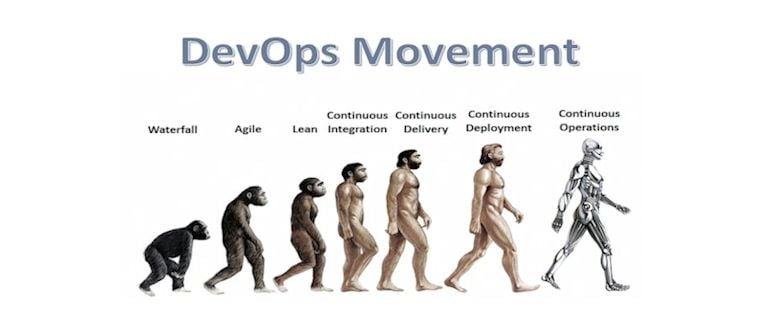
    DevOps is changing the mission of developers. It is a change in the environment if you will. Species are faced with changing environments all of the time.  Those that adapt to change succeed and even flourish. Those that fail to adapt fall into the extinction bin.  Generally species that are generalists adapt and thrive much better than species that are too specialized. This is basic evolution theory.

    I think to Mr. Knupp’s point we are going to see a form of DevOps Darwinism play out. Developers who insist they only develop and don’t do full stack or other DevOps type of tasks will find shrinking habitats and less opportunity. They will exist on the margins. Developers who embrace this new environment will find abundant “target rich” environments with rewarding (both monetarily and stimulating) career opportunities.

    I am all for doing something you love for your work. Otherwise I would be practicing law somewhere. I stared working in the technology world because playing with computers was the most fun I was having. I am sure many of you had the same experience. Messing around with code or scripting moved from fun and something you did because you liked it to something you also do to earn a living.

    Earning your livelihood doing something you love is a great blessing by the way. There are untold numbers of people who trudge off to work every day and have to do something they dislike, are not passionate about and do just for a paycheck. I can’t imagine having to live life like that.

    I think that is what Knupp is talking about too. That developers code because they love to, they need to, and it is what they do. Forcing them to do other tasks takes away from their focus and stunts their growth, which in turns comes back to hurt the organization as a whole.

    I don’t think developers will ever stop coding. Mr. Knupp is right, developers code because they want to. That is what they love to do and it is why they became developers.  I think however they will have even more opportunity to code, not less as software continues to gobble up the world. It may be a different kind of development, with coding as infrastructure as software dominates, but developers are still going to code no matter what.

    We may be seeing the rise of the coding generalist versus the pure application developer as the lines between developer, ops, QA and yes even security continue to blur and overlap. But I don’t think it is a bad thing for developers, enterprises or anyone else. It is just part of the constant change in our environment.

    I don’t think this change is bad at all. In fact to paraphrase the great Gordon Gekko, “Change is good, change is what made America great.”

  • Services As A Model For DevOps Communications

    Services As A Model For DevOps Communications

    DevOps is an interesting movement. As with any effort of this magnitude, there will be many opinions on what is entailed in adoption and implementation. The issue is that businesses are so diverse and varied in culture that no single method for adoption is guaranteed to fit all businesses. In large IT organizations, this issue is additionally hampered by the fact that multiple cultures and dominions exist.

    Thus, I am not a believer that DevOps adoption comes from the approach that the business commits to adopting DevOps. The business has committed to many initiatives over time that have not panned out. This is not necessarily failure, but perhaps just shifting priorities, shifting political landscape, lack of training or simply a lack of desire to change. “The best laid plans of mice and men ….” and all.

    If commitment is not hampered by people, then there’s a good chance that DevOps adoption may be hampered by silos. This does not make silos our enemy. Silos help to compartmentalize and provide focus. Still, silos limit the ability to orchestrate process without involvement and participation from each of the silos.

    Regardless of the reason, the challenge stands, how to align a process without the use of force. The answer is protocol. With protocol, an individual or group does not need to buy into the entire process, but just needs to understand their role. Short of incompetence or insubordination, or even both, which will eventually result in the removal of these particular types of hurdles, following protocol ensures that every role in an activity will complete their action and, thereby, facilitate the whole with roughly an 80% success rate.

    I posit that the service is the means for defining protocol and of communicating that protocol into an IT organization, such that DevOps is the natural activity and outcome. A proper service entails defining a number attributes, for example:

    • Metered
    • Valued (priced)
    • Advertised / Catalogued
    • Governed
    • Monitored
    • Supported
    • Documented
    • Quality
    • Available
    • Intuitive

    It is up to each area of IT participating in the DevOps process—Design, Develop, Test, Stage, Deploy, Operate—to contribute to defining and providing their completed artifacts that pertain to formulation of the service. The service will guide the development in the understanding of operational characteristics and will allow operations to ensure they can deliver and support the service to the level of expectations of the consumer. Moreover, in those cases where the service is not meeting appropriate levels, it will allow them to provide development with the appropriate data and metrics to take corrective action, thus leading to fewer and shorter outages and failures.

  • A Critical First Step in Bringing Dev and Ops Together

    A Critical First Step in Bringing Dev and Ops Together

    We all want to deliver excellent software to our customers. We now have a greater awareness than ever before of the interconnectedness of all the activities required to do so. The agile movement started this but it was not until the advent of DevOps that Ops was considered part of the full picture. In this article I will explain an effective first step that agile organizations can take to complete the picture and bring ops more completely into the product development process.

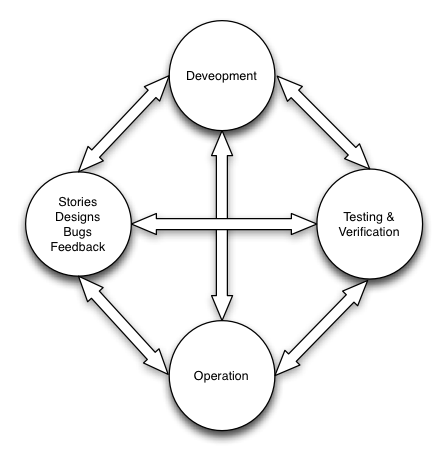
    Delivering excellent software starts with product definition and flows from those initial stories and designs, into dev, verification and testing, into production and then back again in the form of customer feedback and bugs. In reality the feedback paths represent a transitive closure of all activities just mentioned as you can see in the diagram below. Agile recognized the importance of feedback loops in good product development. Agile also realized that for the right information to flow, walls had to be broken down. The motto “Done means tested” arose and indicated that product owners were not done with a story, could not consider it closed, until it had been tested and they had verified it. This represented the integration of PM, development and QA functions. A huge step, but one step too short. Operations was still not viewed as a key part of building excellent software and there was not much insight into the fact that the feedback loop did not stop at testing. DevOps has recognized this shortfall and taken it to its logical conclusion – “Done means in production.”

    Operational Excellence Feedback Loop

    Product development is a cycle, a cycle that operations is a critical part of. In describing how all parts of the cycle can be integrated lets start at the most natural beginning; product definition. Product definition activities produce stories, designs, functional acceptance criteria (A.C.) and prioritization. In this phase we don’t produce all we need for the finished product but just enough to get us going. With popular agile methodologies like Scrum this is ideally not done solely by a product owner but instead in conjunction with dev and test at story grooming meetings, design reviews and sprint planning. In these meetings dev, QA and product communicate and negotiate stories, comment on designs, and flesh out acceptance criteria. In this way the stories, designs and acceptance criteria are improved and everyone gains an understanding of what is being built; they also become invested in it. A story may look something like this (abbreviated):

    Story: Blog administrator can change user roles SO THAT users can be managed effectively

    A.C: Given blog administrator is logged in
    And on a user profile
    When he selects a permission scheme from a permissions drop-down menu
    Then the users permissions are updated and stored in the DB

    This is a great start but it is not enough. If we are to be excellent we must modernize this just a bit and add in some DevOps spice.

    A first step towards bringing ops effectively into the cycle is to include someone responsible for actually operating the software in the story and acceptance criteria grooming sessions, design reviews, and sprint planning meetings. The critical aspect is that when the team negotiates the acceptance criteria associated with a story it will be ops responsibility to ensure we for each story or feature the team adds success and failure metrics, initial alarm values and any operational functionality such as a kill switch that will be needed in order to operate the functionality effectively. So a story will now contain things like the following in the A.C. (acceptance criteria).

    Given operation X fails
    Then the metric operation-x:failed will be sent through the metrics feed

    We will also alter our definition of done to make sure that a story will not be closed until we meet the ops driven acceptance criteria. For example: we can see the metrics we have defined in our A.C. show up on an ops dashboard. There are so many benefits to this such as folks that are unlucky enough to be on on-call will have participated in this story grooming and will know exactly what these metrics mean when they encounter an issue with them for the first time in production. Furthermore, they will know what operational levers they can pull or request to be pulled.

    This first step represents a connection from product definition to dev, to QA, to operations. This connection is perfectly natural and intuitive when you think about it. Being a true DevOps organization and developing operationally excellent products requires more but having connected product definition to operations as we have provides a nice toe hold from which to flesh things out further. Best of luck. If you have any questions leave them as comments and I will respond as best I can.

  • Why you can’t buy DevOps in a box

    Why you can’t buy DevOps in a box

    Companies will often believe they can buy their way out of technical debt without making any substantial changes. They often think they can buy DevOps in a box. Well, unfortunately, devops isn’t for sale. For an organization to embrace DevOps it will need to adopt cultural change, adopt tools which enable automation, and change processes to include both dev and ops. I like to think DevOps can be explained simply as operations working together with engineers to get things done faster in an automated and repeatable way.

    Culture

    Organizations large and small have experienced these changes, the challenges encountered along the way, and the light at the end of the tunnel. Each organization requires their own set of tools and processes to embrace DevOps. Cultural change largely depends on the existing dynamic of an organization. In small companies, I have found it needs to come from the ground up and usually starts with adding the DevOps toolchain. In large organizations the value of DevOps needs to be sold to the executive team and then enforced from the top down. This is a daunting challenge for most large companies because it’s hard to quantify the value of DevOps.

    Most organizations only quantify failure when it comes to IT outages. How many outages? For how long and how severe? They often don’t quantify the success from 100% uptime or the resilience of failing over with zero down time. The ability to instrument and prove to an organization the value of applying DevOps is a crucial step to making it happen. DevOps teams efficiently deploy features faster with far less bugs. Also, when outages happen they respond faster minimizing the business impact.

    From developer to operations – one and the same?

    As a developer I have always dabbled lightly in operations. I always wanted to focus on making my code great and let an operations team worry about setting up the production infrastructure. It used to be easy! I could just ftp my files to production, and voila! My app was live and it was time for a beer. Real applications are much more complex. As I evolved my skillset I started to do more and expand my operations knowledge.

    Tools

    During the development phase, the operations staff normally makes sure the development environment is managed and they actively work to set up the test, QA, and Prod environments. This can take a lot of time if automation tools aren’t used. Here are some tools you can use to automate server build and configuration. In another post I will dive through the pros and cons of each tool, but as long as you apply some form of configuration management and treat your infrastructure as code you will be on the right track.

    Process

    From an operational perspective, my first instinct is to understand the application architecture so I can start thinking about the proper deployment model for the infrastructure components. Here are some of my operational questions and considerations for this stage:

    • Are we using a public or private cloud?

    • What is the lead time for spinning up each component and ensuring they comply with my company’s regulations?

    • When do I need to provide a development environment to my dev team, or will they handle it themselves?

    • Does this application perform functions other applications or services can already handle?

    Operations should have high-level visibility into the application and service portfolio. From a development perspective, my first milestone is to make sure the ops team fully understands the application and what it takes to deploy it to a pre-production environment. This is where we the developers sync with the product and ops team and make sure we are aligned.

    Planning for the ops team:

    • What tools will we use for deployment and configuration management?

    • How will we automate the deployment process and does the ops team understand the manual steps?

    • How will we integrate our builds with our continuous integration server?

    • How will we automate the provisioning of new environments?

    • Capacity Planning – Do we know the expected production load?

    Once developers have built unit and functional tests we need to ensure the tests are running after every commit and don’t allow regressions in our promoted environments. In theory, developers should do this before they commit any code, but often times problems don’t show up until you have production traffic running under production infrastructure. The goal of this step is really to simulate everything that can go wrong and find out what happens and how to remediate.

    Combining the power of developers and operations

    The focus on the developer/operations collaboration enables a new approach to managing the complexity of real world operations. I believe the operations complexity breaks down into a few main categories: infrastructure automation, configuration management, deployment automation, log management, performance management, and monitoring.

    In my next post I will walk through each one of these complexities and address how you can get your organization inline.