Tag: continuous integration

  • The Missing Link in Continuous DevOps Cycles

    The Missing Link in Continuous DevOps Cycles

    Delivering software quickly, reliably and safely is at the heart of technology transformation and organizational performance regardless of industry. As part of overall technology transformation, many companies are recognizing the benefits of applying DevOps methodologies to areas outside of software development, such as general product development, IT expansion and scaling and new business processes. However, some organizations—and even software development teams—may be missing a crucial step in the product development life cycle. 

    The Missing DevOps Link

    DevOps methodologies are nothing new. In fact, part of the reason organizations are adopting DevOps practices for initiatives outside of software development is because of its tested and proven success when it comes to developing and deploying new processes and features. The exact steps involved in DevOps processes can be debated by reasonable people, but there are three generally agreed-upon factors involved: Continuous integration (CI), continuous deployment (CD) and continuous release (CR). 

    Continuous Integration

    CI refers to a strategy of constantly updating products with new features and code on a regular basis. The cadence of the updates varies from weekly to monthly, but the strategy remains the same: Detect problems early before they can snowball and impact further development down the line. 

    Continuous Delivery

    CD is related to continuous integration but is focused on the delivery stage. CD is executed when new features and development updates are deployed to production. The most critical factor of CD is consistent management of the product’s end environment. To maintain the consistent functionality of a product in the end-user environment, it must be regularly deployed and tested to ensure performance doesn’t suffer as a result of product updates and new features.

    Continuous Release

    CR is the final step before the product development life cycle starts over again. CR refers to the practice of continually releasing new product updates, features and capabilities to end users. The tricky part of CR is that you must execute CI and CD flawlessly to ensure the end user doesn’t experience any bugs or issues caused by an update. 

    But what’s missing? The answer lies in continuous exploration (CE). 

    Why CE is Critical to Product Development Success

    CI, CD and CR are often-discussed product development strategies, but they don’t tell organizations where to start with the DevOps life cycle. To begin developing new products or features, organizations must first identify what exactly they’re building and for whom. As I often say to my product team, you need to get the kitchen ready before you can cook a great meal, but you need to know what meal you’re making before you start cooking the wrong thing.

    CE refers to the continuous exploration of a company’s markets, target audiences and customers to understand their requirements and preferences. This may sound like the job of a marketing department, not product developers, but the two should work together in a coordinated fashion that helps to achieve both teams’ goals. For example, product development teams don’t know what new product features their customers love, which ones they hate or which ones they really need. On the other hand, marketing teams don’t know how to market products if they don’t understand the ins and outs of the new features and how they can be of service to customers. 

    Even departments within an organization that don’t develop products can benefit from CE. For example, if an organization is pursuing a cloud migration of on-premises software, they will likely hire an expert consultant or vendor to help them execute their cloud vision rather than developing their own cloud environment.

    However, simply moving all of the on-premises systems and data to the cloud at once could be a catastrophe. What if you migrate systems and processes to the cloud and they suddenly stop working? Unless you’ve performed the migration at a gradual pace by following CI, CD, CR and CE strategies, you don’t know what, specifically, is causing the system error in the cloud.

    In the same vein, by performing CE internally, organizations can determine which processes and on-premises systems would benefit most from cloud capabilities and execute the migration accordingly. This not only prioritizes technology transformation initiatives based on the needs of the business but may also let the business know which on-premises systems may no longer be needed in a cloud environment.

    Many organizations interested in improving customer experience (CX) and internal processes by leveraging DevOps strategies would benefit greatly from leveraging CE. Products and businesses processes should be designed to meet the needs of customers and drive bottom-line revenue. So, it stands to reason that the first step in meeting the needs of customers is understanding those needs. This cannot be done without CE as the foundational building block of product development life cycles. 

  • CircleCI Report: Pipeline Optimization Best Practices

    CircleCI Report: Pipeline Optimization Best Practices

    CircleCI today published a report that found most successful software engineering teams have average workflow durations of five to 10 minutes, with any failed run being fixed or reverted in under an hour.

    The report was based on two years of data gathered from more than a quarter-billion workflows and collected from nearly 50,000 organizations using its continuous integration/continuous delivery (CI/CD) platform. The CircleCI 2022 State of Software Delivery Report also found those teams have success rates that are above 90% for the default branch of their application and deploy at least more than once per day.

    Mike Stahnke, vice president of platform for CircleCI, said the report also makes it clear there is no correlation between team size and the level of DevOps success achieved.

    Organizations that focus on optimizing pipelines are also better able to integrate testing within their DevOps workflows, he noted.

    In general, Stahnke said more DevOps teams are relying on cloud-based CI/CD platforms versus opting to deploy and maintain infrastructure themselves. That shift also lowers the barrier to entry for organizations looking to embrace DevOps best practices to accelerate application development, he added.

    Less clear is the degree to which organizations have embraced both CD and CI. While many developers routinely employ CI to accelerate application development, CD has proven to be a more elusive goal. Each platform a DevOps team supports tends to have unique attributes that require them to rely on manual processes to deploy applications. However, as DevOps processes continue to mature, Stahnke said the CI and CD integration will become more seamless. In fact, as the number of applications that organizations build simultaneously increases, the pressure to automate CD will also rise.

    However, it remains to be seen to what percentage of organizations will opt for a tightly integrated CI/CD platform versus separate CI platforms for developers and CD platforms for IT operations teams that are more loosely coupled.

    In the meantime, organizations of all sizes are clearly more focused than ever on developer productivity. In the wake of the downturn brought on by the COVID-19 pandemic, there was a rush to launch a range of digital business transformation initiatives. The issue that many organizations are now encountering is they need to find ways to enable a finite number of developers to simultaneously build and deploy multiple applications with multiple interdependencies. Many organizations are trying to address that challenge by sharing best practices across DevOps teams that have varying levels of maturity. Few organizations have a set of standardized DevOps practices that are consistently employed across every application development team within an enterprise.

    It will be up to each organization to decide whether to compare their level of DevOps expertise to other organizations. Each application development team faces a unique set of challenges. The most important goal is simply to continuously improve at a time when demand for custom applications has never been greater.

  • CircleCI Acquires Ponicode to Gain AI Testing Tool

    CircleCI Acquires Ponicode to Gain AI Testing Tool

    CircleCI today revealed it has acquired Ponicode to gain control over a unit testing platform infused with artificial intelligence (AI) that makes it simpler to review application code prior to uploading it into a build. Financial terms of the deal were not disclosed.

    Jean-Philippe (JP) Leblanc, senior vice president of engineering at CircleCI, said the goal is to integrate Ponicode’s testing technology within CircleCI’s continuous integration/continuous delivery (CI/CD) platform. That approach will make it possible to apply algorithms to individual developers’ code as well as to code aggregated from multiple developers within a build as it is continuously updated across a DevOps workflow, he added.

    Ponicode was initially launched in June 2020 as a JavaScript unit testing extension for Microsoft VS Code. Since then, the company has started to support TypeScript, Java and Python, including complex functions such as variable mocking and infer suggestions of complex structures for nested objects.

    The issue that DevOps teams frequently encounter is that even when individual developers test their code prior to uploading into a build, integrating different developers’ code can still result in an application failure. The Ponicode AI testing tools will give both developers and IT operations teams more confidence in the quality of the code being employed to drive applications, noted Leblanc.

    Although not many developers want to admit it, Leblanc noted there is still a lot of sloppy code finding its way into applications.

    In addition, Leblanc said the Ponicode acquisition will help the code review process become more efficient. Instead of requiring another developer or dedicated tester to review code, he said most issues will be surfaced by the AI testing tool that provides the equivalent of a built-in peer review. As a result, AI testing tools will improve the overall quality of the code being used to drive applications, added Leblanc. Developers will also be able to spend more time on the business logic that drives their application than on code reviews.

    The goal, however, is not to eliminate the need for dedicated testing teams as much as it is to augment them and the developers they work with, said Leblanc.

    It’s not clear to what degree responsibility for testing code is shifting left toward developers. However, many developers would prefer to have issues surfaced via an AI tool so they could address issues on their own rather than having them discovered by someone else. In fact, there are already more than 20,000 users of the Ponicode AI tool that plugs directly into developers’ integrated development environment (IDE), said Leblanc.

    In general, there’s never been a greater focus on developer productivity. Organizations are attempting to simultaneously build and deploy more applications than ever—thanks mainly to digital business transformation initiatives launched in the wake of the COVID-19 pandemic. The challenge they face is recruiting and retaining developers. As a result, organizations are looking for ways to increase developer efficiency by eliminating as many manual processes as possible.

  • CircleCI Adds Free Unlimited Access Tier to CI/CD Service

    CircleCI Adds Free Unlimited Access Tier to CI/CD Service

    CircleCI has added a free unlimited access tier to its continuous integration/continuous delivery (CI/CD) platform.

    Jim Rose, CircleCI CEO, said in contrast to other ‘freemium’ offerings, CircleCI’s free tier provides developers and DevOps teams with frictionless access to all the premium capabilities of the platform. Those capabilities include up to 6,000 build minutes per month, unlimited users, the ability to fine-tune pipelines using caching, concurrency, test splitting, security tools and health metrics.

    CircleCI claims more than 200,000 teams now employ its CI/CD platform. The freemium tier is intended to make it easier for a DevOps team to take advantage of a CI/CD platform as they begin an application development project, noted Rose. As that project evolves and matures, many of those teams will eventually require commercial support and other services provided by CircleCI, he added.

    The free tier of the CircleCI cloud service comes as many organizations attempt to accelerate the rate at which they can build and deploy applications. Digital business transformation initiatives, in particular, have become a much higher priority in the wake of the COVID-19 pandemic. A free tier of a CI/CD service is likely to encourage more experimentation simply because it reduces the level of overhead associated with setting up an application development environment.

    As the number of applications being developed continues to steadily increase, competition among CI/CD platform providers is becoming more intense as the number of organizations adopting DevOps best practices to accelerate application development increases. At the same time, more DevOps teams than ever are relying on cloud services to host CI/CD platforms in the wake of the COVID-19 pandemic.

    It’s still not clear whether DevOps teams will opt to rely on a proprietary platform versus an open source platform. While an open source platform prevents organizations from vendor lock-in, the ease of use of a cloud service may lessen those concerns as the cost of switching from one cloud service to another declines.

    One way or another, usage of CI/CD platforms will increase sharply in 2022. It’s not uncommon for different DevOps teams within the same organization to employ different CI/CD platforms despite efforts to encourage standardization. In the name of productivity, DevOps teams tend to exercise a fair amount of autonomy within many organizations.

    The biggest challenge, of course, will not necessarily be building applications but deploying them. Despite the availability of CI/CD platforms, the processes that most organizations rely on to deploy an application are still largely manual. In the age of the cloud, however, it should become easier to automate application delivery thanks to the APIs cloud service providers expose. In fact, 2022 may be the year that DevOps teams finally master CD. Providers of CI/CD platforms, of course, have a vested interest in making sure the full promise of an integrated CI/CD platform finally becomes an everyday DevOps reality.

  • Harness CD Platform Now Available via Source-Available License

    Harness CD Platform Now Available via Source-Available License

    Harness today announced a free community edition of its continuous delivery (CD) platform is now available under a source-available license rather than a more traditional open source license.

    Scott Sanchez, chief marketing officer for Harness, said the goal is to make CD as accessible to developers and DevOps teams as their current CI platform. Harness already makes an open source edition of its continuous integration (CI) platform available.

    The Harness CD platform is available under a Polyform Shield license that provides free access to the platform, including the right to use, modify and distribute it but not launch a competitive offering. A source-available license is an alternative to an open source license that allows an organization to potentially create a fork of the Harness CD that could, for example, be delivered as a cloud service. That specific issue has led to scenarios where vendors that create an open source project find themselves competing for revenue against a cloud service provider that is not necessarily as committed to contributing and maintaining the primary open source project. At this juncture, it’s not clear how many other vendors that make software available under an open source license might take a similar tack.

    While most organizations that embraced DevOps have been able to successfully implement a set of CI best practices, the number of organizations that have implemented CD is not nearly as high. One reason for that is automating deployments across platforms has never been especially easy. Each platform tends to be customized to the point where it is difficult to automate application deployments. In effect, each platform is its own unique type of “snowflake.”

    However, as the number of digital business transformation initiatives continues to steadily increase, the need to regularly update application experiences is going to require more organizations to implement a set of CD best practices. A source-available license should help increase the number of DevOps teams that can access and experiment with a CD platform, noted Sanchez. The challenge, of course, is that many of those applications are now based on microservices with components widely distributed across an IT environment.

    Historically, CI and CD have been synonymous when viewed within the context of a CI/CD platform. It’s not clear to what degree DevOps teams will look to better leverage the CI/CD platforms they already have in place rather than deploying a dedicated CD platform for IT operations teams and letting developers choose whatever CI platform they prefer. In general, a recent survey conducted by the Continuous Delivery Foundation found that 80% of respondents that work for companies with two or more employees are involved in DevOps to some degree.

    Regardless of approach, the coming year is shaping up to be one where many more organizations take DevOps initiatives to the next level. Arguably, as more organizations realize how dependent they are on software to differentiate themselves from rivals, the ability to deliver new application experiences has become critical. At the core of those efforts is a set of DevOps best practices that will ultimately determine just how competitive those organizations will be.

  • Best of 2021 – 7 Popular Open Source CI/CD Tools

    Best of 2021 – 7 Popular Open Source CI/CD Tools

    As we close out 2021, we at devopsy.kinsta.cloud wanted to highlight the most popular articles of the year. Following is the fourth in our series of the Best of 2021.

    DevOps is a software development strategy that incorporates agile practices for fast, efficient product creation and release. It focuses on integration of development and operations teams, continuous integration/continuous delivery (CI/CD) and automation of tasks and processes.

    Typically, DevOps teams use pipelines to streamline and standardize processes. DevOps pipelines are toolchains that teams can use to automate tasks and provide visibility into the software development life cycle. In this article, we’ll cover seven popular open source CI/CD tools.

    How DevOps Will Change in the Near Future

    Although DevOps has been around for just over a decade, it has continued to evolve. New DevOps technologies and changing infrastructure have caused teams to adapt and technology advancements that will continue to drive change. Below are a few of the ways you can expect DevOps to evolve in 2021 and beyond.

    AI and Data Science

    Artificial intelligence (AI) and machine learning have significant potential to improve current DevOps processes. Teams can use AI to identify inefficiencies in pipelines, optimize testing or evaluate user needs. Increasing amounts of data about environments, customers, markets and individual habits can all be applied to increase productivity and, ultimately, revenues.

    Serverless Architectures

    Serverless platforms, such as the AWS serverless ecosystem, including AWS Lambda and Fargate and the Azure serverless platform, including Azure Functions and Azure App Service, are becoming increasingly popular. These platforms enable DevOps teams to focus on just their code and eliminate many other variables, such as concern for host operating systems. These architectures provide scalability, deployment speeds, and user experiences that are difficult to match. This value will further secure FaaS in the coming years.

    Cloud-Native

    The growth of cloud-native applications has both driven and been driven by widespread adoption of cloud services. The containers and microservices that make up many cloud applications are used in many pipeline deployments and environments. Efficiently developing cloud-native applications require agility and automation that are difficult to meet without DevOps strategies.

    For the above reasons, DevOps has become almost synonymous with cloud-native. As cloud-native technologies change, tooling and processes adapt, as well. Additionally, since cloud growth isn’t slowing down, you can expect that DevOps will continue to focus on and refine cloud-native development.

    DevSecOps

    When developing applications in an automated CI/CD pipeline, security cannot be an afterthought. Especially in complex microservices architectures, security must be built in from the planning and development stages. Everyone must be aware of security requirements – developers, DevOps engineers and infrastructure teams.

    Transitioning to a DevSecOps paradigm requires a culture change, but also a new technology stack. Shifting security left requires tight integration of application security tooling into the development life cycle, and implementation of cloud security solutions that can help gain visibility, and apply automated security controls, to complex cloud environments.

    Which CI/CD Tools will You Use in 2021 and Beyond?

    As technologies change, so does tooling. While you can continue to use the same tools you started with, you should at least consider if other tools can increase your efficiency. Below are a few popular, open source tools you might want to integrate.

    Argo CD

    Argo CD is a CI/CD tool for Kubernetes development. It is an open source project which is currently in the incubation status at the Cloud Native Computing Foundation (CNCF). It uses Git repositories to store the state of Kubernetes applications, monitors applications and can resync clusters to the desired state, as represented in the git configuration.

    This innovative approach also allows you to store multiple desired states of a Kubernetes application, using branches, tags, or by pinning manifest versions using a Git commit. This provides a flexible environment for managing Kubernetes configurations during the development process.

    CircleCI

    CircleCI is an open source CI/CD tool. It includes features for job orchestration, resource configuration, caching, debugging, security and dashboard reports. CircleCI integrates with a variety of tools, including GitHub, Heroku, Slack and Docker.

    CircleCI is available in three tiers, one of which is free. You can use it in the cloud or on-premises with Linux, Mac or Windows machines.

    GitHub Actions

    GitHub Actions are a recently released open source tooling feature you can use to automate workflows. It enables you to build, test and deploy code directly from GitHub. You can base your automation on any GitHub events, including push or issue creation.

    GitHub actions include features for matrix workflows, hosted runners for all major operating systems, built-in secrets storage and live log reviews. It supports all common programming languages.

    GitHub actions includes hosted runtime environments that are free to use for the first 2000 minutes of use per month. If you need more time for testing, you can purchase time by the minute or in bulk. You can use GitHub actions by including them in your YAML files.

    GoCD

    GoCD is an open source build tool that lets you build CI/CD development pipelines. At its core, it is a continuous integration (CI) server, which lets you work with complex release workflows. It goes beyond classic CI to let you construct a full continuous delivery (CD) pipeline, all the way from automated and secure deployment to production.

    GoCD defines pipelines using code checked into source control – this infrastructure-as-code (IaC) approach lets you test, manage and reuse pipelines across multiple projects. Pipelines can be represented by JSON or YAML templates.

    Another feature of GoCD is the ability to run pipelines both sequentially and in parallel, with configurable dependencies. You can view entire workflows from development to production and track a feature from initial commit to production deployment, using value stream mapping.

    GoCD is extremely flexible, providing an ecosystem of plugins and the tool also allows you to develop and contribute your own.

    Gradle

    Gradle is an open source build automation tool that has been around for about a decade. It continues to be well-adopted and supported. Although it is not a new tool, it can be a good alternative if you’re looking to replace Maven as your build management solution. Gradle is more extensible and faster than Maven, and can be used for native development of C/C++ applications.

    Gradle includes features for incremental builds, build caching and parallel execution. It supports a variety of languages and platforms, including Java, Scala, Android and C/C++. You can integrate Gradle with a range of tools, including Eclipse, IntelliJ and Jenkins.

    You can use Gradle on-premises or with a virtual machine in the cloud. Gradle is free to use; however, if you want enterprise support or training, you need to pay an additional fee.

    Helm

    Helm is an open source Kubernetes package manager. You can use it to define, install and upgrade Kubernetes-orchestrated applications. Helm includes a wide range of pre-built charts (sets of distributable Kubernetes resources) that you can use to deploy services faster and more easily. You can use Helm on Linux, Mac and Windows devices.

    Jenkins X

    Jenkins X is an updated version of the well-known Jenkins. It builds on the existing features of Jenkins with capabilities tailored to Kubernetes and Docker workflows. It includes features for pre-built pipelines, integrated GitOps support, automatically generated preview environments and feedback integration.

    Jenkins X integrates with Tekton, Prow, Helm, Knative and Skaffold. You can use it on Linux, Mac or Windows machines.

    CI/CD and Automation Go Hand-in-Hand

    Agile teams need automation tooling, especially when creating and working with CI/CD pipelines. DevOps environments are dynamic, built for fluid workflows and constant change. Automation helps DevOps teams maintain a high level of visibility and reduce time spent on repetitive tasks. When adding AI and data science into the mix, DevOps teams gain the ability to make data-driven decisions, in addition to automated alerts and response.

  • EP 10: Observability & Continuous Improvement

    EP 10: Observability & Continuous Improvement

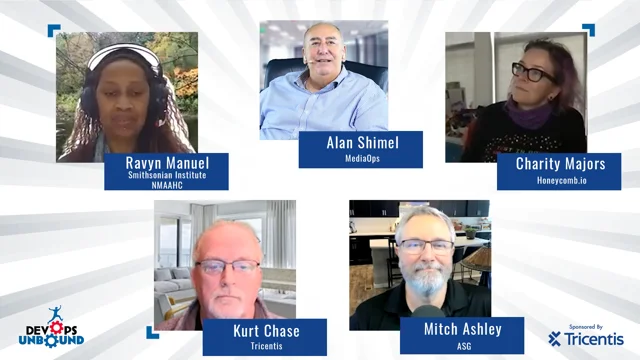
    Observability at enterprise scale brings with it additional application life cycle management requirements. Success requires knowing which changes result in improvements and which don’t produce positive results and how that information must make it back to the DevOps team through feedback loops. In this episode of DevOps Unbound, Alan Shimel and Mitch Ashley talk with Kurt Chase, senior director, global release management at Tricentis, Charity Majors, co-founder at Honeycomb and Ravyn Manuel, senior application manager at the Smithsonian as they discuss observability and continuous improvement. The video is below, followed by a transcript of the conversation.

    Alan Shimel: Hey, everyone. I’m Alan Shimel and welcome to another DevOps Unbound. We have a great panel in store for you today here on DevOps Unbound. Our topic is observability at a broad level. We’re going to jump into some of this. Let me first of all introduce you, though.

    First I want to introduce you, of course, to my cohost of DevOps Unbound. He’s the CEO of Accelerated Strategies Group, CTO here at MediaOps, my friend Mitchell Ashley. Hey, Mitch. Welcome.

    Mitch Ashley: Alan, thanks. Great to be here.

    Shimel: All righty. Let me introduce you to our panel for today. We have a great panel. I was so happy that this came together. First, coming at us from the mountains of Virginia by way of the Bronx, Ravyn Manuel. Ravyn, why don’t you introduce yourself and where you work?

    Ravyn Manuel: Absolutely. My name is Ravyn Manuel and I work for the National Museum of African American History and Culture, which is part of the Smithsonian. I am the Senior Applications Developer and DevOps Engineer. And thanks for not putting me in West Virginia. I appreciate that.

    [Laughter]

    Shimel: Okay. I don’t blame you. Next up we have the one and only Charity Majors, CTO and Co-founder at Honeycomb. Charity, a little bit about yourself, maybe introduce to the audience?

    Charity Majors: I am an ops nerd. I have been on call since I was 17 racking hardware. I no longer rack hardware anymore. Hardware doesn’t exist, as far as I’m concerned. Instead, I’m trying to save the world through better observability.

    Shimel: Excellent. And then, last but not least, we have Kurt Chase of Tricentis, Tricentis Releasing. Kurt, why don’t you introduce yourself?

    Kurt Chase: Hi, everyone. My name is Kurt Chase. I’m currently Head of Global Release Management at Tricentis, based in Northern California. Nice to join you all today.

    Shimel: Nice to have you here, Kurt. All right. So, team, panel, our topic this week is observability. And given that is the topic, I feel compelled to start with Charity because, Charity, in many ways you and the Honeycomb team are responsible for all this buzz around observability. Tell us about it.

    Majors: Yeah, a little bit. When we started the company a little over five years ago it was not a term that was really in use – used in tech. Now – which is not to say that we invented it. Far from it. But it has this long and impressive pedigree in mechanical engineering, specifically control theory. And in control theory observability is the mathematical tool of controllability.

    So, we started building this startup, Honeycomb, and we knew that what we were doing wasn’t monitoring. We knew that we weren’t reactively monitoring. We knew that we were – it was about instrumenting the code, getting at it from the inside. But for the first five, six months we couldn’t figure out what to call it. It was really hard to figure out how to talk about what we were doing. And then it was mid-July, midway through the first year when I remember Googling “What is the definition of observability?” And when I read it it’s all about “Can you understand what’s happening on the inside of the system just by looking at it from the outside with no prior knowledge?”

    And a lightbulb just started going off. It was like “Ding, ding, ding. That’s what we’re trying to build. That’s exactly –” if you translate that into software terms, what it means is can you explain any system state that – any state that your system can get into without shipping new code to handle that state because shipping that code to handle that state implies that you had prior knowledge. So, it’s all about the unknown unknowns instead of the known unknowns. So, yeah, that’s my story.

    Shimel: And you’re sticking with it. So –

    Majors: Yeah. I mean, it really encapsulates a lot of the problems that people are increasingly having, that there’s a lot that precedes from that definition of “unknown unknowns,” like you need to have high cardinality, high dimensionality, blah, blah, blah, all this stuff. But those are the things that speak to the problems of microservices and multiple storage systems, et cetera.

    Shimel: I get it. So, Ravyn, this is your life. How does this observability and what Charity has describe, the fact pattern or the problem pattern that she came to call observability, how does that in your life, day to day of what you’re doing, how does that kind of manifest itself?

    Manuel: Thanks, Charity, for actually providing a definition because I was like “Okay, are we supposed to define our own meaning of observability?” So, you’ve given a baseline. And I like that you said it’s not monitoring because I can actually feel the nuance. There’s a nuance between monitoring and observability. And it’s – what’s really interesting is that that’s a problem that I’m trying to solve today at work because we’ve got – and – because we’ve got the black boxes. So, you’ve got observability but when you have software there’s a lot of black boxes. You’re not supposed to be asking what’s going on inside the code because you’re not supposed to know what’s going on inside the code. But when you get a – you put a signal in – I was in the military, so I did electronic repair – so, you put the signal in and you don’t get the right signal out but you’ve got a black box. How do you know what went wrong there if you can’t actually observe what’s going on inside of there?

    It’s one thing to know the state of the software when you are the developer. So, as a developer, yes, I know. But when it comes to being the product owner or the project manager or a stakeholder and you’re trying to figure out what – “Why is this doing this?” or “This is not what I wanted,” actually is how that would come from that end, is “That’s not what I wanted.” So, how to get the stakeholders to get what they want when you can’t actually tell – I can’t tell what the code from my coworker is doing? So, in a way observability is a little bit – it is abstracted from monitoring because monitoring is telling you what it’s doing but it isn’t telling you the state. And so, it’s a problem that I’m trying to solve actually today.

    Chase: I was going to jump in here and say from my experience although monitoring, logging, reporting, alerting, they’re not observability, I think they are fundamental foundational pieces that you have to have in place. You can start observability without any of them, but I’ve found that the more you can get your monitoring and reporting and even get some alerting going, it allows you to then start observing the system. And for me, I know at Splunk and now here again at Tricentis I’m really trying to connect all the pieces because it’s not just about the applications, but I find that some of the DevOps engineers, they really help with observability, especially the ones that are super inquisitive, and they don’t just – when a result appears or something happens they don’t just take it at face value. They’re inquisitive. They dig in. They try and find the root cause.

    And I think that’s key with observability, is taking all the monitoring, reporting, alerting you have, taking the feedback from your customers, all of that comes together, I think, to really help you start to define those unknown unknowns that Charity brought up. I think it becomes very complicated. And then I think I’d love to talk about how AI and machine learning now can start to learn some of these things, because I think we get really good at repeatable incidences, observing those and then accounting for those in our systems, but it’s the unknown unknowns, how do we deal with those? That’s the real interesting part to me nowadays for sure.

    Majors: It is, I think, the interesting part. And I also think that AI ops is mostly bullshit and it will be for the foreseeable future.

    Chase: For a while. I agree, yeah.

    Majors: But I wanted to circle back to what you said about logging and everything, which is – so, there’s a technical definition for observability which has to do with high cardinality, all this stuff, and then there is just understanding your systems. And I absolutely agree: You need some alerting, you need some monitoring. I think there’s a question is – of – it log files? Is it metrics? That’s kind of irrelevant for just data. What’s important is can you understand what’s happening in your system when you need to understand it?

    And I do think it’s important to sort of differentiate the technical definition of observability from just the tendency that we have to, say, observing things because there’s a very rich and mature and well-established set of best practices for monitoring, which are in many cases completely mirror opposite from the best practices for observability.

    For example, with monitoring it’s like for years we’ve been saying, “You should not have to stare at graphs all day. The system should inform you when you need to – when there’s something wrong.” Super canonical best practice. With observability it’s exactly the opposite. It’s – we’re saying that most problems that happen are so subtle that you need to be looking for them. You don’t – you can’t page everyone at the threshold – you would drive them nuts if you were like “Oh, every little thing is going wrong. Bing, bing, bing.” You’re just – you would drive people nuts and they would quit. But when you’re an engineer, when you’re working on this endpoint or when you’re trying to solve this problem you should absolutely be looking through, asking questions, iterating on them, and looking for the trails in your observability tool at that very fine grain level.

    Chase: I agree.

    Shimel: So, I hear what all three of you said and it’s funny how everyone brings their own baggage to this issue.

    Majors: Oh, sorry.

    Shimel: No, no, it’s not – don’t be sorry. I love it. Here’s, I think, fundamentally – for those people out here who are watching this whole – I’ve got a lot of people out here who are DevOps people, who are ops folks, SREs, cyber folks, and their heads are spinning because I think there’s a little bit of what Kurt said to them, which is they don’t do – they do a shitty job monitoring, quite frankly. We don’t do a great job of it. People started throwing this AI ops word around, and there are a lot of companies raising a –

    Majors: Yeah, there are.

    Shimel: – crap ton of money around their AI ops stuff. And I never really understood what was real about it and many times it just sounded like another word for monitoring to me. But whatever. There is no AI in it.

    But – and now, look, over the last year, year and a half, two years we’ve seen observability come up here and they don’t get the difference. Ravyn, I think you do because quite frankly your black box analogy with electronic in the military, that is – you’ve got to figure out what the unknowns are from the unknowns. It’s not just getting all these signals that are known and then recognizing patterns and putting some automation behind it. That’s not observability. I’m sorry. Not in my mind, anyway.

    So, I think number one is we need to clearly define it. And Charity, you guys, you are a major kind of evangelist for this: “What is observability versus AI ops versus ALM,” which is before AI ops, and so forth. And there are SREs who are living this and DevOps teams who are living this every single day out here who haven’t got their heads around it. Ravyn, I always look to you as someone who gets it. Where do you fit on the – where do you kind of see it on the – let’s say there’s a scale of ALM, AI ops, blah, blah, blah, observability. What do you think?

    Manuel: I feel like I would be very – most close to observability because, again, all – anything with ops in it, when you start doing DevSecOps and DevOps, all of those ops just become marketing terms after a while. But observability is – because it’s not quite tangible it’s actually more real, because it’s real – because it speaks to exactly what’s coming, what’s going on when you’re trying to get continuous improvement, because you need metrics to show and prove that you’re doing continuous improvement. But how do you get there? What is it – what are the steps to get you there? How are you alerted that you are not improving or that you are going backwards?

    And so, when – I feel for me as far as observability I’m at the cusp, because I didn’t actually know that the word existed until I found out about the talk. I didn’t know that that had been defined. So, it’s really cool to know that I can now call it observability. It’s because it’s that thing that I can’t – there isn’t a tool to actually help me – actually help me know what it is that I’m looking at all the time. Not all the time. There are some tools that help me some of the time but not all the time. And it’s the times that I don’t know that’s when we are stuck, because it could be impacting the way – the system performance or the team’s performance.

    Shimel: Charity, I think you might have a customer there. It sounds like they need a tool.

    Majors: I feel like one of the key differentiators here between observability and AI ops and stuff is what it tries to center. With observability we are not – AI ops are like “Eh, we’ll tell you what to look at. You don’t need to understand your system. We’ll understand your system for you. We’ll tell you what to look at. We’ll tell you what it means. We’ll tell you what’s important.” With observability it’s the opposite. I think that we need to look to solutions that let computers do what computers are good at and let humans do what humans are good at. Computers are good at crunching lots of numbers but they can attach meaning to something. Only human beings can attach meaning to something. If I see a big old spike of red that could be good, that could be bad. You don’t know. There is no meaning until a human has attached them to it.

    And with AI ops, AI ops only really works if the corpus of data that you’re training it on doesn’t change. So, if you’re actually shipping software every day you’re fucking up your corpus. This – it’s kind of incompatible with modern software development. I have many thoughts and feelings on AI ops. God bless them, but mostly I think that what they’re trying to do is take the humans out of the driver’s seat. And I understand why, because the C-level, CTOs, CIOs, whatever – there’s something that kind of blew my mind when I realized it a couple years ago: They trust vendors over their own people. Their employees come and go; vendors are forever. So, whenever a vendor comes along it’s like you give them tens of millions of dollars; your people don’t have to hold all of the wisdom in their heads. You can replace them. They’re fungible. The tool will tell you; the tool will be the source of truth.

    And I just fundamentally reject – I’ve never seen that work well. I think it’s a shitty way to treat your people. And I would prefer to take the –

    Chase: And I would not agree with that statement, quite honestly. I’ve had leads that are –

    [Crosstalk]

    Shimel: All right. “Mr. Vice President, I’m talking.”

    [Laughter]

    Sorry.

    [Crosstalk]

    Majors: – and then using our tools to make them better, to impress them, to give them a better sense of where they sit in time and space in the history and what’s happened before and what they’re – they should be wearing grooves in the system as they wear – as they use it in the [inaudible].

    So, I think that it should – if you’re centering a person it’s observability and if you’re centering the – it’s AI ops. Sorry. Go ahead, Kurt.

    Shimel: It’s okay. Kurt, your turn.

    Chase: No, I was just – in my experience the leads, I’ve had – I’m a senior level director now; it was the same at Splunk – I did not encounter that where my leads trusted vendors more than myself or the people on my team. I was surprised to hear that, quite honestly, Charity. I have not experienced that.

    [Crosstalk]

    Majors: It’s not universal. But it’s – there – it exists quite a lot.

    Chase: Yeah, that’s too bad to hear that. That is seriously wrong and that’s going to go against everything we need to accomplish internally.

    Majors: Yeah.

    Chase: Yeah, if –

    Ashley: Have fun attracting great people with that mental model.

    Chase: Yeah, yeah, yeah. And the other thing – I’d love to hear your opinion on this, Charity – we have very complicated systems we’re running. The source code management, the build systems, the agents. I’ve found that it always is very helpful to distill it down into discrete parts, try not to blow the ocean at once. Let’s start with the source code management system. How are we observing that? What are we doing here? And would you suggest that’s a great way for people to get going? I mean, when you try and look at everything – you have to look at everything for sure, but to get started it seems like find some of the most important pieces. Source code management is a great one. The crown jewels. What’s your suggestion there for getting started and –?

    Majors: Source code management is important but it’s never – it’s almost – it shouldn’t almost ever be in the critical production path. And when people are rolling something out I always advise them to find something that’s – don’t waste your time instrumenting _____ observability, lights, and backwater to the system. Find the thing that you’re trying to understand and fix now. Find the thing that’s broken. Find the thing that’s causing you pain. Because it should be an order of magnitude better at answering your question, observability should, even than monitoring. I don’t think you can look someone in the eye and ask them to switch up what they’re doing and to use something else unless you can tell them it’s going to be an order of magnitude better than what they’ve got now because the costs of transition are so high.

    But with observability you should be able to go from instead of just the aggregate where it’s like “Well, I see a spike but I can’t tell you what it means or how they’re different from –” with observability you should be able to go exactly those rows, in which ways are those events different from all the baseline events, and very quickly go “Oh, I have a much richer view of my system now.” And if – once you’ve got that you should be able to explain way more about what’s going – so, we see this all the time when people are running out – when they’re rolling out Honeycomb. They start rolling – they roll it out to the service and they’re like “Oh, God, there are problems there. Did you know that this is broken? Oh, there –” and we’re like “Yeah, yeah, yeah, but you’re just picking up the rug. It’s been there – it’s been that way for as long as you know.” And they’ll pick up another service and the problems – I’m like “Yeah, but these problems have existed – you just had no idea because we were dealing with [inaudible].”

    So, I feel like the way to pick up momentum, the way to incentivize people to get excited about this is to look for the biggest pain point in your system and –

    Chase: That’s awesome.

    Majors: – then patch that with observability.

    Chase: That’s great advice. I agree.

    Manuel: Charity, a question. Does – can observability actually take in account process? Because you’re talking about if there’s something wrong in the system itself, but sometimes the thing that’s wrong with the system is the process.

    [Crosstalk]

    Majors: Well, everybody is not about process. And you’re totally right. That’s often – that is not something that you should ever ignore. A lot of the biggest problems are process problems. But observability is not the tool for that.

    Shimel: And that’s good to know too because quite frankly – and Mitchell knows this too – we live in a silver bullet world where people think the latest shiny trinket is the cure-all.

    [Crosstalk]

    Majors: – everything, you should –

    [Crosstalk]

    Shimel: No, observability, yeah, it’s not going to cure Covid either.

    Majors: No.

    Shimel: But –

    Chase: And that was the point I was trying to make initially. I think I said it wrong. It’s not that monitoring and reporting, logging aren’t foundational; they’re complementary. You kind of need them all. If you’re running modern stacks – I said that incorrectly at the start – it’s not foundational. There’s – you need them alongside each other.

    Shimel: They’re adjacent. They’re not –

    Chase: Yeah, absolutely. Absolutely.

    Shimel: They’re not – it’s not a pyramid per se.

    Chase: Right. Exactly.

    Shimel: I think it’s part of your stack horizontally.

    Chase: Yes. Yes. And I’ve found –

    Shimel: Can I – we haven’t’ – go ahead, Kurt, I’m sorry.

    Chase: I was going to say I’ve found with especially new individuals and new people to the DevOps team and the DevOps world, getting them involved in the monitoring and saying, “Hey, this is how we start monitoring,” that’s a great place to start. It’s almost entry level for observability, if you – I’d love your opinion on that, Charity, too.

    Majors: Well, I really think that everyone who writes and ships software should be on call for their code, no matter how –

    [Laughter]

    Chase: Yeah, me too.

    [Crosstalk]

    Majors: Software ownership. And so, yes, that’s very empowering, I think, to show them how to find the trail, the alert that’s paging them, trace it all the way to the system and fix it. That’s something that as engineers, we feed on that. That’s exciting to get to know how to run your ship better. Yes, absolutely.

    Shimel: Well, but – so, you know what? Mitchell and I started a company – or, were two cofounders of a company called StillSecure 20 years ago. And that was one of the things. Mitchell ran the engineering team and that was one of the things he instituted, I remember, was that every developer had to take a turn on the help support desk, level one, answer the phone. “Hello, Mr. Customer.”

    Majors: It builds empathy.

    Shimel: And try to explain it because they had to answer the alert. And even when they weren’t on that level one our escalation procedure was if it went to level two or three it was the developer who did the level two and three support.

    Majors: I will say that, yes, and I do think that every engineer should be on call for their work, but you have to couple that with it’s management’s job to make sure that that doesn’t suck, that it isn’t _____ for them, but it doesn’t just kill you with [inaudible]. It is management’s absolute fucking responsibility to make sure that they’re given the time to – away from project work to fix these problems so that they don’t recur, so that they get enough sleep. I think it’s reasonable to ask any engineer to be woken up two or three times a year for their code. That’s it. Because more than that, you’re burning people out hardcore.

    Manuel: Been there, done that.

    Shimel: You know, Charity, Ravyn –

    [Crosstalk]

    M : I have a question. I have a question I’d love to ask all of you. I’m thinking about observability has been elevated because of, in part, the world that we’re living in. Software architecture is changing. We’re dealing with microservices, all these much smaller things that are interconnected to make software. And at the same time as we’re changing the pace at which we release software, not only is it unknown unknowns, it’s like a river – Riven –

    Shimel: Ravyn.

    Ashley: – we’re in the river of the changing software. So, you’re trying to understand all of these things at the same time. It seems like it’s the right time for observability to be the thing to be working on because ops has to be elevated to the same level of the same kind of architecture and processes that we’re using across the – in the life cycle of software. Do you agree with that or not? It seems to me we’re in the right place, right time.

    Majors: Absolutely. I mean, I feel like the first wave of DevOps transformation was all about “Ops people, learn to write code.” And we’re all like “Eh, okay.” But I feel like the pendulum has swung. I think now it’s about “Okay, software engineers, your turn.”

    Ashley: You’ve got to do ops.

    Majors: I have to learn to write operable services and to learn to maintain them and get called for them and – because what microservices has done, all of that complexity and logic has to be bundled up in the app. The app.

    Manuel: Exactly.

    Majors: And now it’s like we’ve been thrown to the four directions of the map. And what that means is that so much of understanding and operating your application has been pushed into the realm of operations and systems. It used to be that if all else failed you could attach a debugger to your app and just step through, see what was happening. Well, you can’t do that anymore now because the process died and jumped to another service, and another service. And part – the way that we instrument for observability is all about packing up the context of the application and shipping it along with it from hot to hot, one event per request per service, so that you can slice and dice and reason about your systems in a way that you used to be able to.

    Ashley: Doing that really changes the design. I’m thinking about Alan’s story of what I did back at StillSecure. What prompted that was when a customer called in and said, “I’m sitting in – we’re using your project and this dialogue box popped up and it says ‘An unknown error occurred’ and that’s all it says. What do I do?” Well, nobody knows what to do with that. So, we all just said, “Look, everybody does support in that case. Everybody does ops.” And that changed: “Okay, we have to figure this out.” And suddenly that was the problem of “How do we make this easier to support and easier to resolve issues with?” So, it does affect behavior and design or product.

    Majors: Yeah, absolutely.

    Manuel: I think microservices is – will actually do good for observability because if you do microservices correctly then each service is atomic. It does one thing and one thing only. It does that thing good. So, if the unknown is not taken out of it because you know exactly what this thing is supposed to do –

    [Crosstalk]

    Majors: Oh, no, honey, the unknown is never taken out of it. The unknown is never –

    [Crosstalk]

    Manuel: In my ideal world it is.

    [Laughter]

    There are no more unknowns –

    Shimel: In Ravyn’s world, yeah.

    Manuel: – in Ravyn’s world. Exactly.

    Shimel: Yeah. But I’m going to tell you something. The flipside to this, though, too with microservices, and I think we’re starting to see this now, is can you have too many microservices running? Does it – is the complexity load in there such that observability almost becomes meaningless or impossible?

    [Crosstalk]

    Majors: I don’t know that complexity can every really be created – no, it typically is not meaningless. It’s your only hope to understand this shit if that’s what you’ve done to yourself. But complexity can only be moved around. It’s just a question of tradeoffs, like which set of tradeoffs – some folks have gone whole hog on microservices and then they’ve found the edges to those design _____. But –

    [Crosstalk]

    Chase: What I find – I was going to say what I find challenging is both at Splunk – Autodesk was interesting. So, to your point, Alan, we used to make engineers buy bagels. You break things; you have to buy bagels. And so, we had a lot of bagels brought in. But both at Splunk and here at Tricentis we have a world where we’re supporting large enterprise applications and delivery of enterprise apps. We’re also – obviously all the microservices – and trying to apply these techniques across the board is very interesting, very challenging.

    [Crosstalk]

    Majors: Oh, yeah. There’s no one-size-fits-all.

    Chase: There’s not. There’s not. And almost to the point you made, Ravyn, observability almost has to be customized for what you’re observing. It’s – I haven’t had a chance to run Honeycomb yet, but for me my experience has been there’s always those little idiosyncrasies about how we run our ops, how we –

    [Crosstalk]

    Majors: There’s no such thing as a perfect _____. No one else can do it for you. It can be – it can get you started. It can give you a boost. But at the end of the day somebody’s got to fucking understand your software and roll that into your instrumentation. Nobody else can do that for you, let alone _____.

    Chase: And that’s where with AI ops, I won’t say it’s complete shit. I think there is some value there. Some of it is just about automating common occurrences. And maybe that’s not valuable but –

    [Crosstalk]

    Majors: – it’s an AI but they’re just using that to make – to raise lots of _____.

    Chase: Oh, sure. Okay. Yeah.

    Manuel: Didn’t work.

    Majors: Like, “Oh, I have an AI too.”

    Shimel: No, but we – and you’re right, AI is a money term. But ML ops is something that’s caught on a bit, more than, I think, than AI ops. And I think that’s really at the heart of it, which was to recognize repeatable patterns or recognize patterns that we can respond to.

    [Crosstalk]

    Majors: Although, I would still challenge – I think in far too many cases people are reaching for the complicated solution instead of fixing it at the start. They’re like “Ooh, I’ve got 50 bazillion e-mails so I – and all of that disk space so I need AI to solve it” instead of turning off the fucking e-mails and setting up a different kind of alert or some automatic _____. Just – is this really a problem we need to solve? Or could we solve it better by just not having it?

    Shimel: There is that.

    Majors: Sorry. That’s my last bitch.

    Shimel: Do we need to solve every – and I think Ravyn – or, not Ravyn – Charity, you were getting at it before. Do we need to solve every problem?

    Majors: Is it the most important problem? Is this going to be the biggest bang for our buck?

    Shimel: Yep. I mean, we used to have a –

    [Crosstalk]

    Majors: – or the _____. Like, senior engineers write software but very senior engineers don’t need software.

    Shimel: Yeah, no, I mean, look, when Mitchell and I were doing the security company we had a product, “Vulnerability Assessment of Management.” VAMP. Internally we called it the Bad News Generator because that’s what it was.

    [Laughter]

    It was the Bad News Generator. And the problem was we would go to an organization like Ravyn’s and it would pop up a few thousand vulnerabilities, and the security or the ops people would be like “What am I going to do?” And “Don’t worry about 95 percent of them. Let’s just worry about the top five percent.” And it was like – it was employment insurance, was what it was, because there would always be more vulnerabilities for us to find next year.

    But that being said, it really was the case where you’re not going to fix everything. We don’t have the time to fix everything even if we wanted to.

    [Crosstalk]

    Majors: And it’s not really doing a great job of giving you differentiation, letting you know what’s really important and what’s just noise. So much of these tools, they just give you so much noise and it’s almost worse than nothing at all.

    Shimel: Well, that’s why with the Bad News Generator people used to – so, Mitchell got the lucky part of designing it. I had to go sell it. That was much harder.

    Ashley: I remember the –

    Shimel: Much harder.

    Ashley: – guy from the federal government called and said, “This thing is spamming everybody in the Defense Department.”

    Shimel: Yes, “We have all these vulnerabilities.”

    Ashley: “How do I turn it off?”

    Shimel: Because we had this automated workflow before we had terms like AI and ML. But it is hard.

    Hey, guys, we’re coming down the home stretch here. We probably only have five minutes or so left. I wanted to – let’s look forward now. I’m big into looking forward these days. I’m hoping we’re going to do conferences in person again; we’re going to – I don’t know if we’ll go back to our offices but…

    What’s next for observability? How does this continue to evolve?

    Majors: What’s next is I think really wrapping traces in as a first, best tool so that – right now too many people are like “I have one tool for metric, one tool for logs, one tool for servability, another tool for –” they’re spending just ____ data again, every time. And it’s worse than that because you can’t actually seamlessly break down a chain of events, so you’re just copy/pasting this idea into that tool or hoping despite – because it seems to line up timewise, it’s actually bees in the logs – you should be paying to store this data once and you should be able to flip back and forth between loads. Are you slicing and dicing? Are you doing aggregations at read time? Are you zooming in? Are you zooming out? Or are you slipping back so you can view it as a logger file by time?

    I think that observability tools like us and Lightstep – which are the only two observability tools out there by my technical definition – although, I will say I do think that this might be the year that that begins to change. I know that so many of the big players have been working as fast as they can for years on the back end. They’re trying to catch up to where we sit technically faster than we can get catch up to where they sit in terms of the business. So…

    Chase: And I –

    [Crosstalk]

    Manuel: I like that you said that. Sorry, Kurt. That –

    Chase: No, no, go ahead, Ravyn.

    Manuel: – Charity – I just wanted to say to Charity –

    Chase: No, no, Ravyn, go ahead.

    Manuel: – about tracing, because that’s actually the solution that I am actually looking for, that I’m looking for –

    [Crosstalk]

    Majors: It’s got a lot of rough edges.

    Manuel: – for organizations. Yes, to be able to follow –

    [Crosstalk]

    Majors: But there are lots of problems we can’t solve any other way.

    Manuel: Exactly. So, I feel good that I’m doing it inherently, like I know what I’m supposed to be doing.

    [Crosstalk]

    Majors: You’re on the right path.

    Manuel: I think I’ve actually found a way to do that. But yeah, tracing I also think is the way to go. That is the only way you’re going to be able to know, because it’s taking you from point A to point B to point C to point D and you’ll be able to see that all. And there will be no unknowns. [Laughs]

    Majors: Oh, honey. You keep saying that.

    [Crosstalk]

    Manuel: It’s my dream. That’s – let me live my little dream.

    [Laughter]

    Shimel: Kurt, what do you got?

    Chase: Yeah, well, where mind – excuse me – where my mind goes to in the future is what are we doing in the education system to really disseminate this information, how monitoring software is developed, how we monitor it. And then also “observability” is such a loaded term because I know at Splunk they would consider observability something much different, for running a SOC and things like that.

    [Crosstalk]

    Majors: Oh, no.

    Chase: So, I think it – I mean, at its core observability is what it is. But how it’s implemented for different disciplines and how they use it, I think companies would definitely take exceptions with some of the things we’ve said here –

    Majors: For sure.

    Chase: – and what observability means to them. And I would just say keep that in mind, that it is a huge field and I think we’re going to see further improvements. I love the tracing. And being able to have that in your tool set would be fantastic.

    Shimel: Charity, final thoughts before we wrap?

    Majors: Oh, I am just enjoying the fact that some people are so interested in this that they’ll show up and argue about it all the time. So…

    [Laughter]

    Shimel: It’s all good. Hey, you know what? It’s a living. Mitchell, as usual, I’m going to give you the last word.

    Ashley: Well, I’ve learned two things today. Don’t call my tool an observability tool or an AI tool unless it really meets the definition, or I’m going to get crucified.

    [Laughter]

    No. No, what – I mean, I love this conversation. I learned a ton. I always do when we have these – what’s so cool to me is that we’re talking about operations and we’re talking about this part of our world and we’re not talking about better ticketing systems. We’re talking about really meaty, interesting things that help us do our jobs better, do a better job for the company, for the customer. That’s exciting to me. It’s just really cool. I enjoy it very much.

    Shimel: Join us for our next show where we’ll be talking about better ticketing systems.

    [Laughter]

    No.

    Chase: And what argument did I miss? I was –

    [Crosstalk]

    Shimel: No, no, no, no. It’s all good. You know what? I enjoy having really bright, smart people who are willing to express their opinions. And when I knew we had this panel, it was the lineup, I knew there was going to be no shortage of opinions, nor any backing down. So –

    Ashley: We’re going to call the next one “The observability mix-up.”

    Shimel: Right.

    Majors: We’re going to have to call it “Observability AI.”

    Chase: I still want to see that sticker –

     Shimel: “AI Observability.” All right. Hey –

    Chase: We need to see the sticker Charity was holding up. We need to see that.

    Majors: Oh.

    Shimel: Oh, we never got to that. Yes.

    Chase: We have to see that.

    Majors: I’ve got a few of those. I’ve got “Release := deploy.”

    Shimel: You’ve got a lot of them here.

    Majors: I’ve got “Ship dangerously.”

    Chase: Yeah, I love that one.

    Majors: “Deploy on Fridays.”

    Shimel: You know what? You used to be able to get these things on conferences. Now we’re reduced to showing them on Zoom.

    Majors: Yeah, you have to.

    Chase: Yeah. Exactly.

    [Crosstalk]

    Majors: “Perhaps this is a good day to deploy.”

    Chase: Maybe.

    Shimel: Okay, yeah. Perhaps.

    Chase: It’s Friday. It’s not a good day.

    Manuel: No, Friday is not a good day.

    Chase: That’s the one, right there.

    Shimel: And there it is: “I deploy from Cron.”

    Ashley: That’s the one to end on right there.

    Shimel: That’s is. We’re going to wrap it. Hey, you’ve watched devopsy.kinsta.cloud. It’s sponsored by Tricentis. Many thanks to them for sponsoring. Just wanted to quickly mention Kurt is from Tricentis. Charity is from Honeycomb, and it’s Honeycomb.io. Go check that out.

    Majors: We have a very generous ____ here.

    Shimel: A very free _____. Ravyn, you can start playing with it now and see if it’s something that gives you tracing and so forth. Mitchell, thanks for joining us.

    Ashley: You bet.

    Shimel: We are back – actually, we are back with a roundtable next, which will be open to the public. Looking forward to having you on for that. But until then, this is Alan Shimel for DevOps Unbound. Have a great day, everyone. We’ll see you soon.

    [End of Audio]

  • Survey Finds Biggest DevOps Obstacles are Organizational

    Survey Finds Biggest DevOps Obstacles are Organizational

    A survey of 600 IT professionals published this week by mabl, a provider of a test automation platform, finds the biggest barriers to adopting DevOps practices are more closely related to organizational issues rather than any technology.

    The survey identified non-technological issues as the main inhibitor to DevOps by a wide margin (82%). Only 11% of respondents said their organizations has fully implemented DevOps practices, while another 24% said they were most of the way toward achieving that goal.

    The top two barriers to adoption are slow processes and speed of adaptation (29%), followed by budget and funding (21%). Only 18% identified technology limitations as an issue.

    Nearly half of respondents (46%) said they have been able to implement continuous integration, while more than one-third (36%) said they have also been able to achieve continuous delivery. Just over a quarter (27%) said they have also achieved continuous deployment. However, only a third of respondents said they deploy new code at least once per week. Almost half still deploy less than once per month. The number of teams that deploy new code daily or multiple times a day (15%) is roughly equivalent to those that deploy code on a quarterly basis (16%).

    The most widely used DevOps tools are GitHub (34%) and Jenkins (33%), followed by GitLab (21%), Azure Pipelines (20%) and Bitbucket (19%).

    In terms of testing, the most widely automated tests are user interface (UI)/functional and unit tests at 42% each, followed by regression at 41% and integration at 35%, respectively. The most widely used functional testing tool is Selenium (41%), followed by Cypress at a distant second place (14%). The most widely employed tool for testing application programming interfaces (APIs) is Postman, followed by SoapUI (21%) and homegrown tools (17%).

    Dan Belcher, co-founder of mabl, said that while it’s clear most organizations still have a long way to go before they fully embrace DevOps best practices, it’s now more a question of degree rather than if. As organizations realize the extent to which they are dependent on software today, the focus on both quality and ensuring timely delivery will increase. The stakes involved in software delivery these days have never been higher, noted Belcher.

    Nevertheless, the survey makes it clear how resistant to change organizations are. Some organizations have been building software the same way for decades. The only thing more difficult than convincing IT and business leaders there is a fundamental need for change is driving that change all the way down to individual developers and IT operations teams.

    Competitive pressure, however, will inevitably force the issue. If rivals are delivering better application experiences that create a business advantage within the context of a digital business process, an organization will have to adapt. Otherwise, their fate will be, over time, to fade away or be acquired. Equating DevOps with that existential threat may be a challenge, but unless that connection is made it’s only a matter of time before organizations that aren’t embracing DevOps best practices will slide toward irrelevance.

  • Make a Plan for Test Automation

    Make a Plan for Test Automation

    The amount of testing that we could be doing is massive. Most of us don’t look at testing across the spectrum and all-inclusively, but let’s do that for a second.

    We have functional testing at the code level, which is reasonably well automated already, if your shop is using such automation. Then we have integration testing, which is a superset collection of API testing, code integration testing, usability and regression testing. Integration testing is automated, and sometimes that’s done well, but this massive space is still growing. Next up would be security testing, which covers much of the same code that other testing is interested in from a strictly security focused perspective. Then, there is actual usability testing, which is more important for some areas than others—embedded needs far less usability testing than web apps, for example—and has different levels of automation at this point in time.

    Really, when you think about it, the complexity of this environment is massive. We not only need to test an array of different functionalities from an array of different perspectives, but we have to do it on an array of platforms. Testing on Windows is different than testing on Linux; testing in the cloud can use different tools than testing in-house; clients can be on any given platform, depending on the application and target market … we really do have a beast, here.

    And testers have always been behind, or have not covered things well. This is not a ding on testers, this is the result of the complexity at hand and the fact that, in many instances, one line of code can go wrong in a bunch of different ways.

    Enter automation, which is growing rapidly in the world of continuous integration (CI). Automated testing tools range from broad to very focused, and all help facilitate testing. The DevOps increase in development means more testing, and testing was already behind. This has been discussed pretty thoroughly in the past, but it finally feels like we’re getting to a point where we have viable solutions to the problem. If testers become test developers that review results of automated tests, and through CI those automated tests are increasingly worked into the process of development, we’ll see testers getting better coverage and quality seeing a continued increase.

    But that does mean you should keep your eyes on the market as it continues to grow, and pick tools that offer the most functionality that is most useful to your test team. And get them up and running. More testing means more work setting up tests. Even no-code test solutions for UI require someone to record the actions that are necessary to complete the test, and that takes someone’s time. But the return is long-term testing that doesn’t require a person until a red flag is raised by automation.

    I’m all for it. Both testing and security have the most to gain from automation, because they’ve been the most behind historically, and corner-cutting has cost organizations dearly. So, let’s get with it; check out some new test tools (there are plenty listware articles giving you a place to start), and let’s make great software better!

  • Modernizing Continuous Integration

    Modernizing Continuous Integration

    In the duality of continuous integration/continuous delivery (CI/CD), CI focuses on build automation. Leveraging CI practices for software delivery is normal for most organizations and can be seen as a solved problem. However, the demand for increasingly distributed applications has risen with the expansion of microservices, and development teams have the expectation that every commit should be a build.

    Continuous integration has, surprisingly, become an unexpected bottleneck with these expectations. To begin modernizing CI, it’s important to first understand some of the challenges. Let’s dig in.

    Challenges of Continuous Integration

    Given that build and release candidates follow advancements in development technology closely — such as new languages, packaging and paradigms in testing the artifact — expanding the capabilities in continuous integration implementations can be challenging. With the introduction of containerized technology, the firepower and velocity required to build greatly increased.

    Scaling Continuous Integration Platforms

    The infrastructure required to run a distributed CI platform can be as complex as the applications they are building because of the heavy compute requirements. Consider how much a local machine’s resources are tied up during a local build and test cycle. Now, multiply that by the number of folks on a team or in an organization and you start to understand just how much compute power is being used. Distributed build runners are just one area that can be complex, and managing when new build nodes are spun up and spun down can depend on the platform/end user.

    Keeping Up With the Technology Velocity

    The adage of “the only constant in technology is change” is true. New languages, platforms and paradigms are to be expected as technology pushes forward. The ease of including new technologies in a heterogeneous build or accepting new testing paradigms, however, can be difficult for more rigid CI platforms. These legacy platforms were designed for only a small subset of technologies. With legacy or rigid approaches, the dependency management required to maintain technical velocity becomes a significant burden.

    What it Takes to Modernize Continuous Integration

    The simplest way to change continuous integration practices and platforms is to take what I call the four-pillar approach: platform infrastructure modernization, engineering efficiency strategy, test optimization and rapid pipeline development. Making strides in any of these pillars will put you on the path toward modernizing your continuous integration platforms and practices. Making strides in all of the pillars will set up your DevOps teams for significant success.

    Platform Infrastructure Modernization

    The location where the actual builds and packaging take place (e.g. build nodes/runners) do most of the heavy lifting and have a fairly elastic workload nature. Builds (e.g. a JAVA JAR build) and packaging (e.g. a Docker Image Compose) are compute-heavy tasks. Once the build and packaging are complete, the runners can sit idle. This shows the importance of having an ephemeral build node. The build node spins up during the task, then spins down or is destroyed after the build task is done, so as to not drain resources.

    Engineering Efficiency Strategy

    A core tenet of engineering efficiency is meeting your internal customers where they are. For software engineers, this means being as close to their tools and projects as possible. Like many modern pieces of application infrastructure, shifting left to the developer means being included in the project structure in source code management (SCM).

    A common disconnect in CI platforms is dependency management. Over the past decade, for software engineers, this problem has been solved with package or build tools such as Maven, Gradle and NPM. Engineers need to simply define implicitly or explicitly what they need, and the dependencies will be resolved. Continuous integration tools can suffer from a disconnect, since we are leveraging several tools that potentially don’t have a common syntax. So, again, it’s important developers have close oversight on all the tools they need to complete their projects to reduce this friction.

    Test Optimization

    While initial confidence in getting tests into the CI pipeline expands, more tests — and sometimes inappropriate test coverage — is introduced by the ease of integration with the pipeline. An even harder problem to identify and rectify is flaky tests. A flaky test is one that both passes and fails periodically without any code changes. This becomes a twofold problem: increasing execution time and lack of confidence with flakiness. The most logical solution to avoid these issues is adding test optimization. A modern continuous integration solution should be able to visualize pipeline order, timings and overall execution to help identity (and eventually rectify) excessive coverage and flakiness.

    Rapid Pipeline Development

    Software is an exercise in iteration. The lower the barriers to entry for iteration to occur, the more gains in engineering efficiency and agility are achieved. Local builds happen dozens of times before reaching a committable stage, moving them forward to a dev-integration environment. It’s here where having a local environment is key. Oddly, most continuous integration pipelines are designed to run externally from a local machine. So, the ability to move to a local CI pipeline helps build confidence that the externally run pipeline will be successful.

    Continue on Your Continuous Integration Journey

    Continuous integration might seem like a solved problem for many organizations, but as with any technology, there is always room for improvement and modernization. Like any engineering efficiency paradigm, CI is a journey and the destination ever-evolving.