Tag: collaboration

  • Automation, ChatBots Can Improve DevOps

    Automation, ChatBots Can Improve DevOps

    At its heart, the goal of DevOps is to foster better communication between the development team and operations team at an organization. When these two teams are systematically connected, they can easily stay in sync on most issues and there is strong coordination in building and delivering the product to customers.

    Automation and ChatBots can play a big role in the connecting development and operations. They open the door for companies to go beyond simply being alerted when something happens in a chat application, allowing an employee to take action after receiving the alert either in an automated manner or by providing guidance to the employee on which actions to take.

    Automation: Creating Smart Alerts That Don’t Require Follow-Up

    Monitoring applications, systems, virtual machines and networks are a key part of any operations team. There are a number of tools that are used for this purpose, including CloudWatch, Splunk, Rollbar, Pingdom and Newrelic. These tools typically alert the operations teams when there are issues. Engineering teams, on the other hand, use tools such as JIRA and Github to track tickets and manage their agile development process. Alerts from the tools used by operations are helpful, but they still require some manual follow-up. For example, imagine a critical alert is reported by one of the tools because of a product issue. Follow up on this alert would require:

    • Creating a ticket in JIRA/Github with all the relevant information to help diagnose the issue.
    • Escalating that ticket so that it gets looked into right away.
    • Keeping the required people in sync as the status of the issue changes.

    This entire process can be automated. When automated, the workflow operates like this:

    • When the monitoring tool senses there’s something abnormal, like error rates above certain thresholds or a critical failure, alerts are sent and a ticket is created in JIRA or Github automatically with all the relevant information about the issue.
    • Taking this a step further, based on the type of issue, it can be automatically assigned to the right person and even post a message on the appropriate Slack channel.
    • As engineering works through the issue, everyone is automatically informed in Slack when the ticket is updated.

    The key to getting this scenario automated is to leverage an integration and automation platform that is powerful enough to handle complex workflows, yet easy to use so that these automations can be built in minutes. Users don’t want to work for your automations, they want their automations to work for them. With that in mind, the platform should also be flexible so changes can be made to the workflows without any engineering effort (i.e., an automation platform where integrations and automations can be built and changed without any coding).

    ChatOps: Monitor and Orchestrate via Chat Platforms

    With all the apps being used by DevOps, it is difficult for any team to stay on top of monitoring and managing issues while also taking actions across all these tools. Studies show that app hopping is not efficient and results in constant context switching, which negatively impacts productivity.

    ChatOps allows users to stay on top of everything including orchestrating workflows right from chat platforms such as Slack. To make ChatOps work, users need a bot that works in tandem with an integration and automation platform. The bot works with all business apps (even the tough ones with custom objects such as Github and Salesforce), is customized to meet the specific needs of the business and can extend to address all operational needs.

    Here are three ways users can leverage bots for better DevOps:

    Smart, actionable alerts: Rather than have a firehose of alerts coming in, users can define various thresholds, monitor velocity of alerts and, based on these settings, post an alert to the relevant channel or person on Slack. Bots can also prompt the person to take action based on the notification.

    Stop services, virtual machines: Bots can connect with any app, or service that has a HTTP/REST API. Not only can they monitor various apps and environments, they also can start and stop them.

    Workflow orchestration: Various workflows such as managing incidents, escalations and deploying code are all triggered and managed through Slack.

    Automating DevOps has significant benefits in overall increased engineering and operations productivity. The key to automation success is to select an integration and automation platform that is secure, resilient, can handle complex workflows, can be easily customized to meet the specific needs of the business and can be managed through Slack. It should be easy to use so automations can be built fast and changed easily as workflows change. Automation and ChatOps will streamline business workflow, keep the important players from both development and operations informed and increase productivity for everyone involved.

    About the Author / Gautham Viswanathan

    Gautham Viswanathan is the founder/head of products at Workato, www.workato.com. He also leads the team in creating Workbot For Slack, a bot designed to be customizable and allow you to do work in your apps right from Slack. Gautham has a deep background in integration platforms and was previously the head of products and engineering at TIBCO. Connect with him on LinkedIn.


  • Welcome to the Continuous Delivery 101 Podcast

    Welcome to the Continuous Delivery 101 Podcast

    No matter what industry you’re in or how old your business is, your software often determines your success in today’s application economy.

    Applications are the face of your business—both the way it performs and the speed with which you can incorporate new ideas and innovations, driven by the efficiency of your software development life cycle—determines whether your company can survive in this competitive market.

    Software doesn’t just support the business today, it drives the business—and your organization’s livelihood in this application economy comes down to your ability to quickly deliver world-class capabilities. As a result, more organizations than ever are turning to the practice of continuous delivery (CD) to improve their ability to plan, build, test and release applications to market.

    With this increased focus on continuous delivery methodologies and practices, we’ve established a new podcast that highlights the importance of utilizing CD, along with adoption techniques and other best practices.

    Dubbed “Continuous Delivery 101,” the series features some of today’s leading  experts in the field discussing where they’ve seen CD success, across some of the world’s top organizations and across multiple industries.

    The first episode in this series covers CD fundamentals and the software evolution that has made continuous delivery so critically important.

    Beginning in the ‘60s, this first wave of this software evolution saw mainframe systems brought in to automate business tasks. A second wave saw the emergence of ERP/CRM-based processes, so we could improve how we run contact management and transaction processes.  Today we’re in the third wave, which started with the widespread adoption of mobile and web technologies, with all of these paradigms intersecting in perfect convergence.

    Businesses that have mainframe and distributed systems, that have CRM and ERP system, that have web fronts and mobile apps, are utilizing these continuous delivery tools to innovate faster than ever before. These organizations are being forced to reinvent how they communicate with customers and how they deliver goods and services to stay relevant in the market.  This third wave, where business is now driven by IT, is the biggest disruption that we’ve seen.

    To hear a lot more on this topic, check out the  first episode of the Continuous Delivery 101 podcast via YouTube or the iTunes store, where you can find it on the Podcast App by searching for “Continuous Delivery 101 podcast.”

    Software delivery, fueled by CD, is evolving at a furious pace.  Stay tuned for more expertise and best practices.

    — Scott Edwards

  • Predictable Progress: Tracking DevOps Maturity Metrics

    Predictable Progress: Tracking DevOps Maturity Metrics

    As DevOps methodologies continue to evolve, we’re naturally seeing an increased emphasis on the cultivation of related maturity metrics.

    For instance, in the 2016 State of DevOps Report, researchers with DORA took an initial stab at creating relevant ROI measurements.

    Similarly, a new report issued by researchers Coleman Parkes, sponsored by CA Technologies, offers additional evidence that as agile and DevOps processes continue to expand, today’s practitioners are increasingly employing metrics to optimize their efforts.

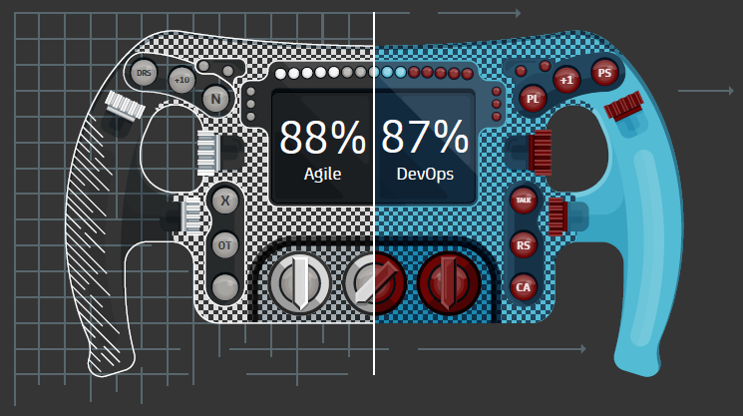
    The report, titled, “Accelerating Velocity and Customer Value with Agile and DevOps,” finds some form of adoption among nearly every enterprise, with 87 percent having adopted agile to some degree and 73 percent leveraging DevOps.

    Related to the overall maturity of these practices, those organizations that are moving to embrace the techniques most broadly are predictably seeing greater returns. Yet, despite the widespread adoption, only a third have deployed either practice widely, according to the research.

    Percentage of Advanced Adopters Reporting Improvements in Customer Experience


    Based on a survey of 1,770 senior business and IT executives, the study also closely investigates the specific KPIs that organizations are using to gauge how agile and DevOps initiatives are translating into customer interactions.

    Most notably, “advanced” agile and DevOps adopters have observed more than an 87 percent improvement in overall customer experience, compared to “basic” adopters.

    In terms of how those efforts are affecting business drivers, Coleman Parkes finds:

    • Advanced agile practitioners are experiencing a 40 percent improvement in time-to-decision, compared to 33 percent for basic users.
    • Advanced DevOps adopters have noted a 42 percent improvement in speed-to-market, compared to only 24 percent for basic practitioners.

    Key Performance-Invoking Indicators

    To that end, the research highlights specific KPIs that organizations are using to measure the impact the agile and DevOps practices are having on customers. In fact, the study finds that between two thirds and three quarters of all the organizations surveyed have established such measurements.

    At least half of these focus on business or customer-related metrics, reflecting how “critical software has become to businesses’ ability to achieve their core mission,” Coleman Parkes researchers note.

    Among the mostly widely invoked metrics, include:

    • Business growth (specifically revenue): over 73 percent
    • Operational or process efficiency: over 73 percent
    • Employee productivity: over 73 percent
    • Customer experience: over 71 percent
    • IT-related costs: over 71 percent
    • Speed-to-market: over 71 percent
    • Customer satisfaction (via NPS): over 70 percent
    • Time-to-decision: over 70 percent
    • Quality of development: over 70 percent
    • Employee retention: over 64 percent

    If increasing applications delivery speed and overall organizational velocity are, in fact, the primary goals of engaging agile and DevOps, the research bears out that the techniques are having the desired effect. After all, the survey finds that time-to-decision and speed-to-market are being accelerated among approximately a third of the organizations studied.

    Related to other notable KPIs, Coleman Parkes highlights that a full three-quarters of adopters have moved the needle on overall customer experience, along with employee recruitment and retention, a significant benefit that was also highlighted in the State of DevOps Report.

    Along with positively impacting customers, the reality is clearly that agile and DevOps are also making a big difference in allowing companies to improve the atmosphere for their workers—a huge benefit when you consider the shortage of talent in IT today, and how much it typically costs to attract new employees, just as DORA’s researchers noted.

    Other key findings by Coleman Parkes include “before and after” metrics that many organizations are observing related to their continued adoption and advancement of the involved methodologies themselves.

    I encourage you to download the entire report, and leverage it to measure how far you’ve come with Agile and DevOps transformation—and where you may need to re-examine your efforts.

    — Aruna Ravichandran

  • DevOps by the Book in 2017: Where we Really Stand

    DevOps by the Book in 2017: Where we Really Stand

    Now that the year-end prediction season is over, it’s time to focus squarely on the actual here and now—where the DevOps movement actually stands at the start of 2017.

    As we’ll need to wait another six months or so for the annual State of DevOps Report to emerge from the good folks over at DORA and IT Revolution, which forces us to take stock of the situation using other resources. In this case, I’ll point to the recently released book, “DevOps for Digital Leaders,” authored by my colleague Aruna Ravichandran along with co-authors Kieran Taylor and Peter Waterhouse.

    Register today for the upcoming webcast, “Chart a Winning Course: DevOps for Digital Leaders,” and enter the chance to win a free signed copy of the book [U.S. only].

    Why should you value this book over any of the other DevOps-related titles inundating the technology literature scene, in particular those issued by (gasp!) technology vendors? I’d cite two very specific reasons: real-world metrics and use cases.

    I often preview any comments I make in cross-functional meetings with the phrase “shameless marketing.” That is because I work in marketing. For 12-plus years prior and sometimes in between marketing gigs I’ve served as a journalist, wherein my job was to attempt to be as objective as possible. Today, I work for a vendor that would really like to sell you stuff.

    That said, this current career path does not preclude me from being able to see beyond my own not-so-secret agenda. While many onlookers understandably groan and roll their eyes at the manner in which DevOps has been co-opted by marketers as a means to advance products, this doesn’t mean we’re all full of it.

    Like myself, working at CA—in particular, leading marketing efforts that span a huge array of strategic technologies actively being leveraged by global enterprises to attack various elements of DevOps—has given Aruna and her partners tremendous insight into where many people stand in terms of maturity.

    To that end, this book is written around some fantastic stories about how some of these organizations are refining best practices and measuring real success in domains including continuous testing, release automation and shift-left monitoring. IMHO, these are some of the hottest areas of DevOps being advanced as we speak.

    In addition to these use cases and related practices, the book takes an up-close look at critical aspects of the DevOps build, test, deploy and manage stages, along with key processes related to tuning and continuous improvement. And it even goes so far as to talk about essential DevOps tooling. I hope people are ready to acknowledge that beyond culture and leadership, automation absolutely plays a significant role in all of this.

    Specific to metrics, one of the areas where the State of DevOps peeps attempted to break new ground in the 2016 report, there’s a lot to appreciate. The book takes a close look at how these same organizations are attempting to tie DevOps-driven change directly to ROI, including the all-important customer experience.

    Worth noting, in the coming days we’ll also see the release of a new report from Coleman Parkes that charts numerous KPIs being used to this same end, so stay tuned.

    So there you have it, the marketer has officially hijacked this blog space to do little more than market a book about DevOps written by marketers. But, the truth is that’s not all.

    If you really want to hear the best parts of this story, sign up for the upcoming devopsy.kinsta.cloud webcast, “Chart a Winning Course: DevOps for Digital Leaders,” in which Aruna and Alan Shimel will discuss the high points, with an emphasis on fielding questions from the audience live Q&A style.

    If you don’t have time to read the book—or, better yet, you want a preview to ensure that what I’ve written here is true—post up and ask your own questions. We’ll also be conducting live polls about DevOps maturity, audience use cases and the leading types of DevOps metrics.

    It’s worth noting that all proceeds from the print edition will go to Foundation for Excellence, which provides STEM scholarships to children in India. Order your own copy today (or download it for free).

    — Matt Hines

  • A Holiday Tradition: 2017 Continuous Delivery Predictions

    A Holiday Tradition: 2017 Continuous Delivery Predictions

    It’s that time of year. As the calendar year comes to a close, many of us are following time-honored traditions: making preparations for the holidays, planning some much-deserved time off and enjoying time with friends and family.

    In the business world, the year-end also brings its own traditions, and first among those is making predictions for the coming year. I’m not one to forgo traditions, so in this article I’ll share my thoughts on the upcoming year within the context of the continuous delivery movement.

    To level set, continuous delivery is the most evolved and modern state of software development and testing—and is core to a successful DevOps strategy. Organizations that are able to achieve continuous delivery can rapidly develop, test and release applications—with higher quality and at lower costs.

    Simply put, the ability to more continuously deliver software is one of the biggest advantages to attain in the application economy, where the battleground for consumer loyalty is most often found in the ability to deliver superior applications.

    Now that we know what continuous delivery means, let’s get to my predictions for 2017:

    1. Continuous Delivery Means Continuous Everything

    Continuous delivery is still a relatively new concept, and one that many organizations strive to achieve. As a new concept, it suffers from some of the misconceptions that often plague emerging technologies or trends. Many technology providers latch on to the term and claim to provide “continuous delivery solutions” that in reality only address a small part of the continuous delivery challenge.

    Truly delivering software continuously means that all the tasks within the software development life cycle (SDLC) must be optimized to occur in parallel and continuously. This means development must be continuous, testing must be continuous, and likewise for release and operations.

    2017 will be the year that industry embraces the importance of an end-to-end continuous delivery value stream. In 2016, many organizations began their continuous delivery journey by addressing certain aspects of the SDLC; in 2017 many organizations will begin to realize a truly open and integrated continuous delivery workflow.

    1. Democratization of Continuous Delivery Tools (via the Cloud)

    Optimizing all aspects of the SDLC for continuous delivery, as mentioned above, means that related tools need to be easier to use and easier to access. Developers who have access to testing tools (left-shift) can improve the quality of code they produce. Similarly, QA engineers who have access to design requirements sooner can create more accurate test data and scenarios, earlier.

    However, for this to occur, the tools have to be both easy to access and simple to use. Developers have avoided complex testing frameworks, but with simple, easy-to-use tools available—often in SaaS forms—developers can certainly incorporate testing into their methodologies.

    In 2016, CA acquired BlazeMeter, which pioneered the notion of cloud-based performance testing employing a simple and easy-to-use (yet very powerful) product. We expect to see this trend expand into other tools within the continuous delivery value chain in 2017.

    1. The Industry Embraces Open Source (Really)

    In the past, we’ve noted that commercially motivated technology providers have tried to keep open-source technology “at arm’s length.” There may have been some lip service paid to openness, but in reality many commercial providers felt threatened by open-source solutions that were seen as competitive to their products.

    This perception has already started to change, but I believe 2017 will mark the tipping point where companies will truly embrace open-source solutions as part of their strategy; those companies that continuously resist (pun intended) will be at a significant disadvantage.

    Open source is important for many of the same reasons as the cloud: It is broadly adopted because it creates advantage in time to market, quality and cost effectiveness. Embracing open source—and by that I mean both integrating with open-source solutions and using them as part of a product strategy—only makes good business sense. It helps software development teams meet their objectives in delivering quality software faster, and at lower cost.

    Another year is rapidly coming to a close and we have a lot to look forward to in 2017.

    On the topic of continuous delivery, looking forward means spreading continuous delivery throughout the SDLC, using the cloud more and embracing open source.

    All of those things combined will help us advance the continuous delivery movement together as an industry. Here’s to another year of continuous delivery advancements!

    Don’t forget, you can also take a closer look at the ongoing evolution of continuous delivery and other DevOps-related trends by picking up a copy of my colleagues’ new book, “DevOps for Digital Leaders: Reignite Business with a Modern DevOps-Enabled Software Factory.” If you have some extra time over the holidays, you’ll find it to be an interesting deep-dive.

    — Jeff Scheaffer

  • Assembling the Key Components of Continuous Delivery

    Assembling the Key Components of Continuous Delivery

    As agile methodology was popularized at the start of last decade, engineering teams gained the opportunity to begin producing software in shorter cycles, while releasing it reliably at more frequent intervals.

    This concept garnered greater attention in 2009, when Tim Fitz published his thoughts on continuous deployment. By the time Jez Humble authored his seminal book, “Continuous Delivery: Reliable Software Releases through Build, Test, and Deployment Automation,” in 2010, the approach started to get significant mindshare. In the book, Humble advanced the three building blocks of continuous delivery: configuration management, continuous integration and continuous testing.

    Thereafter, Agile Operations—the practice of using end-to-end monitoring, fueled by analytics, to increase operational agility—appeared. This complemented continuous delivery, with the goal of increasing the quality and velocity of software delivery while minimizing overhead.

    Since then, and particularly over the last six years as DevOps adoption has exploded, there’s been significant discussion (and confusion) over the opportunity to embrace “continuous everything” across the software development life cycle (SDLC) to deliver functionality continuously and optimize end-user experience.

    Today, having spoken to hundreds of organizations employing agile and DevOps, it’s possible to expand on these concepts to better define the key components of continuous delivery.

    In this blog, I’ll detail the precepts of “CD” that CA’s customers recognize as critical in reducing the time, risk and expense of software delivery by frequently releasing smaller batches of code with extensive visibility and traceability.

    These building blocks of continuous delivery are:

    • Continuous development & integration,
    • Continuous testing. and
    • Continuous release.

    Continuous Development and Integration

    When it comes to delivering quality apps faster, every second counts.

    That’s why it’s important to automate the planning, development, unit testing and integration of code with different inter-dependent components, all while packaging it for quality assurance. We categorize these activities under continuous development and integration, as shown in Fig 1.

    This all starts with sprint planning and modeling of requirements in agile management software. Unit tests can be created automatically, based on requirements and use case stories. These unit tests then can be executed automatically based on pre-defined criterion, using automatically generated synthetic data.

    Fig 1: Continuous Development and Integration

    Next, virtual service interfaces can be generated automatically by simulating unavailable systems across the SDLC, allowing developers, testers, integration and performance monitoring teams to work in parallel—driving faster delivery, along with higher quality and reliability.

    The integrated code can be built and tested automatically against validation criterion, and upon passing, made available for continuous testing. This later phase, after code development and before QA, is also commonly referred to as continuous integration.

    Continuous Testing

    Continuous testing across app delivery not only enables enterprises to shift testing left, engaging it earlier in the SDLC, but it also helps them shift right, leveraging the same processes throughout staging and production.

    After the unit tests are passed and integrated builds are made available for QA, functional and performance tests can be completed—before the build is made available for staging and production. Various activities during continuous testing are shown in Fig 2.

    Before the functional and performance tests are performed, the build promotion criterion and configuration also need to be validated. Testers require provisioning of QA environments to deploy the build, along with virtual services and test data. Using test data management to create a subset of production data and mask sensitive information is another continuous testing requirement.

    Fig 2: Continuous Testing

    It’s also important to engage application performance monitoring in the QA environment before running automated tests, providing feedback about any problems back to developers.

    After the automated tests are executed and promotion criterion are met, the build is ready for deployment in staging or production environments.

    Continuous Release

    Continuous release matches release velocity to development velocity through controlled and scalable deployments.

    The goal of continuous release (sometimes referred to as continuous deployment) is to continually and automatically deploy the build into production; similar activities also can be performed in a staging environment.

    As shown in Fig 3, build configuration needs to be validated, with the production environment configuration updated before being sent to production. As with application code, configuration is also maintained in the version control system and can be automated for deployment.

    Fig 3: Continuous Release

    After the build is deployed into production, application monitoring should be initiated to track performance and customer experience. Feedback from the production environment can be passed back to developers to guide enhancements or sprint backlogs.

    This blog aims to outline core CD activities, and in subsequent articles I’ll provide additional details on entry and exit criterion, as well as metrics useful in tracking continuous development & integration, continuous testing and continuous release.

    In the meantime, check out, “DevOps for Digital Leaders: Reignite Business with a Modern DevOps-Enabled Software Factory,” a new book authored by my colleagues Aruna Ravichandran, Kieran Taylor and Pete Waterhouse.

    Based on learnings gained from numerous customers who have already embraced CD and DevOps, it highlights key practices for starting this journey, related ROI metrics and other useful tips.

    — Anand Akela

  • Four Inspiration-Killing Concepts That Need Redefining

    Four Inspiration-Killing Concepts That Need Redefining

    Software engineering is a creative process, and creativity cannot be measured by the hour. It can be measured only by the value of the contribution. Yet, a majority of companies still measure productivity by hourly contributions. Companies treat the development process as if it still existed in the days of the assembly line, and all we needed to do was to affix 100 widgets a day. This mindset pisses off developers, kills inspiration and causes developers to quit.

    So, how do we measure progress in our companies? How do we ensure that we can increase our probability of success? These are necessary questions for businesses, and it’s easy to see why companies cling to the rules of the past. It’s all we know. And it is a big gamble to change. After all, shareholders and such.

    It will take true visionaries to rewrite the rules. And although many new companies are doing wonders for changing the way we define work, we still have a long way to go. So the question now stands: What does the ideal dev process look like in the future? It might be helpful to attribute new words to the dev process to help us gain better understanding.

    New definitions for the Internet Era

    Task → Contribution

    Approval → Collaboration

    Workplace → Remote

    Workers → Culture

    Task → Contribution

    Remove the worker from the assembly line, and give them a seat at the decision makers’ table.

    This trend has already started in the open-source community. What used to be a to-do or a task is now an “issue” on GitHub or GitLab. If you think about it, task implies, “You got to do this whether you like it or not!” It’s involuntary but necessary involvement; you being creatively engaged with the task is optional. We embraced this unnecessary definition and are justifying it for no reason.

    We have established that creative workers don’t like to be told what to do and how. We should have contribution meetings where creative workers decide what they would like to work on. Unfortunately, many decisions are made in meetings where business owners pre-decide needs and delegate to managers to distribute tasks among engineers. If you want to lose creativity in your team and make everyone feel bad, this top-down approach works exceptionally well. We see the Band-Aid solutions to this top-down approach all over the place now. The manager needed to find ways to motivate workers. How? Ping pong tables! Free laundry! Ice cream! You get the idea. Most creative people see right through that garbage. It’s only novel to inexperienced recent grads who have yet to understand how the real world works.

    You will not have an engaged workforce unless you empower them and let them decide how to give value to the company. The easiest way to achieve this is to communicate transparently to the company what the business requires and give a detailed description as to the reasoning. From there sit back and watch the engineers chime in and say, “Hey, can I do that?” or, “What about this other problem we have?” I believe we could then change the perception from, “This is what I’m expected to do,” to “This is what I’m contributing to the company and I’m passionate about it.”

    Approval → Review

    This change is also apparent in the open-source world, when you submit your changes to a source code repository, your peers can take a look at it and see if they can contribute to its quality. In the past, this process was called “approval” and now is called “review,” where in fact your peer is approving the piece of code you’ve written. Approval implies. “I have authority over you,” whereas review says, “I’m going to help you get this done.”

    Workplace → Remote

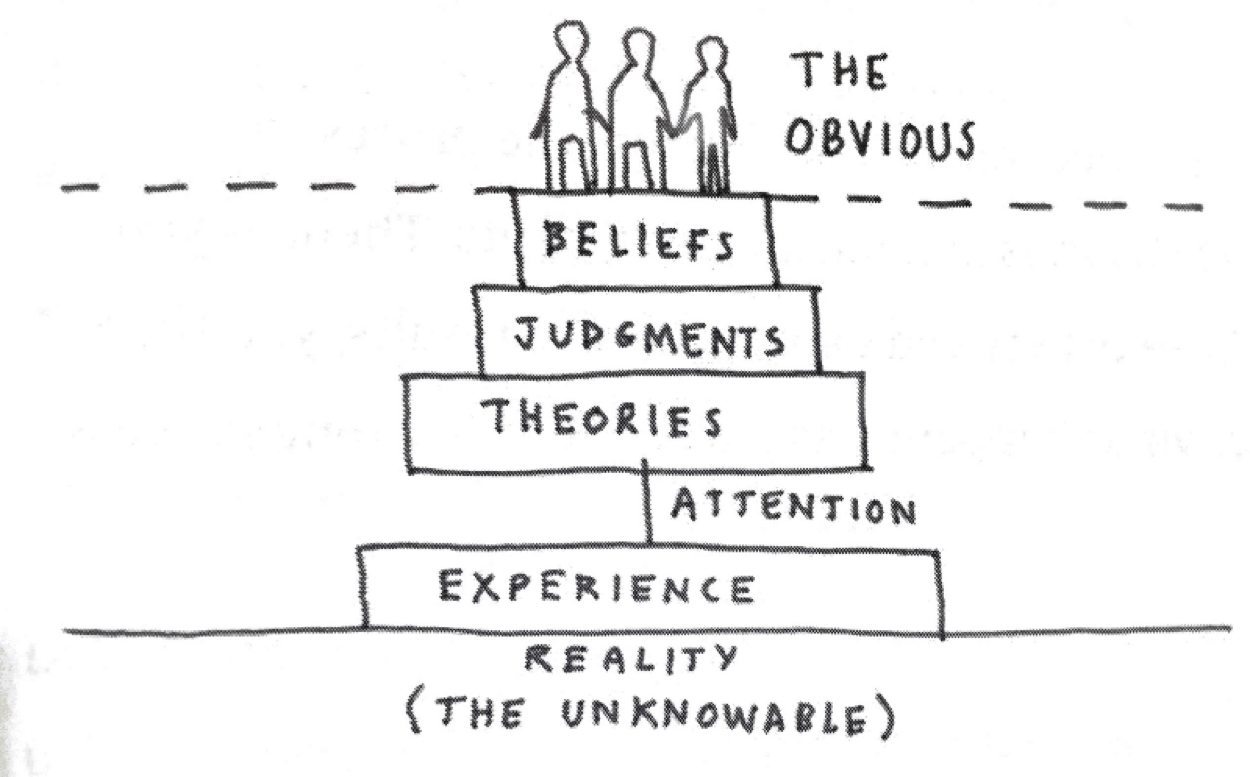
    Dave Gray makes some really interesting points about how we make decisions in his book, “Liminal Thinking: Create the Change You Want by Changing the Way You Think.” He suggests that we only have the ability to make theories, judgments and beliefs based on our personal experiences. And even in our experiences we are only able to process a minuscule sliver of the information available.

    picture1David Gray’s diagram of how we come to our understanding of what the obvious choices is in a situation.

    If we apply this idea to the way we feel about our workplace, then we can quickly see the we are reducing the number of creative solutions available to our workforce. If everyone one of your creative workers gets to work from 9 to 5 at the same desk doing relatively the same thing daily,  they will start narrowing their understanding of what is possible. Just imagine what different solutions might arise if your employee is sitting outside at a lake or in a crowded bar. Their experience would change, thus their well of experience deepens, and their concepts of what is possible, multiplies. Make sure your developers experience new things, both as individuals and as teams. This doesn’t just mean offsites for team-building. It means, let them follow their gut, and work from wherever they need from time to time. This doesn’t mean let them go solo and unplug for days at a time. They need to stay plugged into the team and be a contributing part to the culture, but they need to balance that with building fresh perspectives so they can contribute to the collective experience of the whole.

    Workforce → Culture

    Yes, I know. “Culture” is one of those buzzwords that now cause people to roll their eyes so far back in their head that they fall out. But it’s important to know why the concept is important in relation to the old idea of “the workforce.” When management thinks of its developers as “workers,” the developers are immediately dehumanized and turned into pawns. They are expendable and indistinguishable as creative minds. They act out of fear from punishment and rarely take chances.

    We are no longer cogs in the corporate machine. Our ability to take risks can make the difference between being one of the 99 startups that fail, or the one tech company that succeeds. Managing culture as opposed to a workforce means that we can focus on enabling workers to be as creative as possible. We can focus on nurturing collaboration and honest feedback. A healthy culture is one that is transparent and communicative. A workforce could give a rat’s ass about making positive change. A culture is a living breathing thing that everyone contributes to and improves. A culture is owned by the collective. A workforce is owned by a man in a suit at the top of the tower. Screw the man. Power to the people.

    Conclusion

    Now that we have an understanding of why we must redefine our terminology, it’s time to start defining practical ways to make the switch for each term. In my upcoming writings I will start to lay out practical ways to make the switch in your company.

    About the Author / Devrim Yasar

    devrim_yasarDevrim is the CEO of Koding, a San Francisco-based software development automation platform vendor. Connect with him on LinkedIn and Twitter.

     

  • DataOps: Time to Bring DevOps Ideas to Big Data

    DataOps: Time to Bring DevOps Ideas to Big Data

    What can data scientists learn from DevOps? A lot, actually. By applying DevOps principles to the world of big data, you get DataOps, which streamlines data analytics.

    If you’re reading this site, you’re probably already familiar with DevOps. The DevOps philosophy emphasizes continuous collaboration between software developers (the “dev” people) and system admins (the operations, or “ops,” folks)—as well as everyone in between, such as software testers.

    It’s possible to apply similar ideas to the world of big data and data analytics. There, as in the world of software development and delivery, different teams traditionally have worked in isolation from one another. Those teams include storage admins, who keep data storage systems running; data analysts, who write and execute programs for interpreting large volumes of data; data quality specialists, who ensure data consistency; and data security teams, which protect data from attackers.

    As DevOps professionals know, keeping different teams isolated from one another is not efficient. It limits collaboration and maximizes confusion when problems occur.

    The data world, therefore, has much to gain by ending this isolation between teams and adopting a DataOps workflow. This will keep data operations flowing smoothly and provide continuous insight into the data that organizations collect.

    DataOps is not a brand new concept. People like Andy Palmer have been writing about it for a little while now. But the term and the idea have yet to gain nearly as wide a following as DevOps. (There is not yet even a Wikipedia entry for DataOps—and you know an idea is still in its infancy when no one has taken the time to write about it on Wikipedia.)

    Making DevOps Bigger

    Meanwhile, from the DevOps perspective, the growth of interest in DataOps is significant because it exemplifies the broad applicability of DevOps principles. So far, the DevOps conversation has focused on the relatively narrow context of software development and delivery. But it can extend much further, too. DataOps is a start.

    So, if you’re a data analyst, storage admin, data security professional or someone who works with data in any other capacity, it will be worth your while to borrow some ideas from your DevOps brethren. And if you work in software development, testing or delivery, it may be worth your time to educate your data friends on DevOps principles. It will make their workflows more efficient, while introducing DevOps to a wider audience.

    — Chris Tozzi

  • DevOps: Using Games to Make it Practical

    DevOps: Using Games to Make it Practical

    This blog stems from my experience of being one of the earliest DevOps Foundation trainers of DOI and successfully completing 19 batches of DOI Foundation course in the last year.

    In retrospect of the year starting when TaUB Solutions signed up as a registered education partner (REP) of DOI, my opinion is this has been the best service portfolio offering for our customers and partners.

    There are few things that appeal best when it comes to DOI Foundation course and I can summarize them with the collective feedback I’ve received so far:

    “Challenges the preconceived myths and practices around DevOps with practitioner stories.”

    “Gives a holistic overview of philosophy behind DevOps. Philosophy should precede science and science should precede engineering.”

    “This course maintains the discipline to be truly advisory in nature by illustrating tool chain without recommending vendor-specific tools.”

    “The group exercises during the class and the facilitator practical insights helped us to put the aspects in to our organizational context of delivering products and services.”

    “We have never seen a course such beautifully designed that could be the first basic building block to know ‘Do’s’ and ‘Don’t’s’ of DevOps across application developers, infrastructure operations, project managers, infosec professionals and business leaders.”

    To enhance the overall learning curve of the audience, we put them in to the third day of experiential learning using the Phoenix Project Business simulation. The simulation was divided into four rounds and played with maximum of 12 people per batch. The Team was entrusted to achieve a target of $300,000 within four rounds and take the share value from $21 to $45.

    While the target milestones were clearly laid down at the beginning of game it was difficult for the teams to get hold of the situation due to various unknown parameters. It took them quite sometime to understand the different moving parts of flow, dependencies, business impact of projects, issues and features that came up in every round and make  appropriate choices and decisions.

    The teams experienced significant learning, sharing and collaboration over the four rounds and had loads of fun. One common feedback from the teams was for the game to be mandatory after every two-day DevOps Foundation course.

    The consolidated feedback after playing the DevOps business simulation after the two-day course:

    “It demonstrated that it is not easy to build collaboration, communication and integration. It takes time and there is a lot of patience and team work needed to make this a reality. The DevOps culture had to be nurtured through self-organizing teams with mutual respect, sense of pride and collective ownership to work toward a common goal.”

    “It gave a working knowledge on how ITSM and DevOps are complementing each other [Ex. Change Management and Improved Flow].”

    “The Principles of DevOps, namely the First Way (Improve Flow from left to Right), Second Way (Shorten Feedback Loops) and Third Way (Repetition through Mastery) was visibly evident over the course of four rounds.”

    “The speed of execution improved over the rounds using short feedback loops, continual improvement and applying lessons learned from previous rounds.”

    “It gave a good understanding of how different roles and responsibilities in the organization contribute to the overall success of the project.”

    Finally, the teams made over and above the required target of revenue and stock price. The winning moment was enhanced by the significant learning opportunity and ability to bond with diversified cross functional teams.

    The experience of playing the business simulation reinforced practical understanding of DevOps and also transferred skills that they could implement immediately at their workplace.

    About the Author / Suresh GP

    sureshSuresh GP is the Managing Director of TaUB solutions and Regional leader of BRMI (APAC). He has more than 15 years of experience in IT Service Management, IT Governance, Program Management and Organizational Change Management. He is regular blogger and International speaker at itSMF UK, itSMF Australia, itSMF USA, itSMF Finland and itSMF Norway. He is a Certified DevOps, Agile Service Manager, Business Relationship Management Professional, PMP, CGEIT, ITIL V2 Service Manager, ITIL V3 Expert,  ISO 20000 practitioner. He was awarded the ITSM contributor of the year by itSMF Singapore in 2013.

  • Industry Alignment: Supporting Real-World DevOps Workflows

    Industry Alignment: Supporting Real-World DevOps Workflows

    In our ongoing work to advance the interests of customers around adoption of Agile, DevOps and continuous delivery, the theme of evolving workflows to better suit human-scale work cycles often comes to the fore.

    While  it’s easy to say that build, test, release and monitoring capacities should feed into each other to promote continuous collaboration, realizing this vision in the form of integrated tooling is still no trivial feat. And it is further exacerbated by the reality that DevOps teams typically utilize a wide range of products built by a diverse set of providers, from larger players such as CA Technologies to open-source projects.

    If the goal is to drive  application lifecycle processes and supporting technology to better support human work cycles—along with accelerating organizational velocity and improving quality—somewhere in this domain of tooling integration there’s a need for relevant vendors to participate.

    That work officially begins today.

    At the Jenkins World 2016 conference this week, CA, along with a dozen other leading DevOps solutions providers and the DevOps Institute, announced the DevOps Express consortium. Joining us, along with CloudBees and Sonatype, which spearheaded this effort, are Atlassian, BlazeMeter, Chef, GitHub, Infostretch, JFrog, Puppet, Sauce Labs, SOASTA and SonarSource.

    So what’s the big deal? The direction of this initiative—which will focus first on supplying reference architectures that describe field-tested integrations of best-in-breed solutions—strikes directly at the heart of the central DevOps tenet: collaboration.

    The immediate result is that these providers are moving to boost interoperability across a typical production DevOps toolchain. It is truly noteworthy that these solutions providers, some of whom maintain palpable competitive interests, are putting aside those considerations to advance the interests of end users; that is a very DevOps phenomenon.

    In many other areas of IT, this type of cross-pollination either never commences or doesn’t emerge until the sector is so well-established that industry collaboration seems more of an effort to fend off perceptions of commoditization. To anyone familiar with the incredible pace of innovation ongoing in the automation sector, and the potential for competition between many of the companies involved in DevOps Express, it should be immediately obvious that this is a partnership that truly puts customers first.

    Yet, if we’re serious about empowering the kind of wholesale software factory reinvention that we espouse around DevOps, this is something that had to take place. How can an industry talk endlessly about eliminating stovepipes and marrying long disparate processes, and then defer to a walled garden worldview as it relates to the enabling products? That certainly wouldn’t really add up.

    It’s amazing to see what’s going on in the world of technology these days, and ever more exciting to be a part of it. We’re proud to be a member of DevOps Express.

    It’s a great time to be involved in this space.

    — Jeff Scheaffer