Tag: code

  • Generative AI: The 90% Rule

    Generative AI: The 90% Rule

    There is a concept we need to solidify that I will call the 90% Rule—until someone smarter than me comes up with a better name. The 90% Rule is simple: Generative AI will be able to do 90% of the work in areas that it is good at. Right now, that would be writing, but coming up soon will be image generation and coding and, not too long after that, video generation. For those of you buried in the space who are offended, I’m not rating it as advanced as it is for specialists; the point of generative AI is not to let AI specialists do things, but to let average people in the space do so. And that list is representative of the current space.

    This is just based upon the state of things at the moment I wrote this blog, but that seems to be the immediate order. I’m only talking generative AI here—AI for things like filtering test results is a completely different beast (that might just meet that 90% rule … Hmmm). I can tell generative AI to write a story, a script or code for me, and tweak the results. The amount of tweaking certainly depends on the topic and how much time I spent zeroing it in, but 90% seems right. There are those looking far ahead to a time that will herald the arrival of our AI overlords, but for the foreseeable future, we will not be ditching authors, coders and ops people. Our jobs will just change.

    Crikey—given the last few decades, a change to our jobs that means less work is not a terrible thing. Today, writers have to be publishers and marketers, coders have to be ops and ops have to be coders and the entire group has increasingly had to be security and architecture specialists, too.

    Let’s celebrate a tool that says, “Here’s a start, make it useful in your specific situation.” I know I will. I sometimes contract people to do initial research for me and send me links and short descriptions. I encourage them to use generative AI to do so. I do not contract people with my level of knowledge for this work, so they’re going to have things I need to read carefully and follow the links for—they’re not specialists, after all. Generative AI suffers from this syndrome, too, but that means there is no difference for me and they can work smarter, not harder. It’s not like they are writing content; merely providing introductory research through a scan of web properties.

    As time goes on, I expect they will become specialists. But not in the things I pay them to research—in making generative AI do what they want. I would argue the person I contract with the most often is better than me at it, just because she’s doing it regularly. That skill set will inevitably be transferrable, and I may lose her to a full-time position making the I in generative AI actually mean something, and I’m great with that. Meanwhile, I’m getting the background info I need to do my job(s).

    Embrace it. Aim for 90%. Turn out even more rockstar-level apps for the org, and maintain them with less effort. This is where we’re headed, and it’s entirely possible you’ll be less buried in work for some of that time. Win/win. Go out and enjoy. The business will thank you for being even more productive … then waste that extra time you created by implementing new projects. But that’s in the future; use AI in the short term to get some breathing room and still be the force behind the apps.

  • Despite Concerns, AI Increasingly Used to Build Software

    Despite Concerns, AI Increasingly Used to Build Software

    A survey of 1,001 senior technology executives, developers, and security and operations professionals published this week by GitLab finds 67% are working for organizations already using artificial intelligence (AI) to build software, with 60% of those respondents reporting their organizations use it every day. A full 90% said their organizations are either already using or plan to use AI to build software.

    More than half (51%) have already identified productivity as a key benefit, but 32% are also “very” or “extremely” concerned about introducing AI into the software development life cycle (SDLC).

    Those concerns included AI-generated code introducing security vulnerabilities (39%) and whether that code may not be subject to the same level of copyright protection as human-generated code (48%). A full 95% of senior technology executives said they prioritized privacy and intellectual property protection when selecting an AI tool.

    Most organizations will continue to move forward with AI, but nearly two-thirds of respondents (65%) who use or are planning to use AI for software development said their organization hired or will hire new talent to manage its implementation.

    A full 81% cited a need for training to successfully use AI in their daily work, with 75% of respondents saying their organization provides training and resources for using AI. However, a roughly equal percentage also said they are finding resources on their own.

    David DeSanto, chief product officer for GitLab, said it’s already clear that AI will have a major impact on productivity simply because 75% of a developer’s time is typically spent on activities that have nothing to do with writing actual code.

    Less clear is the amount of expertise required to use AI to build software. In some cases, development teams may need to master, for example, prompt engineering to automate DevOps workflows at scale, but in many more instances, it’s likely the DevOps platform will automatically execute the commands required.

    Regardless of approach, it’s clear that as the amount of code being created by developers starts to steadily increase, the need to leverage AI to manage DevOps workflows will become more acute. The challenge is the pace at which developers can leverage AI to write code is, for the moment, exceeding the pace at which it is being embedded into DevOps platforms.

    In addition, organizations must determine whether to converge DevOps workflows with the machine learning operations (MLOps) workflows used to build AI models that are integrated into applications. As more MLOps capabilities are added to the GitLab platform, it will become easier to achieve that goal and enable data scientists to work more collaboratively with DevOps professionals, noted DeSanto. Today, a cultural divide between two distinct IT cultures is slowing down the pace of AI innovation.

    One way or another, DevOps workflows are about to be transformed. The challenge now is determining which tasks and bottlenecks are likely to be eliminated by AI to enable DevOps teams to focus on managing applications at an unprecedented scale.

  • Grafana Labs Delivers Open Source Code Profiling Tool

    Grafana Labs Delivers Open Source Code Profiling Tool

    Grafana Labs this week released version 1.0 of an open source tool that collects data about an application’s code to aid debugging, troubleshooting and optimization efforts. The tool makes it simpler to identify the specific lines of code driving a process or task within an application.

    Ryan Perry, engineering director for Pyroscope at Grafana Labs, said Grafana Pyroscope 1.0 combines a tool acquired last year from a company he led with Grafana Phlare, a code profiling tool that Grafana Labs previously developed. The combination of the two tools provides a more precise code-tracking capability with an underlying database that is designed to scale horizontally, he added.

    For example, Grafana Pyroscope 1.0, which supports extended Berkeley Packet Filtering (eBPF) running on Linux systems, can now ingest, store and query workloads from any project of any size. Grafana Pyroscope 1.0 has already been used to profile more than 50,000 application instances at a rate of more than 6,000 unique profiles per second.

    The code profiling tool was added to Grafana Cloud Profiles, the hosted continuous profiling tool that Grafana makes available as a service, earlier this month.

    While the primary use case for Grafana Pyroscope is to troubleshoot applications, organizations are also using it to identify and then remove dead code within an application as part of a larger application modernization initiative, noted Perry. As updates to applications are made over several years, organizations frequently find that subsets of the application code are no longer needed, said Perry.

    The goal going forward is to add support for features such as flame graphs in GitHub pull requests, canary deployments, profile-guided optimization (PGO), integrating profiling with load testing tools such as Grafana k6 and integration with visual editors such as VS Code.

    In addition, Grafana Labs is committed to working with the OpenTelemetry project led by the Cloud Native Computing Foundation (CNCF) to ensure Grafana Pyroscope remains aligned with the OpenTelemtry effort to develop an OTel-native profiling tool. Grafana Pyroscope 1.0 will provide the ability to ingest data from that tool and contribute client-side instrumentation capabilities the company has developed.

    Grafana Labs is also working toward improving client-side software development kits (SDKs) to add more real-time agent management features, such as sampling controls, ad hoc profiling capabilities and alternative instrumentation options.

    Finally, Grafana Labs plans to improve eBPF integration for languages such as Python, Java and .NET.

    DevOps teams naturally spend a lot of time trying to optimize application performance and troubleshooting issues that arise long after an application is initially deployed. Code profiling tools are emerging as a tool that makes it much simpler to aggregate metrics, logs and traces and surface actionable insights that make debugging and troubleshooting applications much less tedious. The challenge is finding the time to identify and proactively address potential issues before they become another incident to manage.

  • Google Adds App Modernization Tools to Generative AI Platform

    Google Adds App Modernization Tools to Generative AI Platform

    Google this week added automated refactoring capabilities to the generative artificial intelligence (AI) tools it makes available to write code on Google Cloud.

    In addition, Duet AI for Google Cloud is now integrated with Google’s Apigee API Management and Application Integration services. This makes it possible to design, create and publish application programming interfaces (APIs) using simple natural language prompts.

    These additions to the preview of Duet AI for Google Cloud were announced at the Google Cloud Next 2023 conference and are scheduled to be generally available later this year. The new capabilities promise to reduce the time and effort required to modernize applications.

    For example, DevOps teams can now convert code written in C++ into Go and migrate that application to Cloud SQL, the managed relational database service that Google provides. Via a natural language interface, these tasks are launched via a prompt from directly within a development environment.

    Priyanka Vergadia, a developer advocate for Google, told attendees these capabilities will reduce the need to rely on consultants to migrate applications and take up much less time. In addition, the overall quality of the code should improve using large language models (LLMs) that have been trained using code written by Google developers and best practices defined by Google software engineers.

    Organizations will save time and effort because the need for developers to understand how existing application code was constructed is eliminated, she noted.

    Google has also started to work with select enterprise IT teams to allow Duet AI to incorporate knowledge from their libraries and codebases to generate more context-aware code suggestions.

    In addition to writing code, Google is making a case for also using Duet AI in Google Cloud to monitor performance and troubleshoot IT issues by identifying correlations across application environments. For example, natural language prompts can be translated into PromQL queries to analyze time-series metrics. Duet AI can also provide intuitive explanations of complex log entries in Logs Explorer for easier root-cause analysis and provide suggestions for how to fix issues that surfaced in an error reporting tool.

    Duet AI is also incorporated into the Google BigQuery service to help developers write SQL and Python code to access and analyze data. It can generate full functions and code blocks, auto-suggest code completions and explain your code and SQL queries. Via a single SQL statement, a query can connect tables with the foundational AI models Google makes available via its Vertex AI service.

    At the same time, IT teams can optimize prompts using BigQuery Studio tools, perform text analysis or generate new attributes to enrich a BigQuery data model. Duet AI also enables IT teams to generate vector embeddings in BigQuery to create semantic searches and recommendation queries.

    It’s not clear whether generative AI capabilities will automate entire DevOps and DataOps workflows just yet, but many of the tasks that once required automation scripts will soon be automated by AI models embedded within DevOps platforms. The challenge and the opportunity is to determine how to make those capabilities available to drive DevOps workflows at unprecedented scale.

  • Loosely Couple Your Schema and Keep Data Separate

    Loosely Couple Your Schema and Keep Data Separate

    In software development, one of the primary goals is to write clean, maintainable and extensible code. To achieve this, developers often strive to design systems that are loosely coupled and separate concerns into smaller, more manageable components. Loose coupling refers to the practice of designing components that are not tightly dependent on one another, allowing them to be modified or replaced without affecting the rest of the system. Separating data into distinct layers, such as a database layer, further contributes to this modularity by allowing developers to focus on writing business logic without worrying about data management. Together, loose coupling and data separation provide a solid foundation for building scalable and adaptable systems that enable developers to concentrate on writing high-quality business logic. This approach also lends itself to platform engineering best practices, a popular methodology that is being implemented or considered by developer teams today.

    Loose coupling is an important concept in microservices architecture because it helps to achieve the goal of creating modular, scalable and easily maintainable software systems. In a microservices architecture, individual services are designed to be independent, self-contained and loosely coupled, meaning they can be changed, updated or replaced without affecting other services or the system as a whole.

    There are several benefits to loose coupling in microservices:

    • Scalability: Microservices architecture allows scaling of individual services independently based on their needs, and with loose coupling, the interdependencies between services are minimized, allowing for better scalability.

    • Maintainability: With loose coupling, it’s easier to make changes to individual services without disrupting the system as a whole, reducing the risk of introducing bugs and making maintenance tasks easier to perform.

    • Flexibility: With a loosely coupled architecture, services can be developed, tested and deployed independently, enabling teams to work in parallel and make changes to the system without impacting each other.

    Platform engineering plays a crucial role in ensuring that microservices are loosely coupled. A well-designed platform should provide a standardized set of APIs, protocols and interfaces for service communication, as well as tools and frameworks for building, testing, deploying and managing services. This enables service teams to focus on developing their services rather than worrying about the underlying infrastructure and communication protocols.

    Moreover, platform engineering can also ensure that there is a standardized and centralized approach to security, monitoring and logging, which are critical aspects of microservices architecture. By providing a consistent and standardized approach to these areas, platform engineering can help ensure that individual services remain loosely coupled and can evolve independently, without negatively affecting the system as a whole.

    It’s All About Keeping the Schema Separate

    In platform engineering, the concept of keeping the schema separate typically refers to separating the schema of a database or data store from the application code that interacts with it. This separation allows for greater flexibility and scalability in the platform, as changes to the schema can be made independently of the application logic. By decoupling the schema from the application code, developers can avoid introducing breaking changes to the platform, and can more easily evolve and scale the platform over time.

    Separating the schema also allows for different parts of the platform to interact with the same data store using their own specialized schemas, without interfering with each other. This is particularly important in large and complex systems, where different teams may be working on different parts of the platform concurrently. By keeping the schema separate, teams can work independently and avoid stepping on each other’s toes, while still interacting with the same underlying data store.

    In summary, it’s all about the schema – don’t share databases and tables. The separation of data is fundamentally driven by that desire for loose coupling. Microservices should be as independent as possible from each other from design to development to production. Why? Efficiency. Disparate teams can change data structures and will not affect others versus the more traditional approach where we do share and it’s more cumbersome and involves more coordination between teams.

    Keeping schema separate in platform engineering is important for several reasons:

    ● Scalability: Each microservice owns its private schema, which enables the platform as a whole to scale more effectively. As the platform grows and evolves, it may become necessary to change the data schema without necessarily changing the underlying code. Separating the schema makes it easier to make these changes without disrupting the rest of the platform.

    ● Maintenance: Separating schema from code makes maintenance easier. It allows developers to make changes to the schema without needing to change the code, which reduces the risk of introducing bugs or errors.

    ● Collaboration: Separating schema from code makes it easier for multiple developers to work on the platform at the same time. When developers work on the code and schema separately, they can work independently without interfering with each other’s work.

    ● Flexibility: Separating schema from code provides greater flexibility for integrating with other systems or applications. It enables the platform to adapt to changing requirements or to interface with different data sources more easily.

    Separating Schema From Code is an Essential Practice

    By hiding data from service components from other service components, It provides guardrails and “just works.” While it does provide a form of coupling, it’s through messaging (typically asynchronous). Platform engineering encourages good design patterns from the start versus having to be more aware of these things. It’s a lot easier for especially newer developers that are not familiar with some of these architectural patterns and can get themselves into trouble.

    Overall, separating schema from code is an essential practice in platform engineering that provides scalability, maintenance, collaboration and flexibility benefits. It allows developers to build more robust and flexible platforms that can adapt to changing business requirements and technical environments.

  • New Relic Adds Module to Surface Code Metrics

    New Relic Adds Module to Surface Code Metrics

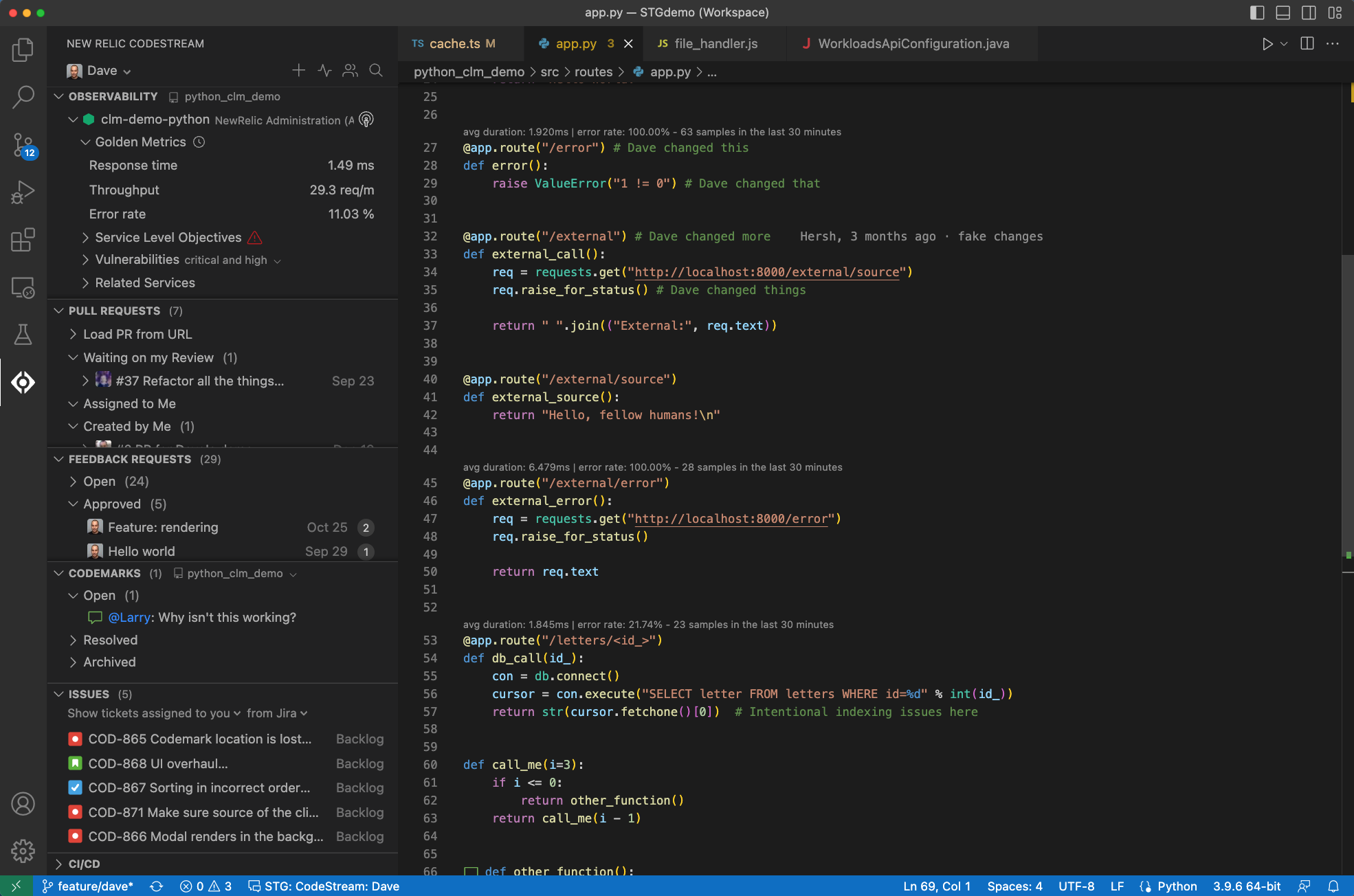
    New Relic today added a free CodeStream module to its observability platform to give developers access to metrics and telemetry data that will enable them to write higher-quality code faster.

    Peter Pezaris, group vice president and general manager of strategy and experience for New Relic, said this capability is part of an effort to shift observability left toward developers to optimize code as it is written and after it is deployed.

    CodeStream surfaces metrics and telemetry data within the integrated development environment (IDE) developers use to write software. Telemetry metrics are displayed as a line of text above the code or in the debugging tool used to troubleshoot an application. Alternatively, developers can view metrics via an observability panel at the service level. They can also view performance metrics such as error rates and response times for related services.

    That approach eliminates the need to wait for IT operations teams to surface issues that usually don’t manifest until long after the code in question was originally developed, noted Pezaris.

    The overall goal is to provide development teams with frictionless access to observability data at every stage of the software development life cycle, he added. That analysis capability will result in faster mean-time-to-detection (MTTD), mean-time-to-resolution (MTTR) and, ultimately, shorter development cycles, said Pezaris.

    Organizations should also be able to reduce technical debt faster by making it easier to identify issues that, for example, adversely impact application performance, he noted. That activity can be especially challenging because developers often inherit code written by someone else that often lacks clear documentation. CodeStream makes it simpler to onboard a developer to any application modernization initiative that has been launched to reduce technical debt, said Pezaris.

    A recent New Relic survey found only 27% of respondents have achieved full-stack observability, and only 5% claimed they have a mature observability practice in place. A third (33%) of respondents also said they still primarily detect outages manually or based on complaints, the survey found.

    On the plus side, the survey also found nearly three-quarters of respondents said C-suite executives in their organization are advocates of observability, and more than three-quarters of respondents (78%) saw observability as a key enabler for achieving core business goals. However, more than half (52%) of respondents said they experienced high-business-impact outages once per week or more, and 29% said they take more than an hour to resolve those outages.

    A full 82% of respondents said they use four or more tools to monitor the health of their systems. Only 7% said their telemetry data is entirely unified and only 13% said the visualization or dashboarding of that data is entirely unified. Nearly half of the respondents (47%) said they would prefer to have a single, consolidated observability platform, but only 2% said they currently used one tool for observability.

    Regardless of the approach to observability, it is clear that development and IT operations teams need to be looking at the same metrics and telemetry data at the same time to collaborate effectively.

  • AWS Previews Amazon CodeCatalyst to Automatically Create Dev Environments

    AWS Previews Amazon CodeCatalyst to Automatically Create Dev Environments

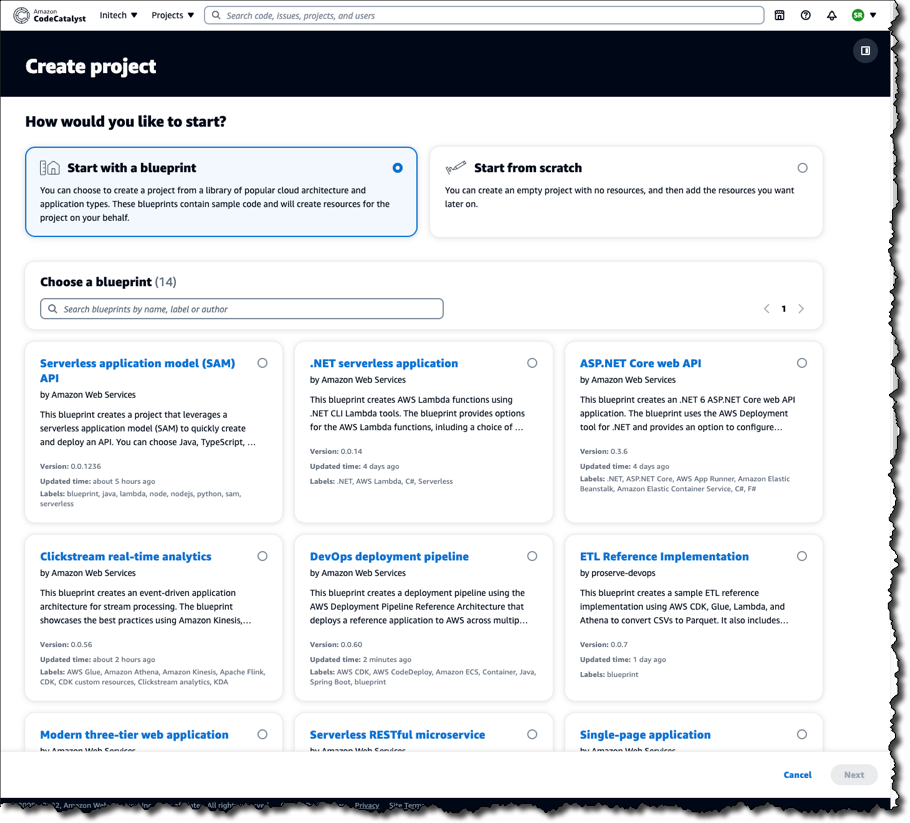
    Amazon Web Services (AWS) this week launched a preview release of the Amazon CodeCatalyst framework that leverages blueprints to automatically provision and configure developer environments in its cloud.

    Announced at the AWS re:Invent 2022 conference, Amazon CodeCatalyst takes advantage of a Project Blueprints tool to launch a source code repository and a project management tracker that are then used to create build and release pipelines. DevOps teams can use either the tools provided by AWS or substitute an instance of, for example, GitHub or the Jira project management software.

    Amazon CTO Werner Vogels told conference attendees the goal is to reduce the friction that developers currently encounter whenever they need to launch a new development project. As part of that effort, Amazon CodeCatalyst promises to make it simpler to consistently replicate development environments using scaffolds in addition to providing dashboards and search capabilities for tracking changes across commits, pull requests and deployments.

    Amazon CodeCatalyst uses a devfile to define the configuration of an environment that comes in four resizable instance options made up of two, four, eight or 16 virtual CPUs. The devfile defines and configures all the resources needed to code, test and debug a project. Devfiles, which are added to the source code repository by the selected blueprint, can also be modified.

    Collectively, those capabilities make it possible to deploy sample TypeScript, Python, Java, .NET, JavaScript, React, Angular and Vue code running in a few minutes. Developers can work with the AWS Cloud9 integrated development environment (IDE) or use tools such as JetBrains IntelliJ IDEA Ultimate, PyCharm Pro, GoLand and Visual Studio Code on their local machine. Developers, as a result, can simply switch between multiple codebases or collaborate with other developers as needed.

    The pipelines can be run on pre-provisioned builds in the cloud or organizations can opt to deploy their own container environments. Developers can incorporate build actions that are built in or provided by AWS partners in addition to incorporating GitHub Actions to compose fully automated pipelines that can be configured using either a visual editor or YAML files. Build and release pipelines enable deployment on Amazon Elastic Container Service (Amazon ECS), AWS Lambda and Amazon Elastic Compute Cloud (Amazon EC2) services.

    In general, Vogels advocated that IT teams should build event-driven applications that are loosely coupled to make it simpler to add new capabilities to existing applications running at scale without impacting the entire codebase. To make it simpler to build those types of applications, AWS added an Amazon EventBridge Pipes tool that creates point-to-point integrations between event producers and consumers in a way that eliminates the need to write that code. AWS also made available in preview a graphical AWS Application Composer tool that makes it simpler to design, configure and build serverless applications using infrastructure-as-code (IaC) definitions.

    It’s not clear to what degree developers will be embracing event-driven applications. As a programming model, event-driven architectures have been around for decades. The issue has been those applications also have tended to be among the most challenging to build and maintain. AWS is now clearly signaling its intent to make building those applications a lot easier.