Tag: code

  • Skillsoft Taps ChatGPT to Improve Developer Training

    Skillsoft Taps ChatGPT to Improve Developer Training

    Skillsoft today revealed it plans to add generative artificial intelligence (AI) capabilities to its Codecademy online training platform to provide developers with hands-on experience using ChatGPT to write code.

    Kunal Ahuja, general manager for Codecademy consumer business at Skillsoft, said the goal is to give developers a more curated path toward teaching them how to define prompts that will result in better code being generated. These enhancements will be made available to Codecademy Plus and Pro users as well as enterprise customers in the coming months, he noted.

    There’s no doubt that developers are relying more on generative AI to write code, but not all the output generated by platforms that are based on a general-purpose large language model (LLM) is going to be consistent. Codecademy provides a more immersive experience that enables developers to refine their prompt engineering expertise, said Ahuja.

    AI-enabled capabilities include code explanations and project hints to improve debugging skills, along with other real-time feedback surfaced via a virtual coding assistant. There are also courses such as “Prompt Engineering for Software Engineers” available.

    Finally, Skillsoft is also providing access to a mock interview simulator that developers can access to help determine if they are ready for a job interview.

    As it becomes more apparent that prompt engineering is a skill application development teams will need to master to build and deploy software, there’s a clear need to teach nearly everyone in IT how to craft prompts efficiently. Ultimately, the number of prompts used to generate code will have an impact on the total cost of building software.

    In the longer term, Skillsoft plans to build its own LLM using data it collects via its platform to provide training using an LLM that has been trained using code that has been curated, said Ahuja. One of the issues with a general-purpose LLM is that it is trained using examples of code pulled from across the web that varies widely in quality. That can result in outputs of code that have known vulnerabilities or that simply run inefficiently. Of course, it may be just as likely that a developer augmented by generative AI is, depending on their level of expertise, actually delivering higher-quality code.

    Despite those concerns, however, it’s still important to provide developers with the training they need today to remain competitive, said Ahuja.

    It’s not clear how much code these days is being generated by machines versus humans, but as the volume increases, the number and size of the software builds that need to be managed is only going to increase. Hopefully, as much AI will be applied to the DevOps workflows used to manage those software builds as there is being applied to writing code, but in the short term, at least, DevOps teams might soon find themselves overwhelmed.

    The one thing that is certain is DevOps teams have a vested interest in making sure the code being written by developers is of the highest quality possible. After all, whenever there is an issue with that code, it usually falls to the DevOps team to fix it.

    Image source: https://vecteezy.com/programming-background-with-person-working-with-codes-computer-e1679047506780.jpg

  • Improve Efficiency With Smaller Code Reviews

    Improve Efficiency With Smaller Code Reviews

    In software development, code review plays a significant role in helping detect issues in your application’s source code early and promote collaboration among your team members. Breaking down code reviews into more manageable portions can yield great benefits. Review cycles are shorter and more convenient to comprehend when they are smaller. In other words, smaller reviews are easier to comprehend and provide feedback cycles. As a result, we can reduce development, deployment and debugging times while reducing the scope of change in each iteration.

    This article presents a discussion on code reviews, why they are important, their benefits and why smaller code review cycles are more effective than larger ones.

    What is Code Review?

    Code review is defined as a software development process which involves reviewing code written by other developers. As part of the development process, it aims to improve code quality, ensure compliance with standards and identify and fix problems early on. Code reviews play a role in software development as they help catch errors before they turn into significant issues.

    Peer reviews allow developers to detect errors or defects in each other’s code. By reviewing each other’s code, developers are able to identify bugs and flaws in the code. It helps deliver code that is secure and sustainable, adheres to standards and detects and resolves problems early in the development life cycle.

    This can either be a formal process, where code is systematically evaluated according to a checklist or set of guidelines, or an informal process, where code is reviewed ad hoc. Code review can be performed by the same developers working on the code or by other developers with expertise in the relevant domain or technology.

    ​By engaging in the exchange of feedback and actively participating in code reviews, we can ensure that the code is well-organized, easy to comprehend, adapt and extend over time. To be effective, it’s essential that everyone on the team is on the same page when it comes to their expectations and goals regarding these reviews.

    Here are the key benefits of code review at a glance:

    • Identify bugs and issues
    • Improve code quality, consistency and maintainability
    • Enforce coding standards
    • Foster team collaboration
    • Promote knowledge sharing

    Best Practices of Code Review

    Here are some of the best practices you should follow to improve your code review process:

    • Review small units of code
    • Set clear objectives and guidelines
    • Involve multiple reviewers
    • Provide constructive and respectful feedback
    • Use code review tools
    • Prioritize high-risk areas
    • Balance attention to detail with time efficiency
    • Encourage collaboration and learning
    • Set realistic deadlines
    • Follow up and close the loop

    Automating the Code Review Process

    Automated code reviews can help you enhance collaboration amongst your team and reduce the time spent in each cycle. Your developers can improve code quality and maximize productivity by automating the development workflow.

    Here are the key benefits of automating the code review process:

    • Enhances code quality
    • Improves productivity
    • Enhances code quality
    • Improves collaboration
    • Fosters learning opportunities

    The Problem With Large Code Reviews

    The traditional approach to code review often involves reviewing large chunks of code in a single session. Although this approach is initially efficient, it can lead to multiple problems. You will need more effort and spend more time reviewing large chunks of code. If code reviews are extensive and take longer to complete, it can often result in decreased attention to detail. Due to this, the likelihood of missing crucial errors and reviewer fatigue will increase, resulting in delays in feedback and completing the code review process.

    The Benefits of Smaller Code Reviews

    When the code review cycle is small, it becomes easier to track deployment changes easily. Smaller code reviews continuously improve development, deployment and debugging times and reduce the radius of a change set. As a result, it promotes faster deployment and helps identify issues easily and early in the software development life cycle.

    Once a code review cycle is complete, the code goes through many steps before it finally reaches the production phase. Monitoring the application’s performance and detecting bugs (if any) is much easier when you make only minimal changes to your code. When the changes are small, it is easier to track the application’s behavior and detect bugs.

    Here are some benefits of adopting smaller code reviews:

    Focused Review

    Reviewing smaller chunks of code enables you to analyze the code in a more focused and in-depth manner. This helps reviewers focus on specific functionality or components, leading to more accurate feedback.

    Reduced Cognitive Load

    Limiting the amount of code to review reduces cognitive overload for both developers and reviewers. Smaller code review cycles can be more efficient because they break down the review process into more manageable chunks. As a result, you’ll be able to evaluate code quality in a much more effective and efficient manner and identify potential issues or improvements more easily.

    Faster Feedback Loop

    Smaller code reviews can significantly speed up the feedback loop in the development process. Hence, feedback cycles will be faster, i.e., you will be able to receive feedback faster, resulting in quicker iterations and faster software delivery. The smaller the review, the easier it is to digest and the faster the feedback cycle.

    Enhanced Collaboration

    Smaller code reviews allow for more focused discussions and collaboration between reviewers and developers. Most importantly, since you can handle concerns effectively and efficiently, you can engage in more productive discussions. The efficiency and effectiveness of code reviews improves when the expectations of all stakeholders are aligned.

    Measuring Success

    To measure the success of smaller code reviews, consider the metrics and approaches given below:

    Defect Detection Rate

    This is a measure of the number of defects or issues identified during a code review cycle relative to the number of defects found later in testing or in the production environment. Note that a higher defect detection rate indicates you’re able to detect defects effectively.

    Review Efficiency

    Calculate the time it takes to review a chunk of code to understand the pace and efficiency of the code review process.

    Feedback Quality

    Assess the quality of the feedback provided during reviews, such as checking if the feedback is constructive, clear and actionable. Note that if the feedback is of high quality, it would typically yield better code improvements and learning opportunities for your team.

    Cycle Time

    The duration of the code review process is an indicator of efficiency. A shorter cycle time suggests an efficient review process, but quality should not be compromised.

    Automated Checks Integration

    Evaluate how effectively automated tools are integrated into the code review process to detect common issues and reduce the manual effort required in reviews.

    Knowledge Sharing

    Assess how well the code review process facilitates knowledge sharing and cross-team learning. This can be observed through the diversity of reviewers and the nature of the discussions in the review process.

    Bug Rates Post-Release

    Monitor the incidence of bugs or issues in the code post-release. A decrease in this rate can indicate that the code review process is effectively catching and addressing potential problems before release.

    Conclusion

    Code review helps produce code that is highly performant, scalable, secure and compliant with the recommended standards. Code reviews can make the codebase easily understood, flexible and scalable. A collaborative approach to code review can yield several benefits, such as promoting a culture of continuous development and learning, maintaining an organized codebase with clean code and clear structure, helping detect and resolve issues quickly, etc.

  • Swimm Adds Generative AI Chat Tool for Documentation

    Swimm today announced it has added a chat tool that enables developers to use natural language to surface insights into code.

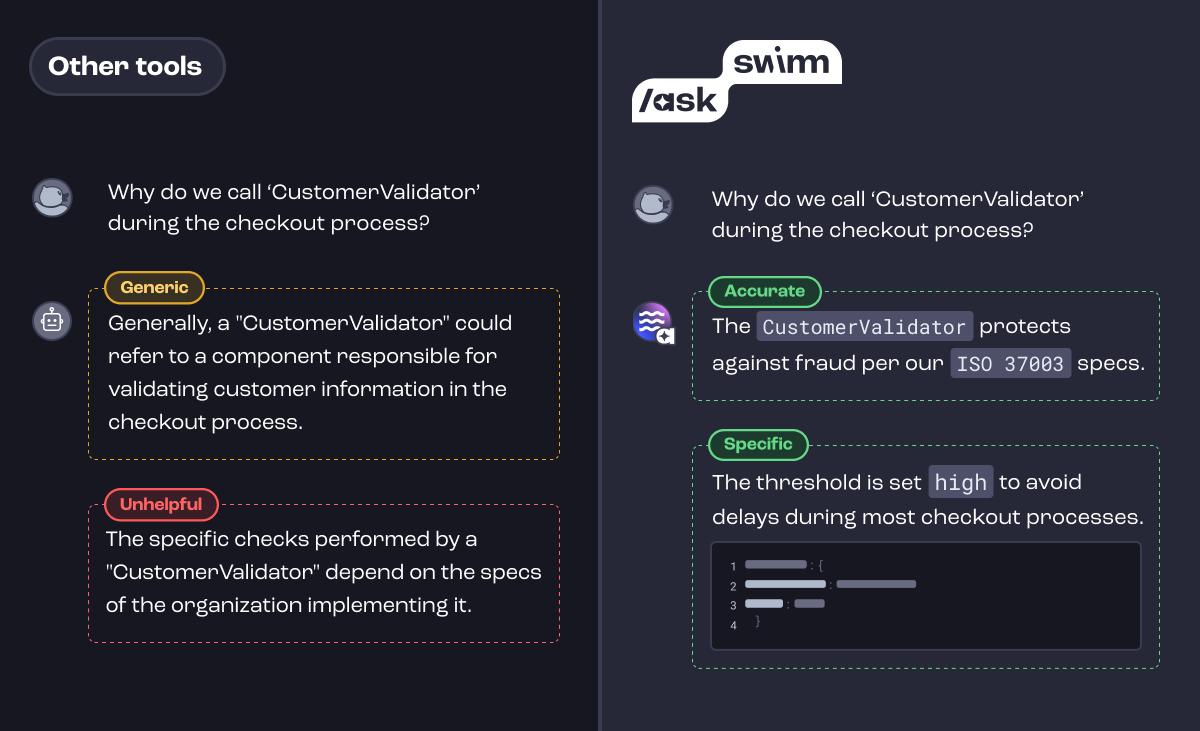
    Company CEO Oren Toledano said the /ask Swimm tool makes it simpler to launch queries that enable developers to better understand how code was constructed.

    The /ask Swimm tool aggregates documentation along with other related data to surface factors that are not evident in the code itself, such as documentation of business decisions, product design considerations and decisions concerning why specific architectural choices were made. It automatically captures and updates code-related knowledge to provide a continuous feedback loop as code, documentation, files and repositories are created and updated to provide deeper insights into code that goes beyond what might have been actually documented.

    The overall goal is to provide a mechanism that enables developers to understand how and why code was constructed within the context of an integrated development environment (IDE), said Toledano.

    Swimm has previously made available a platform that uses generative AI platform to create a static analysis of documentation. That capability should make it simpler for organizations to track documentation at a time when generative AI platforms such as ChatGPT are exponentially increasing the amount of code being written. In theory, those platforms should be able to also create documentation for that code, but there will still be a need for tools to track and analyze it.

    In the longer term, Swimm plans to continue to extend its usage of generative AI to provide deeper levels of insights across entire applications and software ecosystems to address that challenge, noted Toledano.

    In the short term, however, it’s clear that AI is making developers more productive than ever. In fact, the volume of code being generated might soon overwhelm existing DevOps pipelines and workflows. Most DevOps teams will need to revamp those workflows as the pace at which more applications than ever are being developed and deployed faster than ever.

    It’s still early days as far as generative AI adoption is concerned, but it’s clear many developers are already using it to write code. How much of that code makes it into a production environment is difficult to determine, but a lot of that code is going to be of varying quality. A general-purpose AI platform such as ChatGPT was trained using code collected from all across the web. The code generated by these platforms is only as good as the examples used to train it, all of which were created by human developers who may have made mistakes, such as including code that has known vulnerabilities.

    Regardless of whether code was generated by a machine or a human, the probability that documentation will need to be analyzed as part of a code review process is always high. The challenge and the opportunity is to determine the best way to apply AI to a longstanding challenge that is now being exacerbated by the existence of AI tools that, with each passing day, are only becoming more accessible to developers.

  • Sonar Adds Secrets Detection to Code Analysis Portfolio

    Sonar Adds Secrets Detection to Code Analysis Portfolio

    Sonar has added a secrets detection capability to its portfolio of tools for analyzing code and DevOps workflows.

    Designed to be applied to both finding secrets in code repositories and as applications are developed using an integrated development environment (IDE), this capability is being added to SonarLint, SonarQube and the managed SonarCloud service to identify, for example, passwords, application programming interface (API) keys, encryption keys, tokens, database credentials and other private information.

    Sonar co-CEO Olivier Gaudin said the goal is to eliminate secrets that are accidentally or maliciously stored in source code to improve software supply chain security.

    While it’s important to discover secrets in codebases, Sonar is making a concerted effort to make it simpler for developers to discover secrets before they find their way into a codebase that is one step away from a production environment, noted Gaudin. The SonarLint static analysis tool the company provides can now discover secrets in microseconds using the syntactic and semantic analysis engines the company has now extended, he added. No developer is going to wait five to 10 minutes for a code scan to be completed, said Gaudin.

    A Learn as You Code tool also explains how each secret found in a code segment poses a security risk. The overall goal is not only to remove secrets but, ultimately, reduce the number of instances where secrets are discovered in code, said Gaudin.

    Most organizations today are at varying stages of embracing DevSecOps best practices to improve software supply chain security. It’s not clear how readily secrets management is being embraced as part of those modernization efforts, but as cybercriminals routinely scan for application secrets stored in clear text that can be used to compromise application security, the need to encrypt secrets becomes a higher priority.

    There is, of course, no shortage of tools for detecting secrets. Sonar is now simply making a case for managing secret detection as part of a larger effort to reduce vulnerabilities in code that cybercriminals can exploit. That approach should help reduce the total cost of securing a software supply chain at a time when forthcoming regulations are going to make organizations that deploy software more accountable for application security.

    In the meantime, thanks to the rise of generative artificial intelligence (AI), the volume of code that needs to be scanned will likely exponentially increase. The issue with general-purpose AI platforms such as ChatGPT is they were trained using code of varying quality that often contains vulnerabilities that are now sometimes incorporated into the code they generate. On the plus side, however, many developers have little to no application security expertise, so it’s just as feasible that ChatGPT will create more secure code than a human developer. Regardless of how the code was created, however, no one will know for sure how secure it is without scanning it first.

    Hopefully, as AI progresses, the quality of the code being generated will only continue to improve. Until then, DevOps teams should continue to assume all code is suspect until proven otherwise.

  • Hitting the Accelerator for Change: How Open Source Drives Software-Defined Cars

    Hitting the Accelerator for Change: How Open Source Drives Software-Defined Cars

    Every new car on the road today contains hundreds of millions of lines of code, and that’s a good thing because the technological functions they enable add greatly to the car’s ultimate value. For over 100 years, automotive consumers coveted cars because of their paintwork, their leather interiors and the speeds they can travel. But now, their real and perceived value is influenced by technology features. Technologies such as electric vehicles, self-driving and other software-defined services are what drive the value of the car—and it’s no longer too nerdy to describe cars as ‘software-defined.’

    Navigating the Road to the Future

    For car manufacturers and their suppliers, the challenges of the software-defined car are already very much in focus. Original equipment manufacturers (OEMs) have been hiring new workers and re-training existing ones to navigate these challenges, such as cybersecurity and connected technologies. Ten years ago, OEMs such as Renault and Volkswagen had few in-house software engineers. Fast forward to today, and both companies have numerous resources focusing on software.

    Software will soon become ever more central to the vehicles we drive, and that will soon drive us, as vehicles become more connected, autonomous, shared and electric (CASE). In the next few years, autonomous vehicles will soon be handling tens of terabytes of data per day, gathered by sensors such as LIDAR and cameras. Customers are increasingly expecting smartphone-esque features, which involves keeping pace with the very latest apps and technologies.

    Combined with features such as passenger entertainment systems and remote diagnostics, the requirement for software and processing power in vehicles is going to grow at an ever-increasing pace. Open-source software can provide automakers with the power to keep up.

    You Must Shift Gears

    Inevitably, these processing power requirements will require a seismic shift in the way OEMs work. Currently, OEMs are struggling to maintain existing systems‒while at the same time attempting to develop new platforms. It’s a hangover from years in which vehicles were not connected or had extremely basic connected services. This has led to a situation where it’s difficult to upgrade the software at pace due to the requirements and constraints of the hardware.

    There are lessons for car-makers in the smartphone world. Think about how a software update can be applied across multiple different smartphones. An iOS update works just as well across a new device or a device from four years ago. One iPhone will see multiple updates, adding new features and boosting security.

    For car manufacturers, this won’t be an easy shift: The industry needs more defined standards to allow an easier interface between hardware and software. The industry also needs to reconsider how it develops hardware and how this relates to software. These challenges will require a new way of thinking for car manufacturers as they transition to a world where time cycles are critical. I believe that cross-industry collaboration is needed to accelerate the development of autonomous vehicles.

    Keep an Eye on Moving Parts

    Complexity is building at an increasingly rapid pace in the car industry, and this shows no sign of slowing down. In a report on the industry, McKinsey noted that the average complexity of individual software projects in the automotive sector has grown by 300% over the last decade. By 2025, the number of lines of code in the average luxury car will have doubled from today’s figure of 100 million lines of code, according to a prediction by Volkswagen‒which is already more than a military aircraft like the F-35. In full-self-driving cars, the figure could potentially reach a billion lines of code, analysts believe.

    It’s not just the software that is becoming more complex, the hardware is too. Modern vehicles already have up to 150 Electronic Control Units (ECUs), often scattered through the vehicle, close to sensors. Increasingly, manufacturers are moving towards a model where these ECUs are combined and consolidated, connected by an ethernet network. As the amount of data vehicles deal with increases, it’s unlikely that all of this will be directly uploaded to cloud servers; instead, much of it will be processed inside the vehicle before ‘edited highlights’ are uploaded to the cloud for processing.

    This has important implications for vehicle maintenance and also poses cost issues. Car manufacturers face challenges when it comes to managing the ever-growing complexity of their systems while trying to keep annual recurring costs down.

    Watch the Hacker Threat

    The need for cybersecure vehicles is also growing, particularly as we see self-driving vehicles enter the fray. In 2015, two security experts showed off a hack where they were able to ‘switch off’ a Jeep driving at 70mph down an American highway. It marked the dawn of the ‘hackable’ car—although the seeds of this were sown decades earlier when the first ‘connected’ components were unveiled in the 80s and were not built to be resilient to hackers. A 2021 report on global automotive security was damning, saying, “There have been 110 Common Vulnerabilities and Exposures (CVEs) that year related to the automotive industry, 33 in 2020 alone compared to 24 in 2019.”

    Ultimately, the automotive industry faces increasing regulation in the face of these threats. As governments begin to regulate software within the automotive industry, those designing the products and software will become more accountable.

    Open Source and Safety … Always

    For car manufacturers, there are also important issues related to functional safety—unsurprising when you are dealing with a device that weighs a ton or more. This directly impacts software development, with additional costs for any system that has an impact on driver or passenger safety.

    Car manufacturers need to learn from the aviation industry, where systems related to safety are rigidly separated from those that are not, reducing costs due to compliance.

    It’s often difficult to reuse existing software in cars today, as it can require porting to a different configuration. Costs can rise, not in a linear fashion, but exponentially. How much money will it cost to write, implement and test 100 million lines of code ‒ or a billion? This is the challenge manufacturers are facing. When it comes to managing these costs, open source will become ever more important and not only will allow the reuse of existing software, but will enable other manufacturers to contribute to said software.

    Software-Defined Cars

    The future is rushing towards us at speed—and in it, cars are increasingly software-defined. In this future, open source offers OEMs a highly attractive solution to the considerable hurdles ahead, from safety issues to cybersecurity. Open source will unleash the power of the ambitions of the car industry—not just to compete with the tireless innovation of other industries, such as mobile, but to exceed it. For consumers, cars are already the most complex devices they own: and they could be the most innovative. The flexibility and scalability of open source will allow car-makers to free their imagination and create the innovative, software-driven car of the future.

  • Improvement Cycles and AI

    Improvement Cycles and AI

    It’s that time of year when pundits start to crank out their predictions for the next twelve months! I’ve been asked to contribute to a private group (and occasionally, Techstrong Group asks me to contribute to their annual list), so I won’t thrill you with my predictions just yet; but I will discuss the cycles and trends that previous predictions have shown.

    Back when I was testing physical servers, we thought of throughput bottlenecks in terms of where the problem was. The circle would go disk->memory-> CPU, and in the case of things like NAS, insert network in there somewhere, too. When one bottleneck was resolved, another would crop up. And users will always seem to be pushed to the next bottleneck.

    We see similar cycles in DevOps. First, Agile made development faster, and that caused us issues throughout the rest of the process. Then, DevOps helped with the build and a little with the testing and deployment steps, but in the early days it was more standardization than speeding up. And since then, we have been in that cycle. We’re seeing GitOps speed up and automate deployment and upgrades—based upon the automation that came before—we’re seeing test and security tools feeding directly into the IDE to speed resolution, we’re seeing container automation cause “cloud-first development” (I hate that name; Kubernetes has cloud-like interfaces, but is not precisely cloud) to be fully automated, and thus faster.

    And we’re looking at that cycle continuing. No doubt you will hear a lot of predictions that start with “AI …” For the most part, AI is a tool and/or technique. Listen for what it is improving because it is doing very little that’s actually new. (Delete list of things that sounded alarmingly like those predictions I said I wouldn’t make.)

    All in all, we are still living in a very cool technological time. We can have a tool generate code snippets of the dull work for us so we can focus on the important bits. Some shy away from this use of “AI,” but honestly, we already use libraries to do the grunt work—I haven’t written to a screen buffer in forever—because we don’t have to. Same story—use the tools that make you productive. Some of the more obscure bits of Linux command lines are far better dealt with by asking an AI to give me examples than searching through tons of docs across several platforms. Never was much of a fan of man output for complex commands, this makes it easier. The nice bit is that bash and UNIX utilities don’t change much over time, so answers can be a bit dated and perfectly accurate. That’s not true for much of IT.

    The environment has consistently gotten more complex, while the building blocks have gotten easier to use. This allows things to keep moving and changing while it offers us better ways to serve the organization’s needs. This does change at some point—infinite change is indeed a thing, but any technology does have its limits—but I honestly can’t see the point at which we are content with our IT tools and stop looking for more. Oh, most organizations go through those cycles—organizationally, once an infrastructure and process works correctly, it is likely to hang around until better is found—but the industry will keep changing.

    And you’ll keep learning and changing. That’s one prediction I will make for next year. Teams and IT staff will grow and learn new things, because at its heart, that is what we do. We learn new things and keep the lights on. In good years, we offer sweet new tools and functionality to the company or our customers. But either way, we keep things online. Year after year. You all rock, so that’s an easy prediction.