Tag: cloud

  • Health Care’s Shift to the Cloud via the Hybrid Cloud, Part 2

    Health Care’s Shift to the Cloud via the Hybrid Cloud, Part 2

    In part one of this series, we looked at how the healthcare industry has changed, requiring integrations and interoperability that were not previously needed.

    Having established that the cloud is the way to go and that the hybrid cloud is the stepping stone hospital CIOs are comfortable with, we must ask how DevOps can help.

    DevOps in Health Care

    The legacy HL7 connection technology healthcare facilities use is a great example of how DevOps brings interoperability to health care and the hybrid cloud. “We have a cloud-hosted HL7 interface that can connect to any number of different hospitals and to our system as well. That’s something that would be very difficult to do without a cloud-based HL7 interface,” said Mayank Thanawala, CTO of HealthLoop, a provider of a cloud-based platform to automate follow-up medical care.

    Another challenge hybrid cloud can address concerns the registries that track patient episodes and the bundled payment initiatives that health insurance companies use to pay the hospital systems, Thanawala noted. “The challenge is that hospitals have to get the patient data into the registries in order to receive payment.”

    A hybrid cloud makes it easier to submit data to the registries because it provides an opportunity to connect to the registries using a system that already connects with the EMR system also and contains other data useful for registries and payments.

    Thanawala illustrated registry solutions in the hybrid cloud. The Comprehensive Care for Joint Replacement Program is a large registry hosted by Medicare CMS. Hospitals need data such as diagnosis histories from medical records and patient-reported survey information to submit to this registry. “So, in an example of a hybrid cloud, HealthLoop is a cloud system that uses a web interface to ask the patients the questions and collect the data. Then we use this hybrid cloud-based HL7 interface to query the on-premises EHR (electronic health records) system for all the rest of the data, fill in the blanks, create this file for this registry, and basically solve the hospital’s problem,” he said.

    How DevOps Speeds the to the Hybrid Cloud

    DevOps and the move to containers have helped accelerate health care’s move to the hybrid cloud. “When you deploy a Ruby on Rails API in, say, a Docker container, because of how the container is configured it is going to take care of logging for all of the applications and transactions and putting those in a store that will keep the transactions for the seven-year period that HIPAA requires,” Thanawala said. This automation saves the hospital CIO the step of having the logging set up.

    In the same way, if encryption of data both in flight and at rest is set up automatically in the container default configurations, that’s another matter the hospital CIO doesn’t have to worry about, he said.

    If applications are set up as microservices in containers so that they already perform all these functions when containers are created or scaled up, the hospital and HIPAA requirements surrounding these activities automatically are met. “This lets startups like HealthLoop focus on building app functionality so we don’t have to worry about these other more involved matters,” Thanawala noted.

    Even with health care’s complex move to the hybrid cloud, the modularity, completeness and singularity of applications in container technology as microservices make it possible to configure the containers, use them as building blocks and to build out efficient, scalable solutions in the cloud, he said. “It allows companies such as Catalyze, a medical systems integration and compliance organization, which we use to offer its products in a PaaS (platform-as-a-service) model using compliant containers so that we can simply deploy the containers and not have to worry about building compliance.”

    Saving Time, Effort, Worry

    HealthLoop’s story is a great example of how the automation and modularity of DevOps components such as containers and microservices can make or break new business opportunities, such as taking health care to the cloud and solving interoperation challenges.


  • Health Care’s Shift to the Cloud via the Hybrid Cloud, Part 1

    Health Care’s Shift to the Cloud via the Hybrid Cloud, Part 1

    The changing healthcare scene is dragging hospital systems into the cloud to enable the interoperability necessary for the industry to send electronic medial records (EMRs) and other data to outside systems such as registries that enable bundled payments.

    Because health insurance companies and Medicare only pay for patient episodes rather than for each subsequent treatment regardless of whether they’re medically necessary, hospitals must follow each treatment and take responsibility for them all. This gives hospitals incentive to get treatments right the first time.

    devopsy.kinsta.cloud paints the landscape behind the healthcare industry’s DevOps-enabled move to the hybrid cloud together with illustrations of how DevOps speeds that transition.

    The Old World Order in Health Care

    The Old World order for health care dictated that each hospital maintain its own isolated, protected, siloed and closed systems and patient health records, which in the not-too-distant past were maintained entirely in paper documents and charts. “That closed system was a file cabinet,” said Mayank Thanawala, CTO of HealthLoop, a provider of a cloud-based platform to automate follow-up medical care.

    Patients likely would have outpatient visits with their doctors at the local clinic adjacent to the hospital. Interoperability between the hospital systems and the clinic systems amounted to hospital staff faxing over the patient record or chart or sending it over via Sneakernet.

    A transition still occurring to move all that into EMRs/EHRs (electronic health records), although in a similar model as paper, with closed systems tied to the hospital and local clinics. “These are mostly not cloud systems but are rather on premises with largely client-server topologies,” Thanawala said.

    Pain Points Driving Health Care’s Shift to the Cloud

    In the old billing model, the hospital or physician billed the patient’s insurance or Medicare for each individual visit and procedure, treating them as separate, disconnected events even when the patient had the same treatment twice for a single need. “Insurance companies and specifically Medicare are now saying, ‘Hospitals, we don’t really care about all these complications, we care about the overall cost. If your patient had to go to the emergency room and had to have you perform the same surgery over again, that’s on you. We’re only paying for that initial surgery,’” Thanawala said.

    The result is that the hospital must know whether the patient had additional care or the same care twice for the same need, where they had the procedure or treatment and what that was. A closed system, electronic or paper cannot address these requirements. “That is driving the need for interoperability between systems across different organizations, which is driving the shift to the cloud to handle that need,” Thanawala noted.

    Delays in the Industry’s Shift to the Cloud

    There is a breadth and complexity to health care that requires a great deal of cloud infrastructure, which is creating delays in the industry’s move to the cloud. Health care and HIPAA regulations demand tight, auditable security, which is easier to achieve with the current on-premises systems. “There’s not a lot of confidence in cloud security. It’s getting better, but hospital CIOs have great responsibility and want to be the kings of their domains where security and control are concerned,” Thanawala said.

    At the same time, and because it can be problematic for hospitals to update workflow technologies, the cloud must support legacy connections such as HL7 that are not going away. “HL7 is designed to work within a network. Once you talk about cloud systems accessing HL7, you are talking about site-to-site VPNs for security and developing to embedded older technologies such as versions 8 or 9 of Internet Explorer,” he said.

    The fact that the data so heavily affects people’s lives, including life-or-death situations, makes the proper scalability, security, stability, uptime and privacy, as well as all the other goals of the cloud and DevOps, doubly important. “It adds another level of scrutiny and pressure to the move to the cloud,” Thanawala said.

    Take, for example, auditing, which touches every piece of healthcare data with such intensity. “From a systems perspective, you have to start thinking about auditing systems and tracking all transactions seven years back, which puts a lot of pressure on logging systems and databases,” he noted.

    As for uptime, if a healthcare system goes down, how does it affect life-or-death situations in that moment?

    How Health Care’s Transition to the Hybrid Cloud is Unique

    “The hybrid cloud gives the hospital CIO the ability to maintain control over what they need to control and still look to the cloud to enable the integration and interoperability with outside systems,” Thanawala said. This is important because of the many factors that make transitioning to the cloud unique in the healthcare industry, including:

    • Users in hospitals blame their systems—systems the CIO is responsible for—for any number of challenges and errors.
    • Healthcare facilities don’t really have to scale in the cloud quickly, because in health care there already is a defined patient population and facilities won’t have a large number of new users signing up that it can’t handle.
    • Service providers must convince hospital CIOs that collaborating with cloud technologies, including opening up VPNs and ports where necessary, is worth the risk.

    Digging into DevOps

    In part two of this series, we’ll explore how DevOps helps to enable the hybrid cloud in health care.

  • On Building Self-Driving IT

    On Building Self-Driving IT

    More CIOs than ever are moving their data centers to the cloud. Some have decided to maintain their on-premises data centers and move cloud-first with all new deployments, while others are moving more aggressively to all-cloud and are retiring on-premises hardware and software as quickly as possible. Both types of enterprises also are working to automate as much as they can to not only cut costs, but also improve their user satisfaction and the productivity of their organization though higher efficiencies.

    Aater Sulemen, co-founder and CEO of Flux7, a DevOps and cloud consulting firm, is an expert in hardware architecture and performance optimization, and has spent more than 10 years working with cloud. He calls that hyper-automation “self-driving IT.” This push-button IT works much the same way many expect self-driving cars to work in the not-so-distant future: Push a button, summon a car, instruct it where you want to go and it takes you there.

    In this view, when business users wants an app, a database or even more infrastructure, they reach out and request it. They fill out a form, the system determines the proper security and governance policies that should control such systems and data, they push a button, and it’s delivered.

    And rather than IT enforcing these rules manually, developers build the right tools to enable this, enabling developers to be autonomous. As the theory goes, technology gets deployed much more quickly, and when the systems are built properly, compliance and security are improved.

    devopsy.kinsta.cloud: What does “self-driving IT” mean to you?

    Suleman: It’s about achieving successful DevOps through automation. It’s not about dictating rules, or what should be done, but making the processes associated with DevOps seamless.

    Self-driving IT means that the business does not wait for developers or operations to get things done, and they don’t wait for each other. If someone needs something, from an application, to expanded infrastructure, to test and development environments, they should be able to push a button and get it done.

    Self-Driving IT is a way of automating the repetitive events and all of the process overhead and the auditing and logging systems, when someone needs a new application or service they can just get it, and it’s ready. They don’t need to wait weeks, or longer, to provision the apps, storage, servers that they need. Just like a self-driving taxi, they call it and use it.

    devopsy.kinsta.cloud: What are some of the challenges that organizations face when moving to “self-driving IT?” themselves?

    Suleman: There are known hiccups, and there are areas companies know how to smooth very well. Typically, the hiccups within enterprises are in terms of skills necessary to essentially provision infrastructure and make infrastructure provisioning very automated. Then there are the skills needed to create the tests that need to be created, and the automation that can be done around that. We don’t see such a fundamental issue there. Usually the issue that people have is a skill-set issue—They don’t have the skills or the right mindset and place for building self-driving IT themselves.

    I think, generally, most organizations run into trouble when they have to make major changes to the infrastructure and how they will support that. There are a lot of changes that need to be made, and they may not be ready.

    In most cases, if you’re making such a major change that there is going to be a brand new infrastructure designed and built, organizations are going to need some guidance and support through that.

    Another aspect here is that the infrastructure isn’t always the highest priority. So the focus isn’t always there to automate it. But when you need a database, you need a database. There’s no getting around it. So it’s a higher priority and it actually gets done, and the underlying change to the infrastructure that needs to get done to automate doesn’t get done.

    devopsy.kinsta.cloud: Where do you see this heading in a year to 18 months? Do you see more companies moving down the path to self-driving IT?

    Suleman: That is a very interesting question. We have been having a lot of discussion around this very subject lately. There are actually two kinds of customer perspectives. There’s the, what I call, IT view of automation. So IT cares about, “I can create a server with one click, backups happen automatically and I don’t care what’s run inside the server, because to me, these are just boxes. I have 80 boxes on-premises and now I have 80 boxes in the cloud. And this is self-driven IT because I can press a button and spin up a new server.” That’s a fair definition from an IT perspective.

    This is where the continuous integration/continuous delivery and (CI/CD) becomes interesting. When you wear your DevOps hat is when you see that there’s a whole new world inside those boxes. Well, what IT likes to think as boxes. And self-driving IT now has a whole new meaning: code deploy, configuration management, patch management … the stuff that is inside the virtual machines becomes very different.

    A new class of customers has started emerging. This is as recent as early this year. They used to think of virtual machines as boxes. “I don’t know and don’t care what’s in there. What I care about is I have a box in the cloud,” they’d think. And now they have evolved to just wanting to move huge segments of their enterprise to cloud.

    We’re actually working with a lot of this right now. It’s not DevOps, because it’s automated Ops. This is a new level of discussion; this isn’t an app team moving to the cloud or modernizing. It’s CIOs calling and saying that they don’t want to build another data center, that they want 5,000 virtual machines migrated.

    devopsy.kinsta.cloud: That’s fascinating. This sounds like it’s the natural evolution of cloud and DevOps?

    Suleman: Exactly. To us, self-driving IT has been synonymous like cloud, just like DevOps is. In fact, cloud has always been means to achieve DevOps, and CI/CD and configuration management follows. Now it’s a different mindset. They’re looking for a way to not deal with the servers. So, now what is happening is, when it’s time for a refresh, they are either going to call a hardware provider and ask for 5,000 boxes, or they’re going to decide to move to the cloud. And if they have a tight deadline, like under a year or six months, they don’t have enough time to “DevOpsify” 500 applications. They end up wanting a one-to-one migration, so that they don’t have to invest in a new data center or upgrade their current data center.

    It’s a very interesting conversation, and it’s front and center with a lot of enterprises now.

  • Akana Platform Wins Cloud Platform Innovation Award

    LONDON–(Business Wire)–Akana, a leading provider of API Management, API Security, API Analytics and Microservices solutions for Digital Businesses, announced today that its Akana Platform won the Cloud Platform Innovation of the Year category. The award was given at the 4th Cloud & DevOps World Awards ceremony on 21 June 2016. Other great companies have won this award in the past. In 2015, this award was won by Amazon Web Services.Cloud and DevOps Awards celebrate excellence and innovation in Cloud Computing. The awards have 8 different categories. The Platform innovation of the Year Award is designed for that game-changer solution provider whose PaaS offerings are able to significantly minimize the cost and complexity of IT. The Judges looked for a platform that enables further agility, scalability, collaboration and facilitates the development environment in the most cost efficient, high quality and secure manner. See more information at https://cloudanddevopsworldawards.com/

    “We are thrilled to receive this cloud innovation recognition,” said Roberto Medrano, Executive VP of Akana. “Akana has developed a proven API Management solution that exceeds customer expectations. As a category leader working with Fortune 1000 accounts, we will continue helping customers in their digital transformation journey.”

    The Akana Platform provides an end-to-end API Management solution for designing, implementing, securing, managing, monitoring, and publishing APIs. It is available as a SaaS platform, on-premises, and as a hybrid deployment. For more information and a free trial go here http://bit.ly/1sIsUHE

    About Akana

    Akana’s comprehensive suite of API Management, API Securityand Microservices solutions helps businesses accelerate digital transformation by securely extending their reach across multiple channels – mobile, cloud and “Internet of Things.” Akana enables enterprises to quickly deliver scalable applications, share data as APIs, connect and integrate applications, drive partner adoption, monetize their assets and provide intelligent insights into their businesses and operations. The world’s largest companies including Bank of America, Pfizer, and Verizon use Akana to harness the power of their technology and transform their businesses. Akana is also recognized as a “Leader” by several analyst firms. For more information on Akana’s Platform , please visit http://www.akana.com.

    For more information, please contact: pressroom@akana.com

    All product and company names herein may be trademarks of their registered owners. Akana, SOA Software, Community Manager, API Gateway, Lifecycle Manager, OAuth Server, Policy Manager and Cloud Integration Gateway are trademarks of Akana, Inc.

    Follow Akana:

    • Blog: https://blog.akana.com/

    • Facebook: https://www.facebook.com/AkanaSoftware

    • Twitter: https://twitter.com/AkanaInc

    • LinkedIn: https://www.linkedin.com/company/akana

    • YouTube: https://www.youtube.com/channel/UC4QdcCn-FDCqN7gao7wp24g

    • RSS: http://www.akana.com/index.php/news/feed

    Akana
    Lisa Blank, 323-708-2651
    pressroom@akana.com

  • AppFormix Ships ContainerFlow, Leveraging Intel(r) Technology for Advanced Monitoring and Scheduling with Cloud-Native Applications

    Latency and jitter fall 70 percent with ContainerFlow; response times improve 51 percent—benchmarking study.

    SEATTLE — Dockercon — June 21, 2016 — Developers writing applications with microservices tools like Docker containers and the Kubernetes container cluster management system today gain a new tool built for the DevOps era, resulting from a collaboration announced in March between AppFormix and Intel(r).

    ContainerFlow is a cloud service optimization tool that provides advanced monitoring, scheduling and performance management for DevOps environments, where containers and VMs can have life cycles much shorter than in traditional development environments. ContainerFlow is currently the only tool that integrates Intel Resource Director Technology to provide major improvements in application performance, especially with container-based applications.

    The collaboration that led to today’s product announcement kicked off via a joint announcement between the two companies at Intel Cloud Day in March.

    In a solution brief, “Realize The Performance Of Your Cloud Infrastructure,” testing shows improved response times averaging 51 percent with ContainerFlow. The testing also shows an average 27 percent improvement in throughput. By actively managing cache allocation in real time, ContainerFlow reduces latency and jitter by 70 percent.

    Importantly, the variances of the average and peak latency are significantly reduced. Peak latency is reduced by 70 percent to 146 milliseconds, and the standard deviation of peak latency is 17 milliseconds, compared to 95 milliseconds without ContainerFlow.

    ContainerFlow works out of the box for microservices built using Docker containers, using Kubernetes an open source system for managing containerized applications.

    *** More at: http://www.appformix.com/intel/ ***

    ContainerFlow is the first scheduling and monitoring tool built specifically to address the unique needs of cloud-native applications and DevOps environments. Applications built with containers and microservices run in environments where many thousands of containers are created, used and discarded in only a few minutes. ContainerFlow works in real time, delivering a critical improvement over monitoring tools built for traditional, monolithic applications.

    Before ContainerFlow, microservice application developers and infrastructure operators were stuck with old tools designed for those monolithic technologies, where it is common for schedulers to take several minutes to do their work. With containers and microservices, however, the actual lifetime of processes being scheduled is less than the amount of time legacy tools need to schedule and monitor performance.

    “The next generation of cloud depends on the industry’s ability of create technologies that make apps built on microservices easy to write, deploy, scale and iterate,” said Sumeet Singh, CEO and founder of AppFormix. “Conventional tools take longer to do their jobs than the lifespan of the services they’re scheduling and monitoring. Effective tools cannot be more complex and time-consuming than the problems they are trying to solve. Current tools were begging for replacement, so we built ContainerFlow to give users the experience they expect.”

    Customer and Partner Quotes

    “When isolation is imperfect, containers cannot prevent interference in resources the operating-system kernel doesn’t manage, such as level 3 processor caches and memory bandwidth,” said David Aronchick, Senior Product Manager for Kubernetes. “The approach taken by AppFormix offers hope for operators struggling with managing performance in container-based environments reliably, by giving them a tool designed for that use case.”

    <INTC QUOTE IN APPROVAL>

    “With AppFormix, Rackspace gets a team that’s solely focused on solving scheduling and management issues that arise in a world where the lifecycle of compute instances is very short,” said Bryan Thompson, senior director, product management of OpenStack Private Cloud at Rackspace. “The Appformix software aligns with our mission to help customers remove the complexity of deploying and operating OpenStack Private Clouds while driving benefits for their business.”

    “Our applications demand reliable performance,” said Joshua Barry, product director, cloud at ViaSat. “The combination of technologies in Intel RDT and AppFormix ContainerFlow has the potential for our operators and developers to better understand and manage cloud environments, delivering better user experiences and infrastructure efficiency.”

    Media Resources

    About AppFormix

    AppFormix is a startup delivering a cloud service optimization platform targeting enterprise devops teams. Via real-time analytics, capacity planning, and orchestration tooling, AppFormix software gives cloud operators and applications developers a shared dashboard to understand performance across the entire cloud stack, for hybrid, private, and public enterprise clouds. AppFormix works with popular cloud environments like AWS, OpenStack, Azure and Kubernetes. AppFormix software captured the Grand Award winner at Interop 2016 and was named a technology to watch by the MIT CIO Symposium. The company is backed by August Capital and is headquartered in San Jose, Calif. More atwww.appformix.com.

    ###

    Media Contact:

    Robert Cathey

    Cathey Communications for AppFormix

    robert@cathey.co

    +1 865 386-6118

    @robertcathey

  • Threat Stack Speeds Up Cloud Security Operations with New Alert Tagging and Daily Vulnerability Management Reporting

    Only cloud security provider to offer alert tags to accelerate incident resolution; Daily vulnerability reporting including Amazon Machine Images (AMI) IDs

    BOSTON – June 16, 2016 – Threat Stack, a leader in cloud security and compliance management, today announced feature enhancements designed to speed up security team velocity and improve efficiency with new alert tags and vulnerability management reporting capabilities of the Threat Stack Cloud Security Platform™ (CSP). Threat Stack CSP alert tags and vulnerability reporting provides security and operations users with previously unattainable, in-depth context about AWS instances, improves security incident response and allows organizations to easily track and manage vulnerabilities with detailed, easy-to-follow daily reports.

    “Both alert tags and vulnerability reports are features that enable customers to get even more visibility into what is happening on each server, across the infrastructure, saving hours of investigation during critical events or in depth audits,” said Venkat Pothamsetty, vice president of products and customer advocacy, Threat Stack. “We continue to work tirelessly to deliver features and enhancements that help to securely increase security and ops efficiency and productivity.”

    Threat Stack’s alert tags integrate host data alerts with infrastructure tag information to provide detailed server-specific context to each alert. By clicking on a tag, users can now easily see the process details and cloud context behind each alert, including identifying the user that may have been involved. Typically, this level of detail is only attainable through hours spent manually reviewing logs. By automatically identifying which server the alert is related to, these tags enable security engineers to resolve the issue in minutes instead of hours. Over time, these alerts will provide even more context as the CSP scours increasing amounts of data.

    Daily vulnerability reporting from Threat Stack gives users a comprehensive breakdown of system-wide vulnerabilities including Amazon Machine Images (AMI) ID’s for Amazon EC2 users, not commonly available in traditional vulnerability reports. This level of reporting not only provides details on remedial actions or Common Vulnerabilities and Exposures (CVE) management, but also creates a record to demonstrate daily vulnerability management in case of an audit.

    “Threat Stack provides an unmatched level of security and visibility across our infrastructure,” said Jon Debonis, VP of Information Security/CISO, Blend Labs. “Using one single dashboard, we always know who is doing what on our machines saving us hours of investigation and reducing our time to resolution.”

    Both features are now immediately available to all Threat Stack users. For more information on Threat Stack, please visithttps://threatstack.com.

    About Threat Stack

    Threat Stack enables growth-driven companies to scale with confidence by identifying and verifying insider threats, external attacks and data loss in real-time. The only fully integrated, cloud-native continuous monitoring solution that gives customers instant visibility and automatically responds to changes in their environment, Threat Stack provides the coverage needed to run secure and compliant, in all environments, without sacrificing speed and efficiency. For more information, or to start a free trial, visit threatstack.com.


  • CloudHealth Partners with Datadog, Connecting Cloud Performance Metrics to Cloud Costs for Enterprise and Fast-Growing Technology Companies

    The New Integration Enables Customers to Rightsize Complex Cloud Environments

    BOSTON–(BUSINESS WIRE)–CloudHealth Technologies, the leader in Cloud Service Management, today announced an integration partnership with Datadog, the leading monitoring service for dynamic cloud applications. The integration of the CloudHealth and Datadog platforms offers customers end-to-end visibility across every dimension of their cloud environments, giving them recommendations and analysis to make analytically driven rightsizing decisions in the cloud.

    While the decentralized management and dynamic provisioning of cloud resources greatly improves application development agility, it creates new challenges for organizations, related to cost allocation, infrastructure rightsizing and governance. The CloudHealth-Datadog partnership addresses the major challenge enterprises face as they embrace agile processes and cloud-based infrastructures: an inability to effectively manage cloud resources at scale.

    Datadog provides a SaaS platform that monitors data across the entire infrastructure stack and presents that data in elegant and easy to understand dashboards, allowing for actionable insight. The CloudHealth platform simplifies cloud management, enabling enterprises to consolidate, evaluate, analyze, optimize and automate their clouds.

    By connecting cloud metrics to costs, the integrated platforms allow customers to manage assets in a more strategic and holistic fashion. CloudHealth Technologies and Datadog bring together granular performance data, end-to-end visibility and powerful analytics to help customers continually make the best decisions about provisioning and rightsizing in the cloud. The CloudHealth-Datadog partnership provides customers with the following benefits:

    • Rightsizing analysis: Customers can use data from both solutions to receive recommendations about where to adjust resources that are over- or under-provisioned, saving them time and money.
    • Visualization of key assets: Using CloudHealth, customers can zero in on the cloud data they care about – looking by department, line of business, or any relevant Perspective. Using Datadog tags, they can get a centralized view of all their assets in one place alongside other tools and services.
    • Advanced performance metrics per asset: Customers can maneuver between the tools to really understand their environments. They can jump into CloudHealth to track trends or scan through performance data or jump over to the Datadog console to explore individual assets in more detail.

    “To optimize your cloud resources, you need to have tools that help you visualize your data, understand it and act on it,” said Joe Kinsella, CTO and founder of CloudHealth Technologies. “Putting Datadog’s best-in-class cloud monitoring assets together with CloudHealth’s Cloud Service Management capabilities gives customers the ability to truly solve the issue of cloud complexity.”

    “The cloud cost allocation and optimization is a significant challenge for many of our enterprise customers who spin up tens of thousands of cloud instances across various business units,” said Amit Agarwal, Chief Product Officer at Datadog. “We look forward to partnering with CloudHealth to provide customers who use both products a solution that helps customers quickly allocate and minimize costs, while ensuring that their critical applications are adequately provisioned at all times.”

    Many joint customers are already using CloudHealth and Datadog together, including Elastera, a provider of managed cloud hosting environments for ecommerce sites. The company moved to the cloud to innovate and get to market faster and adopted CloudHealth and Datadog to get accurate rightsizing recommendations for its AWS infrastructure.

    “CloudHealth takes information collected from Datadog and connects the metrics to the money. It shows us if an instance is under-utilized and how much we could save by making a change,” said Zachary Stevens, co-founder and chief architect, Elastera. “Using this powerful set of data analytics, we are able to downgrade over-provisioned assets, saving us time and money.”

    About CloudHealth Technologies
    CloudHealth Technologies gives organizations a new, more efficient way to visualize, optimize, and automate their cloud environments. The CloudHealth Cloud Service Management platform integrates with services across the datacenter and cloud, giving enterprises, startups, and service providers access to a centralized hub of robust data analytics. Using a policy-driven approach aligned to business processes, customers leverage CloudHealth to drive cost savings, improve agility, enhance security, and reduce complexity. With CloudHealth, customers are able to innovate faster without sacrificing governance or control.

    The world’s cutting-edge companies rely on CloudHealth to meet their cloud management needs, including Amtrak, Dow Jones, Acquia, and Sumo Logic, among others. Based in Boston, MA, the company is backed by Sapphire Ventures, Scale Venture Partners, .406 Ventures and Sigma Prime Ventures. For more information, visit www.cloudhealthtech.com or follow us on Twitter @cloudhealthtech and LinkedIn.

    About Datadog
    Datadog is the world’s leading monitoring service for cloud-scale applications, bringing together data from servers, databases, tools and services to present a unified view of your entire stack. These capabilities are provided on a SaaS-based data analytics platform that enables Dev and Ops teams to work collaboratively to avoid downtime, resolve performance problems, and ensure that development and deployment cycles finish on time. Since launching in 2010, Datadog has been adopted by thousands of enterprises, including Twilio, Airbnb, Netflix, EA, Spotify, Warner Bros. Games and AdRoll.

    Learn more about the integration on the CloudHealth Tech blog and the Datadog blog!

  • PTC: Using DevOps to Transform Applications

    PTC: Using DevOps to Transform Applications

    Large companies and monolithic applications are not usually associated with DevOps. But I recently discovered that some of the best DevOps operations have come from the largest organizations and most complex applications, and PTC is the latest example.

    If you are not familiar with PTC, the company has a wide range of offerings for enterprises looking to improve their operations. Its solutions range from enterprise resource planning (ERP) to product lifecycle management (PLM) and Internet of Things (IoT) platforms as a service (PaaS). Its existing products started as on-premises solutions, and have expanded to modern solutions including IoT. But now there is a large demand to convert them to cloud-based offerings. And as PTC goes down this path, it needs to have a modern delivery chain to support it.

    Enter Cloud Services

    So PTC created its Cloud Services group to deliver cloud-based versions of its existing platforms to customers. Its cloud-based offerings are subject to all the same demands of any other modern software-as-a-service (SaaS) and PaaS offering—faster releases, more frequent updates and higher quality. After a few years of building the Cloud Services group, the company has proven it can automate and improve delivery of its traditionally on-prem platforms in the same fashion as poster-child DevOps environments.

    The journey was not easy, and it did not start with DevOps as a goal. The goal was simply to deliver solutions to its customers. DevOps was the natural outcome following the challenges it faced. Some of the challenges were common for all development operations, but others were very unique:

    1. Lots of variables: PTC has to support a wide range of customers across a wide range of deployments. PTC works with its customers on their varying needs of platform versions and also understands their varying requirements around software updates. And each potential variation has a unique snowflake configuration, which, unlike most cloud platforms that offer one production version to all users, its entire ecosystem of releases is actually a wide range of configurations and versions.
    2. Data integrity: Data is important no matter what. But PTC works with customers that have had data in their on-premises solution for a long time, and that same data needs to make it to the cloud, securely, without a single flaw. That data is part of business-critical applications and ongoing business processes.
    3. Educating users: As customers continue on their journey to the cloud, PTC is there to support the changes and enable them through customer success, continuous knowledge transfers and an endless online platform of PTC educational services.

    So not only does it face technical challenges, it also is facing huge change control and people challenges. Before any software delivery can begin, there is a specific part of the Cloud Services group that is responsible for the necessary development to SaaS-ify the existing applications and build a gold master for each release.

    The initial delivery chain was hand-to-hand combat: one solution, one customer, one release at a time. This required a lot of warm bodies to manage manual release processes and customers.

    “We could not keep on throwing people at the problem,” notes Tameem Hourani, senior director of Cloud Services. Even though PTC had established workflows via ServiceNow, each step was manual and simply not scalable. But the customers and releases were increasing at an ever-climbing rate. It simply would not be feasible to on-board new team members to handle the load.

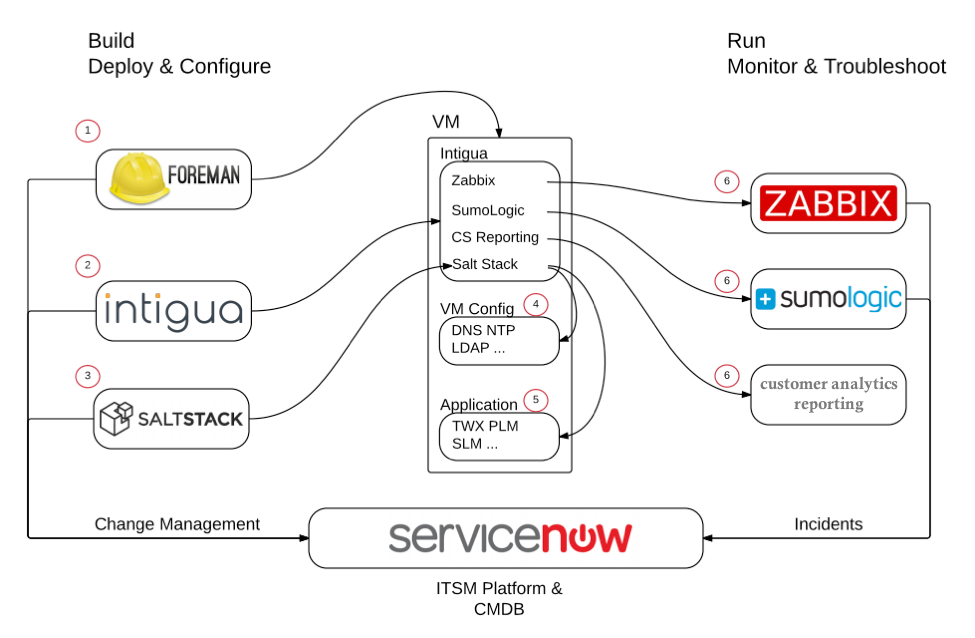
    So it turned to good practices and tools to build a delivery chain that can take care of a brand-new deployment in less than two hours, instead of days, and upgrades in less than 10 minutes. Here is what the resulting setup looks like:

    ptc_flow

    PTC was not new to automation. The company had been leveraging ITIL practices for some time. But what ITIL lacked was exposure to the customer. So with the ITIL backbone and ServiceNow in place, PTC added pipeline-level orchestration called Foreman.

    In this configuration, both ServiceNow and Foreman essentially act as a system of record for the entire environment. ServiceNow is the system of record for all states and workflows. It also is the base entry point for any new update or deployment. And Foreman is the system of record for infrastructure and configurations across all customers and all deployments. But it also serves as the “checklist” of all the aspects of orchestration.

    To manage the infrastructure orchestration and create the templates for configurations, PTC turned to Saltstack. It originally used another tool, but the benefit of Salt is that it allows for more sequential orchestration, as opposed to another tool with a stateful-only option.

    PTC uses another unique tool called Intigua. Intigua peaked my interest because I have previously talked about the overhead in both resources and management of server agents. And because so much of what is done for headless monitoring and control of servers these days is done by agents, this actually becomes a serious management problem.

    “The only way to grow a modern delivery chain is tools. And most new tooling is driven by agents,” Hourani notes. “It is easy to forget that the new tooling and processes also come at a cost. Usually the cost is less than the benefit they provide, but it is there nonetheless. Management of agents seems simple enough, but [when] actually doing this at scale, things can easily get out of hand.”

    PTC had four-plus unique agents across a wide range of configurations. One of Intigua’s value points is the ability to “self-heal” and make sure the agents are always running correctly.

    Once it is handed an IP, Intigua installs and configures agents based on tags, policies and AWS regions. When Intigua is running, it will make sure agents are up to date, and that self-heal agents go to work should something go wrong. The ability to use Intigua as a single pane of glass in a highly variable grid of configurations is a huge benefit.

    Triggered by ServiceNow, configured by Foreman, Salt and Intigua, the infrastructure and code are deployed. But to learn and maintain all environments for the customer, PTC needed some strong production monitoring tools. It uses SumoLogic, deployed as an agent via Intigua, for log analysis. For most applications, using a single instance of Sumo is fine. But PTC has to segregate an instance per customer, and the process must be fully automated. There is some overlap with another monitoring tool, Zabbix, which has been set up to attempt self-healing upon a triggered alert.

    And then there’s Jenkins. While not used for the entire deployment process, it is used to drive testing and manage states during the testing process. Upgrades to production releases are done incrementally, and complete deployments are done full-stack.

    Services Layers Are All the Rage

    Cloud services and shared services are not necessarily new. I recently did a write-up on Wix, which has a similar approach. But the complexities associated with SaaS-ifying on-premises solutions, along with the number of variables, adds not only another layer of complexity, but also another layer of value to a repeatable delivery chain.

    I am humbled by case studies like these, because it proves that those who say their environments are too complex for DevOps have yet to see what’s possible.

  • Datadog Adds Hadoop and Spark Integration to Leading Cloud-Scale Monitoring Platform

     Users can now monitor the four most widely-used technologies in the Hadoop ecosystem: HDFS, MapReduce, YARN, and Spark

    NEW YORK – May 24, 2016 – Datadog, the leading SaaS-based monitoring platform for cloud applications, today announced support for Hadoop, bringing its unified view of applications to the Hadoop ecosystem. Hadoop users can now benefit from Datadog’s rich dashboards, full stack visibility and correlation, sophisticated and targeted alerts, collaborative tools and integrations, and easy setup with no maintenance. Integrations can be turned on immediately, adding to the long list of technologies DevOps teams can monitor easily and collaboratively with Datadog.

    By adding the power of Datadog to Hadoop, users can now see hundreds of Hadoop metrics alongside their hosts’ system-level metrics, correlating what is happening within Hadoop with what is happening throughout their stack. Users can also avoid problems by setting alerts when critical jobs don’t finish on time, on outliers or any other problematic scenarios.

    This product update supports:

    HDFS: Using the HDFS integration, users can monitor the number of data nodes and blocks, disk space remaining on each host and cluster, as well as namenode load and lock queue length.

    • MapReduce: The MapReduce integration includes metrics for map and reduce jobs pending, succeeded and failed, bytes read by job or in total, as well as input/output records.
    • YARN: The YARN integration gives visibility to nodes, applications, cluster cores and cluster memory.
    • Spark: With the Spark integration, users can see driver and executor, RDDs, tasks, job stages and more.

    Since launching in 2010, Datadog has been adopted by thousands of enterprises, including Twilio, Airbnb, Netflix, EA, Spotify, Warner Bros. Games and AdRoll. For additional information on Datadog, please visit www.datadoghq.com.

    Supporting Resources

    Company Blog

    Twitter: @datadoghq

    About Datadog

    Datadog is a monitoring service that brings together data from servers, databases, applications, tools, and services to present a unified view of the applications that run at scale in the cloud. These capabilities are provided on a SaaS-based data analytics platform that enables Dev and Ops teams to work collaboratively to avoid downtime, resolve performance problems, and ensure that development and deployment cycles finish on time.

    #

    Media Contact

    Mindshare PR

    Heather Fitzsimmons, 650-279-4360

    heather@mindsharepr.com

  • Managing Application Performance in Hybrid Clouds

    Managing Application Performance in Hybrid Clouds

    Keeping pace with changes to your networks, systems and applications can feel like a full-time job. As applications support more data types in more distributed environments—often in real time—it becomes imperative to have a clear picture of your end-to-end computing environment.

    Just as important is making sure your apps take advantage of the adaptability and efficiency of microservices, document data models and other cloud-focused technologies.

    All those much-touted benefits of cloud computing—efficiency, agility, scalability—come to nothing if your applications don’t perform as expected. The growing prevalence of hybrid cloud infrastructures makes managing app performance trickier than ever. According to a recent survey conducted by Riverbed and reported in a Jan. 29 article in Data Center Journal by Riverbed Marketing Director Steve Brar, 89 percent of IT pros claim poor application performance hinders their operations, with 58 percent report application performance glitches each week and 36 percent experience application performance problems each day.

    Even worse, 71 percent of the IT managers surveyed are “in the dark” about why the apps are running so poorly, and 37 percent have turned to unsupported apps to fill the breach when such problems occur, which exacerbates the growing problem of shadow IT. On the plus side, the managers believe that making application performance more visible improves productivity (58 percent), customer service (54 percent), product quality (49 percent), employee engagement (46 percent) and revenue generation (43 percent).

    Brar identifies five requirements to ensure end-to-end application performance visibility:

    1. Network- and app-aware path selection directs traffic to one of three branches: one MPLS-based, one IPSec-protected Internet link and one that exits directly to the Internet.
    2. Dynamic tunneling via a central control plane allows backhauling of branch data to the data center over an IPSec link.
    3. Use secure web gateways in conjunction with advanced threat detection.
    4. Use a QoS function that manages traffic from the source (inbound) rather than from the destination (outbound) to avoid slowing business-critical inbound data flows unnecessarily.
    5. Implement a unified management plane that has an intuitive interface and is based on such high-level abstractions as applications, sites, uplinks or networks, depending on the unique characteristics of your IT infrastructure.

    Cloud Application Management: The IT Basics Still Apply

    It isn’t unusual for IT departments to feel they’re losing control of their network infrastructure when they migrate applications to the cloud. Cahit Akin writes in an April 22, 2015, article on Network Computing that capacity management, change control and other IT fundamentals are just as important for managing your cloud infrastructure—if not more so, considering the likely increase in network traffic that results.

    The key is to consider the cloud part of your internal network architecture. Three WAN-optimization techniques transfer easily to cloud infrastructure management:

    1. Caching images and other common elements on the local device helps ensure network bandwidth is reserved for the most important data.
    2. Deduplication minimizes your backups and other secondary network traffic by ensuring only changed data is updated.
    3. Compression removes unnecessary data from files to make them smaller and reduce overall bandwidth use.

    The same features of a typical WAN optimization tool apply to improving the performance of cloud-based applications, notes TechTarget.

    The challenge for IT is to keep pace with the tremendous changes in the nature of applications themselves. Data is collected, aggregated and analyzed from diverse sources, including IoT sensors, clickstreams, logs and social media data, as Ravi Dharnikota writes in a Feb. 5 article on DataInformed. Dharnikota states that IT has to support “anything, anytime, anywhere.”

    Rather than a point-to-point approach to integration, you have to rearchitect your systems based on microservices that communicate via lightweight REST APIs. This way you distribute execution of integrations, which lowers costs and increases efficiency. If you aren’t already, you need to break out of the row-and-column rut and adopt document data models that support semi-structured and unstructured data.

    Design Apps to Leverage Batch and Real-Time Processing

    The only way to deliver an infrastructure that meets the anytime, anywhere nature of modern apps is to be adaptable enough to support both batch processing and real-time processing. Along with this comes the ability to determine which apps require real-time attention, and which can be shifted into batch-processing mode. Dharnikota cites the Lambda architecture as an example of one that accommodates batch and real-time processing by balancing latency and throughput.

    However, the Lambda architecture’s shortcomings are explained by LinkedIn’s Jay Kreps in a July 2, 2014, article on O’Reilly Radar. Ultimately, you have to maintain code that produces the same result in two complex, distributed systems. According to Kreps, it’s much simpler and efficient to improve the stream processing system to support both batch and real-time modes. Doing so would entail increasing the system’s inherent parallelism by “replaying history very, very fast.”

    MorpheusData-Kreps-parallelism

    An alternative to the dual-processing-mode Lambda architecture enhances the stream processing of a single-mode system to reprocess the full data log to mimic both batch and real-time modes.

    In this model, reprocessing is required only when the code changes. Rather than two full duplicates of your code, you simply update the single set. The recomputation is done by a job that is merely an improved version of the same code: it runs on the same framework and takes the same input data, although the parallelism needs to be increased to ensure fast performance.

    To optimize performance further, you could combine two output tables. However, having two separate tables, at least for a brief period, lets you revert to the old logic in an instant via a button that redirects the application to the older output table. To prevent the new version of the code from degrading performance in comparison to the old version, add an automatic A/B test or bandit algorithm that lets you control the cutover.