Tag: cloud

  • Enterprise Cassandra Deployments

    Enterprise Cassandra Deployments

    Successful Cassandra deployment in the cloud takes a certain amount of skill and knowledge. In this blog I will share best practices for a successful Cassandra deployment in the cloud such as Amazon Web Services (AWS) and Google Cloud Platform (GCP). I will also discuss how you can protect and recover the data in your Cassandra cluster when deployed in the public cloud.

    Cassandra Deployments in the Public Cloud

    There are two main ways to have successful enterprise Cassandra deployments in AWS:

    • Use a ‘managed’ Cassandra deployment. This is a reasonable approach; the only downside is the inability to customize data placement beyond what is typically provided by the vendor.
    • Manage the cluster yourself, if you want to have full control over your Cassandra deployment and customize it to scale and perform according your business needs.

    Please refer documentation from Datastax or Apache Cassandra for detailed best practices for Cassandra deployments. The following best practices are reiterated here to simplify deployment of a scalable Cassandra cluster in AWS.

    Storage

    Both AWS and GCP offer two types of local storage options for their compute instances. For AWS, the options are Elastic Block Storage (EBS) and Ephemeral Storage. In GCP, the options are Persistent Disks and Local SSD. Both options have their own trade-offs. Pick the one that best suits your deployment.

    Persistent Storage

    EBS volumes have performance characteristics similar to network storage such as a NAS or SAN. Because storage from EBS volumes is multitenant in nature, it is not suitable for distributed, log structured databases such as Cassandra. If you want to ensure reliable performance through EBS volumes, use “EBS optimized instances” with “provisioned IOPS.” Since the IO traffic to EBS volumes goes over the instance network, EBS optimized will provide reliable performance, but does not guarantee any increased performance. To get the most performance out of EBS volumes, use instances with multiple disks and separate the volumes used for “Data” and “Commitlog.”

    If you have to use EBS Volumes, go with “EBS Optimized Instances,” with “Provisioned IOPS” and split data and Commit Log on different volumes.

    Ephemeral Storage

    Ephemeral storage is a great option to use for downstream Cassandra environments such as test/dev and staging. Since ephemeral volumes are typically SSDs, there is no need to separate the data and commitlog into separate drives. To optimize performance, choose EC2 instances with multiple ephemeral storage drives and stripe them together into one logical volume. Send data and commitlog to the logical volume. Remember that when you stop the EC2 instance, the data in Ephemeral storage will be deleted.

    Stripe all Ephemeral drives into a single volume to get maximum performance.

    Data Distribution

    Cassandra uses Snitch to determine the topology of the cluster. The Snitch is also used to determine the data center and rack for each node in the cluster. Replication strategy is used to determine the placement of data across the different nodes in the cluster.

    AWS

    1. EC2Snitch works well for single region deployments.
    1. Ec2MultiRegionSnitch works well for cluster distributed across multiple AWS regions. Please note, Multi-DC, Active-Active configuration makes your cluster resilient to region failures and for multi-dc cluster, use “local quorum” to improve performance.

    Google Cloud Platform (GCP)

    1. Use GoogleCloudSnitch for Cassandra deployments in GCP.
    1. GoogleCloudSnitch treats regions as Cassandra data centers and availability zones as racks.

    Other Features

    Both AWS and GCP offer a series of operational capabilities that seem to make it easier to maintain high uptime on Apache Cassandra cluster. These capabilities have to be chosen carefully depending your deployment needs.

    1. Load Balancing: Network-level load balancing service is offered by both AWS (Elastic Load Balancer) and GCP. It is not recommended to put a load balancer in front of Cassandra. It is better to use a client connector that can handle this, consider open source utilities such Presto and Astyanax
    1. Autoscaling: Both AWS and GCP offer Autoscaling facility for compute instances. However, although this functionality looks very enticing, putting all C* nodes in an autoscaling group will not produce the desired result. Instead, create a separate autoscaling group of ‘1 node’ for every node in your cluster. This will ensure that anytime a node goes down, it is automatically brought back up. This will ensure the cluster data placement is not disturbed when nodes go down and nodes coming up do not cause excessive data movement.

    Scalable Backups and Reliable Point-in-Time Recovery

    Backing up your data is a must-have for enterprise organizations. The impact of data loss is so high that no enterprise wants to risk relying alone on replication. Protecting data in a public cloud environment may seem daunting, but there are several options available that can make this easier compared to an on-premise deployment. A simple option may look like one of the native snapshots:

    Storage Snapshots

    I have seen few customers use snapshots of EBS volumes as a way to protect the data in their cluster against logical and/or operational errors. This solution will work but with some severe limitations. On top of the overhead of maintaining the scripts to take snapshots, there is a large overhead in storage costs. Taking a snapshot of volumes does not allow for incremental backups of your data. This causes an exponential bloat in the amount of data stored in snapshots, leading to high cost of the backup solution.

    Amazon S3 or Google Cloud Storage

    Using an S3 bucket as the secondary storage enables enterprises to use low-cost, highthroughput storage, while reducing overall operating costs for storing backup data. Here are a few recommendations when using S3:

    1. S3 Region: Amazon S3 buckets are region-specific. A bucket created in one region will provide better performance characteristics to other infrastructure in the same region. Subsequently, it is important to ensure the S3 bucket used as the secondary storage is in the same region as the production database being protected and the Datos IO cluster.
    1. Storage Class and Lifecycle Policy: Amazon S3 allows users to create lifecycle policies on buckets. These policies dictate the performance and response time characteristics of objects in the bucket. STANDARD_1A is more suitable for longer lived and less frequently access data, and is not suitable as secondary storage. Additionally, do not turn on any lifecycle policies on the buckets used for the secondary storage. All buckets should be in the standard storage class.

    Conclusion

    As enterprises leverage the agility provided by public cloud environments, it’s important to understand the various facets of Cassandra deployments to ensure the efficient use of your money and time.
  • Data Protection for Operational Reporting Platforms

    Data Protection for Operational Reporting Platforms

    Making real-time business decisions based on data from social, mobile and cloud platforms is a requirement in today’s world. That’s why an ecosystem of next-generation operational reporting platforms such as Spark, Apache Cassandra, Kafka, Docker, Mesos, Marathon and more have come to life. Enterprises are using these technologies to re-architect their data storage and processing frameworks to achieve lower costs, scalability and faster response times. However, as enterprises onboard business-critical applications on this next-generation technology stack, they need to prepare for failures or errors that may disrupt customer-facing applications.

    One of the key benefits that operational reporting platforms provide is real-time visibility, which allows businesses to make strategic decisions based on actionable insights. However, the new applications generate a large amount of data and archaic operational reporting platforms (those based on traditional data warehouses, data marts and ETL logic) are unable to catch up and, as a result:

    • Business decisions are based on stale data
    • Fragmented data increases the risk of errors
    • Multiple copies of data increase storage costs

    These issues have driven many progressive, data-centric enterprises to re-architect their operational reporting platforms. In this new architecture, Kafka serves as a persistent message bus that ingests data from relational stores and provides failure resiliency and message buffering. Spark or Spark Streaming may be used for transformation, aggregation and other lightweight stream processing. These processing nodes may be deployed in Docker containers. Finally, Apache Cassandra serves as a distributed data storage layer that provides linear scalability and high-availability. Kafka also enables the ability to add multiple data consumers such as Hadoop/HBase through Flafka.

    Datos IO - operational reporting platforms

    However, as enterprises adopt operational reporting platforms, they want to ensure that bad data feeds and human error do not result in data loss. Apache Cassandra natively replicates data but that does not provide the capability to go back in time to recover data efficiently and at scale.

    As enterprises onboard their critical applications to achieve development agility, scalability and lower operating costs, they must also explore data protection solutions that are specifically dedicated for scale-out databases.

  • Supermicro Total Solutions for Private, Public Cloud Accelerate Open Infrastructure Growth

    April 25, 17:00 UTC+3

    Complete End-to-End Integration, Validation, Deployment and Services Maximize ROI through Agile, Scalable Cloud Infrastructure Total Solutions

    AUSTIN, Texas, April 25, 2016 /PRNewswire/ – Super Micro Computer, Inc. (NASDAQ: SMCI), a global leader in high-performance, high-efficiency server, storage technology and green computing showcases its total solutions for public, private and hybrid cloud at OpenStack® Summit this week in Austin, Texas. Business success today requires adaptability, flexibility, and security. The Cloud promises to address these challenges by providing an open standards-based infrastructure that enables rapid workload deployment. Supermicro Total Solutions for OpenStack® enable cloud and hyperscale growth with the most comprehensive OpenStack certified compute, storage, networking and management node components. Supermicro’s Total Solutions for OpenStack takes into account design considerations across performance, density, redundancy, and serviceability down to the component level to build exactly the best reference architecture addressing use cases such as DevOps, Big Data and Service Providers.

    “Supermicro offers the industry’s strongest server, storage and networking solutions for high scalability OpenStack deployments,” said Charles Liang, President and CEO of Supermicro. “Supermicro’s OpenStack Reference Architecture leverages our SuperServer, SuperBlade, SuperStorage and high-throughput network switches to deliver ready to deploy complete rack solutions. With our Total Solution advantage, Supermicro offers full integration, validation, deployment, service, and support worldwide”.

    Supermicro Showcase

    • Supermicro Reference Architecture for OpenStack® – Balanced configuration for enterprise grade DevOps system with high-availability on data path. Leverages a pre-validated design that integrates compute, storage, networking and software into an efficient, application-centric cloud solution that is simple to deploy and easy to scale. Standard and Advanced Reference Architecture configurations are also available. For more information email Total_Solutions@supermicro.com.
    • Supermicro (Mirantis) Unlocked Appliance – Supermicro and Mirantis are bringing the best of cloud and converged infrastructure together to simplify OpenStack deployments and reduce the time-to-value of your private cloud, allowing you to focus on your business and your applications. Together our goal is to ensure the success of your OpenStack cloud, enabling you to achieve Agile IT. www.supermicro.com/SUA

    Visit Supermicro at OpenStack Summit in Austin, Texas, April 25 through the 29 at the Austin Convention Center, Booth #B25.

    For more information on Supermicro’s complete range of high performance, high-efficiency Server, Storage and Networking solutions, visitwww.supermicro.com.

    Follow Supermicro on Facebook and Twitter to receive their latest news and announcements.

    About Super Micro Computer, Inc. 
    Supermicro® (NASDAQ: SMCI), the leading innovator in high-performance, high-efficiency server technology is a premier provider of advanced server Building Block Solutions® for Data Center, Cloud Computing, Enterprise IT, Hadoop/Big Data, HPC and Embedded Systems worldwide. Supermicro is committed to protecting the environment through its “We Keep IT Green®” initiative and provides customers with the most energy-efficient, environmentally-friendly solutions available on the market.

    Supermicro, Building Block Solutions and We Keep IT Green are trademarks and/or registered trademarks of Super Micro Computer, Inc.

    All other brands, names and trademarks are the property of their respective owners.

    SMCI-F

    CONTACT:

    Media Contact, David Okada, Super Micro Computer, Inc., davido@supermicro.com

    More:
    http://tass.ru/en/press-releases/872266

  • Threat Stack Secures $15.3 Million in Series B Funding to Drive More Efficiency for Cloud Security Teams


    Scale Venture Partners Leads Round; Market Demand and Rapid Customer Growth Key to Series B Funding Round

    BOSTON – April 19, 2016 – Threat Stack, a leader in cloud security and compliance management, today announced it secured $15.3 million in Series B funding, led by Scale Venture Partners (Scale), with participation from all existing investors, including Accomplice and .406 Ventures. Threat Stack today also announced that Ariel Tseitlin, a partner at Scale, will join the company’s board of directors. The latest round of funding brings total investment in Threat Stack to more than $26 million.

    Threat Stack Series B funding comes on the heels of the company’s record year of customer growth in 2015 and the launch of the Threat Stack Cloud Security Platform™ (CSP) in early 2016. The new capital will be used to double headcount in the next year, bolstering sales, marketing and engineering to further enhance product capabilities and user experience. Threat Stack will also use funding to support expansion into a new Boston headquarters in the coming months.

    “We are thrilled to bring Threat Stack into our strong portfolio of cloud businesses. Threat Stack’s rapid quarter-over-quarter growth and industry-leading approach to cloud security made this a compelling investment for us. There is a big gap in the security needs of cloud-native application and the capabilities of security tools in the market, and Threat Stack fills that gap with a unique product that’s easy to use and scale,” said Tseitlin. “I look forward to Threat Stack’s further expansion in the market as enterprises of all sizes continue to build rapidly and securely in the cloud.”

    “Threat Stack’s Cloud Security Platform has enabled us to grow faster by replacing point tools and using security resources dedicated to our cloud environment more efficiently,” said Jarrod Sexton, senior security engineer for Interactive Intelligence. “By enabling us to more quickly and cost-effectively identify and resolve security issues, Threat Stack has proven to be an invaluable partner.”

    The cloud-native, fully-integrated Threat Stack Cloud Security Platform supports security insight across all environments, cloud security providers and containers, eliminating the need for fragmented solutions and reducing the complexity of security concerns facing IT leaders and CISOs. With integrated security data from all aspects of the cloud environment, customers achieve a faster time to resolution and an overall lower total cost of ownership. Threat Stack’s CSP is used by companies in the healthcare, fintech and SaaS sectors, among others.

    “Since I joined Threat Stack a year ago, we’ve experienced incredible business momentum. Our growth is not only across our customer base but also as a team working passionately to build a security and compliance solution that meets the growing needs of modern cloud infrastructure,” said Brian M. Ahern, chairman and CEO, Threat Stack. “This latest round of funding validates our approach to the market, and will fuel further enhancement of Threat Stack’s Cloud Security Platform to improve operational efficiency, while resolving security and compliance challenges for customers across all industries.”

    Today’s fastest growing companies are relying on modern cloud infrastructure to fuel speed to market, innovation and scale. Resources are at a premium while security risk is greater than ever. According to a recent Enterprise Strategy Group (ESG) survey of cyber security and IT professionals,“34 percent said their organization finds it challenging to monitor workloads across clouds. This could be related to workloads within hybrid clouds, or it could indicate monitoring challenges with workloads across heterogeneous private or public cloud infrastructure.”

    For more information on Threat Stack, please visit https://threatstack.com.

    About Threat Stack

    Threat Stack enables growth-driven companies to scale with confidence by identifying and verifying insider threats, external attacks and data loss in real-time. The only fully integrated, cloud-native continuous monitoring solution that gives customers instant visibility and automatically responds to changes in their environment, Threat Stack provides the coverage needed to run secure and compliant, in all environments, without sacrificing speed and efficiency. For more information, or to start a free trial, visit threatstack.com.


  • DevOps and ITaaS: Two Sides of the Same Coin

    DevOps and ITaaS: Two Sides of the Same Coin

    It seems IT practitioners haven’t realized yet the scale of digital disruption. Mired in the old IT thinking, they firmly believe that sophisticated tools are all businesses need to survive the ongoing digital disruption waves. Most of them warn, “Digital transformation is changing the way we do business, the way we deliver IT services must change, businesses need to adapt the way they work.” The problem is, there’s nothing new in what they offer to help businesses work the “right” way.

    Indeed, the same old IT thinking’s practices are still applied with the illusion that deployment automation and configuration management tools on their own will make businesses agile, responsive to market opportunities, and therefore in line with the digital economy’s competitive challenges. That belief misses the point for two reasons: First, it’s an incorrect understanding of what business agility is, and second, it’s a misunderstanding of the global competitive environment’s transformation.

    Turning your IT organization lean and agile is the competitive differentiator your business lines desperately have been calling for. Authentic DevOps implementation is the way to go. That’s the price to pay to keep up with the pace imposed by new leading-edge companies such as Google, Apple, Uber and the like.

    The changing competitive environment forces businesses to focus on innovation, market responsiveness and timely revenue

    A digital economy threatens the existence of all businesses. Yes, you read it right, their existence is at stake. And that fact is underestimated by IT vendors and consulting firms.

    As illustrated, we’re shifting from business environments where established businesses (incumbents) control a large percentage of market segments to competitive contexts where, attracted by the amazing digital opportunities and the adoption of cloud which significantly reduces infrastructure expenses, a growing number of startups disrupt entire industries:

    The changing competitive environment (Credit: Philippe Abdoulaye ITaaS Now LLC)
    The changing competitive environment (Credit: Philippe Abdoulaye ITaaS Now LLC)

    The proliferation of startups created by highly qualified unemployed seniors and creative entrepreneurs, coupled with the propagation of highly innovative digital services (e.g., Internet of Things [IoT] applications) substituting traditional services, have been disrupting the vast majority of industries.

    Several examples substantiate that fact: the taxi industry shaken by the emergence of technology-driven companies such as Uber, the banking industry facing new breed of competitors including PayPal, Google and Apple; and the healthcare industry increasingly disrupted by companies such as GlowCap.

    To grow and prosper in the digital era, your scale, brand equity or market capitalization aren’t enough anymore. To succeed, your business lines must be on top of the digital economy’s competitive standards: competitive innovation (the ability to continuously improve customer experience), market responsiveness (the ability to deliver added-value services to the right market segments at the right moment) and timely revenue (the ability to continuously increase customer value).

    The digital economy has taken IT to an inflection point—deploying sophisticated tools isn’t enough; being lean and agile is the way to go

    The obligation for business lines to focus on innovation, market responsiveness and timely revenue is unprecedented for techies; it forces them to think beyond tools and address issues as unusual as organizational and operational effectiveness.
    Indeed, innovation, market responsiveness and timely revenue assume greater cross-functional collaboration, IT focus on business priorities, organizational flexibility and accelerated time to market. Make no mistake, you’ll never achieve them by only deploying tools, but by also making your IT operating model flexible through proactively eliminating the organizational and operational dysfunctions that prevent cross-functional collaboration, fast problem-solving and decision-making.

    That’s what is meant by making the business agile.

    The new IT thinking is summarized in that simple  arithmetic: Digital Competitiveness = Lean and Agile Operating Model + Effective and Efficient Tools. Without the lean and agile operating model, innovation and timely revenue are wishful thinking. Without effective and efficient tools, innovation and market responsiveness are wishful thinking as well.

    The organizational and technological dimensions are complementary. Adam Jacob, Chef’s CTO, confirms that fact in a very informative article, “The Secret of DevOps: It’s Always Been About People, Not Technology.” This is where DevOps can help businesses succeed.

    DevOps is the IT asset businesses need to succeed in the digital economy

    Contrary to a now (unfortunately) established belief, DevOps isn’t a technology; Chef, Puppet, Jenkins, OpsWorks, alike aren’t DevOps, they’re only pieces of it. It’s important to be clear about it.

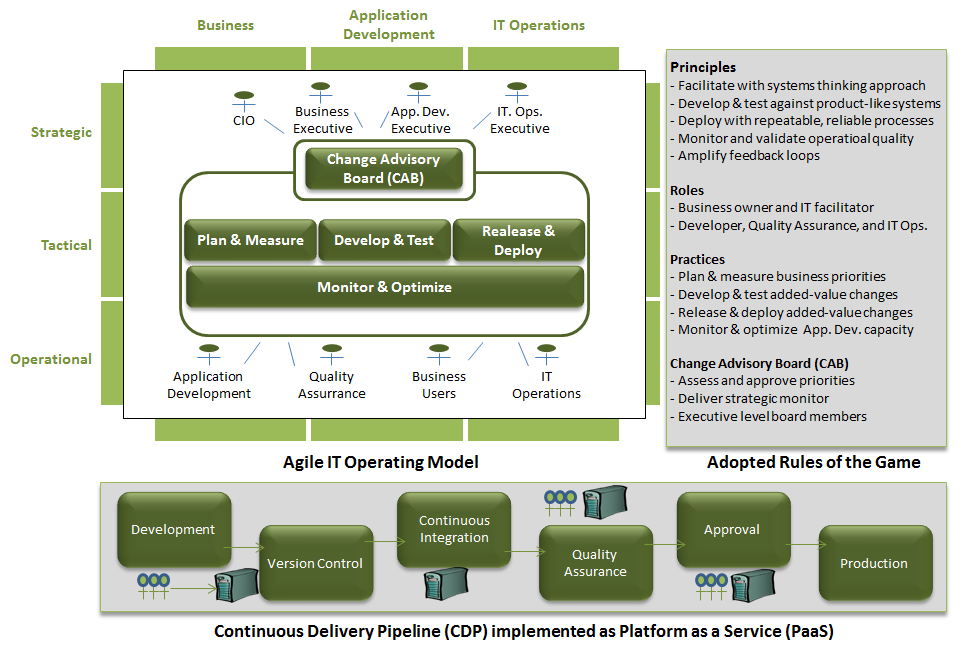
    As I’ve been implementing it, DevOps is a system of principles, practices, roles and responsibilities, governance structure and tools purposely arranged to establish cross-functional collaboration, enable accelerated applications delivery and, in turn, make the business responsive to market opportunities:

    DevOps Model (Credit: Philippe Abdoulaye ITaaS Now LLC)
    DevOps Model (Credit: Philippe Abdoulaye ITaaS Now LLC)

    As illustrated, DevOps as a business capability is made up of three components: the Rules of the Game, the IT Operating Model and the Continuous Delivery Pipeline (CDP). Let’s explore them.

    DevOps Rules of the Game create the conditions for lean and agile IT environments

    Rules of the Game are a fundamental dimension of DevOps: They enable the establishment of lean and agile environments. I refer to them as the DevOps non-technological piece.

    In practical terms, they’re a set of principles, practices, roles and responsibilities and tools institutionalized to ensure accelerated applications delivery.

    They serve as catalysts to specific organizational and operational effective practices. Let’s take the principle, “Facilitate with system thinking (involvement of all relevant stakeholders)”—it forces application development stakeholders to adopt a collaborative mindset, which in turn breaks down organizational silos to eliminate the impediments to operational flexibility and institutionalize cross-functional collaboration.

    They’re the poor cousin of today’s DevOps practices, which ignore them in favor of more technical and technology issues. That’s a terrible mistake that reduces DevOps influence vs. the digital economy’s challenges.

    The agile IT Operating Model establishes the lean and agile work environment

    The IT Operating Model reflects the interactions that take place across your application development value stream. In practical terms it represents the work environment derived from the application of DevOps’ rules of the game.

    I always remind my clients that DevOps’ rules of the game aren’t theories, they’re the foundations of a tangible strategic capability: the lean and agile IT  environment. They demand a thorough transformation of your application development work space to put together business, application development, and operations:

    The lean and agile IT work space illustrated (Credit: O.C. Tanner)
    The lean and agile IT work space for the digital era illustrated (Credit: O.C. Tanner)

    The picture illustrates what’s meant by lean and agile IT environment, it substantiates Adam Jacob’s point that “Fundamentally DevOps is about taking the behaviors and beliefs that draw us together as people, combining them with a deep understanding of our customers’ needs, and using that knowledge to ship better products to our customers.”

    The IT operating model is the poor cousin of today’s DevOps practices which ignore it in favor of more technical and technology issues. Once again, it’s a terrible mistake that reduces DevOps influence vs. the digital economy’s challenges.

    Make no mistake, technology matters, the CDP helps to meet digital technologies challenges

    The importance of the rules of the game and the resulting IT operating model don’t suggest at all that technology doesn’t matter. Make no mistake about it, the CDP is essential; I refer to it as the DevOps technological piece. Through deployment automation and configuration management tools, it significantly accelerates application development, testing, resources provisioning and deployment.

    However, one thing to be aware of is, digital economy raises technological challenges that transcend speedy delivery issues. They include:

    • The importance of IoT
    • The pivotal role of predictive analytics
    • The increasing importance of APIs

    As a matter of fact, IoT devices generate massive data and making use of it to generate revenue requires big data technologies to integrate, automate and analyze them.

    On the other hand, this ocean of IoT data has generated an API business; the idea is, to monetize their data and generate revenue, businesses must provide their customers and partners with APIs that easily give access to their systems.

    Implementing the CDP as part of PaaS cloud services can help to prosper in the digital economy; it allows businesses to benefit the cheap and on-demand computing, storage and network resources provided by the cloud.

    Takeaway

    In hindsight, with a business-oriented perspective, the ITaaS delivery model and DevOps follow the same goal: Provide business lines with the lean and agile IT environments they need to be flexible enough and responsive to meet the competitive challenges of digital economy:

    The ITaaS Delivery Model (Credit: Philippe Abdoulaye ITaaS Now LLC)
    The ITaaS Delivery Model (Credit: Philippe Abdoulaye ITaaS Now LLC)

    Like DevOps, the ITaaS delivery model (…) takes advantage of an agile IT operating model to help businesses succeed in the digital era. It implements consumer-provider relationships across the IT value stream to ensure organizational flexibility and operational agility.

    CIOs must realize that what matters to the business is to continuously generate revenue through improving customer experience and increasing customer value. Deploying applications at the speed of light for the sake of speed doesn’t make sense from a business perspective; as long as expected business benefits aren’t achieved, speed is a useless gadget.

    Implement DevOps as what it is: a three-dimension IT capability including rules of the game, IT operating model and, of course, continuous delivery pipeline.

  • Cloud on the customers’ terms: iland offers maximum flexibility with new ReST API and software development kits

     iland cloud API empowers developers to tap the advanced security, disaster recovery, compliance, management and big data functionality of iland’s enterprise-class cloud 

    HOUSTON – March 29, 2016 – iland, an award-winning enterprise cloud hosting provider, today announced its new iland cloud API, enabling customers to easily access cloud data, deploy workloads, and integrate the iland cloud into their own management tools. By releasing the API along with Python, Java and Golang software development kits (SDKs), iland gives DevOps, IT Operations and managed service providers yet another vector of customizability and flexibility to interface with cloud on their own terms.

    “From day one, we designed the iland cloud to give companies the fastest possible path to the scalability, cost efficiency and agility benefits of cloud while also ensuring customers never sacrifice transparency or security,” said Justin Giardina, CTO at iland. “By leveraging ReSTful endpoints, we’ve been able to rapidly integrate advanced security, disaster recovery and other features that set us apart from the competition. With the new API, we’re now giving customers the ability to directly access and build on top of that integration so they can focus on designing and delivering new capabilities for their business.”

    Unlike most cloud infrastructure offerings, iland Enterprise Cloud Services-Advanced Security (ECS-AS) platform integrates advanced security, compliance, disaster recovery, backup, monitoring and resource management functionality to ease cloud adoption and ensure rapid success. Further, iland ECS is built on the open source Apache Cassandra global data warehouse, giving iland and its customers a powerful Big Data back-end that fuels intelligent control, automation and reporting capabilities. iland’s cloud console allows companies to manage all of this functionality from a single web-based interface, which is ideal for many cloud infrastructure customers.

    Now with the new iland cloud API, customers also have the option of programmatically interfacing with the iland cloud and all of its advanced features – from security information to disaster recovery to the vast resources in the Big Data back-end. This straightforward gateway to comprehensive data and services enables customers to further benefit from the unmatched transparency, granular resource control of vApps, clear pricing and nuanced alerting of the iland cloud. The API and SDKs provide seamless access to the complete functionality integrated into the iland cloud, assembled into a single stack of accessible services. The iland API is built using the ReST architecture, which, due to its usability, is the industry-leading approach to exposing functionality.

    iland’s global customers will deploy this API towards a host of innovative uses, but some initial approaches include:

    • DevOps and Operations automation:Developers and systems engineers can rapidly spin up virtual machines or configure systems using their existing deployment tools. There is no need for extended training or a deep understanding of the data structure and workflow to add a connector. The straightforward SDKs mean creating the lightweight cloud interfaces can be simple.
    • Operations integration: Operations teams can access and visually integrate cloud data alongside their other monitoring tools in a single display or network operations center.
    • Reporting Flexibility: Whether delivering billing reports or assembling executive updates, the API can ensure IT can easily and accurately demonstrate cloud success.
    • Data to fuel innovation: With access to the iland Big Data back-end, customers can leverage performance, capacity, usage, security and compliance information about their systems to drive decision-making, prioritization, and IT innovation.

    For more information on iland Enterprise Cloud Hosting or to access the iland cloud API and SDKs, go to:

    About iland

    With data centers in the U.S., U.K. and Singapore, iland delivers the only enterprise cloud solutions in the market today with true innovation, transparency, intelligent management and advanced security built in. iland’s technology and consultative approach mean anyone– regardless of expertise, location or business objective–can benefit from a hassle-free cloud. From scaling production workloads, to supporting testing and development, to disaster recovery, iland’s secure cloud and decades of experience translate into unmatched service. iland has been recognized as Veeam’s Service Provider of the Year as well as VMware’s Service Provider Partner of the Year, Global and Americas. iland is also part of the Cisco Cloud Managed Service Provider Program for IaaS and DRaaS and partners with other industry leaders including Zerto, Trend Micro, Hytrust and Nimble Storage. Visit www.iland.com.

    Trademarks

    All registered trademarks and other trademarks belong to their respective owners.

  • Case Study: Sauce Labs Covers Animoto’s Testing Needs

    Case Study: Sauce Labs Covers Animoto’s Testing Needs

    Animoto’s web and mobile platforms enable businesses and consumers to drag and drop stock and user-defined visual and audio elements to create videos via a tiered monthly subscription service. Animoto updates service features with increasing frequency—some of them several times a day.

    “We have a broad range of applications and features including an online video maker application, where we enable users to import videos and video elements from all the known, established sources such as Facebook and through Dropbox,” says Siddharth (“Sid”) Jain, VP of Engineering at Animoto. “They can then export videos out to a variety of venues such as YouTube.”

    Animoto must iterate new innovations continuously into its application/platform for high-quality yet simple video creation to compete with similar solutions in the marketplace such as WeVideo and Stupeflix. This fast-paced development process is challenging, since Animoto must update separate versions of its software for the web, Android OS and Apple iOS (both iPhone and iPad). “The mobile apps are largely consumer-focused for very easy, on-the-go, frictionless video creation and sharing, while our web apps feature server audiences of professional photographers, educators and small businesses,” says Jain.

    In addition to testing service capabilities of different versions of the video maker application, Animoto must test the on-boarding/registration flow and the free product experience, where users get their first taste of Animoto. “We do lots of interesting things such as testing support for multiple currencies around the globe and running continuous multiple AB tests to ensure that the free product experience is working,” Jain notes.

    Notable Animoto testing includes user funnel testing in a simulated user flow environment starting at sign-up and continuing through video creation, feature exploration and the upgrade experience. “We test this several times a day on the different platforms,” Jain says, noting Animoto tests for the seamless success of import and export of videos and video elements to and from Facebook, Dropbox and YouTube. “The emphasis is on ensuring the quality and consistency of the user experience, i.e., making sure that nothing goes out that breaks revenue in terms of service.”

    Porting to Sauce Labs Promotes Progress

    Sauce Labs‘ cloud service helps Animoto scale up and out instantly to test Apple/iOS versions of its application so it can meet the high standards set by Apple and ensure fast inclusion of new app versions in the Apple App Store. This helps Animoto to compete by getting new innovations and features to market more quickly. “The biggest advantage to using Sauce Labs is that we don’t have to create or maintain a test lab internally,” says Jain.

    This accelerated testing speed is especially important since the app must adapt to every new iOS version while maintaining backward compatibility. “It would be a very nightmarish thing to do this all manually,” he says.

    In addition to faster testing, Sauce Labs is helping Animoto ensure that testing was delivering on its promises of software improvement through accurate feedback. “We used to be religious about doing extensive unit tests. Now we emphasize integration tests over unit tests because we got bit by unit tests that were all green even though the software functionality was broken,” says Jain. “Now we have a balance between unit and integration tests while frontloading the latter with tests of customer-facing functionality and collecting fine-grain feature use data.”

    The comprehensive testing helps to ensure that users aren’t shying away from certain features and that features are not broken. Frontloading uncovers regressions very early so the Animoto developers dedicated to fixing them can catch them before they lead to breakage.

    Sauce Labs helps Animoto shrink technical debt. “Debt rears its head in awkward ways. We do get surprised, but having good test coverage allows us to know where the app hot spots are and to have feedback to fix these and verify changes swiftly,” says Jain.

    Results: More Stability, More Capacity

    “We have been able to reduce testing time from three hours to under 30 minutes for some tests,” says Jain. “Thanks to Sauce Labs’ cloud, we added VM capacity, moving from 20 VMs to 45 VMs for the testing environment.”

  • Top 5 Reasons to Back Up Your OpenStack Environment

    Top 5 Reasons to Back Up Your OpenStack Environment

    I am a big fan of lists. If you recall the movie “High Fidelity,” John Cusack’s character Rob and his co-workers—armed with an encyclopedic knowledge of all things musical—compile “top five” lists for every conceivable occasion, openly mock the tastes of people, and, every so often, sell a few records. In the spirit of a lists, here are the top five reasons to back up your OpenStack environment. We thought that it would be helpful to many.

    If you’re currently working with OpenStack clouds, or are in the process of embracing it, you need to include backup and recovery for OpenStack on your list of to-dos from the start. You may ask, “Why? I have orchestrated/automated everything, I just need to spin resources up and down.” Cloud environments are fundamentally different from the virtualization we have become used to. Virtualization relies on infrastructure for resiliency. In the cloud, distributed applications are responsible for their own resiliency, and are independent of the underlying infrastructure. Therefore, cloud apps need backup and recovery options, lest you face a complete machine, data or file meltdown.

    We’ve compiled the top five reasons to backup your OpenStack environment. Take a read and it will become clear why you must include backup in your OpenStack plans.

    1. Compliance — Compliance may seem like an issue for only certain industries—finance and health care come to mind—but nearly every organization has to deal with compliance issues. For some, it’s compliance to external regulations, while for others it’s simply complying with internal policies and best practices. Backup for OpenStack is an essential component for compliance; it ensures the availability of the data at a specific point in time within your OpenStack applications. I was recently involved in a dialogue/string on LinkedIn watching experienced OpenStackers go back and forth debating “pet vs. cattle.” “I am getting tired of it,” one person said. “This is cloud. It’s about scaling up and out … With automation and orchestration there is no need for cattle.” This conversation went on for days. Theory is great. Practice is reality. What people failed to discuss is that compliance or the business units will drive many requirements (such as backup) either today or tomorrow. End of story.
    2. DevOps — Backup is often the forgotten tool for DevOps. Containers are great to use, but the ability to test with real data is an issue. The reason to use backup is quite simple: test and development. With a copy of a production environment, you now can test upgrades and new features in your agile development process. Furthermore, if you lose a machine or your data, or you end up with corrupted files while in the middle of testing or development, your life will be much easier if you have an appropriate backup solution in place. Restoring machines, data and files is a better option than re-creating them entirely. Cookbooks and recipes are great as well, but you still need to couple it with the appropriate “ingredients.” It is like playing with a fake kitchen as a child … do you want to make breakfast with plastic pancakes and toast? Nothing beats the real thing. Yes, more resources are required for one over the other, but when something goes wrong—it is unfortunate—people point fingers.
    3. Disaster recovery plans — While the terms “backup” and “disaster recovery” often are used interchangeably, they are actually not the same thing. You might have what appears to be a great recovery environment (ideally one that mirrors your production environment for high availability), but without a comprehensive backup solution, your recovery might not be the painless experience you expect it to be. Perhaps the solution for intelligent disaster recovery is to marry backup with a Swift environment so you can recover from any point in time, anywhere in your organization.
    4. Save time — Often recovery can be a frantic process, driven by a business need to have the machine, data or files recovered as soon as possible. Or, more likely, sooner than possible. If you are trying to re-create something under that type of environment, there’s a likelihood that mistakes could be made. This becomes increasingly true the more complex and mature your cloud becomes (think about the growing number of workloads and applications). A much easier approach—one that provides you with peace of mind—is to have a comprehensive backup solution ready and available for when you need it. There’s also another reason backup can save you time: When you have to re-create the lost information, you are taking your time away from something else—and that means you are taking a big hit to your productivity. Save yourself and your organization a big headache with backup.
    5. Security and forensics — You never know when you are going to be asked to provide data or files related to a security issue or a forensics investigation. The right backup solution not only makes it easier to assist with the activity, but think how good you’ll look by being able to deliver the information the forensics team needs quickly.

     Are you currently looking into backup solutions for OpenStack? Now that you know why you need backup for OpenStack, learn more about how to backup OpenStack.

  • Threat Stack Cloud Security and Monitoring Now Integrates With Slack For Real-Time Response to Security Threats

    New Integration Provides Security Alerting and Immediate Collaboration for Security and DevOps Teams

    BOSTON– March 9, 2016 – Threat Stack, a leader in cloud security management and compliance, today announced its integration with team communication platform Slack. The Slack integration with Threat Stack’s Cloud Security Platform™ alerts channel members to security concerns and enables instant workflows for cloud-based security operations center (SOC) teams. The Threat Stack Slack integration improves the speed at which team members can respond to and communicate about real threats the instant they happen.

    “Threat Stack’s integration with Slack alerts our entire DevOps team to security concerns and alerts in real-time,” said John de Freitas, principal software engineer, OnShape.”Threat Stack helps us to collaboratively detect potential security issues, and Slack allows us to communicate and address them immediately.”

    “Today’s fast growing businesses leveraging modern infrastructure for scale need to incorporate security into day-to-day workflow tools,” said Pete Cheslock, senior director of operations and support, Threat Stack. “Integrating Threat Stack security alerts into Slack allows for context and conversation around important events, providing valuable insight into activities happening across your infrastructure.”

    Threat Stack’s Slack integration automates SOC team’s processes, delivering only the most important security alerts directly into a designated Slack channel. After all alerts are thoroughly analyzed and baselined within Threat Stack, Severity 1 and 2 alerts are delivered to Slack, including:

    • Abnormal user behavior (e.g., insider threats)
    • Abnormal process behavior (e.g., new process behavior)
    • Abnormal network behavior (e.g., connections to new and bad IPs)
    • File tracking and copying of files
    • Abnormal infrastructure and CloudTrail activity

    The Slack integration works alongside Threat Stack’s audit trail capabilities, and improves SOC teams’ workflows by pinning alerts, dismissing alerts and identifying new patterns and rules. Additionally, Slack Plus users can easily archive conversations for audit and compliance purposes.  By leveraging the benefits of Slack’s real-time communication, users gain deeper context on Threat Stack security alerts and the ability to collaborate pre- and post-alert to determine the best course of action.

    To learn more about Threat Stack’s Slack integration, please visit our blog.

    Availability

    Existing customers can get started by simply providing their webhook API and alert severity preferences in the Threat Stack dashboard.  New customers can get started here: http://get.threatstack.com/threat-stack-free-trial

    About Threat Stack

    Threat Stack enables growth-driven companies to scale with confidence by identifying and verifying insider threats, external attacks and data loss in real-time. The only fully integrated, cloud-native continuous monitoring solution that gives companies instant visibility and automatically responds to changes in their environment, Threat Stack provides the coverage needed to run secure and compliant, in all environments, without sacrificing speed and efficiency. For more information, or to start a free trial, visit threatstack.com.

  • Relus Cloud Expands East Coast Footprint with Senior Solutions Architect Hire

    Ferzan Rizvi brings strategic expertise in Continuous Delivery, DevOps, and Amazon Web Services.

    Atlanta, GA (PRWEB) February 16, 2016

    Relus Cloud, a leading cloud solutions provider in Atlanta, announced today that it will expand the organization’s footprint into the New York and Pennsylvania markets with the addition of a new Senior Solutions Architect, Ferzan Rizvi. The expansion and Rizvi’s role will assist Relus in providing robust solutions in Amazon Web Services (AWS) and Continuous Delivery (CD) to organizations of all types. Rizvi brings a wealth of experience in AWS, architecture, development, and agile methodologies.

    “This exciting expansion will allow us to better serve organizations throughout our East Coast markets,” said Michael Campbell, Vice President of Sales at Relus Technologies. “Ferzan’s vast knowledge of AWS, Continuous Delivery, and DevOps will allow Relus to provide even greater expertise to organizations making cloud transitions or optimizing existing cloud environments.”

    Ferzan brings the organization over ten years in Continuous Delivery, DevOps and software engineering. Before joining Relus, Ferzan worked at Scripps Networks Interactive, Siemens, and eBay Enterprise. In previous roles, Rizvi was responsible for managing Continuous Delivery teams, solving challenging technical problems, and ensuring compliance with Federal and industry regulatory requirements.

    As Senior Solutions Architect, Rizvi will work closely with customers to deliver innovative cloud solutions and architecture. He will also support clients in developing cloud strategies and initiatives that align with the overall goals and objectives of the organization. “My goal is to bring the highest subject matter expertise to Relus clients,” said Rizvi. “I am excited to solve complex technical challenges and deliver quality results to Relus Cloud customers.”

    About Relus Cloud

    Relus Cloud is an Amazon Web Services Advanced Consulting Partner based in Atlanta, GA. Our core competencies include Cloud Strategy & Planning, Cloud Architecture & Design, DevOps Consulting, Managed Services, and Big Data Consulting. Our expertise and capabilities in cloud technologies positions us as a true business partner to the most profitable and impactful organizations around the country. Our experienced team develops tailored solutions aimed at minimizing costs, maximizing investment, building compliance, and simplifying the cloud technology environment. For more information, visit http://www.reluscloud.com.

    For the original version on PRWeb visit:http://www.prweb.com/releases/2016/02/prweb13217141.htm