Tag: cloud services

  • How Cloud Data Platforms Help Enterprises Drive Business Value

    How Cloud Data Platforms Help Enterprises Drive Business Value

    Cloud data platforms make businesses more scalable and flexible and more cost-efficient

    The need for actionable data is nothing new. Enterprises spend time, money and resources working to get their data into a format that is usable for analytics. But most are still struggling to do just that. More than 90% of enterprises say that making data available for insights is a key challenge in their analytics programs. The journey to modernizing your data infrastructure is challenging, especially if performing data transformation quickly is holding back your business.

    To compete effectively with data, you need “analytics-ready” data. This requires scalable data transformation—the ability to join together siloed data, denormalize, enrich and apply business logic. This process is imperative for getting to the insights that will help you solve business challenges at pace. So how much can data transformation benefit your business? It can rapidly improve your data preparation process, consolidate your data sources, save money, make accurate forecasts and predictions and most importantly, provide you with the insights you need for business growth.

    Cloud-native Solutions and the Cloud Data Warehouse

    A modern data infrastructure works best with cloud technology. Legacy data warehouses hold businesses back from scaling alongside data volumes and bringing data together into a single view. Cloud data warehouses help companies move quickly, and cloud-native solutions use the economics and power of the cloud to handle big and varied data volumes. This is especially helpful with a cloud ELT (extract, load, transform) solution. Traditionally ETL (extract, transform, load) is used to perform data transformations. But the modern ELT approach allows you to move data directly into your cloud data warehouse and then perform the necessary transformation. When enterprises employ a modern data environment and cloud-native tools, it is easier to proactively use data to glean insights—and save on provisioning costs.

    Take, for instance, a large cloud security organization that needed a centralized data repository that was modeled to handle diverse data sources and increasing data storage and reporting needs. This company moved off of its legacy system onto a cloud data platform with a cloud data transformation tool, allowing them to reduce application spends by 84%. Now with a single view of data, they can easily run unified reports to analyze data quickly, opening up greater possibilities to extract insights.

    Preparing and Transforming Data Quickly for Faster Time to Insights

    The act of wrangling data is time-consuming. In a recent survey by IDG, nearly half of data professionals reported that it takes more than a week to prepare data for analytics. ETL, ELT and data preparation workloads are bogging down precious data engineering resources and wasting valuable time that could be better spent innovating with data. Data preparation is a challenge for organizations because the work is code-heavy and manual.  Cloud-native ELT solutions can reduce the burden of data wrangling and provide a much faster, low-code process to prep data.

    Data transformation tools that take advantage of the power of the cloud, have intuitive and automated data preparation processes that eliminate the need for coding.

    This enables businesses to transform data for advanced use cases such as machine learning. For example, a global logistics company that made 100 million deliveries to 37 million unique customers across 72 countries needs to use massive amounts of data, from a variety of sources, to fuel its daily operations. Using data transformation inside their cloud data warehouse helped them to join together disparate data and improve business processes. The company deployed 200 machine learning models in a single year, used to make 500,000 predictions every day. This significantly increased the efficiency of its delivery operations and helped the customer service team reduce inbound call center inquiries by 40%.

    High-quality, Accurate, Timely Data Makes the Difference

    New data sources are proving beneficial—and challenging—for businesses to integrate into their organization. As the pace of data increases, the need for recent and accurate data rises along with it. An analytics platform built in the cloud can provide a much-needed pipeline of high-quality data that can be used in a timely manner, with insights provided quickly.

    As another example, a software company that wants to improve its data-driven culture by relying on fast data integrations using a cloud analytics platform to ingest information. Instead of analyzing data that was days old, the software company used a cloud data transformation tool to load data in real-time from all external sources in the business. By taking advantage of reusable components built in the cloud, the team reduced their data ingestion process from as many as 10 workflows down to just one. This allowed them to reduce their data warehouse and ETL administration, freeing up developer resources to innovate within the business.

    Scaling Resources and Saving Costs With a Cloud Data Platform

    The results of cloud data transformation speak for themselves, as enterprises from different industries see accelerated time to value, scalability and cost savings that validate their investment in modern solutions.

    Data transformation, performed in the cloud, can help you rapidly improve data management and existing processes. Analytics-ready data can help you solve critical business problems and ultimately generate revenue. As external factors contribute to pressure on budgets, resources and road maps, transforming data with an ELT solution will help reduce development time and accelerate innovation with new insights. Cloud ELT and data platforms make businesses more scalable and flexible, cost-efficient and better-prepared to leverage data in advanced use cases involving IoT data, machine learning and artificial intelligence that can predict what comes next and what to do about it.

  • How to Choose the Right IoT Cloud Provider

    How to Choose the Right IoT Cloud Provider

    The flexibility and scale of cloud-native development makes it an obvious choice for IoT initiatives. That’s partly because IoT engineering tends to be more complex, requiring seamless interoperability between software, hardware, a UI, together with connectivity and data handling capabilities. Typical IoT initiatives are compute-intensive too, again making them a good fit with the functionality a cloud-native development platform can provide. The right cloud platform can help accelerate the launch of an IoT project and reduce the risks associated with rollout. Simultaneously, cloud-native development should also increase efficiencies through the development cycle, which both speeds things up and lowers costs.

    Considering the significant benefits of cloud-native engineering, what, if any, are the downsides? For those new to engineering in the cloud, there is a learning curve involving a few new variables that need to be taken into consideration to avoid disruptions and vulnerabilities in the software development and operations environment. Furthermore, selecting the right cloud tools can be confusing. The cloud giants (Microsoft, Amazon Google, and IBM) all have comprehensive offerings. In addition, dozens of specialist providers compete alongside them with targeted sector-specific solutions.

    An IoT platform should help to minimize risk and ensure quality digital service delivery from end-to-end. It should provide organizations with tangible benefits that amount to a head start in engineering terms: built-in tools and capabilities that cut effort, costs and time required. Many specialist vendors offer attractive packages that address IoT solutions needs without requiring too much customization. However, engineering teams must also take into account how the IoT solution integrates with their organization’s wider digital offering. IoT systems deliver the most value when they are closely aligned with the rest of the business. As a result, data handling and data integration become critical factors in the decision-making process.

    More generally, IoT platforms offer some very attractive services to help companies get started in setting up their IoT solutions. There are trade-offs, however, which often come later down the line in the form of pricing, technical constraints, complexity and vendor lock-in. When it comes to evaluating cloud platform providers for IoT, there are a number of factors every organization needs to keep front of mind.

    1. Is there a cloud platform name that keeps cropping up in conversations with your trusted influencers? Enterprises should seek recommendations, then follow up to ensure providers can share examples and evidence to back up success stories.
    2. Pay attention to scalability. Cloud providers will dazzle prospective clients with how many millions of connections they can handle. Can they show consistently high uptime? Can they help you make the job of scaling easier? Can they monitor the performance of devices?
    3. Finding a cloud platform that can meet your IoT solution needs is your primary concern. But longer-term, it is worth asking how well the platform accommodates changing use cases.
    4. How will your IoT system handle regular updates? These come in the form of system integrations from the IoT platform vendor and firmware updates that you will want to push out to your connected devices.
    5. The new IoT environment will need to seamlessly manage data, so businesses need to consider how they will ensure that happens. When approaching the challenge of data management, they will need to evaluate if they have the skills and resources in-house to work alongside their IoT cloud provider to ensure success, or if additional external support may be required.
    6. Congratulations, your role is now to own, manage and secure millions of data points! How will your IoT cloud platform work alongside your existing security practices to bolster security and privacy in the IoT system?
    7. Established all-rounders or small specialists? Proprietary or open source? There are many factors to weigh up, including the trade-off with ease of setup, where enterprises feel the benefits immediately, but potentially at the expense of future constraints such as vendor lock-in.
    8. It’s important to read the small print when it comes to disaster recovery options. A whole host of environmental factors can impair the ability of an IoT system to function. This is an opportunity to examine how DR planning is handled right from the get-go, and to question a provider’s track record when it comes to outages.
    9. The difficulty businesses most often have in budgeting for their IoT platform support is failing to account for how their needs change. A pricing model that seems great upfront can prove costly in the long run. Try to anticipate the changing needs and ask what kind of pricing flexibility the IoT cloud platform can offer.

    While there are undoubtedly many factors to consider before undertaking cloud-native IoT development, cloud engineering confers many significant benefits. Nowadays the right IoT cloud platform is much more than hosting and accessing resources in the cloud. Cloud-native computing enables companies to take advantage of the most up-to-date techniques and services. These include PaaS, multi-cloud, microservices, agile methodologies, containers, CI/CD, data engineering, IoT, AI, and machine learning, but the list could go on. With the right IoT cloud partner, companies can harness the latest technical capabilities to progress toward their strategic business goals. Embracing cloud-native engineering helps organizations accelerate digital delivery as well as achieve scale, increase reliability and improve efficiency.

  • AWS Expands Breadth, Depth of DevOps Services Portfolio

    AWS Expands Breadth, Depth of DevOps Services Portfolio

    Amazon Web Services (AWS) today launched a bevy of cloud services, including a preview of Amazon DevOps Guru, that collectively promise to make it much easier to deploy and manage cloud applications.

    Announced during the online AWS re:Invent conference, Amazon DevOps Guru is a fully managed service that employs machine learning algorithms to automatically detecting operational issues and recommend specific responses that will be delivered via a notification. Through a single console, IT teams will also be able to visualize their operational data by summarizing relevant data from multiple AWS and third-party data sources, including PagerDuty and Atlassian.

    AWS also unfurled AWS Proton, a service to automate the development and deployment of microservices-based applications built using containers and the AWS Lambda serverless computing framework. Available also in preview, AWS Proton is an application management service that enables IT teams to define reusable application components as “stacks” that can be combined with a set of curated application stacks for security, architecture and tools defined by AWS. This service then automates the provisioning of infrastructure as code, the setting up of continuous integration/continuous delivery pipelines and the setting of monitoring tools.

    AWS CEO Andy Jassy told conference attendees that in effect, AWS will be managing DevOps processes on behalf of developers.

    At the same time, AWS is launching Amazon Elastic Container Service (Amazon ECS) Anywhere, which allows IT teams to use Amazon ECS to orchestrate containers in their own data centers, and Amazon Elastic Kubernetes Service (Amazon EKS) Anywhere, which provides the ability to run EKS on the distribution of Kubernetes that AWS employs in local data centers. There is also now an Amazon Elastic Container Registry (Amazon ECR) Public service for sharing container images.

    At the same time, AWS previewed Amazon Aurora Serverless v2, which will make it possible to scale instances of MySQL databases instantly using the AWS serverless computing framework. Support for PostgreSQL databases is planned for next year.

    AWS also announced it has added a Microsoft SQL Server-compatibility layer to its PostgreSQL database to make it easier to migrate Windows applications to an open source database. The company will also open-source that capability, dubbed Babblefish, as part of an effort to encourage the development of compatibility layers for other databases. PostgreSQL already provides compatibility with Oracle RDBMS applications.

    Jassy chided providers of these proprietary database platforms for changing licensing terms when organizations deploy these databases on public clouds other than their own. Those moves have only created additional demand to migrate faster to open source databases, noted Jassy.

    Finally, AWS is adding a slew of infrastructure options, including Mac instances (EC2 Mac instances) for Amazon Elastic Compute Cloud (Amazon EC2). Built on Mac mini computers, the service will make it possible for developers to more cost-effectively build MacOS applications.

    In addition, AWS is adding 1U and 2U servers to its AWS Outposts portfolio for deploying infrastructure in on-premises IT environments. Those offerings expand AWS Outposts beyond rack-based systems.

    The company is adding AWS Graviton2-powered C6gn instances to deliver 100Gbps networking performance for Arm processors it designed. Those instances offer 40% better price performance over comparable current-generation x86-based instances, according to the company. There is also now M5zn instances of Intel Xeon Scalable processors that offer 45% better compute performance per core than current M5 instances, according to the company.

    AWS is also adding G4ad Graphics Processing Unit (GPU) instances based on processors from AMD and revealed its intention to build its own GPUs next year. The company also plans to add an Amazon EC2 instance based on up to eight Habana GAUDI accelerators from Intel to deliver up to 40% better price performance than current GPU-based EC2 instances, according to the company.

    Overall, Jassy said AWS grew 26% year over year to achieve a $46 billion run rate. As the number of services provided by the company continues to expand, maintaining that growth rate at a time when applications are moving into the cloud faster than ever looks easily achievable.

  • What’s the Best Multi-Cloud Strategy for Your Organization?

    What’s the Best Multi-Cloud Strategy for Your Organization?

    Scaling your business needs robust solutions, and a multi-cloud strategy can exactly help you achieve that. There has been a debate on whether organizations should go for multi-cloud or stick to a single vendor. Recently, one of the users of Reddit posted a question, “Do you need a multi-cloud strategy?”

    Responses to the question offer some interesting observations, in which large organizations are considering the multi-cloud strategy as failover situations. Most organizations migrate toward multi-cloud strategies to:

    • Avoid vendor lock-in.
    • Porting over dependency for computing function toward one cloud service.
    • Achieve self-containerization and portability.

    Multi-cloud is a strategy in which organizations seek services from heterogeneous cloud providers. Such providers can be specialized in platform as a service (PaaS), infrastructure as a service (IaaS) and software as a service (SaaS). Multi-cloud can also include public cloud, private cloud and even hybrid cloud service.

    The strategy has been quite popular among organizations across the globe. The global market for multi-cloud management will reach more than $1659.6 million by the end of 2020 and is expected to grow at a CAGR of 16.1% for the forecast period of 2021-2026.

    Here, we are going to discover some fantastic architecture designs for multi-cloud deployments. But, before that, let’s answer the question that most organizations should ask.

    Why Deploy a Multi-Cloud Strategy?

    Suppose you are a big organization like Spotify and all your data is handled by a single vendor—say Google Cloud Platform (GCP). Now, the streaming service has all the chips on a single vendor here. It is not that GCP is inefficient, but the dependency is higher. So, what to do for the worst-case scenario?

    Multi-cloud is an architectural decision for an organization. It helps reduce the dependency on a single vendor and creates a fail-safe.

    So, let’s discover some interesting multi-cloud migration strategies for your business.

    Redeployment Multi-Cloud Migration Pattern

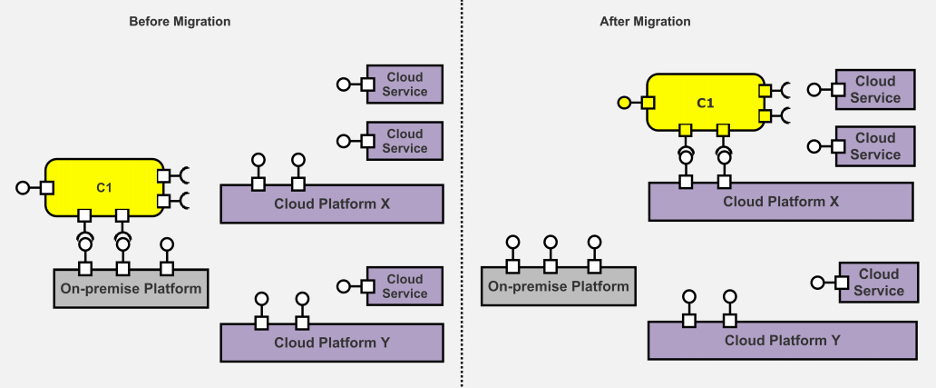
    Re-deployment of an application or software needs refactoring of the architecture. It is a great way to revisit the deployment strategy, especially when you are migrating to multi-cloud. This migration pattern can help transform the existing architecture into a multi-cloud design. It includes pre-defined architecture elements including the service, cloud platform, connectors and even onsite storage devices.

    Image Source: Re-deployment Migration Pattern

    Any service component can be atomic or allow a hierarchical redundancy. Here, before the migration, the component uses services from the on-premises platform. These services can be the coordination of different component architecture or IaaS.

    Once we migrate the component to multi-cloud architecture design, the on-premises service is replaced by a public cloud platform. So, the application is re-employed on a cloud platform without higher operational expenses, offering greater virtualizations.

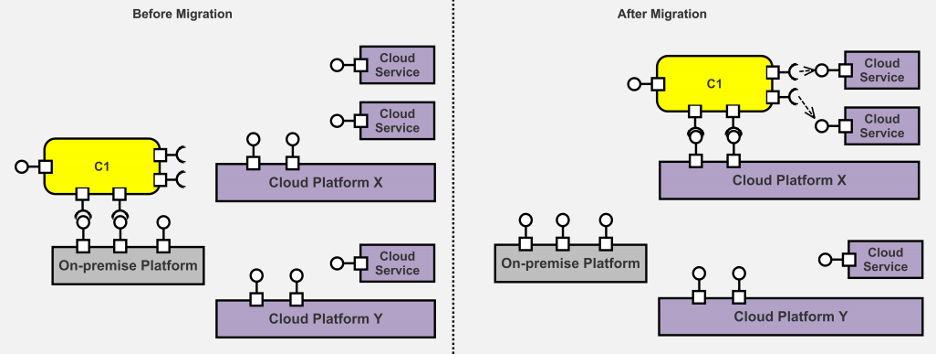
    Cloudification

    Cloudification design architecture explores the integration of public cloud platforms for added capabilities. Before the migration, the component uses on-premises services without any additional capabilities. It reduces the extensibility, increases redundancy and decreases reusability.

    Image Source: Cloudification Migration Pattern

    The solution here is simple: You can migrate to the cloudification architecture. Here, the on-premises service is integrated with the existing public cloud platform for extended capabilities.

    Relocation Design Pattern

    Sometimes significant changes in the multi-cloud architecture design can increase the operational expenditures. The solution to such an issue is a relocation strategy that helps maximize the existing architecture with multi-cloud capabilities.

    Image Source: Relocation Migration Pattern

    Here, the architecture uses queues, partitions of the database and other tools such as NoSQL or cache to capitalize on cloud services. It helps improve the efficiency of the components rehosted in the cloud.

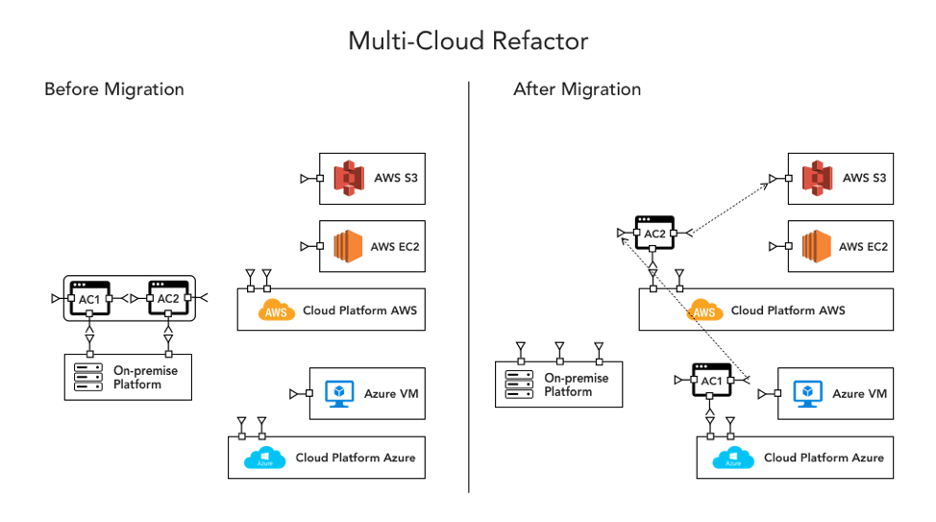
    Multi-Cloud Refactoring

    Many large organizations opt for multi-cloud architecture designs. The component is often pretty large to capitalize on the advanced optimizations offered by cloud platforms. The bulky components do not respond well to changes and variations in data.

    Image Source: Reforctoring Multi-cloud

    The solution is to refactor the multi-cloud architecture. The application is refactored into small components that are optimized individually for lower usage. A parallel architecture helps with better performance, scalability and flexibility of multi-cloud features through integration.

    Multi-Cloud Rebinding

    Multi-cloud rebinding is an especially fail-safe architecture. Take an example of Netflix’s streaming service: You are watching a movie on the app, but streaming stops due to a bug in the cloud platform. Netflix simply routes the traffic to the nearest healthy data center or cloud service for an uninterrupted experience.

    Image Source: Rebinding Multi-cloud pattern

    Rebinding the multi-cloud architecture can help redirect the traffic while your unhealthy instances come back to normal during a failover. So, you can again use the original cloud services and direct the traffic back.

    Replacement Architecture Design

    Innovation in existing products often needs services with higher capabilities. For example, you want to integrate a machine learning algorithm into an application, but the current architecture does not have that capability due to existing cloud service. So, you can replace the cloud service with the ones that have better performance and handle such integrations.

    Image Source: Replacement Architecture Design Pattern

    Replacement architecture saves your re-engineering efforts and operational costs. It helps improve the performance of your products through cloud services with advanced technology.

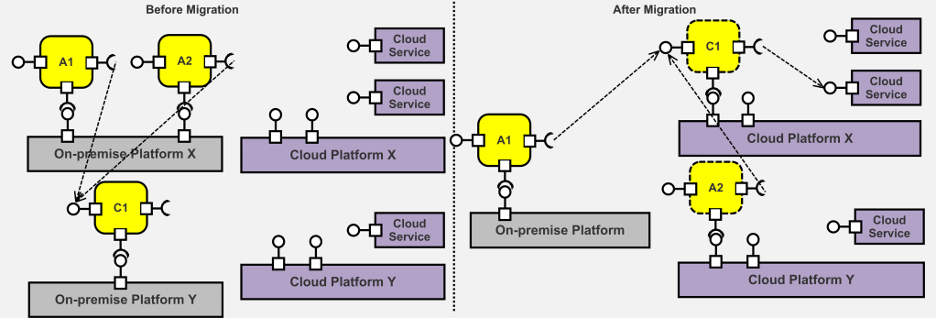
    Multi-Application Modernization

    Many organizations tend to create a portfolio of on-premises applications for cost reduction and better consistency. What transpires in the real world, however, is often different from the envisioned architecture. These shared components do not have that consistency and cost higher.

    Image Source: Multi-application Modernization Pattern

    Here, you can see that A1/A2, C1 shares the on-premises platform as a portfolio deployed on the cloud environment. Instead of a portfolio, these services are separately deployed in a re-architected multi-cloud design. It helps in identifying the capabilities of different components and finding the solutions shared among them. It will help organizations have constant information on shared solutions and reduce operational costs through optimizations.

    Conclusion

    The current application market has many organizations leaping through innovations and advancements. It emboldens these firms to use multi-cloud architectures to leverage different microservices and containers. The multi-cloud landscape is growing and a new era of function as a service (FaaS) has emerged.

    Breaking the single vendor lock-in to deploy apps with services from multi-cloud is popular these days. The best things about this revolutionary change are better consistency, flexibility and performance, which become evident. Organizations can switch to multiple vendors to share the workloads and create an ecosystem of services.

  • New AWS Services Optimize App Development Process

    New AWS Services Optimize App Development Process

    Amazon Web Services (AWS) is always busy introducing new services, enhancing existing ones and, quite often, driving trends. However, the cloud services provider has upped its game even more in recent months.

    In the first half of 2020, AWS announced an astonishing number of developments that enable technology interoperability, simplifying legacy feature removal, creating greater flexibility and time-savings for developers and putting new capabilities at users’ fingertips.

    AWS and ARM Power

    You are going to be hearing a lot about ARM processor architecture and not just because the chipmaker is being acquired by Nvidia, the leading maker of GPUs.

    Developed in the 1980s, ARM processors are finally hitting their stride as companies are embracing ARM-based chips. ARM-based processors combine high-performance RISC designs, lower manufacturing costs and reduced power consumption, making them ideal for portable devices such as smartphones, tablets and even laptops. More and more companies are designing processors that implement ARM architecture, including Apple, AppliedMicro, Broadcom, Qualcomm and Samsung Electronics. This year, Apple brought ARM chips into the desktop world with tailored extensions such as a built-in security enclave, a motion co-processor and a neural engine.

    AWS is among those embracing ARM architecture, which has led to introducing an array of robust services that will benefit developers and end users alike. Case in point: This summer, AWS announced the general availability of its sixth generation of Amazon Elastic Compute Cloud (Amazon EC2) instances, including general-purpose (M6g), compute-optimized (C6g) and memory-optimized (R6g) instances. Powered by AWS-designed, ARM-based Graviton2 processors, they deliver up to 40% better price/performance over comparable current-generation x86-based instances.

    They also offer 50% more NVMe SSD storage GB/vCPU over comparable x86-based instances. The local SSD storage works well for apps that require high-speed, low latency storage, as well as for temporary storage of data such as batch and log processing, and high-speed caches and scratch files.

    They’re ideal for workloads ranging from application servers, microservices and high-performance computing to CPU-based machine learning inference, electronic design automation and gaming. Numerous organizations have already successfully adopted ARM-powered instances and are realizing price/performance benefits.

    The AWS Graviton-based instances are supported by a broad ecosystem of operating systems and services from independent software vendors (ISVs) as well as AWS. They can be purchased as on-demand, reserved, or spot instances; covered by savings plans or as dedicated hosts/instances, and support up to 19 Gbps Elastic Block Store (EBS) bandwidth.

    The AWS Graviton2 processor itself, released in late 2019, deserves recognition, too. Compared to first-generation ARM-powered Graviton processors, they provide twice as fast floating-point performance per core for scientific and high-performance computing workloads. They also offer optimized instructions for faster machine learning inference, always-on fully encrypted DDR4 memory and 50% faster per core encryption performance to further enhance security.

    A number of AWS services, such as Amazon Elastic Load Balancing, Amazon ElastiCache and Amazon Elastic Map Reduce, have realized superior price/performance in testing and will be moving into production on Graviton2-based instances.

    Better, Easier Artifact Management

    AWS isn’t the only organization opting for ARM. As many others prepare to make a move, AWS is doing its part to facilitate the transition. That includes deploying services that streamline various aspects of the app development process, in keeping with the efficiencies and increased performance offered by ARM-based chips.

    One that we’re most excited about is AWS CodeArtifact. This fully managed software artifact repository service eliminates the need for setting up, operating and scaling the infrastructure required for artifact management. It works with commonly used package managers and tools such as Maven and Gradle (Java), npm/yarn (JavaScript) and pip/twine (Python), so it can easily be integrated into existing development workflows.

    AWS CodeArtifact can be used for creating centralized repositories for sharing software packages approved for use across development teams. Its integration with AWS Identity and Access Management (IAM) enables access control. Its support for AWS CloudTrail provides visibility into which packages are in use and where they can easily be updated or removed.

    AWS Making Containerization Easier

    Using containers to modernize existing apps make them portable, increases development agility and reduces operational costs. The problem is that the process requires numerous manual tasks that are time-consuming and error-prone, and slow down modernization efforts.

    That’s why we think another recently deployed AWS service will have a positive impact on the app development process. AWS App2Container is a command-line tool that helps containerize existing apps running on-premises, in Amazon EC2 or in other clouds with no code changes required.

    App2Container discovers apps running on a server, identifies their dependencies and generates relevant artifacts for seamless deployment to Amazon ECS and Amazon EKS. It also provides integration with AWS CodeBuild and AWS CodeDeploy for a repeatable way to build and deploy containerized applications.

    AWS App2Container generates artifacts such as Dockerfiles, container images in Amazon Elastic Container Registry (ECR), ECS Task definitions, Kubernetes deployment YAML, templates to set up a build/release pipeline in AWS CodePipeline and more.

    It can also be used to containerize ASP.NET (.NET 3.5+) web apps running in IIS 7.5+ on Windows and Java apps running on Linux.

    Code Review and Optimization

    Another handy tool that debuted this summer is Amazon CodeGuru. Powered by machine learning, this set of tools automatically reviews code for bugs and suggests potential optimizations. It includes two components:

    • Amazon CodeGuru Profiler—Helps developers find an app’s most expensive lines of code and then recommends how to improve the code to save money.
    • Amazon CodeGuru Reviewer—Helps improve code quality by using machine learning to identify critical issues and hard-to-find bugs during development.

    Do-It-Yourself Development

    One more recently released AWS service we want to mention is Amazon Honeycode. This one has the potential to be a big time-saver for customers. The fully managed, low-code/no-code development tool makes it easy to build powerful mobile and web apps quickly with no programming required.

    Customers can use a simple visual app builder to create highly interactive web and mobile apps, backed by an AWS-built database to perform tasks such as tracking data over time and notifying users of changes. They can get started creating apps in minutes and build applications for up to 20 users for free. After that, they pay per user and for the consumed storage capacity.

    What’s Next With AWS Is What’s Now

    AWS is continually developing and deploying services that make app development easier and more cost-efficient. You can put these new services to work to innovate more, get to market quicker, generate significant cost savings and much more.

  • Dell Launches Project Apex to Deliver IT as a Service

    Dell Launches Project Apex to Deliver IT as a Service

    Dell Technologies today launched Project Apex, an initiative that promises to significantly expand its ambition to deliver IT as a service from the edge to the public cloud.

    Announced at the online Dell Technologies World 2020 conference, this initiative builds on the Dell Technologies Cloud Platform through which Dell manages IT infrastructure as service on behalf of customers.

    Sam Grocott, senior vice president of product marketing at Dell Technologies, said via a single pane of glass organizations will be able to deploy and manage application workloads running on IT infrastructure provided by Dell as well as public cloud service providers using the Dell Technologies Cloud Console, which is currently available as a public preview.

    In the first half of next year, Dell plans to roll out Dell Technologies Storage as a Service (STaaS) for on-premises IT environments, which also can be managed via the Dell Technologies Cloud Console.

    In addition, Dell is reducing the entry-level cost of its existing hybrid cloud offering built on top of Dell Technologies Cloud Platform to $47 per instance per month with a subscription, in addition to making the service available in the UK, France and Germany.

    Dell is also making a pre-approved Flex On-Demand pricing option that charges organizations on a usage basis for IT infrastructure, and has expanded its managed data protection services to include multiple public clouds.

    It’s not clear whether organizations will prefer to rely on Dell to manage their IT versus continuing to manage it themselves or rely on a third-party IT services provider. In theory, organizations will be able to invest more in application development that would eventually consume more IT infrastructure than is consumed today. However, it’s not clear internal IT organizations are prepared to cede control over IT infrastructure and applications to a single IT vendor, especially if they employ IT technologies provided by a broad spectrum of vendors.

    In the wake of the economic downturn brought on by the COVID-19 pandemic, however, Grocott noted the number of organizations that prefer to treat IT as an operational expense has increased substantially. In addition, with more employees working from home organizations are looking for a more flexible approach to IT that is a challenge for them to achieve relying on legacy systems. To facilitate that transition, Dell is expanding the refurbishment and recycling services it makes available to customers.

    In effect, Dell is enabling a cloud operating model to be applied to all of IT regardless of where applications or IT infrastructure is deployed.

    Of course, Dell is not the only IT platform provider with such ambitions. Not only are longtime rivals in the data center expanding the scope of the managed services they provide, but every major provider of a cloud service has also expanded the reach of their offerings to include on-premises and edge computing platforms. It may be a while before this titanic struggle for control over IT plays out, but the one thing that is for certain is the way IT is consumed is changing utterly.

  • Has the Time Come for IT Predictive Analytics?

    Has the Time Come for IT Predictive Analytics?

    Predictive analytics technologies have become critical to compete in manufacturing (predicting machine failure), banking (predicting fraud), e-commerce (predicting buying behavior) as well as to address horizontal use cases such as cybersecurity breach prevention and sales forecasting. Using data to predict and prevent IT outages and issues is also a growing best practice—especially as advances in monitoring software have made it easier to deliver analytics in a timely manner.

    The process of rapidly collecting IT systems data, including by integrating data from various monitoring tools in use, has become rudimentary. The magic is in the algorithms, which can deliver actionable intelligence. IT predictive analytics, once known as IT operations analytics (ITOA), is still nascent in many organizations, but it’s far more streamlined than it used to be when one needed to export data sets to specialized analytics tools such as Tableau or Microsoft PowerBI. Data analysts and then data scientists were necessary to interact with these advanced tools and deliver valuable predictions—a process that could take weeks.

    Today, IT professionals can use modern IT operations monitoring and management systems for collecting and integrating the data, normalizing it and then analyzing it in real-time. That’s making predictive analytics in IT far more user-friendly, affordable and useful for all organizations, not just the largest companies with the biggest budgets.

    Advances in predictive analytics technology, aided by machine learning and AI, are creating more proactive workflows for IT operations teams. For instance:

    • Storage usage. It is not a happy moment when IT finds out that the expensive storage array is down. It’s not enough to know after the fact that storage volumes were steadily climbing out of the normal pattern. By knowing ahead of time that a trend is heading out of the acceptable range, IT can research the cause and fix it before any damage is done. With cloud storage, risks include slow connectivity if network bandwidth is insufficient or security breaches if the cloud provider’s security mechanisms are not sufficient for your use case. Predictive analytics can alert on these possibilities in time to take corrective action.
    • Cloud-to-cloud performance comparison. An important aspect of predictive analytics is the ability to make correlations and show relationships between multiple data points. IT leaders are interested in learning about an application’s performance across the entire IT environment, which may include comparing historical performance across multiple clouds to predict weaknesses in one service over the other and mitigate them proactively. This use of predictive analysis could also be valuable in helping companies choose one cloud provider over another for particular applications and workloads.
    • Container optimization. Making correlations is especially valuable when it comes to managing performance in a microservices environment. Collecting metrics for a containerized application isn’t useful by looking at each container per se, but it is useful when looking across the container environment to see if there are common metrics dangerously trending the wrong way across many or all containers.

     A Few Tenets for Predictive Analytics in IT Operations

    Regardless of the tools that you choose to create a predictive analytics practice in your organization, there are several things you must get right first. Here are six recommendations to consider:

    1. Centralize the data into one or two systems at the most. This allows for data cleansing, normalization and a single (ideally) system of record for all other users and integrations.
    2. Invest in first-class data visualization. As business units now interact with IT management systems to see departmental usage and troubleshoot minor issues, tools should be user-friendly for people who are not data analysts. Dashboards and charts can tell the story simply and explain the correlations and conclusions which the software delivers.
    3. Make it actionable. There is no use in creating predictive data if it’s not automatically sent to the right individuals and/or shared with other systems to execute actions when needed. Think about it the Amazon way: We all know that people aren’t sitting behind monitors sending millions of individualized recommendations to customers every day. Your IT operations portfolio should behave the same way: automated, intelligent, helpful and always adapting to new information.
    4. Correlate data at the speed of IT change. Before there was such a thing as virtualization and cloud infrastructure, there weren’t many devices to monitor and things didn’t change much day-to-day. You could actually “set and forget” data center infrastructure components for weeks. Now, of course, changes are happening behind the scenes every minute without our knowledge. Yet your monitoring and change management tools need to know about it. By using standard deviation for change detection monitoring—four-hour increments are typical—you can ensure that your team always has an updated understanding of infrastructure status as well as the relationships between the various systems and components.
    5. Avoid the black box. Enrich your data lake continuously with event data and allow users to see the IT operations platform working in real-time. With machine learning and artificial intelligence, there’s always a measure of doubt and a margin of error. This uncertainty can be counteracted by sending more diverse data sets so that the user can make her own conclusions. As well, when the machine makes an error in judgment, train it to avoid making the same mistake again.
    6. Update internal IT skills. You’ve heard it before. In the age of big data, IT organizations need data science expertise and skills. It’s important to acquire or develop these skills so that your team can combine machine intelligence with human insight and make better decisions. That is where AI-driven analytics holds the most promise.

    We are just getting started on this new age of predictive analytics in IT operations. Before long, organizations will move from predicting downtime and serious application issues to driving infrastructure optimization and cost savings. IT leaders will be able to answer with confidence, how much cloud infrastructure needs to be provisioned or de-provisioned over time. They will understand with better clarity common application scaling patterns, as well as overall capacity management needs. As predictive analytics takes hold, IT leaders will need to determine how to reorganize employees who previously spent hours scanning data on screens into more strategic roles.

  • ServiceNow Extends DevOps Integration Reach

    ServiceNow Extends DevOps Integration Reach

    ServiceNow today announced it has added four new integrations with DevOps platforms to its IT service management (ITSM) platform delivered via the cloud.

    The four integrations add native support for Microsoft Azure Pipelines, a Jenkins Plugin, GitHub Actions and GitLab pipelines. A continuous integration/continuous delivery (CI/CD) Spoke capability on the ServiceNow platform makes it possible for developers to build automated pipelines using the Flow Designer tool.

    Marcus Torres, vice president of product platform management at ServiceNow, said these latest integrations build on a DevOps integration initiative that ServiceNow launched last year. Rather than building its own DevOps platform, the company has opted to focus on integrating ticket-based ITSM processes with DevOps processes as the management of IT continues to evolve and mature.

    In some cases, best DevOps practices for rapidly deploying applications is an absolute requirement, he noted. However, there are plenty of IT processes that are still best served by a ticket-based approach based on best practices defined within the widely adopted ITIL framework.

    Since the initiative was launched, the number of organizations that are employing the low-code ServiceNow App Engine platform to build custom workflows that integrate DevOps platforms is also steadily increasing, said Torres. ServiceNow will continue to add other integrations with DevOps platforms based on customer demand with each successive update to its platform.

    Torres said early tensions between ITIL and DevOps proponents are subsiding in favor of a more practical approach, which seeks to leverage the best of both approaches. The goal is to enable developer agility in a way that internal IT teams can support more reliably. The goal is to reduce to mean time to resolution whenever an incident arises from a recent change to the IT environment in real-time, noted Torres.

    Overall, the rate at which IT management platforms have shifted to the cloud has accelerated in the wake of the COVID-19 pandemic. With more IT professionals working from home, remotely accessing management platforms via virtual private networks (VPNs) has shown itself to be cumbersome at best.

    Longer-term, that shift to cloud will also enable IT teams to leverage artificial intelligence (AI) and robotic process automation tools to automate most low-level IT processes. The challenge IT organizations face today is on-premises IT management platforms are not able to aggregate enough data to automate IT processes reliably. However, AI capabilities will not replace IT administrators, but rather free them to address a wide range of more complex challenges, said Torres.

    Arguably, more IT organizations are re-evaluating their existing IT processes now than at any other point in IT history. The shift to supporting employees who will be working from home much more frequently is seminal moment. Each IT organization will need to determine its own best path forward, but the one thing that is for certain now is, like it or not, there is no going back.

  • Cloud Orchestration Language Roundup: A Comparison

    Cloud Orchestration Language Roundup: A Comparison

    What cloud providers do you work with? Google Cloud Platform (GCP)? Amazon AWS? Microsoft Azure? Which services? Are you using a managed Kubernetes such as GKE, AKS, Openshift or EKS? How do you manage your cloud resources? How do you manage the release cycle of the infrastructure and applications that you deploy?

    If the above questions are the basic introduction to describe your work, then you are probably also familiar with the console, API or both of a major cloud provider. You probably know how to use a configuration management tool such as Ansible or Chef, Terraform or CloudFormation, or some other similar tool. Additionally, you are familiar with the languages of one of these tools. You probably have opinions on those languages, which inform your attraction to the tools you choose.

    Kubernetes and Ansible use YAML. CloudFormation and Azure ARM can be JSON or YAML. Chef and Terraform have their own languages. (To be precise, Terraform can also be expressed in JSON.)

    cloudify orchestration language comparison
    A comparison of cloud orchestration languages

    Whenever you start learning a new tool, it is helpful to already know the tool’s language. The strength of using a standard language is that new users will feel more at home learning to use a language if they already understand the basics of its syntax. In the same way that many English speakers will relate to cognates in French, German or Latin than in Greek or Sanskrit without using transliteration, developers that know YAML will find it easier to learn Ansible than a tool that relies on XML. However, just because you know the language doesn’t mean you know the DSL. A DSL might use a language in a novel or even strange way that contradicts what you believe is proper.

    A number of variables may come into play when a user develops an opinion of a tool. The most important is, “How simple is it for me to create something that does what I want and minimizes frustration later on?” The next often are, “Which I venture is dependent on the first, are apparent scientific and analytical reflections? Does it lend itself to convoluted data structures? Do efforts to remain readable flounder because of inefficient use of space or punctuation?”

    Some projects, such as HashiCorp’s (Terraform), abandon a standard language to avoid such issues and instead create their own languages. The main drawback here is that it is more difficult to integrate the tool with existing projects and software libraries (although, providing for input and output in standard languages such as JSON can alleviate such problems).

    Cloudify has a DSL, which is based on YAML. Cloudify uses YAML, because it is easier to read than JSON, but powerful enough to define new types when necessary.

    Whether using a general language such as YAML or a proprietary one, certain designations are necessary: the type of resource, the name of the resource and often even whether the line refers to a resource, a parameter or a dependency.

    To illustrate the differences between the languages, and associated products that have been mentioned, let’s take a look at a few examples. Let’s use a relatively simple example, an AWS VPC, named “myVPC.” This is a simple resource to define in any language because it has relatively few parameters and no dependencies aside from an AWS account.

    Terraform:


      resource “aws_vpc” “myVPC” {

        cidr_block       = “10.0.0.0/16”

        instance_tenancy = “dedicated”

        tags = {

          foo = “bar”

        }

      }


    Terraform, or HCL, is notable for two reasons. First, the HCL “block” syntax recalls method definition syntax in a number of familiar programming languages. This is a nod to how Terraform, among all of these tools, relates to packaging infrastructure definition as code. Second, Terraform is the most concise. It only takes seven lines.

    Also, Terraform syntax infers significance from string position through the use of identifiers, such as “resource,” “aws_vpc” and “main.” HCL knows that block type comes first, followed by type and then name. For readability, this may be an ideal and certainly elegant method for defining components. Inside of the block definition is the API payload accepted by AWS EC2 Service for the creation of a VPC.

    One drawback of HCL is the punctuation requirements. Braces are required to enclose blocks as well as dictionaries. Arrays require square brackets.

    Let’s compare HCL/Terraform to CloudFormation:


      myVPC:

        Type: AWS::EC2::VPC

        Properties:

          CidrBlock: 10.0.0.0/16

          InstanceTenancy: dedicated

          Tags:

           – Key: foo

             Value: bar


    CloudFormation utilitizes YAML as well as JSON. These are data serialization languages. So, we are looking at our resource definition, less as code and more as information. This results in greater verbosity and decreased readability. Less concise, CloudFormation is eight lines.

    Whereas HCL uses “blocks” for resources. CloudFormation templates just call them “resources.” Instead of positional arguments, we have keys and values. “Type” defines the type. Properties introduce the resource API payload accepted by AWS EC2 service. However, YAML reduces the need for punctuation. Dictionaries are introduced by indentation and lists with hyphens. This can result in improved readability, and if someone really likes to use braces and brackets, no one is forcing them not to. However, it increases the number of lines and characters needed, because even abstract sections of the DSL require keys for introduction. This is because YAML accepts JSON.

    Ansible also has a module for creating a VPC in AWS.


      – name: create VPC.

        ec2_vpc_net:

          name: myVPC

          cidr_block: 10.10.0.0/16

          region: us-east-1

          tags:

            foo: bar

          tenancy: dedicated


    Ansible also uses YAML; however, there is no separation between API payload and other parameters. For example, authentication parameters are on the same level as payload parameters. Ansible uses modules for infrastructure management the way it uses modules for managing applications, which, while novel, is implemented in a clunky and relatively useless way. For example, you need a playbook for creation and a playbook for deletion.

    Cloudify:


      myVPC:

        type: cloudify.nodes.aws.ec2.Vpc

        properties:

          resource_config:

            CidrBlock: 10.10.0.0/16

            InstanceTenancy: dedicated

            Tags:

              – Key: foo

              – Value: bar


    Cloudify also uses YAML. It also works with key-value pairs. Cloudify is even more verbose than CloudFormation.

    A node template can be a resource or a group of resources. In Cloudify, there are three types of properties. The resource_config, which contains the API Payload; the client_config, which contains the API Authentication; and orchestration properties,which are additional properties that enable you to describe how Cloudify will interact with the resource. For example, all resources have the use_external_resource, which means that Cloudify can use resources that Cloudify did not create.

    Whereas Terraform/HCL uses “resource blocks” and CloudFormation uses “resources,” Cloudify uses “node templates.” Node templates can be a VPC or other cloud resource, or even a CloudFormation Template or a Terraform template.

    Azure also sports an orchestrator, Azure ARM, and has its own DSL to describe Azure resources. This is how a virtual network is defined in Azure ARM:


      type: Microsoft.Network/virtualNetworks

      apiVersion: ‘2019-11-01’

      name: myVPC

      location: “[parameters(‘location’)]”

      properties:

        addressSpace:

          addressPrefixes:

          – 10.0.0.0/24

        subnets:

        – name: “[parameters(‘subnet_name’)]”

          properties:

            addressPrefix: 10.0.0.0/24


    One notable difference in Azure ARM is that the resource entry in the YAML does not have a key name with the definition being the value of the name key; instead, the entire dictionary is a list item. This is perhaps more concise, but it may forfeit a modest amount of readability. Also, Azure is similar to Cloudify in that the resource definition “properties” is not on the same level as other more general details, such as “apiVersion” or “location.”

    The syntax for accessing a parameter is also a tad obtuse. Accessing a key in a dictionary via square brackets and parentheses is probably one of the most unreadable methods in the DSLs we are looking at.

    Like Cloud Formation, ARM can be written in JSON or YAML.

    Terraform can define the same Azure resource using fewer lines.


      resource “myVPC” “example” {

        name                = “virtualNetwork1”

        location            = azurerm_resource_group.example.location

        resource_group_name = azurerm_resource_group.example.name

        address_space       = [“10.0.0.0/16”]

        subnet {

          name           = “subnet1”

          address_prefix = “10.0.1.0/24”

        }

      }


    Cloudify will define the same resource in 14 lines. However, this could be shortened using default values.


      network:

        type: cloudify.azure.nodes.network.VirtualNetwork

        properties:

          resource_group_name: { get_input: resource_group_name }

          name: { get_input: network_name }

          location: { get_input: location }

          resource_config:

            addressSpace:

              addressPrefixes:

                – 10.10.0.0/16

            subnets:

              – name: subnet1

                address_prefix: 10.0.1.0/24


    Azure and Amazon expose ARM and CloudFormation as API objects respectively. This enables orchestrators to manage those resource stacks as single resources.

    You can define an ARM deployment in Terraform like this:


      resource “azurerm_template_deployment” “deployment” {

        name                = “myArmDeployment”

        resource_group_name = azurerm_resource_group.example.name

        template_body = file(“${path.module}/environment.json”)

      }


    The type requires deployment name, resource group name and template body. The latter can be supplied inline or using Terraform’s file function.

    Ansible can also define ARM templates:


      – name: Create Azure Deploy

        azure_rm_deployment:

          resource_group: myResourceGroup

          name: myDeployment

          template_link: ‘https://…/azuredeploy.json’

          parameters_link: ‘https://…/azuredeploy.parameters.json’


    Cloudify can also orchestrate ARM deployments. Here is a simple infrastructure stack in ARM using Cloudify:


      deployment:

        type: cloudify.azure.Deployment

        properties:

          location: { get_input: location }

          name: { get_input: resource_group_name }

          template_file: ‘resources/arm/environment.json’


    Cloudify can also accept a file or inline JSON (or YAML).

    Having defined the source code for our infrastructure components, we can now connect other resources and processes to this infrastructure dependency. We can use the Terraform template to a CICD workflow or a networking application.

    Using the same approach, Cloudify can also call Terraform stacks:


      infrastructure:

        type: cloudify.nodes.terraform.Module

        properties:

          resource_config:

            source: resources/terraform/template.zip

            variables:

              access_key: { get_secret: aws_access_key_id }

              secret_key: { get_secret: aws_secret_access_key }

              aws_region: { get_input: aws_region_name }

              aws_zone: { get_input: aws_zone_name }

              admin_user: { get_input: agent_user }

              admin_key_public: { get_input: public_key }


    Cloudify also utilizes other Cloudify deployment stacks as service components:


      infrastructure:

        type: cloudify.nodes.Component

        properties:

          resource_config:

            blueprint:

              id: my_deployment

              blueprint_archive: { get_input: infra_archive }

              main_file_name: infra.yaml

            deployment:

              id: my_deployment


    To summarize, there are many DSLs for orchestrating cloud resources. Each has its own focus: Terraform on simplicity and repeatability, CloudFormation on Amazon, ARM on Azure, Ansible on setting up applications and Cloudify on enabling users to automate any task, including automating Cloudify. We call this “orchestrating the orchestrator.”

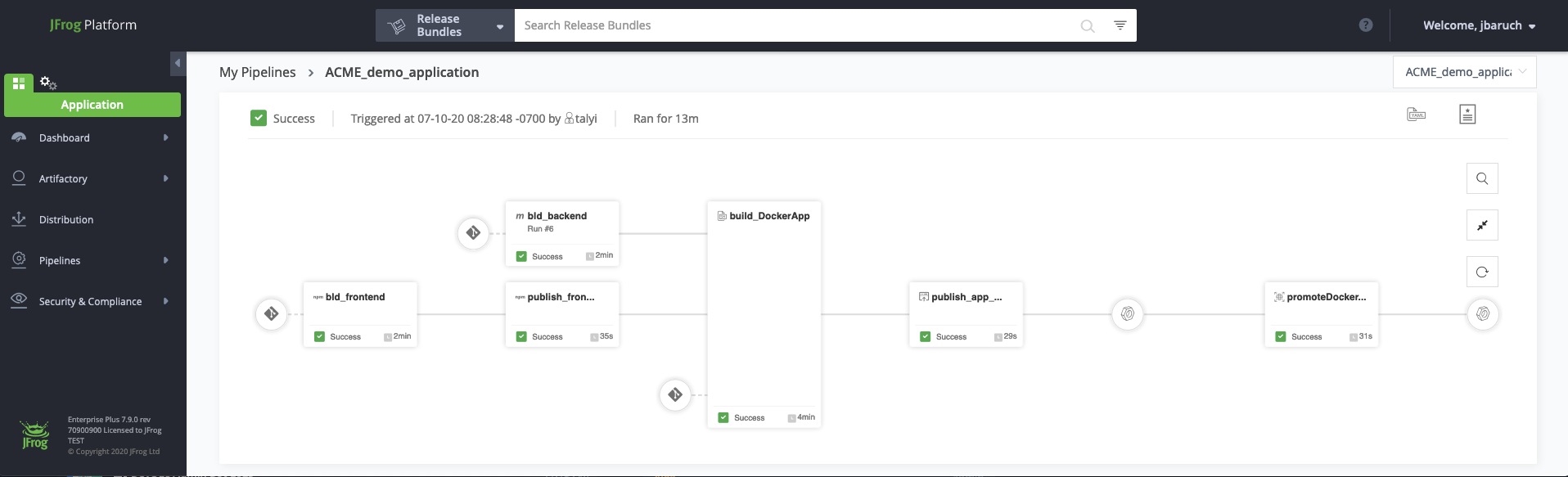
  • JFrog Adds Free DevOps Tier in the Cloud

    JFrog Adds Free DevOps Tier in the Cloud

    JFrog announced today it is making a free tier of its namesake DevOps platform available on all three major public cloud service providers.

    Stephen Chin, senior director for developer relations at JFrog, said a free subscription to JFrog Platform running on Amazon Web Services (AWS), Microsoft Azure and Google Cloud Platform (GCP) is now generally available across 18 cloud regions. DevOps teams are provided with up to 2GB of storage, 10GB of monthly data transfer and 2,000 CI/CD pipeline minutes per month free of charge.

    The subscription spans JFrog Artifactory, an integrated software package management tool for binaries and container registry; JFrog Xray, a vulnerability scanning tool; and JFrog Pipelines, a continuous integration/continuous delivery (CI/CD) platform.

    Chin said the best way to further DevOps adoption is always going to be to make it as easy as possible to get started. There is no substitute for hands-on experience, he said.

    Fresh off raising additional capital via an initial public offering (IPO), JFrog is looking to expand its customer base. JFrog has more than 5,800 customers currently. The free tier will make it easier for JFrog to achieve that goal in a way that allows a nascent DevOps team to upgrade to a paid tier as their project scales, he said.

    It’s not clear to what degree organizations that have already embraced DevOps might be willing to replace their CI/CD platform or, in some cases, consolidate the multiple CI/CD platforms they already employ. However, as the number of organizations that are embracing best DevOps practices continues to grow, there appears to be plenty of opportunity for providers of CI/CD platforms to expand as organizations move to accelerate various digital business transformation initiatives in the wake of the economic downturn brought on by the COVID-19 pandemic.

    Less clear as the competition among DevOps platform providers heats up is the degree to which the total cost of DevOps could decline. Most IT organizations are under more pressure than ever to contain costs even as they are being required to accelerate software development. The challenge is striking a balance between open source tools and platforms that IT teams need to deploy and support versus relying on DevOps platforms that are managed on their behalf. In theory, the fewer IT staff dedicated to managing infrastructure, the more money there is to hire developers.

    DevOps adoption historically has been driven from the bottom up within most organizations. However, as more organizations appreciate the importance of software within their organization, senior IT and business leaders are revisiting software development processes. As part of those efforts, more organizations are looking to standardize on a specific set of DevOps platforms across their entire organization regardless of what cloud platform they may be deployed on.

    The challenge, is as often the case with any journey, is making that first step.