Tag: CI/CD

  • DevOps Teams Struggling to Keep Secrets

    DevOps Teams Struggling to Keep Secrets

    A growing number of organizations are suffering security incidents related to exposed secrets in DevOps CI/CD pipelines, according to a recent ThycoticCentrify report.

    The study paints a troubling picture: Only 5% of survey respondents said most of their development teams use the same secrets management processes and tools.

    The incidents run the gamut, from secrets published in the clear in public cloud code repositories to insecure third-party code to vulnerabilities in the organization’s own code or configurations.

    The problem is often made worse by security teams not knowing what to protect because development teams have their own cloud infrastructure or the ability to create internet-facing applications directly without security teams’ knowledge.

    “The reason why we see so many security incidents related to exposed secrets in DevOps is that using hardcoded passwords and keys is the easy path to getting things to work,” said Joseph Carson, chief security scientist and Advisory CISO at ThycoticCentrify. “We need to make it just as easy for DevOps to use secrets vaults so even when secrets get compromised they are no longer usable, valid or expired.”

    Carson said moving away from persistent privileges to just-in-time, on-demand privileges will reduce these types of misconfigurations and attacks.

    “Unfortunately, many developers continue to use hardcoded passwords or static keys that, when compromised, allow an attacker to gain control of the application resulting in either data exposure, ability to change the application configuration or move laterally around the network,” he added.

    John Bambenek, principal threat hunter at Netenrich, said the fundamental problem is that when organizations go to agile and DevOps, they remove all friction to moving code quickly—and that almost always includes removing security.

    “That means security is inherently reactive instead of being embedded into engineering, and that’s assuming security even knows what to protect in the first place,” he said. “It’s the natural consequence of removing security from the equation and expecting that it’ll just work on the backend. That approach hasn’t worked for decades; a JIRA board isn’t going to suddenly fix that problem.”

    From Carson’s perspective, secrets management is the ability to move away from hardcoded passwords or static keys to just-in-time privileges or one-time-use passwords so even when comprised they cannot be used.

    “Many privileged access management solutions that protected privileged access for years have extended functionality to developers to help move the value into DevOps so they can manage credentials for applications, databases, CI/CD tools and services without causing friction in the development process,” he said.

    Approaches like privileged access security helps enable API-as-a-service and provides instant availability of secrets, SSH keys, certificates, API keys and tokens.

    Secrets Management

    Bambenek added the problem isn’t choosing a secrets management process or tool, but rather that they aren’t in place at all.

    “Pick something that will keep keys and secrets out of public cloud repositories that developers will use that allows for quick and easy rotation of keys as the need arises,” he said. “The most important thing is that it’s the same tool everywhere that operates in a near-invisible process for developers. Four decades of software vulnerabilities have taught me that if you rely on the developers to do the secure thing, you’ll consistently be disappointed.”

    One Wrong Step

    Davis McCarthy, principal security researcher at Valtix, pointed out developers are not security practitioners by trade.
    “Developers are building new ideas, and no good idea comes without experimentation,” he said. “Experimenting with a new technology stack may lead to misconfigurations that unintentionally expose data.”

    McCarthy said shared SSH keys between users create a larger attack surface, and users will store secrets differently creating multiple attack vectors.

    If one user’s endpoint becomes compromised and their SSH keys are exfiltrated, it’s difficult to know what the first mitigation steps are. Between insider threats and malware, the wrong step could lead to a breach.

    “Whereas a software engineer may hold great knowledge of secure coding methodologies, web application attacks and encryption, they are still focused on executing their craft,” he said. “Organizations that do not build security into the development life cycle create a systemic risk that leads to failures in best practices.”

    McCarthy added organizations can centralize and embed secrets management into the tools already in use in CI/CD pipelines by creating an inventory, auditing it and frequently rotating secrets to sensitive environments.

    Bambenek said the short answer is to make sure the infrastructure of CI/CD pipelines is centrally managed and controlled without the ability of engineering teams to ‘roll their own.’

    “No security control will remain intact if someone can pick their own tools without any real governance,” he said. “CI/CD processes don’t require engineering teams to manage the backend of the deployment pipeline which means someone can ensure those functions are in place to begin with.”

  • Data Theorem Adds Runtime Protection Enabled by Observability

    Data Theorem Adds Runtime Protection Enabled by Observability

    Data Theorem, Inc. this week added an Active Protection offering to its portfolio of application security services that makes it possible for DevOps teams to embed observability and runtime defenses in their applications via a software development kit (SDK).

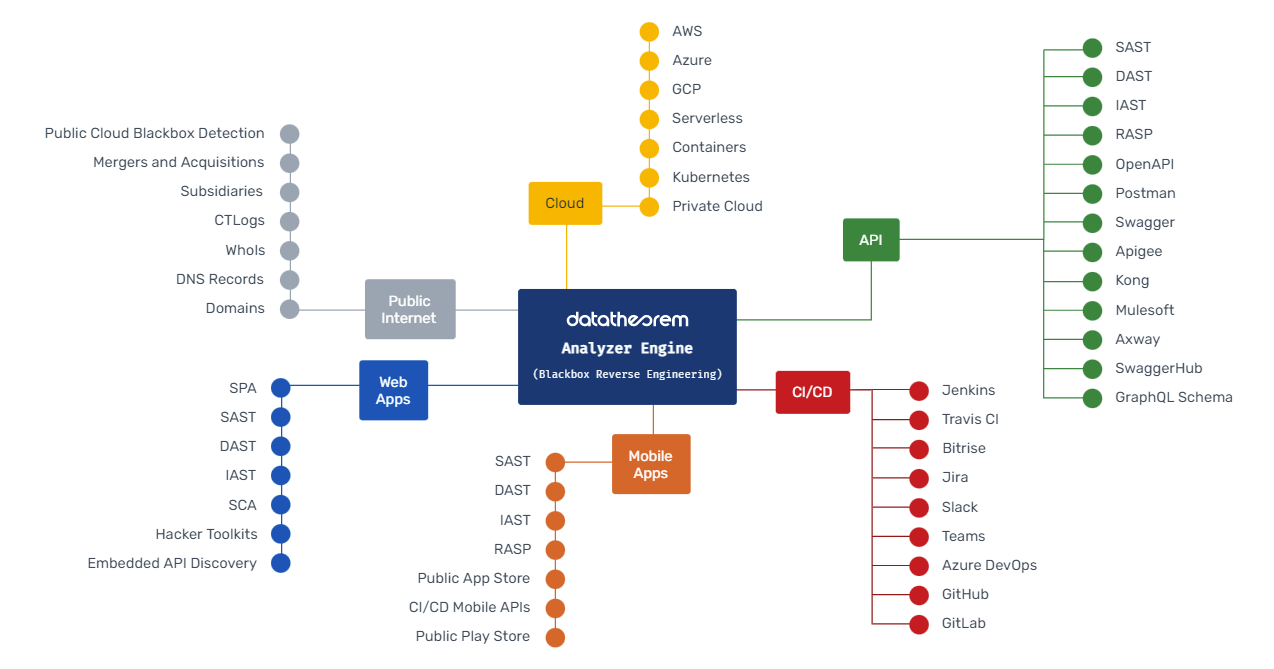
    The Data Theorem cloud services are based on Trustkit, an open source framework the company created to make it easier to employ secure socket layer (SSL) to encrypt connections and Analyzer Engine, its runtime analytics engine.

    The company is now extending its services to make it possible to embed observability capabilities by collecting logs and traces. Those logs and traces are then used to enforce runtime security policies that protect applications from known attacks from malicious sources and other common attack vectors as defined by the Open Web Application Security Project (OWASP) Foundation. It also prevents violations of encryption levels, authentication types and authorization rules along with a variety of custom rule checks, including preventing broken object-level authorization (BOLA) attacks.

    Doug Dooley, Data Theorem COO, said Active Protection can be applied across any application stack, including microservices applications based on cloud-native frameworks. In contrast, existing approaches to securing application runtimes based on web application firewalls (WAFs), runtime application self-protection (RASPs) or endpoint detection and response (EDR) agents cannot be applied to cloud-native applications based on containers and serverless computing frameworks.

    Active Protection solves that issue because it is designed to be applied via the Data Theorem software development kit (SDK) or using application extensions made available via a serverless computing framework or as a container sidecar.

    Dooley noted that the Active Protection service is also designed to be fully integrated with DevSecOps workflows that are increasingly being driven via continuous integration/continuous delivery (CI/CD) platforms to enable continuous, automated security inspection and remediation. The company claims to have detected more than one billion application incidents and is currently used by more than 8,000 applications.

    Developers don’t generally set out to build and deploy insecure applications. The issue is most developers don’t have a lot of security expertise, so it’s easy for mistakes to be made. Organizations looking to embrace DevSecOps best practices need to find a way to achieve that goal in a way that developers can easily embrace. The more automated the checks for security issues become during the application development process, the more likely it is developers will make additional efforts to remediate vulnerabilities long before an application is ever deployed in a production environment. In effect, DevSecOps is easier to achieve when addressed from the bottom up rather than via an edict from above without any real implementation plan in place.

    It’s still early days as far as DevSecOps is concerned, but as best practices for DevOps continue to evolve, there may come a day when security is just another gate that needs to be passed within the context of a larger DevOps workflow. In the meantime, DevOps teams and cybersecurity teams should put aside their differences and work together as the number of attacks launched against applications increases.

  • Beyond IaaS: The Benefits of Using EaaS

    Beyond IaaS: The Benefits of Using EaaS

    Beyond IaaS: The Benefits of Using EaaS

    The market for cloud infrastructure is growing at a rapid clip. Driving factors include IT’s need to cut costs, provide more services, respond faster to business needs, and enable innovation and digital transformation. For many years, Infrastructure-as-a-Service (IaaS) offerings have been both the first and most used cloud services consumed by businesses. But increasingly, more is needed. That has opened the door for Environment-as-a-Service (EaaS), what some call IaaS Plus.

    To put the demand for such services into perspective, consider cloud spending. While most organizations were already executing on their cloud migration strategies pre-COVID, the pandemic was a serious wake-up call for those lagging behind. Gartner predicts public cloud services global spending will grow to $332.3B this year, up from $270B in 2020. Gartner also anticipates that by 2024 almost half of all IT spending on software, system infrastructure, and process outsourcing will have pivoted from traditional solutions to the cloud.

    Within those numbers, the IaaS segment is predicted to have the largest growth (percentage-wise) over the next few years. The IaaS market will nearly double from roughly $60,000 in 2020 to about $107,000 in 2022. Looking beyond next year, ResearchAndMarkets.com predicts the IaaS market will reach $74.63 billion in 2025 with a compound annual growth rate (CAGR) of 13.8%.

    Why the big jump? Cloud-based service models can provide significant financial advantages for businesses, allowing them to quickly access new functionalities without requiring heavy upfront investments. Cloud services rotate some capital expenditure costs into operational costs, with infrastructure-as-a-service (IaaS) enabling organizations to move fundamental storage and networking functions to the cloud and away from on-premises hardware.

    Enter EaaS

    One of the greatest fundamental changes companies have encountered in the last few years is that business demands for new applications and services have rapidly grown, causing a need to accelerate application development.

    And most importantly, development is no longer a one-time effort, and applications must continuously be patched, updated, and enhanced. Each change or addition requires one or more development environments, plus infrastructure and applications for performance testing, quality assurance and deployment.

    That’s where EaaS helps. EaaS extends the capabilities and benefits of IaaS into the development environment. It offers the infrastructure, applications, and data that DevOps teams need to develop, deploy and maintain their applications.

    An ideal EaaS solution will offer certain features to increase the efficiency of the DevOps staff, reduce costs and help businesses maintain control over fast-paced development environments.

    For example, a well-suited EaaS would use automation to configure servers for a specific application. It would be a self-service offering that integrated with normal DevOps workflows, tools, and methodologies. For example, a business might look for an EaaS offering that gives users a choice in how they access the services. That might include access via a web portal, command-line interface, or directly through a developer’s CI/CD tools.

    That last capability is particularly important today, given the way applications are developed and maintained. An EaaS must integrate into the existing DevOps ecosystem and CI/CD pipeline to support today’s demand for complete, ready-to-run environments delivered on demand. The way to ensure this is to look for an EaaS provider that supports out-of-the-box plugins and an extensive REST API for common CI/CD and DevOps tools.

    One additional issue that businesses need to address is cost control. Costs can quickly add up with the use of cloud services being so easy and with some providers offering self-service options. In many situations, cloud service users have no insights into their cloud spending until after the monthly bill arrives. And even then, there is often no granular view into where the costs were incurred.

    What’s needed is an EaaS offering that incorporates cloud cost management capabilities that are implemented in such a way as to not slow down application development and delivery. In particular, cost visibility and control are required but cannot be implemented in a way that adds friction to the process. Many cost management approaches fail in this regard. A good EaaS solution will provide the needed visibility and control while not hindering development and deployment.

    Last word

    Modern applications development must be based on CI/CD to deliver new applications, services and updates in a timely manner to match fast-changing business opportunities and requirements.

    While IaaS platforms satisfy many of the core infrastructure requirements, EaaS complements these capabilities by offering the complete environments delivered on-demand needed for DevOps to work. EaaS also offers tight integration into DevOps workflows and CI/CD pipelines.


  • Securing Your Software Development Pipelines

    Securing Your Software Development Pipelines

    Earlier this year, it was announced that the attack on IT management software provider SolarWinds had been used to compromise other organizations, including parts of the United States government. There were several reasons for alarm because of this news, but one of the biggest was the revelation that attackers breached SolarWinds’ software development process and pipeline. The level of concern was such that it led to a first-of-its-kind executive order on cybersecurity.

    The security of the software development process has been a concern for development teams for decades, beginning with Ken Thompson’s thought experiment around hacking compilers to inject vulnerable code (PDF). As the software development process becomes increasingly automated, this means there is more to secure. Indeed, the biggest difference between Thompson’s “Reflections on Trusting Trust” and today is that much of our concern stems from just how much we, as development teams, must trust code that was not written by us.

    The issue of code ‘not written here’ is bigger than just open source libraries – though those are a big part of the issue since a typical Java application is 97% third-party code by weight, according to the Veracode State of Software Security, 2020. Moreover, modern cloud-native applications are also comprised of additional types of code written by others, including container images, serverless code and other cloud-native artifacts.

    As a result, an attacker could compromise a development pipeline by one of a variety of means:

    • Poisoning an upstream open source repository by taking over an open source project, or by typosquatting
    • Compromising a container image repository
    • Gaining access to the continuous integration server and making changes in the pipeline to incorporate malicious code
    • Gaining access to the source repository, identifying an existing vulnerability (zero-day) in an application, and exploiting it in production

    So, what must be done to mitigate these threats? A lot of the answer comes down to testing, managing the chain of custody and monitoring access to internal resources.

    • Managing access—Systems that touch your software development process provide a door that, if not properly secured, may allow an attacker to walk in and compromise the software you ship to your customers. Things to be aware of here include the source control system, the continuous integration server and other tools (including quality and security tools) that have access to the source repository. Similarly, any activity that touches the source code, especially commits to the source code repository, must be properly authenticated with a developer GPG key. This prevents spoofing a user’s identity by setting git configuration parameters (this blog post from Alessandro Segala describes the problem nicely) or by stealing credentials.
    • Manage the chain of custody for software dependencies—Most modern software dependency managers allow connections to multiple software registries, including public registries that can be easily attacked or compromised. Configuring dependency managers to only allow connections to an authorized list of registries can help keep compromised packages from entering the build pipeline. This can also help to ensure that only dependencies that are free of critical and high vulnerabilities can be used in the application. This topic also relates to the next one on testing for vulnerabilities. Part of managing code coming from other parts of the software supply chain is looking for security vulnerabilities in the code. Consider a security scanning tool that can look for vulnerable open source libraries or container images with vulnerabilities and security misconfigurations.
    • Testing for vulnerabilities —Code introduced by an attacker may introduce new vulnerabilities. Using static application security testing (SAST) can help to identify serious security issues, including poor cryptographic practices, hard-coded credentials, and injection vulnerabilities. Performing SAST in the pipeline allows for the identification of critical and high severity defects early, enabling you to fail a pipeline upon their discovery and preventing insecure code from being deployed into production. Likewise, as noted above, testing for vulnerable containers and open source libraries can prevent vulnerabilities from being introduced via the software supply chain. Finally, using dynamic application security testing (DAST) to perform an end-to-end runtime test for a web application in a pre-production environment can help identify other exploitable issues in the end-to-end application. It can also find problems with application configuration that are only observable in the deployed environment. Both SAST and SCA might identify weaknesses in software that, while indicative of poor coding processes, may not be vulnerabilities. So, selecting tools that allow you to set a baseline of acceptable findings can help to ensure this control is adopted successfully.

    Solving all these problems requires thinking about different parts of the application development process as a complete system. To that end, Veracode collaborated with Venafi, Sophos and CloudBees earlier this year to put together a proposed blueprint for secure software development pipelines. The proposal is maintained on GitHub and is available for users to raise issues or propose pull requests on the blueprint—all input is welcome.

    The importance of getting this right cannot be underestimated. Hacks and breaches continue to hit the headlines, and putting in place the right tools, technologies and processes to minimize security risk in the software development pipeline is more critical than ever. 

  • Dynatrace Survey Sees Continuous Delivery Challenges Ahead

    Dynatrace Survey Sees Continuous Delivery Challenges Ahead

    A global survey of 1,300 application development and DevOps leaders conducted by the research firm Coleman Parkes on behalf of Dynatrace finds, on average, organizations expect to increase the frequency of their software releases by 58% over the next two years.

    Andreas Grabner, director of strategic partnerships at Dynatrace, an observability platform provider, said that while it’s clear organizations are embracing DevOps best practices to achieve that goal, the survey also found that more than a quarter (27%) of DevOps teams’ time is spent on manual continuous integration/continuous delivery (CI/CD) tasks. Nearly a quarter (22%) admit they’re often under so much pressure to meet the demand for application deployments that they must sacrifice code quality.

    In response, nearly two-thirds of respondents (62%) are investing in automation to eliminate manual tasks, while a similar percentage are looking to automate incident response processes. Another 45% are investing in observability tools, with nearly three-quarters (74%) noting that end-to-end observability will be essential to DevOps in the future.

    A full 98% also noted that extending DevOps to more applications will play a crucial role in driving digital transformation and optimizing customer experience. A total of 71% said a unified platform that seamlessly integrates their toolchains will be critical to scaling DevOps, while 79% said extending artificial intelligence to IT operations (AIOps) into the realm of DevOps is critical for their future success.

    Survey respondents, however, also identified siloed team cultures (75%) and application complexity (70%) as the primary barriers to achieving DevOps success. Organizations, as a result, are investing in the automation of manual CI/CD tasks (62%), eliminating manual incident response (62%) and end-to-end observability (45%).

    Grabner noted that, as more organizations build and deploy next-generation applications based on microservices constructed using containers and application programming interfaces (APIs), it will only become more challenging to automate DevOps processes. As part of an effort to reduce the cost of delivering those applications, Dynatrace donated Keptn, an open source enterprise-grade control plane for automating the continuous delivery of cloud-native applications, to the Cloud Native Computing Foundation (CNCF), added Grabner. The overall goal is to reduce the total cost of implementing DevOps as part of an effort to instrument more applications, he noted.

    While most organizations that have embraced DevOps have a good handle on how to implement continuous integration, achieving the continuous delivery side of the DevOps equation has proven to be more challenging. In the absence of standardization among the platforms, each application deployed on individual IT systems is a “snowflake,” in that it is unique to that platform. That issue, in part, is why so many IT teams still rely on manual processes to deploy applications.

    It’s only a matter of time before organizations begin to more aggressively automate the deployment of applications. That may become even easier to achieve if they standardize on a Kubernetes application programming interface (API) that can be implemented across any platform.

    In the meantime, however, it’s clear that, as the pace of digital business transformation increases, one of the most limiting factors organizations will encounter is the pace at which applications can be deployed and updated.

  • CircleCI Adds Test Insights Module to CI/CD Platform

    CircleCI Adds Test Insights Module to CI/CD Platform

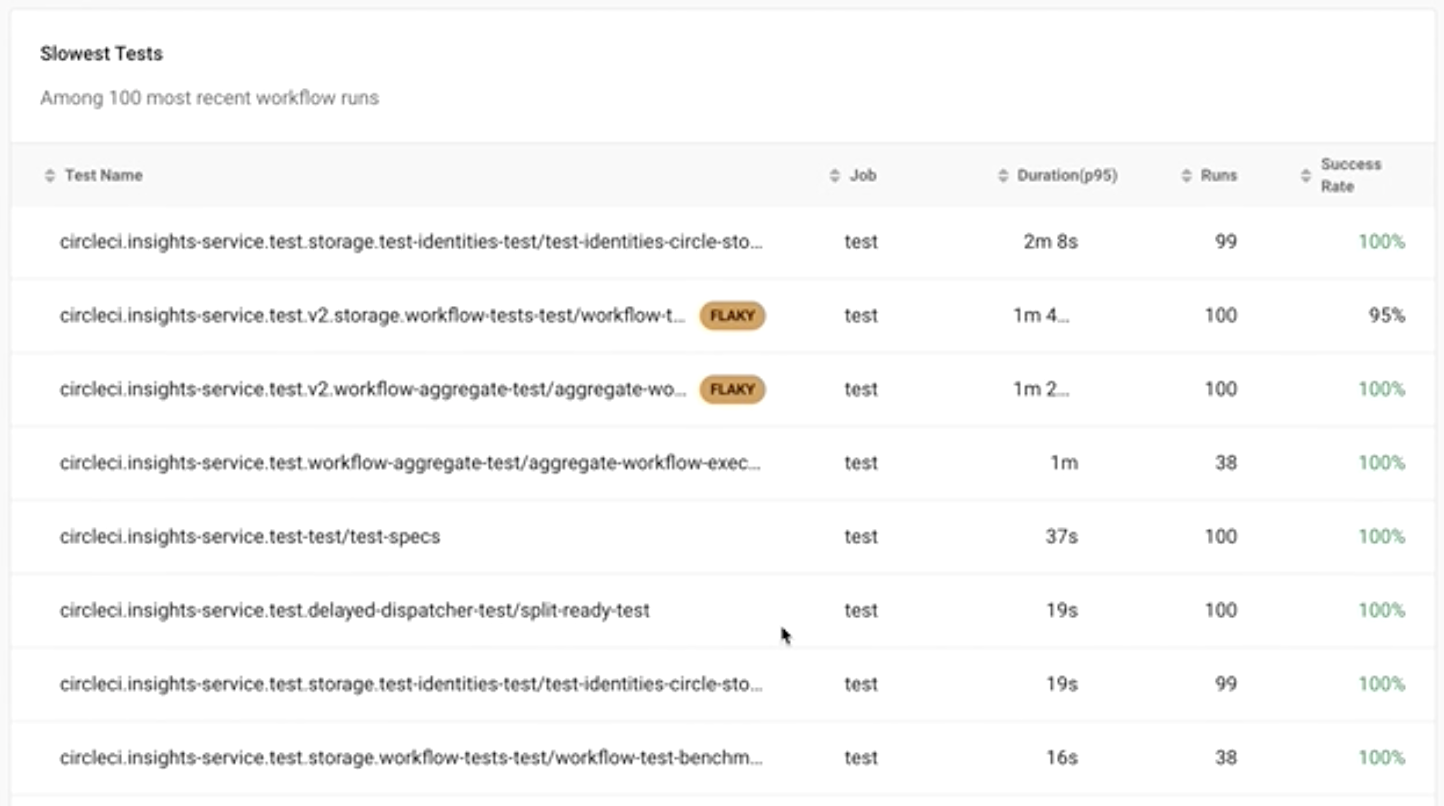
    CircleCI today announced it has added a Test Insights capability to its continuous integration/continuous delivery (CI/CD) platform to make it easier to identify tests that are either taking too long to run or simply exhibiting some form of anomalous behavior.

    Dawit Gebregziabher, product manager for data insights at CircleCI, said Test Insights is designed to make it simpler for IT organizations to shift more responsibility for testing further left toward DevOps teams that identify issues as applications are being built on the CircleCI platform.

    Each organization will still need to determine what tools to employ to create a test, but once it starts running, the Test Insights module will be able to surface the tests that, for one reason or another, are problematic to execute, he added.

    Test Insights, for example, will flag flaky tests and identify the longest-running and most failed tests. It will also enable DevOps teams to identify performance changes over time to pinpoint changes in application behavior.

    Finally, DevOps teams can track benchmarks at the organization, workflow and job level, as well as metrics for mean-time-to-recovery, throughput and durations for 24-hour, 7-day and 30-day windows of time.

    The challenge DevOps teams often encounter is a test may be run even when it’s apparent the application will fail. Test Insights makes it feasible for DevOps teams to manage the testing process much more efficiently, said Gebregziabher.

    It’s not quite clear how far testing is shifting left. There’s no doubt more developers are testing their code before it is loaded into a production environment to hopefully avoid issues that will only become more expensive to fix later. Other organizations have dedicated software engineers to create testing processes that are tightly integrated with CI/CD pipelines, noted Gebregziabher.

    However, many large enterprise organizations continue to also hire and retain dedicated application testing teams that are trained to identify issues that might either adversely affect the end-user experience or run afoul of compliance requirements.

    Regardless of who does what kind of testing, however, it’s clear there’s a lot more focus on addressing issues earlier when they are much less expensive to fix. The goal should be to make it easier to optimize when tests should run based on probabilities that ultimately reduce the time wasted running tests that either will fail or are, for one reason or another, flawed.

    Developers, of course, are all equally committed to running tests, so organizations will need to determine for themselves how far to shift that process left. However, at the very least, DevOps teams should be able to identify patterns that might indicate there is a need for additional developer training. After all, it’s unlikely a developer is going to understand there’s an issue until some meaningful metrics are shared.

    In the meantime, the more testing that occurs at a faster rate the more likely it becomes that an organization can provide a superior application experience the first time—and every time—an application is built and deployed.

  • A Blueprint for Securing Software Development

    A Blueprint for Securing Software Development

    Software development has changed dramatically in recent years, as technologies like DevOps, application containers, and cloud-native transform how software is built and distributed. Unfortunately, attackers have been paying close attention to these changes, and have retooled their attack strategies to take advantage of relatively weak security controls in software development and build environments. Attackers recognize that security teams are more focused on protecting infrastructure and less focused on software development and supply chains. This is how damaging attacks like SolarWinds happen – and it’s likely that attackers will strike again to yield even more successful outcomes.

    A new approach is needed to secure the software development pipeline. What’s more, this approach needs to be put in place by the engineers developing the software—and not by information security teams. Engineering teams need to be responsible for design and implementation while giving security teams visibility and assurance that controls are operational and that policies are being enforced.

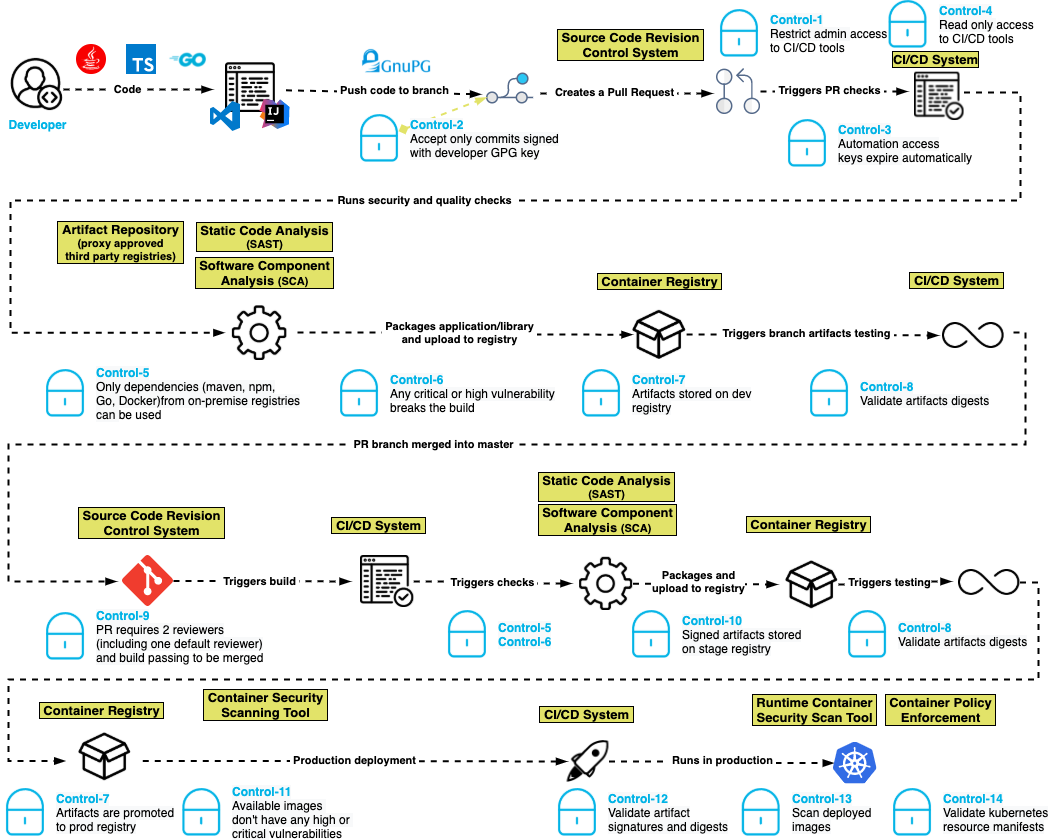
    A new blueprint for securing the pipeline centers on a flexible set of controls that secure the software build pipeline by ensuring that authentication and authorization are properly managed, that the integrity of software artifacts are tested at appropriate stages and that controls are placed on third-party and open source solutions incorporated into the software. The result: Software innovation and delivery at lower risk of supply chain tampering, and reduction of attacks during development.

    A Pragmatic Design Philosophy

    This modern software security blueprint is based on the following design philosophy:

    • Least-privilege: Only grant the access and permissions required to accomplish a job, and no more.
    • Immutability: Artifacts and infrastructure are not modified after deployment to an environment. If a change is required, it’s done in the image or script in the development environment and then promoted through the higher environments.
    • Everything-as-code: Infrastructure, security policies and other parts of the pipeline are also implemented as code and subject to the same controls as the software artifacts.
    • Traceability: All changes, whether to infrastructure or business code, are version-controlled. 

    Controls Blueprint for Software Development Pipelines

    The basis for this software security blueprint centers around a set of 15 controls that are built for modern development pipelines where developers, pipelines and execution can happen anywhere in the world.

    Control one: Restrict administrative access to CI/CD tools. Ensure that only authorized people can make administrative changes to the CI/CD system, which prevents unauthorized changes to pipeline definitions.

    Control two: Only accept commits signed with a developer GPG key. Unsigned code commits are challenging, if not impossible, to trace and pose a risk to the integrity of the codebase. 

    Control three: Automation access keys expire automatically. By ensuring that access keys used by automation expire periodically, developers create a shorter window of attack when keys are compromised.

    Control four: Reduce automation access to read-only. CI systems should have read-only access to source code repositories following the principle of least-privilege access.

    Control five: Only dependencies from trusted registries can be used. By configuring the dependency manager to only allow connections to an authorized list of registries, attacks can be blunted by keeping malicious packages in public registries from entering the pipeline.

    Control six: Any critical or high-severity vulnerability breaks the build. Supply chain attacks may introduce code with vulnerabilities into the software pipeline. Static application security testing (SAST) helps to identify serious security issues, including poor cryptographic practices, hard-coded credentials and injection vulnerabilities. 

    Control seven: Artifacts are stored in a repository in development, staging and production. This control helps to enforce the immutability of the artifacts so they can be compared in the development, staging and production repositories.

    Control eight: Validate artifact digest. Before an artifact is deployed in any environment, its digest should be validated against the artifact in the repository to ensure that it has not been compromised.

    Control nine: Pull requests require two reviewers (including one default reviewer) and a passing build to be merged. In addition to supporting good coding practices, this control also helps ensure that no commits are made without competent human oversight. 

    Control 10: Artifacts in higher repositories are signed. Requiring artifacts to be signed in a repository throughout the process ensures visibility and traceability for whatever is deployed to production. 

    Control 11: Available container images don’t have any high or critical vulnerabilities. Just as applications need to be tested for vulnerabilities before being placed in production, so do the container images into which they are packaged for deployment. Container images could have open source vulnerabilities if they contain open source software. 

    Control 12: Validate artifact signatures and digests. Validating the signature of the artifact against the digest ensures that the artifact was not tampered with in the repository and that the artifact being deployed is the same one that was tested.

    Control 13: Scan deployed images in production. This helps to ensure that the prior controls were followed for all software in production.

    Control 14: Validate Kubernetes resource manifests. If the resource manifests are tampered with, they could be tricked into deploying a container of the attacker’s choice. 

    Control 15: Ensure build environments are ephemeral and immutable. Build environments should be defined in code with automated creation and teardown and a fresh environment created for every build. Build hosts should not be accessible using interactive logins.

    We believe this blueprint provides engineering teams with an actionable architecture that security teams can rally behind and support. By adopting these standards, engineering teams are promised the delivery of assured software at lower risk of supply chain tampering, reduction of attacks during development and manipulation in staging and production.

    Here’s what it looks like:

    blueprint

    To learn more about the suggested blueprint, read our GitHub post about the project. Our goal is to prioritize speed and agility for software development while incorporating a security-always mindset.

  • Perforce Charts Testing Course After BlazeMeter Acquisition

    Perforce Charts Testing Course After BlazeMeter Acquisition

    Perforce Software has acquired BlazeMeter from Broadcom as part of an effort to extend the scope of its testing tools beyond the Perfecto tools for testing mobile and web applications it acquired in 2018.

    Broadcom gained control over BlazeMeter after it acquired CA Technologies in 2018. CA Technologies acquired BlazeMeter in 2016. Terms of the latest acquisition involving BlazeMeter were not disclosed.

    Tim Russell, chief product officer for Perforce, said BlazeMeter adds a complete platform that spans everything from load and performance testing to application programming interface (API) testing. The goal is to enable DevOps teams to push continuous testing further left as part of an effort to accelerate the development and deployment of applications, added Russell.

    The need for continuous testing has become more pronounced as more organizations launch multiple digital business transformation initiatives, noted Russell. The real challenge will be finding ways to embed continuous testing within DevOps processes at a sufficient level of scale, added Russell.

    In fact, the quality of the digital experience those applications provide ultimately determines the degree to which those efforts are likely to succeed, which Russell noted is why so many enterprise IT organizations are reengineering their application testing processes.

    In general, organizations are taking two paths to shift testing further left. Some are giving application performance testing tools to developers to employ during DevOps sprints while others are trying to bring application testers into the application development process earlier. In some cases, organizations are doing both as part of a comprehensive effort to discover issues before applications are deployed in a production environment. Those issue are naturally more expensive to fix after an application has been deployed.

    Perforce, for now, expects to continue to make BlazeMeter and Perfecto available as a set of complementary cloud-based services with some cross-pollination of capabilities occurring over time, said Russell.

    In the longer term, it’s apparent that more artificial intelligence (AI)-based analytics will be embedded within cloud-based platforms that can collect enough data to build meaningful models of development processes. IT teams should also expect to see testing tools make greater use of computer vision algorithms to surface issues.

    One away or another, the entire application testing process is about to become a lot more automated as more organizations are simultaneously building multiple applications. That may not necessarily reduce the need for either a developer or tester to create and manage that process, but it does mean the amount of testing time required for each application should continue to steadily decline in the months and years ahead.

    Hopefully, all that effort will lead to better application experiences being provided to end users more consistently. There is nothing quite as frustrating for any application development team than to discover that 90% of the functionality of an application is not being used because end users are not able to easily surface it. Worse yet, of course, is when an application turns out to be too slow once it is deployed. In either case, it’s difficult to regain that initial end-user enthusiasm for any new application experience after it’s been lost, simply because no one thought through all the use cases that should have been tested much earlier in the application development life cycle.

  • Achieving Business Maturity with Database DevOps

    Achieving Business Maturity with Database DevOps

    Companies have seen unprecedented change over the past year and a half, with IT teams trying to help businesses weather the storm by meeting customer demands for services and products to be delivered in new ways while adjusting to remote work. As more companies introduced hybrid approaches to their workplace, a particular trend began to emerge: DevOps adoption. 

    Many adopted DevOps to navigate the new landscape, boosting software delivery and operational performance with advanced application and database development practices. In fact, research from Redgate Software indicates that DevOps adoption reached its peak earlier this year, with 26% of enterprises leveraging DevOps across all projects—a significant increase from previous adoption rates.

    Although not all companies have been quick to adopt for fear of disrupting existing workflows, a technical skills gap or lack of buy-in from management, there is a strong case to be made for why adopting DevOps practices, including for the database, can help businesses better manage the evolving tech environment.

    Adopting Automated Deployments

    Companies everywhere migrated databases to the cloud over the course of the past year, and that trend shows no sign of slowing. Analysts at IDC predict that by 2022 more than 90% of enterprises will rely on a mixture of on-premises/dedicated private clouds, multiple public clouds and legacy platforms to meet their needs. One of the best ways to help maintain that data is to implement DevOps processes for those databases and automate deployments. This provides a host of benefits, including: 

    • Preventing software errors: Manual database migrations often come with a host of errors that lead to downtime, rollbacks and rework. It’s far better to rely on an automated process that is robust and repeatable and can be implemented across all databases to ensure they’re updated in the same, reliable way. 
    • Staying in the loop: Knowledge of how to release updates and changes is often limited to a handful of people or even just one person. If, instead, it is part of the system and development process, it ensures everyone is in sync with updates and developments and allows anyone on your IT team to handle deployments.
    • Guaranteeing quality and consistency: For companies with security and compliance concerns, the predictable and repeatable processes that automated database deployments introduce ensure nothing is left to chance, while providing an auditable record of exactly what was changed, when and by who.

    Although the research shows 20% of companies cite cost as a roadblock to automation, avoiding automation will leave businesses at a disadvantage as they prepare for the coming year. 

    Creating Communities of Practice 

    When asked how they decide the strategic direction and planning for DevOps, the most popular answer from respondents was communities of practice. This concept was proposed for the first time in the early 1990s, and the practice has seen increased popularity among IT teams recently. It’s described as groups of people who share the same passions or concerns for something they do and often learn how to do that task better based on their regular, frequent interactions. 

    These various communities—regardless of whether in-person or virtual, given the current environment—help foster intrinsic motivation in employees and improve overall decision-making and encourage innovation. According to Redgate’s research, over a third of respondents noted that a community of practice makes decisions, provides recommendations or is consulted before DevOps strategies and planning are put into place. Another interesting point from the research is that the adoption of communities of practice correlates with company size. Enterprise and medium-size companies reported adoption rates of 38% and 36% respectively compared to only 28% adoption in small companies.

    As companies grow and teams mature, these communities not only benefit the organization by bringing more diverse minds to the table when making decisions but benefit individuals by supporting development, enabling networking and improving recognition across the organization. 

    Managing Cross-Database Estates

    Redgate’s research found that 70% of organizations now have more than one database management system in use, and 48% have teams working on three or more different databases. One possible reason for this is the increased adoption of cloud databases. With a large range of cloud databases and platforms in use, each offering different advantages, teams are now making choices based on specific use-cases. There was an increase in the share of respondents using cloud-native databases such as Azure Cosmos DB, MongoDB and Snowflake compared to last year, for example.

    With cloud adoption accelerating due to the pandemic and the need for technologies that can be managed, operated and accessed remotely, the advantages of introducing DevOps processes to maintain database changes and ensure version control have never been clearer. Teams that have automation and advanced development practices in place can continue building and deploying software as smoothly as before the pandemic, even when working remotely.

    Instead of working to build up processes and procedures, mature DevOps teams can focus their efforts on solving problems and ensuring higher quality of code, without the need for laborious manual tasks or code reviews that automated systems perform more reliably. 

    Making the Case for Database DevOps

    When teams are physically separated, working disparate schedules and dealing with their own challenges at home, the more companies can do to reduce workloads and help them focus on value-added work creates a happier workplace and improves the chances for business success. The rise of DevOps for both application and database development helps mitigate many of the challenges organizations face as part of their digital transformation journeys. It’s going to help IT teams remain productive when working remotely and encourage them to explore new database platforms, both on-premises and in the cloud.

    With remote and hybrid work the new normal for the future, companies that set their sights on adopting DevOps across the company will only see these benefits increase.