Tag: CI/CD

  • CDEvents Aims To Standardize CI/CD Interoperability

    CDEvents Aims To Standardize CI/CD Interoperability

    Companies are under mounting pressure to continuously release new applications and features. And as software development life cycles become more iterative, continuous integration and continuous delivery (CI/CD) has become a necessary ingredient to enable more rapid deployments.

    Many development teams now embrace DevOps, but fully automating a CI/CD pipeline from source code to production deployment is no easy task. For one, the number of tools in use continues to balloon, meaning CI/CD poses an ongoing maintenance hurdle. Furthermore, CI/CD tools often adopt varying formats to describe their events. A CI/CD pipeline, a form of event-driven architecture, may require a lot of special “glue” to patch events together if the output from each tool is not in a standardized format.

    Interestingly, CDEvents, an emerging open source standard from the Continous Delivery Foundation (CDF), is working to standardize the root semantics of how CI/CD tools describe the payloads of their events with more granularity than CloudEvents. The project aims to establish schemas for how common CI/CD events are described, easing integration and providing more actionable data surrounding the CI/CD pipeline.

    I recently met with Andrea Frittoli, open source developer advocate at IBM, to understand why the CDEvents project exists, how it works and what they’re hoping to achieve. According to Frittoli, who is also co-creator of the CDEvents project and a member of the CDF Technical Oversight Committee, CDEvents has the potential to bring much-needed interoperability to the sprawling CI/CD tooling ecosystem. Below, we’ll investigate where the project is and consider where it’s heading.

    The Problem With CI/CD

    At its core, the problem CDEvents is trying to solve is a lack of interoperability in the CI/CD field, explained Frittoli. As it stands today, DevOps engineers must routinely make point-to-point integrations between CI/CD tools. “No single tool will take you entirely from managing source code to production,” he said. A single development team could be using up to 15 unique components in one pipeline, and tooling preferences can vary dramatically across teams, he adds, further complicating CI/CD interoperability.

    Although CloudEvents has made inroads as a specification to describe event data, nothing has yet existed specifically for describing CI/CD events. According to Frittoli, CloudEvents falls short here, as it’s agnostic about what is inserted into the payload.

    Understanding CDEvents

    CDEvents is “a common specification for Continuous Delivery events.” Frittoli describes it as a shared dictionary or shared semantics for common events. These events could be a change in source code, running a test, or a code execution or deploy. CDEvents uses JSON object schemas to describe the event types and can work alongside CloudEvents as an attribute. “CDEvents is a standard format for the payload as well, not only for the envelope,” said Frittoli.

    As Frittoli explains, the CDF special interest group is still drafting the CDEvent specification’s exact semantics and common names. Currently, CDEvent organizes these objects into four main buckets: Core events, source code version control, CD events and CI events.

    While the group is still finalizing the format of events as they work toward the initial release, the example below is an approximation of what the final format will look like:

    "meta": {
      "version" : "draft",
      "event_id" : "A234-1234-1234",
      "source" : "/staging/tekton/",
      "type" : "dev.cdevents.taskrun.started",
      "timestamp" : "2018-04-05T17:31:00Z"
    },
    "subject": {
      "id": "/namespace/taskrun-123",
      "type": "taskrun",
      "content": {
        "URL": ...
        "pipelinerun": ...
      }
    },
    "extensions": [{
      "name": ,
      "content": ...}
    ],
    "links": [{
    ...
    }]

    Benefits of CI/CD Event Standardization

    So, why is it necessary to define the format of CI/CD event data? What benefits does this bring to developers and the business as a whole? Well, Frittoli sees two potential primary use cases. First off, CDEvents could reduce the effort spent writing and maintaining glue code between common DevOps tools like Spinnaker, Argo or Flux. “This will allow a smoother integration between all the parts,” said Frittoli. Alleviating this could help scale CI/CD initiatives and increase overall agility.

    Another positive side effect is collecting more detailed information about workloads and their performances. If all these components generate similarly-formatted events, Frittoli explained, then you can begin to create a true end-to-end visualization of the entire CI/CD pipeline. Then, you can start to measure things such as deployment frequency, failure rate, time to change and other metrics.

    If events begin to use a common language, you could do many interesting things with that data, says Frittoli. Event data could help ascertain the root cause of incidents and aid debugging. One could even foresee some AIOps potential to further automate operations and increase observability around CI/CD.

    Final Thoughts and Ways to Participate

    CDEvents emerged at a time when iterative software development has become commonplace. A slew of helpful CI/CD tools is at our disposal to enable niche operations. Yet, the space still requires a standard way to operate between them. CDEvents is an exciting prospect, yet the project is still in its early stages. It has yet to reach a full release or any production use and proofs-of-concept are still being developed.

    Of course, encouraging a vendor-neutral specification requires the tooling community to get on board. “It’s vital for the different tools to implement CDEvents for it to be successful,” said Frittoli. He encourages the tooling community to join the working group to collaborate in building proofs-of-concept. The SIG plans to continue working on finalizing the first version of the specification. In the meantime, the group has produced a proof-of-concept using Tekton and keptn and the project has its future sights set on Knative and Jenkins.

    The CDEvents project is in incubating mode and maintained by the Events Special Interest Group (SIG) at the CDF. For more information, you can peruse the CDEvents documentation here or become involved with the community here. The Events SIG also holds biweekly meetings and a CDEvents Community Summit will be part of the upcoming CDcon.

  • Why is Security Still in the Way? A Look at DevSecOps Right Now

    Why is Security Still in the Way? A Look at DevSecOps Right Now

    According to industry trend reports for 2022, DevSecOps is now considered to be one of the most effective approaches to building software quickly and securely. This effort, of course, means development, security and operations teams commit to addressing security as early as possible in the software development life cycle (SDLC). The goal of the shift into DevSecOps revolves around the need for more automation, streamlined CI/CD pipelines, less friction among teams and plenty of time for productive innovation. Incorporating DevSecOps practices into an organization unites security, compliance and development issues into a collaborative concern, one that allows DevOps to move fast without jeopardizing code quality. 

    As we approach the middle of 2022, it’s worth looking back and considering why security is still standing in the way of smooth software development. Security vulnerabilities have always been present in the process, and yet these pesky bugs continue to be the biggest threat to software performance. The question is, why?

    The Truth About Security

    Software has always been deployed and shipped with some existing bugs. But as software and services continue to dominate our everyday lives, the reality of this statement continues to plague both businesses and the end user. On some level, software development has yet to evolve into the next phase of security. Code is still rolled out regularly, only to discover security vulnerabilities in production. Some say the way software is developed today actually lends itself to defects, mostly because the pace of work required supersedes best practices around AppSec. 

    While the larger cybersecurity industry—and every DevSecOps team in the world—is striving to make software more secure, many organizations still prioritize speed and productivity over digital risk. This means the state of security (and, to some extent, the DevSecOps world) has become somewhat lopsided, with some enterprises making great efforts while others embrace a more lackadaisical approach. To make matters worse, many professionals today believe there has been a general under-investment in cybersecurity over the past several decades. 

    The Next Phase of DevSecOps

    The shift to remote and hybrid work models has led to mass adoption of cloud technologies and digital transformation, across all sectors and industries. As a result of this evolution, organizations today need to bear in mind that the more services they use, the more digital threats and overall risk they face. As this exposure to vulnerabilities increases, so does the need for new approaches to security. 

    The majority of modern enterprises do, in fact, have a security process in place, as well as other risk management solutions. But with the cybersecurity reckoning of 2021 and the stakes of cloud computing being higher than ever, businesses right now are feeling the pressure to think long and hard about why security still isn’t a guarantee. The trend of slowing down software development to address security more thoroughly, also known as the secret sauce of DevSecOps, is not free from roadblocks—but it is also far from optional. For many organizations, the implementation of DevSecOps practices feels less like security and more like speed bumps that just slow down the shipping of software. 

    Even so, the effort to improve security is happening now. Organizations do not need several solution platforms or tools to get started. They can begin right away; evolving their security tools and practices as they grow the business. With this growth comes one of security’s biggest challenges—scalability. Because toolchains across the cloud have become more and more complicated, setting policies and/or workflows in one tool is challenging. While these issues can be largely addressed by the adoption of an end-to-end security solution, organizations must continue to focus on strengthening supply chains, improving security oversight, and bolstering their approach to DevSecOps. Some ways to make this happen include:

    • Making sure CI/CD pipelines are integrated with DAST and SAST testing in development
    • Ensuring developers and DevOps teams complete vulnerability scanning before commit or merge, as they write code
    • Minimize manual security as much as possible with automated AI/ML tools to support more effective scanning and monitoring
    • Invest in management solutions that improve security in a multi-cloud environment

    Addressing the Supply Chain

    According to an industry survey, 60% of companies have decided securing the software supply chain should be a top priority for 2022. When we think about software supply chain attacks, we need to think about better controls to validate its integrity through all stages of the SDLC. Obviously, DevOps and automation have provided considerable help in this area; however, they cannot pull all the weight of security without proper governance and guardrails. 

    With a secure supply chain comes better security, as well as compliance, privacy and transparency. When a supply chain is secure, it can automatically enforce policy requirements for things like instrumentation, testing and architecture. As a result, software development and deployment become a repeatable process that is also reliable. Teams across the organization can rest assured that the products and services they are building comply with security expectations, such as validating code before production with static analysis and scanning tools. 

  • CDF Report Surfaces DevOps Workflow Gains

    CDF Report Surfaces DevOps Workflow Gains

    At its cdCon 2022 conference today, the Continuous Delivery Foundation shared a State of Continuous Delivery in 2022 report that found nearly half of developers (47%) use either continuous integration or continuous deployment platforms—but only about 20% report using both to automate all application build, testing and deployment.

    Overall, only a little less than a quarter (23%) of the 18,585 developers surveyed by SlashData on behalf of the CDF said they are not involved in any DevOps-related activities.

    Fatih Degirmenci, general manager for the CDF, said that the relatively low percentage suggested that DevOps workflows are now more widely employed than ever. Monitoring software and infrastructure performance and using continuous integration to automatically build and test code changes remain the most popular DevOps-related activities cited in the survey, at 36% each.

    The survey also found that, among large enterprises, the proportion of low performers when it comes to lead time for code changes has dropped from 34% to 24% in the last six months, while the proportion of top performers that need less than one day for code changes has also increased from 13% to 21%.

    Larger enterprises are also seeing an increase in developers that report they can restore a service in less than an hour (22%) versus those that still require one week (18%), according to the report.

    The survey also suggested there is a strong correlation between the adoption of modern backend technologies such as microservices, containers and Kubernetes and improved lead times for code changes and time to restore. Survey respondents using containers are twice as likely to have lead times of less than one day, while respondents that have adopted Kubernetes are one-third more likely to be top performers.

    However, the survey found no impact on deployment frequency. The percentage of top performers capable of deploying code multiple times per day is 11%, the report found. Developers who don’t use these technologies are, in fact, about twice as likely to deploy multiple times per day. Overall, only 53% of developers that work in backend development are using microservices.

    Degirmenci said it is clear there is still much work to be done in terms of simplifying DevOps workflows. The average number of technologies that DevOps practitioners use now stands at 4.6 in the first quarter of 2022. The CDF last month launched a CDEvents project to create a vendor-neutral specification for defining a format for sharing event data across multiple services, platforms and systems.

    In the meantime, the CDF survey also noted more than a quarter of respondents (26%) now rely on managed continuous integration/continuous delivery (CI/CD) services rather than building and maintaining a DevOps platform themselves.

    It’s too early to say how much complexity is driving organizations to rely on managed services, but as the pace at which applications are being developed continues to increase, more organizations are starting to focus on developer productivity. As a result, more than a few organizations are reviewing their existing approach to DevOps and whether it is actually a bottleneck rather than an accelerant for building and deploying applications faster.

  • Continuous Delivery Foundation Adds Interoperability Project

    Continuous Delivery Foundation Adds Interoperability Project

    At a CDEventscon event this week, the Continuous Delivery Foundation (CDF) announced it is hosting a CDEvents project through which it hopes to create a vendor-neutral specification for defining the format of event data across multiple services, platforms and systems.

    Andrea Frittoli, open source developer advocate at IBM, co-creator of the CDEvents project and member of the CDF technical oversight committee, said the open source consortium is launching this initiative to foster interoperability across continuous delivery (CD) platforms. In the context of the CDF, that mission spans both continuous integration and continuous deployment platforms that are subsets of CD.

    CDEvents itself is based on an existing CloudEvent specification created by the Serverless Working Group within the Cloud Native Computing Foundation (CNCF). As part of the effort, the CDF has already built a proof-of-concept implementation that enables Tekton pipelines and Keptn orchestration tools for managing application life cycles to communicate over a common event protocol.

    Collecting metrics from multiple DevOps platforms is a challenge because there is no standard for sharing event data. Analytics providers and value stream management platforms that collect metrics need to create connectors for each platform they support. CDEvents would provide a standard interface for collecting metrics from any developer tool or platform. That data would also make it easier to visualize workflows that describe artifacts and their metadata, he added.

    That lack of a common way to describe events means developers not only must constantly re-learn how to consume events, it also limits the potential for libraries, tooling and infrastructure to facilitate the delivery of event data across environments ranging from routers and tracing systems to software development kits (SDKs).

    Naturally, it may be a while before this continuous delivery specification results in increased interoperability across DevOps environments, but the need for one across what has become a patchwork of fragmented tools and platforms is self-evident. Many organizations are already investing in an assortment of analytics tools in the hopes of improving the rate at which applications can be developed and deployed. In too many instances, DevOps teams have inadvertently created bottlenecks that slow down the rate of development. The challenge is that, as new tools and platforms are added to a DevOps workflow, they are not likely to be able to share data with those applications until a connector is created.

    Not everyone, of course, is a fan of having more metrics. The goal should be to coach teams on how to become more efficient rather than implementing a set of draconian mandates. Arguably, such mandates are only going to drive away developers that are trying to strike a balance between coding as an art form and application development as a craft.

    Nevertheless, as organizations better appreciate the critical role software plays in driving business processes, the greater the desire to measure the pace and efficacy of their application development efforts—to justify the levels of investment in software development they are making.

  • Why Over-Permissive CI/CD Pipelines are an Unnecessary Evil

    Why Over-Permissive CI/CD Pipelines are an Unnecessary Evil

    Balancing the speed of innovation with security is an age-old problem in software development. This is no different in modern DevOps. Development teams want a frictionless path to deploy new code but often struggle with access permissions that are linked to services. The CI/CD pipeline makes it easier for developers to quickly introduce new features and updates, in an agile way. As application changes move through the CI/CD pipeline, automation can allow changes to happen very quickly, without creating downtime or delays on the customer side.

    Permissions of CI/CD Servers

    When it comes to the permissions of CI/CD servers, DevOps often don’t want to deny access. After all, the wide access permissions are part of allowing the speed of innovation, and development teams are regularly—and often understandably—cautious about putting least-privilege or other access rules in place.

    But there are some security risks to consider. Any developer being granted admin permissions to deploy new code is open to vulnerabilities, weaknesses and misconfigurations. Cloud sprawl has created a lack of visibility into whether or not the infrastructure is properly set up and connected with logging tools. How does the development team know if things are getting properly patched?

    The balance is extremely sensitive. DevOps need the speed of change and the ability to innovate freely, but security teams can’t handle the growing risk. Something has to change that can allow security to shift left and get involved earlier in the CI/CD pipelines rather than getting in the way.

    Reducing the Risk Without Impacting Innovation

    Here are some suggestions for accelerating the speed of innovation while maintaining a healthy security posture:

    • Map threats and secure connections. Conduct a threat modeling exercise to map threats to the pipeline. Remember that every connection to the CI/CD pipeline is a potential point of compromise. Regularly patch and scan all services that connect to the pipeline and block the devices if they fail to meet security policy requirements.
    • Learn to love logs. When a security issue arises in production, developers, IT engineers and security engineers need to react quickly and efficiently to solve the problem. Logging is critical for enabling fast and coordinated responses. Waiting on manual sharing of sensitive data can slow down reaction times. But when every stakeholder can get the data they need from logs, access to information is no longer the weakest link in the security incident remediation process.
    • Tighten access control and enforce strong admin permissions. Be specific about who has access to which data. Clear and enforced separation of duties should ensure no one person or account can access more than necessary in the continuous software delivery pipeline. Improperly credentialed users or bad actors can’t establish control over the entire pipeline and mess with the code or processes. Moreover, they won’t easily be able to penetrate deeper into other corporate systems and data.
    • Leverage flags to manage risks. Developers often use feature flags (or feature toggles) to add new features to applications while mitigating the risk that those features will introduce performance or stability issues. Although most developers likely don’t think of feature flags as a security tool, they can be used for that purpose, too. New features are prime vectors for security vulnerabilities, especially if developers haven’t thoroughly tested them yet.

    Many security teams do not realize that just because their network is private, they’re still sharing pipelines with third parties, including anyone from maintenance to the team deploying your mobile app. By embracing these tools, developers can shift left, shoring up defenses early in the process, without adding a blocker to the pace of innovation coming from DevOps CI/CD pipelines.

  • How to Secure CI/CD Pipelines With DevSecOps

    How to Secure CI/CD Pipelines With DevSecOps

    Many companies are adopting a DevOps approach in their workflows as IT moves toward a more automated and cloud-native world—but for some industries, this migration isn’t easy. Many of these companies—in finance, health care, government—are obligated to meet compliance requirements. For these organizations, DevSecOps adds necessary security focus to the DevOps methodology.

    Compliance means adhering to certain standards and controls to ensure that applications are secure. But compliance only goes so far. How many applications contain third-party dependencies inside? How expensive would it be for a company in the financial industry, for example, to fail to meet compliance standards?

    Initially, containerizing an application while complying with requirements of whichever framework or standards apply to your organization could seem close to impossible. Within the cloud-native landscape, however, technologies are also rapidly evolving to enable healthy migration and ensure that applications can meet compliance standards without being rewritten from scratch.

    First, let’s look at the standards organizations must adhere to in terms of compliance.

    CIS Benchmarks for Kubernetes and Docker

    The Center for Internet Security (CIS) benchmarks offer guidelines for the correct use of containers in applications. The CIS benchmarks specifically discuss Docker and Kubernetes.

    NIST SP 800-190

    The U.S. government’s National Institute of Standards and Technology (NIST) defines containers as a form of virtualized operating systems within its application container security guide.

    PCI

    The payment card industry (PCI) standards are a framework that helps protect data in the e-commerce and retail areas.

    HIPAA

    The Health Insurance Portability and Accountability Act (HIPAA) sets the compliance standard for patient data protection in health care.

    Securing Infrastructure via CI/CD Pipelines

    All these standards guide organizations to keep their infrastructure secure and compliant with their specific industry best practices, but security doesn’t end (or even start) there.

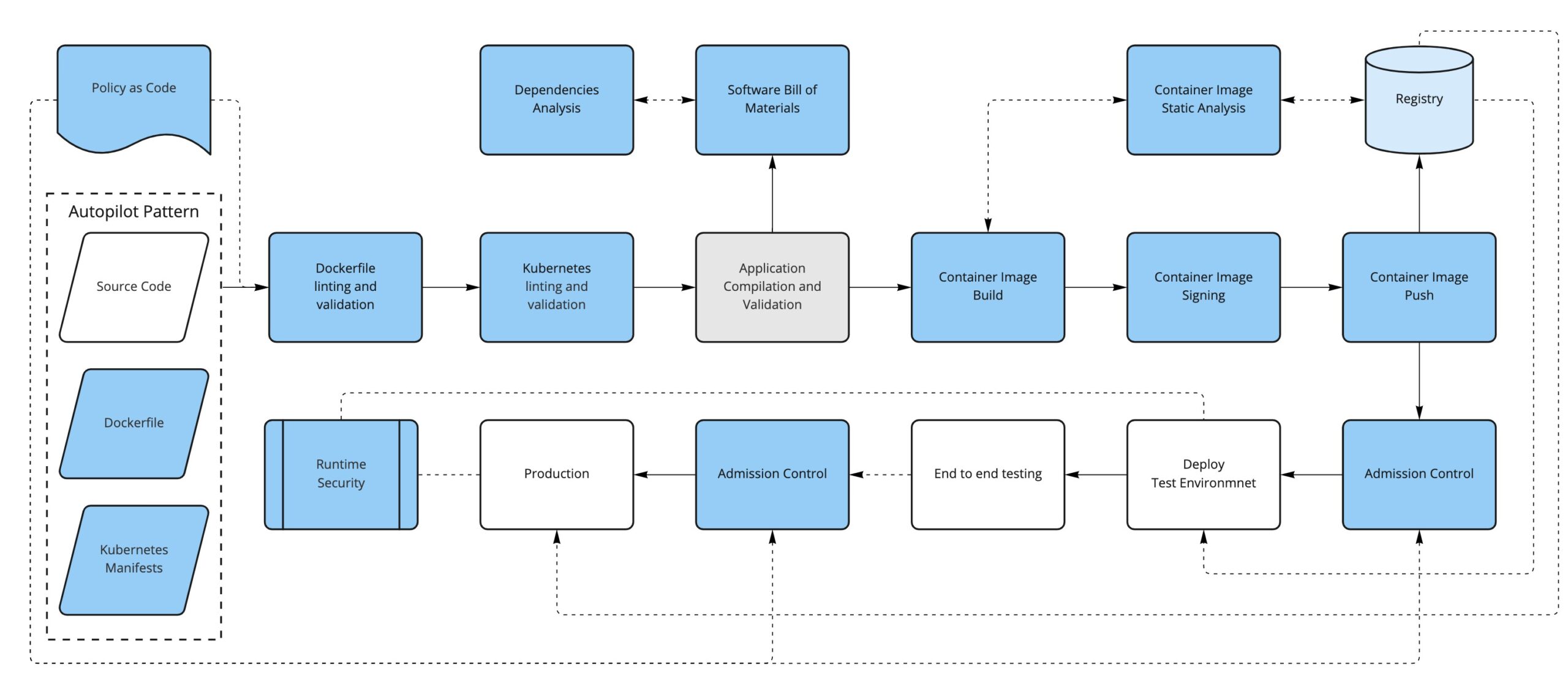
    Secure systems start from the design stage and from the code itself; you should aim to have security controls and enforcement built in as early as possible in the development life cycle. The practice of moving security checks earlier in the development pipeline (and, thus, nearer the source code) is known as shift left.

    You likely already have CI/CD pipelines in place for your application(s), and this is a great place to shift left your security checks. There are some great tools in the CNCF portfolio to help you achieve this.

    Enter Containers

    In the cloud-native world, containers are first-class citizens. From the DevSecOps point of view, containers represent a new attack surface to consider, starting with how the container image is defined and what ends up inside the container (the Dockerfile) to how the container evolves over time in response to new vulnerabilities that might be found.

    The first thing we can do is to convert our written policies to something that we can automate (such as code); for example, using a tool like OPA/conftest and a Dockerfile linter like hadolint, we can validate that the Dockerfile is compliant with our security policies.

    For instance, we could have a policy in place to limit the base images used to build new containers (limiting the FROM directive in the Dockerfile, for example).

    The second thing to consider is that, depending on how it has been built, a container image can have not only our application but also additional software included, like dependencies and operating system binaries.

    This additional software could have new vulnerabilities discovered in the future, so we should monitor the images that we have already built and pushed to our registry by periodically scanning them to find if they are open to any vulnerabilities that weren’t known at the time of building the container image.

    Just as before, we could sign our application artifacts. Now, our deliverable artifact is a container image, so it is preferable to be able to sign container images. In this way, we can trust that the container image we run comes from us and that it has been through our security process. There are projects like Notary, Grafeas and sigstore/cosign that can help with the container signature process.

    Running Containers in Kubernetes

    If we are running containers, the next logical step is to consider how we run them. Kubernetes use is on the rise as a solution to orchestrating containers across several machines. Introducing Kubernetes into the equation requires considering yet another attack surface in our DevSecOps workflow.

    Manifests

    Alongside our application’s source code, we will have the Kubernetes manifests that define how to deploy our application into a Kubernetes cluster.

    We can take the same approach as the container definition: Define some policies-as-code to enforce early in the process so our manifests are aligned with our security policies (not running untagged images, running images only from our trusted sources, ingress must have TLS, not using node port services, for example) and lint the YAML files to fail early if there are syntax problems, for example.

    We could also enforce most of the same policies and some additional ones at runtime when the manifests get applied to the cluster via a Kubernetes Admission Controller.

    Some tools that can help us with these enforcements are OPA/conftest, kubeval or kubelinter for linting and validation and, for the admission controls, we can use OPA/Gatekeeper or Kyverno, in addition to the API server admission plugins.

    Secrets

    Secrets require special attention since they contain sensitive information.

    If you’re using a GitOps approach, application secrets are often stored in repositories. Here are some resources that discuss sealed secrets in GitOps and Kubernetes secrets. 

    RBAC

    Do not use default service accounts: Define explicit service accounts associated with their permissions so you know exactly who can do what.

    Avoid the use of wildcards in roles and cluster roles; with RBAC you can define fine-grained permissions for users and for service accounts, as well.

    Know Your Dependencies

    Another attack surface that we need to consider is the application’s dependencies. It is important to first know what they are and if they have any known vulnerabilities. To help us with that, we can create a software bill of materials for the application and run an analysis on it.

    Finally, just like we periodically check for the images stored in the registry, we can continuously analyze what’s running in our Kubernetes cluster. This will ensure that there is no suspicious activity like abnormal network requests, images with critical CVEs running, etc.

    Conclusion

    By now, you should have a better idea of what it takes to secure your pipeline. Keep in mind, however, that this is mostly about process and cultural change.

    First of all, you need to know your attack surface—that is not only a technological choice, it’s also about what you think is important.

    These concepts are hard to apply from the beginning, so a better approach is to introduce changes, get used to them and think about how to improve the existing process step by step.


    Join us for KubeCon + CloudNativeCon Europe 2022 in Valencia, Spain (and virtual) from May 16-20—the first in-person European event in three years!

  • Defining the Next Cycle of Technology

    Defining the Next Cycle of Technology

    We’re in the middle of what we at ScyllaDB dubbed The Next Tech Cycle. Not “The World of Tomorrow” nor “The Shape of Things to Come” nor “The Wave of the Future”—because it’s already here today. We’re right in the middle of it. It’s a wave that’s carrying us forward, but it began with trends that got their start earlier this century.

    Everything is co-evolving, simultaneously, from the hardware you run on to the languages and operating systems you work with to the operating methodologies you use day-to-day. All of those familiar technologies and business models are themselves undergoing revolutionary change.

    This Next Tech Cycle Goes far Beyond “Big Data”

    We’re talking about huge data. Welcome to the Zettabyte Era. This era, depending on who is defining it and what it is measuring, either started in 2010 (if you’re measuring total data stored on earth) or in 2016 (if you’re measuring total internet protocol traffic in a year).

    Right now, individual data-intensive corporations are generating information at the rate of petabytes per day and storing exabytes in total. There are some prognosticators who believe we’ll see humanity, our computing systems and our IoT-enabled machinery generating half a zettabyte of data per day by 2025.

    Yet, conversely, we’re also seeing the importance of small data. Look at the genomics revolution.

    Because the RNA gene sequence of, say, COVID-19 is actually not that big, data-wise—you can store it in less than 100kb; less than an ancient floppy. But it is increasingly important to understand every single byte of that information because vaccinating against this global pandemic requires understanding every change of that rapidly-evolving pathogen.

    So, this next tech cycle has to scale everything from huge data and small data systems. And the database you will use and the data analytics you perform need to align with the volume, variety and velocity of the data you have under management.

    “Great! Now Make it All Multi-Cloud!”

    Also, this next tech cycle is not just the “cloud computing cycle.” AWS launched in 2006. Google Cloud was launched in 2008. And Microsoft Azure was formally launched in 2010. So, we’re already well over a decade past the dawn of the public cloud. Yet this next tech cycle definitely builds on the ecosystems, methodologies and technologies these hyperscalers provide.

    The database you use also has to align with where you need to deploy it. Does it only work in the cloud, or can it be deployed on-premises far behind your firewall? Does it just work with one cloud vendor or is it deployable to any of them? Or all of them simultaneously? These are important questions.

    Just as we do not want to be locked into old ways of thinking and doing, the industry does not want to be locked into any one technology provider.

    If you’ve just been mastering the art of running stateful distributed databases on a single cloud using Kubernetes, that’s not good enough. Now you’re being asked to do it all over again; this time in a hybrid or multi-cloud environment using Anthos, OpenShift, Tanzu, EKS Anywhere or Azure Arc.

    Computing Beyond Moore’s Law

    It’s also not the basic broadband or wireless internet revolutions. We’re a full two decades into both of those. Yet the advent of gigabit broadband and the new diverse range of 5G services—also capable of scaling to a gigabit—enable incredible new opportunities in real-time data streaming services, IoT and more.

    So how does your database work when you need to connect to systems far and near? How important are the limitations of the speed of light to your latencies? How well do you deal with data ingested from hundreds of millions of endpoints at gigabit-per-second scale?

    And finally, underpinning all of this are the raw capabilities of silicon, summed up by the transistor and core counts of current generation CPUs. We’ve already reached 64-core CPUs. The next generation(s) will double that, to the point where a single CPU will have more than 100 processors. Fill a rack-based high-performance computer with those and you can easily get into thousands of cores per server.

    And all of this is just traditional CPU-based computing. You also have GPU advancements that are powering the world of distributed ledger technologies like blockchain. Plus, all of this is happening concurrently as IBM plans to deliver a 1,000 qubit quantum computer in 2023 and Google plans to deliver a computer with one million qubits by 2029.

    This next tech cycle is powered by all of these fundamentally revolutionary capabilities. It’s what’s enabling real-time full streaming data from anyone to anywhere. And this is just the infrastructure.

    If you dive deeper into that infrastructure, you know that each of the hardware architecture bottleneck points is undergoing its own revolution.

    We’ve already seen CPU densities growing. Yet vanilla standalone CPUs themselves are also giving way to full systems on a chip (or SoCs).

    And while they’ve been used in high-performance computing in the past, expect to see commonly-available server systems with greater than 1,000 CPUs. These will be the workhorses —or, more specifically, the warhorses—of this next generation: Huge beasts capable of carrying mighty workloads.

    Memory, another classic bottleneck, is getting a huge boost from DDR5 today and DDR6 in just a few years. Densities are going up, so you can expect to see warhorse systems with a full terabyte of RAM. These and larger scales are going to be increasingly common—and, for businesses, increasingly affordable.

    Storage is also seeing its own revolution with the recently-approved NVMe base and transport specifications, which will enable much easier implementation of NVMe over fabrics.

    Now, software will have to play catch-up to these capabilities. Just as it took time for kernels and then applications inside of a vertically scaled box to be made async everywhere, shared-nothing, sharded-per-core, and NUMA-aware, this next tech cycle is going to require systems to adapt to whole new methodologies of getting the most from these new hardware capabilities. We will need to reconsider many foundational software assumptions.

    Evolving Methodologies: Agile and Beyond

    Speaking of methodologies, just look at these from the dawn of the millennium and onward. As an industry, we’ve moved from batch operations and monolithic upgrades performed with multi-hour windows of downtime on the weekend to a world of streaming data and continuous software delivery performed 24 × 7 × 365 with zero downtime ever.

    And by migrating to the cloud (and this always-on world) we’ve exposed ourselves and our organizations to a world of random chaos and security threats. We now have to operate fleets of servers autonomously and orchestrate them across on-premises, edge and multiple public cloud vendor environments.

    While Scrum has been around since the 1980s, and continuous integration since 1991, in this century, the twelve principles of the Agile Manifesto in 2001 altered the very philosophy—never mind the methodologies—underlying the way software is developed.

    The Agile Manifesto’s very first line talks about the highest priority being “to satisfy the customer through early and continuous delivery of valuable software.”

    However, the specific term continuous delivery (CD), as we know it today, didn’t take hold until 2009. It was then joined to continuous integration and coincided with the birth of what we now know as DevOps.

    With that, you had a framework for defining change-oriented processes and software life cycles through a responsive developer culture that now, a decade or two into this revolution, everyone takes as a given.

    This graph shows how continuous integration (CI) and continuous delivery (CD) evolved independently. They were eventually conjoined by the term CI/CD, whose popularity as a search term only began to rise around 2016 and did not displace the two separate terms until early in 2020. It is now increasingly rare to refer to CI or CD separately, according to Google Trends.

    Onto that baseline were built tools and systems and philosophies that extended those fundamental principles. The Chaos Monkeys of the world, as well as the pentesters, want to break your system—or break into them—to uncover flaws and defects long before something stochastic and catastrophic or someone maliciously does it for you.

    Cloud-native technologies like Kubernetes and single-source-of-truth for infrastructure methodologies like GitOps were created out of sheer necessity to scale systems to the hundreds of thousands of production software deployments under management.

    DevSecOps

    And that’s still not enough. We’ve already seen software supply chain attacks like SolarWinds, low-level system attacks like Spectre, Meltdown and Zombieload, or human-factor threats like viral deep fakes and millions of fictitious social media accounts using profile images generated by generative adversarial networks, never mind millions of IoT-enabled devices being nefariously harnessed for distributed denial-of-service (DDoS) botnet attacks. Just recently, news broke of the Log4j vulnerability—our best wishes to anyone who was patching code this past holiday season.

    These are all just the bowshocks of what’s still to come.

    So now, your AI-powered security systems are locked in combat every day in real-time against the threat actors attempting to undermine your normal operations. We know this because a growing number of intrusion prevention and malware analysis systems are built at terabyte-and-beyond scale using distributed databases as their underlying storage engines.

    Hence, these days, rather than just DevOps, increasingly we talk about DevSecOps—because security cannot be an afterthought. Not even for your MVP. Not in 2022.

    And these methodologies are continuing to evolve.

    Summary

    This next tech cycle is already upon us. We’re in the thick of it. You can feel it in the same way you’d yearn for major life or career change. Maybe it’s a programming language rebase. Is it time to rewrite some of your core code as Rust? Or maybe it’s in the way you are considering repatriating certain cloud workloads or extending your favorite cloud services on-premises such as through an AWS Outpost. Or maybe you’re actually looking to move data to the edge? Planning for a massive fan-out? Whatever this sea change means to you, you’ll need rock-solid infrastructure that’s available today to take workloads into production right now, but flexible enough to keep growing with your emerging, evolving requirements.

  • The Argo Project: Making GitOps Practical

    The Argo Project: Making GitOps Practical

    If you’re a DevOps engineer, chances are you have at least heard the name “Argo,” seen the friendly squid logo, and wondered: What the heck is this tool everyone is talking about? 

    In a nutshell, Argo is a popular open source tool that is making GitOps practical for anyone who uses Kubernetes. But it’s much more than that because, by enabling GitOps, Argo will also make Kubernetes environments more robust, secure and reliable than ever before. 

    Let’s find out why the combination of Argo, GitOps and good DevOps engineers is a recipe for production panacea.

    What is GitOps and Will it Replace DevOps?

    GitOps is a new(er) process and paradigm used by development teams to manage infrastructure and deploy applications. The “Git” in GitOps refers to the popular open source version control system. GitOps uses Git as a single source of information for declarative configuration. Based on this declarative configuration, it works its magic.

    GitOps automatically manages the configuration and deployment of infrastructure using Git pull requests. When development teams make a change to Git configuration, a GitOps agent deployed in the environment automatically reconciles the changes with the live state. Every change to the live environment is captured in the Git repository, so teams have unprecedented visibility and auditability over system changes. Most importantly, it is trivial to roll back to a previous working version in case of fires in production.

    GitOps builds on the developer experience, enabling teams to manage their infrastructure using the same tools and processes they use to develop software, extending those tools to the realm of software deployment and infrastructure management.

    While some have touted GitOps as “DevOps 2.0”, many experts disagree, saying that GitOps is not a better version of DevOps, nor is it something that will replace DevOps altogether. GitOps is a technical practice that can be highly beneficial to DevOps teams. The DevOps engineer will not, as some fear, be replaced by a Git-triggered robot. But GitOps will make her and the developers she supports happier and more productive.

    What is the Argo Project?

    Argo is an open source project hosted by the Cloud Native Computing Foundation (CNCF) for building and managing continuous delivery workflows in Kubernetes, GitOps style. The unique aspect of Argo is that it is Kubernetes-native—designed from the ground up for a modern containerized environment.

    The Argo project consists of four main sub-projects:

    • Argo CD—A GitOps continuous delivery engine with a powerful GUI and CLI.
    • Argo Workflows—A workflow engine that supports workflows and directed acyclic graphs (DAGs) in which each process stage is a container.
    • Argo Rollouts—An advanced Kubernetes deployment engine that supports progressive delivery strategies like canary and blue/green deployments, which are difficult to implement in plain Kubernetes.
    • Argo Events—A Kubernetes event-based dependency management system, which can be used to trigger automated workflows in CI/CD pipelines.

    Requirements for Kubernetes in Production

    Kubernetes is an orchestration platform that can help deploy, scale, and manage containerized applications. It can manage containers and the underlying infrastructure—scheduling containers and managing their workloads. This capability integrates software development and platform management to improve application management and portability. 

    Kubernetes in production can offer many advantages. For example, it makes it possible to release frequent changes to a high-availability application while keeping them online and enables you to move applications from one cluster to another. However, you need to configure Kubernetes correctly to realize its potential.

    Configuring Kubernetes for production involves implementing requirements according to each use case. As a result, what constitutes “production ready” in one Kubernetes project may vary greatly between different use cases. However, there are still minimum requirements that should be applied to most use cases. Here are key requirements for Kubernetes in production:

    • Security—When securing Kubernetes for production, you need to minimize the attack surface. This means locking down the Kubernetes control plane, applications, and their associated data. You need to keep secrets secured, harden nodes, use role-based access control (RBAC), and keep your Kubernetes version up-to-date with the latest security updates.
    • Portability and scalability—You can maximize cluster performance by maintaining portability and scalability. There are many Kubernetes capabilities that can help you achieve this goal, including self-healing nodes and auto scaling the infrastructure.
    • Deployment velocity—Kubernetes makes infrastructure and applications management faster by automating related processes. You can use Kubernetes’ automated features with GitOps to increase deployment velocity across your CI/CD pipelines.
    • Disaster recovery—You can significantly minimize your mean time to recovery (MTTR) by using Kubernetes and GitOps together. GitOps can help you reduce MTTR to minutes and quickly and easily recreate your container infrastructure in case of a complete cluster meltdown. 
    • Persistence—To support stateful production applications you will need to configure Kubernetes persistent volumes, provision storage devices with multiple storage tiers, and ensure they are efficiently utilized.
    • Observability—Observability enables you to gain a high-level view into running services, helping you make informed decisions before deployment to mitigate risk. GitOps can help you continuously monitor Kubernetes deployments, ensuring you can act immediately when issues occur.

    Benefits of Argo Tools for Production Environments

    Argo CD

    Argo CD is a continuous delivery (CD) tool native to Kubernetes. While most CD tools only support push-based deployment, Argo CD works in pull mode, retrieving updated code from a Git repository and deploying it directly to Kubernetes resources. This allows developers to manage infrastructure configuration and application updates in one system.

    Argo CD key features include:

    • Automatically synchronizing application state in a Kubernetes cluster with the current version of declarative configuration in a Git repository (==GitOps).
    • Ability to visualize deployment issues and detect and fix misconfigurations.
    • Convenient web-based GUI and CLI.
    • Role-Based Access Control (RBAC) and single sign-on (SSO), including login via GitHub, LinkedIn, Microsoft, etc.
    • Support for webhooks triggering actions in GitLab, GitHub, and BitBucket.

    How does Argo CD make Kubernetes production ready?

    GitOps can help you achieve a true GitOps workflows in Kubernetes, which provides the following benefits in production environments:

    • Minimize failed deployments and rapidly recover from downtime—Argo CD lets you instantly revert and rollback easily if anything goes wrong in production, reducing recovery time to seconds. 
    • Built-in auditing history—Argo CD ensures that every change to a Kubernetes cluster ia audited in the form of a Git configuration change log. This provides a complete audit trail of who changed what in the cluster, enabling consistent operations and supporting compliance requirements. 
    • Greater visibility on the lifecycle of developed features—Argo CD provides traceability from every change to infrastructure or applications directly to the code commit that caused those changes.
    • Improved security—Argo CD provides strong security guarantees, leveraging strong cryptography to manage changes and verify authorship, and creating a complete separation between CI environments and production systems, eliminating many types of supply chain attacks.

    Argo Rollouts

    Argo Rollouts is a set of Kubernetes controllers and CRDs that provides advanced deployment features such as blue/green and canary deployments, experiments, and progressive delivery in Kubernetes environments. It can integrate with input controllers and service meshes to incrementally transition traffic to new versions during updates. 

    A key capability of Argo Rollouts is that it can query and interpret metrics from many sources to validate that a deployment works properly and perform automatic upgrades or rollbacks.

    How do Argo Rollouts make Kubernetes production ready?

    By default, Kubernetes provides the Deployment object which updates applications using the “rolling update” strategy. In large production environments, rolling updates are considered too risky because there is no control over rollout speed and no way to automatically roll back in case of failure.

    Another limitation is that out of the box, Kubernetes deployments cannot query external metrics, such as real user measurements of performance or engagement, to determine the success of a deployment. 

    Argo Rollouts can address all these challenges and enable full progressive delivery in a Kubernetes environment, without requiring complex configuration.

    Argo Workflows

    Argo Workflows is an open source container-native workflow engine for orchestrating parallel tasks on Kubernetes. Argo workflows are implemented as Kubernetes Custom Resource Definitions (CRDs).

    Key features of Argo Workflows include:

    • Defining workflows where each step in the workflow is a container.
    • Modeling multi-step workflows as sets of actions or DAGs to capture dependencies.
    • Running CI/CD pipelines natively on Kubernetes without configuring complex software development products.

    How do Argo Workflows make Kubernetes production ready?

    Argo Workflows lets you automate production workflows in any Kubernetes environment, whether on-premises, hybrid cloud, or multi-cloud. It eliminates manual processes and ensures automation is represented as declarative configuration, making it consistent, repeatable, easy to rollback, and easy to troubleshoot.

    Argo Events

    Argo Events is a Kubernetes event-based dependency manager that defines multiple dependencies for different event sources (e.g. webhook, S3, schedule, stream, etc.) and Kubernetes objects after event dependencies are successfully resolved. Help the trigger.

    Argo events by themselves are not very useful. To deliver value, you need to integrate with a system that can execute workflow steps. So you can use Argo workflows to set Argo events. This helps orchestrate parallel Kubernetes jobs.

    How do Argo Events make Kubernetes production-ready?

    Argo Events provides several capabilities that enable dependency management in production Kubernetes environment:

    • Manage dependencies for various event sources.
    • Ability to customize business-level constraint logic to resolve event dependencies.
    • Manage everything from simple linear real-time dependencies to complex multi-source batch job dependencies.
    • Compliance with the CloudEvents standard.
    • Ability to manage event sources at runtime.

    Conclusion

    In this article, I covered the basics of GitOps and the Argo project and showed how each of the Argo project’s key modules can help make Kubernetes production-ready with minimal effort from developers and DevOps engineers. The magic of Argo is its simplicity and the way it fits seamlessly into existing Kubernetes workflows. I hope this will encourage you to try it out and see if it can help with your organization’s production issues.