Tag: Chef

  • Chef Accelerates Enterprise Ability to Deliver Effortless Infrastructure and Any App Anywhere

    ChefConf 2018 showcases Chef Automate 2.0, new Chef Workstation and significant application and compliance automation enhancements to enable high-velocity post-digital transformation

    CHEFCONF 2018 – CHICAGO — MAY 23, 2018 — Chef, the leader in Continuous Automation, today announced the next-generation automation platform, Chef Automate 2.0, that unifies infrastructure and applications work and enables enterprise organizations to rapidly and securely build, deploy and manage any application, legacy or modern, in any environment. Chef also announced availability of the new Chef Workstation, along with significant enhancements to Chef Application Automation (Habitat) and Chef Compliance Automation (InSpec). These new innovations were unveiled at ChefConf 2018, being held in Chicago from May 22-24.

    “The race to modernize IT by deploying and managing new and legacy applications in multiple environments is greatly hindered by the complexity of current toolsets, including containers,” said Stephen Elliot, Program Vice President, Management Software and DevOps at IDC. “Solutions that span the application lifecycle and unify the teams currently tasked with owning and optimizing small pieces of the puzzle will enable enterprises to move their modernization initiatives forward, and achieve their business goals, more rapidly.”

    A recent survey conducted by Chef of more than 365 DevOps, applications and infrastructure leaders revealed that while most (72 percent) see “time from code to production” and “time from commit to deploy” as the most critical measures of application deployment success, a majority (60 percent) also take days, weeks or months to complete application builds and (56 percent) need the same amount of time to deploy apps into production. The innovations introduced by Chef today are designed to accelerate those processes by enabling IT to deliver immediate, effortless and scalable infrastructure to achieve compliance at velocity and to build, deploy and manage any application in any environment.

    “Enterprise software development and delivery is so often gated by the operational concerns of infrastructure – from desktops to servers, storage and networks – applications end up as a second-class citizen,” said Corey Scobie, SVP of Product and Engineering at Chef. “This is insufficient to thrive in a world where the primary interface to customers, and therefore revenue, is the application. The targeted solutions we introduced today enable executives and their organizations to make that critical shift quickly and easily.”

    Chef Automate 2.0

    Chef Automate has been rebuilt from the ground up to provide performance, scale and advanced analytics required by enterprises using DevOps at scale to meet the demands of post-digital transformation. Chef Automate now provides a single control plane for infrastructure and compliance automation to enable a closed-loop ‘detect, correct, automate’ process to make infrastructure effortless.

    New features include:

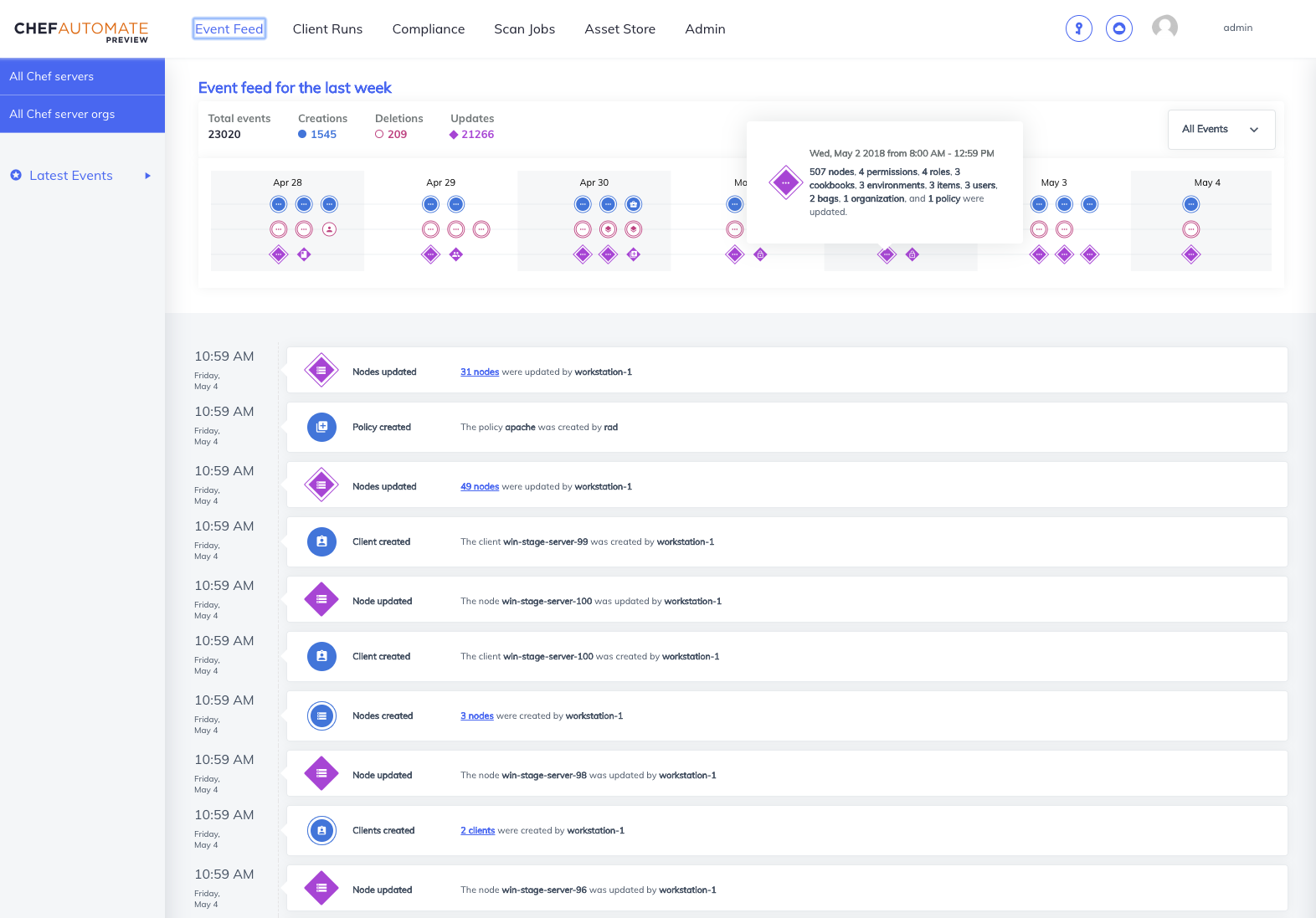
    • Enhanced operational visibility and debugging – New tools and visualizations, including a streaming event feed, trend graphs and a rich query language, help users analyze infrastructure and compliance automation data from a unified dashboard.
    • Compliance scanning and reporting in any environment – Integration with cloud compliance capabilities of InSpec 2 enhances scanning, which can now be used to evaluate cloud configurations (AWS, Azure, Google Cloud) via APIs for compliance on either an ad-hoc or ongoing basis. Chef Automate 2 also supports scanning of Cisco IOS equipment as a significant start on extending modern compliance capabilities to network devices.
    • Re-architected for speed and flexibility – A Go-based microservices architecture, with a modern, performant web UI atop a REST API, enables Automate 2 to support tens of thousands of nodes from a single installation. In-place upgrades with automatic data migration from Chef Automate 1 ensure that customers retain all historical information.

    NEW! Chef Workstation

    Chef Workstation enables DevOps teams and practitioners to complete ad-hoc DevOps tasks using all of the familiar Chef capabilities, without agents. This provides a simple and effective way to use Chef to complete tasks and then seamlessly scale those tasks through Chef Automate.

    Capabilities include:

    • New standard desktop/laptop experience for Chef – Includes a new ‘target mode’ for executing Chef recipes or entire cookbooks remotely and Introduces ‘chef’ command as the single point of entry.
    • Foundation for a better workstation experience – Bundling all the tooling previously included in the ChefDK provides an improved user experience and cohesion between tools to deliver a seamless experience for any infrastructure automation task.

    Habitat – Automate Any App Anywhere – Build, Deploy, Manage

    Habitat supports an ever-widening array of supported application release scenarios, enabling teams to ‘build, deploy and manage’ any app, anywhere. It is ideally suited to ‘Lift, Shift and Modernize’ initiatives as enterprises seek to find a unified way to ship all of their apps – from monoliths to microservices, bare metal to containers and datacenter to cloud.

    A fast-growing number of enterprises, including top US ticket sales site Ticketmaster and Alaska Airlines, recently named the top airline in the US (1), are finding great benefits in using Habitat to deploy applications in any environment.

    “We’re very interested in what Habitat can help us with,” said Stephen Nelson-Smith, principal infrastructure developer, Ticketmaster. “From the work we’ve done so far, it allows the iterative migration of mission-critical applications to the cloud by enabling us to build a single, intelligent artifact that moves, unchanged, from development to production whilst wrapping a consistent cloud-native interface around legacy applications. This is giving us a clear path to implement our strategy to containerize and cluster our services.”

    “In today’s world, supporting containers and microservices is a necessity,” said Steven Mullinax, director of infrastructure engineering, Alaska Airlines. “Habitat can help get us there with applications that run anywhere.”

    New capabilities include:

    • Habitat Builder on-premises – Customers can now take advantage of Habitat’s build once, run anywhere capabilities behind the firewall. This is critical for financial services, government and other highly-regulated environments.
    • Expanded ecosystem integrations – An updated Kubernetes Operator for Habitat, export to Azure Container Service (AKS), Helm chart exporter, Open Service Broker integration and integration with Splunk for operational analytics validate Habitat’s cloud-native, “runs anywhere” approach to modern application delivery.

    InSpec – Compliance at Velocity to Accelerate DevSecOps

    InSpec is the first step in Chef’s ‘Detect, Correct, Automate’ approach to cloud migration and continuous automation. It helps organizations maintain an up-to-date view of compliance status in production, detect security issues long before they reach production and reduce risk while delivering applications faster.

    New capabilities include:

    • Cloud configuration compliance – Verify AWS and Microsoft Azure policies, with Google Cloud Platform support in beta. More than 10 new AWS resources bring it to CIS Level 1 benchmark completeness.
    • Improved out-of-the-box experience – More than 30 new resources, including support for Cisco IOS network devices as agentless targets, are built in.
    • Drastically improved performance – Users now see up to 90 percent performance gains on Windows and 30 percent on Linux/Unix.

    “Enterprise IT leaders face a variety of challenges regarding the need to modernize applications and infrastructure to maintain competitive advantage and increase user satisfaction as they accelerate post-digital transformation,” said Barry Crist, CEO of Chef. “Chef allows them to build, deploy and manage all applications – legacy or new – much more easily and consistently, in any environment. Our technology is a level-setter, allowing them to match or even exceed the application deployment velocity achieved by even the most innovative and well-resourced hyperscalers in the market today.”

    About Chef

    Chef is the leader in Continuous Automation software, an innovator in cloud native operations and one of the founders of the DevOps movement. Chef works with more than a thousand of the most innovative companies around the world to deliver their vision of digital transformation, providing the practices and platform to deliver software at speed. Chef Automate is Chef’s Continuous Automation Platform which is powered by an awesome community and open source software engines: Chef for infrastructure, Habitat for cloud native operations, and InSpec for compliance. For more visit http://www.chef.io

    #

    Media Contact:

    Wilson Craig

    SVP/GM

    Mindshare PR

    wilson@mindsharepr.com

    +1 408 516 6182
  • Chef Embraces Microservices to Advance IT Automation

    Chef Embraces Microservices to Advance IT Automation

    Chef at the ChefConf 2018 conference today unveiled a series of DevOps offerings, including a revamped version of Chef Automate that has been rewritten using the Go programing language to improve performance and scalability. Now based on a microservices architecture, Chef Automate 2.0 a new user interface based on a REST application programming interface (API) that also serves to enhance integration. There also are a variety of visibility and debugging tools built into the platform, including a streaming event feed, trend graphs and a query language.

    Chef Automate

    At the same time, Chef unveiled Chef Workstation, which enables members of a DevOps team to take advantage of IT automation capabilities on a local PC without having to load any agents.

    Chef also updated its Habitat application release management software to include support for Kubernetes Operator for Habitat and the Open Service Broker originally developed by the Cloud Foundry Foundation, the ability to export to Azure Container Service (AKS), a Helm chart exporter for Kubernetes clusters and integration with operational analytics software from Splunk. Habitat also is now available in an on-premises edition as well as as a software-as-service (SaaS) application.

    Finally, Chef updated InSpec, the company’s compliance automation tool. The latest version can now verify Amazon Web Services (AWS) and Microsoft Azure policies, while support for the Google Cloud Platform support is in beta. InSpec also now has built-in support for more than 30 new resources, including Cisco IOS network devices as agentless targets.

    Chef is touting InSpec performance gains of 90 percent on Windows and 30 percent on Linux systems.

    Julian Dunn, director of product marketing for Chef, said as more companies transition to emerging technologies such as containers and Kubernetes, the need to rely on IT automation frameworks increases. In fact, while container use is widespread, more than half (51 percent) of 347 application and operations professionals surveyed by Dimensional Research on behalf of Chef said they have fewer than 10 percent of their production applications deployed using containers. Dunn said that survey also finds that adoption of DevOps practices in general are still limited—just over half the respondents (53 percent) said they are using both infrastructure and app automation for DevOps.

    However, 46 percent survey respondents said by 2020 they will have more than a quarter of their applications containerized, while 45 percent said at least a quarter of their application deployments will be based on microservices. That accelerated rate of transition will require IT organizations to rely more on IT automation frameworks to implement DevOps processes, Dunn noted.

    Further complication matters, Dunn said organizations are trying to lift and shift existing applications into multiple public clouds while continuing to develop new applications faster than ever to drive various digital business transformation initiatives.

    There’s no doubt that IT organizations are relying more on IT automation frameworks more than ever. The question is, Which one will they use? There are now more IT automation framework choices than ever. Chef is betting that a comprehensive approach based on a modern microservices architecture spanning both IT management and compliance ultimately will win the day.

    — Mike Vizard

  • Survey: Not Much Compliance Progress in DevOps World

    Survey: Not Much Compliance Progress in DevOps World

    A survey of 1,500 customers conducted by Chef illustrates the lacking state of DevSecOps in the enterprise today, finding that nearly three-quarters of IT organizations still manually assess whether applications comply with various regulations before being deployed to production. Worse yet, half the respondents also manually remediate any issue once it arrives, which takes days or sometimes weeks to accomplish.

    In fact, according to the survey, more than half the respondents (52 percent) have applied automation to fewer than 25 percent of the servers they manage.

    Manual processes conspire to make IT organizations less agile at a time when the pressure from the business to deploy applications and associated updates faster has never been higher.

    Julian Dunn, director of product marketing for Chef, said compliance—much like security—needs to move much further left into the DevOps process as a subset of DevSecOps. After all, most compliance regulations are trying to set a bare minimum standard for IT security.

    The first line of IT security defense is detecting vulnerabilities before they go into a production environment. Whenever a vulnerability gets exploited, most organizations incur the initial injury. But after the cybercriminals have come and gone the regulators show up, demanding explanations. Those explanations usually don’t do much to mitigate the fines and penalties that are assessed, especially in highly regulated industries.

    Chef has been making the case for applying the same constructs it developed to automate configurations to compliance for some time. Most compliance issues typically stem from one setting or another that wasn’t configured properly, noted Dunn.

    The issue is that most compliance officers inside organizations are unaware that many of these issues could be automatically resolved, and DevOps teams are too focused on daily operational issues to make anyone aware of what’s now possible. But now that DevSecOps is becoming more mainstream, many of the individuals involved are starting to realize they are dealing with the same issues time and again, said Dunn.

    Dunn added that, much like IT security professionals, compliance professionals who typically reside in a risk-management function need to be brought into the application development process earlier, but without slowing down the pace of application development. However, given the current level of manual remediation occurring, earlier participation mostly likely will reduce the level of manual work occurring right before the application is supposed to be going into production.

    When it comes to compliance, most IT organizations are their own worst enemy. Compliance requirements typically are spelled out in arcane language in documents that not many read, much less comprehend. Asking developers to make sense of those requirements is not the best use of their time. Besides, few of them would interpret the requirements correctly. An automated approach to compliance is not only going to create a better application, but it also should reduce a lot of unnecessary aggravation for all concerned.

    — Mike Vizard

  • DevOps Chat: Chef Habitat Project Continues to Mature

    DevOps Chat: Chef Habitat Project Continues to Mature

    When Chef Habitat was released a little more than two years ago (good devopsy.kinsta.cloud story on Habitat here and a good DevOps Chat on it here), many people in the DevOps community wondered where Chef was going with Habitat. It was a really ambitious vision, but could it meet its lofty goals?

    Habitat is now made up of many different packages that provide different functionalities. There is, of course, much more to Chef Habitat. This DevOps Chat will tell you all about it.

    Joining us on this DevOps Chat are Jaime Winsor, a co-author of Habitat, and Tasha Drew, senior product manager of Habitat, and Blake Irvin of SmartB, a Habitat user. Between the three of them, there is a ton of great information here. If you are interested in Chef Habitat or would like to find out more, this is a great place to start!

    As usual, the streaming audio of our conversation is below, followed by the transcript of our conversation. Enjoy!

    Audio: Chef Habitat

    Transcript: Chef Habitat

    [su_pullquote][su_custom_gallery source=”media: 118811″ target=”blank” width=”250″ height=”250″]Blake Irvin
    Blake has spent over a decade working in systems and software engineering automation, on platforms ranging from on-premise metal to containers-as-a-service, BSD and Solaris systems to embedded Linux sensor platforms. He lives and works in Berlin, Germany, where he’s Senior Operations Engineer at smartB, GmbH, an energy-efficiency and sustainability startup.[/su_pullquote]

    Alan Shimel: Hey, everyone, this is Alan Shimel from devopsy.kinsta.cloud here for DevOps Chat, and we’ve got a really great chat lined up for this episode. It is all about Chef Habitat, and we’ve got some really-we actually have three guests on the show today, so we’re gonna move it along to keep it moving.

    Let me first of all introduce my two Chef guests or from Chef. One is Tasha Drew, who’s a Product Manager for Chef Habitat, and one is Jamie Winsor, an engineer with Chef and one of the co-authors of Habitat. Jamie, Tasha-welcome to DevOps Chat.

    Tasha Drew: Thanks so much. Happy to be here.

    Shimel: Thank you.

    Jamie Winsor: Yeah, thanks for having us, man.

    Shimel: Hey, it’s my pleasure. And then, joining Jamie, Tasha, and myself today, all the way from Berlin, is Blake—and I hope I’m not gonna mess this up—Irvin. Blake, are you there?

    Blake Irvin: Yep.

    Shimel: Okay. Thanks. Hey, Blake, I appreciate you taking the time to join us. Blake, you’re with, is it BusyBee, is that what’s the name of the company?

    Irvin: It’s called smartB.

    Shimel: smartB.

    Irvin: Yeah, and the B essentially stands for business, because we are building, because we focus on providing energy efficiency analysis for businesses—small to very large businesses and the buildings that they operate.

    [su_pullquote align=”right”][su_custom_gallery source=”media: 118812,118813″ target=”blank” width=”200″ height=”200″]Tasha Drew
    Tasha Drew is the Product Manager for Habitat. She previously launched Chef Automate’s analytics capabilities, was Head of Product at Rentlytics, was responsible for product for Engine Yard Cloud, and spent several years in various data center endeavors on behalf of Lockheed Martin. Tasha holds an M.S. in Management from RPI and a B.S. in Computer Science from USC. When not in front of a computer, Tasha prefers to be cruising around Napa or at the beach with her dogs—all while having intensely deep thoughts about how to save application developers from tedious rework via the wonders of application automation with Habitat.
    Jamie Winsor
    Jamie Winsor is a lead engineer at Chef Software and the coauthor of Habitat, an open source project built upon distributed system protocol Butterfly to provide a self-healing, self-configuring, stack-agnostic, frictionless abstraction for running applications—regardless of their complexity—to software developers. Jamie has been a software engineer in the video game industry for 10 years, focusing on networked application servers on such titles as League of Legends, Lord of the Rings Online, and Dungeons and Dragons Online. One of Jamie’s responsibilities in his game development tenure was to bring what we today know as DevOps into the daily lives of the other developers on his team, which Jamie accomplished by building, evangelizing, and teaching methods to his peers. He draws on that experience today in building Habitat, as he helps enable all software developers, regardless of their experience, bring their ideas to life without investing in the details of operationalizing an application.[/su_pullquote]

    Shimel: Wow, that’s really good stuff. Jamie and Tasha, you both work for Chef, no need to introduce who Chef is to our DevOps audience, but Blake-welcome. And we have you on today because we’re gonna talk a little bit about Habitat, and Blake, if you don’t mind, I wanted to start with Tasha and Jamie and talk a little bit-just a little background. Maybe we have some folks on here who are not familiar with Habitat.

    So, Jamie, you’re a co-author. Why don’t you take that one, right? What’s Habitat, for people who may not be familiar?

    Winsor: Yeah, sure. So, the Habitat project is a number of pieces of software, and the overall goal is to, I hope, redefine what application automation means by focusing on the application instead of the infrastructure. In the past, we have been building computers in service to host our applications, and what Habitat does instead is it says, “Let’s focus on what the applications are that we need to run our application, what software we need down to a bare minimum, and then provision the machine around it,” and Habitat runs exactly the stuff that you need.

    It does so with a packaging system and a build system and then a process supervisor. The process supervisor runs the packages, the process supervisor communicates to other supervisors using a gossip protocol to share and spread information about what software they’re running, which allows us to enable things for free, just by packaging your software with Habitat, such as service discovery, leader—follower failover, rolling configuration updates, rolling software updates—and it’s all coordinated using the gossip ring.

    Finally, the piece that we built, the last piece of Habitat is simply called Builder, which we can also chat about today, which we just launched about a month ago. And Builder is a hosted Software as a Service build service that’s currently in preview mode. It’s free, and it builds your software that’s packaged with Habitat and hosts it as well in release channels, which allows you to have supervisors subscribe and then receive automatic updates using a complete CI/CD process of promotion between an unstable branch to a stable branch and so on. That’s basically it.

    Shimel: Yeah, no, more than basically-that was a great description and great stuff there, Jamie.

    Tasha, now, Habitat was released as an open source project by Chef, and it’s probably about two years ago now, right?

    Drew: Yeah, yeah.

    Shimel: And so, Tasha, tell us kinda what’s been the latest with Habitat.

    Drew: Sure. So, basically, we have been working nonstop since the initial reveal of Habitat about two years ago, just adding functionality and capability across both that Builder system and that process supervision system that Jamie’s been talking about.

    We’ve also been working on the deployment piece of the overall integration between those two which, in Habitat’s world, is highly agnostic. So, the idea is, use whatever tools you need to deploy those artifacts and supervisors that you’re using with Habitat. And so, we’ve been working with partners to have a really great cloud foundry ecosystem story, Kubernetes ecosystem story, AWS and Azure story, and then Terraform as well.

    So, the idea is, we have been making it easier and easier for people to come get started using Builder, and that’s why we’ve released Builder in free preview mode, it’s because we just want to have this very low friction way for people to get started with Habitat and start rebuilding all of their workloads, and then deploy using your favorite technologies and then start seeing the benefit of the supervisor in Builder, communicating between the two.

    Shimel: Absolutely. And as you mentioned, Builder is in free preview right now. You know, some people look at things like Habitat and some of the other great open source projects Chef is kind of shepherding, and they say, “This is all great, great, great, but how—you know, where does, how do they stay in business? Where do they make money?”

    So, Tasha, can you talk a little bit about sort of where Chef sees commercial opportunity with Habitat?

    Drew: Yeah, absolutely. So, for our enterprise customers, having on prem solutions that integrate with all of our open source products in order to have that really strong control plane management layer is super important. And so that’s, with Chef Automate, something that we continue to invest and see incredible success with.

    And then, with Habitat, Habitat becomes the technology that continues to support enterprises while they want to move fast to deliver applications to production at scale. And so, having this part of the technology suite be adopted by our core set of enterprise customers will continue to be part of our strategy, but then we also have Builder to enable smaller shops to just get started—really low friction point, really easy to use. And how we monetize Builder itself over time will be something that we investigate as we see how people adopt and use the technology.

    Shimel: Excellent answer. Great, Tasha. So, Blake, I didn’t wanna leave you too long in the cold. Let’s bring you into this now. First of all, Blake, I don’t think I asked you, and I don’t know if our audience is savvy to it, but what exactly is your role at smartB?

    Irvin: So, I—we have a team of sort of multidisciplinary, polyglot engineers at smartB. We do all kinds of things because we’re a small shop and a small company, still. But the focus that I have—and this has been my focus and my interest, sort of, for the last, it’s actually been a little bit over 10 years is on all manner of operations engineering.

    So, what I used to do would be something more like traditional systems administration, and now I would say I’m more of a software engineering operations specialist. In other words, I’m focusing on improving and streamlining the process of software engineering and less focused on things like racking servers.

    Shimel: Sounds like you’re doing DevOps to me, man. [Laughter] But Blake-

    Irvin: Yeah, you could say that.

    Shimel: Yep. So, Blake, smartB is using Habitat?

    Irvin: Yeah, that’s true.

    Shimel: Let’s talk about why.

    Irvin: I would say, for the moment, about-sorry?

    Shimel: I was gonna say—why? What are you using it for?

    Irvin: Well, we’re using it for almost everything. We have one—yeah, we have one production service that is not yet what I called Habitized or wrapped up in the Habitat package, and we’re just waiting for some work in the community to be finished before we can do that. But yeah, like, 85, 90 percent of our services are running under Habitat, using the Habitat supervisor, and we’re using as much of that workflow that Jamie and Tasha were describing as we can at the moment.

    And that’s actually been a pretty good process for us, I think, because the way that Habitat’s designed, the adoption process can be incremental. So, when Tasha was referring to giving Habitat users the freedom to pick and choose how they want to deploy or how they want to go about adopting, that’s definitely something we’ve leveraged a lot to make our story good for ourselves.

    Shimel: Got it. And so, Blake, I mean, when did you guys adopt, start with Habitat?

    Irvin: So, when I saw the launch video, which was, I think, Adam speaking in Seattle-Adam Jacob, the Chef CTO. I was sort of, I was watching it originally just out of curiosity and then, as the talk went on, my mouth started hanging open further and further, I think. Not because I thought it was the most groundbreaking thing that I’d ever seen, but more because I couldn’t-I was surprised to see how many of the check boxes that I had in my mind from 10 years ago around this kinda stuff, all this kind of operations work, how many of those check boxes were getting checked off by the project as the architecture and the behavior of the tools was described.

    So, we really started looking at the feasibility of adoption within weeks, I think, of that launch video.

    Shimel: Wow.

    Irvin: And started doing the rollout probably a few months afterwards. So, we’ve been doing it like a very slow, incremental rollout to, you know, ensure that we don’t disrupt any of our current software development process or our current production environments. That’s what’s been going on. It’s been a continual process for, I’d say, like eight months now, but just done very slowly.

    Shimel: Very cool. So, Blake, you know, I have a long history of working in open source-related projects and stuff, and I’m always curious, you know, as a consumer, if you will, or a user of this open source project, have you guys—what have you contributed back? Have you contributed any code, bug findings, suggestions for new features? How are you giving back to the community, here?

    Irvin: Yeah, sure. I think the thing, since we’re a really small team, what we’ve really focused on is trying to use the tool in the way that it’s been designed to be used and then giving feedback to the community and/or to the core maintainers whenever we find bugs or places we want to see improvements, and just keeping that conversation really open and fluid, which has been great. It’s one of the reasons that I’ve continued to use Chef software stuff for—not quite my whole career, but a sizable majority of my career. It’s just that, I think, as an organization, Chef believes that community is very important, and in fact, perhaps, one of the most important things about building a company. And compared to other experiences I’ve had with other open source groups, I think that’s been a real win for everybody involved.

    So, in terms of code contributions, I think mostly what we’ve done is put out a lot of plans, which are the sort of blueprints for packages that Habitat uses when you set up like a set of dependencies for your application. So, we’ve definitely published a lot of those back into the community. I think you can find them if you look on the Builder site under the smartB origin, you’ll see all the packages we’ve published. And we’ve also published some stuff back into the core plan side, just the ones that the Habitat team maintains.

    Shimel: Got it, got it. So, Jamie and Tasha, does Blake and smartB sort of represent the kind of prototypical Habitat user?

    Winsor: I’d say so. You know, with Habitat, you can pick and choose what pieces you want, and it’s been great to watch Blake and smartB grow from—back to the packaging manager and the supervisor and gradually moving toward adopting Builder. They’ve been great to work with in the community. They gave us a lot of great feedback. You know, they’re users, so one of the things that is really important is, you build a feature or you build—you know, you fix a bug, and then you immediately get the feedback from the community, and they’ve been unbelievable to work with.

    I’d say that Habitat would work for any team that ships software, though. So, they’re absolutely a typical user, because they ship software, right?

    Shimel: Mm-hmm. Cool beans. Guys, we’re almost at the end of time, unfortunately, leading up here over 15 minutes. But Tasha, for people who may want to, you know, go explore Habitat themselves, where can they go to get information?

    Drew: Yeah, we would love them to visit our website, Habitat.sh. There, you can see, we have a quick, you know, just kick the tires, 10-minute kinda step-through demo. We have more in-depth tutorials if you want to start just playing around with both the run and build time features of Habitat, and our community is very active on our Slack channel, which you can find a link there to join, but it’s just at Slack.Habitat.sh. So, as you get started, if you wanna just jump in that Slack channel, the entire core team is there, our community is there, and we seek to be super welcoming to new people. New questions are very welcome in the general channel. So, you can just hop in and get support and ask whatever questions you have.

    Shimel: So, it’s Habitat.sh?

    Drew: Yeah, yeah.

    Shimel: Excellent, excellent. Guys, listen. Thank you very—all three of you, Blake Irvin, Jamie Winsor, Tasha Drew—thank you so much for being our guests in this episode of DevOps Chat. Continued success, Blake, with you guys in your bigger business as well as using Habitat, and Jamie and Tasha, with you guys continuing to develop and make Habitat, you know, an indispensable tool for companies around the world. Alright?

    Drew: Thanks so much.

    Winsor: Thank you.

    Shimel: Alright, everyone, have a great day. This is Alan Shimel for DevOps Chat. We’ll hopefully see you soon on the next chat. Until then, take care, everyone.

    — Alan Shimel

  • DevOps, Security, AI Convergence on Horizon

    DevOps, Security, AI Convergence on Horizon

    DevOps is regarded as practice that can drive performance advantages. Artificial intelligence is showing very real promise across the security market. Most public and private-sector organizations know that they must explore new and different ways of defending their networks against modern threats. These three factors make it clear that DevOps, AI and security are ripe for convergence.

    Defining AI

    Anyone reading this post doesn’t need me to explain to them what DevOps and security are; both of these categories are well-defined. However, AI is really in an emergent stage, with different types in use and many definitions floating around. Because of this, I think it is important to let readers know that in this post, AI refers to a class of technology that can:

    • Consume data, learn and get smarter on its own
    • Automatically identify and solve problems
    • Operate independently, without human supervision
    • Scale massively
    • Move at near real-time speed
    • Achieve levels of accuracy that are beyond human capabilities

    DevOps and Security are United

    DevOps and security have merged. For several years now, organizations have been leveraging automation technologies and DevOps practices to continuously deliver security and compliance policies across data centers and clouds.

    Further legitimizing the union is the fact that leading DevOps and automation players such as Puppet, Chef and Ansible have formed numerous partnerships that deliver effective security capabilities to their customers.

    There are, of course, other signs that show how successful the DevOps and security marriage has been. One of which is the emergence of the term “rugged DevOps.” It is now so widely recognized that it commands its own section on this site and is often the subject of discussion at several notable security conferences.  

    DevOps and AI are Dating

    The relationship between DevOps and AI is in the early stages, with the courtship between the two well underway. Examples of its progress are found in numerous blogs and articles, several of which include:

    DevOps and AI have certainly not yet intertwined as deeply as DevOps and security have. These examples (and others out there) do show they the two will continue to integrate beyond what we are currently witnessing.

    DevOps, Security and AI

    DevOps and security are wed. DevOps and AI are moving closer toward each other. It’s only a matter of time until all three get together.

    Because several DevOps leaders are already in the business of security, it’s logical to assume that a partnership between one of them and an AI-driven security provider will be what ultimately leads to a marketable solution.

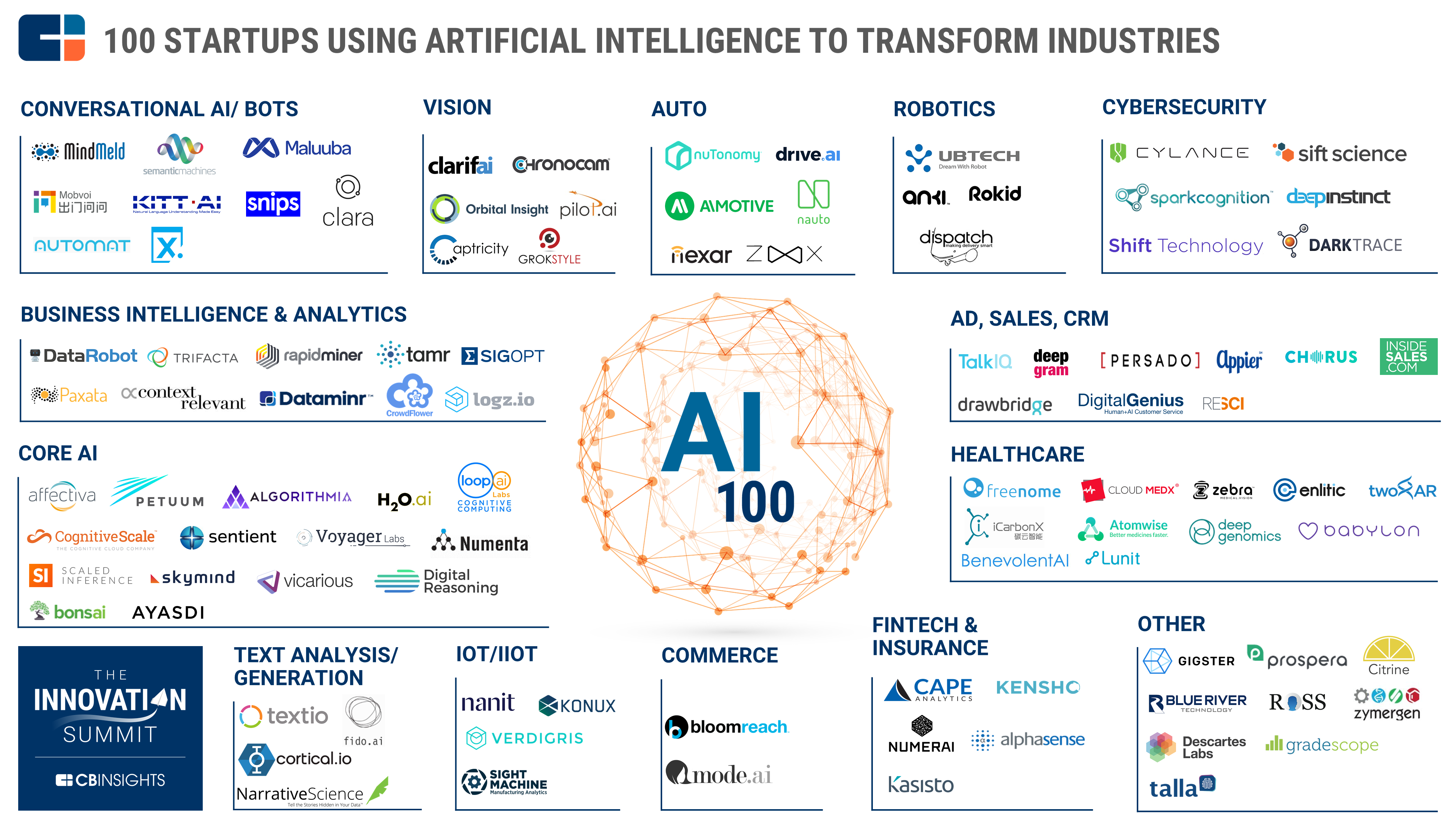
    DevOps provider candidates with the potential to move on a partnership that can combine DevOps, security and AI have a raft of new and established security providers available to work with. Several of the startups in this class are recognized in the CB Insights AI 100 2017 infographic. Companies such as Cloudera (NYSE: CLDR), which is using AI and machine learning to solve security problems, are among the more established providers that may make for a perfect partner. 

    How quickly will the market see such a partnership? That remains to be seen. However, with DevOps now fully accepted as a methodology that can positively impact bottom lines, AI coming into its own, and the need for new and different ways of defending organizations against attacks at a critical stage, it seems almost certain that the convergence will be upon us sooner rather than later.

    — Joe Franscella

  • VMware Cloud on AWS Will Bring DevOps Issues to a Head

    VMware Cloud on AWS Will Bring DevOps Issues to a Head

    Now that instances of VMware are starting to become available on Amazon Web Services (AWS), a DevOps ecosystem is starting to emerge around the management of applications workloads moving into and out of AWS.

    Among the more than 4,500 applications that VMware claims already support VMware Cloud on AWS are those from Blue Medora, CA Technologies, Chef, Cloudbees, Dynatrace, Jfrog, Puppet, SaltStack and the Ansible arm of Red Hat.

    VMware CEO Pat Gelsinger told attendees at the recent VMworld 2017 conference that VMware and AWS are just now scratching the surface of what they plan to accomplish together. AWS CEO Andy Jassy added that, unlike other alliances, which consisted mainly of marketing, engineers at both companies are working closely together to deliver VMware globally across all AWS availability zones. At present, VMware Cloud on AWS is available in the AWS availability zone hosted in Portland, Oregon. The service soon will be extended to the east coast of the United States, followed by rest of the world over the course of 2018.

    The availability of VMware Cloud on AWS should force several DevOps issues within enterprise IT organizations that have deployed the VMware stack of software mainly on-premises. Many of those organizations have also been employing public clouds such as AWS. But because those environments are based on different hypervisors, it was never easy to migrate workloads between the two platforms. There are plenty of options for running VMware software in the cloud, but because AWS is the largest provider of public cloud services, there are many customers who want to seamlessly move workloads between their on-premises IT environments and AWS via a common stack of VMware software.

    In many organizations the desire to shift applications workloads into AWS will bring many DevOps issues to a head, as VMware and AWS use has occurred in independently of each other. There could be many workloads running on each platform, but for all intents and purposes, IT organizations have managed both platforms in isolation. Now that VMware is becoming available on AWS, all the challenges associated with moving workloads between a public and private cloud come to the fore.

    Most of those DevOps issues will be focused first on moving some classes of workloads running on VMware into AWS. Application workloads that don’t need to run constantly will be among the primary candidates followed by a slew of data protection applications that will enable IT organizations to back up and archive massive amounts of data inexpensively. Next up will be applications that need to be distributed globally to increase availability.

    At the same time, a lot of VMware shops will be moving application development into the cloud. But just because an application is developed in the cloud doesn’t mean it will stay there. Many IT organizations have already discovered that when it comes to long-running applications, the total cost of deploying them on-premises is less than deploying them on a public cloud. The DevOps tasks ahead, of course, will start with figuring out which VMware-based applications make the best candidates from a financial and availability perspective to be deployed on AWS.

    — Mike Vizard

  • DevOps Chat: Chef Update with Ken Cheney, Chef CMO

    DevOps Chat: Chef Update with Ken Cheney, Chef CMO

    There are always new developments going on at Chef. We caught up with Chef CMO Ken Cheney to give us an update. Last time we spoke with Ken was right after ChefConf. Since then, Chef continues to move forward on several fronts including Habitat, Automate and INSPEC. We speak to Ken every other month or so, as it is always good to know “what’s cookin’” at Chef.

    As usual, the streaming audio of our conversation is immediately below, followed by the transcript of our chat. Enjoy!

    Audio

    Transcript

    Alan Shimel: Hey everyone, Alan Shimel, editor in chief of devopsy.kinsta.cloud here, for another DevOps Chat. Today’s guest on DevOps Chat is our friend Ken Cheney, CMO of Chef. Ken, welcome back to DevOps Chat.

    Ken Cheney: Alan, it’s great to be here. Thanks for having me.

    Shimel: Thank you. Ken, I apologize, between your schedule and my schedule, it’s been a while since we’ve had a chance to catch up. I think the last time we left off it was – was it right after Chef Conference, ChefConf?

    Cheney: It was actually right before ChefConf. So it’s been a couple months, right? Given that was at the end of May. 

    Shimel: Ken, I don’t think I’ve been home for more than two or three days at a time since then. So yeah, it has been. But for our listeners who maybe aren’t lucky enough to be down in Austin and ChefConf this year, can you fill us in a little bit about maybe what we missed?

    Cheney: Yeah, so ChefConf this year, as you mentioned, was in Austin, Texas. And you know, I think the highlights of ChefConf, on the product side, were some announcements we made around Chef Automate and bringing in our open-source tooling fully under that umbrella of Chef Automate. So Chef Automate is our commercial offering. And first and foremost, we brought in InSpec fully, so now, from one spot within Chef Automate you can see both how you’re doing in terms of your infrastructure and how your infrastructure automation is going with Chef, but also from a compliance perspective you can see what’s happening in terms of policy through the Chef Automate UI. So it’s really – the product has evolved from how it was working before, where we essentially had two servers for and now you have a single, common UI for looking across all the various data points

    In addition we brought in the Habitat data so now you can see the state of your Habitat instances that are running in the wild.  And you know, what I find really interesting about what’s happening with the compliance front is that, you know, we’re really evolving quickly from just being focused on sort of core compute elements to now expanding InSpec out to cover up on cloud-based APIs. So we can now go at AWS and Azure and be able to scan those, as well as VMware environments. So you know, we’re expanding InSpec to be a language that’s not just appropriate for compute, but also for broadly managing all of your infrastructure as code. And so that was announced as well at Chef Conf. And I think that’s a bi move forward. You’re going to see that continued expansion of that InSpec language and capabilities to go after a broad set of other types of infrastructure in the near future.

    And it’s an area where we see just a tremendous interest and uptake from our customers and users. So anyone who hasn’t tried out InSpec, I really encourage them to try it as part of Chef Automate if you want to actually see that InSpec data roll up into common policy views and really understand how you’re doing at an infrastructure level, both in terms of the state of your infrastructure but also how your infrastructure is conforming to policy around compliance and security. You get that from one place. And in this world of WannaCry and other exploits that are happening, it’s amazed me how many organizations, when tools like InSpec exist, still have giant vulnerabilities, right? And here we have this open-source tool that can solve this problem of really understanding what is your exposure. And then you can use a tool like Chef to actually remediate and fix it. It just blows my mind that it’s still a common occurrence.

    Shimel: It blows your mind, Ken? For 20 years it’s blown my mind. For those of us in the security space, it’s no secret that well over three-quarters—actually, probably over 80 percent or 85 percent of attacks and successful attacks actually take place not because of what we used to call Zero Day or unknown vulnerabilities, but because known vulnerabilities were not patched.

    Cheney: That’s exactly right. That’s exactly right, yes.

    Shimel: And that’s the key. I mean even today –

    Cheney: Yeah, and –

    Shimel: It’s crazy. I’m sorry, go ahead, Ken.

    Cheney: Oh I was just going to say, one of the common things, you know, as many organizations haven’t really fully automated – and so they reintroduce the vulnerabilities into the wild all of the time. And what I love about what you can do with InSpec is you can actually – because you’re managing as code, every time you test your software, every time you push a configuration with Chef, you can verify that you’re not reintroducing to file that or something on a keyboard the reintroduces that potential hole in your organization.

    Shimel: Yep, you know – I’m sorry, can you hear?

    Cheney: Yeah, yeah, go ahead.

    Shimel: I’m getting a little audio back. I hope this is recording well. Ken, we did a survey a while back where only 75 percent of organizations are actually scanning their code for vulnerabilities prior to deployment. And you know, what are the other 25 percent thinking?, is kind of what I think. But anyway, on the topic of security, Ken, I wanted to quick mention that Matt Ray of Chef is actually speaking at a conference I’m doing as a part of RSAAPG on DevSecOps next week. And Matt, I think, is based in Australia, correct?

    Cheney: Yes, he is. Yeah, Matt is based in Australia and he will be talking about InSpec, and folks who are there can attend his session and learn more, for sure. 

    Shimel: So maybe it’s because I’m traveling to Singapore and so it’s kind of right in my face, but to me, it’s this global – I mean, DevOps has really become a global – I don’t want to use the word “phenomenon” – but a global force. And we’re seeing it

    Cheney: Yes, it is.

    Shimel: – you know, certainly in EMEA, but we’re seeing it in AP. And then just this week, Ken, I think Chef just announced their first Latin American partner, right?

    Cheney: Correct, correct. Yeah, we are definitely seeing DevOps at a global level and seeing broad interest. And what’s interesting is that – Alan, I’ve been in the industry a while, and it used to be a little bit of a lag – you know, a several-year lag before you’d see markets such as Latin America or parts of Asia pick up technology that would originate in the United States. Or process ideas. But things move much more quickly now and you’re seeing global companies with operations in India and operations in China. And so we as a company do a lot of activity at a global level. You know, if you look at how we’re doing meet-ups and where we’re doing meet-ups, they’re happening all over the place. And our partner ecosystem, which is well over 300 partners, covers the globe, because we see that demand.

    Now how we enter any given market varies depending on what’s going to work best in that market. So some markets we address through partners and some markets we actually put our own physical presence in that market.

    Shimel: Yeah, we see the same thing at devopsy.kinsta.cloud, Ken. You know, our readership when we first started was almost three-quarters U.S.-based, and now it’s only about 37 percent, with the rest being global. But it’s more than just spreading through the world. It’s what you said – there’s not as great a lag time. At one point, Latin America was three – we used to tell people, “Oh, it’s three years behind what we’re doing here.” And that’s not the case anymore, certainly.

    Cheney: Yeah, I’ll tell you, the highest volume of leads that we get come from the Asia Pacific region.

    Shimel: Really.

    Cheney: Yeah, so there’s just a tremendous amount of demand coming out of there. I’ll tell you, if we do a meet-up in Bangalore or Delhi, we’ll have 300 people show up to that meet-up.

    Shimel: Wow, that’s fantastic. You know, we’ll talk more about that off-mic. But Ken, a lot of what’s driving strong numbers like 300 people at a meet-up and stuff like that is training and availability of training, right?

    Cheney: That’s right.

    Shimel: And that’s something Chef has always done really well. But you guys recently rolled out – not Pilot, excuse me – what is the name of the –

    Cheney: Chef Automate. The Chef Automate Pilot, yeah. We actually rolled out a whole new online learning site called Learn Chef Rally and it’s gotten very fast adoption and has a lot of users hitting it every day. And as part of that we have what’s called the Chef Automate Pilot, which is really targeted at an individual who wants to really understand Chef over the course of maybe a lunch, right? So that kind of lunchtime evaluation where they want to get a feel for how Chef works and what it does for them. But as a whole, Learn Chef Rally constitutes a whole set of modules that will walk you through the various parts of our technology. So if you want to learn about compliance, there’s an InSpec module and a Chef Compliance module. If you want to learn even about DevOps concepts, you can go and learn about them there on the Learn Chef Rally site.

    And we’ve had such strong uptake. You know, we’ve seen a lot of customers who would like to bring that learning site in-house and customize that learning environment for their own company. There’s been such a strong interest. So it’s a great resource and I encourage people to go look at it.

    Shimel: Sure. Ken, well, the logical question then is, how do they get there?

    Cheney: Yeah, so it’s very easy to get there. You can just go to learn.chef.io and you can get started.

    Shimel: Excellent. That’s a good one. So that’s Chef Rally and it’s highly recommended. It sounds like there’s a lot and I’m sure you guys are planning to add more into that. So Ken, we are kind of in the dog days of summer here but it’s certainly not slow, it doesn’t seem, anywhere. Any other news, events?

    Cheney: Yeah, well we just passed the one-year anniversary of Habitat and I’ll note that, you know, we at ChefConf made some Habitat news. So we announced a Habitat build service and we made improvements to the Habitat scaffolding, which are essentially build packs to make it easier for people to package up their applications, as well as we’re writing a set of enterprise-ready Habitat plans or common languages, common platforms, such as like BigData, Cassandra, Spark and real common kind of web apps. And so Habitat continues to evolve, and just in the past couple of weeks we announced the pre-release of Habitat for Windows. So along with what we had for Linux support, people can now use Habitat to package up their Windows-based applications. And from our view, Habitat is now the premiere packaging solution for containers. It’s the fastest, easiest way to package an application and have it run in a container and be able to manage it across the life cycle.

    Shimel: That rocks. I mean, because certainly, Ken, the one thing that we’re seeing here is the – you know, we talk about the Internet time crunching or compressing time. The pickup on containers? I’m old enough, and probably you are too – remember when VMware first came out, right?

    Cheney: That’s right.

    Shimel: And through virtualization, it went really quick. The move to virtualization went a lot quicker than let’s say the move off of client server or something like that, from peer-to-peer, or peer-to-peer to client server or what have you. But the move to containers – man, I’ve seen several surveys recently that showed container in production numbers upwards of 50 percent of organizations. And I thought frankly this wasn’t true, but it says something. Right?

    Cheney: Yeah well, you know what’s interesting though about that move? What’s interesting about that move, Alan, is that the majority of containers that are running out there are being used almost like a VM. You know, 75 percent of containers right now are running a full OS.

    Shimel: Yep.

    Cheney: And they’re basically just using it as a way to kind of attempt a higher level of abstraction and remove a little bit more of the infrastructure complexity that they were encountering when they were using VMs. So what I think the next wave is going to happen, I think people are going to actually figure out how to actually better package their applications to actually take advantage of what they can do to remove unwanted dependencies and remove a lot of the weight around the application that they’re currently doing today when they just package up the full OS and all of the broad set of unassociated dependencies that they’re packaging right now. So I expect that’s going to be the next wave and we’re there to help them when they go there.

    Shimel: Agreed, agreed. Ken, any shows or conferences coming up, other than of course the DevSecOps that I mentioned, where Chef will be presenting or a part of?

    Cheney: Yeah, well yeah, we will be at VM World, coming up. We’ll be at Microsoft’s big event that’s coming up. And of course as we look toward November we have our own community summits that happen in the fall timeframe. So those are a great way that we bring our community together. So the first one is going to be in London Oct. 10 and 11. So that’s coming right up as well. So expect to see Chef and our brand showing up at a lot of different places in the coming months.

    Shimel: Great. Very cool. Well Ken, we’re about out of time here. 15 minutes goes quick. But hopefully it won’t be a few months before you’re back on –

    Cheney: Yeah.

    Shimel: – and we can pick up where we left off here.

    Cheney: Yeah, Alan, enjoy your travels and thanks so much for the time today.

    Shimel: Not a problem. Ken Cheney, CMO of Chef, here on DevOps Chats. This is Alan Shimel for DevOps Chat and devopsy.kinsta.cloud. Thanks for listening, everyone, and we’ll see you on another DevOps Chat soon.

    — Alan Shimel

  • SecOps: The Next Stride for DevOps

    SecOps: The Next Stride for DevOps

    Global IT spending is now touching a figure of $4 trillion. In today’s technology-intensive environment, data is the biggest commodity, more valuable and powerful than ever. And like Peter Parker’s uncle Ben noted, “With great power comes great responsibility.”

    Security has always been a big concern for valuable things and IT is no exception. IT as a whole is trying to push security left in the development cycle—trying to involve it in every step of the development cycle. And just when development and operations teams are getting used to the “esprit de corps” we call DevOps, I think it’s time we add the third musketeer: security.

    What is SecOps?

    SecOps is a collaboration between security and operations teams, just like development and operations teams collaborate on DevOps front. SecOps is a set of practices organizations need to follow, processes they need to execute and tools they need to use to ensure the security of their application environment. SecOps is making sure organizations do not sacrifice security to attain set performance and uptime indexes.

    In a typical development cycle—requirements gathering, design, development, testing, implementation or deployment and maintenance—security normally is introduced in the later stages, somewhere between testing and deployment or even later. But SecOps is all about making sure to introduce aspects around security much earlier or at each stage of the software development life cycle (SDLC).

    I know what you are thinking: This is going to complicate things and increase the time to delivery. This is where operations and development teams need to join forces to uncomplicate the things and make it time efficient practice. Next thing you must be thinking of is, Why so much hassle? Think of it the other way. Wouldn’t it save more time when you address the security concerns at much earlier stages than at the time of delivery or implementation? All it takes is an amalgamation of the security group, development team and operations team; a little bit of planning; and a whole lot of execution.

    SecOps + Containers

    Containerization is slowly but steadily moving from an alternative to full virtualization to a serious platform for running your applications. Containers have some obvious advantages including scalability and flexibility, and this solves most of the problems related to resources in case of application development. Reduced size; reduced time to provision application environment and testing; platforms including Docker, Solaris Zones, BSD Jails; and orchestration platforms including Kubernetes, CoreOS Fleet, Amazon ECS and OpenShift make containers a more preferred option for application development environments.

    This increased traction toward containerization points to the increased need to concentrate on security aspects. Here are some best SecOps practices for container environment you and your organizational teams can follow:

    • Authentic sources and images: Always check for authenticity of container images. There are various tools such as Docker’s security scan. With Docker Cloud and Docker Hub you can scan images to check for potential security vulnerabilities. Most images are built from some base image and not built from scratch, so there is always a threat with the used images.
    • Vulnerability management tool: There are tools available in the market to analyze container image formats and libraries for threats before you actually start using them.
    • Follow benchmarks and hardening guidelines: Always make sure you do the checks and follow hardening guidelines for containers, images, hosts and platforms before you start with production. There are few standards and benchmark checks for containers such as CIS’s Docker security benchmark, PCI compliance checklist, etc.
    • Periodic auditing: Regular auditing of your application environment can help you save yourself from the future troubles. Moreover, automation of auditing process can help in detection of unused images and containers.
    • Use of management frameworks: Use frameworks that can automate behavior profiling and control all the users, authorize the access to the containers, images and hosts.
    • Security built in to container engine systems and third-party security solutions: Third-party vendors have a number of applications for container security in addition to security systems of container management platforms.

    Dev + Sec + Ops

    With the continuously increasing business demands for new applications and software, and new practices and development trends such as DevOps, Agile, cloud, automation, CI/CD and others, traditional security needs to upgraded in the new paradigm. Thankfully, some of these practices facilitate the security. Consider CI/CD as an example: Continuous integration requires continuous integration tools, or what we call build servers. Some popular examples are Jenkins, TeamCity, GitLab CI, Travis CI, Bamboo, Go CD, CircleCI and Codeship. The best SecOps practice is to check and fix vulnerabilities at early stages as a part of CI/CD workflow. Integration between authentication, scanning, management tools and CI/CD pipeline tools could be the best possible solution to your security-related problems. Some easy-to-implement solutions can include automated security testing, static code analysis, authentication checks and login tracking.

    SecOps enable organizations in lifecycle management, analysis of security threats, incident management, optimizing and measuring the effectiveness of security controls, reduced breach response time, reduced security risks and increased business security. The basic principle on which SecOps works is Avoid, Analyze, Respond, Review, Repeat. By analyzing the security events and data, you can build incident response plans to avoid future unwanted events.

    Frameworks and Tools

    Now that you have a clear understanding of why you need your security, development and operations teams to work together, let’s see what tools and frameworks you can use.

    • Docker-native tools: If you are using Docker as a platform then you can use few security tools provided by Docker itself for the security of production environment: Docker Bench and Docker Notary. Docker Bench is a script that checks common best practices around deploying Docker containers in production. Docker Notary enables you to check whether content is from a trusted publisher.
    • Chef: Chef provides different tools including Inspec to automate security testing.
    • Puppet: Puppet provides security compliance and policy defining frameworks.
    • Ansible: Ansible provides system tracking, setting up firewall rules, user lockdown and compliance automation solutions.
    • CoreOS Clair: CoreOS Clair is an open-source project for vulnerability analysis in applications and Docker containers.
    • SaltStack: SaltStack can help in orchestration and automation of security practices solutions for containers.

    This is just a look at some of the most popular ones. If you want, there are a number of others that can look after the security of your application environment.

    The main motive behind implying SecOps practices in any organization is involving security team at all possible stages to remove any ambiguity in any stage of development rather than security team providing analysis reports to the operations team and then sitting back and enjoying the show. When these teams perform in a synergistic manner, the business focus can be shifted to other important things.

    About the Author / Chaitanya Jawale

    Chaitanya Jawale is founder and CEO of Opcito Technologies, a leader in microservice-based product engineering and automation. Chaitanya comes with strong background in product engineering, data center automation, DevOps and multi-cloud orchestration and management.

  • Patrick McClory on Building Successful DevOps Organizations

    Patrick McClory on Building Successful DevOps Organizations

    Patrick McClory has been writing code, managing DevOps and designing scalable application infrastructures for more than 10 years. Most recently, as COO and CTO of DualSpark, he served as an expert Amazon Web Services consultant, helping clients capitalize on the benefits of cloud architecture and design with modern and innovative software, infrastructure and automation strategies leveraging AWS. After DualSpark’s recent acquisition by Datapipe, McClory assumed the role of SVP of Platform Engineering and Delivery Services, where his expertise is put to good use overseeing Datapipe’s global automation and DevOps, as well as its strategic consulting and platform teams. In this role, he manages several teams, including Datapipe’s client-focused service delivery team focused on enabling customers to transform their businesses by leveraging cloud-based patterns and practices.

    devopsy.kinsta.cloud: Tell us a little about your cloud experience, your consulting background and your role with Datapipe?

    McClory: I found myself in the Amazon partner channel probably a little over eight years ago. I worked for a couple of Amazon partners, and then I eventually went to work for Amazon. After having helped lead some of their consulting work in their professional services organization, which was fairly fledgling at the time, I left to form my own organization. It proved to be an interesting divergence for me. Where I previously spent a lot of time helping clients solve technical cloud problems—which is typically technical and very straightforward—I found myself transitioning to the greater software- and people-problem challenges around effectively taking advantage of cloud technologies.

    That’s really how DualSpark was born, both in terms of cloud data architecture, design and consulting. We helped customers understand how to take advantage of the cloud from a business perspective, as well as dive all the way down into the deep, nitty-gritty of exactly how they should technically do it. After eight years of consulting in that world and Datapipe acquiring DualSpark, I found myself in an interesting place where I now run the consultative, the engineering, the client-face role for Datapipe. I also run our platform-engineering team. The big story behind that is trying to take all the knowledge and all the patterns and all of the collective wisdom that we’ve gained over the years, between myself and the team, and building product to help our customers get there faster.

    devopsy.kinsta.cloud: We’re many years into the movement toward DevOps. What do you think we’ve learned the biggest challenges to be when it comes to getting DevOps right?

    McClory: What we’ve learned is that the technical side of the argument, when it comes to actually achieving a DevOps workflow, is probably the least complicated. The real challenge is getting people aligned and focusing the effort in the right direction. For me, that’s been the challenge. But people gravitate toward the tools because they’re easy. Realistically, you can’t take advantage of the tools if you don’t get yourself organized and going in the right direction.

    I’m going to tell a story. There was probably a span of six months where I had the, “What continuous integration tool should I use?” discussion. Invariably, every time, everyone ends up with the same sets of tools. Everybody ends up with Jenkins and, realistically, no one’s always terribly happy with it. Still, it was a six-week conversation, no matter what they eventually chose. Then, rather than starting from nothing, I decided to come to these meetings with a pre-configured system. I would load it into their AWS account, or wherever made sense. They’d see Jenkins hooked up, fully, to their source control toolset. It was highly available and had all of the plug-ins they sought. We took away everything to discuss. We’d then take the next two hours to configure it, play around with the bells and whistles and knobs. Fit it to their purpose. They could always shift to something else down the line.

    We couldn’t believe it, but that tactic worked. I no longer had six-week discussions about CI and what tool to use. I had a two-hour, fit-for-purpose discussion. At that point, bells going off in my head, going this is very interesting. What if we could do this more deeply? What if we did this all the way through the entire stack? What if I gave people multiple options and we just went through and picked it, like a menu? I’m not going to say that’s the overall product design. It’s a little bit more complicated and more intricate than that. The whole goal is to help customers get to the transformative place where they want to be, faster, by avoiding some of the common pitfalls of technologists who like to chase shiny things.

    devopsy.kinsta.cloud: With that in mind, what are some of the biggest challenges when it comes to getting the processes and people in place?

    McClory: IT as an organizational concept within companies that hasn’t done themselves any favors in the last 20 years. There are several different takes on this, but all basically converge on the idea that since the IT service management boom, IT as a discipline hasn’t really matured. Since then, there have been many, many inflection points and/or maturity moments when IT can provide services. But there’s this awesome gap that continues to grow between what the typical IT organization can deliver and what the business is demanding. That’s where shadow IT shows up. It’s like to divergent lines and that gap is shadow IT.

    What’s happened is that IT never, and I say this with the internal acknowledgment that I’m a part of this community as well, really done a great job of connecting our mission to the value of the business. The cost center, the revenue center, there’s all these ways to look at it but at the end of the day, IT is a burden, not an enabler. That’s why a lot of these technologies in DevOps are such a focus. The pain is so great that organizations don’t want to fix the systemic problem because they need to stop the bleeding. Often, what we’ve found is that there’s a combination approach that’s really necessary to build trust within that relationship.

    devopsy.kinsta.cloud: What do you think IT teams must do to flip IT from that unhelpful department to become more aligned with business objectives and profitability? Not that IT must be a profit center, but be more aligned with the business.

    McClory: Being more aligned with delivering value, right? I think it’s two vectors. There’s the one half that’s easy and stereotypical and that’s just because that discipline hasn’t really aligned that way for so long. As silly as it sounds, I find that there’s so much animosity between business and technology organizations on the stereotypical kind of day. There’s a little bit of corporate therapist that we play and we help build bridges, help to realign, help to translate. It’s a surprisingly entrenched issue of people at an interpersonal level.

    It’s not simply between the technologist and the company and the business. It’s also even within the technology organization, between your typical developers and operations organizations. Getting those three views aligned to serving the value of the business is, a lot of times, a matter of helping people to acknowledge that other people are a part of it and that they’re all there to serve the same mission.

    On the other side, there’s also this misnomer that there is a silver bullet, from a tooling capabilities perspective. There are some great tools out here and I’ve both built partnerships with them and used their tooling heavily. One that comes to mind, particularly, is Chef. I love their tools. They don’t solve every problem I have, though. There’s a landscape of tooling that I tend to end up back at that standard configuration management, continuous integration, testing and deployment management, monitoring and alerting. You end up finding good options in each one. Not that they’re perfect solutions, but a lot of organizations are looking for that DevOps in a box. They’re looking for that one capability and they forget that it’s not one thing. Even if people have tried to market it that way. It’s very much a technology plus an organizational culture issue. Not a single technology.

    devopsy.kinsta.cloud: Where do you see your clients now in the curve of DevOps adoption?

    McClory: If you’re looking at a bell curve and cut it into quarters, I think we’re probably in the early phase of the second quarter of adoption. There’s a ton of interest and I think that’s what I would look at, in terms of volume. I see lots of people who’re interested. I don’t remember who said it but to paraphrase, there’s a lot of people talking about it. There are very few people who actually achieve it.

    At the same time, I don’t believe that, to your point, DevOps isn’t a destination, it’s a way of doing things. It puts you on a vector, it pushes you in a direction. It’s never about the destination, it’s about the journey.

    In that respect, I think there are a lot of DevOps practices that start to seep in at the cultural level. As organizations try to be more efficient, we see them coming into some of the automation practices and the tooling side of things much more eagerly than they are the organizational collaboration side. Even that’s starting to break down and, oddly enough, I don’t know that I would blame it on the influx of newer developers or younger developers into the market. Certainly, it plays a role as the—not to wax poetic—the culture of sharing economy, the open visibility outcry from the hipsters perspective, or the millennial view. I think a lot of that I really positively impacted organizations behind the scenes, to open up a lot of that collaboration and visibility that’s necessary to get DevOps right.

    — George V. Hulme

  • Fleetsmith Pulls Apple into DevOps Orbit

    Fleetsmith Pulls Apple into DevOps Orbit

    For too long now Apple Macintosh systems have been the proverbial red-headed stepchild of DevOps. There are a lot of ways to incorporate Windows systems automatically into a larger DevOps pipeline, but Macintosh systems generally require a lot of manual intervention.

    As part of a larger effort to automate application deployments across Apple systems, Fleetsmith has announced that the platform it created for automating the management of Apple systems now supports both the Puppet and Chef automation frameworks. DevOps teams looking to extend the reach of those frameworks to Apple systems can now invoke Fleetsmith to automate the deployment of Chef and Puppet like any other Macintosh application.

    Of course, once Puppet or Chef are installed, IT organizations can control what gets deployed on those systems going forward. But in general, organizations that deploy Macintoshes prefer to employ tools that provide a native Macintosh experience when it comes to managing those systems, says Fleetsmith CEO Zack Blum. There are plenty of options when it comes to cross-platform management tools, but Blum notes each of the tools compromises the Apple Macintosh experience such that individuals who prefer Apple systems must manage those systems using a construct that was not primarily designed for use in, for example, a Windows environment.

    Over the years, a number of developers have shown a marked preference for Apple Macintosh systems. As a result, it’s difficult to develop a coherent approach to DevOps that does not include some way to automate the management of those platforms, including the ability to deploy DevOps tools such as Puppet and Chef. Blum says that, in time, Fleetsmith plans to increase the number of Macintosh applications that can be distributed via its platform.

    Naturally, Apple is too focused on the end-user experience to trifle with IT management issues. It prefers to leave those issues in the hands of partners such as Fleetsmith, JAMF Software, IBM and SAP. The other alternative is to rely on open-source software that has been created to address this same issue. But Blum says open-source alternatives are more complex than commercial software, while rival commercial approaches to provide the same level of fleet management of Apple system at scale.

    Fleetsmith was developed when its founders worked at Dropbox and Fandom. Both organizations had evaluated several Mac management options before deciding to develop their own code. The company launched last fall with $3.1 million in funding.

    Pricing for the service, which officially is still in beta, is $10 per month per device. The service is free for any organization with fewer than 10 Apple devices. In addition, Fleetsmith integrates with Google G-Suite to make it simple to authenticate users of the service.

    Obviously, there’s more to be done in terms of pulling Apple devices into the greater DevOps ecosystem. But as a first step, making it simpler to deploy Chef and Puppet on these systems signals greater awareness of the overall issue.

    — Mike Vizard