Tag: ChatGPT

  • Honeycomb Taps ChatGPT to Simplify Observability

    Honeycomb Taps ChatGPT to Simplify Observability

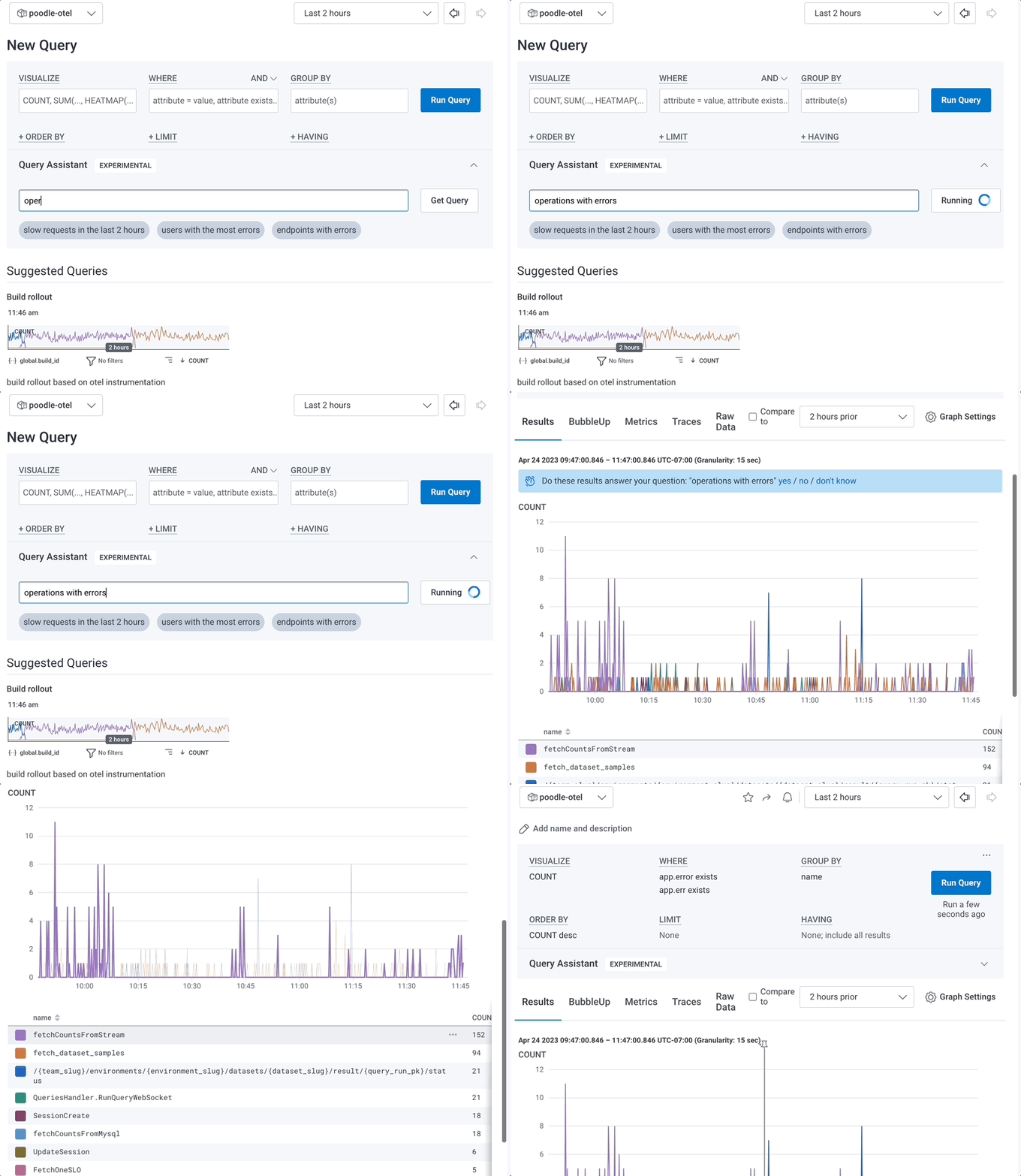
    Honeycomb today added a Query Assistant to its observability platform that uses OpenAI’s ChatGPT generative artificial intelligence (AI) platform to launch queries via a natural language interface rather than having to master a query language.

    That capability complements an existing tool based on machine learning algorithms, dubbed BubbleUP, that DevOps teams already use to debug code.

    Honeycomb CTO Charity Majors said both tools make the Honeycomb observability platform more accessible to IT teams that are tasked with managing complex application environments. Those teams are not going to be able to accomplish that goal without relying more heavily on AI to determine the root causes of an issue.

    Generative AI augments DevOps teams by making it possible to build a relevant, modifiable query that they can continuously iterate as IT staff investigate an issue. This approach means teams don’t necessarily need a deep understanding of code behavior and the underlying infrastructure it depends on, noted Majors.

    That’s critical, because not every IT professional immediately knows what query to launch. One of the challenges with adopting any observability platform is they require a a DevOps team member to frame a query to generate a result. If multiple queries are required, coding them in a query language becomes a cumbersome task.

    As AI continues to improve, algorithms should be able to automatically surface more issues. But given all the dependencies that exist in modern application environments, there will still be a need for a DevOps specialist to ensure application availability and optimize performance, at least for the foreseeable future.

    In general, generative AI represents a significant leap forward compared to AI for IT operations (AIOps) platforms that, in comparison, are not nearly as useful, noted Majors.

    It’s still early days as far as measuring the impact AI will have on DevOps workflows. But the AI genie is already out of the proverbial bottle. Many of the low-level tasks that tend to make DevOps jobs tedious will soon be automated. As a result, job roles within DevOps teams will need to evolve.

    Less clear is what impact the rise of generative AI might have on the adoption of observability platforms. While there is no shortage of observability platforms, adoption has been limited by the number of DevOps professionals that could master a specific query language created for that observability platform. The ability to rely on a natural language interface instead reduces the need to use a proprietary query tool.

    In the longer term, the simpler it becomes to use DevOps best practices, the more widely they will be adopted. AI platforms should enable more organizations to embrace DevOps in a way that reduces the level of cognitive load currently required.

    In the meantime, there’s no doubt that current DevOps professionals are cautiously watching the rise of generative AI, much like everyone else. The difference is that most DevOps professionals are not going to want to work for organizations that don’t provide access to AI-infused tools and platforms that make their jobs easier.

  • GitLab Allies With Google to Bring AI to DevOps

    GitLab Allies With Google to Bring AI to DevOps

    GitLab extended its alliance with Google as part of an effort to bring more generative artificial intelligence (AI) capabilities to DevOps workflows.

    The GitLab suite of software-as-a-service (SaaS) applications already reside on the Google cloud platform to provide GitLab with the foundation of data required to train those AI models. Over the course of the last two months, GitLab has already added numerous capabilities that rely on multiple types of AI technologies.

    For example, there is now an experimental Explain This Vulnerability capability that provides a natural language summary of an issue in a way developers and cybersecurity teams can easily comprehend.

    Taylor McCaslin, a product group manager for data science and AI/machine learning for GitLab, said going forward, most of the AI focus is going to be on leveraging generative AI capabilities. Those capability will be enabled by Google using a large language model (LLM) that GitLab developed for DevOps workflows. That approach enables GitLab to surface more accurate recommendations based on validated data compared to the general purpose LLM that was used to create the ChatGPT service.

    In addition, GitLab can continuously update the AI models it is running on the Google Vertex AI cloud service using the data from its SaaS application environment which is continuously monitored and updated, McCaslin noted.

    It’s not clear what impact AI may have DevOps workflows, but GitLab is forecasting a 10x improvement. That will be accomplished by, for example, surfacing code that can be used to remediate a vulnerability. Today, many vulnerabilities are not addressed simply because developers don’t have enough time to write a patch.

    A recent GitLab survey, however, suggested developers are already embracing AI to improve productivity, with 62% of developers using AI and machine learning algorithms to check code. More than a third (36%) also rely on AI and machine learning algorithms to review code.

    At this juncture, the one thing that is certain is AI and other associated technologies are going to make developers more productive. It’s not nearly as apparent what impact increased amounts of code moving simultaneously through DevOps pipelines is going to have on the software engineers that manage those processes. The expectation is that similar types of AI advances will also enable more code to flow through those pipelines without, hopefully, further exacerbating any existing bottlenecks that might exist.

    In the meantime, it’s clear the AI genie is out of the bottle. There will soon be more LLMs for all kinds of tasks. DevOps teams should start planning today based on the assumption that many manual tasks that conspire to make software engineering tedious are going to fade away. As such, the roles with a DevOps team are going to change and evolve. The assumption those DevOps teams should make is that these changes will be for the better. After all, the reason organizations embraced DevOps in the first place was to ruthlessly automate IT processes—AI is simply the latest iteration of that commitment.

  • ClickUp Adds Project Management Templates to Invoke ChatGPT

    ClickUp Adds Project Management Templates to Invoke ChatGPT

    ClickUp is adding templates and collaboration tools to make it easier to access generative artificial intelligence platforms such as ChatGPT from within its project management application.

    Haris Butt, head of product design for ClickUp, said ClickUp AI now includes pre-built department-specific prompts that any product managers, developers or designers can easily access rather than having to develop prompt engineering skills to engage a generative AI platform more effectively.

    The templates, for example, make it simpler to produce summaries of project timelines in addition to the ability to automatically generate a whiteboard that lists tasks that need to be finished to complete a project.

    In the longer term, ClickUp is also moving toward developing its own large language model (LLM) using its own data to provide a generative AI experience specifically optimized for project management, added Butt.

    ClickUp is embedding AI into project management applications as part of an effort to eliminate drudgery, added Butt. One of the primary issues that makes project management challenging is that navigating workflows can be challenging, especially for stakeholders that might not be as well versed in, for example, how a Gantt chart flows.

    It’s still early days as far as generative AI is concerned, but it’s already apparent that a wide range of templates are being developed to make it simpler to invoke these platforms. The need for project managers to become well-versed in all the nuances of prompt engineering techniques to optimize generative AI queries is likely to be limited.

    In fact, the general expectation is that every application will eventually include templates for invoking generative AI capabilities. Less clear is the impact that should have on productivity. In the case of DevOps teams, however, many tedious project management tasks should become increasingly automated.

    Generative AI will, of course, soon be employed across the entire DevOps workflow. Many of the tasks that have historically conspired to make DevOps processes tedious will be automated. In fact, many application developers are already using AI to test and review code. DevOps teams that have historically advocated ruthless approaches to automation are likely to be at the forefront of AI adoption.

    There are, of course, concerns about the accuracy of generative AI platforms such as ChatGPT that have been trained using data that hasn’t always been verified. As a result, it’s possible that some of the results being surfaced by these platforms should be reviewed by humans before being acted on. However, LLMs trained on narrower ranges of validated data will soon become commonplace. As those AI advances are made, the accuracy of generative AI platforms that are optimized for specific use cases will increase.

    In the meantime, DevOps teams should be more concerned about being left behind than about how generative AI impacts their employment prospects. There is no doubt generative AI will transform DevOps workflows along with a wide range of processes. The issue now is determining where DevOps teams can add value—and where machines can’t—in an era where IT environments are becoming more complex with each passing day.

  • Sendbird Adds API to Invoke ChatGPT From Mobile Apps

    Sendbird Adds API to Invoke ChatGPT From Mobile Apps

    Sendbird today added an application programming interface (API) to its low-code platform for building mobile applications that enables developers to add bots that communicate with OpenAI’s ChatGPT.

    Shailesh Nalawadi, head of product for Sendbird, said this API makes it possible to add the ability to communicate directly with the generative artificial intelligence (AI) platform from within both new and existing applications in just a few minutes.

    Most developers will add natural language processing (NLP) interfaces to complement the graphical user interfaces that most mobile applications today surface, added Nalawadi. It will be up to each development team to determine how best to employ that capability, but Sendbird envisions, for example, a health care application being able to invoke ChatGPT to answer queries, he noted.

    In the longer term, Sendbird will provide APIs to enable mobile app developers to invoke a wide range of large language models (LLMs). LLMs are increasingly being developed for generative AI platforms and are being optimized for a range of use cases.

    While OpenAI’s generative AI model is being widely used thanks mainly to Microsoft, there are already LLMs that are being created for a narrower range of use cases using much less data. DevOps teams should expect APIs invoking any number of generative AI platforms from within applications to become commonplace in the weeks and months ahead as more end user come to expect to be able to engage these platforms from within almost every application Sendbird’s chatbot API can now be invoked by more 1,300 existing mobile applications alone.

    In general, developers have tended to employ chatbots sparingly because they are often too scripted and inflexible. ChatGPT, conversely, provides a much more open-ended user experience. Organizations can also feed historical conversations or customer relationship management (CRM) data to ChatGPT to drive more personalized and accurate responses, given the veracity of some of the data used to train ChatGPT.

    A recent survey of digital quality testing professionals conducted by Applause, a provider of a platform for accessing a networking of independent testers, found nearly one-third (30%) of respondents are dissatisfied with their current chatbot, IVR and conversational assistant experiences, with wrong answers (29%) and a lack of understanding (24%) as the top two reasons cited. The results indicate there is plenty of opportunity for improvement.

    Nearly three-quarters (74%) said they had a positive experience with the ChatGPT generative artificial intelligence (AI) platform, with more than two-thirds (67%) reporting the platform provided helpful answers to questions. In terms of work-related tasks, most said ChatGPT would either be “very” (43%) or “somewhat” (37%) helpful.

    It’s apparent now that generative AI platforms are about to change the way humans engage with machines. Instead of always creating an abstraction to interface with a machine it’s now feasible for interactions to occur between them using language humans readily understand. As such, the way applications are built and employed is about to fundamentally change in ways that are difficult to predict.

  • Endor Labs Taps ChatGPT to Identify Secure Open Source Software

    Endor Labs Taps ChatGPT to Identify Secure Open Source Software

    Endor Labs has launched DroidGPT, an extension of its software for assessing risks in open source code. DroidGPT integrates the ChatGPT generative artificial intelligence (AI) platform to make it simpler to discover the most secure version of an open source package.

    That capability makes it possible for developers to launch a natural language query from within the Endor Labs platform that asks ChatGPT to identify, for example, the most secure logging modules of Java applications.

    Endor Labs CEO Varun Badhwar said the goal is to make it simpler to apply guardrails to application development processes that today rely heavily on reusing open source packages. Developers often wind up using an older version of those packages that are not as secure because a known vulnerability has not been remediated.

    Endor Labs’ Dependency Lifecycle Management platform applies graph analysis to identify the depth of dependencies that exist within an application. That capability makes it simpler to identify where vulnerable components have actually been employed within an application. DroidGPT extends that capability to identify the most secure versions of those components that developers should be using, said Badhwar.

    Having a full understanding of their dependency graph also lets customers generate and analyze accurate software bills of materials (SBOMs) as applications are dynamically updated, noted Badhwar.

    The level of dependency on open source software packages to create applications has risen sharply over the years. An analysis of nearly 2,000 software packages published by Endor Labs found 95% of all application vulnerabilities can be traced back to a transitive dependency created when a developer used an open source component. Functional dependencies are created whenever developers download a third-party component, so it is crucial to assess the risk levels created by those dependencies.

    Fortunately, in the wake of a series of high-profile breaches, there has been increased focus on securing software supply chains. The ongoing challenge is most developers don’t have a lot of cybersecurity expertise, so as contributions are made to open source projects it’s relatively easy for mistakes to be made. The simple truth is many applications deployed in production environments are riddled with known vulnerabilities that have yet to be addressed. DroidGPT is designed to make it simpler to begin the process of remediating software vulnerabilities in applications as they are built and after they are deployed.

    There is no doubt that it will take years before organizations are able to implement a set of truly mature DevSecOps best practices to teach developers how to build more secure applications. That journey, however, needs to begin with tools that enable them to address fundamental issues that dependencies inevitably create. After all, the best way to combat application vulnerabilities is to make sure they don’t manifest themselves in code in the first place. Making it easier to update applications using older versions of open source modules is nothing less than critical at a time when cybercriminals are getting more adept at exploiting them.

  • Can ChatGPT Fix Bugs? ‘Wolverine’ Dev Says YES

    Can ChatGPT Fix Bugs? ‘Wolverine’ Dev Says YES

    Welcome to The Long View—where we peruse the news of the week and strip it to the essentials. Let’s work out what really matters.

    This week: Instead of AI aids for programming, what about for debugging? The pseudonymous “BioBootloader” says he’s persuaded GPT-4 to make his code self heal. (more…)

  • New Relic Bets on AI to Advance Observability

    New Relic Bets on AI to Advance Observability

    New Relic is preparing to extend the capabilities of its observability platform by making use of both additional machine learning algorithms and the ChatGPT generative artificial intelligence (AI) platform.

    Peter Pezaris, senior vice president for strategy and experience at New Relic, said during an interview on an episode of TechStrong TV that a prototype of an AI model created using machine learning algorithms will automatically notify developers when code in a production environment is not performing well—right within their integrated development environment (IDE). The notification will then take developers to the precise line of code identified as the root cause of the issue, he said.

    DevOps teams will need to add two lines of code to applications running in production environments to take advantage of this capability. New Relic also plans to use a similar approach to integrate with generative AI platforms such as ChatGPT to create suggestions for fixing code, he added. ChatGPT now makes it possible to create entire programs in ways that output HTML and JavaScript code, so DevOps teams should expect to be able to use the platform to create natural language queries that invoke the proprietary query language New Relic makes available for its observability platform, he noted. Conversely, ChatGPT will make it possible to explain how a piece of code functions in plain language, Pezaris added.

    Previously, New Relic employed a similar approach to integrate its observability platform with machine learning operations (MLOps) platforms used to build and deploy AI models. This was part of a larger effort to integrate MLOps and DevOps workflows, added Pezaris.

    These AI extensions to the New Relic platform are part of a larger effort to extend the reach of the New Relic One observability platform further left toward developers. Most recently, New Relic added a free CodeStream module to its observability platform to give developers access to metrics and telemetry data that will enable them to write higher-quality code faster.

    That approach eliminates the need to wait for IT operations teams to surface issues that usually don’t manifest until long after the code in question was originally developed. The overall goal is to provide development teams with frictionless access to observability data at every stage of the software development life cycle to reduce mean-time-to-detection (MTTD) and mean-time-to-resolution (MTTR) of issues.

    Organizations should also be able to reduce technical debt faster by making it easier to identify issues that, for example, adversely impact application performance.

    In general, most organizations are still in the early stages of achieving full-stack observability. A recent New Relic survey found only 27% of respondents have achieved full-stack observability, and only 5% claimed they have a mature observability practice in place. A third (33%) of respondents also said they still primarily detect outages manually or based on complaints, the survey found.

    On the plus side, the survey also found nearly three-quarters of respondents said C-suite executives in their organization are advocates of observability, and more than three-quarters of respondents (78%) saw observability as a key enabler for achieving core business goals. However, more than half (52%) of respondents said they experienced high-business-impact outages once per week or more and 29% said they take more than an hour to resolve those outages.

    The hope is, of course, that by augmenting DevOps teams with AI capabilities, the number of those outages will be dramatically reduced in the months and years ahead.

  • Low-Code Should be Worried About ChatGPT

    Low-Code Should be Worried About ChatGPT

    Is ChatGPT the technology revolution that will save the world, or the Pandora’s Box that will eventually destroy it? How about neither? Putting these two extremes aside, a more rational concern is whether ChatGPT will steal your job, especially if you work in software development.

    Is this a fair concern? Conversations like this are nothing new. New technologies always go through this cycle; starting with intrigue then moving onto fear and resentment until eventually being accepted and embraced as the new normal.
    ChatGPT and other natural language AIs are undoubtedly exciting new trends with huge potential. One area of ChatGPT’s potential that has largely been overlooked is how it can democratize software development. Should low-code/no-code providers be worried about this?

    Delivering the Low-Code Promise

    Low code has long promised to democratize software development by providing a way for non-coders to develop applications themselves. This “democratization of IT” promises a new wave of innovation by enabling organizations to create new processes without the new to engage with IT. While low-code has already achieved some great things when and where it has been implemented, the amount of change it can deliver is fundamentally limited by the developer’s choices. The developer still chooses which aspects of the application can be configured by the user, so the user still has no fundamental access to the code. While this has been low-code’s strength (since users cannot damage the underlying code if they can’t access it), users are still beholden to developers to do anything significant. ChatGPT could allow users to make more significant changes to applications, potentially enabling organizations to achieve far more than with low-code and in half the time.

    Software Development is Just the Start

    ChatGPT can achieve more than helping non-developers build the applications they need. If you think about the most common reason for an IT project failure, it is rarely down to poor delivery or mismanagement alone. Most IT projects fail because they do not deliver the outcomes that users want. This happens because of a communication breakdown between IT and end users. On one hand, users fail to convey exactly what they want and IT fails to ask the right questions to find out. The requirements (i.e., the intended outcomes) get lost in translation because technical and non-technical people simply speak different languages.

    In a scenario where the message is too often lost in translation, ChatGPT can serve as the interpreter between those who build and maintain IT and the wider staff who use it day-to-day. ChatGPT can bridge the gap because users won’t need technical skills to realize the changes they want.

    Always Start with the Business Case

    Delivering change in an organization is fraught with challenges and uncertainty. Like any project, it is important to start with the fundamentals of what you’re trying to achieve, not the technology you want to use. No matter how much you want to use ChatGPT, you must start by defining the outcomes you want to achieve and working backward from there. How you achieve these outcomes is a technical decision that comes much later. If one of your questions is to enable change to happen faster and to be more adaptive to the company’s needs, then ChatGPT may well form part of the answer. Just remember to define the problem first, build the business case and then evaluate the various solutions to achieve those objectives. Don’t get carried away by the hype.

    ChatGPT Needs Room to Flourish Outside of IT

    ChatGPT has the potential to be the bridge between technical and non-technical users in every organization. It can reduce the gulf between these radically different types of people to speed up change in the organization and deliver better outcomes for all. But it is crucial for technologies like ChatGPT to sit within the domains where they will have the best chance to flourish. In what might sound like a controversial statement from someone in the IT sector, I believe that, like low-code, ChatGPT must sit outside of the technical domain. ChatGPT needs to move out of the IT sector where it was born to reach its full potential. The question is, is IT ready to let it go?

    Image via Unsplash

  • Microsoft Power Platform Integrates ChatGPT: What This Means

    Microsoft Power Platform Integrates ChatGPT: What This Means

    Microsoft recently announced it integrated ChatGPT into its low-code Power Platform developer suite. This follows the news of ChatGPT-powered Bing search and Microsoft’s pledge to invest billions into its partner company, OpenAI.

    ChatGPT, the large language model (LLM), has reached viral status due to its ability to generate impressively complex textual outputs given simple prompts. And now, enterprises are hoping to cash in on its power. Microsoft’s inclusion of ChatGPT in its Power Virtual Agents and AI Builder tools will likely signal more native inclusion of AI models within other low-code development environments throughout the industry.

    However, not all is peachy in the world of generative AI. Users have compiled a laundry list of ChatGPT failures, ranging from simple arithmetic errors and inaccurate information to social biases and even one attempt to dissolve a journalist’s marriage. AI seems sure of itself, but the “hallucinations” it produces can be mind-bogglingly off-base. If such inaccuracies persist within production use cases, it could lead to false suggestions that confuse users and even harm a company’s reputation.

    Below, I’ll consider the implications of this new paradigm of AI-driven development, exploring the benefits and potential risks of incorporating LLMs into low-code development frameworks. We’ll also highlight how this may upset the competition and consider things leaders should keep in mind as they seek to leverage this new technology.

    Benefits of Incorporating ChatGPT

    Low-code development platforms (LCDPs) excel at abstracting complex functionalities into usable components. They typically offer drag-and-drop capabilities and reusable templates to enable citizen developers and professional programmers alike. And there are many potential benefits of incorporating ChatGPT into such a low-code environment. For example, as a feature within Power Virtual Agents, ChatGPT can be used to create chatbots that connect to public company resources and internal company data. This could help users seamlessly develop a contextually-aware AI trained on a company’s documents.

    Utilizing AI within low-code can spur development with deep inferences and guidance. Such AI assistance can drastically accelerate development efforts through enhanced auto-completion and intelligent insights, quickly generating boilerplate code and making suggestions more customized to the task at hand than your typical static templates.

    GPT-based chatbots leveraging AI trained on a company’s documents could be incredibly more valuable than an off-the-shelf model without context. In the realm of customer support, an in-house trained AI could be beneficial in summarizing company information and automating manual support activities. Providing a low-code means to generate such chatbots also brings advanced AI to a broader range of users. All in all, this could advance the pace of development, especially for mobile interfaces, automated workflows and contextually-aware chatbots.

    Implications For the Low-Code Space

    In the wake of ChatGPT, the market has been scrambling to respond. Tech giants have debuted their own generative AI to mixed reviews. And some, myself included, are left pondering how low-code and AI will coexist in this new era. Will natural language-driven code generation replace the need for programming entirely, whether it’s traditional or ‘codeless’?

    This remains uncertain. But what appears most plausible is that these recent developments will raise the bar throughout the software industry and augment how LCDPs are built and used. AI has the power to enhance LCDPs in a few ways, including augmenting the developer experience, training bespoke ML models and building more intelligent end-user experiences.

    Yet, with Microsoft funneling billions into AI research and development, it could be challenging for mid-size low-code platforms to keep pace without their own AI-driven workflows. Thus, the LCDPs that do not integrate robust AI of their own may lose out on new subscribers. Plus, engineers hoping to create AI models that run on internal datasets may prefer working with a larger cloud technology suite in which their data is natively stored.

    Downsides of AI-Infused Programming

    ChatGPT and other generative models are absolutely impressive, but the results can’t be 100% trusted. And at the time of writing, ChatGPT usage within PowerApps is still experimental, which is indicative of ChatGPT and generative AI in general—still in the experimentation phase.

    This doesn’t bode all that well for programmers relying on its outputs, given the potential for inaccuracies. Because although the results of ChatGPT sound authoritative, they are generated from knowledge scoured from the public web, which often contains bugs, errors and inefficiencies.

    The outputs of ChatGPT may even suggest entirely nonexistent features! This is, unfortunately, a current issue with geocoding API provider OpenCage. ChatGPT routinely recommends users integrate OpenCage’s “phone lookup service” for certain prompts. But … OpenCage doesn’t even offer this feature. The team has received so many complaints from angry developers that they even had to issue a statement explaining what happened.

    With AI code generation, the focus shifts from hardcoding toward creating and organizing prompts and debugging errors. And although it’s giving programmers newfound agility, it doesn’t solve all software development problems—namely, the DevOps side of the equation. There will still be friction in deploying code and piecing together an optimal architecture. Also, due to rising software supply chain vulnerabilities, code automation that loops in third-party dependencies must require careful security forethought. There’s also the chance of breaking changes and ongoing maintenance hurdles with any software.

    Another important element is that low-code requires governance to be secured correctly. No-code business users may not have the security oversight to understand the implications of spinning up new services. And when you add AI into the mix, the technical implications escalate. AI can result in ethical violations, and bots have been found to communicate anger and irrational ideas when poked and prodded.

    Are We All Just Hallucinating?

    ‘Hallucinating’ is when an AI model confidently spouts nonsense or inaccurate information. And although this is the case with some models currently, they are actively accepting feedback and being retrained. Over time, their outputs will improve. But for now, engineers should be aware that they are still under experimentation. As such, enterprises should use caution and test new AI innovations on internal processes first. And AI adoption must be governed carefully to avoid misconfigurations and abuse.

    AI is here, and the future is now. But although it’s dismantling some coding barriers, developers still have their work cut out for them. This reality is a win for low-code solutions offering standard software delivery pipelines and centralized collaboration features. If LCDPs can maintain pace with AI and embed it into their workflows, both sides should fare pretty well in this new era.

    Surprise — this entire article was written by ChatGPT. Just kidding! None of it was. I’m just tired of seeing this “gotcha” moment at the end of news segments…

    This post was written by a human.