Tag: ChatGPT

  • Datadog Adds Additional Generative AI Capabilities to Platform

    Datadog Adds Additional Generative AI Capabilities to Platform

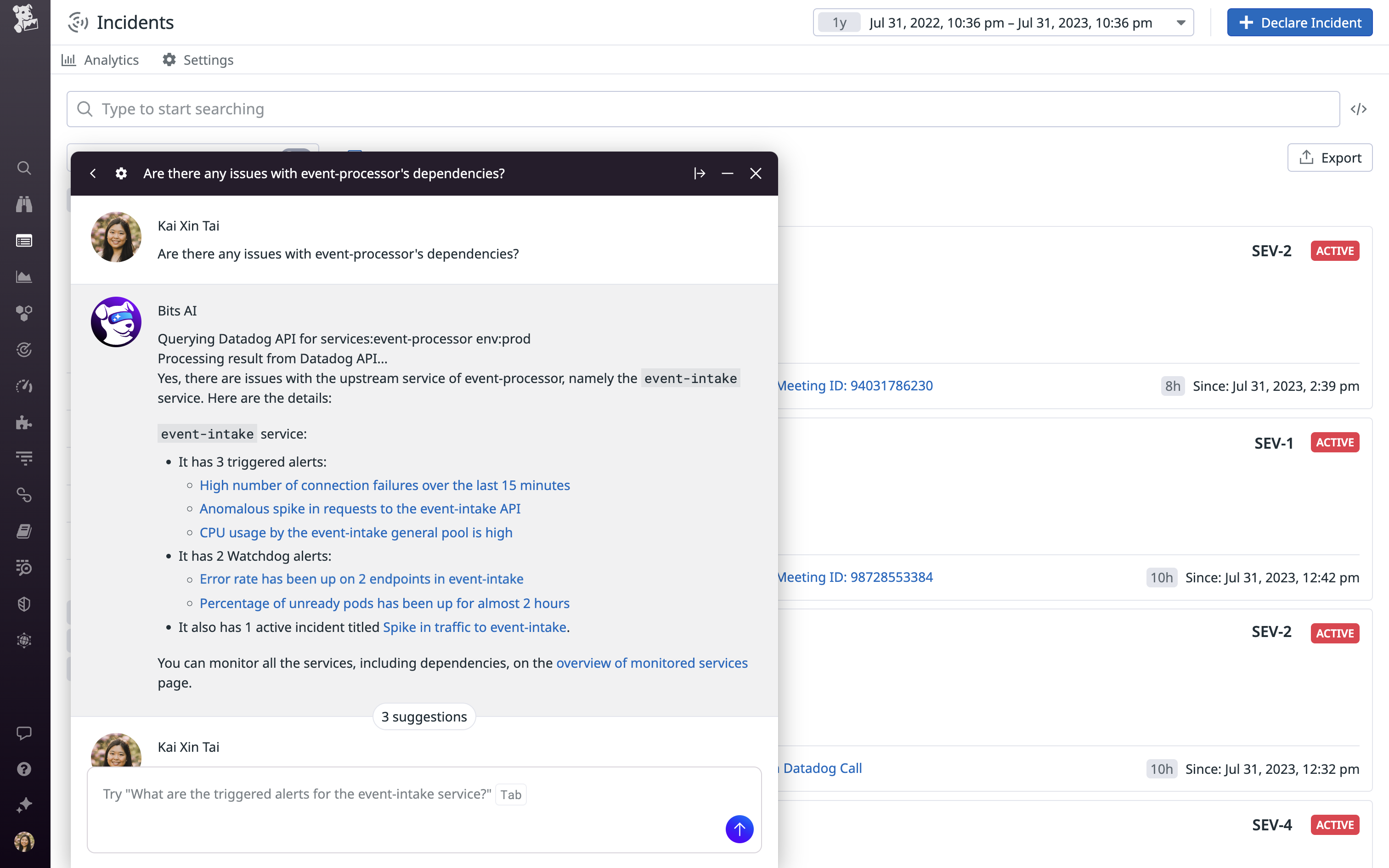
    At its DASH 2023 conference, Datadog today launched Bits, a digital assistant that uses generative artificial intelligence (AI) from OpenAI’s ChatGPT platform to provide real-time recommendations to resolve issues surfaced by the company’s observability platform.

    At the same time, the company announced it is extending the reach of that platform to enable IT organizations to monitor the large language models (LLMs) many are now embedding within custom applications.

    Datadog also released an LLM Observability platform in beta, which brings together data from applications, models and various integrations to help engineers discover and resolve AI issues in applications such as performance degradations, drift and hallucinations in real-time.

    Those extensions complement an existing ability to monitor the usage patterns of application programming interfaces (APIs) making calls to the OpenAI ChatGPT platform.

    Yrieix Garnier, vice president of product at Datadog, said the generative AI capabilities in beta are enabled by data the company used to extend the core capabilities of OpenAI’s ChatGPT platform.

    Bits AI learns from both customer data and other sources to answer queries via a natural language interface that makes the Datadog platform more accessible to a much wider range of IT professionals, noted Garnier.

    The overall goal is to reduce the mean-time-to-resolution for issues by, for example, explaining errors and suggesting code fixes that can be easily shared with developers via a Slack communication channel.

    Those capabilities extend the functionality of the machine learning algorithms that Datadog has already embedded within its platform, noted Garnier.

    While the generative AI capabilities added to the core Datadog platform will make DevOps teams more efficient, it’s not quite clear what role those teams will play in monitoring LLMs created by data science teams. In theory, DevOps teams should be responsible for optimizing the performance of any element of an application, but most DevOps engineers today don’t tend to have much experience with LLMs that are created by data science teams.

    At the very least, however, DevOps engineers should be able to share the root cause of an issue that is adversely affecting those LLMs with those data science teams.

    It’s not clear how quickly LLMs will be incorporated into applications, but most DevOps teams should expect them to soon be pervasive. In effect, Datadog is now providing DevOps teams with the AI tools they will need to effectively monitor applications infused with AI capabilities. The issue is not so much whether DevOps teams will be taking advantage of AI to better manage application environments but how quickly. Given the overall level of complexity DevOps teams regularly encounter, few are likely to want to take on that challenge without some level of AI augmentation.

    The challenge is determining exactly what DevOps tasks might be best handled by a machine that enables software engineers to focus on more complex issues they previously didn’t have the time to address.

  • AI ‘is Getting Worse’ ¦ AI ‘Will Lose India Jobs’ (Probably Isn’t ¦ Probably Won’t)

    AI ‘is Getting Worse’ ¦ AI ‘Will Lose India Jobs’ (Probably Isn’t ¦ Probably Won’t)

    Welcome to The Long View—where we peruse the news of the week and strip it to the essentials. Let’s work out what really matters.

    This week, a conundrum: On the one hand, researchers say ChatGPT is losing the plot; and on the other, we hear outsourced coding jobs in India will be replaced by AI. (more…)

  • Is ChatGPT Helping or Hurting Your Developers’ Productivity?

    Is ChatGPT Helping or Hurting Your Developers’ Productivity?

    ChatGPT’s ability to translate natural language into working code has sparked tremendous interest in the programming community. Developers are exploring ways to use ChatGPT to reduce redundant tasks, from creating code snippets to analyzing and debugging programs. This also allows them to focus on more complex tasks like data analysis and monitoring with the help of a strong full-stack observability platform. Despite ChatGPT’s impressive capabilities, developers and their employers are split on whether the AI chatbot significantly boosts developer productivity.

    We will explore how to use ChatGPT to benefit your developers’ productivity and go over the advantages and disadvantages of ChatGPT to help you make the right decision for your business.

    How to use ChatGPT for Better Productivity

    ChatGPT has quickly become the most popular intelligence chatbot, with over a million user signups in its first five days and over 100 million in the first two months. Here are a few ways ChatGPT, developed by OpenAI, can help boost productivity in your organization.

    Improve Their Code
    Sometimes manually written code snippets consume additional CPU resources. Using ChatGPT, developers can optimize their functions for better performance. Additionally, ChatGPT can also write test cases and spot security vulnerabilities in their code, helping developers work faster.

    Simplify Documentation
    ChatGPT can give a simple explanation for the layman, avoiding technical jargon to a large extent. For instance, a developer at Twitter fed ChatGPT their code and it responded with a pretty detailed explanation. Using ChatGPT to generate the first draft of a company’s internal documentation would make knowledge transfers easier. New hires could quickly get up to speed on the company’s codebase. Further, ChatGPT could also be used for external-facing documents where other developers can learn how to use the company’s APIs and frameworks.

    Test and Understand Code
    ChatGPT can write automated tests for code that is fed into it. Although many developers consider testing boring and stressful—and sometimes a waste of time—it’s a critical step in ensuring that published applications are bug-free.

    With ChatGPT, developers can output reliable, well-tested code much more quickly and easily. ChatGPT can also give high-level and line-by-line explanations of code and even teach developers how to use external modules and APIs in their own code, helping them build much faster.

    Debug Code
    ChatGPT makes a great debugging tool for developers. It can take in error messages and output information on the likely cause of the error and how to fix it. This is typically a lot more time efficient than browsing forums and blogs for a solution.

    The tool can also suggest helpful code alternatives. Many developers claimed that ChatGPT can be much faster and less mentally challenging than the conventional approach of searching the web for a solution.

    As the CEO of Replit, Amjad Masad, put it, “ChatGPT could be a good debugging companion; it not only explains the bug but fixes it and explains the fix.”

    Code Comprehension
    ChatGPT’s terabytes of training data come from various sources, including common crawl and WebText2. This training data makes it easy for ChatGPT to simplify explanations of complex pieces of code for developers. Therefore, developers can save time deciphering any code’s underlying logic and structure.

    For instance, Stanford instructor and well-known developer Matt Harrison used ChatGPT to build a simple graphic design tool. He explained, “I’m using ChatGPT to create a GUI program for drawing lines. I haven’t used QT [a development framework] in years, yet I can throw this together really quickly.”

    Generate Documentation
    Writing code documentation is often considered a mundane task by developers. With ChatGPT, developers can significantly cut down on the amount of time needed for documentation. For instance, they can expedite the creation of troubleshooting guides, tool user manuals and test cases by asking ChatGPT to perform code analysis and generate detailed technical reports. Accelerating this documentation process allows for easier onboarding of new developers and faster product release times.

    Writing Tests
    ChatGPT can analyze code snippets and automate testing for them, saving developers lots of time and helping them output reliable code. Test coverage is an essential metric for most enterprises, and ChatGPT could help streamline the process.

    ChatGPT Disadvantages

    While many developers have praised ChatGPT for increasing developer productivity, others have criticized it as unreliable. Let’s understand some key areas where the tool falls behind.

    Outputting Buggy or Unusable Code
    Developers have complained that the chatbot would sometimes output plausible-looking code that doesn’t work. This might result from misunderstanding the user’s requirements or simply being unable to come up with a correct answer—then faking it.

    Programming Q&A forum Stack Overflow even issued a temporary ban on ChatGPT-generated answers. The ban was because the chatbot generated an influx of answers whose average accuracy was pretty low. ChatGPT sometimes uses nonexistent commands and outdated modules in its code, so while they theoretically might make sense, they don’t work in practice.

    Writing Outdated Code (and Forgetting Previously Written Code)
    Since ChatGPT’s training data cut off in September 2021, the chatbot has no knowledge of the recent developments in programming languages and modules after that. As a result, ChatGPT often needs to use outdated commands, modules and paradigms in its code.

    ChatGPT also occasionally forgets the context within which it is working, affecting code output. Some users have reported that ChatGPT sometimes forgets about the task at hand and begins generating incompatible code.

    Security Concerns
    Security concerns are the biggest drawback to having developers work with ChatGPT. Open AI uses the data users input into ChatGPT to train the underlying AI model.

    Research by cybersecurity firm Cyberhaven has shown that 11% of the data employees input into ChatGPT is confidential. This presents a significant risk, as such data can be used in the chatbot’s next responses. Corporations like JPMorgan and Verizon have even gone as far as to block employees’ access to ChatGPT because of these concerns.

    Lacks Problem-Solving Skills
    A developer’s job is to understand the business problem and develop customized solutions to address it. Although AI/ML tools like ChatGPT help developers code faster, they can’t help in problem-solving or implementing a software application.

    Furthermore, when developers become overly reliant on AI-generated code, they’re discouraged from upskilling on new programming frameworks and languages. This can hurt the organization in ways that might not be evident immediately.

    To ChatGPT or not to ChatGPT

    As Google’s head of developer experience Bret McGowen said, “While AI will transform software development in many ways, human judgment, intuition and creativity will remain essential to building great products.”

    While ChatGPT may not be a perfect solution for every aspect of software development, it can be a useful addition when combined with human problem-solving skills. However, companies should be careful while allowing the usage of AI in day-to-day processes. Guidelines educating in-house developers on the fair usage of AI are a must to protect sensitive information and maintain a high-quality control process.

  • 92% of Devs Use AI, Survey Says ¦ Intel One Mono Font

    92% of Devs Use AI, Survey Says ¦ Intel One Mono Font

    Welcome to The Long View—where we peruse the news of the week and strip it to the essentials. Let’s work out what really matters.

    This week: GitHub touts unbelievable AI stats, and Intel’s beautiful open source typeface. (more…)

  • Friend or Foe? ChatGPT’s Impact on Open Source Software

    Friend or Foe? ChatGPT’s Impact on Open Source Software

    OpenAI’s ChatGPT took the world by storm, amassing 100 million users in the first two months after its public launch. The continued interest in the tool has created a buzz among developers, especially those in the open source community. But this begs the question: How will ChatGPT impact open source software?

    Amid the excitement and promise that ChatGPT holds, many wonder whether the open source community, just like any other organization, should fear or embrace the technology. Certain concerns for open source contributors and developers are sparking debate as questions surrounding the origin of generated source code surface, and the possible ethical and legal implications are discussed. While valid, developers should not fear or stray away from using ChatGPT but rather shift their focus to understanding how to embrace it for positive outcomes.

    The Top Three Open Source ChatGPT Concerns

    Collaboration between contributors is the cornerstone of open source projects, which some fear will be disrupted with the increased use of AI-based tools. However, the level of synergy within the community cannot be easily taken away or replaced by tools. Instead, ChatGPT or other AI-based tools, including GitHub Copilot, allow developers to produce code more quickly and more efficiently.

    As developers increasingly use AI tooling to assist with new or enhanced code, project collaboration and oversight will help improve the AI-generated code.

    Debunking and navigating the top concerns will be imperative to take full advantage of the technology’s promise and potential.

    Validity. While the creation of code by ChatGPT has generated excitement among developers, critics argue that—without context—the validity of code can be questioned. Some open source developers worry that teams will begin to rely entirely on ChatGPT to generate code, but this concern fails to consider the humans involved in the process—today and far into the future.

    Developers don’t take ChatGPT’s output as the final word; rather, they use it as a baseline and jumping-off point to streamline their code. In fact, code is rarely created from scratch anymore. Developers rely on others’ source code. For example, code from Stack Overflow, GitHub and thousands of open source libraries that are available on public registries like npm, Maven, Nuget and PyPI. Bringing ChatGPT into the fold will not significantly change how developers source their code, but will improve development velocity, saving valuable time and associated cost.

    Training Data. Machine learning (ML) and deep learning (DL) model training must be fair, robust and explainable to avoid biases. If the data is wrong, the results will be as well. Garbage in, garbage out. Coming from ML/DL models, the code ChatGPT returns in response to prompts could raise concerns surrounding its accuracy. Like any other source (Stack Overflow, GitHub, etc.), ChatGPT’s code outputs are not guaranteed to be perfect, and developers must be mindful of this.

    However, there are more benefits of ChatGPT-trained models concerning code outputs. ChatGPT can also explain new or existing code, it can also effectively provide unit tests for code, which will help with writing better software faster.

    Ownership. Questions of ownership have surfaced regarding the use and distribution of the code that the AI tool generates. While the code that ChatGPT generates is the result of ML/DL inference from many sources, it’s the developer’s responsibility to use that code ethically and safely. It should be treated as any other public data or open source software, as not a final product and must be used in the context of your requirements. It’s also important to carefully review any code generated by ChatGPT and ensure that it doesn’t introduce vulnerabilities.

    Similar to GitHub Copilot, ChatGPT is trained by millions of lines of open source software. Code posted in prompts is likely to make it to models, too. Unlike copyrighted pieces of art and writing, the code that ChatGPT outputs should not be considered in a final state and should not be used in a way that is subject to licensing restrictions or legal implications that have dominated the conversations around its use.

    Ownership closely relates to the ethical dilemma of using AI-generated text, code and more. To address that, there are new tools that help detect whether AI generated the content and how much, which will be useful for educators concerned with students overusing the tool. This emerging area of checks and balances exemplifies the constantly evolving and improving technologies that allow humans, and in the case of open source, contributing developers to improve their craft and produce better open source software.

    ChatGPT’s Impact on Open Source Talent

    Discussions about whether ChatGPT will require new skills for existing positions or new jobs with specialized experts are ongoing. While new and exciting, ChatGPT won’t immediately create new or different jobs. Like any new tool introduced to developers, it takes time for developers to become familiar with the technology and understand how to use it best. ChatGPT is no different. For example, consider the previous push to use low-code/no-code technology. While this great technology is used to speed up the creation of apps and improve the usability for non-developers, it has taken time for organizations to properly use low-code/no-code technology. A similar perspective and trajectory will extend to the use of ChatGPT for all software development, including open source projects.

    In the coming weeks and months, it will be essential to encourage the open source community to embrace ChatGPT and explore its possibilities. Technology has already proven to be an effective educational tool. Consider asking ChatGPT for book recommendations about programming languages and coding; it delivers short descriptions for each book. Or, prompt it for the top takeaways from one specific book. By doing this, individuals can make learning so much easier. By learning from other developers and sharing resources, including results from ChatGPT, the community roots of open source will keep thriving.

    Human Involvement is Always Needed

    The public’s reaction to ChatGPT may be novel, but the idea behind the tool’s relationship to open source is not. Analyzing how ChatGPT works within the open source community reveals that it will be useful because it enhances the capabilities of developers, it doesn’t replace them.

    Whether it’s reviewing code, pair programming or learning from fellow developers, humans will not be replaced by generative AI, only enhanced. Leveraging the tool will decrease the time and effort needed to complete tasks, increasing developer quality and efficiency. The use of ChatGPT does not create new positions or overhaul current skill sets; it makes them better and empowers developers to expand their opportunities and enhance their abilities.

    Soon, ChatGPT and other AI tools will be standard practice within the open source community—or until a new technology is created and shakes up software development once again.

  • Checkmarx Brings Generative AI to SAST and IaC Security Tools

    Checkmarx Brings Generative AI to SAST and IaC Security Tools

    Under an early access program, Checkmarx today made available query builder and guided automation tools that take advantage of OpenAI’s generative artificial intelligence (AI) technologies to make it simpler for developers to resolve application security issues.

    AI Guided Remediation surfaces actionable remediation recommendations for vulnerability issues such as misconfigurations directly from within integrated development environments (IDEs).

    Meanwhile, AI Query Builder makes it possible to use natural language text to create a query for both the Checkmarx static application security testing (SAST) and the infrastructure-as-code (IaC) security tool that creates rules for scanning code. Those rules can be easily fine-tuned or modified and queries for other use cases can easily be added.

    In addition to reducing the amount of time it takes to create a query by 65%, that approach also dramatically reduces the number of false positive alerts that arise based on rules created by a security administrator.

    Checkmarx CEO Sandeep Johri said these additions to the Checkmarx One Application Security Platform are aimed at improving the application security experience for developers. Most developers don’t want to be inundated by alerts that lack any real context, nor do they want to be bothered with remediation details.

    It’s not likely developers will be interested in how AI could help them write more secure code from the start, but the faster a reliable fix is surfaced, the sooner developers can return to writing code, noted Johri.

    In the longer term, Checkmarx will add support for multiple large language models (LLMs) beyond those provided by OpenAI to provide other AI capabilities that are based on more domain security knowledge, said Johri.

    However, despite these advances, vulnerability remediation will not become fully automated using AI any time soon, he added. Instead, it will become much simpler to identify code that has either inadvertently or deliberately introduced a vulnerability, said Johri.

    In fact, generative AI tools such as GitHub Copilot can themselves introduce vulnerabilities into code. As a general-purpose AI platform, the recommendations surfaced are based on a mix of instances of clean and flawed code, Johri noted. There will also be instances where cybercriminals attempt to subvert an LLM that creates code by injecting snippets loaded with malware into the samples used to train a generative AI model.

    On the plus side, however, generative AI tools should narrow the divide that currently exists between application developers and cybersecurity teams as more issues are discovered and remediated before applications are deployed in a production environment. The challenge has aways been surfacing application security issues at the time developers are writing code rather than sending them a list of vulnerabilities to address weeks (sometimes even months) after a developer has moved on to another project.

    Naturally, there is a lot of trepidation when it comes to all things generative AI; one area of certainty is that the benefits far outweigh the risks—especially when it comes to developing secure-by-default applications.

  • Nobl9 Adds Tools to Make SLO Queries More Efficient

    Nobl9 Adds Tools to Make SLO Queries More Efficient

    At its SLOconf event today, Nobl9 added a Query Tester tool that validates whether queries made against the data its service level objectives (SLO) management platform collects will deliver meaningful results. Nobl9’s SLO management platform collects data in real-time from data sources such as New Relic, Datadog and Dynatrace to help customers meet SLOs.

    In addition, a Query Checker tool will now automatically put any new SLO into a testing state to automatically validate that the query against that SLO will run correctly.

    The company has also improved the precision of its calculations to provide DevOps teams with more accurate, reliable and actionable insights into the performance of services and added a Metrics Health Notifier toolset that provides insights into anomalous data being collected from various sources as well as what data might be missing. Nobl9 has also added a Custom Query Delay tool that gives DevOps teams more control over when data is pulled along with access to data source logs.

    Kit Merker, chief growth officer for Nobl9, said the overall goal is to improve the overall resiliency of its platform for managing SLOs.

    Finally, Nobl9 also announced that its platform is now available for the Google Cloud Platform (GCP) in addition to existing support for Amazon Web Services (AWS). As part of that GCP support, Nobl9 made available an educational site that provides example of how DevOps team can take advantage of the large language models (LLMs) that Google is making to improve SLOs or generate an SLO that is automatically converted into a set of YAML files.

    A survey of 314 IT professionals conducted by Dimensional Insight on behalf of Nobl9 found 69% have implemented SLOs, with more than three-quarters of those respondents crediting SLOs for preventing business disruptions. A total of 80% also noted their organization has an increased focus on system reliability, with just over a quarter (27%) saying SLOs saved their organizations a half million dollars or more. A full 95% said SLOs are also driving better business decisions.

    However, 97% also reported it is difficult to manage SLOs because of a lack of reporting, lack of application and environment support and interoperability issues.

    Nobl9 is trying to spur greater adoption of SLOs by making available an open source SLO specification that defines a common interface for constructing SLOs across a Git-based workflow. Nobl9’s platform based on that specification has now been integrated with 24 data sources, said Merker.

    SLOs, of course, are not a new idea. They have been employed as a metric to track the performance of IT services for decades. However, as more microservices-based applications are built and deployed, it’s becoming more challenging to maintain SLOs across applications that have many more dependencies than legacy monolithic applications.

    Ultimately, each IT team needs to provide some sort of objective benchmark that assesses their overall effectiveness at delivering application services. SLOs-as-code are intended to make it simpler to gather the metrics that confirm whether service levels are being achieved. Those SLOs are then tracked and integrated across any set of application services a DevOps team cares to track.

  • 8 Ways ChatGPT Can Help Developers

    8 Ways ChatGPT Can Help Developers

    ‘Adapt or perish’ is the mantra in the tech world, and it holds particularly true if you’re a developer.

    Because of how dynamically technology evolves, developers face greater pressure than most to be ahead of the curve in adapting and becoming proficient in the best tools becoming available as a result. ChatGPT is the latest such tool.

    While there has been talk of ChatGPT being a “job killer” and horror stories are making the rounds about a dystopian future in which it renders half of humanity meaningless, the reality is much more nuanced. The market will evolve as it has with the advent of any technological advance, and those who can leverage such leaps to their advantage will continue to be effective.

    For developers, ChatGPT represents a chance to introduce efficiency in their tasks, scale up productivity and minimize errors and deficiencies. Used wisely and appropriately, it can help developers become better at their jobs by honing their abilities and enabling them to work more creatively within their existing functions.

    Here are just some of the few areas where ChatGPT can bring tremendous value to developers:

    Testing

    Writing code is a complex process. Debugging it is harder. And in between those two is the process of actually testing the code. ChatGPT allows developers to enable real-time or prompt-driven code testing at different instances to ensure the coding process becomes more efficient.

    ChatGPT provides a wide array of suggestions and assertions based on the functions and variables used in that particular code to allow for wholly tailored testing of the code for that particular environment. Doing so can be particularly helpful in the subsequent debugging and documentation phases.

    Debugging

    Ask any developer what the worst part of their job is, and debugging is likely to be relatively high on their list. As an old saying goes, “An average developer spends hours writing code and days debugging it.”

    However, with ChatGPT, that may soon become a thing of the past; it can be leveraged to debug thousands of lines of code for error identification and then debug again based on any error message received.

    Regardless of whether you’re a seasoned veteran or just starting out, in this particular case, ChatGPT can be invaluable when scanning code and suggesting possible fixes. Used effectively, this can help developers perform their functions more efficiently by eliminating the laborious hours spent identifying the problem to fix.

    Furthermore, this should prove particularly helpful when writing test cases and documenting the debugging process to identify what caused the bug in the first place.

    Documentation

    As mentioned above, ChatGPT can be leveraged to assist in or, in some limited cases, perform the entire process of documentation.

    It can analyze complex code, contextualize and understand its logic and develop an appropriate explanation of the code’s functionality. More importantly, the specific language used in such documentation can be adjusted to ensure it is tailored to the skill and comprehension level of the person reading it.

    Imagine not having to explain and re-explain how the code works based on who reads the documentation. As a result, developers can spend more time coding rather than documenting what their code does.

    Code Generation

    The most exciting, if not the most effective, way ChatGPT promises to revolutionize what it means to be a developer is code generation. With its code generation functionality, ChatGPT effectively functions as a personal coding assistant that understands the users’ coding preferences and natural language and turns that into executable code.

    Doing so promises to bring unparalleled efficiency to all code generation, as simple command prompts can be used to produce code. In other words, code generation that would have taken minutes can now be done within seconds.

    Moreover, this allays the fears of complete code generation by ChatGPT, as programmers can assume an oversight role over its generated code. This, coupled with some of the other benefits discussed, has a lot of time-saving potential and it can maximize productivity.

    Data Preprocessing

    Machine learning is yet another exciting aspect that promises to drive the future of coding and development in general. ChatGPT can be used across the board to clean, transfer and appropriate particular datasets to be used for testing and training.

    With the ability to deal with issues such as missing values and miscoded variables, ChatGPT can enhance the overall value that can be driven from any particular dataset while bringing more efficiency to the table.

    3D Designs

    This is where the expansive aspect of ChatGPT, as mentioned earlier, comes into play. ChatGPT is more than just a programming developer’s friend. ChatGPT is fully capable of being integrated into the Unity Editor. This is particularly significant as this allows for extensive 3D modeling and in-game designs.

    Digital prompts can be converted into usable 3D images and models, allowing faster and more elaborate renders. This promises better productivity, with the scale of in-game designs set for unprecedented growth in terms of both details and content.

    Threat Detection

    ChatGPT is already pushing the limits and boundaries in terms of generating and documenting code. Additionally, it addresses another vital issue related to coding and programming as a whole: Identifying potential vulnerabilities.

    Using security tools such as a firewall or password manager is not enough protection. ChatGPT can be leveraged to generate code and peruse and review existing code to weed out any potential vulnerabilities. Not only can it point out potential vulnerabilities, but it also helps carry out parallel quality assurance to enhance the overall security and quality of that code.

    Pair that with the conventional and reliable privacy and security elements, and you’ve generated near-impenetrable code for secure deployment.

    Customized Extensions

    Perhaps the most hyped-up benefit of ChatGPT is the proliferation of extensions available since its release. While the use of automation to oversee the completion of tedious and monotonous tasks is nothing new, ChatGPT allows for an unprecedented degree of customizable extensions. Developers can generate extensions based on their own usage patterns and preferences.

    Final Thoughts

    As is the case with any new technological wonder, ChatGPT is a resourceful tool, but its full potential can only be leveraged by those that understand it and know exactly where and how ChatGPT may prove most productive. However, the very fact that we do not yet understand the full extent of its capabilities should be cause for caution.

    ChatGPT has already faced mounting criticism related to how it handles users’ data privacy, particularly that of minors.

    It is critical for organizations to devote appropriate resources to fully assess exactly how ChatGPT may bring the most value to them without negatively impacting security and data privacy.

  • 4 Risk Factors Devs Should Consider for ChatGPT Integrations

    4 Risk Factors Devs Should Consider for ChatGPT Integrations

    It’s only been a couple of months since OpenAI introduced its latest low-cost API for developers to leverage ChatGPT in their applications and already many engineering teams have jumped headlong into new integrations. But developers experimenting with the possibilities of how ChatGPT can boost their software should temper that with some risk analysis and threat modeling before deployment. So say a range of cybersecurity and risk experts, who warn organizations that leverage the ChatGPT API in their software that they’ll need to navigate a minefield of privacy, data governance, and security operational risks.

    “I use ChatGPT Pro and think it’s an exciting tool for holiday cards, poems for my kid, writing inspiration, first drafts and search,” says Patrick Hall, data scientist and co-founder of BNH.AI, a boutique law firm focused on minimizing legal and technical risks of AI. He’s also the author of the upcoming book Machine Learning for High-Risk Applications. “I get concerned about generative AI used as a consumer product in high-risk domains, such as consumer finance or the law.”

    With that framing in mind, the following are a few of the areas that experts like Hall suggest that developers, DevOps teams and CTOs start thinking about to avoid some potentially costly unintended consequences of ChatGPT integration in their software.

    Data Privacy and Governance Concerns

    One of the most immediate and obvious risk concerns IT leadership, DevOps teams and privacy experts are worried about is what happens to sensitive data when users enter it into a ChatGPT-backed prompt—whether directly or through an app using the API. Be it a customer entering personally identifiable information (PII) into an external-facing app or an employee entering proprietary company information in an internal tool using ChatGPT’s API, these use patterns open up a world of data exposure and regulatory compliance concerns. The good news is that OpenAI does not use data submitted through the API to train its models, but this shouldn’t automatically give devs peace of mind. They’ll need to be sure that using generative AI in an app truly aligns with their company’s privacy policies and with any local, federal or international data privacy laws their firm is beholden to, said Hall.

    “Although OpenAI appears to maintain a robust security and privacy program and there are steps you can take on your own to limit data sharing, some people are still worried,” said Walter Haydock, founder and CEO of StackAware.

    Among Haydock’s side projects, he is currently developing a tool for sanitizing data before sending it to OpenAI. Called GPT-Guard, it’s still in beta and it would need to be run on a local machine or in the cloud to sanitize data before sending it via API. But it provides some rapid prototyping of the kind of methods and tools developers may need to think about as they design their applications to interact with ChatGPT.

    Intellectual Property Infringement

    Developers should also be thinking through intellectual property infringement concerns when it comes to the responses generated by an app tapping into ChatGPT, Hall said.

    “Devs need to consider whether a generative AI system may be coughing up other people’s licensed or copyrighted intellectual property as responses,” he said.

    This is likely going to be a tricky situation that will likely be tested by the courts in the coming years. For example, will applications using ChatGPT be required to compensate licensed copyright holders for certain kinds of responses using their material? These are the kinds of questions that developers and the organizations they work for should be asking themselves, said Frank Huerta, CEO of Curtail Security and a longtime DevOps expert.

    “For example, what’s the mechanism for resolving IP and copyright disputes?” he asked. “Is ChatGPT going to have its own IP? Is it going to generate it—and will it put that in the public domain? Who owns the copyright to a generated response? None of that has been considered yet, and it’s going to come up fast.”

    Adding New Cybersecurity Threat Vectors

    In addition to all of the concerns about the data, developers integrating ChatGPT into their applications also need to consider what that does to the software’s attack surface. ‘Never trust user input’ has always been a good rule of thumb for developers, and that advice is just as true for large language model (LLM) prompts as anything else.

    A recent example scenario laid out by a data scientist on Twitter showed one of the myriad ways that malicious actors could carry out prompt injections in the same way they’d carry out a SQL injection. In that scenario, if a recruiter used ChatGPT to crawl LinkedIn profiles for a certain keyword and send an email to the people whose profiles included that keyword, it’d be possible to add text to a profile that sends an email chiding the recruiter for using an automated tool to send out emails. That’s a fairly low-stakes example, but it shows the possibility for injection attacks, said Andy Patel, a security researcher for WithSecure who has been digging into AI risks.

    “So, if you are integrating it, you should think about things like that. You should think about the fact that people will determine that you are using a large language model to do something, to automate something, and then they’ll essentially SQL injection attack it,” he said.

    Problems With Bias

    Finally, developers and software design teams should be cognizant of the potential problems that AI bias can introduce into their software if they lean on the generated output from ChatGPT to trigger actions or to inform the user.

    “Generative AI systems continue to make wrong, offensive or otherwise problematic content. Being wrong can give rise to negligence issues and biased content can lead to discrimination issues,” Hall warned. “Don’t embarrass yourself, offend others or run afoul of the law by not testing and further protect yourself by screening the heck out of generated content.”