Tag: business value

  • Why We’re Swimming in Dashboards and Drowning in Data

    Why We’re Swimming in Dashboards and Drowning in Data

    Knowing how to use a dashboard is table stakes in the enterprise. Information technologies generate countless volumes of data from multiple sources, and dashboards are meant to harness all of that information, reduce the noise and display the stats you need to do your job. Yet businesses are still struggling to unlock the value of their data, with over half of global businesses (57%) claiming they can identify and capture just 70% of their data, according to a study conducted by IDC and commissioned by Qlik.

    As in “The Rime of the Ancient Mariner,” there is water, water everywhere, but not a drop to drink. Enterprises are inundated with dashboards and still struggle to make effective decisions with the information in front of them.

    The Limits of Analytics

    There are many reasons why a dashboard may communicate ‘bad’ or ‘useless’ information. Analytics can’t do it all. A data pipeline may be parched with too little data or flush with the wrong kind of data, limiting the volume and/or value of outputs that can be drawn into the dashboard. The organization may be heavily siloed, rationing the range of information available to the dashboard. Or, the tooling itself might be inadequate for leaders to quickly respond to opportunities and disruption.

    When a decision-maker looks at a dashboard, they want to see things as they could be, as well as how they are. That requires a dashboard that depicts the data itself, but that also generates views of, for example, how it looks when sales activity in the Southwest is increased in the face of a weather event or other externalities. Results don’t have to be taken at face value – they can be analyzed more carefully and intuitively to uncover meaningful insights.

    Investigatory analysis is what modern, interactive dashboards and applications are all about. They support non-linear exploration and search and provide advanced features, such as augmented analytics, to help subject matter experts explore data and generate insights without relying on IT, data scientists or expert analysts. Interactive dashboards also make it possible for business intelligence to be truly self-service, simplifying aspects that were once limited to experts working in much more complex environments. They give all employees access to the insights they need to make better decisions, regardless of their skill level, essentially democratizing analysis across organizations.

    How to Choose the Right Dashboard

    For any business looking to really expand decision making across the business, here’s how to find a dashboard suited for investigatory analysis:

    Accessibility and timeliness: In the past, business users who wanted insights had to submit a request to an analyst, wait for their turn in the queue and go back and forth answering clarifying questions before they could review a dashboard and make decisions. The process took too long, and insights came too late. With modern, interactive dashboards, users can explore all their data using interactive selections (filters), search, and NLP (natural language processing) powered by AI. In the end, they can ask and answer all their questions leading to informed decisions.

    Flexibility: Modern dashboards are not just static displays of content with limited filtering. They are rich analytics applications that provide unmatched interactivity and exploratory power. Business users aren’t limited to rigid, linear analysis on partial subsets of data. Instead, they have the freedom to explore all their data however they like. Analytics are always in context together, giving users peripheral vision, and all data relationships are exposed – including what’s related to your selections and what’s not.

    Performance: Interactivity should be driven by outcomes. Novel techniques to optimize and store data, index and understand relationships and deliver high-performance calculation all help to go beyond the limits of query-based and RDBMS architectures. Interactivity should also be enhanced with AI to deliver next-level analytical power, in new forms, across a full range of user experiences.

    A Crucial Tool in the Stack

    Turning data into business value is what a dashboard should—and can do—for the business. When a business user looks at a static dashboard or visualization, they usually end up with more questions than answers. To make an informed decision, they need to go through a process of questioning and evaluating – and then questioning again – an interactive display of business-critical trends until the right insight is fully uncovered. This iterative process is unique to every user and their lines of thinking, and modern dashboards allow all users, beyond data experts and analysts, to build visualizations and queries.

    In addition to creating business value, interactive dashboards help rally key stakeholders in organizations and allow them to act quickly to changing market needs. Take, for example, a major luxury fashion retailer; parent company of three well-known apparel brands. Their businesses hinge on having the products consumers want and need, when they want and need them. Their assortment planners need to analyze their sales mix and inventory mix by product attribution to identify mismatches and, more importantly, understand the drivers behind the mismatches to make more accurate inventory recommendations. Interactive dashboards allow them to investigate their data in different ways and ultimately inform strategic decisions for the business moving forward.

    In addition to empowering users to transform data into business value, dashboards ultimately drive the need for data literacy. Sharing dashboards throughout all levels of an organization fosters a data-driven culture by encouraging exploration of data – and that’s how new discoveries and innovations can be made.

    So while some say the dashboard is dead, I say long live the interactive dashboard.

  • DevOps Chat: Maximizing the Benefits of DevSecOps

    DevOps Chat: Maximizing the Benefits of DevSecOps

    When discussing security in DevOps, we often focus on the security tools instead of the DevSecOps process itself. In this DevOps Chat, ZeroNorth CEO John Worrall takes us to the root of “why” DevSecOps, focusing on the business benefit, gain and measurement of what we seek to accomplish through DevSecOps. John advocates we concentrate on the process and data enabling us to assess risk, prioritize the most beneficial security work and for decision making to creating business value.

    As usual, the streaming audio is immediately below, followed by the transcript of our conversation.

    Transcript

    Mitch Ashley: I have the pleasure of being joined by John Worrell, who is CEO of ZeroNorth. Welcome, John, good to be talking with you today.

    John Worrell: Thank you, Mitch. Good to be here as well.

    Ashley: And we’re talking about security and DevOps, DevSecOps. But before we get to that topic, would you tell us a little bit about yourself, let our audience know a little bit about ZeroNorth, too?

    Worrell: Sure, I’d be happy to, Mitch. I’m John Worrell, CEO of ZeroNorth. We’re in the DevSecOps space, maybe with a different approach that, a lot of times people focus on tooling. We believe that you need to kinda build a process out first for DevSecOps to actually have business value, and I’d like to maybe talk through that with you, Mitch.

    Ashley: That’d be excellent. I’m all about the business value, too. [Laughter] So, let’s talk about that. So, usually, when you say DevSecOps, it’s about shift left, how you need to get to the security people working with the software folks, how do you help developers write more secure code? You get to the tooling conversation.

    So, I think you’re talking about—well, let’s stop for a minute and ask why are we doing all that stuff? Yes, let’s create better app security, but why do we need to make this a process that produces, maybe, some business value, measurable results, those kinda things?

    Worrell: Yeah, you bet. That’s exactly right. We’re all for the tooling, we’re all for building the bridges between security and the Dev teams. But you have to have an objective in mind, and you have to have some help along the way. You have to have some data along the way that’s gonna actually get you there to pull all that together.

    One of the best quotes I ever heard that got applied to this was channeling your inner Deming, which is, you know, if you can’t describe what you’re doing as a process, you don’t know what you’re doing, right, and there is a real lot of truth to that. If you step back and look at AppSec over the years, it’s been very tool-centric, very sporadic, anything but a process. When you look at DevOps, it’s a process, it’s repeatable, it’s scalable. It’s kind of a self-learning or positive flow of information with telemetry so you can get better and better at it over time just by learning from your past experiences.

    And when you think about integrating security into Dev to drive DevSecOps, you have to think about it the same way, and I think that’s where it all starts. This is a process, this is not a tool selection, this is not just a scan or an integration, it’s that process that you need to build first, and then you can start building out your tooling, your technology underneath that.

    Ashley: You have a really good point, and if I’m being over general here and generalizing this, as security professionals, we kind of think of, “Let’s buy boxes, let’s buy software, let’s put functions into the network, into software, and not into the software development process that will solve our security problem.”

    But security is not just people attacking you, it’s also how you do your work and making sure you create a secure environment, you operate securely, write secure code. So, I think you’re spot on about the process and how you can do that consistently, referring back to Deming, right?

    Worrell: Yep.

    Ashley: You can’t manage what you can’t measure, your adaptation of that phrase. So, talk to us a little bit about how do you make that real? When you talk with people, how do you help them sort of elevate the conversation to that and then get on the right track?

    Worrell: So, I think it starts out with that process conversation and whichever analogy you’d like to us for that. Think about it this way—the process, in our view, works like this. You’re gonna set some kind of a governance standard for your organization. You can’t have each Dev team setting their own or each business unit setting their own, you’re gonna wanna try to get global visibility so you can actually have effective global risk management. And we’ll start that as a kinda catch-all for the business objective—but in a sense, that really captures what we’re trying to do with DevSecOps. You need global risk management across your organization. That means you have to have some visibility into it, but you have to have a way to impact your current state to make it better, and you need a process to drive that in a continuous way.

    It starts with setting some governance standards and saying, “Okay, what is our ideal objective for our top tier applications? What is our ideal objective or governance model we wanna put around our mid-tier?” or whatever the application categorization might be. Then you wanna make sure you’ve got a continuous process to build the data that’s gonna inform you, whether or not you’re actually meeting those objectives. You have to look at performance reporting so you can measure how you’re doing against that. 

    And then you have to be able to action that intelligence to say, yeah, that data is helpful to me for a number of reasons. Number one, I get visualization of risk, I can get prioritized remediation if I do this right so my developers can make intelligent business decisions about which vulnerabilities get fixed now before we progress the build and through the build. The third piece of that is, which teams need what kind of training on security coding, good security coding practices? Instead of trying to treat everybody the same, use this telemetry to say, “You know what? Team A is struggling with cross-site scripting. Let’s go do a lunch and learn with those guys and watch the immediate impact we’re gonna get from that” and then let the process continue and go all through. There’s a lot of technology in there, there’s a lot of things in there, but it starts with the process.

    The next piece that’s really critical is the data that comes out of that, right?

    Ashley: I was just gonna ask you about the data part of it. [Laughter] 

    Worrell: [Laughter] That data drives everything. It drives so much. You know, we had talked about this idea that you’ve got different tooling—well, sure you do. You want the best tool that you can get, you want best of breed. But trying to pull those tools or the data from those tools into some meaningful, actionable intelligence is a key step in the process, right? You wanna take different data points and put them together so you get a complete view of what the risk posture is for that particular target or entity or application you’re working with.

    We talk about the analogy of the blind man and the elephant. You have four blind men all experiencing an elephant from different places, and they all can come up with a different understanding of what they’re really touching and trying to investigate. And it’s a perfect analogy for a multi-tool environment when you’re scanning across the pipeline that, if you just look at one experience or one tool, you’re not gonna get a complete view of what’s going on.

    Imagine the difference of being able to just do static scanning and realize that you’ve got all these highs and criticals, but not compare that with your dynamic. So, a lot of those highs and criticals may not be exposed in my environment, right? I wanna pull those together.

    I’m trying to understand, number one, where the risk is, but I’m also trying to optimize my developer productivity and making sure they’re not fixing a bunch of stuff that doesn’t need to get fixed, if I’ve got a compensated control in place or it’s just not exposed already. That’s not high on my list. I want to really focus in on what’s valuable.

    So, that data can be used for making good business decisions on risk. It can be used for prioritizing remediation. That data can be used for, you know, call it the wall of fame, wall of shame. It’s how do you really measure and incent and reward your business units for meeting their risk management targets, right? Again, how do you help those that are lagging behind, how do you help them get better?

    And that, to me, built into this process, is where you get real business value. You’re getting the faster delivery of software, you’re getting the better developer productivity out of this, you’re getting that risk management layer and visibility you need, but you’ve got it as a process, and you can measure week to week, month to month, quarter to quarter, how much better you’re getting at it. That, to me, is a real business solution.

    Ashley: You know, you described a lot, so let’s unpack some of those things. The third piece of it usually is, you know, you talk about people process and technology people. What are the kinds of roles of people who are gonna be using that kind of information, that kind of data? Because we’re often talking about getting security information into the developer’s hands so they can fix things, but you’re also talking about, “Well, what should we fix? Let’s not waste our time on things that don’t matter, right? The environment secures against cross-site scripting, so let’s not worry a much about maybe that as something that can be exploited.” Who uses that information?

    And then I guess the third part of it is, it’s about continuous improvement, that’s a cyclical process of, “Are we getting better? Are we getting value? Is there benefit to the work we’re putting in on this?”

    Worrell: You bet. So, you’ve actually said a lot there, too, so, I’ll try to—

    Ashley: I did. I’m just following your lead, John. [Laughter]  

    Worrell: Yeah. [Laughter] Good, we can confuse each other in this whole process.

    So, you know, if we start with this idea of the continuous improvement, just kinda going backwards here, the whole goal is to have that process, which is a continual healing process, if you will, you’re always gonna get better. DevOps does that with telemetry about, “What is the productivity of my developers? What are my key metrics on how many story points I’m taking down, how many am I delivering, and am I getting better, sprint after sprint after sprint?” All great stuff—the same model plays out in security.

    That ties back to one of your comments about the role of the CISO. You mentioned, you know, typically, security guys, via technology, they deploy it. And that works or a proactive control, which is what security’s been doing so much for. My days of running the product for RSA SecurID and working at CyberArk and any kind of blocking technology or control—it is. You buy it, you deploy it, you set it and forget it, for the most part, and it works, right?

    By the same token, this isn’t really responding on the SOC side, either, right? This is not responding to an in process attack, this is a different approach to security. And I think the reason that’s important is, number one, businesses are demanding more business metrics, business telemetry out of their security programs, what am I getting for my investment? How do I know I’m investing in the right things? Am I spending in the right places? All of those things are really important, right?

    And the role of the CISO, by definition, is evolving as well. And you can see the people that were running security teams 10 years ago are very different than the model who’s out there now. Many people have grown into that role. Other people have come from the business side of the house, and they’re not the technology experts that were good at configuring firewalls that were really trying to deliver business value to the organization. And if you’re gonna step from infrastructure into the world of application security, you need to be able to have value to the business, and this data is a great way to deliver value to the business.

    Ashley: Really important point, because the CISO role is evolving, and oftentimes, it’s becoming a CIO/CISO kind of role, which means you’re getting into the application stack, not just the network stack. Not saying that they weren’t worried about the app stack, but now you’re getting much more into the nitty gritty of it. And are your security people software people? Well, not necessarily, but they are very accustomed to getting data and responding to that data, and in this case, maybe helping development teams, developers, others with understanding what the true severity, not what some scanning tool might say, right?

    Worrell: You bet.

    Ashley: Which is sort of our history with vulnerability management, [Laughter] to really help them understand, “Okay, great”—and then demonstrating to the business, to compliance, to whoever you may need to be reporting to, it could be customers as well, to say, “Here’s what we’re doing. Here’s the actions that resulted from investment in these tools, people, and processes.”

    Worrell: And that customer angle is actually really important. And I hate to use the word SolarWinds, but I’ll use it. It’s just put, yet again, a big spotlight on software supply chain, software security, and how critical that is. And so many organizations now are asking of us, as well as our customers, “What is your software development process? Prove to me you’ve got one.” Right? Great use of this data.

    When you think about your business line risk owners, the people that are actually responsible for data, they work for the GM or the SVP of that business unit, they’ve got the risk management challenge. They need this data to do their job well. If you take that data to the board, our data is being used as part of the quarterly board package to talk about how they are addressing and how they are improving the risk posture of the organization.

    And then, I wanna go down, really, one level deeper. Because when you think about this, you know, integrating into the DevOps process means that it’s not necessarily just about the developer making that independent decision. Typically, there’s a product owner in there some place that’s gonna be making some decision about what’s gonna get done now versus what’s gonna get done later, right?

    So, being able to feed that product owner with the data they need to help do the triage and make those decisions, that’s another great use case of this data we’re pulling together.

    Ashley: You know, you mentioned a lot of roles, too, including the product person. In your experience with ZeroNorth—and I really appreciate your background in security, too, so we can relate about those days as well—what’s most often, when people come to ZeroNorth and say, “Hey, we need your help, here’s what we need your help with?” Is it the software team, is it the product team, is it the compliance group, is it the CISO/CIO? Usually, what’s that initial driver for engaging with you.

    Worrell: Yeah, there’s probably two different ones we hear most commonly. One is, “Hey, I’ve got a somewhat mature program, I’m running two or three different tools. I can’t make heads or tails out of the data, or if I try to do it, it’s manual, I can only do it once a quarter or once a month, it’s just too labor intensive. So, I think I’m getting good, I’ve got a decent process right now for scanning, but I wanna start pulling that data together.”

    The second use case is those that wanna start out on building what we would call a federated or a shared governance model, and it’s led by the security team, perhaps, but they know they’ve gotta bring in the business line owners into this process, or business line risk owners into the process. And they say, “Hey, can you help me get data out there so I’ve got a single source of vulnerability truth or my applications?” And I’m looking at the same data that they’re looking at, we’re all making decisions off that same set of data so we can build a governance model that makes sense. 

    The security guys wanna work in partnership with the business owners and the people that are actually doing the software development and risk owners in the business. But that relationship is gonna get built on having really good data and everyone using the same data. I think that’s another use case.

    The third one, which is a variation of that, is people that are coming in and really saying, “Hey, listen, I need to go to full DevSecOps right away. I know that I can put this layer of reporting and analytics on top of my current tooling and that’s a great start, and I’m gonna build this over time.” It’s a fine strategy. Other people are coming in because they’re just getting started or they just have a business imperative to do it and they’re saying, “We’re going to DevSecOps right now, and we wanna do the pipeline integrations as well as the reporting and analytics that we’ve been talking about so that I do get that data in real time, I do have a consistent scanning process, it is automated, I don’t have to worry about the developer forgetting or not doing it, and I’m gonna get that data value out of this in that particular way.” 

    Ashley: Yeah, “Help me accelerate through the learning curve instead of making all those mistakes myself to get to DevSecOps, if you will.”

    Worrell: You bet, you bet.

    Ashley: That second example especially kind of is a multiplication of the first one, which is, you have Dev teams with all this data, maybe it’s the primary group—usually, it’s multiple, right? How do you pull it together into something? They can’t make sense of it. How do you do that across the enterprise to meet compliance requirements or even just your own internal assessment and reporting up the management chain maybe to the board.

    Worrell: You bet. If you step back, the biggest concern we get out of just about everyone we talk to is a CISO or a Risk Manager saying, “Hey, help me, I’m flying blind. I don’t know what highs and criticals I’ve got in my production environment right now. I just don’t know. I don’t have visibility into it. And for me to get it, it takes too much effort, and once I get it, it’s outdated, because it’s 30 days old. I’m pushing code every day” or every week or whatever it might be.

    And that is the primary motivator or so many people who just say, “Gimme that visibility, and that’s the starting point. And then at least I know what I’m dealing with and then I can start building out a program that’s gonna help me address that over time.”

    Ashley: You know, you brought up SolarWinds, so I’ll bring up COVID. What have you seen happening over the last 12 to 18 months with the acceleration to the cloud, acceleration of digital transformation projects? Has it taken these same issues and just made them even more visible critical to address, or have new problems emerged?

    Worrell: I think it’s more of an acceleration of the entire process. In general, COVID has driven people to be more comfortable or more reliant on relationships with their customers, with their partners, with their employees. And that means more software, by definition.

    So, as digital transformation accelerates because of more online interaction and new business models that this opens up, it’s just really accelerated the pace and some of the maturity of people coming. The types of questions we’re getting from our prospects now are much more advanced than they were a year ago. And that just shows that the market is really getting smart about this and they’re kind of moving beyond the tool only approach to say, “Okay, how do I get some business value out of this that can really, really help us move our risk management program forward?

    Ashley: That’s one of many indicators I see, kind of data points that are saying the technology groups, the software groups are getting out from under, looking at themselves and starting, trying to get aligned with the business and meet where the business is headed.

    Worrell: And as a big consumer of software, as we all are in our lives today, I’m really happy to see that, right? I mean, that’s what I—I know it’s gonna take bringing the two together and working cooperatively in that federated or shared model to make this work, and I’m really happy to see that kind of a progress. Because, like you and everybody else, software just drives so much of our daily experience.

    Ashley: It is. Can’t do much without it these days. Well, it’s been great talking with you, John. Where can folks learn more about ZeroNorth?

    Worrell: Well, that’s easy, ZeroNorth.io. We’d be happy to talk to you. Take a look, see what we have, and if we can help you out or you wanna hear more about it, we’d love to chat with you. Thank you very much.

    Ashley: Yeah, I think we’ve had a great conversation. Hopefully, that’ll spark some folks to elevate that conversation with you and the ZeroNorth team, so take care, we’ll talk to you again soon.

    Worrell: Thank you, Mitch. I appreciate it.

    Ashley: You bet. 

  • Don’t Tool Up a Broken Value Stream

    Don’t Tool Up a Broken Value Stream

    A well-known failure mode for business process automation is to automate a broken process. The same goes for tooling up value stream management (VSM). If you have an overly complex value stream – immobilized with dependencies, a clumsy way to move work from ideation to engineering or disagreements over who has power over the plan – then trying to tool up your value stream to make it visible is a waste of time and money.

    First, form engineering teams capable of delivering business value, and form program or product owner teams to feed backlog to those engineering teams. You may need a portfolio or strategy team to set prioritization across all of the programs. If you must matrix manage your teams, ensure that the business (not engineering) is the strong side of the matrix.

    Such an engineering team should be able to take a chunk of business value, a small epic, and develop, test and deliver it with very few, if any, dependencies on other teams. How you define business value in this case should be very close to how the customer would define value. It’s okay to have some component teams or service teams provide value to multiple other teams, but organize to have few of those because dependencies kill agile.

    Done well, your portfolio team can have a kanban of epics in which the status of those epics is clear, instead of complicated. This is because there are few teams involved in building those epics. The portfolio team will be able to see epics move frequently. They should all slide over a column every month or three. You don’t need a sophisticated VSM console because it’s so simple. Whatever tool they have their epics in will most likely have a cumulative flow diagram (CFD) and info on lead time, flow time and cycle time for the epics. That’s the level at which they need to manage, and all the info they need is (more often) able to be in a single tool.

    It’s the same all the way down, at the program and delivery team level as well. When features map to sprint goals and when velocity is stable and dependencies are few, each engineering team can understand their own process. They can manage their own value stream with whatever simple tool they happen to be using at that level. 

    To achieve higher levels of velocity, agility and predictability, companies need to connect people, process and tools effectively. Integration has its place, even in messed up situations. It can be a useful tactic to help deal with a complex and hard to understand value stream, but integration and VSM platforms will not automatically fix your situation. That’s because VSM is human.

  • Software Development Management Drives Business Value

    Software Development Management Drives Business Value

    How much business value does your software group generate for your organization?

    That’s the existential question an international corporation’s software leader poses, kicking off the 2017 book “The Business Value of Software.” It’s also a topic we’ve all likely wrestled with from time to time. It’s the essence of the value we personally bring to the business through our daily actions.

    The problem is, value is hard to define and hard to measure. But, it’s easy to see how business value can seep away from software initiatives when software projects start to experience problems. 

    When production is delayed, and software releases don’t go out on time, sales will fall short of projections. When a release doesn’t satisfy customer needs in a specific market, negative user reviews will spike–and that could impact future sales. When market trends shift suddenly, and business unit leaders have no clear way to push the development team to add new features to the product, that’s a missed market opportunity.

    With every misstep, you’ve lost a certain amount of business value.

    Conceptually, every one of these situations is fixable. To an extent, some companies have adopted practices that can catch certain problems before they become unfixable. But, to a greater extent, the inability of software-driven companies to anticipate trends, flag problems, share information, iterate on solutions and learn from mistakes is costing them business.

    In this blog series, we’ve discussed how software delivery management (SDM) presents a framework for organizations to change the way they think about software and streamline delivery processes. SDM seeks to connect all aspects of the software delivery process to not only become more efficient but also drive toward a common goal of delivering maximum business value.

    The SDM model is built around four key pillars: ensuring everybody is working with common data; sharing insights and continuous learning across the organization; connecting processes to bring ideas to market; and enabling closer collaboration across software-related functions and teams to amplify value creation efforts. It emphasizes that software doesn’t have to go it alone–the whole organization is rallying around software and making it a top priority.

    How does an interconnected, collaborative, information-driven software organization create business value using SDM? Here are a few ways.

    Leaning on Analytics

    Rather than just using discrete build-test-deploy processes, make sure management, developers, marketers and engineers are all incorporating key analytical measures in their iteration processes. These stakeholders shouldn’t go on hunches–they should base their decisions, at least in part, on data. The data includes downloads, adoption figures, conversions, support requests and customer experience performance ratings. Armed with information, the organization will do a better job delivering the software customers want and are willing to pay for.

    Helping People Ask the Right Questions

    Developers are a prideful bunch. They want to build great software that users love to run. Without insight into business needs and user preferences, they’ll do their best with features and functionality. With data sharing and communications channels in place, they can ask questions like “Where is this feature being deployed?” or “Why will customers want a whole new interface?” Consequently, ops pros can ask, “Who pushed this new release to production and when?” VPs can ask whether the latest round of releases will be ready for the big marketing push to launch it. If you’re asking the right questions early enough in the process, you’re going to make better decisions and be doing a better job delivering on business goals.

    Being Nimble Enough to Change Quickly

    Organizations pride themselves by their ability to act in an agile manner. But, are they really set up to move on a dime? Say a well-researched release flops unexpectedly. Sales and support rapidly gather feedback that European users hate the color and APAC users hate the navigation path. Because all the stakeholders are aligned and ready to move, developers tweak the features, ops leaders juggle the release schedule, management relaunches with regional marketing campaigns, sales follows up with targeted incentives and developers watch for more user feedback that can be incorporated into future releases.

    Your company has worked hard to turn itself into a software-driven business. Using the principles of SDM, your business can drive business results to the next level. It can generate more sales. It can make unhappy customers happy. It can make happy customers even happier. It can improve its own responsiveness, up and down the organization. Most of all, it can use software to achieve its ultimate goal: to drive business value.

  • Developers Have More in Common With Marketers Than They Think

    Developers Have More in Common With Marketers Than They Think

    Marketing professionals and developers together are critical in advancing customer experience

    More than a decade ago, in the early age of digital transformation, industry analysts and insiders began discussing the need for an increased focus on the collaboration between CTOs, CIOs and CMOs to achieve business goals. It was determined that CMOs would spend more on technology than their technical c-suite counterparts, thus creating an increased need for cross-functional alignment and cooperation.

    Today, we find the same kind of alignment is still required, but on an even deeper technical level—between developers and marketers. They are charged with the day-to-day operations of highly scaled and complex marketing operations driven by increasingly complex martech stacks. Companies across industries and markets are becoming more digitally oriented, so the need for seamless collaboration between business functions is mission-critical.

    There are many reasons for the perception that marketers and developers share completely different business priorities—from the trope of left brain versus right brain to completely different modes of operation, it has been assumed that marketers are practitioners of soft science and developers are entrenched in code. However, when you consider the nature of today’s modern marketing technology, you realize that both skill sets and sets of expertise are crucial to engaging, retaining and growing a company’s customer base.

    To marketers, developers can come across as unapproachable or highly focused internally on technical tasks that distance them from customers. To developers, marketers may seem less technically savvy and unsympathetic to the time requirements in technical projects and the juggling act and trade-offs that ensue for competing priorities. The result is an environment and dynamic in which one party often can feel the other has more control and say over the other. However, what we’re learning is that most of these sentiments are exaggerated or are changing as the business landscape continues to evolve. The truth is, marketers and developers have a lot more in common than they think.

    A recent survey of 500 marketers and developers at companies of all sizes uncovered the real truth behind this relationship and understand its inner workings. We looked at identifying their priorities, challenges and where they see success when it comes to their working relationship. Two things in particular stood out:

    1. Business alignment is overwhelmingly the key objective that both parties agree they need to effectively achieve to succeed.
    2. Customer experience is by far the highest priority where the two overlap.

    Broken down, 79% of marketers and 83% of developers agree that being aligned on business goals and priorities is a huge factor in being able to succeed in their roles. Developers cultivate this partnership in large part by recognizing that the work of marketers is becoming more data-driven and technical—a fact that 73% of marketers report being true.

    Meanwhile, customer success serves as the factor bringing marketing and DevOps closer together. Customer experience represents a critical driver to the success of any business, and on that, both marketers and developers passionately agree. Somewhat surprising, more developers (89%) than marketers (86%) agree with the notion that every touchpoint and interaction with a customer resolutely matters.

    The area where marketers and developers face their greatest disconnect is time. Forty-three percent of marketers feel they cannot get requests done promptly, while an overwhelming majority of developers (86%) are confident in their ability to deliver work within a requested time frame. When it comes to the development of new products or software, this is the biggest pain point for both, leaving each side equally frustrated when trying to appease the demands of the other. But with strategic marketing efforts, better collaboration and a more innate understanding of each others’ roles, marketers and developers can drive powerful business results.

    Here are just a few simple tips that can foster a more harmonious relationship between marketers and developers that results in real business value:

    • Marketers should involve developers in software evaluations as early as possible.
    • Developers should communicate the work required to accomplish a given request and any trade-offs that need to be made to curb marketers’ expectations.
    • Both parties should reconnect outside of specific projects to frequently share context about their goals, challenges and opportunities.

    That last tip is key, as the survey results show marketers and developers are more aligned on those factors than they realize. As the role of marketers continues to evolve in digital organizations and developers take note of this shifting tide, the two have the potential to wade each other through this massive wave of digital disruption. All it takes is walking a mile in each others’ shoes and realizing that both pairs fit.

    — Len Shneyder

  • DevOps Chat: ‘War, Peace & IT’ With Marc Schwartz

    DevOps Chat: ‘War, Peace & IT’ With Marc Schwartz

    Marc Schwartz is one of those rare individuals who is not only a great IT exec, but he also can analyze what works and doesn’t work and write it up in a way that helps others. His “A Seat at the Table” is still one of my favorite DevOps books.

    Marc’s new book is called, “War, Peace & IT.” You can download an excerpt of it here: dl.orangedox.com/WarPeaceITExcerpt

    In this DevOps Chat, we speak with Marc about the book and some of the lessons behind it. Have a listen and check out the book ASAP.

    As usual, the streaming audio is immediately below, followed by the transcript of our conversation.

    Transcript

    Alan Shimel: Hey, everyone, it’s Alan Shimel for devopsy.kinsta.cloud, and you’re listening to another DevOps Chat. I’m really delighted to have as my guest on DevOps Chat today none other than Marc Schwartz. Marc, if you don’t know, is an AWS executive, multiple author on some of the greatest books on DevOps you’re gonna read—”A Seat at the Table” is still one of my all-time favorites—and I think as he’s described in the latest blurb on IT Revolution, an iconoclastic CIO.

    Marc, welcome to DevOps Chat.

    Marc Schwartz: [Laughter] Thanks. I’m glad to be here.

    Shimel: So, Marc, what is an iconoclastic CIO?

    Schwartz: [Laughter] I like to question assumptions. You know, I find that, very often, people are frustrated. There are obstacles to what they’re trying to accomplish, and the problem is that they’re constrained in all sorts of ways, and if you don’t question the assumptions and knock away some of those constraints, they’re gonna continue to be frustrated—so, that’s what I’m all about.

    Shimel: Yep. I agree. So, I don’t want to spend a lot of time, but Marc, we mentioned you’re from AWS, but I didn’t really mention a role. Just so our audience, who may not be familiar—what currently is your role with AWS?

    Schwartz: They call me an enterprise strategist, and what means is, I’m part of a small team of ex-IT leaders, many of us ex-CIOs or CTOs of large enterprises who did digital transformation, moved to the cloud, and what we do now is, we work with executives from large enterprises to help them overcome some of the challenges that they face as they’re trying to do a transformation.

    So, often, it’s things like cultural change, or organizational change, or organizational structure, financing models, people skills, things like that. And we speak at conferences, we write books and blogs and we work with individual customers.

    Shimel: Very cool. No, let’s jump in, Marc. You’ve got a new book, just recently came out. It’s available on Amazon, by the way, in case anyone is interested, as well as Barnes and Noble, 800-CEO-READ, Indiebound, BAM and any other place where you can find decent books. It’s called “War and Peace and IT: Business Leadership, Technology, and Success in the Digital Age.”

    Marc, share with our audience—what’s the book about?

    Schwartz: Well, the book is essentially an answer to a challenge that people gave me after they read “A Seat at the Table.” Because, in “A Seat at the Table,” it was written primarily for IT leaders, and throughout that book, I made the argument that we needed to get rid of this business versus IT distinction, you know? The way we talk about the business and IT as if it’s two separate things, the way that we see IT as taking requirements from a business and executing on those requirements, but that way of thinking is no longer effective. We need to find a way to bring IT into the business itself.

    And people responded very well to that message in “A Seat at the Table,” but they said, “This doesn’t work unless somebody tells the business folks the same thing, you know? [Laughter] We can’t just change the relationship ourselves. So, somebody should write a book for the business executives to explain to them what you’re talking about.” And I realized that that same book, if I could write it, would also help a lot of the executives that I was talking to as part of my job who were facing impediments to their transformations.

    So, I wrote a book that essentially said, “One of the big impediments to your transformation is that the relationship between the business and IT is not the right relationship, and here’s how you can change it, and here’s why it will make a big difference for you.”

    Shimel: Excellent. So, you know, I think you laid it out pretty well there, Marc, for people. You know, I’m just back—we were talking offline and I told you I was at a KubeCon + CloudNativeCon in Barcelona last week and it was another great event, 7,500 people.

    And what really kinda hit me square between the eyes was the fact that though this is a fairly technical event, right? We’re talking about cloud native and a lot of open source software programs and ops procedures, the business angle of it, the amount of business people who are there trying to get smart about what’s the latest trends, what’s the wave, if you will, in IT, and how could they leverage things like serverless or Kubernetes and some of these newer things to make their business better, not necessarily because it’s cool or, you know, shiny trinket syndrome or anything like that.

    But really, how does—when does rubber meet the road with this technology? And, you know, I can’t help—I mean, I’m heartened by it, Mark, but I still don’t know if business executives are all bought into that.

    Schwartz: Yeah.

    Shimel: Your thoughts?

    Schwartz: Well, I don’t think it’s about the cloud, per se, or DevOps or whatever it is. What really is important is how the cloud and DevOps and new ways of doing IT empower businesses to do new things that they couldn’t do before. And I think that’s what the non-IT business executives need to learn about what’s possible now that was not possible before.

    And the reason why they have to, why it’s an urgent matter is because their competitors are, you know? Whatever tools you have available to you, your competitors also have, and if you’re not using them, and your competitor is, then you’re at a business disadvantage. And I think mostly, it comes down to a question of speed, one way or another. So, using the cloud well, using DevOps well, lets you move at a much faster pace to get IT capabilities to change your business.

    And that pace is important not just for the obvious reasons that you need time to market, you need to get first mover advantages, you need to respond quickly when you competitors disrupt you, but also for more subtle reasons, because we now use speed as a way to test out ideas quickly and see if they’re gonna work, and manage our risk by testing out ideas before we fully commit to them, and we use speed to get feedback from customers and users and alter our product offerings based on what we’re able to learn, and we use speed to mitigate risk to improve our security posture, to improve our availability of systems.

    So, speed becomes a really important factor, and the cloud, DevOps, you know, their technical implementations, but they happen to help companies achieve speed, and that’s the important message, I think, that executives need to take away.

    [su_pullquote align=”right” class=”do_blockquote”]I don’t think it’s about the cloud, per se, or DevOps or whatever it is. What really is important is how the cloud and DevOps and new ways of doing IT empower businesses to do new things that they couldn’t do before.[/su_pullquote]
    Shimel: I agree. But, you know, there’s an old saying—speed can kill. Great speed kills, too, right?

    Schwartz: [Laughter] Well, if you’re using the right model for speed, it doesn’t kill, and the reason for that is that the models that use speed usually also use automated controls or guardrails. So, what you want, and the idea is, you want to be able to move really quickly, but within the boundaries of guardrails that enforce compliance, enforce security, enforce quality and it’s possible to do both. We always thought, in the past, that there was this trade-off between speed and stability or speed and quality, and it turns out that, in this DevOps world, in this cloud world, speed—increased speed actually increases quality, resilience, availability, security and all of those things. It’s a question of learning how to use speed for those purposes.

    Shimel: Yeah. And that’s really—I mean, tongue in cheek, speed kills. What I was really trying to get at is, speed for speed’s sake alone is, you know, speed has to be wielded—with great power comes great responsibility, right?

    Schwartz: [Laughter] Yes. You have to achieve the speed for competitive reasons and for business model reasons, as I was saying before. So, it’s not really an option, but you do, at the same time, have to learn how to use that speed as a way to reduce risks and improve the quality of what you’re offering.

    Shimel: Exactly, exactly. So, what’s the reception been, Marc? What kind of feedback have you been getting from people?

    Schwartz: Well, the book was just published a couple of weeks ago, really. Where are we? Yeah, May 14th was the publication date, so a couple of weeks. And people seem to be enjoying it. I was a little bit playful in writing the book, and I think there are some aspects of it that are entertaining people, and that makes me feel very good.

    But from the feedback that I’ve been getting, people are seeing it as the successor to that previous book, just as I had hoped. You know, this is the way of looking at a similar message, but very much from the point of view of non-IT business executives. You know, how should the CFO be thinking about the new world, the new digital world, how should a CEO be thinking about it, how should the board of directors be thinking about it? And I’m very happy that people see it as valuable on that front, and a lot of people are saying, “Well, I’m gonna have my entire executive team read this, and it’s gonna stimulate some great discussions,” so I’m very happy about that.

    Shimel: That’s fantastic, great stuff. Let me bring in another aspect of it and get your thoughts on it, Marc. You know, we’ve heard a lot over the last, I’ve heard it maybe over the last year or 18 months—DevXOps, right? We have DevSecOps, DevBusOps, DevHROps—DevWhateverOps, right? DevXOps. And I think there’s a little bit of a reverse equation, here. Business leaders have to be more involved in IT and have to learn how to harness IT to further their businesses’ goals and delight customers, as you say, right?

    At the same time, we can take lessons from IT and things we’ve learned in IT with things like DevOps but not only DevOps. But IT has had, in a relatively short period of time, had a rather torturous road of self-improvement and of learning new things and evolving to things like DevOps that we see. What can businesses do—not harnessing IT, per se, but maybe saving some idiot taxes?

    Schwartz: [Laughter]

    Shimel: You know, from mistakes and lessons learned from IT and apply them to general business?

    Schwartz: Yeah. I think—I also joke about DevOps, DevSecOps, DevSecBizOps, DevSecFinBizOps—you know? You can keep adding to that.

    The real point is cross functional teams, right? DevOps meant we’re gonna have a cross functional team that has dev skills and ops skills, and at some point we realize that that set of skills is not quite enough, they also need to have security skills and you can keep adding to that infinitely, because the bottom line is that functional silos don’t work very well in a fast moving environment like we have in the digital world today. Functional silos slow down your response, they slow down your ability to innovate and grasp new opportunities and respond to change and things like that.

    So, that’s really what was behind the DevOps, DevXOps concept. And I think businesses find this, in general, that when you have functional silos and they operate as silos, you introduce waiting time when you pass things from one silo to another. You reduce innovation because each silo thinks of itself as having its own responsibility instead of joint responsibility for results.

    So, the lesson that I think everybody can take away from what’s happened in IT is that, to respond quickly in an environment where you need to respond quickly, you have to do away with silos and instead focus on cross-functional teams that [Background noise] objective. At least, that’s my biggest takeaway.

    Shimel: Sure, sure. [Background noise] I’m sorry, my machine’s—uh oh, here we go. You know, I’m on my, I’m not gonna give you the brand of the surface I’m on. There’s only one company that makes surfaces.

    Schwartz: [Laughter]

    Shimel: It’s on a roll of reminders.

    Schwartz: Excellent sound effects.

    Shimel: It doesn’t shut up, here. Look at this, this is—

    Schwartz: That’s okay, we could use some background music.

    Shimel: Yeah, I guess so. It’s happening—I don’t know if I like the rhythm, but anyway. [Laughter] So, Marc, a good question is—look, you’re globetrotting around the world evangelizing your AWS role and everything. And yet, you know, over the last, let’s say, three years, four years, you know, this is the third book, actually, isn’t it?

    Schwartz: Yeah. It’s the third one, and I’ve started to work on a fourth.

    Shimel: Can you give us a sneak preview of the fourth, or it’s too premature yet?

    Schwartz: Well, it is too premature. It can go in lots of different directions, but I can tell you what I’m thinking a lot about right now, which is bureaucracy and how to overcome it on the one hand, but even more than that, I think you can harness it in many ways, if you are trying to become a digital organization.

    And, you know, I think that fulfills my role as an iconoclast. I think bureaucracy is one of those words that people have a very strong negative reaction to. But, of course, in my role before AWS as a government CIO, I, of course, witnessed, experienced a lot of bureaucracy and developed strategies for coping with it that I think would be useful to a wide audience. So, I think I’ll probably write something that has to do with that.

    Shimel: Okay, pretty cool. And you know what? We mentioned “A Seat at the Table” and, you know, there’s nothing like your first book, but I feel amiss if we shouldn’t also mention the title of the second book, right, and that is “The Art of Business Value,” right?

    Schwartz: Yeah. “The Art of Business Value” was sort of my initial train of thought. You know, I said to myself, we’re talking a lot about business value and how important it is to guide what you do in the IT world by delivering business value and how you should make prioritization decisions by business value, and it occurred to me that nobody was really talking about what that meant, you know? What is business value, exactly?

    And when I looked into it, I realized that people were not really interpreting it, in many cases, in the best way, and that if you thought a little bit more deeply about that, it would change the way that you practiced IT.

    So, that was what drove that first book, and in that book, I introduced the question of what does a CIO have to do with figuring out what business value is? How does a CIO make sure that he or she is delivering business value? And I realized that that was a good topic for a second book, actually. [Laughter] Something that I really needed to dive more deeply into. So, that’s what generated “A Seat at the Table.”

    And then, as I said before, once I had written “A Seat at the Table,” it was sort of clear to me what the next thing had to be. It had to be the book that I hope will speak to non-IT business leaders. So, that explains the sequence of the three books in my head.

    Shimel: Very cool. So, Marc, is there a tour going on with the book? Are you out speaking—I mean, are you gonna be, for instance, at DOES: London, coming up?

    Schwartz: I will be there. I speak at a lot of conferences in my role with AWS, and so, I’m on a permanent tour, essentially. [Laughter] I speak all over the world, and of course, I write blog posts and I’ll be writing some more books. And it all ties together with my role at AWS, where I’m part of a team that’s trying to lead enterprise executives into the future. You know, here’s the way that we see things developing, here’s how you can take advantage of what’s going on with the cloud and with DevOps.

    And so, I don’t have a speaking tour specifically about my book, but a lot of the topics that the book touches are also the topics I talk about for AWS.

    Shimel: Great. Great, great, great. Marc, we’re about out of time. We mentioned you can get the book on Amazon. Up on devopsy.kinsta.cloud, I think we have a link to a, I don’t know if it’s the first chapter or an excerpt of the book. We’ll put that in the show notes.

    Look, man—first of all, congratulations on what sounds like another great book. I’m actually, I’m gonna be on the road a whole bunch in June, so, I’m gonna have a chance to catch up on my reading on planes and stuff, so I’ll get a chance to read this one. And then maybe we can circle back, maybe at the end of June in London, and we can talk a little bit more in depth about it.

    Schwartz: Uh huh. Sounds great.

    Shimel: Great. Hey, Marc Schwartz—iconoclast, CIO, or iconoclastic CIO as well as multiple award winning author, a real DevOps expert. His newest book, “War, Peace & IT,” you can find out more, get an excerpt from it on devopsy.kinsta.cloud, you can get it on Amazon or any number of good quality book sites.

    Hey, Marc, congratulations, and thanks for being our guest on DevOps Chat.

    Schwartz: Thank you very much.

    Shimel: Alright. Enjoy your day and we’ll be in touch.

    Schwartz: Thanks.

    Shimel: Alrighty. Bye bye. This is Alan Shimel for DevOps Chat and devopsy.kinsta.cloud. Have a great day.

    — Alan Shimel

  • Too Many Projects: Breaking Initiative Overload

    Too Many Projects: Breaking Initiative Overload

    Initiative overload. Those words send a chill down the spine of IT leaders everywhere. Not only are overloaded teams juggling too many projects, morale is usually low, with long hours every week and no end in sight. Yet, leaders can’t arbitrarily kill or stall projects without suffering blowback from somewhere. If you’ve been tapped to lead a DevOps team and you see too many projects in play, breaking initiative overload is a top priority. Here’s where to start.

    It’s very common that highly productive DevOps teams suddenly end up with a list of 20 or 30 “priorities” and rapidly developing gridlock. As the team’s newly anointed coach, you get one shot to fix it. What’s your strategy? Addressing these objectives is critical in breaking initiative overload:

    • Prioritize the right initiatives.
    • Shorten the priority list, ideally to five or fewer projects.
    • Allocate resources so priority projects start and finish promptly.
    • Communicate and defend prioritization with a transparent metric.
    • Identify and plan the “next project up” as priority projects finish.
    • Empower the team with “not a priority right now” if approached.
    • Get buy-in and hold all team members accountable.

    Gather the List

    Sounds complicated, right? Keeping it simple is usually good advice. When you’ve got a long list of projects, first recognize they are not all created equal. Some are truly initiatives, such as that mandate from the CEO for tracking widget sales in real-time. Functional departments have their important projects, providing needed cost reduction or efficiency improvement. You’ll probably see a few wish list projects from various sponsors with weaker justification.

    Next, understand that every project carries a couple of hidden costs. One is the opportunity cost of assigning precious resources to it and not to something else. Another is the switching cost teams incur when they are multitasking too heavily. Neither of these costs can be eliminated; however, they can be optimized within the context of what resources are needed.

    So, make a list of every development project on your radar. List the untouchable initiatives with C-level sponsors. Add the functional projects and those pet project requests. Don’t filter the list at all—anything consuming resources or awaiting start needs visibility. Now, you should see what all the initiative overload chatter in the hallways is about. Take a deep breath, call your team leads together and order your preferred brainstorming chow for a meeting.

    Create the Plot

    Seated around you should be a mix of your best technologists and line-of-business experts. Look at the list together. Sponsors may have justified a project request without a real assessment of merit. If you need someone to speak to a project that team leads haven’t seen, bring in a departmental expert. If they can’t explain it or it’s an outdated request they want to revise, put it in a parking lot. When you’re sure your team leads all understand every project on the list, assign a letter designation for each project.

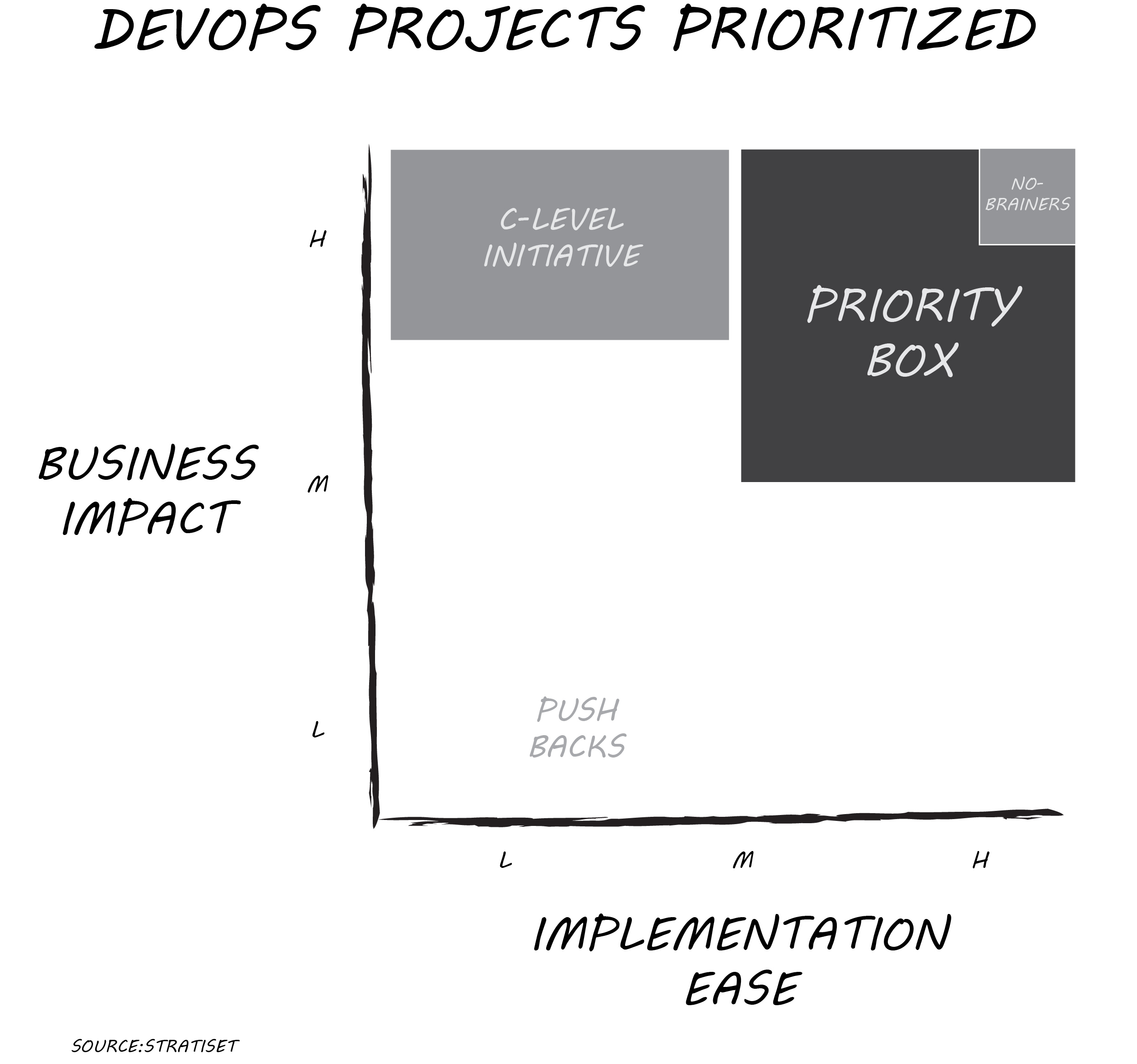
    On your whiteboard or shared screen, plot each project against two dimensions: implementation ease and business impact. Use a relative scale of low, medium or high for each axis. Implementation ease can incorporate many variables including cost of tools, technical difficulty, in-house expertise and more. Business impact can address revenue increase, cost reduction, competitive advantage or regulatory compliance. Don’t worry about absolutes; you’re looking to see how a project compares to all other opportunities. Adjust the pins if necessary after the first few projects are plotted. You’ll get the hang of it in just an hour or two, even if it’s a long list.

    Line Up Priorities

    Few projects are priority no-brainers with high business impact and high implementation ease. More likely, you have several projects in the “priority box,” scoring better than medium/medium. If you have more than five projects there, take another look and jostle pins a bit to get a manageable list. Make sure your available resources match projects identified in the priority box. Allow one exception: That C-level initiative may score as high business impact and low/medium implementation ease. Killing it just because it’s difficult isn’t a good move, but prioritization within context can help address resourcing.

    That’s the priority list you take back to your team. If it’s on that list, work it and finish it. If something isn’t on that list, your team kicks any inquiries on those projects back to you. Push projects with low business impact and low/medium implementation ease back to their sponsors for justification or removal. When one of the priority projects finishes, then and only then start the next best ranking project. Rescore the entire project list after the first group of projects is complete.

    Too easy? Here’s a recent HBR article, “Too Many Projects,” describing a more elaborate approach for bigger initiatives. You may need such in-depth analysis for a C-level initiative requiring more resources. For most projects on your list, more analysis takes substantially more time and likely produces the exact same prioritization as this faster method.

    The key to breaking initiative overload is starting and finishing the right projects. Creating a vetted priority list quickly and getting the team rolling again is well worth the price of an afternoon and some food. Morale will improve rapidly as your team sees progress and the business sees value faster.

    I’d enjoy your feedback on how this process works for you.

    — Don Dingee

  • 3 AWS Design Patterns to Maximize DevOps Value

    3 AWS Design Patterns to Maximize DevOps Value

    Many business leaders are planning to make DevOps the cornerstone of their IT transformation strategy. But, as surprising as it might sound, skepticism abounds regarding how major vendors address the DevOps transformation challenges—they confuse DevOps with continuous delivery (CD) infrastructure.

    “We wanted DevOps and we got after a nine-month-long implementation a continuous delivery platform which speeds up IT operations without significant business value. How differently can you help?” the senior business executive of a major financial institution in New York sarcastically asked me during a conversation three months ago.

    The business executive is right: DevOps isn’t a technology as I’ve been implementing it, it’s primarily an accelerated application delivery approach implemented in the form of a technology-enabled application delivery operational model. Adam Jacob, CTO of Chef, substantiates that fact in “The Secret of DevOps: It’s Always Been About People, not Technology,” when he says, “DevOps is about bringing together all the people you need to build and run your business effectively, and empowering them to move as quickly as possible towards their goals.”

    Agile Admin’s Ernest Mueller in, “DevOps: It’s not Chef and Puppet,” confirms Adam’s point: “Chef and Puppet are individual tools that you can use to implement specific parts of an overall DevOps strategy if you want to use them—but that’s it. They are fine tools, but do not solve DevOps for you.”

    How can we implement DevOps in line with business leader expectations? Three Amazon Web Services (AWS) Design Patterns I developed can help to get the best of DevOps on AWS cloud: Software Organization Factory, Digital Organization Factory and CD Infrastructure Factory. This article discusses the Software Organization Factory.

    The Foundation of DevOps Value: Consequences to IT Service Delivery

    Before delving into these AWS design patterns, a quick reminder of what DevOps is, its value propositions and, more importantly, what changes are needed in how IT services are delivered.

    The Ignored DevOps Business Logic We All Must Consider

    The combined effect of cloud adoption and the rising digital economy is changing competitive environments; it forces business leaders to focus on innovation and market responsiveness as the competitive differentiators.

    The fact of the matter is, by facilitating access to technology, cloud accelerates entrance of several thousands of tech startups that take advantage of the recent technology innovations to substitute traditional products and services into digital. This creates a context where new entrants increasingly compete with established brands, forcing business leaders to seek value paradigms other than IT efficiency.

    The business executive argues, “In these new markets, our concern is to increase customer value by delivering the right services to the right segments at the right moment. You guys need to change the IT paradigm; IT alone does not create that kind of value.”

    Then, what should be changed in today’s IT approach?

    The Two Dimensions of Modern IT: The Operational Model and the Continuous Delivery  Infrastructure

    The new IT paradigm advocated in my recent book, “Rethink Your IT with DevOps: The Complete Guide to Aligning Your IT to DevOps,” is the idea that business value results from two dimensions: organizational agility and technology efficiency. In other words, it defines modern IT as a two-dimension asset including the operational model and the continuous delivery infrastructure.

    The timely delivery of innovation transcends IT issues; it not only cuts across your sales, marketing, post sales, application development and  IT operations, but also demands concrete answers as to how to accelerate business prioritization, decision-making and problem solving. The operational model is where business and IT people, processes, practices and tools are combined to create agile and cross-functional environments. The following exhibit shows a typical DevOps operational model:

    Typical DevOps Operational Model
    Typical DevOps Operational Model

    Organizational flexibility for the sake of flexibility doesn’t make sense unless technology is leveraged to speed processes. This is where CD infrastructures come into play; throughout the delivery process, they build on IDEs to accelerate coding and testing, on versioning tools to convert software version into releases, on continuous integration (CI) tools to build releases and on delivery pipelines to ensure continuous delivery.

    So, what is DevOps?

    DevOps is a Technology-Enabled Application Delivery Model

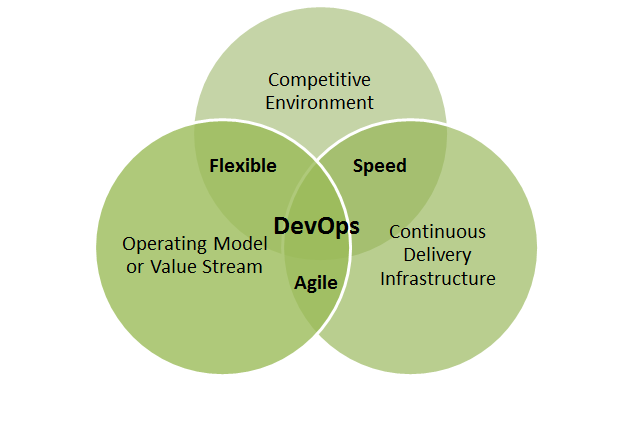
    DevOps is a combination of value, principles, processes and practices shared not only by developers and IT operations but also by the business. The goal is to help the organization deliver the right service to the right market segments at the right moment.

    DevOps from the Business Perspective
    DevOps from the Business Perspective

    As I’ve been implementing it, it’s a cross-functional application delivery model involving the business and IT and enabled by continuous delivery infrastructures.

    By enabling and automating agile practices, the continuous delivery infrastructure makes the operational model agile and provides the business with the flexibility and velocity needed to meet competitive challenges.

    Design Patterns as DevOps Implementation Engineering Framework

    As suggested by the business executive, today’s DevOps implementations struggle to deliver the promised business benefits. The reason is, the operational model dimension is ignored in favor of tools and infrastructure.

    Another reason is, DevOps is young and is still at the early stage of the technology maturity model; the expertise and engineering methodologies to implement it as what it is—a technology-enabled application delivery model—are lacking. That’s where DevOps transformation design patterns help.

    What are DevOps Transformation Design Patterns?

    In this article, the term DevOps transformation design patterns refers to general reusable architectures addressing specific DevOps strategy. They’re not necessarily implementable solutions, their primary goal is twofold:

    • Offer a neutral language for designing and implementing technology-enabled operational models
    • Offer an engineering approach that reduces design and implementation duration and effort

    They’re formalized architecture design and implementation best practices for DevOps and platform-as-a-service (PaaS) services.

    Design Pattern as DevOps Implementation Engineering Methodology

    To meet its goals—technology-enabled application delivery model—the design pattern is structured around four items including purpose,  principles, general solution and implementation techniques.

    Purpose: Clarifies the purpose of the design pattern along with the DevOps strategy to address.

    Principles: Are best practices formulated as rules and beliefs supposed to guarantee expected DevOps strategy benefits? They’re the determinants of the solutions to implement the DevOps strategy.

    General solution: Are blueprints resulting from the application of principles? They summarize the functional and technical architecture of the DevOps platform to implement.

    Implementation techniques: What are recommended technical approaches, solutions and tools to implement the general solutions?

    Why AWS? Why would it be the catalyst for DevOps value?

     AWS-ome Design Patterns That Will Change DevOps Implementation

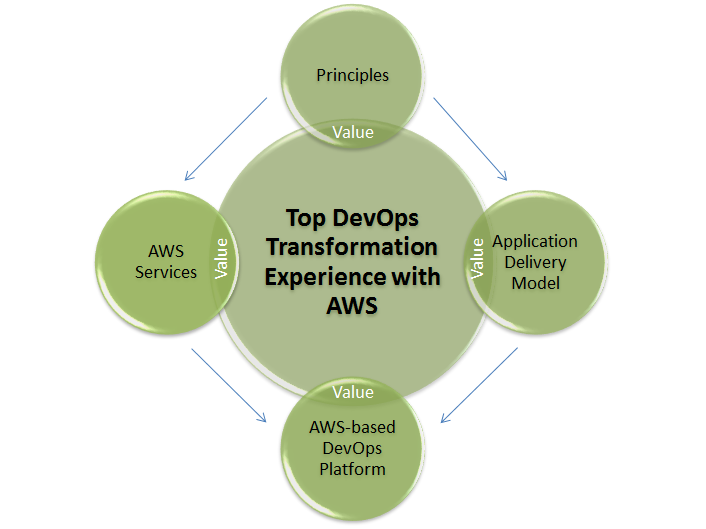
    AWS offers such a rich, varied and easy-to-implement services portfolio that it would be unfortunate not to take advantage of it to modernize IT. The rationale underpinning the value businesses can derive from their DevOps transformation experience with AWS is summarized in the following figure:

    Rationale of the DevOps Design Pattern
    Rationale of the DevOps Design Pattern

    It’s the belief that:

    • Certain principles determine the AWS services needed to deliver the application delivery model (ADM) architecture that guarantees value.
    • The implementation of the ADM using these AWS services results in AWS-based DevOps platforms that tangibly deliver expected benefits.

    The Four DevOps Principles that Yield AWS Value

    Let’s explore the principles I’ve been using to make CIOs happy with their AWS cloud:

    1. Think holistic, not only IT: Reminds that transformation isn’t only about IT but the entire organization’s value stream from marketing and sales to development and IT operations.
    2. Think cross-functional, not only IT: Reminds that the bottom line is to set up a cross-functional application development environments to accelerate business prioritization, problem-solving and decision-making, and meet time-to-value objectives. They’ll be the core value propositions of the DevOps platform.
    3. Make it agile, flexible, and speedy: Reminds that agility, flexibility and speed are the catalysts for competitiveness and business value. They’ll be part of the DevOps platform.
    4. Think PaaS: Reminds that AWS provides varied services for implementing state-of-the-art CD infrastructure.

    Let’s illustrate three AWSome design patterns that’ll change DevOps experience with AWS!

    Implement a Startup Mindset with the Software Organization Factory

    The purpose is to implement DevOps strategies focused on time-to-market and time-to-value. It’s adapted for tech startups.

    To implement the startup mindset, the DevOps four principles for AWS are implemented as follows:

    • Think holistic and cross-functional, not only IT: Relevant business and IT resources are put together in a single and dedicated service development team supported by appropriate Scrum and XP agile practices.
    • Make it agile, flexible and speedy: PaaS services building on agile practices and AWS infrastructure-as-code are provided to make application delivery processes agile, flexible and speedy.
    • Think PaaS:  AWS infrastructure as code and DevOps tools are combined to implement a CD infrastructure in the form of a PaaS platform.

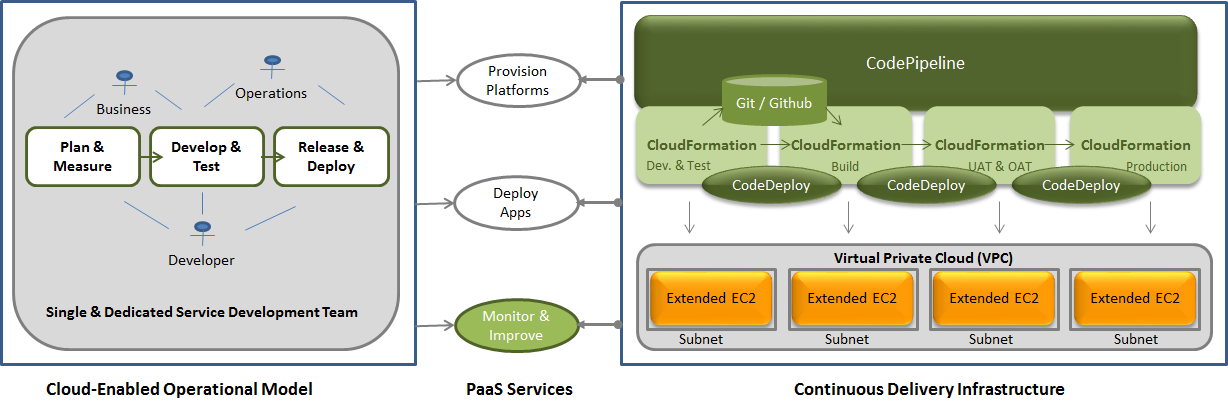
    The DevOps platform resulting from the principles application is illustrated below:

    Software Organization Factory
    Software Organization Factory

    The “Startup Mindset” platform is structured around three components including the cloud-enabled operational model, PaaS and the CD infrastructure.

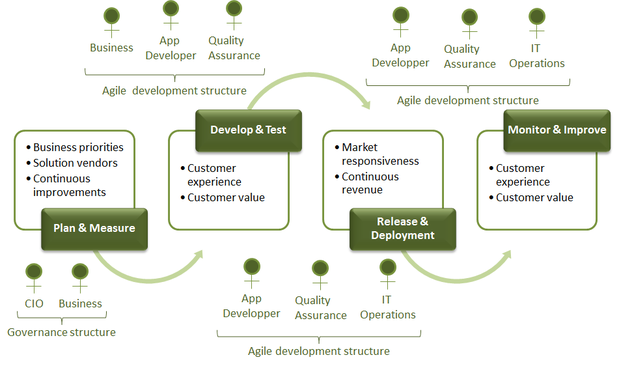
    The operational model builds on a three-stage application delivery life cycle:

    •  Plan & measure: It mobilizes business users, development, QA and operations staff on business prioritization issues using agile practices such as Scrum product backlog planning or XP’s user stories.
    • Develop & Test: It mobilizes business users, development, QA and operations staff across the development life cycle using agile techniques such as Scrum iterations, XP’s test-driven development (TDD) and behavior-driven development (BDD).
    • Release & Deploy: It leverages continuous integration practices to build and test releases prior to deploying to production.
    • Monitor & Improve: It’s outsourced to keep the service development team on its core business: developing software.

    The CD infrastructure combines the followings services:

    • AWS CodePipeline and CodeDeploy to set up the delivery pipeline.
    • AWS infrastructure as code including CloudFormation, OpsWorks and Elastic Beanstalk to generate the CD infrastructure.

    Summing It Up

    The DevOps business benefits are real, yet, it’s young and is still at the early stage of the technology maturity model. The expertise and engineering methodologies needed to implement it as what it is—a technology-enabled application delivery environment—are lacking.

    DevOps design patterns such as the software organization factory fill the gaps of today’s transformation practices:

    • They provide the architect team and the executive team a neutral language to discuss the business, technological and technical challenges and solutions.
    • By pointing out the agile practices to leverage, they simplify and accelerate the design and deployment of the operational model.
    • By pointing out the AWS services and features to leverage they facilitate the design and implementation of the CD infrastructure.

    The DevOps implementation process described in this article is fully documented in my recent book, “Reinventing Your IT with DevOps: The Complete Guide to Aligning Your IT to DevOps.”

    In my next article I’ll tackle the Digital Organization and the CD infrastructure design patterns.

    — Philippe Abdoulaye