Tag: AWS

  • Dead Downtown: It’s YOUR Fault | Pentagon’s FOUR Cloud Vendors | Apple Adds MORE Price Flexibility

    Dead Downtown: It’s YOUR Fault | Pentagon’s FOUR Cloud Vendors | Apple Adds MORE Price Flexibility

    Welcome to The Long View—where we peruse the news of the week and strip it to the essentials. Let’s work out what really matters.

    This week: Home working is ripping the heart out of cities, the DoD’s bizarre cloud strategy, and Apple adds a $10,000 app price option. (more…)

  • AWS Makes Economic Case for Graviton Processors

    AWS Makes Economic Case for Graviton Processors

    Amazon Web Services (AWS) is making available in preview a C7gn instance on the Amazon Elastic Compute Cloud (Amazon EC2) based on AWS Graviton processors. The C7gn instances provide up to 200 Gbps network bandwidth and as much as 50% higher packet-processing performance compared to previous-generation C6gn instances.

    Announced at the AWS re:Invent 2022 conference, these instances are based on Arm processor architecture that AWS provides as an alternative to x86 processors.

    Rahul Kulkarni, director of product management for Amazon EC2, said interest in more efficient AWS Graviton processors has spiked sharply as the overall economic outlook softened. More IT teams than ever are being tasked with finding ways to reduce costs as the overall number of applications being deployed in the cloud continues to grow, he added.

    While it’s not clear how many applications are being developed to run natively on Arm processors, Kulkarni noted that the process of refactoring existing applications to run on Arm processors is not as intensive for most applications as it was when previously moving applications from one class of processors to another.

    Overall, AWS now offers more than 600 types virtual machine instances on its cloud platform, including a set of Inf2 instances, available in preview, based on custom AWS processors that are optimized for processing workloads that include machine learning algorithms that drive artificial intelligence (AI) models.

    Every AWS instance takes advantage of a set of AWS Nitro Cards that offload the overhead virtualization creates so IT organizations can take full advantage of compute resources without having to allocate any resources to run virtualization software, noted Kulkarni. That virtualization tax is instead absorbed by AWS to reduce total cloud costs for the customer, he added.

    In addition, more customers are taking advantage of tools such as AWS Cost Optimizer and AWS Karpenter for Kubernetes clusters that employ machine learning algorithms to identify opportunities to reduce the cost of cloud infrastructure by, for example, shifting workloads to different classes of services.

    There are, of course, multiple strategies for containing cloud costs that range from committing to consuming a specified amount of compute resources annually at discounted rates to relying more on spot instances that are available for limited amounts of time. Less effective is moving workloads from one cloud provider to another simply because the total cost migrating workloads can be substantial depending on the number of proprietary application programming interfaces (APIs) that have been invoked.

    Regardless of approach, the days when developers were allowed to invoke cloud resources at will appear to have come to an end. Enterprise IT organizations are a lot more conscious of the total cost of IT in the cloud era. As a result, many of them are adopting financial operations (FinOps) best practices to maximize utilization of cloud infrastructure resources.

    It’s not clear how readily IT organizations will embrace AWS Graviton alongside other classes of Arm processors to achieve that goal, but as the economic outlook continues to remain uncertain, there is no doubt all options are now on the table.

  • How to Select the Right Volume Type/Storage for Your Workload

    How to Select the Right Volume Type/Storage for Your Workload

    AWS services are at the top of the cloud services food chain, and a hot topic for nearly every business considering migrating to the cloud. Along any cloud migration journey, many hidden traps await the unprepared. The volumes you’ve already provisioned might seem like a perfect match—but are you sure they suit your workload and carry the best price for performance delivered? Today, we’ll make the difficult task of choosing a storage class for your workload a bit less complicated.

    In the World of EBS

    AWS EBS currently provides three categories of considerable storage: Hard disk drives, general purpose SSD, provisioned IOPS, and one that you will most likely never need to use—magnetic. Although I’ll provide brief descriptions of each, I’ll focus on the most widely used volume types—general purpose.

    GP Storage – the Common Choice

    This is the staple storage for pretty much all AWS users. It gives you the best bang for your buck and is commonly used for tasks that don’t require heavy lifting from a drive perspective. GP storage ranges from 1 gibibyte (GiB) to 16 tebibytes (TiB), providing from 128 to 1,000 mebibytes per second (MiB/s) of throughput, which will most probably fit your use case, unless the workload is significantly specific.

    There are multiple types of GP storage, each with different pricing and characteristics that I’ll provide a few details on below.

    GP2 – Old-Gen SSDs for the Masses

    GP2 is the typical solution for boot volumes of EC2 instances, development environments, and lighter/less important databases. This is one of the most popular options out there, although its popularity comes from old habits rather than actually being a perfect shot. GP2 volume performance scales with its size—the bigger they are, the faster they go. Still, these might seem a good option, but to be honest, they aren’t so perfect. And the biggest elephant in the room is the term you’ll have to remember – “burst credits.”

    Burst Credits – Math Homework for Your Business Work

    Provisioning a GP2 volume, you get a one-time grant of 5.4 million burst credits, which you can use to make it handle input/output better during spikes in demand. More of those tokens means you’ll be able to sustain bigger performance demand for longer, boosting your storage up to 3,000 IOPS as long as you have enough of them in your pocket.
    While depleted when you go “turbo,” they accumulate when you’re not using your disks at full speed—saving up unused performance for when you need it most. Burn them all, and your IOPS performance drops to base value and throughput falls to the baseline IOPS multiplied by max I/O size.

    The performance of GP2 storage volume can be calculated with this formula:
    Throughput in MiB/s = ((Volume size in GiB) × (3 IOPS per GiB) × (I/O size in KiB))

    Until you reach the point where your volume is so big that its base performance exceeds burstable, you’d have to learn them by heart. Where is this point? Quite high, at about 1.1 TB (1024 GiB)—a lot of disk, even for a medium-sized business, especially since those volumes can’t be mounted to multiple targets.

    Figure 1: Graph of Max IOPS available for certain volume sizes (Source: AWS documentation)

    Unless you’re deploying a disk-devouring monster such as an EC2 host instance for dozens or hundreds of Docker containers, or you plan to run an enormous Elasticsearch node for the next few years with no clean-up routines in place, you’re not likely to need this much space. Also, in either of the two cases mentioned, you’d probably run out of CPU and RAM first; there are better alternatives for these cases as well, not to mention that the lack of maintenance is definitely not a good practice.

    In addition, for practically every use case—web serving, web applications, databases, casual EC2 instances for use with Docker, and more—pretty much anything is better than GP2.

    Luckily, in 2014, the introduction of GP3 brought some great improvements.

    GP3 – The “Newcomer”

    While not really a “new” player, GP3 volumes are a welcome improvement after experiencing the inner workings of GP2. They perform better and cost less in comparison, allowing you to easily scale your operations according to your needs much easier. Gone are the days of burst credit balances.

    The golden rule of this storage class is “mix n’ match.” Baseline performance here is the maximum burst performance of a GP2 volume, 3,000 IOPS, and 125 MiB/s. If your business needs more, you can purchase additional amounts of either, paying extra only for what you’re interested in.

    The limits are quite generous. You can purchase up to 500 IOPS per GiB (for at least 32 GiB volumes, capping at 16,000 IOPS), or up to 0.25 MiB/s per GiB (for volumes of at least 8 GiB, 4,000 IOPS or more, capping at 1,000 MiB/s).

    If you were previously happy with your GP2 volume, it’s almost guaranteed your company will be just as happy with GP3, and you’ll save a decent percentage of the storage cost, even up to ~20%.

    Assuming that you don’t need more than what GP2 provided you with, make the switch. To make it even easier to cut those costs down, AWS is now automatically setting the IOPS and throughput of your new GP3 volume to the exact same as your GP2. Less guessing, less messing around, more good stuff. Just click a few buttons and save some cash, no strings attached.

    This is the storage class I would recommend for every “generic” or “typical” workload. It’s a good starting point for almost every business use case that doesn’t expect huge amounts of disk operations, but is ready to scale up when the dreaded flood of demand for disk power comes.

    GP3 can easily handle the role of boot volume for EC2 instances. It can host both simple and a bit more complex applications, databases such as MySQL and PostgreSQL, or a blend of those in a containerized environment, especially in a multi-node configuration or as part of a Kubernetes cluster. Zesty Disk for Kubernetes handles this switch automatically if you have the CSI driver installed

    When the time comes, it can scale in tandem with demand. In certain cases, it might even be cheaper to provision high-speed storage with GP3 than the IO1/IO2 types, which are dedicated to speed and next on our list.

    IO Storage Class – Need for Speed

    The IO storage class was introduced to cater to the needs of businesses based on extreme durability, high read/write speeds, and the lowest latency available. It requires certain criteria to be met to show its true potential and costs significantly more. But, in turn, it provides unmatched speeds and reliability, as well as some features you won’t find in any other storage type.

    This volume type is great if you seek a volume to provision for your high-speed disk-based database, for example, or to create a single MySQL database host for multiple large-scale e-commerce instances, although there are multiple options available for this from RDS to multi-instance DBs (e.g., MySQL Galera). It’s also a fit if you need to accept a lot of data fast to process with an ML algorithm.

    IO1/IO2 Vs. IO2 Block Express – Which Type of “Fastest” do you Need?

    IO2 Block Express is pretty much IO2 on extremely potent steroids. You get limits that are four times as high for IOPS and throughput, latency of less than milliseconds, and surprisingly, no additional fee. Yes, you read that right, they’re priced the same. Plus, provisioning additional IOPS/throughput above the limit of a standard IO2 instance actually costs less.

    If you decide to use IO2 and meet the requirements (a certain type of EC2 instance), you should definitely consider Block Express—if it’s not already running by default.

    And when would you run IO2 anyway? Well, with its power and hefty price tag, this class is dedicated to the most disk-dependent, throughput-hungry, and IOPS-dependent monstrosities. For example, a data-crunching machine for a stock exchange, a global log-ingestion mainframe, or a multi-pod Kubernetes node prepared for very demanding workloads—the titans of storage, no doubt. It’s a go-to when you need a single machine that’s going to pack as much punch as you can get.

    How about IO1 then? It’s a compromise between low latency, high IOPS, and price. A good choice when you need a bit more than general purpose, but still not enough to go for the fastest storage out there. Keep in mind there’s also one additional drawback—less durability. A 0.2% failure rate annually does not sound like a lot, but if you’re thinking about dozens or hundreds of drives, absolutely critical workloads, or both, it definitely makes a huge difference.

    So, Which Should I Choose for my Workloads?

    As you can see, the world of EBS is quite complex, to say the least. So, I made a chart that should ease the selection process for your use case:

    Fantastic Disks and How to Tame Them

    Choosing the right storage class is a tough decision to make—but the benefits are worth it. With just one shot, you can both improve the performance of your instances and save on costs as soon as your next invoice.

  • AWS Previews Amazon CodeCatalyst to Automatically Create Dev Environments

    AWS Previews Amazon CodeCatalyst to Automatically Create Dev Environments

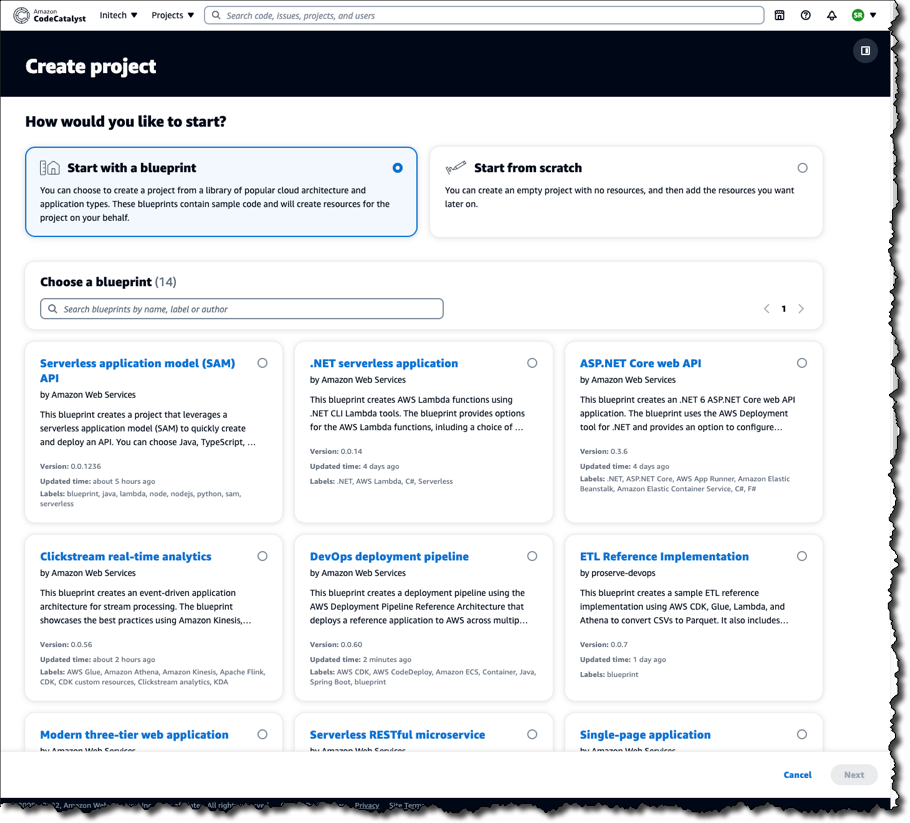
    Amazon Web Services (AWS) this week launched a preview release of the Amazon CodeCatalyst framework that leverages blueprints to automatically provision and configure developer environments in its cloud.

    Announced at the AWS re:Invent 2022 conference, Amazon CodeCatalyst takes advantage of a Project Blueprints tool to launch a source code repository and a project management tracker that are then used to create build and release pipelines. DevOps teams can use either the tools provided by AWS or substitute an instance of, for example, GitHub or the Jira project management software.

    Amazon CTO Werner Vogels told conference attendees the goal is to reduce the friction that developers currently encounter whenever they need to launch a new development project. As part of that effort, Amazon CodeCatalyst promises to make it simpler to consistently replicate development environments using scaffolds in addition to providing dashboards and search capabilities for tracking changes across commits, pull requests and deployments.

    Amazon CodeCatalyst uses a devfile to define the configuration of an environment that comes in four resizable instance options made up of two, four, eight or 16 virtual CPUs. The devfile defines and configures all the resources needed to code, test and debug a project. Devfiles, which are added to the source code repository by the selected blueprint, can also be modified.

    Collectively, those capabilities make it possible to deploy sample TypeScript, Python, Java, .NET, JavaScript, React, Angular and Vue code running in a few minutes. Developers can work with the AWS Cloud9 integrated development environment (IDE) or use tools such as JetBrains IntelliJ IDEA Ultimate, PyCharm Pro, GoLand and Visual Studio Code on their local machine. Developers, as a result, can simply switch between multiple codebases or collaborate with other developers as needed.

    The pipelines can be run on pre-provisioned builds in the cloud or organizations can opt to deploy their own container environments. Developers can incorporate build actions that are built in or provided by AWS partners in addition to incorporating GitHub Actions to compose fully automated pipelines that can be configured using either a visual editor or YAML files. Build and release pipelines enable deployment on Amazon Elastic Container Service (Amazon ECS), AWS Lambda and Amazon Elastic Compute Cloud (Amazon EC2) services.

    In general, Vogels advocated that IT teams should build event-driven applications that are loosely coupled to make it simpler to add new capabilities to existing applications running at scale without impacting the entire codebase. To make it simpler to build those types of applications, AWS added an Amazon EventBridge Pipes tool that creates point-to-point integrations between event producers and consumers in a way that eliminates the need to write that code. AWS also made available in preview a graphical AWS Application Composer tool that makes it simpler to design, configure and build serverless applications using infrastructure-as-code (IaC) definitions.

    It’s not clear to what degree developers will be embracing event-driven applications. As a programming model, event-driven architectures have been around for decades. The issue has been those applications also have tended to be among the most challenging to build and maintain. AWS is now clearly signaling its intent to make building those applications a lot easier.

  • AWS re:Invent — Top 4 Things We Learned This Week

    AWS re:Invent — Top 4 Things We Learned This Week

    Welcome to The Long View—where we peruse the news of the week and strip it to the essentials. Let’s work out what really matters.

    This week, four things that caught my eye from Amazon Web Services’ re:Invent 2022 conference: SnapStart turbocharges Lambda, Graviton3E ARM HPC SoC, AWS continues hiring, and AWS’s origin story. (more…)

  • GitLab Unfurls Dedicated SaaS Edition in the Cloud

    GitLab Unfurls Dedicated SaaS Edition in the Cloud

    GitLab today made available to a limited number of customers a single-tenant version of the software-as-a-service (SaaS) edition of its continuous integration/continuous delivery (CI/CD) platform.

    David DeSanto, vice president of product at GitLab, said the GitLab Dedicated option provides all the benefits of a cloud platform without running afoul of any potential compliance issues.

    Designed to be deployed on a cloud platform selected by the customer, DeSanto said the single-tenant edition of the platform makes sure that all the data stored in the cloud is isolated. In addition, the access to GitLab Dedicated is provided via a private network connection, he added.

    Initially, GitLab Dedicated is being made available on the Amazon Web Services (AWS) cloud with support for other cloud platforms planned for 2023 once it becomes generally available.

    GitLab is, in effect, trying to strike a balance between a lower-cost multitenant edition of the platform or, alternatively, requiring organizations to deploy an on-premises edition of the platform themselves, DeSanto said.

    In general, GitLab expects this latest version of the platform to appeal most to organizations that operate in highly regulated industries. However, the number of organizations looking to isolate their data in a private cloud to better protect their software supply chains is expanding, he noted.

    In the wake of a series of high-profile breaches and vulnerability disclosures, the number of organizations that are reviewing their software supply chains has increased. Less clear is the degree to which organizations will look to lock down their existing CI/CD platform versus replacing it with a more secure modern alternative that can be more easily accessed via the cloud.

    The challenge, of course, is replacing a CI/CD environment is not trivial, so organizations will need to consider the time and effort made over the years to customize their CI/CD environment. In some instances, that customization provides a meaningful competitive advantage. In other cases, however, the weight of maintaining all those customizations has become more troublesome than it’s worth.

    Each individual organization will need to decide to what degree they will want to manage the DevOps platforms used to construct applications. More organizations are deciding they prefer to devote as much of their resources as possible to writing code instead of managing the underlying CI/CD platform used to create their applications, said DeSanto.

    Regardless of approach, the number of organizations adopting DevOps best practices to build and deploy applications faster continues to increase. A CI/CD platform accessed via the cloud lowers the barrier to entry for smaller organizations that typically don’t have the skills and resources required to manage DevOps platforms.

    In the meantime, SaaS-based approaches should significantly increase the number of applications being constructed using DevOps workflows. The level of DevOps adoption will naturally vary by organization. However, the total number of custom applications being used to drive, for example, digital business transformation initiatives should considerably expand in the months and years ahead as more applications are built and deployed at incredible speed.

  • Logz.io Unveils Managed Open 360 Observability Platform

    Logz.io Unveils Managed Open 360 Observability Platform

    At the AWS re:Invent 2022 conference, Logz.io launched an Open 360 platform that combines multiple open source technologies to provide observability across both existing monolithic and emerging cloud-native application environments.

    Existing Logz.io offerings included in the Open 360 platform are Logz.io Kubernetes 360, a managed observability platform based on open source tools such as OpenSearch analytics software, Prometheus monitoring tools and Jaeger distributed tracing agents.

    In addition, Open 360 includes Logz.io Telemetry Collector agent software, Logz.io Data Optimization Hub dashboard, Logz.io LogMetrics Index for converting log data into metrics and the Logz.io Trace Sampling Wizard tool for configuring open source OpenTelemetry Collector agent software.

    Logz.io CEO Tomer Levy said rather than requiring organizations to combine a set of disjointed open software tools to create an observability platform, instances of open source tools have been curated by Logz.io. The goal is to streamline the number of tools and platforms that DevOps teams will need to observe multiple classes of applications, he noted.

    It’s still early days as far as the adoption of observability platforms is concerned, but it’s apparent that as application environments become more complex the monitoring tools DevOps teams rely on today will need to evolve. Observability platforms, in general, promise to unify logs, metrics and traces in a way that makes it simpler to launch queries to identify the root cause of an issue rather than simply tracking a set of pre-defined metrics.

    The rate at which DevOps teams will embrace observability will naturally vary, but the choice many DevOps teams are trying to navigate is how much to rely on proprietary observability platforms rather than using open source software to construct their own. Logz.io is making a case for finding a middle ground between those two extremes by relying on a managed service based on open source tools.

    Observability has always been a core DevOps tenet, but achieving and maintaining it is challenging. Most DevOps teams today aspire to maintain some level of continuous monitoring. However, as it becomes easier and less costly to instrument applications, interest is rising in observability platforms that simplify the investigation of anomalies indicative of an issue that could disrupt a distributed application environment.

    More challenging still, DevOps teams are also now managing a much wider range of application types as cloud-native applications based on microservices deployed on Kubernetes clusters are deployed alongside legacy monolithic applications running in the cloud and on-premises IT environments. The Logz.io approach enables DevOps teams to manage those applications at a lower total cost, noted Levy.

    Regardless of the approach to observability, the increasing complexity of application environments has become a major challenge for organizations that are increasingly sensitive to costs. Many of them can’t afford to hire additional DevOps engineers. Instead, the focus is on increasing the productivity of existing DevOps teams using a new generation of observability platforms that should cost less to acquire and deploy than to expand existing teams of DevOps engineers. That may not necessarily eliminate the need to hire additional DevOps engineers, but it should ensure organizations are getting the most out of the DevOps teams they already have.

  • Data Centers IN SPAAACE | Discord GDPR Fine | AWS Fires Dead Wood

    Data Centers IN SPAAACE | Discord GDPR Fine | AWS Fires Dead Wood

    Welcome to The Long View—where we peruse the news of the week and strip it to the essentials. Let’s work out what really matters.

    This week: The EU wants to put servers in orbit, a GDPR penalty for Discord, and Amazon has the hatchet out. (more…)

  • Zerto Joins AWS ISV Workload Migration Partner Program to Accelerate Adoption of its Cloud Data Management and Protection Solutions

    Ensuring Enterprise-class Protection and Recovery of VMs, Amazon EC2, and Amazon EKS Workloads

    BOSTON, MA – August 10, 2022 – Zerto, a Hewlett Packard Enterprise company, today announced it joined the Amazon Web Services (AWS) ISV Workload Migration Partner Program, allowing it to drive and deliver AWS workload migrations and accelerate the adoption of its cloud data management and protection solutions.

    Zerto customers will benefit from enhanced technical enablement which accelerates migrations with a repeatable and scalable methodology, automations, and tools that leverage AWS best practices. The program also provides access to AWS promotional credits to offset migration costs, including labor, training, and running parallel environments. In addition, Zerto will receive go-to-market support.

    Whether migrating or protecting virtual machines (VMs) or containers on-premises, to the cloud, or within the cloud, the Zerto solution utilizes the flexible capacity of AWS while minimizing downtime and helping protect against data loss. This allows users to achieve their recovery point and recovery time objectives with ease.

    Zerto’s software-only solution ensures enterprise-class protection and recovery of VMs, Amazon Elastic Compute Cloud (Amazon EC2), and Amazon Elastic Kubernetes Service (Amazon EKS) workloads. This includes easily scalable, cloud-based appliances that manage replication for application-centric protection and recovery or workload migration and continuous data protection with journal-based replication for on-premises to cloud or cloud to cloud.

    “Zerto is proud to work with AWS to help customers protect all of their data,” commented Christina Rauscher, global public cloud alliances director at Zerto. “By working together, we can help customers better leverage AWS with added migration, disaster recovery, ransomware recovery, backup, and long-term retention capabilities.”

    About Zerto

    Zerto, a Hewlett Packard Enterprise company, empowers customers to run an always-on business by simplifying the protection, recovery, and mobility of on-premises and cloud applications. Zerto’s cloud data management and protection platform eliminates the risks and complexity of modernization and cloud adoption across private, public, and hybrid deployments. The simple, software-only platform uses continuous data protection at scale to converge disaster recovery, backup, and data mobility. Zerto is trusted by over 9,500 customers globally and is powering offerings for Microsoft Azure, IBM Cloud, Google Cloud, Oracle Cloud, and more than 350 managed service providers.

  • HYCU® Launches New Cloud-Native Backup as a Service for AWS – Free Tier for Life

    Cloud professionals can now further protect their Amazon EC2 instances in minutes with a free SaaS offering

    Boston, MA, August 22, 2022 — HYCU, Inc.,  a pioneering enterprise backup as a service (BaaS) company specializing in hybrid and multi-cloud data protection as a service, today announced a free tier of HYCU Protégé for Amazon Web Services (AWS). This new solution is a cloud-native backup and disaster recovery service that offers additional protection for Amazon Elastic Compute Cloud (Amazon EC2) instances. It delivers a fully managed backup service that offloads and automates data protection tasks. HYCU leverages Amazon Block Store (Amazon EBS) Snapshots to create an impact free, application consistent copies of the data. Cloud admins can now protect their data in minutes instead of spending days on data protection operations. Customers can subscribe and immediately protect their workloads and get back to doing what they do best – accelerating application development.

    Many companies are challenged with having a reliable data protection solution. Although native functionality and scripts provide extensive features, they can require significant time on the part of cloud architects, administrators, and even DevOps teams to configure, deploy and manage, with increasing complexity as organizations grow their use of cloud workloads. HYCU believes

    cloud-native backup and disaster recovery does not have to come at the expense of application development and innovation. 

    “In a perfect world, every organization would have data protection and backup as a core pillar within their organization. HYCU is committed to creating solutions that make data backup and recovery more accessible, limiting the threat of ransomware attack and human error,” said HYCU Founder and CEO Simon Taylor. “By releasing a free tier of HYCU Protégé for AWS, we have created the first cloud-native backup solution purpose-built for cloud and DevOps teams. HYCU has a mission of building a safer world, and above all else, we aim to deliver life-changing solutions to protect data, organizations and people.”

    The free tier of HYCU Protégé for AWS removes the need for multiple interfaces and provides greater visibility and control of AWS workloads. It converges backup and recovery into a simple user experience for all AWS backups. Customers can now back up Amazon EC2 workloads in minutes. HYCU provides backup as a service for free, customers only pay for their AWS consumption used to protect their data. 

    HYCU Protégé for AWS is packed with key capabilities to ensure that data protection is a simple process, yet comprehensive and scalable to organizations and teams using it. New features and benefits include: 

    • Live view of your protection status at all times
    • 1-click automation of backups 
    • Simple granular file restores 
    • Cross-regional disaster recovery 
    • Daily notifications and proactive alerts
    • 100% ownership of their data – including backups.

    This announcement comes on the heels of HYCU’s Series B funding in June 2022, accelerating innovation-focused solutions and services delivery, such as HYCU Protégé for AWS.

    For more information on the free tier and to subscribe, please visit: HYCU Protégé for AWS – Free Tier or follow @hycuinc and connect with HYCU on LinkedIn.

    About HYCU
    HYCU is the fastest-growing leader in the multi-cloud backup and recovery as a service industry. By bringing true SaaS-based data backup to both on-premises and cloud-native environments, the company provides unparalleled data protection, migration and disaster recovery to more than 3,200 companies worldwide. HYCU’s award-winning, purpose-built solutions eliminate the complexity, risk and high cost of legacy-based solutions, providing data protection simplicity in a hyper-connected, multi-cloud world. Customers experience frictionless, cost-effective data backup and recovery, no matter where their data resides. Based in Boston, Mass., the company employs 300 people across the globe. Learn more at www.hycu.com.