Tag: automation

  • In DevOps, Standardize to Minimize Architectural Debt

    In DevOps, Standardize to Minimize Architectural Debt

    I recently reading a great Q&A with the Etsy CTO John Allspaw over on The New Stack, which contained some nuggets of good advice that increasingly are important as we continue the journey toward DevOps adoption. Of particular note were statements on the introduction of “new” things to solve problems. In a nutshell, Allspaw reinforced the importance of standardization as a means to reduce architectural debt.

    If you aren’t familiar with the concept of architectural debt, it’s similar to technical debt, in which choices made today incur longer term investments of time and money when future changes are introduced. If you settle on a caching solution such as Redis, for example, there are technical and architectural implications. You can’t simply switch out Redis for memcached later without significant changes to both code and the infrastructure.

    Even your choice of load balancer today implies architectural debt because of the growing inclusion of scalability as part of the application infrastructure itself. The result is integration with automation and orchestration systems that are not easily changed later on if you decide you want a different solution. The style of service registry you choose is an architectural decision that impacts clients, servers and systems across the microservices architecture. Switching from client-side to server-side will later be costly.

    That’s architectural debt.

    Allspaw noted the need to not reinvent the wheel when possible, and instead encourage the collaborative aspects of DevOps as a means to avoid reinventing the wheel and potentially increasing the architectural debt load on the organization.

    This is not a new concept. There’s a reason enterprises in particular proudly proclaim themselves “Java shops” or “Microsoft shops” and primarily require development in one or perhaps two languages, but no more. Maintainability is a component of technical debt, just as middleware decisions are a component of architectural debt.frameworks in use soad2016

    So as we continue to see wider DevOps adoption, it’s important that we carefully consider the impact of our choices in terms of the automation, orchestration and integration required to implement continuous delivery and deployment. Once you’ve invested time and energy (and probably budget, too) in Puppet or Chef, VMware or Cisco, OpenStack or SaltStack, you’re going to find an unavoidable amount of technical and architectural debt in development as well as production across infrastructure and networking teams.

    Each of these systems, solutions and frameworks comes with its own components. It isn’t just a language, it’s a comprehensive system with management and repositories and agents and reporting components. All of these impose certain architectural requirements on organizations, from needing certain software running to prescriptive details on networking that must be enforced, lest the system break down.

    We’re already starting to see that fragmentation in enterprises that are engaged in automation and orchestration efforts. When asked the number of automation frameworks (Cisco, VMware, Python, OpenStack, Chef, Puppet, etc…) in use, one-third today reported using three or more.

    That’s not necessarily “bad,” as it could be indicative of standardization across silos (networking wants to use Cisco, infrastructure is already on VMware, and Python is being used to cobble it together by ops), but it also could be an early sign of the kind of fragmentation that causes exponential growth in technical and architectural debt.

    Certainly there is room for experimentation in these early days, but it behooves us to maintain a watchful eye on the use of frameworks and systems and languages we employ for automation and orchestration to ensure we don’t end up buried in technical and architectural debt.

    Standardization, even loosely enforced, can help minimize the impact of that debt before it spirals out of control.

  • Conformiq Launches New Transformer for Automated Software Testing

    Transforms Tests for Execution, extending the Conformiq 360ᴼ Test Automation Solution

    San Jose, CA (PRWEB) February 23, 2016

    Conformiq™, transforming software testing with 360ᴼ Test Automation™, today announced Conformiq Transformer™, which helps automate software testing across all markets by transforming tests for execution. The new offering extends the Conformiq 360ᴼ Test Automation solution for complex system testing at the speed of development.

    One of today’s issues is that with new technologies such as model-based testing, software testers now spend about 30% in test design, and 70% in test execution. The transformation required is to shorten the time and decrease the resources needed for test execution, while maintaining the integrity of the existing software development lifecycle (SDLC) tools flow. The new Conformiq Transformer software platform automates the execution of new and existing tests, improving the productivity of the entire quality assurance organization.

    The new Conformiq Transformer solution shortens the path to test automation, simplifies model-based testing (MBT) adoption using existing methods, and automates manual test execution. It builds upon Conformiq Creator™, the automated test design solution.

    While Conformiq Creator generates executable test cases, scripts and documentation from models, Conformiq Transformer enables the transformation of tests for automatic execution, both for automatically generated test cases and for manual or existing test cases. Conformiq Transformer helps integrate the SDLC process, without requiring any changes to popular tools, standards and flows. It extends the value of a wide range of industry-standard test automation tools (commercial and open source) for automated test execution.

    New Conformiq Transformer helps save up to 70% of the required effort to automate test execution, and supports DevOps, continuous integration (CI), in-sprint, and Agile processes.

    “Conformiq Transformer technology was developed to address the key bottleneck in software testing. Companies need a way to automate test execution, the most significant cost and time sink in today’s SLDC flow. Transformer automates execution of existing, legacy, manual tests as well as automatically-generated tests from Conformiq Creator.” commented Mark Creamer, CEO of Conformiq. “Every software organization can benefit from this new solution, expanding our market and providing significant new value for our customers.”

    “Customers expect significant reductions in testing cost through automation, which traditional test automation approaches failed to deliver. Conformiq Transformer changes that by allowing dynamic generation of automated test scripts directly from the model,” stated the program manager at an international testing services provider.

    Conformiq Transformer reduces testing effort and the need for test execution expertise by automating functional testing and test execution, minimizing manual involvement, programming and scripting. It directly links to automated execution frameworks and SDLC tools and processes and leverages existing test assets – test cases, requirements, and prototypes. Now, testers can eliminate their test automation backlog and gain control, automation, integration and speed across the software testing cycle.

    Features of the new Conformiq Transformer software platform include:

    •     Automated execution of new and existing tests- provides the only integrated link between automated test case generation, and automated test case execution.
    •     Automated manual test case execution – imports manual tests for automation, and transforms manual tests into automatically executable tests.
    •     Automated execution of automatically- generated tests – extending the power of Conformiq Creator.
    •     Extension of industry-standard test automation tools to improve the productivity of the entire QA organization – the only solution that fully automates text execution for every major SDLC and execution framework and platform: Application Lifecycle Management, Test Management, Automated Test Execution, and Requirements Management systems.
    •     Automated test execution without programming – eliminating time-consuming, unmaintainable scripting with the ability to create and automate tests using drag and drop, form-based test suites, test case and keyword editors, assisted keyword automation, and live-check of test suites.
    •     Consolidated view of automated test case design, creation, execution, management and validation – Eclipse integration for a consolidated view for the tester; with support for existing and / or open source test execution tools.

    With new Conformiq Transformer, transforming tests for execution, Conformiq 360ᴼ Test Automation further accelerates and automates the end-to-end testing process across all markets, including enterprise IT, communications and embedded software, and is especially effective for web-based applications. Please contact Conformiq about getting started with Conformiq 360ᴼ Test Automation.

    Availability

    Conformiq Transformer is available immediately. For more details and pricing information, please contact sales(at)conformiq(dot)com.

    About Conformiq

    Conformiq is transforming software testing with Conformiq 360ᴼ Test Automation™, providing the most sophisticated and comprehensive automated test design solution in the industry. The unique Conformiq 360ᴼ Test Automation technology enables the next generation of testing: transforming, streamlining and automating even the most complex system-level testing environments. Conformiq 360ᴼ Test Automation improves efficiency with a 40% faster test case development cycle; enables delivery of higher quality code through 50% more defects found; increases manageability with 50% better collaboration: and reduces costs with a 400% return on investment. Conformiq serves enterprise IT, communications and embedded software markets worldwide. Privately-held Conformiq is headquartered in San Jose, California, with a worldwide delivery and support organization including offices in Finland, Germany, Sweden, and India. Visit Conformiq athttp://www.conformiq.com

  • Webinar: 5 Key Metrics to Release Better Software Faster

    Webinar: 5 Key Metrics to Release Better Software Faster

    No matter how often you deploy your application, or how sophisticated your delivery pipeline is, you always need to know the quality status of the software you are building. This can only be done if you measure it. But measure what exactly?

    Join us for this webinar where Andreas Grabner and Brett Hofer, app performance evangelists, will look at five key metrics that will increase your confidence in securing a safe build for production.

    • Learn why metrics can be huge quality gateways
    • Identify key metrics to take back to your team (Dev, Test, Ops and Business)
    • Understand how to use, measure and report these metrics
    • 3 short use cases and how using metrics can help you avoid them

    After this webinar you’ll understand how specific key metrics can be set-up, understood collaboratively across teams, and help you produce better software, faster!

    Recording

    Slides

    [seoslides embed_id=”5481e89ca9d5″ script_src=”https://devopsy.kinsta.cloud/embed-script/5-metrics-release-better-software-faster/13511/” overview_src=”https://devopsy.kinsta.cloud/slides/5-metrics-release-better-software-faster/” site_src=”https://devopsy.kinsta.cloud” site_title=”devopsy.kinsta.cloud” title=”5 Metrics to Release Better Software Faster” /]


  • QA in the DevOps Era

    QA in the DevOps Era

    In software approaches that produce monolithic applications, it is not uncommon to find siloed teams, with development, testing and operations each an island unto themselves. The responsibilities of test and development are distinct from each other and are not meshed into a hybrid team as you might see in advanced DevOps shops.

    “QA (quality assurance) always comes late in the game to verify or test the software developed by the development team against the predefined specifications know as software requirements,” says Venkata Vinay Pandella, team lead at Nisum Technologies Inc.

    That’s the view inside and among these teams in which legacy development approaches still flourish. The rest of the enterprise sees these teams altogether differently from how they see themselves. “Even in a traditional software engineering organization, folks outside the engineering team generally consider Development, QA and Operations teams as a single group with a single responsibility to deliver a quality software product,” says Pandella.

    Even when Dev and Ops do embrace each other, the rest of the enterprise often maintains the same POV it had when Dev, Ops and QA were three entities and not one. How do DevOps and QA see QA after the shift?

    DevOps as a Foundation for the New QA

    Enterprises, the business units, Dev and Ops all expect DevOps to propel software using continuous integration (CI), continuous delivery (CD) and ultimately continuous deployment techniques that are fueled by and gain traction using automation. The more processes that Dev and Ops teams are able to automate, the more that DevOps accelerates the process of software delivery and deployment to the delight of software consumers and the business.

    DevOps enables teams to push software out weekly, daily and hourly through continuous software improvement. This negates the many obvious downsides of applying the traditional software development approach, which requires excessive planning, cross-team coordination, staging, testing and releases of monolithic blobs of software all at once. “Given that companies organically adopt DevOps together with agile software development practices, business managers are able to fulfill the objective to get high-quality software out to market faster,” says Pandella.

    To meet the goals of DevOps, QA must feed into the automated development process and help teams to achieve increasing software quality and faster time to market.

    QA: The Quality Icing on the DevOps Cake

    According to Pandella, QA specialists and teams have a number of roles and responsibilities in DevOps:

    • QA should prevent software defects at the earliest point during the software development process rather than find and report on software bugs after DevOps has produced the software. This will help to ensure that customers experience as few defects as possible.

    • QA takes ownership of and responsibility for continuous software improvement and software quality tracking throughout the software development life cycle.

    • Every QA team member is responsible for identifying problems not just in the product but also in the process, and recommending changes wherever they can to improve the continuous delivery of quality software.

    • Tests must be in code, based on the designed release cadence to publish a new release every week, every day or every hour. There is no room for manual testing—QA must develop automation systems through code that can ensure quality standards are maintained.

    • Automation rules: QA should automate anything that can be automated.

    • QA testers are the quality advocates, influencing both developmental and operational processes. They don’t just find bugs; they look for any opportunity to improve the quality of software through the software development process.

    • QA must move beyond functional testing, because even a small, nonfunctional defect introduced into a critical transaction process on an e-commerce website can bring a business to its knees. Many organizations have mature processes for automating functional testing; they are only beginning to apply these practices to other areas of testing such as security and stress testing. In particular, load testing and stress testing are critical disciplines for DevOps organizations that move at high velocity.

  • Force Multiplication

    Force Multiplication

    Recently, I have found myself reflecting on the statement, “Be a force multiplier.” This usually comes to mind when faced with some sort of burnout: hearing it indirectly from a colleague or friend, or experiencing it firsthand. The intent is good and aligns well with some core tenants of DevOps. Force multiplication fits into the DevOps ethos by encouraging the need to cross-train and collaborate. By working together and sharing knowledge about respective domains (development or operations), team members gain empathy for each other. This in turn has a downstream effect of now enabling better collaboration around the repair/growth/operation/expansion of the delivery pipeline.

    The only challenge I have seen over and over again is that one or more major bottlenecks exist by the time this idea of “force multiplication” is needed in a team. These bottlenecks are often real and result from an imbalance of resources: servers arriving faster than there are resources to rack/stack/configure/turn up. Database administrators cannot handle the number of schema changes needed to be reviewed/tested/deployed. Developers must wait on a certain person or people who have access to publish a package before it can “go live.” You probably have your own bottleneck that you see very clearly in your own mind.

    The next question: Have you (or someone you know) attempted to be a “force multiplier”? The answer always is complex, but a there is always a common theme in noble attempts at team cleanup: lack of training. Think about it: Have you been taught how to be a force multiplier? How to build well-formed teams? How to effectively pass on knowledge? To compound issues even further, our current incentive structure actually celebrates the “heroes” and “unicorns” of the world, calling out these as examples of success. Our economy rewards those first to market, and team-building and normalization often are not high priorities for budding startups today. Unless improvement efforts have a direct impact on the bottom line, often it isn’t a priority. The folks that are brave enough to still even take on the challenge of being a “force multiplier” in these conditions often find little success because knowledge transfer must happen in synchronous fashions: code-pairing, over-the-shoulder demonstrations, etc. These are expensive activities in both time and energy. Opportunity cost is now lost because one resource is cross-training another. Eventually the benefits will be realized, but not today …

    The amount of work is too large. As a result, the can is kicked down the road until such a time that the pain is unbearable and something must be done. At this point, everyone wants to burn down the offending code and start again. But next time, we’ll learn. We won’t make the same mistakes we did last time.

    Bite-sized changes

    The problem is that when looking at the road in front of you, you’re constantly optimizing for the next day or week as opposed to months and years ahead. In the world of quarterly returns, this is the incentive that drives us. Thus, by the time problems are real problems, it is easy to immediately begin the bikeshed conversation and begin designing v2. The next step is to re-adjust the optimization factor. Growing the meat-cloud and getting additional resources often takes too long (three-to-six month onboard time, at least), the time cost of cross-training can be too much, and overworking resources can only go so far. What is the answer?

    Level the playing field

    One of the ideas that I share around ChatOps and Event Driven Automation is to expose small tasks to users. By doing this, you allow team members and others in your company to “consume” actions that you curate. As the curator, you can expose safe actions to users and allow them to do things once relegated to a single individual or team. I’d like to share a real-world story with you and show you how we solved it.

    Bottlenecks at StackStorm

    Recently, our team was bottlenecked in releasing updates to our Puppet module for StackStorm. The team could make changes all day long in the test environment, but getting changes out to the world depended on a single person releasing code to the Puppet Forge. Obviously, this was not ideal.

    Let’s break it down. To release a module to the forge, a user must know:

    • Know how to make a change to the puppet module
    • Update module itself
    • Update metadata
    • Update git repository (tags)
    • Know how properly package up the module for release to the forge
    • Know the credentials for the Puppet Forge

    At face value, this seems minor—just throw these commands into a README, and let others just copy/paste commands. But, my team is not full of Puppet experts. They are developers, eager to help solve interesting problems. But because of this barrier to release, the natural reaction was to shy away from making changes—not because of capability or willingness, but to avoid the pain of friction involved with releasing the code. This meant that any change to the codebase usually required at least two people (change and release). Likewise, any changes that were small or simple naturally got relegated to Puppet people because they knew how to manage the debt and navigate the waters.

    Instead, let’s sprinkle some magic ChatOps dust.

    The Setup

    First, let’s set up our user interface: ChatOps. User experience is a topic that will come up over and over again with ChatOps, so the best place to begin is to decide how to expose commands to colleagues and users. The first thing to set up is the ChatOps Alias.

    Screen Shot 2016-01-27 at 10.56.23 AM

    Source: https://github.com/stackstorm-packs/st2-publish_puppet_forge/blob/master/aliases/publish-puppet-st2.yaml

    I want an all-encompasing command that a user should have to input a minimal amount of information toward. The goal is to have a big red button that can be mashed, and magically a Puppet module is released. This should now happen anytime a user types in !puppet publish puppet-st2 … StackStorm will run the stackstorm.publish-puppet-st2 action with the branch attribute set to whatever the user types in. We choose to reuse the puppet namespace since it is already populated with similar actions.

    The next step is to set up some accompanying Action Metadata for the new stackstorm.publish-puppet-st2 action. We’ll want this to run a new workflow that will take care of all the actions we discussed above. The only variable that I need to get from the user is the branch parameter, so writing the metadata should be a snap. We’ll only take a look at the workflow today.

    Screen Shot 2016-01-27 at 10.59.04 AM
    Screen Shot 2016-01-27 at 11.00.26 AM
    Screen Shot 2016-01-27 at 11.01.04 AM
    Source: https://github.com/stackstorm-packs/st2-publish_puppet_forge/blob/master/actions/workflows/publish-puppet-st2.yaml

    At the top of the file includes our vars section. The puppet-blacksmith application was not built to be run with multiple users, so our workflow needs to be able to adapt. As such, we need to know that the gem will expect a credential file (forge_file) with a username (forge_username) and password (forge_password). We also need to know where our staging directory is (repo_dir), where the upstream target is (repo_url). Simple enough. The next few steps, clone-puppet-module-from-git, bootstrap-puppet-module, cleanup-vendored-gems and set-puppetforge-credentials ensure the build host is setup properly. These actions serially download the repository from Upstream, runs all bootstrap commands, attempts to ensure a pristine directory, and then sets up the puppet-blacksmith forge file. At this point, nothing has actually been done, just some preparation.

    It’s important to note the third step here (cleanup-vendored-gems): This was a small step that often was forgotten and ended up creating archives in the size of megabytes as opposed to kilobytes, which is more reasonable and expected.

    The final steps—tag-puppet-module, build-puppet-module, upload-module-to-forge and push-git-tags—are where the bulk of work occurs. The next steps are focused on running several rake tasks, as well as then tagging the git repository and republishing the package upstream. Most of these actions were enabled by the puppet-blacksmith gem, but now are encapsulated in a nice workflow that is easily consumable.

    And sure enough, if you build it, they will come …

    slack slack_1

    Techniques like this directly enable force multiplication within your team. Essentially, your role shifts from a person “responsible” for delivering to the person for “enabling” delivery. This is a very small example, but powerful. Enabling others on your team to be a force multiplier enables them to keep working, enables you to focus on more important things and also creates a new degree of transparency that may not have existed before. Everyone knows when software is released; anyone has the ability to do this. Add up enough of these small building blocks, and suddenly team members are more apt to take risk and help drive change knowing there is a safety net behind them.

    Worth consideration

    Two very interesting points were presented to me that are worth discussion here:

    Agile Manifesto, rule #1: Individuals and interactions over processes and tools. Tools that try to enforce a workflow of a human? GTFO!

    How far does this paradigm extend? For sure, “process” is the worst. When invoked, it usually means a large amount of paperwork or rules that must be strictly adhered to. The downside is that many of said process are manual in nature and, as a result, error-prone. Likewise, in companies that implement a tool before understanding what they want to achieve or, at the very least, defining a set of principles, the tools end up shaping how the company works rather than the other way around. The point here is that humans are in charge.

    Agreed. What is unreasonable here is the underlying expectation that exists here and across the IT industry: technologists must know an immense amount about an immense number of things. Even in my own domains of expertise, I can think of nothing more demotivating than trying to remember how to deploy code that I haven’t touched in three-plus months. Eventually I’ll remember, but it’s a drag and introduces unnecessary friction. Now, play that out in a larger team and multiply.

    ‘I will become redundant’: I have yet to see this happen. What instead happens is collaboration. Developers can focus on shipping and keeping their code up to date without bugging operations, and operations can care about aggregate problems (capacity, power, storage) as opposed to transactional tasks such as “push this code” or “reset this password.” Most devs I know are not afraid to get dirty, but it’s not where they would rather spend time. Devs want to develop. If you can enable them with better tools to do exactly that, everyone wins. The glucose you were once burning on smaller tasks can and often do become self-service, and you get to go and create even more cool interfaces for users to consume.

    Wrap Up

    Bottlenecks exist. They can and will continue to pop up as companies grow and expand. Sometimes you may find yourself in a situation where bottlenecks accumulate over time as a result of technical debt, while other times you join a new team and that debt may already be gaining interest on amounts owed. Either way, the situation exists where something needs to be done. Instead of going directly for the RPG, burning down the house and starting over, consider smaller approaches to enable others to do the things you do.

    Some thoughts to take with you today:

    • Tend your technology garden: curate, don’t operate
    • Make small, transparent changes for lasting effect
    • Grow it together: don’t control the change

    Until next time!

    About the Author/James Fryman

    jamesNow a senior DevOps engineer at StackStorm, James most recently worked at GitHub assisting in the development and curation of systems scaling within the Operations group. James is also a frequent speaker on the topic of automation at conferences throughout the world.

    Twitter: @jfryman
    email: james@fryman.io / james@stackstorm.com
  • Virtuoso: Focused on Quality as the First Step in DevOps Innovation

    Virtuoso: Focused on Quality as the First Step in DevOps Innovation

    I’ve found that those who have been most successful with DevOps do not actually care for the phrase. What they care about is the ability to automate, respond to, and improve their software delivery chain, as well as the tactics of moving faster and improving application quality. Another common attribute of those committed to DevOps is a focus on releases automation. The problem has been a tendency to move too quickly in the middle of the process, but in production, things start to break. 

    This is why Virtuoso decided to look at the outcome first.

    (more…)

  • Will Microservices Make the ‘Ops’ in ‘DevOps’ Obsolete?

    Will Microservices Make the ‘Ops’ in ‘DevOps’ Obsolete?

    DevOps is a portmanteau of “developers” and “operations.” The concept of DevOps is about shifting IT culture in a way that enables developers and operations to work together more seamlessly. As more and more elements of DevOps become automated and leverage microservices such as container platforms, though, the operations side of that equation plays a diminished role.

    Microservices and Automating Ops

    What you’re left with essentially is developers with the processes and tools to automate the infrastructure back end. Technologies such as containers and services such as AWS Lambda simplify greatly the process of programmatically generating, modifying and maintaining the underlying infrastructure.

    AWS Lambda seems to be a step toward removing the Ops from DevOps. It creates a system for use and runs code via APIs. The instance is spun up, the code is run and the instance is spun back down. AWS Lambda can decrease provisioning time and enable developers to be even more efficient than working with traditional virtual machines in partnership with operations.

    Container technologies such as Docker allow applications to be broken down into very granular elements—many of which can be leveraged repeatedly. The ability to reuse containerized functions across different apps and to drive that process through APIs enable substantially greater automation.

    With each step forward in the evolution of DevOps, organizations find new bottlenecks or roadblocks, and then look for or develop solutions to address them. In this API-based, automated future, the APIs themselves become a challenge. Organizations have to find ways to effectively manage and update a rapidly growing library of APIs.

    Ops Will Live On

    If you work in operations, or aspire to someday work in operations, don’t fret: Operations still will exist on some level.

    The role played by operations will simply evolve. “Operations is not going away, but the job is definitely changing,” says Shannon Williams, VP of Sales and Marketing at Rancher Labs. “Automation and microservices are technologies that are enabling operations teams to spend less time ‘firefighting’ to maintain configurations, etc., and more time on bigger-picture issues that will help improve performance and resiliency, [and] help bring down costs for the business.”

    That’s a step in the right direction. In this future scenario—next-gen data center—those in operations will be able to invest their time in more valuable endeavors. They will be able to automate routine, mundane infrastructure tasks and focus on incorporating new technologies that enable the organization to derive greater value from DevOps and IT in general.

    “What is going away is the time spent arguing about what went wrong, not operations itself,” Williams suggests. “Given the additional time that automation will free up for Ops, they can start to find ways to improve their specific business unit. They can now be focusing on optimizing for performance, costs, etc.”

    Evolution of DevOps

    I have pointed out before that every roadblock in DevOps is actually an opportunity. As DevOps principles are applied in new areas, and new tools are developed to automate more tasks, it just accelerates everything to the next bottleneck. Rinse and repeat.

    To some extent, the infrastructure side of IT and DevOps are two of those roadblocks. That’s why tools are emerging to allow many components of infrastructure to be automated, freeing the operations team to focus its efforts on whatever the next roadblock is.

  • Machine Learning, AI Driving DevOps Evolution

    Automation is the fuel that drives DevOps. Automating routine, repeatable tasks is one of the defining characteristics of DevOps culture. As artificial intelligence (AI) and machine learning improve, the scope and complexity of the tasks that can be automated increases, which raises the bar for all of DevOps. The humans behind the DevOps will be freed from even more mundane tasks and able to focus on more innovative and creative endeavors.

    It makes sense, if you think about it. The trend from physical services in an on-premise data center, to virtualization, to cloud services, to DevOps has been a steady march of raising the bar for automation. The more applications and entire infrastructures can be developed, deployed, monitored and managed programmatically and through automation, the more efficiently and effectively an organization can function.

    As tasks are offloaded to automation, humans can address other challenges. That focus inevitably leads to identifying other new tasks that can be automated. AI and machine learning represent a quantum leap in this evolution, however—with AI and machine learning, the automation can begin to identify and improve itself. When the automation can identify bottlenecks and inefficiencies and automatically adapt to overcome those obstacles, human input and interaction could become almost obsolete.

    In a recent interview, Christian Beedgen, CTO of Sumo Logic, shared some thoughts about the impact of machine learning on DevOps. “Machines will enable greater productivity among teams and businesses through the advances that machine learning and automation can offer,” he said. “A necessary component to augment human contributions, machine learning will finally give humans the power to review millions of bits of data.”

    Automating routine tasks is crucial, but there’s another factor that plays into the role that AI and machine learning have with the future of DevOps. The reality is that there are some things humans simply can’t do as well or as fast as machines—especially at scale.

    Steve Burton stressed in a blog post that humans are capable of observing, digesting and interpreting only so much information at one time. Some feel like the Holy Grail solution is some sort of application performance management (APM) dashboard that can aggregate and correlate real-time data so human IT personnel can monitor metrics and identify issues manually. “This all sounds good in theory, except it’s completely unmanageable in reality when your applications have thousands of components, billions of metrics and hundreds of changes every day,” he wrote. “Humans can no longer cope with this complexity, they now need machines to do the leg work, process this Big Data and provide operational insight into what the f**k is going on.”

    Beedgen agrees. He suggested, “Increasingly, businesses will adopt machine learning technology for its usefulness in augmenting human understanding of complex interaction and large data sets by uncovering the unknown unknowns.”

    On some level this all sounds a bit scary. It seems as though the more we succeed at DevOps and the more DevOps evolves, the less humans are even a necessary part of the equation. Conceivably you could be so good at DevOps that you DevOps your way right out of a job or inadvertently launch SkyNet—or both.

    That scenario is simultaneously feasible and far-fetched. I suggest that you don’t fear that future or look at it as machines stealing your job or taking over humanity. Embrace the future of DevOps driven by AI and machine learning and find the silver lining. Seek out the new frontiers and horizons, because there always will be tasks that the machines simply can’t do without us—and that is where innovation happens.

  • Why You Need to Embrace Automation

    Just in case you hadn’t noticed: The robots are coming.

    Well, you probably had noticed. It’s hard to miss. Newspaper articles and blogs everywhere herald their arrival. The stories usually follow the same general formula: A catalogue of amazing things that robots (really, AI systems) can do. Debate about forced unemployment vs. people freed up to do more interesting work. And then some comments about whether it’s for the good or bad. You can generally infer the general tone from the choice of image accompanying the story: a cute Japanese robot with a plastic smile or a more sinister face with the Terminator’s jawline.

    Of course, workplace automation has been around for almost as long as we have had workplaces. Each new wave of technology disrupts the employment landscape in its own particular way. However, this time it’s serious: It’s not just manual labor that’s under threat, but increasingly, we’re told, white-collar workers are being supplanted by machines. A recent McKinsey report has generated a wave of headlines: “Even the CEO’s job is susceptible to automation,” wrote Patrick Nelson at Network World; and Ana Swanson at the Washington Post reported, “How robots will even affect the jobs of people we thought were immune.”

    Not surprisingly, a closer read of the McKinsey material gives a more nuanced appraisal than a headline can offer. Few of us will actually be replaced by a robot, but many workers will lose some part of their current jobs to automation. The McKinsey report states that up to 45 percent of the activities that employees perform today could be automated, but very few occupations will be automated entirely in the near or medium term. The things that require creativity and emotion remain uniquely in the domain of humans, and they are likely to remain there for quite some time.

    It’s against this background that we see a steady increase in what is often referred to as robot journalism: machines writing news stories. So far, these applications rely on scenarios where the general ‘shape’ of a story remains pretty consistent because of the regularity of the data underlying those stories. For example, a report on stock performance is always going to mention the current stock price, what the stock price was at some particular point in the past, the price highs and lows, and perhaps something on volume or analyst sentiment. These reports often are found in the back pages of a newspaper, and are the stories that few journalists actually want to write, since they allow almost no space for creativity and emotion.

    The reality is that today’s news-writing software is still a long way from replacing human journalists. Which is not to say that what a robot journalist produces isn’t useful; it surely is. Last month I spoke about robot journalism at the news:rewired conference. It was fascinating to see how most of the major news media are exploring how to get robots on staff. So while we’re going to see more robot journalists, it doesn’t necessarily mean fewer human journalists. A recent study by researchers at Oxford University and Deloitte explored how susceptible various jobs were to automation—journalists ranked 285th out of 366 jobs, with an ‘automation risk’ of just 8 percent.

    But if you really want to see where the action is regarding automated writing, just look at it from a different angle. Rather than Natural Language Generation displacing people from their jobs, it’s offering a solution to the problem of shortage: A shortage of workers or expertise. And that story isn’t about news; it’s the Big Data story. You can take issue with the astounding numbers that are thrown around, but even if they’re out by a factor of 10, they’re still significant: by 2020, about 1.7MB of new information will be created every second for each person on earth. But less than 0.5 percent of all data is ever analyzed.

    In 2011, McKinsey noted, “The United States alone faced a shortage of 140,000 to 190,000 people with analytical expertise, and 1.5 million managers and analysts with the skills to understand and make decisions based on the analysis of big data.” And subsequent reporting points to massive year-on-year leaps in demand.

    Regardless of how few or how many people are displaced by robots, they are not all going to become data scientists. The only way this volume of data will be analyzed and explained is if we have machines doing it for us. And that’s the real calling and promise of Natural Language Generation (NLG). Interactive visualizations and dashboards don’t cut it; the meaning in all that data will be lost unless we call in the robots. But you need more than robot journalists, tirelessly churning out one formulaic story after another. You need articulate robots that use sophisticated NLG to construct fluent narratives from idiosyncratic data sets. So, accept the data reality, embrace automation, and find an NLG robot to explain the insights buried in your data.

    About the Author:

    2,41 CWDr. Robert Dale, Chief Technology Officer and Chief Strategy Scientist at Arria NLG, is recognized as one of the world’s foremost experts in Natural Language Generation (NLG) research and Development, having authored or edited seven books and 160 papers on computational linguistics. He was a Professor in the Department of Computing, Director of the Centre for Language Technology at Macquarie University.  He co-authored the seminal textbook “Building Natural Language Generation Systems” with Arria NLG Chief Scientist and co-founder Professor Ehud Reiter.

  • The Role of APM in Continuous Integration and Continuous Release

    Today’s software-defined and -driven business requires fast changes in business models—a phenomenon permeating successful businesses. What this means is almost every company is learning how to make small, rapid changes and adjustments within their business, especially within software systems. As a result, IT is feeling immense pressure to evolve, and the net result is a major uptick in private cloud environments (especially Apprenda, Pivotal Cloud Foundry and Red Hat OpenShift) and public clouds (especially Amazon and Microsoft) within our install base of large enterprises. These new platforms enable faster development, testing and releasing of software.

    Enterprise customers are getting much smarter by using automation to drive the software life cycle, including continuous integration, and even experimenting with and using continuous release processes. This is no longer a startup scenario; it’s a strategy for our large, enterprise customers. These companies are trying to build agile development and operations teams by changing people, process and technology to enable a DevOps feedback loop:
    image02

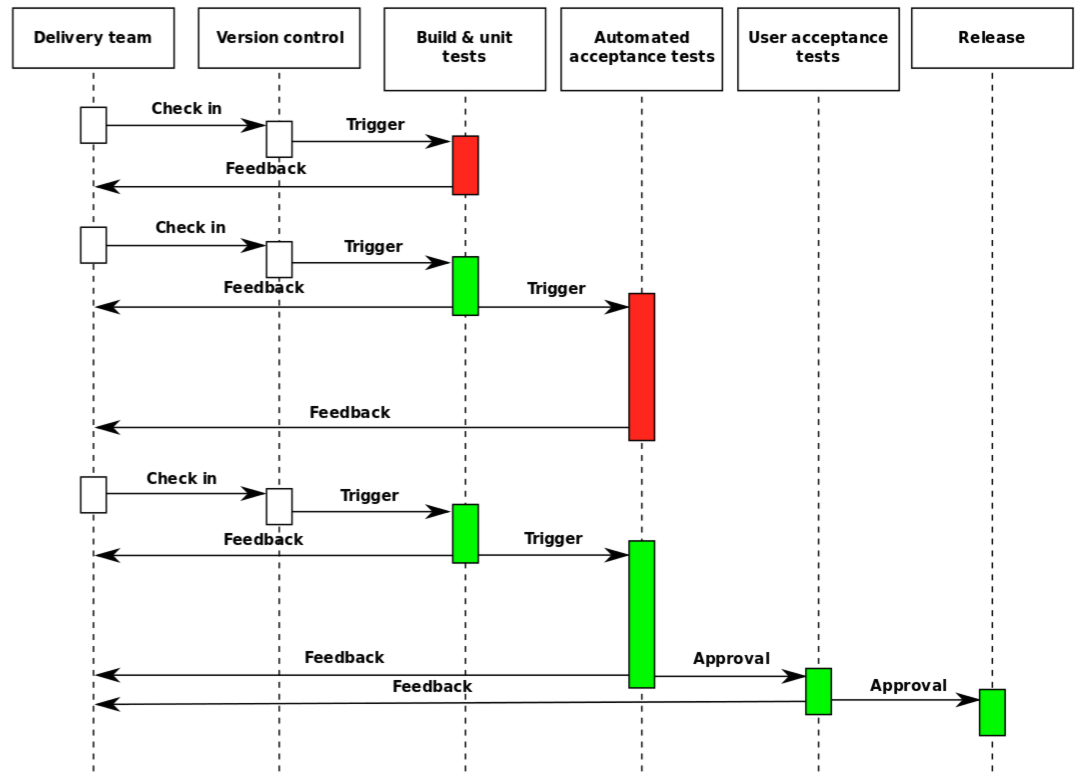
    Wikipedia describes the continuous delivery loop as follows:

    DeliveryLoop

    Within this loop, application performance management (APM) can be part of build, unit, regression and load tests to drive the automated acceptance testing before new code is pushed to production. In fact, at the recent AppSphere 2015 user conference we had several great talks on this subject.

    The first talk was presented by our customer The Container Store‘s  August Azzarello, who discussed, “How The Container Store uses AppDynamics in the Development Lifecycle.” The company began with APM in production, in an effort to improve software quality before production. It began the expansion by installing APM within test, integrating it into functional and performance test suites. It also enabled alerting from dev/test so that developers and testers both understood when there were performance deviations and issues before production.

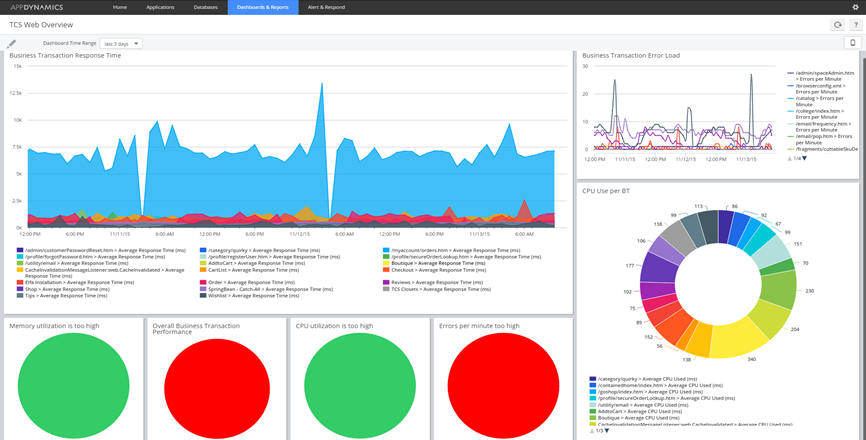
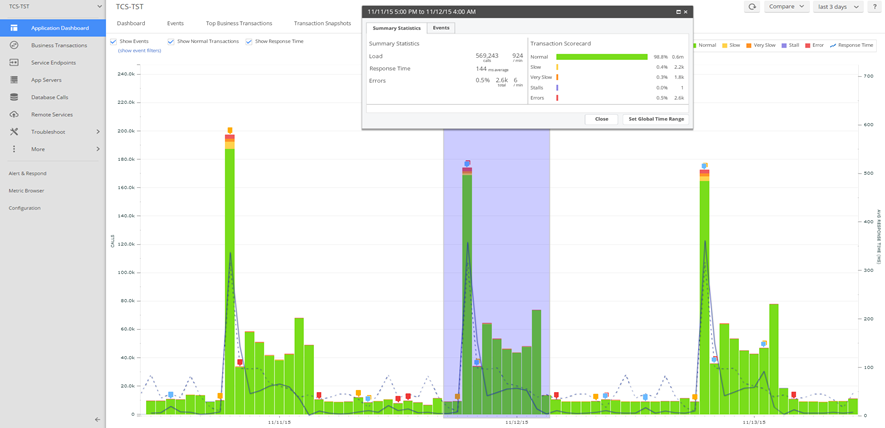
    Key features the company leveraged in pre-production included dashboards such as this one:image03

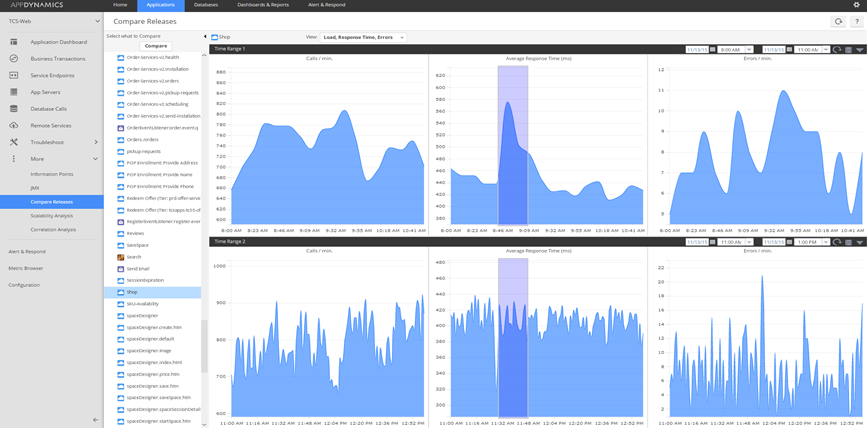
    Comparative analysis views such as this one:

    image04

    And being able to understand between releases if they were improving or degrading:

    image00

    The Container Store is using open source tools including Selenium for functional testing and Locust.io for performance testing.

    During his discussion, August also explained some of the major benefits the company saw from implementing APM in pre-production. Here are some best practices outlined by August in his discussion:

    • Monitor everything
    • Test continuously
    • Performance test early in development life cycle
    • Empower development & QA team members

    Some benefits The Container Store has seen, according to August, are:

    • Set performance expectations before production deployments – about 40 percent improvement since it started using AppDynamics in test
    • Fine-tune alert and business transaction policies prior to production deployments
    • Identify testing requirements and testing gaps
    • Decrease performance test result reporting to 20 minutes from five hours

    One of my favorite talks (which is why I selected it for the deep dive track at AppSphere) was the talk given by one of our senior sales engineers Steve Sturtevant, who came to AppDynamics from PayPal two years ago. In his talk, titled, “DevOps and Agile: AppDynamics in Continuous Integration Environments,” he explained the integration work he did. He also delved into the questions, Can you scale and auto implement monitoring in dynamic environments? Do you quantify the impact of change? Steve also offered a demo with integration between Puppet, Jenkins, ServiceNow and AppDynamics in his examples, with automation throughout the life cycle.

    One of our partners Electric Cloud specializes in continuous delivery and embraces an open ecosystem of technology providers and open source software. It has put together some great resources for people looking to explore the rest of the feedback loop: