IBM today made its first foray into applying DevOps methodologies to building artificial intelligence (AI) applications. Announced at the IBM Think 2018 conference, the latest IBM tools and services for building AI applications include a Deep Learning as a Service capability that has been embedded with IBM Watson Studio development tools and Watson Data Kits that come prepopulated with data for specific vertical industries.
IBM also announced it has extended its alliance with Apple to combine IBM Watson machine learning with Apple Core ML to make it easier to build AI applications employing machine learning algorithms developed and curated by both companies.
Finally, IBM announced IBM Watson Assistant, a voice-enabled digital assistant that can be embedded into enterprise applications.
Ruchir Puri, chief architect for IBM Watson, said IBM is delivering a combination of services and tools that collectively will create a set of DevOps processes for managing the both the development of AI models and managing the complex data pipelines that need to be created to feed data into those models.
The IBM Deep Learning as Service offering is essentially a managed service that provides developers with access to hundreds of AI models based on neural networks that IBM has developed. IBM also revealed that the core technology employed to create the Deep Learning Service will be made available as an open source project called Fabric for Deep Learning (FfDL).
IBM also announced an open source Model Asset eXchange (MAX) online service, through which developers can discover free machine learning models, and the Center for Open Source Data and AI Technologies (CODAIT), which expands the mission of its Spark Technology Center to include building such models.
Puri noted that via all these offerings and services, IBM is moving to substantially lower the barrier of entry for building AI applications. Longer term, IBM also plans to make use of event-driven architectures enabled by serverless computing frameworks to make such models available on demand, he said.
Puri added that AI models require DevOps processes because, over time, organizations will find a need to either update or change the models as new data becomes available. In addition, AI is giving rise to a DataOps discipline for managing data pipelines that needs to become integrated with a comprehensive approach to DevOps, he said.
Puri said IBM expects AI models soon will be infused into every application being built or legacy application that needs to be updated. Given the scale of the task at hand, organizations will need to consider carefully how internal and external data flows into the models, which require continual access to data to learn. At the same time, organizations also will need to focus on ensuring the quality of that data to prevent machine learning algorithms from coming to the wrong conclusions.
Adoption of DevOps processes has been spotty so far. But as organizations begin to incorporate AI into their applications, many will discover it’s simply not feasible to implement AI without a robust set of DevOps processes in place to support the models.
Given the number of platforms applications now need to be able to run on, it’s little wonder that mistakes and errors that compromise the graphical experience of the end user appear all too regularly in production. Keeping up with all the various nuances of each platform is just too much to ask of the average developer. To even those odds, Applitools has developed Applitools Eyes, the latest release of which extends the reach and scope of user interface testing in addition to providing expanded third-party tool integrations, enhanced analytics and team collaboration tools.
Version 10 of Applitools Eyes extends the company’s mission to employ artificial intelligence (AI) to enable organizations to consistently deliver a better application experience, said James Lamberti, chief marketing officer for Applitools.
Testing of graphical user interfaces (GUIs) is becoming more complex because the front-end of each application is increasingly made multiple microservices. Any change to the application requires developers to test each individual microservice and associated content that gets rendered on any number of platform. Applitools Eyes automates that testing process in a way that enables organizations to deliver applications faster without compromising the user (UX) experience, said Lamberti.
“AI makes it easier to identify where the UX is broken,” he said.
Much of the AI focus on DevOps these days tends to be on automating back-end testing. But Lamberti said it’s already been proven AI has a significant role to play in automating UI testing as well. To spur awareness of that requirement, Applitools also announced an Application Visual Management initiative, an attempt to create a new category of tools for visually testing graphical user interfaces.
Lamberti noted that functional tests today are automated, and the visual elements of an application are still conducted manually. That invariably leads to errors that conspire to impede application release cycles no matter how much time and effort may have been invested in continuous integration and continuous delivery (CI/CD) processes.
Applitools claims to have already executed almost 100 million visual tests using its visual AI engine to analyze billions of individual UX elements. Version 10 of Applitools Eyes adds improvements to the Layout Algorithm for dynamic content use cases as well as dashboards to make it easier to discover the root cause of a UI issue. Development teams, for example, can review visual test execution status and baseline status updates, bugs squashed and coverage levels specific to individual tasks and test assignments.
Bugs discovered by Applitool Eyes can now also be programmed to automatically generate a ticket with a bug tracking tool such as Jira.
In addition, integration with collaboration tools from Micro Focus as well as Slack is planned for March.
Developers are often especially challenged when it comes to application usability. Application Visual Management may provide a much-needed framework for capturing UI best practices that would enable developers to avoid the same issue over and over by, for example, enabling a testing tool to make specific recommendations about where to place specific functions on a screen. There may even come a day when AI builds the application. In the meantime, when it comes to building applications end users will actually embrace regularly, most developers need all the help they can get.
In all the hype over AI, let’s concentrate on the real value it can provide, especially for busy IT Ops teams.
2018 is already shaping up to be the year when AI and machine learning (ML) go mainstream—at least in terms of public awareness, if not yet of actual usable products. As I write this, the annual CES event—the show that is, Prince-style, “formerly known as “The International Consumer Electronics Show—is in full swing. The usual suspects are out in force, with Amazon’s Alexa getting embedded in more and more products and Google also showcasing its own consumer AI capabilities.
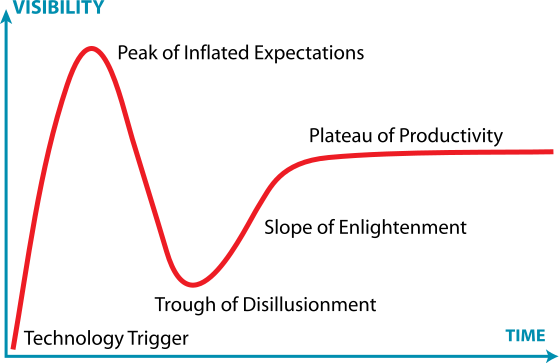
Of course, much of what comes out of CES is frivolous, but there are all sorts of other applications of AI and ML. The problem is that whenever there is this much hype, disappointment and disillusionment are not far behind. Gartner’s famous Hype Cycle model can help here.
By Jeremykemp at Wikipedia, CC BY-SA 3.0
The conventional concern is that overly optimistic projects initiated at the Peak of Inflated Expectations risk failing, leading to excessive caution and fewer projects starting during the Trough of Disillusionment, before a more realistic understanding sets in and the technology achieves true mainstream adoption. Due to the nature of AI and ML, though, there is a second failure mode that is far more insidious.
AI and ML generally operates as a black box. Results are provided, very quickly and without the need to develop deterministic rules, but it is generally not possible to determine why a specific result was generated or troubleshoot failures in detail. As these techniques are used in the real world, potential problems that might not have been obvious in the lab begin to appear. If your smart fridge misreads the expiry date on that chicken (and you don’t think to check yourself), you might be in for an uncomfortable few hours. If your smart thermostat decides for some reason that your house should be as hot as physically possible, you’re still on the hook for the heating bill.
Those are the “nice” failure modes. If a facial recognition algorithm was trained on a data set that didn’t have the right racial balance, you might wind up with some of your employees not being able to get in the door, or some of your customers not being able to unlock your device, or whatever.
Don’t Throw The AI Baby Out With The Hype Bathwater
So should we just forget about this AI nonsense? Far from it. In fact, I am personally convinced that AI is very much a key part of our future. It just needs to be used in the right way.
I mentioned training data above, and that is the key. AI systems need a lot of good data, and they need to be trained to make good assessments. Out there in the real world, both sides of that problem are actually very hard. Gathering enough data, making sure that the data gathered are actually representative of the problem space, dealing with privacy issues around personally-identifiable information, and formatting the data correctly for ingestion by your machine learning system are already not trivial issues. However, even assuming that you have successfully dealt with that hurdle, the initial results will not be very good or reliable. Intelligent assessment by humans who understand the domain that you are training for is key if your deep learning model is not to go off the rails.
Come Up to the IT Ops Lab
Seen in these terms, IT Ops is an ideal domain to which to apply these techniques. First of all, IT infrastructure already generates huge amounts of event data – Big Data, if you insist – and all of those events are already, by definition, formatted to be easily machine-readable. Sure, there are many different formats out there, from SNMP, via various proprietary product-specific formats, to modern REST APIs, but it turns out that computers are pretty good at translating information from one representation to another.
Once the event data are in the AI system, it can apply whatever algorithms to try to make sense of them: which events are even significant, which ones are related to each other, what other relationships might exist, and so on. When it comes to evaluating the results, again, IT Ops already has people, tools and processes working on precisely that question: is this a real issue, and if so, what to do about it — or if not, why not. This evaluation can be fed back to the learning system to improve its results for next time, iterating over time to provide ever more valuable and reliable results.
This learning can even be applied to the evaluation process itself, watching what users find most interesting and valuable, and extrapolating from that to present the most significant data first, or looking for patterns in human interaction to assemble the most effective teams to work on particular types of incident.
This is what AIOps is all about. Don’t assume that the sort of consumer-grade AI that you see at CES is all that is going on in this field. AI has huge potential to help streamline enterprise IT Ops, by presenting human specialists with actionable events, helping them collaborate more effectively, and learning and improving over time.
Once the CES hype has died down, take a good look at AIOps and start to think how it can fit into your plans for 2018.
This is the second installment of a two-part Q&A series on artificial intelligence (AI) with AJ Abdallat. It covers AI’s potential significance to computing; how AI affects jobs; the employee specializations needed to fuel AI; big data; and cultural challenges in the enterprise. Be sure to check out Part 1 as well.
AJ Abdallat is a serial entrepreneur who, from 1998 to 2011, worked with NASA’s Jet Propulsion Labs (JPL) and Caltech on a series of tech incubation startups. The goal was to commercialize NASA technologies, many of which were artificial intelligence-related.
In 2014, Abdallat co-founded and became CEO of Beyond Limits, a startup that secured licenses to NASA AI technologies for use in commercial applications. Beyond Limits currently holds exclusive licenses to 42 blocks of sophisticated intellectual property developed through NASA R&D investment, a $150 million AI technology head start under the aegis of Caltech’s Office of Technology Transfer and Corporate Partnerships program. Abdallat’s company is a leader in cognitive technology, which goes beyond conventional AI, binding deep learning and machine learning tools with symbolic AIs to emulate human intuition.
We interviewed Abdallat while researching the story, “AI Delivering on the Business Analytics Promise.” With AI poised to potentially revolutionize business, Abdallat’s career, which blends AI science and commercialization of the technology, makes his insights fascinating.
devopsy.kinsta.cloud: How does the advent of AI as used by enterprises compare to earlier significant computing milestones like networking, the internet, or cloud computing?
Abdallat: Part of me wants to quash as much artificial intelligence speculation as possible. The hyperbole. But frankly, I think AI is potentially more transformative than the other things you mentioned, which are just infrastructure. AI is starting to help us pose the questions that we ultimately want to answer. What’s unique about AI is that it’s an introspective exercise. Every new success for AI is giving us some insight about how we work.
AJ Abdallat is co-founder and CEO, Beyond Limits, an artificial intelligence firm. He’s an engineer and entrepreneur.
As we integrate AI, the trend may not be that transformative initially. Improvements will likely be focused on doing it faster, bigger with lower downtime and more efficiency. But what comes next is thinking about all the humans involved in that process, and what they touch and how they work. I think once AI starts to integrate with that activity, and act at that level within the enterprise, this will truly change how we think about what a business is meant to do. I’m a little biased in this, but you might go so far as to say we are entering the era of the cognitive corporation, where man and machine at all levels of the enterprise will operate in a synergistic fashion to solve problems, each learning from the other.
If you think about most business processes and most problems that humans find interesting to solve, they are heterogeneous. They move through a pipeline of different specialists that look at separate pieces or provide specific oversight to balance specialized objectives. If I can couple my engineering and sales activities at the enterprise level, and use AI to mediate the trade-offs of both of those objectives, and I have these people processes synchronized with machine processes, it gives me the ability to learn how these two potentially juxtaposed business ends are coupled, where they’re divergent, and what kind of switches I can flick or knobs I can turn to make the net positive of these two forces all the greater.
devopsy.kinsta.cloud: Is artificial intelligence intended to replace humans or help them do their jobs?
Abdallat: In some places, as with any kind of automation, you will see some jobs go away. But the labor that was there before finds a new role working with AI, and I think those new roles, especially at the level of knowledge work, will be very interesting.
As good as artificial intelligence systems are, they’re not going to set our objectives. They can move toward them, and think outside the box, which is one of things that we work hard to do at Beyond Limits. But being able to deal with the nuances of problems is still something that humans excel at. So, finding the things that are worth teaching to AI, to learn and to figure out, that’ll still always be a job in the hands of humans. I imagine that’s also when it gets kind of cyclical. I’m going to learn something, the machine’s going to discover a new pattern, we’ll optimize an approach that I didn’t think could be optimized to such a degree. That’s going to give me new questions, which makes me give it new training data, and the process continues like that.
devopsy.kinsta.cloud: What types of software engineers are now or soon will be in demand to support AI, machine learning and this new industry?
Abdallat: One of the things we’re starting to see is a change in job definition. You probably hear about data scientists and machine learning scientists. What we’re going to see more of is taking that science and flipping it with engineer. There’s a ton of stuff in the laboratory that works and is great. And scientists can write papers and come up with nice coefficients for polynomials that solve problems. But at the end of the day, there’s an infrastructure that makes all this work. So, we will probably begin to see new job titles emerge, like data engineer. A data engineer is maybe the bridge between the work that the data scientist does and the infrastructure in which his data lives. He or she is much more of a software engineer but has some knowledge of the data science workflow and algorithms germane to data and AI work.
Data engineers are becoming more important, and we’re finding they fit somewhere between IT and the business. I think that’s important. It’s the same with machine learning people. For example, the actuary of the future will simply be a data scientist who works in insurance. Systems analysts will gradually become systems data scientists. Of course, to make all this stuff work securely, we’ll probably see a ballooning of the specialized security people to support the work that goes into the systems engineering. Unfortunately, the world is more adversarial than we would like.
devopsy.kinsta.cloud: Does AI present a cultural challenge to enterprises?
Abdallat: Earlier big data solutions and the fact that AI looks promising for big data have paved the way. AI asks for similar machineries, although it can be used in smaller footprints when available. Culturally, some IT organizations are more progressive than others. Some like to play with new toys and would be stoked to get this down, assuming they have the budget, and AI may be enough to motivate them to allocate budget.
In other cases, there may be entrenched opposition to change. But it’s such an exciting field that whenever you start talking about artificial intelligence, you’re going to get buy-in. Some healthy skepticism is a good thing too. You can try to channel it into constructive ways of alleviating the concerns that people bring up, and assess whether they’re just nay-saying the next new thing or they’re aware of a valid institutional or physical barrier to success.
AJ Abdallat is a serial entrepreneur who worked on artificial intelligence (AI) projects and commercializing smart sensors at the NASA Jet Propulsion Laboratory at California Institute of Technology (Caltech) from 1998 until 2011. Later he founded, launched and ran several spinoff companies from Caltech/JPL, doing AI work in support of the space program and various defense agencies. NASA, for one, has used AI in its deep space missions and on the Mars Rover for more than 10 years.
In 2014, Abdallat cofounded Beyond Limits, which secured licenses to NASA AI technology with the goal of commercializing the technologies. Beyond Limits owns exclusive licenses to 42 blocks of sophisticated intellectual property (IP) developed through NASA R&D investment, a $150 million AI-technology head start under the aegis of Caltech’s Office of Technology Transfer and Corporate Partnerships program.
Beyond Limits enhances the AI IP developed for NASA/JPL, and drives new IP and innovations through its mission to bring advanced AI technology to commercial applications. The company is an AI leader in cognitive technology that goes beyond conventional AI, binding deep learning and machine learning tools together with symbolic AIs to emulate human intuition.
We interviewed Abdallat, who is CEO of Beyond Limits, while researching the story, “AI Delivering on the Business Analytics Promise.” He offered a lot of interesting commentary that just didn’t fit that earlier story. With AI poised to potentially revolutionize business, the fact that Abdallat’s career has bridged the gap of advanced AI science and commercializing it makes his insights fascinating on topics including digital transformation, IoT, big data and what AI can and can’t do.
Note: This is Part 1 of a two-part series.
devopsy.kinsta.cloud: What three key things about AI should every C-suite member know?
Abdallat: No. 1 is understanding the transformative power of AI. Most of the AI out there today is not going to replace a human. There is a balance needed between understanding the promise of AI and not being unduly fearful of losing their jobs due to the much-publicized peril. AI is going to advance a lot of progress that’s already in place, not necessarily upend everything. So yes, there are transformative solutions in AI, but I think there are lots of places for it to plug in with what you’re already doing today, in ways that can considerably augment what is done, and free up time for individuals in your organization to turn their minds to the harder problems that AI hasn’t even cracked the shell of yet.
N0. 2 is business practicality. For every AI algorithm, there are 100 articles telling you that it’s a good thing or a bad thing. It either doesn’t matter or it’s going to change your life. I think one of the things that’s important to realize is that AI needs to start with a problem to solve. So, being cognizant of which of your business problems have the biggest potential payoff in their resolution is how you should think about applying AI, as opposed to what AI would be good at solving. The chances are, if you have a problem, AI can shed some light on it. Prioritizing how you describe that problem will be more important than selecting the right AI hammer to swing at a particular nail. Understanding what your problem really is helps artificial intelligence experts devise solutions for you.
AJ Abdallat is co-founder and CEO, Beyond Limits. He’s an AI engineer and entrepreneur.
The third thing the C-suite should know about AI is timing. The time to start thinking about this is not now, it was yesterday. Companies that started experimenting with AI a few years ago are reaping the rewards today. One large, recent study shows that 75 percent of surveyed executives say that AI will be “actively implemented” in their companies within the next three years. So, it’s happening right now.
A lot of people reading the news can’t help but wonder maybe today should be the day to act, because every day I read about something new. In fact, the sooner you can modernize your digital infrastructure, the sooner you can bring AI to address your business issues. You need to level the playing field with potential competitors. Today is the day to upgrade your networks to get more digital, get more instrumentation. The benefit is it will optimize a lot of what you’re doing today, even without AI, but it also makes the AI integration possible. AI can’t work if it can’t see the data.
devopsy.kinsta.cloud: Does AI just pave the cow path or create a whole new business model?
Abdallat: It depends on your perspective. AI can help to automate a lot of things, and that would be paving the cow path. But in general, AI can help humans see problems in new ways. Let’s say I have a bunch of data and I don’t know what’s important in it. This is the kind of thing where we used to have pre-formed opinions, where we would have a group of statisticians help us answer. Now, with an afternoon and an algorithm I can get you a hypothesis of what’s important in your data. Is that automation? I don’t know, it’s automation of ideation, which is certainly more esoteric, and that’s where we’re headed. But I think there’s probably room for both. AI will achieve new business models, but we’re also trying to get AI to do things we’ve been doing forever. It’s really a function of how. That’s what AI changes: how we do things, not so much why. Why you should change things is ultimately something the C-suite should determine.
devopsy.kinsta.cloud: CEOs make decisions about the future. Could artificial intelligence help?
Abdallat: Forty-six percent of executives are fearful that their business may get disrupted by an AI-powered startup, rather than a direct competitor. So, it’s a competitive necessity. Today, big companies are using AI for analytical, predictive, diagnostic and industrial control purposes. Some AI touches ordinary people through services, but they probably aren’t aware. What we’re looking at more and more is: How do I stay aware of a big stream of data and change my hypotheses as that stream comes online? There are companies looking at this, like Beyond Limits. It will become more common, but it’s going to be less about data at rest and more about data in motion. How can I quickly translate the data that I find for my search into some kind of action? That is the next big step for big data, analytics and artificial intelligence.
devopsy.kinsta.cloud: People say lack of data and missing data are issues. Is that true?
Abdallat: Yes. One of the things we bump up against is, What happens when I don’t have all the data, or we missed some of it? A lot of machine learning approaches are bumping into this problem as well, and what they need is human intuition or expertise to guide them over those initial stumbling blocks. That’s when the unconventional comes into play.
IoT is an excellent example of missing data and so on. The internet of things (IoT) brings us new orders of magnitude of data that we need to analyze at higher frequency time scales than we’ve been asked to do before. IoT also forces us to do it out at the edge, away from the super computer that lives in the cloud that can help us answer a bunch of questions efficiently. It’s challenging to make decisions quickly enough at the edge without the ability to go back to the cloud. Because here, the speed of light without exaggeration is a factor. You’re not going to be able to get inside that decision loop if you’re waiting for light to travel back to the server farm and out to the edge again with the information needed to make your decision. You will have to bind some of the intelligence to the edge to be inside the control loop, so to speak.
IoT also relies a good deal on sensor data that has far less redundancy. That means you’re going to get data drop out. On a single installation, some of the sensors just turn off. Others might be generating data that we know, with some prior knowledge, is out of spec; we know not to believe it. These are the kinds of problems you’re going to have when you interface with industrial machinery and lightweight distributed sensors at scale. The challenge is how to deal not only with the new stream of data, but also the inconsistency in its delivery.
Watch for Part 2 of this series, which will cover big data/unstructured data, business process issues, human factors, and where AI is headed.
Thanks to the rise of artificial intelligence (AI), the nature of DevOps is about to change as developers spend less time writing code in favor of training models based on various types of algorithms to accomplish a task.
Dan Scholnick, general partner with Trinity Ventures, an early investor in companies such as New Relic and Docker Inc., says developers in 2018 will absolutely be required to gain mastery over how to implement machine and deep learning algorithms to stay relevant. Once a model based on those algorithms is incorporated into an application, the challenge for the DevOps team will be implementing the processes needed to make sure the AI created based on those models remains tuned and optimized to the business process it’s supposed to drive.
Now that the price of cloud services based on graphical processor units (GPUs) has dropped and open source tools for building AI models such as TensorFlow are readily available, Scholnick says the cost of infusing AI models into applications has dropped considerably. Before the end the end of the year, most users of business-to-business (B2B) applications will expect that application to exhibit many of same natural language and speech recognition capabilities that already are becoming commonplace in many consumer applications, he says.
Serverless computing frameworks also will make it easier to scale those applications up and down as needed using event-driven architectures. Most instances of serverless computing, such as AWS Lambda on the Amazon Web Services (AWS), are employed on a public cloud. But as serverless computing becomes more common, Scholnick says Trinity Ventures is expecting competition for workloads among cloud service providers to become fierce as IT organizations continue to shy away from proprietary technologies.
Scholnick says the rise of serverless computing doesn’t necessarily means batch-oriented applications will disappear. But it does mean that a much higher percentage of the applications being built will be either real time or near real-time.
The challenge most organizations will face building these applications is not necessarily developing them, as the tools needed to infuse AI into applications are themselves becoming more automated. The challenge will be in collecting enough data to inform the AI model. Most of the algorithms being employed to build AI applications are decades old; the only thing that has really changed is the cost of acquiring all the data required to drive those algorithms—it has dropped substantially, thanks primarily to the rise of cloud computing. Because of those lower costs, DevOps teams can expect that not only will new applications be infused with AI capabilities, but also there will be a significant effort to modernize or replace legacy applications.
At this juncture it’s not at all clear that DevOps teams are prepared to incorporate AI technologies into application development processes. But pressure to accomplish that goal is about to increase: A new market research report published by Tractica forecasts that annual worldwide AI software revenue will increase in 2016 to $89.8 billion by 2025 from $3.2 billion in 2016. Most of that growth will be driven by 266 AI use cases distributed across 29 industries, according to Tractica. Whatever the outcome, however, the DevOps landscape in 2018 is about to transformed utterly once again.
At its core, DevOps is meant to touch an entire organization; however it’s heavily weighted in the software development life cycle (SDLC). That’s why DevOps is going mainstream in 2018. Companies are making the business benefits of DevOps a top priority—it’s all about delivering value to the customer faster through maximum automation of the release cycle/processes. And that begins with organizations realizing that to mature their DevOps processes, they need continuous testing as part of their continuous integration practice.
Cross-platform Engagement and IoT Will Mean More Devices—and More Apps
With organizations shifting processes and innovation to a mix of digital technologies—a concept known as digital transformation—consumers are engaging with different apps across various platforms 24 hours a day, seven days a week. Add in the rise of internet of things (IoT) devices, which allow for seamless transitions across smartphones, TVs, tablets and other devices. Now is the time for optimum user experience (UX).
In 2018, industries such as financial services, health care, retail and automotive will fully embrace IoT. We may also see new types of applications replacing current ones, as consumers and developers embrace the constantly evolving innovative capabilities coming in 2018. However, until the C-suite implements the tools needed to keep up with the growing demand for cross-platform upkeep and testing, other industries will experience slow adoption.
A critical step in delivering flawless UX is testing, and lots of it. Never has there been more to test, measure and develop than in this digital revolution we are seeing today.
Frequent New Releases Will Require Even Faster Updates
As the number of platforms consumers engage with rapidly grows, so does the pressure for developers to ensure apps are running as they should at all times. Same goes for the pace of cloud adoption: Cloud test labs will need more sophisticated capabilities, meaning more platforms and blind spots which require continuous optimization to ensure market readiness. This need for faster turnarounds on update releases and bug fixes will multiply in 2018.
To maintain and grow customers and profitability, CIOs must recognize the importance of empowering developers with the tools and time to implement continuous testing across the SDLC. Tools, such as those powered by automation and the cloud, increase efficiencies and free up time developers previously spent on manual quality-checking, allowing them to ensure the apps they are producing are keeping up with consumer expectations. If users feel their app is not delivering on the experience they want, they will delete it and move on to the next competitor, which has a direct negative impact on the company’s bottom line.
Outdated Technologies Will Make for Even Slower Updates
There is a suite of new tools being introduced to the market for all stages of the SDLC in the hopes of keeping up with the heightened speed of testing. As many DevOps environments struggle to adapt their pipelines to these new tools, many are powered by emerging technologies including machine learning and automation. In 2018, developers should ditch outdated infrastructure and processes in favor of more modern architectures, including implementing microservices.
Modernizing pipelines will allow developers to design in next-gen engagement methods such as artificial intelligence (AI), augmented reality (AR) and virtual reality (VR) without compromising velocity.
AI Will Experience Its Shining Moment (for Some)
In the coming year, AI will start to move from a theoretical concept to a commonly applied technology, especially within the DevOps space. However, developers first must understand what they want AI to help them accomplish—and how—within the SDLC and across the DevOps pipeline. One logical place to start is figuring out how they can best leverage it to analyze test automation strategies.
The value of a well-oiled, or not-so-well-oiled, DevOps process can make or break an organization. As the new year begins, be sure to include the IT leadership in these conversations to ensure developers are getting what they need, when they need it, to keep business moving as usual. IoT, AI and the cloud are just a few things to keep in mind as the industry moves to implement the latest tools in 2018.
About the Author / Eran Kinsbruner
Eran Kinsbruner is the lead technical evangelist at Perfecto and the author of the “Digital Quality Handbook.” He is a software engineering professional with nearly 20 years of experience at companies such as Matrix, Qulicke & Soffa, Sun Microsystems, General Electric, Texas Instruments and NeuStar. He holds various industry certifications such as ISTQB, CMMI, and others. Eran is a recognized mobile testing influencer and thought leader. He is also a patent-holding inventor (test exclusion automated mechanism for mobile J2ME testing), public speaker, researcher and blogger. Follow him on Twitter, connect with him on LinkedIn and check out his professional mobile testing blog.
IPsoft wants to put a digital face on the future of IT operations that will be infused by artificial intelligence (AI). Its recently launched 1Desk service desk combines the Amelia digital assistant with IPsoft’s Apollo virtual engineer technology to automate multiple backend processes.
Allan Anderson, director of enterprise solutions for IPsoft, says 1Desk effectively combines two longstanding areas of IPsoft research to provide IT organization with an ability to manage IT at scale using digital personal assistants and virtual engineers.
IPsoft has been providing managed services based on its Apollo AI framework for several years. The launch of 1Desk creates an opportunity for IT organizations to not only employ that AI framework on their own, but also combine it with a digital assistant technology christened Amelia that IPsoft has trained to handle a variety of technology and business process requests.
Anderson says the virtual engineer AI technology developed by IPsoft make use of machine learning algorithms to continually monitor how humans complete a task. Armed with that data, those virtual engineers can then incorporate that information into their knowledge base to learn a process or fine-tune an existing one.
A continuing shortage of IT skills in key areas is significantly reducing resistance to AI technologies being applied inside IT organizations—AI technologies may enable organizations of almost any size to operate IT environments at unprecedented levels of scale while minimizing human errors. IPsoft, says Anderson, expects virtual engineers to be employed as a digital labor force capable of performing tasks such as identifying and killing a long-running query to configuring and executing runbooks across the most complicated data center environments. To facilitate the automation of the those processes, IPsoft has developed a Digital Labor Studio tool that organizations can use to create and train a virtual agent.
There’s no doubt that many of the tasks associated with managing an IT environment are repetitive. In fact, any repetitive IT task is arguably a ripe candidate for automation. How those advances will impact DevOps processes remains to be seen. It’s not difficult to imagine that each development team will be assigned its own digital assistant. The role of the IT operations staff then would evolve into one where a smaller group of people train and manage a pool of digital labor.
IT professionals are generally used to the idea that IT will be used to automate a task that used to be part of someone else’s job. But now IT is being used to automate many of the tasks performed by IT professionals. It may take some time for them to first accept that idea and then evolve their skills accordingly. There will also be a need for some level of human involvement when it comes to IT. But instead of thinking in terms of managers and administrators, perhaps the brave new world will be one where everyone in IT is now the manager of their own digital force of labor.
AT&T and India IT outsourcing company Tech Mahindra announced that code the companies jointly developed to drive artificial intelligence (AI) applications is being contributed to the Linux Foundation.
Mazin Gilbert, vice president of advanced technology for AT&T Labs, says the goal of Acumos is to not only democratize access to AI software, but also consume it as a microservice with a standard set of DevOps processes.
Gilbert says AT&T decided to contribute Acumos to the Linux Foundation because it’s become clear the proprietary implementations of AI platforms will prove to be too difficult and costly to support. AT&T is addressing this issue because it currently has 10 proprietary AI platforms attached to its network and was looking at having hundreds attached within a matter of months.
Making Acumos available as an open-source project should go a long way to reducing that complexity by providing a standard interface to integrating various AI platforms, says Gilbert. Acumos includes a standard mechanism for downloading AI code from an app store, bringing AI functionality to where data resides instead of requiring developers to load data into a proprietary cloud service to access AI functions. In the case of AT&T, that integration is accomplished via the company’s Indigo software-defined network (SDN).
Gilbert notes that much of what passes for advanced AI today has been around for decades. Many of the algorithms being used to drive AI applications are now over 50 years old. The only real differentiation is how these algorithms are being combined to drive applications to access enough data to make the algorithms useful. Because of that simple fact, AT&T doesn’t believe giving Acumos to the Linux Foundation represents any major loss of intellectual property.
As AI becomes more democratized, DevOps teams will manage massive amounts of distributed data pipelines. AI applications require access to massive amounts of data that must be consumed via a consistently applied information architecture. Sometimes referred to as DataOps, the pipelines created by operations teams enable the algorithms embedded in a developer’s application to continually learn about changes that impact the recommendations being surfaced by the AI engine.
At this point it’s now only a matter of time before every application is infused with some form of AI. In many cases, the front end to those AI capabilities will be a voice-enabled digital assistant trained to optimize a specific processor or answer a broad range of capabilities. Applications that don’t provide these capabilities soon will be deemed archaic. The result from a DevOps perspective should be a massive series of rolling upgrades to infuse AI capabilities into existing applications or replace them with one that provide those capabilities. Regardless of how that is accomplished, without some form of integrated DevOps processes in place there can be no data for AI applications to consume.
Applications have become the primary conduit by which customers experience a brand, making the application experience critical to business success. As such, continuous delivery and highly available systems that deliver optimal end user experiences at lightning speed have become top priorities for organizations. Modern IT is all about speed, efficiency and customer experience. Simply put, companies that develop new applications and services the fastest will win.
That’s where containers and microservices come in. Containerized microservice applications enable organizations of all sizes to approach the ultimate goal of continuous integration and continuous delivery. This accelerates everything within the application life cycle, from initial development to component updates and new functionality.
To match the development speed that microservices and containers enable, Ops teams need tools that can also operate hyper-fast, providing an immediate understanding of the impact of changes made, real-time analysis of vast amounts of data across applications and technologies, visibility across a range of languages and infrastructures, and knowledge of how the application is performing for end users.
In fact, we are at a critical inflection point in application performance management (APM), where a generational shift is needed to keep pace with the new hyper-dynamic application architectures consisting of microservices, containers and hybrid cloud environments. To fully understand the impact of this shift, we can examine the genealogy of APM.
APM Evolution
The first generation of APM, established at the end of the last century, collected statistics and metrics out of system and application components, providing a first generation of user-defined transaction profiling by using instrumentation technology. APM 1.0 required a lot of effort to implement and maintain, but helped to monitor and analyze the performance of newly developed 3-tier applications.
The second generation of APM was driven by more distributed, service-oriented architectures (SOA) and the rise of more elastic, virtualized or cloud-based infrastructure. APM 2.0 added application topology discovery and could analyze distributed applications. User experience monitoring of web and mobile apps quickly became part of APM 2.0 as more businesses depended on the service quality of their applications. With a primary focus on application monitoring, not management, APM 2.0 required an even broader set of subject matter experts to configure and interpret monitoring data from dashboards and reports. Similar to APM 1.0, the second generation still required way too much human analysis and setup to fully understand application problems and derive actions.
The continuous change in today’s modern dynamic applications makes it difficult, if not impossible, for those older tools to keep up. Throw in additional architectural challenges such as hybrid clouds, containers and orchestration (such as Kubernetes and Mesosphere) and the picture gets murkier, all in the name of high-speed delivery. Meanwhile, the microservice architecture and development strategy spawns wide technology diversity—each engineer can choose the programing language, middleware and databases best suited to code their individual microservice. Scale, complexity and constant change is the new reality for today’s dynamic applications.
Wanted: A New Breed of APM
In this environment, traditional IT monitoring tools won’t work. These new applications use a vastly larger set of technologies, must scale dynamically and are in a constant state of flux.
In this effort to engineer for speed and efficiency, complexity and scalability have increased exponentially, requiring continuous monitoring and more visibility than ever before. As organizations embrace agile methodologies for development and containerized microservices for deployment, developers have shifted their thinking in technology choices. Developers now continually select the most optimal technology for their individual goals regardless of DevOps’s ability to configure, deploy and manage the specific technology.
With several teams across the enterprise constantly publishing new software releases, understanding the impact of these new releases and changes to the overall environment has become a significant challenge. Today there is no single source of truth assisting communication between various organizations, resulting in what seems a wild west–like environment for IT. With so many groups and technologies in play, everybody seems to be speaking a different language, especially when it comes to delivering high-quality applications. In this environment, a new breed of APM is needed that can provide a “Truth Machine”—complete with deep visibility across all application components in the technology stack.
This new breed of APM must be automatic and dynamic to deal with the ever-changing world of applications running in containerized microservices. To deliver these critical capabilities, the tool must provide real-time visibility into dynamic, containerized, microservice applications, regardless of language or infrastructure. New thinking is required to meet the challenges of these complex, large and dynamic application environments; a new monitoring and management approach that can handle dynamism by:
Delivering real-time analysis of vast amounts of data across all applications and technologies.
Conducting continuous discovery and automatically mapping every component, host and container, (hosted on-prem, private cloud, public cloud), to the exact architecture of complete technology stack.
Visualizing the application architecture and delivering actionable suggestions that assure the operational health of systems and applications.
Providing real-time accuracy to visualize, structure and identify problems immediately.
Monitoring the complete set of diverse technologies that run in microservice environments.
Operating in a heterogeneous environment and automating deployment across nearly all programming languages.
Artificial Intelligence for Next-Generation APM
DevOps and IT organizations are struggling to match the speed of agile development, and this is creating exponentially more challenges around new application architectures. The only constant in these modern application environments is change. Whether change is due to microservice architectures, container orchestration or simply more agile delivery execution to effectively manage microservice applications, DevOps needs up-to-date visibility, a precise picture of the application’s structure and an immediate understanding of its health. To accomplish that, DevOps must be able to apply artificial intelligence to the act of monitoring modern dynamic applications.
Rather than spending time configuring and reconfiguring monitoring tools, organizations must automate management steps with as little human setup and configuration as possible. To have complete control and visibility of their environments, regardless of language and infrastructure, organizations must use a modern application management solution that is automatic and AI-powered to deal with the ever-changing world of dynamic containerized microservice applications.
About the Author / Pete Abrams
Pete Abrams is a co-founder and the chief operating officer at Instana, the leader in application performance management for containerized microservices applications. Formerly vice president of customer centric innovation at AppDynamics, Pete has spent more than two decades in the technology industry focused on introducing new products to market and ensuring customer feedback and desired capabilities are incorporated into future product innovation. Connect with him on LinkedIn.




 Eran Kinsbruner is the lead technical evangelist at


 Pete Abrams is a co-founder and the chief operating officer at