New Relic, following its acquisition of SignifAI, is in the process of accelerating its investments in machine learning algorithms and other forms of artificial intelligence (AI) as part of an effort to make it easier to separate the signal from the noise created by all the alerts in an IT environment.
Aaron Johnson, senior vice president of product management at New Relic, said SignifAI represents an opportunity for New Relic to create a superset platform that can apply advanced analytics to a much wider range of data sources. SignifAI has already created more than 60 integrations spanning open source and commercial monitoring tools that are widely used across DevOps toolchains, he noted, adding that as New Relic moves to add other data sources, there’s an opportunity for the company to distinguish itself beyond providing software-as-a-service (SaaS) tools for monitoring applications and infrastructure.
It’s obviously still early days for AI in the realm of DevOps. But it’s also clear that with the rise of microservices and containers, soon it will be impracticable for IT organizations to manually manage their IT environments. Various forms of automation based on AIOps platforms infused with machine and deep learning algorithms will be required. As a provider of SaaS-based tools for monitoring applications and infrastructure, New Relic already has access to vast amounts of data required to train AI models on optimizing a specific IT environment.
Of course, there’s lots of competition across the IT monitoring category, so it remains to be seen which vendors will have the resources required to drive continuing investments in AIOps.
In the meantime, DevOps teams will need to adjust their processes to take advantage of AIOps. It’s unlikely AIOps platforms will eliminate the need for DevOps teams, but the number of applications and platforms any DevOps team must manage effectively will increase substantially. Rather than replacing humans, AIOps platforms will reduce the pressure to hire additional IT staff when professionals with DevOps skills are already in short supply. The AIOps platform, for all intents and purposes, acts like a co-pilot.
The biggest issue IT organizations are likely to encounter along that journey is establishing trust with any AIOps platform they implement. It takes a while for most AI models to learn the IT environment before that platform makes any reliable recommendations. In most cases, DevOps teams will have to dedicate staff to train and update AI models continuously as the IT environment changes. It may take years, however, before DevOps teams are comfortable enough to move beyond trusting a recommendation and enable an AIOps platform to automate processes on its own. After all, the only thing worse about being wrong about any IT decision is being wrong about it at scale.
AI at this point is all but inevitable in DevOps environments. But it doesn’t necessarily follow that just because something is based on AI it always will be smarter than experienced DevOps professionals.
The 2019 State of the Union Address, delivered Feb. 5, was light on anything tech-related. But just a week later, Feb. 11, technology was the focus of an executive order that launched The American Artificial Intelligence (AI) Initiative. Why do we need a national AI initiative, and what does it have to do with DevOps? (Hint: You may need hardware and a hybrid cloud strategy for your AI initiative.)
Investments in AI technology are exploding worldwide. Most analysts believe that while the total number of startups and equity deals to date still favors the United States, China is spawning startups rapidly, thanks to their recent AI initiative. According to just-released data from CB Insights:
“While China accounted for only 10% of global AI deals in 2017, Chinese AI startups took 48% of all AI funding dollars that year, surpassing the US in AI funding for the first time.”
The long tail doesn’t lie. A big global competition here is a good thing, though, and the scoreboard has spurred movement. The American AI Initiative lays out five principles, paraphrased in brief:
We need to drive technological breakthroughs in AI.
We need technical standards for development and testing.
We need workforce training in skills and applications.
We need to be able to trust AI solutions for privacy.
We need both open markets and protection for “critical” technologies.
Go, Team America! What, you expected more than motherhood and apple pie out of the White House? I’m not going there. I don’t think any administration could prepare the level of technical insight needed for something of this magnitude. It can, however, lay a course and task agencies for technology plans and funding proposals—and about two-thirds of this executive order is devoted to timelines for those.
Let’s assume this AI initiative comes together with real dollars, and everyone including your competition is at work on AI. You may be thinking, “This is easy. I’m looking at a prominent cloud vendor’s machine learning webpage right now and it says, ‘No machine learning skills required.’ Its solution is based on its libraries of algorithms plus cloud-based workload acceleration hardware.”
If that approach solves your specific problem, that’s great. Many use cases will fit those offerings. However, I’m thinking that a lot of you out there won’t turn over your data and your privacy control to a single vendor. Based on what I’ve seen, while the public cloud may be fast enough for some use cases, it’s woefully non-deterministic for others. You may be able to afford all kinds of time and elastic cloud resources for training, where time may be measured in weeks or months on bigger machine learning data sets.
Real-time inference is a different game. There. Will. Be. Slowness. One missed result can be very costly—ask any autonomous vehicle developer, then look at all the hardware sitting in the trunk. Public cloud solutions are woefully non-deterministic, especially as everyone and their dog starts using them. The CEO of another big cloud vendor just said in an event keynote that most AI solutions will split 40/60 private/public cloud. She went on to say if you’re regulated, it’ll be more like 60/40.
Most current startup investment is headed for AI chips. Machine learning is the ultimate workload optimization problem. By adding compute nodes with clusters of GPUs, FPGAs or dedicated system-on-chip (SoC) designs, inference speed-up is achievable. Whatever approach you chose, you’re probably going to want workload optimization safely in your private cloud instance within a hybrid cloud AI solution.
You’re also going to want control over differentiation of your solution. Open source AI software solutions are great because they handle a fundamental base of value. However, AI-enabled applications are very likely to run into problems at scale. Open source will get you to prototyping quickly. Your innovation will be tested as real-world, real-time issues develop. If you can get a truly differentiated hybrid cloud AI solution that proves to be fast, reliable and secure, you’ll have a huge competitive advantage.
Again, this looks like a perfect job for a DevOps team. Here’s where to start on your AI initiative, in increasing order of difficulty:
Have someone get familiar with machine learning and AI public cloud solution offerings—those vendors are easily found.
Also get familiar with open source frameworks such as TensorFlow, Caffe, Cognitive Toolkit, PyTorch, MXnet, DeepLearning4J and others.
Look at your preferred distributed computing framework for recent innovations in AI workload optimization; for instance, a lot of work is happening around Hadoop and Spark.
Inventory the problems you think AI might solve in your organization and see how they line up with those potential solutions.
Experiment and discover where the bottleneck in your preferred algorithms might be; those will be candidates for a hybrid cloud workflow optimized solution.
If there’s a profound bottleneck, you’ll need to evaluate the best hardware solution, meaning someone on your team (or a consultant) should understand GPU code or FPGA design.
For the most severe AI challenges, more companies will be considering either off-the-shelf AI chips or custom SoC designs—even companies that have never designed chips.
My point here wasn’t to provide a primer on AI technology; that’s a huge topic. The American AI Initiative is a call that teams need to move on AI now or risk being left behind in the competitive prop wash. You also shouldn’t wait for someone to generate the exact solution you need out in the marketplace. With the feds driving a sea change in AI, investments and technology will be shifting even more rapidly, and it’s best to get in front of it.
If you’ve started already, how’s your AI initiative going? Are there other areas in AI or machine learning you’re curious about that would be a good topic for future posts? Reach out if you’d like to discuss this.
Datadog announced it is extending its reach beyond IT monitoring to include application testing by acquiring Madumbo.
Madumdo CEO Gabriel-James Safar said it’s become increasingly apparent that application testing needs to be more informed by the metrics gathered by IT monitoring tools. The combined Datadog/Madumbo will bring intelligence to automated testing processes using both application and infrastructure data gathered via the Datadog platform.
The Madumbo platform already makes extensive use of machine learning algorithms and predictive analytics to inject artificial intelligence (AI) into the application testing process. The more data those algorithms can access, the more precise the AI models become over time.
That approach made it possible for Madumbo to build a bot that checks for errors using code running on a real browser, which Safar said means DevOps teams can capture the same defects as they are experienced by end users. That’s critical because much time is wasted by IT organizations that are unable to prioritize tasks to either identify the root cause of a problem or, arguably more importantly, prevent issues in the first place, said Safar. Because of that issue most organizations lack the time required to develop best-in-class DevOps processes.
Datadog provides a complimentary set of IT monitoring tools that are consumed as a software-as-a-service (SaaS) application. That data will then become a trusted source for Madumbo, which in turn will increase confidence in the AI recommendations being made by Madumbo, said Safar.
How many of those customers will wind up replacing whatever application testing tools they currently employ with Madumbo remains to be seen. But if Datadog can provide a more efficient approach to testing, testing tools may wind up driving organizations to replace their monitoring tools. Most organizations spend an inordinate amount of time trying to correlate data across tens of monitoring tools that often generate either conflicting alerts or alerts about issues the IT organization has already been informed of by another tool. Most IT organizations eventually will see the rise of AI platforms that will drive consolidation across the entire DevOps tools category.
In the meantime, the more issues that get addressed during the application development process, the fewer number of problems that will raise their ugly head in production environments. In fact, it’s arguable the whole point of investing in best-in-class DevOps processes is not just to roll out applications faster, but also make sure those applications are of a markedly higher quality than previous generations of applications. That’s not going to happen, however, unless DevOps teams can derive actionable intelligence from the millions of alerts that get generated up and down the IT stack.
AI and automation can help ensure DevOps security doesn’t impact performance
The world revolves around software and internet-based applications—and speed is crucial. Users have very little patience for delays and will quickly jump to something else if performance lags. Organizations have embraced DevOps and containers in an effort to accelerate development and deployment of software and maintain a competitive edge over rivals. One of the biggest challenges, though, is how to identify vulnerabilities and detect security issues without significantly degrading performance.
There will always be some impact on performance. You are adding an extra layer of functionality—a layer of security intended to detect and resolve security issues. No matter how fast that detection is, it will still take more time than not having any detection at all. The goal is to implement detection with as little impact on performance as possible. You don’t want detection to be a bottleneck for your cybersecurity efforts, or a drag on performance in general.
Bridging the Gap Between Speed and Security
One of the defining characteristics of a cloud-based, containerized, DevOps environment is its dynamic and continuous nature. In an effort to streamline and accelerate business, organizations embrace continuous development, continuous integration and continuous deployment combined with continuous monitoring, continuous testing and continuous improvement—all of which require continuous security.
Real-time monitoring for suspicious or malicious activity is crucial. The internet doesn’t sleep, and attackers are constantly scanning and probing for vulnerabilities and weak links to exploit in your network and applications.
Security is important, but not at the expense of productivity. The challenge is how to bridge the gap between speed and security—and ensure you can detect attacks effectively without introducing undue friction. You need balance—security that provides necessary protection without defying the whole point of trying to streamline and accelerate business. In other words, security needs to become a guardrail rather than a roadblock for DevOps.
Improve Detection with Automation and AI
Real-time protection is necessary—but not all real-time security solutions are the same. How attacks are detected is as important—or more important—than just detecting them.
Why? Simple. Attack detection based on signatures or generic patterns such as a core rule set or regular expressions are not customized to recognize threats in the context of the application. For example, with a RASP (runtime application self-protection) solutions, even if the control points are good, the end result will be poor without the right context and detection techniques. This approach is also reactionary and leaves you exposed for some period of time. It is generally ineffective until the signature is developed, and the signature can’t be created until the threat is detected and identified.
Automation and artificial intelligence (AI) can accelerate the process and provide more effective protection with less friction. An AI-powered platform can learn from stateless traffic and deconstruct application logic to create application-specific rules—and update the rules dynamically without the need for human intervention. Using dynamic, application-specific rules rather than signatures and manual rules can result in efficient detection and an exceptionally low false-positive rate. An automated solution that leverages artificial intelligence also can protect without waiting for signature updates.
Modern Security for Modern Networks
The days of periodic scans are long gone. The network architectures and threat landscape today demand constant, real-time protection. Legacy detection techniques are cumbersome and can’t keep pace, but an AI-powered attack detection platform that is automated will be more effective for protecting a dynamic, cloud-based, containerized, DevOps environment.
Kong today announced today two offerings that rely on artificial intelligence (AI) to automate the management of application programming interfaces (APIs).
The first offering, dubbed Kong Brain, collects data from any existing platform to auto generate documentation, which can then be used to automate the configuration of the Kong Enterprise API management platform.
The second offering, dubbed Kong Immunity, leverages machine learning algorithms to analyze traffic patterns to first define normal traffic and then train models to automatically detect any anomalies and issue alerts when those anomalies are detected.
Kong CTO Marco Palladino said Kong Brain is intended to make it easier to manage APIs across a modern IT environment by making it possible to continuously reconfigure APIs as new code is added to any platform connect to Kong Enterprise.
In addition, Kong Brain makes it simpler to visually map services and their endpoints to provide deeper visibility into API traffic and the health of any given service, said Palladino.
Kong Immunity, meanwhile, enhances the overall security of the IT environment by identifying potential threats before they proliferate across the API ecosystem, he notes.
Available under an early access program, Kong Brain and Kong Immunity represent the first steps toward employing AI to layer a central nervous system that automates governance, security ad documentation while increasing the reliability of the overall API ecosystem, Palladino said.
As microservices specifically and IT in general continue to evolve, the number of dependencies that will exist across the IT environment will far exceed the ability of any IT staff to manage manually. That issue will become especially acute as more organizations embrace applications based on microservices, Palladino said, because each microservice within that application has its own set of APIs that need to be managed. While Kong Enterprise can support both microservices and traditional monolithic applications, Palladino expects the proliferation of microservices across multiple cloud platforms to force the need to adopt API management platforms infused with AI.
Obviously, the introduction of AI into IT environments will have a profound impact on API management and associated DevOps processes. While developers typically create APIs, responsibility for managing APIs has been shifting to IT operational teams. By adding AI to API management platforms such as Kong Enterprise it should become significantly easier for any enterprise to manage APIs at scale. Of course, AI models don’t work out of the proverbial box. But as the machine learning algorithms that drive those AI models become more familiar with the IT environment, the more automated the management of the APIs distributed across that IT environment becomes.
What impact AI will have on DevOps processes remains to be seen. But it’s increasingly clear that AI will be applied across the IT operations spectrum. In theory, the more automated IT operations becomes the more resources any organization should be able to shift toward developing more applications, which naturally generates more APIs to be managed. It may take a little more time before most organizations have enough confidence in AI to make that transition. But at this point, it’s not so much a question of whether AI will be applied to IT operations as much as it is to what extent.
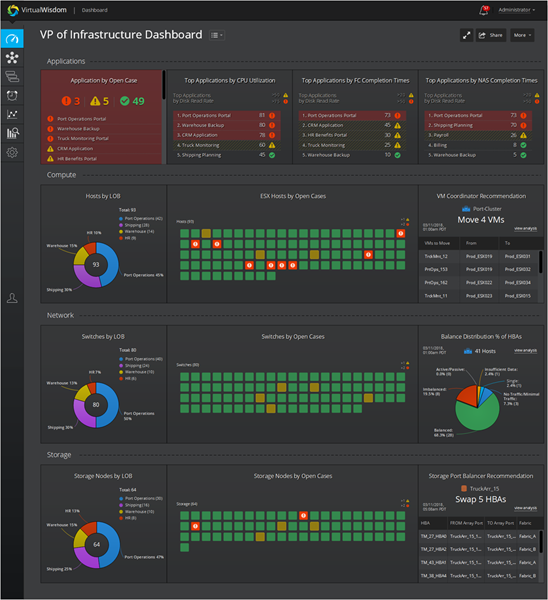
Virtual Instruments has extended the reach of its AIOps platform to add application service assurance, predictive capacity management, workload infrastructure balancing and problem resolution and avoidance capabilities.
Based on a combination of machine learning, statistical analysis, heuristics and expert systems technologies, VirtualWisdom is designed to enable DevOps teams to be able to apply analytics to resolve issues in near real time versus having to convene a “war room.”
Len Rosenthal, chief marketing officer for Virtual Instruments, said the whole war room concept has become antiquated in the age of DevOps. Instead of wasting time having individual departments within an IT organization coming together to defend their innocents every time an issue arises, VirtualWisdom identifies the likely source of the problem instantly.
The latest release of VirtualWisdom adds to that a predictive capability that identify workload balancing opportunities intended to prevent problems from arising in the first place, he added.
As part of an ongoing effort to infuse AIOps into DevOps processes, the latest release of VirtualWisdom also adds integration with application performance management (APM) tools from Dynatrace, in addition to enhancements to existing support for APM tools from AppDynamics, a unit of Cisco.
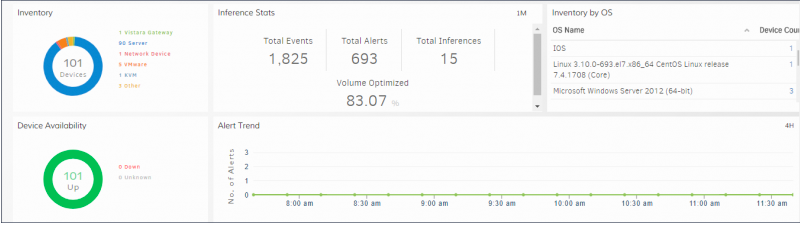
VirtualWisdom is also now able to collect Linux and Windows operating systems along with metric generated on Amazon Web Services (AWS) or Microsoft Azure. There also a now iSCSI wire data monitoring support in the NAS Performance Probe, which complements existing NFS and SMB monitoring capabilities.
Rosenthal said the rate at which applications are being developed and deployed soon will force the AIops issue in most organizations. As those applications become more distributed across hybrid cloud computing environments, it’s become impossible for any single IT team to manually keep track of all the dependencies that could adversely impact all their applications, he noted.
While increased reliance on artificial intelligence (AI) is all but inevitable at this point, it’s less clear to what degree IT organizations themselves will be reorganized as a result. Most organizations have embraced DevOps to bridge the divide between their IT operations and application development teams. But many of the silos within their IT operations teams soon may be automated out of existence as the need for dedicated compute, storage and networking specialists declines. In some instances, developers are already taking advantage of application programming interfaces (APIs) to assume control over IT infrastructure end to end. That scenario may become even more common as AI continues to automate more of the rote IT operations tasks.
None of that means there won’t be a need for someone to architect the IT operational workflows required to support applications at scale. But it does mean many lower-level administrator tasks soon might be sharply reduced or eliminated altogether. The challenge IT organizations soon will face is retraining those administrators to handle tasks beyond what’s possible to automate using AI.
In the meantime, organizations will continue to experiment with AI. Not every organization is comfortable enough with AI to turn over control to what many still view as a “black box” that doesn’t provide any visibility into those processes being automated. But as more of that visibility is provided, it’s now only a matter of time before AI platforms take move control of the IT environment.
Has automation changed the way we perceive interaction with others?
A few weeks back I got an email from an old friend, Jim. Typically, that’s no big deal; I get emails from old friends all the time. Except, in this case, it was different. According to a posting on Facebook, Jim passed away about a year ago.
Another friend who is still among us reports having a similar experience of receiving emails from those who are dead. It’s an eerie event that’s becoming more common. Bad actors hack into a data store and pull up some email addresses, which they blast about nefariously to unsuspecting recipients. It’s a strange, almost morbid experience when you’re on the receiving end.
But it’s gotten me thinking: What does it mean to be alive on the internet? And, more importantly, how much of what we perceive on the internet as a human really is? Jeepers—for all I know, the Facebook post could have been a ruse. Maybe Jim uploaded his consciousness into eternity and he really is trying to make contact. How would I know it otherwise?
Allow me to elaborate.
Technology that Captures the Moment
Mankind has been using technology to represent reality since early caveman figured out how to draw pictures of hunters and animals on the walls of caves. The more real a depiction seemed, the more valuable it was. A sign of significant wealth was having the wherewithal to pay an artist to paint your portrait. The painting passed your likeness onto future generations. Your posterity knew what you looked like. The poor just drifted in away into imageless anonymity.
However, whether you were rich or poor, there was one thing that technology couldn’t do: It couldn’t capture the moment. A painting took weeks, maybe months to complete. And, no matter what, the rendering was an interpretation.
Photography changed all that. It captured the moment, which was a first in human history. And it democratized portraiture. In practically no time at all, it seemed that just about every town and city had a photography studio. Affordable photography made it so images of mothers and fathers could be passed on—future generations had a very clear idea of what great-great-grandma Mary and grandpa William looked like.
Portraits of George Washington left a lot to the imagination. Photographs of Abraham Lincoln left no doubt.
Figure 1: Portraits of George Washington are renderings of the artist’s perception created over time, not in the moment.
Figure 2: Photographs capture a moment in time. Abraham Lincoln in 1858 (left). Abraham Lincoln in 1861 (right).
The first time that 19th century former slave, abolitionist and author Frederick Douglass had his photograph taken was in 1841. By the time of his death, he was the most photographed man in America. Douglass understood the power of the technology both in terms of information representation and dissemination. Photographs of Douglass made his humanity real at a time when a good portion of the population of the United States was deemed subhuman.
Figure 3: Frederick Douglass, born a slave, was the most photographed man in 19th century America. The reality that the technology revealed confirmed his humanity.
The power that photography brought the technological and cultural landscape created trust in the image. The veracity of information in a newspaper article could be argued, but the image the camera captured represented reality beyond a doubt—at least until the practice of doctoring photos to misrepresent reality came into practice.
Reincarnation as Seen on TV
And then came television, which made it possible to represent reality as a stream. Whereas a photograph captured the moment, television captured as many moments as the viewer had to spare. But, it was a trade-off. Television distorted perceptions of life and death. Before TV, no child ever had the experience of viewing an actor portraying a character who died in an episode of “Gunsmoke” one week, only to reappear as another character on another TV show the following week. Death became impermanent. Also, the line between fact and fantasy blurred. The same television screen that brought the nightly news also delivered episodes of “Star Trek.”
In terms of time and space, the only “real” thing is the TV set. Everything else is content. Sometimes you could tag the content as “fact” and other times as “fiction.” Or, you could tag it to a third category, “I’m not sure,” which gave rise to the harebrained idea that the 1969 moon landing really happened in a TV studio at a secret government location.
Now, here’s where it gets really interesting. In the past, most people interacted with others most of the time in close proximity. You went to Grandma’s house for the holidays. You bought your groceries at the neighborhood supermarket. You sat in classrooms under the supervision of one or many teachers for at least 12 years, maybe more.
That was then and this is now.
Today, visiting Grandma for the holiday might be nothing more than a call on Skype. More people are making essential purchases online. The online class is replacing the brick-and-mortar school building.
The fact is, we’re spending a lot of time in an environment that is essentially representational. Every day, more of our interactions with the “world” take place on the screen of a smartphone, tablet or a desktop computer. In some cases, it’s nothing more than talking to a device by name, as in “Alexa, what time is it?”
Is it Human? Does it Matter?
And thus we have the problem of distinction. We’re at the stage now where we’ve come to accept that some of the interactions we have online might be with a human and some interactions might be with a machine powered by AI. Sometimes it’s easy to tell. After all, I know there’s is no miniature person living inside my Echo device. And I know there is no little man inside my refrigerator who turns on the light as I open the door. This is low-hanging fruit; it’s obvious what the machine is. Still, in the long run, how can we tell? And, even if we can’t, does it matter?
These days I have a lot of interactions with people on video conference and on the phone. I estimate that of all the people I interact with regularly, I’ve shaken the hand of about half. Twenty years ago, I physically touched nearly all. Such is the way of progress.
I’ve had the benefit of living in a time in which the person came before the photograph. Now, we live in a time in which the photograph can come before the person. We think up the ideal actor and send it over to the special effects department for rendering. Today, we interact with images that have no human origin and yet behave in a way that is indistinguishable from a human. For those born today, it’s entirely possible that most of the meaningful relationships they have throughout their lifetime will be with non-human intelligence. Yes, there is a good argument to be made that people will still gather together in real time for concerts, religious services and sporting events. But consider this fact: 73,000 people attended the 2018 Super Bowl in a stadium, in real time. However, 103 million watched the event on TV. The “attendance” at the digital representation of the event exceeded the real-time experience by more than a factor of 10. And, companies paid millions of dollars for advertising time during the televised game. Today, that which we perceive as real is just as meaningful as that which actually is real.
Which brings us to life and death in the age of automation. Unless Kurzweil proves right and uploading ourselves to a computerized host becomes possible as the Singularity approaches, all of us will die. And yet the images, both the ones we make and the ones that were made for us, will live on forever. Will these images take on a life of their own? Will we be able to use artificial intelligence to inject these images with the behavior that made us us, using information about us that was gleaned by observing every aspect of the online interactions we had over our lifetime?
I’m not sure. But the possibility has stopped me from replying to that latest email from my friend, Jim. To be honest, I’m afraid of what would happen if I did.
OpsRamp has advanced its case for AIOps via a Fall update to its software-as-a-service (SaaS) applications that adds a Topology Explorer alongside an enhanced set of Service Maps.
In addition, OpsRamp added a cloud database monitoring capabilities for relational databases deployed on public clouds including Amazon Web Services (AWS), Microsoft Azure and Google Cloud Platform (GCP).
Mahesh Ramachandran, vice president of product management for OpsRamp, said the Topology Explorer makes it possible to automate network and application discovery to accelerate impact analysis and troubleshooting. An existing Service Map capability, meanwhile, has been enhanced to allow DevOps teams to invoke visualizations within an alert to better prioritize responses.
OpsRamp has also added a pause capability for alerts, intended to be used during maintenance windows to prevent alert floods. Alert filters now include text-based search that, when combined with the AI Inference Engine, helps resolve issues faster. DevOps teams also can create policies to notify them of alert state changes.
Finally, OpsRamp has added reporting tools that enable DevOps teams to determine not just the amount of resources being consumed on a public cloud, but also which public cloud or on-premises environment is generating the most trouble for the IT organization.
In general, Ramachandran said most organizations have very little way in the way of tools that enable them to realistically compare how one platform performs over another when running specific classes of workloads. By leveraging the machine learning algorithms that OpsRamp includes in its SaaS applications, enough data becomes available to provide DevOps teams with actionable insights, he said.
AI tools typically require access to massive amounts of data. By making available IT operations tools available as a cloud service, OpsRamp is trying to make it practical for DevOps teams to employ AI on both tactical and strategic levels without requiring an IT team to acquire special data science skills, Ramachandran said, adding such an approach also provides the added benefit of making it possible to holistically manage IT silos across multiple classes of infrastructure and applications.
IT organizations are still in the early stages of coming to terms with AIOps and its potential impact on DevOps processes. Many of the manual processes that tend to inhibit widespread adoption of DevOps are clearly going to be automated. In fact, many of those tasks will be accomplished using voice commands that bots will be able to understand. In other cases, the bots will inform DevOps teams when an issue needs to be addressed long before they would otherwise be aware of it. Less clear is how job roles within DevOps teams will evolve as it becomes easier to manage applications and infrastructure comprehensively.
Of course, the rate that transition will occur will vary widely by organization. But rather than debating the right approach to automation, it’s becoming increasingly apparent that many of those decisions will be made by machines. The unspoken assumption being made is that humans responsible for managing IT will be comfortable that the right decisions are being made on their behalf.
WhiteHat Security is now embedding artificial intelligence (AI) into the application security review services it provides, as part of an effort to advance adoption of DevSecOps processes.
Joseph Feiman, chief strategy officer for WhiteHat Security, said the biggest resistance factor to DevSecOps has been the amount of time it takes to test applications for vulnerabilities. By injecting machine learning into that process via a suite of WhiteHat Sentinel Dynamic tools, which are being made accessible as a software-as-a-service (SaaS) application, developers will be more inclined to conduct security reviews as part of an integrated DevSecOps process, he said.
The AI engine identifies vulnerability patterns in a code-based data lake of 95 million identified vulnerabilities that WhiteHat Security has identified via its dynamic application testing service (DAST). WhiteHat Sentinel Dynamic identifies known vulnerabilities in seconds, Feiman said, and any anomalies indicative of potential unknown vulnerabilities are then reviewed by human WhiteHat Security cybersecurity experts.
Feiman said DevSecOps is going through a period of disillusionment because security reviews of code are taking too long. AI technologies represent an opportunity to reignite interest in DevSecOps by giving developers more control over an application security review process that no longer slows down development.
In addition, WhiteHat Sentinel Dynamic enables developers to learn about their potential mistakes without necessarily requiring them to disclose them to the entire DevOps team. Any humiliation a developer might experience is avoided when the developer conducts the security review prior to committing code. IT security teams are still in charge of creating the policies that need to be implemented, but processes associated with implementing those policies make a decidedly shift left to the developer, he said.
Feiman noted that the rise of AI within DevSecOps processes may help alleviate some of the current chronic shortage of cybersecurity expertise. There will always be a need for human cybersecurity researchers to train AI models what to look for as new vulnerabilities are discovered. But algorithms never take a day off or decide to abruptly quit because they suddenly got a better offer.
It may take a while for IT organizations to completely trust AI engines to scan code for vulnerabilities. But currently many applications are not being reviewed at all because any time set aside to conduct that reviews is being eaten up by an application development process that has fallen behind schedule. Too many developers would still prefer to take a chance on a breach than be reprimanded for delivering code late, especially when there’s a chance to address vulnerabilities that might get discovered in the next scheduled release of a patch. WhiteHat Security is making the case for eliminating much of that risk by making it feasible for developers to quietly address vulnerabilities long before an application is deployed in a production environment.
There’s no doubt that AI soon will be employed to automate large swaths of cybersecurity. But it may turn out that the most effective place to apply AI from a cybersecurity perspective early in the DevOps process as possible.
Moogsoft, at a Moogsoft 2018 AIOps Symposium last week, extended the reach of its IT operations analytics software out to where applications are deployed, rather than requiring data to be moved into a Big Data platform.
Will Cappelli, CTO and vice president of product strategy for Moogsoft, said Moogsoft Observe, available in beta, discovers anomalies by applying algorithms where data is generated, versus requiring IT organizations go to the trouble and expense of moving massive amounts of data into a central data lake.
Moogsoft Observe ingests time-series and metrics data in real-time and then applies artificial intelligence (AI) to detect incidents at the source of the problem. The single-agent technology can deployed anywhere, including cloud instances and on-premises systems and applications running containers and virtual machines.
Cappelli noted Moogsoft Observe doesn’t require data scientists to configure it. IT generalists can employ Moogsoft Observe on their own without having to rely on a centrally managed IT operations analytics platform managed by someone else. Moogsoft claims this approach reduces the time to detect a problem by up to 60 percent while cutting nearly 90 percent of the storage and communication costs.
Analytics generated by Moogsoft Observe can then be stored in the Moogsoft AIOps platform to enable IT organizations to run additional analysis against data collected from multiple data sources.
Moogsoft also announced that version 7.0 of the Moogsoft AIOps platform will be available this October. This update adds Vertex Entropy and Situation Topology Visualization, algorithms that enable IT teams to visualize the root cause of an issue via a system topology map. That capability makes it possible to apply algorithms capable of generating contextual analysis that pinpoints the source of issues rather than generating a series of probabilities based on when a set of events occurred, said Cappelli.
Advances in how AI can be applied to automate IT operations are now coming at a rapid rate. Those advances increasingly are becoming affordable for the average IT organization to employ. Most IT teams spend more time trying to determine the source of problem than they do fixing it once the root cause is discovered. AI technologies promise to eliminate many of the rote tasks that IT administrators are required to manually perform time and again, which will make it simpler to manage IT at scale. It also means more IT teams can expect to not have work as many odd hours of the day because fewer things are likely to go wrong. There may never be a perfect IT environment. But IT environments should be a lot more predictably reliable.
Of course, the rise of AI undoubtedly will have a significant impact on the IT staff. Many IT administrators will need to be retrained as more processes become automated. It’s not likely the need for IT administrators will go away anytime soon. But as some tasks become automated, many entry-level IT roles will change dramatically or, in some cases, be eliminated. At this point, those changes are now all but inevitable.