Tag: analytics

  • Red Hat Aims to Push IT Management to the Cloud

    Red Hat Aims to Push IT Management to the Cloud

    Red Hat at the Red Hat Summit 2018 conference this week showed a technology preview of an instance of Red Hat Insights, a predictive analytics IT management application capable of identifying operations issues before they become a problem, running as a software-as-a-service (SaaS) application.

    The instance of Red Hat Insights will be extended to apply analytics to any infrastructure platform. Red Hat plans to eventually make the rest of its IT management portfolio available as a cloud service.

    Joe Fitzgerald, vice president and general manager for management at Red Hat, said the goal is to enable management of virtual machines, container, infrastructure-as-a-service and physical servers all from a single pane of glass.

    Cost analytics also will be embedded in those services, adds Fitzgerald. Cost is now a much bigger issue because cloud service providers bill customers based on actual consumption. Previously, a virtual machine left running on an on-premises server might result in someone being yelled at, but no additional cost, notes Fitzgerald. Now, however, if an IT organization doesn’t turn off those virtual machines, it will end up paying more.

    Fitzgerald noted that management of IT operations is becoming increasingly automated. Red Hat is now adding integrations with the agentless Ansible framework it acquired in 2015 at rate of 50 a week. There already  are 1,600 integrations with Ansible. He said the fact that Ansible presents IT operations teams with a declarative approach to automating IT using YAML files makes IT automation much more accessible. Other frameworks require IT operations teams to learn how to program, which becomes a significant barrier to adoption, but YAML files allow IT operations teams to make use of familiar shell scripts.

    Many organizations now are moving up the IT management curve as applications become more distributed, Fitzgerald said. Every platform they have comes with its own management tools. But the need for a control plane through which multiple platforms can be centrally managed is now becoming more evident, he said, especially as IT organizations realize they will be running many different types of platforms for many years to come.

    Other benefits to shifting IT management into the cloud is that the move eliminates the need to deploy a local server just to run IT management software and all updates to the IT management platform are provided by the applications provider.

    Obviously, Red Hat is not the only IT vendor building a centralized, cloud-based approach to managing distributed computing environments. But as Ansible becomes more widely adopted, the opportunity arises for Red Hat to engage in a broader IT management conversation with IT organizations.

    Most enterprise IT organizations are rapidly approaching something of an IT management crisis. Each platform adopted creates yet another silo that makes adopting integrated DevOps processes even more challenging. While most organizations are not likely to abandon the management tools from the vendors that built those platforms, IT organizations are demanding thet underlying infrastructure exposes an application programming interface (API). In fact, it’s the proliferation of all that software-defined infrastructure that now makes it feasible to centralize the management of IT in the cloud.

    — Mike Vizard

  • VMware Adds Analytics to Automate IT Operations Based on Intent

    VMware Adds Analytics to Automate IT Operations Based on Intent

    VMware is moving to make it easier for organizations to automate data centers and public cloud based on its core hypervisor technology by injecting advanced analytics into its VMware vRealize Suite, enabling them to manage IT environments based on intent rather than having to manually manage every process themselves.

    At the core of those update is the Capacity Analytics Engine, which is being added to version 6.7 of vRealize Operations. Mahesh Kumar, senior director of product marketing for cloud management at VMware, said the capacity analytics engine makes use of Autoregressive Integrated Moving Average (ARIMA) techniques to forecast future system events based on historical data points that identify a long-term trend of sudden spikes in usage. Armed with that data, vRealize Operations can now provide cost analytics that include advice on ways to adjust application size and reclaim idle resources on either a public cloud or inside a local data center. IT organizations can also run “what if” scenarios, Kumar said.

    On top of that capability, VMware is also now adding predictive analytics that enables IT organizations to define a set of intents such as workload balancing to reduce software license cost, prioritize one set of application to maintain a service level agreement (SLA) or make sure certain workloads only run on servers that have been shown to comply with a specific regulation or mandate. Tighter integration between vRealize Operations 6.7 and vRealize Automation 7.4 then can be continuously employed to automate DevOps processes in a closed-loop manner at higher levels of scale without having to add additional headcount, Kumar said.

    In addition, the latest version of VRealize Automation includes more than 120 free, curated blueprints and OVF (Open Virtualization Format) files out of the box. VMware has teamed with Bitnami to add 20 new blueprints and 100-plus new OVFs of applications and databases including GitLab, Hadoop, Jenkins and MongoDB to speed application development and deployment. VMware also updated the Custom Form Designer and added multitenancy capabilities.

    Finally, VMware vRealize Operations is sporting a new user interface and integrates with VMware Wavefront monitoring software.

    Longer term, Kumar said vRealize Operations will be where VMware applies machine learning algorithms to enable artificial intelligence (AI) models to automate the management of VMware environments.

    Collectively, Kumar said the VMware vRealize Suite moves IT organizations that have standardized on VMware in both their local data centers and in the public cloud much farther down the DevOps maturity curve. In effect, VMware vRealize Suite creates an “easy button” for managing complex VMware environments spanning multiple clouds, Kumar said.

    VMware is also betting that AI models will make it a lot easier for organizations to make a cultural adjustment as the management of compute, storage and networking becomes more unified. It’s not clear how long it will take for those machine learning algorithms to manifest themselves in VMware management software. But it’s clear most IT organizations running VMware soon will need to rethink who is responsible for running what inside an IT operations team.

    — Mike Vizard

  • Sauce Labs Adds Analytics to Continuous Testing Platform

    Sauce Labs Adds Analytics to Continuous Testing Platform

    Sauce Labs has added additional debugging and analytics capabilities to its testing platform to make it easier to manage continuous testing across multiple application development projects.

    Lubos Parobek, vice president of product at Sauce Labs, said DevOps teams need to prioritize which bugs to address first across multiple development projects occurring simultaneously. In fact, according to the latest annual survey of 1,091 technology professionals conducted by Dimensional Research on behalf of Sauce Labs, DevOps teams on average are now taking longer to address bugs. These days there are many more issues that require debugging across multiple development projects, which is overwhelming DevOps teams, who must then prioritize some debugging requirements over others.

    Specifically, the survey found only 21 percent of respondents report they fix bugs immediately, down from 23 percent in 2017.

    Analytics capabilities included in Sauce Labs’ rechristened Continuous Testing Cloud include the ability to view test results by browser and operating system, visibility into pass/fail and error trends and the ability to see how a single test behaves over time so DevOps teams can more easily identify tests inconsistent with overall test run time and pass/fail rates.

    Scheduled to be available in the second quarter, the Continuous Testing Cloud makes it possible to more easily reconcile advances in the rate at which applications are being developed and constrained testing and debugging tools, Parobek said.

    The Sauce Labs survey results also show progress being made in the realm of mobile application testing. A full 77 percent of respondents said they now use a mix of both real devices and simulators or emulators for mobile testing, up from 34 percent in 2015. That approach results in higher fidelity to the actual experience of an end user on each device, said Parobek.

    That shift, however, may also explain why there is more manual testing. More than half (56 percent) said they do as much or more automated as manual testing, a minor decrease from 59 percent (2017) and 60 percent (2016), the report found. Just under half (45 percent) said they do, however, expect to increase spending on test automation in 2018.

    Parobek said organizations are moving into what he describes as the third era of testing. The first two eras were manual testing followed by a shift to automated testing. The third era is marked by continuous testing that leverages automation to make it possible to test code as it’s being developed rather than after, when the application is complete.

    Naturally, each organization is not as far down the path toward continuous testing as every other. Parobek said for the most part, early adopters of DevOps practices employ continuous testing more widely than traditional enterprise IT organizations that are still in the early stages of embracing DevOps. The good news is the latter have an opportunity to leverage a much larger body of DevOps best practices than the organizations that originally pioneered the concepts.

    — Mike Vizard

  • SolarWinds Acquires Loggly to Add Analytics to DevOps Portfolio

    SolarWinds Acquires Loggly to Add Analytics to DevOps Portfolio

    An ongoing SolarWinds effort to drive down the cost of implementing DevOps has been extended by acquiring Loggly, a provider of log analytics software provided as a cloud service.

    Christoph Pfister, executive vice president of products at SolarWinds, says the Loggly service rounds out a portfolio of DevOps offerings spanning application and infrastructure monitoring, website monitoring and log management software.

    In keeping with the company’s overall DevOps strategy, SolarWinds will provide access to Loggly at substantially less cost than rival log analytics platforms such as Splunk, Pfister says. Pricing for the Loggly service starts at $99 per month. In contrast, other log analytics platforms charge IT organizations based on the amount of data being analyzed, which results in many of them limiting the amount of log data they analyze because of cost concerns.

    IT organizations have been making major investments in log analytics to more proactively discover anomalies indicative of either potential application performance issues or security breaches. The more log data being analyzed, the more accurate the analytics being applied to those logs becomes. The goal should be to make data science capabilities as broadly available as possible, says Pfister.

    Next up, Pfister says SolarWinds will be working on unifying the user interface experience between Loggly and the rest of its DevOps portfolio. In addition, SolarWinds is examining whatever opportunity there may be to bundle various cloud services together in a single suite of offerings, says Pfister.

    Log analytics has emerged as a foundational component of both DevOps and, by extension, digital business transformation. Developers are keenly interested in being alerted to events that might have a potential impact on their applications before they occur. IT operations teams, of course, are relying on analytics to enable them to be more proactive when it comes to making sure IT infrastructure resources are continuously available. At the same time, business users are discovering that log analytics can provide them insights into events that are indicative of how, for example, end users are employing new capabilities that have been added to a website.

    While most IT administrators have a lot of experience hunting through logs looking for specific events, the sheer volume of data in those logs prevents most of them from gleaning anything that approaches actionable intelligence. Advanced analytics applications provide the means through which all the log data being collected becomes more valuable to the business.

    As it becomes more affordable for more IT organizations to apply monitoring and log analytics, the number of IT organizations embracing DevOps practices should increase. Having access to tools, of course, is only one part of the equation. But most organizations wind up backing their way into DevOps, starting with tools that provide them additional capabilities and insights. Once they master those tools they begin to apply the knowledge and insights they gain to implement more sophisticated DevOps processes. For many IT organizations, however, the cost of acquiring those tools to get started down the path to DevOps has simply been too high.

    — Mike Vizard

  • Gartner: Digital Business Driving Spending

    Gartner: Digital Business Driving Spending

    With half the year gone, Gartner just revised its 2017 worldwide IT spending projection up 1 percent to 2.4 percent. That may not sound like a lot, but last year’s IT spending growth was effectively flat at 0.3 percent. It isn’t just the uptick in the overall spending level that’s interesting, it’s how Gartner predicts the money is being spent. It sees the move to digital business and the related adoption of new technologies such as internet of things (IoT), blockchain and smart machines as a growth engine that’s creating new potential reasons for spending.

    “Digital business is having a profound effect on the way business is done,” said John-David Lovelock, vice president and analyst at Gartner. “The impact of digital business is giving rise to new categories; for example, the convergence of ‘software plus services plus intellectual property.’ These next-generation offerings are fueled by business and technology platforms that will be the driver for new categories of spending. Industry-specific disruptive technologies include the internet of things in manufacturing, blockchain in financial services (and other industries), and smart machines in retail. The focus is on how technology is disrupting and enabling business.”

    Worldwide, Gartner is forecasting that the enterprise software market will be the highest growth segment of IT spending—7.6 percent growth in 2017 from 5.3 percent in 2016. (Device spending is also up markedly in the report.) Enterprise software will be one of the keys to driving and controlling revenues derived from digital business advances.

    Takeaways for senior IT leaders: Digital disruption is the probable stick slowly driving the adoption of digital business. The carrot is innovation. This is putting it too simply, but it’s true: Disrupt or be disrupted. And just because many of the high-profile digital disruptions have been business-to-consumer, don’t think you’re safe in the business-to-business sector, either. As this plays out, probably over the next five to 10 years, a lot more companies are going to be burned and a lot more companies are going to be made. You can no longer laugh this off as a buzzword.

    It starts with analytics, preferably sifting through meaningful big data. Digital business is rewriting business process and the way data is collected, interpreted, moved and consumed in profound ways. That could make your analytics easier to implement and analyze. But if you don’t have a major business analytics upgrade just rolling out, you’re flying blind.

    Ride the wave, but as you adopt new cloud-based services and enterprises apps, there’s a potential for management complexity to trip you up.

    “With the increased adoption of SaaS-based enterprise applications, there also comes an increase in acceptance of IT operations management tools that are also delivered from the cloud,” said Lovelock. “These cloud-based tools allow infrastructure and operations organizations to more rapidly add functionality and adopt newer technologies to help them manage faster application release cycles. If the I&O (infrastructure and operations) team does not monitor and track the rapidly changing environment, it risks infrastructure and application service degradation, which ultimately impacts the end-user experience and can have financial as well as brand repercussions.”

    — Scot Finnie

  • Intelligent DevOps for New Age Digital Systems

    Intelligent DevOps for New Age Digital Systems

    Transforming DevOps by leveraging the power of analytics and autonomics

    In a previous blog, I have written about how Quality Assurance is getting transformed to Quality Intelligence using the power of big data analytics and autonomics.

    In this blog, we will discuss how DevOps solutions of the future can become more intelligent by taking advantage of these same emerging digital technologies such as autonomics and analytics.

    Technologies such as predictive analytics, autonomic computing (autonomics), artificial intelligence and robotic process automation (RPA) are already driving unprecedented levels of automation in many other businesses. Combined, these three technologies are driving the next generation of automation—what is commonly referred to as “intelligent automation.”

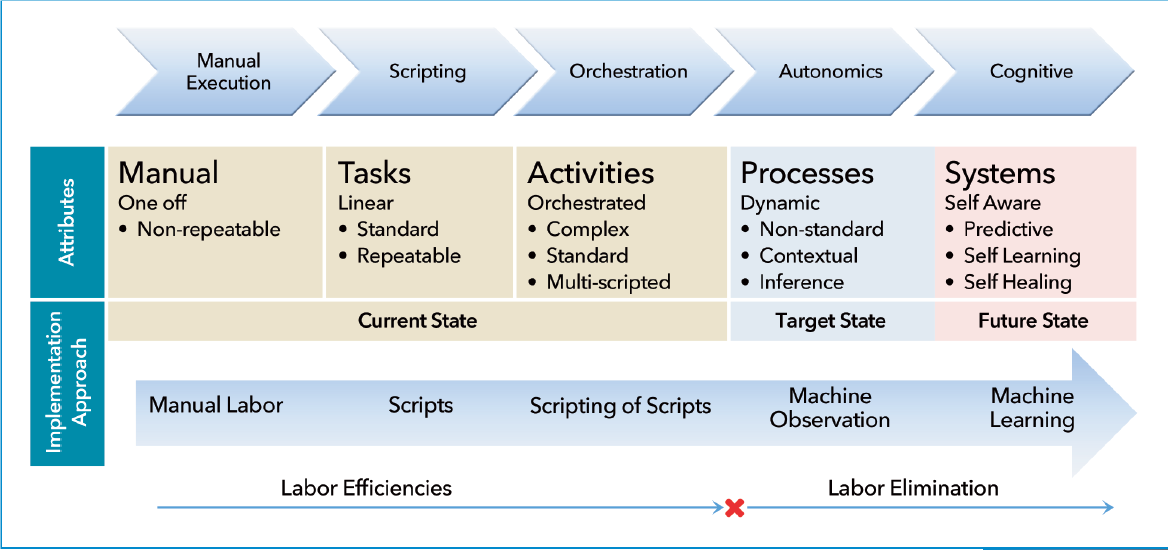
    Intelligent automation goes beyond basic automation and orchestration of manual tasks to incorporate adaptive self-learning—leading to fully autonomous systems. The figure below (courtesy IRPA) illustrates the evolution of automation as it moves toward full autonomy. The Google car (and other similar solutions) is a great example an intelligent automation system, capable of learning from its environment and adapting behavior accordingly.
    Automation in Traditional DevOps

    Digital systems are driven by new age technologies such as social, mobile, big data, analytics, cloud, internet of things (IoT), artificial intelligence, augmented and virtual reality, genomics, etc.  These technologies introduce significant change and complexity to how modern systems are built and deployed. Businesses that leverage these technologies to transform themselves into cognitive enterprises demand new and intelligent approaches to the underlying processes and techniques to support them. Such processes and techniques need to be more than agile; they need to adaptive and capable of reacting dynamically to frequently changing circumstances.

    Let’s look at some examples of current DevOps techniques and how they will need to evolve to support dynamic digital systems. Automation within traditional DevOps solutions is generally limited to scripting and orchestration as shown above.  Automation adoption levels vary, due to various reasons ranging from complexity to skills and organizational challenges. Maintenance of such scripts is itself sometimes a bottleneck, as applications and environments change rapidly, the scripts need to be updated manually and often become obsolete. New age agile digital businesses, by contrast, demand automation that is able to adapt dynamically and self-heal on demand.

    Further, classic DevOps automation techniques are typically driven by static predefined rules. For example, the criteria for promotion of an application build through different stages of the pipeline is often statically defined. This is a limitation for new age systems where the criteria needs to be dynamic and may vary depending on multiple circumstances. The automation system needs to able to look at past data, keep learning from current data and make adaptive intelligent predictions about the right course of action.

    DevOps for internet of things (IoT) systems is very different than that for traditional software systems. The target environment for production deployment in consumer IoT is geographically dispersed, typically not configuration controlled, may have unreliable network connectivity and may even be fragile. Further, IoT systems generate huge amounts of data that necessitate robust data mining and self-learning (adaptive) techniques not provided by traditional lifecycle automation tools.

    Similarly, customer experience (CX) is a key new metric for digital systems that transcends traditional DevOps metrics such as release velocity and quality. CX data is unstructured, fuzzy, voluminous and volatile. CX-driven DevOps (or CX-Ops) is an emerging discipline that requires big data analytics and cognitive approaches (such as natural language processing or NLP) to decode meaningful insight from such data.

    Hence, as digital enterprises evolve and businesses demand greater agility and flexibility, the DevOps function to support such systems will need to transform as well.

    Next-Generation Intelligent Automation Landscape

    Before we jump into what intelligent DevOps would look like, let’s first look at the different types of automation systems being adopted in the industry in general. The following types of automation are described as part of the “intelligent automation continuum”:

    • “Systems that Do”: These are basic automation systems that replicate human keystroke actions and static (pre-defined) rules-based activities. They also take advantage of descriptive analytics that reflect past trends and patterns. Examples of such systems include speech and image recognition.
    • “Systems that Think”: These use algorithms and intelligence to find meaning in data, handle judgment-oriented tasks using diagnostic analytics and make recommendations based on patterns. Examples of such systems include natural language processing and recommendation engines (such as email spam filters).
    • “Systems that Learn”: These understand context, interpret and dynamically adapt based on circumstances; they typically leverage predictive and prescriptive analytics to solve problems independently. Examples of such systems include self-driving cars and neural networks.

    A Peek at Intelligent DevOps

    So, what would transformed intelligent DevOps look like? Intelligent DevOps automation would take advantage of cognitive and autonomics systems to enable smarter adaptive lifecycle automation based on analytics. In my previous blog, I discussed how QA can take advantage of big data analytics. Intelligent DevOps, to a large extent, depends on such capability.

    Based on the above model, let’s look at the different types of DevOps automation we can create:

    DevOps Systems that Do: This includes traditional DevOps automation systems (e.g. for continuous integration and testing, continuous deployment), as well as pipeline lifecycle automation that are based on static rules (e.g. traditional release management automation)

    DevOps Systems that Think: This includes advanced automation systems such as:

    • Automated automation systems, for example, generation of automated test cases from manual tests (or test models) using NLP, generation of virtual services based on request-response data logs
    • Self-healing automation, for example virtual services (or test scripts) that can auto-update based on change in application endpoints (or behavior)
    • Monitoring of IoT systems, for example “smart homes,” which require continuous use of diagnostic analytics to mine huge volumes of data to understand failure modes and prescribe recovery techniques
    • Automated verification of system requirements based on customer experience analytics
    • Automated generation of test scenarios based on analytics on production logs

    DevOps Systems that Learn: This includes sophisticated test automation systems such as:

    • Adaptive continuous delivery pipeline—Learning systems that analyze past data to manage the pipeline based on dynamic rules. For example, correlate code quality and defect detection and slippage patterns to dynamically decide what tests to be run and what gates to be enforced (vs enforcement of statically defined gates) for different teams and products for promoting application builds
    • DevOps process optimization based on insight across the life cycle. For example, correlation of production log data with past code change data to determine the level of failure risk in different application modules. See more on this in the section below.

    We embody the evolution to intelligent DevOps in CA’s maturity model (shown below), which also aligns with the RPA maturity model described above. Beyond the continuous maturity level, Intelligent DevOps is the driving force behind continuous optimization and improvement.

    Cross-Life Cycle DevOps Intelligence

    Intelligent DevOps enables us to perform process optimization based on analytics from data correlated across the system life cycle, from planning through operation. Each process area generates a great amount of data that is typically analyzed within the process (and sometimes organizational) silo.

    While such analytics is useful in itself, correlation of data across these process areas (see figure below) may be used to provide a wide variety of intelligent lifecycle insight (and process improvement possibilities), such as:

    • Correlating configuration data analytics with code change and defect analytics helps us pro-actively identify failure modes related to code and infrastructure changes.
    • CX analytics (from the Operations process) can be used to validate requirements in the plan and define processes
    • Production log analytics may be correlated to test log data to identify missing test cases
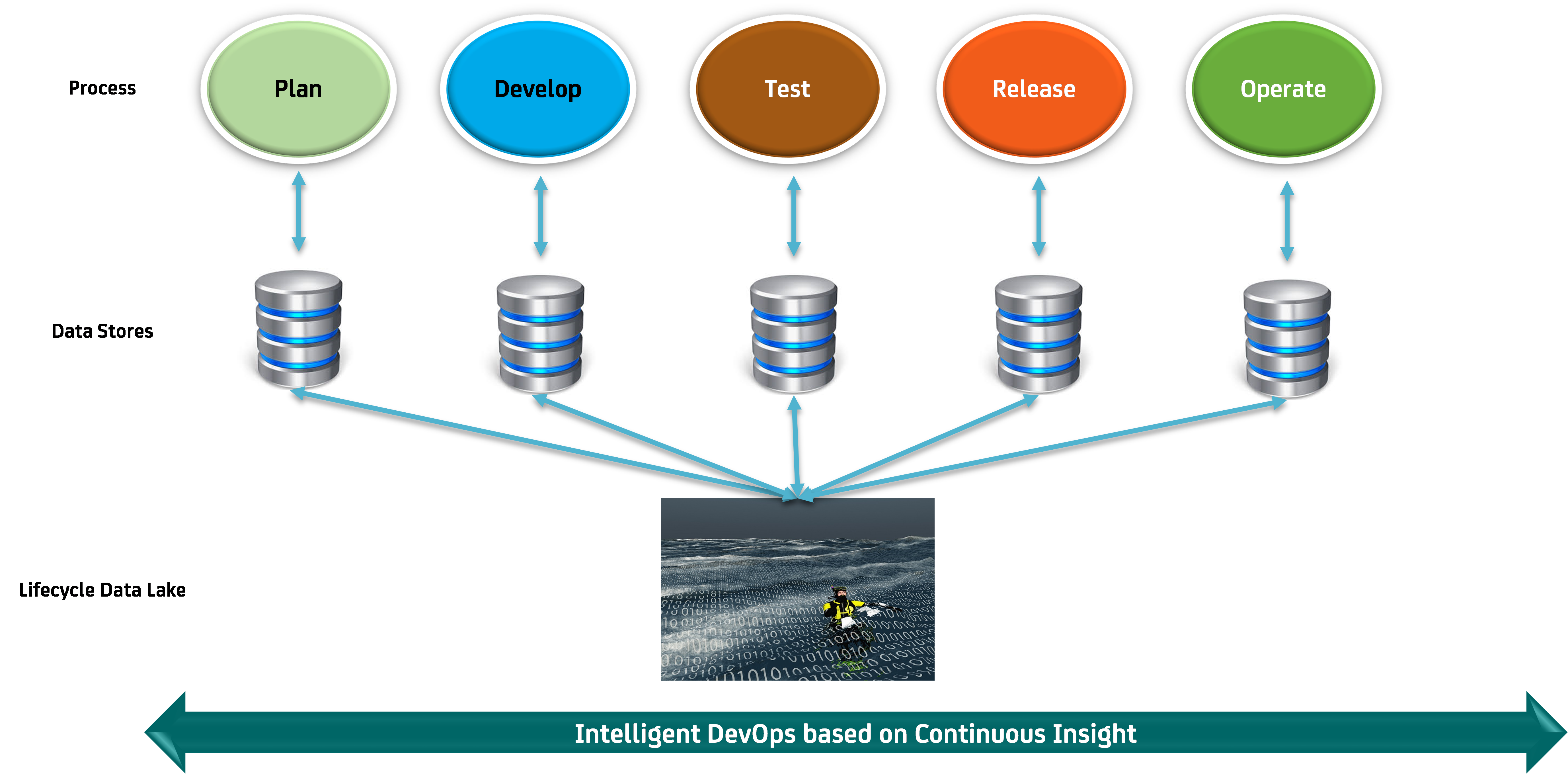
    In the spirit of the “Continuous Everything” philosophy in DevOps, we envision a new solution stream around “Continuous Insight” where analytical insights are generated and acted upon continuously (and autonomously) as processes execute.  We will discuss more on the subject of Continuous Insight in a future blog.

    In conclusion, we believe that intelligent approaches described above will be infused into every aspect of DevOps going forward and revolutionize the way DevOps is performed. Stay tuned my friends, and may all our DevOps be intelligent!

    — Shamim Ahmed

  • The Big Digital Transformation Trends Through 2017

    The Big Digital Transformation Trends Through 2017

    For a number of years now, the enterprise has been well underway in their digital transformation efforts, as they use data analytics, mobile, cloud services, IoT and other technologies to transform their organizations. But while some companies have embraced digital transformation, others have lagged. They’ll be playing catch-up in 2017, while their counterparts will be busy improving and accelerating processes where they can and building upon what has been achieved.

    Based on my interviews in recent months with CIOs, chief digital marketers and chief digital officers, here are a number of big trends in digital transformation that I see in the year ahead:

    Some CIOs continue to struggle to shake role as IT plumbers

    As enterprise digital transformation continues, even accelerates, those CIOs who focused on keeping the lights on through ensuring the infrastructure and services were in place to keep data available rather that on driving digital initiatives forward will continue to see their relevance diminish.

    Those who will lead forward with increased relevance will be the CIOs who focus on new ways for their organization to better support the business with the technologies they need to succeed and partner with the business units, rather than just provide the technological infrastructure for them to do it themselves.

    Business alignment with IT remains a challenge

    If you are a reader of devopsy.kinsta.cloud, you know alignment between the business and DevOps is crucial for enterprise success. In other words, IT leadership must deliver the technology the business actually needs and wants. Seems obvious and straightforward. And it is. It’s just proven to be a not very easy thing to accomplish.

    According to the Deloitte 2016 – 2017 Global CIO Survey, the “business expectations of IT and IT capabilities are out of sync in several areas, including customer focus, technology-enabled business growth, and business innovation. For example, even though 57 percent of the CIOs surveyed said that customers were their organization’s top business priority, less than half were involved in delivering customer experience (45 percent) or working on customer acquisition, retention and loyalty (44 percent).”

    That’s interesting enough. But the survey results got even more dismal: “Even though 78 percent of CIOs said that strategic alignment of IT activities with business strategy was critical to their success, only 5 percent said it was a leading-class capability in their IT organization.”

    CIOs that want to not only thrive but—at the very least—survive are going to need to close this alignment gap.

    Bimodal IT gains more traction

    The concept of bimodal IT is a controversial one. Essentially, bimodal IT is a descriptor from the research firm Gartner that remarks how IT organizations have a need for both agile delivery of technology services and traditional delivery modes. In the Gartner model, so-called Mode 2 teams are focused on DevOps and agile delivery methods, while Mode 1 teams focus on delivering the more established applications in traditional and more predictable ways. A brief explanation of these terms from Gartner is available here.

    Also, according to Gartner, nearly 40 percent of CIOs are currently practicing bimodal, with the majority of CIOs saying they will embrace bimodal sometime in the next three years. This signals to me that the proof of bimodal success is coming in and more enterprises will continue to follow.

    The trend toward Citizen Developers increases

    More enterprises in the year ahead will embrace the so-called citizen developer to provide some of the apps enterprises need. According to the QuickBase State of Citizen Development Report, 75 percent of those enterprises surveyed said that they develop more than three-fourths of the app and leave the “last mile” to the citizen developer. And, not surprisingly, most (65 percent) are building apps to get work done, while 42 percent build apps to run the business and 27 percent build apps targeting customers.

    “These citizen developers can go a long way to help clear the application backlog. Per the report, 29 percent have seen a 2X or more increase in application development speeds. Over three-quarters or 76 percent of respondents cited operational efficiencies as the primary reason for using the platform. And a whopping 62 percent of Citizen Developers responded that it takes less than two weeks for them to complete an application, on average,” QuickBase’s John Carione wrote in this blog.

    With increased demand for more mobile and web-based apps, and the ease with which many of these apps can be started using low-code and even no-code platforms, I fully expect more enterprises to find ways to encourage citizen development within their organizations.

    CMOs, others outside traditional IT, continue to drive more IT budget

    This trend has been underway for some time now, and I fully expect it to not just continue but accelerate. As was discussed in Sarah White’s story, “As CMOs Start to Outspend CIOs, Collaboration Remains Key,” “marketing has a growing influence on technology spending, with CMOs slated to spend more than CIOs by the year 2017. In fact, companies reported that 25 percent of their annual budget was spent on digital marketing efforts in 2014; and out of those companies, 51 percent plan to increase digital marketing budgets in 2015.”

    As that continues, that means marketing is going to have a larger say in what technology services and platforms get investment in the year ahead. CIOs in organizations where the chief marketing officer is getting more and more budget will need to partner to stay relevant.

    Digital transformation accelerates

    According to this Digital Transformation Survey, a surprising 70 percent of c-suite respondents believe they are ahead, or way ahead, of others in their digital transformation initiatives. Compare that to only 30 percent of those in the line-of-business and other employees who believe the same.

    For whatever reason, those in the c-suite are suffering from some form of cognitive disconnect when it comes to their digital transformation efforts. In the year ahead I think more c-level executives will see the reality of their digital transformation efforts and get to work on mobile and IoT and putting data analytics to better work.

    — George V. Hulme

  • Evolving Data Requirements in Multi-Cloud Environments

    Evolving Data Requirements in Multi-Cloud Environments

    By design or by accident, multi-cloud is a reality that most enterprise IT teams have to cope with today. Multi-cloud (or, cross-cloud, as Dell EMC calls it) refers to an IT model where an organization uses services of one or more public cloud service providers, sometimes in addition to using its own data centers. In a multi-cloud model, different clouds may be used in different stages of the application life cycle such as test/dev and production, and for different types of applications such as traditional structured applications and next-gen cloud applications. Nonetheless, IT leaders face challenges in identifying data management tools they need to embrace the multi-cloud environment to improve application agility, reduce operational hassles and enhance application resilience. In this blog, I will discuss how enterprises are using a multi-cloud model and the requirements it places on next-generation data protection products.

    One common reason for multi-cloud is to support geo-replicated applications to enable global reach of e-commerce organizations. In such a scenario, a production database may reside on a private cloud behind an enterprise firewall and replicated to multiple regions in a public cloud to service reads (i.e. consumers are shopping on these e-commerce sites) from different regions at low latency. Such a configuration also protects against disasters at the data center level because the database and application are replicated to public cloud (with multiple availability zones).

    Another use case is to service the requirements of production environment versus test and development environments using different clouds. While security, control and performance optimization may mandate a production environment to stay within a private data center, agility, access to new capabilities such as Google BigQuery and developer preferences may drive application development teams to use a public cloud service providers.

    Finally, using a multi-cloud model could also be driven by the IT strategy of an enterprise to prevent overdependence (or, vendor lock-in) on any one public cloud service provider. To hedge the risks and get leverage, an enterprise may balance its application workloads across multiple cloud providers—for example, deploy Tier-1 applications on one cloud and Tier-2 applications on another. It is a real phenomenon we are seeing with enterprise customers! However, a multi-cloud model presents the following unique challenges to enterprises.

    • Data protection in multi-cloud environment: Legacy data protection (backup and recovery, archiving, replication) products were architected for on-premises environments and optimized to work with legacy applications. Using legacy backup and recovery tools for next-generation applications in a public cloud environment is equivalent to fitting a round peg in a square hole. For one, legacy products don’t leverage the elastic and scalable compute and storage that is available in public cloud. True infrastructure-independent (software-only and elastic compute-based) data protection products that may be deployed in heterogenous environments are required as enterprises look to migrate applications to the cloud.
    • DevOps agility: Moving data across clouds for disaster recovery or to refresh test & development environments with production data is another key requirement for enterprises. Doing so in a multi-cloud environment is not an easy task given the challenges in moving data over the WAN. There are also differences in configuration between test/dev and production environments. Further, the test/dev environments may not be as large as production environment so sub-sampling is required. Finally, personally identifiable data needs to be masked before it leaves the production firewall.
    • Ease of management and governance: Finally, federated management is required for applications and workloads running across multiple clouds. It is extremely inefficient to get familiar with different management tools and their intricacies.

    This is by no means a complete list. There are several other requirements, such as support for cloud storage with consistent performance, handling of identity access and management processes and so on. The point is that data protection needs to be re-thought in the context of multi-cloud environments.

    — Shalabh Goyal

  • End-User Analytics: A Reality Check to SLAs

    End-User Analytics: A Reality Check to SLAs

    Everyone understands that a great user experience is vital for customers, but few organizations give the same level of consideration to their own employees. This lack of insight into the internal end-user experience leads to frustration, inefficiency and waste. Detailed analysis can lift the curtain, exposing the gap between your service level agreements (SLAs) and the reality of your current systems and software.

    Some of your employees may have more applications than they really need, while others may lack the tools to do their job effectively. It’s also likely that some of your employees are making do with outdated software that’s no longer fit for purpose. Before you can set about changing that, you must gain an understanding of the overall picture.

    What does your user experience look like?
    Many organizations will have trouble answering this question. They may not know how many applications they have, which ones are being used, and how well they’re performing.

    The rise of shadow IT—and the fact that 40 percent of spending no longer controlled by the IT department, according to Gartner’s “How to Manage the IT Budget Wisely Through Cost and Value Optimization,”—are further muddying the waters.

    To determine your company’s user experience, ask yourself the following questions:

    • How many users do you have, and how are their roles defined?
    • What devices are accessing your systems on your daily basis?
    • Where are all the access points located?
    • What content is being accessed?
    • What applications are being used?

    By trimming the unused apps and consolidating common apps through a virtualized XenApp or similar environment, you can redirect resources to focus where they can deliver the greatest benefit.

    SLAs are failing
    It may be tempting to take the SLA model and apply it internally, but SLAs are too simplistic and one-dimensional to deliver the insight that’s required here. Cloud service providers might focus on availability and uptime, but what do those metrics tell you about performance? Issues such as slow-loading pages usually aren’t included in the metrics, but they really should be if you want to assess the user experience.

    There’s also a trust issue here. Can you validate that your service provider is meeting expectations? What about security? Relying on provider self-reporting and a set of metrics that don’t reflect accurately the performance or the user satisfaction with the platform or application are inadequate if you really want to understand what’s going on and act to improve things.

    End-user analytics
    You need insight to real-time and historical data on all your hardware, users and applications across multiple environments inlcuding traditional, mobile and virtual. Good end-user analytics will flag security risks and suspicious behavior, record when an application hangs or crashes, and identify whether specific issues are widespread or localized. Records should be comprehensive enough that you can audit areas of concern and run root cause analysis to find ways to improve. Turn your end users and their devices into roaming sensors, which paint a factual view on usability and performance.

    Finding out how your employees really work is invaluable insight that can streamline many emotional conversations. Finding out what applications and devices they’re using—and how they’re using them—can unlock many potential benefits for different areas of your business. You can ensure costs are kept down and you maintain regulatory compliance while maximizing agility. A fresh insight into risk and productivity will help you to make informed business decisions.

    The end user knows best
    The only real measure of software quality that’s worth its salt is end-user satisfaction. Forget about what applications have been designed to do; forget about developer and service provider promises that don’t include an end-user analytical strategy. Cut to the chase and look at what’s actually happening; analyze every user session and employ business intelligence to extract actionable insights that will have a tangible impact.

    Give users the flexibility they want and the tools they need to do the best job possible. Happy and productive staff are the foundation of a good business. Seek out service providers that provide transparent end-user analytics; this will develop a foundation of trust and collectively you can provide guidance based on factual performance. Hone in on boot times, application performance or network speed: You dictate the metrics that are important to your business and metrics that make a difference to your customers.

    By acting without analyzing and putting your faith in SLAs, you’re basing the company’s future and its future path on pure guesswork. With end-user analytics, you can find out exactly what’s actually needed and ensure that you’re on the right track.

    About the Author
    crop_Nicholas Lee of FujitsuNicholas Lee is head of Global Digital Programs for Fujitsu, the Japanese information and communication technology company.

  • Wix requires visibility, and insights are the key

    Wix requires visibility, and insights are the key

    One of the key tenants of the DevOps principle is that your environment has to be prepared for anything. If your shiny modern delivery chain does not support the adoption of new DevOps tools, or does not help you learn, and iterate, then it will ultimately fall into the same category of solutions as Waterfall, and will be on a clear path to Legacy.

    (more…)