Tag: AIOps

  • It’s Time to Take a Customer-First Approach to AIOps

    It’s Time to Take a Customer-First Approach to AIOps

    Artificial intelligence for IT operations (AIOps) has several use cases that IT operations managers can’t deny: reduce alert noise with statistically significant outcomes (up to 80%), correlate alerts and events to uncover the critical business issues immediately, analyze data across environments to find root causes and resolve routine issues (like patching) automatically. Gartner predicts that large enterprise use of AIOps tools to monitor applications and infrastructure will rise from 5% in 2018 to 30% in 2023.

    I’ve been working in the AIOps field for a few years now, and I’ve learned that many organizations, even with relatively modern IT operations management (ITOM) software, are behind the curve. Vendors keep releasing new algorithms, yet the original ones are barely being used or worse, still sitting on the shelf in the customer’s environment. This is because it can be difficult to understand when and how to use artificial intelligence (AI) tools in the daily workflow, and because IT professionals may not inherently trust (or even want) machine-driven recommendations and actions. 

    AI and machine learning technologies are upending traditional assumptions and conventions in many industries – and IT is no exception. In the land grab to bring to market the latest sensational AIOps capabilities, vendors have unwittingly deprioritized customer adoption. This has resulted in a chasm: The technology is getting ahead of the customer’s willingness and ability to implement these solutions in their production environment. 

    The feature-first perspective in the software industry is nothing new, yet for AIOps to reach its full potential, it’s time to take a customer-first perspective.

    Let’s walk through a few ideas to minimize barriers to adoption and speed up time to value for AIOps:

    Start on Adoption During Build

    Machine learning developers and product managers need to understand potential customer barriers during the design and test phase and put themselves in the user’s shoes. How will an individual interact with the system and what level of transparency is appropriate to ensure a frictionless experience? This is a best practice for any software development team, but given the mystique of AI software, it’s even more important. Document expectations for the user experience by giving users early access to the software, such as a beta program, where they can freely deliver feedback on UI, workflows and outcomes of AIOps features.

    Connect the Dots with Visualizations

    A significant barrier for any machine learning application is that users may not fully understand the use cases nor trust what the algorithms are doing. Ensure that software-driven actions and recommendations are transparent at the moment and location they occur in the application. It should be easy for users to see the cause and effect of machine-driven actions as well as how the AI reached a conclusion.

    The concept of “explainable AI” has become popular in the last year and vendors can help by introducing visualizations into their tools.  For instance, you could have graphs showing the progression of a model being trained or the learned sequences in alert correlations. In-app simulation tools can help a customer see the impact of an AI-delivered recommendation without actually making the change.

    Amp Up Training

    Create internal-facing white papers or videos to demonstrate the workings behind algorithms to your technical staff and tools especially designed for users. The best way to learn is by doing, so designing visual cues and tutorials within the application will be most effective. Ensure that you have dedicated AIOps subject matter experts who can guide customers through implementations and be on call for advice as needed. Common questions include, when should the AI be allowed to automate an action or decision and how can you override an automated decision? It’s not a bad idea to involve machine learning developers in creating training sessions and guides. Finally, the age-old concept of nurturing power users within the customer organization can go a long way.

    Diffuse Concerns Over Jobs

    Nobody wants to use a new technology which might eventually replace them. For the most part, AIOps is not going to jettison IT operations staff. Instead, AIOps will empower operations and support teams to handle increasing alert volume and complexity with existing staff, while ensuring that expensive engineers such as SREs can focus on higher-level data performance analysis and optimization initiatives.

    Design Algorithms for Flexibility

    Machine learning algorithms break if they cannot respond to the dynamic nature of modern workloads. For instance, if you design the algorithm based on rules dictating actions between specific applications and infrastructure components, what happens when those technologies disappear or are replaced, as they often do in the cloud? Now you’ve got gaps that could result in a catastrophic system failure and an AIOps tool that requires heavy maintenance. Algorithms should be responsive to environmental changes – such as incorporating neural net technology that can adapt to the shifting sands of the IT landscape.

    A survey conducted in April by OpsRamp found that nearly 70% of IT operations leaders plan to invest in AIOps to improve incident diagnosis, troubleshooting and resolution. By all accounts, the year 2020 has raised the bar for IT expectations around resiliency and user experience. AIOps promises to be a pivotal strategy for IT operations success, but it all depends upon user satisfaction and adoption of the technology. Vendors that incorporate customer adoption and value tactics into their development processes will be instrumental in pushing this market forward in a positive way.

  • Cloudian Adds Object-Based Storage Platform Monitoring Tool

    Cloudian Adds Object-Based Storage Platform Monitoring Tool

    Cloudian today added a monitoring and observability tool to its object-based portfolio of appliances for storing unstructured data in on-premises IT environments.

    Jon Toor, chief marketing officer for Cloudian, said HyperIQ provides access to analytics and health checks that enables predictive maintenance, enhances security and optimizes storage utilization. Cloudian is also pledging to extend the reach of HyperIQ in the future to other IT infrastructure via connectors.

    HyperIQ comes in the form of a virtual machine that IT teams download and install on-premises. A free HyperIQ Basic version comes with pre-configured dashboards. HyperIQ Enterprise comes with support and access to more advanced analytics features and is licensed by capacity at 0.025 cents per GB per month.

    Cloudian is also providing integration to multiple notification channels, including Slack, OpsGenie, Kafka and PagerDuty, to share alerts based on parameters IT organizations define in HyperIQ. In addition to pre-configured dashboards, IT teams can also leverage more than 100 data panels to drill into user or storage data at a more granular level.

    Toor said HyperIQ will become the foundation upon which Cloudian will also start to add AIOps capabilities to its platform. Based on machine learning algorithms, HyperIQ will enable Cloudian to collect the data required to train those algorithms, he said.

    Cloudian has been making the case for a distributed storage system that enables IT teams to globally manage appliances via a single user interface. As modern applications have become more complex, the need to access unstructured data stored within on-premises IT environments has become more pronounced.

    The challenge IT teams face is they don’t have enough staff available to manage each of those systems locally. In the wake of the economic downturn brought on by the COVID-19 pandemic, that issue has only become further exacerbated. Many IT organizations are either trying to reduce the size of their IT staff or limit the number of additional full-time employees they hire.

    At the same time, the amount of unstructured data an organization needs to store continues to grow. While much of that data can be stored on public clouds, a wide variety of global compliance regulations require much of that data to be stored in an on-premises IT environment.

    Given how distributed that data is, there is a clear need for deeper levels of analytics that ultimately should enable the management of distributed storage systems to be more automated. Many IT organizations have already significantly automated the management of storage systems within a local data center. The challenge now is to automate distributed systems residing in multiple geographic regions.

    Reliance on object-based storage systems to manage unstructured data within local data centers is still a relatively new phenomenon. Cloud storage service providers have been making use of object-based storage systems for the better part of a decade to manage massive amounts of data. Now internal IT teams are starting to follow suit. It’s not likely object-based storage systems will completely replace file-based storage systems anytime soon. However, the opportunity to automate the management of modern object-based storage systems may be far greater.

  • PagerDuty Looks to Streamline IT Incident Management

    PagerDuty Looks to Streamline IT Incident Management

    PagerDuty has added more automation and analytics capabilities into its portfolio of incident management tools, at a time when organizations are looking to significantly reduce the total cost of IT.

    Jonathan Rende, senior vice president of product at PagerDuty, said the general release of Intelligent Triage advances the level of AIOps that can be applied to incident management by eliminating a raft of manual tasks.

    Intelligent Triage aggregates signals from more than 375 monitoring, observability and ticketing tools, which are then grouped based on relationship and elevated depending on the impact on the business. That level of contextual data makes it possible for IT teams to increase productivity while dramatically reducing alert fatigue, said Rende.

    At the same time, PagerDuty is adding support for integration with Microsoft Teams alongside existing support for Slack. IT teams are increasingly relying on these collaboration tools to process requests for help from end users, he noted.

    In some cases, IT teams are communicating with one another via these media or employing built-in tools embedded in the PagerDuty incident management platform. In either case, workflows across IT teams are now occurring in near real-time, said Rende.

    Finally, PagerDuty is adding a Dynamic Service Directory to give DevOps teams a central knowledge base that identifies owners and experts for each service and their associated run books, in addition to making available a mobile status dashboard to allow remote teams to collaborate more effectively when incidents arise. That capability is especially critical at a time when many IT staffs continue to work from home as part of the effort to combat the COVID-19 pandemic, said Rende.

    In general, IT organizations are looking to automate incident response whenever possible to both minimize costs and potential disruptions. Businesses are more dependent on IT services than ever. However, as more applications are deployed the nosier the IT environment becomes. Discerning which alerts are stemming from the same root cause issue becomes more relevant as organizations either limit headcount or even look to reduce it during a time of widespread economic uncertainty.

    Of course, regardless of the state of the economy, most IT professionals would rather not have to waste time on manual tasks that don’t add a lot of value to the business. Most IT professionals need to free up more time to achieve more pressing goals. Every minute spent on chasing down an alert that winds up being yet another wild goose chase just piles on more stress.

    Advances in automation and AIOps have been coming at a steady pace for the last several years. The adoption of these new capabilities to manage incidents has been uneven at best. In the wake of the economic downturn brought on by the pandemic, it’s now more a question of how soon IT organizations will be tapping into these capabilities to streamline the management of IT. After all, many IT managers are going to conclude there’s no sense in letting a good crisis go to waste.

  • 5 Reasons Your Legacy IT Management Tools Are Holding You Back

    5 Reasons Your Legacy IT Management Tools Are Holding You Back

    Even before the onset of a global pandemic, IT professionals were coming to the conclusion that their legacy tools were no longer fit for the demands of today’s modern organizations. Their tools have likely met the needs they were originally purchased for, but chances are they’re insufficient to help organizations grow, innovate and move their IT teams from a cost-center to an engine for digital transformation and business success for one simple reason: those tools weren’t built for it.

    If you look at typical legacy IT monitoring and management tools, you’ll find point solutions that were built in-house are more likely purchased from smaller, point-tool companies. They’ve been augmented, updated and patched as far as they can stretch. Any integration is most likely of the swivel-chair variety, relying on your IT team to jump back and forth among different tools and screens in an attempt to piece together the bigger picture. Bolting afterthought add-ons onto an outdated system is not an effective way to deliver a unified, predictive, automated, machine learning-driven IT management system that can meet the challenges and demands of today’s increasingly digital enterprises.

    So, with that being said, let’s take a look at five reasons why your legacy tools are holding your IT team back. 

    Legacy Tools Weren’t Built for the Cloud

    Legacy tools were built for a physical or virtual IT infrastructure that resided within the walls of your data center and under the control of your IT team. They were designed to manage monolithic applications — a single system that scales or changes very slowly and is disconnected from other services and systems. Plus, they were built to deliver data the IT department cared about, not the key performance indicators (KPIs) that drive your organization’s success. The tools you use today that provide domain-specific capabilities already struggle to track and manage complex systems. This difficulty increases when those tools need to manage an infrastructure that comprises multiple hosted cloud solutions or loosely coupled microservices.

    Whether your IT operations are completely or partially on-prem, you know your future investments will be in the cloud, and senior leaders are keeping a keen eye on that investment. You’re committed to the cloud journey, but your current tools don’t map your new application destinations. You need to make appropriate investments in tools built to monitor and manage more than physical and virtual IT infrastructure. The tools you invest in today must be able to keep you and your business informed regardless of where your key applications reside and operate, and be future-proofed for whatever technological disruptions come next.

    Legacy Tools Have Stretched as Far as They Can

    Have the demands on your IT department and your network changed since your current tools were planned and implemented? Legacy tools weren’t designed to handle the demands you face every day. The tools themselves are likely operating at the limit of their capabilities, and they certainly weren’t built to take advantage of the new world of data. Today’s environments produce data from increasingly diverse sources — including containerized workloads, microservices and unique SaaS provider APIs. Applications themselves are now highly distributed, making it even more difficult to collect and use incoming data to gain actionable insights in the environment.

    Inflexibility in tools often becomes a key limitation in your organization’s ability to rapidly adopt and operationalize new technologies. And if they’re already struggling today, what does that mean for next year, or three years from now? What happens when your tools prevent you from capitalizing on your business’s most critical services? They become barriers to success. The tools you use will often dictate your outcomes. Modern tools need to be as agile and flexible as the demands you put on them. They can bend, but they should not break.

    Legacy Tools Were Not Built for Empowering Digital Transformation

    If we’re honest, many of the legacy tools still in use today aren’t very different in design or function than the first IT monitoring and incident management tools that defined the market. In fairness, the demands on those tools did not change much once they adapted to virtualized workloads. Back then the demands on IT were simpler and mirrored the organization’s mission: keep everything up and running.

    Management tools gave you numerous dashboards to identify specific issues in limited context. You would seldom be able to get an end-to-end perspective on your applications and infrastructure. If the environment was large or complex, you typically had to choose between moving between numerous instances or having significant gaps in coverage.

    These days you may find your IT organization judged by very different criteria, including cost metrics and revenue goals, in a much more complex and diverse landscape. That’s because the mission has changed. You’re expected to be a primary driver of digital transformation, including the adoption of new technology distributed across multiple environments. You won’t be able to do that effectively with tools designed before broad cloud adoption and mobile customer engagement. Modern tools must empower both the IT organization and the business, because technology has become a critical component of every organization and a direct line to the customer.

    Legacy Tools Are Domain-Centric

    Systems built over time often include a variety of tools, most of which were designed to only handle specific tasks. Combine this with the tooling sprawl that occurred with the adoption of agile development and DevOps and you have a kaleidoscope of complexity, making it very difficult to collect, aggregate, correlate and analyze all the data necessary to view and manage overall business service health and performance. IT departments need a single tool that can handle diverse use cases and provide the right information for the right context. True AIOps platforms were built specifically to address that need.

    Legacy Tools Lack Intelligence

    Legacy tools are still mostly reactive rather than proactive, let alone predictive. The “AI” in AIOps stands for “artificial intelligence” (even if the functionality is actually machine learning-based). The value of machine learning for IT is pretty well established. The machine learning at the core of AIOps solutions allows them to automate repetitive monitoring and incident management activities and, as they learn, predict an incident before it happens.

    While some vendors will tell you they can graft AI-like features onto their legacy systems, at best they’re trying to fill gaps and plug leaks. Only a system built from the ground up with machine learning at its core is able to offer true AIOps functionality and quickly adapt to meet future needs. Learning systems must not be an afterthought, but core to your tooling strategy with intelligence present at every stage of the operational life cycle.

    Now Is the Best Time to Investigate AIOps

    This is a difficult and challenging time for everyone that raises unique challenges for IT professionals. Recent events have highlighted both successful technology implementations and lingering legacy challenges. I would suggest it’s never been more important for IT teams to ensure alignment with the overall business and show their value beyond the basics.

    An AIOps approach can help you succeed in today’s complex technology landscape and reduce cost by consolidating outdated tools that have been holding you back from your true potential. AIOps is the best option to make your IT department more efficient and cost effective while improving your overall customer experience. I’d argue that these are the KPIs that matter most to your organization during these uncertain times. Most of us have a new perspective on the impact unexpected conditions can have on our technology systems. If you think you’ll be asked to reconsider your IT priorities and goals in the next few months, now is the time to build an informed plan.

  • OpsRamp Offers Users Free IT Management Services

    OpsRamp Offers Users Free IT Management Services

    OpsRamp announced today that IT organizations that subscribe to its discovery and monitoring tools will now also receive free access to the company’s AIOps and remote access management service tiers for one year.

    Ciaran Byrne, vice president of product for OpsRamp, said the decision to provide free access to additional tiers of service is a direct response to the economic downturn brought on by the COVID-19 pandemic. IT teams are under pressure to reduce the total cost of ownership of IT at a time when they need remote access management capabilities more than ever, he said.

    With so many IT teams now working from home—what may become the new normal—OpsRamp is looking to make it less expensive to transition to a cloud-based platform for managing IT operations, he added.

    One of the byproducts of the pandemic, Byrne said, will be to accelerate the rate at which IT teams are automating processes. Many IT leaders are unsure how many members of the IT team they may be able to retain during a downturn. As such, many of them have already begun to aggressively automate many more processes as part of an effort to enable a potentially smaller IT team to remain effective, he said.

    OpsRampThe challenge, of course, is that the IT environment itself is increasingly complex to manage. In fact, as IT teams look to deploy cloud-native platforms to make applications more flexible and resilient, the IT environment is likely to become even more complex. In fact, according to a recent OpsRamp survey, as of the start of the economic downturn, 69% of respondents expect their organization to invest more in AIOps.

    It’s unclear to what degree the OpsRamp decision to make additional services available for free represents the start of a battle among SaaS IT management platform providers to gain market share. IT teams can expect that, given the current economic climate, these providers will be a lot more willing to negotiate terms and conditions.

    Of course, the biggest inhibitor to adopting a SaaS-based platform to manage IT has been inertia within the IT organization. The rate at which organizations now determine whether to migrate to a SaaS-based platform for managing IT will have a significant impact on the degree to which IT vendors will be willing to negotiate. Of course, incumbent providers of IT management platforms deployed in on-premises IT environments are also likely to be more aggressive in response.

    Not every IT organization will be able to make a fast transition to the cloud during the economic downturn. However, at a time when the pressure to transition to an opex versus capex financial model for IT increases, one of the easiest places to start making that transition is with the software employed to manage IT systems regardless of where they happen to be located.

  • DevOps and AIOps: Better Together

    DevOps and AIOps: Better Together

    DevOps is an attempt to scale technology with humans but AIOps is the ultimate answer.

    In today’s world, where so many essential business tasks have become digitized, IT teams must deal with constant change while ensuring zero downtime.

    The irony is that, although IT has become business-critical, the productivity and agility of the people building and supporting the customer experiences has plummeted. This has serious consequences for businesses. When your apps and services malfunction, you lose customers and revenue drops. When IT teams focus mostly on fixing emergencies, agility suffers and innovation shrinks. You need seamless operations in order to grow, compete and thrive.

    Historically, IT teams grew along with technology, beginning with the mainframe through distributed computing. But, the advent of virtual computing led to a world of microservices and ephemeral logic. Now companies simply generate too much data for humans to monitor and understand manually and with legacy tools.

    This opened the floodgates for an AI-led operations evolution, known as Artificial Intelligence for IT Operations (AIOps). By streamlining and automating IT monitoring, AIOps has helped IT Ops teams regain control over IT environments, quickly detect and repair problems, and prevent outages.

    AIOps

    DevOps: Back to the Future?

    However,  there’s recently been a shift in technology operations to once again attempt to scale technology with humans. The DevOps movement has placed the ownership, support and success of their services on the developers that write the code. This has decentralized technology operations teams that primarily operated with little context and unclear escalation paths, creating several smaller teams of DevOps engineers. 

    DevOps teams work together, each on their own microservice, toward the company’s desired customer experience and business goals. Depending on the operations model, there can also be a dedicated site reliability engineering (SRE) team or individuals on the DevOps team with the primary SRE role of monitoring observability data to discover potential issues. In this scenario, SREs feed the insights they uncover back into the development cycle to correct and strengthen the reliability and scalability of the DevOps teams’ services.

    AIOps

    But, as incidents occur in real-time, the challenge remains with SREs and DevOps teams to achieve insights and awareness across their applications, infrastructure and, ultimately, business services. To understand where incidents are occurring and what impact they’re having on the services and customers, it’s necessary to surface important events from the noise, understand the relationships between alerts and obtain the context needed to engage the right teams and people.

    This leads to another challenge: Getting the right people to respond and resolve incidents before there’s any business impact. Each DevOps team has its own responsibilities and tools. Often, DevOps teams don’t communicate except through their APIs. When incidents occur that need immediate attention from multiple people from multiple geographically-dispersed teams, how do you contact them and get them to collaborate, considering they have complex and different on-call schedules and escalation processes?

    As companies continue to transform with a customer experience focus and a digital-first mentality, they realize the seriousness of these challenges, the magnitude of their monitoring data and its negative effect on their business. Part of transforming their business is transforming their technology operations: Enter AIOps with the light to shine on DevOps processes, leading to a manageable, efficient and profitable future. 

    What AIOps Brings to DevOps Teams

    AIOps provides a unique solution to address operational challenges and cover every aspect of your service assurance strategy and business.

    Bottom line: You need to free people to focus on mission-critical tasks and empower them to build better services for better customer experiences—not scale them along with technology in an attempt to operate it.

    AIOps allows you to scale by integrating with the tools and infrastructure you’ve invested in over the years and by adding critical layers of AIOps (intelligence) throughout. By applying patented AI and machine learning algorithms to your observability and monitoring data, AIOps learns your environment’s normal behaviors and generates alerts accordingly. This must be done at the edge, close to where digital services produce vast amounts of data.

    Based on the anomalies generated both locally and environmentally, AIOps will then surface and correlate important alerts from all sources into actionable, contextual insights. A true, comprehensive AIOps solution also identifies root causes and impacts, and prescribes potential solutions based on previous resolution steps and feedback. This all occurs in a virtual workspace, where team members can collaborate, visualize and provide feedback. 

    AIOps notifies and empowers the right people to take the right action. It simplifies and understands complex team structures, engagement methods, on-call schedules and escalation paths, ensuring the right people are engaged and collaborate, even when they’re located around the globe.

    When a situation or incident is surfaced, it is sent to users in real-time. Based on the insights derived from the underlying data and machine learning applied, AIOps knows the exact teams and people that need to take action, and the ones that need to be informed. These users have the context they need to respond, share a consistent view and stay in sync throughout the lifecycle of the incident. Once the incident is resolved, a streamlined post-mortem speeds up future response, by using similar incidents and predictive analysis to spot repetitive and future problems.

    AIOps: A Key Ingredient for Effective DevOps

    The only way to scale with the technology being created in today’s and tomorrow’s world by DevOps teams is with AI. It frees humans to focus on creating and improving the customer experience that drives maximum profitability for your business.

  • IBM Launches Ambitious AIOps Initiative

    IBM Launches Ambitious AIOps Initiative

    IBM today announced it will apply a range of artificial intelligence (AI) technologies to automate the management of IT operations and modernize applications, also known as AIOps.

    Announced at IBM’s Think Digital conference, Watson AIOps leverages algorithms to continuously optimize IT operations while Accelerator for Application Modernization with AI is a suite of tools that leverage continuous learning and interpretable AI models to help organizations stay current as modern of technology and platforms evolve.

    Made available as part of a Cloud Modernization Service engagement, the Application Modernization with AI tools span a range of tasks from applying AI to more accurately identifying software components that should be deployed as containers or converted into microservices to applying symbolic reasoning to dynamically define modernization steps that are surfaced via a natural language processing (NLP) engine.

    Watson AIOps, meanwhile, applies machine and deep learning algorithms to time series data, semi-structured logs, structured data and unstructured data spanning both IT incidents and human conversations to track the timeline of an issue. It then uses that data to correlate root causes, create an explainable diagnosis and generate a recommendation for the best course of action. Built on top of an instance of the OpenShift platform that IBM gained via its acquisition of Red Hat, the Watson AIOps also leverages semantic search techniques that can relate the current incident to past incidents to provide additional context.

    Rob Thomas, senior vice president for IBM Cloud and Data Platform, said Watson AIOps will be made accessible via Slack and comes integrated with Box cloud services. It also is integrated with IT monitoring solutions from vendors including Mattermost and ServiceNow. IBM is applying multiple AI technologies developed by IBM Research for various Watson services provided by IBM, including a Watson OpenScale initiative to make AI explainable to create Watson AIOps, he said.

    That explainability capability is especially critical when it comes to automating IT operations. In general, the main source of resistance to AIOps is a lack of transparency into how algorithms are determining how any given task should be automated. IT teams are concerned not only with whether they can roll back automation for a specific task but also about becoming locked into a specific AIOps platform.

    It is too early to say to what degree IT organizations will embrace AIOps. There is no doubt that in the wake of the COVID-19 pandemic there will be more pressure than ever to automate, especially among organizations that have had to downsize their IT staffs. However, IT automation manifests itself in many forms, not all of which employ machine and deep learning algorithms. At the same time, AI is being infused into every existing IT management tool, so it’s not clear to what degree a dedicated AIOps platform will be required.

    No one expects AI to eliminate the need for IT staff anytime soon. Algorithms, at best, can only augment IT professionals. The challenge now is defining precisely where that human-to-machine interface should optimally be applied.

  • Moogsoft Expands Reach of AIOps Platform

    Moogsoft Expands Reach of AIOps Platform

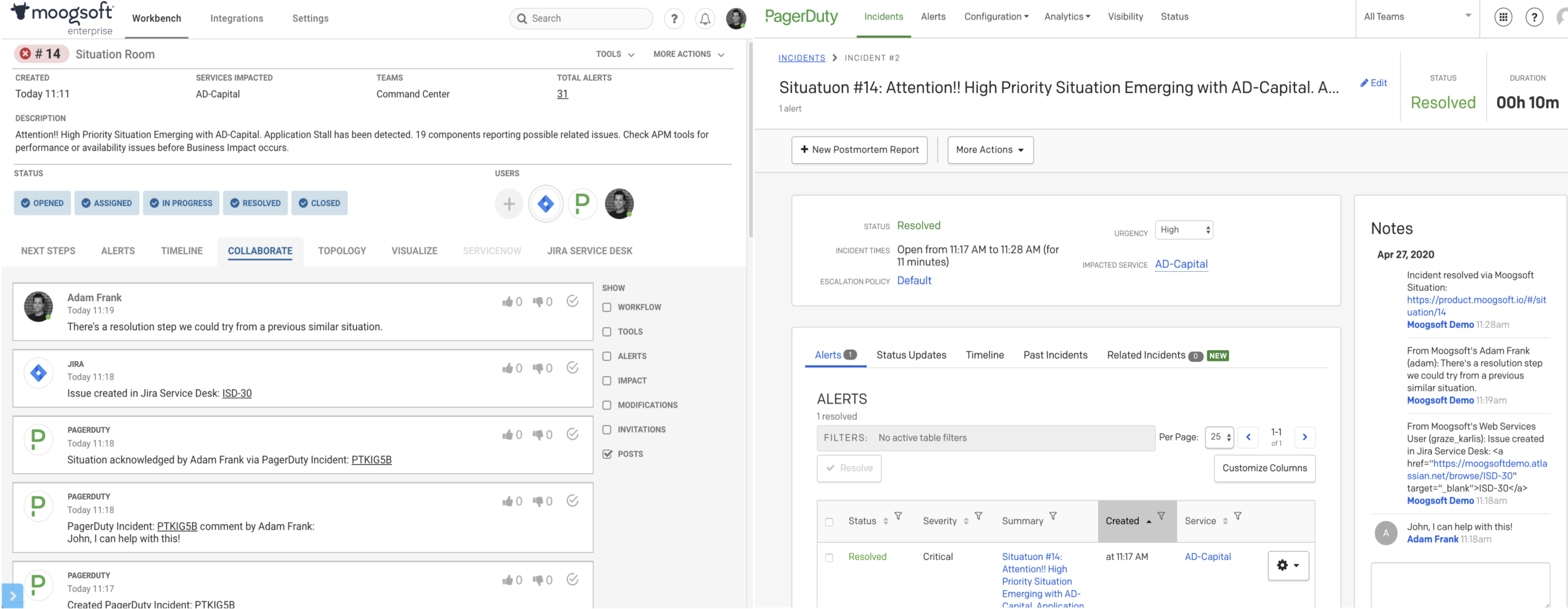
    Moogsoft this week updated its AIOps platform to enable IT organizations to construct a virtual network operations center (NOC) that pulls in data from incident management and DevOps platforms for remote IT management.

    Adam Frank, vice president of product and design at Moogsoft, said version 8.0 of Moogsoft Enterprise enables IT teams to aggregate alerts from multiple platforms in a way that enables machine learning algorithms to identify high-priority issues that require immediate attention.

    Moogsoft accomplishes that goal using noise reduction analytics to better prioritize alerts, which are then surfaced via an automated topology visualization tool that makes it easier to identify the root cause of any issue, he said.

    Version 8.0 of Moogsoft Enterprise adds integration with the Amazon Web Services (AWS) Firelens services to ingest EC2 log files, the PagerDuty incident management platform and the Opsgenie incident management platform from Atlassian.

    Moogsoft has also revamped its user interface and enhanced its Workflow Engine (WE) to ease the process of aggregating data from a variety of IT management platforms.

    Even before the start of the COVID-19 pandemic, IT organizations had been moving to embrace machine learning algorithms and other forms of AIOps to help manage increasingly complex IT environments. In the wake of the pandemic, Frank said it’s clear IT teams will be relying more on AIOps platforms. Many organizations simply will not be able to afford to maintain the current size of their IT teams, noted Frank. At the same time, resistance to adopting AI to manage IT is likely to decline because IT staff simply will not have the time to manually perform as many rote tasks as they do today.

    In the meantime, the debate over AIOps continues to heat up. Incumbent providers of IT management platforms contend they already have collected the relevant data, so it makes sense to apply algorithms to data where it already resides. Providers of AIOps platforms such as Moogsoft contend that for AI to be effective at scale machine learning algorithms need to be applied to data that currently resides in multiple IT platforms. As such it makes more sense to apply machine learning algorithms to data that has been aggregated in a single repository.

    Of course, machine learning algorithms will soon be pervasively applied throughout the IT landscape. The decision IT teams will need to make is which platform will ultimately serve as its primary control point for managing enterprise IT.

    While some IT organizations may be tempted to postpone that decision in the wake of the COVID-19 pandemic, Frank notes the pandemic has also highlighted the need to modernize IT management platforms that increasingly need to be accessed remotely. Legacy IT management platforms generally assumed the IT staff would be working on-premises. Moogsoft is designed to enable organizations to employ a virtual NOC that can be accessed more easily from anywhere.

    It remains to be seen just how the management of IT will evolve in the weeks and months ahead. The one thing that is certain is the way IT is managed is never going to be the same again.

  • AIOps 2020: IT Talent Is the Game-Changer

    AIOps 2020: IT Talent Is the Game-Changer

    Artificial intelligence for IT operations (AIOps) is a fairly new catch-all term for any multi-layered development initiative involving big data analytics, machine learning and/or AI to automate and solve business and IT problems. Definitions vary, but most support the notion that AIOps improve IT performance, infrastructure, cloud and operations.

    This is a dramatic shift in how IT operations have been traditionally managed, requiring a digital transformation commitment from the organization and teams involved. Any enterprise, in any industry, with a complex systems infrastructure can benefit from AIOps. However, differences in AIOps strategies can result in benefits realized in unique ways.

    Whether AIOps solutions are homegrown or commercial, they typically fall into two categories: domain centric and domain agnostic. Domain-centric AIOps focus on specific data types and sources, while domain-agnostic AIOps are more open and ingest a variety of data points.

    Kentik is a domain-centric AIOps solution focusing its platform on large volumes of network data, such as NetFlow, SNMP, streaming telemetry and BGP routing data. It can provide companies with AI capabilities to automatically recognize traffic anomalies, predict cost overages, alert on traffic spikes and more.

    Moogsoft, a domain-agnostic example, provides AI for detecting anomalies and alerting ops teams to potential issues, as well as reducing mean time to discovery (MTTD) and mean time to respond (MTTR). It can monitor system events and is a good illustration for how AIOps not only frees IT resources for other important tasks, but does so effectively.

    No matter which option is right for your organization, it is important to start small when testing the AIOps waters. Pick a specific use case, implement it and then expand out as the use case proves itself.

    Any Software or Web Property Can Benefit from AIOps

    AIOps benefits run deep within an IT infrastructure. With the COVID-19 outbreak, the internet and systems running businesses globally are more strained than ever, given work from home mandates, increased traffic and higher digital asset volume.

    This bandwidth stretch hits people personally, too (e.g. Comcast, Netflix, YouTube, etc.). Greater usage results in an expanded attack surface for cyber criminals to target. AIOps consistency, reliability, security and self-sufficiency directly affect a company’s viability and the amount of time required of support teams to address issues that arise.

    Certainly, an organization is in an optimal position when IT teams can use AIOps to proactively address issues before a red flag needs attention. However, when the fires on systems around the world start, AIOps is there to put them out with its ability to quickly inspect and act.

    For example, in mid-March when the COVID-19 outbreak resulted in widespread school/work from home mandates, online services from ABCMouse to InstaCart to Microsoft Teams saw site complication and outages. Any CTO knows that IT operations and AIOps teams surely answered the call to quickly detect and resolve root causes.

    However, tools or knowledge only provide half of the equation necessary to be successful. Many organizations either don’t have access to the right resources to quickly remediate issues, or don’t have the technology necessary to get the job done. For instance, the State of N.J. has an urgent need for COBOL programmers to support IT efforts. Even if N.J. knows the way to solve its problem, valuable time is being wasted trying to find the means for it to be accomplished.

    Top Tech Talent Is AIOps’ Secret Weapon

    Automation is the backbone of technology, but true AIOps panacea is found when the right technologists know how to use the information AIOps provides.

    Think of a medical MRI: Once the technology identifies issues, human intervention steps in to determine how and when to improve and fix things. The same is true with AIOps. It frees an IT team to prioritize the most important items and who should tackle them, instead of combing through endless logs and wasting every developer’s time on break fixes.

    How a highly qualified, on-demand workforce makes a tangible, measurable difference here is a factor not to be underestimated. Talented technologists who can immediately ramp up on teams and systems—because it’s what they do day in and day out—seamlessly augment internal development staff and can address/remediate issues.

    The future of AIOps goes beyond the technology itself and rests in the hands of dynamically built, virtual teams that can address issues just as quickly as the AIOps platforms identify them.

  • Despite Downturn, Enterprise IT Budgets Remain Intact

    Despite Downturn, Enterprise IT Budgets Remain Intact

    A survey of 137 IT operations leaders at companies in the U.S with at least 500 employees and an annual IT budget in excess of $5 million finds a surprising amount of resiliency at the beginning of the COVID-19 pandemic.

    Conducted April 1 by OpsRamp, a provider of IT operations tools, the survey finds more than half of the survey respondents (58%) said they expect to either significantly or moderately increase their annual technology budgets, while 38% plan to either significantly or moderately reduce their technology spending.

    The survey also finds 73% of respondents expect to either accelerate or maintain digital transformation initiatives and projects.

    Bhanu Singh, senior vice president of engineering and DevOps for OpsRamp, said that at least for now among larger enterprises, digital business initiatives are being accelerated as organizations recraft their business continuity plans. With most customers and employees working from home, the need for applications that digitize business processes has become more critical, especially since no one knows for sure when the COVID-19 pandemic might subside or whether there will be another one, he said.

    Many of those projects will rely on cloud-native technologies that make it easier for organizations to scale IT resources up and down, added Singh, noting organizations are quickly discovering that monolithic applications even when they are deployed on a public cloud are not as flexible as they now require.

    Specifically, the survey finds IT leaders are investing heavily in AIOps (69%), information security and compliance (62%), self-service platforms (60%), cloud-native observability (51%), network performance monitoring and diagnostics (51%), big data analytics (46%) and cloud infrastructure (45%).

    IT leaders are also planning to drive technology vendor consolidation (59%) to reduce costs and rely more on third-party managed service providers (58%).

    In terms of hiring, IT financial analysts (68%), cloud architects (53%), DevOps engineers (50%) and data scientists (47%) top the list of priorities.

    Of course, as the impact of the COVID-19 pandemic on the global economy becomes more apparent it is too early to say what the impact on IT budgets will be. Industry analysts Gartner and International Data Corp. (IDC) are forecasting a relatively small decline in IT spending of about 5% for the year once the economy begins to recover in the second half. However, it’s clear that certain vertical industry segments, such as travel and hospitality, might have a much longer way to go than, say, healthcare companies.

    In addition, it’s likely that much smaller companies than those surveyed by OpsRamp may find it more challenging to restart operations after being forced to lay most of their employees in some cases.

    Whatever the timing, the one probable thing is many of the IT trends that were just beginning to gain traction are likely to see accelerated adoption once the economy recovers. There will be a natural tendency to limit the adoption of new platforms and processes in the short term. However, now that it’s clear existing platforms and processes are not especially flexible it’s only a matter of time now before most of them one way or will be replaced or at the very least completely modernized.