Tag: ai

  • The Future of IT: Smart Tools, Intelligent Technology

    The Future of IT: Smart Tools, Intelligent Technology

    In the last few years, the lines between information technology and development have been blurred. Developers need to know about infrastructure, and administrators need to know how to code. Advances like containerization, orchestration, continuous integration and infrastructure-as-code (IaC) happened in tandem with DevOps’ rise. The advantage of DevOps is that you can quickly build and deploy products. That comes at a cost, though, and that cost is infrastructure complexity. The answer to managing that complexity lies in technologies such as artificial intelligence (AI) and machine learning (ML).

    How can AI Help IT?

    Intelligent technology has come a long way in recent years. Machine learning and artificial intelligence are finding their way into more and more technology. New tools are beginning to emerge that can monitor and manage complex systems with relative ease. There are several clear upsides to using these systems in IT:

    • Instant notifications when there is a problem.
    • The automation of tedious IT tasks.
    • Dynamic infrastructure adjustments to help with traffic spikes and other changes.

    Training an AI to keep systems running optimally, apply updates and alert IT staff to problems in real-time is entirely possible today. By automating away a lot of tedious, manual work like digging through logs, IT is free to focus on mission-critical objectives instead of babysitting servers and monitoring dashboards.

    What Does That Mean for IT Jobs?

    Some people worry that advances in AI will lead to a world where robots take human jobs. While there will undoubtedly be some domains in which AI and ML make more sense than a person, those same technologies will also create new jobs. As IT teams are unburdened from tedious tasks, they can expand into working with ML and AI technology. IT teams are ideal for guiding business decisions about what tasks benefit the most from intelligence technology. So while IT jobs may be transformed by AI, there is no reason to believe that they will disappear. It is more helpful to think of AI as a new tool for IT instead.

    Where can IT Implement AI Tools?

    AI is best used for tasks where there is a lot of data. Having a human comb through log files, databases and dashboards is a slow process. An AI could continuously monitor everything, all the time, freeing up the IT staff to focus on the solution instead of tracking down which piece of the infrastructure is experiencing a problem.

    One area in particular that could benefit from AI/ML is fraud detection. Machine learning can analyze data to find fraudulent transactions much faster than a person ever could. And over time, it will get faster and more accurate at detection.

    Another area with potential for AI is the customer-facing helpdesk. Intelligent systems that have access to ticket resolution histories and device data may be able to handle a majority of requests without needing to use the time of an actual technician. If the AI fails to solve the problem, it can escalate the issue to a technician. As these tools mature, they’re impacting customer service processes, too; let the AI go as far as it can and then escalate less common and/or more complicated issues to a technician. This is an excellent example of how AI and IT can work together to provide the best possible outcome.

    AI and ML tools are the future for IT teams. These tools will be able to handle a lot of the tedious work that is currently done by people such as parsing logs, monitoring traffic and providing some measure of technical support. That leaves IT to focus on mission-critical issues and problems that AI and ML  cannot easily solve.

  • Web Application Firewalls Aren’t Protecting Cloud-Native Apps

    Web Application Firewalls Aren’t Protecting Cloud-Native Apps

    Your web application firewall (WAF) is humming at the edges of your network, faithfully blocking malicious attacks before they can do any harm.

    Better yet, it’s a next-generation WAF (NG-WAF). It consists of signatures, rules, and a sprinkle of machine learning to protect your applications (and user data) from harm. You’ve got it covered, correct?

    Yeah, right.

    You’re a security expert. You don’t take anything at face value. How do you know for sure your applications are protected?

    And what if you have cloud-native applications — microservices, HTTP requests flying around, multiple touchpoints for each user request? Can an NG-WAF protect all of these apps from external and internal attacks?

    We’ve discovered the answer. Let’s take a look at what NG-WAFs do well, what they struggle with, and whether a solution makes up for their gaps.

    The Challenge of Traditional Web Application Firewalls

    According to OWASP:

    A “web application firewall (WAF)” is an application firewall for HTTP applications. It applies a set of rules to an HTTP conversation. Generally, these rules cover common attacks such as Cross-site Scripting (XSS) and SQL Injection.

    Modern applications are more transparent than traditional web applications. Focusing on speed and agility of development — Continuous-Integration, Continuous-Delivery (CICD), and DevOps replacing the waterfall development model — developers tend to use open-source projects to save development time and cost.

    This transparency, ease of access, and incredible detail in documentation make the modern applications attractive targets. The frequent changes in applications make it almost impossible to detect and secure every vulnerability.

    WAFs have added new features over the years, but the backbone of their detection still lies in their signatures or rules. The question is: have WAFs indeed adapted to the needs of cloud-native applications?

    Applications have evolved from massive monoliths to microservices and distributed architectures. They now live virtually in any combination of public, private, or hybrid cloud. The new challenges and threats brought on by distributed architectures have given rise to the NG-WAFs.

    Network firewalls underwent a similar transition, where the Next-Generation Firewalls (NGFWs) introduced a new perspective of looking at firewall traffic with deep packet inspection and attack-centric detection models.

    The next generation WAFs have been frequently defined with three principal characteristics:

    • Detection is based on the application and the attacker’s behavior.
    • Going beyond signatures to identify anomalies and fundamental attacker actions.
    • Cloud-native deployment supporting various cloud platforms, APIs, and microservices architecture
    NG-WAF

    What NG-WAFs Solve

    NG-WAFs propose to solve the new problems introduced by changing application architectures.

    How well have they done? Let’s start by reviewing what NG-WAFs do well.

    Increased Cost to Attackers

    Attackers have a distinct advantage — they don’t play by the rules.

    We live in an age when you can connect almost any device in your home to the internet. Unfortunately, many IoT devices don’t take security measures, which means attackers are salivating at the opportunity.

    Malicious actors try to mask their origin and evade detection using an army of “bots.” Yes, they’re attacking you with DVRs, cameras, and lightbulbs.

    NG-WAFs take a fresh approach of correlating such behavior to detect the attackers and block them, thus increasing the cost for attackers and partly deter the script kiddies.

    Layered Protection: The In-depth Defense

    Defense in Depth increases system security by using a multi-layered approach with intentional redundancies. It’s commonly referred to as the “castle approach” because it mirrors a medieval castle’s layered protection. If one layer fails, another is waiting to take its place.

    NG-WAFs have evolved to protect at multiple levels, including the traditional perimeter and the newer approach of embedding alongside the applications. These layers make an attacker’s job much more difficult and expensive.

    Machine Learning and Behavioral Analytics with Automated Policy Learning

    NG-WAFs aggregate detection from multiple applications to understand attackers from a broader perspective to contextually score them. Using machine learning and behavior analytics on the aggregated data, NG-WAFs automatically disable signatures that would trigger false positives and update the application policies accordingly.

    Virtual patching

    You ideally want to identify and fix every vulnerability found in your code. But real-world business situations dictate that not all vulnerabilities will be fixed quickly or at all.

    A few NG-WAFs support virtual patching to prevent attackers from exploiting critical vulnerabilities until an official fix is available.

    Cloud-native Support

    NG-WAFs now support deployment in a public, private, or hybrid cloud. The NG-WAFs automatically integrate with a containerized approach to scale security natively and elastically. They distribute nodes all over the world to maximize coverage without increasing latency.

    What NG-WAFs Have Failed to Solve

    NG-WAFs have made strides in securing applications. They’ve used defense-in-depth to make successful attacks increasingly tricky to pull off.

    They’ve incorporated new architectures and virtual patching to match the pace and style of current app development. But they haven’t solved every problem.

    Let’s look now at what NG-WAFs are missing that may open up holes in your security.

    Motivated Attackers Can Bypass NG-WAFs

    WAFs introduce obstacles for hackers and penetration testers by making vulnerability finding and exploitation more resource-intensive. However, an experienced hacker or a researcher with enough motivation would probably be able to find ways to bypass it.

    When the application use case becomes complex, it may demand disabling many defenses that produce a higher false positive rate. The more complex a web application is, the bigger its attack surface, and the easier it is to find a bypass for it.

    NG-WAFs Are Vulnerable to Use Case Exploitation

    The same application deployed in different contexts exhibits different behavior. Requests that are harmful for one application may be perfectly normal for the other as user behavior varies for each case.

    NG-WAFs do not have a complete picture of application usage — they cannot detect the business use case. The attack patterns stay hidden within regular traffic and nested protocols. Eventually, the attacker can tune himself to the business traffic and bypass the NG-WAFs resulting in a window of vulnerability and delay in breach detection. Straightforward implementations for detecting such use case exploitation often result in a high rate of false positives and false negatives. Further, customers rarely use all of the available features and rules in modern NG-WAFs.

    Machine Learning and Behavioral Analysis Are Limited to Perimeter Defense

    NG-WAFs have evolved from WAFs and base themselves on a “perimeter defense” model — it guards only against malicious traffic originating outside the network. However, this model fails if an attack comes from within – a common occurrence given the wide variety of ways users can connect to an internal network.

    The new “stay at home” normal and increased risk of insider threats has led enterprises to adopt the Zero Trust model. It is essential to monitor the external traffic along with the internal flow and state of the applications.

    Missing Runtime Protection

    Malicious hackers are attacking all the application stack tiers, be it web, memory, or database. By design, NG-WAFs are limited at the edge of the application module and cannot protect the application at runtime. With this knowledge, the attacker could also circumvent the virtual patch defenses once the vulnerability is known to them by altering their attack method or mingling with the business traffic.

    Monitoring blind spots

    Monolithic frameworks base the visibility into the application on logging frameworks. Want to know what’s happening? Only one directory to check.

    Modern applications built on microservices and serverless introduce advantages to application development, but there’s also the cost of reduced visibility. You can monitor each service individually, but one can quickly lose sight of the global system behavior.

    A single request to the modern application can create a chain of calls behind the scenes. What appears simple can sometimes be incredibly complicated. For example, take a look at what happens inside Netflix when you hit play during your latest binge.

    This call chain generates a massive amount of data along its flow path. External applications have trouble ingesting it all. Instead of solving this problem, most NG-WAFs limit the amount of data they can capture and process, introducing blind-spots the attackers can leverage to bypass them.

    How to Protect Cloud-Native Applications

    Cloud-native microservice architectures introduce drastic benefits but are also challenging to defend. While NG-WAFs have made some strides, they still fall short in several crucial areas. To comprehensively protect your cloud-native apps you should look for a solution that seamlessly provides both security observability and intelligent threat detection. Look for solutions that offer:

    • end to end distributed tracing and visibility, increasing the accuracy and depth of attack detection without extra overhead
    • features that establish baselines for user behavior, API logic, and data flow to identify anomalies
    • the ability to block business use case abuses, insider attacks, and threat actors, even in distributed systems
    • visibility that provides a complete picture of how data (especially sensitive business and personal data) moves throughout your application so you can see problem areas before they become exploits
    • discovery and protection of the complete eco-system of your microservices

    If you’d like to learn more about TraceableAI you can view a recorded demo of Traceable in action.

  • Copado Acquires Qentinel to Gain AI Testing Tools

    Copado Acquires Qentinel to Gain AI Testing Tools

    Copado has acquired Qentinel as part of an effort to incorporate AI-infused application testing within a DevOps platform and build applications using low-code tools across multiple software-as-a-service (SaaS) platforms.

    The Copado continuous integration/continuous delivery (CI/CD) platform was originally created to accelerate the development of low-code applications on top of the Salesforce platform. Now, however, Copado is expanding the scope of its DevOps reach to include other SaaS platforms.

    Andrew Leigh, chief marketing officer for Copado, said as organizations increase the number of SaaS platforms they employ in the wake of the COVID-19 pandemic, it quickly became apparent there would soon be a need to build applications that enable organizations to unify business processes spanning multiple SaaS applications.

    As part of that effort, Copado’s acquisition of Qentinel aims to advance that goal by making it simpler for both developers and end users to participate in the application testing process, Leigh said.

    Qentinel is accessed mainly via the cloud to automate the creation of application tests. Rechristened Copado Robotic Testing, the core of the Qentinel platform is based on the open source Robot Framework that understands scripts, executes them and generates logs and reports. A set of built-in libraries comes packaged with Robot Framework and addresses a wide range of testing scenarios. Qentinel customers include Brunswick, Elisa and Konecranes.

    Copado AI testing

    Gartner is forecasting that, by 2024, 75% of large enterprises will be using AI-enabled test automation tools to advance continuous testing across different stages of the DevOps life cycle. Much of the interest in AI-infused application testing tools is being driven by necessity as the pace of low-code application development exceeds the pace at which manual testing processes can work. As application testing becomes a bottleneck, organizations will naturally look toward automation platforms that employ machine learning algorithms capable of testing applications at scale.

    It’s not clear to what degree those platforms might eliminate the need for humans to test applications. The expectation is humans will be able to test application functionality at a deeper level versus, for example, merely checking to see if compliance mandates have been met. Many smaller organizations building low-code applications don’t have any meaningful application testing capabilities at all. Testing platforms infused with AI will prove to be especially crucial for citizen developers that require guidance to build a secure application that can actually scale, noted Leigh. The more SaaS application environments those applications span, the more critical testing becomes, added Leigh.

    One way or another AI is coming to application testing. After all, machine learning algorithms don’t ever need to take a day off or suddenly leave to take a better offer elsewhere. In fact, soon, most organizations soon won’t even consider a test automation platform that doesn’t have AI capabilities as they attempt to reduce the level of manual, monotonous and repetitive testing tasks. It may take a while for everyone to gain confidence in the algorithms, but it’s now more a question of the degree to which AI will be employed rather than if.

  • Dynatrace Applies AI to Surface App Vulnerabilities

    Dynatrace Applies AI to Surface App Vulnerabilities

    Dynatrace has enhanced the security module to its observability platform that leverages its Davis artificial intelligence (AI) engine to automatically identify the software libraries and open source packages that represent the greatest security risk.

    Ajay Gandhi, vice president of product marketing for Dynatrace, said the Davis Security Advisor, being added to the Dynatrace Application Security Module, makes it easier for IT teams to understand which vulnerabilities need to be remediated first.

    Davis Security Advisor aggregates vulnerability data in real-time and prioritizes remediation based on the number of vulnerabilities, severity, impact to sensitive data, public exposure, how widely known the vulnerability is, and whether the code impacted is facing the internet. That approach enables Davis Security Advisor to monitor all software libraries used in preproduction and production environments in a way that sharply reduces the number of false positives that would otherwise be generated, noted Gandhi.

    Dynatrace

    As application environments become more complex—in part due to increased adoption of microservices that have lots of dependencies—it’s become impossible for IT teams to implement DevSecOps best practices in workflows without some form of AI augmentation, added Gandhi.

    In fact, a recent Dynatrace survey found 89% of chief information security officers (CISOs) noted cloud-native architectures and container runtime environments, used primarily to construct microservices, have made it more difficult to detect and manage software vulnerabilities.

    In theory, application developers are taking more responsibility for remediating security vulnerabilities within their applications. The challenge is they often inadvertently use an older version of a library that has known vulnerabilities. Hopefully, that issue gets addressed before an application gets deployed. There are, however, plenty of cases where, for one reason or another, a library with known vulnerabilities gets deployed anyway.

    Making matters more challenging, many vulnerabilities are discovered after an application has been deployed. Developers don’t always have access to a software bill of materials that would make it easier to determine what libraries have been employed in what application or, for that matter, which libraries are dependent upon one another.

    Gandhi said the Davis Security Advisor resolves that issue via continuous topology mapping of dependencies to identify those potential security issues. Once identified, the updates that need to be made can then be slipstreamed into a DevOps workflow.

    Analyzing code for vulnerabilities is, of course, not a new idea. Training an AI model to perform that task on behalf of DevOps teams does promise to greatly accelerate the process at a time when organizations are under more pressure than ever to secure their software supply chains in the wake of a series of high-profile breaches.

    It’s just not clear yet who inside organizations might drive adoption for AI platforms capable of identifying vulnerabilities in a way that helps prioritize remediation efforts. In some cases, cybersecurity teams have a vested interest in reducing the number of potential security incidents.

    The one thing that is apparent is shipping insecure code faster only leads to more negative outcomes. There may not be such a thing as a ‘great’ application that happens to be insecure. Instead, the assumption will be that any applications with known vulnerabilities, no matter how great, are too flawed to be deployed given all the security risks most businesses currently face.

  • Automatic Right-Sizing is Magical Thinking

    Automatic Right-Sizing is Magical Thinking

    Some months ago, AWS evangelist Corey Quinn wrote a short blog post titled “Right Sizing Your Instances Is Nonsense.” As usual, Corey was spot-on in his takedown of cost-reduction-magic-AI industry hype. But his piece only scratches the surface. I would take the argument a step farther and say that anyone who tells you they can automatically and generally “right-size” compute instances simply doesn’t understand how software works.

    Does that strike you as overly aggressive? Stay with me. Even if you don’t wind up agreeing, there’s a lot to be learned about AIOps from a discussion of “automatic instance right-sizing.”

    What is Right-Sizing?

    Quoting directly from the website of one of the many services that claim to provide “right-sizing” for cloud instances:

    “The Recommendations Engine leverages the time series data of relevant utilization metrics for your resources, then creates a statistical model around average and peak utilization periods. The tool leverages historical utilization data to identify performance characteristics across instance types, families and zones to provide valid recommendations for your workload.”

    The idea behind this “right-sizing” is quite simple, really: track a bunch of cloud service metrics (and maybe a bunch of OS metrics, too, if they are available), use some statistical model—commonly called “AI” on VC decks—and magically deliver recommendations for a more cost-effective cloud instance type.

    There’s just one problem: creating a useful statistical model from generic metrics is practically impossible unless your software is purpose-built to support it, and that is never a software design goal. In fact, software is almost always built in a way that is completely contrary to this goal, and for very good reasons. To understand why, let’s go over the assumptions behind “right-sizing”:

    1. The software will be able to use all given resources
    2. Performance will improve (or degrade) predictably and uniformly with added resources
    3. Metrics accurately describe application load
    4. Scaling dimensions are independent
    5. There will be no side effects on connected systems

    It turns out, none of these assumptions behind right-sizing are generally true.

    A Crash Course in Software Scaling

    In theory, software is bottlenecked on resources, be they CPU, disk, RAM, network, what have you. In practice, however, it is extremely difficult to build software that can fully utilize resources.

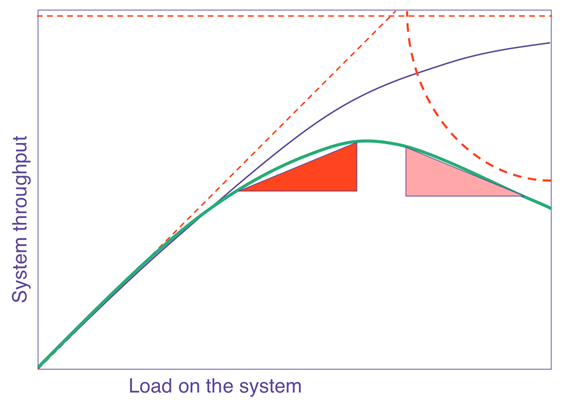
    The general curve that describes how software scales with resources or load is known as the Universal Scalability Law (USL). In a nutshell, it says that on any chart showing scale versus performance, you will see a region of linear scaling where adding resources (say, CPU cores) proportionally increases performance; however, you will then see where performance continues to increase on a nonlinear basis, with smaller and smaller gains with every additional resource until, at some point, the benefit is so marginal as to be completely negligible. This is known as Amdahl’s law, which states that the performance of every program is limited by the serial part.

    Beyond Amdahl lies the issue of retrograde scaling, the existence of which people often forget about until the consequences hit them smack in the face. In this issue, adding resources actually slows down the system. That’s right. From this point onward, larger servers will make your software slower.

    The reason this happens is that, to scale linearly, the workload and resources must be completely isolated and decoupled from each other, which isn’t realistically possible. There are always shared components, e.g. the kernel scheduler, the memory controller, the main PCI bus, perhaps the algorithm requires locking. In any case, the net result is queueing on the shared resource, which might also become a bottleneck when overloaded. Think of a supermarket checkout: you can admit more and more shoppers into the store, but they will still end up waiting at the checkout, eventually, no matter how many registers you open and staff. Performance is limited by the number of checkout counters, not by the number of shoppers or clerks. Worse yet, if the queue gets out of control (maybe people got tired of waiting and shopping carts are literally abandoned in front of remaining shoppers, blocking the path to checkout — think of this as the contention of retries and timeouts), the throughput of checkout will decrease as counters are starved for shoppers.
    right-sizing

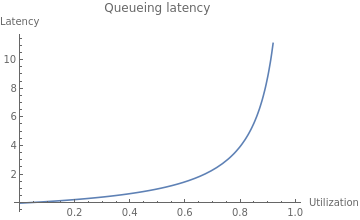
    The USL shows us what happens to throughput as we scale, but what about latency?
    right-sizing

    As resource utilization approaches 100%, the wait time for the resource will approach infinity in a nonlinear fashion. This is why systems are designed to run at low utilization, so that quality of service does not degrade too much. You might see a server running at 50% utilization and think, “We can use a server with half the resources and save money!” but if you actually try to do that, you will degrade latency and quality of service to an unacceptable level, most likely causing an outage.

    The Dark Arts of Configuration

    Even if your software is able to take advantage of available resources in theory, it needs to be properly configured to use them. Buffer sizes, thread pool sizes, memory heap size, number of connections—most software has numerous options to tune it for resources and specific workload. You can’t just change the box size and expect it to work! Not to mention, it’s quite possible your current configuration is far from optimal. I’ve substantially reduced cluster sizes on several occasions by making a one-line configuration change.

    For example, a common web server configuration is the number of concurrent requests the server can handle (often expressed as number of threads), which relates to the number of CPU cores available, the amount of memory available to the specific workload and the average time it takes to handle a request. The problem you are solving isn’t “What instance size will have the best ROI?” but rather “What combination of instance size and configuration will have the best ROI?” That is a totally different question that requires specific knowledge of the application to answer.

    Let Them Eat Cache

    In the old days, when you tried to allocate memory beyond what was currently available, the operating system would simply refuse your request. Ah, the good old days were simple! Alas, in our quest to simplify programming and resource management, and to allow software to efficiently adapt to a changing environment, we made common use of resource tradeoffs. For example, a complicated computation can be calculated again and again using the CPU, or the results can be saved and reused, saving CPU time and trading it for the use of RAM or disk. This pattern is quite common; when you overallocate memory, the operating system may trade off CPU to free memory by compressing memory objects, or it may trade off disk space by paging out RAM to swap. Java, Node.js and Go each have a similar tradeoff where they spend CPU time on garbage collecting to free RAM. Modern software makes numerous tradeoffs between CPU, RAM, disk and network in multiple dimensions. The end result is that different resources are coupled in many unexpected and obscure ways.

    Lies, Damned Lies! (And Metrics)

    Speaking of that server running at 50% CPU utilization, it is quite possible that server is also maxed out on CPU at the same time. How can this be? It’s because the metrics you see are not raw data but aggregates—in many cases, averages—and aggregates hide certain behaviors that can be very important; for example, peaks and bursts, such as the ones you get from compaction, garbage collection and other periodic processes that routinely run in modern software. There are billions of events happening every second on a modern server, and only a few data points of metrics emitted every minute. All metrics are loss-y; it’s simple math, really. But machine learning (ML) models are only as good as the data they work on, so if the metrics weren’t specifically created to show the relevant behaviors—and they weren’t—the model would be completely blind to their existence.

    What is “Performance,” Exactly?

    Whenever we deal with resource allocation, we are interested in its impact on performance, which raises the obvious yet rather uncomfortable question: what’s your definition of “performance?” Is it throughput? Latency? Mean or the 99th percentile? Of which transaction? Or, perhaps you are mostly interested in the rate of purchases executed on the website? These are all different things, and often, optimizing one might degrade the others.

    This kind of discussion is the first step in any performance engineering session—but completely absent from the scope of “right-sizing” services, and the last thing you want is the generic cost function of the ML model costing you money.

    This wouldn’t be so bad if all performance goals could be achieved at once, but, sadly, some of them are in opposition: e.g., higher throughput causes higher latency due to queueing effects. When making changes to software systems, we have to know what performance metrics are important to us.

    The Curse of Local Optimization

    It is very tempting to look at a cluster of machines as an independent system. But if that system is doing something meaningful, it is part of some bigger system, and changing the configuration will likely have an effect on the larger system it is a part of. When we make changes to subsystems, it is with the intent of improving the system as a whole, to make the customer happy and make more money. But when a change to a subsystem is motivated by a desire to reduce the cost of the subsystem, the result is often an increase in the overall cost of the system! This is because the local cost of subsystems is relatively small compared to the cost of the entire system, not to mention the possible reduction in the income of the system. For example, you could save lots of money by using older, slower servers, but your customers won’t be very happy with a slow application and your profits will suffer—which will probably cost you much more than whatever you saved.

    To take this ad absurdum, you could save 100% of the subsystem cost by turning it off completely. Of course, the assumption is that changing server sizes will not have any side effects, which, as discussed, is highly unlikely. There will be side effects on connected systems as well, some of which will not appear immediately. Load is variant, and operational overprovisioning and buffers were often put in place for a reason. It’s quite likely the reason for low utilization is safety margins.

    The Problem With “Right-Sizing”

    The basic problem with “right-sizing” is the rather obvious, yet implicit, assumption that there is such a thing as “the right” size. Software engineering is all about tradeoffs, precisely because it’s very rare (if it happens at all) that one thing can be improved without making another thing worse. Tradeoffs mean business decisions to make, and you really don’t want a generic ML heuristic to make those for you. ML is very good at dealing with problems where a lot of data is available, the data is high quality, the data is predictive of behaviors (which isn’t the case for complex systems!) and most important, the problem is well defined. Most problems in AIOps are very far from this. Don’t take it from me, take it from the people who excel at both high-scale ops and ML.

    Even if it was feasible to make such ML models work, software is unable to automatically adapt to different machine sizes and fully utilize server resources. If it were, companies like ScyllaDB and Azul Systems wouldn’t need to exist. Creating software that is scalable and resource-efficient on modern hardware is a very difficult problem, and without those building blocks, ML models are constructing very shaky structures.

    It’s worth emphasizing that I’m not arguing against adapting the size and configuration of servers, only that doing so automatically and blindly for some local “cost-saving” goal isn’t the solution you might think. The goal of such changes should be to raise the overall quality and performance of the larger system guided by a theory of how that system works. ML is not a replacement for human thought and learning. There might certainly be an “optimal” instance type, or even a few, but “optimal” implies a target metric that certainly isn’t cost reduction. No system exists for the sole purpose of being inexpensive. All systems exist to serve business requirements first, and to be low-cost second.

  • WSO2 Applies AI to API Management

    WSO2 Applies AI to API Management

    WSO2 today unfurled a Choreo cloud platform through which DevOps teams can create and manage application programming interfaces (APIs) more efficiently by leveraging machine learning algorithms and other forms of artificial intelligence (AI).

    Eric Newcomer, WSO2 CTO, said the integration platform-as-a-service (iPaaS) eliminates all the tasks associated with setting up a platform for and managing services based on APIs.

    Choreo, available in beta, employs AI to learn historical activities and performance behaviors in order to anticipate the needs of a developer. As developers build an API, the platform will provide performance feedback, identify anomalies, map data and even complete code, said Newcomer.

    The Choreo platform also comes with built-in observability tools for monitoring API usage and troubleshooting APIs, added Newcomer.

    In addition, Choreo provides access to the open source Ballerina programming language the company developed to enable developers to create APIs using both low-code and procedural code as they see fit, noted Newcomer. The low-code diagram that developers create generates source code that developers can then run wherever they want, said Newcomer. Developers can close the entire repository Choreo provides, Newcomer added.

    Developers can also trigger low-code integration logic to control hundreds of software-as-a-service (SaaS) APIs via pre-built connectors and templates provided by WSO2 or ones they create themselves.

    WSO2 is also making it possible to deploy APIs via a single click in Kubernetes environments, which eliminates the need to manage cumbersome YAML files. That capability is based on technology that WSO2 gained via the acquisition of Performer that the company revealed today.

    Finally, WSO2 is making available an API marketplace through which organizations can share APIs, event streams, data sources and templates.

    With the rise of microservices-based applications, API management has become a lot more challenging. Each additional microservice adds an API that needs to be managed and maintained. As more APIs are employed, it becomes increasingly difficult for DevOps team to keep track of the dependencies that exist between all those APIs without the aid of machine learning algorithms.

    It’s not likely machine learning algorithms will replace the need for DevOps professionals anytime soon. However, it’s becoming apparent that many of the manual tasks that DevOps teams routinely perform today are becoming automated by machine learning algorithms. In other cases. DevOps teams are gaining new capabilities that would have either been impossible for them to do on their own or would simply have taken too much time to complete.

    Of course, it takes time for any AI platform to learn the DevOps environment. IT teams need to invest a significant amount of time training an AI model to recognize relevant issues in much the same way they might train any new member of a DevOps team. The only difference is, once a machine learning algorithm learns something, they never forget it. Nor do they take a day off or announce one day they are leaving the company because they got a better offer somewhere else.

    It may take a while before DevOps teams are able to strike the right balance between man and machine, but one thing that is certain is that AI in DevOps environments is here to stay.

  • Harness Employs ML to Streamline DevOps Workflows

    Harness Employs ML to Streamline DevOps Workflows

    At the online {Unscripted} 2021 conference, Harness today announced an update to its namesake DevOps platform that includes support for feature flags that expose new capabilities to a select number of users for testing purposes along with the ability to prioritize the running of those tests based on the likelihood an application is likely to fail them.

    In addition, Harness is adding a unified pipeline capability that enables DevOps teams to streamline the management of multiple tools that make up a workflow and has updated its cloud cost management module to enable DevOps teams to automatically stop idle workloads. That capability is based on technology the company gained with its recent acquisition of Lightwing.

    Steve Burton, chief marketing officer for Harness, said Harness is now employing machine learning algorithms to identify which tests an application is most likely to fail. That test intelligence module enables DevOps teams to run those tests first versus testing an application only to discover close to the end of that effort that an application will need to be updated and then retested. The amount of time spent on testing is then sharply reduced, noted Burton.

    Overall, Harness is reducing the amount of time and effort spent maintaining DevOps pipeline and workflows, said Burton.

    The cost of maintaining a DevOps platform will naturally vary as the overall environment becomes more complex. It may not be clear how much time a DevOps team is spending on testing, but the faster that process becomes the more likely an application will be thoroughly tested before it is deployed in a production environment. Fixing applications after they are deployed in a production environment is, of course, considerably more expensive.

    At the same time, as the number of applications being built simultaneously increases, the amount of cloud resources being consumed also increases. Developers, however, don’t typically pay close attention to what workloads are consuming which cloud resources, which can result in an unpleasant surprise when the monthly bill from the cloud service provider comes due.

    In general, Burton says machine learning algorithms and other forms of artificial intelligence (AI) will soon become table stakes for any provider of a DevOps platform. The expectation is the platform will routinely employ AI to streamline processes and reduce total costs, noted Burton.

    Many of the manual tasks that DevOps teams regularly perform to maintain a DevOps platform will increasingly become automated as usage of machine learning algorithms becomes more pervasive. It’s not clear to what degree organizations may abandon a legacy DevOps platform to take advantage of those capabilities. However, over time it will become apparent that some organizations are spending a lot more time building and deploying applications than others as the next generation of DevOps platforms, infused with machine learning algorithms, are installed.

    In the meantime, DevOps teams might want to make a list of the manual tasks they perform today as part of an effort to determine how much time they are wasting that might otherwise be spent on tasks that are more valuable to the organization.

  • Leveraging AI in DevOps for Non-Linear Scaleup

    Leveraging AI in DevOps for Non-Linear Scaleup

    With technology evolving in leaps and bounds, AI is shaping the future of digital transformation for every business seeking speed, scalability, quality and flexibility.

    Since DevOps is on the verge of delivering exceptional software development environments, DevOps in AI is undeniably the next breakthrough in technology. We’ve witnessed every industry racing toward the adoption of AI to transform their business. To support this transformation, smart automation solutions coupled with AI implementations is becoming the new normal.

    So if you’re thinking about reinforcing your enterprise’s DNA by leveraging AI, DevOps principles for artificial intelligence are vital to these efforts. Here’s how businesses can unlock the true potential of AI and stay ahead of the curve.

    DevOps and AI

    DevOps has been s game-changer for numerous businesses. Applying AI can helps DevOps teams achieve the operational efficiency of machine learning (ML) models all the way through the journey from design to production.

    Artificial intelligence undeniably enhances automation and fast-tracks the performance of DevOps. Since the digital transformation process is quite challenging for diverse businesses, DevOps and AI ensures the right processes are in place that can further bring flexibility throughout the journey.

    DevOps enables continuous deployment and quick delivery of AI models via:

    • Speed: Improved overall development and delivery time by reducing unnecessary activities
    • Scalability: On demand and auto-scaling AI models
    • Quality: Boosting cleaning datasets and eventually promotes consistent learning that further enhances AI
    • Data monitoring: Decision making and computing helps handle huge amount of data with precise data monitoring

    Benefits of Integrating AI in DevOps

    There are endless benefits to integrating AI in DevOps.

    Analysis

    Data analysis is the key to business success, especially in times when there’s a huge list of competitors rushing to gain consumer trust. Since DevOps produces an enormous amount of data, it isn’t practical for humans to analyze the data without technological intervention.

    Artificial intelligence’s smart analytics eases the process by identifying and solving problems in a
    more systematic way, resulting in efficiency and increased consumer satisfaction.

    Data Correlation

    In the wider technology environment, development teams have their own set of issues and errors, which arrive while monitoring the processes. Since the communication scope is minimal and there’s a lack of mutual learning across teams, artificial intelligence can help to accelerate the learning cycle.

    Artificial intelligence helps to improve data insights from multiple platforms, which, in turn promotes better communication and establishes better data correlation.

    Failure Handling

    Machine learning is paving the way to better error resolution based on data, and eventually artificial intelligence will be able to predict signs of failure by examining patterns. Since humans cannot match the observation capabilities of AI, certain indicators of failure can only be analyzed through AI. This further enhances the overall development processes, as quick identification helps identify issues before they can impact the software development life cycle.

    Breaks Down Silos

    DevOps with AI has the ability to streamline business processes and establish proper communication among diverse systems, removing barriers that slow down the development and deployment processes. Furthermore, the ability to automate, continuously integrate and enhance communication helps business leaders to focus more on other aspects that can further accelerate business growth.

    Economic Growth

    Since the basic function of an AI-based model is automation, it can help businesses save money and enhance human resources. For any business, eliminating repetitive human work is a tough nut to crack. but a necessity when businesses are demanding continuous innovations. Artificial intelligence could be the best way for enterprises to cut costs and eventually helps the organization to use human resources more creatively and productively.

    Makes Software Intuitive

    Besides endless business benefits, AI-based software is more intuitive and user-friendly, since it prioritizes the reduction of human error. While DevOps is a well-known, reliable, business-driven approach for delivering software, intermingling artificial intelligence could enhance the user experience by integrating technology more deeply into the system.

    The perfect harmony of simplified interactions between humans and AI helps businesses achieve their desired goals of speed, efficiency, scalability and security.

    AI-driven systems are providing promising and scalable solutions for enterprises that are on a hunt
    for innovative and rapid ways to scale business growth. AI in DevOps is undoubtedly the best solution for accelerating growth through precise monitoring, automation and process improvement. This is the right time for businesses to ensure they operationalize artificial intelligence as a core business objective to stay ahead of their competitors.

  • How IT Can Use AI To Prepare For Uncertainty

    How IT Can Use AI To Prepare For Uncertainty

    The past year has been unpredictable for businesses – from migrating to remote work to planning for a return to offices to keeping pace with shifting government guidelines. With so much in flux, it was and is a good reminder that organizations must be prepared for the unexpected and have contingency plans in place.

    From an IT standpoint, this means ensuring that employees are well equipped to work efficiently and safely, no matter what work may look like in the year ahead. Fortunately, artificial intelligence (AI) technologies are evolving quickly, enabling enterprises to better manage an ever-changing hybrid workforce.

    The following are three AI-enabled strategies that organizations should implement to help prepare for times of uncertainty:

    Invest in Self-Driving Networks

    When companies quickly and unexpectedly moved their employees to remote work last year, networks experienced increased pressure on multiple fronts: usage, quality and issue remediation. These factors compounded on top of the fact that networks have continued to become more complex in the past few years as workloads become more distributed across public and private clouds. Even under the best circumstances, building and maintaining a traditional network requires a team of dedicated experts and can be time consuming. Due to their complexity and the increasing amount of data, networks are becoming more difficult to manage via command-line interface (CLI) and are required to adapt to changing workloads and employee connectivity – this is where AI comes into play.

    A self-driving network eases complexity by using AI and automation to run the network’s end-to-end user experience with minimal human intervention. This includes monitoring for issues such as bad cables and capacity hotspots within the network and solving them before they impact the end user. By ensuring networks are running smoothly on the foundational level, self-driving networks allow IT teams to spend their valuable time tackling more complex problems and driving innovation.

    Empower IT With AI Assistants

    Another way to free up the IT team’s time is to make a new hire – not a traditional employee, but rather an AI assistant. More specifically, an AI assistant that can answer questions and manage networks on par with a network domain expert – one that learns and improves as you work with it. As AI truly delivers on completing functions on par with humans, this is where AI and machine learning are disrupting industries.

    Today’s AI assistants, through conversational interfaces, are delivering more than simple “yes” and “no” answers to IT questions – they are able to answer complex open-ended questions such as, “Why is Bob having a poor Zoom experience?” They’re even learning to solve more complex problems, helping IT teams minimize the number of support tickets issued by frustrated remote workers. As businesses recognize the value AI assistants bring to their team, they now see them as members of the IT team that help them simplify the ever-growing complexity of IT networks.

    Educate Employees on the Benefits of AI

    In 2021, we expect the adoption of AI in networking to accelerate. Ensuring the right AI technologies are property executed starts with trust. Therefore, getting teams to perceive AI assistants as more of a teammate and less as a job-threatening technology is an important step toward successful AI implementation. The end-user experience is more important than ever, and AI is becoming more crucial for enterprises to manage this experience.

    To many employees, the concept of AI can be scary. A common misunderstanding is that AI will take over humans’ jobs. However, people are starting to understand the importance of AI by seeing it solve real problems. As companies implement AI technologies into their solutions, they should first prioritize open conversations about the business benefits of AI. By ensuring everyone is on the same page, teams can work toward building a better process together. After all, the goal is for AI to ultimately make their jobs easier.

    The last year has been difficult to navigate, but it serves as a reminder of the importance of planning for the unexpected – this is necessary to continue running a business efficiently and supporting employees remotely. Though there are sure to be more uncertain times ahead, we have the tools to prepare the best we can today.

    By taking steps toward building a self-driving network, investing in AI assistants and educating employees on AI, organizations can have peace of mind that they’re on the path to building themselves, their employees and their stakeholders a stable future that’s prepared for whatever uncertainties come their way.

  • IT Ops Takes Center Stage

    IT Ops Takes Center Stage

    When people talk about the last 18 months, most will remember it as a disruptive time when nothing felt certain. Yet, for many IT Ops and network operation center (NOC) leaders, it was the year they stepped out of the darkness and into the spotlight. Suddenly, it mattered deeply who was maintaining those services we relied on to shop, work, eat, live – and it became clear that IT Ops teams – who were previously thought of only as the number you called for a password reset – had been keeping our businesses running all along.

    While there may have been some recognition before the pandemic, that awareness certainly gained momentum during 2020 and, now, shows no signs of stopping.

    As Ben Narramore, senior manager of operations with Sony Playstation Network said at a recent customer conference, “Today, I am able to talk to leaders across the company that I would never have talked to a year ago. They didn’t care about operations, they didn’t care about the NOC, didn’t care about incident management, and now they’re like, ‘Wow, this is great stuff,’” he said. “I’m excited right now. We’re at a place in operations where my team has evolved, doing more than just problem-solving.”

    I am excited to hear sentiments like that, because for the last 10 years or so, application development has been the golden child of IT. The faster you could crank out code, the faster the business could move. For years, every dollar and every resource went to building out amazing applications and services, leaving the IT Ops people to keep it all available and performing. Sure, some companies like Hulu and Expedia had the dynamics worked out and built a modern, optimized organization that could run as fast as it built, but most companies paid a high price in time, focus and resources to keep their services up and running.

    For most companies, it felt like a war of speed versus availability. Engineering wins when they can deliver what the business needs, quickly. They do not need to look beyond their group for much and – if it works as intended – they are good to go. IT Ops, on the other hand, needs a broad view of the entire technology landscape. They need to think about the availability of all services, which requires them to have visibility across the entire enterprise stack, often dealing with the downstream implications of outages and incidents that cross networks, hardware, software and clouds.

    Now, it’s 2021, and the war is over. And it turns out, the rise of operations wasn’t about a revolution. It was about recognition. IT Ops teams needed a seat at the table. They finally got the chance to explain that they want to move fast, too – to streamline operations, consolidate awareness, automate wherever possible and help support and enable the velocity the business demands, side by side with their partners in engineering.

    Jeremy Bragg is an infrastructure automation architect at Abbott Labs. I thought his role description was really compelling; here’s how he explained it: “Probably the most interesting aspect about being in automation is that we break down silos. We cannot just be a server team or a network team or a mobility team. We work across the board with all the teams to try to further their causes. We ask ourselves: where are we doing manual work today that we could automate?”

    Over the next five years, I believe more teams will start to take advantage of AI and machine learning to set the pace for the modern IT organization; more of the mundane work will be automated so they are free to lead innovation, not just react to it.

    Ben Narramore also has a lot of passion for that very topic. “If I look at my teams in the last ten years, we were firefighters; we’re good at it out of necessity. Now, we’re at a point with cloud computing [and] with AI that gives us a chance to reassess our team. I’m excited about how our team has evolved from day-to-day problem solving to looking at our business with the future in mind. Being able to automate manual operations and workflows gave us the ability to do new, more exciting work, as well as helping out with incident management and problem management.”

    My own take on IT is that the shift is happening, and I am excited to have a front-row seat as IT Ops teams step out of the shadows and into the light, taking their well-deserved place as strategic partners at the table, and helping drive the business forward.