RECORDING
SLIDES
[slideshare id=75243643&doc=webinarloomai1125-170420191116]
[slideshare id=75243643&doc=webinarloomai1125-170420191116]

[nextpage title=”Introduction” ]
There’s a lot of discussion today about not so much if artificial intelligence will dramatically change the way humans work and provide economic value, but when, how quickly and to what degree AI will change our relation to work. In this post we’ve collected eight of the best TED talks we could find when it comes to increasingly intelligent machines and how they will impact business and the nature of work.
[/nextpage]
[nextpage title=”The Wonderful and Terrifying Implications of Computers That Can Learn” ]
 We increasingly hear about it: Some machine has beaten a human at something that was previously unheard of—chess, Jeopardy and, most recently, Go. In this talk, technologist Jeremy Howard shares new developments in the fascinating field of deep learning. This is happening quickly, and business leaders need to prepare for the day when computers are on par with humans in certain cognitive domains.
[/nextpage]
[nextpage title=”What Happens When Our Computers Get Smarter Than We Are?” ]
 In this talk, Swedish philosopher Nick Bostrom explains how artificial intelligence is getting smarter rapidly and soon may be as smart as people. Bostrom believes thinking machines will be man’s final invention. I’m hoping they end up on our side.
[/nextpage]
[nextpage title=”Are Droids Taking Our Jobs?” ]
 Andrew McAfee is one of my favorite reads on this topic, and if you haven’t read “Race Against the Machine: How the Digital Revolution is Accelerating Innovation, Driving Productivity, and Irreversibly Transforming Employment and the Economy,” you need to close your web browser and go do that right now. Well, maybe watch this TED talk, first. It details how robots and algorithms are getting good at building cars, writing articles, translating—jobs that once required a human. Did he say article writing? What will I do for work? In this talk, McAfee, citing labor data, takes a look at what could be in store for us.
[/nextpage]
[nextpage title=”The World’s First AI Legal Assistant” ]
 Anyone who doesn’t like lawyers never faced a prosecutor or lawsuit. Those that have know legal advocacy can be quite the hit on the bank. What happens when the scales of justice are digital? In this talk, lawyer Andrew Arruda partnered with a computer scientist to create the world’s first artificially intelligent legal assistant, Ross. Arruda hopes Ross will make legal help more affordable for us.
[/nextpage]
[nextpage title=”The Jobs We’ll Lose to Machines — and the Ones We Won’t” ]
 In this talk, entrepreneur Goldbloom tries to tackle the age-old question: What jobs will the machines take from the labor pool and what jobs will be left for us humans to fight over?
[/nextpage]
[nextpage title=”Get Ready for Hybrid Thinking” ]
 Futurist Ray Kurzweil says we need to get ready for the next big exponential in brain power—the computer. In other words, don’t hate the machine, become the machine.
[/nextpage]
[nextpage title=”How AI Can Bring On a Second Industrial Revolution” ]
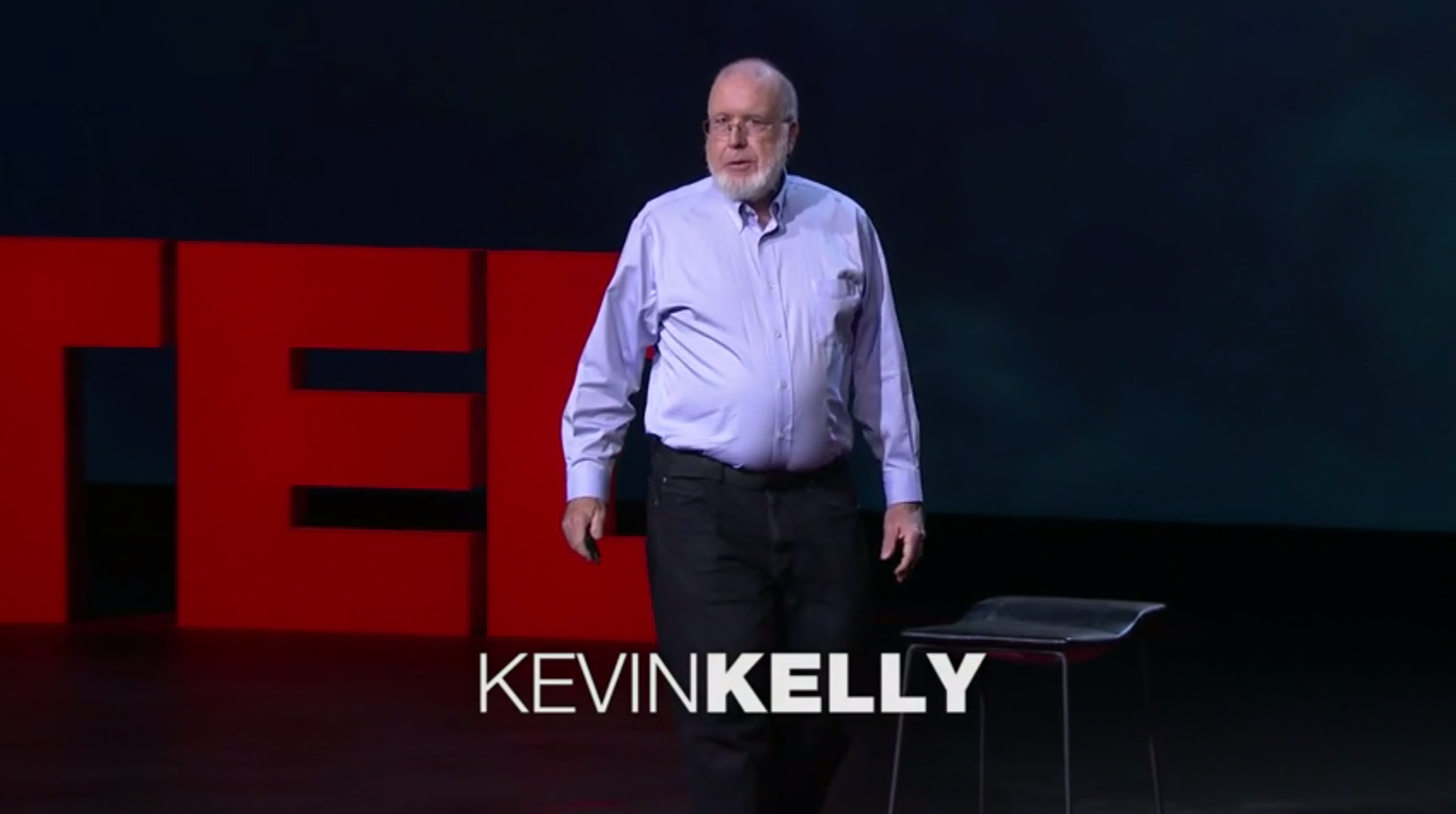 Digital sherpa Kevin Kelly says technology is driven by patterns that are surprising but also predictable. That is, while the exact path taken isn’t predictable, where we eventually end up is. And in the decades ahead our machines are going to get smarter and smarter, and this will change the world in very big ways.
[/nextpage]
[nextpage title=”Can We Build AI Without Losing Control Over It?” ]
 We should all be scared, very scared, of superintelligent AI. In this talk, neuroscientist and philosopher Sam Harris explains why. And one of the reasons could be that we end up making superintellient machines that decide we will make very nice pets (at best) or treat us like an insect infestation (at worst).
[/nextpage]

The momentum behind the adoption of new technologies underway is no less than astounding.
Those enterprises that not only adopt, but learn to master, emerging technologies will be the clear winners in the years ahead as they learn their customers’ needs better, rapidly develop new and successful products and services, optimize their use of business technology, improve supply chains, increase margins and stay a few steps ahead of the competition.
Recently the World Economic Forum released its annual list of technologies it thinks are ready to “break through” this year, which generally means start witnessing wider adoption. Some of the breakthrough technologies this year include very powerful batteries, what is deemed “socially aware” artificial intelligence (AI) and improved solar panel technology.
According to a statement released by the World Economic Forum, the Top 10 2016 Emerging Technologies list, compiled by the Forum’s Meta-Council on Emerging Technologies and published in collaboration with Scientific American, reveals the technological advances the group believes could improve lives, transform industries and safeguard the planet. The list also serves as an opportunity to discuss the any human, societal, economic and environmental risks the technologies may pose prior to widespread adoption.
“Horizon scanning for emerging technologies is crucial to staying abreast of developments that can radically transform our world, enabling timely expert analysis in preparation for these disruptors. The global community needs to come together and agree on common principles if our society is to reap the benefits and hedge the risks of these technologies,” said Dr. Bernard Meyerson, chief innovation officer at IBM and chair of the Meta-Council on Emerging Technologies.
Some important criteria in technology selection was the council members’ belief that 2016 would prove to be a deployment tipping point of each technology. That should be of interest to CIOs and technology leaders, too. And it means it’s time for tech leaders to start figuring whether and how implementation may or may not make sense.
The top 10 technologies to make this year’s list are:
Automation is the fuel that drives DevOps. Automating routine, repeatable tasks is one of the defining characteristics of DevOps culture. As artificial intelligence (AI) and machine learning improve, the scope and complexity of the tasks that can be automated increases, which raises the bar for all of DevOps. The humans behind the DevOps will be freed from even more mundane tasks and able to focus on more innovative and creative endeavors.
It makes sense, if you think about it. The trend from physical services in an on-premise data center, to virtualization, to cloud services, to DevOps has been a steady march of raising the bar for automation. The more applications and entire infrastructures can be developed, deployed, monitored and managed programmatically and through automation, the more efficiently and effectively an organization can function.
As tasks are offloaded to automation, humans can address other challenges. That focus inevitably leads to identifying other new tasks that can be automated. AI and machine learning represent a quantum leap in this evolution, however—with AI and machine learning, the automation can begin to identify and improve itself. When the automation can identify bottlenecks and inefficiencies and automatically adapt to overcome those obstacles, human input and interaction could become almost obsolete.
In a recent interview, Christian Beedgen, CTO of Sumo Logic, shared some thoughts about the impact of machine learning on DevOps. “Machines will enable greater productivity among teams and businesses through the advances that machine learning and automation can offer,” he said. “A necessary component to augment human contributions, machine learning will finally give humans the power to review millions of bits of data.”
Automating routine tasks is crucial, but there’s another factor that plays into the role that AI and machine learning have with the future of DevOps. The reality is that there are some things humans simply can’t do as well or as fast as machines—especially at scale.
Steve Burton stressed in a blog post that humans are capable of observing, digesting and interpreting only so much information at one time. Some feel like the Holy Grail solution is some sort of application performance management (APM) dashboard that can aggregate and correlate real-time data so human IT personnel can monitor metrics and identify issues manually. “This all sounds good in theory, except it’s completely unmanageable in reality when your applications have thousands of components, billions of metrics and hundreds of changes every day,” he wrote. “Humans can no longer cope with this complexity, they now need machines to do the leg work, process this Big Data and provide operational insight into what the f**k is going on.”
Beedgen agrees. He suggested, “Increasingly, businesses will adopt machine learning technology for its usefulness in augmenting human understanding of complex interaction and large data sets by uncovering the unknown unknowns.”
On some level this all sounds a bit scary. It seems as though the more we succeed at DevOps and the more DevOps evolves, the less humans are even a necessary part of the equation. Conceivably you could be so good at DevOps that you DevOps your way right out of a job or inadvertently launch SkyNet—or both.
That scenario is simultaneously feasible and far-fetched. I suggest that you don’t fear that future or look at it as machines stealing your job or taking over humanity. Embrace the future of DevOps driven by AI and machine learning and find the silver lining. Seek out the new frontiers and horizons, because there always will be tasks that the machines simply can’t do without us—and that is where innovation happens.

TEST


— ROELBOB