Log analysis has become a big data issue. As we collect and want to analyze more and more information, the amount of data to analyze seems to grow by leaps and bounds. One answer to this issue is AI Log Analysis (apply artificial intelligence). While I will spare you the obligatory “machine learning” references, there are companies that are bringing AI to this issue.
One such company is a startup from Israel, Loom Systems. devopsy.kinsta.cloud sat down with Loom Systems CEO Gabby Menachem in this episode of DevOps Chat. As usual, the streaming audio of our conversation is below, with the written transcript of our conversation immediately below that. Enjoy!
Alan Shimel: Hello, everyone. It’s Alan Shimel, editor in chief, devopsy.kinsta.cloud, for another DevOps Chat. On this episode of DevOps Chat, we’re joined by Gabby Menachem, who’s CEO of Loom Systems and comes to us today from Israel. Hello, Gabby, how are you?
Gabby Menachem: I’m great. Hi, Alan. Thanks for having me.
Shimel: Thank you for being our guest today, Gabby. Gabby, I guess we should start with – I’m gonna imagine that folks in our audience are not familiar with Loom Systems, so would you mind giving us just kind of a quick background on Loom Systems?
Menachem: Sure. Loom Systems is a platform—a solution, actually, to predict and prevent problems in your digital business. We actually are able to analyze logs and semi-structured machine data for immediate visibility into the company’s digital environment, any environment going from legacy systems to the latest application, your homegrown application that you just wrote. And, by doing that, we can significantly reduce the cost and complexity of working with operational analytics on IT. And, using our tribal knowledge bank, which is called “TriKB,” we’re actually able to find issues proactively using log analysis and bring them to IT’s attention and help them resolve them in minutes, instead of hours or days.
Shimel: Got it. So, Gabby, just to be clear, is Loom actually the log gatherer—in other words, gathering the logs—or is it just analyze logs that are provided from another solution?
Menachem: So that’s a great question and, for the most—in most environments, we’re not focused on gathering the logs, so we come to places, in most cases, where they already collect logs, although our solution can handle the collection of logs as well. What we focus on is the actual analysis, so we find that businesses today have a problem utilizing their personnel that they already have, in order to find a root cause and do root cause analysis of issues in the logs. And, as we all know, when you have a problem and with today’s digital transformation, you have to go into the logs in order to find issues that affect your customers. And so, by using Loom Systems, you’re able to get help with that root cause analysis and you get actionable recommendation on how to solve these issues in minutes. And that’s how you can actually use a solution that helps you with the analysis phase and not with the ingestion or things like that.
We also provide a way to do collection and all the other features of a log management tool, but it’s not out focus and we’re, to be honest, in most cases, we’re happy to find that businesses have already put effort into looking at logs in a centralized manner. That kinda gives us the signal that they’re already operational and they’re looking at logs as a way to solve issues and find the ROI in that case.
Shimel: Excellent. So, Gabby, give us an idea what kind of log gathering tools does Loom System integrate with. Is it Splunk and that type of thing?
Menachem: So we work, basically, with every tool in the market. I’m not aware of a customer that we went to that we weren’t able to connect in less than 90 minutes, so that’s our claim for fame and you can test us, if you want.
Shimel: Mm-hmm.
Menachem: And it takes us—the main thing with our platform is that, from whatever source that you would stream logs from—it could be Splunk, as you said; it can be open-source tools like Logstash or proprietary tools that are Syslog, for example—and, from there to streaming information into Loom, what would happen is that Loom would parse the logs automatically and find anomalies and trends and can actually alert you on things before it affects your business. So we’re appealing more to the business layer, where we want to connect what IT is doing to what the business is looking for, in terms of understanding users’ behavior, anomalies that affect the customer experience, and, basically, our ROI, in most cases, is measured on preventing churn from customers that are actually looking for a better customer experience with all these businesses’ ongoing and digital transformation. Does that make sense?
Shimel: Yeah, it makes total sense. So, Gabby, one of the probably most overused terms we’re hearing in the market today, but I don’t see it mentioned in the Loom Systems, is this idea of machine learning, if you will. And, you know, machine learning kinda goes hand in hand with AI and stuff like that. Is that kinda what Loom is doing then, in performing this analysis? Or something different?
Menachem: Yes. So the way that we actually are able to do all of that is based on machine learning and AI. We don’t want to use the hype of the words as much as we want businesses to understand that this is actually the future of being able to analyze data, so one of the key hurdles that we see or the barriers that customers experience is that, when you want to analyze information, first of all, you need to get a data scientist, which they’re hard to find these days, and you need to have a good methodology of how to analyze your data.
And one of the key issues here is that Loom is able, through AI and through the heuristics that we’ve put in, to actually do this for you. So we’re trying to abstract away all the complexities of using machine learning and working with features that most data scientists do today, and, that way, we can actually use your, well, highly skilled personnel, but they are not now proficient with using these machine learning systems. So this is the way for you to use super advanced analytics and AI without having to go through extensive training or something like that. The machine would just act as if it’s a human and as if you’ve got a new IT person in your environment that can actually go through the logs all day, without getting tired, and just alert you, call you, and say, “Alan, come look at this. This looks interesting. And, by the way, when I saw this last, we had a problem with our database and we were able to fix it by applying this patch from Oracle,” for example.
Shimel: Got it.
Menachem: Does that answer your question?
Shimel: Yes, it does. So, Gabby, give us an idea of—and we realize Loom is a startup, but what is the target? Who is the target customer here?
Menachem: So we’re marketing to medium-sized businesses through enterprises. Mostly doing insight sales these days, less of an enterprise sale, per se, but what we’re doing is we’re going to these organizations and we’re talking to anyone from the CIO down through directors and IT leaders and DevOps, in order to explain to them that one of the biggest, most sought after solutions that they were always thinking about, which is “How do I actually find things – surface things that are of interest from my logs without any prior configuration?” So you don’t wanna do the big project of parsing your logs and explaining to a system what is important, what is not. You don’t wanna do all of this that is in the market today, which is based on supervised learning, where you have to give a lot of feedback and explain to the system how things should work. You just want the system to act as if it’s a human and understand by itself what is meaningful and what is not.
And, with that approach of unsupervised learning with a few feedback loops that we employ, what you can actually get is a very sophisticated tool with a very simple approach to operating it, which I think is what IT operations is looking for all the time. We want the simplicity and—actually, we want the complexity of our environments to not transcend to the complexity of the tools that we use, so simplicity in the tools gives us better way to manage these problems. We don’t wan to suffer from alert fatigue and we don’t want to interact with systems that take years to learn and to know how to operate, and that’s the way that we’re actually able to give better customer experience for our customers and solve issues faster.
So, today, when we go into a business, it takes us about 90 minutes, as I said, to install and get running. And you see the value from your Loom installation in the same day. Do this either on-prem or in our SAS, in AWS or in Azure, so you have all the possibilities there, and we go to both big businesses, like banks and insurance companies through retail and e-commerce, and down to businesses with 200 people. But our main audience is the medium businesses all over and DevOps leaders that are looking for the next generation of proactive alerting.
Shimel: Got it. So, Gabby, in a lot of ways, this type of intelligence—you know, I come from a security background and we’re seeing this more and more in security, providing actionable intelligence, analysis of—because, I mean, the good thing about big data is it’s big. We have a lot of data; we’re seeing a lot of things. But trying to make heads or tails of it and boil it down to actionable intelligence is key; otherwise, we just drown in data. How did you guys kinda come up with the idea to do this?
Menachem: So, first of all, the big thing here is what you described—the fact that we were—a lot of the team was working in intelligence, in fact, before that, and we’ve seen a lot of this use cases where you’ve had to look at a lot of information and be able to sift through it and find interesting things, in order to bring them in front of a human that can make the business decision.
So there’s a layering system, where you look at data as the lowest layer and on top of it there’s the what we call “information layer,” which is where all the tools today are. So it’s a way to have a mapping between data and visualization, so let’s take the number of errors that you see in your logs, for example—that could become a graph. And, on top of this graph, what people are doing today is they’re looking at it and figuring out if there’s some anomaly or a trend there that they should be looking at, and then they go back to the data and make sense to out of it. This is the third layer, which is called the “intelligence layer,” and this is where our tool operates. On top of this, there’s one more layer which is called “wisdom,” and that’s where you connect the intelligence layer, which tells you what is going on with a business decision that you have to make, and then you can take action.
So an example would be—and sometimes we get this question of, “Why don’t you connect this to automation tool to actually resolve issues automatically?” And what we say is that resolving issues is a business decision. It’s not just about, you know, if it’s Black Friday and our system is finding that there are one percent of your users that are experiencing a problem, you don’t want the server to restart because you’re gonna lose a lot of business, so the business decision has to remain in the hands of DevOps leaders.
And, coming back to why we started this business and how we came up with the idea, it’s basically—I think what happened in intelligence is actually happening in the commercial market, so big data is a new thing in our world, but it’s not a new thing in intelligence. It’s been there for 50 years. And, as the intelligence community grew and came to the conclusion that something had to be brought into a visualization tool, they built this information layer, and then the next phase was to actually build “smart systems,” as people call it today, to analyze information for you and come up with things that people just can’t handle, in terms of capacity. So the cognitive ability that we built into the solution perfectly aligns with what happened in the intelligence community, and now we’re bringing it to the commercial market, for the use of all these businesses doing digital transformation.
Shimel: Makes sense. Makes sense. So, Gabby, we’re coming on the end of our time—as I mentioned to you, it goes fast. Where can people find out more about Loom Systems?
Menachem: So through our website, loomsystems.com, is the best way to get information. You can sign up there or you can even talk to us with a chat online. We provide free trials, so it’s very easy to start streaming information to our SAS business, and we can converse with you and start understanding your use case. We’re very fast to operate and you’d see value in the same day. I invite everyone to come talk to us and you can also meet us at a lot of the industry events. We’re gonna be in OpenStack next week and hope to see you there and talk to you.
Shimel: Got it. Gabby, just so the audience knows, what is a typical engagement price-wise or how is it priced?
Menachem: So it’s based—today, it’s based on the number of instances sending information into Loom, so one of the differentiators, in the way we price this, is it’s not data volume-based, so you can actually send us as much information as you want, unlimited data, and we just count by the number of instances sending information into Loom. And the regular prices, they start at about, I’d say, $20,000.00 for the smallest amount, and most installations are in the $50,000.00 to $100,000.00 on annual deal.
Shimel: Got it. Excellent. Well, Gabby, thanks for sharing this information with us today and thanks for being our guest on this episode of DevOps Chat. Continued success with Loom Systems and we’d like to hear more maybe, going in the future—if my mail program would stop making noise, we’d be okay. I apologize. Gabby, we’ll check back in on Loom Systems perhaps in a few months and see what kind of—what’s new, but until then, keep doing what you’re doing. This is exciting, kinda representing the future of where we are with analysis and using computers, so congratulations and continued success to you and Loom Systems. This is Alan –
Menachem: Thank you very much, Alan.
Shimel: Thank you, Gabby. This is Alan Shimel for DevOps Chat and devopsy.kinsta.cloud. Thanks for listening, everyone. We’ll see you soon on another DevOps Chat.



 We increasingly hear about it: Some machine has beaten a human at something that was previously unheard of—chess, Jeopardy and, most recently, Go. In this talk, technologist Jeremy Howard shares new developments in the fascinating field of deep learning. This is happening quickly, and business leaders need to prepare for the day when computers are on par with humans in certain cognitive domains.
 In this talk, Swedish philosopher Nick Bostrom explains how artificial intelligence is getting smarter rapidly and soon may be as smart as people. Bostrom believes thinking machines will be man’s final invention. I’m hoping they end up on our side.
 Andrew McAfee is one of my favorite reads on this topic, and if you haven’t read “Race Against the Machine: How the Digital Revolution is Accelerating Innovation, Driving Productivity, and Irreversibly Transforming Employment and the Economy,” you need to close your web browser and go do that right now. Well, maybe watch this TED talk, first. It details how robots and algorithms are getting good at building cars, writing articles, translating—jobs that once required a human. Did he say article writing? What will I do for work? In this talk, McAfee, citing labor data, takes a look at what could be in store for us.
 Anyone who doesn’t like lawyers never faced a prosecutor or lawsuit. Those that have know legal advocacy can be quite the hit on the bank. What happens when the scales of justice are digital? In this talk, lawyer Andrew Arruda partnered with a computer scientist to create the world’s first artificially intelligent legal assistant, Ross. Arruda hopes Ross will make legal help more affordable for us.
 In this talk, entrepreneur Goldbloom tries to tackle the age-old question: What jobs will the machines take from the labor pool and what jobs will be left for us humans to fight over?
 Futurist Ray Kurzweil says we need to get ready for the next big exponential in brain power—the computer. In other words, don’t hate the machine, become the machine.
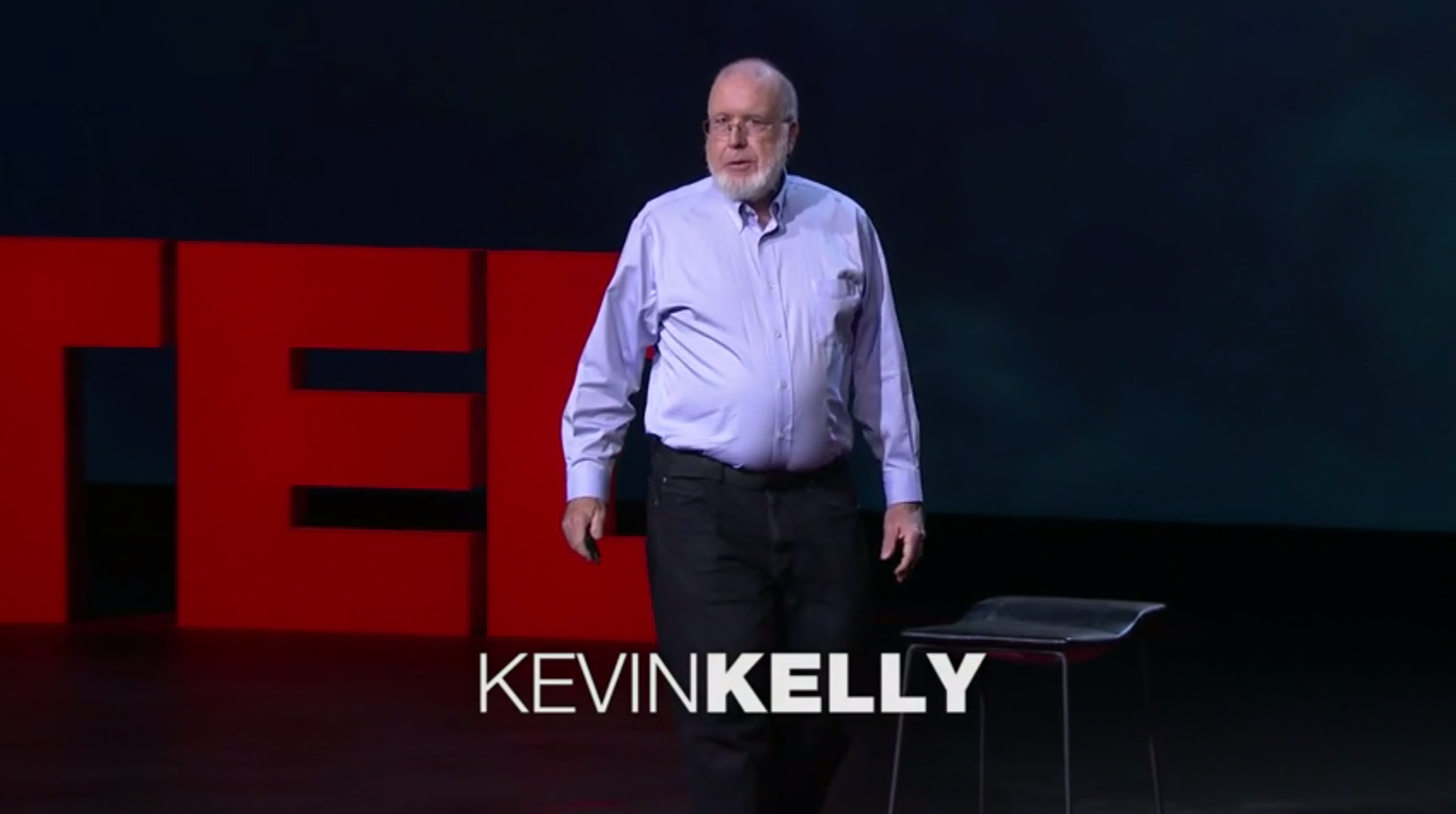 Digital sherpa Kevin Kelly says technology is driven by patterns that are surprising but also predictable. That is, while the exact path taken isn’t predictable, where we eventually end up is. And in the decades ahead our machines are going to get smarter and smarter, and this will change the world in very big ways.
 We should all be scared, very scared, of superintelligent AI. In this talk, neuroscientist and philosopher Sam Harris explains why. And one of the reasons could be that we end up making superintellient machines that decide we will make very nice pets (at best) or treat us like an insect infestation (at worst).