
Category: News

  • Splunk Expands Scope of Observability While Lowering Costs

    Splunk Expands Scope of Observability While Lowering Costs

    During its online .conf21 conference Splunk Inc. today revealed a bevy of updates that advance observability while at the same time reducing the total cost of deploying its platforms.

    As part of that effort, Splunk also announced it will now make workload-based pricing available to all customers.
    Previously, a select number of small customers had access to workload-based pricing while other customers licensed Splunk platforms based on how much data was loaded into the platform. That approach, however, tends to discourage IT teams from loading as much of their data as possible.

    CEO Doug Merritt said workload pricing was created to enable a value-oriented pricing model that customers could employ instead of a data-centric model that can discourage IT teams from analyzing as much data as possible to improve IT operations.

    To further lower total costs, the company is also previewing a Flex Index option for customers that choose workload-based pricing to enable longer retention for lower-value data at a lower cost. Splunk is also expanding its cloud storage to include a preview of SmartStore, which allows larger volumes of data to be stored more cost-effectively on Microsoft Azure Cloud initially with support for Amazon Web Services (AWS) and Google Cloud Platform (GCP) forthcoming.

    Other enhancements to the portfolio include a preview of a data manager, a revamped onboarding tool for data stored in Amazon Web Services (AWS) and Microsoft Office 365, and Ingest Actions, which enables IT teams to act on data in motion in addition to data at rest stored in Splunk or the S3 cloud service from AWS.
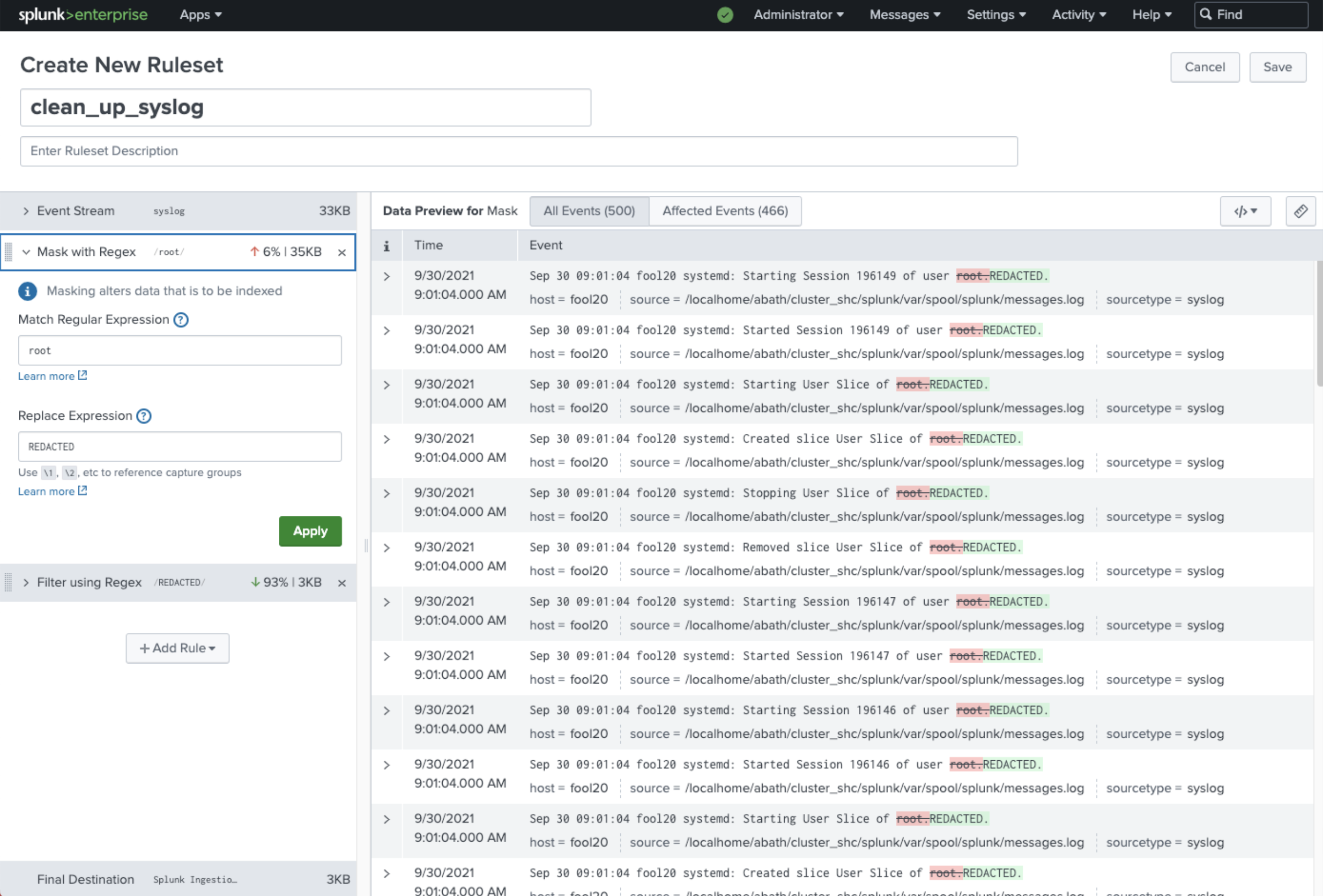
    The company is also now making it easier to find and explore data via a federated search tool and a Splunk Dashboard Studio offering, available via Splunk Mobile, that makes it easier to create dashboards.

    At the same time, the company is also making available Splunk Operator for Kubernetes to make it easier to install its platforms in cloud-native environments. There is also now Splunkbase, a curated catalog that makes it simpler to find or develop a Splunk application.

    In terms of observability, the company is providing a preview of AlwaysOn Profiling for its application performance management (APM) platform, dubbed Splunk APM. AlwaysOn Profiling extends existing tracing capabilities to provide continuous code-level visibility and analysis.

    In addition, there is now a preview of an enhanced version of Database Visibility for Splunk APM, which automatically uncovers slow queries that are causing transaction latency without having to instrument a database.

    The company also announced that its real user monitoring (RUM) for mobile applications, which makes use of open source, now is generally available alongside the Splunk Observability Cloud for Mobile platform. The company also revealed there are previews of integration between Splunk Log Observer and Splunk Enterprise and Splunk Infrastructure Monitoring AutoDetect, a tool that automatically discovers infrastructure anomalies. There are also now additional Content Packs for managing Microsoft365, third-party APM tools and synthetic monitoring.

    Finally, Splunk has expanded its security portfolio to include Splunk SOAR App Editor, which provides a way to edit, test and create security orchestration, automation and remediation (SOAR) applications. There are now more than 350 SOAR apps now available on Splunkbase. The company also launched Splunk Intelligence Management based on a platform it gained with the acquisition of TruSTAR earlier this year and that it is making available security services via a team of experts dubbed SURGe.

    It’s not clear to what degree these additions will enable Splunk to fend off what has become a larger number of rival providers of observability platforms. However, as one of the most widely used IT operations management platforms in the enterprise, it’s clear Splunk enjoys an incumbent leader status it is determined to maintain.

  • Splunk Donates eBPF Telemetry Data Collector to CNCF

    Splunk Donates eBPF Telemetry Data Collector to CNCF

    Splunk Inc. announced during the KubeCon + CloudNativeCon North America conference that it donated a data collector to the OpenTelemetry project run by the Cloud Native Computing Foundation (CNCF).

    Splunk’s data collector runs as a sandbox-level program at the kernel of a Linux operating system and takes advantage of extended Berkeley Packet Filter (eBPF) technology to make it simpler to collect networking telemetry.

    The OpenTelemetry initiative itself spans a range of open source tools, application programming interfaces (APIs) and software development kits (SDKs) that are used to instrument applications. Previously, Splunk contributed the SignalFx Smart Agent and Smart Gateway to the OpenTelemetry project along with more than 64,000 code contributions.

    Morgan McLean, a director of product management for Splunk, said that while OpenTelemetry is officially in beta, some elements of the project are more mature than others. For example, tools for capturing metrics and traces are already being employed, while another set of tools for capturing log data will be ready sometime next year, he said.

    The data collector contributed by Splunk is among the first that operate at the kernel level to collect data, added McLean. That approach makes it possible for some types of data to be captured by default rather than requiring developers to always instrument their applications using agents to enable an observability platform. It will also contribute toward the eventual convergence of network operations and DevOps processes.

    Going forward, DevOps teams should expect to employ a mix of open source data collectors that operate at both the eBPF and application level, said McLean. The eventual goal is to instrument every application by default by making it much simpler to collect data. Today, most DevOps teams are employing a mix of proprietary and open source agent software to collect data that then must be deployed and then integrated with all the applications they build. Given the cost and level of effort required, the percentage of applications that are actually instrumented is, not surprisingly, fairly low.

    However, as agent software becomes more readily accessible, the percentage of applications that are instrumented should increase considerably in the years ahead. For DevOps teams that depend on that data to optimize application performance, that capability should prove to be a boon for improving overall observability in IT environments.

    Observability, in one form or another, has always been a core tenet of any DevOps best practice. Initially, DevOps teams focused on continuous monitoring as the most effective way to proactively manage application environments. However, it can still take days, sometimes weeks, to discover the root cause of an issue.

    Monitoring focuses on predefined metrics to identify when a specific platform or application is performing within expectations. The metrics tracked generally focus on, for example, resource utilization. Observability platforms combine metrics, logs and traces—a specialized form of logging—to instrument applications in a way that makes it simpler to troubleshoot issues without relying on a limited set of predefined metrics focused on a specific process or function.

    Those observability platforms then make it possible to correlate events so that it is easier to identify anomalous behavior indicative of an issue’s root cause. Armed with these insights, it becomes a lot simpler for IT teams to resolve issues faster.

    It’s unclear when OpenTelemetry tools will become more widely employed, but as more tools for collecting data become available, the impact on DevOps will be nothing short of profound.

  • CNCF Adopts Meshery to Advance Service Mesh Management

    CNCF Adopts Meshery to Advance Service Mesh Management

    The Cloud Native Computing Foundation (CNCF) announced this week during the ServiceMeshCon/KubeCon + CloudNativeCon conference that Meshery, a service mesh management plane created by Layer5, has become a sandbox-level project.

    In addition, Layer5 has also donated Service Mesh Performance (SMP), a set of tools for measuring the efficiency of a service mesh, to the CNCF. SMP provides an open source framework to define standardized benchmarking practices, performance test configurations and measurements as part of an effort to create a MeshMark index for rating a service mesh. A set of service mesh performance methodologies will also be published by the IEEE later this month, developed in collaboration with engineers from Layer5, Intel, Red Hat and HashiCorp.

    Layer5 CEO Lee Calcote said the goal is to make it simpler for IT teams to determine which service mesh to employ based on their specific use case requirements.

    Several service mesh platforms are starting to gain traction as a means to both manage application programming interfaces (APIs) and provide a layer of abstraction between lower-level networking and security APIs that makes those services more programmatically accessible to developers.

    Meshery itself is an implementation of SMP and the conformance tool created for the Service Mesh Interface (SMI), a separate CNCF project to promote interoperability between service meshes. Meshery is based on a set of microservices that are designed to make the platform easily extensible.

    That approach makes it possible to manage multiple instances of service meshes that might be deployed on virtual machines as well as Kubernetes clusters using a range of management tools that are part of the Meshery project.

    Meshery supports AWS App Mesh, Citrix Service Mesh, HashiCorp Consul, Istio, Kuma, Linkerd, Network Service Mesh, NGINX Service Mesh, Open Service Mesh and Traefik Mesh. Meshery also provides IT teams with more than 60+ best practices in the form of templates that can be used to deploy a service mesh.

    It’s still early days as far as adoption of service mesh in the enterprise is concerned. Most IT teams still rely on either proxy software or a gateway to manage APIs. However, as the number of APIs that need to be managed steadily increases, it won’t be long before many IT teams start to at least evaluate a service mesh.

    In the longer term, the impact those service meshes are likely to have on the management of IT could be profound. It is becoming apparent that a service mesh also provides a higher level of abstraction for invoking networking and security services. In fact, the service mesh may wind up playing a key role in driving the convergence of network and security operations with DevOps best practices.

    In the meantime, IT teams will need to decide to what degree they may want to standardize on a single service mesh versus letting individual teams implement their own preferred platform that could one day be centrally managed via Mashery. One way or another, the way APIs are managed and invoked will soon fundamentally change forever.

  • Techstrong Research Bolsters Focus on Business Value and Outcomes of Disruptive Technologies with Addition of Hurwitz & Associates

    Judith Hurwitz, Daniel Kirsch and company bring extensive experience in technology and market research, management and strategy consulting, business and go-to-market planning to Techstrong Group business unit

    Boca Raton, Fla. — October 13, 2021 — Techstrong Group, the power source for people and technology, announced today that Hurwitz & Associates will join Techstrong Research. The Hurwitz & Associates team, led by Judith Hurwitz and Daniel Kirsch, will join Mitchell Ashley in leading the firm. Hurwitz will serve as president and Kirsch will serve as managing director of Techstrong Research. Ashley will continue as a principal of Techstrong Research, as well as CTO of Techstrong Group. The combined team brings deep technical and business expertise to guide business leaders, technology providers, entrepreneurs and investors on the business value of emerging technologies.

    Techstrong Research is the go-to source for unbiased information, insights and connections that help IT professionals understand new technologies. The Techstrong Research team brings deep knowledge about today’s leading technologies with insights and actionable strategies for DevOps, cloud, IT management, security/governance, AI and data initiatives. It offers a holistic business perspective essential for IT leaders and practitioners to adapt and thrive in the digital economy.

    “I have worked with Judith and the Hurwitz & Associates team for decades with tremendous success,” said Andy Palmer, co-founder, chairman and CEO at Tamr Inc. and co-founder, Koa Labs. “I am looking forward to the potential of this important next-generation research and analyst firm created by the combination of Hurwitz & Associates and Techstrong Research.”

    Founded in 1996, Hurwitz & Associates brings industry longevity, experience and credibility earned by working with hundreds of enterprise customers and publishing numerous books and research reports.

    Prior to joining Techstrong Research, Hurwitz was president and CEO of Hurwitz & Associates. A pioneer in anticipating technology innovation and adoption, she served as a trusted advisor to many industry leaders. Hurwitz has helped clients transition to business models focused on the business value of emerging technologies. She is a frequent speaker at industry events and is the co-author of 10 books, including Augmented Intelligence: The Business Power of Human–Machine Collaboration, Cognitive Computing and Big Data Analytics and Smart or Lucky: How Technology Leaders Turn Chance into Success. She serves on the College of Arts and Sciences Dean’s Advisory Board at Boston University. She also serves on several technology advisory boards, was a recipient of the 2005 Massachusetts Technology Leadership Council award and was named a distinguished alumnus by Boston University’s College of Arts and Sciences in 2005.

    “I am very excited to join Techstrong Research and to collaborate with Dan and Mitchell to create a bold, next-generation research and analyst firm,” said Hurwitz. “Our ability to couple research and analysis with the reach of Techstrong Group platforms, audiences, events and membership will give us significant differentiation in the market.”

    Kirsch will serve as managing director and co-founder of Techstrong Research, working with clients on their strategy to develop, market and partner in disruptive technologies, including AI, cloud and security. At Hurwitz & Associates, Dan was managing director. He was a trusted advisor to large and mid-size IT vendors, providing them with market perspective and aligning strategy with customer requirements. His research focused on how compliance, governance, security and privacy are impacting the software industry and customer requirements. Kirsch is also co-author of Augmented Intelligence: The Business Power of Human–Machine Collaboration, Big Data for Dummies, Cloud Computing for Dummies and Hybrid Cloud for Dummies. Kirsch has a JD from Boston College Law School where he focused on corporate law, emerging corporations and intellectual property. As an attorney, Dan represented startups, cloud computing ventures and companies going through second-round financing.

    “In addition to our unique differentiators, Techstrong Group amplifies our clients’ messages and our research to help reach a curated audience,” added Kirsch.

    “I am thrilled to have Judith and Dan join Techstrong Research,” said Ashley. “Their deep experience and skill in helping clients focus on the business outcome potential of emerging and disruptive technologies will help our clients accelerate value from their technology investments.”

    “In my time as CMO for IBM’s software, cloud and AI businesses, I worked closely with the Hurwitz & Associates team. They provided our organization with clear customer-focused positioning, collateral and insight for our go to market strategy,” said Buell Duncan, technology and marketing executive/senior advisory board member. “Their knowledge of the market, including competitors’ strengths and weaknesses, is invaluable. Hurwitz & Associates analysts are natural storytellers who understand the world from the customer’s perspective and the problems they are trying to solve. This team helped translate the value of IBM solutions into impactful business outcomes for our clients.”

    Techstrong Research is an integrated Techstrong Group business along with Techstrong Media, Techstrong Associations, Techstrong Learning and Techstrong Live!. This gives Techstrong Research a unique advantage over other analyst firms as Techstrong Group is the go-to resource for millions of software development, delivery and security professionals to inform research, validate messages and customize research engagements.

    “The market moves fast and keeping up requires data. I’ve worked with Techstrong Research analysts for years, and the only thing I value more than the quality of their research and deliverables is their partnership in helping us identify the right questions to ask,” said Sam Fell, vice-president, product marketing, Sumo Logic. “This new combination of the former Accelerated Strategies Group and Hurwitz & Associates brings together powerful resources and very experienced, senior analysts.”

    Additional Resources

    About Techstrong Research

    Techstrong Research accelerates the adoption of disruptive technologies that drive business outcomes and provide actionable strategies in rapidly changing markets. We are the only organization serving the needs of IT leaders, practitioners and the industry ecosystem with research, analysis, content, events and education. We bring deep knowledge about today’s leading technologies such as DevOps, cloud, data and AI/ML, security/governance initiatives and supporting infrastructure. We offer our customers a holistic business perspective essential to adapt and thrive in the digital economy. The Techstrong Research team has the knowledge, experience and credibility earned by working with hundreds of businesses across many industries to provide consulting, thought leadership and research.

    Media Contact
    Jeremy Douglas
    Catapult
    jdouglas@catapultpr-ir.com

  • LF Networking (LFN) Adds to Open Source Portfolio

    LF Networking (LFN) Adds to Open Source Portfolio

    At the online Open Networking & Edge Summit + Kubernetes on Edge Day event LF Networking (LFN), an arm of the Linux Foundation focused on networking, today added several projects that promise to make it simpler to programmatically manage networking services based on open source software.

    Walmart is contributing a L3AF project for managing network applications that make use of an extended Berkeley Packet Filter (eBPF) capability that allows applications to run in a sandbox at the microkernel level of an operating system. Intel and Aarna Networks, meanwhile, are donating the seed code from an EMCO project that provides a universal control plane to securely connect and deploy workloads across distributed computing environments that span everything from the edge to the cloud.

    Arpit Joshipura, general manager for networking, edge and internet of things (IoT) for the Linux Foundation, said the L3AF project adds a control plane for managing those applications to the LFN portfolio that addresses load balancing, rate limiting, traffic mirroring, flow exporter, packet manipulation, performance tuning and other management tasks. Earlier this year, the Linux Foundation set up a separate eBPF Foundation to further advance development and adoption of eBPF across multiple operating systems.

    At the same time, LFN also revealed today that Project Alvarium, a tool for measuring how well data is being delivered to devices that was originally created by Dell, and eKuiper, an existing open source lightweight IoT data analytics and streaming platform, are now part of the LF EDGE portfolio of projects.

    Finally, an open source mobile edge computing project, dubbed Edge Gallery, that was originally created by Huawei has been contributed to the Linux Foundation.

    Joshipura said the LFN continues to gain momentum as more vendors contribute core technologies that, ultimately, don’t provide them with enough differentiated value to continue to develop on their own. The LFN today also revealed that VMware and F5 Networks have joined the LF EDGE consortium as premier members, while mimik and Veena, Inc. have become general members of LFN and the Eclipse Foundation has become an associate member.

    The LFN also provides a mechanism that promotes adoption of those technologies more widely than any one vendor can achieve on its own. The total cost of delivering next-generation edge computing platforms based on wireless 5G networks will also be sharply reduced as LFN projects continue to mature, said Joshipura.

    In general, the rate at which various LFN projects are updated continues to accelerate, said Joshipura. The Akraino project for creating blueprints for edge computing platforms recently delivered its fifth update to address use cases involving smart cities, cloud-native multi-tenant environments and vehicular networks. An EdgeX Foundry project for IoT platforms, meanwhile, recently revamped its application programming interfaces (APIs) to make them more secure and enable more message-based communications. The Home Edge project will also soon issue a Drewberries update that will address code stabilization, scripting, APIs, data synchronization and security.

    It’s now only a matter of time before these LFN projects become more integrated with DevOps workflows as IT teams seek to give developers more programmatic control over network services. The issue now is deciding not so much whether to integrate network operations and DevOps teams but rather determining to what degree those teams will need to fold into each other.

  • Snyk Extends Tools Portfolio to Drive DevSecOps Adoption

    Snyk Extends Tools Portfolio to Drive DevSecOps Adoption

    During its online SnykCon 2021 conference this week, Snyk extended Snyk Code, a static application security testing (SAST) tool that already supports the Java, JavaScript and Python programming languages to include support for C#, Ruby, PHP and Go.

    At the same time, Snyk Open Source, a platform for remediating open source vulnerabilities, has been extended to provide native integration with Atlassian BitBucket and AWS CodePipeline platforms for driving DevOps workflows. Snyk has also tightened integrations with platforms from DigitalOcean and HashiCorp.

    Snyk also added support for the Elixir programming language and package managers Yarn 2 and Poetry alongside integration with a C++ scanning tool from FossilID, a provider of a software composition analysis (SCA) tool for open source code that Snyk acquired earlier this year.

    The Snyk Container platform is now integrated with the open source Trivy container scanning tools and with Snyk’s vulnerability database in addition to adding support for container registries such as Quay, GitHub Container Registry, GitLab, Google Artifact Registry and Harbor.

    The Snyk infrastructure-as-code platform now also makes it possible to detect configuration issues in Kubernetes manifests in Terraform code in a way that is compatible with cloud platforms from Amazon Web Services (AWS), Microsoft Azure and Google Cloud Platform (GCP).

    Snyk also is adding support for version 3 of OpenAPI, which the company reports is three times faster than the previous version. That API is also the foundation for Snyk Apps that the company will continue to roll out.

    Finally, Snyk launched both a new free developer security education program, dubbed Snyk Learn, through which developers can attain and measure their level of DevSecOps expertise and Snyk Impact, an effort to foster collaboration among developers involving a wide range of socio-economic issues.

    Company president Guy Podjamy said as DevsecOps continues to evolve, the primary focus remains on developers and DevOps teams. However, as an issue, DevSecOps is also becoming more important at both the C-level within organizations as well as individual security operations teams. As such, and in the wake of recent high-profile security breaches, the sense of urgency surrounding DevSecOps is now a lot higher. The fundamental challenge organizations are trying to address is finding a way to improve overall application security without slowing down the pace at which applications are built, noted Podjamy.

    Snyk itself revealed it has secured an additional $530 million round of funding to address those issues. The company has now raised a total of $775 million to date with a valuation of $8.5 billion. Snyk also revealed it has increased annual recurring revenue (ARR) by 154% year-over-year from a customer base that now spans more than 1,200 organizations, including Asurion, Google, Intuit, MongoDB, New Relic, Revolut and Salesforce. Snyk customers and users collectively have run more than 300 million tests in the last 12 months to fix more than 30 million vulnerabilities in a 90-day period of time, the company claims.

    It may be a while before most organizations have embedded security tools within every DevOps workflow. However, given the resources being poured into DevSecOps, it may be more a question when DevSecOps will be finally achieved rather than if.

  • BMC Acquires StreamWeaver to Advance AIOps Strategy

    BMC Acquires StreamWeaver to Advance AIOps Strategy

    BMC has acquired StreamWeaver, a provider of a platform that makes it simpler to capture streaming data in real-time, as part of an effort to extend the BMC Helix IT operations platform infused with artificial intelligence (AIOps). Financial terms of the transaction were not disclosed.

    Margaret Lee, general manager and senior vice president for digital service and operations management for BMC, said StreamWeaver brings with it a wide range of integrations with multiple data sources that BMC will use to both train AI models and improve overall observability. While connecting to data sources is relatively straightforward, the challenge now is collecting that data in real-time in a way that is easily repeatable for IT operations teams, noted Lee.

    In general, AIOps continues to gain traction as IT environments become increasingly complex. Most IT operations teams are not going to be able to manage highly distributed computing environments without augmenting their IT staff with some AI, said Lee.

    Naturally, many rote tasks that were once performed manually by IT operations professionals will become increasingly automated. However, there will always be a need for IT personnel, noted Lee.

    Arguably, there may come a day when IT professionals will not want to work for organizations that don’t have an AIOps platform in place simply because the tasks assigned to them would otherwise be considered archaic, especially if they involve a series of tedious tasks that not many IT professionals really want to perform.

    At the same time, AIOps should reduce overall risk by making it easier for IT operations teams to proactively identify issues before they disrupt an application service. That’s especially critical as IT environments—increasingly with microservices-based applications constructed using containers—and serverless computing frameworks are being deployed with greater frequency alongside legacy monolithic applications.

    BMC has been making a case for AIOps as far back as 2017. However, since then, a wave of startups and IT operations incumbents have either built an AIOps platform from the ground up or updated an existing platform with AI capabilities. It’s difficult to assess which vendors are now ahead in terms of the AIOps race, but one thing that is certain is that IT organizations now have plenty of options.

    From a cultural perspective, however, not every organization is entirely comfortable with AIOps. While some IT professionals remain skeptical, others view AI as an existential threat to their existence. Most IT teams are also concerned about the potential impact any flawed AI model might have on IT operations—it’s one thing for a human to make a mistake, but an AI model making a mistake at scale could be catastrophic.

    There are few IT organizations that are embracing AIOps across the board, but most do recognize that AIOps platforms, in one form or another, are inevitably here to stay. After all, machine learning algorithms never forget anything they learn. Nor do they ever take a day off or decide to leave when offered higher pay. The challenge is figuring out exactly where the interface between IT staff and algorithms is going to be—not just today, but also in the near future.

  • Verica Launches Database for Sharing IT Incident Reports

    Verica Launches Database for Sharing IT Incident Reports

    Verica, a provider of an incident management platform, announced this week it is making available a database to make incident reports publicly available via a single repository.

    Courtney Nash, senior research analyst at Verica, said the Verica Open Incident Database (VOID) initiative is part of an effort to enable organizations to learn from outages and failures caused by software. Today, reports about such incidents tend to be difficult to find because they are scattered all across the internet, she added.

    That lack of transparency makes it difficult to compare and contrast incidents in a way that surfaces meaningful insights, noted Nash.

    Launch partners for the VOID include Indeed, NS1, Adaptive Capacity Labs, Security Scorecard and Auxon. Each will provide support to help fund the development, research and dissemination of knowledge generated by the project.

    The VOID contains more than just standard company postmortems or status updates, added Nash. Verica is committed to applying metadata to better understand how individuals, companies, media and others reacted during an incident.

    One early finding already derived from this initiative is that mean-time-to-resolve (MTTR) is proving to be an inaccurate metric due to the varied distribution of incident data. Other findings include the fact that only one-quarter of incident reports took the time to identify the root cause of an issue, while less than 1% took the time to study incident reports of near-misses.

    In general, there’s now more riding on the performance and availability of IT environments than ever. Digital business transformation became all the rage in the wake of the economic downturn brought on by the COVD-19 pandemic. As the economy continues to recover, businesses now expect IT to respond and pivot to changing conditions no matter how sudden.

    DevOps teams have, of course, learned to expect the unexpected by embracing modern incident management based on DevOps best practices that enable IT teams to adroitly respond to any outage or sudden degradation in application performance. The most important thing to remember about incident management is that practice makes perfect. While practice runs may never precisely mirror an actual crisis, organizations that have processes that are well-known by their IT incident teams and that practice ‘fire drills’ tend to respond both faster and better. After all, the more muscle memory there is to call on the more resilient the organization will be.

    It’s not clear to what degree IT organizations will be willing to share incident reports. However, there is an opportunity for IT professionals to come together that is similar to how engineers from different airlines collaborated to make flying safer for the general public, said Nash. In fact, with so many processes now dependent on software, it’s amazing there have not been more catastrophic events due to software issues. It’s even arguable that it’s only a matter of time before such levels of collaboration are mandated.

    In the meantime, the first step toward achieving that goal may simply be sharing a report with colleagues so they can learn from previous mistakes.

  • Perforce Charts Testing Course After BlazeMeter Acquisition

    Perforce Charts Testing Course After BlazeMeter Acquisition

    Perforce Software has acquired BlazeMeter from Broadcom as part of an effort to extend the scope of its testing tools beyond the Perfecto tools for testing mobile and web applications it acquired in 2018.

    Broadcom gained control over BlazeMeter after it acquired CA Technologies in 2018. CA Technologies acquired BlazeMeter in 2016. Terms of the latest acquisition involving BlazeMeter were not disclosed.

    Tim Russell, chief product officer for Perforce, said BlazeMeter adds a complete platform that spans everything from load and performance testing to application programming interface (API) testing. The goal is to enable DevOps teams to push continuous testing further left as part of an effort to accelerate the development and deployment of applications, added Russell.

    The need for continuous testing has become more pronounced as more organizations launch multiple digital business transformation initiatives, noted Russell. The real challenge will be finding ways to embed continuous testing within DevOps processes at a sufficient level of scale, added Russell.

    In fact, the quality of the digital experience those applications provide ultimately determines the degree to which those efforts are likely to succeed, which Russell noted is why so many enterprise IT organizations are reengineering their application testing processes.

    In general, organizations are taking two paths to shift testing further left. Some are giving application performance testing tools to developers to employ during DevOps sprints while others are trying to bring application testers into the application development process earlier. In some cases, organizations are doing both as part of a comprehensive effort to discover issues before applications are deployed in a production environment. Those issue are naturally more expensive to fix after an application has been deployed.

    Perforce, for now, expects to continue to make BlazeMeter and Perfecto available as a set of complementary cloud-based services with some cross-pollination of capabilities occurring over time, said Russell.

    In the longer term, it’s apparent that more artificial intelligence (AI)-based analytics will be embedded within cloud-based platforms that can collect enough data to build meaningful models of development processes. IT teams should also expect to see testing tools make greater use of computer vision algorithms to surface issues.

    One away or another, the entire application testing process is about to become a lot more automated as more organizations are simultaneously building multiple applications. That may not necessarily reduce the need for either a developer or tester to create and manage that process, but it does mean the amount of testing time required for each application should continue to steadily decline in the months and years ahead.

    Hopefully, all that effort will lead to better application experiences being provided to end users more consistently. There is nothing quite as frustrating for any application development team than to discover that 90% of the functionality of an application is not being used because end users are not able to easily surface it. Worse yet, of course, is when an application turns out to be too slow once it is deployed. In either case, it’s difficult to regain that initial end-user enthusiasm for any new application experience after it’s been lost, simply because no one thought through all the use cases that should have been tested much earlier in the application development life cycle.

  • Welcome to Techstrong Group

    Welcome to Techstrong Group

    Today is a big day in the neighborhood. What neighborhood, you ask? If you are involved in DevOps, cloud-native, cybersecurity or digital transformation, you are in that neighborhood. Today we launch Techstrong Group. Techstrong Group is a combination of all the companies I have been involved in within this neighborhood. It represents the greatest breadth of brands, services, content and tools to help those in our neighborhood. It is the power source for people and technology.

    The combination of MediaOps—the people behind DevOps.com, Security Boulevard, Container Journal, Techstrong TV and more—along with the DevOps Institute, Accelerated Strategies Group and Prospera Events makes Techstrong Group the most comprehensive provider of thought leadership and information to people and companies in our field.

    Techstrong Group also represents the coming together of everything I have worked on over the last eight years. When I launched DevOps.com back in 2013, I knew we were at a pivotal point in technology adoption. The internet had changed the world, but another transformation was coming. This digital transformation didn’t start with the COVID-19 pandemic, but it illuminated the fact that if you weren’t transforming digitally, it would be difficult—if not impossible—to thrive in this new normal.

    This belief that DevOps would be a catalyst in changing the world was shared with me by Jayne Groll, one of my co-founders at DevOps Institute and now my co-founder at Techstrong Group. Over the last six or seven years, Jayne has worked tirelessly to help the “Humans of DevOps” and now will continue that mission as Chief Strategy Officer at Techstrong Group.

    Along the way, I have had a chance to meet and work with some tremendous people. My longtime friend Mitchell Ashley, who was a co-founder at StillSecure with me (along with Rajat Bhargava, who founded StillSecure), founded Accelerated Strategies Group. He is now CTO of Techstrong Group, as well as principal at Techstrong Research, which is where the Accelerated Strategies Group business will operate (more about that in a moment).

    Sean Lowery, another friend who founded and runs Prospera Events, the people behind the InnoTech conferences for more than a dozen years, has also joined Techstrong Group, in our Techstrong Live events business unit. We are excited to have Sean and the whole Prospera team as part of Techstrong Group and officially welcome them to the family.

    I would be remiss if I didn’t mention some other important people in the Techstrong Group team. Parker Yates, our Chief Revenue Officer, has been in this adventure with me since day one. Andre Pino, who joined us from CloudBees, heads up our marketing and operations team as Chief Marketing Officer. He is assisted by Heidi Gilmore who as VP of Marketing has really cranked up our marketing efforts. Charlene O’Hanlon, who started with me at MediaOps more than five years ago as a contract editor, is now Chief Content Officer. Marc Halcrow, who has helped Jayne make DevOps Institute the market leader it is, is now our SVP of Corporate Development and Strategic Partnerships. Finally, our newest executive member, Jason Baum, heads up our Techstrong Association and membership efforts.

    Of course, these are just the executive team members. Techstrong Group is more than 50 people strong with dozens of other contributors. We are grateful for every one of them, who have made what we do possible.

    But none of this would be possible without you. We believe we serve today’s “Masters of the Universe,” the people who are making our digital world possible. The worlds of DevOps, cloud-native, cybersecurity, which are all part of digital transformation, are remaking the world before our eyes. We know you; we believe we know what you want and how we can help.

    It is critical for technology professionals at all levels to understand how technology can improve business processes, revenue, profitability and customer satisfaction. Techstrong Group’s goal is to create a place where technology leaders and practitioners gather to exchange ideas and continually learn, grow and succeed.

    To help with this mission, we have organized into several distinct business units:

    •     Techstrong Media: The business unit with most of the existing MediaOps brands—DevOps.com, Container Journal, Security Boulevard and Techstrong TV.
    •     Techstrong Associations: The business unit comprised of DevOps Institute and the Humans of DevOps association.
    •     Techstrong Research: Our analyst and research business, which includes Accelerated Strategies Group.
    •     Techstrong Live: Our events-focused business unit, which produces both in-person and virtual events.
    •     Techstrong Education: You will be hearing more about Techstrong Education in the coming weeks and months.

    Over the coming weeks and months, you will see more of the full Techstrong Group vision roll out. I hope you find it compelling and will entrust us with the greatest gift you can give: your time. We value you and your time; we know our mission and will continue to try and make sure we live up to our tagline, “The power source for people and technology.”

    So, welcome to Techstrong Group. We don’t view today as the culmination of our story; rather, it is the end of our prologue. Now the true adventure begins. Strap in: The world is an exciting place right now and we want to help you get the most out of it.